




Abstract
This article introduces a theoretical model of projects in motivated behavior. It begins with the discussion of two theoretical traditions that conceived a project as either an anticipation of action or a set of actions aimed at the same goals. The limitations of both traditions are discussed, and a project is then conceived as an integration of internal processes and actions. Next, a theoretical model of projects is presented, comprising cognitive, motivational, volitional, emotional, and behavioral components. A framework interrelating the different components of the model is presented. Considering the framework introduced, a project is then defined as a process comprising the formation, enactment, and maintenance of intentional structures and actions. The definition is comprehensive because it integrates both the previous theoretical traditions of the project in order to overcome the limitations of both. The applications of the new approach in existential theories and management sciences are discussed.
The term project has been extensively used in different contexts and fields of knowledge. Lawyers commonly discuss law projects, whereas architects often design projects for houses. Particularly in the human sciences, the term has been frequently referred to as a component of motivated behavior. For instance, in career counseling, a practitioner helps the client construct a life project. Even though widely used, the definition of the term project is still controversial. On the one hand, some approaches mostly describe projects as internal processes preceding actions, and end up conceiving action as a component that is independent from projects. On the other hand, there are approaches that define projects as a set of mid- to long-term actions, in which internal processes are conceived as mere components of action. Even though the two approaches brought about great contributions to the project literature, both are grounded in restricted definitions of a project that focus on either internal processes or actions. An approach to projects as a concept integrating both internal processes and actions would be beneficial due to its greater comprehensiveness regarding human motivation.
This article introduces a theoretical model of projects in motivated behavior. It begins with a discussion of the two theoretical traditions that conceived a project as either a process preceding action or a set of actions aimed at the same goals. We discuss the limitations of both traditions and thus agree with the definition of a project as an integration of internal processes and actions. Next, we present a theoretical model of projects comprising cognitive, motivational, volitional, emotional, and behavioral components. Rather than only introducing these components, our model presents a framework stating the interrelation between them. Grounded in the theoretical model, a new comprehensive definition of a project in motivated behavior is introduced. We conclude by illustrating our approach in two distinct fields—that is, in existential theories and the project management literature.
Theoretical traditions of projects in motivated behavior
The notion of a project has been used in the context of motivated behavior either as an anticipation of action or a set of actions aimed at the same goals. One of the main exponents of the former is Schutz (1953/1962), who described a project as the “anticipation of future conduct by way of phantasying” (p. 20). According to Schutz, a project is a condition for action. He referred to “voluntative fiat” (a term that he borrowed from William James) as an inner command that turns a project into a purpose and, subsequently, into actions. Like Schutz, Nuttin (1980/1984) also conceived a project as preceding action, yet not as a process but as a cognitive representation. According to Nuttin, a project is a programmed sequence of steps toward a goal. Lastly, Boutinet (1992) conceived projects as operational anticipations by means of which one seeks to bring about one’s desired future.
The main exponents of the second tradition are Little and Young. Little (2007) defined personal projects as “extended sets of personally salient action in context” (p. 25). Thus, whereas the first tradition conceived a project as a process or representation prior to action, Little (2007) considered a project as a set of interrelated actions. In this regard, the internal processes described by the first tradition are mere cognitive, motivational, volitional, and emotional components of action. Likewise, Young et al. (2002) developed the contextual action theory, according to which action is a process comprising manifest behavior and internal processes. Subsuming action, a project is “a goal-directed mid-term process comprising individual and group actions” (Domene et al., 2015, p. 154).
Both traditions offer restricted definitions of a project. By conceiving a project as an anticipation of motivated behavior, the first tradition barely distinguishes a project from other related concepts, such as intentions or plans. The second tradition ascribes reduced importance to the internal processes of action and thus conceives a project solely as the actions from a mid- to long-term perspective. This strongly contrasts with the first tradition, according to which a project is related to each and every action, from the most trivial to the most complex. In our view, a project comprises both internal processes and actions from a short- to long-term perspective. This conception is in line with Sartrean ontology, according to which a project refers to choosing a way of being and is expressed by action in the light of a future end (Barnes, 1978). According to Sartre (1943/1978), a project represents the means through which consciousness concentrates on bringing a future end into being, which forms a hierarchical chain of concurrent and consecutive projects. As voiced by Sartre (1943/1978): We discover ourselves then in a world peopled with demands, in the heart of projects “in the course of realization”: I write. I am going to smoke. I have an appointment this evening with Pierre. I must not forget to reply to Simon. I do not have the right to conceal the truth any longer from Claude. All these trivial passive expectations of the real, all these commonplace, everyday values, derive their meaning from an original projection of myself which stands as my choice of myself in the world. (p. 39)
Years later, Sartre (1957/1963) developed a dialectic framework in which a project is defined as the transition from one objective situation toward another. First, a project starts with the internalization of the first objective situation, which is titled “the given.” Next, the given turns into a subjective experience, in which one elects a being to bring about by means of action. This being becomes the end of one’s action, which in turn changes the environment. A new objective situation then arises, which is the starting point of a new project. Therefore, a project is “the moving unity of subjectivity and objectivity” (Sartre, 1957/1963, p. 97), a sort of structure encompassing one’s will, actions, needs, and thoughts.
In the next section, we briefly introduce a theoretical model stating the relationships between internal processes and actions throughout the construction and implementation of projects. Figure 1 graphically represents our model. Rather than reintroducing Sartrean ontology or dialectics, we describe these processes in the light of psychological terminology, which somehow conflicts with Sartrean ontology. Our model is also based on the relational theory of dynamic behavior (Nuttin, 1980/1984) and action control theory (Kuhl, 1984). Even though Nuttin (1980/1984) presented a restricted definition of a project, he created a framework of motivated behavior that describes the different processes that are interwoven while a project is formulated and implemented. Action control theory, in turn, grounded our notion of self-regulatory processes mediating the relations between intention and action.
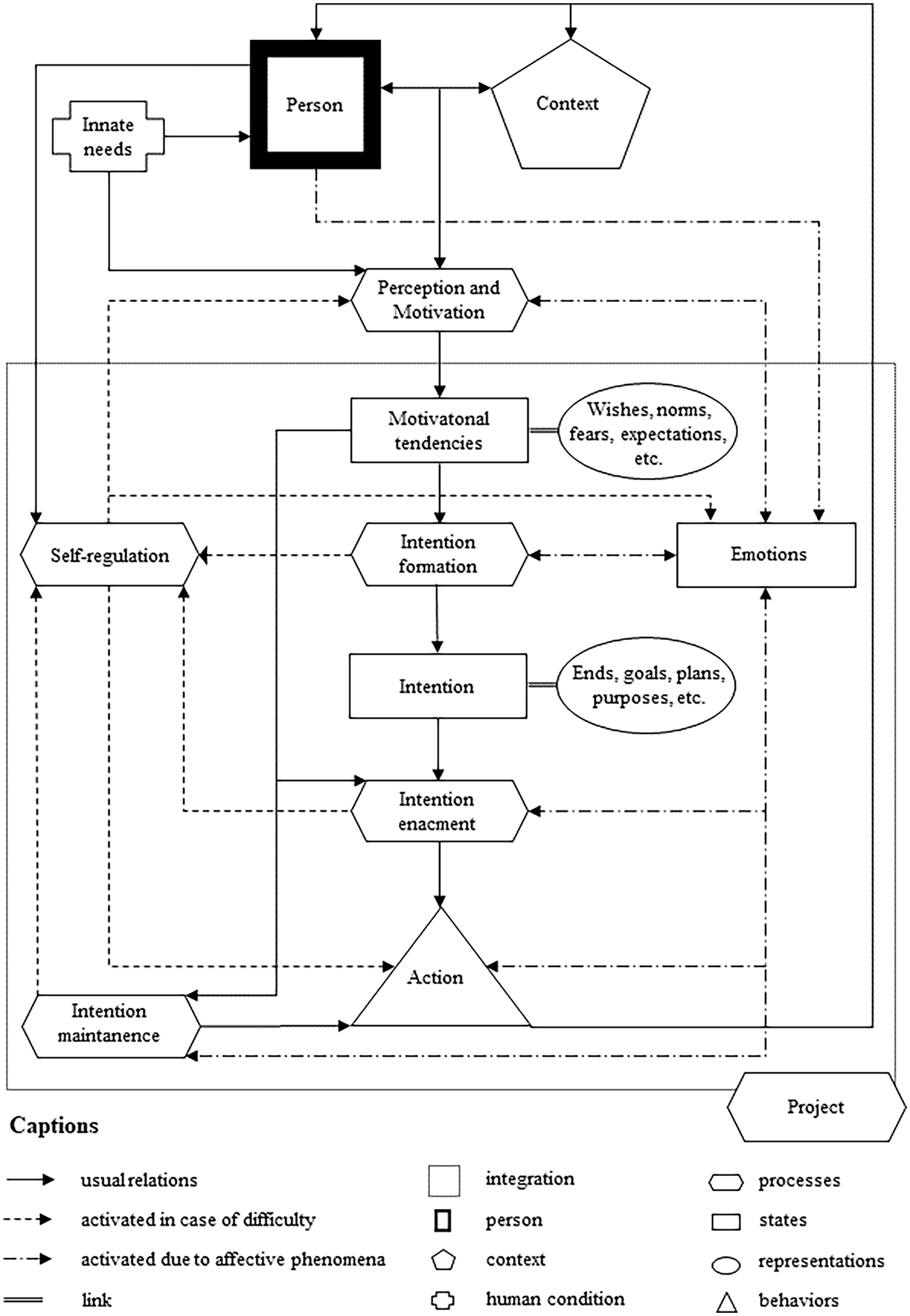
Model of project in motivated behavior.
The rise of the behavioral world and motivational tendencies
A project starts from the continuous relationships of a person in a context by means of which perceptual processes take place. By getting in touch with the context, a person perceives the physical reality in a very particular way, which depends not only on information processing at the sensory level, but also on a set of symbolic references. Therefore, even though we are referring to perception, other cognitive processes are interwoven in this task, such as memory, attention, and prediction. These cognitive functions allow a person to grasp the social and physical reality, and transform it into a meaningful situation (Nuttin, 1980/1984). In Sartrean dialectics, this is described as the subjective internalization of the objective situation (Sartre, 1957/1963). In Nuttin’s (1980/1984) theory, the perceived meaningful situation is named the behavioral world.
Grasping reality is also influenced by motivation, which is conceived by Nuttin (1980/1984) as “a continuous dynamic orientation that regulates the ongoing interaction between the individual and his behavioral world” (p. 75). As a person interacts with the context, motivational tendencies arise and the “required” relationships between the person and the context are set. Nuttin (1980/1984) referred to these required relationships as needs, and to their concrete manifestations in specific situations as motives. These needs aim at the organism’s optimal functioning, following both innate and developed standards. Innate standards describe physiological needs (such as thirst) and some general psychological needs (such as autonomy), which may assume very different manifestations throughout a person’s life. Developed standards represent the various shapes assumed by these innate standards—that is, the particular way that the innate needs are transformed in the life of everyone.
The person–context unit
The physical and historical-cultural world is the basis for the behavioral world, yet it does not determine it. This is particularly evident when one notes that the same objective situation may be perceived in a wide range of ways. For example, two women are running in the woods and suddenly it starts raining. One of the women may decide to go back home, as she is bothered by the rain, whereas the other may keep on running, as she assumes it to be a challenge. These two different reactions underline that perceptions of a context are subjectively internalized. What made one of the athletes confront the rain, in contrast to the other, is her particular way of perceiving the environment according to her current biographical situation. For instance, she may have assumed the rain to be a challenge because she has always been encouraged by her mother to go beyond her limits.
According to Sartre (1957/1963), human beings are not passive products determined by circumstances. Rather, they are active producers of the environment, acting on and changing their surroundings. By stating this, Sartre did not assume a fallacious neoliberal principle, according to which one may achieve whatever one wants. The material condition of human lives does affect and limit human choices and actions. Hence, Sartre (1957/1963) posited that humans are “characterized above all by [their] going beyond a situation, and by what [they] succeed in making of what [they have] been made” (p. 91)—that is, human beings act on a material condition that does not determine, albeit limits, their actions.
The Sartrean dialectics is in line with Nuttin’s motivational theory, according to which the person and the context form a situational unit that may only be didactically divided. Throughout a person’s life, persistent patterns of motivational tendencies arise from the relationships between the person and the context. According to Nuttin (1980/1984), these patterns comprise the relational aspect of personality. Several terms have been coined to describe this relational aspect of personality, such as “interests” (Holland, 1959), “personal strivings” (Emmons, 1989), “life themes” (Csikszentmihalyi & Beattie, 1979), and “fundamental project” (Sartre, 1943/1978). These terms refer to different levels of analysis of personality (McAdams, 2008), yet they all describe the tendency of individuals to be driven toward certain categories of objects, to the detriment of others.
Even though the arousal of motivational tendencies is influenced by features of the self, a project still contains within it the objective situation that it seeks to overcome (Sartre, 1957/1963). As much as one acknowledges a wish as personal, this wish is potentially shared with other members of the same cultural group (Velho, 1994/1999). For instance, most individuals from modern cultures refer to long-term projects related to work, family, and education. We are not assuming a social constructionist perspective that denies human agency. We do, however, agree that reality is socially constructed, yet, for reality to exist, it must be lived to some extent as a personal experience. Hence, our perspective shares the assumptions of social constructivism (rather than social constructionism), according to which individuals construct reality via cognitive processes grounded in social relationships (Young & Collin, 2004). In Figure 1, this is represented by a double arrow connecting the person and the context. The person–context unit leads to perceptual and motivational processes that, in turn, are responsible for the rise of motivational tendencies.
Types of motivational tendencies
Different theories have described several types of motivational tendencies that arise during the interactions between a person and a context. The expectancy–value theory (Atkinson, 1964) referred to two types of states: values and expectancies. Values pertain to the importance and relevance ascribed to a future state of affairs. Expectancy entails subjective confidence in the accomplishment of an outcome. Nuttin (1987) voiced that expectancy may only be conceived as a motivational tendency if it is related to a valued state of affairs, otherwise it is purely cognitive in nature. He described two types of expectancies without motivational impacts. First, those followed by anticipations with which one is not emotionally involved, such as when a meteorologist expects a sunny day. Second, those derived from a passive attitude, whereby one expects something to happen the same way as it has happened before, such as when one turns on a tap and expects water to flow out.
In addition to value and expectancy, several other motivational tendencies have been described. Seginer (2009) underlined control as a motivational component of future orientation—a state of expectancy of the causal attribution of an outcome. Urgency describes the priority of an action with respect to a time limit (Dörnyei & Ottó, 1998). If an action becomes a priority, it sees its importance increased, and thus urgency may be seen as a type of value. Perceived difficulty may be related to value and expectancy (Dörnyei & Ottó, 1998). An individual who likes challenges may ascribe value to a difficult task. Yet, if a task is perceived as difficult, one may lessen the expectancy of success. There are other motivational tendencies described by other theories and, to our knowledge, they all seem to be potentially reduced either to value, expectancy, or both, though each with specific features.
Motivational tendencies are linked to cognitive representations. A value derived from personal preferences is usually represented as a wish (Nuttin, 1980/1984). When the value derives from a social pressure or agreement, it is usually denoted as a norm (Ajzen, 1985). A value may arise not only due to personal or social preferences, but also due to a threat, which embodies a fear (Seginer, 2009). Expectation is the most direct cognitive representation of an expectancy (Coscioni et al., 2020). The list is endless and very often the same term is used to express both states and representations. For example, the term value has also been used to express a moral principle (Inhelder & Piaget, 1955/1958), which is an idea and, therefore, a cognitive representation.
The linguistic overlap between states and representations reflects the inherent complexity of any description of psychological phenomena. When Nuttin (1987) described the psychological instances related to action, he did not refer to states and representations separately. Rather, he acknowledged that motivated behavior occurs through the processing of cognitive–dynamic structures arising in the interactions between the person and the context. In Figure 1, cognitive–dynamic structures are represented by rectangles (states) linked by double lines to ellipses (cognitive representations). Two types of cognitive–dynamic structures are shown in Figure 1. On the one hand, motivational tendencies are shown as linked to wishes, norms, fears, and expectations. On the other, intentions are linked to ends, goals, plans, and purposes. Figure 1 also exhibits a process entitled intention formation, which mediates the transformation of motivational tendencies into intentions.
From motivational tendencies to intentions
When one gets in touch with the context, several motivational tendencies arise simultaneously, with some of them conflicting. Let us consider a person who receives two job offers at the same time. As they are competing tendencies, the person will need to decide between one or the other. The subsequent state of decision-making is an intention, which necessarily implies commitment (Kuhl, 1984). The psychological sense of intention contrasts with its philosophical sense. In philosophy, intention is a relational concept describing a propositional attitude toward an object (Kuhl, 1994). In psychology, intention is a preactional state of motivated behavior (Kuhl, 1984).
As a state, intentions are linked to two types of cognitive representations. First, the representations of objective situations sought by the intention, which correspond, from the most proximal to the most distal level of analysis, to an end, a goal, or a purpose. An end is the representation of the immediate objective situation that an intention aims at. A goal represents objective situations that may not be directly achieved by the current action, such as when a ballerina rehearses for a performance. The end of the rehearsal is to improve her dancing skills, while the goal is to perform properly during the show. Lastly, above ends and goals, a purpose occupies a higher hierarchical position. Even though Schutz (1953/1962) used the term purpose to describe trivial actions and choices, it has been used to portray enduring and meaningful intentions (Damon, 2008). The second type of cognitive representations linked to intentions is plans, which represent the programmed sequence of steps toward an end, goal, or purpose (Nuttin, 1980/1984).
From intentions to actions
Once an intention is admitted, it does not mean that it will be enacted. A “voluntative fiat” must supervene in order to prompt actions. Like Schutz (1953/1962), we borrow the term “voluntative fiat” from James, although we use it with a slightly different meaning. Rather than affirming the transformation of a project into a purpose, a voluntative fiat transforms an intention into an active project. We conceive purpose as a cognitive representation of an intention and, thus, it entails a component of a project rather than its subsequent stage.
The voluntative fiat is represented in Figure 1 as intention enactment. The enactment of intentions is influenced by motivational tendencies, yet the motives interwoven in this process might be different than those regulating intention formation. Kuhl (1984) described the effect of motives in these two stages as choice motivation and effort motivation, respectively. For instance, values and expectancies of success are mostly interwoven during the process of intention formation, whereas expectancies of causal attribution and self-efficacy are mostly motivating effort, and thus action.
Action is defined as an intended behavior (or an enacted intention) that may be either overt or covert. Overt actions, such as walking or talking, take place in the outer world. Conversely, covert actions are cognitive behaviors, such as solving a mathematical problem. In contrast to other theories (e.g., Little, 1983), we do not separate planning and action as different stages of a project. Let us suppose that a man is planning to visit a friend, and thus is thinking about the route he might take. In our view, thinking about the route is an action just as much as taking that route. Additionally, planning may also include overt actions, such as typing an address into an application that gives directions.
Disregarding planning as an action might be related to its linguistic proximity with the term plan, which describes a cognitive representation. Yet, planning comprises actions through which one organizes the means and resources to reach a goal. A potential outcome of planning is the optimization of plans. Thus, we prefer the term organization rather than planning. Even though we may distinguish organization from the subsequent execution, organization is an active phase of a project just as much as the execution phase.
The maintenance of intentions and the hierarchy of projects
The enactment of an intention does not imply that the actions will be continuously taking place until the intended goal is reached. The persistence of actions depends on whether the intention is maintained, which is also influenced by effort motivation. At any time, the intention may be modified or abandoned (Kuhl, 1984). In Figure 1, the arrows from motivational tendencies point not only to intention formation and enactment but also to intention maintenance.
With the enactment and maintenance of intentions, actions modify either the context, the person, or both. At the end of a rehearsal, the ballerina feels more confident about the performance, whereas the dance floor may be slightly more damaged. With the transformation of the person and the context, new motivational tendencies arise, which may provoke the formation of new intentions, as well as the rejection of previous ones. This is represented in Figure 1 by an arrow that leaves from action and reaches both the person and the context.
As actions affect both the context and the person, motivated behavior is driven by different sets of consecutive and concurrent projects. Hence, the preactional phase of some projects corresponds to the active phase of others. When the man is thinking about the route he might take, he is evaluating different motivational tendencies, as in which is the fastest route or whether or not he might encounter a traffic police officer (given that his driving license has expired). Thinking about the route is the preactional phase of the project of driving on a specific route, although it is already an action in respect of the project of visiting his friend.
Chain-reaction frameworks
Several theories have described the transition of motivational tendencies into intentions and actions. Sartre (1957/1963) voiced that, after the objective situation is internalized, one elects a new objective situation to bring it into being and thus act in light of this end. Nuttin (1980/1984) stated that motives are cognitively channeled in order to become goals and plans that, in turn, drive actions. Nurmi (1991) described the motivational stage of future orientation as the transformation of abstract values, motives, and interests into concrete goals. Subsequently, planning comprises the organization of the steps toward goals, as well as their execution. Seginer (2009) created a framework of future orientation in which the relation between motivation and behavior is partially mediated by a cognitive stage that is responsible for the acknowledgment of hopes and fears. The expectancy–value theory (Atkinson, 1964) posited that the transition from motivational tendencies to actions occurs by the selection of the strongest of all competing tendencies.
As briefly illustrated in the previous paragraph, most motivational theories created frameworks in which motivation, intention, and action are automatically successive stages in a sort of chain reaction. Once motives arise, one automatically acts according to the strongest set of motivational tendencies. Intention, in turn, is a cognitive process in which these motivational tendencies are transformed into clearer representations of goals and plans. These chain-reaction frameworks seem imprecise if one considers the potential gap between intention and action (Ajzen, 1985). For instance, a person may intend to be on a diet and yet eat a chocolate cake. Action control theory (Kuhl, 1984) sought to investigate this gap by differentiating motivation and volition as two separate, albeit related, psychological processes.
The role of self-regulation
Kuhl (1984) referred to volition as a set of self-regulatory processes controlling and energizing the formation, enactment, and maintenance of intentions. He listed six volitional processes: (a) selective attention, in which one selectively strengthens the activation and processing of specific features in the context; (b) encoding control, in which one selectively encodes specific features of the perceived object; (c) emotion control, in which one facilitates or debilitates the effects of emotions; (d) motivation control, in which one facilitates or debilitates the effects of motivational tendencies; (e) environment control, in which one actively manipulates features in the context; and (f) parsimonious information processing, in which one terminates the process of generating information. As seen in Figure 1, self-regulatory processes are activated whenever one faces difficulties with regard to the formation, enactment, or maintenance of intentions. They regulate perceptual and motivational processes and emotions, or prompt actions aimed to control the environment.
According to Kuhl (1984), intentions are not merely admitted, enacted, and maintained according to a quantitative criterion selecting the strongest of all competing tendencies. Rather, qualitative admission rules can lead one to select nondominant motivational tendencies, which thus activate volitional processes. By considering the possibility of nondominant motivational tendencies being admitted as intentions, we are able to understand why some intentions are enacted or maintained with greater or lesser difficulty. Thus, rather than a simple stage in a chain reaction, intention formation, enactment, and maintenance are complex processes involving not only motivational and cognitive systems, but also volitional ones.
Volitional processes are directly influenced by different types of self-regulatory dispositions. Even though their effects vary considerably, these dispositions share a controlling function that affects perceptual and motivational processes, emotions, and actions associated with motivated behavior. For instance, optimism (Scheier & Carver, 1985) and hope (Snyder et al., 1991) are related to positive expectancies. Self-efficacy (Bandura, 1997) and locus of control (Rotter, 1966) are associated with generalized expectancies of the causal attribution of valued outcomes. Consistency of interest (Duckworth et al., 2007) is related to the maintenance of values and intentions. The influence of personal dispositions on self-regulation is represented in Figure 1 as an arrow pointing from the person to the self-regulatory hexagon.
The role of emotions
Lastly, we want to address the role of emotions while projects are ongoing. When we speak of emotions, we also include their extended and cognitively processed states and representations, such as feelings, affects, and moods (Dalgalarrondo, 2018). In our model, the separation of emotion, cognition, and motivation is only theoretical. Emotions are states that are inherently related to the cognitive–dynamic structures arising when a project is constructed, and they may either energize or drain its intentional nature. Positive emotions, such as excitement, are often associated with the optimization of motivational tendencies and actions (Reschly et al., 2008). Conversely, negative emotions, such as anxiety, are often related to less engagement and indecisiveness (Farnia at al., 2018).
As seen in Figure 1, emotions may arise and affect projects in each and every one of their stages, and thus influence perceptual and motivational processes, intention formation, enactment, maintenance, and action. Emotions may also be elicited due to the same components of a project. Let us suppose that a person has been experiencing anxiety due to problems at work. These negative emotions may affect how the person perceives the environment, which also affects the rise of motivational tendencies. Additionally, this negative emotional state may affect how the person forms, enacts, and maintains intentions. Let us now suppose that a person must make a difficult decision. In this situation, emotions may be elicited due to the intention-formation process itself.
Lastly, some personal dispositions and personality traits might be related to enduring emotional states that, consequently, affect the formulation and implementation of projects. For instance, a depressed person may face difficulty in enacting and maintaining intentions (Dalgalarrondo, 2018). In Figure 1, this is represented by an arrow pointing from the person to the emotion rectangle.
A comprehensive definition of projects
Taking all of the previously described perspectives into consideration, we define a project as a process comprising the formation, enactment, and maintenance of intentional structures and actions. This definition overcomes the limitations of both the project traditions previously introduced. On the one hand, rather than a process or representation prior to action, our conception includes action as its behavioral component. On the other, rather than a set of actions, our definition highlights the intentional structures activated before and during an action. The model describes a process in which a person, in interaction with the context, grasps it as a meaningful situation from which motivational tendencies arise. These motivational tendencies are transformed into intentions, which, subsequently, prompt actions. The transition from motivational tendencies to action does not occur like a chain reaction but is mediated by motivational, cognitive, volitional, and emotional states, representations, and processes. As actions take place, they modify both the context and the person, which may lead to either new intentions or the rejection of old ones.
The reader might inquire as to how our definition of a project differs from the other concepts previously introduced, such as volition, intention, purpose, and plan. First, volition is a psychological process that controls and energizes the formation, enactment, and maintenance of intentions. Thus, volition is a process that controls and energizes projects when one faces difficulties. Second, intentions are states experienced during the construction and implementation of a project—a sort of commitment that leads to the creation of purposes. Purposes, in turn, are cognitive representations of meaningful goals to be accomplished in the future. Like a purpose, a plan is also a cognitive representation, although of the intermediate stages through which one intends to accomplish an end, goal, or purpose. Therefore, intentions (states), purposes (representations), and plans (representations) are not synonyms of a project, which is a process embodying the activation of the former.
Our definition of a project is also similar to the use of the term in other fields. For example, when one thinks of a research project, one often imagines a written document in which the goals and method (a plan) of the research are described. However, the idea of a research project may also refer to the actions already in progress to achieve the research goals—such as when we are asked “How is your project going?” The actions in progress represent the intentional actions in our definition. The research goals and method, in turn, represent the intentional structures shared by the research team.
Our processual comprehension of projects illustrates forms from the most trivial to the most fundamental choices and actions. Drinking a glass of water may be a project just as much as making the world a better place. Both situations evoke the formation, enactment, and maintenance of intentional structures and actions, yet the latter certainly comprises more complex choices and actions. The reader might think it curious to consider drinking water as a project. It does indeed sound strange to say, “I have a project of drinking a glass of water in the next few minutes.” However, the use of the term in daily language may substantially differ from its use in science. Some theories corroborate the idea of projects as mid-term processes (e.g., Young et al., 2002), although the first theories on the theme refer to projects as taking place even in the most trivial actions and choices (e.g., Sartre, 1943/1978).
Implications and applications of our approach
Our approach allows for a more comprehensive interpretation of people’s motivated behavior. Let us consider the situation of a person who is engaged in a set of endeavors aimed at a job promotion. If the first approach is adopted (i.e., a project as a process preceding action), the person’s project is defined as the anticipation of actions toward this end. Thus, the person’s project would be, for instance, thinking of strategies and plans to get the promotion, such as how to approach their colleagues the next morning or how to improve on a task required by the manager. The implementation of the anticipated plans is no longer part of the person’s project but, rather, comprises the person’s action—an instance of human behavior that succeeds the project. Conversely, if the second approach is selected (i.e., a project as a set of actions aimed at the same goals), the person’s project embraces the actions that have been taking place aimed at the job promotion, such as the interactions with colleagues and performance in tasks demanded by the manager. The motives, self-regulation, emotions, and representations linked to these endeavors are conceived and interpreted based on the person’s actions, and thus play a less important role compared to the first approach.
If our approach is used, the person’s project is comprehensively analyzed. The project of getting a promotion comprises the intention to be promoted, which is a result of several motivational tendencies, such as the wish to improve their career and the expectancy of success in work activities. The increase in motivational tendencies is driven by personal and contextual features, such as a high sense of self-efficacy and an organizational environment that encourages competition between colleagues. The project embraces both actions already enacted and self-regulatory processes that seek to decrease the difficulties in achieving job promotion. Thus, in addition to actions already in progress, the project includes actions not yet enacted, strategies to deal with obstacles and frustrations, and new actions after the review of previous strategies. The person may realize that their interactions with colleagues were not effective and consequently change the pattern of their relationships. Lastly, the person’s project includes the emotions that influence, and are influenced by, anticipations and actions, such as anxiety regarding the results of the current endeavor and the person’s frequent good mood at work.
Our theoretical model and related definitions are not simply rhetorical but provide a complex unit of analysis for human action. Whereas the other approaches to projects focus on either internal processes or actions, our approach delivers a theoretical framework that describes the influences of different psychological processes and actions on human-motivated behavior. Therefore, rather than simply reviewing misconceptions in the terminology used in the field, our approach provides a comprehensive model and definitions that may be applied to different areas in psychology, education, business, and any other field in which motivated behavior is studied. In the following two sections, our theoretical model is applied to two distinct contexts in which the term project has become of central interest—that is, in the existential theories and causal models of management science.
Projects in existential theories
The term project has been extensively employed in existential theories to refer to a sort of personal feature or process that drives personal choices (Coscioni et al., 2021). The use of the term in philosophy dates back to the work of Heidegger (1927/1996) and Sartre (1943/1978), who described a project as a component of human consciousness that drives one toward the future. Sartre (1943/1978) additionally defined a fundamental project as an internal structure comprising one’s original choices and subsequent deliberations. Likewise, Williams (1976/1981) coined the concept ground project to designate the set of projects related to one’s existence in order to provide a meaning in life. According to Williams (1976/1981), the absence or frustration of these ground projects may lead to the existential question of whether to continue with life at all.
In psychology, distinct theoretical approaches have coined concepts that are analogous to fundamental project or ground project. For instance, Little (2007) defined core projects as “those [personal projects] that are most resistant to change, most extensively connected with other projects, and intrinsically valued by the person as pursuits without which the meaning of one’s life would become compromised” (p. 43). In addition, Coscioni (2021) reviewed the literature on the term life project and defined it as a process to form, enact, and maintain intentional structures and actions that drive, and are driven by, the set of projects one pursues to attain meaningful goals in the future.
The notions of fundamental project, ground project, core project, and life project all describe a sort of supraproject driving other minor projects. Considering our theoretical model, these concepts entail long-term projects in which the intentional structures assume the shape of a purpose (as defined by Damon, 2008). These intentional structures drive daily actions that are undertaken either as instrumental intermediate steps or intrinsic activities toward what one intends in life. Therefore, one’s daily actions comprise short- to mid-term projects that are integrated into a long-term project that ascribes a sense of meaning and coherence in life. Whereas these concepts (fundamental project, ground project, etc.) emphasize the intentional structures underlying projects, a close look at our framework may provide an insightful perspective on the interaction between daily actions and purposes.
Let us return to the example of the man who is planning to visit a friend. The short-term project of visiting his friend may be subsumed by a mid-term project, such as revealing to Peter (his friend) that he is in love with him. In turn, the mid-term project of declaring his love to Peter may be subsumed by other long-term projects, such as coming out and having a long-term intimate relationship. Therefore, the simple action of driving toward a friend’s place may actually be part of a meaningful long-term project that unveils one’s personal values and sense of self—something that is valuable for existential theories.
Let us now focus on the man’s long-term project to be in a long-term relationship, which may be conceived as a core project (as defined by Little, 2007). Considering our theoretical model, the man’s core project is driven by several motives, such as the wish to share his life with someone, the fear of being alone in the future, the life task of getting married at a certain age, and the sudden desire to do something fun on a Saturday night. Those motives drive the rise of goals, of which being in a relationship is the most long-term goal, whereas reaching Peter’s place represents a short-term goal. The goals result in behaviors such as driving a car, calling Peter, and watching Peter’s favorite movie. While carrying out the project, the man may face difficulties (such as prejudice) that result in self-regulatory strategies and a review of his plans. In accordance with our theoretical model, all of these intentional structures and actions, aligned with the emotions linked to them (anxiety, passion, fear, and others), encompass the man’s core project. As we have previously mentioned, our theoretical model describes the most trivial and the most complex human choices and actions.
Projects in management science
The field of management science has also frequently used the term project with different meanings. One of the most popular definitions is provided by the Project Management Institute (PMI, 2017), which describes a project as “a temporary endeavor undertaken to create a unique product, service, or result” (p. 715). This definition focuses on the usual ends in the management field (products, services, and results) and thus represents an application of the concept in a specific area. However, management theorists, such as Richardson and Jackson (2019), claim that the concept is universal and may be applied to every situation in which one intends to move from a current state of affairs toward a future state of affairs. A project represents, then, the movement between these two distinct states of affairs.
The PMI (2017) outlined a model that describes a project as involving five major phases. Initiation refers to the activities linked to the initial overview of the project, which result in the approval of the project—that is, the decision that the project shall be undertaken. Planning integrates the activities aimed at the proposal of a formal plan, which includes deliverable objectives, budgets, schedules, and other important information to guide the subsequent implementation. Execution entails the activities undertaken to attain the project’s goals, which are driven by the plan formulated in the previous phase. Monitoring and controlling comprise the activities that measure and monitor progress to assess potential deviations from the original plan and thus promote appropriate corrective actions. Lastly, closing includes the activities to formally end the project and document its results. Even though conceived as serial phases, the actual workflow entails interactions between the five phases, with complex back-and-forth movements.
The five major phases of the PMI model together represent a formal structure for how a project usually develops. By claiming the universality of the concept, Richardson and Jackson (2019) advocate that every project may be understood in accordance with this structure, and that differences across projects embody variations across these elements. Even though originally conceived in the field of management sciences, the PMI model is aligned to theoretical frameworks in other fields, including psychology. For instance, when Little (1983) first described his theoretical framework of personal projects, a model with four serial phases (initiation, planning, action, and termination) was acknowledged.
One may successfully apply the PMI model to analyze human-motivated behavior. Let us think again about the man who plans to visit his friend, Peter. The project’s initiation starts with his wish to do something fun on a Saturday night, which results in the idea of visiting Peter. The man starts to plan the visit by checking Peter’s availability and checking the best route to his place. The project’s execution starts when the man begins to drive toward Peter’s place. On the way to Peter’s place, the man realizes that the route originally planned is blocked due to an accident, and thus controlling and monitoring actions are taken to calculate a new route. Finally, the project’s closing entails the moment when the man reaches Peter’s place and starts to enjoy the Saturday night with his beloved friend.
Just as the PMI model may be applied in the context of motivated behavior analyses, our theoretical model may also be applied in the context of project management. Let us suppose that a company has a project to create a new product—for instance, special shoes for wet weather. This project is driven by several motives, such as the company’s need to make more money, the manager’s need to create something original, and the needs of the population of a certain city where it rains 235 days a year. While thinking of the need to propose something original, the manager is watching weather reports on television and suddenly has the idea of creating special shoes for rainy days. The motives thus become an intention that is represented by a goal (creating the shoes). The personal project of the manager becomes the project of a whole team, which now acts toward the same endeavor. During the implementation of the project, the team may face difficulties that require self-regulatory strategies, such as the material initially planned not being currently available or an employee getting fired and the team being a person short. The team may also experience several emotions (such as excitement or stress), which may affect their work either positively or negatively. Our theoretical model may thus elucidate the intentional structures and actions of team projects, considering either the whole group of people involved or individual members of a group.
Therefore, the PMI model does not conflict with our theoretical model but, rather, complements it. The PMI model focuses on team projects and mostly classifies the distinct activities of a project using a serial approach, ranging from initiation to closing. These features are to be expected considering that the PMI model originates in the management sciences. Conversely, our theoretical model focuses on motivated behavior grounded in a psychological perspective. Whereas the PMI model emphasizes the distinct phases of a project, our theoretical model seeks to elucidate the intentional structures and actions that are interwoven during the construction and implementation of a project.
Conclusions
This article has introduced a theoretical model of projects in motivated behavior. We define a project as a process that comprises the formation, enactment, and maintenance of intentional structures and actions. Our definition contrasts with two theoretical traditions: one conceiving of a project as a process prior to action and the other defining a project as a set of interrelated actions. In our view, the former fails to consider action as the behavioral component of a project whereas the latter ascribes reduced theoretical importance to the internal processes of action. Our definition is more comprehensive and entails a project being a process that embodies cognitive, motivational, volitional, emotional, and behavioral components. More than simply pointing out the existence of these components, we have proposed a theoretical model that provides a framework for the interrelation between these components. Therefore, this article describes a new approach to the notion of a project that may be applied to the distinct fields in which human-motivated behavior is studied. The applications of our model in the context of existential theories and management sciences have been discussed, and we encourage readers to think of potential applications in other contexts.
Footnotes
Declaration of conflicting interests
The authors declared no potential conflicts of interest with respect to the research, authorship, and/or publication of this article.
Funding
This study was financed in part by the Coordenação de Aperfeiçoamento de Pessoal de Nível Superior—Brazil (Capes)—88882.346414/2010-01 and 88887.363292/2019-00.
