




Abstract
Over recent years, several publications have drawn attention to the fact that mainstream psychology has neglected cross-temporal variability and the historicity of the human psyche. One of the early proponents of a historical perspective on psychological matters is German psychologist Gerd Jüttemann. Despite his pioneer work and his continued publication efforts from the 1980s until today, his ideas have largely been ignored by the academic discourse, both inside and outside Germany. The question is: Why? Based on a brief overview of his writings, this article argues that it was not (only) a result of Jüttemann being at odds with the zeitgeist, but was also caused by conceptual problems as well as practical obstacles. Understanding why historical psychology remained at the brink of the academic discipline can help contemporary scholars to develop a perspective on the historicity of the human psyche that has a better chance to be heard.
Keywords
Recent years have seen animated debates about the quality of psychological research. On the one hand, the so-called “replication crisis” has led psychologists to think about ways to improve the reliability and reproducibility of psychological findings. Based on the observation that failed replications are the norm rather than the exception (Open Science Collaboration, 2015) and that questionable research practices are more common than one might think or hope (Fanelli, 2009; John et al., 2012; Simmons et al., 2011), various countermeasures have been proposed, ranging from the introduction of new statistical tools (e.g., G*Power; Faul et al., 2007) and analysis procedures (e.g., Bayes factors; Schönbrodt & Wagenmakers, 2018) to encouraging openness and transparency (e.g., by using preregistrations and sharing data and materials; Nosek et al., 2015). In addition, it has been claimed that psychological academia needs to rethink its incentive structure (Lilienfeld, 2017) and that the discipline should embrace methodological pluralism (Malich & Rehmann-Sutter, 2022; Mayrhofer & Hutmacher, 2020).
On the other hand, it has been pointed out that psychological research is “WEIRD,” which means that the vast majority of participants in psychological studies are from Western, educated, industrialized, rich, and democratic countries (Apicella et al., 2020; Henrich et al., 2010). It has been argued that this dramatic lack of diversity calls the generalizability and interpretability of psychological research and psychological theories into question. These concerns with respect to the cross-cultural validity of psychology have been complemented by concerns regarding the cross-temporal validity. Psychological samples are not only limited and biased because they merely rely on a small fraction of the humans currently living on this planet, but also because they exclusively rely on humans currently living on this planet, while individuals and societies of the past remain largely unexplored (Hutmacher & Mayrhofer, 2021, 2022; Muthukrishna et al., 2021). In other words, if academic psychology were to become truly universal in the sense that it explores the psychology of all humans, it should not only put more effort into exploring cross-cultural, but also historical heterogeneity.
Importantly, engaging in research on the historicity of the psyche does not have to remain a purely academic and theoretical endeavor, but could also have significant practical benefits (Hutmacher & Mayrhofer, 2022): by tracing current patterns of thinking, feeling, and behaving through history, we might come to an improved understanding of the psychological functioning of modern-day individuals as well as the origins of cross-cultural differences (see also Henrich, 2020). In addition, realizing that the human psyche has changed and evolved over time might provide an interesting and inspiring starting point to rethink the structures of our societies: if cross-temporal variability exists, this also means that the current state of things is neither unchangeable nor unavoidable (see also Graeber & Wengrow, 2021). Although these basic ideas have been renewed in recent publications (Hutmacher & Mayrhofer, 2021, 2022; Muthukrishna et al., 2021), they have already been described by various authors over several decades (e.g., Barbu, 1960; Danziger, 2003; Gergen, 1973; Jüttemann, 1986a; Meyerson, 1987; Smith, 2005; van den Berg, 1961).
One of the most productive proponents of “historical psychology” is German psychologist Gerd Jüttemann (born 1933), who has published “a veritable avalanche of literature on the subject” (A. C. Brock, 2016, p. 184) from the 1980s until today. Despite these publication efforts and despite the apparent need for a historical perspective on psychological matters, Jüttemann’s approach has been hardly noticed, if at all, by the academic mainstream, both inside and outside Germany. The question is: Why? In order to answer this question, I will briefly sketch Jüttemann’s perspective on historical psychology. Based on this overview, I will explore the different reasons—sociological, conceptual, and theoretical, as well as practical—as to why his approach was largely ignored, hoping that this in-depth discussion will enable scholars who have an interest in engaging with historical psychology to develop a perspective on the historicity of the human psyche that has a chance to be heard. As I will argue, Jüttemann was not (merely) a victim of the societal and academic zeitgeist. Quite the contrary, his approach to historical psychology suffers from several shortcomings that make it difficult to follow in his footsteps. However, understanding the nature of these shortcomings could help the contemporary academic discourse to avoid the mistakes of the past and to turn historical psychology into a vibrant generator of relevant knowledge about human thinking and behavior.
A brief history of Jüttemann’s “historical psychology”
Historical psychology: The beginnings (1986–1989)
As Jüttemann stated in an interview (Klotter, 2000), he became interested in historical psychology after reading publications from the Annales school as well as Michel Foucault and Norbert Elias. His personal fascination led to a research initiative on “The History of Civilization and Historical Psychology” that was founded at the Technical University of Berlin in the beginning of the 1980s, where Jüttemann was teaching at the time. This research initiative resulted in Jüttemann’s (1986a) first edited volume on historical psychology. In the introduction to this volume, Jüttemann (1986b) defines the subject matter of historical psychology as the investigation of the “development of the soul” (“Gewordenheit des Seelischen,” p. 13), 1 a term that refers to both the individual biography and processes of cultural development. As Jüttemann argues, the historicity of the human psyche is one of the key aspects that make humans human as it moves them beyond the state of being merely biological creatures. Although Jüttemann holds that psychological research has neglected the historical dimension of the human psyche so far (see also Jüttemann, 1986c), he does not aim at “developing an alternative psychology, which could gradually replace experimental psychology” but rather wants to explore an “approach to the subject matter of psychology that has not yet been uncovered” (Jüttemann, 1986b, p. 21).
These early considerations were backed up by an edited volume that sought to identify the Pioneers of Historical Psychology (Wegbereiter der Historischen Psychologie; Jüttemann, 1988a). It included 53 chapters on various philosophers (e.g., Johann Gottfried Herder, Friedrich Nietzsche, Jean-Paul Sartre), sociologists (e.g., Georg Simmel, Émile Durkheim, Max Weber), historians (e.g., Karl Lamprecht, Lucien Febvre), and psychologists (e.g., Wilhelm Wundt, Alexander Luria, Lev Vygotsky) who had—in some way or another—ideas about how to account for the fact that the human psyche has a history and that the ways of thinking, feeling, and behaving of past individuals and societies differ from those that we are familiar with. 2 Jüttemann considered it necessary to trace the roots of historical–psychological thinking in order to strengthen the insight that the development of a research agenda in historical psychology is urgently needed (see Jüttemann, 1988b).
The consolidation phase: Progress and drawbacks (1989–2006)
The first steps to establish such a research agenda were made in the years following. For instance, Jüttemann coedited another collection of essays describing the “history of the soul” and different conceptualizations of subjectivity and individuality in the Occident from ancient Greece through the Middle Ages to modern times (Jüttemann et al., 1991). Most importantly, however, Jüttemann cofounded and coedited the scientific journal Psychologie und Geschichte (Psychology and History), which was published between 1989 and 2002. 3 To provide an overview of the articles that appeared in Psychologie und Geschichte, I sorted them into five main categories and counted the category frequencies (see Figure 1; data and more information about the categorization procedure are available at https://osf.io/kjw6s/). Out of the 221 articles, about half (109 articles, 49.3%) dealt with the history of psychology rather than historical psychology. That is, these articles were concerned with the history of the academic discipline of psychology and not with the historicity of the psyche. In fact, there were also more articles on theoretical psychology (42 articles, 19%), that is, on theoretical and philosophical aspects of psychology, than on historical psychology (26 articles, 11.8%). The remaining articles were either book reviews (25 articles, 11.3%) or did not fit into one of the aforementioned categories (Other: 19 articles, 8.6%). The vast majority of the articles were published in German (203 articles, 91.9%), the rest were published in English. As this brief, quantitative overview already makes clear, Psychologie und Geschichte was only able to provide a forum for the dissemination of studies and investigations in the field of historical psychology to a limited degree (see also A. C. Brock, 2011).
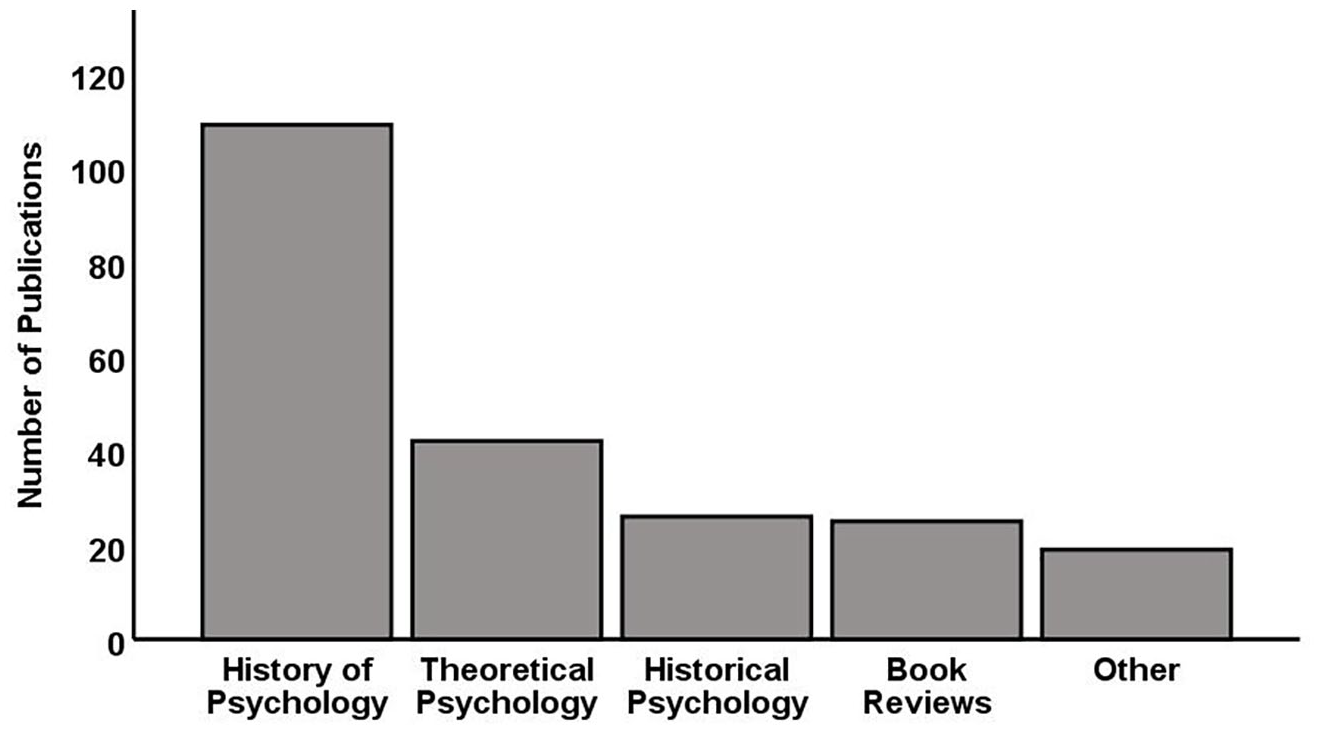
Articles published in Psychologie und Geschichte.
Parallel to these developments, Jüttemann (1992, 1993, 2004, 2006) continued to think about the role that historical psychology could and should play within the academic discipline. While Jüttemann was still hoping that investigations on “humans as historical beings” (Sonntag & Jüttemann, 1993, p. 5) would find their place within the scientific discourse that they deserved in his opinion, he also showed some signs of resignation. He wrote, for instance, “that it is not to be expected in the short term that historical psychology will be introduced as an academic (sub)discipline or that it will be part of the overall program of psychological research to any significant degree” (Jüttemann, 1993, p. 11; see also Klotter, 2000). In this phase, Jüttemann criticizes academic mainstream psychology more explicitly and more harshly than in his earlier publications and demands the renewal, reorientation, and reorganization of the discipline. In particular, Jüttemann identifies two problems: the principle of inversion (Inversionsprinzip; see also Jüttemann, 1983; Mayrhofer & Hutmacher, 2020) and the problem of system immanence (Systemimmanenz). In short, the principle of inversion denotes the observation that the research question should determine the methods used to answer the question but that this relation is reversed in the case of academic psychology. Psychologists almost exclusively use quantitative-experimental methods, largely ignoring other methodological approaches and the question whether quantitative-experimental methods are actually the best fit in a given situation.
The principle of inversion is closely connected to the problem of system immanence. According to Jüttemann, the focus on quantitative-experimental methods is motivated by the fact that most psychologists share a natural science perspective on human mind and behavior. While he acknowledges that “no serious scientist would doubt that our inner life [‘Seelenleben’] is based on brain processes” (Jüttemann, 1992, p. 12), Jüttemann claims that a natural science perspective is only appropriate when investigating biological or psychophysiological processes. When extending the natural science perspective beyond these processes to studying the human psyche as a whole, however, mainstream psychology becomes distorted. It forces psychological investigations into a framework that erroneously portrays individuals as purely biological creatures ruled by deterministic laws. That is, researchers are blinded by their ideological presuppositions and therefore unable to see the complexities of the human psyche. Hence, Jüttemann sees the necessity for a perspective on the human psyche that is theory-free (i.e., not influenced by “system immanence”) and enables the direct observation of psychological phenomena. He also hopes that historical psychology could provide such a perspective (see Jüttemann, 1992, p. 109; for a critical stance on this conclusion, see the section on “The illusion of an Archimedean point”).
A new direction? The psychogenesis of humankind (since 2007)
In more recent years, Jüttemann (2007, 2011a, 2011b, 2015) has tried to develop a framework—or as he calls it: a fundamental theory (“Fundamentaltheorie”)—for guiding research in the field of historical psychology. Once more, Jüttemann (2011a) summarizes that the purpose of historical psychology is to investigate “the process of the socio-cultural becoming of the human being” (p. 3). What is new is the idea that the purpose of this task is actually twofold. On the one hand, historical psychology investigates how historical and sociocultural circumstances have influenced and changed the human psyche. On the other hand, historical psychology is also concerned with the psychological mechanisms and motives that drive humans to generate culture and to create history. To sum up: “What did humans do, for which reason and what in turn did it do to them?” (Jüttemann, 2011a, p. 10). The theoretical key concept that Jüttemann proposes to use for answering this question is the contrast between autogenesis (Autogenese) and heterogenesis (Heterogenese). Autogenesis refers to the formation of one’s self and one’s life by one’s own responsibility. In contrast, heterogenesis refers to being influenced in the formation of one’s self and one’s life by others.
Building on this distinction and a teleological understanding of history that Jüttemann himself traces back to Wilhelm Wundt (see also Jüttemann, 2006), he proposes four stages of cultural–historical and individual development: an archaic character (archaischer Charakter) encompassing the animalistic and hard-wired drivers of human behavior, the differential potential of competence (differenzielles Kompetenzpotential), referring to rational and intellectual abilities, societal and social influences (gesellschaftlich-soziale Prägung), and the current autogenesis (aktuelle Autogenese), which denotes all motives and actions that are active and important at a given point in time. Using these concepts and several other theoretical distinctions, Jüttemann (2011a) arrives at the conclusion that humankind has become “freer, smarter, more peaceful and more playful” over the course of its history (p. 10). Following the publication of the article on his “fundamental theory,” which was accompanied by 41 comments from various other scientists inside and outside psychology, Jüttemann has served as the editor of a book series dealing with the Psychogenesis of Humankind (Psychogenese der Menschheit; e.g., Jüttemann, 2013a, 2014) and of several other edited volumes (e.g., Jüttemann, 2020).
Why Jüttemann’s “historical psychology” was ignored
As mentioned in the introduction, Jüttemann’s prolonged efforts to promote historical psychology have had a relatively limited impact. I will consider sociological, conceptual, and theoretical, as well as practical reasons that can help to explain this fact. From a sociological point of view, it seems important to note that Jüttemann’s resistance to embrace a natural science perspective on psychology and to speak about the human psyche in the form of numbers and metrics does not fit with the (scientific) zeitgeist. However, Jüttemann is not (only) a victim of adverse circumstances. First, there are conceptual and theoretical aspects of his approach to historical psychology that have sparked controversies. Second, several practical issues—such as the cooperation with neighboring disciplines, which are working on similar topics—have remained largely unresolved throughout the last decades. All of these reasons will be described and discussed in the following sections.
Sociological reasons: Jüttemann at odds with the zeitgeist?
As A. C. Brock (2016) has argued quite recently, “there is no reason to suppose that historical psychology will have a greater impact on psychology than it has had in the past” (p. 184). Brock bases his argument on the observation that historical psychology is an interdisciplinary endeavor within the humanities and that such an interdisciplinary endeavor is at odds with the spirit of “our neoliberal times” (Pettit & Davidson, 2014, p. 709). As Martha Nussbaum (2010) has put it quite drastically: The humanities and the arts are being cut away . . . in virtually every country in the world. Seen by policymakers as useless frills, at a time when nations must cut away all useless things to stay competitive in the global market, they are rapidly losing their place in the curricula. (p. 2)
These considerations match with Jüttemann’s own line of thought. He states, for instance, that research projects in historical psychology beyond those that he conducted were not possible within an academic psychology that strictly adheres to quantitative methods and a natural science perspective on the subject matter (Jüttemann, 2011a, p. 13; see also the quote from Jüttemann, 1993, cited above).
Although I do not want to dispute that there is something to this perspective, I believe that it does not tell the complete truth for at least three reasons. First, Jüttemann’s tone in his publications is often uncompromising and therefore does not invite a constructive, open debate. Despite his early claims that he was not aiming at establishing an alternative psychology, Jüttemann repeatedly states that current mainstream psychology is inadequate and needs to be replaced (e.g., Jüttemann, 1993, p. 17). In the interview with Klotter (2000), for instance, Jüttemann explains that he intended to work towards a “general reorientation of psychology on the basis of the humanities” because the deterministic and mechanistic view on the human psyche that many contemporary psychologists hold is “simply false” (p. 78). Irrespective of whether historical psychology has something to give to the discipline, such an apodictic wording will likely cause reactance among researchers who identify themselves as part of mainstream psychology. Second, if even the proponents of a historical perspective on psychology—such as Jüttemann himself—are skeptical about the future prospects of the endeavor, it is not to be expected that new generations of researchers will feel inspired to work in the field. If everyone believes that historical psychology remains irrelevant, it will remain irrelevant.
Third, the failure to establish historical psychology as a new field of research should not simply be attributed to societal circumstances or the dogmatism of the quantitative-experimental paradigm. To begin with, there are examples of other subdisciplines with similar interests and approaches as historical psychology—such as (cross-)cultural psychology—that have found their niche within the academic discourse. On an even more fundamental level, one might argue that grand concepts such as “neoliberal times” or “mainstream psychology” are not nuanced enough to capture the complexities of reality. On the one hand, Jüttemann’s first pleas for the importance of historical psychology were published during a time when German academic psychology witnessed a massive shift towards practical areas such as clinical psychology, counseling, and psychotherapy (cf. Malich, 2020). Maybe it was this shift within the discipline that Jüttemann was at odds with—rather than the abstract affordances of “our neoliberal times.” On the other hand, the idea that mainstream psychology is a uniform block—which Jüttemann uses to formulate his criticism—is not entirely accurate. In a certain sense, assuming that there is such a thing as “mainstream psychology” in which everyone thinks and acts alike can be considered a strawman argument that enables Jüttemann to construct himself as opposed to the majority of the discipline. Put differently, the claim that the other members of psychological academia are caught up in their dogmatic views is maybe an all-too-easy excuse for the problems that Jüttemann had while trying to establish his version of historical psychology. In short, these remarks make it clear why it is important to consider conceptual and theoretical, as well as practical, reasons that may have impeded the formation of the field, before concluding that historical psychology was a victim of the societal and scientific zeitgeist.
Conceptual and theoretical reasons
As far as the conceptual and theoretical reasons are concerned, I will focus on three aspects. First, on Jüttemann’s idea that historical psychology can provide a neutral and theory-free description of reality that does not suffer from the same problems as a natural-science perspective on the human psyche. Second, on the observation that Jüttemann’s claim that historical psychology is important and necessary has not led to a fully fleshed out research program. Third, on Jüttemann’s fundamental theory, which might—as his critics argue—not be able to advance the field in the way Jüttemann may have been hoping for.
The illusion of an Archimedean point
As briefly sketched above, Jüttemann argues that mainstream psychology relies on a natural-science perspective on the human psyche, which translates into the use of quantitative-empirical methods as well as the overall goal to arrive at nomological conclusions. More generally speaking, it shapes the kind of research that is being conducted and the kinds of theories that are being developed: by presupposing that the human psyche can be analyzed in a natural-science framework, researchers create experimental settings, observational data, and theoretical models that create the impression that the human psyche can indeed be understood this way. The seemingly neutral and objective observations are actually theory-laden. This is what Jüttemann calls system immanence, which he believes psychology must get rid of. What Jüttemann is hoping for is an Archimedean point, “the development of an unassailable research program” (Jüttemann, 1992, p. 96) that does not presuppose any specific perspective on the human psyche and that enables pure observation.
As most philosophers of science would agree nowadays, however, pure observation is impossible (for an overview, see Boyd & Bogen, 2021): the theory ladenness of empirical results cannot be avoided. The best that researchers can do is to reflect their theoretical presuppositions and to take the limitations of their methodological approaches into account. Hence, it does not seem necessary to claim that a natural science perspective on the human psyche is inadequate. It would suffice to say that a natural science perspective is not the only valuable perspective in order to conclude that more methodological pluralism as well as a historical perspective on the subject matter is needed (see Hutmacher & Mayrhofer, 2021). Inversely, it would be wise to accept “the coexistence of different grammars” as a “consequence of the multidimensionality of psychology’s object of knowledge” (Cornejo, 2014, p. 263).
By stating that he can offer a value-free and theory-free approach to the human psyche, Jüttemann inadvertently exposes himself to the same criticism that he had applied to mainstream psychology. It has been argued, for instance, that Jüttemann’s idea of a value-free theory of the psychogenesis of humankind is an “epistemological fossil” (Spode, 2011, p. 93; see also Slunecko & Wieser, 2011). In short, these critics hold that Jüttemann’s historical psychology suffers as much from system immanence as mainstream psychology does, bringing it into a difficult position from the very beginning. Although I do in principle share this concern, I believe that it should not be used to discard the relevance of Jüttemann’s approach to historical psychology. Just as quantitative-experimental psychologists may provide interesting insights into the functioning of the human psyche despite a lack of reflection on their theoretical presuppositions, historical psychology could be an important addition to the field even if it is not able to provide a theory-free and value-free point of view.
A mere declaration of intent? The lack of actual research in historical psychology
In his introduction to the first edited volume on historical psychology, Jüttemann (1986b, p. 19) writes that the contributions do not yet include specific studies on the historicity of the psyche because the volume should rather be seen as a first attempt to establish the relevance of a historical perspective on the subject matter of psychology. Almost 30 years later, Jüttemann (2013b) introduces the first volume of his book series on the Psychogenesis of Humankind by stating that the book series is dedicated to conducting “first pioneer work” in the field (p. 11). Seeing this, a malevolent reader could conclude that Jüttemann’s efforts never really moved beyond a mere declaration of intent. In this spirit, A. C. Brock (2011) writes: “The whole area is a jungle of proposals and counterproposals.... What is needed is good historical research in order to show that history can make an important contribution to our understanding of psychology’s subject-matter” (p. 19). Brock certainly has a point here: it is not enough to repeat that historical psychology is relevant. The relevance has to be demonstrated empirically by conducting respective research. It should be noted in defense of Jüttemann that he has tried to provide a platform for research in the field of historical psychology (e.g., by cofounding the journal Psychologie und Geschichte) and that he has also published edited volumes that included specific studies (e.g., Jüttemann et al., 1991). In addition, the book series on the Psychogenesis of Humankind includes contributions from different authors with different perspectives on the subject matter (e.g., Lange & Schwarz, 2015; Seidel, 2018). Nevertheless, Brock’s overall impression seems accurate that the field of historical psychology—as imagined by Jüttemann—has not reached the stage of a fully fleshed out research program.
The lack of actual research is related to a second problem: given that material remains are relatively scarce for large parts of the history of humankind and that we have no immediate access to the inner life of long-deceased individuals from societies of the past, the question how historical psychology can arrive at meaningful and well-founded insights is highly relevant (Reinhard, 2011; Stubbe, 2011). However, it remains quite vague throughout the publications and decades what kind of research methods Jüttemann considers appropriate. While Jüttemann states that he does not merely want to replace the use of “quantitative operationalizations . . . by the formation of qualitative categories” but hopes for studies that can address the complexities of historical–psychological processes “realistically and appropriate for the subject matter” (Klotter, 2000, p. 76), it is not specified what exactly these studies could look like (but see Jüttemann & Mack, 2010, for some potentially helpful methodological proposals). While mainstream psychology suffers from what Jüttemann calls “inversion,” that is, while mainstream psychology suffers from the dominance of the quantitative-experimental paradigm and the lack of a properly defined subject matter, the opposite seems to be true for historical psychology: although there is some basic consensus that historical psychology deals with the historicity of the psyche, the appropriate methods for investigating the subject matter remain unclear. 4 However, one could also argue that embracing methodological pluralism should be seen as a strength rather than a weakness (cf. Mayrhofer & Hutmacher, 2020). In this sense, the problem with Jüttemann’s version of historical psychology would not so much be the lack of methodological consensus but the lack of elaborating the different methods and applying them to specific settings.
Taking the wrong turn? Jüttemann’s “fundamental theory.”
One attempt to get rid of this vagueness was the development of Jüttemann’s (2011a, 2011b) fundamental theory. Although there were positive and encouraging voices among the 41 comments that were published together with the original article, the overall tone of many comments was negative. While I cannot repeat all the arguments here, I want to summarize the main points in order to illustrate why the formulation of Jüttemann’s fundamental theory was met with skepticism.
First, it is argued that the whole notion of a fundamental theory is misguided. As A. C. Brock (2011) puts it, referring to Jüttemann’s fascination for Wundt’s Völkerpsychologie, the idea that the history of humankind can be analyzed as a coherent whole and that there are several stages of human development that follow one after another “is a typical 19th-century view and it is there that the view belongs” (p. 18). The reasons that can be given for this quite harsh evaluation are manifold. First and foremost, history seems to be too diverse and too complex to be summed up in a universal framework that diagnoses a linear development. In other words, Jüttemann’s fundamental theory is too broad and too general to be convincing; it “is ultimately unable to adequately describe . . . the anthropological peculiarities of specific communities” (Cornejo, 2014, p. 263; see also Chakkarath, 2011; Friedlmeier, 2011). Moreover, formulating a universal history of humankind always runs the risk of providing a posthoc rationalization of historical processes (D. Brock, 2011; Flammer, 2011): one should not forget that historical changes and events tend to appear more logical and inevitable in hindsight than they actually were. Even those who sympathize with the overall vision of a fundamental theory, that is, even those who think that it could, in principle, be possible to identify overarching regularities in the history of humankind, argue that formulating a fundamental theory before engaging in specific research on the subject matter means doing things in the wrong order (see A. C. Brock, 2011; Friedlmeier, 2011; Teo, 2011). In order to advance, historical psychology does not need more abstract theories, but concrete studies.
Second, Jüttemann’s critics argue that the conceptualization of his fundamental theory is Eurocentric in at least two ways. On the one hand, the term autogenesis is considered problematic. Anticipating possible criticism, Jüttemann (2011a, p. 4) stated that he thinks of autogenesis as a neutral term that can capture both positive and negative developments and that should not be confused with value-laden concepts such as self-actualization. However, the mere fact that Jüttemann decides to use the—successful or unsuccessful—autonomous development of the individual as a starting point for his entire framework, can be seen as mirroring the typical structure of modern Western thinking about psychological issues, which is certainly not universal (Reichholf, 2011; Spode, 2011). On the other hand, Jüttemann’s narrative of progress is questioned: not only because it remains relatively unclear what kind of progress Jüttemann is referring to (Thies, 2011) but also because it is far from obvious that humankind progresses as a whole (Friedlmeier, 2011; Kölbl, 2011): The successful history of the human soul that Jüttemann describes is easier to follow if you live in Europe, North America, or Japan. It is unfortunately harder to agree with when you take into consideration the zones of the globe that seem to be ignored or minimized when making such self-pleasing statements. . . . It is Western man [sic] and not necessarily the whole of humankind that is more clever, happier, and more peaceful today than ever before. (Cornejo, 2014, p. 261)
To summarize, Jüttemann’s critics argue that his fundamental theory creates more problems than it solves, as it provides neither a plausible explanation of the history of humankind nor a framework that is sketched well enough to guide future research. Nevertheless, Jüttemann’s courage to come forward with a broad theoretical framework aimed at bringing different fields of research together should be acknowledged. In times of an ongoing academic specialization in which the focus of many researchers seems to become narrower and narrower, the attempt to bring the big questions of psychology back to the table is refreshing.
Practical reasons
In addition to the conceptual and theoretical issues with Jüttemann’s version of historical psychology discussed so far, there are also two practical problems. On the one hand, there has been only limited exchange with other disciplines that are concerned with the historicity of the human psyche, as well as other scholars within the discipline. On the other hand, Jüttemann has exclusively published in German, mostly using edited volumes as a publication format, which is at odds with the common practices of the discipline. In the following, I will elaborate on these two problems.
Lack of interdisciplinary and intradisciplinary co-operation
Although historical psychology has never found a place within academic mainstream psychology, it is important to keep in mind that psychologists are not the only researchers with an interest in the historicity of the human psyche. In fact, the topic is pursued by scholars from other disciplines such as the history of mentalities (Burke, 1986; Hutton, 1981) and the history of everyday life (Lüdtke, 1995; Steege et al., 2008), but also cognitive archeology (Henley et al., 2019; Renfrew, 2008), historical anthropology (Wulf, 2013), and cultural history (Burke, 2019; Green, 2008). Surprisingly, references to these fields of research are quite rare in Jüttemann’s writings. While he acknowledges their existence in some of his publications (e.g., Jüttemann, 1988b, 2011a, 2011b) and has published one edited volume with the historical anthropologist Christoph Wulf (Jüttemann et al., 1991), neither the theoretical and methodological approaches nor the results of these disciplines seem to have been included systematically in Jüttemann’s thinking. This is seen as a major weakness of his approach to historical psychology by several commentators who find it “incomprehensible why [Jüttemann] neglects the broad spectrum of psychology, ethnology, and anthropology” (Friedlmeier, 2011, p. 35; see also D. Brock, 2011; Nolte, 2011; Reichholf, 2011). As one may argue, historical psychology could only thrive as an integrative approach that is open to insights from various fields and traditions. Especially in the face of the fact that historical psychology has produced a limited amount of original research so far, ignoring the state of the art in neighboring disciplines is certainly not optimal.
Interestingly, Jüttemann seems to share this insight in principle when he states that the research questions at hand can only be addressed adequately from an interdisciplinary perspective (e.g., Klotter, 2000). However, he attributes the lack of co-operation across disciplines to a “fear of contact” with psychology on the part of the historians (Klotter, 2000, p. 77) as well as to the historians’ and sociologists’ unwillingness to accept that “historical explanations are primarily psychological or psycho-diagnostic explanations” (Jüttemann, 2011b, p. 117). No matter who was ultimately responsible for the lack of interdisciplinary co-operation, it cannot be denied that historical psychology will only have a future if it starts to play an active and constructive role within the discourse on the historicity of the human psyche. This could also help to clarify what constitutes the genuinely psychological perspective on the subject matter that goes beyond the perspectives already covered by other disciplines. As A. C. Brock (2011) has emphasized, “psychologists do not usually have training in the theories and methods of history” (p. 17). Hence, he argues that psychologists interested in the historicity of the human psyche should “acquire the specialist skills and knowledge of the historian” (p. 17) before they begin to conduct research. However, this would mean that a historical psychologist is nothing but a psychologist with some additional training in historical methods. Instead, it could also be worth considering whether psychology has concepts and methods to offer that can add a new facet to the study of the past. For instance, one might point out that the expertise of psychologists lies in their trained ability to analyze and interpret human thinking and behavior in a structured and systematic manner—while (at least some) historians lack this expertise and consequently refer to their everyday psychological intuitions when explaining historic phenomena.
In addition to the lack of interdisciplinary co-operation described so far, there is also a lack of intra-disciplinary co-operation. As already briefly mentioned in the introduction, Jüttemann is not the only psychologist within the 20th century who has developed an interest in the historicity of the human psyche (e.g., Barbu, 1960; Danziger, 2003; Gergen, 1973; Meyerson, 1987; Smith, 2005; van den Berg, 1961). However, Jüttemann has failed to build bridges between the approaches of these other scholars and his own. This seems particularly regrettable, as these writings might have had insights to offer that could have enriched Jüttemann’s perspective. For instance, Ignace Meyerson (1987) has carefully argued against the naturalization of the human mind and a teleological understanding of history while pointing out the importance of taking all manifestations of human activity into consideration when conducting research in historical psychology (for an overview, see Pizarroso, 2013, 2020). This line of reasoning directly speaks to different aspects within Jüttemann’s publications that have repeatedly attracted criticism, such as the absence of specific studies dealing with concrete historical material or the idea of developmental and cultural stages (see above). Moreover, Jüttemann could have benefited from considering the impact of the writings of eminent figures such as Kurt Danziger (2003, 2008, 2012), Kenneth Gergen (1973), or Roger Smith (2005), who have invested a lot of effort into elaborating why psychological categories should not be treated as natural kinds but as historically and socially constructed entities. Given that Jüttemann often operates on a very abstract level (using categories such as autogenesis and heterogenesis) without taking the characteristics of specific historical and societal circumstances into account, one could imagine that even (Soviet) cultural–historical psychology (for an overview, see Yasnitsky et al., 2014) or German critical psychology as represented by Klaus Holzkamp (1983; see also Teo, 1998) would have had important ideas to offer. This is not to say, of course, that Jüttemann should have blindly followed these authors. However, engaging more explicitly and more intensively with the propositions brought forward within academic psychology could have sparked controversial and inspiring conversations. In addition, it probably would have made his ideas more visible within the intra-disciplinary discourse—which brings us to a second practical problem for the reception of Jüttemann’s historical psychology.
German solipsism
Jüttemann has exclusively published in German, which means that much of his thinking “is unknown in the English-speaking world” (A. C. Brock, 2016, p. 184). Teo (2011), who believes that it would be important that Jüttemann’s “ideas are presented to the English-speaking world because he has provided an original and important perspective” (pp. 100–101), attributes this fact to a tendency that he calls German solipsism: Communication with English-speaking colleagues means sharing with them that there exist current innovative psychologies outside of North America . . .. The problem that I encounter is that a small group of German psychologists that have the intellectual caliber to shape discourses in North America do not seem to be interested in influencing the North American psychological community. This German solipsism includes a refusal to publish in English-speaking journals, to develop concepts that can resonate with English-speaking audiences, [and] to look for American publishers and translators. (p. 100)
In the context of the present paper, it is not important whether Teo’s speculation is correct that Jüttemann is one of those German scientists who are not interested in communicating with English-speaking colleagues, or who even refuse to do so. What is important, however, is the fact that publishing (exclusively) in German and using nonpeer-reviewed edited volumes as the primary publication format conflicts with the contemporary conventions and practices of the academic discipline. Even the best ideas need a forum to be spread and discussed. The forum that Jüttemann has chosen, however, makes it quite unlikely that his ideas will be picked up by a broader audience. On a positive note, it should be added that Jüttemann has repeatedly used his edited volumes as a platform for younger scientists who were given the opportunity to develop their own interests and to find their own voice. Judging from the list of authors included in his edited volumes, a diverse subset of (German) psychologists from more than one generation has—at least at some point in their career—thought about questions in the field of historical psychology.
Conclusion: The future of historical psychology
In times when mainstream psychology almost exclusively focused on investigating currently living individuals by using quantitative-experimental methods, Gerd Jüttemann was one of the few proponents of a historical perspective on the subject matter. As Jüttemann understood very clearly, neglecting cross-temporal variability stands in the way of making academic psychology a truly universal endeavor that explores the psychology of all humans. From the 1980s until today, Jüttemann has invested a lot of effort into promoting his vision of historical psychology and the psychogenesis of humankind. Although the general idea that psychology should show more interest in the historicity of the human psyche has been reemphasized in recent publications (Hutmacher & Mayrhofer, 2021, 2022; Muthukrishna et al., 2021), Jüttemann’s own pioneer work has largely been ignored by mainstream psychology. The present paper has tried to understand the reasons for this, in order to draw conclusions for the future of historical psychology.
As I have argued, it would be too simplistic to portray Jüttemann as a victim of the zeitgeist, which prefers a natural-science perspective on the human psyche to the perspective that the humanities may have to offer. While Jüttemann has eloquently pointed out some weaknesses of mainstream psychology (such as the principle of inversion; see also Mayrhofer & Hutmacher, 2020), his version of historical psychology is confronted with several problems that may have kept other researchers from following in his footsteps. Jüttemann’s idea that historical psychology can provide a pure and value-free observation of reality and his fundamental theory have been criticized on theoretical and epistemological grounds. In addition, there is a lack of specific studies that investigate the historicity of the human psyche from a psychological point of view as well as a lack of interdisciplinary and intra-disciplinary co-operation. Finally, the fact that Jüttemann has published exclusively in German and mostly in edited volumes, may have further reduced the visibility of his theoretical approach.
Nevertheless, the problems with Jüttemann’s version of historical psychology identified in this article can serve as a basis for thinking about what a psychological subdiscipline interested in the historicity of the human psyche could look like. In other words, learning from the mistakes of the past can be considered an important precondition for turning historical psychology into a vibrant generator of relevant knowledge about human thinking and behavior. As the discussion of Jüttemann’s approach has made clear, historical psychology can only thrive as an interdisciplinary endeavor that is willing to take up impulses from neighboring fields of research such as cognitive archeology, historical anthropology, and cultural history. Although there are already some publications by psychologists on topics such as memory (Danziger, 2008), stress (Hutmacher, 2019, 2021), or personhood (Danziger, 2012; see also Smith, 2005) that could be considered genuinely psychological contributions, psychology still needs to find its own, unique voice. That is, it remains to be determined what constitutes the particularity of the psychologists’ perspective on the historicity of the human psyche. As I have tried to point out, a possible starting point for developing such a perspective could be the observation that the expertise of psychologists is based on their trained ability to analyze the human psyche in a structured and systematic manner. If psychologists interested in the historicity of the human psyche would systematically use this expertise to address cross-temporal variability, this would also be a late triumph for Gerd Jüttemann and his pioneer work.
Supplemental Material
sj-docx-1-tap-10.1177_09593543221122735 – Supplemental material for Gerd Jüttemann’s “Historical Psychology”: Why it should have succeeded, why it was ignored, and what that means for the future
Supplemental material, sj-docx-1-tap-10.1177_09593543221122735 for Gerd Jüttemann’s “Historical Psychology”: Why it should have succeeded, why it was ignored, and what that means for the future by Fabian Hutmacher in Theory & Psychology
Footnotes
Acknowledgements
I would like to thank the two anonymous reviewers for their comments and remarks that helped a great deal to improve the manuscript and to sharpen my line of reasoning. I would also like to thank Thomas Feiler and Alina Thielpape for their help with preparing the manuscript.
Declaration of conflicting interests
The author declared no potential conflicts of interest with respect to the research, authorship, and/or publication of this article.
Funding
The author received no financial support for the research, authorship, and/or publication of this article.

Supplemental material
Supplemental material for this article is available online.
Notes
Author biography
References
Supplementary Material
Please find the following supplemental material available below.
For Open Access articles published under a Creative Commons License, all supplemental material carries the same license as the article it is associated with.
For non-Open Access articles published, all supplemental material carries a non-exclusive license, and permission requests for re-use of supplemental material or any part of supplemental material shall be sent directly to the copyright owner as specified in the copyright notice associated with the article.
