




Abstract
While in the last decade we made strides in the pursuit of gender equality, women's rights, dignity, and safety continue to be under threat around the world. There is a growing body of research documenting contemporary misogyny, mainly focused on extreme manifestations found in online environments. Conversely, we know less about how misogyny features in other spheres of our daily lives. The current study focuses on such an environment, namely segments from the British show This Morning in which guests are invited to take opposing stances on a variety of topics related to women's appearance, behaviour, competencies, and experiences with sexual harassment. Using discursive psychology, we identified two sets of argumentative discursive practices employed by guests who espoused misogynist views. First, when guests were prompted to present their controversial views, they constructed them as reasonable, strategically differentiating them from established misogynist tropes. By contrast, when guests’ views were challenged, they doubled down on their positions by drawing on scientific explanations for human behaviour that ostensibly justified bigoted views. This study sheds light onto the discursive mechanisms through which misogyny escapes eradication, and through which it mutates into subtler forms that are increasingly difficult to identify and denounce.
Misogyny manifests itself in many ways, from toxic forms of online misogyny whereby women are harassed, threatened, or humiliated (Thompson, 2018) to more subtle forms of modern misogyny (Anderson, 2015) like jokes, microaggressions, or slights that undermine or demean women (Pettersson et al., 2023). Such manifestations of inconspicuous misogyny can be particularly insidious as they are often difficult to identify and confront; therefore, they continue to permeate everyday life and maintain gender inequalities.
This study aims to document how inconspicuous misogynist conduct is perpetrated in social interaction. We employ discursive psychology (henceforth DP), an approach that is well-suited for the study of psychological phenomena in everyday settings (Humă & Potter, 2023). We use DP to investigate how subtle and defeasible misogynist views are presented and managed in social interaction; that is, how they are introduced, justified, contested, defended, and so on. To find such inconspicuous misogynist conduct manifested spontaneously in social interaction, we turned to live broadcast television, specifically the genre of morning television shows. Segments of one particular show—This Morning, broadcast by the British TV channel ITV—frequently engendered heated arguments between hosts and guests on issues related to women's appearance and conduct. In these arguments, we noticed possible instances of inconspicuous misogyny, which rendered these interactions a suitable data source for our study.
DP has successfully been employed in the examination of misogyny (Pettersson et al., 2023; Sakki & Martikainen, 2022; Tileagă, 2019; Worth et al., 2016), with a focus on mainly (though not exclusively) extreme misogyny in text-based and video-based discourses. Our study aims to extend our understanding of contemporary misogyny by documenting manifestations of inconspicuous misogyny found in naturally occurring face-to-face interactions. Additionally, the paper contributes to the emerging body of scholarship on transmisogyny (Edmonds & Pino, 2023; Henderson, 2022; Riggs, 2014; Serano, 2007). Specifically, we show that, while misogynist views are ostensibly condemned by all interactants, transmisogynist views are “owned” by speakers even when challenged by interlocutors.
The discursive psychological approach to misogyny
Discursive psychology focuses on how individuals manage psychological topics in their everyday lives. By analysing naturally occurring talk-in-interaction, DP documents how attitudes, identities, or memories are constructed, invoked, and negotiated (Potter, 2021). For example, DP research found that speakers who ordinarily display extreme racist views also work to appear reasonable and rational (Burke & Demasi, 2020) to manage what Edwards (2007) has called the subject-side; that is, the subjective basis of speakers’ claims which could render racist views liable to dismissal. Similarly, accounts of why women should not get involved in certain sports (Speer, 2002) or why they are rarely considered for certain jobs (Gill, 1993b) were found to be carefully embedded in a network of justifications that mobilised normative views of womanhood and invoked external circumstances, independent of the speakers. Thus, by studying actual manifestations of prejudice in and as part of everyday life, discursive psychologists have exposed their logic (Manne, 2017) and demonstrated that prejudiced views are not mere expressions of underlying bigoted attitudes, but instead that they are carefully constructed and interactionally managed to preempt or counter potential challenges, accusations, or criticism (Billig, 1985).
DP has a tradition of studying prejudice, in particular racism (Billig, 2001; Tileagă, 2007) and sexism (Gill, 1993a; Sorrentino et al., 2019; Speer, 2002; Weatherall, 2002). Comparatively, misogyny has received less scholarly attention, although these phenomena often work hand-in-hand (Augoustinos & Every, 2007; Worth et al., 2016). Nonetheless, on a theoretical basis, Tileagă (2019) distinguishes between misogyny as a historical prejudice that, throughout centuries, has demeaned women, and sexism, which is a “modern invention” (p. 5) predicated on gender differences and aimed at legitimising a patriarchal status quo (cf. Manne, 2017).
Equally applicable to racism as well as to misogyny and sexism, DP has documented the existence of a moral ban on prejudiced conduct (Billig, 1988). It means not that prejudice has been somehow restricted, but that it is treated as normatively and morally accountable in interaction. The avoidance of overtly prejudiced language has led to the conclusion that we now live in a postfeminist era. Yet this could not be farther from the truth (Anderson, 2015; Gill, 2011). In fact, the moral ban on prejudice has activated the interactional mechanism of dialogic repression (Billig, 2004) through which troubling topics are pushed away and replaced with safer alternatives. Unlike the Freudian conceptualisation of repression as an unconscious mechanism beyond the individual's control, Billig's (2004) respecified dialogic repression operates through talk-in-interaction by transforming unacceptable views into acceptable ones. As such, condemnable language will be substituted with more benign alternatives, leading to prejudiced conduct becoming inconspicuous. Manifestations include disclaimers such as “I’m not a chauvinist or anything” (Stokoe & Smithson, 2001, p. 235) through which speakers orient to their actions as at risk of appearing prejudiced (Potter & Wetherell, 1988); the construction of factual accounts that allow speakers to dissociate themselves from their sexist views (Speer, 2002); and the mechanical enforcement of verbal hygiene (Cameron, 1995) whereby sexist terms are replaced with gender-neutral ones (Weatherall, 2002).
To date, discursive psychological studies have mainly focused on excavating manifestations of misogyny in political communication by scrutinising various discourses ranging from news and social media texts (Sakki & Martikainen, 2022; Sorrentino et al., 2021; Worth et al., 2016) to a political campaign video (Pettersson et al., 2023). For example, Sakki and Martikainen's (2022) examination of close to 400 negative forum posts targeting the Finnish Prime Minister Sanna Marin delineated four discursive portrayals of Marin as an (a) immoral, (b) incompetent, (c) calculating, or (d) inferior woman. Similarly damaging and diminishing representations of the prime minister were instantiated in an ostensibly humorous political video made by the far-right Finns Party (Pettersson et al., 2023). Taken together, these studies show how misogyny can be turned into a weapon to be leveraged against political leaders in an attempt to discredit and undermine them and their political ideas.
Discursive psychological research on naturally occurring prejudiced discourse has also found that speakers employ a range of rhetorical strategies to preempt possible criticism. As such, it is not surprising that challenging prejudice constitutes a difficult interactional task. In the case of inconspicuous misogyny, the accusers bear the burden of amassing evidence of the transgression. In these situations, new vocabularies of sexism such as mansplaining or manterrupting may enable women to speak out against previously unspeakable offences (Joyce et al., 2021). However, even when produced, accusations of sexism and misogyny are likely to be dismissed as irrelevant and as strategically deployed for personal gain (Worth et al., 2016), or to be met with scepticism, disbelief, or passive acquiescence (Romaniuk, 2015). Women who speak up against sexism and misogyny are characterised as extreme, abnormal, or angry (Worth et al., 2016). Thus, they find themselves between the proverbial “rock” of existing inequalities and “the hard place” of standing up against them. While ignoring sexist or misogynist conduct will not help to stop its perpetuation, calling it out puts women at risk of further abuse (Worth et al., 2016).
In summary, DP has examined naturally occurring prejudiced conduct, its rhetorical accomplishment, and the institutional, interactional, and sequential environments where it occurs. Within DP, misogyny is not reduced to a single phrase or individual trait, but is understood as the concerted product of individuals’ talk-in-interaction. DP has demonstrated that misogyny is not only an explanatory scientific construct, but also a speakers’ concern (Tileagǎ, 2016).
Data and method
According to YouGov (2020), 1 in 5 British citizens watch TV at breakfast time, the most popular shows being aired by BBC One and ITV. Our data come from the British morning television show This Morning, broadcast on ITV, on weekdays between 10:00 a.m. and 12:30 p.m. This show, which regularly amasses an audience of over a million viewers (ITV Media, 2021), covers the news as well as topics related to fashion, lifestyle, and home amongst others. Live, nonscripted TV shows such as This Morning are well suited for scrutinising how guests and hosts mobilise categorial (Kilby & Foster, 2022), sequential, and rhetorical resources (Thornborrow, 2007) to accomplish discursive actions and manage social identities.
This Morning regularly features two hosts. In our segments, these were either Holly Willoughby and Phillip Schofield, or Eamon Holmes and Ruth Langsford, although five segments had different hosts. Usually, the segments feature two guests that have been invited to take opposing stances on topics proffered by the hosts. The format presents the topics as controversial and up for debate, providing for pro and con arguments to be produced by the guests, who are introduced as holding that position (see also Fitzgerald, 2012).
Our corpus consists of 43 clips (about 5.4 hours in total) selected because the segments therein debated topics that made it possible for interlocutors to espouse arguably misogynist views, such as discussions of women's clothes, breastfeeding, personal hygiene, work and home life, as well as violence against women. The clips ranged from 1.32 to 10.00 minutes, with the majority being between 5 and 7 minutes long. They aired between February 2016 and July 2019 (see the supplemental material for a list of clips and links).
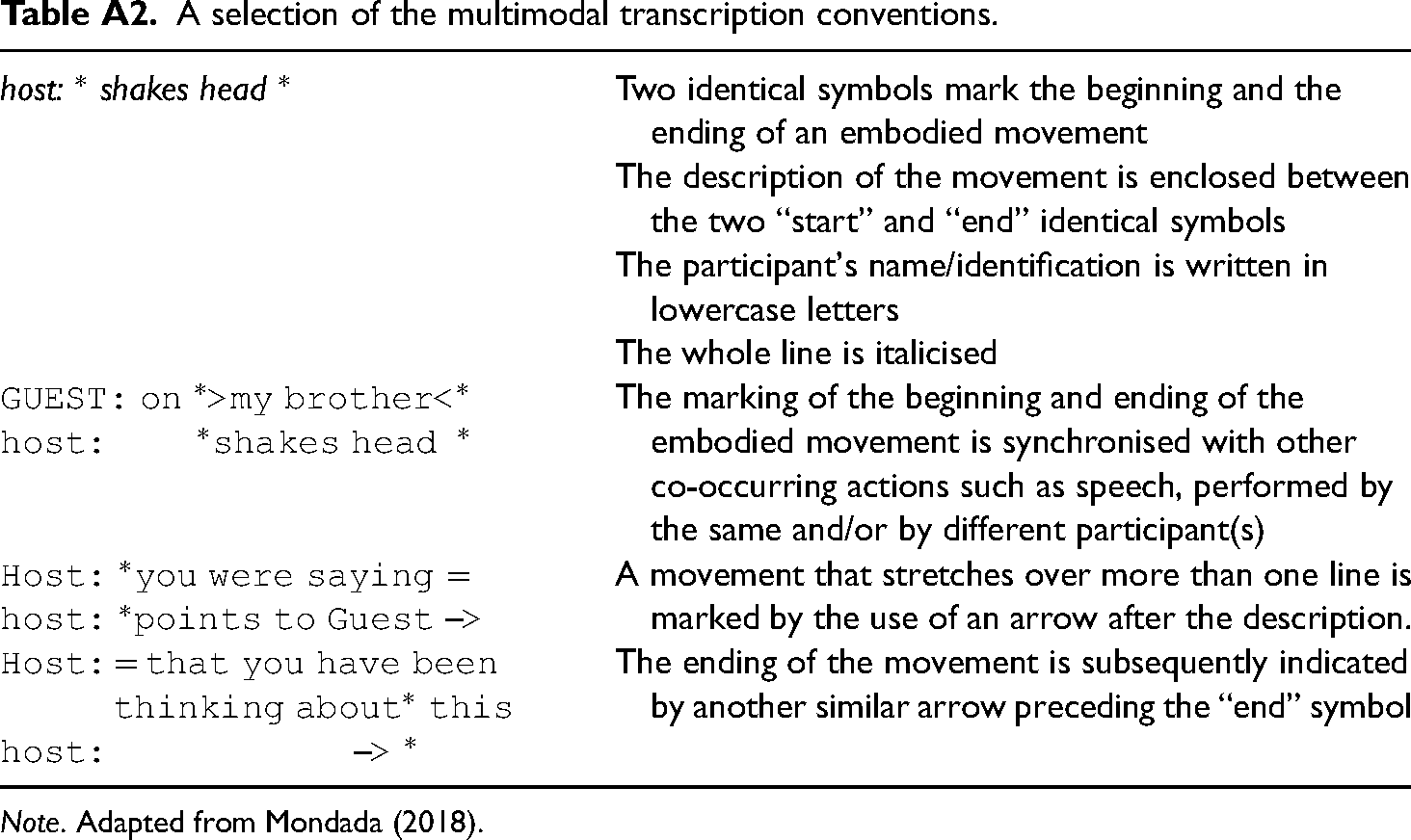
Following ethical approval from Leeds Trinity University, the clips were accessed via the broadcaster's YouTube channel and transcribed using Jefferson’s (2004) conventions for capturing the details of how talk is produced, including prosody, gaps, and overlaps (see Table A1 in the Appendix for a list of symbols and their use). Additionally, where relevant for the analysis, multimodal aspects such as hand gestures are included in the transcripts following the conventions developed by Mondada (2018; see Table A2 in the Appendix for a selection of multimodal transcription conventions).
We analysed the data following the principles of DP (Wiggins, 2017). We approached the data without a strictly formulated research question. Instead, we were interested in observing if and how misogynist views were managed in this setting. We started by watching the clips while annotating the transcripts. This allowed us to notice interesting features about how participants legitimised controversial inconspicuous misogynist views, both when they were simply elicited by the hosts and when they were directly challenged. We identified 34 clips in which a guest could be seen to espouse such views, and within these, we tracked the two sets of practices presented in the Analysis section below.
In examining the fragments, we focused on delineating speakers’ argumentative practices and the sequential environment where they were employed. Following DP's epistemological principles, we treated individuals’ talk as action-oriented and refrained from speculating about what they might think or feel (Humă et al., 2020). Instead, we focused on the sequential (Schegloff, 2007) and rhetorical organisation of conversations (Edwards & Potter, 1992). The extracts included in this paper are reflective of the collection as a whole and were chosen because they constitute the clearest and most concise examples in our collection. We have retained the titles of the segments given by the broadcaster on YouTube.
A key characteristic of inconspicuous forms of misogyny is their defeasibility. While we acknowledge that multiple readings of participants’ conduct are possible, we see this as a feature of the phenomenon. Like other prejudiced conduct such as racism or sexism (Whitehead & Stokoe, 2015), misogynist acts can be designed as inherently ambiguous, which may appear to pose some difficulty for analytic approaches such as DP that rely on visible participant orientation as evidence for making analytic claims. Yet, while labels such as misogynist or misogyny are never used by the participants, this should not prevent us from recognising misogynist acts based on their resemblance with identifiable misogynist tropes. This resemblance is in fact a resource which participants themselves also use. For example, we often see speakers orienting to their own conduct as possibly interpretable as misogyny. Moreover, on most occasions, the other guest and the hosts challenge such conduct as potentially problematic.
Before moving forward, we also need to clarify our standpoint and how it informed our analysis. The intersection of our identities as feminist, White, European, middle-class, heterosexual ciswomen with higher education informed our interest in undertaking a study on contemporary manifestations of misogyny, and provided the cultural background against which we analysed the interactions. We believe that, together with the reviewed literature, these category memberships enabled us to make sense of participants’ conduct (Kitzinger, 2000). It is likely that our selection of extracts and, to some extent, the presentation of the findings, has been guided by our sociocultural background as well as by our support of feminist ideas (Wilkinson, 1988). Still, in line with the discursive psychological approach, in the analysis below, we support all observations with evidence from the data, which ensures the transparency and integrity of our analytic endeavour.
Analysis
We identified two sets of argumentative discursive practices that guests on This Morning use to present and defend problematic views either when they are at risk of being heard as misogynist or when they are challenged by their interlocutors. In the first analytic section, we show how speakers present their claims as reasonable by dissociating their positions from established misogynist views. In the next section, we focus on how speakers defend their controversial views by constructing factual arguments to support their positions.
Constructing one's misogynist views as reasonable
In Extract 1, the show host prompts a male guest to explain his stance in the debate about whether women should cover up when breastfeeding in public.
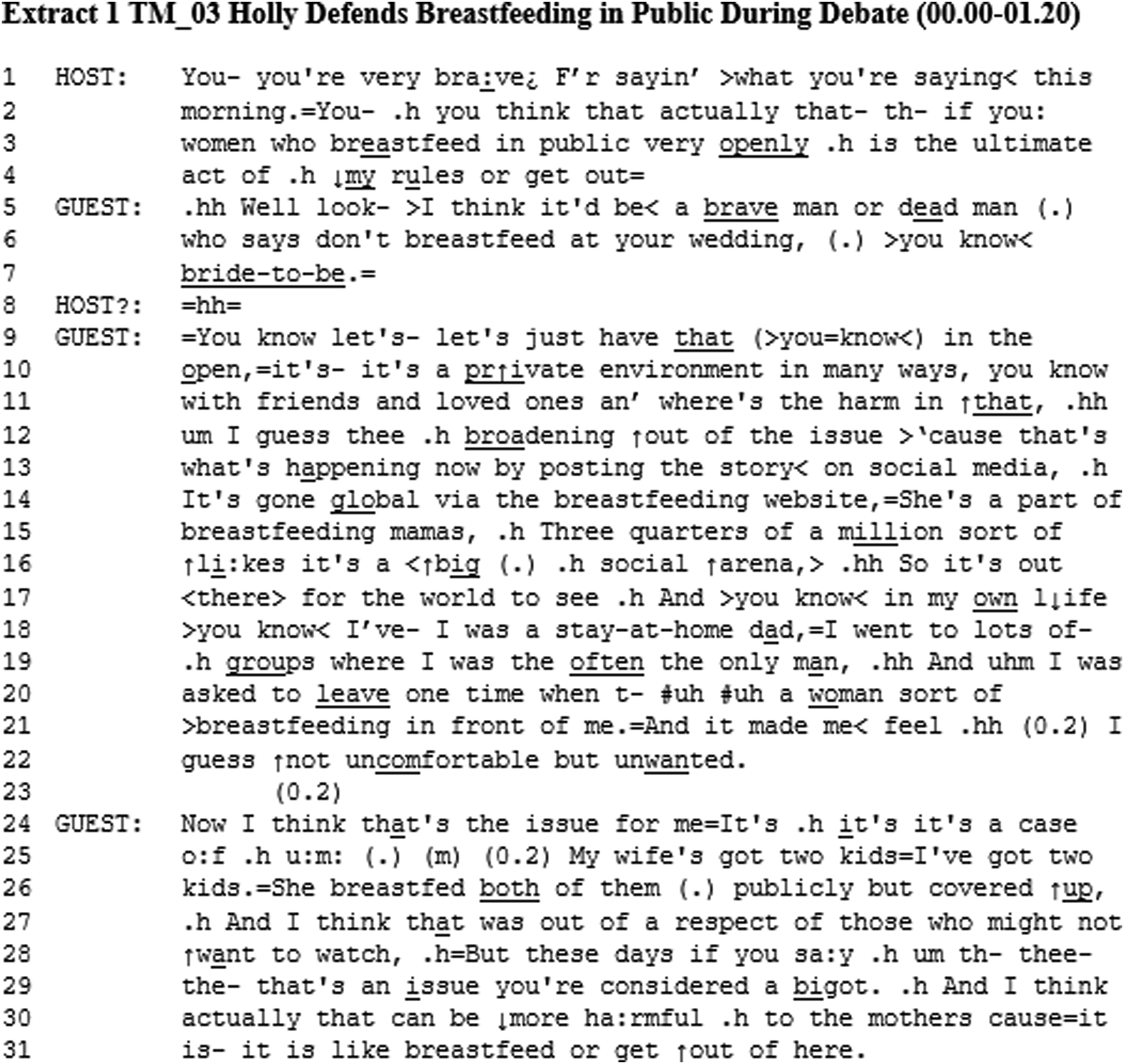
There is a lot to unpack in this extract, but we will mainly focus on three points: first, how the speaker distinguishes his stance from what are recognisable problematic views; second, how he self-categorises as an open-minded parent; and third, how he uses that categorisation to make counter-accusations.
First, the guest acknowledges that supporting the view that a bride should not breastfeed at her wedding would be problematic through the categorisation of someone evincing such a view as either “a
The guest proceeds to present himself as an open-minded parent and progressive father. As a “stay-at-home d
Having thus prepared the ground, the guest builds a counter-accusation over several steps. He inserts a side sequence (Mazeland, 2007) that brings up his wife's breastfeeding in public whilst “covered ↑
Like condemning breastfeeding in public, another recognisable misogynist trope is blaming rape victims for what happened to them (Gravelin et al., 2019). In the next extract, we will see a guest on This Morning distance herself from this position while still managing to present women as responsible for being assaulted.
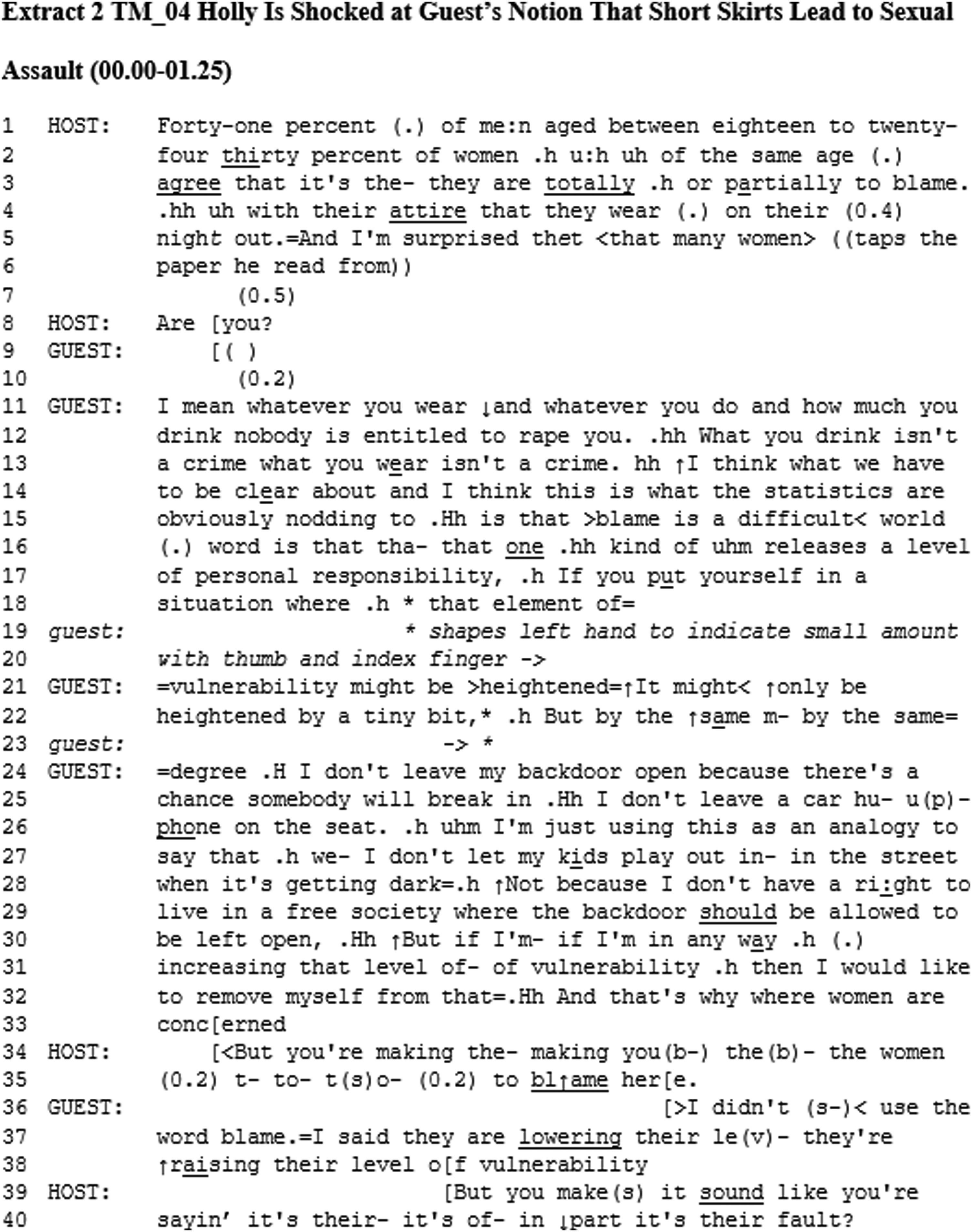
The segment starts with one of the hosts presenting the results of a survey that found that a high percentage of respondents blame victims for being sexually assaulted. He invites one of the guests to react. The guest initially takes a clear stance against the view that a woman's choice of clothes, conduct, and drinking can legitimise rape. Delivered as a three-part list (Jefferson, 1990), this inventory is rhetorically designed to convey that nothing a woman does can function as a justification for sexual assault. Still, there is one clue in the guest's statement alerting us to the argument she makes later. Her use of the term “entitled” (Line 12) indexes a lack of perpetrator rights to commit assault, rather than a normative expectation or obligation for women's safety to be upheld. Thus, the agency of the perpetrator is never discussed (Northcutt Bohmert et al., 2018).
Next, the speaker problematises the term “blame” introduced by the host (Line 3) by taking issue with its connotation: “>blame is a difficult < world (.) word” (Line 15). The assessment “difficult” allows the speaker to distance herself from the recognisable misogynist position of victim-blaming, while still not explicitly refuting it. Importantly, the defeasibility of her position will serve as a resource a few moments later when the host will accuse her of victim-blaming.
Having taken a stance against blaming women for sexual assault, the guest presents the matter as one of “personal responsibility” (Line 17) and positions the victims of rape as agents in charge of their circumstances, “if you put yourself in a situation” (Lines 17–18 and 21–22). This implies that women are at least in part responsible for being raped by virtue of putting themselves in situations where rape can be committed in the first place (Meyer, 2010). How women are responsible for sexual assault is never unpacked. Instead, the speaker uses various analogies in which victims of crimes put themselves in harm's way when they should know better. She constructs this issue as not one of personal rights, but one of personal responsibility of protecting yourself (Lines 28–30).
The host formulates his concern that the guest portrays women as being “to bl↑ame here” (Line 35), prompting a denial from the guest, “I didn’t (s-)< use the word blame” (Lines 36–37). However, she only takes issue with the word choice of “blame” (Cameron, 1995), and does not contest the level of culpability she has assigned to potential victims in holding them responsible for their level of vulnerability.
The final extract included in this section shows a similar configuration of practices employed by a guest discussing the criminalisation of wolf-whistling.
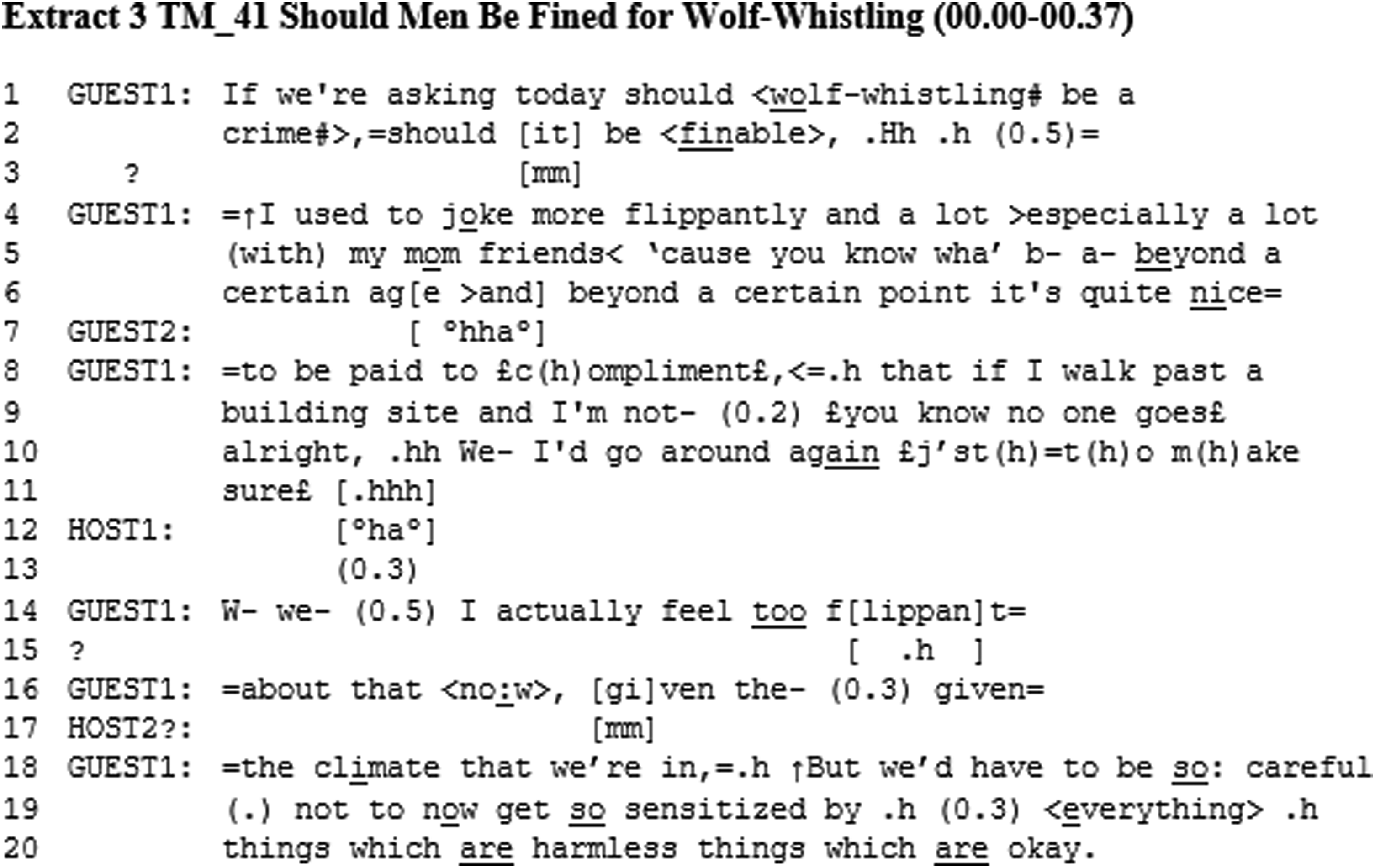
Let us first focus on how the guest builds up her credibility. In Lines 4–11, she tells a story that illustrates her previous view on wolf-whistling, towards which she takes a critical stance. The story recounts her ostensibly habitual conduct (Edwards, 1994) of joking about trying to occasion wolf-whistling when walking past a building site. From her current vantage point, she dismisses her past conduct as “
Having established her credibility, the guest then goes on to frame the criminalisation of wolf-whistling as exaggerated (Lazard, 2020). She issues a tentative warning against overreactions towards wolf-whistling stemming from people becoming “
At one point in her story, the speaker's stance towards wolf-whistling can be heard as problematic. In Lines 5–8, she divulges that she treats wolf-whistling as a compliment. Her account can be heard as possibly ageist (Previtali, 2023) and misogynist, as it invokes age, gender, and familial status to justify her interpretation of wolf-whistling as a compliment: “(with) my
On a final note, as we saw in previous extracts, there is always a degree of defeasibility in what conduct the guests are supporting or condemning. Here, the speaker never specifies what actions fall into the category “harmless” or “okay” and thus should not be criminalised. Note also how these lexical choices support the reasonability of her views, as a sensible person would not condemn such clearly inoffensive actions.
Moving on, in the next section, we will see how guests, when challenged by hosts, double down on their positions by arguing that problematic conduct and views are deeply rooted in, for example, human biology and thus factually correct.
Justifying a misogynist stance through building factual arguments
Extract 4 comes from roughly 50 seconds into a different segment on breastfeeding. Prior to Line 1, the guest already presented her position not as taking issue with public breastfeeding in general, but as viewing breastfeeding in the pub (a public house in the UK where drinks and sometimes food is available) as problematic, especially when women do not exercise discretion. Thus, the guest presents her position as reasonable using the argumentative practices highlighted in the previous section, and when she gets challenged by the host, she doubles down on her position, as seen below.
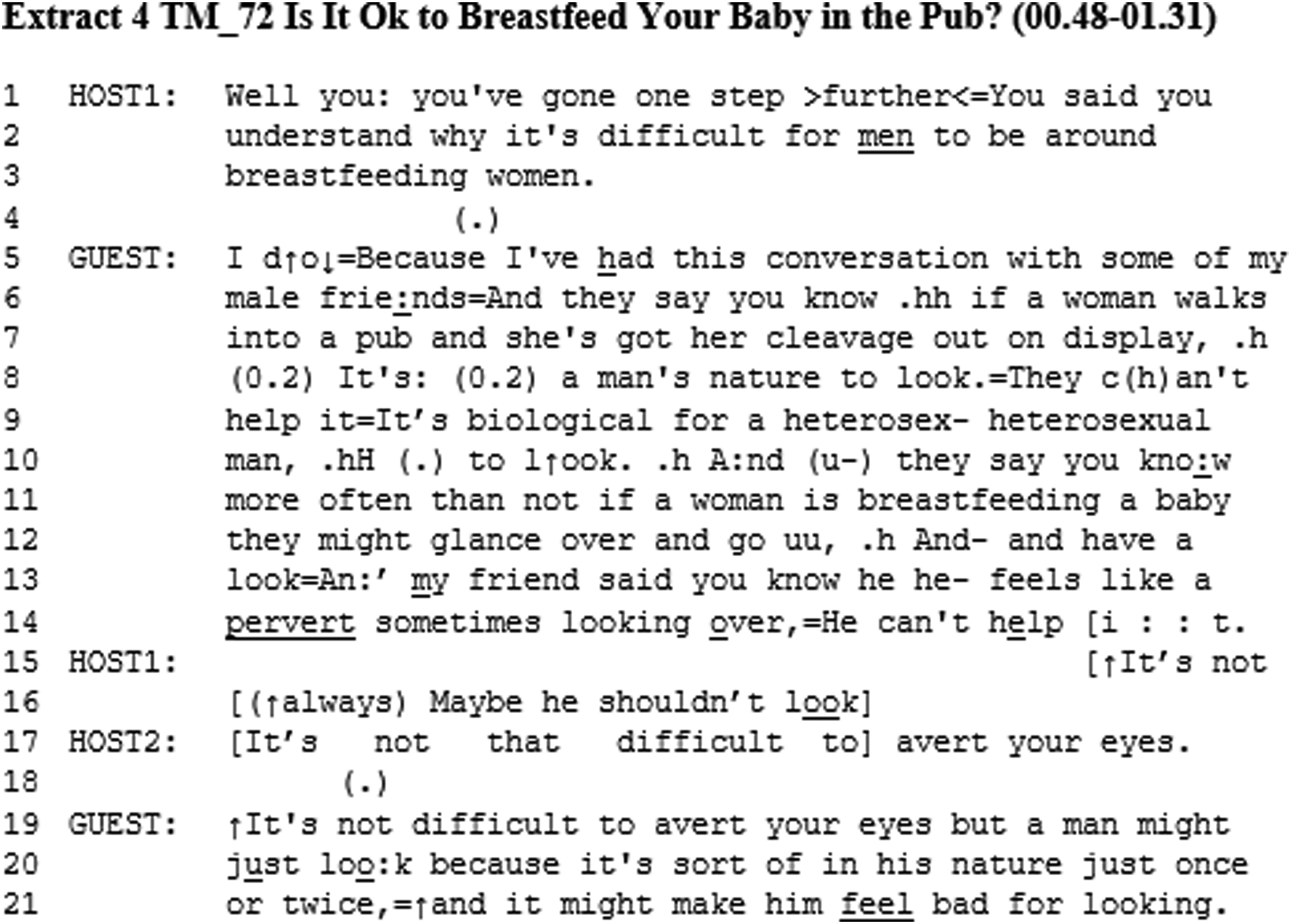
In Line 1, the host prompts the guest to justify siding with men who experience difficulties in the presence of breastfeeding women. Given prior talk (before Line 1) in which host and guest clashed over public breastfeeding, this prompt carries challenging undertones. Indeed, the guest's position is described as going “one step further” (Line 1), framing it as an even more controversial stance. The guest's emphatic confirmation “I d↑o↓” (Line 5) conveys a strong investment and displays her orientation to the ongoing dispute in which her views are being challenged (Billig, 1989).
In constructing her justification, she invokes prior conversations with male friends who shared their personal experiences around breastfeeding in the pub. Thus, her understanding of men's difficulties is grounded in accounts from trustworthy sources with direct access to such experiences. To ensure that these reactions are heard not as particular for a selected few male friends, but as potentially characteristic of all men, the speaker uses rhetorical vagueness (Potter, 1996) to indicate she spoke about this to “some of my male frie
Between Lines 5 and 14 there are three instances of reported speech wherein the guest shifts footing (Levinson, 1988) and voices the experiences of her male friend(s). First, she presents their perspective that a man is naturally conditioned to look at a woman's cleavage. This introduces the idea that men look at women's breasts not because they want to, but because it is “a man's nature” (Line 8). This claim is further reinforced by statements such as “They c(h)an’t help it” (Line 8) and “It's biological” (Lines 8–9), which portray the behaviour as outside of the looker's control and absolve him of any responsibility. Also, the hypothetical woman in question is depicted as having “her cleavage out on display” (Line 7), which portrays her as inviting the man's gaze and thus being responsible for it. Having established that men are biologically built to look at women's breasts, the speaker applies this to breastfeeding. In this second anecdote, men's conduct is constructed as involuntary through word choices such a “glance over” and ostensibly automated reactions as “go uu.” These paint a picture of men unwittingly spotting a breastfeeding woman, having an involuntary reaction, and continuing to look, all because of their biological build-up. The final switch to reported speech gives voice to men's subjective experiences of their own behaviour. Disclosing feelings of shame—“feels like a
Both hosts challenge this account in partial overlap (Lines 15–17), with HOST 2 countering the claim that looking away is difficult for men. The guest deals with this counter by reiterating her argument in a compact form. She concedes that looking away is not difficult, but that it is not the issue. Being hard-wired to “j
An appeal to the “biological bedrock” of human behaviour also appears in the next extract. In this segment, the interlocutors are debating the appropriate attire for a woman on a job interview. In Line 1, the host invites the guest, who has argued in favour of a less conservative attire, to defend her position. Our analysis focuses on the argumentative discourse she produces to justify it.
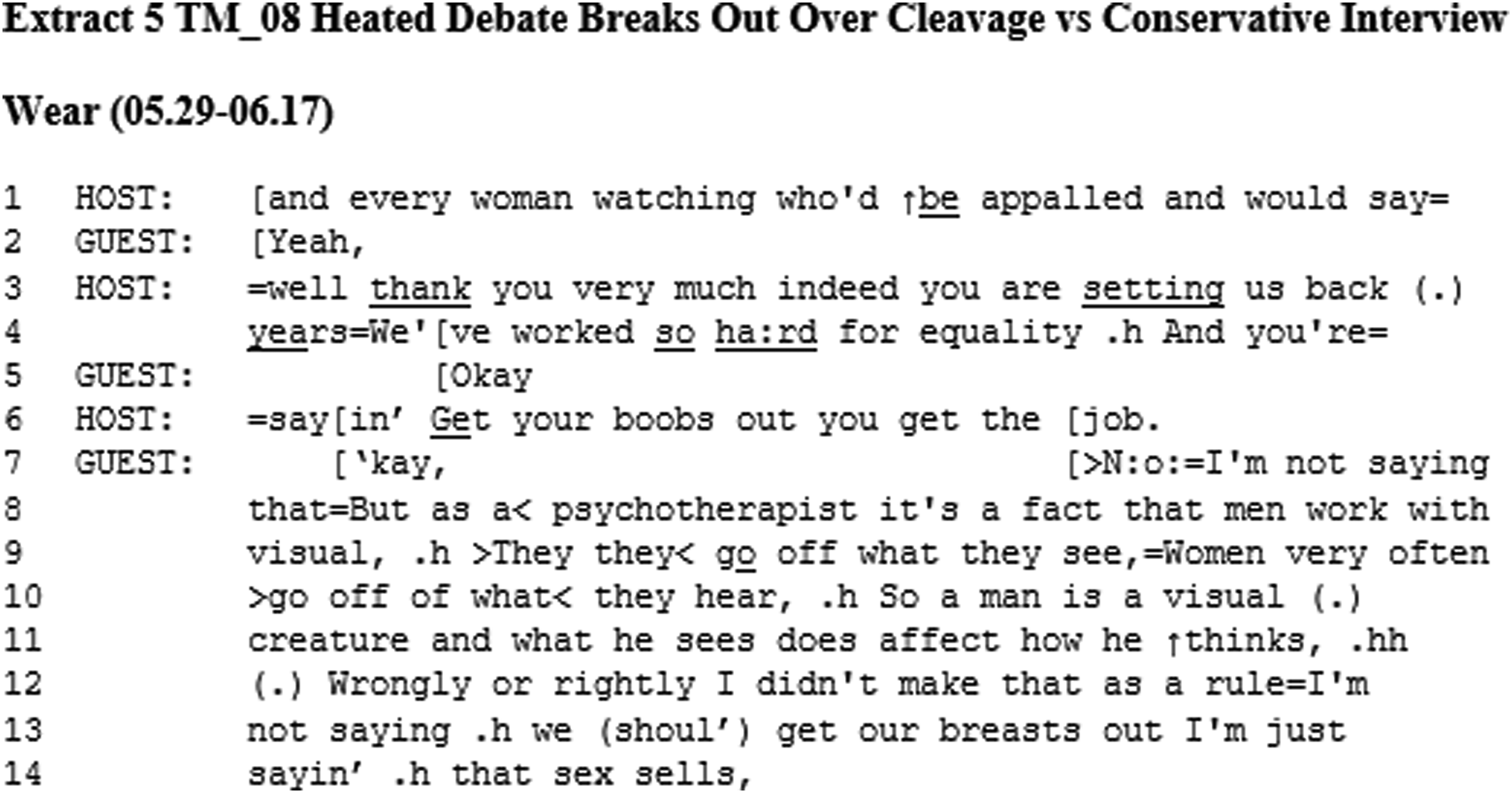
The host accuses the guest, on behalf of “every woman watching” (Lines 1, 3), that her views threaten gender equality. This first pair part makes relevant particular types of responses (Schegloff, 2007) such as a denial or an exonerating account (Atkinson & Drew, 1979). What follows in Lines 10–24 is just that: a denial “N:o: = I’m not saying that” accompanied by an exposition of the guest’s position. The latter is designed to counter the accusation of the speaker's personal responsibility for hampering gender equality and to bolster her position that ultimately “sex sells” (Line 17).
After flatly denying the host's accusation that she is encouraging women to exploit their looks, the guest builds an alternative account for her position. To preface this, she invokes her identity as a psychotherapist, a professional category that allows for her description of the psychology of men and women to be heard as grounded in her professional knowledge rather than appearing as her personal opinion (Potter, 1996). Building on this, she produces a generalised description, “it's a fact that men work with visual, .h > They they < go off what they see” (Lines 8–9), introduced as a fact and designed as a contrast between how men and women presumably function—although she leaves out what exactly this refers to. The speaker then delivers an essentialising upshot (Schiffrin, 1987) that reduces a man to the status of “a visual (.) creature” (Lines 13–14). Having constructed an ostensibly objective account of how men think, the speaker disavows any personal stake in this description (Edwards, 2007), which bolsters its factuality while also possibly orienting to the host's accusation prompting her account.
In this sequential context, she is now explicitly returning to that accusation and offering a counter-formulation of the position that the host attributed to her “I’m not saying .h we (shoul’) get our breasts out I’m just sayin’ .h that sex sells,” (Lines 16–17). This counter-formulation uses a contrast structure (Smith, 1978) featuring the disavowed position in the first part, “I’m not saying .h we (shoul’) get our breasts out,” and the upheld position in the second part, “I’m just sayin’ .h that sex sells.” Such a construction maximises the distinction between the two components. This separation effect is also accomplished by the use of the minimiser “just” (Lee, 1987) in the second component, where it instructs recipients to refrain from inferring more than the speaker has said.
Altogether, the guest presents herself as holding what has been constructed as a rational view—based on facts that she had access to due to her psychotherapist training—of the value of women's sexual attractiveness in their dealings with men. Thus, while she disavows advising women to exploit their appearance, she constructs an elaborate argument ultimately suggesting that men—as “visual” creatures—will always judge women's physical appearance and that women can profit from this through the way they dress. The danger of this line of reasoning lies not only in offering a basis upon which to police women's appearance (Jeffreys, 2005), but also in distorting the complex nature of gender relationships by reducing them to sexual attraction.
Both extracts shown so far feature justifications for challenged misogynist views that invoke men's biological make-up to account for their social conduct. Presented as factual, such explanations provide support for guests’ problematic views when hosts confront them. The final extract is slightly different: it features a case of transmisogyny whereby a guest refuses to recognise the other guest's gender identity (named India and referred to in Line 7). Here, biology is invoked not to excuse male behaviour, but to justify the first guest's exclusionary conduct (Henderson, 2022). Still, when challenged on their controversial standpoints, guests revert to the “biological bedrock” as a justification.
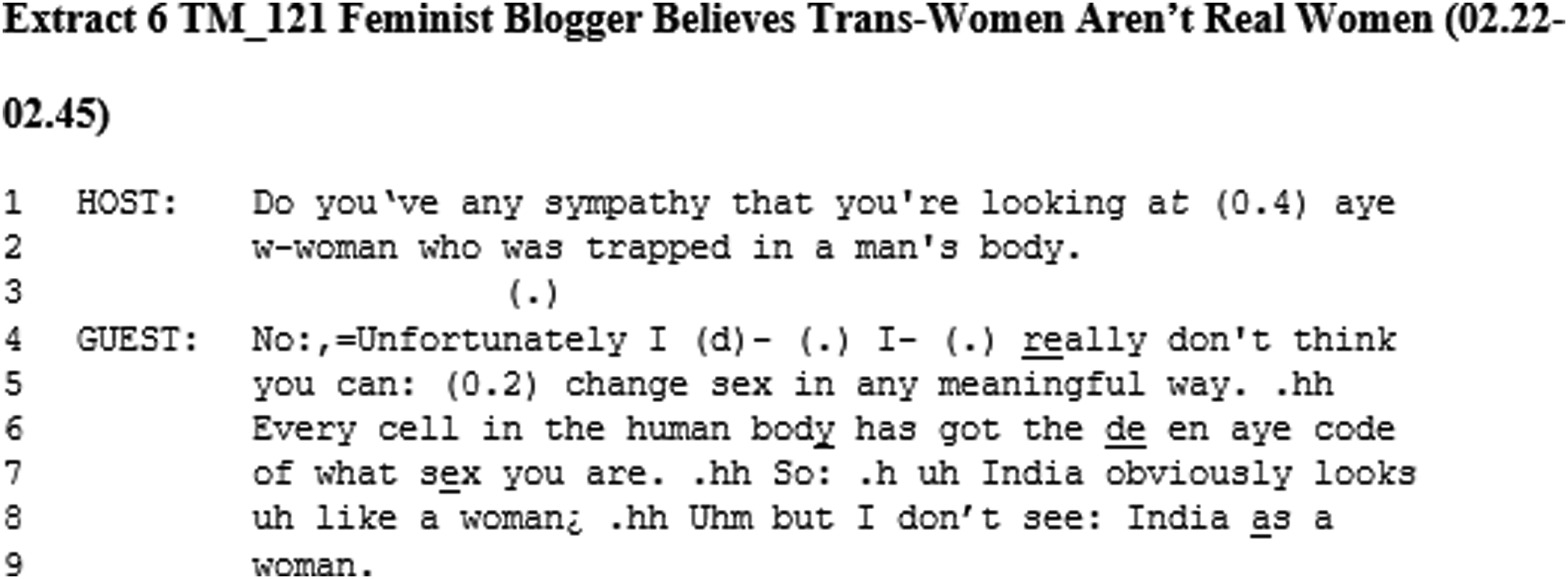
In Line 1, the host asks the guest whether she has sympathy for what India has been going through as a “w-woman who was trapped in a man's body” (Line 2). This is not just a simple question given that the guest has made clear her stance that she does not accept transwomen as women. Enquiring about her sympathy towards India puts the guest in a bind (Heinemann, 2008). If she responds affirmatively, she may appear to be contradicting herself, whereas if she responds negatively, she may appear cold-hearted for not sympathising with India's struggle.
The guest deals with this conundrum by producing a negative response followed by an account prefaced with a minimal display of regret to mitigate the disaffiliativeness of the response. Through the account, the guest conveys holding a belief that a person's sex cannot be changed “in any meaningful way” (Line 5). This qualification suggests that any changes that do occur are only superficial. Note also her choice of the term “sex” (instead of “gender”), which is used to index a person's biology. The genetic make-up of a person as either male or female is invoked as a further solid argument for why sex change is not possible. A person's identity as a man or a woman is reduced to the genetic material in their cells, which is treated as the ultimate determinant of a person's sex. The guest concludes her turn by contrasting India's appearance as a woman with how she, the speaker, sees her. This contrast is framed as a consequence of the biological roots (Henderson, 2022; Serano, 2007), and thus the speaker's refusal to accept India's identity appears ostensibly justified by biological facts. Through this refusal and the personal investment displayed in its formulation, the speaker claims the right to police gender boundaries, specifically to exclude transwomen from the gender category “women” to which she herself lays claim, and to deny India's self-categorisation. Thus, in this case, the boundaries between transmisogyny and transphobia become permeable with the guest moving from one to the other.
Discussion and conclusion
To the best of our knowledge, this article is the first to examine inconspicuous misogyny-in-action to uncover how it is served for breakfast to an audience in the millions. Using DP, we identified two sets of argumentative discursive practices through which misogynist views were either constructed as reasonable by being distinguished from established prejudiced tropes, or defended through appeals to ostensibly factual explanations about human biology. The two sets of practices were deployed in different interactional environments. Guests presented their views as reasonable when these were elicited by the hosts, whereas they defended their views when challenged.
The first analytic section showed how This Morning guests (a) first condemned widely recognisable misogynist viewpoints, thus presenting themselves as progressive, (b) then dissociated their own views from these recognisable misogynist tropes, (c) which in turn enabled them to construct their positions as reasonable and arguably nonmisogynist. However, we showed that these alternative positions still condemned women and that hosts treated them as problematic. Our analysis thus reveals guests’ orientation to a moral ban on misogyny (cf. Billig, 1988), which becomes visible in their attempts to ward off suspicions of bigotry and through their efforts to present their positions as reasonable. As documented in the case of other prejudiced conduct (Durrheim & Murray, 2021), this sets in motion the mechanism of dialogic repression whereby problematic (verbal) conduct is replaced by ostensibly acceptable alternatives. A case in point comes from Extract 2, where the guest explicitly denounces the negative implications of the term “blame” to then still find a way of assigning responsibility to victims for being assaulted.
The second analytic section focused on guests’ practices for defending their positions in response to challenges from hosts. Guests (a) strengthened their commitment to the espoused stances, (b) constructed justifications appealing to human biology, and thus (c) reinforced their stances as rational and supported by facts. The rhetorical resources drew on and reinforced essentialist binary theories of gender and a biological determinism of gendered behaviour and identity that have gone hand-in-hand with misogyny for centuries (Holland, 2006; Saini, 2017). In line with the moral ban on misogyny, bolstering misogynist views through biological arguments not only lent them support, but it also allowed speakers to take some distance from these problematic views (Edwards, 2007), which they presented as having been arrived at because they are rational and correct (Worth et al., 2016), not because they are self-serving or advantageous. Notably, in the last extract featuring transmisogyny, this is not the case. Here, after having constructed an argument about how male and female DNA is immutable, the speaker displays clear personal investment “So: .h uh India obviously looks uh like a woman¿ .hh Uhm but I don’t see: India
This article makes a series of contributions to the psychological scholarship on misogyny. First, it expands our knowledge of the range of settings in which misogyny thrives and the forms it takes therein. While there is a growing body of research addressing extreme forms of misogyny in online communication, less attention has been paid to subtle misogyny that inhabits everyday spaces and is often presented as reasonable, rational, or at least justifiable.
Second, by using DP to examine how speakers’ claims are rhetorically designed, this study documents inconspicuous misogynist views even when they are not explicitly labelled as such. While this raises the question of whether we, as analysts, imposed our agenda onto the data, we have strong evidence against this suspicion. While the speakers do not explicitly treat their own stances as problematic, we showed that they orient to possible accusations of bigotry, for example, by disavowing recognisable misogynist views and by appealing to scientific explanations for them. Moreover, we noted that interlocutors do treat speakers’ talk as problematic, thus providing further evidence for our analysis that is grounded in participants’ orientations (Speer, 2002).
As a third contribution, this article expands the body of work that has demonstrated how contemporary prejudiced conduct in talk-in-interaction is designed as defeasible (Whitehead & Stokoe, 2015). Our analysis suggests that modern misogyny is increasingly subtle not because it is perpetrated unconsciously and unintentionally (Anderson, 2015), but because it may be strategically constructed to forestall denunciation.
Relatedly, fourth, the discursive practices identified here give us insight into how misogyny resists eradication while also taking new shapes. This study begins to explicate how misogynist conduct has evolved through dialogic repression (Billig, 1998) as one of the mechanisms through which misogyny mutates into subtler forms, becoming more difficult to recognise and challenge (cf. Joyce et al., 2021).
Last, our findings provide evidence for how misogyny is not confined to individual minds. Instead, it can be found in practices employed by speakers in talk-in-interaction. Misogyny, like racism, is not a product of a “bigoted mind” (Burke & Demasi, 2020, p. 207), but one of “bigoted interactions” and, like other forms of prejudice, it “comes to life, propagates, and sustains itself in and through discourse and communication” (Tileagǎ, 2014, p. 82).
A practical implication of this study pertains to informing interventions aimed at curbing misogyny. We suggest that such interventions should not be centred on changing individuals and their attitudes or behaviours, but instead be designed to empower people to recognise and confront subtle forms of misogyny, ideally using real-life examples (Stokoe, 2014).
This paper is not without limitations. First, our data originate from a single morning television show broadcast in the United Kingdom, so analyses of other programmes in other countries might provide slightly different insights. We hope that more research into on-air misogyny will be conducted, as this is an underresearched environment. Second, we refrained from making any claims about how widespread the identified practices are. In line with DP, this study aims to characterise the practical accomplishment of misogyny in morning television shows rather than document its prevalence. However, even if the cases in our dataset were one-off manifestations of misogyny, still millions of viewers have been exposed to them, and thus understanding their logic (Manne, 2017) is valuable.
Supplemental Material
sj-docx-1-fap-10.1177_09593535231197526 - Supplemental material for Porridge and misogyny: Rationalising inconspicuous misogyny in morning television shows
Supplemental material, sj-docx-1-fap-10.1177_09593535231197526 for Porridge and misogyny: Rationalising inconspicuous misogyny in morning television shows by Anna Ridley, Bogdana Humă and Linda Walz in Feminism & Psychology
Footnotes
Acknowledgements
First, we would like to thank Hannah Anderson for the high-quality transcription and data management work she has done as a research assistant on this project. We are also grateful to York St John University and Leeds Trinity University for the financial support received to undertake this study. Finally, we are thankful to the two anonymous reviewers who have provided very helpful and insightful comments on the manuscript.
Declaration of conflicting interests
The author(s) declared no potential conflicts of interest with respect to the research, authorship, and/or publication of this article.
Funding
The author(s) disclosed receipt of the following financial support for the research, authorship, and/or publication of this article: This work was supported by York St John University and Leeds Trinity University (Psychology QR funding 2020/21, Research Support Scheme 2021/22).

Supplemental material
Supplemental material for this article is available online.
Author Biographies
Appendix
A selection of the multimodal transcription conventions.
|
|
Two identical symbols mark the beginning and the ending of an embodied movement The description of the movement is enclosed between the two “start” and “end” identical symbols The participant's name/identification is written in lowercase letters The whole line is italicised |
|
|
The marking of the beginning and ending of the embodied movement is synchronised with other co-occurring actions such as speech, performed by the same and/or by different participant(s) |
| A movement that stretches over more than one line is marked by the use of an arrow after the description. The ending of the movement is subsequently indicated by another similar arrow preceding the “end” symbol |
Note. Adapted from Mondada (2018).
References
Supplementary Material
Please find the following supplemental material available below.
For Open Access articles published under a Creative Commons License, all supplemental material carries the same license as the article it is associated with.
For non-Open Access articles published, all supplemental material carries a non-exclusive license, and permission requests for re-use of supplemental material or any part of supplemental material shall be sent directly to the copyright owner as specified in the copyright notice associated with the article.
