



Abstract
Although many Western democracies have made important strides toward egalitarianism in recent years, members of the LGB+ community continue to endure sustained animus. Yet, little empirical work has examined the ideologies that promote sexual prejudice in the twenty-first century. We address this oversight by positing that hostile sexism temporally precedes increases in sexual prejudice for both men and women. Accordingly, we used nine annual waves (2014–2023) of longitudinal panel data from a nationwide random sample of New Zealand adults to examine the within-person cross-lagged associations between ambivalent sexism and sexual prejudice across heterosexual men (n = 22,751) and women (n = 38,004). As hypothesized, hostile sexism (but not benevolent sexism) predicted within-person increases in sexual prejudice for both heterosexual men and heterosexual women over time. These results replicated across ethnic majority men and women, ethnic minority men (but not women), and LGB+ men (but not women), as well as when adjusting for participants’ age. Together, these results demonstrate that the pernicious effects of hostile sexism extend beyond women's rights, and highlight the importance of addressing sexism to foster broader egalitarian ideals over time. Additional online materials for this article are available on PWQ's website at http://journals.sagepub.com/doi/suppl/10.1177/03616843241275579.
Despite ostensible steps toward egalitarianism over the last two decades (e.g., see Eagly et al., 2020; Huang et al., 2019), members of the LGB+ community continue to face substantial animus from the public (Poteat & Birkett, 2017; Wight et al., 2013). Indeed, although supposedly “egalitarian” nations—including New Zealand (i.e., the location of the current study)—have passed progressive legislation on same-sex marriage, these important victories have been met with hostility from members of structurally advantaged groups. For example, conservative politicians have relied upon traditional gender roles to undermine various rights for the LGB+ community, including protections under New Zealand's hate speech laws (Greensmith-West, 2022). Given the recent rise in hate crimes against members of the LGB+ community (Camut, 2023) and the threat to overturn Obergefell v. Hodges in the United States (US; Aguilera, 2022), it is critical to identify the ways in which sexual prejudice is maintained in the twenty-first century.
The present study aims to address this lingering question by utilizing nine annual waves of longitudinal panel data spanning 8 years (i.e., 2014–2023) to investigate the within-person associations between ambivalent sexism and sexual prejudice across men and women. We begin by reviewing research on sexual prejudice to illustrate that traditional gender role attitudes correlate positively with hostile attitudes toward members of the LGB+ community. We then explain how hostile sexism predicts animosity toward those who violate traditional values. Our introduction concludes with an overview of the aims and hypotheses of the current study.
The Nature of Sexual Prejudice
Sexual prejudice encompasses negative—and often overtly hostile—attitudes toward members of the LGB+ community on the basis of sexual orientation (i.e., it is not a measure of prejudice toward gender identity or gender transition; Poteat & Birkett, 2017). Scholars have previously utilized a myriad of terms to capture the expansive ways in which members of the LGB+ community have been discriminated against over time (Poteat & Birkett, 2017), including (but not limited to) homophobia, sexual stigma, heterosexism, and sexual (orientation) prejudice (Herek, 2004; Poteat & Birkett, 2017). Although these terms have relevance within specific times and spaces (e.g., “heterosexism” is particularly helpful in understanding the role of structural systems in undermining LGB+ rights; see Herek, 2004; Poteat & Birkett, 2017), Herek (2004) argued that the term sexual prejudice best captures the negative attitudes directed toward LGB+ people in the twenty-first century. Specifically, sexual prejudice (as opposed to the other aforementioned terms) was specifically conceptualized to explicate attitudes (rather than stigma) toward the LGB+ community (also see Poteat & Birkett, 2017). Accordingly, we adopt this terminology throughout this manuscript.
A growing literature documents the ubiquity of sexual prejudice in contemporary society. For example, lesbian and gay job applicants are perceived as less competent and hireable than their heterosexual counterparts (Bryant-Lees & Kite, 2021). Once employed, members of the LGB+ community report higher rates of workplace harassment (Sears & Mallory, 2011) and lower incomes (Badgett, 1995) than people who identify as heterosexual. Given these pervasive inequities, it is unsurprising that members of the LGB+ community have higher poverty rates (Albelda et al., 2009) and poorer health outcomes (Fingerhut et al., 2010; Fredriksen-Goldsen et al., 2012) than their heterosexual counterparts.
These deleterious outcomes are not, however, inherent to the LGB+ community. Rather, the inequities noted above emerge due to prolific rates of discrimination against members of the LGB+ community (Poteat & Birkett, 2017; Wight et al., 2013). Indeed, Hatzenbuehler et al. (2010) revealed that members of the LGB+ community who live in states with legal protections from hate crimes and employment discrimination have lower levels of anxiety and depression than their counterparts who live in states without these protections. Likewise, the legal and social acceptance of same-sex relationships correlated positively with feelings of social inclusion among married members of the LGB+ community (Badgett, 2011). Accordingly, the legalization of same-sex marriage in the US attenuated the mental health disparities between members of the LGB+ community and heterosexual people (Wight et al., 2013).
Although the promotion of equal rights for a historically marginalized group should be sufficient motivation for examining the antecedents to sexual prejudice, the acceptance of sexual minorities also provides societal benefits that extend beyond members of the LGB+ community. For instance, Badgett et al. (2014) found in an analysis of 39 countries that LGB+ acceptance correlated positively with nationwide gross domestic product. Progressive LGB+ laws also correlated positively with egalitarian policies in adjacent domains, such as reproductive rights (Henry et al., 2022). Thus, progressive LGB+ policies often coincide with numerous societal benefits.
Predicting Sexual Prejudice
Despite the benefits associated with progressive LGB+ laws, hostilities toward the LGB+ community remain. As such, a growing literature has investigated the predictors of sexual prejudice, with scholars arguing that traditional gender roles are closely intertwined with heterosexuality (Kite & Whitley, 1996, 1997). Specifically, an LGB+ identity is often perceived to conflict with traditional gendered expectations (Doyle et al., 2015). Accordingly, support for traditional gender roles and masculinities predict opposition to same-sex relationships (Bryant-Lees & Kite, 2021; Osborne & Wagner, 2007). Likewise, longitudinal research revealed that the endorsement of traditional gender roles at age 18 predicted increased sexual prejudice 3 years later (Hooghe & Meeusen, 2012).
The endorsement of traditional gender roles may also explain why men express more bias toward the LGB+ community than women (Herek, 1988; Kite & Whitley, 1996, 1997; Poteat & Birkett, 2017). Because society values masculinity over femininity, Kite and Whitley (1996) theorized that the perceived deviation from men's prescribed gender roles is viewed as more egregious than perceived deviations from women's traditional gender roles. Heterosexual men can, however, emphasize their masculinity by divorcing themselves from femininity and condemning those who violate traditional gender roles (e.g., some members of the LGB+ community). Therefore, it is unsurprising that heterosexual men display more sexual prejudice than women toward the LGB+ community (Kite & Whitley, 1996; LaMar & Kite, 1998). Taken together, these findings illustrate that conservative gender role attitudes reliably predict attitudes toward the LGB+ community, particularly among heterosexual men.
Ambivalent Sexism and Sexual Prejudice
Despite the growing interest in the relation between conservative gender ideologies and sexual prejudice, surprisingly little research has considered the impact of sexism on attitudes toward the LGB+ community. Related work does, however, highlight that sexism undermines egalitarianism in more subtle and pervasive ways that are not captured by traditional gender role ideologies (Connor et al., 2017). Specifically, ambivalent sexism theory proposes that, unlike most intergroup relations that are characterized by hostility between groups, gender relations remain cooperative (Glick & Fiske, 1996). That is, despite a clearly gendered hierarchy, men and women depend on each other for heterosexual intimacy (Glick & Fiske, 1996; Glick et al., 1997). As such, Glick and Fiske (1996) theorized that sexism consists of two distinct, albeit complementary, ideologies: Hostile sexism and benevolent sexism. Whereas hostile sexism encompasses animosity toward women who challenge traditional gender roles (e.g., feminists), benevolent sexism portrays women as docile and reveres those who conform to traditional yet restrictive gender roles (e.g., wives and mothers).
Although hostile and benevolent sexism predict distinct attitudes toward different subtypes of women (Glick et al., 1997; Sibley & Wilson, 2004), these ideologies are highly correlated and work together to enable a subtle form of social control that neither ideology could achieve alone (Glick & Fiske, 1996, 2001). Whereas hostile sexism elicits overt animosity toward women who violate traditional gender roles and provokes resistance from women (Connor et al., 2017; Glick & Fiske, 2001), benevolent sexism encompasses a superficially positive tone and is generally perceived as “nonsexist” (Connor et al., 2017; Hopkins-Doyle et al., 2019). Thus, Glick and Fiske (1996) argued that benevolent sexism enables the maintenance of heterosexual intimacy by rewarding women who conform to traditional gender roles with positive regard, whereas hostile sexism maintains a gendered hierarchy by punishing those who violate traditional values. Indeed, a cross-cultural analysis of 19 countries confirmed that national levels of hostile and benevolent sexism correlate positively with gender inequality across countries (Glick et al., 2000). Thus, hostile and benevolent sexism are highly correlated ideologies that work together to maintain gender inequality.
Although hostile sexism evokes disdain toward gender role violations (Connor et al., 2017; Glick et al., 1997), direct evidence that hostile sexism precedes changes in sexual prejudice is lacking. It is likely, however, that hostile sexism fosters animosity that extends beyond women toward others who transgress traditional gender roles—including members of the LGB+ community. Consistent with this argument, Bills and Hayes (2022) used nationally representative cross-sectional data from the US to show that hostile sexism predicted negative attitudes toward members of the LGB community. Research utilizing student samples from Turkey (see Sakalli, 2002) and the US (see Nagoshi et al., 2008) also revealed that hostile, but not benevolent, sexism correlated positively with hostile attitudes toward homosexuality for both men and women. These studies show that the relation between ambivalent sexism and attitudes toward the LGB+ community is isolated to the antagonistic aspect of ambivalent sexism (i.e., hostile sexism), as benevolent sexism only predicted sexual prejudice when hostile sexism is excluded from the analyses (e.g., Nagoshi et al., 2019). In other words, ambivalent sexism—and hostile sexism in particular—correlates positively with various indicators of animosity toward members of the LGB+ community.
Current Study
Although prior research provides insights into the relation between ambivalent sexism and sexual prejudice, numerous questions remain. Namely, because extant research has relied almost exclusively on cross-sectional data, it is unclear how ambivalent sexism impacts peoples’ attitudes toward sexual minorities over time. It is possible that ambivalent sexism—specifically hostile sexism—precedes changes in sexual prejudice. Specifically, conservative gender ideologies predicted sexual prejudice over time (see Hooghe & Meeusen, 2012), and the animosity of hostile sexism extended toward the LGB+ community (Bills & Hayes, 2022; Nagoshi et al., 2008; Sakalli, 2002). As such, hostile sexism should undermine support for members of the LGB+ community over time. We investigated this possibility by utilizing a multigroup random intercept cross-lagged panel model (RI-CLPM) to examine the within-person associations between ambivalent sexism and sexual prejudice across men and women. Notably, we focused on general attitudes toward homosexuality rather than attitudes toward specific gender minorities (e.g., attitudes toward transgender or nonbinary people) and/or differing attitudes toward different sexual minorities (e.g., attitudes toward gay men compared to lesbian women).
Akin to a traditional cross-lagged panel model (CLPM), an RI-CLPM utilizes longitudinal panel data to estimate cross-lagged effects across time (Hamaker et al., 2015). But unlike the traditional CLPM, an RI-CLPM estimates correlated random intercepts to isolate the between-person differences (i.e., ways in which people differ from one another) and within-person differences (i.e., the ways in which the same person changes over time; Hamaker et al., 2015; Osborne & Little, 2024). Given that most psychological theories (including ambivalent sexism) emphasize within-person effects (see Osborne & Little, 2024; Sibley & Becker, 2012), it is essential to separate these two processes in order to increase understanding of the psychology of sexism. The multigroup RI-CLPM extends this approach by investigating whether within-person changes differ between groups (Mulder & Hamaker, 2021; Osborne & Little, 2024). Because men tend to score higher than women in sexual prejudice (e.g., Herek, 1988; Kite & Whitley, 1997; Poteat & Birkett, 2017), we assessed the possibility that the associations between ambivalent sexism and sexual prejudice are stronger for heterosexual participants who self-identify as men (vs. women). Unfortunately, sample size restrictions prevented us from examining these processes among those who explicitly identified as transgender or gender-diverse.
Our focus on heterosexual participants who self-identified as (only) men or women is necessary for numerous reasons. First, because heterosexual intimacy is a main component of ambivalent sexism theory, items in the Ambivalent Sexism Inventory focus exclusively on cisgender heterosexual people (i.e., the Ambivalent Sexism Inventory was never intended to measure LBGTQ+ peoples’ sexism; see Cross et al., 2021; Glick & Fiske, 1996). Thus, the meaning of ambivalent sexism varies across heterosexual and LGB people (Cowie et al., 2019; Cross et al., 2021). For similar reasons, the Ambivalent Sexism Inventory should be variant across gender identities (e.g., gender diverse and transgender individuals; see Cross et al., 2021). Using the Ambivalent Sexism Inventory to measure sexism among members of the LGB+ community may misrepresent their actual attitudes (Cross et al., 2021). Accordingly, we focus our primary analyses on heterosexual participants who self-identify as (only) male or female. Nevertheless, we performed a separate multigroup RI-CLPM with LGB+ men and women (see Online supplementary materials) to explore potential differences and similarities across heterosexual and LGB+ participants.
Hypotheses
Consistent with the tendency to punish gender role violations, cross-sectional research from the US and Turkey demonstrated that hostile, but not benevolent, sexism correlated positively with sexual prejudice (Bills & Hayes, 2022; Nagoshi et al., 2008; Sakalli, 2002). Longitudinal research also showed that conservative gender ideologies predicted increases in sexual prejudice over time (Hooghe & Meeusen, 2012). Thus, hostile (but not benevolent) sexism should precede within-person increases in sexual prejudice across an 8-year period. To demonstrate that these effects are unique to the antagonistic aspect of ambivalent sexism (i.e., hostile sexism), we adjusted for benevolent sexism. We also used a multigroup RI-CLPM to examine the possibility that the within-person cross-lagged effect of hostile sexism on sexual prejudice is stronger for men (vs. women). In doing so, we provided the first examination of the within-person longitudinal associations between ambivalent sexism and sexual prejudice across men and women.
Method
Sampling Procedure
Data for the current study came from nine annual waves of the New Zealand Attitudes and Values Study (NZAVS). Sampling took place over nine separate occasions. The initial sampling occasion in 2009 (Time 1) recruited 6,518 participants (response rate = 16.6%) via the New Zealand electoral roll (i.e., a list of registered voters in New Zealand). Because voter registration is compulsory in New Zealand, this sampling approach reflects a random sample of New Zealand adults. To account for sample attrition, a nonrandom booster sample was recruited in 2011 (Time 3) via a nationwide news website. This second sampling occasion yielded 2,966 participants.
Seven additional booster samples were recruited between 2012 and 2023 to enhance the size and diversity of the sample. The sampling occasions in 2012 (Time 4), 2013 (Time 5), and 2016 (Time 8) oversampled hard-to-reach populations from the electoral roll. These three sampling occasions yielded 5,107 new participants at Time 4 (response rate = 9.98%), 7,579 new participants at Time 5 (response rate = 10.6%), and 7,667 new participants at Time 8 (response rate = 9.7%). Another sampling occasion in 2018 (Time 10) recruited 29,293 new participants (response rate = 9.2%) through the New Zealand electoral roll and an online paid promotion. Additional sampling occasions in 2019 (Time 11) and 2022 (Time 13) recruited 6,106 new participants and 1,301 new participants, respectively, through paid promotions (Time 11 and Time 13) and by asking participants to invite their partners to join the study (Time 11). The final sampling occasion in 2023 (Time 14) recruited 3,468 participants (response rate = 5.83%) through the New Zealand electoral roll and another paid promotion. This final sampling occasion resulted in a total sample of 33,722 participants (29.35% retention from Time 1, 70.39% retention from Time 13; full details on the sampling procedures and retention rates can be found at the NZAVS OSF page: https://osf.io/75snb/). Times 2, 6, 7, 9, and 12 did not undergo additional booster sampling (for a full overview of the sampling procedures for the NZAVS, please see Sibley, 2024). We focused on data from Times 6 to 14 because these were the first and last consecutive waves to assess sexual prejudice to date.
Participants
The current study focused on the 60,755 participants included in Times 6–14 of the NZAVS who provided complete or partial responses to our focal variables at one or more assessment occasions (Mwaves = 3.9, range = 1–9) and identified as heterosexual. Of these participants, 37.3% identified as male (n = 22,751), and 62.7% as female (n = 38,004; see Table S1 in the online supplemental materials). In addition, 78.7% identified as New Zealand European (n = 47,834), 12% as Māori (n = 7,363), 2.5% as Pacific Nations ancestry (n = 1,514), 5.3% as Asian ancestry (n = 3,184), and 1.6% did not report their ethnicity (n = 950). The mean age of the sample was 50.4 (SD = 13.8) at Time 6. In a set of robustness checks, we also assessed the relation between ambivalent sexism and sexual prejudice in a separate subsample of the NZAVS comprised of LGB+ men (n = 2,272) and women (n = 4,824).
Materials
The current study included measures of sexual prejudice, ambivalent sexism, gender, and sexual orientation. All measures were included in a large omnibus survey with additional measures outside the scope of the present study. Unless stated, all items were rated on a 1 (strongly disagree) to 7 (strongly agree) scale. Table S1 in the online supplemental materials displays the descriptive statistics for men and women for our focal variables across all nine time points, and Table S2 in the online supplemental materials displays the corresponding bivariate correlations.
Sexual Prejudice
Sexual prejudice was measured at each time point with one item adapted from Pew Research Center (2008): “I think that homosexuality should be accepted by society” (reverse-coded). Although we only leveraged a single-item measure of sexual prejudice, this item had high face validity and has been utilized across cultures to capture broad attitudes toward homosexuality (Poushter & Kent, 2020). Indeed, the term “homosexuality” is well-understood across generations and cultures and can, therefore, accurately capture participants’ level of sexual prejudice across time. Further demonstrating its validity, our sexual prejudice item has a strong negative correlation with support for same-sex marriage across time in our data set (r = −.73 to −.88, ps < .001).
Hostile and Benevolent Sexism
Hostile and benevolent sexism was measured at each time point using 10 items from Glick and Fiske's (1996) Ambivalent Sexism Inventory. The five items for hostile sexism included: “Once a woman gets a man to commit to her, she usually tries to put him on a tight leash.” The five items for benevolent sexism included: “Every man ought to have a woman whom he adores.” Responses to hostile sexism and benevolent sexism subscales were reliable across all assessment occasions (αs ranged from .81 to .85 and .71 to .74, respectively; see Table S2 in the online supplemental materials). Notably, the Ambivalent Sexism Inventory has been validated in many countries, including in New Zealand via (for example) confirmatory factor analysis (Glick & Fiske, 1996; Glick et al., 2000; Sibley et al., in press) and measurement invariance tests across both time and gender (Huang et al., 2019).
Gender
Gender was measured at each time point using an open-ended item that asked participants, “What is your gender?.” Gender was then coded as a dichotomous variable (0 = woman, 1 = man; see Fraser et al., 2020). This open-ended item was developed as a gender-inclusive measure by the NZAVS to allow participants to describe their gender using their preferred term(s). Because less than 1.0% of participants self-identified as gender-diverse or transgender in our sample, the sample size of gender-diverse participants was too small (i.e., 0.7% of the total sample) to utilize with our analytic approach. Also, because many members of the community do not explicitly report a transgender identity (i.e., self-report as “male” or “female”; see Fraser et al., 2020; Lilly et al., 2023), our gender measure is unable to identify all transgender and gender-diverse participants in our sample. Thus, we included all (cisgender and transgender) participants who self-identified as (only) men or women across assessment occasions. But, due to the sample size issues and uncertainty in our measure, we decided to exclude those who explicitly self-identified as gender-diverse. We also excluded participants who reported one or more changes in their gender identity over the 8-year period, as it was unclear if these changes were reported in error or if they reflected an earnest change in gender identity over time.
Sexual Orientation
Sexual orientation was measured with an open-ended question that asked participants, “How would you describe your sexual orientation?.” Sexual orientation was then coded according to a scheme developed for the NZAVS (0 = missing, 1 = heterosexual, 2 = not heterosexual; Greaves et al., 2017). Because people who have ever identified as LGB+ may have a different experience with heterosexual intimacy—and, thus, ambivalent sexism (see Cowie et al., 2019)—we focused our primary analyses on those who consistently reported a heterosexual identity over time. That is, we excluded participants who experienced changes in sexual orientation across time (e.g., changes between “heterosexual” and “lesbian” over time) or reported any identity that did not align with heterosexuality (including responses like “I don’t know” or “anything goes”). Our robustness checks focused on the subset of participants who identified as members of the LGB+ community (i.e., not heterosexual) on one or more assessment occasions.
Results
Analytic Strategy
To examine gender differences in the associations between ambivalent sexism and sexual prejudice, we performed a multigroup RI-CLPM in Mplus v. 8.7. Whereas traditional CLPMs estimate cross-lagged effects across time, this approach conflates between-person differences and within-person effects (see Berry & Willoughby, 2017). Although there are various analytic approaches for isolating between-person and within-person effects, an RI-CLPM is particularly versatile because it does not require intensive longitudinal data (i.e., an RI-CLPM requires three or more waves of data). An RI-CLPM (compared to other strategies) also has various extensions that enable us to test our hypotheses (e.g., multigroup analyses are easily implemented; Mulder & Hamaker, 2021; Osborne & Little, 2024).
Unlike a traditional CLPM, an RI-CLPM estimates correlated random intercepts to separate the between-person stability (i.e., the ways in which people differ from one another) and within-person change (i.e., the ways in which the same person changes over time). By adjusting for between-person effects, an RI-CLPM ensures that the autoregressive effects resemble the within-person deviations of participants’ mean scores on ambivalent sexism and sexual prejudice over time, whereas the cross-lagged effects reflect the extent to which deviations from participants’ trait-level ambivalent sexism at one-time point predict deviations from their trait-level sexual prejudice at another time point (Hamaker et al., 2015). Thus, whereas the autoregressive parameters in a CLPM are related to autocorrelations, the autoregressive parameters in an RI-CLPM reflect within-person carry-over effects (Hamaker et al., 2015; Mulder & Hamaker, 2021). Regression toward the mean is also mitigated in an RI-CLPM given that the means are captured by the random intercepts. Because men score higher than women on sexual prejudice (Herek, 1988), we compared a multigroup model of the RI-CLPM in which the auto-regressive and cross-lagged effects were free to vary across men and women (i.e., there were no constraints across groups) to a model that constrained these paths to equality across groups. If constraining these paths to equality significantly reduces model fit (at least some of), the paths differ across genders.
Focal Analyses
Results revealed that our stationary multi-group RI-CLPM provided an excellent fit to these data, χ2(618) = 6132.283, CFI = .990, RMSEA = .017 [.017, .018], SRMR = .031. As for the between-person components of the model, the random intercepts for hostile and benevolent sexism correlated positively for both men (b = 0.390, SE = 0.009, p < .001; see Figure 1) and women (b = 0.538, SE = 0.007, p < .001; see Figure 2). Consistent with ambivalent sexism theory (see Glick & Fiske, 1996), these results indicate that women and men who tended to be high (low) on hostile sexism also tended to be high (low) on benevolent sexism over time. Likewise, the random intercepts for hostile sexism correlated positively with sexual prejudice for both men (b = 0.757, SE = 0.015, p < .001) and women (b = 0.517, SE = 0.008, p < .001). Finally, benevolent sexism correlated positively with sexual prejudice for men (b = 0.534, SE = 0.013, p < .001) and women (b = 0.470, SE = 0.009, p < .001).
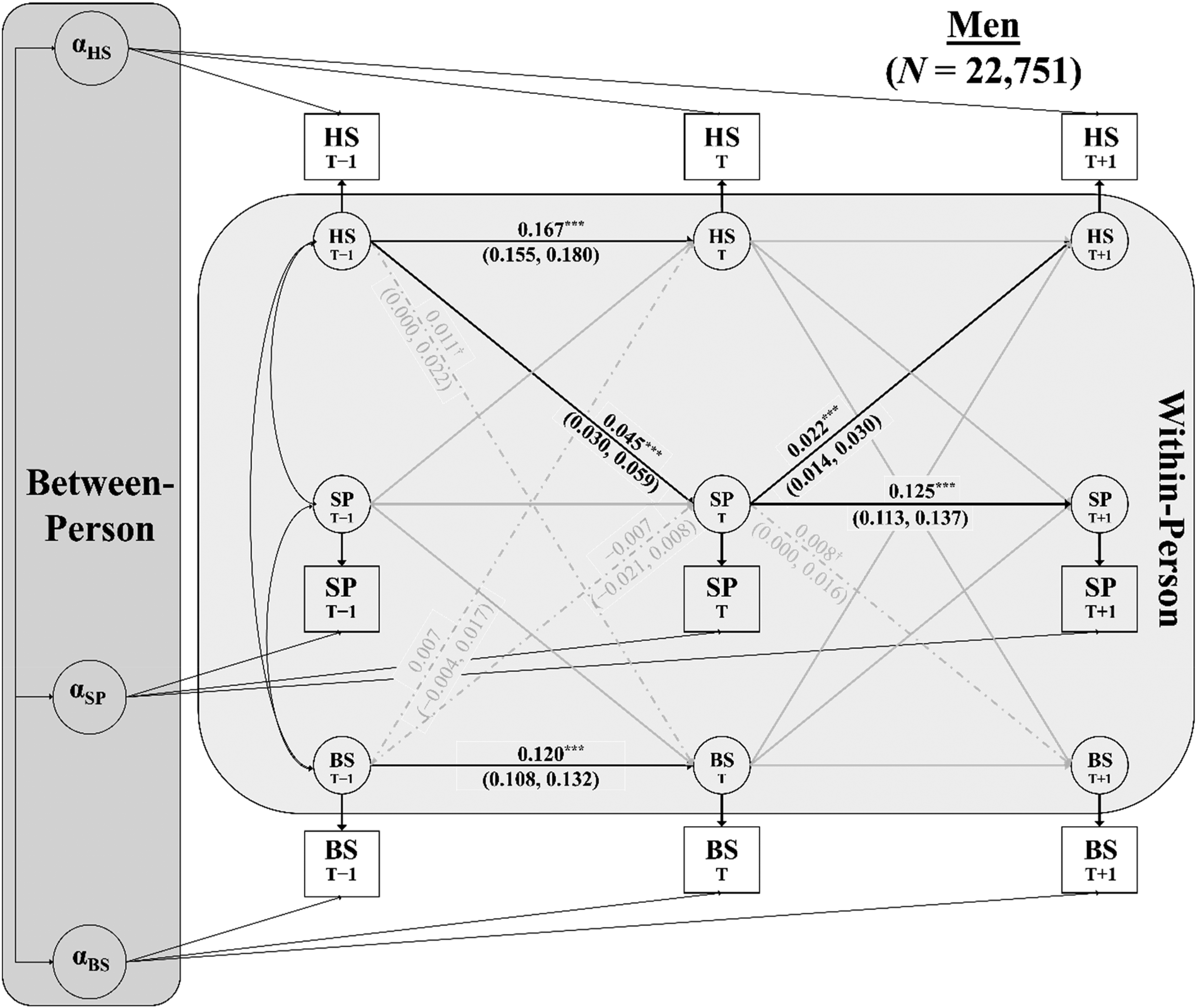
RI-CLPM of the Associations Between Ambivalent Sexism and Sexual Prejudice for Men.
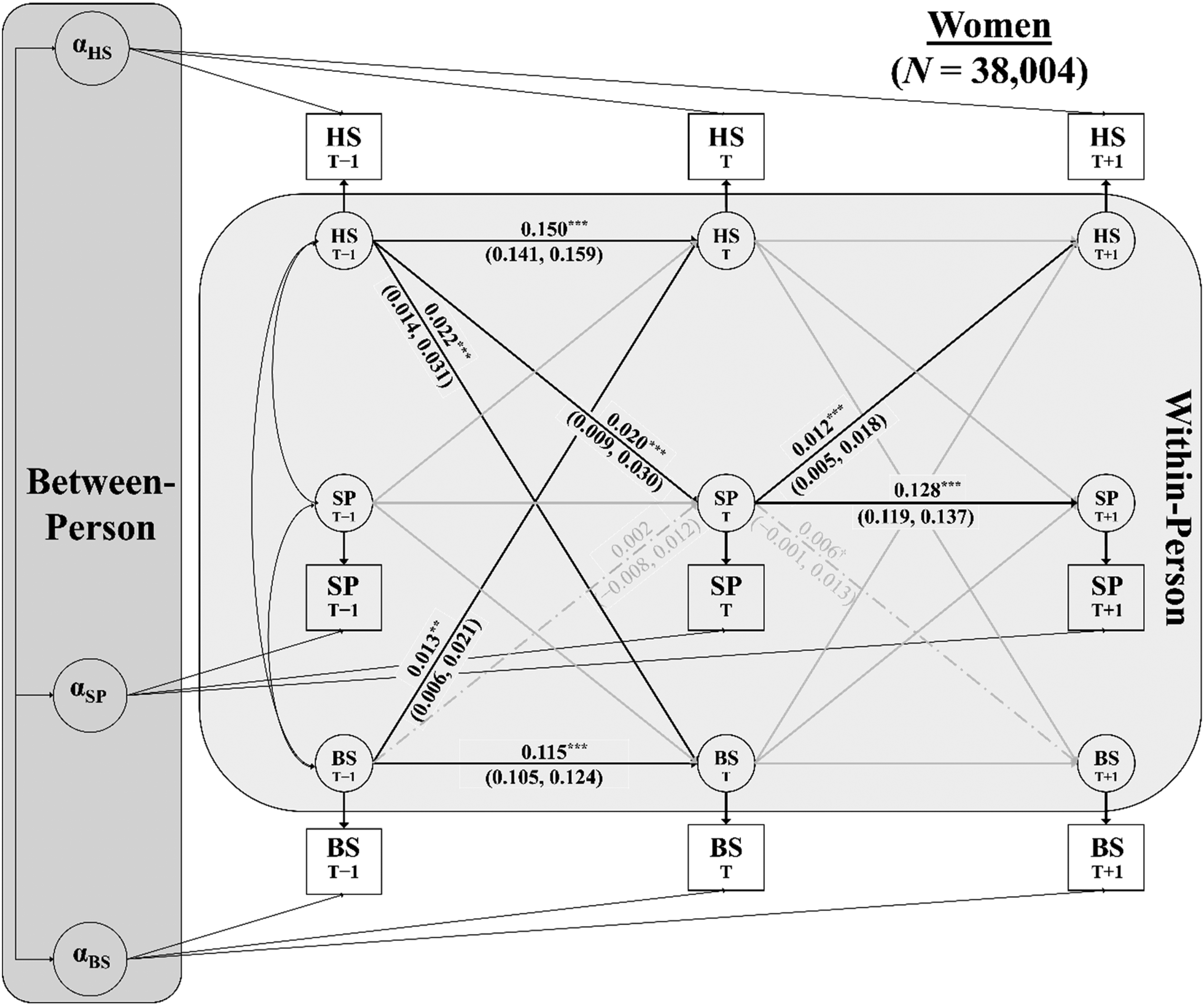
RI-CPLM of the Associations Between Ambivalent Sexism and Sexual Prejudice for Women.
After adjusting for the stable between-person differences in sexism and sexual prejudice, an inspection of the within-person paths revealed that each of the autoregressive effects were significant for both men and women. Specifically, Figure 1 reveals that the autoregressive effects for benevolent sexism (b = 0.120, SE = 0.006, p < .001), hostile sexism (b = 0.167, SE = 0.006, p < .001), and sexual prejudice (b = 0.125, SE = 0.006, p < .001) were significant for men across time. Because autoregressive effects in an RI-CLPM capture the extent to which a departure from one's trait-level mean persists at the following assessment, these results indicate that a 1-unit increase from men's trait-level benevolent sexism, hostile sexism, and sexual prejudice at one-time point persisted as a 0.120-, 0.167-, and 0.125-unit increase from their trait-level benevolent sexism, hostile sexism, and sexual prejudice (respectively) the next year. Figure 2 demonstrates that the autoregressive for benevolent sexism (b = 0.115, SE = 0.005, p < .001), hostile sexism (b = 0.150, SE = 0.005, p < .001), and sexual prejudice (b = 0.128, SE = 0.005, p < .001) were also significant for women.
Most importantly, examination of the within-person cross-lagged effects supports our hypotheses. Specifically, within-person increases in men's hostile sexism (b = 0.045, SE = 0.007, p < .001; see Figure 1) and women's hostile sexism (b = 0.020, SE = 0.005, p < .001; see Figure 2) at one-time point predicted subsequent increases in their sexual prejudice the following year. Notably, constraining these slopes to equality across men and women reduced model fit (χ2[1] = 7.635, p = .006). Thus, the strength of the relation between hostile sexism and sexual prejudice was stronger for men than women. In contrast, benevolent sexism was unassociated with departures in sexual prejudice the following year for both men (b = −0.007, SE = 0.007, p = .362) and women (b = 0.002, SE = 0.005, p = .670).
Although hostile sexism predicted increases in sexual prejudice for both men and women over time, the association between ambivalent sexism and prejudice may be reciprocal. Indeed, within-person changes in sexual prejudice at one-time point predicted subsequent within-person increases in hostile sexism for men (b = 0.022, SE = 0.004, p < .001; see Figure 1) and women (b = 0.012, SE = 0.003, p < .001; see Figure 2). However, within-person changes in sexual prejudice were unassociated with subsequent increases in benevolent sexism for men (b = 0.008, SE = 0.004, p = .062) and women (b = 0.006, SE = 0.003, p = .088). Together, these results illustrate the (bidirectional) relation between hostile (but not benevolent) sexism and sexual prejudice for both women and men.
Robustness Checks
To examine the robustness of our main analyses, we conducted three additional multi-group RI-CLPMs to see if our results replicated (a) when controlling for participants’ age, (b) across ethnic majority (i.e., New Zealand European) and minority (i.e., Māori, Pacifica, and Asian) group members, and (c) in a separate sample of participants who identified as LGB+. These supplementary analyses revealed that our results remained substantively unchanged when controlling for age (see Table S3, Figures S1–S2, and online supplementary materials). Likewise, within-person changes in hostile sexism at one-time point temporally preceded increases in sexual prejudice for ethnic majority men (b = 0.040, SE = 0.008, p < .001; see Figure S3 in the online supplemental materials), ethnic majority women (b = 0.021, SE = 0.006, p < .001; see Figure S4), and ethnic minority men (b = 0.058, SE = 0.019, p = .002; see Figure S5 in the online supplemental materials), but not ethnic minority women (b = 0.011, SE = 0.013, p = .405; see Figure S6 in the online supplemental materials). Finally, within-person increases in hostile sexism at one-time point predicted subsequent increases in sexual prejudice for LGB+ men (b = 0.045, SE = 0.016, p < .001; see Figure S7 in the online supplemental materials), but not LGB+ women (b = 0.015, SE = 0.011, p = .169; see Figure S8 in the online supplemental materials). As with our primary analysis, benevolent sexism was unassociated with departures in sexual prejudice the following year for ethnic majority, minority or LGB+ men and women (see the online supplementary file for full results).
Discussion
The current study examined the within-person longitudinal associations between ambivalent sexism and sexual prejudice for men and women. Although hostile sexism is positively correlated with sexual prejudice (Bills & Hayes, 2022; Nagoshi et al., 2008; Sakalli, 2002), the extant literature has relied exclusively on cross-sectional data. As such, it is unclear how ambivalent sexism impacts people's attitudes toward sexual minorities over time. We addressed this limitation by utilizing nine annual waves of longitudinal panel data to examine the within-person associations between ambivalent sexism and sexual prejudice for men and women. Because conservative gender ideologies predict sexual prejudice over time (Hooghe & Meeusen, 2012), and hostile (but not benevolent) sexism is associated with negative attitudes toward the LGB+ community (Bills & Hayes, 2022; Nagoshi et al., 2008; Sakalli, 2002), we anticipated that hostile (but not benevolent) sexism would correlate positively with within-person increases in sexual prejudice over time for men and women.
As predicted, our results revealed significant between- and within-person associations between ambivalent sexism and sexual prejudice over time. Specifically, our results at the between-person level revealed that men and women with (relatively) high levels of hostile sexism also reported (relatively) high levels of benevolent sexism. Likewise, those with (relatively) high levels of both hostile and benevolent sexism reported (relatively) high levels of sexual prejudice. More importantly, hostile (but not benevolent) sexism predicted within-person increases in sexual prejudice over time for both men and women. These results extend upon a growing literature focused on the relation between conservative gender ideologies—including hostile sexism—and sexual prejudice (e.g., Bills & Hayes, 2022; Nagoshi et al., 2008; Sakalli, 2002) to demonstrate that hostile sexism precedes within-person changes in sexual prejudice over nine annual assessments. Thus, our results illustrate that the animosity of hostile sexism is not specific to women, but rather, extends to others who violate traditional gender roles in ostensibly egalitarian societies.
We also separated our analyses by gender to reveal that the association between hostile sexism and sexual prejudice is significantly stronger for men than for women, irrespective of men's ethnic or sexual identity. Thus, consistent with Kite and Whitley (1996), men are more likely than women to condemn those who violate traditional gender roles (e.g., the LGB+ community), presumably because doing so allows them to reassert their masculine identity. In this case, it is unsurprising that hostile sexism—which promotes the punishment of gender role violations (Glick & Fiske, 1996)—more strongly undermines men's (compared to women's) support for the LGB+ community over time.
Notably, our robustness checks revealed that the relation between hostile sexism and sexual prejudice was unreliable for LGB+ women over time. These results corroborate our assumption that ambivalent sexism theory's emphasis on heterosexual intimacy renders the Ambivalent Sexism Inventory less relevant to those in same-sex relationships and, in particular, lesbian and bisexual women who, unlike gay and bisexual men, do not benefit (even indirectly) from hostile sexism (also see Cowie et al., 2019; Cross et al., 2021). Indeed, LGB+ women would appear to gain nothing from the endorsement of ambivalent sexism, as the protective paternalism found in benevolent sexism is predicated on the dyadic dependency between men and women in heterosexual relationships (Glick & Fiske, 1996). Accordingly, the underlying meaning of ambivalent sexism fundamentally differs for LGB+ women.
Relatedly, our robustness checks also showed that hostile sexism had no effect on sexual prejudice for heterosexual ethnic minority women. Although beyond the scope of our study, these results demonstrate the importance of intersectional approaches when examining the experiences of minoritized groups. Indeed, Western constructions of gender and (hegemonic) femininity are often weaponized against ethnic minority women (Hamilton et al., 2019). Thus, gender-role-conforming ethnic minority women do not reap the same benefits as their ethnic majority counterparts from downward comparisons to non-conforming women (cf. Becker, 2010). Changes in hostile sexism over time may, therefore, function differently across ethnic minority and majority women. In any case, these results illustrate the instrumental role of power and privilege in maintaining unequal systems (i.e., sexism and sexual prejudice) and demonstrate the need to take an intersectionality approach when examining various domains of oppression (see Carbado et al., 2013; Cho et al., 2013; Crenshaw, 1989). Future intersectional research is needed to further explicate the nuances of sexism and sexual prejudice among LGB+ and ethnic minority women.
Practice Implications
By utilizing nine consecutive annual waves of longitudinal panel data to perform a multigroup RI-CLPM, to our knowledge, we are the first to examine how ambivalent sexism impacts the same peoples’ sexual prejudice over time. In doing so, we extended prior inferences made from cross-sectional data (e.g., Bills & Hayes, 2022; Nagoshi et al., 2008; Sakalli, 2002) to demonstrate that hostile (but not benevolent) sexism temporally precedes within-person changes in attitudes toward sexual minorities over time. To these ends, we clarified that—despite being (almost) exclusively used to investigate women's rights—hostile sexism plays a pernicious role in undermining strides toward egalitarianism in adjacent domains and caution against dismissing sexism as merely a women's issue.
In terms of the practical implications of our results, the within-person associations between hostile sexism and sexual prejudice identified here suggest that addressing hostile sexism in society could both increase support for women's rights (e.g., Becker et al., 2014) and foster progressive attitudes toward the LGB+ community. In this case, because prior education-based interventions have been fruitful in reducing ambivalent sexism (see Becker et al., 2014), continued education on sexism could also help reduce sexual prejudice and foster LGB+ rights across time.
Our results also revealed a bidirectional relation between hostile sexism and sexual prejudice for both (heterosexual ethnic majority and minority) men and (heterosexual ethnic majority) women. Thus, addressing sexual prejudice should reduce hostile sexism over time. Such results are particularly crucial given the current debate on LGB+ education in schools and the conservative agenda to censor discussions of sexuality (Gegenfurtner & Gebhardt, 2017). Whereas conservatives argue that LGB+ education only benefits a minority of society (Bateman, 2019), our results indicate that increased education and discussion on progressive LGB+ policies and rights will help mitigate the negative intergroup (e.g., workplace opportunities; Masser & Abrams, 2004) and interpersonal (e.g., intimate partner aggression; Overall et al., 2021) outcomes of sexism. Future research should investigate the impact of progressive LGB+ education and policies on hostile sexism over time.
Limitations and Future Research Directions
It is worth noting that our results yielded small effect sizes. Although small effect sizes are often criticized in the literature (e.g., see Primbs et al., 2023), small cross-lagged effects are the norm when examining longitudinal data (Orth et al., 2024). Indeed, because an RI-CLPM adjusts for both contemporaneous and between-person effects, small cross-lagged effects are generally expected with this approach (Orth et al., 2024). Moreover, because complex attitudes (e.g., attitudes toward sexual minorities) are multiply determined, singular predictors (e.g., ambivalent sexism) should typically yield a small effect size across time (Götz et al., 2022). Nevertheless, it is important to keep in mind that the results reported here qualify as small effects.
Due to space constraints in the NZAVS, we utilized a single-item measure of sexual prejudice that captures broad attitudes toward homosexuality rather than attitudes toward specific sexual minorities (e.g., attitudes toward gay men compared to lesbian women). Yet the oppression of differing sexual minorities varies considerably (Herek, 2009b). As such, heterosexual people may hold distinct attitudes toward different sexual minorities. For instance, some scholars argue that biphobia is a unique form of prejudice that is distinct from sexual prejudice (Eliason, 1997; Hertlein et al., 2016). Research has also revealed gender differences in attitudes toward different sexual minorities (see Herek, 1988). For example, although women (compared to men) are less pressured to endorse sexual prejudice, women report feeling more “threatened” by lesbian and bisexual women than by gay men (Pirlott & Cook, 2018; Pirlott & Neuberg, 2014). In contrast, heterosexual men often fetishize and subsequently accept lesbian and bisexual women, but not gay and bisexual men (Louderback & Whitley, 1997; cf., Pirlott et al., 2016).
With these nuances in mind, Herek (2009a, 2009b) argued that the term “homophobia” cannot capture the myriad attitudes toward the LGB+ community. Specifically, because the terms “homophobia” and “homosexuality” typically refer to gay men, scales assessing homophobia are unlikely to accurately measure other forms of sexual prejudice (e.g., biphobia or attitudes toward lesbian women). Likewise, a single item is unable to capture the multidimensional nature of sexual prejudice across time (Chonody, 2013; Herek & McLemore, 2013). For example, whereas some heterosexual people may feel “uncomfortable” around gay men (i.e., the affective component of sexual prejudice), they may not necessarily stereotype (i.e., the cognitive component of sexual prejudice) or oppose legal protections for the LGB+ community (i.e., the behavioral component of sexual prejudice; Chonody, 2013). Although it may be tempting to dismiss our results on these grounds, distinct forms of sexual prejudice and attitudes toward different sexual minorities are strongly correlated. Thus, those who display prejudice toward one group (e.g., gay men) tend to also display prejudice toward other members of the LGB+ community (e.g., lesbian women; Herek, 2000). Likewise, those who are uncomfortable around LGB+ people are also generally less supportive of progressive LGB+ legislation (Chonody, 2013; Herek, 2009a). Nevertheless, future research should utilize a multi-item scale to further explicate distinct forms of sexual prejudice toward different members of the LGB+ community over time.
Our single-item measure of sexual prejudice is also unable to capture distinct attitudes toward gender minorities (e.g., transphobia). And although attitudes toward homosexuality and transphobia are highly correlated (Hill & Willoughby, 2005; Nagoshi et al., 2008; Poteat & Birkett, 2017), the conflation of the two concepts overlooks important distinct experiences, predictors, and outcomes of transphobia in relation to homophobia (Nagoshi et al., 2008; Poteat & Birkett, 2017; Warriner et al., 2013; Weiss, 2011). For instance, cross-sectional research revealed that benevolent (but not hostile) sexism is a better predictor of transphobia than homophobia—particularly for women (Nagoshi et al., 2008). Attitudes toward transgender individuals do, however, remain under-researched and restricted by cross-sectional data (e.g., Nagoshi et al., 2008, 2019; Poteat & Birkett, 2017). Longitudinal research would thus benefit from including measures of transphobia (e.g., Genderism and Transphobia Scale—Revised; see Morrison et al., 2017; also see Tebbe et al., 2014). In doing so, future research will be able to investigate how distinct aspects of transphobia are related to hostile and benevolent sexism over time. For instance, whereas negative attitudes toward the “incongruence” between gender and assigned sex at birth (i.e., genderism) may be associated with benevolent sexism, the proclivity to punish gender-nonconformity (i.e., gender-bashing) may be distinctly associated with hostile sexism across time (see Hill & Willoughby, 2005; Tebbe et al., 2014).
In a similar vein, our main analysis focused on heterosexual participants who self-identified as men or women (i.e., gender minorities were not included in the analysis). That said, it is unlikely that our single-item gender measure identified all transgender and gender-diverse participants (see Fraser et al., 2020; Lilly et al., 2023). As such, we were unable to examine the association between sexism and sexual prejudice among gender-diverse participants in a separate analysis. This subset of gender-diverse participants is, however, likely too small to significantly alter the current results. Nevertheless, we caution against generalizing our results to transgender and gender-diverse communities—especially given the documented differences in sexism (e.g., Greaves et al., 2017) and sexual prejudice (e.g., Pirlott et al., 2016) among members of the LGB+ community. We strongly urge research to utilize relevant and validated measures of sexism for gender-diverse populations (also see Cross et al., 2021) to further investigate the association between sexism and sexual prejudice among heterosexual transgender participants.
It may also be tempting to assume that the (relatively) low rates of ambivalent sexism and sexual prejudice observed in our sample are an artifact of social desirability (Larson, 2019). Socially desirable responding is, however, reduced in large-scale surveys in a myriad of ways, including (a) embedding sensitive measures (e.g., the ASI) in larger questionnaires and (b) ensuring the questionnaire is self-administered (see Krumpal, 2013 for a review). Indeed, research assessing the effect of social desirability in the NZAVS revealed that socially desirable responding has statistically non-significant effects on various sensitive measures (i.e., climate change beliefs) over time (Vilar et al., 2020). In any case, social desirability would likely only impact the mean levels of hostile sexism and/or sexual prejudice (but not BS; Agut et al., 2023) and not the strength of the association between hostile sexism and sexual prejudice.
Finally, the low levels of sexism and sexual prejudice observed in the current study may reflect the (relatively) high levels of egalitarianism in New Zealand. Indeed, compared to other nations that have experienced numerous fluctuations in LGB+ rights across time (e.g., the US), New Zealand has been praised for its progressive LGB+ policies since passing the Civil Union Act in 2004 to recognize same-sex relationships (Bull, 2020). In addition, hostile and benevolent sexism are (relatively) low in New Zealand and are declining at an accelerating rate over time (Huang et al., 2019). That ambivalent sexism impacts sexual prejudice in such an egalitarian society (i.e., where the baseline levels of sexism and sexual prejudice are low) further illustrates the detrimental effect of sexism on LGB+ rights over time. Thus, hostile (and benevolent) sexism may have a more pronounced effect on sexual prejudice in societies with higher levels of ambivalent sexism and sexual prejudice. Given the recent increase in attacks on the LGB+ community (Camut, 2023), future research should investigate whether ambivalent sexism also undermines LGB+ rights across cultures.
Conclusion
Despite growing rates of discrimination against the LGB+ community and the field's increased interest in conservative gender ideologies, research has yet to examine the impact of ambivalent sexism on sexual prejudice over time. We addressed this limitation by utilizing nine annual waves of longitudinal panel data to examine the within-person cross-lagged associations between ambivalent sexism and sexual prejudice for men and women. Consistent with its proclivity to punish gender role violations (Glick & Fiske, 2001; Glick et al., 1997), our results revealed that hostile (but not benevolent) sexism correlated positively with within-person increases in sexual prejudice over time for both men and women. Moreover, these results replicated when adjusting for participant's age, as well as across (a) ethnic majority men and women, (b) ethnic minority men (but not women), and (c) LGB+ men (but not women). Together, these results demonstrate that the deleterious effects of hostile sexism extend beyond women's issues and undermine LGB+ rights across time.
Supplemental Material
sj-docx-1-pwq-10.1177_03616843241275579 - Supplemental material for Hostile Sexism Predicts Annual Within-Person Increases in Sexual Prejudice for Both Men and Women: Evidence from an 8-Year RI-CLPM
Supplemental material, sj-docx-1-pwq-10.1177_03616843241275579 for Hostile Sexism Predicts Annual Within-Person Increases in Sexual Prejudice for Both Men and Women: Evidence from an 8-Year RI-CLPM by Eden V. Clarke, Chris G. Sibley, and Danny Osborne in Psychology of Women Quarterly
Supplemental Material
sj-pptx-2-pwq-10.1177_03616843241275579 - Supplemental material for Hostile Sexism Predicts Annual Within-Person Increases in Sexual Prejudice for Both Men and Women: Evidence from an 8-Year RI-CLPM
Supplemental material, sj-pptx-2-pwq-10.1177_03616843241275579 for Hostile Sexism Predicts Annual Within-Person Increases in Sexual Prejudice for Both Men and Women: Evidence from an 8-Year RI-CLPM by Eden V. Clarke, Chris G. Sibley, and Danny Osborne in Psychology of Women Quarterly
Footnotes
Declaration of Conflicting Interests
The author(s) declared no potential conflicts of interest with respect to the research, authorship, and/or publication of this article.
Funding
The author(s) disclosed receipt of the following financial support for the research, authorship, and/or publication of this article: This work was supported by the Templeton Religion Trust grant, University of Auckland Doctoral Scholarship (grant number TRT-2021-10418).

Supplemental Material
Supplemental material for this article is available online.
References
Supplementary Material
Please find the following supplemental material available below.
For Open Access articles published under a Creative Commons License, all supplemental material carries the same license as the article it is associated with.
For non-Open Access articles published, all supplemental material carries a non-exclusive license, and permission requests for re-use of supplemental material or any part of supplemental material shall be sent directly to the copyright owner as specified in the copyright notice associated with the article.
