




Abstract
Online dating platforms are increasingly used to explore dating and relationships by young adults. Although a growing body of evidence shows that they pose disproportionate and gendered risks to women's safety and health, the question of how young adult women respond to and resist these risks is not sufficiently understood. The present study aims to fill this gap by exploring how women navigate safety and exercise agency when dating men online in a non-Western traditional context in transition, that is, urban Turkey. Data were collected through qualitative interviews with 11 women users of dating apps, aged 24–33 years, and thematically analyzed from a feminist perspective. The analysis showed three themes that captured the women's extensive and individual safety-building labor when dating men via apps: (a) bearing the burden of risks, (b) exercising control in the midst of risks, and (c) planning for a safe exit. The conservative gender order that fails to effectively respond to gender-based violence and reinforces the stigmatization of women for dating online exacerbated their effort in contemporary Turkey. Our findings extend previous work by showing that women's safety work and agency in online dating are socioculturally, contextually, and continually mediated.
Online dating refers to using paid or free internet-based websites or applications for entertainment, casual sex, friendships, long-term romantic relations, and/or marriage (Castro & Barrada, 2020). Since the 2010s, online platforms are used by many young adults to access compatible matches (Sobieraj & Humphreys, 2022), increasingly more so after the COVID-19 pandemic (Wiederhold, 2021). Dating apps also represent a liberal space that particularly increases women's choice and control in dating encounters with men (Lundquist & Curington, 2019). However, a growing body of work shows that these platforms can pose disproportionate risks to women's safety and health, such as exposure to gender-based violence, sexual harassment, and coercive and intrusive online interactions (Gillett, 2018; Henry et al., 2020). Although the prevalence rates of these gendered risks are reported to be as high as 53% for women aged 18–35 (Anderson et al., 2020; McGlynn et al., 2021), the question of how women respond to and manage these risks in online dating has only recently been addressed. Expanding the latest research on women's safety work (Gillett, 2023) and invisible digital labor (Pruchniewska, 2020) in online spaces, the present qualitative study aims to investigate how young adult women navigate safety when dating men via apps in Turkey, where a conservative gender order prevails and fails to effectively respond to gender-based violence. Based on the findings, we argue that women's safety and agency in online dating are situated not only in digital but also in gendered sociocultural contexts, and they need to be addressed as such in dating violence prevention programs in traditional non-Western contexts in transition, like Turkey.
Gendered risks and women's agency in online dating
Existing research on online dating documents the risks involved in using dating apps and other platforms, particularly for women, including digital violence, sexual harassment, threats to privacy, and catfishing 1 (Anderson et al., 2020; McGlynn et al., 2021). This gendered vulnerability is viewed as originating from a heteronormative digital context that construes men's coercive, threatening, and unwanted communications in dating apps as ordinary and trivializes them (Berkowitz et al., 2021; Gillett, 2018). Consequently, some researchers have emphasized the need to study how women resist these gendered risks. Studies show that women often report being alerted to potential signs of danger and taking precautions to avoid risks in online dating. These precautions include online and offline strategies such as cross-checking the match on other social media platforms, providing as little identifiable personal information as possible, using humor as an emotional coping strategy, connecting with supportive social networks, and controlling the time and place of the in-person meeting (Berkowitz et al., 2021; Castro & Barrada, 2020; Lundquist & Curington, 2019; Sobieraj & Humphreys, 2022; Thompson, 2018).
Overall, these studies point to the gendered effort that online dating requires on the part of women. Gillett (2023) defines this effort as safety work and draws attention to the constant labor of devising plans for self-protection from men's violence in online spaces. Similarly, Pruchniewska (2020) emphasizes women's invisible and normalized digital labor that involves perpetually examining and watching out for their own safety when searching for a love match online. In fact, women's willingness and motivation to explore the potential of online dating platforms while simultaneously managing risks can be considered as a manifestation of their agency in the digital context. Although it is a much debated concept, we consider agency as the dynamic and creative capacity to negotiate gender inequalities and violence in one's social environment, and to exercise one's choices towards increased safety and autonomy (Lloyd et al., 2009).
As in many areas of women's lives, agency in online dating platforms is contextually constrained (Mirza, 2018). Thus, it is important to examine the characteristics of the digital as well as the sociocultural setting women dwell in for a fuller understanding of their agency as they navigate online dating. However, the current literature mostly documents varied uses of dating apps in North American and European contexts, focuses on the affordances and freedoms that new technologies provide, and largely neglects gendered and cultural processes involved in their adoption (Chan, 2018; Cöbek & Ergin, 2021). The issue of how different sociocultural settings shape women's gendered experiences with intimacy and dating through digital media in non-Western contexts remains to be explored (Costa & Menin, 2016), particularly in relation to the understudied topics of safety and agency in online dating.
The present study: Women dating men online in urban Turkey
Online dating has become increasingly common in Turkey and showed an increase during the COVID-19 pandemic, similar to international trends. However, several factors characterize the landscape of online dating for women in the present context. Firstly, it is important to recognize that dating itself is a relatively new form of interaction in Turkey, with women in urban settings having more freedom for in-person dates (Thobaben & Kuguoglu, 2021). In Turkey, women are typically discouraged from premarital romantic and sexual interactions, and the expectation of modesty and virginity from women remains somewhat important (Thobaben & Kuguoglu, 2021). Currently, gender conservatism—which tries to regulate women's bodies, sexuality, and morality—is on the rise, despite the adoption of more liberal and egalitarian views by some segments of the society (Cindoglu & Unal, 2017). Accordingly, there is social stigma around women's use of dating apps in Turkey, since their use is perceived as exclusively indicating a motive for sexual encounters (Cöbek & Ergin, 2021). Thus, while women in urban as well as conservative parts of Turkey use social media and online dating platforms to experience romance, mostly before marriage, they also strive to keep their app use hidden from family and community in their neighborhoods and workplaces (Cöbek & Ergin, 2021; Deniz, 2020), and to preserve a moral and decent public image (Costa, 2016). Lastly, it is important to note that traditional gender norms and roles in Turkey still influence dating relations. This is evident in young women's reports of experiencing sexual double standards, controlling behaviors, and dating violence in heterosexual relations (Ustunel, 2022). In addition, 38% of women report having experienced violence perpetrated by an intimate partner, placing Turkey second at the Intimate Partner Violence Index of the Organisation for Economic Co-operation and Development (OECD) (OECD, 2019). Nonetheless, there is increased awareness and activism related to dating and gender-based violence (Toplu-Demirtaş et al., 2022), owing to persistent feminist resistance, which has recently increased to protest against the high rates of femicide and violence in Turkey after the withdrawal of the government from the Istanbul Convention. 2
Against this background, the present study aims to explore women's online dating experiences with men via apps in relation to risk, safety, and agency within the contemporary sociocultural milieu of urban Turkey. Adopting a feminist lens, we aim to investigate how young adult women identify, respond to, and resist gendered risks in online dating, to document their lived experiences with safety building and to inform future prevention efforts. The study focuses on women aged 18–35 years, in light of evidence pointing towards the importance of this age range in common use of apps in Turkey (Cöbek & Ergin, 2021) and its increased risk of experiencing harassment (Anderson et al., 2020). Our research questions are: (a) How do young adult women navigate safety and risk in online dating platforms?; (b) How do they increase safety in their interactions with men on these platforms?; and (c) How do they exert their agency when using these platforms?
Method
Data collection
After obtaining ethical approval from the Institutional Review Board at Istanbul Bilgi University, the study was announced via a digital recruitment flyer on various social media platforms, including the Instagram and Twitter accounts of the first author and the public accounts of the Clinical Psychology Program at the university. Two criteria for eligibility were defined: (a) being a woman aged 18 to 35 and (b) having used an online dating platform or app for meeting and dating men for at least 1 month. The exclusion criterion was having acute psychological stress or trauma symptoms due to experiencing violence, sexual harassment, or other distressing events. This criterion was set as an ethical precaution to minimize the risk of causing or increasing emotional distress related to participation in the study. During recruitment, potential participants reached the first author via the email address provided on the flyer. Then, a brief information sheet and the informed consent form were sent to them. The information sheet included questions on sociodemographic characteristics (i.e., education level, sexual orientation, age), online dating use (i.e., length of use, apps chosen, motivations for use), and current psychological symptoms and stress levels. Those who met the eligibility criteria and provided their informed consent were recruited. Participation was on a voluntary basis.
The first author collected data through semistructured individual interviews conducted online over Zoom, in Turkish. Firstly, in the interview, participants were verbally informed about the research procedure and the nature of the interview questions, and reminded of their right to withdraw from the study, skip a question, or end the interview at any point they wanted. After obtaining their verbal consent, the interviews were carried out following the guide the authors prepared. The guide started with open-ended questions related to participants’ lives and relationships in general, and later focused on their views and experiences with online dating, their motivations for and concerns about using dating apps, their decision-making processes when dating men through apps, and their coping and safety strategies. A pilot interview was conducted to test the guide and was later included in the data analysis since no revisions were made to the questions.
During the interviews, care was taken to adopt a flexible approach and to create an emotionally safe setting. Most of the women expressed feeling enthusiastic about study participation, because they felt that the issue of online dating was not talked about enough due to the stigma attached to it. In all interviews, rapport was strong with the participants, and their accounts were very rich and descriptive. When some of the participants were upset and expressed discomfort, the first author took on a supportive role and normalized their reactions to their experiences. The interviews lasted 56 to 99 minutes, were audio-recorded, and transcribed verbatim for analysis.
Participants
A sample size of 10–12 was targeted, as recommended by Braun and Clarke (2013) for small-scale qualitative studies. Accordingly, 11 women with an age range of 24 to 33 years participated in the interviews. Sociodemographic characteristics of the participants and information on their dating app use are presented in Table 1. Overall, the sample consisted of heterosexual, single, highly educated professionals who lived in urban settings in Turkey, and had varying levels of experience in online dating and diverse motivations for use.
Sociodemographic characteristics and online dating practices of the participants.
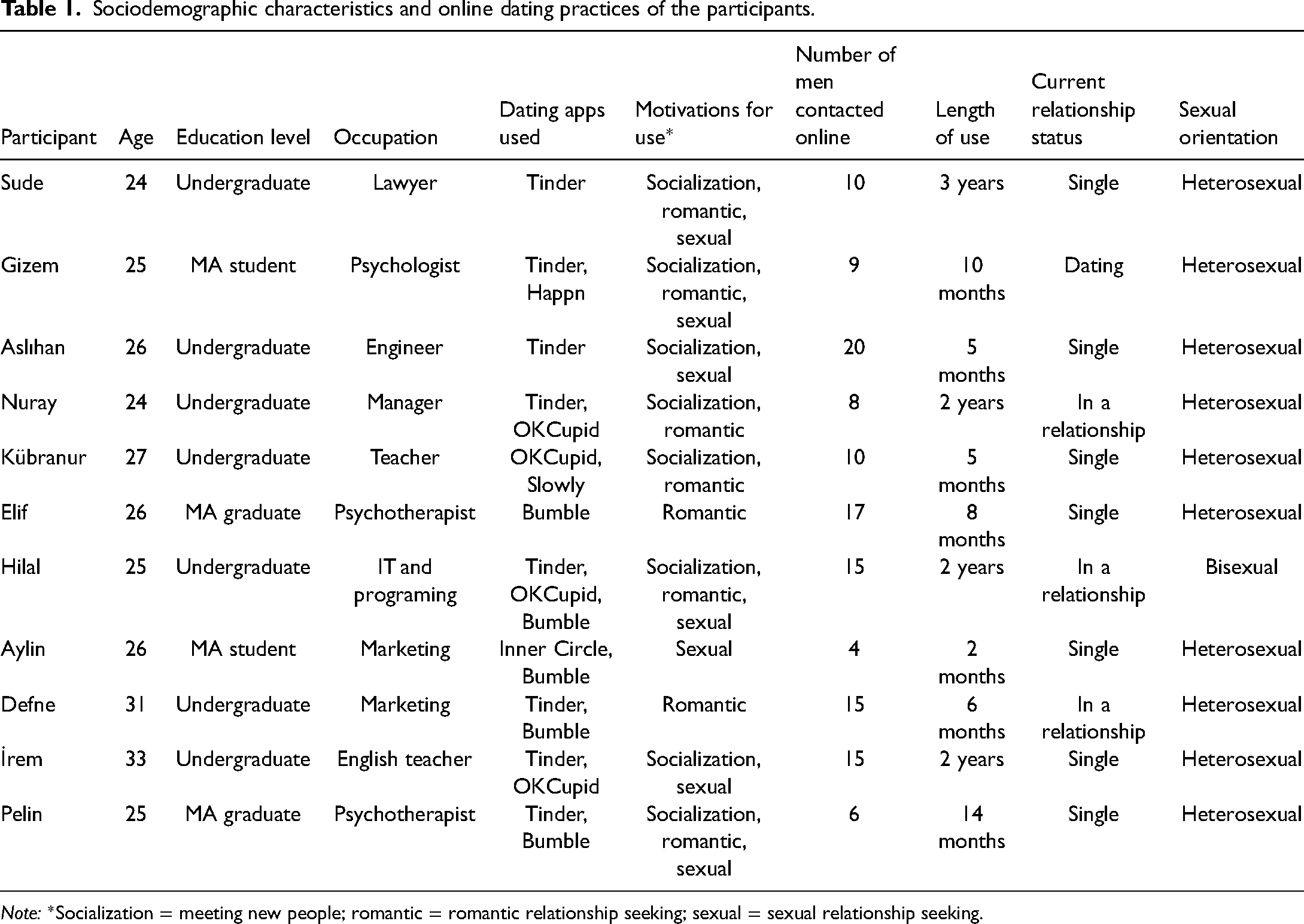
Note: *Socialization = meeting new people; romantic = romantic relationship seeking; sexual = sexual relationship seeking.
Data analysis
Inductive thematic analysis (TA) was considered a suitable method for the present purposes because it is defined as an efficient and systematic approach to identifying common themes, patterns, and meaning-making processes in participants’ accounts (Braun & Clarke, 2013). A feminist lens informed the current analysis that aimed to explore how women's experiences are embedded in the context of gender power relations at the societal and discursive levels, expose the gender-based oppression that heavily influences women, and stimulate change by learning from their lived experiences (Lafrance & Wigginton, 2019). By adopting this lens, the authors focused on how the participants navigated safety in online dating in the current sociocultural context of Turkey, and how they resisted gendered challenges unequally affecting them.
The analysis was carried out using MAXQDA 2022 (VERBI Software, 2021) and following the six steps of TA, as recommended by Braun and Clarke (2006). The first step involved transcribing and reading the interviews as well as going over field notes taken by the first author, to increase familiarity with the data. The second step involved going through each interview sentence by sentence and creating an initial code capturing their meaning (e.g., “date too pushy,” “precaution – date in public,” “decisions made intuitively”). In the third step, by examining the frequencies of the initial codes and bringing together codes with similar meaning, potential themes were formed (e.g., “dating experiences,” “decision making,” “precautions in response to concerns”). Next, potential themes were reviewed by rereading relevant data extracts and the whole data set to check their coherence. Then, the potential themes were revised and three main themes along with their subthemes were defined. The quotations were translated from Turkish to English, and lightly edited for privacy and increased lexical accuracy by the authors. A pseudonym was assigned to each participant for confidentiality.
To increase trustworthiness of the analysis, the authors held regular meetings to discuss the meaning of initial codes, the coherence of the potential themes, and the labelling of the final themes. We conducted member checking by emailing a summary of the final themes to the participants and asking them whether the results accurately captured their experiences. Only one participant responded with her approval. Thus, no revisions were made. Additionally, we engaged in an ongoing reflexivity practice and observed the impact of our positions, beliefs, and values on the research process. The study's research questions originated from our experiences and observations in the field of dating violence prevention in Turkey. In 2021 and 2022, most of our dating violence prevention activities continued online because of the COVID-19-related lockdowns, which brought to our attention the increasing adoption of online dating practices by young adults. The first author is a young woman and a psychotherapist who has experience in facilitating group-based programs and workshops that aim to prevent dating violence; the second author is a middle-aged woman and a feminist researcher–practitioner who is supervisor of the activities carried out by the first author. During the interviews, the first author observed that being close in age to the participants and being a trainee psychotherapist served both to enhance trust and to increase participants’ sense of comfort, which created a cordial atmosphere. We both were motivated to document the ways in which women manifested their agency and engaged in safety behaviors when dating online, in a digital space whose relevance became increasingly clear through our interactions with these young adults.
Findings
The analysis showed that the women in the study viewed online dating apps as a “necessary evil,” and presented a mixed account of excitement and worry, satisfaction and fear, exploration and risk. On the one hand, the women defined the apps as an accessible medium with diverse possibilities in the age of digital communication and in the context of the COVID-19 measures that limited in-person contact for an extended period of time. Through their active efforts to utilize the apps, all participants reported having established meaningful, fulfilling, and enriching connections. They reported these connections eased feelings of loneliness and isolation, temporarily lifted up their confidence, and facilitated an accelerated process of experimentation with dating and relationships. On the other hand, the women in the study also provided detailed accounts of the labor they undertake for risk assessment and safety building when dating men online. They considered this labor as a given and viewed it as an ordinary and automatic reaction to a reality that lacks effective legal and institutional protections against violence and in which conservative gender norms dominate. The three main themes that were identified present the steps the women took in the face of this reality: (a) bearing the burden of risks, (b) exercising control in the midst of risks, and (c) planning for a safe exit.
Bearing the burden of risks
The women in the study actively calculated and bore the risks of online dating. In their minds, they went over a series of “what if” questions that were primarily related to their physical safety, and secondarily to their emotional safety and privacy.
The risk of violence
All participants reported thinking about the risk of murder, rape, harassment, and violent assault during online and in-person interactions with men. They shared having questions like “Will I be raped? Will something happen to me?” (Nuray), “Will I be violently harmed?” (İrem), “Will I be cut and chopped into pieces?” (Sude), and “How will I know if they get obsessed or stalk me?” (Pelin) at the back of their minds as they used dating apps. Sude recalled the murder of Münevver Karabulut (a young woman killed by a man she dated), an event that shook the country, as she discussed the risk of violence when using apps. Similarly, Kübranur likened her experience in relation to safety while using apps to a Russian roulette, and conveyed the important mental effort she put into estimating possible threatening scenarios: When dating online, there is the risk of being harmed physically. Unfortunately, we live in a country that is filled with many men who kill women on the streets. When this is the case, I don’t know what kind of psychology the person in front of me has … He could find some way to harm me from a tiny detail I give. People can find where you are from a tiny detail in a photograph. This may be paranoid, but I am like “What if he harms me physically?” (Kübranur) You have no other solution, you are a woman, you live in Turkey, if you have a drop of commonsense, this [the risk of violence] is something you know, you are aware of this when you are talking to a stranger online … Geography is your destiny. Many women are killed. It is imprinted on our minds to be careful. Even if I don’t use Tinder, I am worried about walking home at night. (Gizem) In Turkey, there is a lot of news on violence against women. People don’t refrain from such things, because legal punishment is not sufficient … Let's say I met someone [from an app], we are walking together and he makes me uncomfortable. If I ask for help from a police officer and my date says “It's nothing, we’re lovers,” I don’t think the officer will take my side. I think anything could happen to me in a country where I cannot trust the police. There is no state mechanism to defend me. (Aylin) We hear such bad things every day, be it on social media or here and there … I am living in Turkey, I did not experience this when I was living in the Netherlands. In Turkey, when I match with someone and send them a message, I begin thinking “Will he find out who I am?” There are perverts and very weird people in the end. How will I know if they get obsessed or stalk me? So, I have serious problems with meeting someone in person in Turkey. (Pelin)
The risk of being stigmatized
Many participants reported having concerns over being judged, belittled, or harassed by others because of their use of dating apps. They described and criticized the commonly held view in Turkey that online dating indicates some sort of social deficiency, and that it is mostly used for hook-ups by morally loose or sexually promiscuous women. Because of this stigma, some participants calculated the repercussions of running into people they knew on apps, such as coworkers, clients, family members, or professors, and feared harming their social or professional image. As a result, they kept their app use private, which reduced their feelings of shame and fear of judgment. One participant, Nuray, experienced harassment through repeated calls and sexual images sent to her phone, and she filed a police complaint but hiding the fact that she met the man on Tinder, in order to avoid their judgment. In the following quotes, Sude and Defne express how ashamed and fearful of others’ condescending reactions they felt when they first started using dating apps: In my circle of close friends, there was no one else who used Tinder, and I could only share my experiences with a few people, because I thought it was seen as despicable. I did not feel comfortable about sharing. (Sude) I never told my mom when I was on Tinder … She knew everyone used these apps to have sex, but I used it to find a beautiful relationship back then. Yet, it was hard to talk about it because of the shame. (Defne)
The risk of deception and manipulation
Many participants emphasized the ease with which men can misrepresent themselves on dating apps in terms of profession and marital or socioeconomic status, for manipulative gain. Some women expressed concerns over unknowingly dating a married man posing as single, and feared breaching a moral code in this way. Others talked about uncovering deceptive personal information in their former dates and shared how these experiences caused them insecurity, shock, anger, hurt, and disappointment. Kübranur recounted how she became emotionally involved with a man who claimed to be a lawyer and disappeared after she started to confront him with questions. Nuray explained how a man convinced her to exchange numbers under the pretense of wanting to date her, but created an escort profile with her contact information instead. As a result, most of the women questioned the truthfulness of this form of dating, and carried a sense of insecurity due to the risk of being deceived as they engaged with men online. Below, Defne describes the appeal and ease of projecting an unrealistic, yet desirable, image and how it prepares the ground for manipulative online interactions, while Gizem describes how emotionally loaded and unsettling these deceptive encounters can be: People can create themselves a different profile and you cannot tell that easily. It takes a long time to tell. Such a thing happened to me. The guy was completely different from the profile he created. It was like he was the driver of the company of which he told me he was the owner. People think of sex when they think of apps, but the apps are a place for people to live out the fantasies they can’t live out in real life and an effort to turn them into reality … In a way, it is easier to prove yourself on those platforms than in real life. (Defne) There was a man flirting with me who I later realized was engaged. I was very upset and broken. There was another one who I found out was married … He said he was embarrassed to tell me. What am I supposed to do, thank you for your honesty? It was such a horrible moment. There could have been other ones as well without me ever knowing. (Gizem)
Exercising control in the midst of risks
In response to the risks outlined above, the women tried to increase their sense of control and protect their physical and emotional safety by making deliberate and active decisions on the nature of their interactions with men they met online.
Managing interactions
The women talked about defining and gradually refining criteria to screen for safety and trustworthiness of potential matches, and that they decided on how to manage their interactions with them accordingly. Most of the participants preferred to initiate contact with well-educated and employed men with whom they felt safer to engage. These men were perceived to be more open-minded, supportive of gender equality, respectful of boundaries and consent, and less judgmental of women with dating lives compared to less educated men. Thus, many women established or sustained their online communications with men after examining their educational and professional backgrounds and cross-checking the information they provide in their app profiles with other social media (i.e., Instagram, Facebook, LinkedIn). They considered this screening process as essential to decrease risk and uncertainty and to decide about continuing contact. Below, Pelin defines the process of verifying a man's claims as “stalking,” that is, a surreptitious behavior normally viewed as negative, and recommends doing a background check using social media and other online tools: It's not a nice thing but you should stalk, and try to find the man online, and learn what kind of a human he is and what he does … In today's world it has been quite normalized, but what you do is meet a person you do not know … You make plans to see them in person. This is dangerous at the end of the day. (Pelin) I want to understand his views towards the relationships between men and women from the questions he answers on his profile. Does he have sexist attitudes? Does he have a very traditional understanding of men's and women's societal roles? … On my profile, I wrote that someone could message me if he is not sexist, homophobic, or does not support speciesism. I try to choose accordingly. But does it still carry a risk? Yes. (İrem) I gaze over their LinkedIn profiles. I look at the websites of the companies they supposedly work in. But ultimately, this is also not reliable, a fallible security, because the fact that he's working there doesn’t mean that he can’t be a murderer. (Defne)
Maintaining privacy
Many participants deliberately kept their personal information and contact details private until they felt safer to engage with the men they matched. They took various measures to remain harder to track online and end all communications if need be, such as not sharing identifiable demographic information, using aliases, posting few and casual pictures, and keeping their social media accounts private. The women particularly emphasized not disclosing their addresses of residence and work, and giving general answers to questions about where they live or socialize. In this way, they controlled their accessibility, which had a positive impact on their physical safety and protection from unwanted contact. Elif recalled a scary incident in which a man she matched on an app lived nearby, was able to identify her building, and pressured her to meet by waiting in front of her apartment. Below, Gizem and Aylin emphasize the sense of control they derive from managing their accessibility, while Pelin talks about giving vague information, bearing in mind that her date remains a stranger despite their interactions online: If I don’t give my phone number, they can’t reach me, they can’t find my Facebook or Instagram, I can hide myself as I please or open myself if I want. I am not the type of person that shares a lot of information about herself. That stuff can come out when I don’t want it to. (Gizem) Let there be as little information about you as possible. They should not be able to find me with just my photo and my name. I wouldn’t give out my school, my age, where I work, I don’t give out that stuff. I wouldn’t share anything, because in Turkey, people would respond to you even without that information. (Aylin) I try not to share too many facts about my personal life before meeting in person. I try not to say where I live … I don’t give out the names of the people in my family … If he asks where I’m going today, I say “I am going to a café to study,” but I don’t give out the name of the café. After all, it's a stranger whom I don’t know. (Pelin)
Planning for a safe exit
All the women considered an in-person date as the riskiest aspect of using apps. To decrease the risk of physical harm and increase the possibility of a safe exit, the women made deliberate preparations and plans before physically meeting their dates.
Choosing a safe location
All participants explained that the ease of leaving a place and accessing help were central concerns when deciding where to meet on an in-person date. All participants preferred a public and crowded location that they knew well, that was easy to get out of, and in a less conservative part of their city. Going to a man's home or getting in his car on a first date were considered risky and mostly avoided. Below, both Kübranur and Aylin describe the labor involved in assessing the ease of escape and the availability of support from others, if needed, when choosing a location: He could harm me or harass me … That's why I always take care to choose places that are a little bit more crowded, central, well-known by me, and easy to leave if anything makes me uncomfortable. I never go to places that are unknown to me. (Kübranur) I prefer to meet at a location where you can sit outside, in a crowded place if possible, and to not get into his car … A place where I could have some help by screaming. If I get up and leave the table, he shouldn’t be able to follow me or grab me … A place that I could easily leave, if he is making me uncomfortable … I would prefer a public, crowded place in districts with people more like me, with people who I would expect to be more open-minded. (Aylin) After talking with a guy for 2 weeks, I invited him home. There was the lockdown then. We were going to meet outside and then go to my home, and if I wanted him to leave, he would not have been able to get out, or if he left, he would have to remain outside because of the lockdown rules. Was I nervous? I was nervous. But I really wanted to see him, so I invited him. There had been no problems though. (Aslıhan)
Involving social networks
Almost all women shared the identity of their dates with friends or family to increase accountability in case they are victimized, asked them to be on alert in case they call or need help, and updated them throughout in-person dates. Location sharing was also a commonplace safety precaution that the women either automatically adopted or were taught by concerned friends out of increased anxieties about gender-based violence in Turkey. In the following quote, Kübranur explains how alerting her friends to be available should she call them or need their help is key to planning a safe date: If I am going somewhere to meet someone for the first time, I send my location to my friends. “I am here, you should know.” They already have told me to send my location and keep my phone on … They are on alert in case of something happening. (Kübranur) Will you look at my madness? First of all, my location is always on my mother's phone, there is a program, you can see my movement for the entire day. Where you went, how much time you spent there, how much battery was left on my phone, you can see it all … I have a friend, I always share my live location with her … There is AirTag … It is paired with my cousin's phone. If I am going on a date, I put it either in my bra or my underwear, so that they could track me if needed. I take this insane level of safety precautions, because this is no joke, in a country with this many femicides, why wouldn’t my family end up next on Müge Anlı [a TV program that covers homicides and missing cases]? Why wouldn’t I be one of the murder victims? (Defne)
Communicating rejection
Most women devised a plan for how to communicate rejection and leave an in-person date safely. They feared that many men do not fully grasp the concept of consent and may react in a coercive or violent manner in case of rejection. Because of their heightened concern for risk of violence, some women reported using vague language, making up an excuse such as being busy or having an emergency, and conveying their rejection in the most nonoffensive way possible when ending an in-person date. Below, Hilal and Elif express how uneasy and apprehensive they feel when they want to communicate rejection, and describe a sense of “breaking free” from the date: When you want to end the date, it can be panic inducing to try. Because a man who has been rejected might not really take it well. That's what I am afraid of … “We met and spoke with each other, but I wasn’t drawn to you.” I find it hard to express and to end the date. I try to make up an excuse or there were one or two times I have had my friends call me, no joke, and ask me to come over urgently. (Hilal) If the guy is incessantly texting me, even when I do not like them, then I say “I was busy” or “I didn’t have time to respond back, I am working too much these days,” so that he understands it. I say “I’m sorry about it” … Not to be too offensive … As much as possible, I give the message that the issue is mine and not his. I try to escape like that. Because these are people I do not know well, I can’t possibly know who could harm me. (Elif)
Discussion
The present study aimed to explore young adult women's experiences of dating men online in relation to safety, risk, and agency in urban Turkey. The study contributes to the literature by being one of the few studies that explore this underresearched issue in a non-Western context as Turkey. Consistent with previous research that draws attention to gendered and sociocultural experiences in online dating (Chan, 2018; Cöbek & Ergin, 2021; Costa & Menin, 2016), the findings demonstrate women's careful navigation of safety when dating men via apps within the conservative gender order of contemporary Turkey, and manifest women's agency as they attempt to avoid these risks and reap the benefits of using apps.
Most notably, our findings indicate the extensive thinking, planning, and organization that the women undertake online and offline in order to increase their sense of control and protect themselves. Throughout their dating processes, the women continually and actively assess threats and make decisions about whether to carry out or end an online conversation, which red flags to watch out for, when to share personal information, where to physically meet, how to seek help if needed, and how to communicate rejection. This pattern of making deliberate choices to plan for safety aligns well with Gillett's (2023) notion of safety work that captures the strategies employed by women to minimize harm in online spaces. Similarly, the vast amount of individual effort that goes into this task supports Pruchniewska's (2020) notion of invisible digital labor, which emphasizes the normalized responsibility of women to plan for their own security, despite its emotional and mental burdens. These results suggest that online dating involves gendered work on the part of women, rather than solely offering new freedoms and equal opportunities.
The present study also extends the notions of safety work (Gillett, 2023) and digital labor (Pruchniewska, 2020) by showing how the gendered sociocultural context of contemporary Turkey shapes and exacerbates women's safety-building efforts. Firstly, the findings showed that the women overwhelmingly emphasize the risk of physical and sexual violence when dating men online and in person. They explained the salience of this risk against the backdrop of high rates of femicide and violence against women, and lack of adequate institutional support in Turkey, as documented in prior work with women survivors (Yalcinoz-Ucan, 2022). In contrast to previous research in Western contexts (Anderson et al., 2020; Henry et al., 2020), our participants did not voice much concern over digital forms of harassment, since they considered this risk as easier to avert owing to the physical distance inherent in online communications. The context of the COVID-19 pandemic has also likely played a role in women's increased fear of physical and sexual violence on in-person dates, as the chances of meeting in public places were limited and some first dates occurred in the privacy of their home during the study.
Secondly, in light of the growing emphasis on gender conservatism (Cindoglu & Unal, 2017) and traditional norms on women's dating and premarital relationships in Turkey (Thobaben & Kuguoglu, 2021), many women discussed the risk of stigmatization when using apps, and took precautions to protect their public image and social standing. They expressed concerns over being judged as socially deficient, sexually promiscuous, or morally lacking in case their app use were known, or over being deceived to unknowingly date a married man. The findings showed that the women strived to manage the risk of stigmatization by keeping their app use private in some social circles. This is consistent with previous research showing that prevalent stigmas around online dating create concerns over social disapproval and the loss of one's reputation, more notably among women users in non-Western contexts, such as Turkey (Cöbek & Ergin, 2021; Deniz, 2020) and China (Chan, 2018). Furthermore, the women tried to avert judgment by choosing well-educated and employed men with seemingly more liberal and egalitarian views and arranging in-person dates in less conservative and more crowded neighborhoods. These findings indicate that women's attempts to plan for safety and to avoid stigmatization are simultaneous and go hand in hand. This seems to be particularly relevant for the urban and professional women in the present study, as they cross the borders of conservative and traditional norms that disapprove of women's premarital dating in contemporary Turkey. For them, safety work expands to include the task of stigma management.
Nonetheless, it is important to recognize the limits of women's agency in navigating safety when dating men online. All participants in the present study discussed their individual safety-building efforts as a given and ordinary fact. They shared how they gradually devised strategies to minimize risks and managed to create a support network. Given their lack of trust in the effectiveness of institutional and legal action, the mobilization of this informal network seemed to provide a compensatory safety net. However, many of the women described their efforts with a note of caution and emphasized that the steps they take cannot ensure a risk-free in-person date. Interestingly, the women did not dwell on the question of who is responsible for safety at great length in the interviews. The role of online dating companies as for-profit organizations that offer privacy-related security services at a cost and that can sell people’s personal data to third parties did not come up as a topic of discussion, although app developers are criticized for these reasons in many Western contexts. These results suggest that demonstrating agency in online dating entails increased and unfairly placed responsibility for personal safety on young adult women, particularly within an atmosphere of mistrust in legal, institutional, and societal systems of protection in contemporary Turkey.
Practice implications
Although the present study demonstrates young adult women's agency and safety-building efforts in online dating, it also highlights the necessity of looking beyond individual actions and steering clear of the trap of seeing them as the sole actors in this endeavor. Although dating violence prevention activities are currently limited in Turkey, we recommend integrating the topics of online dating, digital violence and harassment, legal rights, and app developers’ responsibilities into existing programs that support critical awareness on these issues. Our study revealed that stigma around online dating and lack of trust in the effectiveness of institutional protections against gender-based violence, decreased the women's feelings of security. To combat these challenges, collaborative and feminist practices are needed to create support systems that advocate victims’ rights and provide legal information outside of the traditional justice system. Gender-based cultural and social norms that create stigma need to be questioned through several channels and by multiple actors such as feminist organizations, political and community leaders, and educational institutions. Moreover, our participants were concerned that the men with whom they engaged were unlikely to have an accurate understanding of consent in romantic and sexual encounters. Although Turkey currently lacks a primary prevention policy that supports the delivery of consent education at schools in a standardized manner, awareness-raising seminars and workshops offered by nongovernmental organizations and initiatives at universities can address dating, gender roles, and sexual consent. Another step could be providing brief information on consent and gender-based violence to users in the process of signing up to dating apps, and testing their understanding through measures such as quizzes.
Limitations and future research
The present study had some limitations that can be addressed in future work. Firstly, many women in the study lived in urban cities, had a college degree, were employed, and identified as heterosexual. These characteristics limited the diversity of the voices represented in the study. Future work can more specifically investigate the experiences of women, as well as men, from different backgrounds and social positions such as older users, nonheterosexual young adults, and women who live in conservative families or rural settings. Research in other non-Western contexts besides Turkey can also enrich our understanding of women's diverse experiences with safety and agency in the digital domain. Secondly, the women who took part in the study were presumably well adjusted enough to be able to share their narratives of safety and risk in online dating. Other women who had experienced violence and harassment through dating apps and suffered severe mental health consequences might not have felt comfortable with sharing their stories. Thus, future studies can explore what kind of psychological impact such experiences have on women and how they cope with it. Thirdly, the present study showed that women may have different vulnerabilities and need different types of support when navigating online dating. The results pointed out that some factors influencing this vulnerability include the accessibility of social support, the endorsement of stigma about online dating, and past experiences of violence. Future research can further investigate how these factors shape women's experiences with safety in online dating. Fourth, the present study did not explicitly focus on women's sexual experiences with men they met via apps. Since sexuality is an important issue when discussing safety, future research should inquire into how women manifest their agency in their sexual encounters with men they met online. Lastly, men's experiences with app use and safety, particularly men who date men online, can be explored in future work to expand our understanding of agency in digital and gendered contexts.
Conclusion
The terrain of dating is changing globally, with online platforms and apps creating new avenues for exploration while posing gendered risks. The present study shows young adult women's careful assessment of these risks, and their individual efforts to resist them and build safety. In contemporary Turkey, their efforts primarily focus on protection from gender-based violence, conservative gender norms, and stigma. Overall, these results suggest that the nature of women's safety work and agency in online dating is socioculturally, contextually, and continually mediated. Our participants expressed their excitement and appreciation for getting a chance to talk about an often-stigmatized topic and share their experiences. Their recognition of this study as being a long-needed one calls attention to the importance of increasing discussion on this topic in future research and practice in diverse contexts.
Footnotes
Declaration of conflicting interests
The authors declared no potential conflicts of interest with respect to the research, authorship, and/or publication of this article.
Funding
The authors received no financial support for the research, authorship, and/or publication of this article.
