



Abstract
Methods
Data from 206 physically active individuals (basketball players and students) were retrospectively analyzed. Hierarchical multiple regression models predicted jump height, with sex and training status entered as covariates, followed by braking RFD and braking FI, and finally the early-to-late push-off FI ratio. Additional models examined whether braking variables predicted the FI ratio.
Results
In bilateral CMJ, braking variables and the FI ratio significantly improved model fit beyond sex and training status, with the FI ratio emerging as a strong independent predictor of jump height (lower early-to-late push-off FI ratio: β = −0.367, p < 0.001). Braking FI was positively associated with jump height (β = 0.165, p = 0.003), and braking RFD also showed a positive independent association in the final model (β = 0.197, p < 0.001). In unilateral CMJ, the FI ratio similarly predicted jump height (lower ratio: β = −0.311, p < 0.001), whereas braking RFD was not independently associated and braking FI showed a modest positive effect (β = 0.154, p = 0.009). Braking RFD positively predicted the FI ratio in both jump tasks, indicating an association with a more early-loaded push-off profile.
Conclusion
Jump height was consistently related to push-off force distribution, with relatively greater late-phase FI (i.e., a lower early-to-late ratio) associated with superior performance. Braking FI showed modest positive associations with jump height, whereas braking RFD primarily influenced push-off force distribution and displayed task-dependent relevance for performance.
Introduction
The countermovement jump (CMJ) is one of the most commonly used tasks in sport science and strength training and conditioning, both as a diagnostic tool to assess neuromuscular performance and fatigue, as well as a training method to develop lower-body power.1–3 Its widespread use spans the assessment of training adaptations,4,5 return-to-play decision-making, 6 and profiling across age, sex, or sport-specific populations.7,8 The use of CMJ is especially prevalent in sports where lower-limb strength and power capabilities are critical to performance.9–11 General performance variables such as jump height are easy to obtain and interpret, 12 but a more detailed analysis, particularly regarding phase-specific force-, power-, and velocity-time characteristics, can offer deeper insights into underlying neuromuscular mechanisms.13–15 Moreover, CMJ testing can be performed across a range of loading conditions, facilitating individualized profiling through methods such as force–velocity (FV) analysis.16,17
Jump height in the CMJ is primarily determined by the net force impulse (FI) generated during the push-off (concentric) phase.18,19 Greater concentric FI leads to a higher take-off velocity and, subsequently, increased jump height. A range of morphological and neuromuscular factors underpin this ability, including muscle strength and power, tendon stiffness, and intermuscular coordination.20–22 Beyond these gross physical characteristics, the temporal distribution of force application has received increasing attention.14,23 For instance, recent studies examining CMJ force-time curve modality suggest that unimodal curves (exhibiting one distinct force peak) may be associated with superior performance. 24 However, more important than peak count appears to be the timing of peak force relative to the lowest center-of-mass position, which may optimize the efficiency of eccentric-concentric transition.15,25 Additionally, eccentric braking phase characteristics, such as the braking rate of force development (RFD) and braking FI, are thought to influence concentric output by mechanisms associated with stretch-shortening cycle function, muscle activation and force build-up, and removal of muscle slack.26,27 Moreover, the velocity conditions under which eccentric force is applied may influence subsequent jump performance, as eccentric loading performed at different movement speeds does not uniformly translate into improved CMJ height. 28 This underscores the importance of considering the temporal characteristics of eccentric loading when interpreting the role of braking force parameters.
Building on this, a new line of research has focused on how eccentric braking force characteristics (particularly braking force and RFD) may shape subsequent concentric (push-off) force production and overall jump performance. A growing body of literature has emphasized the importance of the force–velocity (FV) relationship in understanding jumping performance.29–31 In support of this, a recent study 32 found that higher braking RFD and peak braking force enhanced early-phase push-off force output but were negatively associated with latter-phase push-off force, with no effect on jump height. A follow-up study manipulated braking variables by acutely changing countermovement velocity and depth, confirming that increased braking forces consistently elevated early push-off FI, but also reduced the later phase push-off FI, leading to no net gain in jump height. 33 These findings suggest that improvements in eccentric force application may be offset by unfavorable force–velocity interactions later in the movement. However, both studies were limited to bilateral CMJ in relatively small samples (n = 27 and 19, respectively), and the implications for different populations, jump tasks, and performance levels remain underexplored. In addition to exploring mechanistic links between eccentric and concentric (push-off) force outputs, it is also important to consider the role of task specificity. Unilateral and bilateral CMJ differ in terms of neuromechanical demands, motor control strategies, and force production patterns. For example, unilateral jumps typically involve increased force output (per leg) 34 and greater demands on stability and interlimb coordination,35,36 which may influence force-time characteristics. The present study aims to extend the existing research by examining how eccentric force characteristics relate to phase-specific push-off FI and jump height across bilateral and unilateral CMJ tasks, and by comparing individuals with and without sport-specific background. This study adopts an exploratory approach, aiming to identify potential task- and population-specific associations between eccentric force characteristics, phase specific push-off force output and jump performance; rather than providing definitive conclusions, the findings are intended to generate hypotheses for future confirmatory research with greater inferential control. 37
Methods
Participants and study design
This was an exploratory study based on retrospective analysis of data collected as part of a larger research project investigating neuromuscular function in jumping tasks. 38 The exploratory nature of this study reflects the fact that specific hypotheses concerning the relationships between eccentric force characteristics, concentric (push-off) force distribution, and jump performance were formulated post hoc. The dataset included male participants drawn from two distinct cohorts: competitive basketball players and physical education students. All participants were free of injury at the time of testing and had prior experience with CMJ testing procedures. A total of 206 (79 women, 127 men) participants were included in the analysis (with average age of 17.5 ± 1.8 years, a height of 181.7 ± 10.7 cm, and a body mass of 74.7 ± 12.9 kg). Basketball players (n = 151) were active members of national or regional teams, while the student group (n = 55) was composed of physically active individuals with no history of competitive sports participation. Prior to the commencement of measurements, participants were informed in detail about the study protocol and provided signed informed consent for participation. The protocol was conducted in accordance with the latest revision of the Declaration of Helsinki. The experimental procedures were reviewed and approved by the Slovenian Medical Ethics Committee (approval no. 0120–99/2018/5).
Measurement procedures
Participants performed bilateral and unilateral countermovement jumps (CMJs) as described previously. 39 All jumps were performed on a Kistler force plate (model 9260AA6, Winterthur, Switzerland), with ground reaction force data recorded at a sampling frequency of 1000 Hz. Prior to data collection, all participants completed two to three preparatory trials for each task to ensure familiarity and consistency. In addition, CMJs were already well known to the participants, either as part of regular athletic monitoring (basketball players) or as components of practical coursework (students). Each participant completed three repetitions of bilateral and six repetitions of unilateral CMJs (three per leg), with hands placed on the hips and a one-minute rest period between sets. Only the data for the dominant leg was used for this study. For both bilateral and unilateral trials, jumps were initiated from an upright standing position with arms akimbo. Participants performed a rapid countermovement to approximately 90° of knee flexion and then executed a maximal vertical jump. Verbal instructions emphasized a quick and continuous motion, avoiding any preparatory pause or excessive lowering beyond the standardized countermovement depth. 39 The quality of each jump was monitored in real time, and trials with obvious execution errors or irregular force-time characteristics were excluded. The mean of three trials was used in the subsequent analyses.
Processing and outcome variables
Vertical ground reaction force data were processed using MARS software, applying a 5 ms moving average filter to reduce signal noise. For each CMJ, jump height was calculated based on the FI–momentum approach, whereby take-off velocity was derived by dividing the net vertical FI (i.e., the integral of net vertical ground reaction force over time during the push-off phase) by body mass, and subsequently applying the kinematic equation

Representative vertical ground reaction force profile during a CMJ, segmented into distinct phases: baseline, unloading, yielding, braking, and push-off. The push-off (concentric) phase is further divided into early and late sub-phases based on temporal midpoint. This segmentation was used to extract phase-specific FI and rate of force development variables.
We analysed the collected data using IBM SPSS Statistics software (version 25.0, IBM Corp., Armonk, NY, USA). Statistical significance was set at α < 0.05. Descriptive statistics are presented as the mean and standard deviation, along with minimum and maximum values. The normality of the data distribution was assessed using the Shapiro–Wilk test and visual inspection of histograms. All normality tests were non-significant (p = .098–.922), indicating no substantial deviation from normality; therefore, parametric statistical procedures were used. To examine associations between jump height and force–time variables while accounting for participant heterogeneity, a hierarchical multiple linear regression approach was used. Separate models were constructed for bilateral and unilateral CMJs. Jump height was entered as the dependent variable. In the first step, sex and training status (basketball players vs. students) were entered as covariates to control for systematic between-group differences. In the second step, eccentric braking variables (maximal braking RFD and braking FI) were entered to assess their contribution beyond sex and training status. In the final step, the early-to-late push-off FI ratio was entered as an index of concentric force distribution timing. Absolute push-off FI variables (first- and second-half FIs) were not included in the regression models because jump height is directly linked to net concentric FI, and their inclusion can yield near-deterministic model fits. The ratio-based approach was therefore selected to evaluate whether force-time distribution, rather than absolute FI magnitude, was independently associated with performance after accounting for participant characteristics. Model fit was evaluated using changes in explained variance (ΔR2), F-tests, and adjusted R2. Standardized regression coefficients (β) are reported to facilitate comparison of predictor contributions. Multicollinearity was assessed using variance inflation factors (VIF) and tolerance values. Independence of residuals was verified using the Durbin–Watson statistic, and standardized residuals were inspected to identify potential outliers. To examine whether eccentric braking characteristics were associated with push-off force distribution independently of sample heterogeneity, an additional hierarchical regression was performed with the push-off FI ratio as the dependent variable. Sex and training status were entered in Step 1, followed by braking RFD and braking FI in Step 2. Bivariate correlations (Pearson's coefficient) for the full sample and stratified by sex and training status are provided in the Supplementary Material 1 for descriptive purposes only. The strength of associations is interpreted as negligible (r < 0.1), weak (r = 0.1–0.4), moderate (r = 0.4–0.7), strong (r = 0.7–0.9), or very strong (r > 0.9), in accordance with established guidelines. 41
Results
Descriptive statistics
Descriptive statistics for all analysed variables in bilateral and unilateral CMJs are presented in Table 1.
Descriptive statistics for bilateral and unilateral CMJ variables (N = 206).

Descriptive statistics for bilateral and unilateral CMJ variables (N = 206).
CMJ – countermovement jump; RDF – rate of force development; SD – standard deviation.
To account for participant heterogeneity and reduce the risk of spurious associations, hierarchical multiple linear regression was used to examine predictors of bilateral CMJ jump height (Table 2). In the first step, sex and training status explained a substantial proportion of variance in jump height (R2 = 0.461, p < 0.001), with males and basketball players achieving greater jump heights. In the second step, the inclusion of eccentric braking variables significantly improved model fit (ΔR2 = 0.055, p < 0.001). Braking FI emerged as a significant positive predictor of jump height (β = 0.233, p < 0.001), whereas braking RFD was not independently associated with performance (β = 0.048, p = 0.413). In the final step, adding the early-to-late push-off FI ratio further improved the model (ΔR2 = 0.116, p < 0.001), yielding a final explained variance of 63.3% (adjusted R2 = 0.624). In this model, a lower early-to-late push-off FI ratio (indicating relatively greater force production in the latter half of the push-off phase) was independently associated with greater jump height (β = −0.367, p < 0.001). Both braking FI (β = 0.165, p = 0.003) and braking RFD (β = 0.197, p < 0.001) also remained significant predictors, while sex and training status retained independent effects. No evidence of problematic multicollinearity was observed (VIFs ≤ 1.69), residuals were normally distributed, and the Durbin–Watson statistic (2.16) indicated independence of errors.
Hierarchical multiple linear regression predicting bilateral CMJ jump height.

Hierarchical multiple linear regression predicting bilateral CMJ jump height.
RFD = rate of force development; B = unstandardized coefficient; SE = standard error; β = standardized coefficient. ΔR2 indicates the increase in explained variance at each step of the hierarchical model.
Figure 2 (top chart) visualizes the association between bilateral jump height and the early-to-late push-off FI ratio across participants, with subgroup membership indicated by color. To examine whether eccentric braking characteristics were associated with push-off force distribution in bilateral CMJ, a hierarchical regression was performed with the push-off force–FI ratio as the dependent variable. The first step did not significantly explain variance in the force–FI ratio (R2 = .021, p = .111). The inclusion of eccentric variables resulted in a substantial and significant increase in explained variance (ΔR2 = .114, p < .001). In the final model, braking RFD was positively associated with the force–FI ratio (β = .403, p < .001), whereas braking FI was negatively associated with the ratio (β = −.181, p = .032).
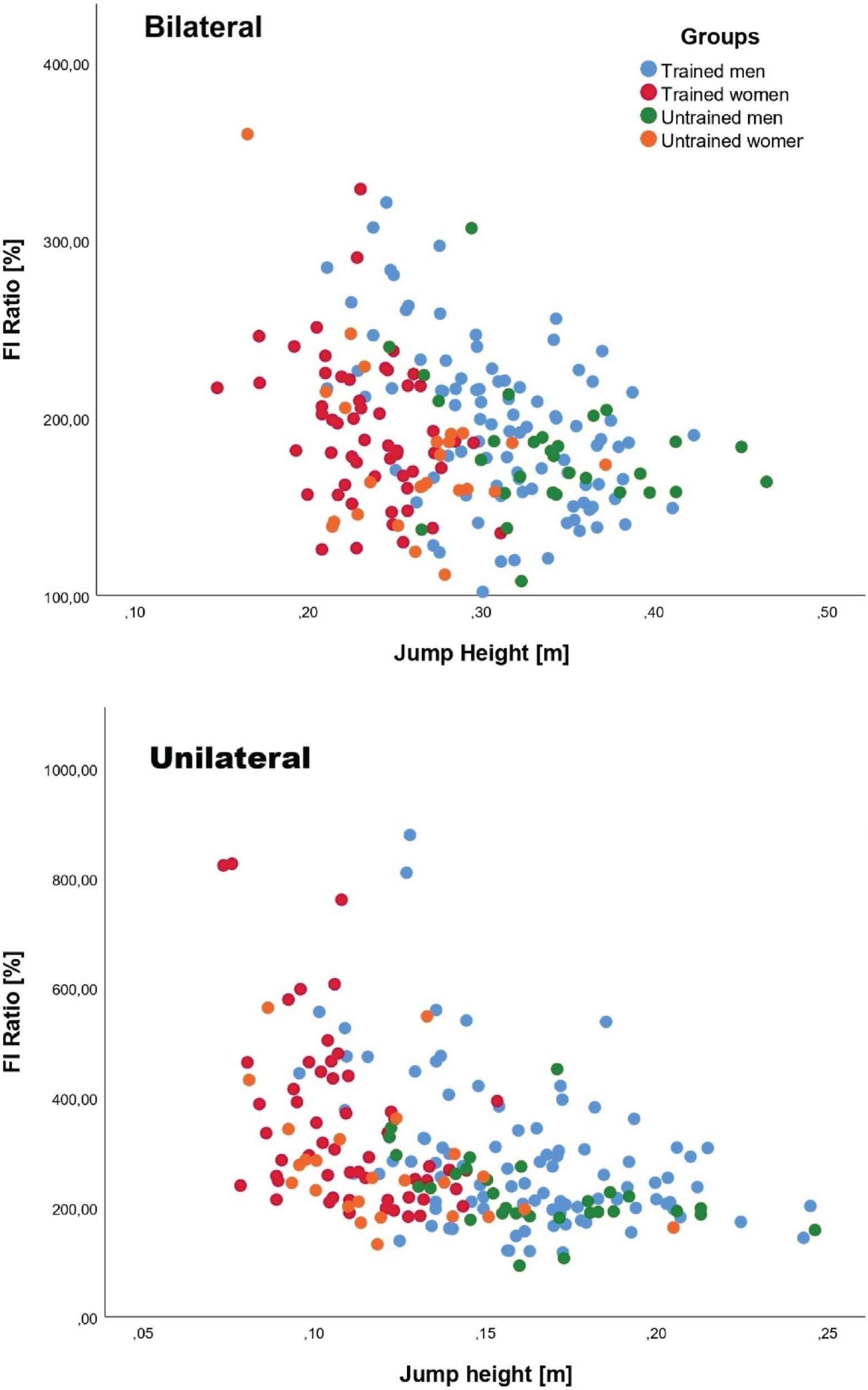
Relationship between countermovement jump height and the early-to-late push-off FI ratio, with data points colored by subgroup.
A similar hierarchical multiple linear regression was used to examine predictors of unilateral CMJ jump height (Table 3). In Step 1, sex and training status explained 43.9% of the variance in jump height (R2 = 0.439, p < 0.001), with sex emerging as a strong predictor (β = −0.664, p < 0.001), whereas training status was not significant (β = 0.083, p = 0.116). In Step 2, the inclusion of eccentric braking variables resulted in a small but statistically significant improvement in model fit (ΔR2 = 0.024, p = 0.012). In this step, braking FI was positively associated with jump height (β = 0.191, p = 0.003), while braking RFD was not (β = −0.090, p = 0.135). In Step 3, adding the early-to-late push-off FI ratio further improved the model (ΔR2 = 0.086, p < 0.001), yielding a final explained variance of 54.8% (adjusted R2 = 0.537). In the final model, a lower FI ratio (i.e., relatively greater late-phase push-off FI) was independently associated with greater jump height (β = −0.311, p < 0.001). Braking FI remained a significant predictor (β = 0.154, p = 0.009), whereas braking RFD remained non-significant (β = −0.024, p = 0.670). Training status showed no independent association (p = 0.999), while sex remained significant (β = −0.545, p < 0.001). No evidence of problematic multicollinearity was observed (VIFs ≤ 1.53), and residual independence was supported by the Durbin–Watson statistic (1.95).
Hierarchical multiple linear regression predicting unilateral CMJ jump height.

Hierarchical multiple linear regression predicting unilateral CMJ jump height.
RFD = rate of force development; B = unstandardized coefficient; SE = standard error; β = standardized coefficient. ΔR2 indicates the increase in explained variance at each step of the hierarchical model.
To examine whether eccentric braking characteristics were associated with push-off force distribution independently of sample heterogeneity, an additional hierarchical regression was performed with the push-off force–FI ratio as the dependent variable. Braking RFD was positively associated with the push-off FI ratio (β = .212, p = .006), whereas braking FI was not a significant predictor (β = −.119, p = .145). These findings indicate that higher braking RFD is related to differences in push-off force distribution during unilateral CMJ, independent of sex and training status.
Figure 2 (bottom chart) visualizes the association between unilateral jump height and the early-to-late push-off FI ratio across participants, with subgroup membership indicated by color.
This exploratory study examined how braking force characteristics, specifically eccentric braking RFD and braking FI, relate to concentric (push-off) force distribution and jump performance in bilateral and unilateral CMJ. Across both jump types, jump height was associated with the distribution of force during the push-off phase; specifically, a lower early-to-late push-off FI ratio (indicating relatively greater force production in the second half of the concentric phase) was consistently linked to superior performance. From a biomechanical standpoint, a late-loaded push-off strategy may be advantageous as it could align greater force production more closely with the phase of the movement where the center of mass is accelerating toward take-off, potentially contributing to a more efficient conversion of muscular force into vertical velocity. However, the precise mechanical advantages of late- versus early-loaded profiles warrant further investigation. Braking FI showed moderate positive associations with both jump height and early push-off FI, supporting its role in facilitating an efficient transition between movement phases. However, the relevance of braking RFD varied between conditions. In bilateral jumps, it was moderately linked to jump height and early push-off force, though this seemed to reflect a more early-loaded force profile. In unilateral jumps, RFD was not related to jump height and was associated with an unfavorable shift in concentric force distribution, suggesting that rapid loading during braking may not be advantageous for unilateral jumps. These results suggest that not only the magnitude, but also the timing of push-off (concentric) force production is crucial for vertical jump performance.
The primary regression analyses controlled for sex and training status, and no subgroup-specific inferences are drawn from the main models. Descriptive supplementary analyses suggested that associations were independent across sexes and sport backgrounds, but a few notable differences emerged (Supplementary file). In bilateral CMJ, the associations between eccentric parameters and performance tended to be stronger in basketball players compared to students. In contrast, during unilateral CMJ, braking RFD showed stronger links to performance-relevant variables in students. Additionally, although overall patterns were similar between men and women, the relationship between braking FI and RFD appeared more pronounced in women, possibly pointing to a greater reliance on eccentric control. While our results showed largely comparable associations between jump height and late-phase push-off FI across sexes, prior work 42 highlighted that men achieved greater velocity during the latter half of the push-off phase, contributing to higher overall power output and jump height, despite similar relative force-time profiles. This distinction in velocity-time characteristics warrants further investigation in larger samples to determine whether the distribution of force across the push-off phase plays a more critical role in one sex compared to the other. These observations are descriptive in nature and should not be interpreted as confirmatory findings.
Braking FI may be associated with jump height for at least two reasons. First, a larger braking FI could reflect better maintenance of pre-tension during the braking phase, which may reduce muscle–tendon “slack” before push-off and facilitate a smoother eccentric–concentric transition. 26 This may support concentric force production without requiring an excessively high braking RFD, potentially benefiting force expression later in push-off. Second, braking FI may partly capture subtle differences in countermovement strategy, such as a slightly deeper countermovement and greater braking/propulsive displacement, which could increase push-off distance (and thus mechanical work) and contribute to greater jump height. 27 Importantly, these potential mechanisms help contextualize our findings in relation to recent experimental work that has manipulated braking force characteristics in CMJ.32,33 Specifically, it was found that experimentally increasing braking forces elevated early-phase push-off force but did not enhance jump height, which they attributed to a decline in force production later in the push-off phase. Their interpretation, grounded in the force–velocity relationship,16,29 suggests that a stronger early push-off, paradoxically, accelerates the center of mass too quickly, limiting muscle force generation in the latter push-off phase due to increased contraction velocity demands. Our results in the unilateral CMJ are in line with this, as braking RFD was tied to early but not late concentric force and failed to predict jump height. At the same time, our findings also provide some insights not fully captured in previous work. In bilateral CMJ, braking RFD was associated (albeit the correlation was small) association with jump height, without an evident cost to late-phase push-off force. As a purely descriptive observation from supplementary analyses, associations between braking RFD and performance-related variables appeared numerically stronger in basketball players, which could tentatively be linked to sport-specific exposure to high-velocity tasks. However, this pattern was not examined within the primary inferential framework, and given the exploratory design and modest effect sizes, it should be considered hypothesis-generating only. Basketball players, who are regularly exposed to high-velocity explosive tasks such as jumping, sprinting an changes of direction, are likely more accustomed performing high-velocity tasks.43,44 Their ability to preserve late-phase push-off force despite rapid eccentric loading may therefore reflect sport-specific adaptations that enable more optimal force-velocity management throughout the movement. While this interpretation is conceptually consistent with the notion that athletes capable of generating force at high contraction velocities may be less prone to performance decrements in the latter push-off phase, it is important to note that the observed correlation coefficients were not particularly strong. Therefore, this hypothesis, although plausible, should be interpreted with caution. Taken together, the results reinforce the idea that the relationship between braking eccentric force characteristics and jump performance is shaped not only by maximal force capacities, but also by task constraints, the temporal distribution of force, and sport-specific movement strategies.
Given the exploratory nature of this study, future research should aim to confirm these preliminary findings using experimental or longitudinal designs, ideally with controlled interventions that manipulate eccentric loading strategies. It would also be valuable to explore how training experience, movement strategy, or neuromuscular coordination influence the relationship between braking and concentric (push-off) force characteristics and performance, particularly in unilateral tasks where mechanical constraints may amplify individual differences. Despite the exploratory nature of this study, the findings have practical implications for both assessment and training. The consistent association between jump height and the push-off FI ratio indicates that the timing of concentric force application is a meaningful performance characteristic, beyond force magnitude alone. This suggests that force–time–based metrics may help identify suboptimal push-off strategies that are not evident from jump height measures alone. From a training perspective, approaches that support force production at higher contraction velocities during the latter part of push-off (e.g., ballistic or plyometric exercises) may be beneficial, whereas an exclusive focus on rapid eccentric loading may not universally enhance performance, particularly in unilateral tasks.
Limitations
This study was exploratory in nature and based on a retrospective dataset, which limits the ability to infer causality. All potential effects identified in this paper need to be verified in a future confirmatory study with adequate error control. 37 Although the sample size was relatively large, subgroup analyses (e.g., by sex and sport background) may have been underpowered to detect more subtle differences. To mitigate sample heterogeneity, sex and training status were explicitly accounted for in the primary regression models. Nevertheless, residual heterogeneity related to unmeasured factors (e.g., inter-individual differences in training history, technical proficiency, or neuromuscular coordination) cannot be fully excluded. For this reason, regression analyses should be treated with caution and correlation analyses (supplementary file) were treated as descriptive and provided as supplementary material only. All participants were young and physically active, and thus findings may not generalize to older populations or clinical groups. Furthermore, while we assessed force-time variables in detail, no direct biomechanical or neuromuscular measures (e.g., joint kinematics, EMG, or muscle-tendon properties) were available to better explain the underlying mechanisms of observed associations. Finally, although jump technique was standardized to the extent possible, individual variations in countermovement depth or strategy could have introduced uncontrolled variability into FI distribution patterns. While verbal instructions were provided to guide participants toward an approximately 90° knee flexion, the actual countermovement depth was not strictly monitored or quantified. This may have affected braking dynamics and the resulting concentric force characteristics. Previous research has shown that countermovement depth is a key determinant of FI generation and jump performance, particularly due to its effect on muscle-tendon interaction. 28 This is particularly relevant given the recent findings showing that countermovement depth and velocity can systematically alter braking and concentric force characteristics. 33 Therefore, future studies should consider implementing more precise control or measurement of countermovement depth to isolate its impact and improve internal validity. Additionally, instructing participants to perform a rapid, continuous countermovement with an aggressive transition may have constrained their natural execution strategies, particularly in less experienced individuals. Such externally imposed instructions may have altered individual kinetics and obscured natural variation in eccentric–concentric coupling. Future studies should consider assessing both self-selected and constrained strategies to clarify these influences.
Conclusion
This exploratory study provides preliminary evidence that jump performance is more strongly related to the temporal distribution of concentric force during push-off than to eccentric force magnitude alone. Across both bilateral and unilateral CMJs, a lower early-to-late push-off FI ratio (reflecting relatively greater force production in the latter part of the push-off phase) was consistently associated with superior jump height. Braking FI showed modest positive associations with jump height, likely through its contribution to early push-off force development. In contrast, braking RFD was primarily related to push-off force distribution, being associated with a more early-loaded concentric profile, and demonstrated limited or task-dependent relevance for jump performance, particularly in unilateral CMJ. These findings indicate that rapid eccentric loading does not universally translate into improved performance and that its effects depend on task constraints and force–time organization. Given the exploratory, retrospective design and lack of error-rate control, all observed associations should be considered hypothesis-generating and require confirmation in future, adequately powered confirmatory studies.
Supplemental Material
sj-xlsx-1-iso-10.1177_09593020261446743 - Supplemental material for The relationship between braking rate of force development, braking force impulse, push-off force distribution and jump performance: An exploratory study
Supplemental material, sj-xlsx-1-iso-10.1177_09593020261446743 for The relationship between braking rate of force development, braking force impulse, push-off force distribution and jump performance: An exploratory study by Žiga Kozinc, Darjan Smajla, Daichi Nishiumi, Norikazu Hirose and Nejc Šarabon in Isokinetics and Exercise Science
Footnotes

Informed consent statement
Informed consent was obtained from all subjects involved in this study.
Funding
The authors disclosed receipt of the following financial support for the research, authorship, and/or publication of this article: The study was supported by the Slovenian Research Agency through the research program KINSPO - Kinesiology for the effectiveness and prevention of musculoskeletal injuries in sports (P5-0443).
Declaration of conflicting interests
The authors declared no potential conflicts of interest with respect to the research, authorship, and/or publication of this article.
Data availability statement
Anonymized raw data are included in Supplementary File 1 and are also available on Zenodo data base (DOI: 10.5281/zenodo.15525531). Certain demographic variables have been removed to prevent the potential identification of individual players.
Institutional review board statement
The experimental procedures were reviewed and approved by the Slovenian Medical Ethics Committee (approval no. 0120–99/2018/5).
Supplemental material
Supplemental material for this article is available online.
References
Supplementary Material
Please find the following supplemental material available below.
For Open Access articles published under a Creative Commons License, all supplemental material carries the same license as the article it is associated with.
For non-Open Access articles published, all supplemental material carries a non-exclusive license, and permission requests for re-use of supplemental material or any part of supplemental material shall be sent directly to the copyright owner as specified in the copyright notice associated with the article.
