




Abstract
The European Union’s ageing societies poses major policy challenges for pension systems. Since the economies and the societies of Member States are increasingly integrated, the success and failure of national pension policies and reforms have an ever-increasing impact beyond national borders. However, the ‘subsidiarity principle’ and member state autonomy over taxes, limits the EU’s power regarding pension policy. This paper explores the influence of the European Semester discourse on recent pension reforms in the Netherlands and Ireland. We draw on discursive institutionalism (DI) to understand further the nature and form of European Semester driven pension reform ideas and how they are communicated and acted on, in each country. Based on the evidence on pension reform in The Netherlands and Ireland, we find a divergence in effectiveness between cognitive and normative ideas in EU discourse and that cognitive ideas are privileged over normative ideas with respect to influencing pension policy reforms. While the focus of this research is pension policy, this study enhances our understanding of how the EU approach in terms of its discourse, influences national reform in policy areas where the ‘subsidiarity principle’ applies. We suggest that policymakers and other actors may very consciously choose one form of discourse over the other to negotiate their preferred pathway towards implementation.
Introduction
The European Union (EU) has been in many ways, a remarkable experiment in regional integration, fostering cooperation among its sovereign states while trying to harmonise policies in domains as diverse as healthcare, social welfare and gender equality (Lendvai and Stubbs, 2015; Morton, 2022; Zartaloudis, 2015). One notable policy area that has garnered increasing attention is the area of pension policy.
Europeans are living longer. Across every country in the EU, birth rates are falling, and life expectancy is increasing, marking a transition towards an older population structure. The demographic dependency ratio is forecast to double by 2060 (European Commission 2017a). For Europe’s pension systems, this is a major policy challenge with real ramifications for public expenditure as countries confront a potentially declining labour supply and eroding personal income tax base. In turn, these challenges provoke concerns about the ability of countries to continue to support pay as you go (PAYG) retirement programmes. Member states dedicate significant resources to pensions. On average, pre COVID-19, the EU’s public social expenditure amounted to 29% of GDP, with almost 13% of GDP being spent on old age and survivor pensions (European Commission, 2017b).
This research considers a complex question – does the type and nature of EU’s pension policy discourse (through the European Semester process), influence the direction of pension policy reforms in member states? To explore the EU’s influence on pension reforms through this discourse, we examine pension reform in the Netherlands and Ireland —two countries that represent distinctly different governance approaches within the EU framework. The Netherlands, influenced primarily through the soft coordination of the European Semester and open method of coordination (OMC), provides a counterpoint to Ireland’s experience of hard conditionality during its Troika bailout (in addition to the European Semester influences). Despite institutional similarities as open, service-oriented economies, these two countries differ significantly in their interactions with EU governance, offering a unique opportunity to analyse how cognitive and normative discourses shape pension reform under contrasting conditions. To address this question, we employ the discursive institutionalism (DI) framework of Vivien Schmidt (2006) which provides us with a powerful analytical tool to explore the journey of EU influence in National policymaking.
The rationale for this exploration is to understand the EU approach to influencing National reform in policy areas which are the domain of national government, noting that the interconnectedness of European economies and societies has arguably blurred the boundaries of such national policymaking. The success or failure of national policies and reforms now carry repercussions that transcend national borders, impacting the stability of the European Monetary Union and the broader European project (Zartaloudis, 2014; Telò, 2017). Therefore, due to the ageing challenges highlighted earlier, pensions have evolved from being exclusively a matter of national concern to a common concern for the EU.
To achieve this study’s aim, we analyse EU Annual Growth Surveys (AGSs), and the Country Specific Requirements (CSRs) for the Netherlands and Ireland and documentation pertaining to the Troika bail-out for Ireland, and present a comparative analysis of the influence of soft and hard conditionalities on recent pension reforms in these two jurisdictions. Drawing on DI, our findings suggest a divergence in effectiveness between cognitive and normative ideas in EU discourse, and that policymakers at EU level may very consciously choose one form of discourse over the other to negotiate their preferred pathway towards implementation of specific policy recommendations.
Section 2 of this paper provides a review of the pertinent literature relating to the Europeanisation of pension policy. Section 3 introduces DI, and section 4 briefly describes the Dutch and Irish pension systems. Section 5 outlines the methodology employed in the study. Section 6 presents data analysis based on the application of a DI lens to the EU AGSs and CSRs for Ireland and the Netherlands, over the period 2011 to 2023 and traces cognitive and normative ideas to Dutch and Irish policy reforms, with reference in the Irish context to the overarching hard conditionality of the Troika bailout agreement. Section 7 discusses the comparative effectiveness of EU cognitive and normative pension reform “ideas” in both Ireland and the Netherlands, and makes some concluding comments, noting how policymakers and other actors may consciously choose one form of discourse over another to shape the agenda for policy reform.
Literature review
Europeanisation, a dynamic process in which EU-level factors influence and shape the policies of sovereign states in areas ranging from healthcare to gender equality to pensions, has garnered significant attention from scholars and policymakers alike (Morton, 2022; Suutela-Vuorinen, 2010; Zartaloudis, 2015). This section reviews the literature on the Europeanisation of pension policy with the aims of providing an overview of key themes and debates in this area, within the context of the EU’s capacity for direct and indirect influence in member states.
Europeanisation of pension policy
The Europeanisation of pension policies refers to the process by which the EU exercises direct and indirect influence over the pension systems of sovereign states. This stems from a realization that decisions taken by member states have repercussions that extends beyond those states’ borders (Güleç, 2014; Suutela-Vuorinen, 2010). Europeanisation encompasses both “hard” and “soft” mechanisms of integration, including regulatory directives and open coordination methods (Barcevičius et al., 2014; Stepan and Anderson, 2014).
Member states are responsible for their pension systems, although some aspects are directed by the EU. An example of the latter is the existence of EU regulations to coordinate social security systems so that social insurance contributions paid in one member state can count in the calculation of a pension and other social security benefits in another member state.
Otherwise, for most countries, the subsidiarity principle generally applies. Its goal is to ensure that national, regional and local preferences are considered and that decisions are taken as closely to the citizens as possible (Meerten et al., 2011). More specifically, this principle ensures that the EU does not act unless it is more effective than action taken at the national, regional or local level. The subsidiarity principle is an important tool to protect Member States against undesirable EU influence but also justifies EU action when the objectives of an action cannot be sufficiently achieved by Member States alone. This is typically exercised through the open method of coordination (OMC) mode of policymaking (De la Porte, 2002; Di Mascio et al., 2020).
The evolution of EU socio-economic governance
To understand the EU’s influence on pension policy, like other social policies, a distinction must be made between the periods before and after the financial crisis of 2008, as noted by Guidi and Guardiancich (2018) and Zeitlin and Verdun (2018). Before the crisis, the EU’s governance could be broadly divided into two domains: the economic and the social.
In the economic domain, the establishment of the Economic and Monetary Union (EMU) required prospective member countries to implement a series of reforms, including pension reforms. This was followed by the Stability and Growth Pact (SGP), which aimed to coordinate economic policies across member states but was ultimately ineffective due to its reliance on self-monitoring by individual nations.
In parallel, the social domain was characterized by the OMC, a ‘soft’ governance mechanism which facilitated policy problem-solving by identifying and sharing best practices across EU states, fostering policy coordination without regulatory imposition (De la Porte, 2002; Di Mascio et al., 2020). This approach, championed during the Lisbon European Council of 2000, was particularly relevant for politically sensitive areas like pensions, where opportunities for direct regulation were limited (Natali, 2009).
The financial crisis of 2008 and the subsequent sovereign debt crisis shifted the governance landscape significantly. The perception that divergences among Eurozone countries were contributing to economic instability spurred efforts towards greater harmonization, culminating in the establishment of the European Semester in 2011 (Guidi and Guardiancich, 2018; Zeitlin and Verdun, 2018). This annual process of economic and budgetary policy coordination aimed to strengthen governance and improve coordination across the EU (Corti and Vesan, 2023; De la Porte and Jensen, 2021).
Guidi and Guardiancich (2018) outline how the European Semester is structured. Every November, the annual business cycle begins with the release of the AGS, which has been renamed the Annual Sustainable Growth Strategy (ASGS) since 2020. After each government presents its National Reform Programmes (NRPs) and Convergence or Stability Programmes (for non-Euro countries) in April, the European Commission proposes Country Specific Recommendations (CSRs). These recommendations are then discussed and amended by the Economic and Financial Affairs Council (ECOFIN) and the Employment, Social Policy, Health and Consumer Affairs Council (EPSCO). In June, the European Council endorses the recommendations, and they are formally adopted by ECOFIN in July. During the second part of the annual cycle, known as the National Semester, governments are expected to implement the agreed-upon policies. Progress on implementing recommendations in any CSR is provided in the following year’s Country Report.
Evidence from Zeitlin and Verdun (2018) suggests that although the Semester is often perceived as promoting austerity, its influence is more nuanced. Initially dominated by economic concerns, they argue that there has been a shift towards a ‘progressive socialization’ of the process (driven by public discontent with austerity and enhanced collaboration with EPSCO), which leads to more socially balanced ASGSs and a stronger social dimension in the CSRs, fostering cooperation through joint exploration and mutual learning. The extent of this progressive socialisation has been called into question in recent studies, by Ma (2023) for example, who through the case study of Denmark argue for a distinction between procedural socialisation and output socialisation, and by Elomäki and Gaweda (2022) who argue that the socialisation is at best ‘ambiguous’.
In the area of pensions which is primarily managed at the national level, the evidence from Guidi and Guardiancich (2018) and Guardiancich and Guidi (2022) suggests the EU extends influence on the pension policy of its member states through the European semester. In addition, they find that when it comes to pensions, the economic dimension dominates with increasing competency of the commission on areas linked to fiscal sustainability such as employability of elder workers, age-related pensions and improving the efficiency of the pension schemes. Social benefits such as the adequacy of old age benefits and incentives for complimentary pillars are largely ignored
In contrast, during the financial crisis, the EU employed ‘hard’ governance mechanisms through the Troika, comprising the European Commission, the European Central Bank (ECB), and the International Monetary Fund (IMF). These bailout agreements typically came with stringent conditions and policy measures to restore fiscal discipline and economic stability at the national level. While the primary focus was on macroeconomic reforms, such as austerity measures and fiscal consolidation, pensions also became a central element of the Troika’s policy conditionality (Papadopoulos and Roumpakis, 2018).
Many EU countries relied on a Troika bailout, including Ireland (importantly one of the countries focussed on in this study), Portugal and Greece (Hick, 2018; Papadopoulos and Roumpakis, 2018). The conditionalities imposed on those countries meant member states typically had to shrink their pension expenditure through privatisation, raising the retirement age, tightening the eligibility criteria or shrinking pension benefits (Zartaloudis, 2014).
This duality of EU governance—soft coordination via the European Semester and hard conditionality through the Troika—has shaped the discourse around pension reform in distinct ways. While the European Semester emphasizes mutual learning and best practices, the Troika’s interventions were coercive, imposing conditions that left little room for negotiation. This paper examines how the European Semester has influenced pension reform discourses and compares its narratives of soft conditionality with the direct coercion of the Troika.
Given the pan-EU nature of the AGS/ASGS and the specific national focus of the CSRs, they form a key and relevant body of documentation to examine the ideas and discursive processes around pension reform employed by the European Semester, and hence they provide the basis for the core analysis supporting this paper (see section 6).
Discursive institutionalism: A theoretical framework
To understand how the European Semester’s ‘soft’ (Open method of coordination) form of governance has shaped the development and implementation of EU policy, we draw on discursive institutionalism (DI) as an insightful theoretical framework. Other scholars have drawn on DI when examining the Europeanisation process also (Lombardo and Bustelo, 2012; Tsarouhas and Ladi, 2013).
DI as introduced by Schmidt (2002, 2008, 2011) is distinct from other forms of institutionalism, such as historical, rational choice or sociological institutionalism because DI explores ideas as a part of institutions (rather than exogenous to them), whereby ideas interact with these institutions in a continuous process of change.
Schmidt (2002, 2008, 2011) identified three levels of ideas and two ways the content of ideas can be categorised. The three levels of ideas in DI are philosophical, programmatic, and policy. Philosophical ideas sit in the background as underlying assumptions that are rarely contested. In contrast, programs (which define the problem to be solved) and policies (the solutions) are discussed and debated regularly. There are two types of ideas, namely cognitive and normative. Cognitive ideas serve to justify the policies and programs by speaking to their interest-based logic and necessity, whilst normative ideas attach values to political action and serve to legitimise policy through reference to its appropriateness. In the case of pensions, cognitive ideas may, for example, focus on the adoption of pension reforms based on fiscal sustainability while normative ideas will typically seek to emphasize social justice considerations.
An empirical examination of the levels of ideas can be seen in Boswell and Hampshire’s (2017) application of DI in immigration which shows how selective manipulation of public philosophies was used to legitimise policies and programmes and link policy ideas or programmes over time – for example appealing to failed policy legacies or recasting debate on policy legacies such as a change in the German national story as one tolerant of diversity and not simply a programmatic idea of recruiting foreign workers.
However, the generation of ideas isn’t enough, there needs to be a way to convert the ideas into collective action, the interactive dimension, and Schmidt identifies two types of discourse – communicative discourse, in which political actors seek to convince the public about the necessity and appropriateness of a particular policy and coordinative discourse which involve negotiations among policymakers on the policy problems, solutions and implementation activities.
Empirical studies such as those by Wueest and Fossati (2015) on the labour market policy discourse find that in countries with a corporatist model e.g. Germany, coordinative discourse dominates while in countries with liberal markets e.g. the UK, communicative discourse dominates due to a need to convince the public about the need for reforms. Ervik and Lindén (2015) show how a combination of coordinative discourse of the ‘shark jaw’ and a communicative discourse of improvements, rather than cutbacks was used to create a consensus about the need for pension reform in Norway.
It’s important to understand not just that ideas matter but how and in what circumstances. To address this, Mehta (2011) identifies six factors to explain why some policy ideas succeed and others fail: (1) the power and resources of the claimants, (2) how claimants portray the issues (framing), (3) the venue or context in which the problem is heard, (4) which claimants establish ownership over the problem, (5) whether there is a policy solution for a given problem definition and (6) the fit between problem definition and the environment.
There has been a theoretical extension to the work of Schmidt, most notably around how power structures the influence of ideas on public policy. Carstensen and Schmidt (2016) highlight three types of ideational power - power through, over and in ideas. Power through ideas refers to the ability of policy actors to persuade other actors to adopt and accept their views. The persuasion will depend on the ability to muster convincing normative and cognitive arguments in its favour. Power over ideas refers to the ability to impose one’s ideas and sideline alternative explanations. However, this recognises not just ideas imposed by dominant actors but also the ability of powerless actors to either resist or provide alternative ideas. Power in ideas refers to the background ideational processes, constituted by institutional structures and constraints that allow certain ideas to enjoy authority over others. These kinds of ideas often work at a deeper level and are often articulated as background knowledge.
This theorisation has been used in recent studies, such as Hardiman and Metinsoy’s (2019) study on Ireland and the EU Financial Transaction Tax, which identified contestation of policy ideas in three ways: power in ideas (tax-incentivised FDI-led growth), power through ideas (lobbying power and closed club-like governance), and power over ideas (finance preferences vs civil society).
Nevertheless, a key limitation of DI, as even Schmidt concedes (Schmidt, 2008), is the difficulty in establishing causality. To establish this, empirical studies on DI, such as those by Wahlström and Sundberg (2018) and Peng (2016), have used discourse tracing to document how new ideas generated and then communicated to the public by political actors have led to an evolution in public policy over time. Peng (2016) used discourse tracing to document and analyse public and policy discourses on immigration in Japan from 2000 to 2014. These included government policy papers, reports of government studies, reports of round table conferences, policy documents developed, position papers published and subsequent media coverage, Politicians and policymakers interested in reforming immigration policy in Japan, were challenged with swaying public sentiment towards accepting immigrants. Discourse tracing enabled Peng to demonstrate a well-coordinated discourse among key policy actors and media in favour of a more open immigration system so that low and semi-skilled workers could enter Japan to work in the eldercare sector. In analysing the discourse, Peng considered it important to distinguish the different types of ideas and discourse and how they shaped policy debates and public sentiment. Ultimately, Peng found that immigration policy reform in Japan was slow because the Japanese government’s coordinated discourse of a more open immigration was counter to the pervasive public sentiment on Japanese ethnic-cultural homogeneity. The public did not buy into the reform proposal, not because the government had not tried to communicate its policy message, but because it failed to shake people’s fears. We also use discourse tracing in this study (sections 5 and 6).
While the literature has made significant contributions to our Europeanisation of social policies (such as pension policy) and the role of ideas, several gaps and debates persist. One notable gap is the need for more longitudinal analysis, examining the evolution of cognitive and normative ideas over time and their impact on member states (Béland, 2016).
Debates revolve around the extent of the EU’s influence on national pension policies, given its supporting competence in this area. While the EU may exert direct influence through hard conditionality, and indirect influence through CSRs and economic coordination, scholars differ in their assessments of the degree to which national autonomy remains intact.
Pension systems in Ireland and the Netherlands
As noted in the introduction, the choice of Ireland and the Netherlands reflect two countries which despite having similar institutional frameworks, such as open, liberal economies built on services, they have had contrasting relationships with the EU (Hardiman and Metinsoy, 2019). While the Netherlands has been influenced primarily through mechanisms such as the OMC and the European Semester. Ireland has in addition faced stringent conditionalities imposed by the EU (as a member of the Troika) on its economy. Ireland therefore offers a compelling case for examining hard governance because, as Hardiman et al. (2019) note, unlike other GIIPS countries (Greece, Italy, Portugal, Spain), it fully complied with the strict conditionality required by the Troika. Therefore, focussing on Ireland and the Netherlands facilitates an examination, inter alia, of the distinction between the discourse of soft and hard governance.
Ireland and the Netherlands combine a flat-rate public pension with extensive occupational pensions, which, as this paper will demonstrate, matches the thrust of pension reform communiqué from the EU. Yet in terms of coverage and income replacement they differ greatly, raising questions about the possibility of uniform pension provision across Europe. This makes them both interesting and relevant comparative studies.
The Netherlands can be characterised as having one of the original multi-pillar pension systems in Europe. It is frequently cited as one of the best pension systems in the world. In 2023, the Mercer CFA Institute Global Pension Index (Mercer CFA Institute, 2023) rated the Dutch pension system the best in the world. The Dutch pension system consists of three pillars. The first pillar provides a basic state old age pension under a statutory insurance scheme (AOW). The AOW is the basic level of income supporting the old age population in the Netherlands. Everyone who lives or works in the Netherlands automatically accrues AOW. It is a compulsory PAYG old age insurance for all residents (Bovenberg and Meijdam, 2001). The second pillar consists of quasi-mandatory occupational pension schemes through the employer. In total about 87% of Dutch employees participate in such a supplementary employee pension plan (CBS, 2018). The third pillar consists of voluntary private savings arrangements, such as annuities and life insurance (Shirono, 2014).
Ireland can also be characterised as having one of the original multi-pillar pension systems in Europe. The first pillar provides a flat rate social insurance state pension for all workers and the self-employed who have paid the requisite number of social insurance contributions. There is a slightly lower pension for those without sufficient qualifying contributions but significantly, this is means tested. The second pillar of occupational pensions is voluntary, meaning that there is neither an obligation for employers to contribute to a pension for employees or to require employees to join a scheme. The third pillar captures individual retirement savings in retail personal pension products. The voluntary nature of the second and third pillars means that coverage is patchy outside of the public service and large, well-established companies. Of the people in employment in Q3 (July, August, and September) 2023, more than two-thirds (68%) had pension coverage of some form (outside of the State Pension) but there was significant variations in coverage across broad occupational groups. Public Sector workers had the highest pension coverage in Q3 2023 (97%), while the lowest coverage was in the Accommodation and Food Service Activities sector (32%) (Central Statistics Office, 2024). The Irish government in its publication entitled “A Roadmap for Pensions Reform (2018-2023)” (Government of Ireland, 2018), sets out plans for an element of compulsion to the Irish pension system, where all workers not already in an occupational pension will automatically be enrolled in one. Auto enrolment was due to be implemented in 2022 however lack of progress to date means its implementation date is now deferred to at least late 2025, early 2026.
Methodology
Discourse tracing is often used by discursive institutionalists to document how ideas are created by political actors and resulting new policy ideas are subsequently communicated (Peng 2016). This study employs discourse tracing as employed by Peng (2016) to examine the role of European Semester discourse on pension policy in Ireland and Netherlands for the years 2011 to 2023 inclusive. This was done through retrieving the final texts of the AGSs, the ASGSs and CSRs for the Netherlands and Ireland, for the years 2011 to 2023 inclusive. As Ireland was reliant on support from the Troika (“Irish Bailout”) from 2011 to 2014, we also examined the Memorandum of Understanding between the European Union and Ireland in relation to the “Irish bailout”. In total, twenty-six documents were downloaded, analysed and utilised as a primary source of data to identify EU pension reform discourse, requirements and recommendations.
Applying Schmidt’s DI lens to the data, we identify predominantly cognitive and predominantly normative ideas pertaining to pension reform, contained in the AGS’s, ASGS’s and CRS’s. We then trace the progress of implementation of these ideas as policy in Ireland and the Netherlands, recognizing, in the context of Ireland, the hard conditionality of the Troika requirements from 2011 to 2014 with regard to pensions.
The analysis sheds light on the comparable effectiveness of cognitive and normative ideas in EU discourse with respect to influencing pension policy reforms, and on “hard conditionality” and “OMC” as methods of policy reform implementation. We identify how policymakers and other actors could strategically choose particular forms of discourse to negotiate their preferred pathway towards implementation.
Data analysis and findings
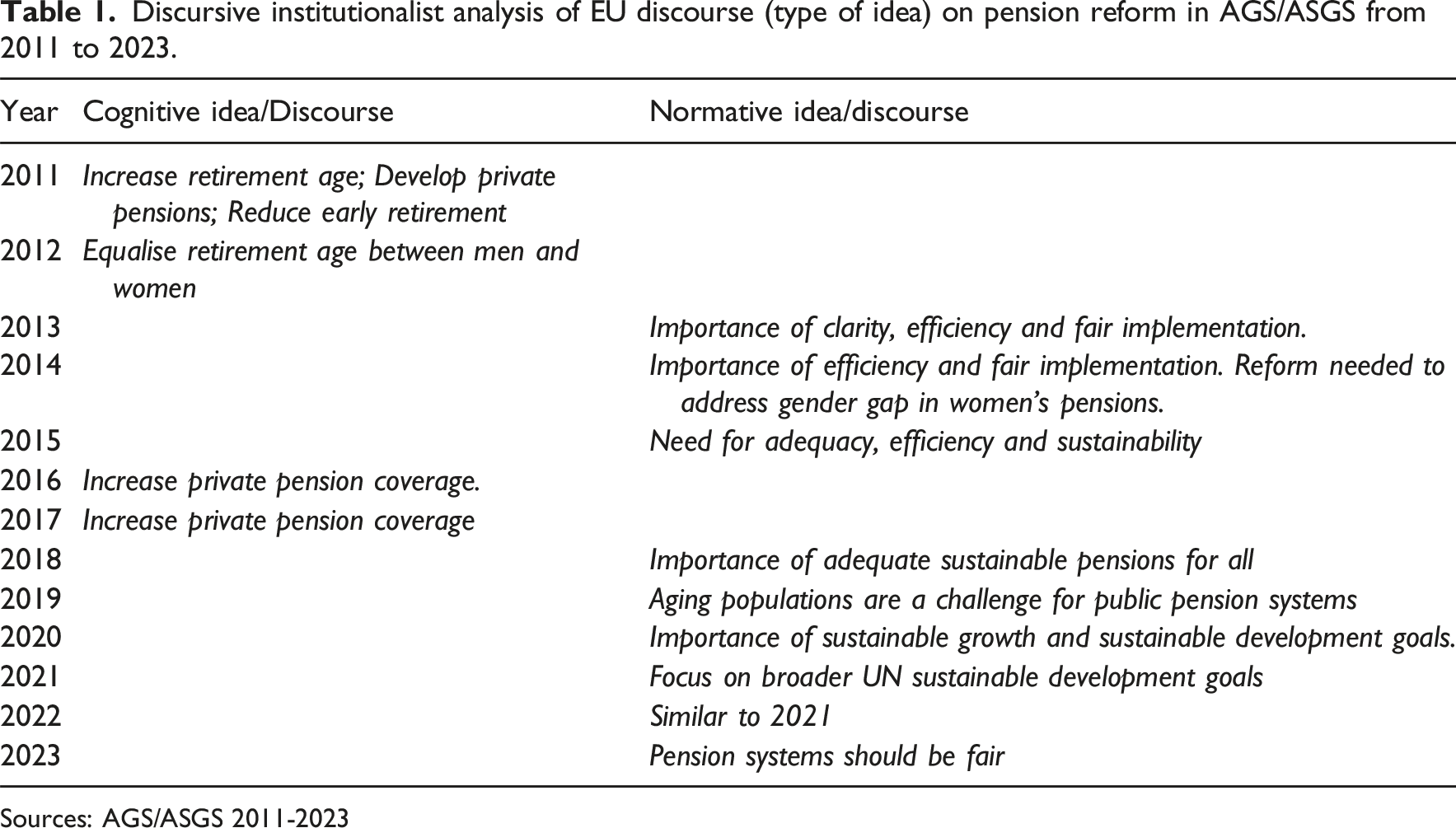
Discursive institutionalist analysis of EU discourse (type of idea) on pension reform in AGS/ASGS from 2011 to 2023.
Sources: AGS/ASGS 2011-2023
The European Commission’s first AGS for 2011 (European Commission, 2010) devoted considerable attention to pension reform. The budgetary impact of the 2008 financial crisis provided the context. Drawing on Schmidt (2008) we find a dominant philosophical level idea in the linking of budgetary impact to demographic change. In the opening paragraph, the AGS identifies the problem that needs to be solved (the programmatic idea). It states that “the budgetary impact of the crisis will compound the effect of demographic change, which will add a fiscal burden of some 4.5% of GDP in the long term” (European Commission 2010: p.2). Ten priority actions were set out (which based on Schmidt (2008) we identify as cognitive discourse) and member states were asked to commit to implementing them. Number five addresses how pension systems should be reformed to make them more sustainable as a support for EU fiscal consolidation (European Commission 2010: p.6). In particular, it included the following: • Member states that have not already done so should increase the retirement age and link it with life expectancy. • Member states should reduce early retirement schemes as a priority and use tax targeted incentives to employ older workers and promote lifelong learning. • Member states should support the development of complementary private savings to enhance retirement incomes. • In view of demographic change, Member States should avoid adopting measures related to their pension systems which undermine the long-term sustainability and adequacy of their public finances.
This focus on public finances was repeated in the 2012 AGS. Member states were asked to keep public expenditure growth below the rate of medium-term trend GDP growth and give particular attention to pursuing the reform and modernisation of pension systems (European Commission 2011). Unlike the previous AGS, this time the framing of reform was couched in the language of social partnership, and with a stronger social perspective. Member States were asked to respect national traditions of social dialogue to ensure both the financial stability and the adequacy of pensions (European Commission 2011: p.4). The specific recommendations from 2011 were repeated, with the addition of equalising retirement age between men and women (European Commission 2011: p.5).
Shortly after releasing the 2012 AGS, the European Commission published its White Paper on pensions. This reinforced the philosophical and programmatic ideas in discourse around the problematic nature of changing demographics on member state budgets. It also introduced a new policy idea, framing pension reform within recommendations to activate labour potential. This ties pension reform to extended work life policies, as well as activation policies for other cohorts outside the labour force including younger people, women, and those with low levels of educational attainment.
The 2013 AGS took a reflective tone with (based on Schmidt (2008)) more normative discourse, declaring that the EU “needs to show that our policies are working, that they will deliver clear results and that they will be implemented fairly in terms of the impact on our society” (European Commission 2012b: p.1). A priority was to “tackle unemployment and the social consequences of the crisis” (European Commission, 2012a: p. 3). The policy ideas in relation to pension reform were distilled into three points: Align retirement age with life expectancy; restrict early retirement; and enable longer working lives. Notably, the discourse around private supplementary pensions was different. Absent was an explicit call for privatisation or a pursuit of supplementary pensions. Instead, member states were asked to assess performance of pension (and healthcare) systems to ensure they represented an efficient use of public resources.
This framing of reform in terms of efficiency was repeated in the 2014 AGS, with identification of a “need to strengthen the efficiency and financial sustainability of social protection systems, notably pensions and healthcare systems while enhancing their effectiveness and adequacy in meeting social needs and ensuring essential safety nets” (European Commission, 2013: p. 7). Further normative discourse was employed around gender equality. Reference is made to the need for reform to address the impact of gender pay and activity gaps on women’s pension entitlements (European Commission 2013: p.11).
In the 2015 AGS equal emphasis was given to sustainability, adequacy and efficiency with the Commission recommending “a more dynamic view on the age at which people can retire needs to be established, including linking statutory retirement ages to life expectancy more systematically to ensure an adequate balance between life spent working and spent in retirement” (European Commission, 2014: p.12).
The 2016 AGS noted that a majority of Europe’s pension systems have been adapted to better withstand the future demographic impact, namely increases in retirement ages and restrictions on early retirement. Evidence of the unchallenged philosophical underpinning of PAYG public pensions being problematic, and the entrenched common sense of supplementary pensions as the solution emerges in how the 2016 AGS reverts to an emphasis on privatisation. Once again, member states are prompted to support the development of collective and individual pension plans to complement public pension schemes (European Commission, 2015b).
In the 2017 AGS the emphasis remained on encouraging the broad coverage of supplementary pensions. Private pensions should be “promoted by appropriate means, depending on the national context” (European Commission 2016: p.12). The need to coordinate labour market measures with pension reform was highlighted to “enable and encourage men and women to remain in employment until a higher age, reflecting growing life expectancy, and restrict early retirement pathways to those genuinely unable to work longer” (European Commission 2016: p.12). Work undertaken by the European Institute for Gender Equality (2015) on the gender pensions gap is recognised in the inclusion of a recommendation that “pension systems could credit care duties”, although this came with the qualification that such measures needed to take account of “fiscal positions and future expenditure implications” (European Commission, 2018a: p.12).
The 2018 AGS again emphasised the sustainability and adequacy of pension systems for all. “Retirement incomes can be boosted by extending working lives, linking the retirement age to life expectancy, avoiding early exit from the labour market and supporting complementary means of retirement incomes” (European Commission, 2017(b): p.11).
In the 2019 AGS it is noted that Europe’s ageing population is a challenge for pension systems (same goes for healthcare and long-term care systems). This increase in elderly Europeans will require the Member States to take additional measures that ensure both fiscal sustainability and adequate pension coverage. The Commission specifically highlights the concerning situation for young people “as they may face a double burden: having to pay higher contribution rates while working and receiving lower pensions after retirement” (European Commission 2018b: p.7).
Before the start of 2020, as mentioned earlier, the European Semester was refocused and the AGS report was renamed the Annual Sustainable Growth Strategy (ASGS). The ASGS 2020 (European Commission 2019b) specifically highlights the importance of sustainable growth within the European Union and that “the Sustainable Development Goals will be at the heart of EU’s policymaking and action” (European Commission 2019b: p.2). Furthermore, “by developing this new approach in this Semester cycle and over the years to come, the European Semester will directly support the European Union and its Member States in delivering the Sustainable Development Goals across its economic and employment policies and ensure that the economy works for everyone, and growth is sustainable” (European Commission 2019b: p.14). Interestingly however, the ASGS discusses population aging, only in the context of it hampering medium-term economic prospects and that future income and employment growth in Europe will depend crucially on higher productivity and innovation.
The ASGS 2021 (European Commission 2020) focuses on overcoming the sudden and deep recession caused by the COVID -19 pandemic while also keeping the Single Market running smoothly and continuing the sustainable, fair, and democratic transition towards the European Green Deal 1 in line with the UN Sustainable Development Goals. There are no specific references in ASGS 2021 (European Commission 2020) to pensions. This could suggest a possible rethinking of the dominant philosophical level idea of earlier years linking negative budgetary impact to demographic change in favour of a philosophy that delivering sufficient and sustainable growth in economies and employment in a way that is fair and democratic will in effect go a long way towards alleviating the challenges of the pension crisis.
The ASGS 2022 (European Commission 2021a) likewise focussed on the effects of the COVID-19 shock and the continuing mitigation of the socio-economic impact of the pandemic and laying the foundations for a transformational and inclusive recovery and stronger resilience. While there are again no specific references to pensioners or pension provision in the ASGS 2022 (European Commission 2021a), both country reports for 2022 refer to developments in each country to shore up the fiscal sustainability of the State Pension system, without issuing a “report card” or specific recommendations in the area.
In the ASGS 2023 (European Commission 2022) however, pension systems are once more specifically referenced, this time in the context of the “fairness” dimension referred to above and specifically the priority to preserve and improve the adequacy and sustainability of social safety nets. Referring to the “2021 Ageing Report” Economic and Budgetary Projections for the EU Member States (2019-2070), the ASGS 2023 (European Commission 2022) states that ensuring the adequacy and financial sustainability of pension systems remain particularly important as is providing access to affordable, quality, and sustainable long-term care.
Tracing cognitive and normative ideas to Dutch and Irish policy reforms
Using Peng (2016) discourse tracing, we look at the responses of both The Netherlands and Ireland to the cognitive discourse from the EU (around increasing retirement age and extending working lives, increasing supplementary private pensions and restricting early retirement – Table 1) and the more normative discourse (around gender equality in pensions and the value for money and long term sustainability of pension systems - Table 1).
Linking retirement age to gains in life expectancy
As early as 2012, the Dutch government presented plans to increase the statutory retirement age. The increase has happened gradually, reaching 67 in 2024. Going forward, the statutory retirement age will be linked to life expectancy. In 2011, Irish legislation was passed which effectively increased the state pension age from 65 to 66 in 2014. With effect from January 2024, a new flexible pension model has been introduced, giving people the option to retire at age 66 or continue working up to the age of 70 and secure a higher State Pension.
Restricting access to early retirement
In the Netherlands, changes in 2005 to the tax treatment of early retirement schemes significantly discouraged such schemes. This does not mean that early retirement is prohibited, but it is no longer “co-funded” by the government.
Unlike some other EU member states, it was never possible to receive a state old age pension in Ireland before the age of 65. Separate disability and invalidity social insurance pensions based on contributions and medical evidence are paid in the event of an inability to work. A jobseeker’s benefit can also be paid for 9 months in the event of a period of unemployment.
Supporting access to longer working lives
By mid-2014 comprehensive reforms in the public and private funded pillars of the Dutch pension and long-term care systems were initiated. In addition to raising the statutory retirement age and linking it to life expectancy, the financial supervision of pension funds was improved, and the system was made more resilient to financial shocks. These reforms are complemented by successful reforms encouraging older workers to work longer including subsidies to boost measures focussed on sustainable employability, working longer and a smooth transition from working life to retirement. By mid-2015 the long-term sustainability of the Dutch pension system had improved (European Commission 2015a).
In Ireland, while the maximum retirement age for public servants was increased from 65 years to 70 years, there is no mandatory retirement age for private sector workers in Ireland. Many contracts of employment and occupational pensions set retirement age at 65 to coincide with the earliest age from which a state pension was originally payable. The removal of the state pension at age 65, and the proposals for later state pension ages, without attention being paid to the age individuals are contracted to leave employment has prompted concern among employer and trade union organisations alike. Notwithstanding this, private contracts of employment may still however contain mandatory retirement ages.
Develop supplementary private pensions
Dutch employers are not legally required to provide supplementary pension schemes for their employees. However, through a series of mandatory industry wide pension schemes which apply to specific industries and collective labour agreements which prevail in other employment situations, in effect a quasi-mandatory system of private pension coverage is in place. In total, about 87% of Dutch employees participate in a (complementary) employee pension plan (CBS, 2018).
Ireland’s multi-pillar system largely meets the EU’s recommendations for supplementary pensions. The replacement of the voluntary nature of the system with the proposed automatic-enrolment addition in 2026 is designed to further strengthen the importance of private pensions in Ireland.
Addressing gender issues
The pensionable age for men and women has been the same in the Netherlands since 1990 (Parliamentary Papers II, 1996/1997, nr.131, 22695). The 2019 CSR does, however, stress that “there is still untapped labour potential, in particular among the high number of part-time working women” (European Commission, 2019a). This inevitably results in a lower pension for women.
There has always been a uniform state retirement age for men and women in Ireland. At Pillar 1 level, the “Total Contributions Approach” introduced under the Roadmap For Pensions Reform (Government of Ireland, 2010) includes provisions for attributing home caring contribution credits of up to 20 years credits for persons in homemaking and caring roles. This is a major initiative in recognising the role of homemakers and carers in society by protecting their social welfare pension entitlements where they take time away from paid employment for these important roles. However, anomalies remain which need to be addressed and there has been no extension of this initiative to pillar 2.
Measures aimed at sustainability, fairness and efficiency of pension systems
As mentioned above, measures taken by the Dutch Government to restrict access to early retirement and facilitate longer working lives did much to improve the long-term sustainability of the public finances. The Dutch Government agreed in 2019/2020 on the main principles of fundamental pension reform aimed at boosting fairness and transparency in the pension system by significantly reducing intergenerational redistribution in the second pillar system and strengthening the link between pension fund performance and payouts. The new framework is due to be phased in gradually from 2023 to 2027. As the Dutch pension system transitions to its new framework by 2027, further integration of the principles of fairness and sustainability is necessary to meet the EU’s broader recovery goals fully.
In the Irish context, in addition to the measures discussed in 6.11 to 6.15 above the memorandum of understanding with the Troika required Ireland to undertake measures which generated immediate savings. There was a requirement for a reduction in pension tax relief and pension related deductions to yield €155m in 2011 and an extra €105m in a full year. Various caps on the amount of tax relief given to private pensions were introduced to produce the required savings, supplemented by a levy on pension fund assets. A requirement was included to reduce existing public service pensions by an average of 4%. Changes to the pensions for new entrants to the public service were incorporated into a new civil service pension scheme that came into effect on 1 January 2013. Reforms included basing pensions on career average earnings, a 10% pay reduction, and linking retirement age for civil servants to the state pension age.
Discussion and conclusion
Applying Schmidt, (2008) DI lens we find the philosophical idea underpinning the EU’s prescription for pension reform is that public expenditure needs to be controlled. The discourse used by the EU identifies unfunded PAYG public pensions as problematic. In this way, the discourse institutionalises the idea that ageing populations are tied to uncontrollable and unsustainable public expenditure. In our analysis, we designate these as cognitive ideas as they justify the policy reform proposals around increasing the retirement age, limiting access to early retirement and supporting private supplementary pensions through a discourse of logic and necessity.
In more recent AGSs/ASGSs, an explicit call for private pensions gives way to the idea of assessing the performance of pension systems, gauging the value for money they provide and ensuring the fairness and sustainability of the State Social Welfare Pension system. They also call for pension systems to address the gender gap in pensions. Drawing on Schmidt (2008), we designate these as normative ideas, which, if implemented, would serve to legitimise the policies through reference to their appropriateness.
Using discourse tracing employed by Peng (2016), we find evidence of a divergence in effectiveness between cognitive and normative ideas in EU discourse. In the first AGS (European Commission, 2010) the policy solution presented is unambiguous. To protect future public finances, pension expenditure needs to become sustainable through a variety of measures; increased retirement age; elimination of early retirement; and the development of private pensions. These cognitive ideas were carried forward in the language used in the CSRs. They served to justify and propel the reforms undertaken in both countries. More recent ASGS’s reflect shifts in EU governance towards an emphasis on fairness and sustainability as guiding principles, thus elevating normative ideas in pension reform discourse. Peng (2016) found that the effectiveness of a communication strategy was a function of how successful it was in swaying preexisting ambivalence. Our findings suggest that the more normative ideas around value for money, gender equality and fairness did not fluidly transfer from the AGS/ASGS to CSRs to explicit policies mirrored in either jurisdiction. Indeed, elements that do, are underpinned by cognitive discourse, for example, the guiding principle of fairness is distilled down into specific cognitive ideas such as introducing “caring” credits to reduce gender gap.
Adopting the DI lens, our examination of the European Semester programme as it applies to pension reform in the Netherlands and Ireland, supports the argument that cognitive ideas are privileged over normative ideas. Cognitive ideas that directly linked ageing populations and precarious public finances were communicated by the EU in the AGSs and CSRs and led to direct reform of pension systems. In contrast, normative ideas of holistically addressing a gender gap in pensions or assessing pension system performance and value for money did not carry through to domestic policy in the same way. Arguably this is because cognitive ideas are more prescriptive and acquire a common-sense designation as logical and necessary policy reforms, that align directly with the unchallenged philosophical idea underpinning EU’s prescription for pension reform, which is the need to control public expenditure. In contrast, normative ideas acquire a secondary designation, a status which labels them as appropriate, but perhaps not as urgent and capable of being addressed explicitly through differing mechanisms. On the basis that cognitive discourse is more effective than normative discourse in effecting policy change, it follows that where ‘the subsidiarity principle’ applies, the European Semester can influence reform in Member States and strive to prioritise certain aspects/types of reform in Member States through the use or otherwise of cognitive discourse.
In conclusion, this paper uses discursive institutionalism as a theoretical lens to help understand the EU approach to influencing National reform in policy areas where the “subsidiarity principle” applies. The particular focus of this paper is pension policy, but our research approach could be helpful, in understanding other European Semester policy areas where the subsidiarity principle applies. The designations between cognitive and normative derive from the way the EU funnels ideas from its AGSs/ASGSs to CSRs to domestic policies. To date, it is the institutionalised cognitive ideas that have transferred, most fluidly and consistently and are therefore the ideas that most heavily constitute the EU’s influence over pension reform. By recognising that normative ideas remain secondary in the European Semester process, the EU can leverage this capacity to create a “priority pyramid” (where priority measures are presented using cognitive discourse while non priority ideas are couched in more normative speak.) in terms of reform measures, with the aim of ensuring a better balance between fiscal sustainability and social equity. Accordingly, we suggest that policymakers and other actors may very consciously choose one form of discourse over the other to negotiate their preferred pathway towards implementation.
Footnotes

Ethical considerations
Ethical Approval was not required for this article.
Funding
The authors received no financial support for the research, authorship, and/or publication of this article.
Declaration of conflicting interests
The authors declared no potential conflicts of interest with respect to the research, authorship, and/or publication of this article.