




Abstract
This study explores how the European Union (EU) governs care provision in member states through the European Semester and its Country-Specific Recommendations (CSRs). Introduced after the economic crisis, the Semester has became a targeted tool for shaping national care policies and regimes, complementing EU measures like family leave directives and childcare targets. Our qualitative analysis of CSRs from 2011–2024, focused on policy orientations and policy frames, shows that the European Semester has been pivotal in the EU’s strategy to shape care policies and systems in member states—a field that belongs to member state competences but is essential to the EU’s social and economic objectives. The European Commission has consistently used the Semester to encourage care-related reforms. While social investment frame aimed at promoting women’s employment is prominent, a cost-cutting approach implying market solutions and family responsibilities remains strong for long-term care. We suggest that the European Semester aims to align national care regimes, fostering a European model based on a fiscally sustainable balance between unpaid care provided by families and care provided by states and markets and underpinned by a commodifying script.
Introduction
The notion of a care crisis has captured the attention of both scholars and policymakers though their interpretations of the causes and consequences of this crisis differ. Care researchers point to unmet care needs and the increasing burdens put upon informal carers, which they attribute to privatisation and marketisation of public care services (e.g. Dowling, 2021; Hansen et al., 2021). Many policymakers, in contrast, primarily focus on the increasing costs of care provision amidst demographic ageing. In the European Union (EU), the organisation, financing and provision of care is a competence of the member states. Yet the EU institutions play a role in shaping and managing the care crisis. The EU has set standards for national policies with maternity and parental leave directives and soft policy tools, such as childcare targets. Recently, the European Commission adopted the European Care Strategy to improve care services and the situation of carers and care receivers across the EU (Caracciola Di Torrella and Masselot, 2020; Daly, 2023; Zacharenko, 2024.). Simultaneously, the pressures that the EU’s fiscal rules put upon member states’ public finances, and the single market policies aiming to open public services to competition, have implied spending cuts and marketisation in national care services (Bruff and Wöhl, 2016; Erne et al., 2024).
This article deepens understandings of the mechanisms through which the EU institutions attempt to govern the provision of care within member states, and of the policy orientations and policy frames of this governance. While the existing literature has shed light on the EU’s directives and soft policy tools related to care, this article focuses on the EU’s economic governance processes. We analyse how the European Semester, the key tool of the EU’s socio-economic governance, has been used by the European Commission and the Council of the European Union to shape reform efforts within national care systems and policies. Established after the economic crisis to promote fiscal and macroeconomic stability, the European Semester expanded the EU’s policymaking and enforcement powers across various socio-economic domains, including those in national competences (Erne et al., 2024: 38-39; Verdun and Zeitlin, 2018). Through this mechanism, the Commission and the Council establish policy priorities, analyse member states’ socio-economic situation, and issue targeted policy recommendations for each member state, known as Country-Specific Recommendations (CSRs). Studying the European Semester is crucial for understanding how the EU governs care, because care is one of those policy fields where the EU does not have legal competence but that has been addressed in the European Semester. Moreover, Semester’s country-specific nature allows for nuanced and adaptable interventions.
We conceptualise care as waged or unpaid labour, resources and relations oriented towards sustaining life and answering care needs (e.g., Daly, 2021). At the policy level, our definition covers care services for children, frail old people and other dependents, and policies targeting unpaid carers. We ask, what policy frames guide problem representations and policy solutions around care in the European Semester, and what is the policy orientation of the care-focused recommendations issued to the member states? Theoretically, our analysis builds on feminist understandings of care that we combine with literature on care regimes and policy frames. We rely on a qualitative, interpretative analysis of CSRs issued within the European Semester from 2011 to 2024, focusing on EU-level trends and shifts over time.
This article contributes to research on EU care policies (e.g., Caracciola Di Torella and Masselot, 2020; Dahl and Litvina, 2023; Daly, 2023; Zacharenko, 2024) and enriches discussions on the social dimension of the European Semester (e.g., Copeland, 2020; Dawson, 2018; Zeitlin and Vanhercke, 2018). It also adds to the broader debates about commodification of care (e.g., Farris and Marchetti, 2017) and marketisation of welfare and the role of EU therein (Crespy, 2016; Ledoux et al., 2021). We show that the European Commission and the Council have consistently leveraged the European Semester to push for care policy reforms in the member states. We suggest that in the absence of a formal competence in the field, the European Semester has become an important additional tool for the EU institutions to govern the provision of care in the member states. In line with the different national care regimes and competing policy frames within the EU institutions, European Semester recommendations have not provided one general blueprint on how national care systems should be reformed. Instead, they have steered national care regimes toward a European model that is marked by a fiscally sustainable equilibrium between unpaid care and care by states and markets and that is based on a commodifying rationale. A social investment frame aimed at promoting women’s employment is the dominant policy frame and a cost-cutting approach implying market solutions and familialised care persists in the context of long-term care.
We first outline previous research on care in EU policymaking and explain our analytical approach. We then present our data and methods. The analysis first identifies how the CSRs represent care as a policy problem and then assesses policy recommendations. Finally, we address the role of care in the Semester and the type of governance exercised.
Literature review: Care in EU policymaking
The concept of care brings together policy fields such as childcare, elderly care, and family leave that, in EU and national policymaking, are often siloed. Our understanding of care builds on feminist care research, which sees giving and receiving care as a basic human condition (Tronto, 2013). Caregiving takes place as waged care work and unpaid care labour within families and communities. Both waged and unpaid caring are gendered and mainly carried out by women. Feminist care scholars see that care is unlike any other waged or unpaid labour: it is a relationship between the carer and the person being cared for, rather than a process producing an output (Himmelweit, 2007). Another insight is that care is not an expenditure or a merely ‘social’ activity but an essential part of the economy. Care as unpaid labour, waged care work, and public resources and policies is crucial for the reproduction of labour force and the functioning of the economy (Folbre, 2021; Fraser, 2022). Yet policymakers may not see its value: waged care labour is often undervalued, unpaid care invisibilised, and public care services seen as a cost (Cavaghan and Elomäki, 2022).
The organisation, funding and provisioning of care remains a competence of the EU’s member states. Articles 145-161 of the Treaty of the Functioning of the European Union (TFEU) which concern social policy do not mention care. Yet the theme has become more salient at the EU level over the last 30 years, and the EU has addressed care through hard and soft governance tools. The legislative aspects of the EU’s governance of care concern unpaid care, notably care-related leave. In the 1990s, the EU adopted directives on maternity and parental leave, and the 2019 Work-Life Balance Directive introduced provisions on paternity leave and leave relating to other caregiving responsibilities (Chieregato, 2020; De la Porte et al., 2023). The directives stem from the EU’s competence in health and safety at work (maternity leave) and gender equality in the labour market (other forms of leave).
Reflecting the EU’s lack of legal competence in this field, the EU has governed the provision of care services mainly through soft tools, such as recommendations and targets (Caracciolo Di Torella and Masselot, 2020). The 1992 Council Recommendation on childcare was complemented in 2002 by Barcelona targets on childcare, which recommended that member states provide childcare for 90% of children from the age of three until school age, and for 33% of children under three. The targets were revised in 2022 as part of the European Care Strategy and are 96 % and 45 % respectively. The childcare targets too are based on the EU’s competence in the field of gender equality in the labour market. EU intervention in the care for the older and disabled people is more minimal and recent. Long-term care first emerged under the EU’s demographic change portfolio (Zacharenko, 2024), and it was included in the social Open Method of Coordination along with healthcare in the early 2000s (Vanhercke and Wegener, 2012). It became a stand-alone issue in the 2010s, and the European Care Strategy included a Council Recommendation on long-term care, although without targets (Daly, 2023). The recommendation draws on the EU’s competence on the modernisation of social protection systems. Other soft policy measures, such as the Child Guarantee, address care services too. The EU has also governed national care services with financing: Cohesion Policy and more recently the Recovery and Resilience Facility (RRF) have allocated funding to improve care infrastructure (e.g., Corti et al., 2022; Thissens, 2022).
From the academic literature on care, two observations on the EU’s governance of care can be made. First, the EU’s limited competence and specific form of governance are underpinned by member states’ different care regimes that distribute responsibilities among the family, state and market (see Bettio and Plantenga, 2004; Esping-Andersen, 1990; Plantenga, 2021). National care regimes differ by the extent to which they rely on the family or attempt to redistribute care responsibilities away from the family, either with public services or market-based provision (e.g., Leitner, 2003). They also differ in terms of whether they portray women and men as caregivers, workers or both (Lewis, 1997). Additionally, the relationship between the market and the state is organised in different ways. Care scholars have noted a steady growth in the use of for-profit providers across the EU. In parallel, market principles have been introduced into public care provision to increase productivity and efficiency, and constrain costs (e.g., Brennan et al., 2012; Farris and Marchetti, 2017). Care scholars have referred to these trends as the commodification of care, arguing that practices of privatisation and marketisation turn care into a commodity that can be priced, bought and sold (Vaittinen et al., 2018). From the feminist research perspective, there are limits to treating care as a commodity, as care work cannot be made endlessly more productive without compromising its quality (Himmelweit, 2007: 591). The commodification of care is part of a broader phenomenon of the marketisation of welfare services (cf. Crespy, 2016; Ledoux et al., 2021).
Second, until the launching of the European Care Strategy, a coherent approach to care was largely absent with different policy frames co-existing (Caracciolo Di Torrella and Masselot, 2020; Dahl and Litvina, 2023; Daly, 2023). The main objective of the EU’s involvement with childcare has been to facilitate women’s labour market participation, although gender equality, children’s rights and eradicating child poverty have also been central policy frames (Caracciolo Di Torrella and Masselot, 2020). In contrast, fiscal priorities have dominated the approach to care for the elderly and long-term care, even if care needs and gender equality have been considered too (Dahl and Litvina, 2023; Daly, 2023; Zacharenko, 2024). Framings focused on the rights of carers and those in need of care have also been present. The EU’s family-leave legislation has addressed the rights of unpaid carers, while only as “workplace rights” that do not address the challenges posed by the increasing demand for care (Caracciolo Di Torrella and Masselot, 2020: 128). Moreover, the European Pillar of Social Rights (EPSR), proclaimed by EU institutions in 2018, established non-binding rights to early childhood education and care and long-term care services. The Work-Life Balance Directive and the European Care Strategy further advanced rights-oriented framings.
The co-existence of the different and conflicting policy frames is illustrative of internal differences and conflicts between and within the EU institutions. The EU’s gender equality actors, social policy actors and economic actors see the issue from different perspectives (Zacharenko and Elomäki, 2022). Overall, scholars have pointed out that there is a misalignment – although a hardly surprising one – between the EU institutions’ approach to care and its conceptualisation within the feminist literature. For instance, the understandings of care in the European Care Strategy have been seen as “rather shallow”, not grasping care as a holistic phenomenon (Daly, 2023: 20).
The issue of care has therefore attracted growing attention by EU institutions and is being addressed by a variety of different governance tools and perspectives. To shed new light on how the EU institutions attempt to govern national care systems in the absence of legal competence, we focus on the EU’s economic governance processes. The European Semester has provided the EU institutions with new policymaking and enforcement powers regarding care provision. As a governance tool, the European Semester is more country-specific than directives or targets, as it allows the European Commission to issue detailed policy recommendations (CSRs) for each member state. It has also allowed the Commission to expand its powers into policy domains in national competence, such as healthcare (Erne et al., 2024: 38-39). The CSRs themselves are not legally binding, but some are issued in frameworks that have coercive elements. The most coercive CSRs are underpinned by the EU’s fiscal rules (Stability and Growth Pact) and the so-called Macroeconomic Imbalance Procedure, and there are potential sanctions for non-compliance. Other recommendations have a less-constraining legal ground in the Open Method for Coordination, but they still entail monitoring and reporting obligations (Bekker, 2021). The CSRs may directly address childcare, long-term care and unpaid carers. Indirectly, recommendations related to fiscal policies also have implications for national care regimes, as they influence the room for care-related public spending (Bruff and Wöhl, 2016). This article focuses on recommendations that directly address care.
Analysing care-related policy orientations and policy frames in the European Semester
Our analytical framework consists of two intertwined lenses. The first interrogates the different policy orientations of the governance of care through the European Semester. We consider three different orientations that relate to the family/state/market relationship (cf. Esping-Andersen, 1990). Firstly, we consider whether the Semester is oriented towards defamilialising or refamilialising care, that is, whether the aim is to move care away from families or continue or increase reliance on (women’s) unpaid care labour. Secondly, we consider whether the Semester instructs member states to contain the public costs of care or invest in care. This orientation captures the role of the state and tackles crucial questions about whether care is seen as expenditure or worth public financing (e.g., De Henau and Himmelweit, 2021). Thirdly, we assess the extent to which the Semester is commodifying or decommodifying, which captures the state/market nexus and the rationales behind policy recommendations. Given the complexity of the issue of care, we rely on a two-dimensional understanding of commodification. On the one hand, we refer to commodification of care (see previous section). On the other hand, we understand commodification more broadly as making different areas of social life dependent of market forces (Copeland, 2020; Esping-Andersen, 1990). In this broader sense, the concept draws attention to how policy discourses around care consider human beings as commodities or make it impossible for persons with care needs or care responsibilities to maintain a livelihood without reliance on the market. While commodification of care and commodification of people are different phenomena, they both rely on a market logic. Similarly, for us decommodication refers to decommodication of care but also more broadly to rationales and policies that do not reduce people to their current or future labour market value.
Framework for analysing care-focused policy orientations and policy frames.
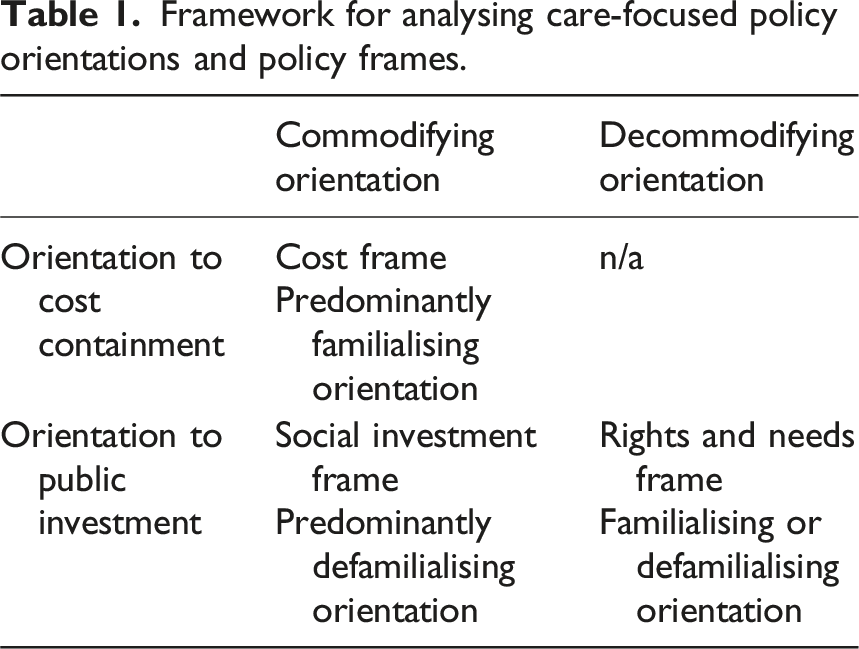
The cost frame is oriented toward cost-containment and commodification. It defines public care provision as a public finance problem. Proposed solutions focus on constraining costs, often with market-oriented policies. This frame is predominantly refamilialising, as spending cuts and marketisation will most likely shift responsibility to individuals. The second frame is oriented toward more public investment in care but within a commodifying rationale. We call this approach the social investment frame. 1 In line with social policy scholars (e.g., Hemerijck, 2017; Morel et al., 2012), this frame sees that some care-related policies contribute to the productive capacity of individuals and the economy, through enhancing human capital or easing labour market participation. Policy solutions might include reconciling work and family life or improving access to care services with a view to increasing women’s labour market participation or education levels. The social investment frame is predominantly defamilialising. The third frame involves investment and decommodification, and we call it the rights and needs frame. Problem representations relate to unmet needs and lack of access, quality or affordability. Solutions would include improved care-related services and benefits. This frame can be refamilialising or defamilialising, depending on the proposed policy solutions (i.e. care services vs cash-for-care schemes).
Based on the literature review and our analytical framework, we can make some expectations about the governance of care within the European Semester. First, we expect this governance to be multifaceted and to display different orientations and policy frames, reflecting the variety of national care regimes and the divergent views on the topic within the Commission. However, given the European Semester is predominantly a fiscal and economic policy process controlled by economic actors, we anticipate a focus on costs and commodification. Second, regarding the intensity of the governance, we expect the Commission to actively use the European Semester to extend its powers and navigate the EU’s limited competence in this policy field.
Data and methods
Our data consists of the European Semester CSR documents (n = 373) for all member states for years 2011–2024. The documents include numbered policy recommendations and an explanatory part (recitals) that provides the rationale for the recommendations. Although the CSRs are discussed by member states and adopted by the Council, they mainly reflect the views of the Commission. Different Commission departments participate in drafting them, but the economic actors within the Commission are mainly in charge. Our methodological approach relies on frame analysis (e.g., Entman, 1993; Rein and Schön, 1977; Verloo and Lombardo, 2007) and combines discursive analysis with quantified classifications. We focus on problem representations and policy solutions, which are key aspects of a policy frame and align with the structure of the CSR documents. We study problem representations and policy solutions through our two analytical lenses: policy orientations (familialisation vs defamilialisation, cost containment vs investment, commodification vs decommodification) and policy frames (cost frame, social investment frame, rights and needs frame) (Table 1). We coded the data with ATLAS.ti, using both descriptive codes to organise the data for analysis and codes directly deducted from our theoretical framework (orientations and policy frames). The purpose of the coding was not to create new concepts but to analyse the data from the perspective of our conceptual lens (see Elliott, 2018; Saldana, 2021). Assessing how member states implemented the recommendations falls outside our scope. Meanwhile, despite its links with the European Semester and the CSRs, we consider the RRF to be its own distinct governance tool and it falls outside the scope of the research.
The first stage was to identify care-related problem representations in the recitals. For the purposes of this article, we define care as the labour, relations and resources related to answering care needs, with a focus on care for children and dependent adults. At the policy level, this definition covers childcare services, long-term care services, parental leave, and work-life balance and other policies targeting unpaid carers. Due to the style of the documents, most references were policy-oriented, and we coded them according to the type of policy (e.g., childcare services, long-term care services, parental leave, flexible working time…). To make care as gendered and undervalued labour visible, we also coded the references to waged and unpaid care labour. Second, we coded the references inductively for problem representations (e.g., fiscal sustainability, inefficiency, employment rate, access, quality, gendered division of unpaid care…), which we then linked to policy orientations and policy frames. Our analysis of problem representations was discursive, to shed light on how care is constructed as a policy problem and on the nuances of these constructions.
The second stage was to analyse policy solutions through the recommendations issued to the member states. The data included 1427 headline CSRs, that is, numbered pieces of text that contain guidance within a broad policy area. A single CSR often contains several policy recommendations, and we focused on these smaller parts of text that we call recommendations (see Crespy and Vanheuverzwijn, 2019; Erne et al., 2024 for a similar approach). Following Erne et al. (2024), we interpreted the recommendations in their semantic context (i.e. what is said in other recommendations and in the recitals). We also used comparative research to place them in the context of national care systems. We first identified all recommendations targeting care provision, according to our definition of care and care-related policies. For general references to welfare services and benefits, we consulted the recitals to see whether care was targeted. We then coded the care-focused recommendations for their policy orientation. Recommendations were coded as familialising or defamilialising based on their explicit aim and potential effects. They were coded for cost-containment when they referred to fiscal sustainability or cost-effectiveness, and for public investment when they referred to improving provision, access, affordability or quality. Recommendations were identified as commodifying or decommodifying based on the concrete policy proposal and its rationale, covering both commodification of care and of people. As the final step, we classified the recommendations under the three policy frames. Mixed or unclear recommendations constituted a fourth category. Our analysis of policy solutions was quantified. We compared the number and share of recommendations by policy orientation and policy frame over the research period to identify shifts and trends.
The recitals were coded by one author only. To ensure consistency and facilitate quantified analysis, the recommendations were coded by both authors. During the first coding round, both authors coded all recommendations separately, and different interpretations were discussed and used to further define the categories. On the second coding round a common view was negotiated on each point of difference. We did not develop an intercoder reliability rating, as our goal was to achieve consensus (Harry et al., 2005: 6).
Problem representations: Employment rate, meeting care needs and costs
In line with our expectations and previous research of the social dimension and the European Semester (e.g., Copeland, 2020; Dawson, 2018), care was predominantly perceived as an economic policy problem. There was a strong – although not exclusive – focus on commodification, and concern for costs was also present.
The main care-related problem representation concerned how care responsibilities limit (women’s) labour supply and labour market participation, constraining employment rates and thereby economic growth. Such representations that are in line with what we call the social investment frame acknowledged that unpaid care was a gendered issue and revolved around how care responsibilities kept women away from the labour market or forced them to reduce working hours. In other words, care as a policy problem was strongly tied to the commodification of women’s labour and the concern for overly familialised care regimes. The lack of childcare services, and to a lesser extent long-term care services, were identified as the main causes to the problem. The recitals often evoked the Barcelona childcare targets, as in the case of Hungary: “The gender employment gap is wide, especially in the 25–39 age group, which can be in part explained by a limited supply of good quality childcare. The level of participation in childcare for children under the age of 3 is well under the Barcelona target and the Union average” (Council, 2018a: 73). Tax-benefit systems that encouraged unpaid care were highlighted as another cause. Parental leave that is too long and is financially too generous “disincentivised” women from taking up paid employment (Romania, Slovakia, Czechia, Estonia, Finland, Hungary). This also applied to tax-systems with joint taxation or posing disincentives for the “second earner” in couples (Germany, Netherlands, Italy, Austria Luxembourg), which have been typical for male-breadwinner regimes. These labour-market-oriented problem representations did not attribute any economic value to unpaid care labour. Nor did they acknowledge how the burdens of unpaid care might have increased due austerity policies and the restructuring of public services.
Although the problem representations were generally defamilialising, the recitals implied that not all unpaid care could or should be moved away from households. Rather, it should continue to function as the invisible subsidy to the monetised economy. For instance, it was stated that low levels of informal care were a reason for the high long-term care costs in the Netherlands (Council, 2011: 14). For Poland and Estonia, problem representations revolved around the lack of support for informal carers, rather than the high level of informal care as such (Council, 2019a: 126; Council, 2019b: 32). A certain level of familialisation was thus tolerated, even encouraged, at least regarding long-term care (cf. Zacharenko, 2024).
In line with our expectation about diversity of orientations and policy frames, the dominant commodifying representations existed side-by-side with other ways to problematise care. Problem representations related to access, affordability and to lesser extent quality were the second main group. These representations that involve decommodifying orientations and link with the rights and needs frame increased when the EPSR with its principles on right to childcare and long-term care was integrated in the European Semester and have been an important part of problem representations ever since. Regarding access, the documents drew attention, among other things, to regional disparities in childcare in Italy and long-term care in Bulgaria and Spain, and lack of statutory entitlement to long-term care in Ireland. Some representations about access had a commodifying edge. For instance, access of disadvantaged children and families to early childhood education and care was framed as a question of human capital development. With childcare, the documents expressed a clear concern for high costs for families, mainly in Czechia, Ireland, UK, Italy and Slovakia – countries with mainly pro-profit, private childcare provision. The high payments for long-term care were raised in some cases too (Estonia, Italy, Slovakia, Spain). While quality was regularly mentioned as a goal – more often regarding childcare than long-term care and linked to concerns for human capital development – the lack thereof was rarely represented as a problem to be addressed. The causes for the unmet care needs and unaffordable, low-quality services, including lack of public investment, were rarely discussed.
Problem representations related to the sustainability of public finances that align with the cost frame were the third main group and focused almost exclusively on long-term care. Although less common than anticipated given the fiscal and economic character of the European Semester, they involved a stronger sense of urgency and crisis than the representations within the rights and needs frame that were more common. The increasing long-term care needs were cast as a threat to fiscal sustainability, together with age-related spending on pensions and healthcare. Public care provision was represented as a cost, often referring to the projected increase of long-term care spending, as in the case of Austria: “The projected increase in pension, healthcare and long-term care expenditures points to a medium risk to fiscal sustainability in the medium and long-term. […] Expenditure on long-term care is projected to double from 1.9% to 3.8 % of GDP by 2070” (Council, 2018b: 86). The cost-oriented problem representations became more detailed over time, drawing attention to ineffective governance structures, unclear funding and organisational responsibilities, and reliance on institutional care as the main causes to the problem. The Commission and the Council even criticised national care reforms for increasing the strain on public finances, for instance, through shifting costs away from care recipients (Council, 2018b: 86) or improving the compensation for informal carers and raising wages of care workers (Council, 2023: 191).
In policy frame analysis, it is crucial to consider what potential problem representations have been omitted (Bacchi, 2009: 12). The silences in the European Semester echoed those in the EU’s other care policies (e.g., Dahl and Litvina, 2023; Zacharenko and Elomäki, 2022). For example, the rare references to waged care labour (i.e. staff shortages and qualifications of care workers) mainly took the perspective of ensuring access to or quality of services. The poor working conditions and pay were only mentioned once for Austria (Council, 2023: 191), even if this is a problem across the EU. A noteworthy omission was connected to the balance between the state and the market. The documents never cast reliance on for-profit providers as a problem, which legitimises the increasingly market-oriented provision in member states. The lack of privatisation and marketisation was not framed as a problem either, at least not explicitly. Yet the general references to the lack of competition and public procurement in public service provision could be understood to imply that care services too should be opened for private actors – as the Commission originally wanted to do with the 2006 services directive but failed (Erne et al., 2024).
Policy solutions: Investment, commodification and defamilialisation
In line with our expectation, different policy orientations and policy frames co-existed also in the policy recommendations. Between 2011 and 2024, the Commission and the Council issued 180 individual recommendations related to care provision for the member states (Figure 1). These recommendations mainly addressed care services. Childcare was the focus in the early years, reflecting the emphasis on childcare within the EU’s other care-related policymaking. Also long-term care was a salient issue from early on, and since 2019 it has been more prominent than childcare – despite being less regulated through hard and soft tools. The recommendations also addressed policies for unpaid carers, mainly fiscal incentives for second earners, work-life balance and parental leave. Number of care-related recommendations in the CSRs by year and type of policy.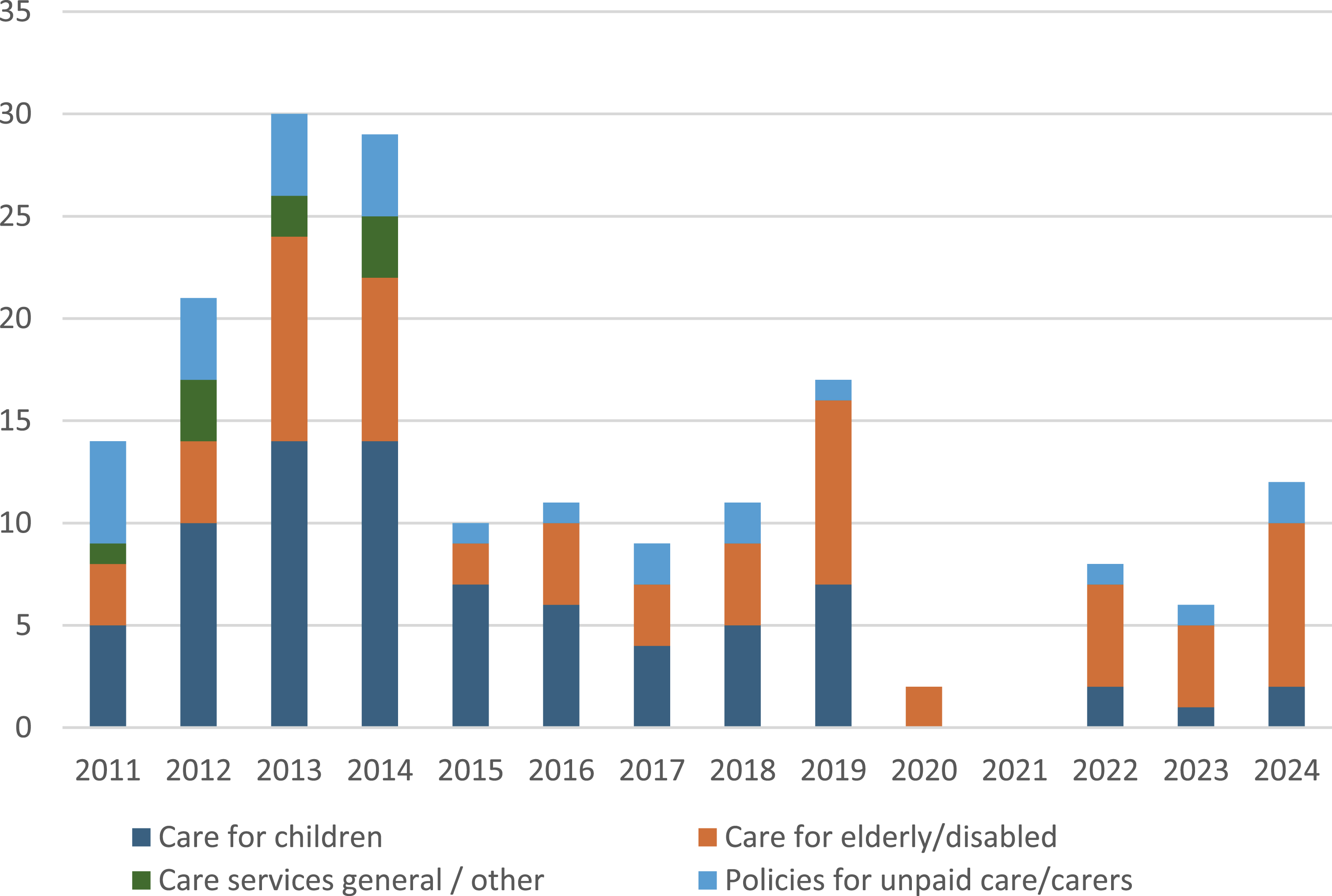
Our analysis of these recommendations along policy orientations and policy frames reveals two noteworthy patterns as well as differences from problem representations. The first pattern that goes somewhat against our expectations is that the recommendations were much more oriented toward public investment than cost-containment. The recommendations were predominantly investment-oriented also during the early, austerity-focused Semester cycles. However, the investment-orientation came with a commodifying rationale connected to women’s labour market participation and human capital enhancement (i.e. the second dimension of our understanding of commodification). In other words, what we call the social investment frame has been dominant within the care-focused recommendations (90 in total, 50% of all recommendations), even if the share of such recommendations decreased since Covid-19 (Figure 2). Most recommendations within the social investment frame addressed childcare. Only few of the investment-oriented recommendations fell within the rights and needs frame, that is, implied additional public investment while decommodifying care or people (15 in total, 8% of all recommendations). These recommendations typically called for improving provision, access or quality, but without a rationale to increase labour market participation or education levels. All were issued to Southern and Central and Eastern European countries with limited care provision and familialised care regimes. We perceived a slight tendency toward the rights and needs frame and a decommodifying orientation after EPSR and Covid-19, but the evidence does not suggest a real turning point. Policy frames in care-focused recommendations, share of all recommendations by year.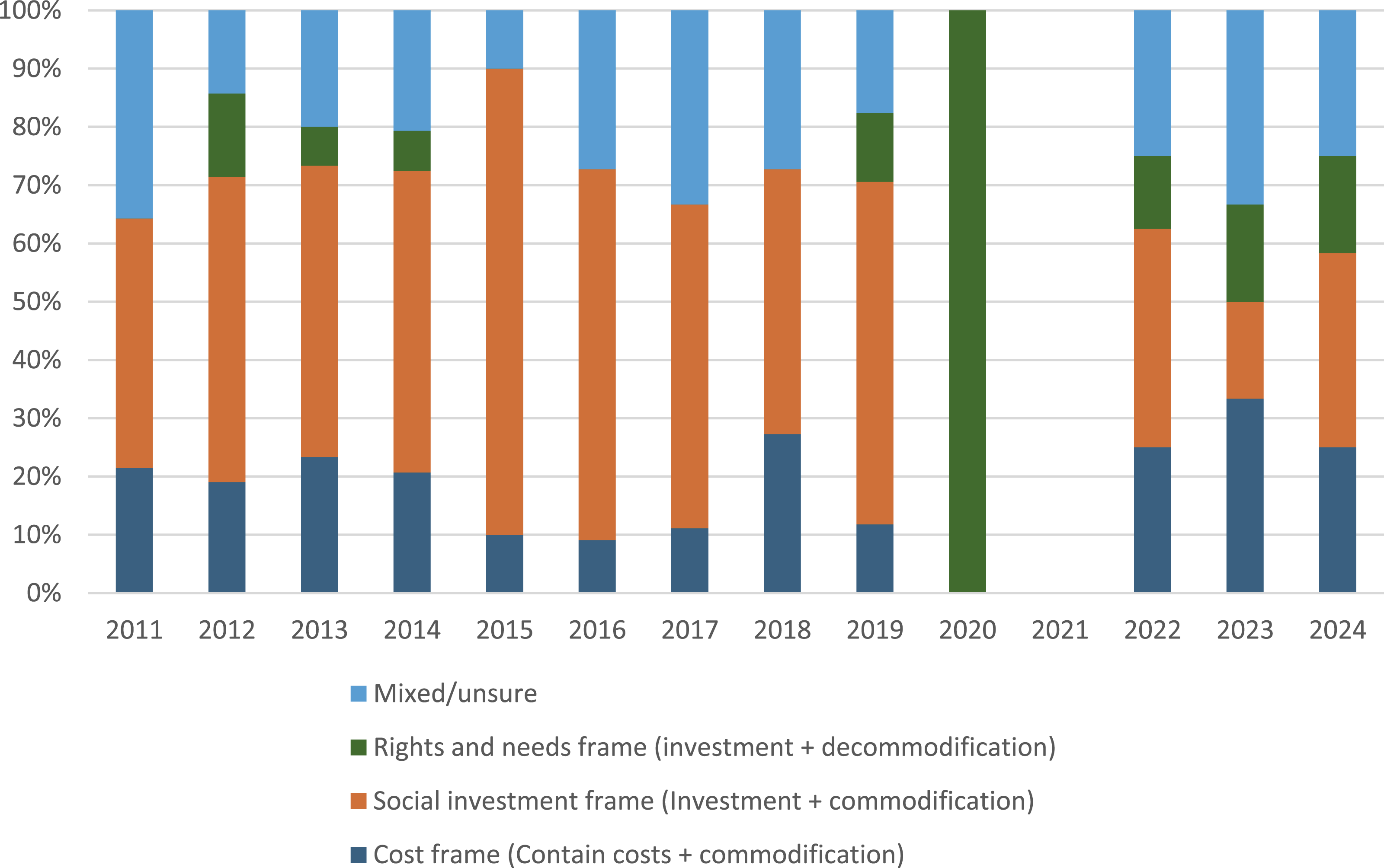
While recommendations that called for cost-containment and fell into the cost-frame were less numerous than those requiring investment (35 in total, or 19%), each year the Commission required several countries to make cost-containing and commodifying reforms, notably to long-term care systems. These recommendations mainly targeted Western and Northern European countries with different care regimes but each with a projected significant increase in long-term care costs. A key policy proposal was the shift from institutional care to home-based care and independent living.
Despite their prominence, the investment-oriented recommendations did not have the same weight than the cost-oriented ones. The recommendations within the cost frame were often part of the fiscal policy CSRs and had their legal basis in the Stability and Growth Pact, the Macroeconomic Imbalance Procedure or both (cf. Crespy and Vanheuverzwijn, 2019). Failure to implement these recommendations might result in further procedural steps and, at least in theory, in sanctions. In contrast, nearly all investment-oriented recommendations could be interpreted as having a lower level of obligation as they were issued as part of the legally non-binding Open Method of Coordination process. The weight of the cost-oriented recommendations increased their relative prominence, supporting our expectation on the focus on costs.
The second pattern relates to how the recommendations navigated the family/state/market nexus. In line with the main problem representation about women’s labour market participation, nearly three quarters of the recommendations (72%) could be interpreted as defamilialising. This applies to most recommendations related to childcare and unpaid care, and some long-term care recommendations. Yet the recurring recommendations to contain the costs of long-term care could have an adverse impact and be familialising. The recommendations were much less explicit whether care should be provided by states or markets, that is, whether care provision itself should be commodified (i.e. the first dimension of our understanding of commodification). Although we expected a focus on commodification that includes market-oriented policy solutions, hardly any recommendations required member states to outsource public provision or implement vouchers or personal budgets to increase market-based provision. The only exceptions were recommendation for Czechia on “strengthening the capacities of both public and private childcare services” (Council, 2013: 17) and for Cyprus to “increase employers’ engagement […] in affordable childhood education and care” (Council, 2019c: 85). However, the involvement of for-profit actors and marketisation of public provision was implicitly present. For instance, the common recommendations to shift long-term care from institutional to home-based imply commodification, as in many member states such services are more market-based than institutional care (see Erne et al., 2024). Also, recommendations on cost-effectiveness could have commodifying impacts, given that efforts to get more with the same money often involve market-oriented reforms.
Finally, our analysis shows that the recommendations issued to the member states had less room for the rights and needs frame and decommodifying orientation than the problem representations. This discrepancy reflects the processes and hierarchies within the European Semester, where social goals are still subsumed to economic ones and where social goals are more accepted in lower-level documents (Copeland, 2020).
European Semester as a tool to govern care provision in member states
The numerous care-focused recommendations within the CSRs show that the Commission actively used the European Semester to govern national care provision, despite the lack of formal competencies in the field. Nearly all member states received care-focused recommendations at some point (only four did not). The European Semester highlights the key EU-level priorities and the main challenges facing member states, and it signals what socio-economic issues on the EU’s broad agenda are seen as important. It could therefore be seen as a priority-setter and agenda-amplifier. From this perspective, care was even surprisingly visible in the CSRs, particularly in the early years, when nearly five percent of sub-recommendations addressed care. This is in line with our expectation related to the intensity of the governance: the Semester has indeed been an important tool in how EU institutions govern care and has enabled them to extend EU’s powers in a policy field where it has no formal competence. One reason is perhaps the co-existence of the different policy frames that link care to the EU’s economic and social priorities.
However, the number and share of care-focused recommendations decreased over time, indicating that the salience of care within the Semester diminished (Figure 1). The first clear decrease in the number happened in 2015 when the Juncker Commission reduced the number of CSRs. Also, the share of care-focused recommendations fell to less than four percent, suggesting that other issues were prioritised. Care recommendations nearly disappeared in 2020 and 2021, when the Covid-19 and the RRF affected the CSRs (D’Erman and Verdun, 2022; Vanhercke and Verdun, 2022). Although the number and share of these recommendations has increased since then, they remained under pre-pandemic levels. One reason is that the RRF provided the Commission with a new tool to govern national care systems and enforce the earlier care-focused CSRs, particularly those on childcare. Many national recovery and resilience plans invested in childcare (e.g. Corti et al., 2022), and the Commission considered that many countries sufficiently covered this issue and did not need a CSR (Elomäki, 2025). Only two of the seven countries that received a CSR on childcare in 2019 received one in 2022.
Our analysis suggests that at the core of the governance of care through the European Semester have been efforts to balance the Commission’s interest to intervene in national care provision with the EU’s limited competences and the varied national care regimes. Therefore, the governance of care could be described as convergence governance. The CSRs provide neither a general blueprint for how responsibility for care should be shared between the family, the state and the market, nor a one-size-fits-all model for organising provision. Rather, the Commission uses the European Semester to bring the diverging national care regimes and systems closer to one another with country-specific reform proposals. This was clearly visible in the recitals, which often justified the recommendations with comparisons to EU averages and benchmarks. Convergence governance promotes care-related improvements mainly for member states that are below the EU average. Conversely, countries with better-than-average or more-expensive-than-average public care provision are not required to improve standards, even if care needs are not met. In the framework of convergence governance, the withdrawal of states from public provision and the increasing burdens for unpaid carers are not a problem to be addressed, if the countries still fare comparatively well on key indicators, such as women’s labour market participation and the Barcelona childcare targets. The concrete influence of the Semester on national care regimes, however, is a nuanced question, where the implementation of recommendations intertwines with cognitive elements, including take-up of framings (c.f. Bockhorst, 2022).
Governing care through the European Semester also relates to what scholars have called the competence creep – the EU managing to act in areas where it does not have a specific competence (e.g. Garben, 2019; Pollack, 1994). With childcare, the Semester recommendations have been closely connected to the Barcelona childcare targets. Here the Semester has not been used to create new policy but to monitor the implementation of existing benchmarks and remind member states that they should be seen as a priority. In contrast, given the lack of EU-level policies on long-term care until the European Care Strategy, the Semester has provided the Commission a way to interfere in member states’ long-term care policies through the backdoor. Operating at the limits of the EU’s competences and beyond has involved negotiation and carefulness that is visible in the vagueness of the recommendations. The care-focused recommendations, which often consist of general policy goals, sometimes contradictory ones, leave room for discretion for the member states regarding interpretation and implementation. For instance, when a member state is simultaneously asked to enhance fiscal sustainability and maintain or even improve access and quality, it has the possibility to choose which goal to prioritise. Similarly, member states are left to decide how to reach the stated goals. For instance, increasing the provision of childcare or long-term care can take place through increasing public provision or encouraging private provision, for example through a voucher system. Similarly, increasing cost-effectiveness or containing costs can mean different things.
Conclusions
Although the organisation, funding and provision of care is a competence of the member states, EU institutions have become increasingly interested in governing national care provision, given its importance for the EU’s economic and social goals. In this article, we have studied how the EU institutions have used the European Semester process to shape reform efforts within national care systems. We conducted a longitudinal analysis of the problem representations and policy recommendations in the CSRs, focusing on policy orientations and policy frames. We expected the Commission to use the European Semester to extend its powers to navigate the EU’s limited competence in this field. We also expected the governance of national care provision to display different orientations and policy frames, with a focus on costs and commodification.
We have argued, confirming our first expectation, that alongside directives and soft policy tools, the European Semester has been pivotal in the EU’s efforts govern national care systems and policies. Since the inception of the European Semester, the Commission and the Council have used the CSRs to direct member states to reform their care-related policies and systems, even if the salience of care within the Semester has decreased over time. The Semester has allowed the Commission to amplify its care-related agenda and soft policy tools and signal to the member states that care-related reforms should be a priority in addressing economic and social challenges.
Our analysis of the policy orientations and policy frames within the CSRs partially confirmed our second expectation. The incoherence which has underpinned the EU’s care policies was part of the European Semester too. Different policy orientations – familialisation and defamilialisation, cost containment and public investment, and commodification and decommodification – co-existed in both problem representations and policy recommendations, reflecting the variety of national care regimes and divergent views on the issue within the Commission. Overall, the social investment frame that implies public investment in care but with a commodifying rationale was dominant. While the cost frame that sees public care provisions as an expenditure to be contained was less prominent than expected given the fiscal and economic character of the Semester, it had a firm presence and facilitated recommendations to make long-term care more cost-effective and fiscally sustainable. The decommodifying policy frame focused on rights and needs gained ground since the EPSR and Covid-19 and thanks to developments in EU’s care policies, such as the European Care Strategy. However, this has been more visible in problem representations than policy recommendations. Importantly, the policy recommendations related to costs had a higher level of obligations than those within the social investment and rights and needs frames.
One reason for the heterogenous outcomes – next to struggles between the social and economic actors within EU institutions – is the country-specific logic of the European Semester and the way the CSRs consider national circumstances. We have argued that the recommendations attempt to bring member states’ diverging care systems closer to one another, toward what could be seen as a European care regime. This regime involves a fiscally sustainable balance between unpaid care and care by states and markets, and it recognises the right to receive some care across the life cycle. One example of how the balance between the family and the state/market is achieved is the push from “expensive” institutional care to “cheaper” home or community-based care, which does not absolve families and women of care responsibilities. Overall, while defamilialisation is the overarching trend for childcare, families and women are expected to either maintain or take more responsibility for care for older people due to demographic ageing. Despite the commodifying problem representations related to women’s labour market participation and human capital, the European Semester did not explicitly push for commodification of care, even if there was an implicit bias toward market provision and marketisation of public provision, particularly in long-term care. However, leaving the state/market balance to the member states legitimises commodifying developments in a situation, where for-profit provision in member states is increasing. Whether the EU should be extending its remit into care policy requires further scrutiny. The care crisis related to ageing populations requires urgent policy and financial solutions, and EU institutions clearly want to be seen as addressing this crisis. Whether the EU is best placed to lead in this field and has the capacity to deliver remains open to debate.
Footnotes

Funding
The authors disclosed receipt of the following financial support for the research, authorship, and/or publication of this article: Anna Elomäki’s research was funded by the Academy of Finland (grant number 347916).
Declaration of conflicting interests
The authors declared no potential conflicts of interest with respect to the research, authorship, and/or publication of this article.