



Abstract
Since the launch of the European Pillar of Social Rights in 2017, the EU has witnessed a marked revival in social policy-making. Existing research highlights the role of institutional entrepreneurs and advocacy coalitions, but tends to overlook the dynamics within Member States themselves. This paper examines how and why support for EU social policy has evolved among two long-standing sceptics: Sweden and the Netherlands. In the 2000s and early 2010s, both exhibited a strong ‘subsidiarity reflex’ aimed at shielding domestic welfare and labour-market institutions, yet their trajectories have diverged significantly in recent years. Sweden has remained defensive and increasingly politicised in its stance, whereas the Netherlands has shifted toward a more constructive and strategically engaged approach. Drawing on interviews with ministers, officials and social partner organisations, complemented by government documents, parliamentary records and secondary sources, we trace how national positions have developed across key EU social initiatives. We argue that neither institutional misfit nor politics alone can explain these divergent patterns. Instead, differences in administrative coordination – shaping opportunities for bureaucratic learning, strategic recalibration and cognitive reframing – are crucial for understanding how Member States navigate the expanding EU social agenda. The analysis shows that preferences for ‘social Europe’ are more contingent and adaptable than accounts focused on structural interests or party politics suggest. By opening the black box of national EU coordination processes, the paper advances debates on the drivers of social integration and demonstrates how internal administrative dynamics condition the capacity of governments to engage with, resist or reinterpret EU-level social policy initiatives.
Introduction
Since the European Pillar of Social Rights (EPSR) was launched in 2017, the European Union has witnessed a much-debated revival of social policy. A striking number of new legislative measures, governance instruments and financial tools have been adopted to address issues ranging from atypical employment and inclusive social safety nets to social investment (Bokhorst and Schreurs, 2023; Keune and Pochet, 2023). To explain this revitalisation, much of the literature has highlighted the role of entrepreneurial policy actors in the European Commission, the European Parliament and the European Trade Union Confederation (Copeland, 2022; Dura, 2024; Schreurs and Huguenot-Noël, 2025). Yet to understand the durability of this momentum for a ‘social Europe’, we must look beyond these policy entrepreneurs and advocacy coalitions. A deeper question emerges: how and why has broader support for an expanded European social agenda taken root within the EU Council, and particularly among those actors that have historically been sceptical of such a development?
Existing work on European social policy often divides Member States into stylised theoretical categories of ‘enthusiasts’ and ‘sceptics’, reflecting broader territorial cleavages within the EU (Copeland, 2021; Deganis, 2006; Hooghe and Marks, 1999). The ‘pro-social Europe’ coalition typically includes Southern and Catholic countries such as Belgium, France, Portugal and Spain, while Northern and Central-Eastern Member States tend to resist EU involvement in domestic social issues. However, these binaries overlook the more nuanced dynamics of position-taking within the Council and the shifts that occur over time – fault lines that are often issue-specific and defy simple categorisation (Mailand and Arnholtz, 2015; Nedergaard, 2007). Other scholars emphasise governments’ ideological orientations as the main explanatory factor, suggesting that social democrats are more likely to support deeper EU engagement in social policy (De la Porte and Palier, 2022; Schäfer, 2006). From this partisan perspective, social integration would progress mainly during progressive ‘windows of opportunity’. Yet post-crisis developments in EU policy and governance suggest that national preferences may be undergoing more profound and enduring reorientations.
To explore the fluidity and contingency of the politics of social Europe, we compare two cases that exemplify these developments: Sweden and the Netherlands. Both have long been regarded as fundamentally reluctant to broaden or deepen the EU’s role in social and labour market policy. The Swedish government remains one of the most consistent opponents of greater EU involvement in social affairs, fiercely defending its ‘well-functioning’ welfare and labour market model against what it perceives as dangerous EU interference – a stance that has become increasingly politicised in recent years (De la Porte, 2019; Johansson, 2018; Kiecker, 2024). By contrast, the Netherlands has subtly but significantly transformed its preferences and strategy. It has come to be viewed as more ‘constructive’ and EU-minded, treating European integration as a vehicle to advance national social objectives. These diverging trajectories are, as we argue below, theoretically puzzling.
The objective of this paper is twofold. Empirically, it seeks to open the ‘black box’ of social policy discussions and negotiations within national ministries and the EU Council. Theoretically, it aims to illuminate the durability of the EU’s social agenda and the barriers to its further development. Is European social integration primarily dependent on the ebb and flow of party-political support, or have deeper cognitive and strategic shifts sustained its momentum? To address these questions, we trace how the approaches of Sweden and the Netherlands have evolved since the mid-2010s, when both exhibited what we term a ‘subsidiarity reflex’ – that is, interpreting EU social ambitions with marked caution in order to safeguard their national welfare and labour market models.
In explaining the subsequent divergence between a persistently reluctant and politicised Sweden and a more open-minded Netherlands, we draw on the literature on the national coordination of EU policies, which seeks to ‘unpack the machinery of government’ and ‘bring bureaucrats back in’ to the study of EU decision-making (Kassim et al., 2000). We do not propose administrative coordination and learning as an exhaustive or alternative explanation to existing theories. Rather, we argue that attention to these bureaucratic and cognitive processes is necessary to account for the limitations of prevailing accounts rooted in institutional misfit and partisan politics. By illuminating how policy coordination practices and administrative learning shape national preferences over time, we aim to complement rather than replace these established perspectives.
The paper first reviews the literature on EU social policy and Member State preference formation, situating our focus on cognitive shifts, evolving strategies and bureaucratic agency within the broader explanatory landscape. It then outlines our research design and case selection, including a brief historical account of how both countries approached the EU’s social dimension in the past. We subsequently reconstruct the changing positions of the two Member States since the mid-2010s, using evidence from 26 interviews with decision-makers and stakeholders, complemented and contextualised with policy documents and media coverage. The paper concludes by comparing the two trajectories and discussing their broader implications for the durability of Europe’s social revival.
Theorising member state preferences in EU social policy-making
Scholarship has paid considerable attention to the supranational policy entrepreneurs who have been the most visible driving forces behind the ‘revival of social Europe’ (e.g., Copeland, 2022; Dura, 2024; Mailand, 2021). In contrast, the preferences of Member States remain comparatively understudied and undertheorised in this body of work. Where national position-formation and Council negotiations have been examined, the literature has typically emphasised two distinct explanatory factors: institutionally defined interests and (party-)politics considerations.
Classic political-economy explanations posit that national responses to EU initiatives reflect domestic institutional configurations (Scharpf, 2002, 2010). Drawing on the Europeanisation literature, scholars have conceptualised this relationship through the notion of a ‘goodness of fit’ – that is, the degree of compatibility between European requirements and national realities (Börzel and Risse, 2000). In this view, Member State decision-makers and their constituencies seek to protect domestic socio-economic and political equilibria by minimising the financial, regulatory and administrative adjustment costs associated with EU initiatives. 1 Supported by the vested interests of social partners, this logic has been central to analyses of Nordic resistance to supranational labour legislation, which is seen as fundamentally ‘misfitting’ with models of autonomous collective bargaining (De la Porte, 2019; Kiecker, 2024). From this perspective, Member State positions should display a high degree of stability. Yet such explanations leave over-time shifts largely unaccounted for and often overlook that the degree of (mis)fit may itself be ‘contingent on domestic preferences or beliefs’ (Mastenbroek and Kaeding, 2006: 347).
Domestic politics form the basis of a second explanatory strand, which highlights how governments’ choices and preferences are shaped by ideology, partisanship and electoral pressures. A long-standing strand of research has emphasised that centre-left governments have generally been more supportive of European social integration, viewing it as a means to strengthen labour standards and social protections across borders. Conversely, right-of-centre coalitions tend to adopt a more cautious, market-oriented stance, seeking to protect national autonomy in welfare and labour market regulation (De la Porte and Palier, 2022; Ladrech, 1999; Schäfer, 2006). From this vantage point, changes in the partisan composition of governments should produce corresponding shifts in national preferences over the EU’s social agenda. Such a logic would also suggest that phases of social integration are dependent on progressive ‘windows of opportunity’, whereas conservative or liberal administrations are more likely to stall or reverse momentum (Crespy et al., 2025).
More recently, post-functionalist scholars have argued that national governments operate within an increasingly politicised European environment, where public opinion, dissensus and sovereignty concerns constrain their room for manoeuvre (Eick, 2025; Hooghe and Marks, 2009). From this perspective, it is puzzling that – despite the rise of Eurosceptic parties and growing politicisation – most governments have nonetheless endorsed the EU’s expanding involvement in the social domain in recent years. The ‘polity maintenance’ literature has suggested that backlash and contestation may, paradoxically, reinforce rather than hinder social integration: national and EU-level elites may strategically advance social initiatives to bolster the EU’s legitimacy and to provide a ‘social face’ to a market-oriented integration process (Kyriazi et al., 2025; Schreurs, 2025b). Yet this approach still leaves unexplained why some Member States have been more willing than others to support these initiatives, and how their preferences may have evolved in different directions over time.
Against this background, we see a need to bring in a third perspective that remains underdeveloped in the literature on social Europe. Earlier work on EU integration and policy-making highlighted how bureaucratic networks, socialisation and learning processes shape the preferences of national diplomats, ministerial officials and other ‘every-day decision-makers’ (Kassim et al., 2000; Lewis, 2005; Schneider and Baltz, 2005). Administrative coordination mechanisms should not be seen merely as transmission belts for institutionally defined interests or partisan convictions. Rather, they constitute arenas in which cognitive frames, negotiation strategies and policy priorities are gradually formed and recalibrated. Yet recent studies of preference formation have largely overlooked these dynamics, leaving significant room for theoretical and empirical development (Kassim et al., 2020).
Bureaucrats operate within complex, internationalised networks that foster the diffusion of norms, practices and repertoires of negotiation, enabling adaptive learning and reflexive behaviour (Geuijen et al., 2008). Their actions are shaped by administrative routines, institutional memory, accumulated expertise and recurrent evaluations of the costs and benefits of European integration. At the same time, they do not operate in a technocratic vacuum: bureaucrats bring their own normative preconceptions and must navigate increasingly politicised domestic environments. As Bokhorst and Schoeller (2024) illustrate in their analysis of EU fiscal position-taking in the Netherlands and Austria, governments proactively consider the reputational costs of their actions, strategically signalling to parliamentarians to manage expectations about what positions are attainable at the European level.
The configuration of national coordination systems determines how bureaucratic preferences and learning processes interact with societal actors (Kassim et al., 2000). In many Member States, ministries responsible for employment and social affairs are embedded in dense corporatist structures, where trade unions and employers’ associations participate in formulating and fine-tuning national EU positions (Falkner and Leiber, 2004). In more pluralist or state-centred systems, such input tends to be less institutionalised and more ad hoc, producing learning that is primarily technocratic and Brussels-oriented. These country-specific variations can be expected to influence not only the content of national preferences, but also the mechanisms through which they evolve over time.
This third, administrative logic does not offer a fully exhaustive or alternative explanation to theories based on institutional misfit or domestic politics. Rather, we argue that it is necessary to complement these perspectives, as it helps account for temporal and cross-national variation that they leave unexplained. By foregrounding the role of bureaucratic coordination, learning and evolving diplomatic practices, this approach enables us to trace how Member State preferences change over time within the institutional networks linking national administrations and Brussels. Nonetheless, studying these processes poses specific methodological challenges: bureaucratic orientations are often expressed only behind the scenes, may vary across policy (sub-)domains and tend to be subtle and context-dependent.
Research design: Case selection, methods and data
This paper employs a comparative case study approach grounded in a most-similar systems design (Gerring, 2007). We compare Sweden and the Netherlands, two countries that share many political, socioeconomic and institutional characteristics, but differ in the phenomenon of interest – namely, their contemporary approach to European social integration. Both have historically strong welfare states and densely regulated labour markets rooted in a corporatist tradition – particularly in Sweden, where social partners play a central role in shaping EU positions, but also in the Netherlands. Additionally, both feature powerful parliaments with well-established mechanisms for scrutinising EU initiatives (Auel and Neuhold, 2018) and experienced relative political stability during the period of study: 8 years of social democratic rule in Sweden and 14 years of conservative-liberal coalition government under prime minister Mark Rutte in the Netherlands (see Annex I). By holding these structural and institutional conditions largely constant, we are better able to identify the factors that account for their divergent positioning vis-à-vis the EU’s social agenda.
Historically, Sweden and the Netherlands were not markedly reluctant toward European social integration. Contrary to contemporary belief, both countries were relatively proactive in advancing EU-level social initiatives during the 1990s. The Swedish government played a leading role as the architect of the Employment Chapter, promoting coordinated labour market and welfare policies across the EU – an ambition that was actively supported by the Dutch ministry of social affairs (Borstlap, 1999; Hemerijck, 1997; Johansson, 1999). While remaining sceptical of extensive harmonisation, both also shared an interest in strengthening EU-level social dialogue and collective bargaining – potentially even leading to binding agreements (Dølvik, 1999) [NL4]. 2 This historical record underscores that the later divergence in positioning between Sweden and the Netherlands cannot be explained simply by longstanding national scepticism, but must instead be traced to subsequent shifts in preferences, strategies and domestic interpretations of EU social initiatives.
However, both countries’ early enthusiasm for EU social initiatives waned in the 2000s. In Sweden, scepticism intensified following the ECJ’s 2007 Laval ruling, which was widely perceived as threatening its model of collective bargaining and labour regulation. In the Netherlands, concerns emerged as the rules-based order of the Economic and Monetary Union (EMU) proved less robust than expected, and were further reinforced when Dutch voters decisively rejected the proposed European Constitution in 2005. The subsequent Eurozone crisis deepened the subsidiarity reflex in both countries, reinforcing a cautious approach to EU social policy and heightening sensitivities to potential threats to national welfare and labour market arrangements. This period marked a shift toward a much more defensive posture, setting the stage for the divergent trajectories that would later emerge in Swedish and Dutch positions on European social integration.
To explore these divergent trajectories, we employ a theory-guided process-tracing approach, which allows us to unpack the ‘conceptually and tightly connected sequences of events that […] belong to one underlying transformative process that transforms the unit of analysis’ (Falleti, 2016: 459). First, we construct detailed case narratives tracing the evolution of Swedish and Dutch positions since the emergence of their respective subsidiarity reflexes. Second, we undertake a systematic comparison to assess which theoretical perspective – or combination of factors – best accounts for the observed trajectories. Following George and McKeown (1985), our process-tracing pays particular attention to the stimuli to which policy actors responded, the strategies they adopted and the institutional arrangements under which these processes unfolded.
Empirically, our analysis draws primarily on 26 semi-structured interviews with ministerial officials, (ex-)ministers, representatives in Brussels and social partner representatives involved in EU social policy-making (see Annex II). Interviewees were asked to reflect on their country’s historical and current positions, motivations for change, significant influences, negotiating strategies and perceptions of other Member States. To strengthen the reliability of our findings, we triangulated these with a wide range of documentary sources, including official assessments of Commission proposals (and other relevant government materials where available), parliamentary debate records or reasoned opinions (as applicable), position papers, media coverage and the relevant secondary literature; these are listed in the references. We also conducted a number of interviews with policy-makers from other Member States and the European Commission to provide external validation of our interpretations.
Sweden: From scepticism to cautious support – and back again
During the early 2010s, the Swedish centre-right government adopted a reluctant and frugal stance toward EU social and labour market policy. It showed little interest in, and often actively resisted, including social questions on the EU agenda. For instance, the government opposed an EU poverty target as part of the Europe 2020 strategy, arguing that it conflicted with the subsidiarity principle (Copeland and Daly, 2012). Faced with the proposed Youth Guarantee, which would provide EU financial support to help young people access employment, education or training, Sweden emphasised that youth unemployment could be ‘better tackled with a strengthening of the EU’s internal market, freer movement and international trade agreements’ (Haglund, 2013).
Sweden’s strong post-financial-crisis performance – attributed to budgetary consolidation and competitiveness-enhancing reforms – fostered a reluctant or even ‘arrogant’ attitude toward European social ambitions (Johansson, 2018: 85). Prime minister Frederik Reinfeldt’s 2012 Government Declaration highlighted Sweden’s fiscal prudence and economic performance relative to other countries, arguing that this should be the focus of EU policy (Regeringskansliet, 2012).
The 2014 shift to a social democratic–Green minority government under Stefan Löfven initially signalled a potential pivot toward constructive engagement. In the run-up to and during the election campaign, the social democrats had called for the EU to be more active and ambitious in the realm of social affairs and employment (Socialdemokraterna, 2014) and criticised the Reinfeldt government for playing ‘domestic politics’ with EU social policy files (e.g. Sommestad and Ludvigsson, 2010). Prime minister Löfven announced that his government would ‘actively pursue […] priority Swedish interests’ in the EU, including ‘increased gender equality’ and ‘order in the labour market’ through a revision of the Posting of Workers Directive (PoWD) (Regeringskansliet, 2014).
Exemplifying this constructive attitude, Sweden responded positively to Juncker’s new social agenda and showed itself willing to host the formal proclamation of the EPSR in Gothenburg (Regeringskansliet, 2016). Löfven and labour minister Ylva Johansson had to navigate a politically contested environment, needing to convince left-wing allies, trade unions and even the centre-right Liberals of the Pillar’s value [SE2; SE6]. The Liberal leader ultimately endorsed the initiative, acknowledging that a stronger social dimension would ‘give the EU more muscles’ (Björklund, 2017). However, other right-of-centre opposition forces criticised the Pillar for competence creep, claiming it ‘created false hopes’ and ‘threatened the Swedish model’ – setting the stage for an unparallelled politicisation of the issue (Corazza Bildt, 2017; Hökmark, 2019).
Although the government maintained that the Pillar was a purely political declaration, civil servants feared that the Commission might use it to put forward new legislation [SE3; SE5; SE6] (Regeringskansliet, 2018b). These concerns crystallised with the proposed Transparent and Predictable Working Conditions Directive (TPWCD) in late 2017. The government supported procedural updates to contractual information rules but opposed new material rights that would represent a ‘departure from the Swedish system of laws and collective agreements’ (Regeringskansliet, 2018a). The EU Affairs Committee of the Riksdag (2018) agreed that there was ‘a common interest in an increased upward convergence of working and living conditions’, but maintained that there was ‘a clear risk that the proposed rules could involve disruptions to Sweden’s well-functioning system’ and issued a negative opinion on compliance with the subsidiarity principle. Social partner organisations also criticised the proposal, arguing that it ‘would deal a deadly blow to the tradition of regulating employment and working conditions through collective agreements’ (Ahlberg, 2018) [SE7]. In the Council, Swedish officials focused on securing a derogation from the new minimum standards by collective agreement [SE3]. Eventually, enough concessions were obtained to permit a positive vote, distinguishing Sweden from Germany, Austria and Belgium.
Sweden also supported the Commission’s proposal for a Work-Life Balance Directive (WLBD), in contrast to the Netherlands and Denmark. Ministerial officials considered this initiative to be largely compatible with the Swedish system of parental leave and with the subsidiarity principle, since it updated already existing European standards (Regeringskansliet, 2017) [SE3]. In the Riksdag, this assessment was endorsed by a majority of left-of-centre parties and the Liberals, who emphasised that it was ‘very important that the EU raises its ambitions’ to promote gender equality in the labour market (Holmgren, 2018; Riksdagen, 2017).
The mid-2010s EPSR momentum continued under labour minister Eva Nordmark. Already as trade union chief, she had embraced the EPSR as a valuable ‘guidance document’ (Nordmark, 2017). When the Von der Leyen Commission was installed, she welcomed its ‘vision for a more social Europe’ as imperative for the future of European integration [SE6]. This was echoed by her fellow social democratic MPs, who argued that the Commission’s EPSR Action Plan provided ‘a unique chance to build a fair EU by ensuring that the Social Pillar is respected by all EU countries and used as a yardstick for how welfare should become equal, not exactly the same, within the EU, with respect for national considerations and financing models’ (Riksdagen, 2020). Still, the government insisted that upwards social convergence ‘should primarily take place through enhanced exchange of experience, not through binding legislation at EU level’ and that ‘for Member States that base their social model on a high degree of collective bargaining […] the Social Pillar cannot be allowed to have a detrimental effect on the work carried out by the social partners’ (Regeringskansliet, 2021: 6–7).
The proposal for a Minimum Wage Directive (MWD) in 2020 reignited widespread scepticism towards the EU’s social agenda. Social partner organisations and politicians across the ideological spectrum had long vocally opposed the idea of a ‘European minimum wage’, fearing a new Laval ruling – in which the ECJ would interfere with the Swedish model and undermine the autonomy of the social partners by creating an individual right to a minimum wage (Kiecker, 2024) [SE6; SE7].
It bears emphasis that these deep-seated concerns did not immediately prompt the Swedish government to pursue an obstructionist course of action. Behind the scenes, Nordmark and her civil servants lobbied Social Affairs Commissioner Schmit for ‘a proposal that could take into account different models within Europe’ [SE1; SE6]. They believed that they ‘succeeded in convincing the Commission to respect the Swedish model’, as the draft legislative text included a carve-out for countries without a statutory minimum wage [SE1; SE6]. While Nordmark gathered a coalition of Member States that preferred a Council recommendation instead of a directive, this group was too small to form a blocking minority (Arbetsmarknadsdepartementet, 2021). Satisfied with the additional caveats introduced, Sweden – unlike Denmark – supported the compromise that the EPSCO Council reached in late 2021 [SE1; SE6] (Duxbury and Tamma, 2021).
Despite tactical diplomatic engagement, societal and political pressures remained intense. Swedish trade unions had already broken with the ETUC over the latter’s campaign for the directive, as they were ‘against any kind of legal instrument’ [SE7]. After its own efforts to lobby for a ‘social partner option’ had failed, blue-collar union LO labelled the Parliament’s amendments as ‘cyanide’ for the Swedish model (Von Scheele, 2021) [SE7]. When the Council and Parliament reached an agreement, unions joined forces with employers and the right-wing opposition to demand that the government ‘actively oppose’ the MWD and vote ‘no’ (Emtell, 2022). Sweden ultimately voted against the directive – a choice that reflected some concerns with its legal substance, but mainly occurred ‘out of principle’ and due to the cumulation of external pressure [SE1; SE6].
The MWD experience spilled over into broader Swedish perceptions of a ‘social Europe’. While Nordmark remained positive about the EPSR, the increasingly politicised debate entrenched scepticism across the political and societal landscape (Bengtsson, 2021a). A former social democratic state secretary for employment described the EPSR as a ‘poisoned gift’ and ‘not designed in any good way for Swedish purposes’ (Bengtsson, 2021b). Ahead of the Porto Social Summit, employers’ representatives widely publicised concerns that the Pillar threatened both Sweden’s labour market model and Europe’s competitiveness (Hidesten and Hagelqvist, 2021).
The right-wing minority coalition that assumed office in late 2022, led by former social security minister Ulf Kristersson, reinforced Sweden’s sceptical stance toward EU social policy. 3 Even before taking office, Kristersson declared that he ‘want [ed] to remove everything that the Social Pillar brought about in terms of wage formation and other things that we believe should be handled at national level’ (Ydstedt, 2022). Although the Liberals, who had supported the EPSR before, took control of the employment ministry, the government maintained that ‘the misjudgement about the EU’s Social Pillar’ reflected Sweden’s failing diplomacy in Brussels, ‘coming in too late, too little and with a lack of commitment’ and resulting in ‘too many legislative proposals that are poorly adapted to Swedish conditions’ (Regeringskansliet, 2022b). In early 2023, Sweden intervened in support of Denmark’s case before the ECJ, advocating annulment of the MWD.
Swedish opposition to EU social regulation has remained prominent, as the spectre of Laval has recurrently resurfaced. In 2023, following repeated pressure from the Commission, public sector organisations revised their collective agreement to prohibit the long-standing practice of 24-h shifts, mandating at least 11 h of daily rest as required by the Working Time Directive (Ahlberg, 2023). This change affected firefighters and other emergency personnel, who argued that the new arrangements would require more frequent shifts, disrupt work–life balance and risk resignations; over 2700 firefighters signed a petition calling for exemptions (Martorell, 2023). The decision was heavily politicised: conservative and far-right politicians subsequently campaigned in the 2024 European Parliament elections to abolish the directive, arguing that it undermined the ability of social partners to negotiate rules suited to sector-specific conditions (Söder, 2023).
The government also displayed deep reluctance toward the Platform Work Directive (PWD), which was seen as overly prescriptive and potentially affecting the national definition of a worker (Regeringskansliet, 2022a). Social partner representatives criticised the limited possibilities for derogation via collective agreements (LO, 2022) [SE3]; only the transport workers’ union favoured EU legislation, arguing that ‘platform work is a hybrid that does not work in the Swedish model’ (Lundstedt, 2024). Parliament once again adopted a reasoned opinion, arguing that the proposal violated the subsidiarity principle (Riksdagen, 2022). Nonetheless, civil servants attempted to navigate these constraints and approach the negotiations in a more ‘constructive’ manner, since they ‘saw the added value’ of the PWD and wanted to ‘avoid just saying “no”’ [SE3]. This enabled Sweden to craft a general approach during its 2023 EU Presidency and ultimately endorse the final Council–Parliament agreement. Nonetheless, when the Commission proposed a Traineeship Directive in early 2024, both MPs and the government once again judged it to be non-compliant with the subsidiarity test (Regeringskansliet, 2024a; Riksdagen, 2024a).
The depth of Sweden’s scepticism was further evidenced in April 2024, when it, along with Austria, refused to sign the La Hulpe declaration on the future of the EPSR. This decision reflected the ‘firm position’ of the office of the prime minister, who described the EU’s role in social affairs as ‘playing with fire’ and did not want to ‘repeat the mistakes of 2017’ (Haglund, 2024) [SE3]. For the governing parties, it was ‘very difficult to back off from their earlier opposition to the Pillar, they needed to hold that line’ [SE3]. The Kristersson government argued that the EU’s strategic agenda should focus on competitiveness, climate, trade and security, rather than ‘becom[ing] some sort of Christmas tree’ (Regeringskansliet, 2024b) [SE3]. Swedish officials similarly criticised the proposal for a Social Imbalances Procedure (SIP) to give more weight to social objectives in EU governance, arguing that it was time ‘to go back to basics’ instead of ‘add[ing] new instruments to existing ones’ or ‘duplicat[ing] things if we already do it here’ [SE3; SE4; SE5] (Regeringskansliet, 2023).
In contrast to the entrenched political scepticism, civil servants were largely ambivalent about this turn against the EU’s social agenda. They acknowledged that elements of the La Hulpe declaration were ‘problematic’ for Sweden and that the negotiating process ‘didn’t make it easier, it was quite forced in the Council’, but emphasised that ‘you could pick your battles better. You end up in a difficult position, it has a price when it comes to your relations with the Commission and the Parliament’ [SE4; SE5]. This tension illustrates why bureaucratic agency in Sweden remains constrained, a contrast that becomes clear when examining the Dutch case – to which we turn now.
The Netherlands: A gradual escape from the subsidiarity reflex
Like the Swedes, Dutch elites have long prided themselves on their social and economic model. Long-time prime minister Mark Rutte frequently invoked the lessons of the 1980s – when wage restraint and fiscal belt-tightening were credited with steering the country from stagflation to sustained growth – as an example for other EU countries (Oudenampsen, 2025). This historical experience reinforced a frugal, cautious approach to European integration, where EU-level solidaristic initiatives were often viewed as vehicles for other Member States – particularly Southern ones – to circumvent reform pressure and ‘impose their inefficiencies’ on the Netherlands (Bokhorst and Schoeller, 2024) [NL5]. A liberal-conservative MP summarised the prevailing sentiment: ‘We have nothing against warm words and nice texts, but we have learned that words have their meaning. Let me be clear on behalf of my party: we do not see any point in a greater role for Europe in the field of social policy. In our opinion, that is unnecessary, undesirable and ultimately unaffordable. […] Commissioner Andor is constantly floating trial balloons about shock-absorption funds and about paying benefits from Europe in other countries. As far as we are concerned, it is: not now and not ever’ (Tweede Kamer, 2013a).
This scepticism was institutionalised after the 2005 rejection of the European Constitution, which shattered the remnants of a ‘permissive consensus’ and led to strengthened ex-ante parliamentary oversight over EU initiatives (Tweede Kamer, 2002, 2011). MPs increasingly used the Early Warning Mechanism (EWM) introduced by the Lisbon Treaty to flag subsidiarity concerns. During the economic crisis of the early 2010s, even staunchly pro-European and social democratic politicians came to advocate a more precise delineation of EU competence, less supranational regulation and tighter parliamentary oversight (Timmermans, 2013; Tweede Kamer, 2014b).
A similar shift occurred among officials at the social affairs ministry. Traditionally inclined to give EU proposals ‘the benefit of the doubt’, they began to follow a more cautious ‘no, unless…’ approach, personified (though not initiated) by conservative minister Henk Kamp the under Rutte I government [NL5; NL8; NL11]. As explained by a senior civil servant and confirmed by a European Commission official, ministerial representatives believed that they ‘had to be more professional in the game’ as EU proposals and recommendations ‘began to hurt a little bit more’ [NL11; COM2].
This defensive stance persisted during the liberal-social democratic Rutte II government (2012–2017), which reaffirmed in its vision on the future of the EU that ‘social policy is primarily a matter for national governments’, although ‘better monitoring of developments and exchange of best practices between Member States [could] improve the quality of social policy’; meanwhile, Member States themselves would ‘have to ensure [a decent standard of living], taking into account their national systems of social dialogue and labour markets’ (Tweede Kamer, 2014b).
From the mid-2010s, Dutch policy-makers began gradually to escape the strict subsidiarity reflex. The Posting of Workers Directive during the Netherlands’ 2016 Council Presidency marked an early ‘turning point’. For the first time in many years, the Netherlands sought to shape the EU’s social agenda rather than simply resist interference. Labour minister Lodewijk Asscher pushed for a revised PoWD to combat ‘unfair’ competition in labour conditions and ensure ‘equal pay for equal work’ (Tweede Kamer, 2015). Framing it around the negative consequences of integration gave the proposal a ‘conservative edge’, helping to generate domestic political support [NL5; NL6]. Although a majority of Member States opposed opening up the PoWD – leading the Dutch Permanent Representation to be deeply sceptical about its feasibility – this ‘gave us an opportunity to want something, instead of not wanting something’ and forced the Netherlands to play an agenda-setting and coalition-building role, breaking from its traditional defensive posture [NL5; NL8].
The Brexit referendum in June 2016 reinforced this strategic shift. With the UK leaving the Union, the Netherlands lost its most vocal and weighty ally in opposing EU social policy initiatives (Adviesraad Internationale Vraagstukken, 2018). Across different policy areas, Brexit triggered a fundamental reconsideration of coalition-building and position-taking on European integration. The Dutch civil service decided to invest in proactive bridge-building efforts to gain influence on the direction of EU policy, collaborating with ‘strange bedfellows’ such as Spain (Ministerie Van Buitenlandse Zaken, 2024b).
Simultaneously, reliance on the EWM to flag subsidiarity concerns lost appeal, as it was seen to isolate the Netherlands and weaken its negotiating position (Bokhorst et al., 2015). The IORP-II Directive on pension fund information requirements first illustrated this risk: the Dutch parliament alone drew a ‘yellow card’, which frustrated Brussels officials (Tweede Kamer, 2014a). The Work-Life Balance Directive reinforced this lesson. Civil servants had met this Commission proposal with ‘caution’, since they ‘saw the danger of interference’ and ‘thought [the Dutch parental leave system] was pretty well organised, but [the proposed directive] would cost us a lot of extra money’ [NL8]. However, a priori opposition from Dutch MPs – together with their counterparts from Denmark and Poland – meant that the Permanent felt ‘stuck’ because ‘no one wanted to negotiate with the Netherlands’ and ‘the directive was eventually adopted without our input’ (Schreurs, 2024) [NL2; NL11]. Due to this parliamentary blockade, the progressive-liberal minister of social affairs, Wouter Koolmees, ‘had no choice’ but to vote against the directive, even though he supported its substance [NL6].
Seeking to draw lessons from the WLBD experience, Koolmees (himself a former civil servant) and his officials sought to foster a more ‘strategic’ approach to the EU’s social agenda [NL6; NL9]. Their objective was to strengthen domestic ownership and involve MPs early in the legislative process, conveying that ‘you have to have a say and cannot sideline yourself’, thereby ensuring a substantive rather than purely principled discussion – marked by caution, but avoiding ‘yellow-card-like scepticism’ [NL2; NL6]. The strategy that Koolmees and the ministry developed formed the basis for a broader substantive reorientation, to which we return below.
When the EPSR was launched, Dutch policy-makers did not consider it a particularly significant initiative. Representatives in Brussels were instead preoccupied with the revision of the PoWD and the contentious, drawn-out reform of Regulation 883/2004 on the coordination of social security systems [NL5; NL6]. Within the social ministry, attitudes toward the Pillar were broadly positive, but civil servants stressed that ‘it shouldn’t get too crazy […] meaning that we run the risk of regulations that interfere with our system of social protection’ [NL8; NL9]. The official reaction of the Rutte II government reaffirmed the primacy of Member States in social policy and prioritised the implementation of the existing acquis – yet it also acknowledged that a supportive EU role on social policy would not necessarily be at odds with the subsidiarity principle (Tweede Kamer, 2017).
When the centre-right Rutte III government took office in 2017, some officials increasingly recognised a mismatch between the EU’s growing social policy involvement and the ministry’s prevailing ‘Pavlov reaction’ – a reflex that ‘we can take care of these things nationally’ [NL9]. MPs exhibited a similar attitude: they wanted to ‘get a grip on the discussion about the social dimension’ and asked the minister to reflect on the EPSR’s implementation to prevent an ‘excessive shift in competence’ (Tweede Kamer, 2018). In response, Koolmees and his officials developed a new framework for assessing EU proposals, drawing on broad consultations within the department and with the social partners, who had set out their own priorities for a ‘fair Europe’ (Sociaal-Economische Raad, 2019) [NL6; NL12].
The aim was to ‘provide a story’ to MPs and ‘get the department on board’ to ensure ‘a neutral assessment’. Adopting a fully proactive stance was still seen as ‘a step too far’ [NL9]. Yet this framework represented an important shift: while maintaining defensive elements, it established the principle that ‘European social policy [would] need to focus on setting common goals and providing practical support in achieving them’ – thus contributing to upward convergence while maintaining flexibility through regulation focused on ends rather than means (Tweede Kamer, 2019).
The MWD was the first test case for this new strategic orientation. Initially, the Netherlands joined the Swedish coalition calling for a Council recommendation, reflecting a long-standing position ‘against binding European agreements on a minimum wage’ (Tweede Kamer, 2013b). Employer organisations echoed this scepticism, whereas trade unions were strongly supportive of a directive (FNV, 2020; VNO-NCW, 2020). The Commission’s proposal triggered an extensive internal debate within the ministry and the cabinet, resulting in ‘a broad understanding that we should prevent ourselves from going in too forcefully and then being sidelined’ [NL9]. Once it became evident that no blocking minority would materialise, Dutch representatives shifted strategy: they sought to form ‘a rather broad coalition of like-minded Member States’ and began drafting alternative texts that would better align the directive with domestic wage-setting practices, while ‘trying to be a constructive partner’ to successive Council Presidencies [NL1]. In this dual role, the Netherlands positioned itself as a leader among the more cautious Member States, while maintaining close collaboration with more ambitious delegations such as Belgium and Luxembourg (Schreurs and Huguenot-Noël, 2025).
Given the political and legal sensitivity of the topic, a renewed subsidiarity reflex would have been unsurprising. Yet this time, Koolmees successfully persuaded parliament to hold back, stressing that: ‘too often […] we in the Netherlands tend to quickly draw a yellow card and no longer participate in discussions on topics. I also think that is strategically and tactically unwise. […] There is a risk that you will simply be passed over and that relevant input from the Netherlands will not get the place at the negotiating table that it deserves’ (Tweede Kamer, 2020)
Using the new strategic framework, Koolmees emphasised how the MWD could advance objectives that the Netherlands supported, such as upwards social convergence. Although right-of-centre MPs expressed doubts about EU interference in wage formation, none sought to constrain the government’s room for manoeuvre (Tweede Kamer, 2020). When asked about Swedish subsidiarity concerns, the responsible state secretary replied that flexibility was indispensable to shape the directive’s content, arguing that robust social systems elsewhere in the EU would also benefit the Netherlands and sustain public support for of European integration.
The Platform Work Directive in 2022 saw the Netherlands move from constructive caution to outright enthusiasm. Koolmees’s successor, Christian democrat Karien van Gennip, ‘really saw the European added value’ of the PWD and wanted to take an agenda-setting role. Dutch civil servants argued in Brussels that ‘you have to arrange this at European level, otherwise you will get a patchwork of national policy rules’, leading them to conclude that ‘the Commission proposal was very much in line with our thinking’ about the need for a ‘level playing field’ to ‘promote upward convergence of employment and social outcomes across the Union and facilitate the development of the platform economy across the EU’ [NL3; NL9] (Ministerie Van Buitenlandse Zaken, 2022b: 9).
Early on, Van Gennip joined her left-of-centre counterparts and the ETUC in calling for a more ambitious directive than the Commission proposed. As a result, the Netherlands found itself in a ‘strange’ alliance with countries such as Spain, which ‘emerged from many bilateral contacts between ministries and Permanent Representations’ [NL3; NL9]. Dutch officials came to be seen as ‘some of the most invested on this file’ and attempted to act as a bridge-builder in the Council negotiations, working ‘to reduce the sceptical group to a smaller number of Member States’ [NL9; MS4; SE3] (Schreurs, 2026).
This more supportive approach extended to other initiatives, such as the Council recommendation on adequate minimum income, where the government argued that ‘the Netherlands has an interest in upward social convergence and protection against poverty in the EU’ (Ministerie Van Buitenlandse Zaken, 2022a: 5). Although officials remained ‘convinced that there is no competence for the EU’ to set binding standards in this field, they ‘did not want to play it in such a way that we cannot talk about it’ – reasoning that the Netherlands would ‘benefit from Member States setting up robust systems’ in other Member States [NL10]. The proposal’s substance also aligned with domestic priorities, especially on reducing the non-take-up of benefits. Similarly, Van Gennip was enthusiastic about the La Hulpe declaration, arguing that Dutch priorities were ‘well reflected’ in the text (Ministerie Van Sociale Zaken en Werkgelegenheid, 2024).
A comparable evolution occurred in Dutch attitudes toward the social dimension of EU economic governance. Whereas the finance ministry had long argued that ‘everything on the social side is just a distraction as it waters down the Semester’, civil servants gradually came to recognise that ‘the boundary between social and economic policy is not so black and white’ [NL9]. Confronted with the SIP proposal, Dutch officials were ‘supportive of the idea […] to investigate countries that continue to struggle and stagnate’, but initially questioned – like their Nordic counterparts – whether an additional instrument would be ‘efficient’ in redressing imbalances between social and economic policy [NL3; NL10].
Van Gennip nonetheless insisted on a positive approach, and when the SIP was rebranded as the Social Convergence Framework, the Netherlands threw its support behind it (Schreurs, 2025a). This did not go unnoticed to other, more sceptical delegations, who observed that ‘the Dutch approach has changed considerably’ since the 2000s [MS3]. Similarly, Dutch representatives adopted a cautious but supportive ‘middle position’ in the Council debate on social investments. There was, as one official put it, ‘a lot of goodwill’ for this initiative from the minister – a stance that was also noticed by more ‘dovish’ Member States [NL9; NL10; MS15]. Civil servants supported the idea of paying more attention to the long-term value of social policy and ‘were very willing to give policy analysis a place’ in the EU context, even if they ‘remained alert’ to the implications for fiscal rules should social expenditures be classified as an investment [NL9; NL10].
In 2024, the political landscape shifted further to the right under the Schoof cabinet, which included the more Eurosceptic PVV, BBB and NSC parties. Nonetheless, there were no major changes in the government’s position toward social Europe, as the new social affairs minister Eddy van Hijum was seen to maintain a constructive and open-minded approach [NL11, NL12]. Despite some pushback from right-wing MPs, the government’s 2024 EU strategy made no reference to subsidiarity or sovereignty in the section on social policy priorities; instead, it emphasised shared European challenges – such as labour and skills shortages and demographic ageing – and expressed interest in the proposed reinforcement of the European Works Councils Directive (Ministerie van Buitenlandse Zaken, 2023, Tweede Kamer, 2024). Later, the Netherlands also endorsed the Commission’s proposal for a Traineeship Directive, considering it largely compatible with existing national practice. Despite some critical remarks, the government deemed the proposal positive in terms of subsidiarity, arguing that ‘this action promotes the equal position of trainees throughout the EU and thus ensures that the objective [of upwards social convergence] is achieved on a larger scale’ (Ministerie Van Buitenlandse Zaken, 2024a).
To conclude, the Dutch approach to the EU’s social agenda has undergone a gradual yet substantive transformation. What began as a defensive strategy of damage control evolved into a pragmatic, coalition-oriented engagement, aimed at shaping rather than obstructing EU social regulation. The subsidiarity reflex that once defined Dutch policy-making has given way to a more confident, constructive role – grounded in an understanding that national interests are often best served through active participation in shaping Europe’s social dimension.
Comparison: Explaining patterns of change and stability
Overview of Swedish and Dutch positions on key EU social policy initiatives.
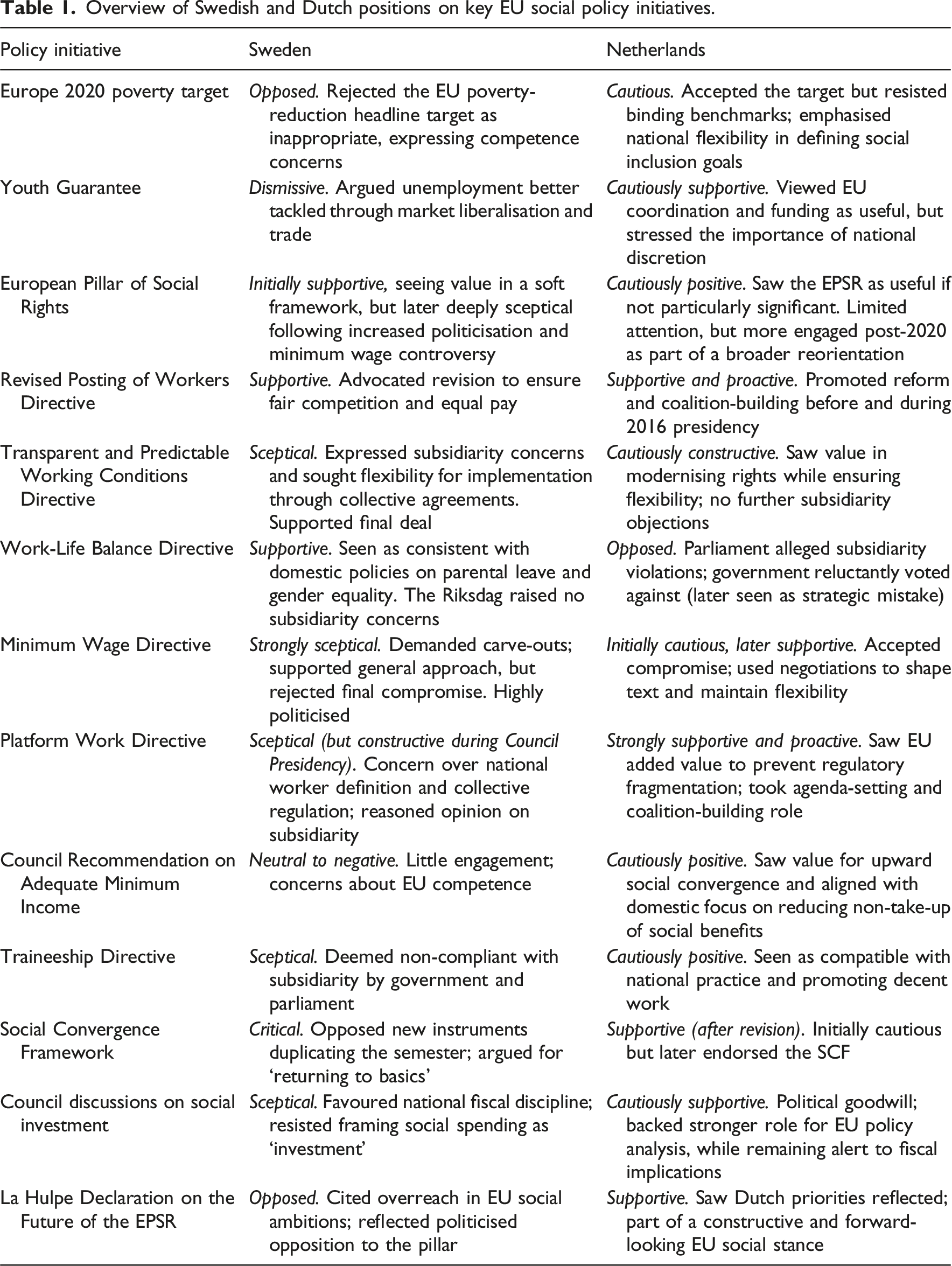
What, then, explains these divergent trajectories? The most obvious candidate is institutional misfit. Given that much of the Commission’s social agenda has centred on employment regulation, Swedish scepticism appears understandable: EU legislation inevitably constrains the autonomy of national social partners, even where it permits implementation through collective agreements. 4 At first glance, individual cases such as the WLBD and TPWCD seem to corroborate this interpretation, as both governments’ positions broadly reflected domestic labour-market arrangements. Yet the explanatory power of this logic is limited, as it cannot account for recurrent shifts and inconsistencies. For instance, it fails to explain why the Netherlands eventually supported the MWD, even though the directive’s provisions have more significant implications for the Dutch system – requiring adjustments to minimum wage evaluation procedures and stronger measures to promote collective bargaining – than for Sweden’s. 5
Moreover, the degree of institutional (mis-)fit should not be overstated or treated as static. Few Swedish officials or stakeholders could identify clear legal ‘clashes’ between EU and national rules – apart from the Working Time Directive’s application in the public sector – suggesting that the ‘trauma’ of Laval (which, to begin with, was never about social regulation but about internal market law) persists more as a perceptual legacy than as a material constraint. Institutional fit is itself shaped by a Member State’s proactive engagement with EU policy-making, and Sweden’s limited participation has arguably reinforced its own constraints. As one expert noted, ‘the fact that countries with other labour market models have at the same time been more constructive has led to individual rights being in principle stronger than collective rights at EU level. If collective agreement regulation is to have a future in the EU, and thus in Sweden, a more constructive approach is required’ (Sinander, 2023). This diagnosis was echoed by an interviewee who observed that Swedish representatives ‘focus on getting derogations from the [Commission’s] proposals, but to be really constructive, we should be involved in negotiations on the substantive rights’ [SE3].
While the EU’s social initiatives may, on balance, be somewhat more compatible with Dutch institutional arrangements, this alone cannot account for the remarkable turnaround observed in recent years. Structural differences thus offer, at best, a partial explanation for the contrasting trajectories of national position-formation.
Could domestic politics offer a better answer? Government composition clearly affects the willingness to build a ‘social Europe’. This is most visible in Sweden, where Social Democrats took a more favourable stance toward the EPSR and its implementation than the subsequent right-wing coalition. In the Dutch case, however, partisanship offers little explanatory power: the strategic shift unfolded under two centre-right coalitions within a largely stable (right-wing and Eurosceptic) ideological environment (see Annex 1). The transformation therefore cannot be reduced to electoral change.
Instead, the Dutch reorientation was driven – and made possible – by a strategic and cognitive realignment within the state apparatus itself. The subsidiarity reflex was not merely political; it had been internalised within the bureaucracy. For years, new EU proposals in the social field provoked automatic concern about competence, necessity and the dangers of ‘outside’ influence, rather than an assessment of substantive benefits [NL2]. This began to change after Brexit, as officials recognised that an oppositional stance curtailed Dutch influence in Brussels. The reputational costs of the ‘no’ to the WLBD were central to this realisation. Remarkably, officials managed to convey this insight to parliament – traditionally a vigilant European ‘watchdog’ – encouraging MPs to use subsidiarity mechanisms more sparingly and strategically (Högenauer, 2015) [NL11].
This cognitive and procedural shift unfolded gradually. It required cross-departmental consensus-building and the arrival of a younger generation of civil servants more willing to engage with EU-level policy-making. Over time, ministers and officials came to see the EU’s social agenda as a means to advance domestic goals – such as stable employment and adequate social protection – and increasingly sought to upload national ideas to the European level. These strategic and cognitive foundations also explain the resilience of the new orientation, which persisted even under a right-wing coalition that included the Eurosceptic Freedom Party.
Why, by contrast, has Sweden remained reluctant to engage in a similar process of realignment and learning? Two factors stand out.
First, the politicisation of the EU’s social agenda has been considerably more pronounced in Sweden. Since its proclamation, the EPSR has evolved into a partisan symbol within domestic politics. The acrimonious debate surrounding the MWD further rendered the Pillar – and, by extension, the Commission’s broader social ambitions – politically ‘toxic’, discouraging even social democrats and trade unionists from referring to it publicly. . This polarised environment also helps explain the limited evidence of bureaucratic learning over time in the Swedish case. While Swedish officials recognise the value of a more strategic approach, they concede that such efforts are hampered by a lack of political backing and societal consensus [SE3; SE4]. A future left-of-centre government might pursue a somewhat more constructive approach than the current right-wing coalition, yet this remains speculative.
Second, Sweden’s administrative coordination style limits the scope for strategic engagement. Compared to the Netherlands, EU coordination is highly formalised, marked by rigid boundaries between ministries, parliament and social partners. This pattern extends well beyond the domain of social policy: a recent evaluation described Sweden’s coordination as ‘more passive and bureaucratic, and less open’, with few informal channels of communication between civil servants, politicians and stakeholders (Jacobsson and Sundström, 2020: 9). The same procedural rigidity characterises the subsidiarity check, which MPs tend to treat as a formal duty rather than a strategic tool (Auel, 2019). Although the Riksdag (2024b) regularly reports issuing more reasoned opinions than any other national parliament, it has never evaluated their effectiveness or implications for Sweden’s negotiating capacity. For their part, ministerial officials maintain that it would be ‘inappropriate’ to interfere with the parliamentary process [SE3; SE5]. These entrenched administrative routines have constrained Sweden’s ability – irrespective of the government in power – to develop the more flexible and forward-looking coordination practices observed in the Netherlands.
In sum, the contrast between Sweden and the Netherlands underscores that national adaptation to the EU’s evolving social agenda is not shaped exclusively by structural or partisan factors, but also hinges on by the capacity for strategic adjustment and learning within state administrations. Where bureaucrats and ministers reconceptualise subsidiarity as a framework for constructive engagement rather than defensive boundary-keeping, opportunities emerge to align domestic priorities with European initiatives. The Dutch case exemplifies such gradual Europeanisation through strategic recalibration, whereas Sweden’s politicised discourse and formalised coordination procedures have inhibited similar processes of learning and adjustment.
Conclusion: Shifting fault lines for a social Europe?
The diverging trajectories of the Netherlands and Sweden demonstrate that national preferences and strategies regarding the construction of a social Europe are not merely determined by stable, institutionally defined interests, nor by the ideological commitments of politicians in government and parliament. Instead, Member State positions are formed in a dynamic and contingent process of learning and coordination, which is both cognitive and strategic in nature. Ministerial bureaucrats and diplomats – often neglected by the EU social policy literature – play a critical role in shaping these trajectories, even if their space for manoeuvre can be constrained by a context of partisan politicisation or formalised institutional arrangements.
In the Netherlands, a long-standing subsidiarity reflex was gradually relaxed. Dutch policy-makers increasingly recognised that the country has an interest in strong social safety nets and inclusive labour markets across the Union, such that ‘Europe’ came to be seen not as a threat to national social sovereignty but as a legitimate venue for welfare and employment policy-making and a useful resource for tackling shared challenges. This reorientation was facilitated by strategic engagement with EU institutions, early parliamentary consultation and a more proactive approach to coalition-building in Council negotiations, enabling Dutch civil servants and ministers to advance domestic priorities while contributing constructively to EU social policy. In contrast, Swedish decision-makers and stakeholders remained locked into a much more defensive stance. They continue to interpret new EU initiatives as either unnecessary or, more problematically, as a dangerous encroachment onto their ‘well-functioning’ domestic welfare and labour market model. This divergence demonstrates that institutional fit alone – i.e. whether EU proposals align with domestic labour market structures – cannot sufficiently explain Member State behaviour. In Sweden, even where the formal rules permitted accommodation, the politicization of social Europe and the rigidities of administrative coordination constrained opportunities for strategic engagement.
This comparison illustrates how the fault lines behind the politics of social Europe are neither fixed nor uniform. The Dutch repositioning shows that historically sceptical Member States may develop a sense of ownership of the EU’s social agenda, enhancing its legitimacy, durability and potential for effective implementation. Conversely, the Swedish case attests to the endurance of red lines: once social Europe is perceived and politicised as a zero-sum game, the scope for substantive or strategic realignment narrows sharply. Sweden’s experience further exposes the dilemmas of social integration: while national models can be safeguarded through exemptions and derogations, these measures are resisted by other EU decision-makers, who fear that such provisions could undermine the level playing field and be exploited by less ambitious governments, effectively eroding the promise of ‘upwards social convergence’. In this sense, social Europe advances over uneven terrain, requiring careful balancing between accommodating legitimate national diversity and maintaining credible common standards.
Administrative coordination thus emerges as a key explanatory lens for understanding these divergent trajectories – though it should not be seen as a fully exhaustive explanation; severe institutional misfit or high levels of politicisation may still constrain the capacity of administrative actors to redirect strategy. Coordination structures shape how opportunities for learning, coalition-building and strategic engagement translate into policy positions. In the Netherlands, informal coordination practices and political leeway allowed civil servants to adopt forward-looking strategies, while in Sweden, rigid and highly formalised coordination, coupled with partisan politicisation, constrained the capacity for constructive engagement. Bureaucratic learning and cognitive shifts were essential to the Dutch realignment, allowing the state to see EU social policy as a resource rather than merely a constraint. Yet administrative coordination interacts with politics and institutional realities; it conditions what is possible, but does not alone determine the positions that governments adopt. Future research could theorise and explore these patterns in other Member States and investigate how administrative coordination practices condition the capacity for strategic engagement in different policy domains.
Ultimately, the durability of Europe’s social revival cannot be assumed. Political prioritisation of competitiveness, fiscal consolidation and security continues to constrain the space for social policy expansion. Long-term prospects for a social Europe depend on cultivating a coalition of support that extends beyond traditional advocates in the Commission, the European Parliament and civil society, ensuring that even previously reluctant governments perceive added value in EU-level action. The Dutch case illustrates that such a reorientation is possible, while Sweden serves as a cautionary example that constructive engagement is contingent and far from inevitable.
Footnotes
Acknowledgements
We are grateful to the two anonymous reviewers for their prompt and constructive feedback, and to the European Affairs section of the Dutch Ministry of Social Affairs and Employment for the valuable opportunity to present and discuss our findings.

Funding
The authors disclosed receipt of the following financial support for the research, authorship, and/or publication of this article: David Bokhorst acknowledges financial support received through ERC project WellSIRE (grant number 882276).
Declaration of conflicting interests
The authors declared no potential conflicts of interest with respect to the research, authorship, and/or publication of this article.