



Abstract
This article explores the intricate relationship between standardization and activation within the framework of digital welfare provision. It highlights the critical connection between benefits and services in the activation process and the challenges posed by the misalignment of their administrative logics against the backdrop of digitalizing active social policy. The findings from the Finnish Social Barometer surveys (2018 and 2019) illustrates how the bureaucratic and professional logics, intrinsic to the street-level implementation and management of integrated activation, respond differently to standardization efforts. The findings shed light on conflicting views between street-level professionals and the management involved in the provision of social assistance, highlighting how these differences impede efforts to activate the most vulnerable members of society. The article contributes to understanding the mechanisms through which standardization impacts the delivery of welfare and activation services, with particular focus on vulnerable groups that require both types of support in the context of digital welfare states.
Introduction
Standardization, a cornerstone of “Weberian bureaucracy”, has historically played a crucial role in shaping modern welfare states, streamlining work processes, and influencing social relations and power structures. By adhering to standardized procedures, bureaucracies have managed public services on a larger scale while aiming to ensure fair and equitable treatment of citizens (Bowker and Star, 1999). The proliferation of pre-packaged tools, manuals, guidelines, and rule-based systems (Considine and Lewis, 2010; Ponnert and Svensson, 2016) has further reinforced bureaucratic goals of efficiency and procedural fairness.
In the era of “Standardization 2.0”, emerging technologies and increasing data availability enable public administrations to pursue efficiency while aligning with New Public Management principles (Ball et al., 2023). A notable example is the British Universal Credit, launched in 2013 as the first system in Europe to fully digitalize the benefit claim and payment processing (Griffiths, 2024). The autonomation trend has also been strengthening in Nordic countries and other European countries, with digitalization techniques becoming a core element of activation policies and labour market integration. Digital systems boost activation policies to “do their work” by enabling labour market activities, such as accessing services as well as demanding it by monitoring and conditioning the public support (Cronert, 2023; 343, Clasen and Mascaro, 2022). However, digital welfare systems – when bound by standardization - may not always serve the goals of activation policy.
Achieving activation requires integrating welfare benefit (cash transfers) with employment and other services to support the entry to the labour market (Heidenreich and Rice, 2016). This is, however, difficult since these two public support systems operate under distinct administrative logics. Welfare benefits, including unemployment benefits, social assistance etc. Emphasize standardized unified rules and procedures, while activation services (e.g. employment, education, health services) aim to enhance individual employability, requiring responsiveness to diverse client needs and advocating for “individualization” and “personalization”, in service delivery (Borghi and Van Berkel, 2007; Van Berkel and Valkenburg, 2007; Van Berkel and Van der Aa, 2012; Van Gerven and Ossewaarde, 2012). Advanced technologies like artificial intelligence and machine learning, increasingly used by Public Employment Services (PES) to design personalized interventions or match individuals with employment, hold the potential of transforming these services in the future (Körtner and Bonoli, 2023). However, the persisting institutional differences in the administration of benefits and services pose challenges to their coordination and integration (van Gerven et al., 2023). Digital systems - reliant on structured data and standardized operations – do not always effectively support this integration either. This is the starting point of this article.
This article demonstrates how standardization, reinforced by digitalization of systems, impacts the implementation of activation policies within the complex relationship between welfare systems and activation services. The central research question is: how does standardization (and digitalization) impact the implementation of integrated welfare and activation policies? This question is examined through a case study of Finland’s digital social assistance. Through the lenses of digitalization and standardization, in the context of minimum income schemes and the related services, the case talks to literature on public management of digital underclass (Helsper and Reisdorf, 2017) and digital inequalities (Van Dijk, 2020). Social assistance schemes, often seen as modern “poor care”, serve as safety nets for those unable to provide for themselves. They are typically funded through taxes and are means-tested in nature. In Finland, social assistance underwent significant reform in 2017, shifting from 311 municipalities to centralized administration under the National Insurance Institution (Kela). This centralization marked the introduction of a “digital by default” system, where Kela manages cash benefits, while municipalities remain responsible for delivering services such as social work and employment services. This institutional context offers a unique opportunity to examine the impacts of digitalization and standardization on last-resort benefits and public service implementation. 1 Social assistance recipients, becoming reliant on the last-resort benefits, often need extensive support from a wide range of social, health and employment services, in addition to the cash benefits. Understanding of standardization and digitalization in this context provides valuable lessons for effective policy integration of welfare and activation in the digital age. The results will go beyond experiences of one country, since technological advancement fosters centralization of welfare system, and therefore lessons at national scale are important since they show how digital systems can accelerate both benefits and risks (Eubanks, 2018; O’Neil, 2016).
The study also broadens the understanding of digitalization of activation. Mainstream literature on activation (as synthesized by Clasen and Mascaro, 2022; Van Berkel, 2020) highlights the targeting welfare conditionality and increasing personalization of street-level interventions. Activation policy analysis, however, needs to be sensitive to the distinct administrative logics in the context of public interventions: namely, a bureaucratic logic that ensures rule-based rights and responsibilities and a professional logic focused on agile, responsive service provision tailored to individual needs. To this end, this article presents the findings from a Finnish Social Barometer Survey datasets from 2018 (N = 984) and 2019 (N = 882). A mixed method analysis sheds light on the intricate relationship between standardization and activation and highlights the challenges of activation policies, implemented by various actors, to provide the last resort safety net for the most vulnerable groups.
The structure of the article is as follows. Section two provides a theoretical overview of the different logics in welfare and activation, highlighting to what extent these are (in)compatible with digitalization and standardization. Section three outlines the data and methods. Section four presents the quantitative findings of the implementors perceptions of the impact. Section five goes into depth in contextualizing and interpreting these views. The section six concludes.
The conflicting logics within activation policy implementation
Welfare states are deeply rooted in their organizational principles and operational processes, which underpin the delivery of social welfare. Public professionals in these fields are not merely implementers of the governmental policy (Van Berkel and Van der Aa, 2012), but their work is shaped by governance structures and legal and political conditions (Van Berkel and Van der Aa, 2012; Vinzant and Crothers, 1998). To analyze these dynamics, this article distinguishes between bureaucratic and professional logics in implementing activation and labour market integration. Additionally, existing research suggests the importance of differentiating between street-level and management perspectives to understand the obstacles stemming from the vertical and horizontal coordination of activation (van Berkel and van der Aa, 2012; van Gerven et al., 2023). These approaches reveal the intricate relationship between standardization and activation, uncovering the logics and conflicting aims inherent in digitalised activation policy at various levels of implementation.
Bureaucratic versus professional logics
Activation policies generally encompass government interventions that combine financial assistance with public services aimed at supporting individuals transitioning from welfare benefits. Previous research (Jewell, 2007) identifies a key distinction between administration of welfare benefits and public services. Bureaucratic logics, associated with hierarchical benefit administration (e.g. unemployment insurance or assistance, or social assistance benefits) emphasizes a rational, rule-based approach to welfare provision. It also prioritises welfare rights and equal treatment (Van Berkel and Borghi, 2007; 283; Van Gerven et al., 2023). In contrast, professional logic associated to public services administration, emphasizes adaptability, professional expertise, ethics, experience, and discretionary decision-making (Van Berkel and Borghi 2007). Following Hasenfeld (1999), service orientation is characterized by ‘a) a belief system that ascribes high moral worth to the clients; (b) a service technology that is individualised … And (c) staff–client relations that are based on mutual trust’ (Hasenfeld, 1999: 185). Discretionary decision-making is central to service orientation (Lipsky, 1980; van Berkel and van der Aa, 2012) allowing professionals to address client needs. Public services typically cover a wider range of services and require professional control throughout claims processing, delivery, and monitoring process. The critique of digital welfare focuses first and foremost on its impact on human-centred service sectors (Bullock, 2019; López Peláez and Marcuello-Servós, 2018). Automation and standardization are seen to reduce professional autonomy and transform public servants into “screen-“ or “system-level” professionals (Bovens and Zouridis, 2002), eroding the discretion essential to service delivery (Ponnert and Svensson, 2017). Similar impacts are currently credited to automatization, potentially crosscutting human decision-making (Ranerup and Henriksen, 2020). However, standardization in welfare bureaucracies can also improve governance, by correctly fostering communication, intersectoral collaboration, and enhancing citizen engagement through digital channels (Ball et al., 2023).
In activation policies, both bureaucratic and professional logics are important since they address both financial support (income replacement benefits) and a wide range of social services (e.g., employment, social work, and health services) to meet diverse personal needs. Standardization may play a dual role: by standardizing procedures, it can ensure equal treatment and promote fairness, particularly in rights-based welfare benefits. In contrast, by promoting one-size-fits-all measures, standardization measures risks by excluding individuals or groups, who do not confirm to predefined criteria. This is a considerable danger for the most vulnerable population (Skillmark and Oscarsson, 2020).
The (in)compatibility between standardization and activation results from the differing organizational logics, whereby standardization aligns more closely to bureaucratic logic than the professional logic of public services. Standardization caters more for the needs of welfare benefit bureaucracy, since it aims to enhance efficiency, reduce uncertainty, and enable hierarchical control, all essential for benefits administration (Ponnert and Svensson, 2016; Skillmark and Oscarsson 2020). It conflicts with professional logic, which prioritizes responsiveness to citizens’ diverse needs (Brodkin, 1997; Bullock, 2019; Desiere et al., 2018). By limiting the autonomy of street-level professionals, standardization undermines the discretionary space needed for tailored support (Considine et al., 2022; Lipsky, 1980).
Street-level versus management logics
Activation policies also exhibit tensions between street-level implementation and management perspectives. Both these perspectives have their distinct focuses, roles, and challenges. Street-level implementation generally focuses on direct client interactions, translating policies into practices, whereas management level involves resource allocation, oversight, and establishing organizational structures for effective implementation. The practical playing field of active social policies is confronted with high caseloads and limited resources, financial and otherwise. These complicate the practical delivery of activation policies. From management perspectives, digital processing accelerates processes, reduces manpower, and streamlines responsibilities. In contrast, street-level implementation is required to respond to the clients’ needs through personalized interventions. Standardization can undermine street-level logic by limiting professional’s discretion. Heavy caseloads combined with decision-making far removed from claimants can encourage professionals to speed up and simplify decision-making to “meet up the numbers” (Brodkin, 2011: 265) or to prioritize particular kinds of actions (labour-extensive solutions instead of labour-intensive solutions). It may lead to differential treatment between clients (van Berkel, 2020) or even decision-makers dissociating themselves from the claimants (Brodkin, 2011: 270). All this may endanger the discretion and decision-making in complex cases. Brodkin (2011) argues that New Public Management strategies have fundamentally transformed the welfare sector by introducing rationalized performance metrics and output targets (i.e., outflow to employment) that overshadow other objectives such as meeting claimant needs and “how” the work has been done. Such strategies favour standardized solutions, often at the expense of professional, compassionate logic in street-level decision-making (Van Berkel and Van der Aa, 2012).
The literature thus suggest (in)compatibility between standardization and organizational logics and two main hypotheses can be drawn. (1) Standardization is expected to align better with the bureaucratic logic in benefit administration than with the professional logic in activation service delivery: it intends to improve efficiency and ensure equal treatment -crucial for upholding benefit rights, while potentially reducing the ability to customize support. (2) Management and street-level approaches are in tension with each other, as the managers typically favor standardization for its potential to enhance operational efficiency, whereas street-level workers prefer discretion and flexibility to support their autonomy and client-relations.
Data and methods
The main research question guiding this study is the following: how does standardization (and digitalization) impact the implementation of integrated welfare and activation policies? By addressing this question, the article sheds light on the changing dynamics of welfare administration in the context of standardization and activation. It highlights the mechanisms through which standardization impacts the digitalised provision of social assistance, with particular focus on vulnerable groups with increased need of activation services.
The study adopted a mixed methods approach utilizing two Finnish Social Barometer Survey datasets from 2018 (N = 984) and 2019 (N = 882). The Finnish Social barometer (Sosiaalibarometri) is an expert survey conducted annually since 1991 by the Federation for Social Affairs and Health (henceforth SOSTE). It aims to describe the developments and general trends in welfare, public services, and public service delivery. The main findings of the Social Barometer are annually published by SOSTE in Finnish (Eronen et al., 2019; Näätänen et al., 2018). This research, which analyzed both selected survey items (SOSTE, 2018, SOSTE, 2019) and anonymized open questions data, made a deeper analysis of the primary data (available through tietorkisto. fi). The latter was requested and received from SOSTE particularly for this research.
The respondents of the surveys of 2018 and 2019 included the classic three-fold organizational levels with different rationales proposed by Kouzes and Mico (1979): the political, the managerial, and the professional. More specifically, the respondent groups were: (1) public managers working in social or health services in Finnish municipalities and/or social and economic cooperation areas, (2) managers at the regional/local units of the benefit administration (KELA), (3) street-level professionals at the local benefit administration (KELA), and (4) social workers at local social services. Social Barometer surveys were sent to all mainland Finland municipalities or regional co-operation area social and health care managers. Social workers were contacted through the trade union of professional social workers (Talentia). In addition, Kela’s management and a sample (half) of all Kela employees were contacted (Näätänen et al., 2018:15). The response rate was between 50 and 63% (Näätänen et al., 2018). The respondents were 984 in 2018 and 882 in 2019. The exact number per category is shown in the descriptive tables in section 4.
The 2018 Social Barometer particularly emphasized monitoring the effects of the transfer of social assistance to Kela in 2017. The 2019 Social Barometer repeated some of the questions. These datasets together cover the two consequent years following the digitalization and standardization of social assistance claims and administration. The survey questionnaire, available at https://www.soste.fi, included questions assessing the impact of the 2017 reform on claimants’ benefit rights and services (e.g., managing equality between citizens, basic rights, administrative cost, etc.), on services and administration such as standardizing treatment of claimants, referring people to online services, time for social work/services, reducing unnecessary bureaucracy, as well as items specifically evaluating the impact of the digital system on improving the quality of benefit delivery (e.g., increasing accessibility, accelerating decisions and completing applications, increasing legal protection, or personal service possibilities, etc).
The open questions include the following: in the 2018 survey, how do you justify your view above (“whether you agree or disagree with the validity of the transition of social assistance to KELA”)? What works well and what doesn’t work well since the transition? How do you think the information system cooperation between social welfare administration at municipalities and Kela should be developed? How could the guidelines be changed to improve the guidance of people in need of social assistance? Are you concerned about the situation of a vulnerable group in relation to reform? In the 2019 survey, the questions utilized were: “What works well in the area between social welfare and co-operation in your area? What is wrong with the co-operation between social welfare and Kela in your area?” For each question, between 400 and 800 short answers were provided. The data had been anonymized by SOSTE before providing the authors with this file in Excel. Each answer is between one to ten sentences.
The data was analyzed by employing mixed methods. Descriptive statistics were analyzed (using IBM SPSS version 26) from the survey data and identified the main trends among various respondent categories. The survey data was analyzed by descriptive statistics to calculate the frequencies and means, and to run crosstabulations. For the mean, all respondent categories were used (1-5, where 5 = fully agree, 4 = slightly agree 3 = not agree or disagreeing 2 = slightly disagree, 1 = fully disagree), except category 6 (= cannot say), and missing values were omitted from the analysis.
For a deeper understanding of perceptions, the open-ended questions were analyzed by qualitative content analysis using Atlas. ti. The authors read and reread the qualitative data and categorized it to identify main topics and subtopics. While the findings of a single case may not be entirely generalizable, it provides an opportunity for a critical theory-led examination of the automation-related developments. Social Barometers of 2021 (Eronen et al., 2021) and 2023 (Londen et al., 2023) were used to update the qualitative analysis. These years included only data by street-level implementors and could not be used for the quantitative part.
Description of survey data
Perceived impacts of standardization.
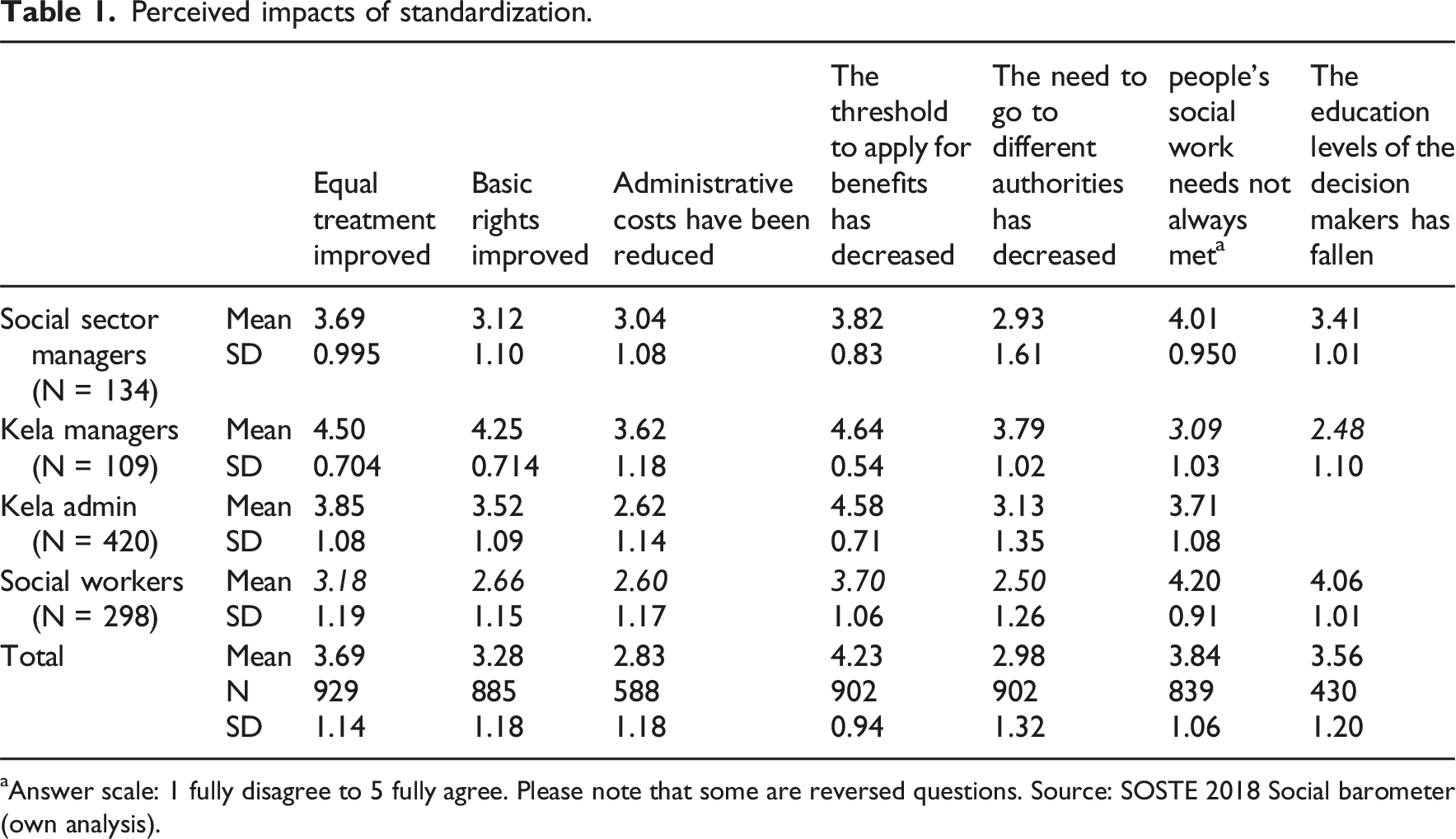
aAnswer scale: 1 fully disagree to 5 fully agree. Please note that some are reversed questions. Source: SOSTE 2018 Social barometer (own analysis).
As Table 1 highlights, Kela management expressed the most positive views. Their perceptions were often well above the mean and higher than the other groups of respondents. Social workers, on the other hand, were most critical when it came to questions related to the outcomes of the reform. The answers by Kela street-level administration, closer to the clients, and the social and health sector managers, responsible for well-being in their municipalities or regional co-operation areas, tend to lie in between these two. Although the differences are not always dramatic, the pattern seems to be that street-level professionals tend to be more critical of the change, whereas higher management tends to be more content. The survey items for 2019 are not identical in wording, but closely resemble those in the 2018 survey. Here, again Kela managers noted the positive effects on increasing legitimacy, efficiency and effectiveness and the negative effects, whereas they saw a decreasing ability to recognize claimants’ needs and changes in the educational level of decision-makers as less problematic, especially when contrasted to the views of social workers.
Perceptions of impact of standardization through digitalization.
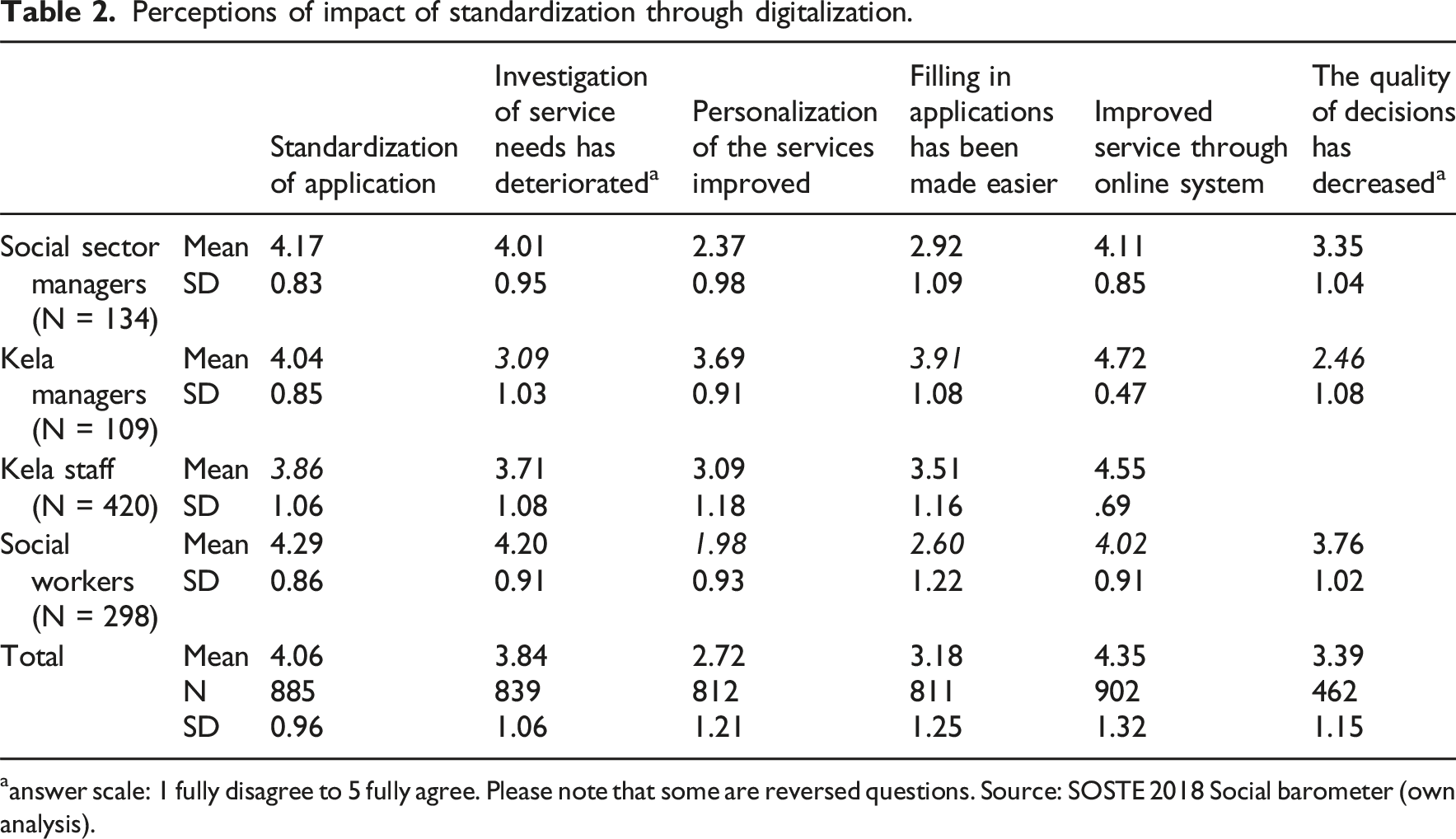
aanswer scale: 1 fully disagree to 5 fully agree. Please note that some are reversed questions. Source: SOSTE 2018 Social barometer (own analysis).
The survey results support the hypothesis that welfare bureaucracies consistently highlight the positive impacts of standardization on efficiency and equal treatment, whereas professionals’ perceptions were more critical. These findings provide preliminary insights into the (in)compatibility between standardization and organizational logics. The manager-level was less concerned with the digital systems’ micro-level outputs, like its limitations in recognizing claimants’ needs. This may reflect a managerial preference to macro-level goals. The findings also show that street-level professionals in both organizational contexts shared criticism, particularly regarding digital systems inability to identify and address service needs. Yet, the differences were relatively small, and a more detailed analysis is needed to fully interpret and contextualize these findings.
Impact of standardization on welfare and activation
The qualitative study uncovered three main categories of impact. Standardization had impacted on (i) professional work, (ii) collaboration between benefits administration and services and (iii) emerging risks for vulnerable groups.
To contextualize the findings, it is important to understand the background of the social assistance reform. Previous research highlights the reform’s long and winding journey, which eventually gained momentum in the 2010s (Varjonen, 2020). A key political argument supporting the reform was that Kela already administered most social insurance (e.g. unemployment, sickness, child benefits, and basic pensions). Expanding its role to national social assistance administration (cash benefit part) was seen as logical. Additionally, Kela’s established ICT-systems promised a streamlined, unified claims and delivery process, making the reform appear – at least politically, as a straightforward decision. The roll-out of the reform, however, was far from consensual and provoked debate in the media and politics. Key issues of public concern included difficulties in migrating to a new digital system and delays in payments (Halmetoja and Rintala, 2020; Jackson and Saikkonen, 2020; Korpela et al., 2020). There were also heated concerns about whether centralizing the administration of last-resort benefit would weaken the connection between welfare benefits and social work (Halmetoja and Rintala, 2020; Kivipelto et al., 2021). These debates are central for understanding the results discussed below.
Impact on professional work
Despite framed as a “practical administrative solution” (Varjonen, 2020), centralization represented a fundamental shift by dividing welfare benefit administration: the main benefit was now managed by Kela, and the services were provided by local authorities. Local levels also kept their former tasks of providing preventive and supplementary social assistance benefits, but Kela took over the administration of the “basic” social assistance covering daily costs of living. Even before the reform, some municipalities had already separated benefit processing from social work, sometimes relying on their own electronic systems. However, the inconsistent practices across municipalities prompted lawmakers to advocate for standardized processes, expected to ensure equitable treatment for all claimants.
However, social assistance differed from other benefits that Kela administers due to its nature as a last resort benefit and need for discretion. This fundamental difference was also reflected in the differing perspectives among the four groups of implementers. For Kela managers and officers, transition was seen to strengthen a bureaucratic logic, emphasizing equality through standardization. The new digital system was perceived efficient, “a means to an end” allowing a rational, arithmetical means for rule-based decision-making that aligns the social assistance with other social security provisions, as are portrayed also in the following quotes form the open answers of the survey: “It’s a simple mathematical procedure, which is more efficient to handle en masse (social sector leader); “It’s a calculated benefit that does not require professional training in the social sector” (Kela management); “The same law and the same calculation formula for everyone. Inequality is decreasing” (Kela staff)
For Kela administration, centralization symbolized a “one-stop shop” for benefits, ensuring uniformity and efficiency while minimizing regional inequalities or personal biases. Kela administration saw standardization as instrumental for guaranteeing a quick process and clear prescriptions, necessitated in the social assistance law.
In contrast, social workers expressed significant concerns, rooted in the professional logic. Although 60% of them had agreed in the survey about the necessity of reform, their answers univocally challenged Kela’s role as the “rational” administrator and the best implementer of the last-resort benefit. Social workers emphasized the fundamental difference between social assistance and other social security benefits (embedding an insurance logic) and the unique nature of the last resort scheme. The implementation was seen to require a nuanced understanding of individual circumstances that standardization and automation could not accommodate: social assistance was “being diluted into zeros and ones”, “delegated to automated systems”. In their responses, the social workers criticized the new division of labour in a following manner: “Kela lacks social work expertise”; “Bachelors of Business Administration” make benefit calculations and decisions according to a ready-made formula and they do not understand that even basic social assistance contains many elements that require discretion and individual consideration”; “Individual knowledge of customers' situations has disappeared, understanding of the customer's overall situation, and the discretion made on that basis has weakened significantly”.
The reform united social workers in their critique of Kela administrations’ (in)ability to address and identify personal circumstances and diverse service needs effectively. Their responses reflected their adherence to professional logic, when they voiced concerns that the reform had significantly undermined the discretion, fundamental to social assistance. Additionally, the digital system was perceived as overly reliant on claimants’ digital skills. The system was seen to disproportionally disadvantage the most vulnerable citizens, and therefore, raised concerns about the potential infringements on their human rights.
Putting it bluntly, results illustrate a clash between “economists” at benefits administration and “humane” social workers. Kela administration lives up to the expectation of administering social assistance based on the prescriptions of the law. Following this logic, granting social assistance is viewed as a basic arithmetical exercise based on standardized procedures. The social workers, on the other hand, still co-implementers of the policy and often physically closest to the clients, were bound by their professional norms and values. From this perspective, criticism of the new system failing to address individual needs and circumstances is not surprising.
The Social Barometer data from 2018 to 2019 illustrates a deep mistrust between these two groups of professionals that has implications in implementing activation. Some of this can be explained by the fundamental transition into a new system, and the setting up systems and collaboration. Social Barometer of 2021, taking stock of the reform 4 years after, suggest that the trust between social workers and Kela administrators has improved over time. Yet, the social workers have still a more critical view on social assistance implementation than Kela personnel (Eronen et al., 2021: 98). Similar trend followed in 2021 and 2023 that the street-level (Kela administers and social workers) shared a deeper understanding of the root problems related to implementing a particular benefit with an inherent need for discretionary space (returned to later in the section below) (Eronen et al., 2021; Londen et al., 2023).
The transfer of social assistance to Kela had promised to give social workers more time to focus on providing services to people in difficult circumstances, but research has later shown that this has not been the case (Kivipelto et al., 2021) Although social workers no longer spend time in making basic calculations (which was seen as positive by many social workers at start of the new scheme), social workers’ time is occupied by tasks such as documentation, meetings, and administrative duties (Kivipelto et 2021: 5). Digitalization of the claims and errors Kela decisions had led them, for example, to “lawyer up” to help their clients with the negative decisions and be the ICT helpdesk when making claims. Social workers expressed many uncertainties and ambivalences involved in implementing digital welfare in practice.
Impact on collaboration
The reform exposed challenges in collaboration between Kela and local workers, that can be traced back to their differing organizational logics. While standardization theoretically offers opportunities for improved collaboration and coordination, this was not achieved in practice.
A significant obstacle was the communication. Both street-level implementers (Kela and social workers) expressed their concerns considering the distorted lines of communication, credited to the underdeveloped ICT system, but also reflecting the mistrust. Information flow was considered difficult and both parties accused each other of shifting clients back and forth between the authorities.
The main problem was the one-sided information flow. The Kela ICT-system (KELMU) primarily facilitated communication from Kela to the municipalities, but it lacked mechanisms for reciprocal communication. Municipalities got the Kela decisions, and Kela had (semi)automated some tasks to the municipalities, but otherwise the communication relied greatly on social workers having merely a telephone line to contact Kela. Social workers expressed dissatisfaction for the overburdened telephone lines to reach Kela. Even if Kela could be reached, the social workers were not able to connect to specific decision-makers due to the impersonalized queue system. Many communication issues have later been addressed, and the collaboration between Kela and municipalities has improved for instance through Skype-groups and appointing local contact persons (Eronen et al., 2021: 98).
The lack of communication fostered inefficiency and mistrust, as clients were seen to be “shuffled” between institutions. Mistrust went to both directions. Social workers criticized Kela for making mistakes and faulty decisions, sending people to the municipalities with little opportunity to rectify them. Furthermore, social workers doubted whether Kela sufficiently utilized their assessments/review documents to consider the claimants’ personal circumstances. Kela was seen to request confirmation on clients’ personal matters which they had already received (claiming that Kela did not trust the clients’ information). Kela staff in return criticized municipalities/social workers for inconsistent practices in supplementary benefits (täydentävä totu) that municipalities still had to pay. There seemed to be a lot of variation in the municipalities on what was seen as supplementary and what not, despite that Kela norms were clear what the basic benefit covered. According to the Social Barometer 2021, the collaboration at the streel-level implementation has improved: similar problems were still raised than in the previous years, but around half the social workers found the collaboration working well or very well. Slight surprise might be that the satisfaction of Kela administrators had gone down: only one of three expressed good collaboration (Eronen et al., 2021: 98). Potentially, the problem may lie in the inadequate resourcing of social assistance delivery. Despite the investments in staff resources after the early years of the transfer, a clear majority of Kela administrators felt the time restriction for their work, despite the number of claims remaining relatively stable (Eronen et al., 2021: 98).
Impact on social assistance clients
Despite differing organizational settings, Kela administrators and social workers agreed on a key issue: processing social assistance claims requires a deeper understanding of clients’ personal situations. The decisions must be made “screen-level”, since face-to-face encounters between clients and those deciding on benefits do not happen at Kela. Both street-level groups acknowledged that the standardized system fell short in addressing complex personal circumstances and service needs. Some Kela administrators (especially those who had not worked in social work previously) admitted that identifying and addressing these needs was beyond their professional expertise, especially in complex cases. Nevertheless, the transform of social assistance to Kela had introduced a discretionary decision-making akin to “social work”. The digital claim process, in particularly, was criticized for being inadequate in capturing service-related needs. The digital application form lacked specific information on social work-related issues, limiting its usefulness in identifying those requiring additional support. While Kela administrators can access the public employment office’s statements (e.g., to verify jobseeker status), their primary task is to ensure eligibility for benefits, not guiding clients to services. Even those Kela administrators with background in social work, found the digital claim platform “hopeless” in capturing social service needs, leaving claimants responsible for seeking entry to services.
The separation of benefit and services in the social assistance reform, together with Kela’s primary role as social security administration, not a provider of social work, has formed a barrier for activation for social assistance beneficiaries. Nonetheless, certain mechanisms have been integrated into the digital system to facilitate the referral process from Kela to local municipalities. The digital system allows Kela to signal a notification of concern (huoli-ilmoitus), thereby alerting local authorities about cases requiring attention. Specifically, for youth under the age of 25, an automatic alarm alerts local social workers if a young person has remained on benefits for four consecutive months (Mesiäislehto et al., 2022). Furthermore, an automatic alarm is generated after 12 months of benefit receipt and for migrants after 2 months of benefit receipt. For every claim, Kela administration possess the capability to manually raise “social work alarm”. However, the incidence of such alerts remains relatively low: only 590 alerts recorded in 2023 (STM 2024). The activation of these alerts necessitates that administers first recognize the need for social work through the digital system or obtain pertinent information through alternative channels (e.g. as direct communication with clients via telephone support line). Many administers, however, expressed a sense of inadequacy regarding their training for this task, despite being obligated under Social Welfare Act to report concerns related to social service needs. Furthermore, administers also expressed that regulatory constrains inhibit their decision-making ability. In cases of non-automated alerts, Kela administration is generally required to inform the client of proposed intervention (for instance pass a concern notification to the municipality) and to get their consent prior to initiating contact with local services agencies. In some situations, the client consent was not needed (e.g. when child’s right necessitated action, or the need for services was evident), but even then, the clients had to be informed of these interventions. This process of contacting clients was seen particularly difficult, especially for marginalized individuals who may be unresponsive to calls or letters. Correspondence in these situations could also lead to rapid escalations of volatile situations. Therefore, providing last resort benefits was considered by some administrators intimidating because of people’s aggressive reactions to outreach from Kela.
The reform’s roll out faced significant delays in processing claims, an issue still evident 2 years later. Surveys indicated that Kela administrators struggled with heavy workloads and stringent processing targets, which also limited their ability to identify and address service needs. Social workers and Kela administrators alike expressed concerns about the exclusion of vulnerable groups such as the elderly, migrants, and low-skilled people and those with weak digital literacy skills. There were surprisingly few variations between the groups of respondents considered as “vulnerable”. Such awareness seemed to be shared across all stakeholders, but not many useful tools to handle this were available. In the 2021 and 2023 Social Barometers, the main challenge remained to be the “lack of service steering” and “work pressure”. The majority of respondents in those surveys, including again social workers and Kela-administers, found that Kela primarily steers clients to claim benefits online, despite the necessity of personal assistance for this process (Eronen et al., 2021: 98; 2023: 28-29). To enhance expertise in social work, for instance, Kela employed client managers (asiakkuusvastaava) to provide individualized support for clients with special needs (Eronen et al., 2021: 29; Turkia 2021). These client managers monitored clients’ situations, offered advice, and served as liaisons between Kela and municipal social services (Turkia 2021: 148). However, a government review in 2021 identified the need for a substantial increase in social work specialists at Kela to effectively manage client process (STM 2021; 18). Currently, no new clients are steered to these services (Kela 2024).
In conclusion, the qualitative result re-confirms our findings on (in)compatibility between standardization and organizational logics. Confirming hypothesis one, standardization fitted well into the bureaucratic logic of Kela administration. The digital system and standardized processes provided efficient tools to ensure uniformity, quick processing, and equal treatment for claimants, fulfilling the core objectives of the social assistance law. Social workers, in contrast, criticized the standardized systems for failing to accommodate the complexity of client circumstances. The systems’ inability to capture relevant service needs highlights the limitations of standardization in activation service delivery.
The findings also confirm the second hypothesis, by illustrating a clear divergence of management and street-level perceptions. However, despite Kela respondents clearly valuing standardization for achieving operational efficiency, the findings also illustrate street-level resistance to standardization, where both Kela administrators and social workers shared concerns about the limitations of the standardized system. Both groups recognized the systems’ inability to adequately serve vulnerable populations, which reflected their shared commitment to client-centred needs that standardization could not meet.
Findings highlight the challenges in client-relations and collaboration, due to a rigid system that created communication barriers between the implementors. The lack of information exchange further hampered collaboration and exacerbated mistrust and in-efficiency.
Conclusions
This article explored the intricate relationship between standardization and activation in the digital welfare state. It underscores the essential link between benefits and services constituting what we call “integrated activation” and illustrated how different logics in the management and street-level implementation respond differently to standardization. The main research question guiding this study was: how does standardization (and digitalization) impact the implementation of integrated welfare and activation policies?
The findings suggest that the bureaucratic and professional logics underlying integrated activation are certainly present, but not aligned. The separation of benefits and services restricts the activation policy goals of promoting labour integration. The Finnish case illustrates benefit administration and social work being disconnected, and digital systems not supporting identification of needs, communication and collaboration, leaving vulnerable beneficiaries of social assistance falling in the cracks. In this way, the main problem with the organizational reform was not related to the digitalization per se. Some problems were ascribed to “dysfunctional” technology (such as the one-sided communication), but the main problems and frictions stemmed from the socio-technical nature of technology (Ruckenstein, 2023). Difficulties and conflicts arose in the clashes of different logics of street-level administration, giving ground to an anecdotal “unhappy marriage” of the benefits administration and social services. Fundamentally, it had to do with a collision between the disparate values inherent to these public organizations. The hierarchical, “bureaucratic” values of income support were incompatible with the social assistance benefit administration requiring (at least from the perspective of social workers) less rule-based and more human-centered service orientation, often requiring high discretionary decision-making levels. As the article shows, standardization, a logic behind digital welfare, is not compatible with administrative logics. It is better aligned with bureaucratic logic. This may further exacerbate the challenges related to integration, and potentially limit the achievement of labour market integration goals despite the technology continuously developing. If we see the technology to be mounted from the rational logic of standardization, together with NPM goals, it becomes a tool, a means to an end (Mol, 2008, 57). What we are suggesting, however, is that a digital welfare reform is never merely a linear process. It teases out important differences between people and organization, alerting providers to needs that might not be obvious otherwise. In this case, it highlights the issue of discretion, deeply rooted in the social assistance system. It is the need for discretion that makes the relationship between activation and standardization difficult. This realization should also pave the way for future reforms incorporating automation into social policy implementation. The main goal of automation is to shrink the amount of human work needed by delegating decision-making to automated systems or assigning responsibility to claimants. Successful marriage in integrated activation requires a better integration of bureaucratic and professional logics, where different kinds of technologies may assist, but as seen in this case, not replace the human factors.
Footnotes
Acknowledgement
The authors acknowledge the support from SOSTE and TIETOARKISTO in acquiring data for the research. The authors also want to thank for the constructive comments by the reviewers and editors and other persons earlier commented on the drafts. Usual disclaimer applies.

Funding
The authors disclosed receipt of the following financial support for the research, authorship, and/or publication of this article: This work was funded by the Finnish Strategic Research Council of Finland grant (REPAIR: breakages and renewal of algorithmic systems), grant no: 353483.
Declaration of conflicting interests
The author declared the no potential conflicts of interest with respect to the research, authorship, and/or publication of this article