




Abstract
Violations of fundamental labour rights have been a problem in global supply chains for decades. Recently, public procurement is increasingly used to regulate labour standards in global chains. Based on previous research on private actors, which distinguished between compliance-focused and commitment-focused enforcement strategies, this article discusses the problems and means of enforcing respect for labour rights in global supply chains. By applying this distinction to public procurement, this article develops a concept of enforcement styles for public procurement as a tool to regulate labour in global supply chains.
Keywords
Introduction
With increasing internationalisation of supply chains, the question of how public authorities can regulate labour conditions in global contexts has received growing attention. In this context, public contracts have increasingly been linked to global supply chains (GSCs). Media reporting drew attention to breaches of workers’ rights in supply chains serving public contracts. Civil society organisations have urged states’ agents to foster labour standards by linking public procurement choices to labour conditions in GSCs (Sack and Sarter, 2018). Increasingly, national and subnational legal regulations on public procurement refer to working conditions in GSCs (Sack et al., 2016; Sarter and Sack, 2016). Yet, a gap in knowledge remains regarding public procurement regulations and practices (Donaghey et al., 2014) and enforcement styles in particular.
This study adapts the distinction between a compliance-based approach and an enforcement strategy based on commitment, made by Locke (2013) with regards to private authorities and seminal to the literature on GSCs and labour standards, to public procurement. Combining Locke’s concept with the literature on implementation, we adapt the original analytical concept, exploring the strengths and weaknesses in regulation designed to ameliorate labour standards along GSCs, and illustrate the value of the analytical concept through the examination of two cases. Thereby, this article takes an analytical stance; its aim is a theoretical reflection for future research. It contributes to the emerging field of regulation of labour issues along the GSCs through public procurement. Based on empirical research in Germany and the Netherlands, 1 it explores two different enforcement styles, a compliance-based and a commitment-focussed approach. The compliance-based approach relies on pre-existing standards that the bidder has to comply with as a requirement for the award of a contract. The commitment-focus approach in contrast seeks to identify risks and commits the bidder to work on improving working conditions. In this sense, compliance can be understood as compliance with predetermined standards and commitment as working towards improvement. Our case studies support the findings of Locke (2013), O’Brien et al. (2016) and Martin-Ortega (2018) who emphasise the need for a procedural and collaborative enforcement strategy for public procurement and workers’ rights in GSCs. Our support stems from two empirical insights: The Dutch enforcement strategy is improving the implementation by committing the contractors. At the time of this study, the German compliance-based approach suffered from opting for compliance with standards as a pre-requisite for the award of contracts and a hierarchical mode of doing procurement while lacking adequate resources, which led to the hollowing-out of social aspects in public procurement. This article proceeds as follows: After discussing the problem that is addressed by the regulation (labour rights in GSC), we present a concept, which includes the problems, means and enforcement strategies for implementation. We then turn to the two case studies (Germany and the Netherlands) and summarise our particular findings. The conclusion discusses main results and limitations of the study as well as practical implications and gives impetus for future research.
Public procurement and labour rights
Public procurement is an important market. On OECD average, it accounts for approximately 30% of total government spending and about 12% of GDP (OECD, 2017: 172). Based on the state’s ‘multiple role as employer, regulator and consumer’ (Donaghey et al., 2014: 247), research has paid growing attention to public authorities’ use of public contracts as a tool for regulating labour (Caranta and Trybus, 2010; Corvaglia, 2017; Donaghey et al., 2014; Holley, 2014; Howe and Landau, 2009; Ravenswood and Kaine, 2015; Sarter and Karamanidou, 2019; Scherrer, 2017; Sjåfjell and Wiesbrock, 2016). Initially focussed on the regulation of domestic labour, the promotion of labour standards in GSCs ‘attracted remarkably little attention’ (Donaghey et al., 2014: 247); this has started to change in the last decade. In this context, a particular problem repeatedly emerges, the existence of an implementation gap (O’Brien et al., 2016).
Addressing labour issues in GSCs through public procurement
The starting point of the regulation and implementation, that is, the problem to be dealt with, are poor working conditions in GSCs and violations of basic labour standards (Delautre, 2019: 24–32; Locke, 2013); also the suppression of rights to organise is a severe problem (Locke, 2013: 3–9; O’Brien et al., 2016: 18–19). Crucially, parts of GSCs are based on wage cost competition, which implies the exploitation of poor working conditions within non-transparent and transnational cascades of contracts. These problems differ according to the economic sector, the region, the gender and origin of the workers and previous traditions of labour policy in a country. Critical for the perception of the corresponding violations are the collective organisation of workers, transnational media perception and political mobilisation by non-governmental organisations (NGOs) and consumer movements in the Global North. Departing from this situation, the regulation and implementation discussed here is concerned with the question of how public procurement can contribute to improving working conditions in GSCs.
The current literature focuses on three groups of actors whose actions (can) interact with each other: Transnational Corporations (TNC), which organise GSCs; those states in which the production is located; and those states that can influence the conditions in GSCs due to their power as ‘mega-consumers’ (Delautre, 2019: 32–41; Locke et al., 2009, 2013; Martin-Ortega et al., 2015). As a result of public pressure, especially when products have become visible to sensitive consumer groups, TNCs, sometimes together with NGOs, have introduced private regulations and codes of conduct (Distelhorst et al., 2015; Locke et al., 2013; Toffel et al., 2015; Zyglidopoulos et al., 2012). The existing literature highlights the crucial role of media awareness, high visibility of the products, commitment of the management of the TNC and the need for continuous monitoring by external agencies. The improvement of working conditions in GSCs strongly benefits from complementary efforts of the states in which suppliers are located. Strong domestic labour laws (including high capacities for inspectorates and active participation in the ILO), high levels of press freedom, like-minded governments and intensive auditing contribute to the betterment of working conditions in GSCs (Coslovsky and Locke, 2013: 501–502; Hughes et al., 2019; Toffel et al., 2015: 216–217). Analyses also show a significant influence of pro-social attitudes in and the GDP of the buyer’s country (Toffel et al., 2015: 215–216). Attention to violations of labour standards derives from consumer protest and campaigns, (mainly) in OECD countries, and media awareness (Hughes et al., 2019; O’Riordan and Fairbrass, 2008: 753–755; Zyglidopoulos et al., 2012). These significant analytical findings suggest we turn to the buyers’ states and public procurement, for the focus of our analysis.
O’Brien et al. (2016) identify the United Nations Guiding Principles on Business and Human Rights (UNGPs), endorsed by the UN Human Rights Council in 2011, as a normative framework for states to protect against human rights abuses by businesses, including breaches of working conditions in GSCs. This framework contains a state responsibility to enforce the acceptance of human rights by third parties, including businesses. Procurement is among the tools to enforce human rights in business (O’Brien et al., 2016: 19–20; United Nations (UN) Human Rights, 2011: 8). It is also sustained by the OECD, the 2030 Sustainable Development Agenda, and policy initiatives on ‘responsible global value chains’ by actors such as the G7 and the European Union (EU; Martin-Ortega, 2018: 2–4; O’Brien et al., 2016: 11–20). The ILO Core Labour Standards (ILO CLS) provide a different, long-standing normative framework (Corvaglia, 2017: 65–68; OECD, 2019: 229). The eight fundamental conventions of the ILO address the protection of life and physical integrity, political rights, equal remuneration and fair and decent working conditions (McCrudden, 2007: 55–56).
Several authors address a gap in the literature on enforcement strategies to implement standards of working conditions in GSCs (Corvaglia, 2017: 231–232; Hughes et al., 2019: 244; Ludlow, 2016: 481, 494; Martin-Ortega and O’Brien, 2017: 69). With O’Brien et al. (2016) providing an overview of different strategies and measures and Ludlow (2016) discussing the Dutch and UK case on ethical public procurement, researchers now know more about different instruments (see below) and discern implementation deficits (O’Brien et al., 2016: 9–10). However, often only procedures and declarations of intent are recorded. We contribute to this emerging research by discussing and exploring an analytical concept, designed to grasp differences in implementation and enforcement styles, enlarging the theoretical debate with empirical data on the actual implementation in public administration in one apparently well-displayed enforcement strategy (the Netherlands) and a case (Germany) rarely discussed in the literature. 2
Implementing labour rights in GSCs through public procurement – a conceptual discussion
The gap in implementation
The consideration of labour rights in GSCs through public procurement is dependent on the corresponding rights (such as the ILO CLS) being a possible or mandatory criterion for the award of public contracts, which are, second, put into practice. As is well known, a large gap between regulation and implementation is likely (Exworthy et al., 2002; Hupe and Hill, 2016; Pressman and Wildavsky, 1973). This also holds true for public procurement (Murray, 2001).
This ‘old’ problem of regulation research has led to the discussion of the possibilities and instruments which can force or motivate actors to comply. A classic distinction here is that between compliance and deterrence (Baldwin et al., 2012: 239) or between ‘punish or persuade’ (Gunningham, 2012: 121). These distinctions ideally capture different ‘styles of enforcement’ (Baldwin et al., 2012: 238), that is, specific mixes of instruments to guarantee implementation (Howlett, 1991; Howlett et al., 2018; Weaver, 2015). On a continuum between coercion and instructed voluntariness, different measures (e.g. fines, disqualification but also advertising and benchmarking) are combined to form a specific mix that diminishes the implementation problem. Ambitious regulatory concepts sequence the respective measures and include a broader range of regulatory actors (Baldwin et al., 2012: 265), namely companies (as self-regulators) and third parties (such as NGOs) (Baldwin et al., 2012: 259–267; Gunningham, 2012: 131–135).
This conceptual perspective suits the analysis of the regulation of labour in GSCs, which is a matter of the business involved (e.g. a TNC), the supervisory authorities of the countries in which production takes place, and consumers, organised private buyers (NGOs, but also buyer consortia and cooperatives) and public authorities as ‘mega-consumers’ (Locke et al., 2013; Martin-Ortega and O’Brien, 2017). Upholding working conditions is subject to regulations of at least three regulatory authorities, first the TNC controlling the contractual relations with suppliers and applying a code of conduct, second, the state (and its labour regulation) in which the production of the goods and services takes place, and third the ‘buying’ state, which stipulates rules for public procurement. While much of the research on labour rights in GSCs focuses on corporate responsibility and the implementation of corporate codes of conduct and its interaction with the public regulation in the producing states as well as with prominent buyer’s networks (Delautre, 2019: 40–41; Distelhorst et al., 2017; Locke, 2013: 17–20, 169–172; Locke et al., 2009, 2013; Martin-Ortega et al., 2015; Toffel et al., 2015), we address the styles of enforcement of the buying state.
Politics and barriers to implementation
Repeatedly, NGOs and consumer mobilisation addressed poor working conditions in GSCs (Delautre, 2019: 24–26). Thereby, not only TNC but also public authorities were urged via media and political pressure to address poor working conditions in GSCs (Hughes et al., 2019: 247, Locke et al., 2009: 324; Martin-Ortega et al., 2015: 341; Zyglidopoulos et al., 2012), particularly for goods and services with high visibility (Hughes et al., 2019). Interwoven with the mobilisation of NGOs and interest groups is the role of party politics. Including respect for workers’ rights in public procurement regulation is clearly a topic of leftist parties (social-democratic, socialist and/or green parties) (Howe and Landau, 2009; Sack and Sarter, 2018). It can also derive from protectionist strategies in the sense of ‘nation’s worker first’ (Barnard, 2009; Corvaglia, 2017: 58–65; McCrudden, 2007: 589) by increasing labour costs in GSCs to favour regional workforces. Vice versa neo-liberal politics and low-profile goods and services make it rather unlikely that workers’ rights are included in public procurement. 3
Once considerations of working conditions in GSCs are enshrined in public procurement law, 4 the ‘barriers to compliance’ (Weaver, 2015: 807) are numerous (UN Environment, 2017: 45–46). Maybe the most evident obstacles are financial aspects and the availability of products (Walker and Brammer, 2009) and the lack of expertise (Brammer and Walker, 2011). From the literature, the following bundle of additional barriers can be summarised: First, a mismatch of politics, that is, political majorities and policy preferences between the regulating state level and the administering level of (sub-)national authorities is a likely obstacle for implementation (Refslund et al., 2020; Sack, 2012). It cannot be taken for granted that the political will for protecting labour rights in GSCs is present throughout the different levels of the politico-administrative system. Second, the long predominant uncertainty about the legal admissibility within the regulatory framework of the World Trade Organization or EU regulation (Corvaglia, 2017) needs to be considered as an obstacle for implementation. ‘These legal uncertainties, both at the level of policy and practice’ (Ludlow, 2016: 481), restricted the willingness of administrative practitioners to take into account other (social) criteria in order to avoid litigation (Ludlow, 2016: 79–81; Martin-Ortega et al., 2015: 346–354; Sack and Sarter, 2018: 380–381). Specific to GSCs is, third, a lack of transparency of subcontracting cascades with variegated ownership structures and employment relations in which the likelihood for labour code violations is high (Coslovsky and Locke, 2013: 499; UN Environment, 2017: 46). From the viewpoint of the public jurisdiction, a mismatch between the need to monitor and to control compliance with labour norms within complex GSCs on the one hand and its own administrative capacities for gaining information on the other is evident. The complexity of subcontracting cascades is not only an obstacle for the administration when controlling respect for labour norms (Delautre, 2019: 24–26). It is also an obstacle for contractors and businesses who may not be able to determine or control the working conditions of their (sub)contractors (Locke et al., 2009: 324–326).
Instruments to overcome the implementation gap
As expected, enforcement of human rights in GSCs is rather weak or non-existent (O’Brien et al., 2016). A lack of implementation is predominant. Nonetheless, some tools and instruments have been collected (O’Brien et al., 2016: 38–48; Sack et al., 2016: 53–72; Sarter and Sack, 2016; UN Environment, 2017).
Tools of knowledge-building and learning cover ‘soft’ governing through persuasion, advice and education, including the following: Risk assessment is an ex-ante identification of goods and services with high risk of adverse human rights. Transparency enables information gains and control; it can be enhanced by legality protocols, integrity pacts and dedicated online databases. Tools of education and learning cover networking, which is dedicated to sharing experiences, legal advice and good practices between the stakeholders. In addition (and occasionally as a product of knowledge-sharing in networks), guidance papers and trainings are developed and disseminated to inform practitioners, legal consultants, NGOs and other stakeholders. Instruments of standardisation reduce the complexity of information (Delautre, 2019: 16). Certificates and labels like Fairtrade signal whether companies adhere to certain labour standards. The same applies to certification under ISO 26000 and ISO standards, under which companies comply with certain social criteria, including fundamental principles and rights at work, conditions of work and social protection, social dialogue and health and safety at work (ISO 26000:2018, 2018: 12). Pivotal to implementation is monitoring the performance of contractors and suppliers in GSCs as an accompanying measure that sheds light on the actual situation of working conditions. Monitoring of compliance with labour norms needs to be extended to all contractor relations. Independent monitoring agencies, be it NGOs or professional auditors, are crucial for the sound verification of social requirements (Martin-Ortega et al., 2015: 359–360). Monitoring of working conditions within contract cascades of GSCs is within the duty of business and the bidder to whom the tender had been awarded; it can be complemented by labour inspectorates of the states in which the suppliers produce (Coslowsky and Locke, 2013: 512–518; Locke et al., 2013: 523–524; see also Martin-Ortega and O’Brien, 2017: 75; O’Brien et al., 2016: 45–47).
Human rights due diligence, which can be required from suppliers, integrates a couple of the measures mentioned above. Being a contractor-led process, it comprises four steps: (i) human rights risk and impact assessment; (ii) integrating assessment findings into company policies and procedures; (iii) monitoring the effectiveness of company responses to human rights impacts; (iv) communicating and reporting on human rights impacts and due diligence. (Martin-Ortega and O’Brien, 2019: 12)
Introduced to organise a sound commitment of business to human rights implementation, it is also used in public procurement. Due diligence establishes ‘a clear allocation of responsibilities within the contractor regarding social conditions in the supply chain’ (O’Brien et al., 2016: 43). Requirements for social criteria, including labour rights and working conditions, need to be specified and should cover the whole GSC including not only the contractor but also subcontractors. Public authorities need to establish the monitoring and verification of compliance. All contract parties should be aware of sanctions following non-compliance (Martin-Ortega et al., 2015: 356–357; O’Brien et al., 2016: 43).
Beyond knowledge-building, learning, guidance, advice and monitoring, the usual arsenal of warning mechanisms and sanctions known from regulatory research is applied in the implementation of the regulations. Those bidders who participate in collaborations, networks, certifications and due diligence are rewarded for this, insofar as they receive special scores or are preferred bidders in the tendering process. Bidders who have been found to be currently or in the past in breach of agreed working conditions will be warned, fined, their contracts terminated and their companies disqualified from further tendering procedures. Positive and negative incentives and sanctions are considered to be used during the implementation to enforce compliance (O’Brien et al., 2016: 38–48; Sack et al., 2016: 53–72; see also Weaver, 2015: 811–812). 5
Two styles of enforcing labour rights in GSCs
Particular mixes of instruments add to certain approaches to implementation. According to the regulation literature (Baldwin et al., 2012: 238–254; Weaver, 2015), enforcement strategies encompass the tools that apply policies on the ground (i.e. implementation). Focussing on approaches of implementing labour rights in GSCs, Locke introduced a catchy ideal-type distinction between a compliance and a commitment approach. The compliance-focussed approach focuses on predetermined standards, which ought to be complied with and verified by detailed audits, protocols and checklists. The compliance-based approach rests on a clear division between the inspectors and those to be inspected and is characterised by negative incentives and punishment. In contrast, the commitment approach commits all actors involved to joint problem solving based on learning, mentoring, trust, reciprocity and enabling. The diffusion of best practices, capacity building and positive acknowledgement of the achievements are in the centre of the approach (Locke, 2013: 174–181; Locke et al., 2009: 343–345). This ideal-type distinction distinguishes hence between, first, a unilateral command regulation based on compliance with stipulated standards and control, in which state agencies play the decisive role and, second, an enforced collaborative governance and self-regulation of business in which joint improvement of standards and learning is prominent for all actors, regardless of whether they come from the state, business, or civil society. 6
In the following, we apply Locke’s distinction to public administration (instead of private business). Based on two case studies, we examine the validity of the distinction for public procurement and suggest expanding it by introducing the barriers, instruments and modes of interaction (Table 1).
Comparison of the compliance versus the commitment approach.
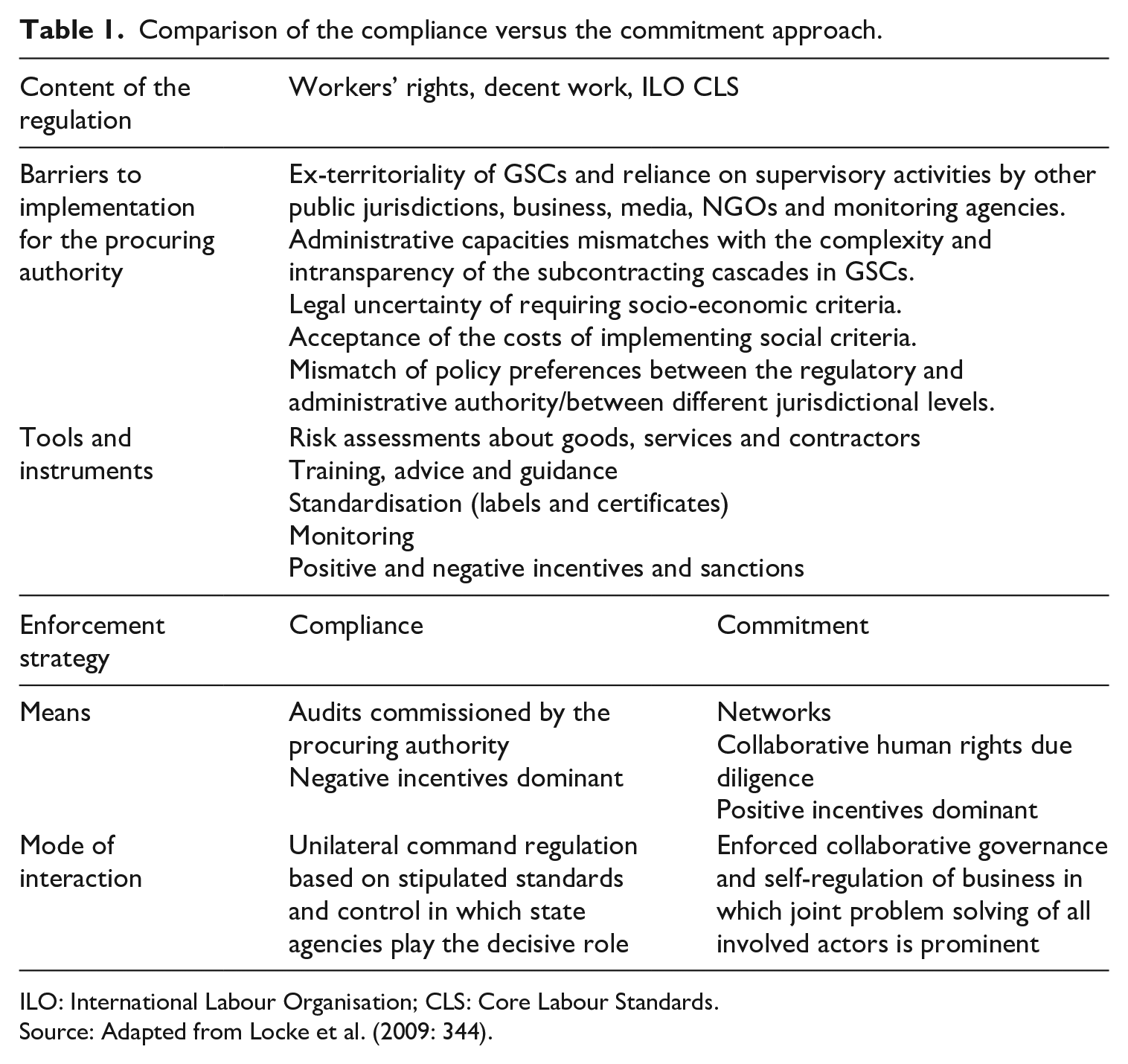
ILO: International Labour Organisation; CLS: Core Labour Standards.
Source: Adapted from Locke et al. (2009: 344).
The administrative design of sustainable public procurement
The following is based on results of the research project ‘Soziale Standards und öffentliche Auftragsvergabe – Regulation und Umsetzung im Europäischen Vergleich’ (funded by the Hans-Böckler Foundation), which analysed policy-making and the implementation of social considerations, among others relating to GSCs, in comparative perspective. Methodologically based on content analysis of policy papers and semi-structured interviews (Bernard, 2013; Bryman, 2016), 69 interviews with 86 interviewees were conducted at European level as well as national and subnational level in Germany, the Netherlands and the United Kingdom between February 2013 and February 2015. For the purpose of this article, we focus on findings from the comparison of 47 semi-structured interviews with 61 interviewees conducted between February 2013 and February 2015 in Germany and the Netherlands with civil servants, representatives of local authority organisations, trade unions, business associations, NGOs and consultants working in the field of public procurement and GSCs. 7
Context: legal impetus and external pressure
For the legal context of both countries, the corresponding EU procurement directives (Directive 2014//24/EU) and EU case law are especially relevant. In this regard, it should be noted that the development of the EU public procurement regime has led to compliance with international labour standards being allowed and enabled, but not made mandatory (Caranta and Trybus, 2010; Sack and Sarter, 2018; Sarter and Sack, 2016).
In 2009, the Dutch government introduced international social aspects (‘internationale sociale voorwaarden’) relating to international labour and human rights standards in GSCs (Melissen and Reinders, 2012: 30). Since 2013, all invitation for tenders that exceed European thresholds should include mandatory social aspects relating to the ILO CLS (de Zeeuw et al., 2014: 2). These may include further stipulations regarding employment conditions and wages (European Commission, 2016: 2f; SOMO, 2014: 3). The ‘international aspects’ are included as contract conditions (Melissen and Reinders, 2012: 30). In Germany, public procurement is embedded in a complex multi-level regulatory framework with legislative competencies at national and subnational level. At the time of this study, regulatory policies at national level opened the opportunity to include social aspects without specifying any specific social aspects. Specific requirements were set at subnational level. Making use of the discretion to pass additional regulation on public procurement, at the time of this study, 8 13 of the Federal States had passed regulatory policies that relate to labour conditions in GSCs between 2008 and the time of this study. Thereby, two points of reference existed: compliance with ILO CLS (on which we focus henceforth) and the purchase of Fairtrade goods (Sarter and Sack, 2016). To reiterate, in both cases considerations relating to working conditions in GSCs were a mandatory norm enshrined in (in Germany subnational) law (Sack, 2012; Sack et al., 2016).
As outlined above, media awareness is a vital factor for improving working conditions in GSCs (Hughes et al., 2019; O’Riordan and Fairbrass, 2008: 753–755; Zyglidopoulos et al., 2012). While media reporting on public purchasing practices was not particularly widespread in either country, interviewees involved in public procurement policy in the Netherlands were highly aware that media outlets had drawn attention to breaches of workers’ and human rights in the past. 9 As a result, a number of Dutch interviewees highlighted a risk of negative media coverage, which put pressure on public procurement officials: ‘they are very afraid of the media, that in the media we get news like ‘okay, this government bought that product, but there is child labour within the supply chain [. . .]’ (Int63). One interviewee voiced the impression that ‘it gets more and more into the media, which I think helps [. . .] procurers to [think, authors] “O, there’s something going on, and maybe I can do something about it”’. (Int64) This suggests that media coverage, the risk of negative publicity and the (perceived) threat to the reputation of a public authority can influence public procurement practices.
Enforcement strategies: compliance versus commitment 10
At the time of this study, public procurement policies and practices regarding ILO CLS required, in Germany, compliance with ILO CLS throughout the complete GSC at the time of purchase (compliance-based approach). 11 Our interviews highlight the perception of a number of challenges; first, several interviewees highlighted that for some goods, products that were produced in compliance with ILO CLS may not exist. In line with policy documents and policy evaluations (Sack et al., 2016), our interviewees also raised concerns regarding whether and how compliance with ILO CLS can be verified throughout the entire GSC. This led some interviewees to perceive that there was no option but to trust companies’ declarations: ‘if you buy something, a part for an ambulance, I believe that most of it will not be produced here. And all I can do is to believe that no child labour or inhuman conditions or the like were involved in the production’ (Int26). Thereby, the lack of external certification that could be used as proof of compliance with ILO CLS was raised as a key issue by several interviewees. As one interviewee argued, ‘Our problem clearly is: There are no labels or certificates for ILO Core Labour Standards. This is a gap and certificates and labels will be needed in the future’ (Int35). Given the lack of no external certification, compliance was judged by self-declarations, which relied on a binary distinction between compliance and non-compliance. In these, companies had to indicate whether a product was produced in compliance with the ILO CLS (or not).
In contrast, the Dutch approach focused on identifying risks and implementing measures to improve working conditions in GSCs, particularly in areas where breaches are common and foreseeable. The multi-layered approach consisted of three distinct regimes. The first regime applies to companies that are a member of certified supply chain initiatives; the second comprises cases where the company is not a member of a supply chain initiative but states that no risks in the supply chain are to be foreseen. 12 In both cases, no specific obligations exist. If the company is not a member of a supply chain initiative and indicates that risks are foreseeable (third regime), suppliers must make a ‘reasonable effort’ (European Commission, 2016: 3) to improve respect for labour standards and reduce breaches of workers’ and human rights (SOMO, 2014: 6). Several interviewees linked this focus on improvement to the fact that transgressions of labour rights in GSCs are a systemic problem, which is deeply and structurally embedded in the trading and production system and ‘not a mistake of the buyers or the suppliers’ (Int64). In contrast to the compliance-based approach, which requires compliance with predetermined standards at the time a contract is awarded, public procurement officials in the commitment-focused approach ‘don’t ask that from day one everything has to be in order’ (Int62). If risks are foreseeable, companies are asked to provide a ‘plan of approach; and in the plan of approach we ask them to specify what steps they’re going to take to their suppliers’ (Int62). To decide which regime is applicable, companies are required to declare foreseeable risks in their supply chains. Depending on their declarations (and membership of a supply chain initiative), contractual obligations may be agreed. As a result, the crucial point – as well as the point of vulnerability – is to correctly identify foreseeable risks, an issue that we will explore further in the following.
Company declarations and the vital role of scrutiny
In both approaches, declarations of companies are vital for assessing either compliance (in the compliance-based approach) or the existence of foreseeable risks (in the commitment-focused approach). If risks are identified in the commitment-focused approach, companies are still able to gain a public contract but will be met with obligations, which mean additional tasks and requirements. In contrast, the compliance approach precludes companies that declare non-compliance (breaches of standards) from being awarded a contract. While both approaches set negative incentives, their strength differs; it can be assumed that excluding a company from the award of a public contract is a stronger negative incentive that ‘merely’ setting additional obligations. Furthermore, excluding companies from public contracts may limit the market of available goods, which may influence the implementation of public procurement regulations.
With company declarations an important part of both approaches, several (especially Dutch) interviewees highlighted that trust in these statements can be misled: ‘Okay, every contractor says, ‘Yes, I will do that’, as long as I get the contract’ (Int62). Consequently, they raised the question whether trusting the declarations is appropriate: ‘when a contractor says, “Well, I don’t see any risk in my supply chain”, and it’s about hardware or the product groups, where everybody can assume there are risks, is the high trust principle, is that in order?’ (Int62). Scrutinising whether companies’ declarations reflect actual practices is not only vital to prevent enforcement deficits (Sack and Sarter, 2016) but has also been a consideration of a number of our interviewees.
Yet, our interviewees, particularly those working within a compliance-based approach, highlighted concerns about the feasibility of scrutinising companies’ declarations. Against the background of increasingly complex supply chains, interviewees from associations of local authorities pointed to the (unscrutinised) acceptance of self-declarations as the only feasible option. Moreover, our interviews from Germany suggest that in administrative practice, the inclusion of self-declarations in bidding documents was treated as a formal requirement. As one interviewee from a NGO who worked closely with public authorities highlighted: ‘as even the procurers themselves tell me, typically for self-declarations, the procurer only pays attention to whether the box “Yes, I will do it” is ticked and only looks to whether the respective form is included’ (Int22).
In addition, requiring public procurement officials to scrutinise bidders’ declarations raises the demands on administrative resources and the knowledge and expertise of the individual public servant. Against this background, it can be argued that the existing system provides incentives for public procurement officials not to check the reality of declarations (i.e. whether they reflect actual practices). This assumption was reflected in the interviews, particularly by Dutch interviewees: actually, the system encourages people to do that [accept the statement that no foreseeable risks exist, even in cases where this declaration was dubious, authors] because for the public procurement officer that means no work. [. . .] And for the company as well [. . .]. So there is no incentive at all to agree that there are risks. (Int69)
Drawing on their experience in supervising public procurement procedures, one Dutch public servant stated that in a very few cases they would challenge it [the declaration that there is no risk, authors] (Int62), even if ‘there were a few products in the selected files, which I could think about, well, I think there are risks and regime 2 is filled in. Maybe it’s possible, I don’t know that supply chain of that contractor but I see reason for a question – and is [there, author] a question? And the answer was “No!”’. (Int62)
The implementation gap and two enforcement strategies
Overall, our interviewees confirm the difficulties that have already been identified by the general regulation literature (Baldwin et al., 2012) and the research on the implementation gap in protecting workers’ right in GSCs (Locke, 2013; Locke et al., 2009). With O’Brien et al. (2016) and Martin-Ortega and O’Brien (2017), we now turn to public procurement and contribute to the discussion with an analysis of actual administrative action to show that the typology introduced by Locke et al. (2009) is also applicable to public procurement. We exemplify the two types of enforcement strategies that are relevant in public procurement. While the content of the regulation, barriers to the implementation for the procuring authority, and tools and instruments are similar in general, public authorities adopt different enforcement strategies (Table 2).
Comparison of the German and Dutch enforcement strategy.
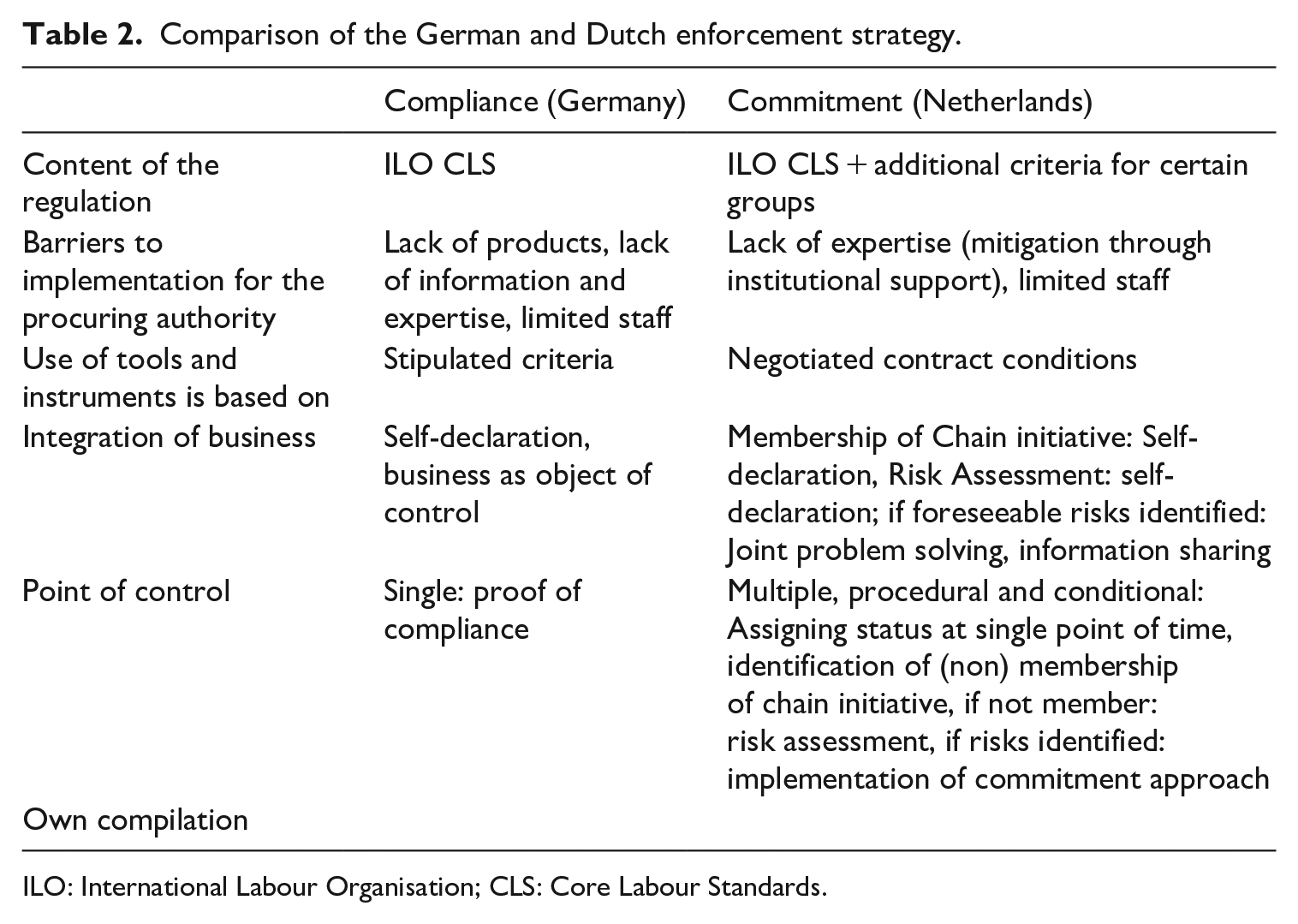
ILO: International Labour Organisation; CLS: Core Labour Standards.
In both cases, aiming to use public procurement as a tool for improving working conditions in GSCs is a rather new phenomenon. This seems to suggest an increased awareness of the violations of fundamental human rights in transnational supply chains. While public policies were set up at about the same time, the strategies differed significantly. The Netherlands adopted a reflexive, that is, flexible and ex-ante assessing strategy that committed businesses to tackle risks in GSCs. This enforcement strategy contains most prominently risk assessment, the production of knowledge and joint problem solving with the enterprises involved. It encompasses multiple points of control, which are linked to the conditional use of incentives and sanctions. Being based on identifying existing risks in supply chains and focusing on improving future conditions in the supply chain and checking for foreseeable risks, the commitment approach is characterised by flexibility and its procedural nature as well as its responsiveness. It sees businesses as partners with whom a common approach is developed and who thereby become agents in the collaborative governance of public procurement.
While the commitment approach mirrors the complex and procedural nature of GSCs themselves, which are flexible and adjusting to externalities, the compliance approach focuses on compliance with predetermined standards at a particular point in time. It focuses on given products, certificates and labels as means of information and a binary understanding of compliance versus non-compliance. It takes private companies as externals who, in order to be able to do business, must declare conformity to predefined rules. Ensuring conformity to and compliance with legal settings a priori is crucial. Assuming the lack of administrative resources, the compliance approach tends to implement the regulation superficially. Negating the opportunity to win a contract if the business does not comply with pre-set standards, the compliance-based approach provides stronger negative incentives than the commitment-based approach, which ‘only’ foresees additional requirements but still provides the opportunity for being awarded a contract.
Conclusion
In the light of increasing internationalisation of supply chains, the role of the state and its purchasing practices has come into focus over the past few decades. A gap in literature remains regarding enforcement strategies to implement standards of working conditions in GSCs (Donaghey et al., 2014; Ludlow, 2016; Martin-Ortega and O’Brien, 2017: 69; Hughes et al., 2019: 244). Our findings support previous findings, particularly by Locke (2013), O’Brien et al. (2016) and Martin-Ortega (2018), who stressed the importance of a procedural and collaborative enforcement strategy for public procurement and workers’ right in GSCs. We add to the literature by proving that the distinction between commitment-focused and compliance-based enforcement strategies is applicable to public procurement. The analytical concept of actual implementation helps to understand and reflect on these two distinct approaches. It shows that the use of tools is based on different premises, integration of business and points of control. Our findings also suggest that scrutinising companies’ declarations is at the same time both, the crucial and the weak point of the two approaches. Whether this finding holds true on a broader empirical basis should be an important concern of future research.
Follow-up questions arise from both a normative and an analytical perspective: We assume learning effects and reflexivity over the course of time, both in terms of legal regulation and in terms of individual tenders and procurement bodies. These can lead to a strengthening of the path already taken, for example, by equipping NGOs and trade unions with control and complaint rights in addition to state authorities (in the path of hierarchical implementation). Enshrining civil right of action for trade unions and NGOs is a virulent issue in this regard. An additional way would be to provide resources in order to establish networks with companies to strengthen their capacity to implement labour rights (in the path of collaborative implementation). It is also conceivable, however, that there is a complementary mix, for example, hierarchical compliance combined with offers of networking between companies and NGOs or the implementation of tough sanctions in the collaborative approach. A permanent and pragmatic adaptation of measures, offers and sanctions is part of responsive regulation.
The analytical concept sheds light on the administrative designs to the implementation of ethical public procurement and allows us to identify the benefits and pitfalls of two ideal enforcement styles. The exploration and our study, however, has its limitations as it is restricted to a small-n comparison. Future research should seek to broaden knowledge on the issues identified in this article. We see two directions in this regard. First, while case studies are dominant in the area (Locke, 2013; Martin-Ortega and O’Brien, 2019), comparative research on different enforcement strategies in public procurement would benefit from selecting cases more rigorously on the ground of basic national implementation styles (Howlett, 2004). We would thereby extend our knowledge of the factors which impact on the implementation. In line with the literature, our article describes the overall pattern of labour rights protection in GSCs as follows: In addition to the efforts and obligations of private companies and the control structures of the labour administrations of the states in which production takes place, the enforcement strategies of the buying states as ‘mega-consumers’ are of particular concern. A second task for further research will be to examine the interactions, complementarities and contradictions of this transnational chain of control in greater depth. In particular, future research should explore the origins of enforcement styles and the relationships and linkages between public and private regulation. In addition, future research should seek to analyse the impact of different enforcement styles for improving working conditions and safeguarding workers’ rights in global chains.
Footnotes
Acknowledgements
We thank David Gwyer and the two anonymous reviewers for their helpful comments.
Funding
The author(s) disclosed receipt of the following financial support for the research, authorship, and/or publication of this article: The research project ‘Soziale Standards in der Vergabepolitik’ was funded by the Hans-Böckler Foundation (2012-581-4).
