



Abstract
The analysis of public support for tuition fees has received little attention so far in the growing literature on the political economy of higher education and redistribution. This paper addresses this research gap, using novel survey data for the German resident population (N = 6208). Using a survey experiment, this study finds evidence that providing respondents with information about existing inequalities in the access to and financing of higher education increases support for tuition fees. We also find higher support levels for tuition fee models with deferred payment options or income-contingent fee levels compared to the generic flat-rate fee model. Finally, the paper finds evidence that individual partisan ideology matters, both for general support for tuition fees as well as with regard to how partisanship moderates the impact of information provision.
Introduction
If […] higher education institutions are also “free,” that only means in fact defraying the cost of education of the bourgeoisie from the general tax receipts. (Karl Marx, 1875)
Academic scholarship in political economy and comparative welfare state research has increasingly recognized the central importance of educational institutions in affecting patterns of social mobility and inequality (Ansell, 2010; Busemeyer, 2014; Garritzmann, 2016; Weisstanner and Armingeon, 2020), while being aware of redistributive consequences of educational investments, which are rather ambivalent as public educational investments also entail private benefits and higher wages for those receiving these investments (Fernandez and Rogerson, 1995). Thus, depending on the overall progressivity of the general tax system as well as the extent of persistent inequalities in access to higher education, the provision of public subsidies to higher education in low-enrolment systems combined with a less progressive tax system comes close to the Marxist interpretation of regressive higher education financing (Ansell, 2010). In countries with broad access to higher education and more progressive tax systems as in the Scandinavian countries, higher education financing may be less regressive (Garritzmann, 2016), but even in these systems, public investments in higher education also create private benefits for students.
The focus of this paper is on exploring patterns of public opinion regarding a particular policy instrument that could be used to mitigate regressive higher education financing: tuition fees. While there is abundant literature on the effects of higher education financing and tuition fees on students’ decisions to study, subject choice as well as study duration (Archer et al., 2003; Becker and Hecken, 2009; Curs et al., 2007; Dynarski, 1999; McPherson and Schapiro, 1991; Nielsen et al., 2010), there is very little research so far on the public’s attitudes and preferences regarding tuition fees (notable exceptions to be discussed further below are the contributions by Garritzmann, 2015, 2016; Lergetporer and Woessmann, 2023). Understanding the public opinion dynamics of higher education financing is, however, crucial as public opinion has been found to systematically affect the dynamics of policy-making, in particular in the domains of education and social policy (Brooks and Manza, 2006; Busemeyer et al., 2020; Garritzmann, 2016; Soroka and Wlezien, 2010).
This paper, using original survey data for the case of Germany, studies public preferences on different tuition fee models as well as how the provision of information about the potentially regressive effects of higher education financing affects these preferences. Germany is a very suitable case in order to address these questions: For one, the German higher education system continues to be largely financed from general taxation revenues and is also characterized by persistent class-related inequalities in access to higher education (Powell and Solga, 2012). As also further discussed below, inequality in access to higher education remains high in Germany with about 75 percent of children from academic households going to university, compared to 25 percent for non-academic households. And while a certain share of the per students costs for higher education of about 10.000 Euro is recuperated via higher income taxes for highly educated individuals (Lergetporer et al., 2021), this is by far not sufficient to cover the whole costs (note that it is difficult to get a proper causal estimate of this point).
Hence, this combination of inequality in access with tax-financed higher education amounts to a regressive financing dynamic reminiscent of the Marx quote from above. However, in the real world of politics, subjective perceptions of the redistributive implications of higher education financing can differ from objective facts. A concrete example for this in the German case is the partial introduction of modest tuition fees in the mid 2000s in about half of the German states (Länder), which were all abolished again about a decade later in the face of public protests, based on the commonly held view that tuition fees constitute a fiscal obstacle for students from low-income backgrounds. In line with this hunch, tuition fees were always introduced by right-wing governments and abolished by left-wing governments (Kauder and Potrafke, 2013). Therefore, while the topic of higher education financing via tuition fees had been a salient issue on the political agenda in many German states, the accompanying politics defied simple politico-economic expectations.
Answering this puzzle is the goal of this paper. Our first research question is whether the provision of additional information on the complex redistributive implications of higher education financing, in particular the regressive implications of financing via general taxation, changes people’s attitudes towards tuition fees. Our experimental survey provides evidence for this: respondents who received the information treatments are up to 7% points more supportive of tuition fees compared to the control group. The second research question we address is whether alternative tuition fees models that by themselves contain more redistributive policy design elements compared to the flat-rate fee model discussed (and partly practiced) in Germany garner higher levels of support among the public. Again, our survey evidence confirms this expectation as tuition fee models that deviate from the flat-rate model by adding redistributive elements are significantly more supported. Finally, we assess in a more exploratory manner the extent to which individual ideological predispositions condition the processing of new information. Our findings indicate that the attitudes of individuals locating themselves in the center of the left-right ideological scale are more affected by information treatments compared to those at the extremes of this scale, which is in line with previous research on this issue (Jerit and Barabas, 2012).
Literature review
This paper builds on a vibrant and growing literature studying the political economy of education and higher education in particular. Earlier studies in this field have focused more on the macro level, explaining differences in higher education spending across countries. In line with the above-mentioned ambivalence regarding the redistributive implications of higher education (Fernandez and Rogerson, 1995), these studies have come up with partly contrasting findings.
On the one hand, some have argued that higher public spending on tertiary education is predominantly promoted by right-wing governments as this directly benefits the (upper) middle classes (Ansell, 2008, 2010; Rauh et al., 2011), a traditional core constituency of these parties. On the other hand, other studies have found that government participation of left-wing parties in particular is associated with higher public spending on tertiary education, presumably because social democratic and other leftist parties use it to appeal to new electoral constituencies in the aforementioned middle classes (Busemeyer, 2009; Garritzmann, 2016; Häusermann et al., 2015).
Beyond exploring the political dynamics of education financing on the macro level of country comparisons, scholars became increasingly interested in analysing the micro-level foundations of the politics of education financing in terms of attitudes and preferences (see the contributions in West and Woessmann, 2021, for a broad overview of this literature). Building on the large scholarship on welfare state attitudes (see Kumlin et al., 2021; Svallfors, 2012, for overviews), researchers started to study public opinion on education policy. To highlight a few findings of relevance for this paper, Busemeyer (2012) finds that the institutional set-up of the education system shapes attitudes and preferences on education policy such that a higher degree of educational stratification is associated with higher levels of support for public education spending among the rich, confirming the regressive dynamic in countries with a high degree of educational inequality mentioned above. Other work in this tradition has explored public preferences regarding the distribution of educational investment across the different sectors of the education system (Busemeyer et al., 2018; Busemeyer and Garritzmann, 2017). Finally, some studies have also researched the consequences of information provision for public opinion towards education. In a comparative study of the US and Germany, Lergetporer et al. (2018) find that informing respondents about the level of teacher salaries decreases support for additional spending on education.
In spite of the increasing interest in the study of public opinion on education, very few studies have addressed the topic of higher education financing and tuition fees in particular. The work of Garritzmann (2015, 2016) has shown that public support for tuition fees as a means to finance higher education is actually higher than commonly believed and also varies significantly across countries, in line with existing institutional regimes of higher education financing, thereby confirming strong feedback effects of policies on prevailing attitudes (Jacobs and Weaver, 2015; Mettler, 2002; Pierson, 1993). A further important finding is that providing information about the redistributive consequences of higher education financing can increase support for tuition fees (Lergetporer and Woessmann, 2023). We add to this literature by assessing the respondents’ support for different types of tuition fee models explicitly as well as by assessing the association between tuition fees support and partisan ideology.
Theory: Information, inequality and policy options
Based on the general discussion about the political economy of higher education financing in the previous section, we now develop a set of testable hypotheses. These hypotheses center on three aspects: first, whether the selective provision of information changes policy preferences for tuition fees; second, how different policy designs might affect support for tuition fees, and third, to what extent the individuals’ partisan ideology conditions and shapes her views on tuition fees as well as the impact of information provision.
Starting with the first issue, we hypothesize that the provision of information about the distributive implications of higher education financing via tuition fees affects overall support for these fees. The implicit assumption underlying this claim is that individuals may be to some extent unaware of the complex redistributive implications of providing ‘free’ university education via tax funding. Instead of realizing the regressive nature of tax-funded higher education due to persistent inequalities in access to this form of education, the public may focus more on how tuition fees create and reinforce access obstacles in the short term. Thus, the selective provision of information about the extent of class-related inequalities in access to higher education as well as additional information on the redistributive implications of tax-funded financing could increase overall support for tuition fees as these fees are then more perceived as balancing out the regressive financing dynamic. It also should increase the individuals’ awareness of educational inequalities in the first place – which is an important preconditioning mechanism. Therefore, our first hypothesis regarding the role of information is:
Providing information about the extent of class-related inequalities in access to university education will increase the respondents’ support for the introduction of tuition fees. In a next step, we discuss the role of policy design. As briefly mentioned above, the German debate about tuition fees centered on a model with income-independent flat-rate fees. After a ruling from the federal constitutional court in 2005 made it possible for German states (Länder) to introduce tuition fees, about half of them introduced moderate fees of up to 1000 Euros per semester in subsequent years. However, tuition fees led to significant political opposition so that by 2014, all federal states which had previously introduced fees had abolished them again (Lergetporer and Woessmann, 2023; Minor, 2023). Currently, public universities in Germany do not levy any tuition fees for German and EU students, apart from a nominal administrative fee (‘semester contribution’) of up to 300 Euros per semester. Across the OECD world, many countries do levy substantial tuition fees, in particular in the Anglo-Saxon and East-Asian countries (Garritzmann, 2016; Wolf and Zohlnhöfer, 2009). For the purpose of this article, we focus on tuition fee models that include some redistributive elements in their policy design. One such alternative to the flat-rate fee model is the deferred payment model practised, for instance, in the UK and Australia. In these countries, governmental loans and grants facilitate access to higher education in spite of high tuition fees, but even more importantly, re-payment of loans (and thereby tuition fees) can be deferred until later in life and made contingent on (later) income (Barr, 2004; Chapman and Dearden, 2022; Vandenberghe and Debande, 2008). Thereby, tuition fees (and their repayment) effectively become a top-up tax for high-income earners. A second alternative model exists in Italy, where fees at public universities depend on the student’s family household income, assessed through the ‘Equivalent Economic Situation Indicator’ (ISEE). This metric, subject to the specific determination of individual universities, defines the level of individual tuition fees, creating a sliding scale that accommodates different economic backgrounds, with yearly tuition fee reductions ranging between 13,000 and 30,000 Euros (Leoni, 2022). Compared to these alternatives, the German flat-rate and income-independent tuition fee model might be perceived as particularly unfair towards low-income students as it does not take into account different economic backgrounds of students and their families. Thus, enhancing the redistributive policy design elements in fee schemes is likely to increase overall support for the introduction of tuition fees. This could be done by either linking the level of tuition fees to parental income (i.e. the Italian model) or by allowing students to defer payment of tuition fees to a later date while also making these payments contingent on the individual’s income (i.e. the UK/Australian model). We refrain from formulating hypotheses about which of the two models should be more preferred, but generally expect that support for the introduction of tuition fees to increase significantly once these changes in policy design are mentioned.
Public support for tuition fee models that take into account the student’s economic background or include the possibility of deferred payment should be higher than support for income-independent flat-rate tuition fees. In the next step, we hypothesize that the selective provision of information on the redistributive effects of higher education and making available alternative policy designs should have a cumulative impact on public support for tuition fees. Thus, we further hypothesize:
Support for the introduction of tuition fees should increase further when the policy design includes more redistributive elements and when respondents are provided with additional information on the redistributive implications of higher education financing. In a final step, we explore potential interaction effects between respondent characteristics and the experimental treatments.
1
We focus on the role of partisan ideology here as this factor has been identified as a crucially important variable in debates about higher education financing as discussed above (Ansell, 2010; Busemeyer, 2014; Busemeyer et al., 2013; Garritzmann, 2016). There is some debate in the literature on the political economy of skill formation on the directionality of preferences by ideology (Busemeyer et al., 2013). On the one hand, it is argued that higher education spending is favoured by left-wing voters and parties because higher education spending can increase social mobility, equality of opportunity and redistribution (Boix, 1997; Busemeyer et al., 2009; Castles, 1982; Iversen and Stephens, 2008; Schmidt, 2007). On the other hand, others argue that higher education primarily benefits higher income groups, as access to higher education is stratified by income, effectively creating regressive redistribution (Ansell, 2010; Breen and Jonsson, 2005). Following this line of argument, higher education spending policies should be favoured by right-wing voters (Ansell, 2010; Fernandez and Rogerson, 1995; Jensen, 2011). Despite this debate, most recent research finds evidence in favour of higher opposition towards tuition fees among the left-wing voters and parties (Garritzmann, 2015), potentially reflecting ideological biases in the perception of the redistributive implications of higher education. In developing our hypotheses regarding individual partisan ideology, we differentiate between the association between partisanship and support for different tuition fee models on the one hand and the moderating role of partisanship on the impact of information provision on the other. Regarding the first aspect, we expect left-wing individuals to be more opposed to tuition fees in general, but potentially more supportive towards fee models that include more redistributive design elements such as income-contingency and deferred payment options. If tuition fee models are designed in a fiscally progressive way, they could be perceived as contributing to both more equality in the financing of higher education as well as in facilitating access. Hence, we hypothesize:
Left-wing individuals are more likely to oppose tuition fees, but are also more likely to support of redistributive policy models. Regarding the second aspect of how individual partisanship might condition the impact of information provision, we expect a stronger impact of such provision on the preferences of respondents at the center of the ideological scale compared to those on the extremes of the scale. This expectation is derived from literature on motivated reasoning (Jerit and Barabas, 2012), which argues that individuals who strongly identify with a particular ideological worldview have a tendency to subsume objective facts to their particular worldview, that is they are simply more ‘ideological’ and less likely to be moved by the provision of facts. Applied to the concrete case, this means that left-wing respondents are likely to be opposed to tuition fees in principle (see above) and not be convinced otherwise by the provision of information on the regressive fiscal dynamic. By contrast, right-wing individuals should be generally more supportive of tuition fees, but the provision of information on the regressive fiscal dynamic should not matter in that case either. Therefore, we posit:
Individuals locating themselves at the extremes of the left-right ideological scale are less likely to be responsive to information provision compared to individuals at the center of this scale.
Data and experimental design
Data
The empirical foundation for our analysis is original survey data from the Inequality Barometer - a survey project of the cluster of excellence “The Politics of Inequality” at the University of Konstanz, which collects data on perceptions of inequality and related preferences on a regular basis. The survey wave for this paper was conducted in September 2020 via computer-assisted web interviewing (CAWI). Participants were recruited from among the resident adult population in Germany from a high-quality online access panel. To ensure representativeness across gender, age, and education, the dataset includes sampling weights to adjust for remaining imbalances resulting from quota sampling. The sample is representative of the German population in terms of gender, age and education at the NUTS-2 level (with a total of 6208 respondents). 2 Summary statistics are available in Table A.1 in the Appendix and balance tests in Tables A.2 and A.3 which indicate no significant differences in the treatment groups along any of the individual-level background characteristics available to us (highlighting successful random allocation across our treatment groups).
Experimental design
In the following section, we introduce the experimental set-up of our study. 3 All respondents receive a short information prompt explaining that the following questions will be about intergenerational social mobility and specifically about respondents’ opinion about higher education. Afterwards, respondents are asked about their prior knowledge about existing inequalities in access to higher education. We test this knowledge by asking how many children from academic families start higher education compared to children from non-academic families start higher education. 4
There are, in total, three treatment groups and one control group. In the first treatment group, respondents only receive the correct answer the prior knowledge question (which is: “In fact, for every 100 children from academic families, about 75 go on to higher education, of children from non-academic families it is about 25 out of 100”). This treatment therefore provides information about class-related inequalities in access to higher education. Below, we assess to what extent prior knowledge on this question influences responses. 5
In a second treatment group, respondents are given an additional survey question, which in fact serves as an information treatment in order to unveil the dynamic of regressive redistribution of a tax-financed higher education system reminiscent of the Marx quote at the beginning of this paper. More specifically, the question text asks: “Some say that financing universities through tax revenues and making them free for students encourages an unintentional ‘redistribution from the bottom to the top.’ The reason for this is that all social classes and groups contribute to the tax revenue, even those who rarely attend university. It is often claimed that ‘the nurse uses his/her taxes to finance the studies of the head doctor’s daughter (or, alternatively, the secretary finances the studies of the lawyer’s son).’ To what extent do you think this argument of redistribution from the bottom to the top is true?” The answer options to this question are on a Likert scale from (1) ‘Strongly disagree’ to (5) ‘Strongly agree.’ However, in a first instance, we actually do not make use of the degree of agreement with this statement, but rather regard the survey question merely as an additional information treatment. 6 The third treatment group receives both the correct answer as well as the additional survey question as combined information treatment. The control group does not receive any such information (their prior knowledge guess is not corrected and they receive no question about the regressive redistribution dynamic of higher education finance).
The survey experiment is followed by three outcome measurement questions probing support for different tuition fee models, which each have a 5-point Likert scale as answer option similar to the one above. The outcome measurements are the following: 1. Flat-rate tuition fee: “Are you in favour of, or against, students studying at a university in Germany bearing part of the cost of their studies through tuition fees?” 2. Income contingent tuition fee: “In other countries, there are tuition fees at public universities that are only charged after graduation, when the former students earn income. These income contingent tuition fees only have to be repaid if their annual income is above a certain threshold. Thus, access to higher education should be made possible for all even with a fee-financed higher education system. Are you in favour of or against students studying at a university or college in Germany bearing part of the cost of their studies through income contingent tuition fees?” 3. Parental income-related tuition fee: “In other countries, there are income-related tuition fees at public universities, the amount of which is based on the parents’ income, so that students from wealthy families pay higher fees than students from less wealthy families. For students from socially weak households, subsidies (like the German BAföG) are paid. In this way, access to higher education should be made possible for all, even with a fee financed higher education system. Are you in favour of or against students studying at a university or college in Germany paying part of the tuition costs through income-related tuition fees?”
Complementing the questions on support for tuition fees, we also add a fourth item that measures perceptions of educational inequality (“What do you think: is inequality of opportunity for children from different social backgrounds a serious problem in the German education system?”) as a manipulation check. To highlight a potential caveat, the fact that the question wording of the alternative fee models mentions the lowering of access barriers to higher education might by itself increase support even though it refers to the likely effects of such fee schemes rather than the schemes themselves. Nevertheless, we deemed it important to provide some explanation of how the alternative models work to respondents as they are not well-known in the populace.
Empirical specification
The three dependent variables in our analysis are the responses to the outcome questions, that is the three different tuition fee models, measured on a 5-point Likert scale with higher values indicated more support. As our main empirical specification, we use Linear Probability Models (LPMs), in which all outcome variables in the respective baseline models are re-coded into binary indicators (dummy variables) where 1 indicates support for the respective tuition fee model (values 4 and 5 on the previous Likert scale) and 0 indicates opposition or indifference (using the remaining categories from the 5-point scales). The LPM directly reflects the average marginal effect of the treatment on the probability of support, allowing us to interpret coefficient estimates as a percentage-point changes. We replicate our analyses using logistic regression, and ordinal logistic regression using the full scale (see Tables A.6 and A.11 in the appendix).
In order to measure partisan ideology, we use self-placement of respondents on a 11-point left-right ideological scale, whereas left ideology as defined as being below the value of 3, right-wing above the value of 7 and centrist everyone in between. As further controls, we include in certain models: gender, migration background, age, education, parental economic background, parental educational background, household size, whether respondents have children under 18, income, living in Eastern Germany, party preferences and whether the participant used a mobile device to complete the survey to control for potential mode effects.
Results
Descriptive statistics
To start, we provide descriptive statistics on the prior knowledge of respondents regarding inequalities in access to higher education. As a reminder, in our study this is assessed by asking respondents for their estimate of how many children from academic families make it to higher education compared to children from non-academic families. The summary statistics (in Table A.1 in the Appendix) indicate that respondents tend to be quite well-informed on this issue as the average guesses are rather close to the real percentages (75/25 percent represented by the red lines in Figure 1). Although only 5.1% of respondents make an exact correct guess (N = 319), approximately half of the respondents’ guesses are within 10% points of the correct answers.
7
From Figure 1, we can also see that respondents from an academic background tend to over-estimate the amount of children from non-academic parents that attend higher education, meaning they tend to underestimate the degree of educational inequality. Prior knowledge about higher education attendance by academic background.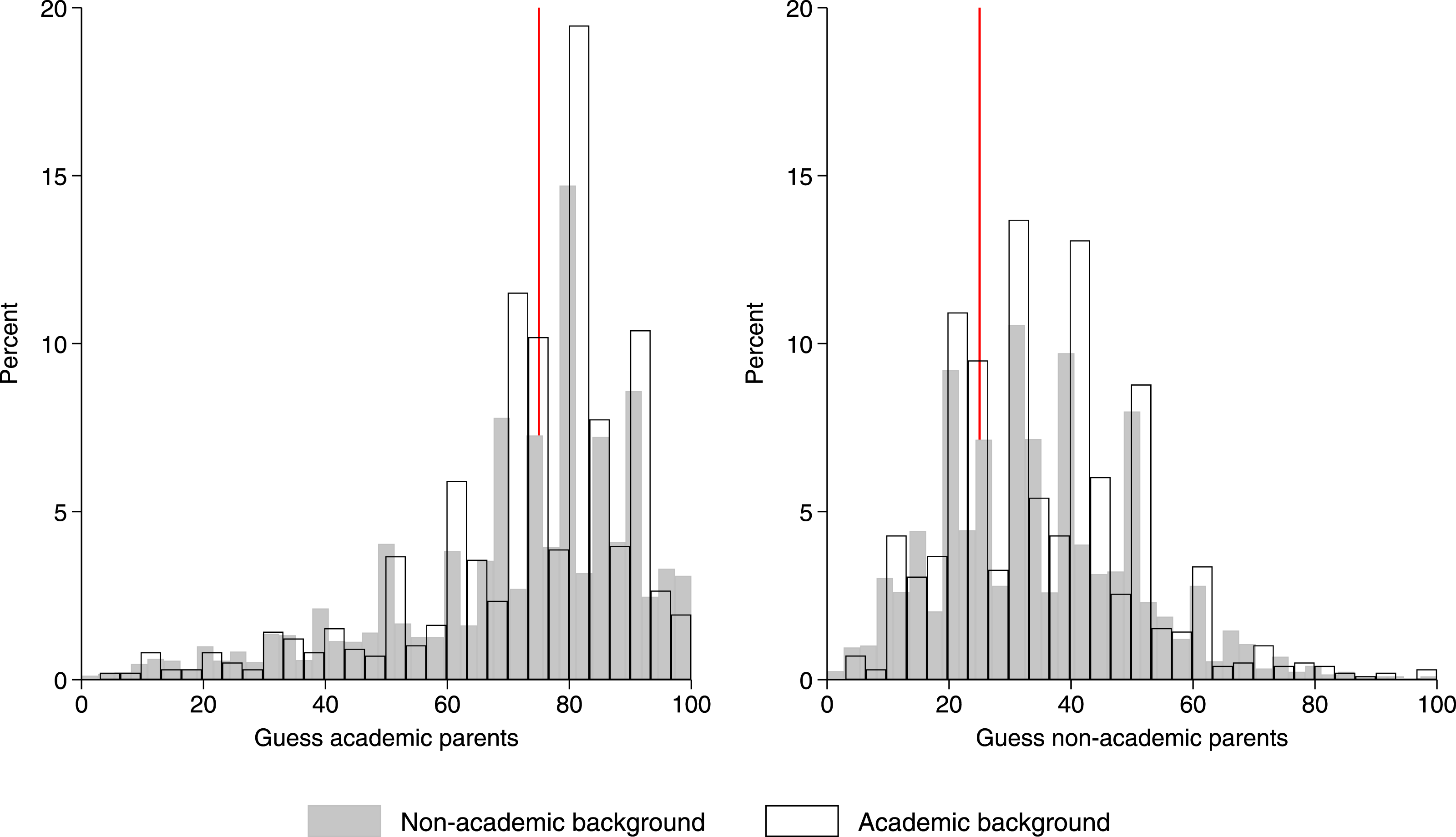
Varying support for tuition fees
Figure 2 combines information on how support for tuition fees changes across the different models (i.e. the three dependent variables identified above) as well as how it changes in response to the information treatments.
8
Starting with support levels in the control group with no information treatment (i.e. the left bars in the panels of Figure 2), we can see that the overall support for flat-rate tuition fees is quite low, with only 33 percent of respondents being supportive across the whole sample. Policy preferences.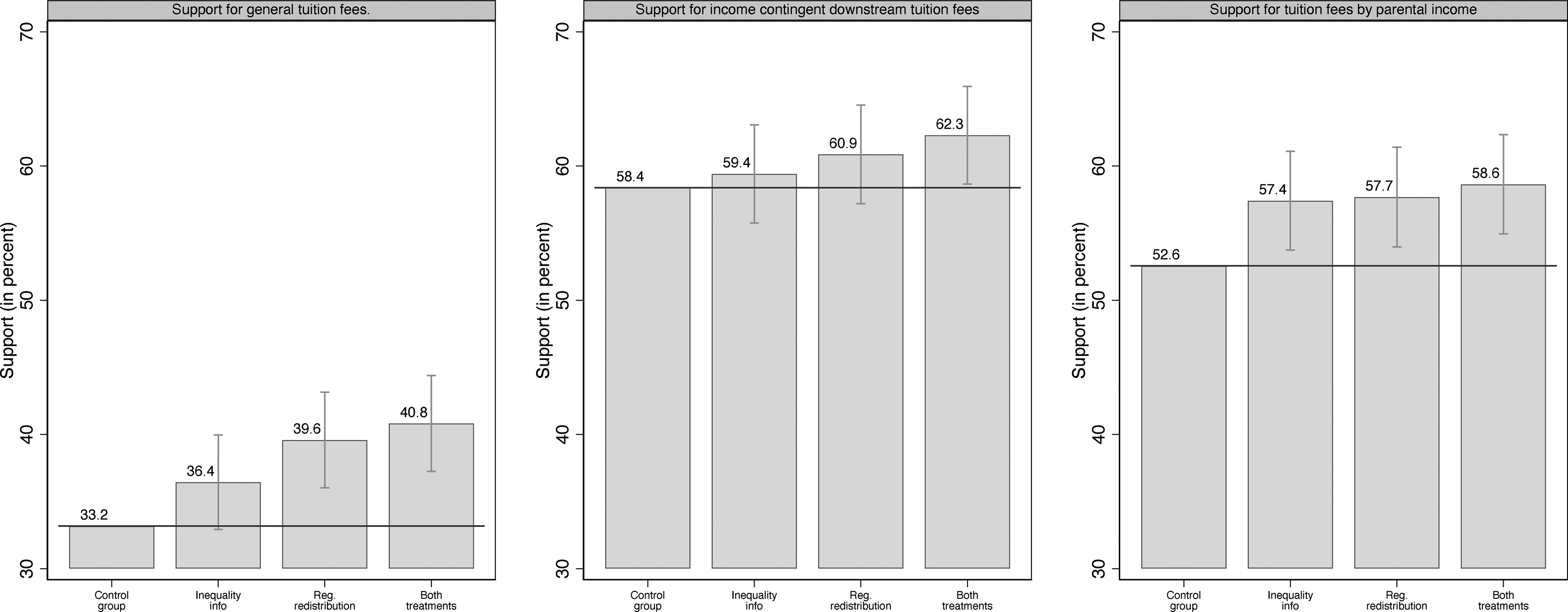
When moving to fee models that involve more redistributive elements in their policy design, support for tuition fees increases steeply, confirming Hypothesis 2. For instance, 58 percent of respondents are supportive of the model with downstream payment options (middle panel), and 53 percent of respondents are still supportive of the model in which fees vary in line with parental income. These large differences in support highlight the importance of policy design. The preference for income-contingent downstream tuition fees is consistent with prior evidence from (Lergetporer and Woessmann, 2024), who interpret such preferences as reflecting equity concerns and a desire to ease the financial burden on students. Our finding that income-contingent tuition is even slightly preferred over tuition fees based on parental income is novel and may indicate that respondents view individual repayment by future high earners as fairer than requiring upfront contributions from parents, regardless of students’ future incomes.
Our findings thus indicate that public support for tuition fees might be significantly higher than commonly assumed (at least in the German debate) when fee models include redistributive design components. Providing respondents with policy options that do not introduce up-front costs, which could be an obstacle for children from lower-income households to attend higher education, significantly increases support for tuition fees, even in the absence of additional information about the partly regressive distributive implications of higher education finance.
Exploring the role of information provision
In the next step, we focus on the treatment effects (see Figure 2 and corresponding Table A.5 in the Appendix). The figure illustrates the change in policy support for tuition fees among the different experimental groups. Meanwhile, Table A.5 presents the estimates of the information treatment effects more explicitly and conditional on further covariates. 9
We find significant effects for information treatments on respondents’ policy preferences towards tuition fees. 10 This is evident where the confidence intervals do not cross zero, indicating a statistical significance at the 5% level difference from the control group which is used as reference category in the underlying models (more detailed information on significance levels and effect sizes are in Table A.5). In line with hypothesis 1, we observe the strongest treatments effects for those respondents that receive both information treatments (i.e. those who are in the third treatment group). More specifically, the support for general tuition fees increases by 7% points (statistically significant at the 1% level), income-contingent downstream tuition fees witness a 4% point increase (statistically significant at the 5% level), and support for tuition fees determined by parental background increases by 6% points (statistically significant at the 1% level) in comparison to the control group. The fact that information provision has the strongest effect on support for general tuition fees indicates that respondents regard fees as a fiscal instrument to balance out inequity in the access to and financing of higher education, essentially akin to an ‘education tax for the privileged.’
To recall, Hypothesis 3 posits that the effects of the information treatment about the extent of educational inequality and the treatment about the regressive redistribution logic of tax-financed higher education should receive more support when the tuition fee models have more redistributive elements. While the relative difference in support between the control conditions and the information treatments are not larger for the policies with more redistributive elements (income-contingent downstream tuition fees and tuition fees by parental background), the overall support levels are up to 21% points higher.
Our results connect well to previous findings regarding the impact of information on inequality in access to higher education in Germany (Lergetporer and Woessmann, 2023). We notice a significant amplification of the effect of information treatment on support for tuition fees when respondents are also prompted to consider the argument that tax-funded higher education leads to regressive distribution. This indicates that information about educational inequality regarding access has a greater impact when paired with information about inequalities in higher education financing. The fact that respondents clearly prefer higher education financing with more redistributive elements further indicates that respondents have clear fairness preferences.
The role of partisan ideology
The average effects illustrated in Figure 2 may conceal considerable treatment effect heterogeneity within subgroups of the population. For the purpose of this paper, our exploration of this heterogeneity focuses on the role of individual partisan ideology.
Existing research posits that the assimilation of new information and the consequent shifts in policy demand are influenced by party affiliation (Campbell et al., 1980). Numerous empirical studies (e.g. Bartels, 2002; Jerit and Barabas, 2012) substantiate the notion that individuals interpret their environment through the lens of their political beliefs. In line with these studies, we anticipate variation in treatment effects related to political ideology. For one, we study to what extent partisan ideology is associated with differing levels of support for the different fee models (Hypothesis 4a). Second, we explore to what extent partisanship moderates the impact of the information treatments (Hypothesis 4b).
Starting with Hypothesis 4a, Figure 3 presents the average support for the tuition fee schemes in the control group across subgroups defined by individual ideology.
11
We operationalize this categorization by utilizing self-placement on the well-established left-right scale [0–10]. For ease of exposition, we have categorized respondents into three groups: left (0–3), center (4–6), and right (7–10). Treatment effects by political ideology.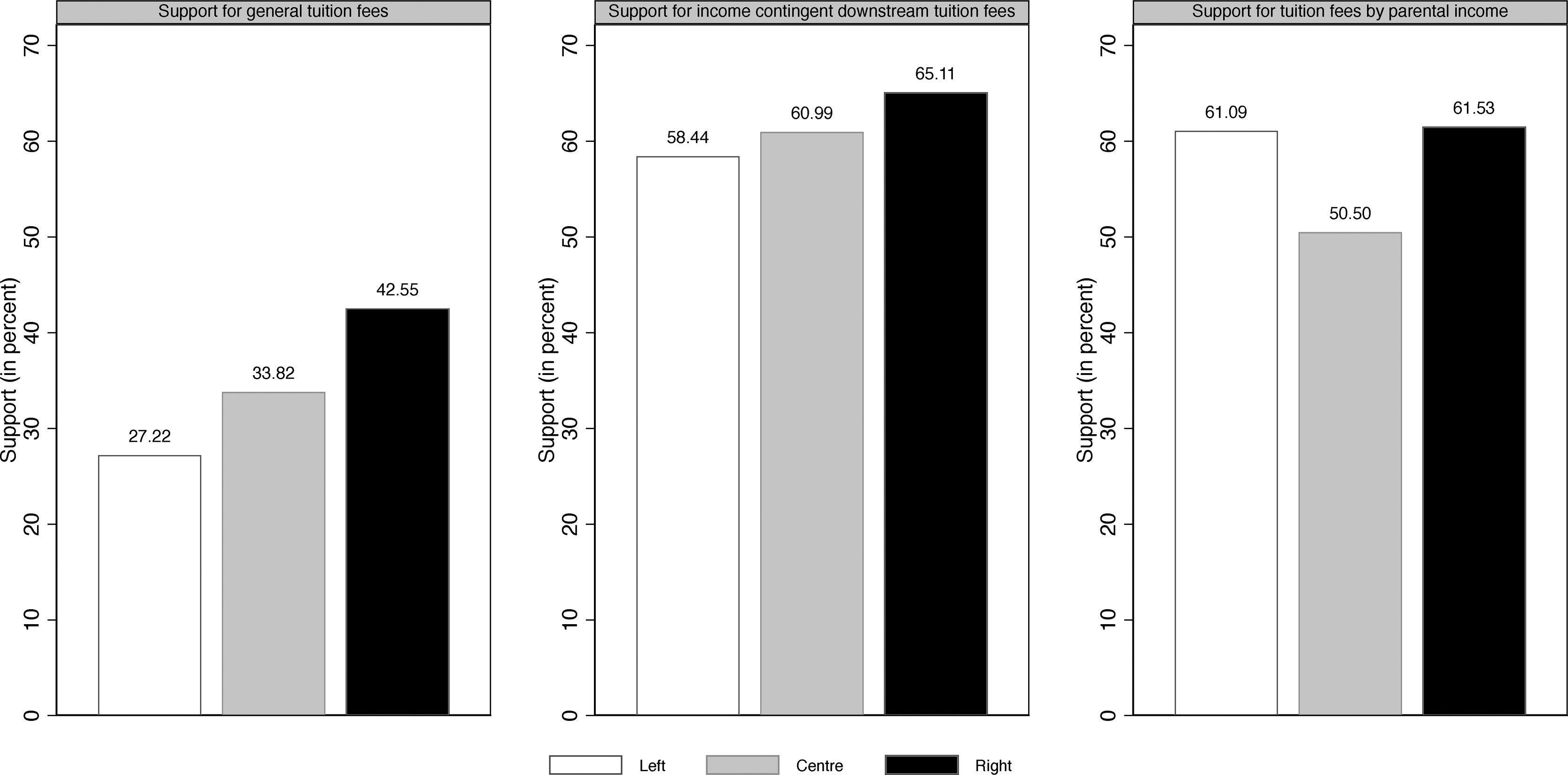
In line with Hypothesis 4a, we observe that left-wing individuals are significantly more inclined to oppose general tuition fees, but are generally more supportive of income-contingent and downstream payment tuition fee models. The level of support for the latter models essentially doubles from less than 30 percent in the case of general tuition fees to values around 60 percent in the latter cases. Right-wing individuals are broadly more supportive of tuition fees, signaling that patterns of support and opposition to this policy are shaped by ideological predispositions rather than an objective politico-economic logic.
Differences related to partisan ideology are less stark in the cases of income-contingent and downstream-payment tuition fee models. The strong support among right-wing respondents for these tuition fee models is to some extent unexpected. A potential explanation might be that right-wing respondents also care to some extent about equity in higher education financing, if not for ideological reasons alone, but also because of enlightened self-interest as right-wingers with less income are worried about high tuition fees as well. Indicative evidence for this speculative argument is that also among right-wingers, support for the flat-rate tuition fee model is significantly lower compared to the other fee models (43 percent vs 65 and 61 percent, respectively, see Figure 3).
Next, we investigate how partisanship interacts with the experimental treatments in Figure 4 (Hypothesis 4b).
12
In line with theoretical expectations, the figures show that centrist voters are more responsive to the information treatment conditions, in particular regarding their support for general tuition fees and income-contingent tuition fees (both statistically significant at the 1% level). While support for downstream tuition fees also shifts positively, this effect is not statistically significant. Notably, none of the treatments convinces the more extremely partisan sub-groups to change their views on tuition fees. This may stem from the fact that the support for the income-contingent downstream tuition fee scheme already receives quite a lot of support to being with (ceiling effect) but could also be related to the intransigence of more extremely partisan individuals to the provision of new information.
13
Treatment effects by political ideology (a) support for general tuition fees. (b) Support for income contingent downstream tuition fees. (c) Support for tuition fees by parental income.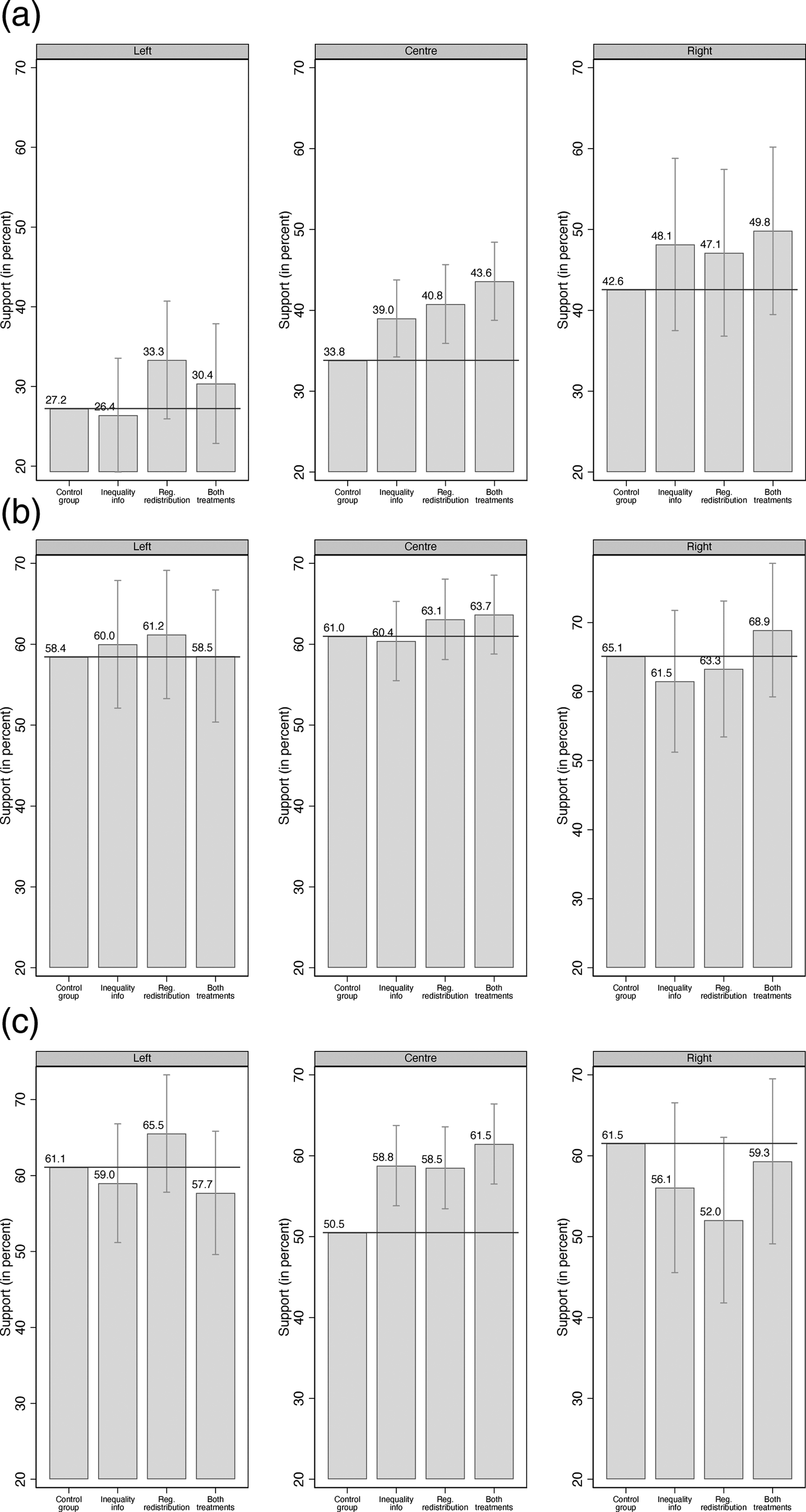
When analyzing specific party preferences we find consistent trends within the control group. As shown in Table A.26, when looking at supporters of specific political parties, we observe that respondents that identify with right-wing and center-right parties – CDU, AfD and FDP – are more in favour of general tuition fees. This effect is statistically significant at the 5% level for CDU and AfD supporters and at the 1% level for FDP supporters. It is also consistent with Figure 4, where the right-wing voters are more supportive of the introduction of general tuition fees. In line with our hypothesis, left-wing individuals (e.g. supporters of “Die Linke”) are opposed to general tuition fees, but more in favour of income-contingent downstream tuition fees (this effect fails to reach statistical significance, however).
In Tables A.15, A.17 and A.25, we observe that CDU/CSU voters are most responsive to the treatments, across tuition fee proposals. This is especially the case when they receive the regressive redistribution treatment and the combined information treatment. The Christian Democratic parties (CSU in Bavaria, CDU in the rest of Germany) enjoy consistently strong electoral support (which is also evident in the large share of our sample that prefers this party) and can be considered as centre-right. The strong responsiveness of CDU/CSU supporters to the information treatment are therefore in line with the finding from Figure 4 that centrist individuals are more sensitive to the treatments.
Conclusion
This study analyzes public support for different kinds of higher education tuition fee models at public universities in the case of Germany. The main objectives of this study are three-fold. First, we examine whether the selective provision of information about the extent of class-related inequalities in access to higher education as well as the partly regressive effects of tax-financed higher education changes people’s views about tuition fees. Overall, we find evidence that this kind of information provision does indeed have an effect, increasing overall support for tuition fees (or lowering opposition towards them).
Second, we investigate variance in support levels across different fee models, which has not yet been done in previous research. In line with our expectations, we find that public support for tuition fee models that have some kind of redistributive component to be significantly higher compared to the generic flat-rate fee model, which was also at the center of public debates about tuition fees in Germany. More specifically, while generic tuition fees are opposed by a large share of the population, a significant majority of respondents actually supports the introduction of tuition fees when these can be repaid later in life (contingent on income) or when the level of the fees depends on parental income.
Third, we are particularly interested in understanding how individual partisanship conditions and shapes both levels of support for different tuition fee models as well as the impact of the information treatments. Regarding the former, we find that support for the introduction of tuition fees increases in particular among left-wing individuals when moving from the generic to the more redistributive fee models. Regarding the latter, we find that centrist individuals are more responsive to information treatments than those identifying with more extreme ideologies.
Taken together, our findings contribute to the broader debate about the political economy of higher education and redistribution. So far, this debate has been more focused on exploring macro-level associations between education spending, educational institutions and the welfare state (Ansell, 2010; Busemeyer, 2014) and only few studies have started to explore the role of tuition fees (Garritzmann, 2015, 2016), which also been largely overlooked in the growing literature on public opinion on education (West and Woessmann, 2021). Our paper points out that the institutional design of tuition fee schemes, potentially linked to the design of student aid systems, might have significant implications with regard to how citizens perceive the overall contribution of higher education as either exacerbating or mitigating inequality.
Our study therefore also offers clear policy implications, particular in the German debate on tuition fees, which has been characterized by strong ideological conflicts between the left and the right as well as a general impression among policy-makers that tuition fees are deeply unpopular. Our findings show that tuition fee models that include redistributive elements such as income contingency or deferred payment options are in fact supported by a majority in the population. Furthermore, for these kinds of tuition fee models, there is much less ideological conflict than in the case of the flat-rate tuition fee model. Hence, these alternative tuition fee models could become a serious policy option to raise revenue for the underfinanced higher education sector.
In closing, we note a significant limitation of our study which is that we only have data for the single case of Germany. Potentially, support patterns might differ significantly when moving to other countries due to the strong feedback effects of existing policies and institutional regimes (Garritzmann, 2015). Clearly, it would be good to have additional survey data on this issue to explore potential cross-country variation in preferences. Furthermore, we focus only on variation in public support for different kinds of tuition fee models, which disregards the possibility that individuals could also be willing to pay additional taxes in order to finance higher education (Busemeyer et al., 2018).
Supplemental Material
Supplemental Material - Who supports tuition fees? How information provision and policy design shapes public preferences for higher education financing
Supplemental Material for Who supports tuition fees? How information provision and policy design shapes public preferences for higher education financing by Marius R Busemeyer, Nanna Lauritz Schönhage and Guido Schwerdt in Journal of European Social Policy.
Footnotes
Acknowledgements
We are very grateful to Raul Magni-Berton and participants at the 6th workshop of Economics & politics @ Brussels (ULB), Kristian Bernhof Ellinggard, Andreas Goldberg and participants at the EVPOC seminar at NTNU, and participants at the Education Policy and Politics SCHOOLPOL Workshop at Nuffield College (Oxford) for their feedback.
Declaration of conflicting interests
The author(s) declared no potential conflicts of interest with respect to the research, authorship, and/or publication of this article.
Funding
The author(s) disclosed receipt of the following financial support for the research, authorship, and/or publication of this article: This work was supported by the Deutsche Forschungsgemeinschaft (DFG – German Research Foundation) under Germany’s Excellence Strategy – EXC-2035/1 – 390681379.
Ethical statement

Supplemental Material
Supplemental material for this article is available online.
Notes
References
Supplementary Material
Please find the following supplemental material available below.
For Open Access articles published under a Creative Commons License, all supplemental material carries the same license as the article it is associated with.
For non-Open Access articles published, all supplemental material carries a non-exclusive license, and permission requests for re-use of supplemental material or any part of supplemental material shall be sent directly to the copyright owner as specified in the copyright notice associated with the article.
