



Abstract
This article conceptualizes the community’s role in the provision of welfare by introducing the concept of a community welfare regime that varies globally across time and space. Four global community welfare regime ideal types, effective formal, effective informal, ineffective formal, and ineffective informal, are identified based on the dual dimensions of effectiveness and formality community welfare provision. Using this conceptualization, the article presents a typology that stipulates the interplay between the four theorized types of the community welfare regime and various global welfare regimes (Gough et al., 2004). The conceptualization of the community welfare regime holds the potential for conducting meaningful comparisons between different community welfare regimes within individual countries and across multiple welfare geographies. These comparative analyses can provide policymakers with valuable insights about the (in)effectiveness of community welfare provision, allowing them to develop policies that are firmly grounded in successful practices adopted by communities to effectively support vulnerable members of society and foster improved overall welfare outcomes, and can also serve as an avenue for Global South–North learning.
Introduction
This article theorizes the role of the community in the provision of welfare and develops a theoretical framework of a community welfare regime that varies globally across time and space. The theorization of the community’s role in welfare provisioning holds significant academic importance in the social policy literature and other relevant academic disciplines. The community’s position in the institutional landscape and welfare mix is crucial in any society, especially in developing and less developed countries and territories (Cornwall, 2008; Humpage, 2010; Wood, 2015; Wood and Gough, 2006). Incorporating the community in development interventions has been a central focus not only for scholarly communities but also for governments and international aid organizations, with the ultimate goal of achieving better social outcomes (Brocklesby and Fisher, 2003; Markantoni et al., 2018; Stoecker and Falcón, 2022). The role of the community in welfare provision is an interdisciplinary topic that has garnered widespread attention in the social policy literature and has been extensively discussed in international development studies, anthropology, and sociology. Therefore, theorising the community’s role in welfare provision holds significant implications for academic scholarship and real-world policy.
In the literature, the term ‘welfare regime’ encompasses a comprehensive framework of policies, programmes, and institutions that regulate the provision of social services and assistance to individuals and families within a society or country (Alcock and Craig, 2009; Bonoli, 1997; Korpi and Palme, 1998). Within the literature on global welfare regimes, four distinct ideal types are often discussed regarding welfare provision, outcomes, and the decommodification of labour at varying scales. The first type is the so-called welfare state regime, conceptualized by Esping-Andersen (1990), broadly based on a welfare mix of state, market, and family. The welfare state regime’s subtypes, namely social democratic, corporatist/conservative, and liberal, are predominantly found in advanced OECD countries. Second, the notion of the productivist welfare regime predominantly found in East Asia puts more emphasis on the state–economy relationships and posits that welfare development has been strictly subordinate to the primary goal of achieving and maintaining high levels of economic growth (Holliday, 2000; Hudson et al., 2014). Third, Gough et al. (2004) extended these concepts by analysing welfare regimes in developing and less developed countries, presenting two additional forms of welfare regimes: informal security and insecurity regimes. ‘Informal security regimes’ represent institutional arrangements where people heavily rely on community and family relationships to meet their security needs, often fostering hierarchies where poorer individuals may trade short-term security for long-term vulnerability. These arrangements reinforce resistant patron–client dynamics while still providing some informal rights and security (Wood and Gough, 2006). The informal security regimes have been shown to encompass variations such as ‘less’ and ‘more’ effective types according to their ability to garner positive social outcomes and promote social development (Kühner, 2015). ‘Insecurity regimes’ describe institutional arrangements that generate gross insecurity and block the emergence of stable (in)formal mechanisms to mitigate, let alone rectify, such institutional arrangements (Mumtaz and Sumarto, 2024; Wood and Gough, 2006). These regimes are characterized by influential external players interacting with weak internal actors to generate conflict and political instability, resulting in a vicious circle of insecurity, vulnerability, and suffering for all but a tiny elite and their enforcers (Mumtaz and Sumarto, 2024; Wood and Gough, 2006).
In this article, we further conceptualize the role of the community in providing welfare using the global welfare regimes lens. The dominant explanation in the economics literature for the provision of welfare by the community points towards market failures (Dercon, 2002; Stiglitz, 2005). However, Shinn and Toohey (2003) argue that different factors, such as social values and norms, the political-economic context, and the availability of resources and infrastructure, also influence the provision of welfare by the community. Community welfare is a vital component of the welfare mix and plays a significant role in shaping welfare outcomes as well as decommodifying labour (Cammett and MacLean, 2014). The role of community welfare provision is particularly pertinent in productivist, informal security, and insecurity regimes, where the capacity of the state and the market tends to be more limited (Wood and Gough, 2006); yet, it also gained prominence regarding the growing discourse on social innovation and co-governance of social service provision across established welfare state regimes.
Indeed, many scholars have highlighted the importance of the community in meeting the welfare needs of global populations, while others argue more directly for policies that involve community participation for inclusive development and poverty reduction (see, e.g., Jennings, 2014; Narayan and Pritchett, 1999; Putnam, 2000). Gough et al.’s (2004) framework of informal security regimes strongly emphasises the community’s role in providing welfare to unprotected populations, ultimately being responsible for social outcomes. However, no study has specifically discussed community welfare through the lens of mainstream global welfare regime analysis. Filling this research lacuna is crucial because the provision of welfare by the community predates modern state welfare (Kujala and Danielsbacka, 2019). Additionally, almost every society has some form of community setup fulfilling the needs of the unprotected poor and marginalized. Community networks, such as religious organizations and non-governmental organisations (NGOs), operate within national or territorial boundaries and transcend them to provide welfare activities (Levitt, 2022). As a result, they contribute to welfare outcomes and the decommodification of labour on varying scales. Community relations also produce and reproduce gender and income inequalities (Cleaver, 2005). Therefore, it is imperative to theorize community-based welfare provision, which will also facilitate better comprehension of the nature of interactions between community welfare and overarching national welfare regimes from a comparative perspective.
To this end, this article uses a constructivist epistemology to develop the concept of a ‘community welfare regime’ for theorizing the community’s role in welfare provision, with four distinct community welfare regime ideal types identified based on the level of effectiveness and formality of community-based welfare provision: effective formal, effective informal, ineffective formal, and ineffective informal. The concept of an ‘ideal type’ used in this study in the Weberian sense involves theoretical constructs representing the purest form, serving as analytical tools to understand complex social phenomena. Ideal types are heuristics, abstract models used for comparison and contrast, not meant to describe concrete situations, but to clarify understanding (Ferragina and Seeleib-Kaiser, 2011; Weber, 1978). Ideal types differ from real types as the latter focus on the reality of a political system or social phenomena, providing a detailed picture, sensitivity to administrative setups, enabling further analysis, and enhancing clarity at national and policy levels (Aspalter, 2018; Ferragina and Seeleib-Kaiser, 2011). Additionally, we present a typology of the interplay between the community welfare regime and overarching national welfare regimes within a country or territory.
The article thus contributes to the literature in several ways. First, it offers a framework for theorizing the community’s role in welfare provision, presenting four different forms of community welfare regime types observed globally. Second, these regime types allow for meaningful comparisons of community welfare effectiveness across different national and territorial contexts. Third, the article provides a typology of the interplay between national/territorial and community welfare regimes, which can serve as a heuristic for examining the community’s role in global welfare regime analysis and social development interventions through empirical studies. Finally, this theorization provides a basis for further applied research crucial for policymakers and other stakeholders.
The article is structured as follows: the next section elaborates on critical community welfare regime characteristics and outlines the various factors contributing to the development of the community welfare regime. Subsequently, we discuss the levels of formality and the different forms of the effectiveness of community-provided welfare. Building on these elaborations, the following sections introduce four distinct ideal types of the global community welfare regime and offer a typology elucidating the interplay between community and national welfare regime types. Lastly, the concluding section highlights the policy implications of the previous elaborations and outlines potential future research directions.
Community welfare regime
Community has been a major focus of study in sociology, with numerous scholars analysing it in various ways (Anderson, 1991; Clark, 1973; Crow and Allan, 1995; Durkheim, 1982; Lynd and Lynd, 1929; MacIver, 2012; Putnam, 2000; Tönnies, 1955). Communities, shaped by factors like geography (e.g., neighbourhood), culture, religion, profession, or shared interests, manifest in a spectrum of sizes, scopes, and levels of cohesion, spanning from tight-knit neighbourhoods to expansive social networks and structured entities such as civil society, religious organizations, and NGOs, thereby providing individuals with a sense of belonging, social support, and shared identity (Crow, 2014; Rose, 2000; Wood and Gough, 2006). Whether a community is based on common residence, interest, identity, or a combination of these factors, the relationships involved are inevitably somewhat exclusive (Crow, 2014). ‘Social capital’ encompasses resources embedded within social networks, including trust, reciprocity, norms, and social connections, enabling individuals and groups to achieve their goals, navigate social life effectively, and derive benefits from social relationships and interactions, such as access to information, support, opportunities, and resources (Bourdieu, 1986; Cheong et al., 2007; Coleman, 1988; Durkheim, 1984; Edwards, 2003, 2004). Communities serve as vital reservoirs of social capital, providing the networks and relationships that contribute to the development and accumulation of trust, reciprocity, and shared norms in society (Fukuyama, 1996; Lin, 1999).
Tocqueville (1987; 1990) emphasized the vital role of communities in democratic societies, countering potential majority tyranny and fostering social cohesion amid rapid modernization. The fear of social disintegration due to transitioning from a mechanic society to a modern one gained prominence in the late nineteenth century literature (Durkheim, 1984; Ferragina, 2012). As the twentieth century began, social capital theorists stressed the importance of social networks in balancing individual and societal needs. However, some scholars advocated for preserving traditional community values, often overshadowed by prevailing notions of progress, reason, and freedom (Ferragina, 2012). Yet, Putnam (2000) argued that social capital, manifested as both bonding (within-group connections) and bridging (connections across diverse groups), was invaluable for individuals, communities, and societies. He asserted that creating public goods through communities was the most productive investment for society, fostering collaboration beyond members’ immediate interests. Putnam’s theory of social capital was instrumental in transforming a pessimistic narrative, highlighting communities’ role in strengthening democracy and proposing political strategies to counteract negative trends.
Tony Blair’s concept of the ‘Third Way’ generally associated with writings of Anthony Giddens aimed to merge community values with scientific evidence in policymaking (Ferragina and Arrigoni, 2017). This approach focused on addressing social issues by emphasizing moral values. Later, the idea of the Big Society emerged, influenced by Third Way politics and echoing social capital principles (Giddens, 2013). It aimed to empower communities, enhance public service access, and promote citizen involvement. However, neoliberal governance has been criticized for its failure to achieve economic growth, highlighting the need for greater equality and solidarity to boost social engagement. This challenges neoliberal policies that individualize social risks (Ferragina and Arrigoni, 2017). Consequently, there’s a tension in policy making between promoting social capital and pursuing individualized solutions to collective problems (Ferragina and Arrigoni, 2017; Rose, 2000). This tension also reverberates in recent government endeavours to facilitate ‘social innovation’ involving public institutions working alongside communities to co-create innovative solutions that are tailored to local needs and circumstances. Common criticisms levied against ‘social innovation’ are its relative neglect of underlying structural issues, the failure to address pre-existing barriers to participation from the communities it aims to serve, and the co-opting of the concept by market-driven ideologies focusing on entrepreneurial solutions and commodification of social goods over community-led initiatives.
In many developed countries, welfare state retrenchment has occurred, involving cuts in social spending, stricter eligibility criteria, and privatization of welfare services (Clayton and Pontusson, 1998; Kühner, 2007). This trend is driven by fiscal austerity, neoliberal ideas emphasizing individual responsibility, and concerns about economic competitiveness. Economic changes like flexibilization and precarization have significant effects on both communities and the welfare state (Rubery et al., 2018). Flexibilization makes jobs less stable, with more people working temporary, part-time, or gig economy jobs. This can weaken social capital within communities as people struggle with income instability. Precarization increases the need for welfare services, putting more strain on already stretched welfare systems. When welfare services are cut back, communities step in to help with informal networks and grassroots initiatives (Mumtaz, 2022; Wood and Gough, 2006). Organizations like charities and mutual aid groups provide vital services like food banks and housing assistance, especially for vulnerable groups. However, these community efforts might not reach everyone in need, leading to unequal access to support across different communities.
Thornton et al. (2012) argue that different institutional logics shape individuals’ and organisations’ beliefs, behaviours, and practices. Institutional logics refer to the systems of values, norms, and rules that guide the actions and interactions of actors within a particular social domain. These logics are deeply ingrained in society and provide a shared understanding of legitimate and appropriate behaviour within a given context. Examples of institutional logics include market logic, professional logic, bureaucratic logic, familial logic, and community logic, among others. The institutional logic of welfare provided by the community refers to the principles, norms, and practices that guide the organization and delivery of welfare services at the community level (Fuertes et al., 2022). This logic can be based on solidarity, social cohesion, mutual support, voluntary participation, contribution among community members, and empowerment and collective decision-making (Hespanha et al., 2018). Path dependency refers to the idea that historical events and choices can shape the development and trajectory of a system or institution, leading to self-reinforcing processes that are difficult to deviate from (Marty, 2010; Pierson, 2004). The path dependency framework suggests that welfare regimes are shaped by a complex interplay of historical, political, economic, and social factors (Ginsburg, 2013). Path dependency in the context of global welfare regimes implies that the historical development of a country’s welfare institutions, both formal and informal, impacts the current shape and future trajectory of its welfare regime.
These two frameworks – institutional logic and path dependency – are important in understanding the motivations for providing welfare and how community relations, both formal and informal, develop over time. They also shed light on the contributing factors to the development of such relations. Using the institutional logic of welfare provided by the community and path dependency for global welfare regime development, we define a community welfare regime as a set of rules, institutions, and structured relationships within a community that govern the provision of welfare and support. The community regime encompasses the collective efforts, practices, and norms established by the community to address the various welfare needs of its members. These regimes are shaped by the historical, cultural, and social context of the community and the country/territory. They may entail a combination of hierarchical structures, reciprocal arrangements, and shared responsibilities.
It is, however, imperative to acknowledge that a community welfare regime is not immune to unintended consequences and the perpetuation of disparities. In some instances, certain groups within the community may encounter barriers or discrimination when attempting to access welfare services provided by the community. For example, Baffoe (2013) argues that persons with disabilities in Ghana face discrimination within their communities, as they are treated in ways that intentionally or unintentionally perpetuate stigma, leading to societal exclusion. Similarly, Saunders et al. (2017) found in their study that refugee families in Australia encounter difficulties concerning the quantity, type, and quality of informal parenting support they receive. Additionally, resource allocation within the regime may exhibit biases, favouring more privileged individuals or groups. These practices and resource distribution mechanisms can contribute to creating or reinforcing inequalities.
Conceptual mapping of the community welfare regime
Wood and Gough (2006) developed a theoretical framework within which global welfare regimes operate, encompassing a range of factors that shape their operation and development. These factors include the mode of production, class relations, nature of labour markets, political mobilization, state characteristics, welfare mix, decommodification of labour, and welfare outcomes. Building upon this scholarly foundation, we present a conceptual mapping for the community welfare regime. This framework highlights significant contributing factors to the formation and development of the community welfare regime, such as the mode of production, political and economic systems, and other relevant elements. While the conditions depicted are not exhaustive, they provide insights into the intricate processes that shape community welfare regimes.
Figure 1 visually depicts the theoretical framework that illustrates the interdependencies between welfare outcomes, national welfare regime, and community welfare regime. This figure underscores the pivotal roles of national social structures and community welfare provision, each contributing significantly to overall welfare outcomes. It is important to note that community welfare regime characteristics do not operate in isolation but function as integral components within the broader framework of national or territorial welfare institutions. They actively contribute to the formation and functioning of the welfare system, working in conjunction with various other factors such as governmental policies, economic structures, and societal dynamics. Additionally, the community welfare regime can generate welfare outcomes, particularly when the state and market mechanisms are absent or ineffective. During such circumstances, communities emerge as the primary providers of welfare, assuming the responsibility to meet their members’ diverse needs. Notable examples of these scenarios include times of conflict or war-like environments where the authority of the state may be compromised, and market systems fail to operate effectively (Bevan, 2004). Framework for community welfare regime.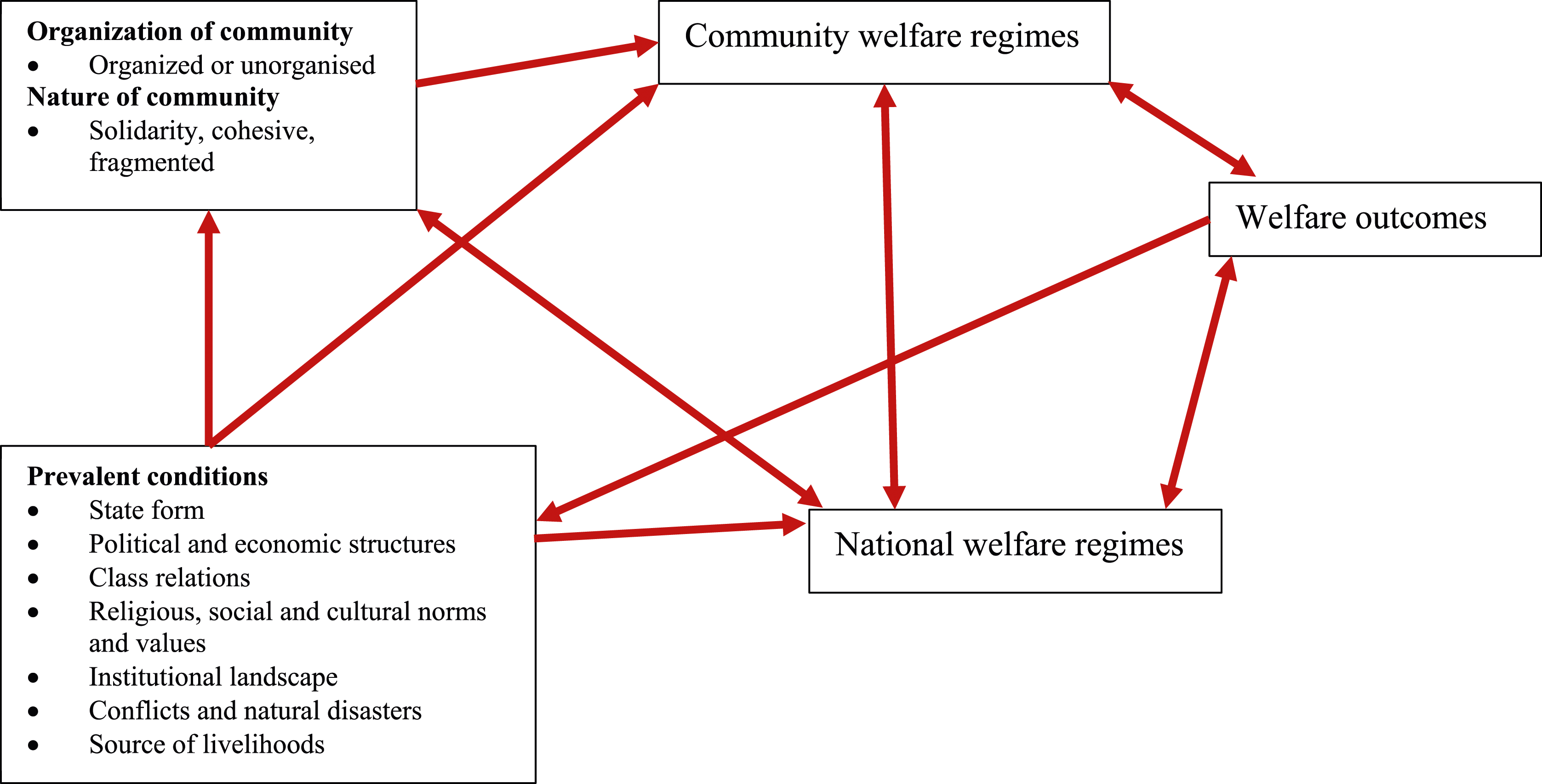
Within Figure 1, prevailing conditions mentioned in the lower left-hand portion influence the nature and organization of communities, shaping the community welfare regimes. These conditions encompass the form of the state, political and economic structures, class relations, religious influences, social and cultural norms, the institutional landscape, and occurrences of conflicts and natural disasters that impact the characteristics of communities. Collectively, these factors shape the organization and nature of communities that prevail in each society, directly influencing the effectiveness of welfare provided by the community and the formation and development of community welfare regimes. As depicted in Figure 1, prevalent conditions can also influence the development of welfare regimes (which are not within the scope of this article). However, in this article, we will examine their role in the development of community welfare regimes below.
State form
Scholars have extensively explored various facets of the state over time. For instance, Weber’s tripartite framework underscores the organizational structure, emphasizing the state apparatus, territory, and population as pivotal components. Jessop (2015) argues that the state can manifest in diverse forms and functions influenced by historical and contextual factors, ranging from capitalist and military to theocratic and democratic configurations. At its essence, the state comprises four fundamental elements: Staatsgewalt, embodying the institutions exerting authority over a territory; Staatsvolk, representing the populace subject to state control; Staatsgebiet, denoting the territorial domain under state jurisdiction; and Staatsidee, encapsulating the envisioned political community associated with the territory (Jessop, 2015). The strength and capacity of a state are shaped by internal and external factors, exhibiting variation across policy domains, historical epochs, and geographical settings (Jessop, 2015). The dichotomy between predatory states, which exploit their societies, and developmental states, which prioritize investments in infrastructure and network power to foster economic growth, illustrates this multifaceted nature. Throughout history, states have assumed diverse roles/forms, evolving from Keynesian welfare states – focused on government intervention and social spending to enhance economic stability, social equity, and employment – to Schumpeterian workfare states (SWS), which emphasize entrepreneurship and innovation as drivers of economic progress, while acknowledging the necessity of a social safety net during economic upheavals (Jessop, 1993).
The form of the state plays an important role in shaping community welfare. Strong states with robust economies and extensive tax bases possess the necessary resources to offer formalised welfare services and finance social programmes (Banerjee et al., 2022). They are conducive to efficient institutions and administrative structures that may effectively manage welfare initiatives. Furthermore, the stability of political systems and effective governance foster social trust and cooperation among citizens (Spiteri and Briguglio, 2018), yielding positive effects on welfare provision (Joo Chang, 2009). Therefore, people’s reliance on community welfare is reduced as communities in such cases are cohesive and inclined to endorse collective efforts and contribute to social programmes. Conversely, weak states encounter substantial hurdles in generating revenue and allocating funds for social welfare. They often lack the requisite expertise, bureaucratic capacity, and operational frameworks to adequately address social needs (Banerjee et al., 2022). Consequently, institutional limitations, inefficiencies, corruption, and difficulties in reaching vulnerable populations emerge as significant challenges. Moreover, political instability and societal divisions undermine social cohesion, impeding the mobilization of resources and hindering the successful implementation of welfare measures (Ritzen et al., 2000). In such cases, community welfare assumes a prominent role as a means of support. It is worth noting, however, that such conditions may also undermine social cohesion among various population groups and aggravate the effectiveness of community welfare substitutes compared to more formal provisions.
Political and economic structures
Democratic systems foster broader participation and representation, allowing citizens to influence policy choices. Tocqueville, in his seminal work Democracy in America (1835, 1840), argues that individuals in a democracy are motivated not only by their self-interest but also by a concern for the well-being of their community. This dual motivation fosters social capital and serves as a bulwark against the centralization of power in the hands of the state. In contrast, autocratic systems exhibit a more centralized decision-making process heavily influenced by the preferences of a narrow ruling elite. The characteristics of these political systems significantly shape the fabric of communities (Sidney, 2003). Democratic societies tend to cultivate cohesive and organized communities, as argued by Tocqueville (1987, 1990), who observed that individuals in such societies tend to voluntarily come together to pursue common goals, form associations, and engage in civic activities, thereby fostering a spirit of cooperation and collective action that contributes to their strength and stability. In contrast, tribal societies often exhibit high levels of cohesion but may struggle with limited resources to effectively address the needs of community members (Brown et al., 2020).
Social democratic or socialist ideologies place a premium on egalitarian principles and establishing a robust welfare state, emphasising the government’s responsibility to ensure social and economic welfare for its citizens. In such systems, the state assumes a prominent role in safeguarding the overall well-being of individuals. Conversely, liberal or conservative ideologies advocate for more restrained state involvement in welfare provision, underscoring subsidiarity, reciprocity, individual responsibility, or market-driven solutions as primary mechanisms. Consequently, in these welfare state regimes, the reliance on community welfare is less as the state and market emerge as the dominant providers. However, it is important to recognize that the nature of community welfare in such contexts is contingent upon the degree to which the state and the market effectively fulfill the population’s needs. In turn, limited state provision and involvement of private actors do not automatically imply ineffective community welfare and negative social outcomes, as demonstrated particularly in productivist and effective-informal welfare regimes (Kühner, 2015). A robust and expanding economy generates increased tax revenues, empowering the government to allocate more substantial resources to welfare programmes. This economic vitality can enhance the societal well-being of communities within a society.
Class relations
Class relations play a pivotal role in shaping the distribution of resources, social stratification, and inequality within a society (Crompton, 2008). Scholars within the Marxist tradition (see, e.g., Gough, 1979; Offe, 1984) argue that state-provided welfare policies serve as instruments of control wielded by the ruling capitalist class, and welfare services do not replace the exploitative dynamics of the labour market for the lower classes, but instead, they suggest that these services, while offering minimal benefits to the lower class, predominantly serve to support the elite class by providing them with an expanded workforce, thereby increasing their profits. The dynamics of class interactions significantly influence the nature of communities, resulting in either organized and cohesive entities or fragmented collectives . Organized communities exhibit a higher level of efficacy in catering to the welfare needs of their members (Warren et al., 2001). When class relations are characterized by cooperation, solidarity, and equitable resource distribution, these communities can effectively allocate resources to individuals in need. By fostering a sense of collective responsibility and shared purpose, organized communities can establish support systems and programmes that address social, economic, gender, and healthcare disparities. Such communities tend to be more resilient as they leverage the strengths and resources of their members to enhance overall well-being and social cohesion. According to power resource theory (Korpi, 1978), the strength of different social groups in terms of resources determines the extent of welfare provision and the level of labour market regulation. When labour movements are strong and possess significant bargaining power, they can pressure governments to implement policies that benefit workers, such as generous social welfare programmes, labour protections, and unemployment benefits (see e.g., Esping-Andersen, 1985; Shalev, 1983; Stephens, 1979). Studies on East Asian welfare development have illustrated how, in the absence of strong trade unions, civil society organisations can play a similar role in advocating and affecting the implementation of transformative welfare policies. Conversely, communities marked by pronounced class divisions and an uneven distribution of resources often face fragmentation and diminished effectiveness in meeting the welfare needs of their members (United Nations, 2020). In such contexts, limited access to resources and social and economic disparities exacerbates social divisions and hampers the community’s ability to address pressing challenges. The absence of equitable resource allocation perpetuates existing inequalities and undermines social trust and cohesion. Fragmented communities may struggle to mobilize collective action (Habron, 2022), resulting in a compromised ability to advocate for the needs of marginalized individuals.
Norms and values
Societal, cultural, and religious norms and values significantly shape communities and influence the provision of community welfare (Brown et al., 2020). These norms contribute to a sense of solidarity among community members and impact the provision of assistance and support within the community. Societal and cultural norms encompass shared beliefs, customs, and traditions that guide community interactions (Shinn and Toohey, 2003). These norms often foster a sense of unity and interconnectedness among community members, encouraging mutual assistance and cooperation. For example, in many cultures, it is customary to support neighbours or extended family members during times of need (Mumtaz, 2022). Similarly, religious teachings and beliefs are vital in assisting and promoting community well-being based on their religious doctrines (Deacon and Tomalin, 2015). Religious organizations frequently establish programmes and initiatives to support vulnerable individuals, address social challenges, and meet community members’ welfare needs (Mumtaz and Whiteford, 2021). They draw inspiration and guidance from their religious teachings to guide their efforts in fostering community welfare. Moreover, the impact of cultural and religious norms contributes to a community’s overall social fabric and cohesiveness (Flint, 2007). Promoting compassion, altruism, and empathy creates a supportive environment that encourages individuals to care for one another and work collectively to address societal issues (Kujala and Danielsbacka, 2019). The two Confucian principles of paternalistic government, which prioritize social harmony and moral education for shaping citizen behaviour, and filial piety, emphasizing the duty of children to respect, care for, and support their parents and elders, and aid those in need, have played a significant role in shaping East Asian communities, and, in turn, formalised and community welfare provision (Shun and Wong, 2004). This sense of collective responsibility and shared values enhances the effectiveness of community welfare efforts as it engenders a stronger sense of belonging and engagement among community members.
Institutional landscape
The institutional landscape of welfare provision, encompassing the combined efforts of the state, market, and family mechanisms, significantly influences the welfare provided within a community. Advanced welfare state regimes primarily rely on government-funded programmes and market-driven services, reducing the emphasis on community-based welfare initiatives. However, the successful formal institutionalization of welfare policies does not always imply the absence or ineffectiveness of community welfare in such cases. For instance, a productivist welfare regime is known to delegate the delivery of social services to community organisations as the government focuses on their regulating role rather than becoming a direct provider of welfare (Hudson et al., 2014). Indeed, the concept of productivist welfare posits a nuanced symbiotic relationship between welfare systems and economic productivity, one that is further nuanced by the ‘varieties of capitalism’ (VoC) perspective (Hall and Soskice, 2001). The VoC approach delineates how different capitalist systems, namely liberal (LMEs) and coordinated market economies (CMEs), shape and are shaped by welfare policies to foster distinct competitive advantages in the global market. Consequently, welfare policies are not merely social expenditures but are strategic investments in human capital that enhance national productivity, illustrating a critical intersection where welfare policy strategies and economic models converge to influence economic outcomes (Hudson and Kühner, 2009). Within CMEs, productivist welfare policies, including education and vocational and labour market training, are closely tied to enhancing industrial or firm-specific skills that complement the economic model’s emphasis on high-quality production and innovation. Conversely, in LMEs, the policy focus is often directed towards general education and creating flexible labour markets, which supports the model’s reliance on market mechanisms for skills development and allocation.
Integrating welfare state regimes within the VoC framework offers insights into the role of informal welfare and community efforts in these economic systems. In CMEs, the prevalent culture of collective bargaining and collaboration among firms, unions, and governments may foster stronger community bonds and more community-led welfare initiatives, often complementing rather than substituting formal welfare institutions. This is supported by more robust backing for community initiatives, which could catalyse innovative, community-led solutions to welfare needs. Conversely, in LMEs, the leaner state welfare apparatus and a stronger emphasis on market mechanisms potentially necessitate a greater reliance on informal welfare, with communities and non-state actors stepping in to fill gaps in welfare provision. This environment may encourage innovation in community welfare solutions, including novel funding mechanisms and volunteer-driven services, although it might also result in greater variability in the quality and availability of these services across communities. Particularly in societies with weak formal institutional mechanisms for welfare provision, community-based welfare assumes a more significant role (Gough et al., 2004). This is particularly prominent in informal security and insecurity regimes outside the developed world, where formal institutions for welfare provision are inadequate. As a result, community-based initiatives, such as mutual aid networks, religious or cultural organizations, and informal social networks, become crucial sources of support (Wood and Gough, 2006; see also: Wood, 2015).
As these examples illustrate, the prevailing institutional landscape in a country or territory shapes the nature and prominence of community welfare. Across both CMEs and LMEs, the integration of productivist welfare and the VoC perspective underscores a trend towards blurring the boundaries between formal and informal welfare provision, incorporating more hybrid forms of social investments that combine elements of both. Particularly, the digitalization of community welfare and a growing policy recognition of the importance of informal welfare roles signify a potentially expanding contribution of these elements to the institutional landscape of diverse economic systems, suggesting an evolving interplay between formal and informal welfare provisions in shaping societal and economic outcomes.
Conflicts and natural disasters
Conflicts and disasters shape communities significantly, highlighting their resilience through mutual support, resource sharing, and collaborative problem-solving (Ride and Bretherton, 2011). Conflicts are influenced by geographic location and socio-political contexts (MacGinty and Williams, 2016; Phanjoubam, 2015). Bevan (2004) argues that insecurity regimes prevalent in Sub-Saharan Africa and the Horn of Africa are often characterized by violence and conflict. Similar situations can also be observed between Russia and Finland, owing to historical tensions and geopolitical rivalries (Rytövuori-Apunen, 2019). This area is sensitive, as it has been a site of military exercises and occasional border disputes, heightening security concerns for residents (Rytövuori-Apunen, 2019). Such conditions stimulate insecurity and hinder the emergence of informal social support provided by communities to alleviate social risks and insecurity (Gough, 2004; Mumtaz and Sumarto, 2024). However, regions under stable and collaborative political unions like the European Union (EU) or the Association of Southeast Asian Nations (ASEAN) often benefit from collective security measures and mutual agreements, thus reducing the risk of insecurity (Haacke and Williams, 2008). Such situations encourage community members to unite to provide practical help, fostering a sense of belonging and social cohesion. However, the effectiveness of assistance may vary due to limited resources and the scale of the crisis. Nonetheless, even when help falls short, it remains a crucial source of welfare and support without formal structures and external aid. During conflicts, communities rely on internal networks, social capital, and community organizations to meet essential needs like shelter, food, and medical care (Aldrich, 2011). It is important to recognize that the impact of conflicts and disasters on communities varies based on the specific context, geography, and existing social dynamics. While such circumstances can bring out the best in communities, they can also magnify inequalities, power imbalances, and vulnerabilities (Amoah et al., 2023; Mumtaz and Sumarto, 2024).
Source of livelihoods
The source of livelihoods that individuals rely on significantly influences the dynamics of communities (Prado et al., 2015). When people depend on subsistence incomes, their resources are often limited (Kellert et al., 2000), impacting their ability to support one another effectively. In such communities, the primary focus is meeting immediate survival needs, leaving little room for extensive assistance or support beyond the essentials (Arboleda et al., 2004). Conversely, communities composed of individuals with more substantial and sustainable livelihoods experience different dynamics. When people have higher incomes and greater economic stability, they can invest not only in their personal well-being but also in the collective welfare of the community. This creates a favourable environment for developing strong and supportive community networks (Warren et al., 2001). The presence of strong communities with individuals who have secure livelihoods fosters a sense of belonging, trust, and social cohesion.
The four-community welfare ideal types
Formal welfare is typically funded by public sources and governed by governmental bodies. It operates within defined regulations and procedures, providing assistance such as financial aid, healthcare and housing (Mumtaz, 2022). In contrast, informal welfare relies on families, including extended family members, community, and voluntary organizations. It offers flexible support, often responding quickly to local needs (Mumtaz, 2022; Mumtaz and Whiteford, 2021). The effectiveness of informal welfare is underpinned by social capital within communities, including trust and mutual aid. According to Mumtaz (2023), the relationship between formal and informal welfare can be complementary, contradictory, or even result in formal welfare crowding out informal welfare and vice versa. In some cases, informal welfare can result in issues such as clientelism, subordination, and domination (Mumtaz and Sumarto, 2024).
Community welfare is a part of informal welfare, can be delivered through both formal and informal channels by the community, each with varying degrees of effectiveness. While various semi-support community welfare mechanisms exist, we will classify them as part of informal support systems for simplicity. Formal community welfare – part of boarder informal welfare – entails the provision of structured and organized welfare services and support by institutions within the community (Cammett, 2014). Within this context, established rules, regulations, and procedures govern the delivery of welfare services (Cammett, 2015). They encompass eligibility criteria, application processes, and standardized guidelines for service provision. Formal community welfare generally operates within a legal framework and is subject to oversight and accountability (Hayman et al., 2013; Jedele, 2020). For instance, skills training programmes offered by local and international NGOs are often regulated and require adherence to specific eligibility criteria. Additionally, their budgets undergo thorough accounting and monitoring processes. Similarly, religious organizations demonstrate high levels of organization and often provide benefits exclusively to individuals from the same religion or sect. Madrassas in Pakistan serve as an example of organized institutions within religious organizations, offering various facilities to their students and their families (Mumtaz and Whiteford, 2021). They enforce eligibility criteria, maintain proper accounting practices, and operate within the framework of the government educational system.
Informal community welfare involves providing non-organised support and welfare within a community through networks, relationships, and practices (Alcock and May, 2014). It relies on the voluntary actions of individuals, families, neighbours, community organizations, and cultural groups to address the welfare needs of community members (Amuyunzu-Nyamongo and Ezeh, 2005; Morduch and Armendariz, 2005). This form of support utilizes social connections and solidarity to provide assistance, resources, and emotional aid to individuals and families facing various challenges (Dhemba et al., 2002). Informal community welfare encompasses different kinds of aid, including financial support, food assistance, childcare, emotional support, housing help, and more. Examples of informal community welfare can be seen in mutual support networks where neighbours come together during times of crisis, community-based organizations that cater to specific needs, and informal care networks that assist elderly or disabled individuals.
Formal and informal community welfare can vary in their effectiveness. Effective community welfare refers to community-based initiatives and practices that successfully meet the welfare needs of individuals and groups within a community (Andrée et al., 2017). It entails organized efforts, programmes, and interventions that positively impact the well-being of community members (Sidney, 2003). Effective welfare goes beyond addressing existing needs and emphasizes prevention and early intervention strategies. Its goal is to identify and mitigate potential challenges before they escalate into more significant problems. On the other hand, ineffective community welfare refers to practices that inadequately address the welfare needs of individuals and groups within a community (Cammett and MacLean, 2014). These initiatives may suffer from inadequate organization, limited resources, poor coordination, or ineffectiveness. As a result, their impacts on community members’ well-being and quality of life are limited or even negative. Ineffective community welfare is often characterized by fragmented or uncoordinated efforts among organizations, community groups, and stakeholders.
Types of community welfare regimes.

Interplay between community welfare regime and welfare regimes
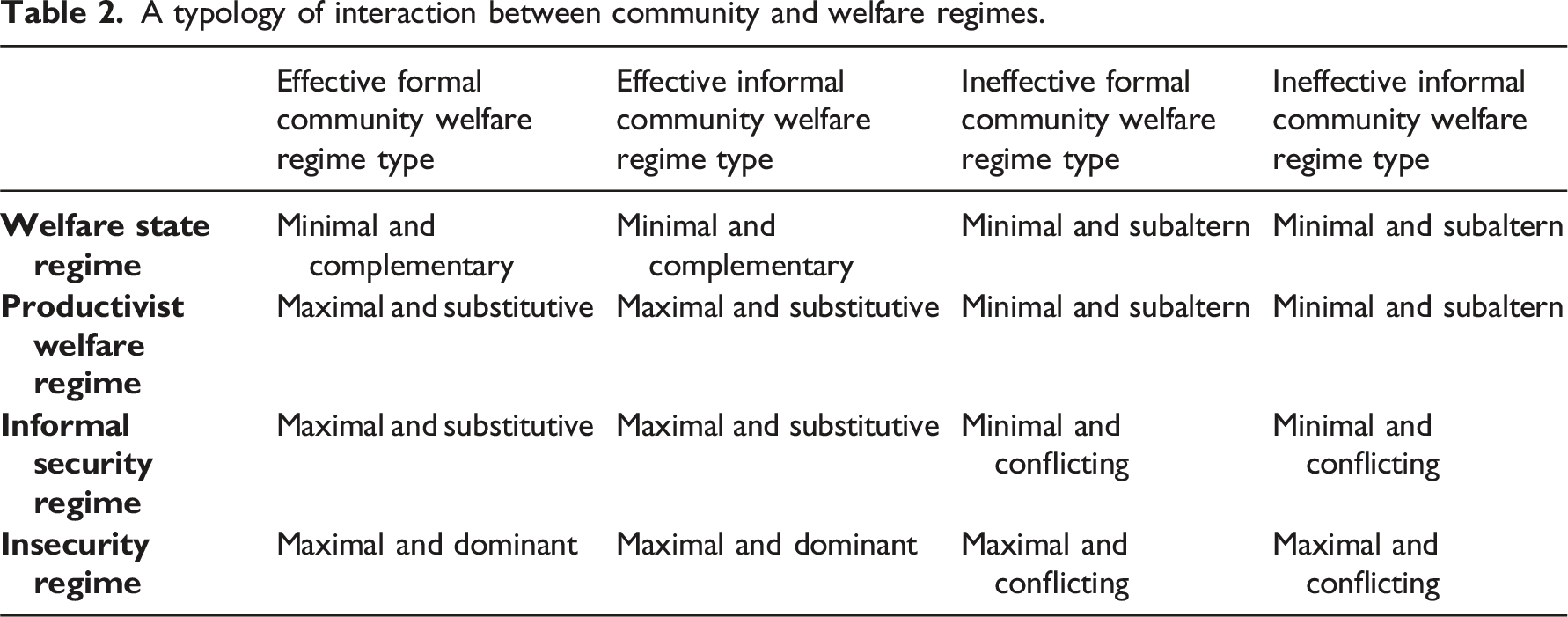
A typology of interaction between community and welfare regimes.
Minimal and complementary
Minimal and complementary interaction appears between an effective formal community welfare regime and a welfare state regime type, as well as an effective informal community welfare regime and a welfare state regime type (Table 2). Within this framework, it becomes apparent that the efficacy of community-provided welfare, while significant, is overshadowed by the highly effective formal welfare mechanisms implemented by the state and market. Consequently, individuals rely less on community-based welfare provisions in favour of those offered by the state and market. This interplay signifies that the welfare the community provides serves as a complementary component to the broader welfare framework established by the state and market. By operating in tandem, these complementary welfare sources contribute synergistically to the population’s overall well-being. Such a phenomenon is particularly observable in advanced welfare states, where the existing welfare mechanisms are robust and further bolstered by the additional support derived from community sources.
Maximal and substitutive
The phenomenon of maximal and substitutive relations can manifest in the interplay between an effective formal community welfare regime and an informal security regime type, as well as an effective informal community welfare regime and an informal security regime type. Additionally, the dynamic can occur in the interaction of an effective formal community welfare regime and a productivist welfare regime type, and an ineffective formal community welfare regime and a productivist welfare regime type (Table 2). This particular configuration highlights the community as the major welfare provider, primarily due to the lack of welfare provisions offered by the state or market, compounded by imperfections within the market system. Consequently, under these conditions, the community assumes a role of utmost importance by delivering maximum support and substituting all other forms of welfare.
Minimal and subaltern
Minimal and subaltern relations arise within specific interactions, namely the ineffective formal community welfare regime with the welfare state regime type and the ineffective informal community welfare regime with the welfare state regime type. Additionally, the dynamic can occur in the interaction of an effective formal community welfare regime and a productivist welfare regime type, and an ineffective formal community welfare regime and a productivist welfare regime type (Table 2). This association signifies a situation where welfare states effectively meet the welfare demands of the populace while community welfare mechanisms lack efficacy or are entirely absent. Consequently, individuals rely to a minimal extent on community-based welfare provisions. Such a relation can predominantly be observed in highly industrialized welfare states where the state fulfills most of the needs of large populations or in developing and less developed countries where a small portion of the population enjoys generous welfare benefits and reliance on community welfare is less extensive. This relation underscores the important role of welfare state institutions in providing comprehensive social protection to the public. In this context, an ineffective formal community welfare regime accentuates the reliance on the welfare state to address societal welfare concerns.
Minimal and conflicting
Minimal and conflicting relations can arise in the interaction of; a) an ineffective formal community welfare regime and an informal security regime type; b) an ineffective informal community welfare regime and an informal security regime type; c) an ineffective formal community welfare regime and an insecurity regime type; d) an ineffective informal community welfare regime and an insecurity regime type (Table 2). These conditions often emerge in periods of war, conflict, crisis, or other volatile situations where state institutions and informal support systems are absent to address the welfare needs of the population. The absence of functional state institutions and informal support systems during periods of war, conflict, crisis, or other volatile situations exacerbates the challenges various population groups face. Individuals rely on minimal or inadequate welfare provisions in such circumstances, leading to heightened vulnerability and marginalized conditions. In such contexts, vulnerable groups, including those based on race, gender, or class, may face exploitation by those who hold power and take advantage of the minimal support available. For instance, formal community welfare mechanisms may become ineffective or non-existent in war-torn regions where state institutions have collapsed (Bevan, 2004). Simultaneously, the presence of an insecure environment further hampers the ability of individuals to access necessary support (Mumtaz and Sumarto, 2024). As a result, vulnerable groups, such as refugees, women, or minority communities, may be subjected to exploitation and discrimination by those who exploit the power vacuum. The absence of comprehensive welfare provisions creates an environment where these marginalized groups bear the brunt of the economic consequences, facing heightened vulnerability and limited opportunities for social upliftment.
Maximal and dominant
The interplay between an effective community welfare regime, formal or informal community welfare regime, and an insecure regime type creates a dynamic characterized by minimal and conflicting relations (Table 2). In these situations, the absence of functional state institutions creates a void in the provision of welfare, leading the community to assume a critical role as the primary source of support. As a result, the community becomes the dominant and reliable provider of welfare, playing a vital part in addressing the challenges posed by the insecure regime. This shift in responsibility highlights the resilience and adaptability of the community in adverse conditions. Nevertheless, despite lacking functional state institutions or secure conditions, the community does not leave the population without welfare support. On the contrary, they take on the dominant role in providing crucial support, demonstrating their resilience and capability to meet the welfare needs of the population even in challenging circumstances.
Implications, conclusion, and future research scope
This article conceptualised the global community welfare regime, elucidating its four distinct ideal types: effective formal, effective informal, ineffective formal, and ineffective informal. The categorization is based on the dual dimensions of effectiveness and formality of community welfare provision and its interaction with national or territorial welfare institutions. Furthermore, the article introduced a typology stipulating the interplay between the theorized community welfare regimes and various global welfare regimes. By doing so, we advanced the scholarship on global welfare regimes by prominent scholars such as Esping-Andersen (1990) and Wood and Gough (2006) and theorized the role of the community as an essential component of the welfare mix. This ideal type (Aspalter, 2017, 2018) conceptualization of the community welfare regime can serve as an analytical template or heuristic for conducting meaningful comparisons between different community welfare regime real types, both within individual countries and across various welfare geographies. These comparative analyses can provide policymakers with valuable insights into the (in)effectiveness of community welfare provision, allowing them to develop policies firmly grounded in successful practices adopted by communities to effectively support vulnerable members of society and foster improved overall welfare outcomes.
We acknowledge that the study does not offer a case study illustrating examples of informal/formal and effective/ineffective community welfare regimes. Additionally, it establishes connections between the various forms of community regimes outlined in this article and existing welfare regime typologies. This abstract mapping identified relationships such as ‘minimal’ or ‘maximal’, ‘dominant/subaltern/substitutive/conflict’ between community welfare regimes and national welfare regimes, based on a functional logic. However, as presented in this article, these relationships do not provide detailed criteria for their establishment and identification. Therefore, conducting a more nuanced examination of the criteria for establishing such relationships and how to identify them offers a promising starting point for further investigations. Additionally, researchers can explore/identify different forms of community regimes using case studies from both the global North and South.
It is important to note that community regimes are not fixed categories but exist in a dynamic and evolving context. However, we do not propose a hierarchical structure of community welfare regimes along a linear continuum, ranging from ‘less effective’ to ‘more effective insecurity’ or vice versa. It is further clarified that our proposition does not advocate for a global programme aimed at simply elevating less effective regimes to more effective ones. As demonstrated in the article, even within a more developed welfare state, effective regimes may coexist but occupy a less dominant role. In addition, within a single country, different regimes may coexist, and the determining factors influencing community regime development can facilitate transitions from one regime type to another. To further advance scholarly understanding in this field, we encourage researchers from both the Global South and Global North to embrace the research agenda of exploring the transitioning and hybridization of community welfare regimes in future studies.
The active involvement of communities in development interventions has long been a central concern for donor agencies (Dongier et al., 2003; Wong and Guggenheim, 2018). The rise of neoliberalism coincided with the popularization of social capital theory, emphasizing healthy communities and civic engagement for safeguarding democracies. However, the tension between neoliberalism’s emphasis on competition and individualism and the need for equality and solidarity to strengthen social engagement has led to a decline in the prominence of social capital theory, especially with the economic crisis of 2008 exposing the incompatibility between neoliberal policies and creating social capital (Ferragina and Arrigoni, 2017). By carefully examining the dynamic factors that contribute to the effectiveness or ineffectiveness of community welfare, policymakers and international agencies can identify the strategies and approaches employed by successful communities to improve not only the welfare of their members but also their compatibility with neoliberal policies. This knowledge can enable governments to align their interventions and policies to maximise impact and promote enhanced welfare outcomes. This approach assumes particular relevance in the context of climate change and extreme weather events, as communities worldwide have demonstrated effective management of such crises (Cartier and Taylor, 2020; Lazrus, 2012). Drawing lessons from such case studies and leveraging the experiences and practices of these resilient communities, policymakers can effectively address the challenges posed by climate change and other natural disasters, ultimately enhancing the overall well-being of affected populations.
In the realm of migrant workers’ access to formal welfare benefits, a significant impediment often arises in the form of citizenship conditions imposed by the nation-state (Levitt, 2022). These conditions restrict the eligibility of migrants to avail themselves of the social welfare programmes and services provided by the state, leaving them in a vulnerable position. Consequently, migrant workers frequently turn to alternative sources of support to meet their welfare needs. Among these alternative sources, third-sector entities play a crucial role. NGOs, church groups, and labour unions have emerged as key actors and create a resource environment for assistance and providing support to migrant populations (Levitt et al., 2017). In addition, in today’s digital age, online communities have emerged as important sources of support and welfare for many individuals. These virtual communities, consisting of people connected by shared interests or experiences, offer a platform for social interaction, information exchange, and mutual assistance for migrant populations (Abendschein et al., 2019). While they may not entirely replace traditional community structures, online communities nonetheless play a valuable role in providing support and fostering connections in an increasingly interconnected world. Examining the interplay between community regimes and the resource environment, as well as online communities within which migrants operate, presents a fruitful avenue for further academic exploration. Understanding how community dynamics intersect with the availability and accessibility of resources can shed light on the strategies and mechanisms migrants employ to navigate their welfare needs. Such research endeavours can potentially inform governments and policymakers in formulating more inclusive and effective policies that cater to the specific challenges faced by migrant populations.
The article did not discuss other types of welfare regimes, such as the familistic welfare regime. This particular welfare regime emphasizes the family as the primary provider of welfare support rather than relying extensively on the state for social services and benefits (Bussemaker and Van Kersbergen, 1999; Ferrera, 1996). These regimes are commonly found in societies or countries with strong traditional family values and a history of limited government intervention in social welfare. Similarly, clientelism, which refers to a system in which politicians offer targeted benefits to individuals in exchange for their votes, while programmatic politics involves the provision of policy proposals and government programmes to attract voters, has been discussed in the development of welfare regimes (Elliott, 2011). The global welfare regimes classified in this article provide a foundation for future research, where the role of these regimes can be further explored concerning the familistic welfare regime and clientelism for the further development of global welfare regime classification.
A common criticism against mainstream Social Policy literature is that it is Eurocentric and may not be entirely relevant when applied to the Global South, where diverse historical, cultural, and institutional factors come into play. Recognizing this criticism in capturing the complexity and nuances of social policies in the Global South, this research developed a community regime classification that considers the distinctive historical, social, economic, and cultural contexts that shape these regimes and, ultimately, the overall welfare systems. It presents an opportunity for south–north learning, as effective community-based welfare regime practices of the Global South can be applied in the Global North to achieve optimal welfare outcomes. By fostering south–north learning and promoting a nuanced understanding of social policy, we can work towards creating welfare systems that are not only sustainable but also responsive, equitable, and culturally sensitive, thereby improving the well-being of individuals worldwide.
Footnotes
Declaration of conflicting interests
The author(s) declared no potential conflicts of interest with respect to the research, authorship, and/or publication of this article.
Funding
The author(s) received no financial support for the research, authorship, and/or publication of this article.
