



Abstract
A theory of rational attitude formation suggests public perceptions that income differences are too large should lead to demands for income redistribution. Public opinion scientists irregularly observe this at best. It is possible that the instruments we use to observe support for income redistribution are ineffective. We suggest at least part of the inconsistently observed linkages are due to unobserved confounding of government heuristics. We hypothesize that government affect provides a heuristic cue for survey respondents to answer questions on their preference for the government engaging in income redistribution. The greater the valence or quantity of reasons for a survey respondent to have negative government affect, the more perceptions of inequality and support for redistribution are decoupled and apparently inconsistent. To test this, we measured government affect at the country-time level using trust, corruption perceptions, and economic performance. We executed tests of moderation using slopes-as-outcomes regressions with ISSP data from 36 countries in 102 country-time points. Given the difficulty in fitting complex theories of society and politics into a limited number of macro-comparative cases, we ran a multiverse analysis of alternatively plausible models. There is a consistent negative moderation effect across models suggesting that our theory of government affect as opinion expression on a survey is worthy of further consideration. The findings also suggest more qualitative cognitive survey interviews to better understand this process.
Keywords
Introduction
Income redistribution is often fiercely debated in the public sphere and in power elite circles. This is particularly true since the advent of modern surveys, and the rise of welfare state institutions (Coughlin, 1980; Korpi, 1983; Wallerstein et al., 1997). The politics of redistribution exacerbates conflicts between social groups, because the perceived deservingness of income redistribution for other groups varies among the public (Appelbaum, 2001; Breznau and Eger, 2016; van Oorschot, 2000). Redistribution refers to government policies that transfer public monies to those who have lower or no income. It serves as a form of social security to protect against risks of poverty, which may generate other positive externalities such as social stability, national attachment, increased economic consumption or lower crime (Barr, 1998; Wulfgramm et al., 2016).
Comparative research on attitudes toward redistribution sometimes uses qualitative interviews (Edmiston, 2018; Hilmar, 2019) but is largely based on surveys (for example, Alesina and Giuliano, 2011; Dallinger, 2010; Finseraas, 2009; Jæger, 2009; Schmidt-Catran, 2016; Steele and Breznau, 2019; VanHeuvelen, 2017; and see citations throughout this article), including the use of survey experiments (Cruces et al., 2013; Kuziemko et al., 2015). Much research investigating income inequality as a cause of greater support for redistribution is inconclusive (Breznau and Hommerich, 2019; Dion and Birchfield, 2010; Finseraas, 2009; Steele, 2015); this is true even in studies that use perceived inequality rather than objective indicators (García-Sánchez et al., 2018). Superficially this suggests the public are less rational in expressing their attitudes as a theory of rational attitude formation. A recent study suggests that question instruments used to gauge redistribution support are too general and do not measure what we think (Dallinger, 2022). If true, this provides a potential explanation for the inconsistencies in this subfield.
We propose an additional theory to explain the lack of coherency. Our theory is that government affect 1 shapes public attitude formation because it moderates the answers that the public give when asked about their preferences for income redistribution on a survey. Government affect provides a heuristic. Varying and complex attitude formation processes lead respondents to answer any given question in diverse ways, possibly struggling to find an answer. Government affect could provide a shortcut to the answer. Imagine a person who perceives rampant inequality in their society and is asked if the government should engage in income redistribution. If they have very negative feelings about the government, its performance or trustworthiness, they are unlikely to express support for government-led redistribution despite their internal belief that redistribution is necessary. Of course, government affect is not triggered in every respondent in identical ways, nor should it explain the entire redistributive attitude formation process during a survey. Our theory merely engages the idea of a central tendency in any given society. If affect is more negative on average, both in quantity (different types) and quality (valence), this could explain why respondents simultaneously strongly agree that society is too unequal but disagree that the government should engage in income redistribution. The word ‘government’ in a survey may be sufficient to activate this affect and provide a heuristic response cue.
In this study we cast a broad net to capture central tendencies in government affect by measuring trust, corruption perceptions and economic performance. We use data from the International Social Survey Program (ISSP), Integrated Values Surveys (IVS), Corruption Perception Index (CPI) and various macro indicators. When treating countries as one of the unit-of-analysis levels, the data-generating model is potentially ultra-complex and difficult to theorize and capture empirically. Therefore, we run a multiverse analysis of alternative plausible modelling choices that could confound or otherwise (dis)attenuate inequality perceptions and preferences for redistribution.
Ostensibly inconsistent support for redistribution
Rational attitude formation theories suggest that individuals should base support for redistribution on what they stand to gain or lose economically (economic self-interest), what they perceive as necessary to achieve an ideal income distribution (means-ends rationality) 2 or on how they view the deservingness of recipients (fairness, justice) (Meuleman et al., 2020). Logically a person who believes there is too much income inequality in society could support redistribution for all three reasons at once. Following this logic, scholars often measure perceptions of inequality by asking the public if they think that income inequality or the rich–poor gap is too high, and then use their responses to predict support for government redistribution, for example, that the government should reduce the rich-poor income gap. Some recent findings show a positive statistical association (Bobzien, 2020; Iacono and Ranaldi, 2021), but many others do not (see review in García-Sánchez et al., 2018).
A recent claim by Dallinger (2022) is that the typical questions used in both the European Social Survey (ESS) and International Social Survey Program (ISSP) 3 are poor measures of support for redistribution. She backs up this claim by showing inconsistent cross-country correlations of the redistribution question with other survey questions such as meritocratic ideology and party-voting. As such, her arguments could explain varying findings in this subfield: that public opinion scientists are picking up more noise than signal. Adding to the confusion, scholars inconsistently operationalize support for redistribution and inequality questions. For example, because of their high correlation, scholars sometimes assume both questions together measure a single unobserved support for redistribution attitude, or are part of a larger general social policy attitude scale (Alemán and Woods, 2019; Bailey et al., 2013; Breznau, 2019; Dallinger, 2010; Döring, 1994; Svallfors, 2013; van Oorschot and Meuleman, 2012).
A quick look at the associations between inequality perceptions and support for redistribution across countries helps demonstrate why studies in this area struggle to observe a ‘rational’ public. Figure 1 presents the aggregate percentage of those who agree income inequality is too high by country (x-axis) and the percentage of these same individuals who do not agree the government should engage in redistribution (y-axis). These questions come from the ISSP, the only large-scale survey to use both and cover so many countries. Cross-country variation in perceptions of inequality and support for government redistribution. NOTE: International Social Survey Program (ISSP) data, authors’ own calculations, see Methods section for details.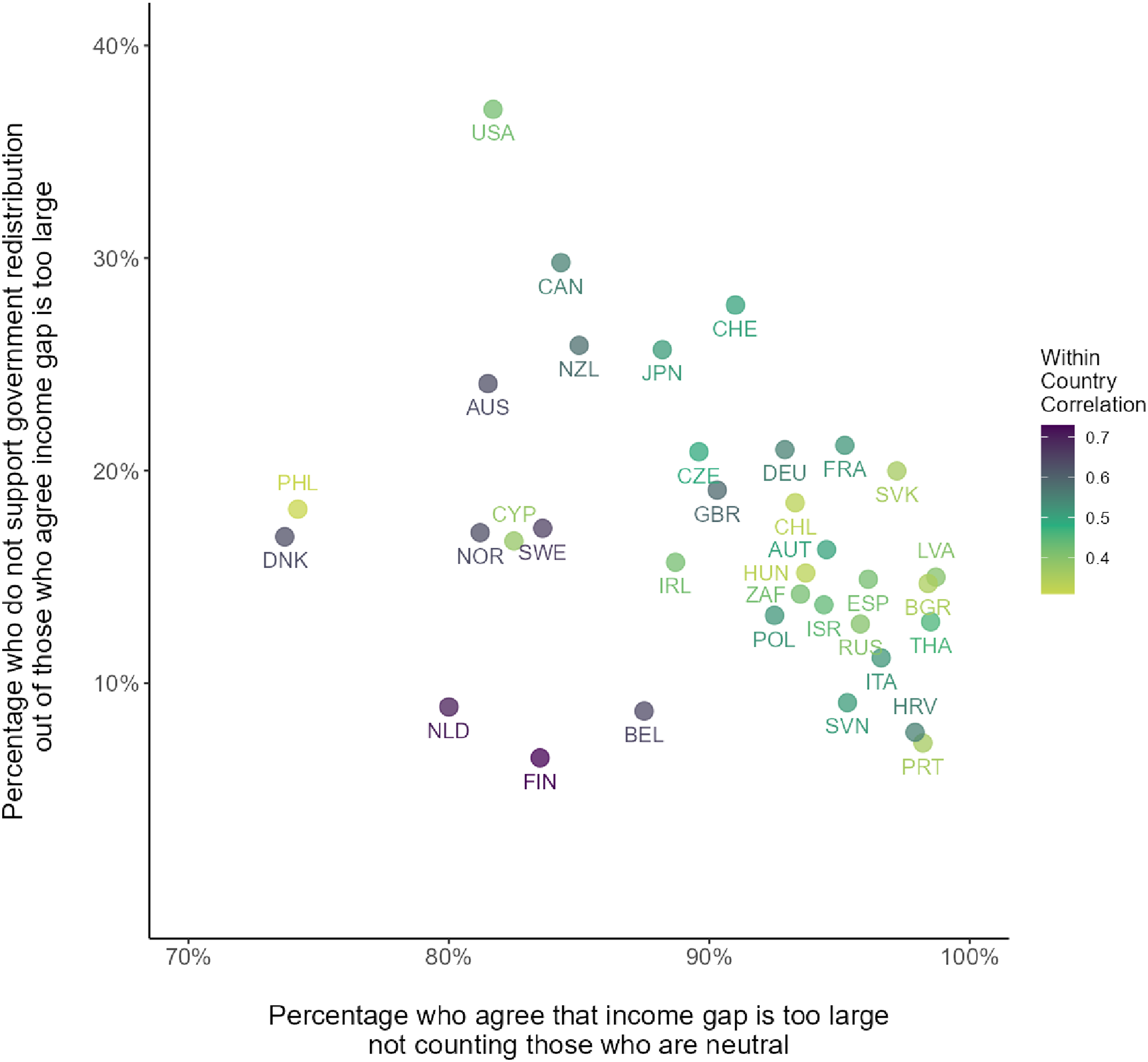
Figure 1 suggests varying levels of (ir)rational attitude formation, at least superficially. It supports Dallinger’s warnings that these questions may be unreliable. For example, Finland shows strong consistency among members of the public. Nearly 85% of those with an attitudinally valent perception of inequality, agree it is too large, and only 8% (of those 85%) do not agree the government should redistribute incomes. Meanwhile, the public in the US appear less consistent, where a similar percentage as Finland agree the income gap is too large, but nearly 40% (of those agreeing) do not agree the government should do something about it.
The shaded colour of the points reflects the within-country Pearson correlation of these two attitude questions on their 5-point response scales where lighter is a lower, more inconsistent, correlation. Many highly consistent countries on the agree/disagree axes in the lower right-hand corner of Figure 1 such as Portugal and Russia, have a surprisingly low correlation of the two survey questions (roughly 0.4), whereas countries such as the Netherlands and Belgium are much higher (roughly 0.6-0.7). Here all survey waves are collapsed, but readers will find country-wave specific correlations in Appendix Figure 1A.
It is our claim in this article that the ostensibly inconsistent attitudes shown in Figure 1, and explained by Dallinger (2022) as a product of poor survey question instruments, are at least somewhat a product of an omitted moderating variable that is activated in the survey response process. In other words, that the public are perhaps more rational than they appear, and that the questions may not be as poor quality as scholars think.
The heuristics of government affect
Humans often use heuristic shortcuts to guide their behaviours. Heuristics enable individuals with limited information or processing time to make decisions, for example when faced with a survey question (Lau and Redlawsk, 2001). Heuristics may be crucial, because respondents often hold unclear positions regarding social policy questions, and need to draw on something to formulate a survey response (Wagner and Zeglovits, 2014). Research in other areas shows strong heuristic effects, for example on political attitudes, perceptions of parties, and persons in power (De Angelis et al., 2020), or on perceptions of deservingness as a heuristic for voting or policy preferences (Meuleman et al., 2020). Support for redistribution should be motivated at first by the respondent’s own subjective perception of inequality. Unless something gets in the way of this.
Namely, we suggest that the government itself is an attitude-object and can produce strong affect. We base this theory partly on previous research demonstrating that when exposed to references to their national ‘government’, respondents answer survey questions differently, for example about their feelings toward other tiers of governance such as the European Union (Brosius et al., 2020; Torcal and Christmann, 2019). This suggests reference to their national government has a cognitive impact that influences expression of opinion. Thus, when respondents are presented with the word ‘government’ in a survey question, it may trigger pre-existing affect, and provide a cue to help express support or opposition for a national government policy. We argue that if a public has a greater quantity of reasons to feel negatively about the government, and/or these reasons are qualitatively stronger in the negative direction, then on average the public should have greater negative government affect. Negative government affect should influence the decision-making process leading individuals to be less likely to support policies that would otherwise align with their ideal preferred outcomes.
Figure 2 visualizes our claims. Panel A is a basic theory of rational attitude formation: the perception that there is too much income inequality should cause a preference that the government reduces inequality. Panel B shows our hypothesized moderation of government heuristics on the expression of attitudes during a survey. If panel B is accurate, government heuristics is an unobserved confounding moderator and should be accounted for to better analyse inequality-redistribution attitude linkages. In this study, we try to test this theory. We use all available countries and waves in the ISSP that contain both questions. We unfortunately lack individual-level measures of government heuristics in the same ISSP surveys as the attitude questions; however, our individual-level attitude formation theory should be capturable at the macro-level based individual averages. Theoretical model of opinion formation moderated by government heuristics.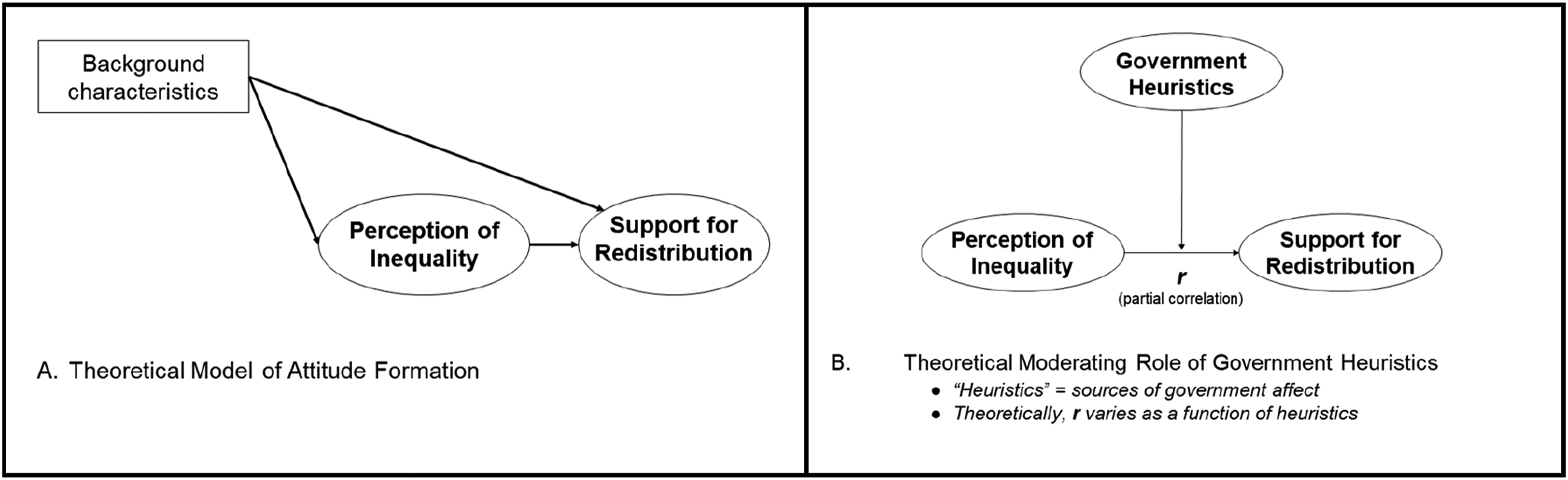
We label the moderating variable in the plural as ‘heuristics’ because we assume that the word ‘government’ as an attitude-object carries a multitude of potential features that could link to patriotism, ideology, lived experiences, expectations or partisanship; to name only a few. We consider what others before proposed as important to government attitudinal affect among what is available as an indicator for many countries of the world in the present theory and study. We decided on trust in government, perceived corruption and economic performance. As many country-time-level indicators such as these are closely correlated, targeting a few with strong conceptual validity and less tight correlations, should cast a relatively wide net to pick up broad variation in sources of government affect in the public.
Political trust
Often measured as confidence in government, political trust should capture ‘people’s positive anticipatory expectation that, despite uncertainty, the conduct of the political trustee [or system] in question will be in line with their normative expectations’ (Breustedt, 2018: 15). Political trust is institutionalized and therefore diffuse and generalized across a population, going beyond specific policies or politicians (Goubin and Kumlin, 2022) and is regarded as an essential stabilizing element of democracy (Catterberg and Moreno, 2006). Therefore, it can come from shared and institutionalized events and ideas that bolster or reduce trust in the government.
Political economy scholars argue that citizens lacking trust are less likely to support policy reforms, even if reforms are in line with their preferences (Hetherington, 2005; Rothstein and Uslaner, 2005), pointing at the potentially heuristic nature of trust (Rudolph, 2017). It is likely that lack of trust exacerbates insecurities regarding perceived material and ideological costs and benefits of implementing a policy change (Goubin and Kumlin, 2022; Rudolph and Evans, 2005). These mechanisms should be particularly strong with respect to redistributive policies because they tap both economic self-interest and political values (Goubin and Kumlin, 2022).
Corruption perceptions
Individual experiences or knowledge of activities undertaken by government officials that abuse public office for private gain or duplicitously violate democratic inclusivity lead to perceptions of corruption in a society (Philp, 2015; Warren, 2004). Some define corruption as reverse redistribution: ‘transfer[ing] resources from the mass public to the elites – and generally from the poor to the rich’ (Rothstein and Uslaner, 2005: 53–54; Tanzi, 1998). Thus, where corruption perceptions are high, even individuals most concerned about inequality should be reluctant to support government redistributive policies they fear will be ineffectual, or even have the opposite effect. Svallfors (2013) presents a similar argument for the effect of perceived government efficacy on support for welfare policies.
Some show that corruption perceptions have a negative association with transfer payments and public spending on education and health care (Uslaner, 2008) 4 , slower economic growth (Campos et al., 2010) and political efficacy and trust in civil servants (Anderson and Tverdova, 2003). Meanwhile other studies show a positive association with income inequality, poverty (Gupta et al., 2002), individual-level crime and negative environment affect (Uslaner, 2008). Research on corruption and redistributive policy preferences is scarce and inconclusive. A study on African countries reports that ‘perceived corruption in the president’s office has a significant and negative effect on reported attitude towards taxation’ (Boly et al., 2021: i140). However, in Latin America corruption is found to enhance public demand for redistribution which is explained with the concurrent effect of corruption on inequality (Hauk et al., 2017). 5
At face value, trust in government and perceptions of corruption in government should tap into similar attitudes; however, empirically this is not the case. As we will show later in our analysis, the best available measures we find of trust (Integrated Values Surveys) and corruption perceptions (Corruption Perceptions Index) have a low Pearson’s correlation across country-years of only 0.11 (see Table 2A in Appendix). Therefore, they apparently tap different elements of government affect, which supports our goal of capturing myriad aspects of government affect.
Economic performance
Gross domestic product or perceived economic strength might also lead individuals to evaluate the government with positive affect. Research suggests the economy can shift perceptions of government without any election or policymaking taking place (Stimson et al., 1995; Whiteley et al., 2016). Economic productivity might drive inconsistent responses to the two types of redistribution questions we analyse. Even though the effect of economics on political preferences or perceptions of government is inconsistent across studies, there is likely a baseline association that should not be ignored (Wlezien et al., 1997). This links to research on the welfare state’s role as arbiter of risk and how risk perceptions are altered by overall economic security in addition to the size and scope of the welfare state itself (Rehm, 2016; Wilensky, 1975). Perhaps people are simply more willing to redistribute when things are going well economically in other words.
We expect higher GDP to be a potential indicator of public perceptions of positive economic performance, and thus a potential heuristic whereby weaker performing economies damage the linkage between perceptions of inequality and support for government redistribution. Research on redistributive preferences that is comparative, almost unambiguously models an effect of GDP per capita or a similar indicator of economic performance when carrying out quantitative tests (Carriero, 2016; Dallinger, 2010; Dion and Birchfield, 2010; Evans and Kelley, 2018; Schmidt-Catran, 2016; Steele, 2016; VanHeuvelen, 2017). Mostly these studies find that GDP per capita, sometimes taken as a log, has a negative statistical association with support for redistribution between countries such that higher GDP predicts less support. This points somewhat opposite to our expectations, but we claim moderation rather than a direct effect. Thus, because richer countries are also more equal on average, this could shape perceptions of inequality in a way independent of our hypothesized effect. This gives us an additional benefit of including this indicator. If it returns a positive test and the other two indicators do not, we have evidence against the government heuristic in favour of an economic cause.
Methods
Dependent variables
Our entire workflow is in a public repository, we call ‘Repo’ throughout this section. 6 We elect to use the largest existing cross-country survey asking both the inequality and redistribution questions, the International Social Survey Program (ISSP), ‘Social Inequality’ module. We derive attitudes toward inequality from responses to the question ‘To what extent do you agree or disagree with the following statements?’ – ‘Income differences in [this country] are too large’, and preferences for government redistribution from the question, ‘On the whole, do you think it should be or should not be the government’s responsibility to … reduce income differences between the rich and the poor?’ (verbatim English ISSP). These questions were asked in the 1987, 1992, 1999, 2009 and 2019 waves. In total this gives us data from 36 countries in 102 country-wave units. See Table 1A for descriptive statistics.
We perform a measurement pre-test of whether the two questions in fact measure a singular latent attitude toward redistribution with a confirmatory multi-group factor analysis (see Repo-04). M1 is a model where the two have free loadings by country-wave, and M2 with loadings constrained to equality across all country-waves. M2 fits worse (p < .001, differences in df = 101 and chi^2 = 3401). In fairness, M1 is just identified, but even if we allowed three country-wave group loadings to be freely estimated in M2, we still arrive at worse fit. This is statistical confirmation of what Figures 1 and 2 show visually: these questions do not apparently measure the same thing.
Government heuristics
Lack of trust in government: A standard measurement of trust is survey questions on trust or confidence in government (Bauer, 2019) which are available for cross-country comparisons (Citrin and Stoker, 2018). The one with the widest coverage is the Integrated Values Survey (IVS 7 ). The IVS contains a standard trust question, ‘I am going to name a number of organizations. For each one, could you tell me how much confidence you have in them: is it a great deal of confidence, quite a lot of confidence, not very much confidence or none at all? [the government]’. Although scholars sometimes generate a latent variable from a scale of trust questions, we prefer to use this single question because it has direct face validity as both this question and the dependent variable use the word ‘government’, while other questions do not include this word.
Corruption perceptions: Transparency International measured corruption perceptions for several decades now leading to a dataset measuring perceptions of the public, with a focus on experts and business people via 13 different corruption surveys and assessments that are standardized and then combined. The data come from sources such as the World Bank and World Economic Forum. The resulting Corruption Perception Index (CPI) is a standard measurement in political research (Heywood, 2015 for a critical discussion) based mainly on surveys of experts corroborated with public opinion surveys (Canache and Allison, 2005; Pellegata and Memoli, 2016). The closest the ISSP Social Inequality module has to a corruption question is to ask if respondents think one must be corrupt to attain top status in society, but this is potentially too general for our purposes, and it does not show content-validity with other trust questions. We code responses so that higher scores indicate more perceived corruption.
Weaker economic performance: This is simply gross domestic product per capita (GDPpc) from the Varieties of Democracy data (V-Dem) in 2020US$, measured in 10 thousand increments. The variable is standardized and then multiplied by −1, such that higher values indicate worse economic performance.
Interestingly, GDPpc correlates highly with CPI but not trust. Trust has noticeably different correlations with other level-2 variables (see Table 2A in Appendix). We see this as a great strength of our study. Although conceptually similar to trust, perceptions of corrupt institutions and processes as measured in the CPI provides an alternative potential measure of government affect in a society. This is part of the ‘wider net’ we cast, to tap into a range of potential government heuristics.
Potential confounders
We are not interested in a direct effect of heuristics on perceptions of inequality or support for redistribution. Therefore, we can safely ignore it for our test. Therefore, the only threats to our test would be unobserved confounding of the X–Y relationship, or variables that cause or bias the moderators we use. Here we discuss potential biasing threats based on research in this subfield.
Group conflicts might play a confounding role. Support for a given policy such as redistribution, may come from a respondent’s own group identity and perceived competition with other groups for scarce in-group resources (Eger, 2010; Eger and Breznau, 2017). This should only cause support for redistribution rather than bias a respondent’s perception of the income distribution, but it is such an important theoretical variable, we leave open the possibility that it shapes both. Research in this area often uses immigration, ‘otherness’, or various group boundaries such as race or cultural-origin to measure group dynamics and conflict (Dahlberg et al., 2012; Schmidt and Spies, 2014). In comparative research, percent foreign born is often the only available measure that is directly comparable across dozens of societies and thus the only variable we find reliable. We use it even though findings are mixed as to its utility (Auspurg et al., 2020; Brady and Finnigan, 2014).
Income inequality (Gini) is an indicator of how much the state insures against the risks or disadvantages of former and current distributional outcomes, and it may indicate other types of group-based conflicts such as between classes. Although evidence of its association with redistributive attitudes is mixed (Breznau and Hommerich, 2019; Trump, 2023), our concern here is with it confounding government heuristics.
Individual socio-economic status impacts perceptions of inequality, risk and government. Individuals perceive their own life chances when espousing support for redistribution leading scholars to use socio-demographic individual-level variables to proxy individual risk or risk perceptions (Rehm, 2016). Thus, tests of a government heuristic should include basic variables to capture age, sex and socio-economic status given their potential to otherwise be unobserved confounders of the X–Y relationship we are trying to observe.
If not a heuristic, economic performance measures wealth, economic ‘health’ and the productivity of a society. Thus, GDPpc is a variable that should appear in models where it is not a moderator, and as a direct effect in models where it is. It is also possible that existing social policy may impact perceived inequality and preferences, therefore we include social spending as a percentage of GDP in our analyses (from the OECD). Although these variables are potential proxies of a range of political economic aspects of a society, they are standard in the welfare state and redistributive policy literature, and certainly a multiverse analysis that includes plausible models should include these.
Data adjustments
As the IVS and ISSP waves do not always align perfectly, we take the closest IVS to an ISSP within a 5-year window. Also, given some missing data points, we interpolate values with country-means to generate raw and imputed versions of corruption perceptions and lack of trust to test in our multiverse. For social spending and percentage foreign-born we use time-series interpolation between closest observation points also to generate multiple test versions.
Testing the association
Part I. Slopes as outcomes
In our mathematical models

The first issue is that other country-specific aspects may influence the association
Therefore, we prefer a multilevel regression allowing us to adjust for the association between


In (3)
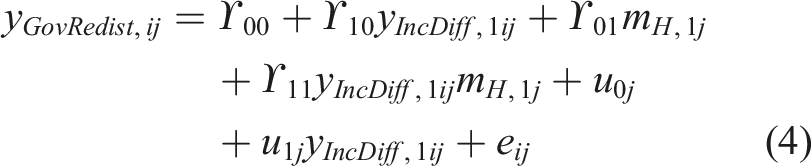
Our only interest is the slopes by country-year to test whether

Not all
Part II. Inequality is too high as a focal sub-group
Our hypothesis applies most directly to persons who think inequality is too high and attempts to explain why varying subsets of this group do not support redistribution across country-waves, that is, why they have ostensibly inconsistent attitudes. For those who think inequality is not too high, supporting redistribution is not as clearly inconsistent, because they might think redistribution is how society arrived at a ‘not too high’ level of income inequality in the first place and continue to support it. Therefore, we run an additional check by calculating the percentage of those who do not agree that the government should redistribute out of those who agree inequality is too high by country-wave, and then plot these results against our three heuristics visually.
Specifying the multiverse
Our ideal model is simply the moderation effect of government heuristics on the within-country-year observation slope of perceptions of inequality impacting support for redistribution after controlling for individual-level variables and the multilevel data structure. This is the most parsimonious model, because it does not risk introducing noise from other country-level variables which measure many things at once. However, based on our discussion in the section ‘Potential confounders’ we find it prudent to run each model with each level-2 variable in it to test if it acts as a confounder or not, and to test the robustness of our results. In fairness, we also run models with and without the individual-level control variables and with country-year level and country random intercepts added. We also run the models with and without a GDPpc interaction and with and without the missing cases imputed for the moderator, except of GDPpc for which we have full information. We then run all these defensibly plausible models as a multiverse analysis (Rohrer, 2018; Steegen et al., 2016). All these combinations across three different moderating variables results in 257 models, 112 for corruption perceptions and trust in government each and 33 for economic performance, as these models cannot be run without GDPpc like the other two thus exponentially reducing the number of models (see Repo-05 and Repo-06 for the workflow, and Table 3A in Appendix for a list of all model specifications).
Results
Figure 3 presents a specification curve of the results of our multiverse analysis of model specifications. A vertical line divides the three versions of our moderation test by variables measuring government heuristics. Dots in the upper panel are the moderation effects with point estimates that are XY-standardized. This means an effect ranging between 0.05 and 0.10 is roughly analogous to a 2.5 to 10% impact of the observed variance in X statistically explaining the observed variance in Y – how much a measurement of government heuristic can grow or shrink the association between perceptions of inequality and support for redistribution. Generally, a standardized effect of 0.10 or less is considered small (similar to Cohen’s d). We do not dispute this, but keep in mind that in elections sometimes it takes only a 1% change to swing the results. In the lower panel, each row of vertical blue bars reflect which level-2 variable is in the model or not, plus a row indicating if the model contains imputed values on the moderating variable. Model specifications in the lower pane where a line is missing indicates that the model did not include that particular specification. Moderation models of attitudes toward inequality predicting government redistribution. Note: These are multilevel general linear regression models. Upper plot dots reflect effects and 95% confidence intervals, and lower plot dashes indicate model specifications. Preferred model result for each heuristic moderator indicated by black dot and represents models that include individual-level control variables of education, sex and age, country-year random intercepts and no level-2 variables other than the moderator and GDPpc and its interaction in the case of GDP as heuristic in the right-most panel.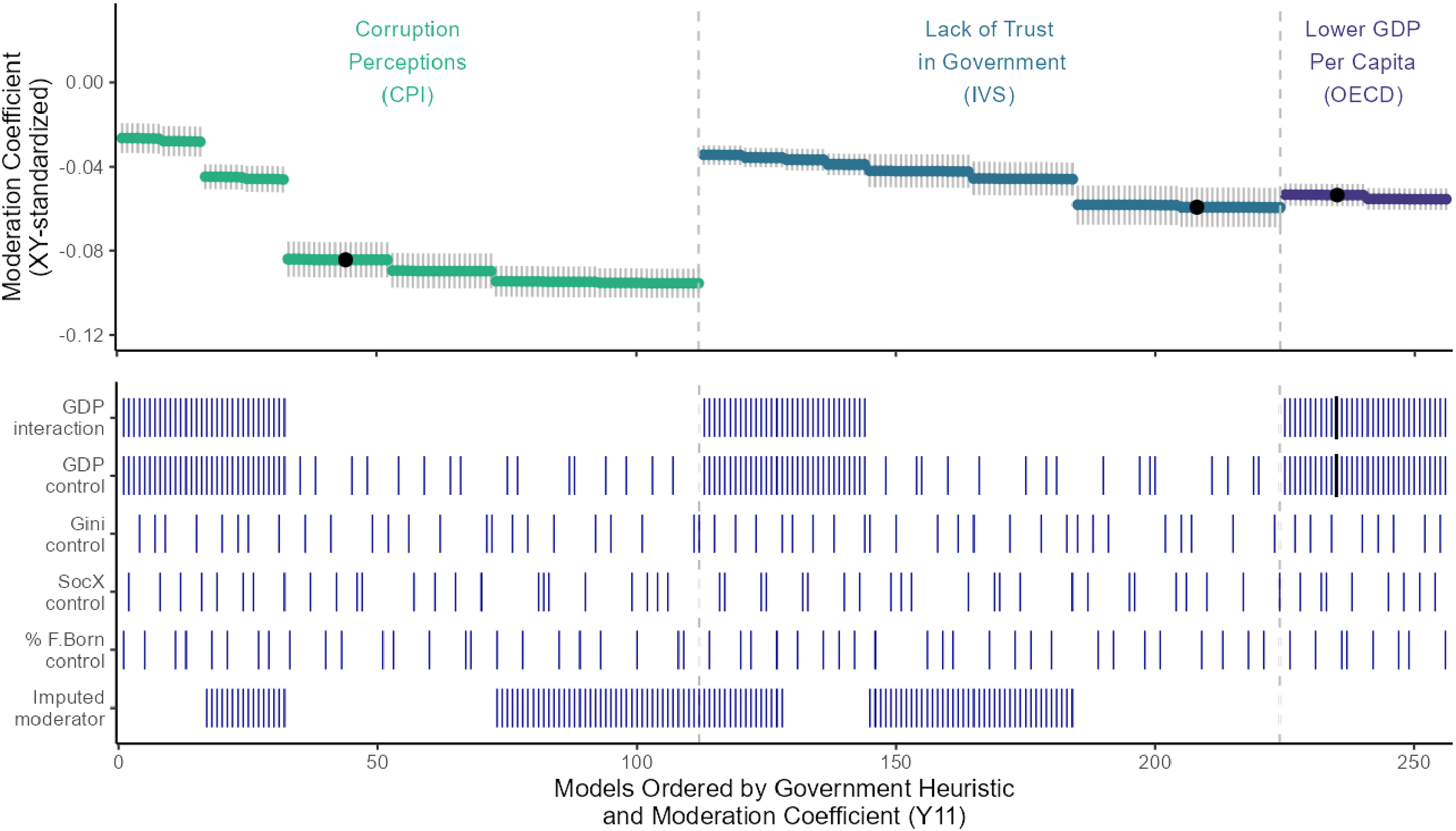
All models show a small to moderate negative statistical moderation effect of government heuristics. This effect remains when adjusting for a range of potential confounders, although with GDPpc the effects are noticeably smaller. In the reverse case, economic performance having an interaction with one of the other heuristics has no apparent impact on the GDPpc moderation effect. Thus, of all three, economic performance measured as GDP per capita has the most stable effects, nearly identical across all model specifications, regardless of whether GDPpc is the moderator or an adjustment variable.
Next, we plot aggregate data from only those who (strongly) agree that inequality is too high, and the percentage of them that do not (strongly) agree with government redistribution (y-axes, top row Figure 4) as described in Part II of ‘Testing the Association’. The higher the percentage the more inconsistent the public support of redistribution among those who agree income inequality is too high. In the three columns we plot our three heuristics’ values on the x-axes with fitted regression lines. Contrary to our expectations, corruption perceptions and worse economic performance show a negative association, suggesting that in countries with higher corruption and lower GDPpc, the public who believe inequality is too high have more consistent redistributive attitudes. Only for lack of trust do we see that higher scores associate with less willingness to support redistribution, that is, more inconsistent attitudes. For comparison we plot the country-wave aggregate correlations (bottom row) with our three heuristics, and in all three cases we see what we expected based on the multiverse of regressions. The bivariate association is negative. This means that the moderation effect of corruption perceptions and lower economic performance is not especially salient for those who see inequality as too high, instead these overall lead to a stronger decoupling of inequality and redistribution attitudes where there are higher heuristic scores. The correlation of heuristics with within-person inequality-redistribution opinions by country-wave. Percent inconsistent, top panel is the rate among those who say there is too much inequality, that do not support government redistribution. Correlation, bottom panel, is the Pearson's correlation between 5-point responses to questions on inequality and support for government redistribution.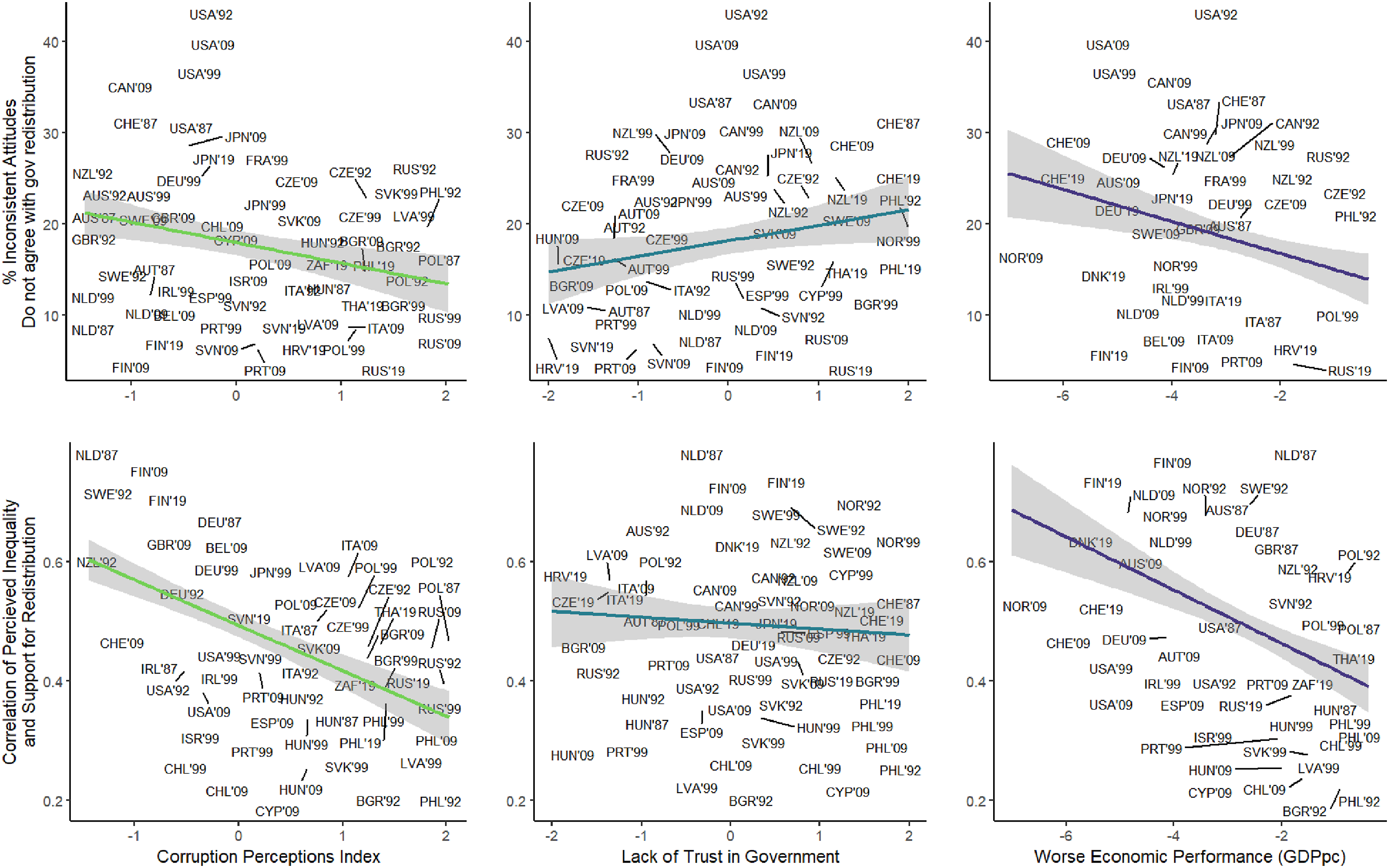
Overall, these results suggest rejection of the null hypothesis that the moderating statistical effect of government heuristics on the slope representing the effect of attitudes toward inequality on attitudes toward government redistribution is exactly zero. However, we must exercise caution because in one out of six cases in Figure 4, lack of trust points in the opposite direction for exactly those whom we expect this to have an impact – thus there is something going on with subgroups that is beyond testing in our current models.
Discussion
The evidence visualized in Figure 3 is consistent with our theory that government heuristics play a moderating role in the rational expression of support for redistribution among individuals surveyed in the ISSP. Our hypothesis is that the government is an attitude-object that, when mentioned, evokes government affect. This affect should derive from multiple sources that vary from individual to individual, but that can be measured as an overall average in each society at a given time. When the average of all sources of government affect in a society is more negative, then there is a greater decoupling of the rational linkage of perceptions of too much income inequality with support for government income redistribution. This was our tested moderation hypothesis, to which we present evidence that across survey waves by country in 36 countries across various years since the 1990s, trust in government and perceptions of corruption on average statistically explain anywhere from 2.5 to 10% of the partial within-country-year correlation of perceptions of inequality and support for redistribution. We arrive at this conclusion based on strong evidence against the null hypothesis that there is zero moderation effect.
Our ability to specify the exact nature of the moderation effect is limited to what we can infer from three heuristic variables. Two capture potential government affect directly, lack of trust and corruption perceptions, and a third more indirectly via economic performance. As we assume there are many other sources of government affect, and that many sources are correlated, we can only draw general and macro-level conclusions. Moreover, the observation of micro-macro processes is extremely difficult and comes with a universe of unobserved confounding possibilities. Our preferred models are those that include no adjustments at the country-level (see black dots in Figure 3), but we cannot know for sure if these are clean, parsimonious tests. Therefore, we ran a multiverse analysis of alternative model specifications mixing in other potential confounders at the country-level of percent foreign born, a gross domestic product per capita and its interaction with the moderator, and income inequality. We also ran models with and without individual level adjustments for education, sex and age, models with country-year and country as alternative random intercepts and finally with imputed data on trust and corruption. Across all models, we find a negative moderation effect, where higher corruption perceptions or more lack of trust predict a reduced statistical impact of attitudes toward inequality on attitudes toward government redistribution. However, in all the models where GDP per capita was interacted with the moderator, the moderation effect is noticeably smaller. This points at a very stable statistical effect of an economic performance indicator. This suggests economics could tap diverse heuristics with a clear standalone effect that leads people to be more accepting of redistribution when higher.
Our measures of trust and corruption perceptions are not highly correlated (see Table 2A in Appendix), yet we find moderation effects of both. This supports the idea of various heuristics working in tandem in each society and increasing or decreasing the likelihood of expressing support for redistribution in response to perceptions that inequality is too high. On the other hand, the corruption perceptions index and GDP per capita correlate at −0.78, suggesting that they are mostly statistically indistinguishable. Our capacity to draw conclusions about individual attitude formation remains superficial because Figure 4 shows that corruption and worse economic performance correlate with more consistent redistributive attitudes for those who think inequality is too high, but not so for trust. It is possible that more corruption and lower GDP per capita both have an impact on individual agency because they undermine the meritocratic distribution of incomes in society. If so, they could work in tandem to alter individual perceptions of deservingness which in turn impacts support for redistribution (Edmiston, 2018). Perhaps there is a ‘breaking point’ where the public find themselves in such a desperate political context that they call for redistribution despite a lack of trust. It also leaves open the possibility that perceptions of corruption have a more dire government affect than lack of trust. Perhaps trust in government varies so much that this small sample of countries makes it difficult to observe a consistent moderating effect. Corruption is, after all, more of a stable institutional quality and trust might derive from elite signals, current government leadership, elections or other current events. These could help explain the curiosities in Figure 4, as could the fact that our theory is only one small piece of a much larger puzzle. Ultimately this calls for more qualitative research on survey questions that are political in nature, in particular cognitive interviews during surveys (Wagner and Zeglovits, 2014).
What we can conclude is that the addition of our heuristic moderator overall leads to attitudes that appear to be more rationally consistent in their expression than previous studies suggest. Dallinger (2022: 10) points out that current findings in support for redistribution research may be hard to interpret because ‘measurement of support for redistribution allow[s] a high degree of inconsistency’. We see the addition of government heuristics reduces this inconsistency. Our findings therefore suggest that these survey questions may be capturing support for redistribution more accurately than Dallinger concludes. Further research is necessary to determine if this is the case, because we agree with Dallinger’s general claim that there is a lot of noise when studying public opinion from relatively vague rather than specific policy questions. We do not want to overstate that government affect as a moderator is a cure for inconsistent findings. We should not automatically assume government heuristics operates similarly in all areas. We propose that a logical way forward is to study government affect. There is currently a large literature on trust and social policy but little about general government affect and its association with redistribution. There are also reasonably large literatures looking at parties and politicians as heuristics for answering policy questions, but we find very few looking at ‘government’ as a moderating cue. The few studies that exist mostly focus on the national government as a cue for evaluating other tiers of government such as local or supra-national.
Our findings apply to support for redistribution. Although many scholars lump this together with general attitudes toward the welfare state, it may be a unique policy domain. One that is different from social insurance policies. Some other welfare state attitudes show overwhelmingly high support, such as with government intervention to support the elderly or the sick. In these areas there may be a ceiling effect that takes away the power to detect moderation, or moderation might not be there. another reason to engage in mixed-method research with qualitative cognitive interviews, but this goes beyond what we can conclude here and we caution scholars such as Breznau (2019) and Döring (1994) when treating support for redistribution as part of a general welfare state support latent attitude; our findings suggest it is likely not.
We reiterate this is not an experimental design, nor based on causal inference. Country-indicators are unreliable as a ‘unit’ of analysis that reflects everyone in a ‘population’. Therefore, ecological fallacy or methodological nationalism may be at play because countries are extremely complex package of processes and individuals. Attempting to account for individual, social, cultural, political, geographic and economic processes in a single theory or causal model, much less in a statistical model with 102 cases, is challenging (Schmidt-Catran and Fairbrother, 2016). When a respondent answers a survey question it is not clear exactly how they chose their response. We expect that they will draw on information easily accessible to them, in their active memory and perceptions. This could include previously or long-term held positions on redistribution. Such stable attitudes could in fact cause government social policies and thus lead to greater government affect, leading ultimately to a feedback loop between the government, policy and public opinion (Breznau, 2017; Soroka and Wlezien, 2010). We still rely on what we can measure foremost, and that is something that takes place at the moment of the survey. Therefore, by linking this to government heuristics we think we are zooming in somewhat on this moment of survey response, and the causal processes leading up to it. We cannot reliably disentangle what happened before the moment of survey response without further research.
Another clear implication of our findings is the need for better theories of attitude formation and survey response. Our visualization in Figure 4 shows that negative heuristics of government associates with a decoupling of perceptions of inequality and support for redistribution, but that this is not specific to those who perceive inequality as too high – the group we specifically theorize to be impacted by government heuristics. It is possible that different subgroups of the public are sensitive to different heuristics, for example trust appears to moderate public attitudes in general, but trust is particularly important for those who perceive inequality as too high and may not matter for those who think it is too low. Therefore, state of the art studies like that of Goubin and Kumlin (2022) might find stronger evidence of trust if they both (a) include trust as a moderator, rather than just a main effect on support for redistribution and (b) consider variables beyond trust that generally refer to perceptions of government. Finally, we should continue to improve on our questions asking about redistribution. Although we think the basic questions on the ESS and ISSP are more reliable than some argue, there is evidence that these general questions do have their limitations and biases (Dallinger, 2022; Margalit and Raviv, 2024).
Supplemental Material
Supplemental Material - The moderating role of government heuristics in public preferences for redistribution
Supplemental Material for The moderating role of government heuristics in public preferences for redistribution by Nate Breznau, Lisa Heukamp, Hung HV Nguyen and Tom Knuf in Journal of European Social Policy
Footnotes
Acknowledgments
Versions of this article were presented previously at the MPSA, 2023 in Chicago, US and at the Center for Public Studies (Centro de Estudios Públicos) in Santiago, Chile. We are grateful to Arne Köller and Sören Goldenstein for their research assistance in this project, and Juan Carlos Castillo and Mauricio Salgado for thier inputs.
Declaration of Conflicting Interests
The author(s) declared no potential conflicts of interest with respect to the research, authorship, and/or publication of this article.
Funding
The author(s) disclosed receipt of the following financial support for the research, authorship, and/or publication of this article: This work was supported by the German Science Foundation (Deutsche Forschungsgemeinschaft) projects ‘The Reciprocal Relationship of Public Opinion and Social Policy’ Project Number 401013559 and ‘The Role of Theory in Understanding and Resolving the Reproducibility Crisis’ Project Number 464546557.

Supplemental Material
Supplemental material for this article is available online.
Notes
References
Supplementary Material
Please find the following supplemental material available below.
For Open Access articles published under a Creative Commons License, all supplemental material carries the same license as the article it is associated with.
For non-Open Access articles published, all supplemental material carries a non-exclusive license, and permission requests for re-use of supplemental material or any part of supplemental material shall be sent directly to the copyright owner as specified in the copyright notice associated with the article.
