



Abstract
In response to labour-market crises, governments routinely adopt ‘short-time’ work schemes which supplement the incomes of workers who might otherwise be laid off. Such schemes increase the number of welfare recipients but could also lead to increased competition among different types of welfare claimants. We draw on data from an online panel survey fielded in Austria during the COVID-19 pandemic (2020–2022) to study individual preferences for financially supporting both short-time workers and the unemployed. We find that individuals prefer higher welfare benefits for low-income recipients and for those on short-time work compared to high-income recipients and those in unemployment. While we find cross-sectionally that these differences are related to individuals’ socio-economic position, we do not find longitudinal evidence that people adapt their preferences following switches in and out of different benefit programmes. Focusing on social beliefs as drivers of preferences, we find that negative attitudes towards the unemployed decrease preferences targeted at low income-earners. We conclude that long-term individual characteristics and attitudes rather than short-term changes in circumstances remain central to explaining benefit preferences under a dualised welfare regime during a labour-market crisis.
Introduction
Conventional self-interest and value-related explanations of welfare demands (Margalit, 2019) suggest that support for welfare programmes should increase during a crisis as the number of (potential) benefit recipients increases and claimants might be seen as having less control over their situation (Uunk and van Oorschot, 2019). Surprisingly, however, studies have found only limited aggregate changes in welfare preferences during the COVID-19 pandemic (Busemeyer, 2023; de Vries et al., 2023; Ebbinghaus et al., 2022; Enggist et al., 2022).
In this study, we suggest that one explanation for this finding could be related to the introduction of new social policies aimed at mitigating the impact of the pandemic. Following established theories emphasizing both material interests and the importance of the perceived deservingness of potential benefit receivers, we predict that these new benefit programmes might lead to preference differentiation rather than general increases in support for welfare policies during the crisis. Hence, we ask whether changes in individuals’ material circumstances and attitudes during a crisis affect how much people want to give to different types of social welfare recipients.
To study this question, this article analyses longitudinal survey data collected between May 2020 and February 2022 on individual preferences for income replacement rates for the unemployed and short-time workers in Austria. The latter is a job retention policy which replaces a part of an employee’s income while the employee reduces their working hours. It was the main passive labour-market policy during the COVID-19 pandemic in many countries, including Austria, where, at the peak, twice as many people received short-time work income assistance than traditional unemployment benefits (BMAW, 2022). This ‘dualization’ of welfare policies produced two distinct groups of benefit recipients, enabling us to study the mechanisms that could explain preferences not only between the employed and unemployed but also between different welfare beneficiaries.
Analysing individuals’ public preferences for income replacement rates of specific types of beneficiaries, we focus on two potential conditionalities: previous income (low/high) and the type of entitlement (unemployment/short-time work). Our findings suggest that individuals prefer relatively higher welfare benefits for low-income recipients and those on short-time work compared to high-income recipients and those in unemployment. Studying the determinants of preference differentiation, we find cross-sectional evidence for both material self-interest and value-oriented explanations but no longitudinal evidence that individuals adapt their preferences to changes in their material status (employment status or income group) during the crisis. Moreover, we find partial evidence that attitudinal changes affect individuals’ willingness to target social benefits at low-income earners. Overall, our results suggest that beneficiaries’ previous income and policy programme has a strong effect on how much people think they should get from the government, but these targeted preferences are not shaped by short-term changes in people’s material circumstances and instead may reflect individuals’ long-term socialization in different socio-economic classes.
Our article makes several contributions. First, the extant literature often draws on abstract measures of welfare preferences (Breznau, 2019; Naumann et al., 2016). Real-world policy debates, in contrast, revolve around concrete modes of welfare provision such as eligibility criteria, benefit levels, or conditionalities (Abraham et al., 2023). We thus study individuals’ public preferences for income replacement rates of specific types of welfare beneficiaries adding to a growing body of work emphasizing the importance of conditionalities and trade-offs for preferences towards welfare reform (Barnes et al., 2022; Häusermann et al., 2018). Second, the literature remains inconclusive with regard to the drivers of preferences: that is, whether, and under what circumstances, individuals’ economic self-interest and/or beliefs and values motivate preferences. Longitudinal recipient group-specific data allow us to rigorously test both these explanatory mechanisms that should explain why people differ on how much welfare for whom they consider adequate. We thus contribute to a growing debate on the mechanisms explaining individuals’ social policy preferences in times of crises.
Background and theory
Labour-market benefits during the COVID-19 pandemic in Austria
Short-time work benefits (‘Kurzarbeit’) are a type of job retention scheme adopted in many countries during times of crisis (see Eichhorst et al., 2022). In Austria, short-time work is a form of partial unemployment or underemployment in which an employee reduces her hours worked (by up to 90%) while the government provides 80 to 90% of their previous net income, depending on the previous gross income (Tamesberger and Theurl, 2021). The rationale behind these job retention schemes is to keep employment ties intact and avoid later reemployment problems. Overall, the policy emphasizes status preservation, with generous income replacement rates, little conditionality and little income progressivity (see Müller et al., 2022).
In comparison, Austria’s long-established standard unemployment insurance provides comparatively low but stable levels of unemployment benefits (see Ennser-Jedenastik, 2023). The unemployed are entitled to an income tax-free transfer of 55% of the previous net income with no reduction over time and unemployment insurance is generally compulsory. 1
At the peak of the COVID-19 crisis in April 2020 a record number of 14% of the labour force were registered as unemployed while simultaneously a fourth of the labour force received short-time work assistance (see Figure 1). At the same time, the Austrian government began talks about a reform of unemployment benefits with some arguing that benefits are ‘too generous’ (Weber, 2021) while others pushed for raising them (BMI, 2022). The question of who should get how much in terms of benefits was thus politically salient. Welfare preferences and labour market dynamics in Austria. Note: Whiskers indicate 95% confidence intervals. Sources: Labour market data: BMAW (2022) and AMS (2022); Surveys: AUTNES (2017–2019) N∼3189 per wave and ACPP (2020–2022) N∼1449 per wave. Question wording: Combat unemployment: ‘Unemployment needs to be combated, even at the expense of high national debt.’; combat inequality: ‘politics must combat social inequality.’; inequality too large: ‘income differences in Austria are too large.’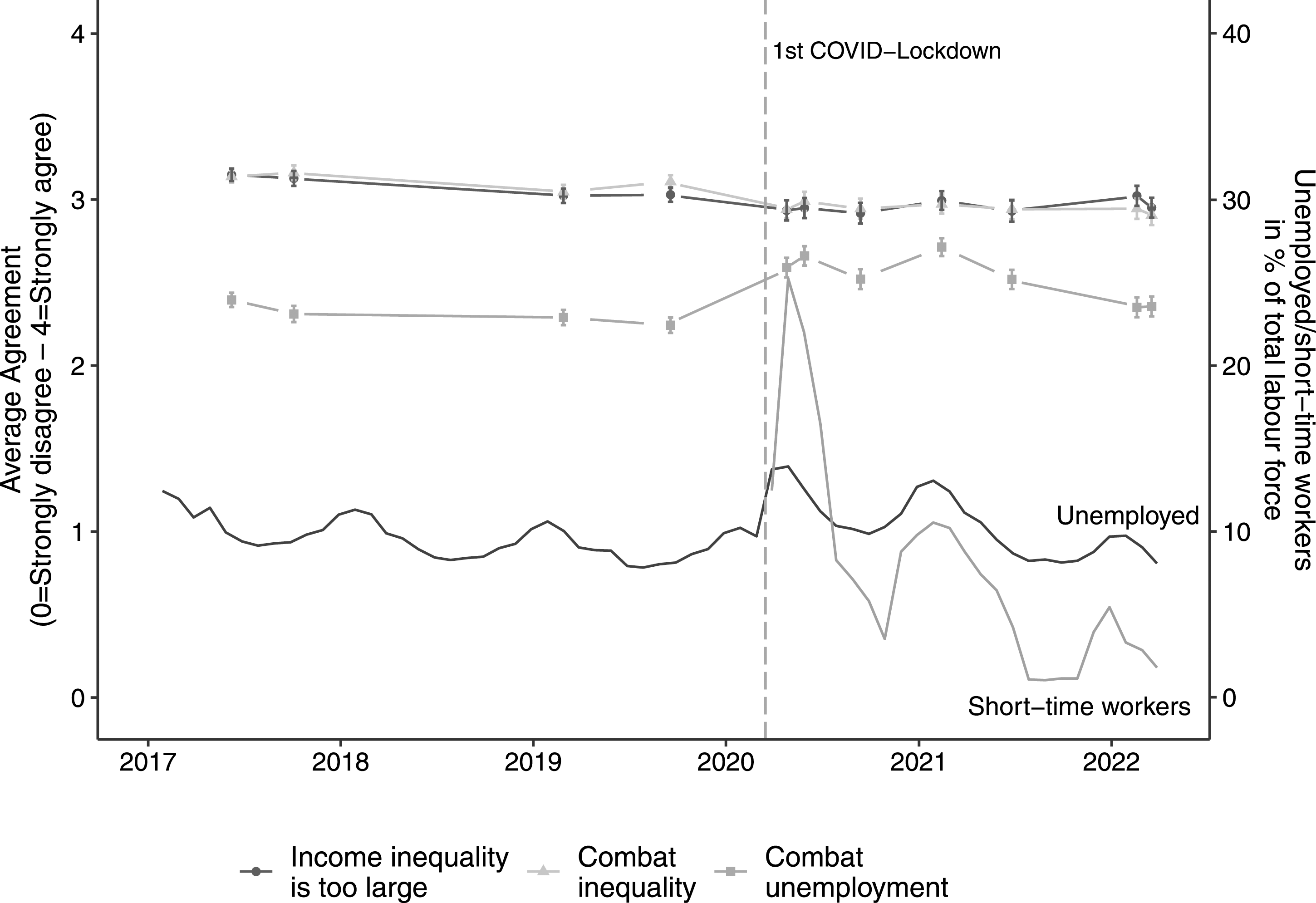
Figure 1 gives an overview of the recent dynamics in the labour market and welfare attitudes in Austria. 2 These data suggest steady support in the general population for government action to combat unemployment with a slight uptick during the first COVID-19 lockdown in early 2020. However, by mid-2022 support had reverted back to pre-crisis levels. Notably, these trajectories have tended to go in lockstep with the number of unemployed and those in short-time work. In contrast, attitudes towards social inequality and the government’s responsibility to fight inequality, have remained nearly unchanged. As a first approximation, these aggregated data suggest that the COVID-19 crisis was associated with some, albeit transient, attitudinal change in Austria, concentrated on unemployment-related attitudes (for similar results, see de Vries et al., 2023; Ebbinghaus et al., 2022). In the following, we will discuss theoretical explanations for potential drivers of attitude change and afterwards go beyond this aggregate analysis using micro-level data to get robust evidence on individual determinants of welfare benefit preferences.
Determinants of welfare preferences
The determinants of public attitudes towards welfare policies have been a long-standing subject of debate (for a review, see Chung et al., 2018). At the micro level, the literature focuses on two main lines of explanation: economic self-interest and welfare attitudes or values.
In line with theories focusing on the importance of individual’s self-interest, empirical findings suggest that the demand for welfare benefits or redistribution increases when people become unemployed (Naumann et al., 2016), perceive a higher risk of becoming unemployed (Marx, 2014), or experience negative income shocks in general (Owens and Pedulla, 2014). When and why such changes in preferences are permanent remains debated (for a review see Margalit, 2019). Naumann et al. (2016) provide panel data evidence that preference change following temporary unemployment is persistent. Other studies find evidence for a transitional nature of effects. For instance, Margalit (2013), Wehl (2020), and Ahrens (2022), using panel data, all cast doubt on the persistence of preference change following economic hardship. Hence, most of the literature agrees that an individual’s material circumstance plays an important role in explaining welfare preferences and a vast body of evidence particularly points to long-term welfare preferences being rooted in an individual’s economic position (see also, O’Grady, 2017). In contrast, evidence on the effect of sudden changes in economic circumstances on welfare preferences is more mixed.
Alongside economic interests, attitudes and values have been shown to be a robust explanatory factor for welfare preferences in general and preferences for unemployment benefits in particular (Lepianka et al., 2009; Schneider and Castillo, 2015). Within this literature, the influential ‘CARIN’ (i.e., control, attitudes, reciprocity, identity, and need) framework highlights multiple dimensions of people’s views about the deservingness of the unemployed that may explain welfare preferences (van Oorschot, 2000; for alternative frameworks, see also Knotz et al., 2022). Among the explanatory factors considered in this framework, beliefs of control (i.e., whether the unemployed are held responsible for their lack of employment) and reciprocity (i.e., whether the unemployed are considered to contribute to society) could be particularly susceptible to changes during times of crisis (see e.g., Uunk and van Oorschot, 2019). Widespread unemployment as a consequence of an exogenous shock may nourish the belief that unemployment is a consequence of bad luck rather than a person’s own failure, and thus increase support for welfare benefits during crises (Fong, 2001). Moreover, experiencing unemployment oneself may change one’s beliefs about the unemployed (Busemeyer and Neimanns, 2017). In line with this expectation, initial evidence from the COVID-19 pandemic suggests that COVID related unemployment claimants were perceived as more deserving, and that blame and control were the most important factors individuals used to justify COVID related benefits, although general welfare attitudes changed little (Bridgman et al., 2022; de Vries et al., 2023).
The literature, thus, provides evidence that, following economic shocks, individuals sometimes update their welfare preferences in line with the expectations of models focusing on individual material self-interest and individual’s welfare attitudes. However, these findings appear to be context-dependent and it remains debated when and how attitudinal changes during crises can foster welfare solidarity in general.
Explaining the structure of welfare preferences
A potential reason for the literature’s inconclusive findings could be the inferential leap from very abstract measures of welfare preferences and the specific social mechanisms which theories posit. Widely used measures such as respondents’ agreement with the statement that ‘the government should provide a decent standard of living for the unemployed’ (ISSP) are essentially inadequate to test specific underlying social mechanisms. For instance, high-income earners may prefer larger welfare benefits if these are not targeted at the poor and labour-market outsiders might prefer lower welfare benefits if they are not eligible (see e.g., Beramendi and Rehm, 2016; Berens and Gelepithis, 2019; Korpi and Palme, 1998). Moreover, people’s deservingness perceptions might be targeted at specific groups of welfare claimants as people may use beneficiaries’ characteristics or stereotypes as cues to evaluate their control over their circumstances or willingness to reciprocate (Aarøe and Petersen, 2014; de Vries et al., 2022). Thus, individuals’ support for benefits for ‘the unemployed’ should be stratified by their views about specific types of benefit recipients and one’s perceived risk of becoming a specific type of beneficiary oneself.
Following these arguments, we thus study the preference for specific forms of stratification embedded in the system of redistribution asking not only how much benefits should be provided but who should benefit. This approach acknowledges previous results suggesting that individuals’ preferences depend on the institutional setting and the target group (Busemeyer and Neimanns, 2017; Gingrich and Ansell, 2012; van Oorschot and Meuleman, 2014). Stratified preferences might also explain why previous research often failed to detect the expected aggregate changes in welfare preferences following economic crises as these could lead to preference polarization rather than to general increases in demand for welfare benefits.
In what follows, we test the key contenders for explaining welfare preferences in the context of the COVID-19 labour market disruptions using a differentiated measure which allows respondents to allocate welfare benefits depending on the economic status of the potential recipients and the specific policy. Following self-interest theories, we expect that individuals discriminate in favour of their ingroup, defined by (i) their own income class (high vs low) and (ii) their own beneficiary status (unemployed vs short-time work): that is, first (H1a), the higher one’s income the more an individual will prefer higher welfare benefits for high-income earners compared to low-income earners. We refer to this as the material income discrimination hypothesis. Second (H1b), compared to those in employment, individuals on short-time work are expected to prefer higher welfare benefits for short-term workers than for unemployed individuals, while the opposite should be true for the unemployed. We refer to this as the material status discrimination hypothesis. Furthermore, following expectations of theories stressing the importance of people’s values and beliefs, we expect that individuals’ attitudes about the unemployed affect the structure of their social benefit preferences. Thus (H2), we hypothesize that negative attitudes towards the unemployed should increase status discrimination against the unemployed in favour of those in short-time work. We refer to this as the attitudinal status discrimination hypothesis.
Method and data
We fielded a question module on the preferred level of income replacement for the unemployed and short-time workers as part of a panel survey (the Austrian Corona Panel Project, ACPP). ACPP is a non-probability web-survey of Austrian residents aged 14 and above. The survey is quota-sampled based on age, gender, age * gender, region, municipality size, and educational level, and managed to depict individuals’ employment status and party preferences quite accurately when compared with governmental data (see Kittel et al., 2020). Our question battery was included in five waves: May 2020, August 2020, February 2021, October 2021, and February 2022.
Respondents’ preferred income replacement
To elicit respondents’ preferred levels of income replacement for the unemployed and short-time workers, we designed a question battery in the style of a factorial survey. Respondents were asked to imagine a person who had been in full-time employment in the previous year and had no children. Respondents were then asked to specify how much money (in euros) this vignette person should receive from the government (i) if they become unemployed or (ii) if they are put on short-time work. The question battery further distinguished between the vignette person having previously earned a gross income of either (iii) €1500 or (iv) €5000. 3 Every survey participant, thus, contributed responses on each of these four entitlement conditions given by employment status and previous income (see Appendix A for the full question wording). To avoid biases by anchoring or learning effects, we randomized the order of conditions across respondents. For easier interpretation, we express the preferred benefit levels as a percentage of the previous gross income and refer to this as the ‘preferred gross replacement rate’ (RR) but provide robustness checks showing substantially similar results using preference allocations in euros (Appendix H).
To test our theoretical expectations, we calculate two different measures of respondents’ preferred gross replacement rates based on the four entitlement conditions: first, we calculate the difference between the average replacement rate for short-time workers and the average replacement rate for the unemployed. The variable thus expresses, in percentage points, respondents’ level of status discrimination in favour of short-time workers compared to the unemployed. Second, we calculate the difference between the average replacement rate for low-income earners and the average replacement rate for high-income earners. This indicator measures, in percentage points, respondents’ level of income discrimination in favour of high-income earners compared to low-income earners (a comparison of average replacement rate preferences to traditional indicators of unemployment-related welfare preferences reveals that they are highly correlated; we provide a detailed analyses on this issue in Appendix C).
Explanatory variables
We first consider indicators of economic self-interest to explain variation in benefit preferences. To that end, we draw on two dimensions of respondents’ economic status corresponding to the construction of our dependent variable, namely employment status and income. Following our hypotheses (H1a and H1b), we expect respondents to prefer relatively higher replacement rates for entitlement conditions that match their own employment status and income level.
Our analyses focus on the sub-sample of respondents actively participating in the labour force as only those people are eligible to receive the welfare benefits analysed here. To measure respondents’ employment status, we use dummy variables differentiating between respondents who are currently employed/self-employed, unemployed, or on short-time work when participating in a specific survey wave. In addition, we also calculate dummy variables for unemployment or short-time work experience which assume a persistent impact even after taking up employment again (similar to a ‘scarring effect’). This approach enables us to account for unemployment or short-time work experience that happened between or before the survey waves that contain the question module on welfare preferences.
To measure respondents’ income, we use a question that asks respondents to specify their disposable household income using 10 income brackets which roughly correspond to the income deciles in Austria. We use the midpoint of these income brackets to calculate an estimate for the absolute amount of income in euros and a Pareto approximation to calculate the income for the open-ended top income bracket (Hout, 2004).
As an indicator for respondents’ attitudes towards the unemployed we use agreement on the following question: ‘Most unemployed people do not really try to find a job.’ Respondents could answer on a five-point rating scale ranging from 0 (fully disagree) to 4 (fully agree). This question has previously been used elsewhere to operationalize negative attitudes toward the unemployed and was part of the European Social Survey (see Buffel and van de Velde, 2019). In addition, this attitude has also been linked to the deservingness dimensions of reciprocity (as people are perceived to lack the willingness to give back to society) (León, 2012) and control (as unemployment can in part be explained by unemployed workers’ lack of effort to accept/search for employment) (van Oorschot and Meuleman, 2014). Thus, we use an established measure of ‘general image of the unemployed’ to capture essential parts of multiple deservingness dimensions which might be particularly susceptible to change during the pandemic (see e.g., de Vries et al., 2023). To improve the comparability of effect sizes, we Z-standardize this variable.
Finally, following established conventions in research on welfare preferences, we control for respondents’ gender (male/female), age (in years), level of education (primary, vocational training (‘Lehre’), secondary, tertiary), and political orientation using a standard left/right question in the pooled OLS models. In addition, we also control for a respondent’s average preferred replacement rate over all four entitlement conditions to avoid confounding due to changes in preferences for general welfare generosity.
Estimation strategy
To test our hypotheses, we estimate two models for each of the two dependent variables (i.e., for income discrimination and status discrimination). First, we provide basic estimates about the relationships between our variables of interest using pooled OLS-regressions with wave-fixed effects to account for average changes between time periods. This should avoid potential confounding due to policy changes, overall changes in the perceived labour market risks due to the pandemic or the salience of our labour market policies. These waves fixed effects regressions provides us with an understanding of the correlational structure of our data. Next, individual-fixed effects are added (2FE) to control for stable unobserved confounders. As our main independent variables of interest could also act as mediators (e.g., the effect of employment status on preferences could be mediated by changes in the attitudes towards the unemployed), we also check if models excluding potential mediators show different effects on individuals’ attitudes.
Sample
A total of 1707 respondents actively participating in the labour market participated in at least one of the five survey waves. As we focus on variation within individuals, we reduce the sample to respondents who provided non-missing answers in at least two waves, resulting in 832 individuals providing 2775 observations with 11,100 evaluated entitlement conditions.
Balance checks show that respondents who were excluded from the analyses prefer, on average, lower and slightly less progressive replacement rates, have less household income, and are more likely to be female, younger, and have a secondary education. Crucially, those remaining in the sample are similar to those who were excluded with regard to the main independent variables of interest: employment status and attitudes towards the unemployed. Utilizing inverse probability weights to partially account for the potential biases due to panel attrition, led to nearly identical results compared to the unweighted estimates we provide here (see Appendix D). In addition, we also checked the answers for consistency excluding preference-outliers and individuals who were potentially straight-lining. We provide these estimates, which are substantially similar to our main model, in Appendix G.
Results and discussion
Preferred gross replacement rates across different entitlement conditions
Pooling all panel waves, we find a substantial degree of variation in respondents’ preferred replacement rates both across respondents and between different entitlement conditions (Figure 2). In the low-income scenario of €1,500, respondents on average prefer higher replacement rates for short-time workers than for the unemployed (diff = 5.77, t = 9.92, p < .001). Only a few respondents preferred replacement rates for low-income earners below 50%, which could be interpreted as a norm for a basic-needs threshold. In the high-income scenario of €5,000, respondents again prefer higher replacement rates for short-time workers compared to the unemployed (diff = 8.82, t = 14.26, p < .001). In comparison to the low-income scenario, we find more dispersed answers, although the share of respondents who prefer benefit levels of €1000 or less is low, suggesting, again, large agreement with at least basic needs provision. Distribution of gross replacement rate by employment status and income level. Note: Distributions are calculated across all five survey waves. Refer to Appendix B for changes in average preferences over the survey waves. Points indicate subgroup means and 95% confidence intervals. N = 2775 per subgroup. Source: ACPP.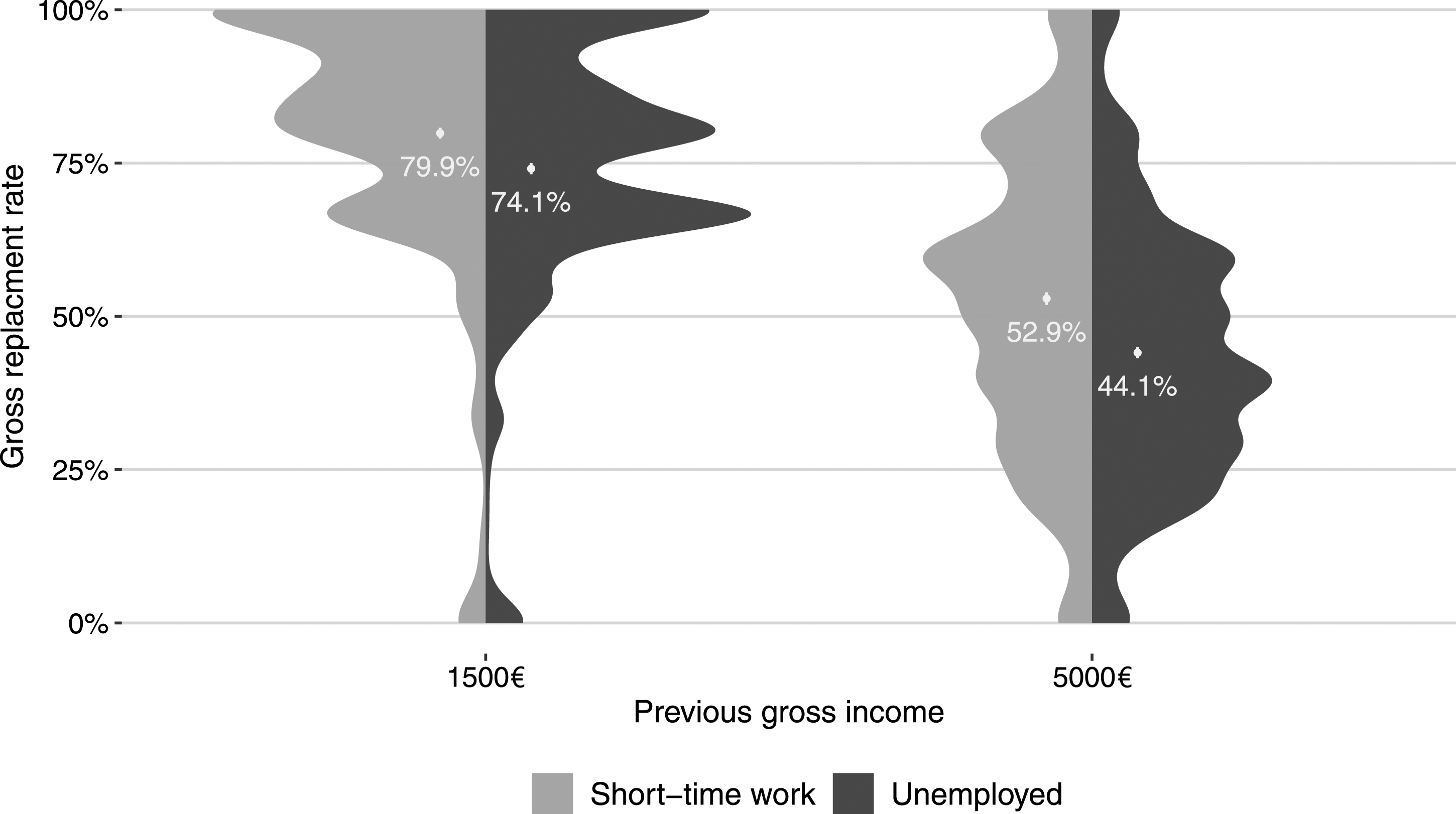
The overall differences between the two income conditions are substantial. Respondents prefer much higher replacement rates for low-income earners compared to high-income earners, irrespective of labour market status (short-time work diff = 26.96, t = 43.77, p < .001; unemployed: diff = 30.02, t = 51.30, p < .001). On average, these preferences are also quite stable over time (for details refer to Appendix B Figure B1). Thus, we find cross-sectional evidence for moderate status discrimination in favour of short-time workers and strong income discrimination in favour of low-income earners suggesting that individuals indeed differentiate by benefit group and economic status.
Determinants of income and status discrimination
We first analyse the determinants of income discrimination (i.e., differences in respondents’ preferred replacement rates between low-income and high-income beneficiaries). Figure 3(a) displays the coefficient sizes from our two regression models. In our pooled regression model with wave-fixed effects, we find that, as expected (H1a), the higher respondents’ household income, the more generous are their preferred replacement rates for high-income beneficiaries compared to low-income beneficiaries. This effect is, however, not statistically significant in the model including individual-fixed effects. The coefficient also remains similar in size if we do not include controls for employment changes and changes in attitudes which could be potential mediators of the income effect (see results in Appendix F model 3 and Appendix I). Both the status of short-time work and of unemployment are also associated with somewhat higher preferred replacement rates for high-income beneficiaries (but only unemployment in the pooled model is statistically significant at 5%). Effects on the difference between replacement rate for (A) low-income earners minus replacement rate for high-income earners (income discrimination); (B) the unemployed minus replacement rate for short-time workers (status discrimination). Note: Linear regression model with wave-fixed effects (wave FE) and linear regression model with wave and individual-fixed effects (wave FE + ID FE); 90% (thick) and 95% (thin) confidence intervals (whiskers) are calculated using individual-level clustered standard errors. Control variables not shown here. The attitude variable is Z-standardised. Full estimates are provided in Appendix E (status discrimination) and F (income discrimination) model 1 and 2. Source: ACPP.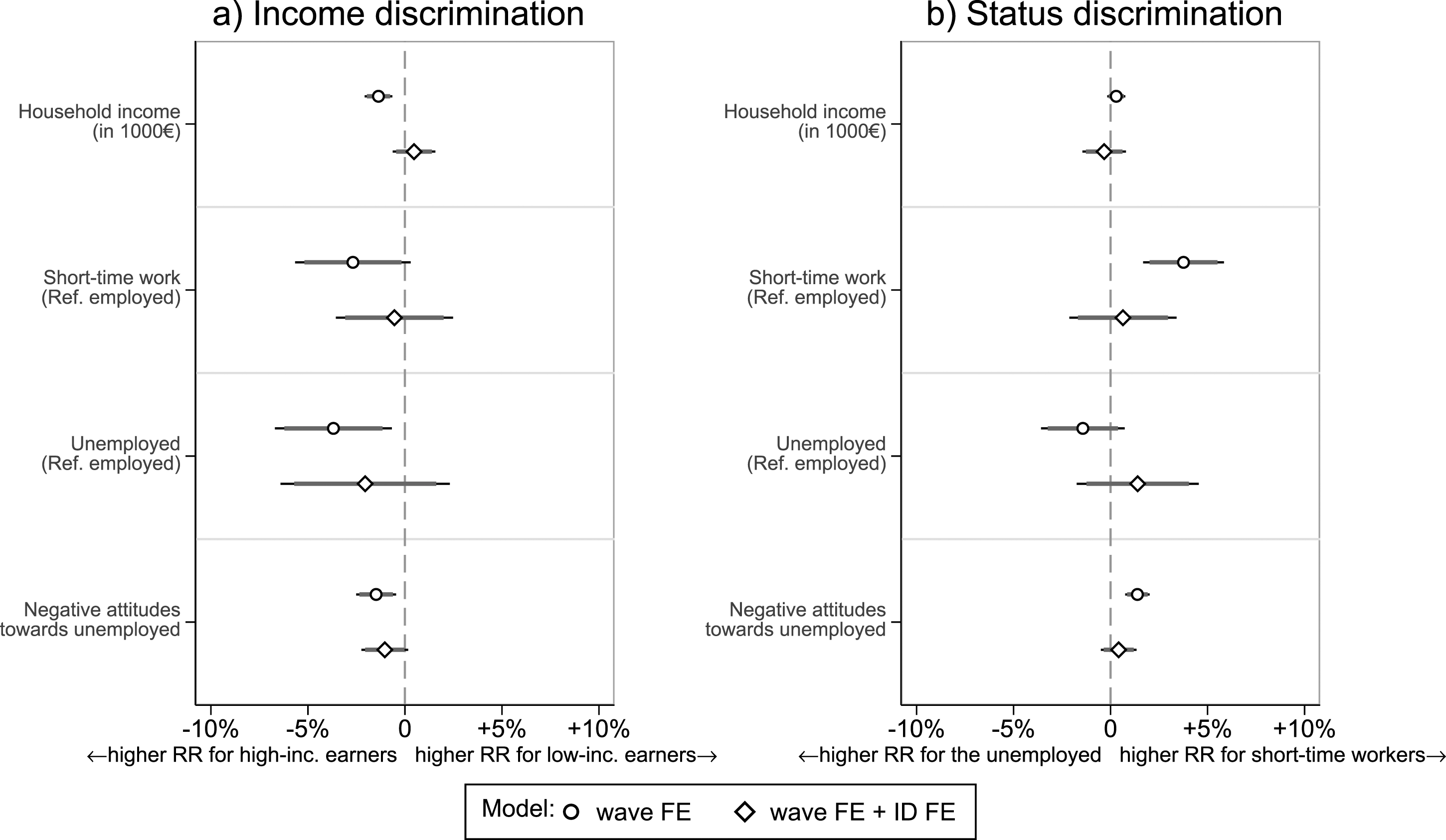
Surprisingly, negative attitudes towards the unemployed are predictive of higher income discrimination. The effect is only statistically significant at the 10% level in the 2FE model, but remains robust in size and improves to the 5% level if we improve precision by including respondents who are not actively participating in the labour-market in the model (which is viable here as all can experience a change in unemployment attitudes, see Appendix G for the estimates). This suggests that an increase in negative attitudes towards the unemployed over time is associated with a reduction in individuals’ preferred replacement rates for low-income beneficiaries compared to high-income beneficiaries. Note that we find these effects despite our question wording specifying that the unemployed vignette person had pursued full-time work in the previous year. Therefore, different beliefs regarding the employment duration of high-income or low-income earners should not drive our results. Analysing the preferred rates for low and high incomes separately shows that this result can be explained by the substantially larger negative relationship between negative attitudes towards the unemployed and individuals’ preferred replacement rates for low-income earners (β = −1.6%-points, p = .01) compared to the relationship between negative attitudes towards the unemployed and the preferred replacement rates for high-income earners (β = −0.6%-points, p = .34). Refer to Appendix F models 4 and 5 for the full regression results. Thus, when negative attitudes towards the unemployed increase, individuals reduce their preferred replacement rate for low-income earners. This leads to an increased income discrimination to the disadvantage of the poor.
Turning to the determinants of status discrimination (i.e., differences in respondents’ preferred replacement rates between beneficiaries on short-time work and those in unemployment), we find that, in the pooled model, being on short-time work is associated with higher preferred replacement rates for beneficiaries on short-time work relative to the unemployed (Figure 3(b)). Being unemployed, on the other hand, is associated with status discrimination in favour of the unemployed but the effect is not statistically significant at 5% and thus provides mixed evidence for H1b. Neither coefficient reaches conventional levels of statistical significance in the 2FE model. This is also true if we only include employment status in the 2FE model, to avoid potential mediation issues, or if we add an indicator of the share of short-time workers versus those who are unemployed in the respondents’ sector of employment to account for the possibility that respondents might adapt preferences ahead of labour-market status changes in anticipation of higher unemployment or short-time risks in their occupation (see Appendix E model 3 and 6 and Appendix I).
A potential reason for why we do not find the expected changes in preferences in response to changes in individuals’ labour-market status could be that individuals permanently adapt their preferences after experiencing unemployment or short-time work. Preferences would then remain unchanged after reemployment. To test this, we use an alternative treatment function that analyses whether previous unemployment or short-time work experience explains individuals’ preferred status discrimination. Results show that respondents who ever experienced unemployment prefer relatively higher unemployment benefits than those who never experienced unemployment during the observation period (β = −1.7%-points, p < .01) and respondents who ever experienced short-time work prefer relatively higher short-time work benefits than those who never experience short-time work (β = 2.6%-points, p = .02; refer to Appendix E models 4 and 5 for the full estimates). Using this approach, the effects on status discrimination thus meet the expectations of self-interest theories in the pooled model. However, neither of these effects are statistically significant at the 5%-level in the 2FE model. Thus, we do not find consistent evidence that respondents permanently change their benefit preferences after experiencing unemployment or short-time work.
As expected (H2), negative attitudes towards the unemployed are positively correlated to status discrimination in favour of short-time workers (see Figure 3(b)) but this effect becomes statistically insignificant in the 2FE model. However, analysing individuals’ preferred replacement rates for unemployed beneficiaries and short-time workers separately (including 2FE), we find that increasing negative attitudes towards the unemployed decrease the preferred replacement rate for the unemployed (β = −1.3%-points, p = .03). Similarly, we also find a negative relationship between negative attitudes towards the unemployed and individuals’ preferred replacement rates for high-income earners (β = −1.0%-points, p = .12; refer to Appendix E models 7 and 8 for the full regression results). Thus, although the difference in the effects is too small to detect attitudinal status discrimination in our sample, we find that negative unemployment attitudes decrease individuals’ preferred replacement rates for the unemployed.
Discussion and conclusion
It has been a long-standing objective of social research to understand the factors influencing individuals’ welfare preferences. Social policies adopted during the COVID-19 pandemic provide a new arena to study this question. Numerous governments adopted ‘short-time’ work schemes which supplement the incomes of workers who would otherwise be laid off. Such measures not only increase the scope of the welfare state but also have the potential to dualize passive labour-market policies and may spark conflicts over the right level and recipients of benefits.
We draw on data from an online panel survey fielded in Austria during 2020–2022 to study individual preferences towards the structure of benefits to the unemployed and to short-time workers. Our results show that individuals prefer higher welfare benefits, measured in individuals’ preferred gross replacement rate, for low-income recipients and for those on short-time work compared to high-income recipients and those in unemployment. Studying the determinants of discriminatory preferences for welfare benefits, we find cross-sectional evidence that both material self-interest and attitudes towards the unemployed matter for explaining the structure of preferences. Longitudinally, we find no evidence that discrimination is driven by individuals’ material self-interest operationalized by changes in individual’s income or labour market status. Results on the importance of welfare attitudes are more mixed as we find that negative attitudes towards the unemployed are most detrimental for social policy preferences targeted at the low-income earners, but do not lead to stronger negative discrimination of the unemployed compared to short-time workers.
Our results speak to several debates in the literature. First, we find that individuals clearly positively discriminate against individuals who are on short-time work compared to individuals in unemployment. This is especially relevant as this holds true despite the fact that we explicitly specified that both types of hypothetical claimants are currently not working at all and had similar employment durations and earnings before applying for benefits. Hence, people seem to have a pro-work bias that remains even if the formal contract is the only transparent difference remaining to the unemployed. Two factors might be important here. First, the fact that short-time workers indeed had larger benefits than the unemployed in Austria may have led to a positive feedback effect in favour of short-time workers. Second, short-time workers may have benefited from a signalling effect as the willingness to work might be more salient compared to the unemployed and because the source of underemployment was easier to tie to the COVID-pandemic which has been shown to increase the perceived deservingness (de Vries et al., 2023) and preferred benefit allocations (Bridgman et al., 2022).
Second, we find that welfare preferences remained remarkably stable amid one of the most severe labour-market crises in recent history. This resonates with findings from other countries (Busemeyer, 2023; de Vries et al., 2023; Ebbinghaus et al., 2022) and also chimes with our finding that changes in individuals’ labour market status cannot explain individual welfare preferences during the pandemic. Specifically, our results indicate that the dualized social policy structure during the COVID-19 pandemic did not lead to an increase, or during our observation period of labour market stabilization, a decrease in preference stratification as people became employed again. This is the case despite our research design creating a most-likely case to find the expected link between material conditions and social policy preferences as respondents could easily link their own economic status to the hypothetical claimant we used to elicit people’s preferences. A possible explanation may be that benefit recipients during crises avoid self-identification with these groups either because self-identifying with such groups would be in conflict with individuals’ self-image or because they believe that they are unlikely to experience unemployment or short-term work under non-crisis conditions (Fiske, 2013; Lamont, 2002; Sherman, 2013). Overall, we thus add to a body of evidence finding small or transient effects of changing economic circumstances on individuals’ welfare preferences. Further research is necessary to analyse whether theories emphasizing the importance of deep-seated, time-invariant attitudes are better equipped to explain individual preferences than temporary changes in economic conditions (see also, O’Grady, 2017).
Third, methodologically, we add to the existing literature by using a novel measurement that allows us to analyse how individuals want to structure welfare benefits, moving beyond the often-studied general preferences for welfare benefits. Utilizing this approach, we find that negative attitudes towards the unemployed decrease individuals’ relative support of welfare benefits towards low-income earners. This suggests that an increasingly negative image of the unemployed may be more detrimental to the poor than to the rich. We suggest two potential mechanisms that could explain this finding. First, people might use previous income as an indicator for lower labour market commitment and thus less willingness to reciprocate. This could be especially relevant in our case as we investigate policy instruments that are strongly linked to an insurance function and thus to the reciprocity principle. Second, as low-income workers must be granted proportionally higher replacement rates for their needs to be fulfilled, it is more likely that in such cases people struggle to ‘make work pay’ (Marchal and Marx, 2018) and acknowledge the higher contributions of high-income earners. In this case, people might rely more on their views of the unemployed to decide whether it is justified to provide higher replacement rates for low-income earners to guarantee a decent living standard for all unemployed workers. However, further research is necessary to determine the specific social mechanisms at work.
Our study also has several limitations. Our period of observation does not include a pre-crisis baseline. This means not only potentially less variance in our variables of interest, but also that we may miss effects on the dependent variable if these are asymmetrical. If becoming unemployed shifts welfare preferences but re-employment does not, our sample would underestimate the effects of unemployment. Furthermore, we rely on data from a non-probability web survey which limits our ability to make claims about the effects within the general population. Moreover, we focus on studying policy instruments where it is evident that people contributed to the welfare state by participating in the labour market. Thus, our results might not apply to other social policies that focus on basic need provision or provide general benefits in times of crisis. Finally, a further limitation concerns the specific COVID-19 context itself. While we tried to control for the most important general COVID induced changes in labour market sentiments and attitudes by including wave fixed-effects in our analyses, the characteristics of the pandemic – as a clear external shock on the labour market – may limit its comparability to other crises contexts. However, we would argue that specific policy context in which governments tried to bolster the negative effects on the labour market via short-time work measures is structurally similar to the strategies of other countries after the financial crisis and its apparent success suggests that short-time work programmes will likely be reintroduced during future crises (Hijzen and Martin, 2013; Müller et al., 2022).
Supplemental Material
Supplemental Material - How much for whom? Explaining preferences for welfare benefits to short-time workers and the unemployed
Supplemental Material for How much for whom? Explaining preferences for welfare benefits to short-time workers and the unemployed by Fabian Kalleitner, Lukas Schlogl and Licia Bobzien in Journal of European Social Policy.
Footnotes
Acknowledgements
We would like to thank participants at the European Network for Social Policy Analysis (Espanet) Conference 2022 for helpful comments on an earlier version of this article.
Declaration of conflicting interests
The author(s) declared no potential conflicts of interest with respect to the research, authorship, and/or publication of this article.
Funding
The author(s) disclosed receipt of the following financial support for the research, authorship, and/or publication of this article: This work was supported by the Fund for Digitalisation of the Vienna Chamber of Labour, Austria and the project ‘3–45 WoCo (Work & Corona),’ and by the Grant Scheme ‘Cohesion in Europe’ funded by the German Federal Ministry of Education and Research.
Ethical statement

Data availability statement
The data can be accessed upon registration at the Austrian Social Science Data Archive: https://doi.org/10.11587/28KQNS. The statistical code used in the analyses presented in this article can be found at https://doi.org/10.17605/OSF.IO/3QPMW.
Supplemental Material
Supplemental material for this article is available online.
Notes
References
Supplementary Material
Please find the following supplemental material available below.
For Open Access articles published under a Creative Commons License, all supplemental material carries the same license as the article it is associated with.
For non-Open Access articles published, all supplemental material carries a non-exclusive license, and permission requests for re-use of supplemental material or any part of supplemental material shall be sent directly to the copyright owner as specified in the copyright notice associated with the article.
