




Abstract
This article examines the impact of the two world wars on welfare legislation in 16 western countries. We use Poisson regressions to test our hypothesis that war was a catalyst of welfare legislation, especially in countries that were heavily exposed to the dreadful effects of war. By welfare legislation, we mean the inaugural adoption and major reforms across four programmes (old age and disability benefits, sickness and maternity benefits, unemployment compensation and family allowances). Our findings suggest that both world wars are key factors for explaining the timing of comprehensive welfare reforms and outweigh the significance of other factors such as regime type or level of economic development.
Introduction
The impact of war and other national emergencies on the development of welfare states in the western world has recently attracted growing attention (Castles, 2010; Obinger et al., 2018; Rehm, 2016). The horrors caused by both world wars created a huge demand for social protection that states were well-placed to fill, leading them to provide income for invalids, war victims and the survivors of fallen servicemen. Moreover, demobilized servicemen had to be reintegrated into society via employment, education and housing programmes. The questions of whether and how war has affected welfare state legislation for civilians have, to date, been neglected in comparative social policy research. Although scholars have observed a clustering of reform activities during and after both world wars, the relationship between war and the introduction and reform of social security programmes has never been systematically examined.
This article aims to fill this research gap. Focusing on four major social protection schemes, 1 we examine the impact of the two world wars on the timing of welfare legislation in 16 western countries. 2 These nations are characterized by very different war experiences, as some countries were involved in both world wars, while others were not. Some belligerent countries fought in war theatres overseas, while others suffered from severe destruction to their homeland. This variation is essential for studying the impact of war on welfare state legislation. We use Poisson regressions to examine this relationship in which the number of welfare acts (programme introduction and major reforms) across the four social protection schemes is our main dependent variable. As the main independent variable, we constructed an index of war intensity measuring the extent to which a country has been affected by war. Our findings suggest that both world wars are key determinants for explaining comprehensive welfare reforms that outweigh the significance of other factors such as regime type or level of economic development.
The remainder of this article is organized as follows. The next section briefly summarizes the state of the art related to the warfare–welfare nexus. The third section discusses possible mechanisms through which war has left its imprint on welfare reform. The fourth section presents the data and methodology and illustrates some descriptive evidence of how warfare and the adoption of welfare schemes are related. The section after that reports the empirical findings of the multivariate analysis. The final section concludes.
War in the comparative welfare state literature
Beginning with Titmuss (1958), several scholars have argued that war has influenced the development of western welfare states. The most obvious and direct impact of warfare on social policy is the establishment of categorical social protection schemes for disabled veterans, dependents of killed servicemen and civilian victims of war (Gerber, 2001; Geyer, 1983). As a result of advances in military technology and the spread of conscription, the number of war casualties reached unprecedented levels in the age of industrial mass warfare. Welfare provision for this group of beneficiaries entailed important but ambiguous consequences for the development of the civilian welfare state. While (generous) veterans’ benefits impeded or even crowded out welfare entitlements for civilians in some countries (Mittelstadt, 2015; Shalev and Gal, 2018; Skocpol, 1992), other scholars emphasized that veterans’ benefits have been harbingers of the welfare state in the long run as these schemes relied on new principles of entitlement or included new policies that later expanded into civilian welfare provision (Geyer, 1983). A second impact of war refers to social spending. Dryzek and Goodin (1986) found in their seminal paper, a substantial push effect of the Second World War on social expenditure. However, this war-induced increase in social spending cannot be simply attributed to the newly established social protection schemes for veterans and their dependents. Obinger and Schmitt (2018) have shown that the Second World War has also significantly raised civilian social expenditure over a period of approximately 30 years. This impact of war on spending levels is closely connected to a third war-induced effect, namely the introduction of income and inheritance taxation and the massive expansion of tax progressivity in wartime (Scheve and Stasavage, 2010, 2012, 2016). Although the tax burden was abated after the end of war, the tax rates imposed in wartime never returned to the pre-war level (Peacock and Wiseman, 1961; Scheve and Stasavage, 2010).
Apart from the newly established veterans’ benefits and the fiscal effects of war, however, other social policy legacies of war have not been systematically studied in comparative perspective. One blind spot refers to the impact of war on programme adoption. Did war lead to the introduction of new (civilian) welfare schemes or to major amendments of existing programmes? Case study evidence suggests a close nexus between military conflict and welfare legislation. In particular, British historiography has pointed to significant war-induced shifts in social policy legislation. This holds true for the Boer Wars (Dwork, 1987), the First World War (Edgerton, 2018) and, particularly, the Second World War (Titmuss, 1958: 81–84). The British historian Asa Briggs (1961) even noted that ‘war seems to have been as relevant as the appeal of socialism in determining the practicability and popularity of introducing comprehensive welfare proposals’ (p. 223). Australia enacted several new welfare programmes during the Second World War (De Maria, 1989; Lloyd and Battin, 2018), whereas Japan introduced not only old age pensions but also launched a major extension of health insurance during the Pacific War (Kasza, 2002). Preller (1978) has argued for Germany that the First World War was the key catalyst of the welfare state in the Weimar Republic. Other belligerent nations of the First World War such as Italy, Britain and Austria introduced or extended unemployment insurance shortly after armistice (Ferrera, 2018; Gilbert, 1970; Pribram, 1920; United States Department of Labor, 1931).
Comparative research has also pointed to a striking coincidence between war and the timing of welfare legislation. Studying social policy innovation in 18 countries, Abbott and DeViney (1992) find that welfare legislation related to health insurance, pensions, workmen’s compensation and unemployment insurance has substantial peaks during and right after the First World War, whereas ‘family allowances are clearly tied to the Second World War’ (pp. 268–269). Emmenegger (2014) observes a close correspondence between job protection legislation and war in several European countries. Obinger et al. (2018) present diffusion charts of welfare legislation in 18 western countries which indicate a close nexus between war and unemployment insurance legislation (First World War) and the introduction of family allowances (Second World War). Like Abbott and DeViney (1992), however, they do not investigate the reasons for this pattern. By contrast, all comparative inquiries which empirically examined the factors accounting for cross-national differences in the temporal adoption of welfare legislation neglected war completely (Alber, 1982; Carroll, 1999; Collier and Messick, 1975; Cutright, 1965; Flora and Alber, 1981; Hicks et al., 1995; Kangas, 2012; Schmitt et al., 2015; Schneider and Ingraham, 1984; Usui, 1994). Both world wars are nevertheless widely seen as crucial watersheds in the history of the welfare state. Flora and Alber (1981) and Alber (1982), for example, distinguish between three distinct phases of welfare state development in the western world which are separated from each other by the two world wars. 3 Although this classification suggests that both world wars were crucial turning points in social policy development, it remains unclear in these accounts why and how large-scale military conflict changed the course of welfare state development. The next section therefore discusses mechanisms through which war and welfare legislation might be causally related.
Why does war matter for welfare legislation? Theoretical reflections and hypotheses
From a theoretical perspective, there are two main channels through which war might affect welfare legislation. 4 The first is a demand-side impact, which is related to the horrors of war. Seen from a functionalist point of view, the cruelties of war generate the need for social protection of a magnitude that required government action. These social needs are direct effects of warfare as they would not have occurred in the absence of military conflict. Belligerent countries needed to provide income support to disabled veterans and to the dependents of killed servicemen. Veterans also needed healthcare and assistance for successful reintegration into society and labour markets. This included, at least for a transition period, the provision of unemployment benefits, housing programmes, education and vocational training.
Social needs were even greater in countries that suffered from acts of war on their home territory. Apart from the military war victims, these countries were confronted with large numbers of civilian casualties, notably during the Second World War. This group of war victims consisted of war refugees, victims of persecution, civilians injured by military hostilities, homeless civilians (e.g. because of air strikes) and the dependents of civilians who were killed in acts of warfare or died of war-induced hunger and diseases. Acts of war on the homeland also had a tremendous impact on the economy. Destruction of production sites and infrastructure, military demobilization and the lay-offs in the munitions industry led to high levels of unemployment and poverty at the end of war. In addition, large segments of the population were exhausted in war-torn countries and suffered from rampant diseases. War also had a devastating impact on demographics in these nations. Birth rates declined, infant mortality increased and millions of procreative young men were killed in combat. Moreover, the horrors of war changed individual preferences and nurtured a higher demand for public social protection as wartime uncertainty, the collapse of financial markets and the loss of household assets in war-torn economies led to higher preferences for redistribution and risk-pooling, that is, collective insurance (Dryzek and Goodin, 1986). Following the seminal study by Dryzek and Goodin, Rehm (2016) argues that national emergencies massively change the distribution of risk in society. Mass warfare, for example, quite likely leads to a substantial ‘risk flip’ towards a more homogeneous risk distribution in society. In such a situation, a majority of the population faces high social risks and the resulting higher demand for public social protection makes, in consequence, the adoption of welfare programmes more likely (Rehm, 2016: 24). However, the extent of a war-induced ‘risk flip’ and the associated demand for social protection is not the same across belligerent countries but rather varies with the intensity of war, that is, the extent to which a country and its population were affected by the horrors of war.
The higher demand for social protection in wartime was reinforced by conscription as the imposition of a risky and potentially deadly civic duty (military service) by the state raised the question of potential compensations after the end of war. Several scholars have argued that conscription and war service nurtured demands for the provision of social and political rights on a quid pro quo basis (Andrzejewski, 1954; Hintze, 1906; Wilensky, 1975). Finally, there is empirical evidence (Bauer et al., 2016; Dudley and Witt, 2004) that exposure to war violence and deprivation strengthened solidarity and cooperation as argued early on by Andrzejewski (1954) and Titmuss (1950, 1958).
The second channel linking warfare and welfare refers to the repercussions of war on the supply-side of the political system. These are well-documented effects that had an impact on the welfare state in a more indirect manner (e.g. Elias, 1982 [1939]); Klausen, 1998; Porter, 1994; Tilly, 1975; Scheve and Stasavage, 2010, 2016). War encouraged the rise of the tax state (via new taxes and tax progressivity), provided governments with new jurisdictions (typically leading to a centralization of government) and led to an expansion of state bureau-cracies (e.g. the first establishment of welfare ministries such as ministries of labour and social affairs). Taken together, these transformations significantly strengthened state capacities and generated the institutional and fiscal means that enabled governments to respond to the colossal social needs generated by the dreadful effects of war. Finally, both world wars were triggers of democratization and electoral reform (e.g. the introduction of proportional representation during and after the First World War in many European countries). This improved the political articulation of social needs and changed, in consequence, not only the power resources of the labour movement in society but also informed political coalition-building, with important implications for redistribution and welfare state patterns in the long run (Iversen and Soskice, 2006; Manow, 2009). 5
Overall, there are many reasons to assume that large-scale interstate wars induced welfare innovations and welfare state reforms. Since a nexus between warfare and the introduction of welfare programmes for veterans is quite trivial, a more appropriate test of this overall argument is to examine the impact of war on the adoption and reform of civilian welfare programmes. In terms of the impact of war on social legislation, two qualifications are in order. First, we assume that the pressure for adopting or amending welfare legislation in response to war-induced social needs should be greater in countries which suffered from acts of war on their home territory than in countries which either fought in foreign war theatres or were not involved in combat activities at all. In other words, we contend that a nation’s particular war experience matters for the timing of welfare legislation (H1). Second, we assume that welfare programmes were mainly adopted immediately after the end of military conflict rather than during war (H2). One reason is that the military attracted tremendous economic resources in wartime 6 that likely crowded out the introduction of expensive transfer-related welfare programmes in wartime. Moreover, there was no pressure during war to introduce unemployment compensation due to the widespread labour scarcity caused by the draft, while military demobilization, lay-offs in the munitions and war-related industries and economic crisis in war-torn nations had the opposite effect immediately after armistice.
In sum, we contend that the probability of welfare legislation increases with war intensity and that the war-related pressure to enact welfare reforms materialized merely in the immediate postwar period.
Data and methods
Our empirical analysis begins with the operationalization of our main variables and some descriptive patterns before proceeding to the multivariate analysis.
Our sample includes 16 western countries that were sovereign states at the onset of the First World War. 7 The period of observation ranges from 1880, when the consolidation of social security programmes had started, until 1955, that is, 10 years after the end of the Second World War.
Our key independent variable is the national intensity of the two world wars. It is a proxy for the social demands (or the risk flip) generated by the horrors of warfare. We use three indicators to measure cross-nationally distinct aspects of warfare and occupation experiences, which are then compiled into an overall index of war intensity (see Obinger and Schmitt, 2018). First, it is of relevance whether military hostilities took place on the home territory or not. Some countries such as Australia, the United States or Canada fought almost exclusively in war theatres overseas. Hence, they escaped large-scale, war-induced destruction on their home territory and had fewer civilian casualties. The war experience in nations whose territories were major battlegrounds and/or that were occupied was markedly different, as they suffered from massive destruction in their homeland and many civilian war casualties. We use a dummy variable for measuring this aspect of warfare which takes the value 1 for war-waging nations and/or occupied countries that experienced military combat within their territory. Our second indicator focuses on the number of military and civilian war victims as a percentage of the pre-war population in the case of the Second World War. For the First World War, we only use military victims as a percentage of the pre-war population as comparable figures for civilian casualties are not available. The third partial indicator reflects the duration of conflict, 8 as it is likely that socio-economic problem pressure and uncertainty increases with the duration of war and occupation. For the second and third indicators, we use data from Dryzek and Goodin (1986) and ‘Correlates of War’ (Marshall et al., 2014) and cross-validated it with data from alternative sources. 9
In a final step, we constructed a composite index of war intensity which is the average of the standardized three indicators. Hence, our index ranges from 0 to 1 and shows high values if a country was heavily affected by the First World War and/or the Second World War and low values otherwise. Our additive index of war intensity reflects several dimensions of warfare and we assume that high values of this index are positively related with war-induced social needs and, in consequence, a high demand for social protection. We furthermore assume that the impact of war intensity on welfare reform only occurs in wartime and shortly thereafter. The war index therefore equals 0 before the outbreak of war and 2 years after armistice (e.g. in the case of the First World War after 1920). 10
Figure 1 shows the war intensity index for all countries from 1880 until 1955, revealing a substantial variation in the extent to which the 16 nations were affected by the two world wars. While some countries were strongly affected by both world wars, such as Germany, Austria and Italy, others were either involved in only one conflict (e.g. Norway) or were not directly involved in war at all, such as Switzerland. This cross-national variation in national war experiences is essential for studying the impact of war on welfare reform.
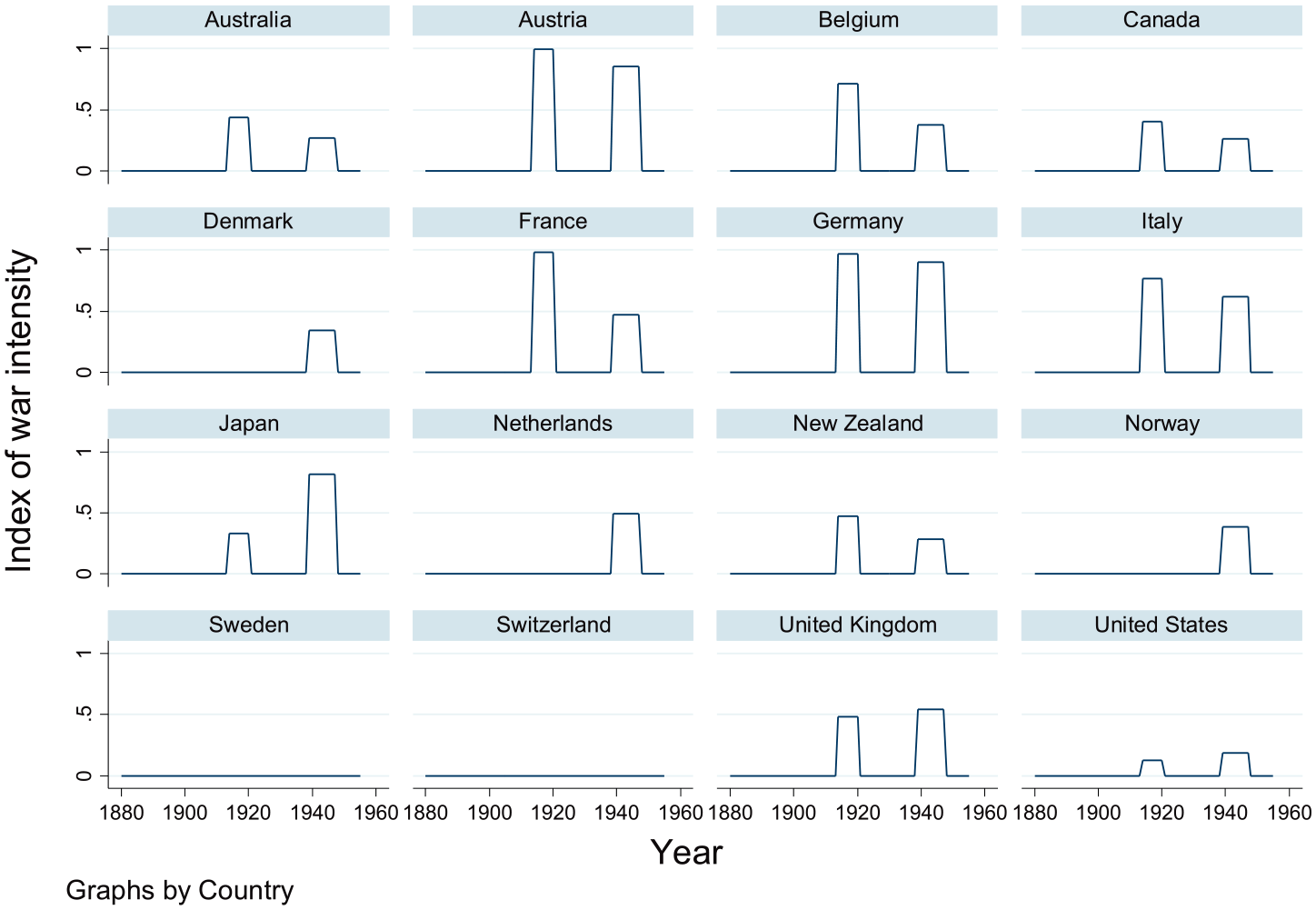
Overall index of war intensity, 1880–1955.
Our key dependent variable is the number of social reforms per year. By social reforms, we mean the initial adoption and/or subsequent major reforms of four major social security programmes, namely (1) old age and disability benefits, (2) sickness and maternity benefits, (3) unemployment compensation and (4) family allowances. Data on social programme consolidation are provided by Hicks et al. (1995) who coded the years of introduction and extensions of social security programmes in the above-mentioned social policy fields. 11 Initial adoption means that a particular social security programme has been introduced at the national level for the first time. Two types of possible extensions are distinguished: (1) making a social programme binding ‘in the sense of being legally compulsory for some set of national actors or virtually binding as in the case of Ghent unemployment programs’ (Hicks et al., 1995: 335) and (2) making a social programme extensively and funded, that is, the scheme covers a notable share of the target group and is adequately funded within some short period to provide notable benefits (see Hicks et al., 1995: 335ff.).
Figure 2 illustrates the number of social reforms per year for 16 countries in the period of observation across the four welfare state programmes. It gives a first clue that war might have swayed welfare legislation in line with our hypotheses as the number of social reforms peaks out during and especially after the end of both world wars. The next section examines whether war is a significant determinant of welfare state reforms if other explanatory factors are taken into account.
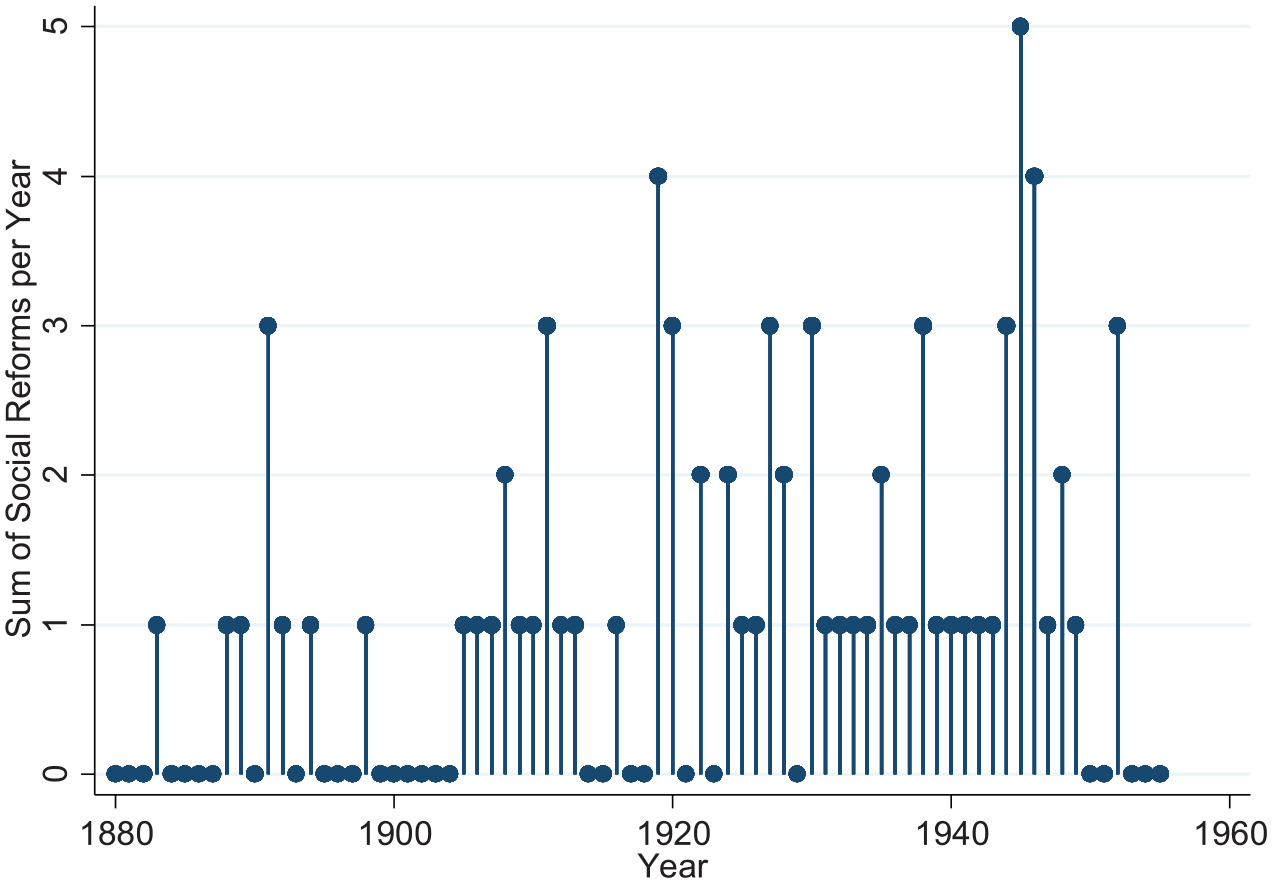
Number of social reforms per year, 1880–1955.
Multivariate analysis: Poisson regressions
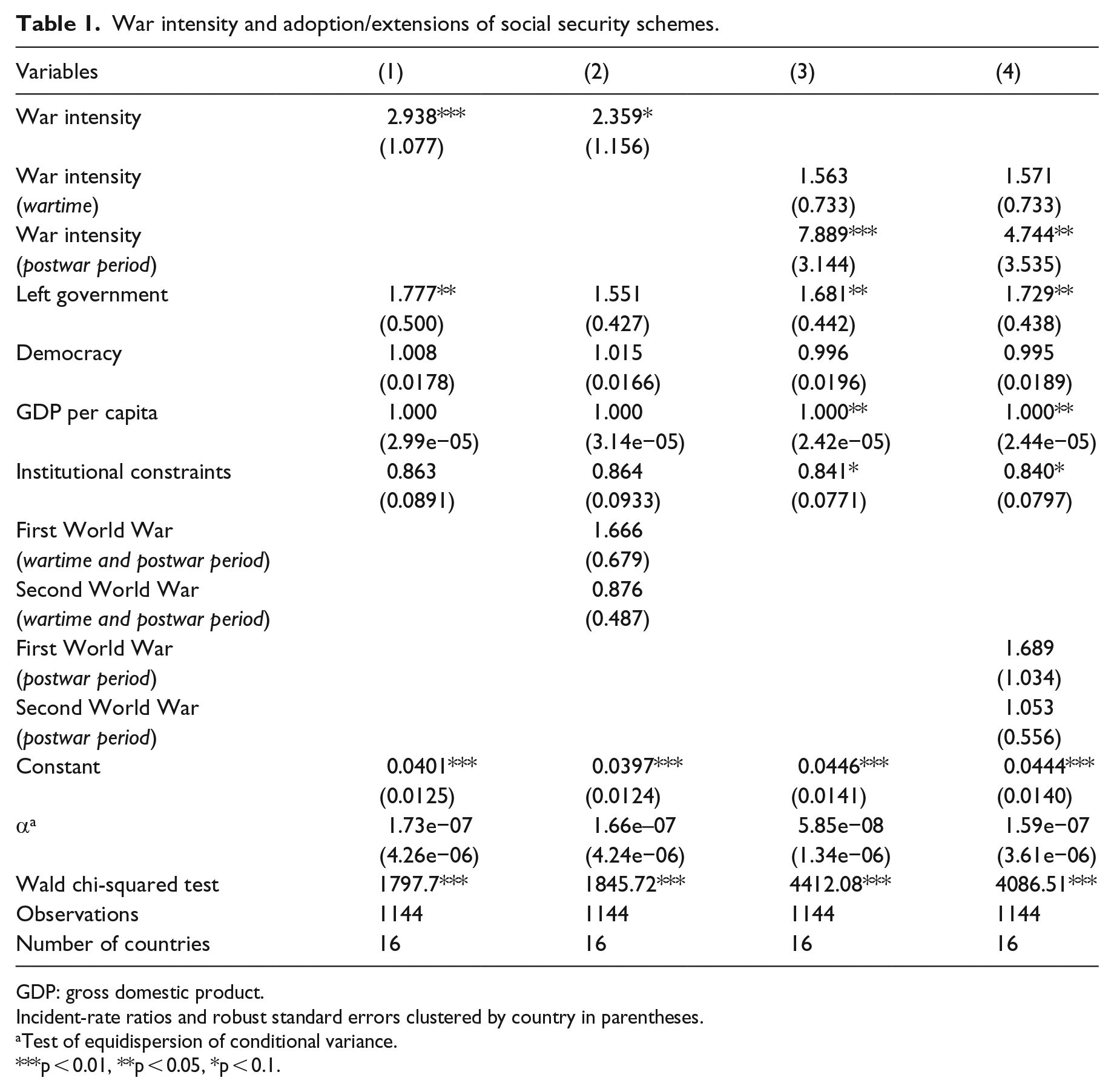
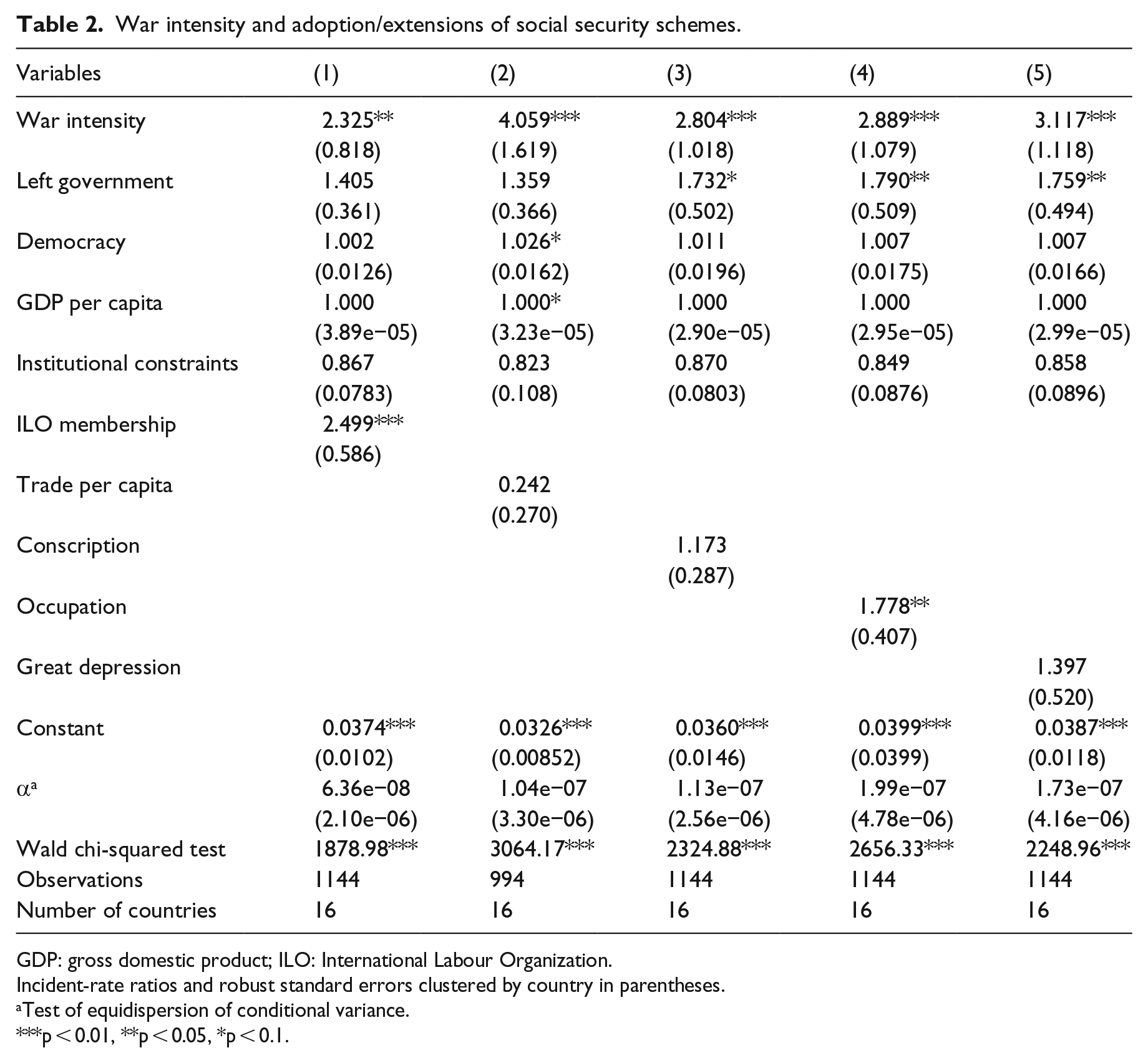
Since our dependent variable is a count variable (the annual number of initial adoptions and extensions of four social security programmes), we estimate Poisson regressions. To account for the panel structure of the data, we use robust standard errors clustered by country. 12 Table 1 reports the empirical findings for a baseline model, whereas Table 2 summarizes models testing the robustness of our findings. Both tables report incident-rate ratios to facilitate the interpretation of our results.
War intensity and adoption/extensions of social security schemes.
GDP: gross domestic product.
Incident-rate ratios and robust standard errors clustered by country in parentheses.
Test of equidispersion of conditional variance.
p < 0.01, **p < 0.05, *p < 0.1.
War intensity and adoption/extensions of social security schemes.
GDP: gross domestic product; ILO: International Labour Organization.
Incident-rate ratios and robust standard errors clustered by country in parentheses.
Test of equidispersion of conditional variance.
p < 0.01, **p < 0.05, *p < 0.1.
To test H1, we include our measure of war intensity as the key independent variable (War intensity). To examine whether the impact of war on social reforms mainly takes place in wartime or shortly after armistice (H2), we use two specifications of our war index: the first one captures war intensity only in wartime (War intensity (wartime)), whereas the second specification measures war intensity in the 2 years after the end of war (War intensity (postwar period)). Furthermore, we test whether the reform intensity is simply a product of time rather than a result of cross-nationally distinct war experiences by including different period dummies. In model 2 of Table 1, we integrate dummy variables that equal 1 both in wartime and during the 2 years after the end of both world wars (First World War (wartime and postwar period) and Second World War (wartime and postwar period)). In model 4, we integrate dummy variables that equal 1 only in the 2 years after the end of military conflict (First World War (postwar period)and Second World War (postwar period)) and 0 otherwise. If the differences in the extent to which countries have been affected by warfare account for differences in welfare legislation, the estimated war impact should remain stable.
Besides the war index, we control for a number of additional variables which are considered by comparative welfare state research as important determinants of welfare legislation. Several of these variables also control for the above-mentioned supply-side effects, that is, the political, economic and institutional transformations generated by war. Concretely, we include GDP (gross domestic product) per capita in 2011 USD as the key variable in functionalist welfare state theory (Wilensky, 1975). The level of economic development is an indicator of socio-economic modernization and a proxy for the capability of governments to finance expensive social programmes. According to the ‘logic of industrialization’, we should expect a positive impact of economic affluence on welfare legislation. Data stem from the Maddison Project Database (Inklaar et al., 2018). Furthermore, we include a dummy variable capturing government ideology. The dummy equals 1 in the case of a left head of government and 0 otherwise (Left government). The data are taken from Brambor et al. (2017), and we assume, in line with power resources theory, that left governments have a higher propensity of enacting social reforms. Moreover, welfare state consolidation should vary with the political regime type. We therefore integrate an index measuring the level of democracy provided by the ‘Polity IV Project’ (Marshall et al., 2014). This indicator ranges from –10 (autocracy) to +10 (full democracy). Although there is evidence that autocratic regimes were pioneers of welfare state consolidation in Western Europe (Alber, 1982), we suppose that democracies launch more welfare reforms by virtue of their greater responsiveness to social needs and higher propensity for redistribution. In addition, the capability of governments to initiate welfare reforms might depend on the institutional setting of a political system. To measure institutional constraints that might impede the capacity of governments to implement policy change, we compiled an additive and time-varying index of institutional veto points (ranging from 0 to 4) which reflects the existence of the following four veto points: (1) judicial review by constitutional courts; (2) proportional representation; (3) referenda at the national level and (4) federalism.
Table 2 reports several alternative models to check the sensitivity and the robustness of our results. First, we test whether the International Labour Organization (ILO) has affected domestic social reform activities by including a dummy variable that equals 1 if a country is a member of the ILO and 0 otherwise (ILO membership). The foundation of the ILO was an outcome of the First World War with a view to promote social security. In line with previous research (Schmitt et al., 2015; Usui, 1994), we expect an accelerating effect of ILO membership on welfare legislation. Furthermore, we control for the extent of economic openness measured by the sum of exports and imports per capita (Trade per capita). Data are taken from ‘Correlates of War’ (Marshall et al., 2014). From a theoretical perspective, the impact of trade openness on the welfare state is unclear, however. While the compensation thesis argues that high levels of trade openness lead to enhanced social protection, the efficiency thesis expects the opposite effect. In model 3, we additionally control for the effect of conscription on social policy. The variable takes the value 1 in years when universal male conscription (own compilation) exists and 0 otherwise. Given mass carnage and the ‘logic of equal sacrifice’ which is prevalent in wartime (Scheve and Stasavage, 2010; Wilensky, 1975), we expect a positive influence of conscription on welfare reform. Moreover, we control for the effect of occupation after the war by including a variable equalling 1 when a country was occupied in the postwar period and 0 otherwise (Table 2, model 4). Finally, we include a dummy variable in model 5, capturing the effect of the Great Depression. Like total war, the Great Depression was a national emergency that likely changed the distribution of risk in society and consequently increased the likelihood of welfare legislation (Rehm, 2016). This dummy variable equals 1 in the years from 1929 until 1935 and 0 otherwise.
The results of the Poisson regressions clearly support H1 that war matters for the timing of welfare legislation in terms of the four major social protection programmes under analysis. In model 1, the incident-rate ratio for our measure of war intensity equals 2.938 and is statistically significant at the 1 percent level. Hence, the expected number of social reforms in countries highly affected by war is estimated to be almost three times higher than in countries not affected by war at all. This effect remains stable if the time effects of the war and postwar period are controlled for (see model 2). Welfare state reform is, therefore, not a product of warfare itself but rather depends on distinct, cross-national war experiences that correspond with significant differences in social needs. The same holds true when we separately test the effect of war intensity during war and in the immediate postwar period (see model 3 and 4). In line with H2, both models indicate that war has triggered social reforms, particularly in the first 2 years following military conflict. Given the lack of financial resources and the priority of the overall war effort, the ability to adopt significant social reforms in wartime was likely constrained. However, it seems that war created a backlog of tremendous socio-economic problems, leading to a burst of welfare reforms right after the military conflict ended. In other words, the impact of war on the welfare state occurred with a delay. The expected number of social reforms in belligerent states with a high score for the war index is 4.7 times higher than in neutral countries in the 2 years after war (model 4). This effect is substantial in size, although the model includes time dummies for the immediate postwar period. Hence, the increase in welfare reform activities in the immediate postwar period does not reflect a general time trend caused by war but is rather the consequence of the extent to which a country was affected by the dreadful effects of war.
The results for the control variables are mostly in line with the conventional wisdom of comparative welfare state research. First, the ideological orientation of the head of government matters for the adoption of social reforms. When a left-oriented government was in office, the expected number of adoptions and reforms of major social programmes is 1.77 times higher than in countries without a left-oriented government. In most models, the coefficient of this variable is statistically significant or slightly fails statistical significance. The estimated coefficients for the level of economic prosperity and the level of democracy are in most models above 1 and thus in line with the theoretical expectations. However, the polity index is statistically insignificant in all models besides one. In accordance with our assumption, a high number of institutional veto points has a retaining effect on social reform activities. The incident-rate ratios are below 1 and therefore indicate that an increase in institutional constraints decreases the expected number of reform activities. However, the respective coefficient is only significant at the 10 percent level in two of the models.
In Table 2, we test the robustness of our results by including further potential cofounding factors.
Our key war measure again turns out highly statistically significant in all models, demonstrating unequivocally that both world wars strongly influenced the adoption and extension of major social programmes. The incident-rate ratios remain stable in size in comparison with our baseline model (see Table 1, model 1). 13 Furthermore, model 1 shows that ILO membership significantly accelerates welfare legislation. By contrast, economic openness as well as universal male conscription do not exhibit a statistically significant influence on social reforms. In terms of conscription, a possible explanation for this finding might be that almost all belligerent countries relied on the draft in both world wars. Model 4 controls for the occupation of the Axis Powers after the Second World War. The coefficient is positive and thus reflects welfare reforms imposed by the occupation forces such as the introduction of unemployment insurance in Japan in 1947 (Takemae, 2003: 327). Finally, the coefficient of the Great Depression in model 5 is not statistically significant. The reasons for this finding might be that, first, the economic recession and the related ‘risk flip’ is already captured by the GDP per capita. And second, the resources required for implementing social security programmes are naturally scarce in times of heavy economic recession. 14
Overall, the results summarized in Table 2 show that our findings are highly robust and consistent across all different model specifications.
Conclusion
More than 60 years ago, Richard Titmuss argued that modern war has had ‘a profound influence on social policy’ (Titmuss, 1958: 86). He even contended that the impact of war on social policy increases with the intensity and scale of warfare (p. 78). While several country studies have corroborated this claim, quantitative comparative welfare state research has widely neglected war as a possible determinant of welfare state development. To address this blind spot, this article examined whether and how both world wars have affected the timing of welfare legislation, that is, the introduction and subsequent reforms of four civilian social protection schemes. From a theoretical point of view, there are many reasons to presume that total war affects welfare reform, notably in the wake of military conflict. We argued that the impetus for social policy change mainly results from war-induced social needs which, however, strongly varied by the extent to which a nation was affected by the horrors of warfare. In other words, not war involvement itself but rather national distinct war experiences are crucial for explaining cross-national differences in the timing of welfare reform. In line with our hypotheses, the empirical evidence suggests that welfare legislation was mainly enacted in the immediate aftermath of war and not in wartime. The comparison of 16 western countries with markedly distinct war experiences in the period between 1880 and 1955 not only reveals that war clearly matters for the adoption of civilian welfare programmes but also that it outweighs many other explanatory factors more commonly emphasized in comparative welfare state research. Power resources theory, which is strongly supported by our empirical analysis, is the major exception. Left governments were far more likely to introduce and extend social security programmes than their conservative counterparts.
Given this overall substantial impact of war on welfare state development, our findings point to two promising avenues of future research. One is to study the impact of war on other programmes of social protection. Examples include regulatory social policies, such as labour protection legislation (e.g. working time and dismissal regulations), housing or social protection schemes tailored to children and juveniles. While many historiographic studies have examined this war impact for individual countries, systematic comparative inquiries are still rare and there are no quantitative studies at all. A second avenue of future research should extend the analysis to further regions, as both world wars had a tremendous impact not only on welfare state development in Eastern Europe, but also in many parts of the Global South.
Footnotes
Funding
The author(s) disclosed receipt of the following financial support for the research, authorship, and/or publication of this article: This research was funded by the Deutsche Forschungsgemeinschaft (DFG, German Research Foundation) – Projektnummer 374666841 – SFB 1342.