



Abstract
Fuel taxes are seen as an important instrument in the fight against climate change, including in the European Green Deal. From a social-ecological policy perspective, it is important to understand current high levels of public opposition to fuel taxes. If social disadvantage is an important driver of opposition, this would strengthen arguments that fuel taxes need to be designed in a fairer way. However, it remains unclear how important social disadvantage – here defined as a combination of low income, fuel poverty risk, low education, low occupational status and job insecurity – is for explaining opposition compared to factors such as political trust and climate change attitudes, and how the role of social disadvantage varies with welfare regimes in Europe. In this article, we examine how strongly social disadvantage is associated with opposition to fuel taxes once political trust and climate change attitudes are controlled for, and we compare results across welfare regimes. The article uses data from the 2016 European Social Survey and employs logistic regression and decomposition analysis. We find that social disadvantage contributes nearly as much to fuel tax opposition as climate change attitudes and political trust together, with 10.9 and 16.6 percentage points respectively. However, the role of social disadvantage varies by welfare regime. It matters most in Southern and Eastern Europe, where opposition is particularly high, as are poverty and inequality. We discuss implications for social-ecological policy strategies that aim to increase public acceptability of fuel taxes in Europe.
Keywords
Introduction
As action on climate change becomes more and more urgent (IPCC, 2023), academics and policymakers increasingly acknowledge the social and justice implications of climate policies, which need to be considered to increase public acceptance and effectiveness of climate action. Fuel taxes are an important topic for social-ecological policy debates because they are regarded as a valuable instrument for tackling climate change, including in the European Green Deal (European Commission, 2019). At the same time, previous research has shown that fuel taxes disproportionally burden low-income households (Büchs et al., 2021; Nikodinoska and Schröder, 2016; Sommer and Kratena, 2020). How distributional outcomes of environmental policies can be improved is an important question for social-ecological policy research (Koch, 2022; Mandelli, 2022).
Public opposition to fuel taxes in Europe is high (e.g., Fairbrother et al., 2019; Umit and Schaffer, 2020). The literature has identified several drivers of opposition to fuel or carbon taxes, including lack of political trust or climate change concern, low income, and low education (e.g., Fairbrother et al., 2019; Kitt et al., 2021; Smith and Mayer, 2018; Umit and Schaffer, 2020). However, the literature remains inconclusive on how important dimensions of social disadvantage are for explaining opposition compared to other factors such as political trust and climate change attitudes. Several articles which focus on the role of political trust and climate change attitudes control for income, education and other socio-demographic characteristics, but do not discuss these factors in the analysis (e.g., Fairbrother et al., 2019; Smith and Mayer, 2018; Umit and Schaffer, 2020). Conversely, several studies that examine income and education as drivers of opposition do not cover political trust (e.g., Becchetti and Conzo, 2022; Kotchen et al., 2017; Rotaris and Danielis, 2019).
In addition, it remains unclear how the importance of social disadvantage for explaining opposition to fuel taxes varies by welfare regime. Most studies refer to a single country (e.g., Kitt et al., 2021; Kotchen et al., 2017; Rhodes et al., 2017) or to Europe as a whole without examining differences across welfare regimes (Becchetti and Conzo, 2022; Fairbrother et al., 2019; Umit and Schaffer, 2020). Two articles have examined differences across welfare regimes in Europe, but the first controls for welfare regimes within a regression model, which means the role of different factors is not compared across welfare regimes (Sivonen and Kukkonen, 2021), and the second specifically focuses on Eastern Europe (Sivonen, 2020).
In this research, we consider the role of a set of dimensions of social disadvantage, namely low income, fuel poverty risk, low education, low occupational status, and job insecurity, and we compare results across welfare regimes. The question of whether social disadvantage matters for fuel tax opposition once political trust and climate change concern are taken into account has important social-ecological policy implications: if it does, then it could be important to address social disadvantage and improve distributional outcomes of climate policies to reduce public opposition to fuel taxes. Variations in the importance of social disadvantage and other factors across welfare regimes could indicate the need for fine-tuning social-ecological policy options depending on the welfare regime.
This article compares how strongly social disadvantage, political trust, and climate change attitudes are associated with fuel tax opposition across five welfare regimes, comprising 20 European countries. The empirical analysis uses data from the 2016 European Social Survey and employs logistic regression and decomposition analysis. Decomposition analysis can assess the role that different factors have in contributing to an outcome by taking into account not only the strength of the regression coefficients but also the size of the groups in the population associated with the respective characteristics. To our knowledge, decomposition analysis has not previously been applied in research on attitudes toward carbon or energy taxes.
The remaining article is structured as follows: the second section introduces the literature and underlying theory; the third section discusses the data and methodology; the fourth section presents the results and the fifth section discusses results and concludes.
Literature and theory
Current literature on the correlates of opposition to fuel or carbon taxes has identified a range of factors, including political trust, climate change attitudes, income, education, gender and age.
Several previous studies show that low income and low education are associated with greater opposition to fuel or carbon taxes (e.g., Becchetti and Conzo, 2022; Fairbrother et al., 2019; Kitt et al., 2021; Sivonen and Kukkonen, 2021; Smith and Mayer, 2018), and with lower willingness to pay for such taxes, e.g., in the United States (Kotchen et al., 2017), Italy (Rotaris and Danielis, 2019) and China (Yang et al., 2014). Three possible and complementary explanations have been presented: • that individuals with these characteristics do not have the capacity to pay higher prices for necessities; • that they already consume the lowest possible amounts of necessities and cannot reduce their consumption further without compromising their needs satisfaction; • that they perceive fuel and carbon taxes as distributionally unfair (Carattini et al., 2017; Douenne and Fabre, 2020).
All previous studies that examine the role of climate change worry or the belief that climate change is happening and/or human-induced have shown that these attitudes increase support for fuel or carbon taxes (e.g., Becchetti and Conzo, 2022; Bumann, 2021; Fairbrother et al., 2019; Kitt et al., 2021; Kotchen et al., 2017; Rotaris and Danielis, 2019; Sivonen and Kukkonen, 2021; Smith and Mayer, 2018; Yang et al., 2014). From a theoretical perspective, it is plausible that people who are more concerned about climate change are more supportive of fuel or carbon taxes because they are more likely to regard such policies as addressing an issue that is important to them. As the extensive literature on climate change attitudes shows, climate change concern is closely related to socio-demographic characteristics such as higher income, higher education, younger age, left-leaning political orientation and ‘altruistic’ values (e.g., Baiardi and Morana, 2021; Lewis et al., 2018; Lübke, 2022; Weckroth and Ala-Mantila, 2022; Ziegler, 2017). Likely theoretical explanations for these findings include: • more educated individuals have a better understanding of the science of climate change and are more likely to trust climate science; • higher earners might be more willing to express concern about climate change because they can more easily afford environmentally-friendly lifestyles and price increases resulting from climate policies; • younger people are likely to be more concerned about climate change because they will be exposed to greater climate change impacts than current generations.
Several previous studies have demonstrated that higher political trust is generally associated with greater support for fuel or carbon taxes (Davidovic and Harring, 2020; Hammar and Jagers, 2006; Kitt et al., 2021; Sivonen, 2020; Smith and Mayer, 2018; Umit and Schaffer, 2020). Fairbrother et al. (2019) even find that political trust mediates the impact of climate change attitudes and conclude that it is the more important factor of the two. People with higher trust in politicians and political institutions are likely to believe that revenues from fuel or carbon taxes will be used for carbon reduction or compensatory measures, not just for increasing government revenues (Dresner et al., 2006). Furthermore, people who trust politicians are more easily convinced of policymakers’ claims about the effectiveness of fuel or carbon taxes to tackle climate change (Umit and Schaffer, 2020).
Many studies on public attitudes towards fuel or carbon taxes conduct multiple regression analysis with models that include factors such as income, education, age, gender, climate change concern and political trust. However, it remains unclear how important factors of social disadvantage are in explaining opposition to fuel taxes compared to lack of climate change concern or distrust in policymakers. There are several reasons for this. First, many studies focus more on either social disadvantage or on climate change attitudes and/or political trust (see the introduction for details). Second, coefficients produced by regression analysis show the importance of the association of specific factors but cannot demonstrate how much the determinants contribute to the overall outcome. While a specific factor, for instance disbelief that climate change is happening, might have a high and significant coefficient in regression analysis, the share of the population that does not think climate change is happening tends to be very small. Therefore, the contribution of this group to fuel tax opposition would be limited. A third issue is that the literature on public attitudes to fuel taxes treats characteristics such as income and education separately (e.g., Becchetti and Conzo, 2022; Kotchen et al., 2017; Rotaris and Danielis, 2019). However, social policy literature has emphasized that poverty and deprivation are multi-dimensional and should not be reduced to single factors such as low income or low education (Anand et al., 2020; Whelan et al., 2002).
From a social-ecological policy perspective, it would therefore be of interest to examine how important different dimensions of social disadvantage combined are in contributing to opposition to fuel or carbon taxes. We address this question by considering social disadvantage as a multi-dimensional concept, covering low income, fuel poverty risk, low education, low occupational status, and job insecurity, and by employing decomposition analysis which takes both the coefficient and group size into account (see methods section for further details).
From a social-ecological policy perspective it is relevant to know how the association between fuel tax opposition and social disadvantage, climate concern and political trust varies across welfare regimes (Esping-Andersen, 1990; Fenger, 2007; Ferrera, 1996). Whether there is an affinity between welfare regimes and (public attitudes towards) environmental policies is still debated. The ‘synergy hypothesis’ assumes that social and environmental policies are closely related because both types of policies aim to regulate and coordinate markets (e.g., Gough et al., 2008). Here, one can hypothesize that welfare state generosity increases support for climate policies because more generous welfare provisions can more effectively compensate regressive impacts of climate policies on disadvantaged groups (Parth and Vlandas, 2022). The counter-hypothesis is that social and environmental policies might not be closely aligned because they compete against each other fiscally (Gough et al., 2008). If people in generous welfare regimes believe social and environmental policies are in conflict, they might oppose environmental policies to protect the welfare state against cuts.
Several studies have tested the ‘synergy’ hypothesis but do not find clear overlaps between welfare regimes and environmental policies or outcomes (Jahn, 1998; Koch and Fritz, 2014). Other research finds clearer relationships between welfare regimes and public attitudes towards climate policies, including fuel taxes. For instance, two studies conclude that support for welfare and climate policies is strongest in Scandinavian countries (Fritz and Koch, 2019; Otto and Gugushvili, 2020), and Fairbrother et al. (2019) show that support for fuel taxes is highest in Scandinavian countries. Sivonen (2020), Sivonen and Kukkonen (2021) and Smith and Mayer (2018) find that support for fuel taxation is lower in Eastern Europe compared to the rest of Europe, especially Scandinavia. The authors explain this outcome with higher political trust and more generous welfare support in Scandinavian countries compared to other welfare regimes, which could help to address regressive distributional impacts of fuel taxes.
A gap in research is whether the strength of different drivers of fuel tax opposition varies across welfare regimes. Results from such an analysis are of crucial importance for formulating more tailored social-ecological policies across welfare regimes, and they add nuance to previous studies which either focus on individual countries (e.g., Kotchen et al., 2017; Rotaris and Danielis, 2019; Yang et al., 2014) or combine country samples with or without multilevel control variables at the country or welfare regime level (e.g., Becchetti and Conzo, 2022; Fairbrother et al., 2019; Sivonen and Kukkonen, 2021; Umit and Schaffer, 2020). We address this gap by conducting regression and decomposition analysis separately for each welfare regime. Based on existing theories and literature, we hypothesize that, after controlling for climate change attitudes and political trust, social disadvantage continues to be associated with opposition to fuel taxes because less privileged groups are likely to be more concerned about negative welfare impacts from fuel taxes and because welfare concerns can be distinguished from concerns about how policymakers use the tax revenue (political trust) and the salience of climate change as a political issue (climate change concern). However, we also hypothesize that the importance of social disadvantage is likely to vary across welfare regimes. Here we expect that social disadvantage will be more strongly associated with opposition to fuel taxes in less generous welfare regimes with higher levels of poverty, because concerns about negative welfare impacts from fuel taxes are likely to be more prevalent among disadvantaged groups in these countries.
Data and methodology
In the empirical analysis, we use data representative of the population of 20 European countries from the European Social Survey (ESS) round 2016 (version 2.2 released in December 2020). Our dependent variable of fuel tax opposition is measured by the ESS item ‘To what extent are you in favour or against the following policies in [country] to reduce climate change? Increasing taxes on fossil fuels, such as oil, gas and coal.’ We define opposition to fuel taxes as those who answer ‘somewhat against’ or ‘strongly against’.
Our independent variables comprise factors of social disadvantage – income, fuel poverty risk (defined below), education (lower secondary, upper secondary and tertiary), whether the job is insecure, and occupational status (managerial and professional vs other); other socio-demographic control factors such as activity (in paid work, in education, unemployed, retired, doing housework), age, gender, family status (single, cohabiting and married, separated and widowed), living in a rural or urban area, household size, and whether children are present in the household. Fuel poverty risk can be seen as an important marker of social disadvantage as it indicates that basic needs might remain unfulfilled (Gough, 2015). Risk of fuel poverty is represented by the variable that asks respondents ‘Overall, how confident are you that you could use less energy than you do now?’ We define those at risk of fuel poverty who answer they ‘could not save more energy’ or only ‘a bit more energy’ (6% of the population), in difference to those who say they ‘could save more energy’. Note that this variable does not represent actual fuel poverty which is usually measured based on expenditure, energy access and/or energy efficiency data.
We also include climate change concern and political trust in the analysis. Those who are not concerned about climate change are defined as respondents who say they are ‘not at all worried’ and ‘not very worried’ about climate change. For a robustness check, we re-estimated our models replacing this variable on climate worries with a variable that measures whether respondents believe that the climate is changing, and results were virtually the same. However, regression results indicated that worrying about climate change was the more important variable. When both variables were included in the model, the variable on belief in climate change was generally not significant. In addition, we differentiate between individuals who trust, have little trust and no trust in politicians. The descriptive statistics by welfare regimes are provided in the Appendix, Table A1. For exact definitions of the survey questions see Note A1 in the Appendix.
For all variables except income and the dependent variable, missing values are marginal (see Table A2). The 4% of the sample for which the dependent variable is missing are excluded from the analysis.
As usual with surveys, the measurement of income is not straightforward. One measure of income in the ESS is based on a survey question that asks individuals to identify which income decile in their country they belong to (called in the following the ‘decile measure’). Figure A1 shows that in about half of the countries, people significantly over- or under-estimate their belonging to the lowest income quintile. In addition, the income decile measure is missing for 20% of the respondents. This subjective income decile measure is therefore of limited quality and utility. Another income measure in the ESS asks respondents how difficult or not they find it to live on their household income (on a four-category scale). This variable is only missing for 0.97% of the sample but it is even more subjective than the ‘income decile’ variable and cannot differentiate between low, middle and high income. To address the higher percentage of missings in the income decile measure, we combine both income measures into one. First, we construct a three-category income variable based on the ‘income decile’ measure where ‘low income’ corresponds to those who estimate that their income falls into the lowest income quintile, ‘high income’ to those who estimate that their income falls into the highest income quintile, and ‘mid income’ to those who estimate their income to be in the second to fourth income quintiles. For the 20% of the sample for which this variable is missing, we use the second income measure and assign those who state that they find it very difficult to cope with their household income to the ‘low income’ category, those who state they ‘live comfortably’ to the ‘high income’ category, and everyone else to the ‘mid income’ category (see details in the Appendix, Section ‘Income Measures’). In the regression models, we use this combined income proxy variable. We also add a bivariate control variable that is coded 1 if income has been imputed and 0 if it has not. This variable is not significant which demonstrates that the imputed income measure works well on average. We also performed a range of robustness tests by running all regression models with each of the different income measures. Results, which are presented in Table A3, are consistent across models.
We conduct nested logistic regressions on the dependent variable of fuel tax opposition and estimate average marginal effects from which we can derive the percentage point change in opposition to fuel taxes if the explanatory variable changes by one unit. We apply ESS survey weights in the entire analysis.
Regression analysis shows how different population characteristics are associated with opposition to fuel taxes. However, the overall contribution of the population characteristic to a region’s fuel tax opposition also depends on the population size. For example, as we will see in our results below, people in Anglo-Saxon countries who say they cannot save more energy are 15 percentage points more likely to oppose fuel taxes than those who think they can save more energy. This is a sizable association. However, only 4% of the population in Anglo-Saxon countries are in this group. This indicates that this group contributes little to overall fuel tax opposition in Anglo-Saxon countries. If all factors were kept constant, and if it was possible to reduce the number of people who think they cannot save more energy from 4% to 0%, overall fuel tax opposition in Anglo-Saxon countries would only fall by 0.6 percentage points (15 * 0.04).
To address this issue, we apply decomposition analysis, which compares the contribution of social disadvantage (low income, fuel poverty risk, low education, low occupational status and job insecurity combined), trust and climate change worries to overall fuel tax opposition. We do this by taking into account the association between these characteristics and opposition to fuel taxes, as well as the population size associated with these characteristics. In order to make the results comprehensible and visually presentable, we retain a smaller number of categories in Figure 2 and only calculate the importance of a factor by comparing two groups for each individual characteristic, e.g., those with high income to those without high income, those with managerial or professional occupations to those with lower-level occupations and so on (results of the simplified regressions used for Figure 2 are reported in Table A4). Opposition to fuel taxes. (a) Fuel tax opposition by country and welfare regime, (b) Fuel tax opposition by income group and welfare regime. Note: Opposition to fuel taxes across all countries is 46%. Opposition to fuel taxes varies by welfare regime: 25% of the population are opposed in Scandinavian, 43% in Continental, 54% in Southern and Eastern European and 38% in Anglo-Saxon regimes. ‘High’, ‘mid’, ‘low’ refers to income groups; ‘high’ relates to people who think their income falls into the highest income quintile in their country, ‘low’ to those who think their income falls into the lowest income quintile in their country, and ‘mid’ to those in between. These percentages are calculated using a population size weight. ESS survey weights are applied.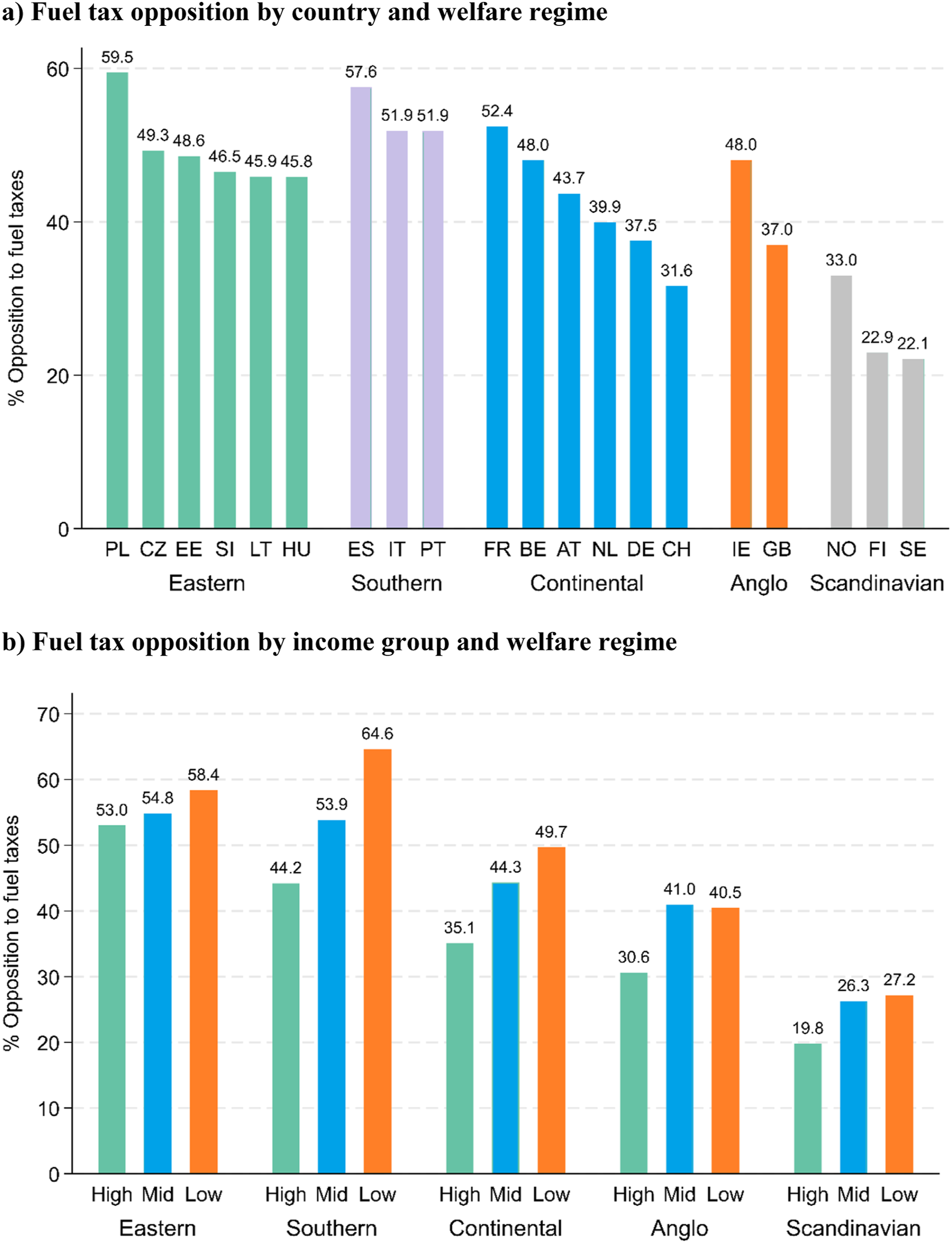
Limitations
Even though our study examines differences in the individual-level drivers of fuel tax opposition across welfare regimes, it cannot explain these differences per se. Additional and complex factors at the welfare regime and country level would need to be taken into account. Multi-level analysis could have contributed to such an approach, but multi-level analysis was not suitable for this study because the ESS only covers 20 countries. Multi-level model coefficients are likely to be biased if fewer than 30 countries are modelled (Bryan and Jenkins, 2016). The regression analysis was limited to those variables available in the ESS and might thus miss out other important factors. As always, it is important to note that regression analysis does not present causal explanations, only associations.
Results
On average, 46% of the population in the 20 European countries are against fuel taxes. Figure 1 shows considerable country and welfare regime variation in opposition to fuel taxes. While the majority of individuals in Southern Europe oppose fuel taxes, one third or less of the population in Scandinavian countries do so. In Poland, which has the highest level of fuel tax opposition, almost 60% of individuals are against fuel taxation, while in Finland and Sweden it is only around 23%. Opposition also varies by income: overall, among those with low income (those who attribute themselves to the lowest income quintile of their country), around 52% of individuals oppose fuel taxation, while the corresponding percentage among those with high income (those thinking their income is in their country’s top quintile) is about 37%. Nevertheless, the gap in opposition between high- and low-income groups differs across welfare regimes. In Southern European countries, only 44% of the rich oppose fuel taxes compared to 65% of the poor; this is a gap between income groups of around 20 percentage points, the largest in any welfare regime. In Scandinavian and Eastern European countries, there is only a 5 and 7 percentage point gap in opposition by income. In Continental and Anglo-Saxon countries, the gap is 14 and 10 percentage points large, respectively. Percentage point contribution of different groups to fuel tax opposition. Note: The graph shows the contribution of specific groups to fuel tax opposition compared to the reference groups. The reference categories are: high income, could save more energy, age 25 to 29, high education, high occupation, worried about climate change, trust in politicians. The contribution of the groups to overall welfare regimes’ fuel tax opposition is calculated by multiplying the regression coefficient, which expresses the percentage point change (see Table A4), with the population percentage in this group (see Table A1). Unconditional overall fuel tax opposition is 38% in Anglo-Saxon, 43% in Continental, 54% in Southern and Eastern European and 25% in Scandinavian countries. Only factors significant at the 10% level are displayed. ESS survey weights are applied.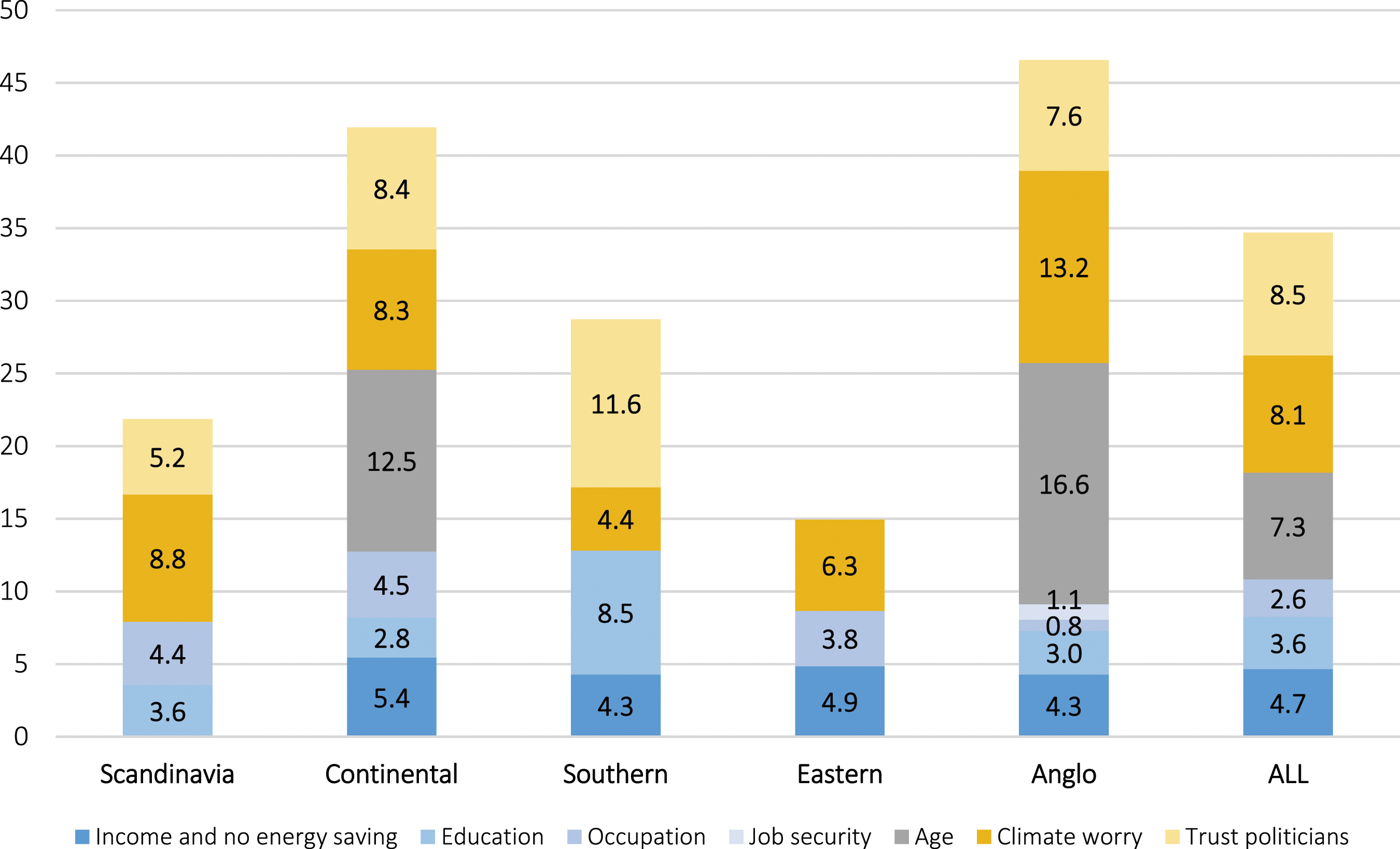
Multivariate analysis of opposition to fuel taxes
How important is our multi-dimensional measure of social disadvantage for explaining opposition to fuel taxes, after controlling for other factors such as political trust and climate change concern? Does the importance of these factors vary between welfare regimes?
Logistic regressions (marginal effects) by welfare regime: opposition to fuel taxes.
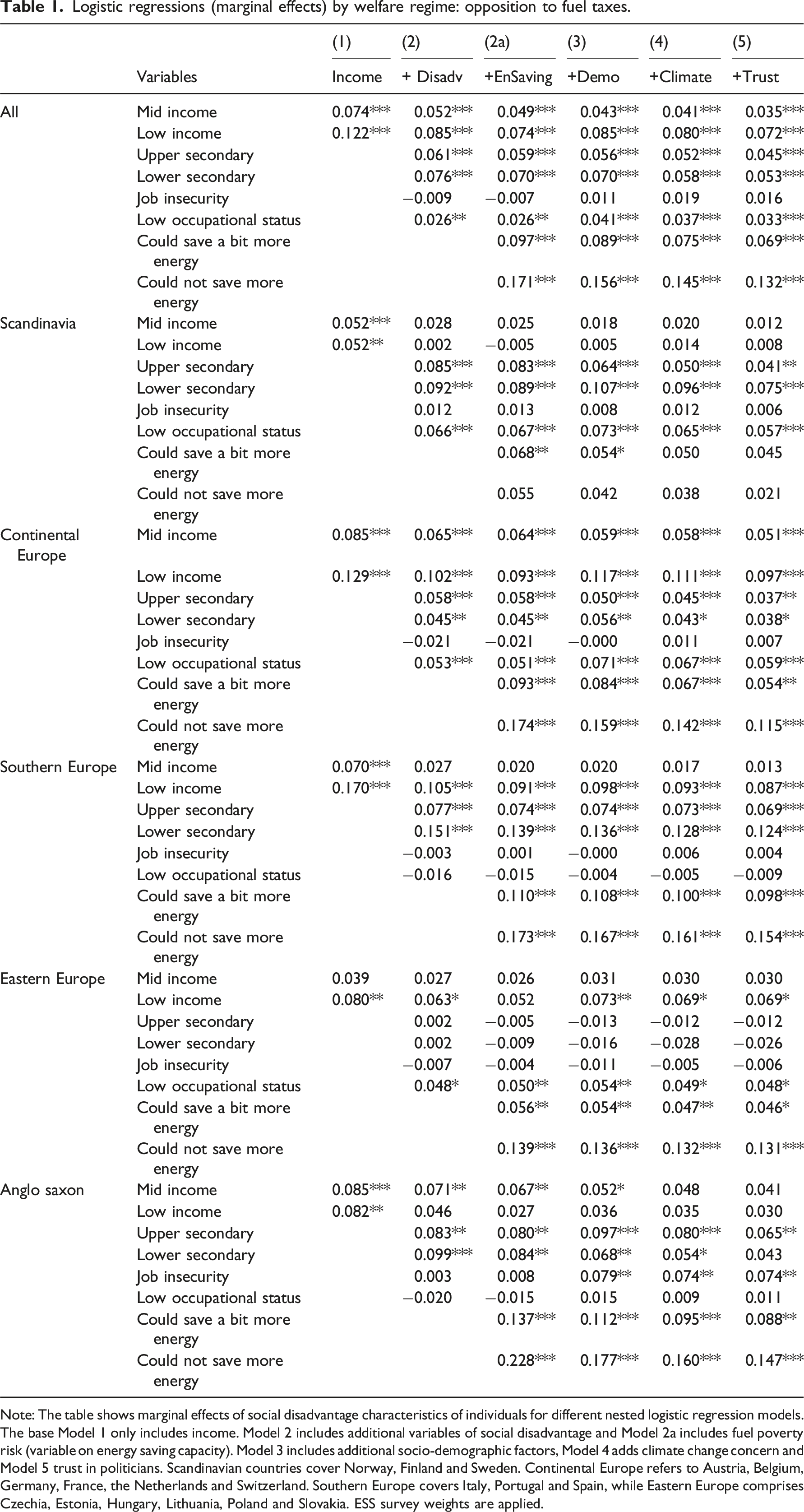
Note: The table shows marginal effects of social disadvantage characteristics of individuals for different nested logistic regression models. The base Model 1 only includes income. Model 2 includes additional variables of social disadvantage and Model 2a includes fuel poverty risk (variable on energy saving capacity). Model 3 includes additional socio-demographic factors, Model 4 adds climate change concern and Model 5 trust in politicians. Scandinavian countries cover Norway, Finland and Sweden. Continental Europe refers to Austria, Belgium, Germany, France, the Netherlands and Switzerland. Southern Europe covers Italy, Portugal and Spain, while Eastern Europe comprises Czechia, Estonia, Hungary, Lithuania, Poland and Slovakia. ESS survey weights are applied.
Model 2a includes further measures of social disadvantage (low education, low occupational status and job insecurity). Overall, and in all welfare regimes but Eastern Europe, lower education is associated with higher opposition to fuel taxes between 5 and 15 percentage points. Having neither a managerial nor professional job increases opposition by 3 percentage points in the full sample, and about 7 to 5 percentage points in Scandinavia, Continental Europe and Eastern Europe.
Another measure of social disadvantage is vulnerability to fuel poverty. Model 2b adds the variable of whether (reference group) or not individuals think they can save more energy. Overall, opposition to fuel taxes is about 17 percentage points higher among those claiming they could not save (much) more energy compared to those who say they could while controlling for all previously mentioned characteristics. Perceived inability to save more energy has the largest impact on opposition to fuel taxes conditional on other factors of social disadvantage in Anglo-Saxon countries, where those saying they cannot save more energy are as much as 23 percentage points more likely to oppose fuel taxes than those who think they can. The percentage point differences are still around 17 percentage points for Southern and Continental Europe, and 14 percentage points in Eastern Europe. Including individuals’ vulnerability to fuel poverty in the model does not have a large impact on the role of income, indicating that both make an independent contribution to explaining the variation in opposition to fuel taxes.
Does income still matter conditional on other measures of social disadvantage and demographic factors (age, household composition, rural and urban area)? Model 3 shows that in the regression that includes all countries, all social disadvantage indicators remain significant and that some coefficients only slightly reduce in magnitude once other demographic control variables are added. Nevertheless, when looking at differences across welfare regimes, results show that, on average, respondents in Scandinavian and Anglo-Saxon countries who locate themselves in the lowest two income deciles are no longer significantly different to those in the highest two deciles, while poorer people in Continental Europe are still as much as 12 percentage points more opposed than their richer counterparts, and those in Southern and Eastern Europe 10 and 7 percentage points respectively. Including demographic factors does not significantly change the association between capacity to save energy and opposition in any welfare regime.
Model 4 includes climate change concern and Model 5 trust in politicians. Compared with Model 3, there is no significant decrease in the association between income and opposition, nor between perceived energy saving capacity and opposition. As a consequence, household income, other factors of social disadvantage, and capacity to save more energy remain highly important for explaining fuel tax opposition in all countries except Scandinavia, even taking into account many other factors. In Southern Europe, opposition against fuel taxes remains 24 percentage points higher among those with low income and no capacity to save more energy, compared to richer households who can save energy. In Continental and Eastern Europe, the difference amounts to 20 percentage points and in Anglo-Saxon countries 14.
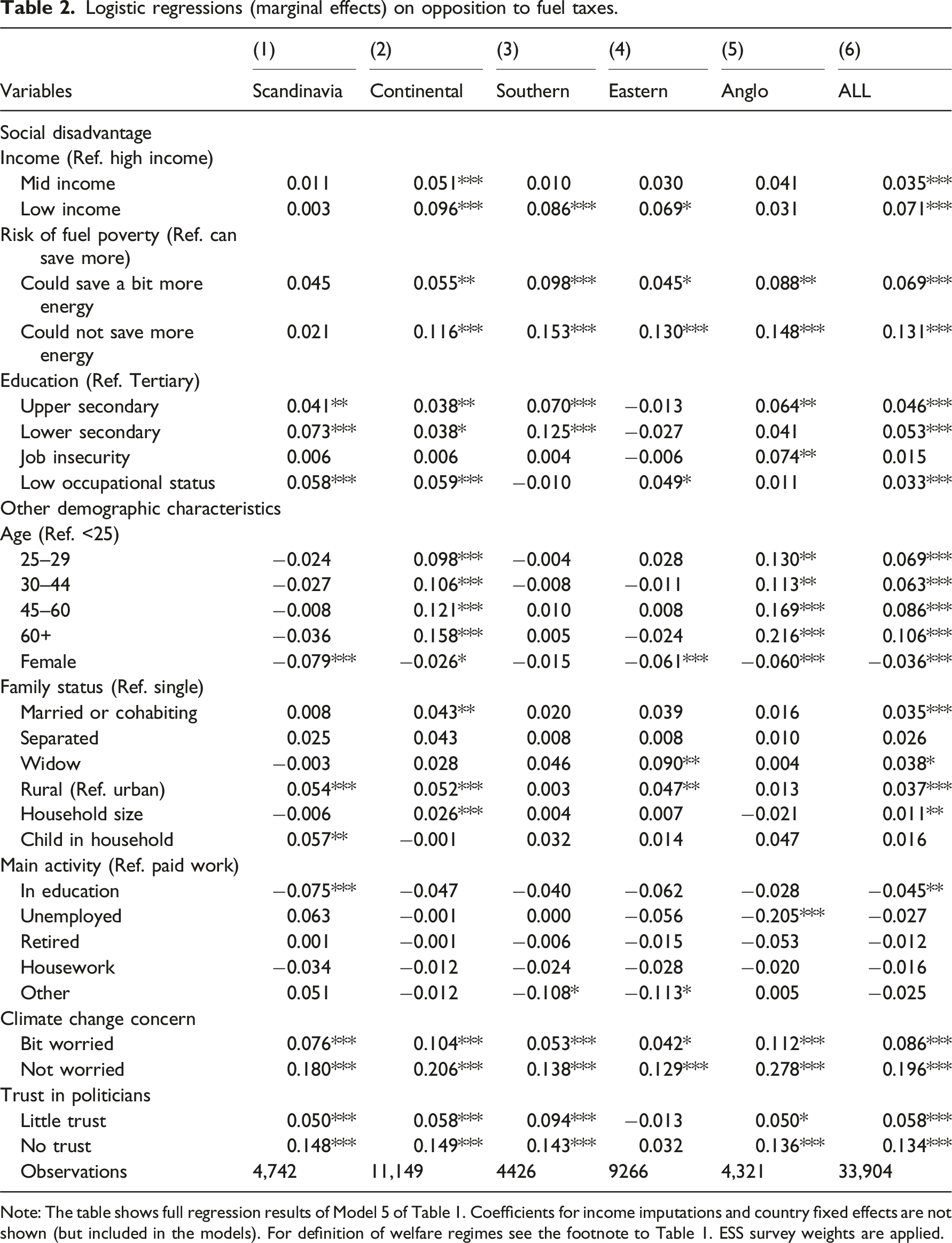
Logistic regressions (marginal effects) on opposition to fuel taxes.
Decomposition analysis
In a second step, we conduct a decomposition analysis (Figure 2) to examine the contribution that different factors make in explaining opposition to fuel taxes. This takes both the importance of each factor (strength of the regression coefficient) and the prevalence in the population of each of these characteristics into account.
Decomposition results in Figure 2 demonstrate that, taken together, factors of social disadvantage have a sizeable impact on opposition to fuel taxes, as they cover about one third to half of the opposition that we can link to observable variables included in the regressions. In the whole sample, lack of climate change concern and lack of trust in politicians combined contribute 16.6 percentage points to fuel tax opposition. Taken together, factors of social disadvantage continue to contribute 10.9 percentage points to fuel tax opposition. Of those, low income and inability to save more energy contribute 4.7 percentage points, low education 3.6 percentage points and low occupational status 2.6 percentage points.
When we compare different welfare regimes, factors of social disadvantage are particularly important in Eastern Europe where they, taken together, contribute more to fuel tax opposition than climate change worry and trust in politicians combined (8.7 vs 6.3 percentage points). In Southern and Continental Europe, factors of social disadvantage only contribute a little less to explaining fuel tax opposition compared to climate change worry and lack of political trust (12.7 vs 16.0 percentage points in Southern and 12.7 vs 16.7 percentage points in Continental Europe). Overall, we can conclude that factors of social disadvantage play an important role in explaining opposition to fuel taxes, in addition to and conditional on lack of climate change concern and trust in politicians.
Discussion and conclusion
Previous research has demonstrated that climate change concern, political trust and factors of social disadvantage, with a focus on low income and low education, play a role in explaining opposition to fuel taxes (e.g., Becchetti and Conzo, 2022; Fairbrother et al., 2019; Kitt et al., 2021; Kotchen et al., 2017; Rotaris and Danielis, 2019; Sivonen and Kukkonen, 2021; Umit and Schaffer, 2020). However, it remained unclear how important different factors are in accounting for opposition to fuel taxes, because multiple regression analysis does not fully take the size of specific population groups into account. Furthermore, existing literature does not examine how these factors vary across welfare regimes, assuming that the association of fuel tax opposition with individuals’ characteristics is similar in all European regions (with the exception of Sivonen and Kukkonen (2021) who still pool the sample but include a welfare regime control variable, and Sivonen (2020) who compares Eastern Europe to the rest of Europe). We conduct decomposition analysis to examine the relative strength of factors explaining opposition to fuel taxes across welfare regimes in Europe. Based on the assumption that social disadvantage is multidimensional (Anand et al., 2020; Whelan et al., 2002), we combine several factors to assess the role of social disadvantage: low income, fuel poverty risk, low education, low occupational status and job insecurity.
Considering all 20 European countries in our analysis, we find that factors of social disadvantage taken together make a sizeable contribution – 10.9 percentage points – to explaining opposition to fuel taxes, not dissimilar to the role of climate concern and political trust which together contribute 16.6 percentage points. However, we find considerable variation across welfare regimes in how much social disadvantage, climate concern, and political trust contribute to opposition to fuel taxes. Factors of social disadvantage are particularly strongly associated with fuel tax opposition in Eastern and Southern Europe, where they explain nearly as much of the opposition to fuel taxes as climate concern and political trust combined, and in some places even more (Figure 2). In contrast, climate change attitudes are most strongly associated with fuel tax opposition in Anglo-Saxon and Scandinavian countries, and the association with political trust is highest in Southern European countries (Figure 2).
These findings suggest that generic theories about which factors drive opposition to fuel taxes are likely to be imprecise because factors are shaped by social, cultural and institutional contexts. Eastern and Southern European welfare regimes are characterized by the highest rates of poverty, inequality and fuel poverty in Europe, while poverty is lowest in Scandinavian countries, and fuel poverty lowest in Scandinavian and Anglo-Saxon countries (Table A5). This indicates that where poverty, inequality and fuel poverty are high, being socially disadvantaged is more highly correlated with opposition to fuel taxes, while more privileged people are more likely to support fuel taxes. Climate change concern (and risk of climate change impacts) are lowest in Anglo-Saxon, Scandinavian and Eastern European countries where it matters most for explaining opposition to fuel taxes. This suggests that being concerned about climate change is more strongly correlated with support for fuel taxes in countries that have lower levels of climate change concern. Trust in policymakers is lowest in Southern Europe, and distrust makes by far the largest contribution to opposition to fuel taxes in this welfare regime. However, political trust is also very low in Eastern Europe where it does not contribute to explaining fuel tax opposition. This aligns with Sivonen’s (2020) finding that political trust was less strongly associated with fuel tax opposition in post-communist Europe compared to the rest of Europe.
In summary, some characteristics that are generally closely correlated with opposition to fuel taxes – social disadvantage and lack of climate change concern – are more closely aligned with fuel tax opposition in countries in which these characteristics are more widespread. One reason for this could be that specific political attitudes spread more easily and are more stable in contexts in which supporting characteristics are more common, e.g., due to ‘socialization’, ‘peer pressure’ or ‘herd behaviour’ (Bourdieu, 1990; Teraji, 2003). Lack of political trust is less consistently important and appears to be mediated by other contextual factors: it matters most in Southern Europe where trust is low, but is not significant in Eastern Europe where trust is also low. In Southern Europe, the role of trust in policymakers might be mediated by social disadvantage, which is most prevalent there, while levels of climate concern are also quite high, probably related to higher risks of climate change impacts (Table A5). Conversely, political trust matters less in regimes that have lower levels of poverty and fuel poverty (e.g., Scandinavian countries) or lower levels of climate change concern (e.g., Eastern Europe).
These findings have important implications for social-ecological policy. First, while we see variation in the importance of social disadvantage for opposition to fuel taxes, results indicate that reducing social disadvantage – for instance by tackling poverty and fuel poverty, increasing education levels, providing better occupational opportunities and job security – could reduce opposition to fuel taxes, especially in welfare regimes which experience high levels of social disadvantage and fuel tax opposition (Southern and Eastern Europe). Results also suggest that lower levels of social disadvantage could be beneficial in reducing the role that distrust in politicians plays in opposition to fuel taxes, as political distrust mattered most in Southern Europe. Reducing social disadvantage in these ways is not a simple and quick task, but a complex undertaking which requires well-coordinated policies. Nevertheless, unfair distributional outcomes from climate policies can generally be reduced by limiting social inequalities and levels of deprivation. Based on the results from this and previous studies, we can assume that support for climate policies is likely to be higher in countries where a smaller proportion of people fear negative welfare impacts from such policies.
Second, our results indicate that generic theories about drivers of opposition to fuel taxes are less likely to be useful for tailoring policy recommendations to institutional and social contexts. For instance, perhaps counter-intuitively, concern about climate change matters more in welfare regimes that are likely to be less affected by climate change in relative terms. While supporting climate change education is likely to reduce levels of fuel tax opposition in these regimes, it is also likely to be a more difficult task.
Third, since previous research has shown that regressive distributional impacts of fuel taxes can increase public opposition (Carattini et al., 2017; 2019), our findings imply that policymakers need to carefully consider distributional and fairness implications of fuel and carbon taxes to strengthen public support. One option is to target ‘luxury’ emissions and energy use with higher carbon and energy taxes. Previous research has shown that distributional impacts of taxes on ‘luxury’ emissions or energy use such as air travel tend to be progressive, burdening high income households more than low income households (Büchs and Mattioli, 2022). Taxes on ‘luxury’ energy use or emissions are therefore likely to find greater public support. Where fuel or carbon taxes are levied on necessities such as home energy, it is important to put compensatory measures in place. The literature has explored a variety of options on this already, for instance returning all or part of the tax revenue to residents on an equal per capita basis or through the existing tax and benefit system (Büchs et al., 2021; Caron et al., 2018; Owen and Barrett, 2020). Regressive fuel and carbon tax impacts can also be compensated by providing free green services directly to the population as an ‘in kind’ income, which is distributionally progressive and helps to reduce emissions (Büchs et al., 2021). These recommendations align with research that finds increased public support for fuel or carbon taxes when accompanied by a redistribution of revenues (Fremstad et al., 2022).
Supplemental Material
Supplemental Material - Public opposition to fuel taxes in europe: How important is social disadvantage and how do welfare regimes compare?
Supplemental Material for Public opposition to fuel taxes in europe: How important is social disadvantage and how do welfare regimes compare? by Milena Buchs, Elena Bastianelli, Sylke V Schnepf in Journal of European Social Policy
Footnotes
Acknowledgements
The authors thank the referees for useful comments on a previous version of this paper, and Andrew Knighton for language editing.
Declaration of conflicting interests
The author(s) declared no potential conflicts of interest with respect to the research, authorship, and/or publication of this article.
Funding
The authors disclosed receipt of the following financial support for the research, authorship, and/or publication of this article: Engineering and Physical Sciences Research Council (EP/R035288/1).

Supplemental Material
Supplemental material for this article is available online.
References
Supplementary Material
Please find the following supplemental material available below.
For Open Access articles published under a Creative Commons License, all supplemental material carries the same license as the article it is associated with.
For non-Open Access articles published, all supplemental material carries a non-exclusive license, and permission requests for re-use of supplemental material or any part of supplemental material shall be sent directly to the copyright owner as specified in the copyright notice associated with the article.
