



Abstract
In times of emergent emphases on how climate change will affect welfare societies, welfare policies and individuals’ welfare and vice versa, this study investigates public support for welfare and environmental policies and concerns. Since previous research and literature have pointed towards a socioeconomic divide between the welfare agenda and the environmental agenda in terms of public support, this article makes a thorough socioeconomic analysis of public welfare and environmental attitudes. The article analyses data from an original study in the context of Sweden (n = 1529). Through multinomial logistic regression analysis this study investigates if and which socioeconomic factors increase the likelihood of expressing mutual support for welfare and environmental policies and concerns compared to expressing support for welfare or environmental policies and concerns in isolation, as well as no support at all. The results indicate that both low and high socioeconomic status factors increase the likelihood of expressing mutual welfare and environmental support. These factors are low - to middle-range income levels, high educational attainment and low - to high-status occupations. Accordingly, this study finds that individuals expressing mutual welfare and environmental support are less easily placed in the low to high socioeconomic continuum. This suggests that we need to go beyond the two established theoretical perspectives of self-interest and personal capabilities when explaining mutual welfare and environmental support and, for example, direct the attention to factors and theoretical points of departure that take post-materialism and non-economic dimensions into account.
Keywords
Introduction
Transformation towards sustainable welfare will require a simultaneous emphasis on welfare and environmental agendas. It is widely recognized today that western welfare standards and existing structures of welfare capitalism have a detrimental effect on the environment linked to modes of production as well as consumption (for example, Fitzpatrick, 2014; Gough, 2017; Koch and Mont, 2016a). Scholars increasingly recognize that climate policy interventions and transformation towards environmental sustainability also affect social systems and generate or aggravate social risks and injustices. Notions like ‘double injustice’ and ‘triple injustice’ indicate that even though vulnerable and low-income groups are the ones least responsible for causing climate change they are the most likely to be affected by its consequences, and will be financially burdened by remedies to counteract it (Gough, 2017).
While welfare and climate studies are mature fields of research, it is only in recent years that scholars have started to investigate them in combination. Notions like sustainable welfare (Koch and Mont, 2016a), green welfare states or ecostates (Meadowcroft, 2005), and eco-social policies (Büchs and Koch, 2017; Gough, 2017) indicate contours of a new field of research on how climate change will affect welfare societies, welfare policies and individuals’ welfare and vice versa. Under the banner of ‘a new eco-social policy agenda’, scholars discuss what it takes and means to satisfy ‘human needs within ecological limits, from the intergenerational and global perspective’ (Koch and Mont, 2016b: 5). Even though we are just seeing the embryonic start of such investigations, it is beyond doubt that climate change presents substantial challenges for not only policymakers, but also academics in terms of how to investigate and conceptualize classic topics linked to social policy and welfare studies.
This article aims to contribute to these debates by studying public support for both welfare and environmental policies and concerns. In terms of public support, previous research and literature have pointed towards a socioeconomic divide between the welfare agenda and the environmental agenda (Gugushvili and Otto, 2021). Individuals with lower socioeconomic status are assumed to respond to social risks due to their own self-interest, and thus to express support for redistributive welfare policies and concerns (for example, Calzada et al., 2014; Jæger, 2006; Svallfors, 2015). Individuals with higher socioeconomic status respond to environmental risks due to personal capabilities, such as high educational attainment, which then makes them supportive of environmental policies and concerns (for example, Fairbrother et al., 2019; Rhodes et al., 2017; Zahran et al., 2006). These theoretical assumptions have been widely tested, yet few studies have combined them in an integrated way, just as few studies have combined empirical welfare and environmental attitude research (see, however, Fritz and Koch, 2019; Jakobsson et al., 2018; Otto and Gugushvili, 2020). Nevertheless, these studies suggest that both lower and higher socioeconomic status is associated with expressing mutual support, for instance in terms of lower income levels and higher educational attainment, but the results are scarce and inconclusive (Fritz and Koch, 2019; Otto and Gugushvili, 2020). This study aims to contribute to previous research by investigating if and which socioeconomic factors increase the likelihood of expressing mutual support for welfare and environmental policies and concerns compared to expressing support for welfare or environmental policies and concerns in isolation, as well as no support at all. The article also sets out to explain how the prediction of support or non-support based on socioeconomic factors can be understood in relation to the well-established self-interest and personal capability perspectives. Because of this article’s thorough socioeconomic focus, other often used individual-level factors, such as political ideology and basic human values among others (for example, Bouman et al., 2018; Calzada et al., 2014), are not included in this study. Still the importance of such factors is recognized. The article analyses data from an original study in the context of Sweden. This is a well-suited context for the study of attitudes towards welfare and the environment due to Sweden’s advanced and universal welfare arrangements and comparatively progressive environmental policies (Blomqvist and Palme, 2020; European Commission, 2019).
The article proceeds as follows. In the next section, previous research and literature regarding the association between socioeconomic factors and welfare and environmental attitudes are discussed. Here the article’s assumptions are outlined. In the following section, the research design is presented, with a discussion of the data collection process, variable operations, and statistical techniques. Then, after presenting the results the theoretical claims are revisited in relation to the results, together with a discussion about how to continue the investigation of public welfare and environmental support in combination, with a focus on individuals expressing mutual support. Lastly, the final section contains some concluding remarks.
Support for social welfare and environmental policies from a socioeconomic perspective
In previous research and literature on welfare and environmental attitudes, it has been proposed that patterns of policy support or non-support are associated with socioeconomic status. While the welfare attitude research field refers to the self-interest perspective (for example, Breznau, 2010; Calzada et al., 2014; Lipsmeyer and Nordstrom, 2003), the branch of environmental attitude research sometimes refers to the personal capability perspective (for example, Stern, 2000; Zahran et al., 2006). These two perspectives are based on assumptions of categorical inequality among individuals due to different social categories such as social class, gender, age, and so forth. As Svallfors and colleagues put it, the different social categories are ‘more or less endowed with crucial resources and more or less exposed to risks’, which in turn give rise to ‘different interests, as well as different beliefs about reality and different values about what is proper, just, and acceptable’ (Svallfors et al., 2012: 161). The two perspectives of self-interest and personal capabilities can be seen as two sides of the same socioeconomic status coin.
The self-interest perspective and welfare attitudes
In the welfare attitude literature, the self-interest perspective assumes that individuals who are dependent, or in a position of being at risk of becoming dependent, on welfare services and/or are receiving income transfers from public welfare institutions are more likely to support public welfare policies compared to individuals who are not dependent on or who are facing the risk of becoming dependent on welfare services and transfers (for example, Calzada et al., 2014). Thus, ‘people prefer and support policies that provide them with personal benefits now or in the future’ (Lipsmeyer and Nordstrom, 2003: 341). The general assumptions are that greater support for welfare policies can be found among individuals (1) who belong to the so-called ‘transfer class’, for example, old-age pensioners, the unemployed and students, (2) who have low levels of educational attainment, and/or (3) who are low-income earners with fewer resources and greater exposure to social risks. Previous research both confirms and dismisses this assumption.
The simultaneous confirmation and dismissal of the self-interest argument is particularly evident when it comes to occupational status. In some studies, the dismissal of the self-interest argument is evident in that old-age pensioners do not express support for redistributive policies (Jæger, 2006; Linos and West, 2003). Conversely, it has also been shown that individuals with employment tend to be less supportive of redistributive policies, which supports the self-interest argument (Gelissen, 2000; Jæger, 2006). Breznau (2010), who measured occupational status on a scale of 0 to 100, where 0 indicated an unskilled farm labourer and 100 a high-level professional, showed that the former group tended to be more supportive of ‘subsidies for basic needs’ compared to the latter group. In another study, it was shown that labour market positions did not have any significant influence on attitudes towards the welfare state at all, indicating that there are no, or very small, differences between the employed and the unemployed (Lipsmeyer and Nordstrom, 2003).
When it comes to education and income, the theoretical assumptions of self-interest state that higher levels of education and income lead to higher socioeconomic status and greater economic security, which in turn are associated with less support for welfare policies. These assumptions have been confirmed in previous studies, which have shown that individuals with higher levels of education and income tend to be less supportive of redistributive policies and of the welfare state (for example, Dallinger, 2010; Jæger, 2006). However, it should be noted that high educational attainment is also assumed to be positively associated with support for welfare policies, and more specifically with government interventions to achieve equality. The reason for this is that education most likely increases socialization in democratic values, which then leads to support for the welfare state (see Gelissen, 2000).
The personal capability perspective and environmental attitudes
In the environmental attitude literature, the focus on personal capabilities pertains to individuals’ knowledge and skills in relation to environmental action (Rhodes et al., 2017; Stern, 2000; Zahran et al., 2006). These personal capabilities, which in turn are linked to socioeconomic factors such as educational attainment and income, are assumed to ‘positively affect environmental outcomes’ (Zahran et al., 2006: 775). For instance, economic security and having more disposable income may make people more inclined to support environmental policies that place fiscal responsibility on individuals, whereas education and literacy make people aware of the severity and causes of climate change (Dietz et al., 2007). Thus, being employed, well-educated, and/or having higher income results in more resources or capabilities to deal with environmental risks, which would make individuals more supportive of environmental policies.
Previous studies have shown that individuals with higher levels of education tend to be more supportive of environmental policies (for example, Fairbrother et al., 2019; Zahran et al., 2006). Other studies, however, show that education does not have an effect on policy support (for example, Rhodes et al., 2017; Shwom et al., 2010). The same pattern applies to income. Some studies confirm the personal capability argument, that is, high income levels are positively associated with individuals’ total concern and total willingness to pay for environmental quality (for example, Franzen and Meyer, 2010; Sivonen and Koivula, 2020), whereas other studies do not find any support for this theoretical argument (for example, Harring and Jagers, 2013; O’Connor et al., 2002). In one study that focused on the impact of income and different kinds of climate policies, high income was only positively associated with support for so-called voluntary policies, but not for any other policy suggestions (Rhodes et al., 2017).
Lastly, occupational status is not used very often to explain support or non-support for environmental policies. However, in a recent study by Sivonen and Koivula (2020) professional class positions were used to determine the impact of social class on support for environmental policies. The study showed that so-called sociocultural specialists, such as teachers and social scientists, who are assumed to have more post-material and non-economic values compared to other professional classes, are more supportive of environmental policies and, in this case, higher fossil fuel taxation. In contrast, technocrats, such as engineers and administrators, who tend to be more materialistic, rational, and profit-oriented, tend to express less support for environmental policies. These results can most interestingly be compared to the study by Fritz and Koch (2019) on sustainable welfare attitudes in which it was shown that those who support both welfare and environmental policies also tend to belong to the sociocultural professional class.
Welfare and environmental attitudes in combination
As stated in the introduction, few studies have combined welfare and environmental attitude research. When it comes to socioeconomic factors, a recent study showed that individuals who are less satisfied with their income are more inclined to express mutual welfare and environmental support relative to expressing non-support (Otto and Gugushvili, 2020). Another study, however, pointed towards a correlation between high household income levels and mutual support (Fritz and Koch, 2019). In both studies, higher education was associated with mutual support for welfare and environmental policies (Fritz and Koch, 2019; Otto and Gugushvili, 2020). In contrast, the ones who express non-support for both welfare and climate policies tend to be more satisfied with their income and to have low educational attainment (Otto and Gugushvili, 2020). When it comes to occupational status, it has been shown that the sociocultural class, for example, those who are social workers and teachers, is more in favour of both welfare and climate policies, whereas salespersons and large employers, for example, capital or firm owners who run a business with 10 or more employees, hold the most negative views (Fritz and Koch, 2019).
Attitudinal groups and assumed associated socioeconomic factors.
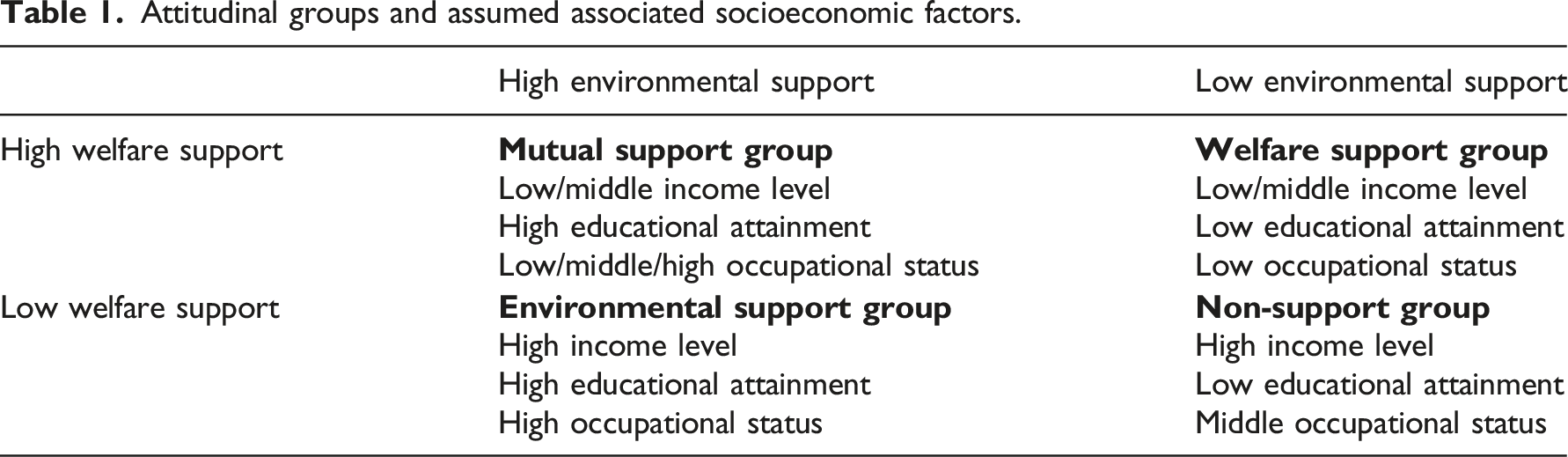
When contrasting the mutual support group to the three other attitudinal groups, it is assumed that the mutual support group will differ from the environmental support group in terms of income and occupational status, from the welfare group in terms of occupational status and educational attainment, and from the non-support group in terms of income, occupational status and educational attainment.
Research design
Data and method
The data were collected as part of the research project ‘The New Urban Challenge? Models of Sustainable Welfare in Swedish Metropolitan Cities’ (funded by the Swedish Research Council FORMAS). The data collection process was conducted from January 2020 to April 2020. The survey study followed a stratified random sampling strategy, targeting 5000 Swedish residents in the age group 18–84 years. Stratification was done in order to target residents living in Stockholm, Gothenburg and Malmö, as well as Sweden at large. With equally large sample sizes (N = 1250) in all four of the sample groups (total N = 5000), the stratified sample is disproportionate in relation to the population size. In order to adjust for the disproportionate stratified sampling design and allow for statistical generalizations from the sample to the Swedish population at large, a population size or design weight was created and used in the statistical analyses (see the section on modelling strategy below). A total number of 1529 individuals responded to the survey, which gives an overall response rate of 31%.
Operationalization of welfare and environmental attitudes
Overview of operationalization of welfare and environmental attitudes.
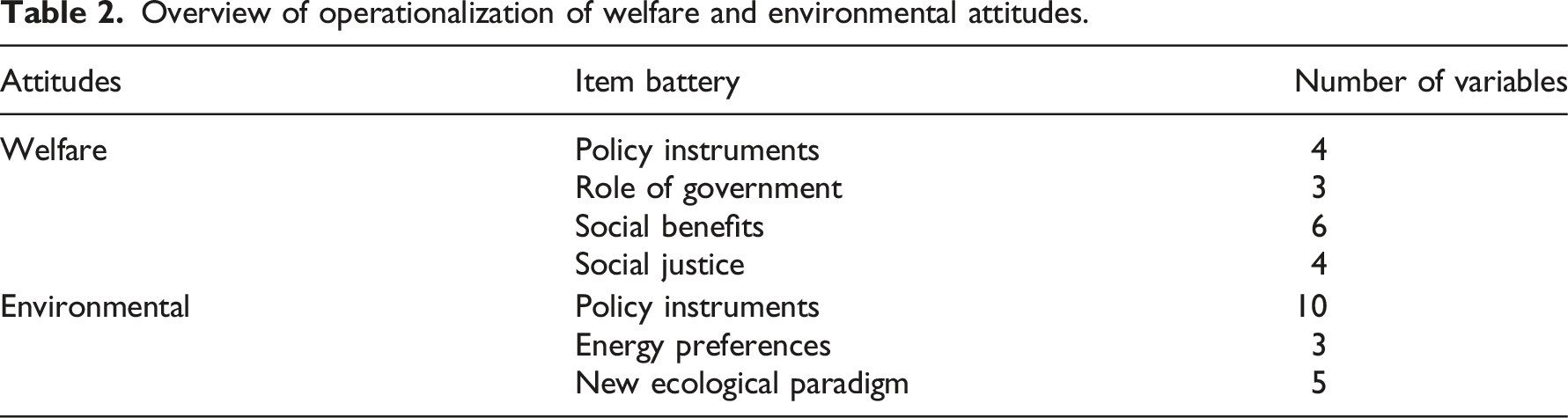
The four batteries operationalizing welfare attitudes can be traced back to the reasonings about the importance of state and public sector intervention as well as redistribution of economic resources in achieving sustainable welfare (for example, Büchs and Koch, 2017; Di Giulio and Fuchs, 2014). The first two item batteries are about social welfare policy instruments and the role of the government in relation to the old, the unemployed and working parents. The third item battery captures one of the core issues of welfare societies, that is, the handling of social risks such as illness and unemployment through social benefits and service, while the fourth item battery is about social justice. When it comes to the three item batteries operationalizing the environmental attitudes, these capture various measures to prevent climate change and environmental depletion. The first item is explicitly about different environmental policy instruments, such as taxes and subsidies. The second item battery captures the respondents’ energy preferences and to what extent there is a willingness to use energy generated from more climate-friendly sources, such as wind power and solar energy. Lastly, the third item battery is about general environmental concerns through the so-called New Ecological Paradigm. All of the questions, response options and references to the questions can be found in the online appendix 1 (see Supplementary Material).
The dependent variable, measuring support and non-support for welfare and environmental policies and concerns, was based on two latent variables that were constructed from the 35 items through principal component analysis (PCA) (see Fritz and Koch, 2019, and also Otto and Gugushvili, 2020, for a similar operationalization strategy). The large set of 35 observable items was transformed into a smaller set of factors, which in turn represent unobservable latent constructs of welfare and environmental attitudes (see Bro and Smilde, 2014). 1 One PCA was conducted on the 17 welfare items (KMO value = 0.895) and one PCA was conducted on the 18 environmental items (KMO value 0.915). All communalities were mostly around 0.5–0.7, indicating that around 50–70% of the variance of each single item is explained by the factors. The first factors in the two PCAs, generated with varimax rotation and an Eigenvalue greater than 1, were used in the subsequent analyses. These two factors explained around 36–37% of the variance in welfare and environmental attitudes, respectively. 2 In a second step, the two factors were dichotomized, and factor scores <0 were coded as ‘below average support’, while factor scores >0 were coded as ‘above average support’. From the dichotomized factor scores, four attitudinal groups were created: ‘mutual support’ (above average welfare and environmental support), ‘welfare support’ (above average welfare support, below average environmental support), ‘environmental support’ (above average environmental support, below average welfare support), and ‘non-support’ (below average welfare and environmental support). Out of the 1482 respondents (47 respondents were excluded due to non-response), 395 respondents (26.7%) were categorized into the mutual support group, 255 respondents (16.7%) into the environmental support group, 316 respondents (20.7%) into the welfare support group, and 516 respondents (33.7%) into the non-support group.
Independent and control variables
In order to capture different aspects of socioeconomic factors, data regarding personal income, educational attainment, and occupational status were used (see Linos and West, 2003; Svallfors, 2012). Personal income was measured as a continuous variable, where the respondent reported their monthly income. A dichotomous personal income variable was created to capture differences between high-income earners and low-to middle-range income earners. Based on the Swedish threshold for high-income earners – that is, the limit for state income tax which was around SEK 40,000/month (∼€4000) in 2019 (Swedish Tax Agency, 2020) – personal incomes between SEK 0 and 39,999/month were assigned a 0, and incomes above SEK 40,000/month were assigned a 1. Educational attainment was measured on a seven-point scale, ranging from no education at all to university and doctoral studies. A dichotomous variable was created also in this case to capture differences between respondents with lower or no educational attainment (coded as 0) and respondents with university studies (coded as 1). Occupational status was measured through the ISEI scale, which is based on the International Standard Classification of Occupations, ISCO-08 (Ganzeboom and Treiman, 2019; Ganzeboom et al., 1992). The index ranges from 0 to 100, where a higher number indicates an occupation with higher status and a lower number indicates a lower status. In order to facilitate the interpretation, the variable was recoded to a categorial variable based on quartiles of the ISEI variable. The lowest ISEI scores of 0–44.1399 constitute the reference category, whereas the second category consists of two quartiles, and thus middle-range ISEI scores of 44.1400–70.3999 (see Hällsten, 2020, where the mean ISEI of Swedish public register data was 51.57, which is equivalent to occupations such as social work associates and engineers). The highest ISEI scores, 70.400 and above, were coded into a third category. 3 To deal with missing data for the income variable and the ISEI variable, the missing values were replaced by mean substitution (see Hair et al., 2019: 68).
In addition, the control variables of gender, age and urban/rural were included. Based on previous findings, women and urban residents are assumed to express support for both welfare and environmental policies and concerns (for example, Jæger, 2006; Otto and Gugushvili, 2020; Sivonen and Koivula, 2020). Gender was scored 0 for males and 1 for females. The classification of urban or rural area was based on the ‘Degree of urbanization’ classification (Eurostat, 2018) and Swedish municipality codes (Statistics Sweden, 2020). Through this classification, three different types of areas were distinguished, namely cities (densely populated areas), towns and suburbs (intermediate density areas), and rural areas (thinly populated areas). Towns, suburbs and rural areas were coded as 0, and cities were coded as 1. When it comes to age, younger individuals are assumed to express environmental support (for example, Fairbrother et al., 2019). Welfare support instead is expected to be expressed in relation to different life stages with associated dependence on the welfare state, for example, student stage, parenthood, retirement, which most often occur in the early and older phases of life, respectively (Konjunkturinstitutet, 2020: 17). Thus, a younger age cohort of 18–34 years (coded as 1) and an older age cohort of 65–84 years (coded as 2) were contrasted to a middle-age cohort of 35–64 years (coded as 0). A detailed description of all independent and control variables can be found in the online appendix 3 (see Supplementary Material).
Modelling strategy
With the aim of investigating which socioeconomic factors increase the likelihood of expressing mutual welfare and environmental support, the article proceeds from multinomial logistic regression analysis (see Otto and Gugushvili, 2020). In order to put the mutual support group in the forefront of the analyses and to make the results easier to interpret, three multinomial logistic regression analyses were conducted, where the reference category alternated between the three other attitudinal groups. In the results section, only results for mutual support are presented in relation to the other three groups.
While logistic regression analysis is used extensively in social science research, it does not come without critique (for example, Aneshensel, 2013: chap 12; Mood, 2010). However, being aware of its pitfalls, this article avoided making comparisons between groups in terms of coefficient sizes. Also, a single comprehensive approach was used that included both the explanatory and the control variables at the same time (Aneshensel, 2013: chap 12). All of the analyses were conducted in SPSS version 27. In order to adjust for the disproportionate sampling strategy, the SPSS Complex Samples package was used. This package enables assessment of the overall model significance as well as tests of subsets of coefficients using the F-adjusted Wald tests in the regression analyses, which can be seen as an alternative to the log-likelihood ratio test when dealing with complex sampling strategies (Hosmer et al., 2013: chap 6).
Results
Before investigating which socioeconomic factors increase the likelihood of expressing support for welfare and environmental policies and concerns let us first take a look at the socioeconomic composition of the four attitudinal groups.
Socioeconomic composition of the four attitudinal groups.
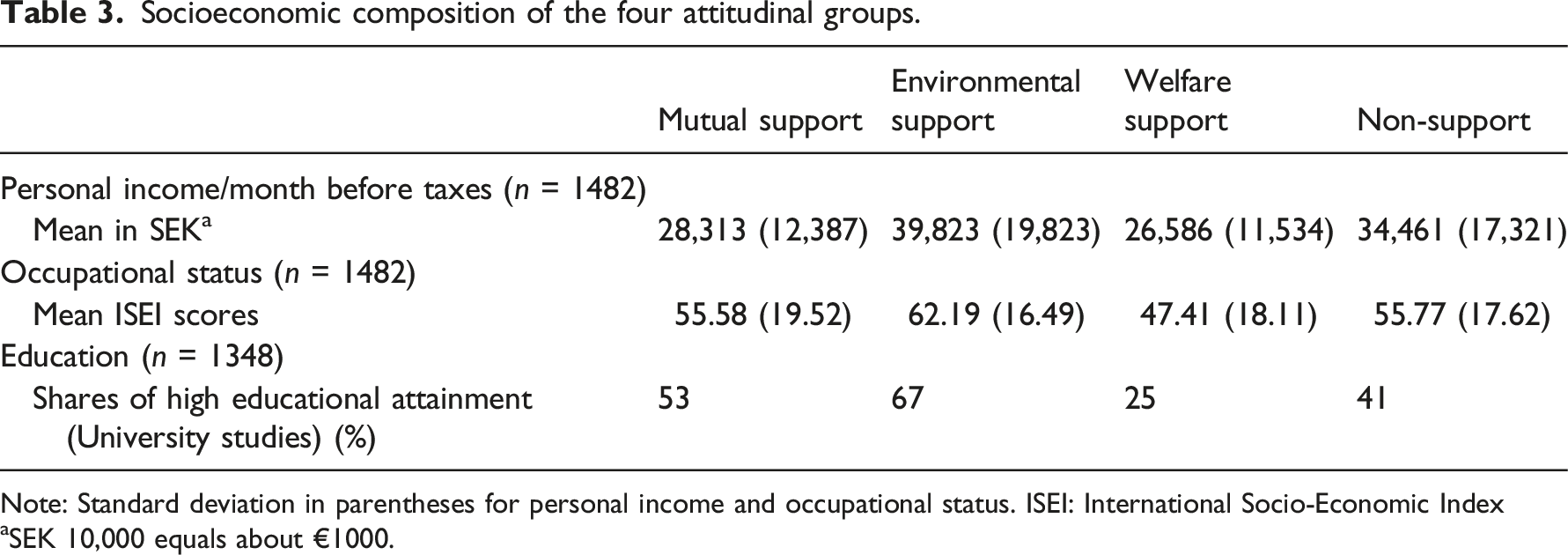
Note: Standard deviation in parentheses for personal income and occupational status. ISEI: International Socio-Economic Index
aSEK 10,000 equals about €1000.
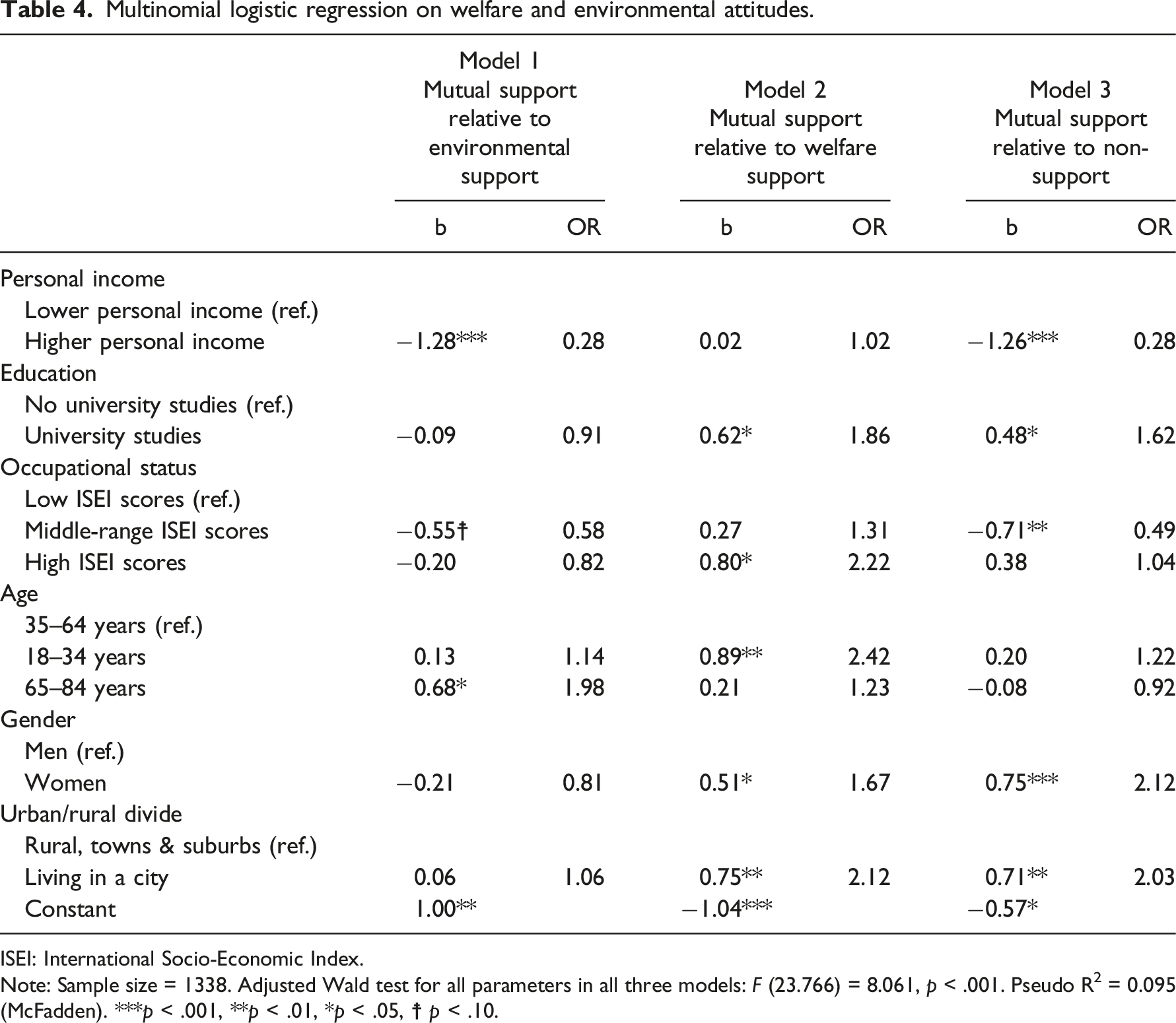
Multinomial logistic regression on welfare and environmental attitudes.
ISEI: International Socio-Economic Index.
Note: Sample size = 1338. Adjusted Wald test for all parameters in all three models: F (23.766) = 8.061, p < .001. Pseudo R2 = 0.095 (McFadden). ***p < .001, **p < .01, *p < .05, ☨ p < .10.
To give one example, when the mutual support group was contrasted with the environmental support group, the OR for personal income was 0.28. This means that as income increases from low to high personal income levels, the odds of expressing mutual support decreases by 72% relative to expressing environmental support, controlling for all other factors in the model.
As shown in Table 4, personal income significantly predicted the respondents’ attitudes towards welfare and environmental policies and concerns. Having lower personal income significantly increased the odds of expressing mutual support rather than environmental support (model 1) or non-support (model 3). No significant differences were found between the mutual support group and the welfare support group in relation to personal incomes (model 2).
When it comes to education, high educational attainment, that is, university studies, significantly increased the probability of expressing mutual support relative to expressing welfare support (model 2) or no support (model 3). No differences were found between the mutual support group and the environmental support group in terms of education (model 1).
Concerning occupational status, high-range occupational status, for example, occupations such as teaching, journalism, and medicine, significantly increased the probability of expressing mutual support rather than welfare support. Instead, jobs of lower occupational status, for example, shop sales assistants and childcare workers, were in general associated with welfare support (model 2). However, lower occupational status also increased the probability of expressing mutual support relative to expressing environmental support, but only at the 0.091 level (model 1), and non-support (model 3), which in turn were associated with middle range status occupations such as those of commercial managers and technicians.
Lastly, and when it comes to the sociodemographic control variables, being older (65–84 years) rather than middle aged (35–64 years) significantly increased the probability of expressing mutual support relative to expressing environmental support (model 1). In contrast, being younger (18–34 years) rather than middle aged (35–64 years) significantly increased the probability of expressing mutual support compared to expressing welfare support (model 2). This means that the group of individuals expressing mutual support tended to be both younger and older depending on if they were being compared to individuals expressing welfare support or environmental support. Finally, being a woman and living in a city significanlty increasd the probability of expressing mutual support relative to expressing welfare support (model 2) or non-support (model 3). No significant differences were found between individuals expressing mutual support and individuals expressing environmental support in terms of gender or the urban/rural divide (model 1).
Analysis and discussion
This article investigated if and which socioeconomic factors increase the likelihood of expressing mutual support for welfare and environmental policies and concerns compared to expressing welfare support, environmental support or non-support. The results show that the socioeconomic factors of income, education and occupational status are associated with welfare and environmental attitudes, after controlling for gender, age and urban/rural residency. Although the explanatory power of the factors in the model is rather low, with only 9.5% explained variance in attitudes, this is in line with previous research (for example, Breznau, 2010; Sivonen and Koivula, 2020). This does suggest, however, that other factors explain the variance in welfare and environmental attitudes (see below).
In line with the theoretical assumption of a socioeconomic divide between the welfare agenda and the environmental agenda (see Gugushvili and Otto, 2021), this article shows that individuals expressing welfare support seem to be located, in general, in the lower socioeconomic strata with lower incomes, educational attainment and occupational status, whereas individuals expressing environmental support seem to be located in the higher socioeconomic strata with higher incomes, educational attainment and occupational status. Following the self-interest argument, individuals expressing welfare support but less environmental support could be understood as having a personal interest in the welfare agenda but limited personal capabilities to engage in the environmental agenda due to lower socioeconomic status (see Calzada et al., 2014; Jæger, 2006). The reversed reasoning explains the environmental support group. Those expressing environmental support are those with personal capabilities to deal with climate change, such as high personal income, but have no personal interest in supporting the welfare agenda (see Fairbrother et al., 2019; Rhodes et al., 2017).
This study finds, however, that individuals expressing mutual support or non-support are less easily placed in this low to high socioeconomic continuum because both low and high socioeconomic status factors significantly increase the probability of expressing mutual support when all other factors in the model are kept constant. The results show, in line with this article’s assumptions, that individuals with low-to middle-range personal incomes are more likely to express mutual support rather than environmental support or non-support (see Otto and Gugushvili, 2020, whose study points in the same direction). Similar to previous research (Fritz and Koch, 2019; Otto and Gugushvili 2020), and also in line with this article’s assumptions, individuals with high educational attainment are more likely to express mutual support compared to expressing welfare support or non-support. That no significant differences were found between the mutual support group and the welfare support group in terms of income, or between the mutual support group and the environmental support group in terms of education, can be seen as an indication that the groups are rather similar (see also Table 3), although this has not been formally tested in this study. Regarding occupational status, the results indicate that individuals expressing mutual support are to be found in occupations with varying occupational status depending on to which attitudinal group they are being contrasted. When contrasted to individuals expressing welfare support, individuals expressing mutual support are associated with higher-status occupations. But when contrasted to non-supporters and environmental supporters, individuals expressing mutual support are associated with lower-status occupations. That mutual supporters seem to have occupations with varying degree of occupational status resonates with previous research in two ways. First, it has been shown that sociocultural professionals tend to express mutual welfare and environmental support (Fritz and Koch, 2019). Second, in the ISEI scale sociocultural professionals can be found in low to high status occupations (Ganzeboom and Treiman, 2019). Thus, the mutual supporters’ varying degree of occupational status can perhaps be understood as a result of them also being sociocultural professionals in this study.
When trying to understand the socioeconomic factors associated with mutual support from the self-interest and personal capability perspectives, a collision occurs between the two theoretical premisses. The collision appears first and foremost in relation to the income and the education factors. Low-to middle-range income levels could potentially explain welfare support from a self-interest perspective, but less so environmental support from a personal capability perspective. High educational attainment could potentially explain environmental support from a personal capability perspective, but less so welfare support from a self-interest perspective. Together with the fact that the mutual supporters seem to have occupations with varying degrees of occupational status, this indicates that the self-interest and the personal capability perspectives provide less guidance for explaining the association between the socioeconomic factors and the mutual support group. This suggests that we need to go beyond these well-established theoretical perspectives, and even further beyond materialistic and economic values.
To better capture the distinctiveness of individuals expressing mutual support we could consider social class based on occupations and professional identity alongside socioeconomic factors. Fritz and Koch (2019, see also Sivonen and Koivula, 2020) argue in favour of a cultural capital approach, which is salient among sociocultural professionals who seem to have a work logic based on interpersonal relationships and who seem to hold post-material and non-economic values. As mentioned before, this particular occupational group tends to be supportive of both welfare and environmental policies (Fritz and Koch, 2019). The findings in this article, and particularly the mix of both low and high socioeconomic factors being associated with mutual supporters, but also with non-supporters, raise questions of whether we can understand these individuals in terms of a ‘new middle class’ (see Güveli et al., 2012, who refer to sociocultural specialists as a ‘new middle class’). If so, it might be that this ‘new middle class’ is divided when it comes to their materialistic and post-materialistic values, and thus when it comes to expressing support or non-support for welfare and environmental policies and concerns (see Fritz and Koch, 2019; Sivonen and Koivula, 2020). In the longer run, and if such a ‘new middle class’ divide truly exists, it would be interesting to investigate what it entails, alongside the socioeconomic divide between welfare supporters and environmental supporters, regarding public support or non-support for an eco-social policy agenda.
Another way of understanding individuals expressing mutual support is to include a relational approach, that is, an approach that focuses on relations towards other beings and nature. Rather than searching for material self-satisfaction, quality of life and self-expression are to be seen as central components (see Inglehart, 1971). Helne and Hirvilammi (2017) discuss this as a step away from humans as Homo economicus, driven by utility maximization. It has been suggested, for instance, that: ‘[i]f taken seriously, sustainability requires a shift in the understanding of humanity’s place on the planet’ (Helne and Hirvilammi, 2017: 39), which in turn ‘requires that we have to include more relationships in our self-image’ (Helne and Hirvilammi, 2017: 39). The concept of Homo iunctus, that is, the connected man, captures the idea of a relational approach towards other beings and nature. Such a relational approach shows the significance of basic human values, especially in terms of altruistic and biospheric aspects (Stern, 2000). Basic human values have already been used extensively in environmental attitude research (for example, Bouman et al., 2018) and to some extent in welfare attitude research (for example, Kulin and Svallfors, 2013), but not in studies that investigate welfare and environmental attitudes in combination. The results of this article suggest that we need to continue to study socioeconomic factors, while also including value-based factors, such as basic human values, in order to better understand individuals expressing mutual support for both welfare and environmental policies and concerns. Adding more factors, such as basic human values, to the regression model would certainly improve it in terms of the explained variance, which is rather limited in this study.
Conclusion
This study has shown that both low and high socioeconomic status factors increase the likelihood of expressing mutual welfare and environmental support. These factors are low- to middle-range income levels, high educational attainment and low- to high-status occupations. Established theories of self-interest and personal capabilities have substance when it comes to explaining welfare and environmental attitudes in isolation, but less so when it comes to addressing individuals who express mutual support for welfare and environmental policies and concerns. The findings in this article suggest that we need to go beyond the two well-established theoretical perspectives in order to understand individuals expressing mutual support. Instead, attention needs to be directed towards other theoretical points of departure that, for example, take post-materialism and non-economic dimensions into account, such as a social class perspective based on occupations and professional identity, but also a relational approach towards other beings and to nature. Another avenue for further research is to explore to what extent mutual supporters, as well as welfare supporters, environmental supporters and non-supporters, can be considered as distinctive social groups (see Fritz et al., 2021 whose study distinguish several eco-social dispositions and habitus). Lastly, future research could investigate mutual welfare and environmental support in relation to support or non-support for an eco-social policy agenda, for example by specifically asking respondents to rank various welfare and environmental issues or to evaluate specific questions regarding an eco-social policy agenda or eco-social policies that explicitly combine social and environmental objectives.
Supplemental Material
Supplemental Material - Attitudes towards welfare and environmental policies and concerns: A matter of self-interest, personal capability, or beyond?
Supplementary Material for Attitudes towards welfare and environmental policies and concerns: A matter of self-interest, personal capability, or beyond? by Kajsa Emilsson in Journal of European Social Policy.
Footnotes
Funding
The author(s) disclosed receipt of the following financial support for the research, authorship, and/or publication of this article: This work was supported by FORMAS, the Swedish Research Council for Sustainable Development [grant number 2016-00340].
Supplemental Material
Supplemental material for this article is available online.

Notes
References
Supplementary Material
Please find the following supplemental material available below.
For Open Access articles published under a Creative Commons License, all supplemental material carries the same license as the article it is associated with.
For non-Open Access articles published, all supplemental material carries a non-exclusive license, and permission requests for re-use of supplemental material or any part of supplemental material shall be sent directly to the copyright owner as specified in the copyright notice associated with the article.
