



Abstract
Active labour market programmes (ALMPs) should help young adults who collect welfare benefits ‘get back on track’. Despite the recent proliferation of research on ALMPs, only scant attention has been paid to their employment quality effects. Aiming to fill this gap, this article evaluates the long-term effects of German ALMPs on young adults’ employment quality. We measure employment quality with two indicators: one on whether someone has a job with earnings below the low wage threshold and the other on whether they have a job with earnings above the low wage threshold. These measures help us assess whether ALMPs prevent young adults from being at risk of poverty again. In addition, we study whether ALMP effects vary by social origin. We distinguish young adults by whether their families collected benefits when they were adolescents, as a marker for disadvantaged social origin. We analyse in-firm training and one-euro jobs as examples for enabling and workfare programmes, which exist across other welfare states as well. Empirically, we apply an entropy balancing approach to a self-drawn sample from registry data to analyse ALMP treatment effects. Results show that in-firm training enhances young adults’ employment quality in the long run. The effects tend to be lower for those from disadvantaged families though, indicating that disadvantages embedded in social origin remain. The workfare programme harms participants’ employment quality, with those less disadvantaged suffering the greatest damage. Overall, our research provides evidence that in-firm training effectively enables young adults to find a job of higher quality, addressing their risk of social exclusion and proving useful in promoting upward social mobility. Nonetheless, the article also raises urgent issues concerning how the needs of those most vulnerable can be addressed by social policy.
Keywords
Introduction
The new social risks (NSR) literature has identified young adults as a distinctive ‘new social risk group’. Scholars have argued that young adults need special attention from the welfare state because they face restricted access to the labour market in the post-industrial era and are therefore at greater risk of social exclusion (Taylor-Gooby, 2004). Those who rely on means-tested welfare benefits and are not in employment, education or training have experienced particular difficulties in their school-to-work transition (France, 2008; Hemerijck, 2017). Unemployment and, more broadly, not being in education or training during early adulthood is likely to scar young adults’ performance in the labour market (e.g., Eurofound, 2012).
To address these problems, welfare states intervene with active labour market programmes (ALMPs). Some studies have evaluated the effects of ALMPs on young adults’ employment (e.g., Caliendo et al., 2011; Harrer, 2021; Rønsen and Skarðhamar, 2009) and a few have analysed the effects of ALMPs on employment quality for the general population of welfare recipients (Dengler, 2019; Fervers, 2019). However, there is no existing research that focuses on the specific effects of ALMPs on employment quality for young welfare recipients.
Yet the effects of ALMPs on employment quality might be different for young adults than they are for the average population of welfare recipients. Allocation to ALMPs and certain mechanisms through which an ALMP affects employment quality are specific to young adults. For instance, a primary objective of the welfare state is to get people under 25 years of age into an apprenticeship or employment as quickly as possible. In addition, less educated young adults in particular receive rather ‘paternalistic’ treatment from public employment services (e.g., Walther, 2006).
Not only might the effects be different for young adults than for older people, but obtaining higher-quality employment is also more decisive for young adults’ career paths (Caliendo et al., 2011; Egdell and McQuaid, 2016). Employment quality, which is being promoted at supranational level to progressively achieve ‘sustainable work’ (e.g., European Commission, 2013; United Nations 2015 Agenda for Sustainable Development), is crucial for developing a career and mitigating young adults’ risk of unemployment and (in-work) poverty throughout their life course.
The aim of this article is to fill the gap in research into the (long-term) effects of ALMPs on young welfare recipients’ employment quality (first research question). Employment quality is a multidimensional social construct. It has been measured using indicators such as skill level at work, occupational exposure and earnings (e.g., Dengler, 2019; Fervers, 2019). We focus primarily on the monetary dimension of employment quality. We use two indicators to measure employment quality: the first is whether someone has a job with earnings below the low-wage threshold and the second is whether they have a job with earnings above the low-wage threshold. The low-wage threshold is defined as two thirds of the median wage (see DeStatis, 2017). Obtaining a job with earnings above the low-wage threshold signifies the potential for financial independence, thereby shielding young adults from the risk of falling back into poverty. In secondary analyses, we assess the robustness of our main results by applying alternative measures of employment quality, such as the probability of working in unskilled or skilled employment.
There is a lack of research on ALMPs that examines the possible intersectionality of young-age welfare receipt and disadvantaged social origin. In the case of two thirds of young welfare recipients, their families were receiving benefits during their adolescence, which exposed them to additional hardships. Studies have shown that, when parents receive welfare benefits, their children are more likely to be unemployed and receive welfare benefits as adults (e.g., for Scandinavia, see Kauppinen et al., 2014; for Germany, see Schels, 2018).
Adopting a social stratification perspective, we therefore investigate whether ALMP effects differ according to social origin (second research question). We use the proxy of welfare receipt at age 14 to 17 to measure social origin, drawing on literature on social origin, life course and cumulative (dis)advantages. In a broader sense, our insights contribute to the debate on how to promote the socioeconomic integration of young people with a high risk of exclusion (e.g., France, 2008; Rovny, 2014).
Empirically, we use rich administrative population data of welfare recipients sampled at age 20 to 22. We apply an entropy balancing approach to analyse the effects of ALMP treatment (Hainmueller, 2012).
Theoretically, framing ALMPs is complex because ALMPs not only vary in design – having particular targets, features and purposes – and in how they are delivered by public employment services (e.g., Im and Shin, 2022), but are also products of multiple policies. One way to understand the specific activation architectures is with the enablement-workfare framework (Dingeldey, 2007), 1 which we employ in order to better grasp what ALMPs promote. Specifically, we study the effects of in-firm training and ‘one-euro jobs’, which are widely applied programmes that mirror the ‘enabling state’ and the ‘workfare state’ to some extent.
Institutional background
The enabling state and the workfare state
The enabling state (a notion analogous to social investment, see Barbier, 2017) 2 activates the unemployed through skill-building and the provision of employment services and childcare (Dingeldey, 2007). According to NSR literature, the shift of welfare states towards enabling policies is a response aimed at improving protection against the social exclusion risks young adults and other groups face (Hemerijck, 2017; Taylor-Gooby, 2004). Recently, the EU’s Social Investment Package has extended the scope of employment quality to advance inclusive growth and led countries to increase their spending on training programmes (see Kenworthy, 2017).
The workfare state enforces compliance with stricter requirements that welfare recipients must fulfil as part of their benefits contract (Dingeldey, 2007; Lødemel and Trickey, 2001). According to Taylor-Gooby (2004), the workfare development is a state’s response to legitimacy questioning and pressures against generosity towards new risk groups. Workfare is also justified as a strategy against welfare ‘dependency’ (Lødemel and Trickey, 2001). It is reflected in the emphasis on ‘more jobs’ rather than ‘better jobs’ (Raveaud, 2007), ‘making work pay’ programmes such as the New Deal for Young People (France, 2008) and the obligation of welfare recipients in Germany to accept any job. Moreover, compulsory workfare programmes have been established (Lødemel and Trickey, 2001). Critics claim that they only exist to make people pay a ‘work fare’ for benefits (e.g., Breidahl and Clement, 2010).
Researchers typically considered the Nordic countries to be ‘train-first’ countries, meaning that enabling policies are predominant there. In contrast, Anglo-Saxon countries have been labelled as having a ‘work-first’ approach because their emphasis lies on workfare, with training programmes being ‘underdeveloped’ there (Dingeldey, 2007). Meanwhile, continental European countries such as Germany combine both enabling and workfare policies to a greater extent (see Kowalewska, 2016).
The German welfare benefits system
The German welfare system is based on the principle of ‘rights and duties’. Welfare recipients have the right to access benefits and enabling policies, coupled with the duty to strive for self-sufficiency. This obligation is enforced through workfare policies. Welfare benefits are means-tested benefits that provide a minimum standard of living for needy households, such as the long-term unemployed (those unemployed for over a year) or those who are employed but cannot make ends meet, and their children. Following a ‘familisation’ logic (Chevalier, 2016), welfare recipients under the age of 25 are considered the responsibility of their parents and must stay at the parental home, unless they were already living apart before claiming benefits, had started their own family or proved that they would be living in intolerable conditions. Those who still live with their parents, however, receive individual counselling from caseworkers.
The state covers rent and heating and provides an allowance for food, clothing, electricity and other needs. The amount of the allowance depends on the number and age of the household members. In 2014, for example, an unemployed individual living alone received €391 per month.
The ultimate goal of the welfare system is to get welfare recipients who are capable of working into work or, primarily in the case of those without postsecondary education, into an apprenticeship. Apprenticeships are one core way of accessing Germany’s highly stratified occupational system (Chevalier, 2016; Walther, 2006). In particular, dual-system apprenticeships are well valued in the labour market, with a range of programmes on offer, depending on the qualifications an individual has achieved at school.
ALMPs
In-firm training
In-firm training typically lasts for 1 month and resembles an unpaid internship at a firm. Employers use the programme as a ‘screening device’ for potential employees, whom they may subsequently hire for an apprenticeship or a job (Harrer et al., 2020; Wapler et al., 2022).
In-firm training is targeted at welfare recipients who, despite struggling to find a job independently, are not furthest from the labour market. Typically, caseworkers suggest the programme to welfare recipients, although welfare recipients can also express their interest in participating. Participating in the programme should help welfare recipients in their careers. Particularly in the case of upskilling measures, welfare recipients’ motivation to participate in the programme is taken into account (Bähr et al., 2019). However, caseworkers may ‘skim off the cream’ by selecting the welfare recipients with the best employment prospects to participate in the programme. This practice has triggered fierce criticism against social investment because those who are worse off are left behind (Bonoli, 2020; Cantillon, 2011).
We would argue that the emphasis of in-firm training is on enabling participants. It focuses on training, takes individual motivation into account and addresses what has been the problem in the past among young welfare recipients, namely contact with employers.
Recent studies show that in-firm training has a persisting positive impact on the probability of being employed, increasing this by 10 to 20 percentage points (pp) on average (Dengler, 2019; Harrer et al., 2020; Kopf, 2013). These effects are unlikely to be mere deadweight effects, where employers hire in-firm training participants they would have hired anyway. Regional-level analyses by Wapler et al. (2022) shed light on this and find that a higher regional in-firm training intensity improves the matching of welfare recipients with vacancies. Analysing the general population of welfare recipients, Dengler (2019) demonstrates that in-firm training mostly leads to jobs with medium occupational exposure (e.g., with moderate exposure to an unhealthy environment). In-firm training increases earnings (Dengler, 2019; Harrer et al., 2020) and the probability of having a job that lasts for at least 6 months (Dengler, 2019; Kopf, 2013). While the effects mentioned were calculated for the average welfare recipient, the effects of in-firm training are likely to be different for young adults, who are more vulnerable than prime-age individuals (e.g., in terms of educational attainment). In addition, taking life stages into consideration, the mechanisms through which in-firm training affects employment quality might be different for young adults, by raising the probability that they will undertake an apprenticeship, for example (Harrer, 2021).
The workfare programme
One-euro jobs are a public-sector employment programme that usually involves participants working for 20 to 30 hours a week for a period of up to 6 months, receiving pay of between €1 and €2 per hour in addition to their benefits. As it is targeted at those who are ‘hardest to place’ – for example, the long-term unemployed – caseworkers are expected to use this programme as a ‘last resort’ (Hohmeyer and Wolff, 2012). The aim of one-euro jobs is to improve participants’ chances of integration into the labour market in the long run by helping them overcome their social and personal barriers through work, a regular schedule and providing a service to society (e.g., street cleaning).
While caseworkers and welfare recipients should discuss the steps to follow to improve the latter’s chances in the labour market (Bähr et al., 2019), in practice, caseworkers have the authority to enforce participation in a one-euro job. Since participation is compulsory and can be used as a monitoring tool in the sense of a ‘work test’, one-euro jobs have often been called a workfare programme (e.g., Gundert and Hohendanner, 2015; Hohmeyer and Wolff, 2012). For instance, Wulfgramm (2011) shows that participation is compulsory for 20% of participants of all ages. According to Lødemel and Trickey (2001), one-euro jobs are also a workfare programme because their emphasis is on raising the employability of people through work.
An additional aim of workfare programmes, however, can be to improve recipients’ wellbeing (Lødemel and Trickey, 2001). According to empirical research, participation may increase participants’ sense of social integration and life satisfaction (Gundert and Hohendanner, 2015; Wulfgramm 2011).
Internationally, public-sector employment programmes have fared rather badly (Card et al., 2018). Studies in Germany demonstrate that one-euro jobs (referred to hereafter as the ‘workfare programme’) either have no positive impact on regular employment (Harrer and Stockinger, 2021; Zabel, 2013) or have modest positive effects for women only, after a phase during which participants reduce the intensity of their job search – ‘lock-in’ effects (Dengler, 2019; Hohmeyer and Wolff, 2012). Effects on employment are, on average, negative for young people (Hohmeyer and Wolff, 2012). Focusing on the general population of welfare recipients, Dengler (2019) finds no or negligible positive effects on earnings for men, but shows more optimistic results for women, with the programme leading to lower-quality employment (measured via occupational exposure). However, the effects on employment quality and the implications of these might vary for young adults, given their more vulnerable situation as an NSR group. In addition, we explore potential heterogeneities by social origin in the following section, with the aim of gaining insights into whether the programme’s targeting of those who are worse off does indeed yield positive results.
Theoretical considerations
Possible effects of ALMPs
In-firm training should have positive effects on employment quality, particularly in the long run. After completing the programme, participants may have the opportunity to stay on at the firm for an apprenticeship or a regular job, depending on their preferences and those of their employers. Employers have the chance to assess participants during the training period. Even if there is a mismatch between participants and employers, in-firm training can increase participants’ human capital. Furthermore, participation in in-firm training can improve an individual’s chances of being hired if employers take this as a positive signal of motivation and skills and know that caseworkers rate the participant positively (Liechti et al., 2017). Clearly, completing an apprenticeship improves a person’s chances of obtaining higher-quality employment. In addition, according to the stepping stone argument, lower-quality employment could become higher-quality employment over time, due to human and social capital accumulation, a positive signalling effect (e.g., Boschman et al., 2021) and the avoidance of negative effects of unemployment on career and wellbeing (e.g., Fervers, 2019; Wulfgramm, 2011).
While the stepping stone argument can also apply to the workfare programme, the workfare programme might be a trap rather than an opportunity. On the one hand, the workfare programme should support participants’ integration into the labour market. Even if the programme is used as a work test, participants may step up their job search to exit welfare receipt more quickly. Since participants undertake low-skilled activities, the programme mainly leads to lower-quality employment that could gain in quality over time. On the other hand, as the programme mainly involves low-skill activities, it may not support participants in gathering work experience that is valued by employers. Additionally, because it is targeted at those furthest from the labour market, the programme carries a stigma (Ames, 2009). Employers might associate former participants with negative traits such as incompetence if they know about a person’s earlier participation in the programme.
Social origin
We suggest receipt of welfare benefits during adolescence as our indicator of disadvantaged social origin, integrating structural and life-course approaches (see Vandecasteele, 2011). From a structural perspective, parents on welfare are often characterised by long-term unemployment or employment in low-wage jobs, with a disproportionate representation of people with low educational attainment and foreign nationality (Zabel and Kopf, 2018). From a life-course perspective, events are most likely to affect a person if they are experienced at a critical stage (Elder, 1985). Adolescence is a critical stage – adolescents must prepare for a complex school-to-work transition (France, 2008; Walther, 2006). Navigating this transition becomes more challenging when the adolescent’s family is experiencing poverty, and receipt of welfare is a marker for this (e.g., families live in poor-quality housing, or cannot participate in sociocultural activities). According to the cumulative (dis)advantages framework, inequalities faced during adolescence may accumulate and widen over time (e.g., Vandecasteele, 2011). Experience of receipt of welfare during adolescence is therefore our indicator of low social origin.
We have competing hypotheses as regards how participation in in-firm training might affect young adults of lower social origin compared to those of higher social origin. On the one hand, young adults of lower social origin may perform worse during in-firm training and, later, in the labour market because they start ‘at a lower level’ in terms of economic, cultural and social resources. The effect on employment quality could be smaller for them if their initial disadvantages accumulate, hindering their performance during in-firm training as compared to their higher social origin counterparts. This would mean that the labour market situation of the latter is also consistently better than that of the former. On the other hand, because young adults of lower social origin have more restricted access to opportunities (e.g., due to a lack of family networks), in-firm training could be a greater chance for them than for those who are less disadvantaged. In addition, resilience processes could take place where children ‘develop coping strategies and support structures as a result of previous experience of adversity’ (Nikolova and Nikolaev, 2021: 316), which could in turn result in young adults of disadvantaged social origins making the most of the programme. According to Liechti et al. (2017), those furthest from the labour market benefit most from the signalling effect of ALMPs.
We expect the workfare programme to be more effective for those of lower social origin because they might face greater social and personal barriers due to their experience of poverty – precisely the barriers that the programme aims to address. A potentially negative signalling effect might affect the most disadvantaged the least, as employers could find their participation more readily justifiable (see Liechti et al., 2017).
Data and method
Data and sample
We use administrative data on the entire population of welfare recipients in Germany provided by the Statistics Department of the Federal Employment Agency. The Unemployment Benefit II Recipient History contains detailed information about welfare recipients in Germany and their households. The data is linked to the Integrated Employment Biographies that contain a variety of information, including employment histories, data on participation in ALMPs and sociodemographic characteristics.
Our focus is on unemployed welfare recipients aged 20 to 22 who are ‘capable of working’. We do not include younger cohorts because some welfare recipients could still be in school. As explained in note 4 the upper age limit is motivated by data availability. We draw a stock sample on 31 July 2014. 3 We exclude welfare recipients who were employed, in an apprenticeship or in ALMPs on the sampling date because that would have prevented them from participating in ALMPs later. In addition, we exclude those who were not registered as jobseekers on the sampling date. Finally, we exclude welfare recipients with inconsistent or insufficient information; this applied to fewer than 1% of observations. Our final sample consists of 67,405 individuals.
We differentiate two groups according to social origin: those who received welfare benefits for at least 1 day when they were aged 14 to 17 (65% of the sample) and those who did not (35%). Among those who did receive welfare benefits, 87% received them for more than a year (see appendix Table A1). 4
Means of selected variables by welfare experience.
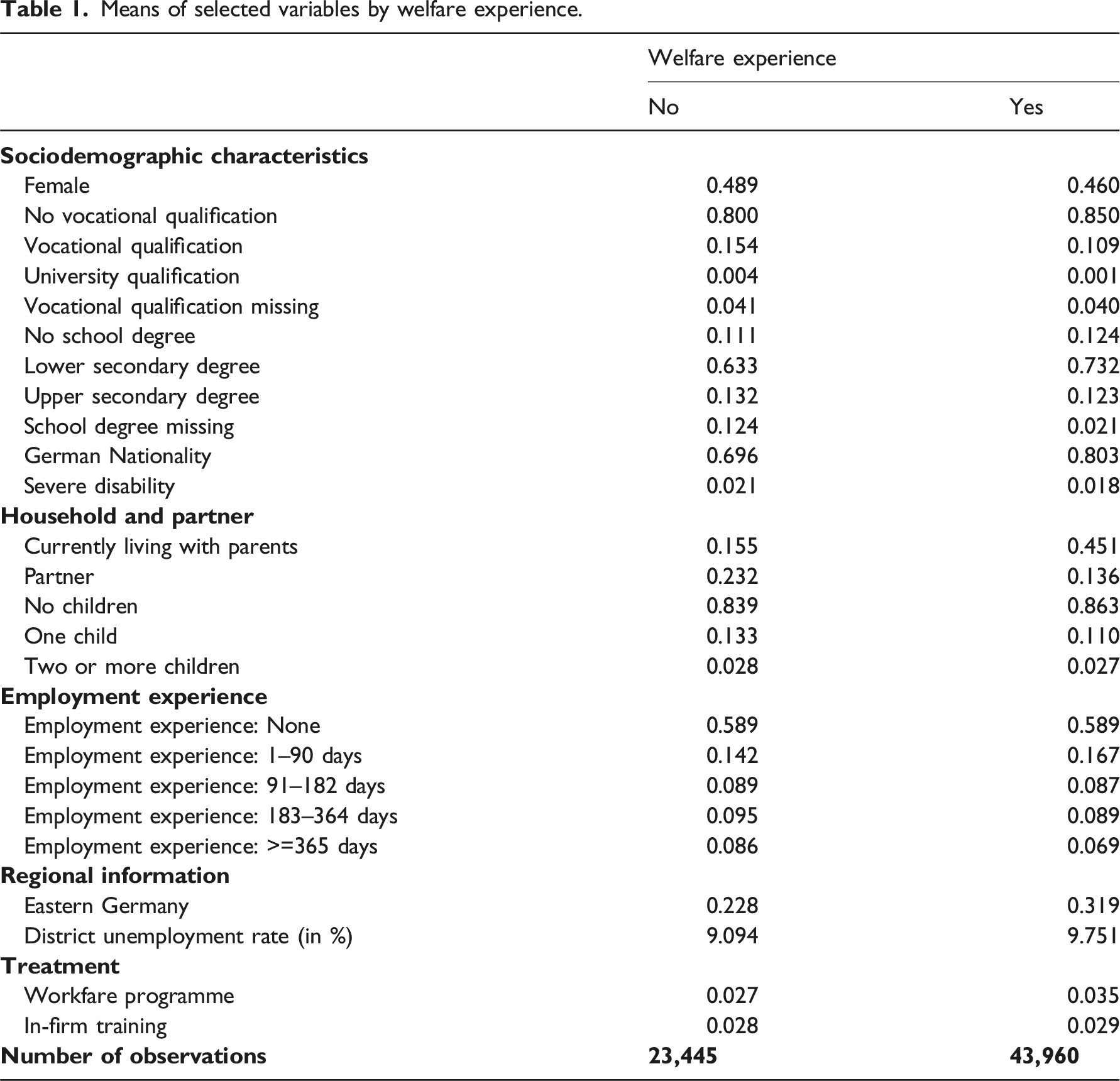
Treatments are defined as follows: if sample members begin participation in in-firm training or the workfare programme within 6 months of the sampling date, we define them as participants; those who do not are defined as non-participants. The control group may participate in in-firm training or the workfare programme after 6 months. Being in the control group hence means ‘waiting’ for the treatment for at least 6 months.
An alternative definition of treatment is participation within 6 months compared to never participating. In appendix A.3, we discuss this in more detail and run a robustness check where we exclude those treated later. The results of this robustness check suggest that results are similar or treatment effects are slightly larger compared to our main estimates. Hence, if anything, our approach leads to more modest estimates of treatment effects compared to the alternative definition of treatment.
To analyse employment quality, we differentiate between employment subject to social security contributions with monthly earnings up to the low-wage threshold and earnings above the low-wage threshold, hereafter referred to as lower-pay and higher-pay employment. In 2014, the low-wage threshold in Germany as defined by the Federal Statistics Office was €10 per hour (DeStatis, 2017), corresponding to a gross monthly income of €1,733 per month when working full-time. We generate two indicators, the first indicating employment with earnings up to this threshold (lower-pay employment) and the second indicating earnings above this threshold (higher-pay employment). If a welfare recipient works in neither lower-pay nor higher-pay employment, both indicators are set to zero. For all dependent variables, we trace outcomes on a monthly basis from the beginning of programme participation until 5 years later. This allows us to study in detail the short-run and long-run effects of ALMPs and the development of the effects.
We do not have access to information on working hours. A person might be working part-time with earnings below this threshold, but would earn above the threshold if working full-time. Hence, the indicators reflect not only the wage received, but also the hours worked: the lower-pay indicator partially measures part-time employment and the higher-pay indicator partially measures full-time employment. We therefore interpret our indicators as a more general measure of employment of comparatively lower or higher quality.
To assess the robustness of our results with regard to the shortcomings of our indicators, we conduct two additional analyses (see appendix A.3). First, we estimate the programme effects on (un)skilled employment as an alternative measure of employment quality. In contrast to our main indicators that measure employment quality in monetary terms, this measure sheds light on the skill dimension of employment quality. These results resemble the results for lower- and higher-pay employment, raising our confidence that these indicators are suitable measures. Second, we analyse effects on lower- and higher-pay full-time employment as outcomes. For these outcomes, differences in our indicators reflect differences in earnings alone, and not in working hours. The results suggest that the effect on lower-pay employment is partially, but not fully, driven by part-time employment. Overall, our conclusions do not differ substantially from the ones we derive from our main estimates.
We assign each welfare recipient a random programme start date based on the distribution of actual programme start dates and measure outcomes from this date onwards (see appendix A.2). We observe 1,445 participations in in-firm training and 1,622 in the workfare programme. The control group ranges from around 16,000 to 31,000 observations (appendix Table A2).
Method
Our interest lies in the effect of in-firm training and the workfare programme on employment quality. More specifically, we analyse the effect for those who actually received treatment, that is, the average treatment effect on the treated (ATT). We cannot simply compare outcomes of those who participated in the ALMPs with those who did not participate, as participants select into treatment.
Means of selected variables by treatment status and ALMP.
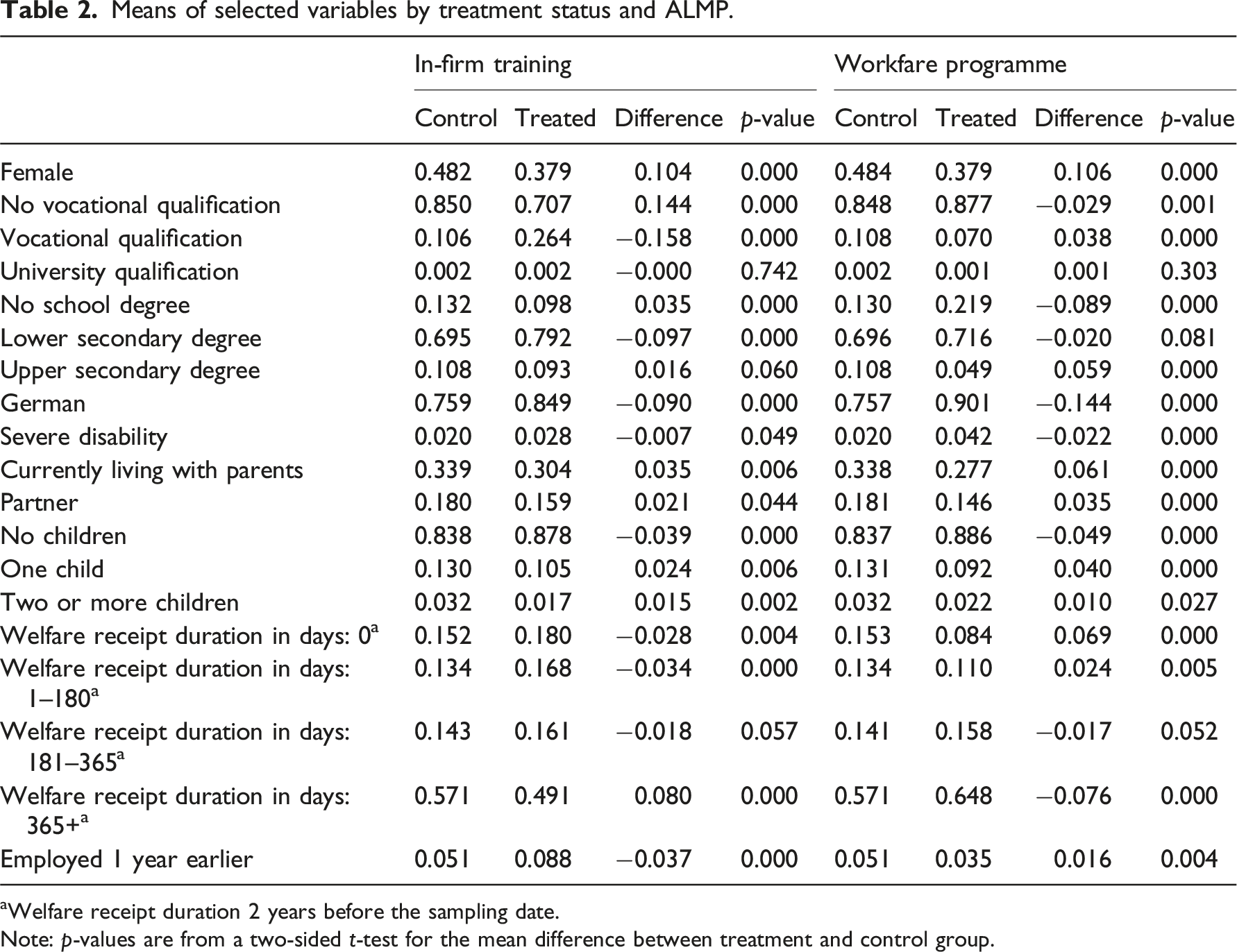
aWelfare receipt duration 2 years before the sampling date.
Note: p-values are from a two-sided t-test for the mean difference between treatment and control group.
To account for this selectivity, we apply an entropy balancing approach (Hainmueller, 2012). Entropy balancing is similar to matching-type approaches, such as propensity score matching. In appendix A.3, we show that results for the main effects on employment quality do not differ substantially, irrespective of the matching method chosen. Entropy balancing calibrates weights for individuals in the control group based on the distribution of control covariates in the treatment group. After applying these weights, differences in control covariates between the treatment and control groups disappear. Roughly speaking, this means that those individuals in the control group who are more similar to the treatment group will be given a higher weighting.
Conditional independence assumption
A consistent estimation of the ATT using entropy balancing rests on several assumptions, the most crucial being the conditional independence assumption (CIA). 5 This assumption requires the weighted outcome of the control group to be a valid estimate of the counterfactual potential outcome of the treatment group, given the control variables. The quality of the control variables is therefore essential – they need to effectively control for all the selection involved with the treatment assignment.
The administrative data provides us with a comprehensible and reliable dataset, encompassing substantial information that caseworkers may use to make decisions regarding the assignment of a welfare recipient to an ALMP. Participation in in-firm training and the workfare programme is related to a range of factors (Knize et al., 2021) that we control for, namely (i) sociodemographic characteristics, such as gender, vocational and school qualification, nationality and disability status, (ii) household characteristics, including whether young adults still live in the same household as their parents, number of children and partner’s information and (iii) regional labour market and job centre characteristics, such as German federal state, the district’s unemployment rate and the job centre’s inflow rates to in-firm training and the workfare programme.
Unobserved characteristics, such as motivation and ability, can be important, too. An analysis by Caliendo et al. (2017) of ALMP effects on unemployment benefit recipients in Germany shows that omitting personality traits that are usually unobservable does not alter results substantially if rich information on labour market history is included. A recent study by Tübbicke (2023) of welfare recipients in Germany comes to similar conclusions for the ALMPs we study in this article. We control for employment histories and for outcomes prior to treatment. Since young adults may not have had the chance to gain much employment experience, we additionally include information on (short-run) welfare experience, on whether young adults live in the same household as their parents and indicators for the incidence of prior sanctions. We think that, similarly to employment histories, such characteristics are correlated with unobservable characteristics (see appendix A.3 for more details).
We are aware that we may not be able to fully account for unobservable characteristics with entropy balancing. We do, however, find quite large effects and we believe that differences between the treatment and control groups do not merely reflect selection bias, but also the effect of the measure itself. A sensitivity analysis indicates that results are not sensitive to a confounding variable that is simulated based on the distribution of an observed variable with strong selection into the treatment (see appendix A.3 for more details).
Results
Main effects on employment quality
In the following, we briefly discuss the main effects of the programmes on employment quality in general, before turning to a more thorough discussion by prior welfare experience. We apply entropy balancing for the two measures analysed separately. Entropy balancing reweights non-participants so that the control group becomes more similar to the treatment group in terms of observable characteristics, such as gender or human capital, that would otherwise bias the estimation of treatment effects. Appendix Table A3 displays summary measures of this similarity between the treatment and control groups (i.e., the balance quality).
Figure 1 plots the ATT for participants in in-firm training and the workfare programme. After participating in in-firm training, the probability of working in lower-pay employment strongly increases, peaking at around 14 pp 3 months after the start of treatment. The probability of working in higher-pay employment increases and is 3.1 pp higher for the treatment group 3 months after treatment. The effect declines sharply after the initial period, suggesting that welfare recipients in the control group catch up, but it remains positive and significant for the entire period analysed. While we cannot entirely rule out that these effects are partially due to deadweight effects, the study by Wapler et al. (2022) raises our confidence that the effects are not exclusively deadweight effects, but also direct effects on the participants (see ‘ALMPs’ section). ATT of in-firm training and the workfare programme (95 % confidence intervals).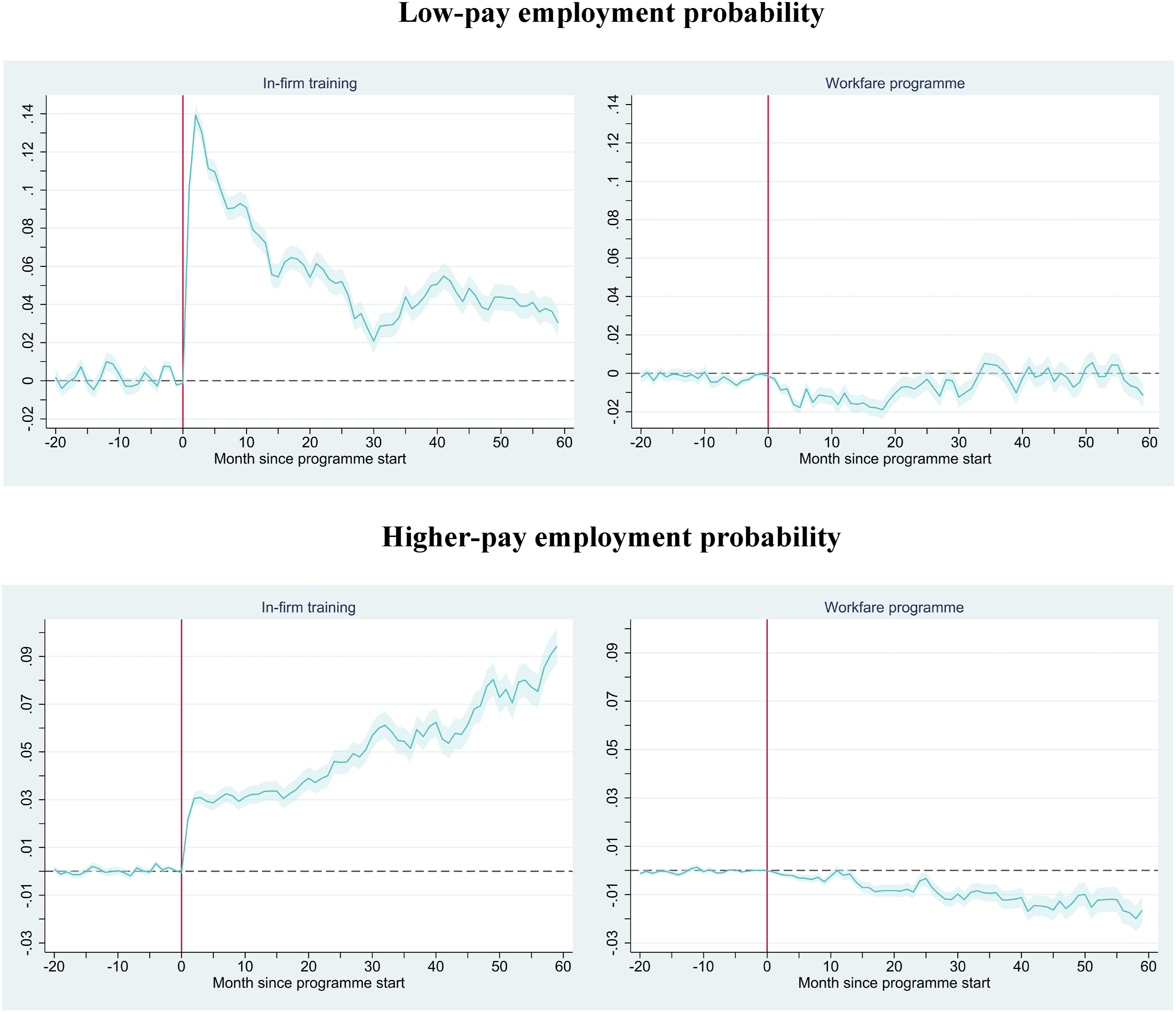
While the effect on lower-pay employment decreases over time, the effect on higher-pay employment increases over time. This indicates that in-firm training speeds up transitions to lower-pay employment in the first instance, enabling participants to find better employment later on. In this sense, the lower-pay employment induced by in-firm training acts as a stepping stone.
The effect of the workfare programme is different. After the start of the treatment, participants have significantly lower employment probabilities for both outcomes (lock-in effects). Five years after treatment, there is no effect on the probability of lower-pay employment, but there is a significant negative effect of −1.5 pp on the probability of higher-pay employment. While the control group is more likely to find better employment over time, participants lag behind. The differences actually increase with time.
Effects of ALMPs by welfare experience
We apply entropy balancing separately for four subgroups defined by treatment in in-firm training or the workfare programme and by welfare experience (see appendix Table A2). Appendix Tables A5 and A6 display the means of selected control variables for the four subgroups. First, after entropy balancing, the means of the covariates are well balanced between the treatment and control groups (see also appendix Table A7). Second, entropy balancing does not lead to extreme weights according to the threshold suggested by Imbens (2004), so trimming of the entropy balancing weights is not necessary (see appendix Table A8).
Our main interest lies in the long-run effects on employment quality. Figure 2 plots the effects on lower-pay employment and higher-pay employment by welfare experience. As far as in-firm training is concerned, the ATT on lower-pay employment is, in most periods, larger for those with experience of welfare receipt than for those without it. In contrast, the effect on higher-pay employment tends to be greater for those without experience of welfare receipt. In addition, Figure 2 shows that the workfare programme has more detrimental effects for those without welfare experience, but that participation does not help those with welfare experience find higher-quality employment in the long run either. ATT of in-firm training and the workfare programme by welfare experience (95% confidence intervals).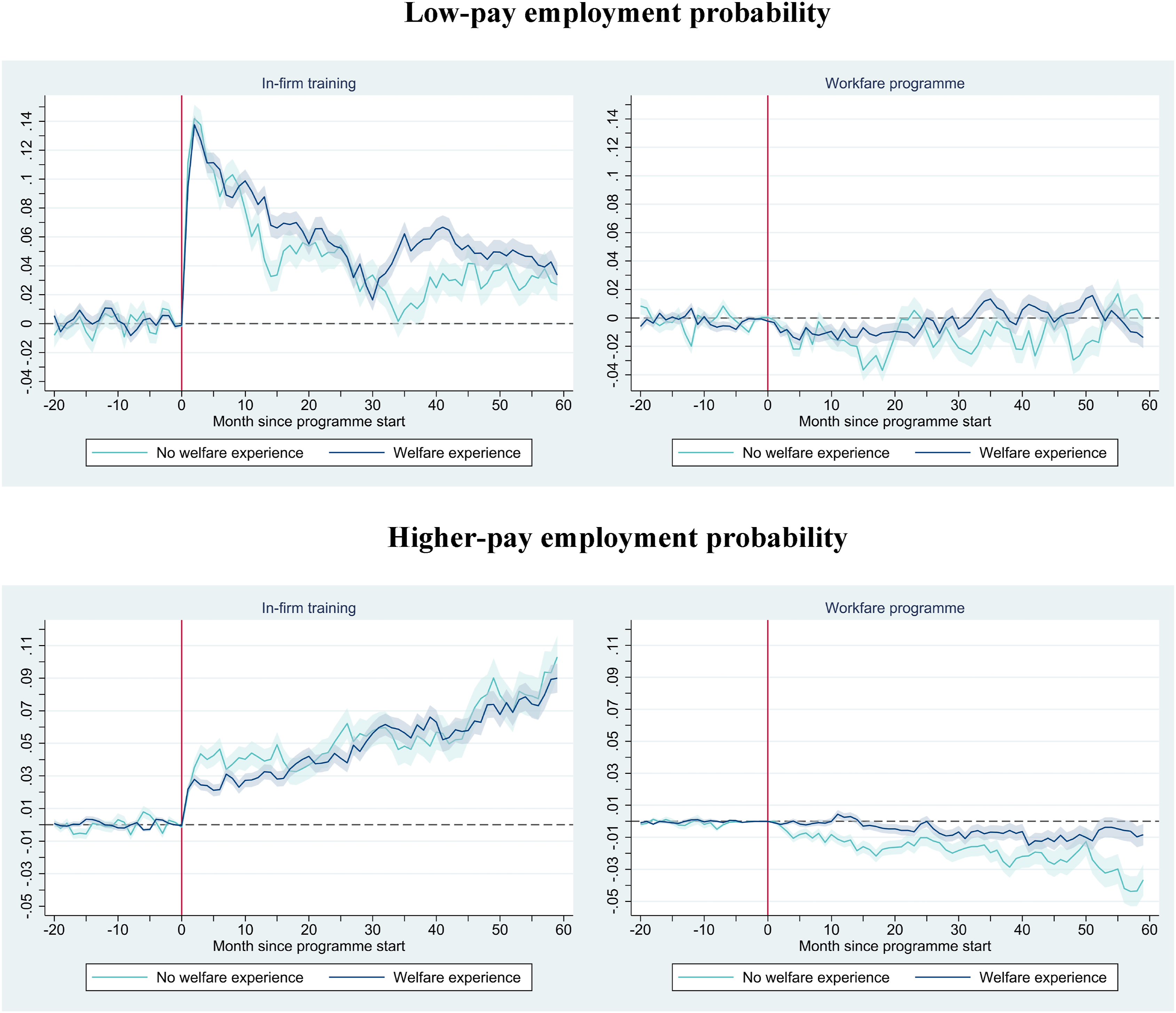
ATT on cumulative outcomes.
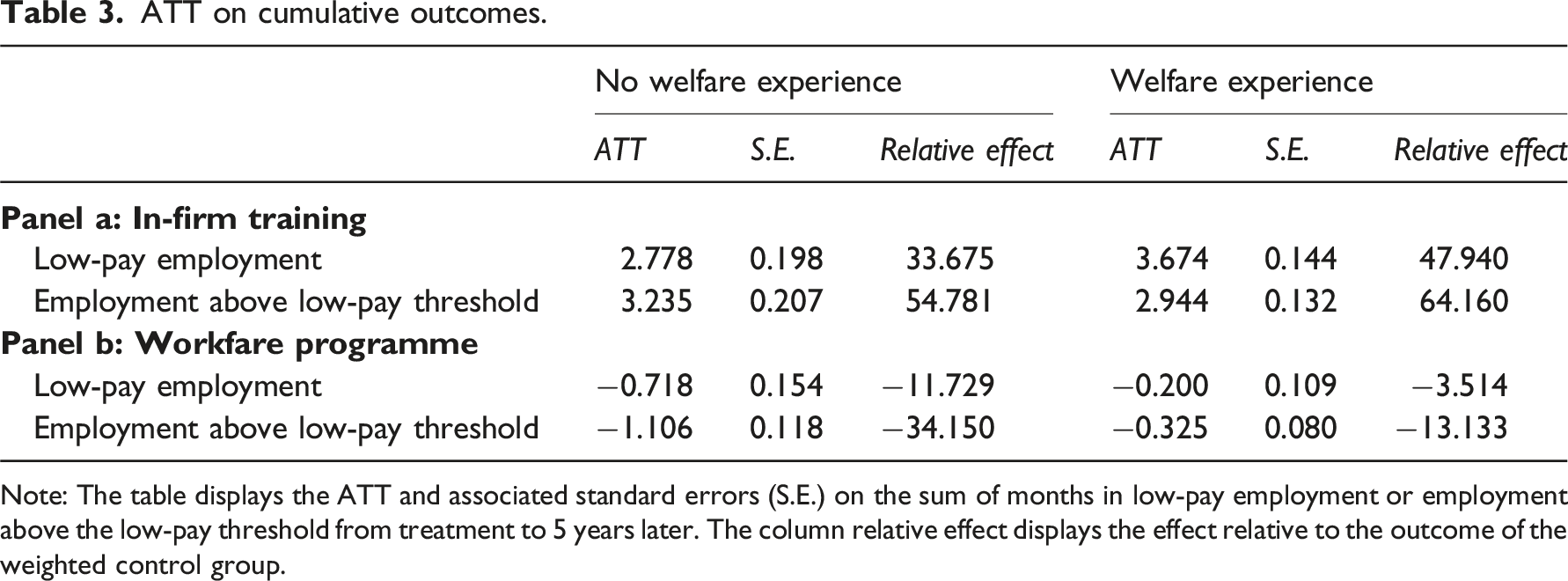
Note: The table displays the ATT and associated standard errors (S.E.) on the sum of months in low-pay employment or employment above the low-pay threshold from treatment to 5 years later. The column relative effect displays the effect relative to the outcome of the weighted control group.
We conduct a range of additional analyses, which are included in the appendix (section A.3). We want to highlight two findings here. The first is that in-firm training increases the probability of starting an apprenticeship in a firm, particularly for those with welfare experience. Our second finding is that the workfare programme lowers the probability of an apprenticeship. This is one potential explanation for the long-run effects of each programme. We also discuss the sensitivity of the results with respect to possible unobserved confounders, based on the approach proposed by Ichino et al. (2008). Overall, our results are robust.
Conclusions
In this article, we seek to answer the question as to how in-firm training and the one-euro job workfare programme affect young adults’ employment quality. We adopted a social stratification standpoint and studied whether ALMP effects vary by social origin. Broadly, we contribute to the debate on how the socioeconomic integration of young people as an NSR group is being promoted by the welfare state (e.g., Rovni, 2014). We would like to highlight two main findings.
First, in-firm training raises young adults’ employment quality in the long run. In the short run, participants take up lower-pay employment and apprenticeships more often than non-participants, which leads to higher-pay employment later, thus indicating a stepping-stone effect. Participation in in-firm training can increase initial differences by social origin: the effect of in-firm training on lower-pay employment is larger for the more disadvantaged and the effect on higher-paying employment is larger for those least disadvantaged. We interpret these findings as a result of cumulative (dis)advantages in terms of resources that contribute to an individual’s performance in the labour market before, during and after in-firm training.
Second, the workfare programme promotes neither employment nor higher-quality employment among participants. While non-participants have more time to search for a job, participants suffer negative consequences. For example, the programme may be stigmatising or inadequately targeted, and it may not help participants substantially increase their human capital. Effects are less negative for more disadvantaged young adults, perhaps due to initial disparities compared to those better-off. It therefore appears that the workfare programme makes participants pay a ‘work fare’ for benefits. However, considering the multiple disadvantages faced by those of lower social origin, even a time horizon of 5 years may not suffice for them to achieve employment at all. Since the programme has been useful in improving participants’ wellbeing (e.g., Wulfgramm, 2011), the programme is still a way to promote social inclusion. Whether the improvements found in other studies compensate for the detrimental effects found here remains an open question.
Working on this article allowed us to understand that ALMPs are not purely enabling or workfare-like: we framed in-firm training as an enabling programme, but it also promotes lower-quality employment, and the workfare programme might support people in subjective terms. We would like to make a theoretical contribution by extending Dingeldey’s (2007) framework to a multidimensional classification to better understand the design, delivery and effects of activation policies. In our view, there are at least four dimensions that determine whether an ALMP is more enabling or more workfare-like, namely (i) the degree of compulsion or voluntariness of participation in counselling and ALMPs (drawing on Lødemel and Trickey, 2001), (ii) whether the priority is fast transition into work or skill investment, 6 (iii) the emphasis put on job quality and job matching with skills, and (iv) the relevance attached to one’s wellbeing and personal situation and development.
Lately, scholars have typically framed activation policies using the enablement/social investment perspective. Yet the workfare perspective remains critical in many countries due to fiscal pressures and public discontent about social spending. Understanding the contradictory political forces at play and how these affect the welfare system is crucial. We therefore believe that future work on ALMPs can benefit from consideration of the two perspectives and from use and further development of the classification mentioned in the previous paragraph.
Our article has had some limitations. First, we cannot entirely rule out that unobservable characteristics drive our results. However, the effects we find are large and the sensitivity analyses do not indicate that unobserved heterogeneity drives differences between the treatment and control groups, demonstrating that our results do not merely reflect bias. Second, we could not differentiate the analysis further, such as by using a gender lens.
Our results pertain to ALMPs for young people in the context of Germany. Germany is specific in several respects, such as its highly stratified occupational system. However, our results are insightful for contexts beyond Germany for two reasons. First, similar programmes exist in other welfare states (e.g., Denmark, the UK and Switzerland, as described in Breidahl and Clement, 2010; Dingeldey, 2007; Liechti et al., 2017) and research on their employment quality effects for young people is lacking globally. Second, our results exemplify how the needs of young people as an NSR group are being addressed with these programmes. Although Germany adopts neither a strictly work-first nor a strictly train-first approach, we found both optimistic and somewhat gloomy results. This prompts the question as to how unemployed young people fare in other welfare states, particularly in work-first states. International research has also raised criticism of participation in certain ALMPs for young welfare recipients (e.g., for the UK, see Egdell and McQuaid, 2016; for Norway, see Rønsen and Skarðhamar, 2009). We contribute to the debate by suggesting that some ALMPs need to be reconsidered to better address (long-term) youth unemployment.
This article provides new insights for policymakers. While we recognise a move towards the sustainability goal in this respect, the workfare programme can represent a setback for the integration of young people into the labour market, contradicting the goal of fighting welfare ‘dependency’. Targeting the workfare programme more effectively is crucial for reducing negative effects on employment, and this includes avoiding using it as a work test. An initial step could be to make participation voluntary, without the threat of sanctions. In addition, positive incentives and coaching could help people move towards sustainable employment. Last, young adults of lower social origin constantly experience lower-quality employment than those from less disadvantaged backgrounds. Therefore, young people from families receiving welfare need further support if the aim of social policy is to promote a more egalitarian and meritocratic society.
Supplemental Material
Supplemental Material - Help or harm? Examining the effects of active labour market programmes on young adults’ employment quality and the role of social origin
Supplemental Material for Help or harm? Examining the effects of active labour market programmes on young adults’ employment quality and the role of social origin by Veronika J Knize, and Markus Wolf in Journal of European Social Policy
Footnotes
Acknowledgments
We are grateful to Veronika’s doctoral supervisors Joachim Wolff and Brigitte Schels for their support and constructive feedback. We also thank the participants of the ESPAnet conference 2022, American Sociological Association Annual Meeting 2022, Danish Centre for Welfare Studies Early-Career Workshop 2022, European Consortium for Sociological Research Annual Conference 2021 and European Sociological Association Conference 2021 for their valuable comments on previous versions of this article. We also thank Rebecca Heinrich and Leon Löppert for their excellent research assistance.
Declaration of conflicting interests
The author(s) declared no potential conflicts of interest with respect to the research, authorship, and/or publication of this article.
Funding
The author(s) received no financial support for the research, authorship, and/or publication of this article.

Supplemental Material
Supplemental material for this article is available online.
Notes
References
Supplementary Material
Please find the following supplemental material available below.
For Open Access articles published under a Creative Commons License, all supplemental material carries the same license as the article it is associated with.
For non-Open Access articles published, all supplemental material carries a non-exclusive license, and permission requests for re-use of supplemental material or any part of supplemental material shall be sent directly to the copyright owner as specified in the copyright notice associated with the article.
