



Abstract
This article interrogates the impacts of different types of family benefits expenditures on the positive relationship between female employment and fertility rates in developed welfare states. It does this by theorizing how these family benefits align with welfare state regimes’ preferences for different normative gender-role ideologies. Rather than treating family benefits as a monolith, this article investigates the impact of disaggregated expenditures in the Organisation for Economic Co-operation and Development (OECD) family policy database (1. services and in-kind benefits, 2. child-related cash benefits and 3. tax-based financial support for children) on both female employment and fertility rates. This is done using pooled time-series analysis covering the period 2000–9. The analysis yields evidence that expenditure most reflecting a ‘full egalitarian’ gender ideology including service and in-kind benefit provision has the most positive association with female employment and fertility due to an emphasis on defamiliarization. The picture for child-related cash benefits is mixed due to the presence of cash transfer provisions not employment-contingent captured in the indicator. In contrast, tax-based financial support for children harms female employment, reflecting a maternalistic ‘traditional’ ideological orientation, but is positive for fertility rates indicating a moderate pro-natal effect of tax-based financial support for children.
Introduction
Historically, the relationship between national female employment and fertility rates in post-industrial welfare states was negative (Brewster and Rindfuss, 2000). Orthodox theories have attributed this phenomenon to the many opportunity costs that women face in reconciling labour market participation and household commitments associated with having children (Iversen and Rosenbluth, 2010). However, the relationship reversed during the mid-1980s and has since emerged as a positive correlation across all developed welfare states (Rindfuss et al., 2016). Literature attempting to explain the positive relationship between female employment and fertility rates in post-industrial welfare states has increasingly focused on cross-national variation in gender equality (Brinton and Lee, 2016). However, these explanations have mainly focused on social attitudinal gender equity in family-oriented institutions, or the household. McDonald (2013) has argued that low fertility is a product of contradiction between higher levels of gender equity in labour market institutions compared to the household. In keeping with this view, Brinton and Lee (2016: 424) find that flexible egalitarian gender ideology is most positively associated with fertility rates in post-industrial nations as it provides the ‘widest array of socially acceptable options with respect to work and family’. However, gender ideologies are not hermetically sealed in isolation and interact with welfare state policies, including family benefits expenditure, to shape the options and constraints that women face reconciling paid employment and motherhood (fertility) (Nelson et al., 2022).
Indeed, social policies can influence the challenges women face combining paid employment and unpaid household work surrounding childrearing (Nieuwenhuis and Van Lancker, 2020). Not all welfare states assist women to combine paid work in the labour market and children (fertility) equally (Mandel and Semyonov, 2006). Different welfare states privilege different gender role attitudes toward female employment, especially maternal employment, which influences fertility (Arpino et al., 2015). Therefore, explanations for the positive correlation between female employment and fertility rates in post-industrial nations have turned to comparative analyses of gender inequality more broadly. As such, several scholars including Esping-Andersen and Billari (2015) and Goldscheider et al. (2015) have called for the development of an alternative focus steeped in the changing role of women in the public sphere (paid employment) and private sphere (fertility and childrearing).
Expenditure on family benefits (including cash transfers, family services and other tax incentives) can influence the constraints and opportunity costs women face balancing both female employment and family responsibilities (fertility) (Thévenon, 2012). Analysis of family benefits expenditure is less developed as opposed to other forms of family policy including maternity and parental leave (see Ferragina, 2019; Hegewisch and Gornick, 2011; Thévenon, 2012). Even less well-developed is how these expenditures interact with female employment and fertility concomitantly using macro-level cross-national analysis. Often much of the existing literature engages in discussion of the impact of overall family benefits (see Bonoli, 2008) alongside other determinants of gendered outcomes in the labour market (Ferragina, 2019), rather than the role of different and specific family benefits expenditures (Nygård et al., 2019). Hence, literature interrogating the gender-role ideologies of family benefits policies and their impacts on the positive relationship between female employment and fertility is under-developed.
Family benefit policy settings can impact the opportunity costs that women face between paid employment and motherhood. Given the role of the welfare state in supporting various ideas of family, family benefits can directly impact the gender division of household labour, especially in relation to childrearing (Gornick and Meyers, 2008). Impacts of policy on women’s household labour are crucial to understanding the positive relationship between female employment and fertility given the role of gender equality in reducing the trade-off between paid work and motherhood (Brinton and Lee, 2016; Kleider, 2015).
Theorizing gender-role orientations of family benefits and the female employment–fertility nexus
Existing literature examining the links between family policy, fertility rates and female labour force participation generally put gender-role ideologies on a polarized spectrum (Chesnais, 1996; Kleider, 2015; Wesolowski and Ferrarini, 2018). On one hand, traditional ideologies reflect a male breadwinner/female caregiver model with a strong normative emphasis on women’s role in childrearing. At the other end of the spectrum exists the dual earner/dual carer model. These dyadic typologies often fail to capture the nuance that sits between the theoretical division of ‘traditional’ and ‘egalitarian’ ideologies. To overcome this dichotomy, Brinton and Lee (2016) conceive four main classes of normative gender ideology: (1) traditional, (2) pro-work conservative, (3) flexible egalitarian, and (4) full egalitarian. The pro-work conservative and flexible egalitarian strategies reflect ‘combination’ approaches to balancing work and family for women. Pro-work conservative ideology prescribes that women participate in the labour market while maintaining a primary homemaking role. In comparison, flexible egalitarianism condones women’s own choices about how to balance work and family.
This article does not intend to categorize national family benefit regimes according to Brinton and Lee’s (2016) framework, instead employs it to theorize how family benefit expenditure resource allocations reflect different gender norm preferences. There are exceptions to welfare state expectation in conforming with Brinton and Lee’s (2016) gender-role ideologies. 1 Nonetheless, using Esping-Andersen’s (1990) traditional welfare state analysis, conservative welfare states largely conform with traditional and pro-work conservative ideologies, liberal welfare states with flexible egalitarianism, and social democratic with full egalitarian ideology. Using Brinton and Lee’s (2016) framework, this article supersedes traditional polarized conceptualizations of gender-role ideologies by examining how disaggregated family benefits expenditures reflect these different normative gender-role perspectives. As such, this article analyses how these normative gender role ideologies combine with welfare state preferences for different family benefits expenditure to explain the positive cross-national relationship between female employment and fertility rates in post-industrial nations.
Three main types of family benefit expenditure.
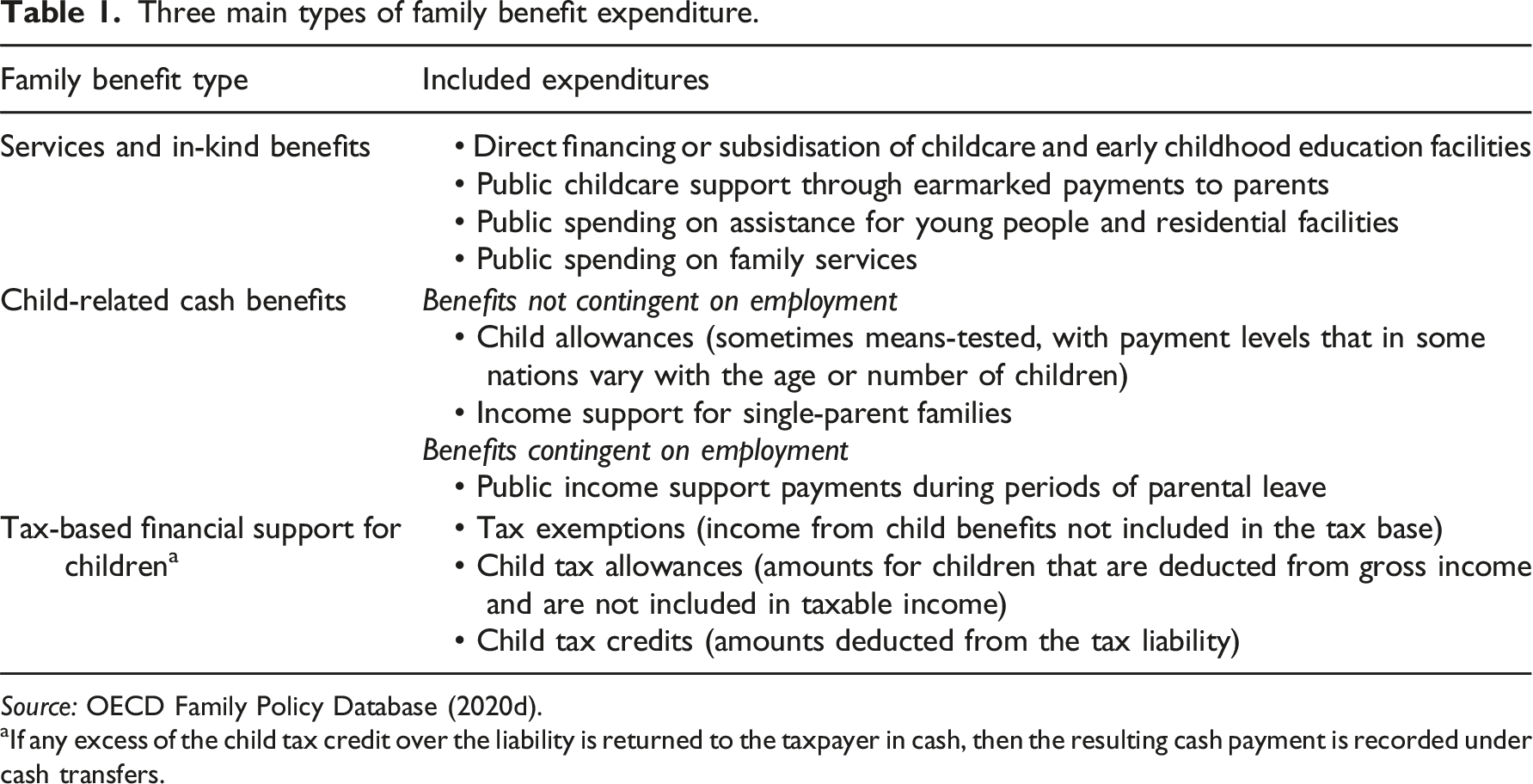
Source: OECD Family Policy Database (2020d).
aIf any excess of the child tax credit over the liability is returned to the taxpayer in cash, then the resulting cash payment is recorded under cash transfers.
As evident in Figure 1, all OECD nations possess some form of family benefit expenditure system. In so far as family benefits are intended to ease the reconciliation of paid employment and family, total expenditure is hypothesized to be positively related to both female employment and fertility rates (Hypothesis A). Overall family benefit expenditure only partially maps onto Esping-Andersen’s (1990) traditional welfare state typologies with social democratic welfare states spending on average 3.1% of GDP on family benefits across 2000–9. Conservative welfare states spent comparable levels to liberal welfare states at 2.1% and 2.08%, respectively. However, aggregate expenditures mask remarkable variation with respect to prioritizing different gender ideologies when examining disaggregated measures, as will now be analysed. OECD pooled time series aggregate family policy expenditure, as a percentage of GDP (2000–9). Source: OECD Family Policy Database (2020d). Note: Pooled time series averages were calculated for social democratic (Denmark, Finland, Norway and Sweden), conservative (Germany, Belgium, France, Austria, Italy, the Netherlands and Switzerland) and liberal welfare states (US, Australia, New Zealand, UK and Canada).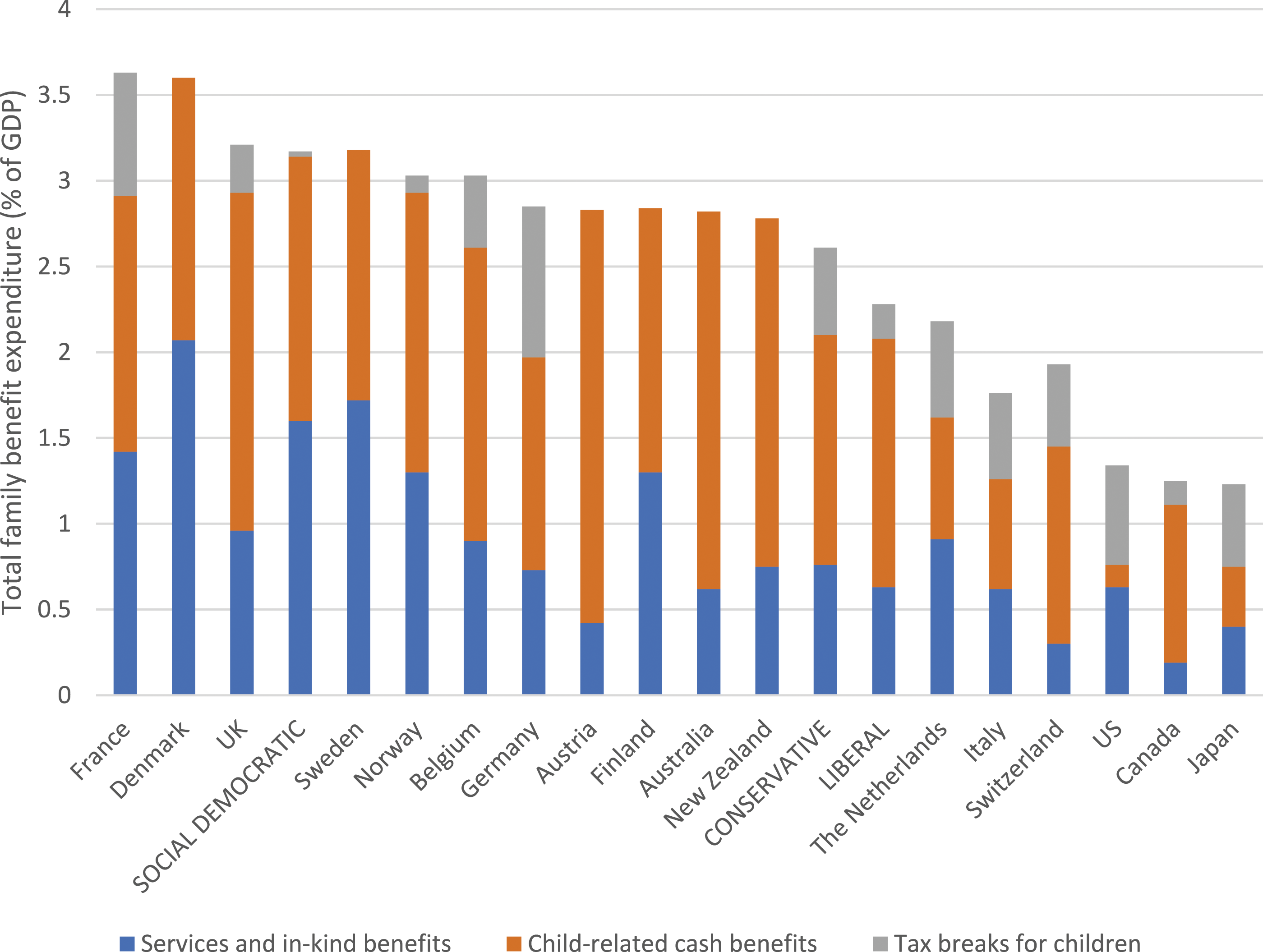
The ‘full egalitarian’ model: defamiliarizing service and parental leave oriented expenditures
The ‘full egalitarian’ model rejects gender essentialism and regards it as both natural and important that both men and women participate in paid employment and childcare responsibilities (Brinton and Lee, 2016). However, women face many gender-specific barriers to entering paid employment, including a disproportionate burden of unpaid labour especially surrounding childcare. Hence, the affordable provision of childcare and paid parental leave is often a prerequisite for women to engage in paid employment alongside childrearing (Mandel and Semyonov, 2006). ‘Full egalitarian’ family benefits are therefore those that defamiliarize: that is, the extent to which policies help women gain and maintain paid employment and achieve financial independence with their partners, especially in the context of childrearing (Gornick and Meyers, 2008).
The OECD family policy database (2020d) ‘service and in-kind benefits’ metric captures expenditures that focus mostly on subsidies for childcare and early education. Governments are motivated to provide these expenditures for many reasons including child development, increasing maternal employment, economic growth and fertility rates (Brewer and Cattan, 2017). In keeping with a ‘full egalitarian’ model, social democratic welfare states direct 51% of their aggregate family benefits spending toward services and in-kind benefits, in contrast to 36% and 30% for conservative and liberal welfare states, respectively. 2
Childcare-related services are a significant factor in alleviating an asymmetrical division of unpaid hours of housework that exacerbates the tension which women face in combining paid work and motherhood (Bonoli and Reber, 2010; Kleider, 2015). Family benefits directed toward service expenditure reduce the time and financial constraints associated with raising children, decreasing the opportunity cost which women face between paid employment and motherhood (Flynn, 2017). By increasing women’s labour supply, service-oriented expenditures fulfill the normative gender ideology of ‘full egalitarianism’ by promoting women’s options for financial independence and a more gender-equal division of household labour. Therefore, the association between service and in-kind benefits expenditure and both female employment and fertility rates is hypothesized to be positive (Hypothesis B).
Social democratic welfare states also rate most generous among all nations for child-related cash benefits. Regrettably, the OECD family policy database does not disaggregate between expenditures which are employment-contingent (including paid parental leave payments) and which are not employment-contingent (child-allowances and income support). One crucial point to emphasize: cash transfers expenditure for social democratic welfare states largely captures cash transfers which are employment-contingent, including generous public paid parental leave (Hemerijck, 2013). Paid parental leave may lead to long absences from paid employment for women, however, employment rights are protected and secured (Mandel and Semyonov, 2006), potentially diminishing the costs associated with having children. As such, paid parental leave expenditures are defamiliarizing as they socialize the disproportionate costs that women face in interrupting their employment for childrearing. Hence, employment-contingent cash transfers are hypothesized to be positively related to female employment and fertility rates (Hypothesis C1). To test this hypothesis, child-related cash benefits can be interacted with different welfare state types, on the assumption that social democratic countries provide most employment-contingent benefits.
Traditional male breadwinner strategy: maternalizing tax-based financial support for children
On the other side of the gender-role spectrum exists the traditional male breadwinner/female caregiver strategy. Traditionalism prescribes that pre-school aged children suffer if their mother works, and that engaging in paid employment impedes a ‘warm and secure’ relationship with her children (Brinton and Lee, 2016). Family benefit policies reflecting traditionalist attitudes are therefore likely to prioritize familialism. As women have a greater share of the division of household labour, familialistic policies are likely to be associated with the greatest trade-off between female employment and fertility.
The OECD family policy database (2020d) ‘tax-based financial support for children’ metric includes family benefits expenditures that encompass financial support for families provided through the tax system. Conservative welfare states spend around 24% of total family benefits on tax-based financial support for children, compared to 10% and less than 1% for liberal and social democratic welfare states, respectively.
Conservative welfare states tend to be characterized by taxation systems that are not designed to encourage the labour force participation of both parents. The tax rates of labour market participants are relatively high and there is little or no economic benefit for dual-earner households relative to single-earner ones (Thévenon, 2012). Instead, in many OECD countries including Belgium, Germany, France and Switzerland, family support is embedded in the tax system so that at a given income level, the marginal tax rate declines with the number of household components (Colonna and Marcassa, 2015; OECD Family Policy Database, 2023). That is, tax support for families increases with the number of dependent children. Nevertheless, it is noteworthy that tax support for married couples is not universally categorized as ‘social’ expenditure across all OECD nations, and fiscal measures pertaining to this aspect are not classified as tax breaks with a social purpose (OECD Family Policy Database, 2023). Consequently, only the value of support for children through the tax system is included in the tax-based financial support for children indicator.
In comparison, in liberal welfare states, governments attempt to limit the effective tax rate, so that households maintain freedom of choice with respect to childcare preferences. Low effective tax rates and individualized taxation systems in liberal welfare states ensure a strong financial incentive to return to work, with the tax system enabling choice for parents to spend their disposable income on privately provided childcare services in the market if they so choose in the absence of generous public support for childcare (Flynn, 2017). In social democratic ‘full egalitarian’ welfare states with strong public provision of childcare, women enjoy strong continuous support for reconciling paid work and family roles with correspondingly high tax rates (Immervoll and Barber, 2006). Consequently, tax-based financial support for children reflects government attempts to subsidize spousal dependency mainly in familialistic conservative welfare states, especially given that the real income of the taxpaying spouse is augmented by the unpaid domestic activities of the other spouse.
Family benefits directed toward tax-based financial support for children are therefore likely to promote household reproduction without defamiliarization, entrenching traditional household gender ideology. These policies direct women’s time toward reproductive tasks in the form of tax concessions to households, while not alleviating the time or career opportunity costs associated with having children. In the absence of affordable and accessible childcare in conservative welfare states, mothers are either incentivized to withdraw from the labour market or eschew childbirth in pursuit of financial independence from a male breadwinner (Iversen and Rosenbluth, 2010). Hence, it can be hypothesized that tax-based financial support for children, which is associated with a ‘traditional’ policy regime, corresponds with lower female employment and fertility rates (Hypothesis D).
Combination strategy: pro-work conservatism and flexible egalitarianism
The dichotomy between ‘full egalitarian’ and ‘traditional’ gender-role ideologies neglect the spectrum between these two poles. To fill this void, Brinton and Lee (2016) devise two combination strategy categories: ‘pro-work conservatism’ and ‘flexible egalitarianism’. Pro-work conservatism is characterized by many similar essentialist gender-role attitudes shared by traditionalism. However, it departs from traditionalist attitudes in believing that a job is the best way for women to be independent. ‘Flexible egalitarianism’ shares similar gender-role attitudes to full egalitarianism, in that women are not viewed to need to have children to be fulfilled, and that women’s role is not solely in the home with children. However, flexible egalitarianism departs from ‘full egalitarianism’ in not viewing female independence as something that can be solely gained from paid employment, and in being more accepting of women not contributing to household income for periods of time.
The ‘combination strategy’ espoused by pro-work conservatism and flexible egalitarianism is expressed through family benefits expenditure on cash benefits not being employment-contingent including child allowances and income support for mothers, in conjunction with limited public provision of childcare. Cash benefits not linked to employment status generally provide generous cash allowances for primary carers, almost always mothers, to engage in at-home care work, without requiring recipients to maintain a labour market attachment (Thévenon, 2012). Hence, mothers when presented with a cash benefit which is not employment-contingent, are more likely to withhold labour supply (Ferragina, 2019). The negative impact on female labour supply is exacerbated when cash transfers are generous, as they provide new mothers with less of a need to maintain current levels of income through labour market attachment (Hemerijck, 2013).
Liberal welfare states are most highly oriented toward overall cash benefit expenditure, with 70% of total family benefits expenditure directed toward cash benefits. In comparison, conservative and social democratic welfare states spend 64% and 49% of their aggregate expenditure on this type of benefit, respectively. Conservative and liberal welfare states allocate greater shares of expenditure on cash benefits which are not employment-contingent while also spending relatively little on services and in-kind expenditure, demonstrating a limited defamiliarizing focus. Instead, cash benefits give households the option of how to use these expenditures: using the cash allowance as financial support for women withdrawing from the labour market to engage in childrearing or using it to cover childcare expenses. While pro-work conservatism and traditionalism adhere to gender essentialist norms, traditionalist tax-based financial support for children does not fully recognize the value of mothers’ paid work. This is evident in their prioritization of familialism providing disincentives for mothers to re-enter the labour market, over offering an element of choice as in child-related cash benefits.
The extent to which cash transfers reflect pro-work conservative or flexible egalitarian normative gender-role ideology depends on the institutional frameworks in which women receive these payments. While pro-work conservatives believe that a job is the best way for women to be independent, many conservative welfare states have refused to expand public childcare, leaving women to navigate maternalistic family tax benefit provisions, limited childcare access and the expectation that some labour force engagement is maintained. On the other hand, where childcare is relatively affordable, women with a stronger attachment to the labour market are more likely to use cash transfers to pay for childcare (Hemerijck, 2013). Flexible wage setting mechanisms and the associated expansion of low-wage, low-productivity services in liberal welfare states allow middle- and high-income women to draw upon services in the low-cost services sector in the absence of public alternatives (Bonoli and Reber, 2010; Flynn, 2017; Morgan, 2005; Nelson and Stephens, 2013). The lax employment regulations of liberal welfare states have also enabled women to, with less difficulty, return to the labour market after periods of absence, which may be supported by cash transfers which are not employment-contingent (Bonoli and Reber, 2010; Iversen and Rosenbluth, 2010; Morgan, 2005). This conforms with a ‘flexible egalitarian’ gender-role ideology, that is more permissible of women not contributing to household income for periods of time and giving women the greatest choice with respect to balancing work and family (Brinton and Lee, 2016).
Comparatively, conservative and social democratic welfare states are associated with wage setting mechanisms that compress wages, frustrating market forces from satiating demand for childcare (Nelson and Stephens, 2013). However, conservative welfare states have refused to follow their social democratic counterparts in expanding their services and in-kind benefits to the same extent (Iversen and Rosenbluth, 2010). This has forced women in conservative welfare states to rely upon non-market providers including families and relatives (Esping-Andersen and Billari, 2015). In the absence of being able to rely upon these non-market sources of care, women face immense opportunity costs between paid employment and family roles. Hence, forms of cash transfers that do not prescribe that women work or earmark expenditure for use on childcare maternalize the caring of children, exacerbating the asymmetrical division of labour, likely putting downward pressure on both female employment and fertility rates (Hypothesis C2). To test this hypothesis, child-related cash benefits can be interacted with conservative welfare states on the assumption that conservative nations provide the most benefits that are not employment-contingent.
Measurement of variables
The analysis covers the period 2000–9 for 17 developed welfare states. The period 2000–9 was chosen for four reasons: (1) Gauthier’s (2010) comparative family policy database only includes data up to 2010, (2) the time period covers a full decade of data up until and including 2009, (3) it covers an entire decade after the emergence of positive relationship between female employment and fertility rates post-1990, and (4) it was a period of relative institutional stability before the Global Financial Crisis.
The two dependent variables under scrutiny in this article are the female labour force participation rate (FLFP) and the total fertility rate (TFR). The labour force participation rate of women is calculated as the female labour force divided by the total female working age population (either working or looking for work), defined as people aged between 15 to 64 3 (OECD, 2020a). The total fertility rate represents the number of children who would be born to a woman if she were to live to the end of her childbearing years and bear children in accordance with current age-specific fertility rates (Rovny, 2011; OECD Family Policy Database, 2020d). The dataset used encompasses 17 OECD countries: Australia, Austria, Belgium, Canada, Denmark, Finland, France, Germany, Italy, Japan, New Zealand, Norway, Sweden, Switzerland, the Netherlands, the UK and the US. These nations represent a cross-section of different welfare states, 4 following similar comparative research (see Iversen and Rosenbluth, 2010; Nelson and Stephens, 2013; Rovny, 2011).
Explanatory family policy and institutional variables have been selected to generate parallel regression models for the two dependent variables. The main explanatory variables under investigation in this study are drawn from the OECD Family Policy Database (2020d). 5 The first variable is total public social expenditure on families as a percent of GDP which is aggregate family benefit support exclusively designated for families and children. However, this metric fails to account for variations in the extent of spending for different policy subcomponents. Total public spending as a percent of GDP for services and in-kind benefits, child-related cash benefits and tax-based financial support for children are disaggregated in models. 6 The included components in each of these subcomponents is summarized in OECD Family Policy Database (2023).
Given public income support payments during parental leave are captured in the cash benefits metric, variables used to control for variation in parental leave are drawn from Gauthier’s (2010) comparative maternity, parental and childcare database. These include ML_WKS (total number of weeks of maternity leave), ML_BEF (number of weeks of maternity leave prior to childbirth), ML_AFT (number of weeks of maternity leave after childbirth), ML_PAY (cash benefits paid during maternity leave, as a percent of female wages in manufacturing), PL_WKS (total number of weeks of parental leave) and PL_PAY (cash benefits paid during parental leave, as a percent of female wages in manufacturing).
To capture the institutional choice frameworks in which women decide to use cash benefits, measures of employment protection (see OECD, 2020b) and wage dispersion (see OECD, 2020c) are included in models. Brinton and Lee (2016) argue that employment protection protects labour market insiders making it difficult for mothers to be integrated into full-time roles and may intensify discrimination against women. The OECD summary index EPL variable quantitatively summarizes several sub-indices including the difficulty of hiring and firing, and regulations associated with the use of temporary work. Nelson and Stephens (2013) identify the role of wage inequality in generating private sector supply of childcare in liberal welfare states. As such, the D5:D1 measure of wage inequality is used. The D5:D1 measure is a ratio of the median decile of wage earners to the lowest decile of wage earners, serving as a proxy of wage dispersion between the middle and lower classes.
Appendix 1 shows the mean values of the key focus indicators and dependent variable (FLFP), broken down by country and welfare state regime type.
Data analysis
In summary, Hypothesis A posits that overall family benefits expenditure, reflecting mixed gender role norms, is positively related to both female employment and fertility rates. Hypothesis B suggests that services and in-kind benefits, reflecting a full egalitarian gender-role orientation, also have a positive impact on female employment and fertility rates. Hypothesis C suggests that overall child-related cash benefits are positively related to female employment and fertility rates, with two subcategories identified. Hypothesis C1 indicates that employment-contingent cash benefits, reflecting a full egalitarian orientation, have a positive effect on both female employment and fertility rates. Hypothesis C2 indicates that cash transfers which are not employment-contingent, reflecting a combination strategy of either pro-work conservatism or flexible egalitarianism, have a negative effect. Lastly, Hypothesis D suggests that tax-based financial support for children, reflecting traditional gender role norms, is negatively related to both female employment and fertility rates.
In order to test the generated hypotheses, a pooled time-series analysis of the determinants of female employment and fertility rates is used. This is conducted using Prais-Winsten regression estimation, correcting for the first-order auto-regressive process, and using panel-corrected standard errors (following Pennings et al., 2006). Beck and Katz (2004: 16-17) have demonstrated that correcting for first-order autoregressive (AR(1)) includes a lagged dependent variation. Consequently, Prais-Winsten regression estimations deal with statistical problems associated with serial correlations that are found in pooled time-series data, but without suppressing the power of the other independent variables included in the model. Due to the trend evident in the data set, a lagged dependent variable is not recommended, as Achen (2000) shows it can inappropriately suppress the power of other independent variables. To assess the effects of the independent regressors, the change in the dependent variable contingent on a two standard deviation change in the independent variable is used.
Beck and Katz (2004) and others argue for the inclusion of country dummies to correct for the vast number of unobserved differences between countries or ‘omitted variable bias’. However, this article follows Plümper et al. (2005: 330–4) that argue instead that inclusion of country dummies can lead to unintended consequences, including: (i) completely absorbing differences in the level of the independent variables across the units, (ii) eliminating differences in the dependent variable due to difference at time t in the time series, (iii) eliminating variation in the dependent variable that is due to time invariant factors, and (iv) greatly reducing coefficients of factors that vary mainly between nations.
Prais-Winsten models of family benefit determinants of female employment and fertility rates.
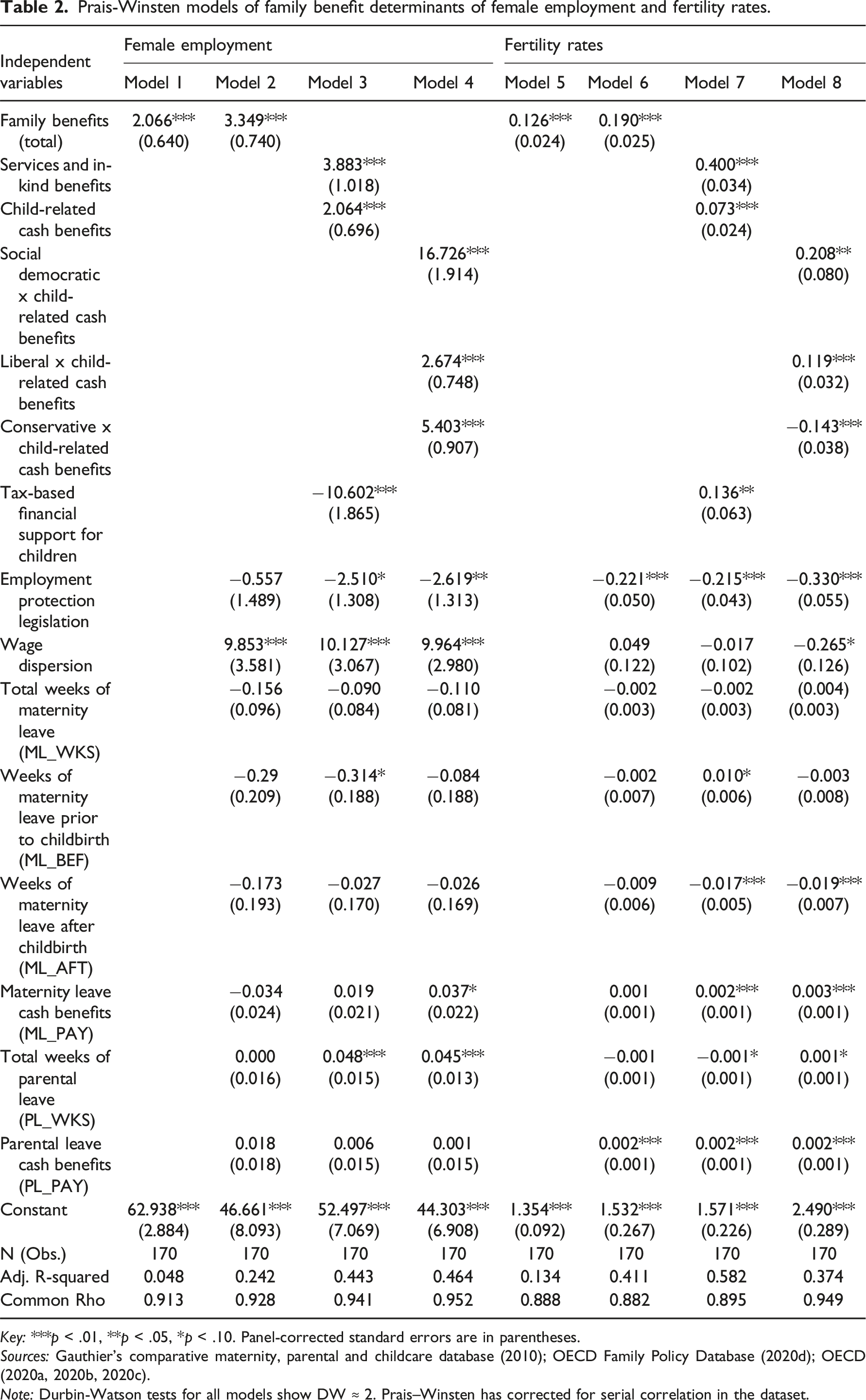
Key: ***p < .01, **p < .05, *p < .10. Panel-corrected standard errors are in parentheses.
Sources: Gauthier’s comparative maternity, parental and childcare database (2010); OECD Family Policy Database (2020d); OECD (2020a, 2020b, 2020c).
Note: Durbin-Watson tests for all models show DW ≈ 2. Prais–Winsten has corrected for serial correlation in the dataset.
As per Hypothesis A, aggregate levels of spending on family benefits as a percent of GDP is positively related to both female employment and fertility rates. This result is consistent with the view that insofar as family benefits assist work and family reconciliation, expenditure generosity can be expected to disproportionately assist women who are typically secondary income earners and primary carers. Moving two standard deviations on the measure of overall family benefits yields an increase in the FLFP rate of 3.31% in Model 1, and a fertility rate increase of 0.20 in Model 5. Controlling for maternity and parental leave in Model 2 and Model 6 show overall family benefits yielding an increase in female employment of 5.36% and 0.30 in fertility, respectively. However, the extent and direction of the relationship between the three OECD family benefit categories and female employment and fertility differs stressing the importance of normative gender-role ideologies expressed by welfare states that privilege different categories of family benefits expenditures, as evidenced in their disaggregated results.
Consistent with Hypothesis B, expenditure on services and in-kind benefits has a positive relationship with both female employment and fertility rates: higher national expenditure on services as a form of family benefit policy allows women to increase labour force participation concurrently with having more children. This result corresponds to a ‘full egalitarian’ view of the household: as governments provide greater support to childcare services, the household constraints which women face decline, seeing their capacity for marketable work increase closer to that of men (Brewer and Cattan, 2017; Chesnais, 1996). As such, there is also less of a reason for women to be forced to eschew children in pursuit of financial independence (Iversen and Rosenbluth, 2010). However, moving two standard deviations sees FLFP only increase 3.97% (Model 3), and fertility by 0.41 (Model 7) which appears smaller than might otherwise be expected. This modest result reflects the private provision of childcare in liberal welfare states, facilitated by relatively high degrees of wage dispersion, in the context of weak public provision of childcare (see Flynn, 2017) as well as lax employment protection which may permit the expansion of part-time employment for women (Bonoli and Reber, 2010; Brinton and Lee, 2016; Nelson and Stephens, 2013). Therefore, it comes as no surprise that liberal welfare states express higher preferences for ‘flexible egalitarianism’: flexible labour markets enable women to withdraw from the labour market for children and reintegrate later into paid employment in contrast with long and publicly subsidized maternity leaves imposed in some conservative welfare states.
As hypothesized, overall cash benefits (Hypothesis C) are positively associated with both female employment and fertility rates. Moving two standard deviations among all welfare states yields an increase of 2.65% (Model 3) for female employment and an increase of 0.09 for fertility (Model 7), indicating the positive effect of employment-contingent cash benefits including public income support for parents who take leave upon the birth of a child captured in the indicator. These results reflect the dual-earner household preferences of the ‘full egalitarian’ gender ideology underpinning social democratic family benefit expenditure. An important limitation to this result is that the OECD family benefits database does not disaggregate for cash benefits that are not employment-contingent.
In the absence of employment-contingent disaggregated data, cash benefits were interacted with welfare state regimes. The results challenge Brinton and Lee’s (2016) expectation of flexible egalitarianism to be most positively associated with increased choice to balance work and children. The results demonstrate that cash benefits in full egalitarian nations in social democratic welfare states are most positively associated with both female employment and fertility rates, supporting Hypothesis C1. The results from Model 8 provide evidence supporting Hypothesis C2 which suggests that cash transfers that are not employment-contingent, are negatively related to fertility rates.
The variable with the largest, albeit negative effect on female employment was tax-based financial support for children, reflecting conservative welfare states’ preferences for a more traditionalist male breadwinner/female caregiver household strategy, especially in the period immediately succeeding childbirth (Brinton and Lee, 2016). As hypothesized (Hypothesis D), moving two standard deviations saw female labour force participation decline by 6.20% (Model 3). Germany’s joint taxation system, for example, increases the marginal tax rate for the secondary income earner, and they indirectly pay for the marginal tax rate of the higher earning spouse, with a tax break going to the household (Dingeldey, 2001; Immervoll and Barber, 2006). However, the same hypothesis for fertility rates is rejected. In Model 7, a moderate positive result emerged for fertility rates. This indicates a limitation to gender equity-based explanations for post-industrial fertility, indicating that tax-based financial support for children can have a moderate pro-natal effect while also diminishing female employment.
Conclusion
To summarize, these analyses offer support for the hypothesis that family benefit expenditures can and do impact female employment and fertility outcomes in post-industrial nations. However, different welfare states favour dissimilar gender-role norms through privileging different types of family benefit expenditure, which can help or hinder nations in being able to achieve higher female employment alongside moderate fertility rates.
Family benefit frameworks favouring ‘full egalitarianism’ are most positively associated with female employment and fertility rates, as seen mainly in social democratic welfare states. These nations prioritize services-oriented support, employment-contingent cash benefits that assist working mothers while not penalizing them through the tax system for working. ‘Flexible egalitarian’ family policies, typically overlapping with liberal welfare states, are associated with moderate female employment and fertility rates, and with limited public spending on services owing to the presence of market substitutes and cash benefits which are not employment-contingent that can be used as income support for mothers withdrawing from the labour market or to pay for private childcare. The central ‘problem cluster’ with respect to balancing female employment and fertility are nations with ‘traditionalist’ and ‘pro-work conservative’ family benefit policy orientations, typically conservative welfare states, that combine weak public support for childcare services in the absence of affordable market alternatives, a maternalizing cash benefits system in conjunction with a tax benefits system favouring traditionalist male breadwinner/female caregiver households.
This article theoretically and empirically analyses how normative gender role ideologies combine with welfare state preferences for different family benefits expenditures to explain the positive cross-national relationship between female employment and fertility rates in post-industrial nations. In so doing, this article contributes to the existing literature in at least five ways. This article extends the gender equity literature on post-industrial fertility using macro-level panel data to analyse the interaction of gender-role ideologies and family benefit expenditures on family employment and fertility concomitantly.
Brinton and Lee (2016) find that flexible egalitarian gender ideology from a social attitudinal perspective is most positively associated with facilitating work and family balance. In contrast, this article finds welfare state preferences for family benefits that are aligned with a full egalitarian gender ideology such as services and in-kind benefits and employment-contingent cash benefits expenditure are most positively associated with both female employment and fertility rates.
Further, previous studies have focused mainly on the role of total social spending and mainly employ a nation-specific cross-sectional approach (see Ferragina, 2019; Hegewisch and Gornick, 2011; Thévenon, 2012) or on defamiliarizing family expenditure such as childcare alone (see Mandel and Semyonov, 2006; Pettit and Hook, 2005). Instead, this article analyses the role of different types of family benefits expenditure over a defined period of time and across post-industrial nations. This article presents compelling evidence for distinguishing between these distinct categories of family benefits, with individual nation’s institutional features crucial in understanding how these policies help explain the positive relationship between female employment and fertility rates. This article analyses the less-studied macro-level indicators of family benefits expenditure that strongly suggest that both the extent and ideological orientation of each form of expenditure has disparate impacts on female employment and fertility rates at a national level. This article also situates the directional female employment and fertility rate impacts of specific forms of family benefits in a broader theoretical context by interrogating how they reflect policymakers’ support for different normative gender-role ideologies. Furthermore, the theorizing of family benefit policy orientations according to Brinton and Lee’s (2016) four-class framework more accurately captures cross-national variation in family benefit policy than models of defamiliarization proposed by feminist welfare scholars, that have mainly focused on female employment promoting policies (Kleider, 2015). Indeed, as the results show, it is not only the presence of policies that promote the reconciliation of female employment and motherhood, but also the absence of policies that may diminish it, and the presence of maternalizing policies that may also exacerbate the tensions between them.
The results raise the question of whether welfare states’ preferences for different family benefit policy expenditures are driven by variations in the dominant normative gender-role ideologies across nations, or whether family policy itself shapes attitudes to gender norms. In welfare states where traditionalist attitudes pervade, it may be the case that pre-existing attitudes through electoral pressure on policymakers determine government’s preference for family benefits giving women cash benefits not employment-contingent and tax-based financial support for children to male breadwinner households. Or it may be the case that family benefit expenditures themselves influence household bargaining processes that shape attitudes towards the household division of labour. These explanations may not be mutually exclusive. Nonetheless, future research ought to consider the interactive effects between family benefit policy provisions, and family policy more broadly, and how it may promote or hinder different normative gender-role attitudes.
It is important to note that the empirical data used in this study spans 2000–9, and since then, many nations used in pooled time series analysis have shifted to more employment-friendly policies including improved childcare coverage and other family support measures. Additionally, the typology focused on traditional welfare state orientations but did not encompass Mediterranean and post-communist regimes. As such, future research should consider expanding the typology to include these regimes as well as exploring the impact of recent family benefits policies, gender roles and their impacts.
Supplemental Material
Supplemental Material - The positive relationship between female employment and fertility rates: The role of family benefits expenditure and gender-role ideologies
Supplemental Material for The positive relationship between female employment and fertility rates: The role of family benefits expenditure and gender-role ideologies by Daniel Dinale in Journal of European Social Policy.
Footnotes
Declaration of conflicting interests
The author(s) declared the following potential conflicts of interest with respect to the research, authorship, and/or publication of this article: State: Employed as a Senior Advisor Policy & Strategy at NSW Treasury.
Funding
The author(s) disclosed receipt of the following financial support for the research, authorship, and/or publication of this article: Australian Research Council Centre of Excellence in Population Ageing Research (Project Number CE170100005).

Supplemental Material
Supplemental material for this article is available online.
Notes
References
Supplementary Material
Please find the following supplemental material available below.
For Open Access articles published under a Creative Commons License, all supplemental material carries the same license as the article it is associated with.
For non-Open Access articles published, all supplemental material carries a non-exclusive license, and permission requests for re-use of supplemental material or any part of supplemental material shall be sent directly to the copyright owner as specified in the copyright notice associated with the article.
