



Abstract
Previous literature on paternal involvement emphasizes the influence of fathers’ socialization contexts, considering either welfare policies (Hipp and Leuze, 2015) or experiences with their own fathers (Brown et al., 2018; Parke, 1995). In this study, we combine those two branches of research and examine how fathers’ and their fathers’ (grandfathers’) socialization experiences (parental leave regulations in their early adulthood as an example of (de-)familization policies (Lohmann and Zagel, 2016)) predict paternal involvement today. To measure paternal involvement, we create an indicator for involvement that covers Lamb et al. (1985) three aspects of direct interaction, responsibility, and availability and the fact that a father has taken paternal leave for at least one of his children or not. We use the fact that a substantial proportion of the fathers in the German, national survey AID:A 2019 (Kuger et al., 2020) were socialized in another welfare state regime (6.3% of fathers have a direct and another 13.5% have an indirect migration background (their fathers were born in another country) covering birth cohorts from the 1970s to the 1990s; total N = 1053). We then add context-related information on their (fathers’ and grandfathers’) countries of origin from the OECD family database and estimate an SEM model to test potential direct and indirect effects. We find that more educated fathers who experienced extended parental leave regulations are more involved fathers today. Our results support, thus, that welfare state conditions influence individuals’ behaviour while education is a relevant moderator in this relationship.
Introduction
The previous literature on fathers’ involvement emphasizes the influence of the socialization conditions in which fathers grew up. In particular, the role of their own father has a role model function that fathers can distance themselves from or use as a guide (Lamb et al., 1985; Norman, 2017; Hipp and Leuze, 2015). In addition, parents’ attitudes towards gender hierarchies and regarding the priority of the family over employment are considered to be relevant factors for involved parenthood (Jentsch and Schier, 2019; Nitsche and Grunow, 2018). Independently of this, comparative welfare state research deals with socio-political regulations, such as the parental leave regulations, which can directly influence the actions of fathers and mothers concerning their families (Neyer, 2021). However, the welfare state conditions with which fathers are confronted during their socialization and fatherhood of fathers from social minority groups are only discussed to a limited extent (Chuang and Fagan, 2021). Therefore, we want to bring together several of the aspects mentioned and fill in existing gaps in this study. We rely on the structural model of socialization (Tillmann, 2011) to explain current differences in fatherhood based on four interrelated stages of socialization. While the norms and value systems of the society as a whole (stage 4) structure social institutions (for example, the family, school, or employment) (stage 3), those institutions constitute everyday interactions with others (for example, with family members or friends) (stage 2) that are the foundation of the development of individual attitudes, values, or abilities (stage 1). Relating to this model, we examine how fathers’ experiences of socialization with paid parental leave policies shaped by the welfare state (stage 4), mediated through the family of birth and educational attainment (stage 3), taking parental allowance as an antecedent form of parenting (stage 2), and recent attitudes towards gender roles and family (stage 1), affect current paternal practice.
We place a special focus on (de-)familizing social policies which influence the social and economic dependency of individuals on their families (Lohmann and Zagel, 2016), with which fathers were confronted directly and indirectly through their own fathers during their first two decades of life. Additionally, we take into account the school education background of fathers. We suggest this is necessary because previous research (Shu, 2004) has shown that higher educational qualifications are accompanied by more egalitarian family concepts as well, which often result in practice that is more egalitarian. In our understanding of paternal practice, we rely on the concept of involved fatherhood of Lamb et al. (1985) and its further developments and differentiate the three aspects of direct interactions, responsibility (taking care of their children’s needs), and availability (being present in and available beyond direct interactions). As a further aspect of paternal practice, we consider taking parental leave to trace the interactions between attitudes and actions over time.
Some information on the German situation might help to contextualize our study and our results. (West-)Germany has had a moderately conservative familial welfare regimen for decades (Adler et al., 2015) with a series of familizing family policies (Goldacker et al., 2022; Lohmann and Zagel, 2016). The law ‘Erziehungszeit’ (‘Act on the Granting of Child-Raising Allowance and Child-Raising Leave’; enacted from 1986 until 2006), for example, provided a low income (around €300) for 24 months and has usually been taken by mothers (Schutter and Zerle-Elsäßer, 2012). Additionally, childcare institutions were mainly offered for 3 to 6 year olds (until school) and primary school (for children aged 6 to 10 years) usually closed at around noon with few childcare options for the afternoons (Leitner et al., 2008). This arrangement forced parents into a very clearly gendered division of labour and fostered dependency of mothers from their male partners. These male-breadwinner models were accompanied by norms regarding the mothers being the best suited and most important person to care for her child(ren) during the first years of children’s lives (Ciccia and Bleijenbergh, 2014; Trappe et al., 2015).
Changes to the parental leave law (Law on parental allowance and parental leave; in short ‘Elterngeldgesetz’) introduced in 2007 and further developed in 2015 (‘ElterngeldPlus’) now foster a faster (re-)integration of mothers into paid employment as well as the participation of fathers in early childcare (Huebener et al., 2016; Leitner et al., 2008). The law from 2007 includes compensation for loss of individual income (65% of the net wages of the parent staying at home) for 14 months (12 for one partner, plus two for the other partner: the so-called daddy months). At the same time, childcare facilities have been expanded and a legal entitlement for the provision for care for children from 1 year until 3 years (introduced in 2013) as well as for all-day care for children of primary school (has been decided to be introduced in 2026). In doing so, the reforms clearly have a defamilizing goal (Lohmann and Zagel, 2016) and respective effects (Bergemann and Riphahn, 2023) and made mothers financially (more) independent from their male partners. The reforms also led to an increase in the proportion of fathers taking on childrearing or parenting responsibilities from 3.5% before the introduction of Elterngeld to a share of around 40% of fathers taking paternal leave times in 2018 (Bundesministerium für Familie, Senioren, Frauen und Jugend, 2021). The revised law (ElterngeldPlus) adds the option to work part-time during parental leave. The shift in German family policy lead to something that has been called ‘optional familialism’ (Stahl and Schober, 2018: 632). To complete the German context, it must be added that there were and still are some differences between East and West Germany. In East Germany, defamilizing family policies have a long tradition; as a result, the maternal labour force participation rate only recently aligned and amounts to 63% in East and 61% in West Germany (Barth et al., 2020). Mothers working in part time employment is still a more important phenomenon in West Germany (for example, for mothers with a youngest child under 11 years: 40%) than in East Germany (same age group: 32%) (Barth et al., 2020). Institutional childcare arrangements are still better available and more accepted in East Germany (Autorengruppe Bildungsberichterstattung, 2020; Zoch and Hondralis, 2017) and West Germans still report more traditional gender ideologies than East Germans (Ebner et al., 2020).
Theory: Does the socio-political context matter for paternal involvement?
Behavioural dimensions of paternal involvement as outcomes of our study
By involved paternity, we understand that fathers can become more or less intensively engaged in the upbringing of their children (Lamb et al., 1985). The intensity of this involvement can be measured, first, by the direct interactions between father and child (for example, playing together or caring activities). This first dimension does not only subsume the time fathers spend with their children in total, but focuses on more strongly engaged activities. Second, the concept considers the availability of the father to the child outside of direct interactions, and, third, if fathers take responsibility in the fathering role, that is, being a contact person for third parties (for example, towards state institutions) and arranging resources for the child. Against the background of family science research, Pleck (2010) reflects on the approach of Lamb and colleagues and suggests some extensions of this concept. Taking the suggestion made by Palkovitz (1997) to extend this threefold operationalization, Pleck sees the affective-physical expression of responsiveness and emotional warmth as a relevant, additional part of involved fatherhood. As well, there is the degree of control that fathers exercise over the behaviour of their children so that both concepts together enable a connection to the educational styles according to Baumrind (2005). Accordingly, Hawkins et al. (2002) presented the ‘Inventory of Father Involvement’, which also includes indicators such as school engagement, support for autonomy development and joint conversations. On the other hand, Pleck differentiates Lamb’s dimension of responsibility by including not only the idea of the father as a contact person but also the identification of the child’s needs on the father’s initiative and the father’s organization of goods and services in the child’s interest.
The role of the welfare state and parental leave schemes
First, policies of (de-)familization are particularly relevant for the focus on families (Esping-Andersen, 1999; Korpi et al., 2013; Korpi and Palme, 1998; Neyer, 2021). According to Lohmann and Zagel (2016), defamilizing policies reduce the dependency of individuals on their families, while familizing policies strengthen it. In this study, we will focus on leave policies for parents as an indicator of (de-)familization within the welfare state. According to the ‘18th International Review of Leave Policies and Related Research’ (Koslowski et al., 2022), maternity and paternity leave relate to leave opportunities available gender-specifically to mothers or fathers while the term ‘parental leave’ relates to leave that is available to both of them. Lohmann and Zagel (2016) consider short times for paid leave with a high wage compensation as an example of defamilizing policies, as parents are encouraged to continue their labour market participation after a certain time. Contrarily, long periods of unpaid or low-paid leave are an example of familizing policies, as parents are encouraged to live from one main income and opt for one parent to stay at home permanently as the main caregiver. In their report, Koslowski et al. (2022) differentiate countries by the total length of parental leave indicating countries with less than 15 months as short and those with 15 months and more as ‘“long leave” countries’ (p. 23). Lohmann and Zagel (2016) describe familizing and defamilizing dimensions as independent of each other, that is, the welfare state regimes usually include both dimensions and do not pursue them one-sidedly. Thus, they refer to such mixed forms as implicit (both levels low) or optional (both levels high) individualism/familialism. Parental leave policies determine the extent to which parents can take a temporary break from employment after the birth of a child and what financial compensation they are granted. This process structures the opportunities of a couple giving birth to a child and their individual life courses subsequently. With a social-ecological approach to socialization (Bronfenbrenner, 1994), the relevance of welfare state policies can be extended even further: the welfare state as a macrosystem not only expands or restricts the individual scope for action through law-based norms but represents a value system that expresses normative preferences for certain options for action over others. In the following, we compare fathers born and living as young adults in different sociopolitical regimes regarding the leave schemes valid there. Considering the framework of Lohmann and Zagel (2016) as well as the review of Koslowski et al. (2022), we differentiate familizing and defamilizing leave schemes according to the total length of paid and unpaid leave available to fathers, mothers, and both at a specific time and country.
We expect that defamilizing social policies experienced in young adulthood increase the chance that fathers in Germany take parental allowance for at least one of their children (H1a) and strengthen fathers’ current involvement towards their children (H1b).
Intergenerational transmission: Indirect influence of the (grand-)fathers’ socialization context
Second, the norms and beliefs that are transported through welfare states are also objectified and mediated to children who experience the involvement of their parents as part of their primary socialization (Berger and Kellner, 1964). According to Lamb et al. (1985), the level of involvement of fathers is closely related to their socialization experiences with their parents. Fathers can enter into a positive, encouraging, or negative, repelling relationship with their fathers by either adopting their behaviour as a role model or trying to avoid it (motivation). In the same vein, Parke (1995) differentiated between two main hypotheses that essentially guide the studies on the transmission of fatherhood. The first one is the model hypothesis, which goes back to Bandura’s socialization theory, according to which fathers shape their fatherhood role in the same way as they experienced it. The second one, the compensation hypothesis, postulates that men consciously shape their own fatherhood differently to that of their own father. Findings show, that good relationships confirm the model hypothesis, bad relationship confirm the compensation hypothesis (Brown et al., 2018). Further, Lamb and colleagues suggest that the gender roles pursued by their parents can go hand in hand with more or less frequent opportunities to practise involved-caring activities (skills) and to receive confirmation or rejection for them (support). Since their parents are in turn influenced by the (de-)familizing welfare state practices/parental leave policies surrounding them, they pass them on to their children indirectly through their actions.
Having a father who grew up in a society with defamilizing social policies increases the chance that fathers’ take parental allowance for at least one of their children (H2a) and strengthen fathers’ current involvement towards their children (H2b).
Education as a moderator for the acquisition of gender role attitudes
Third, the norms and beliefs that are transported through welfare states are also objectified and mediated to children by the education system as part of their secondary socialization. In the tradition of the ‘hidden curriculum’ approach, prior research (Del Hernández et al., 2013; Jackman and Muha, 1984; Meagher and Shu, 2019) has shown that higher educational attainment is regularly associated with more gender-egalitarian attitudes. Researchers from this perspective argue that individuals with a higher educational background get in contact with the dominant culture of their society more easily. As part of the welfare state regime, the education system represents socially relevant norms and values and is strongly oriented towards the dominant culture of social elites (Bourdieu et al., 1990; Shu, 2004) instead of norms and values shared by the particular family. To achieve higher educational attainments as well as higher social positions, it is necessary to learn the norms and values of the dominant culture that are part of the ‘hidden curriculum’. Thus, attitudes that are more egalitarian and oriented towards the family are more likely to be conveyed when they are part of the hegemonic gender order, especially among individuals successfully participating in the educational system and attaining high levels of education.
We presume that a father’s educational background moderates the relationship between experiencing defamilizing policies and behavioural involvement positively.
Taking parental allowance as an antecedent of current involved fatherhood
Recent studies discussed taking parental leave as an antecedent for their subsequent involvement in child rearing and household work. Bünning (2015), using data from the German Socioeconomic Panel, finds that fathers taking parental leave, especially if this is not parallel but sequential to the partner’s leave and longer than the two so-called ‘daddy months’, reduce their working hours and increase their participation in household work and child rearing most significantly. Similarly, Brandth and Kvande (2009) find that Norwegian fathers taking the father-specific parental leave months participate more strongly in child rearing subsequently than fathers taking only the cash-for-care benefits (home care allowance) that could be accessed jointly with their partners. Taking parental leave could represent another behavioural indicator of involved fatherhood meaning that fathers taking (especially long) parental leaves are therefore more involved. Integrating a life course perspective (Mayer, 2004), we suggest thinking about taking parental leave as an antecedent of involved fatherhood that potentially helps fathers to establish a gender egalitarian attitude and pro-family orientation.
Fathers taking parental allowance for at least one of their children have more gender egalitarian attitudes (H4a) and a stronger family orientation (H4b).
Gender egalitarian attitudes and family orientation
Among the individual factors, reference is made particularly frequently to the normative attitudes and expectations about the gender roles pursued by fathers and their partners. In quantitative analysis, Macon et al. (2017) find that fathers are more likely to spend time in caregiving activities if they agree strongly with egalitarian gender orientations and are convinced of their influence in the development of their child. According to Bulanda’s (2004) analysis using the US data from the National Survey of Families and Households, the gender orientation of fathers is more important than that of their partners to explain fathers’ involvement. With the German pairfam data, Nitsche and Grunow (2018) find a positive influence of egalitarian gender orientations of both parents to predict the fathers’ share of childcare. Jentsch and Schier (2019) also point out the importance of more pronounced family orientation regarding the division of childcare and chores. As a result, fathers with a strong focus on their partner relationship or family are more likely to demand the family time to which they are formally entitled, even in the face of structural obstacles emanating from the employment system.
In addition, we suggest that, according to the recent literature, gender egalitarian attitudes (H5a) and a stronger family orientation (H5b) are positively related to current paternal involvement.
Figure 1 summarizes our theoretical framework explaining fathers’ involvement in relation to their socio-political socialization context, educational attainment, former up taking of parental allowance as well as family orientation and gender roles. Theory model.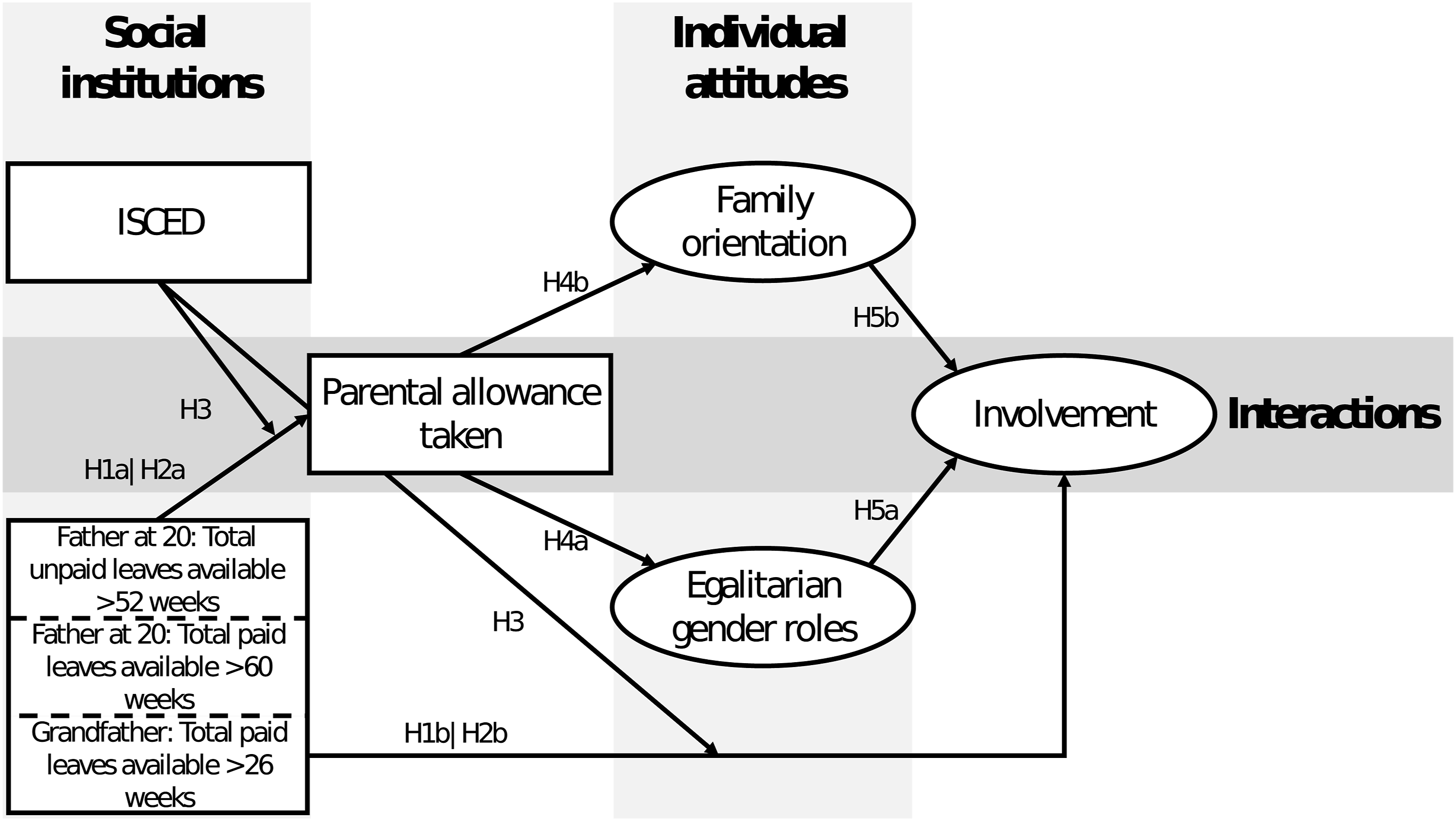
Methods and study design
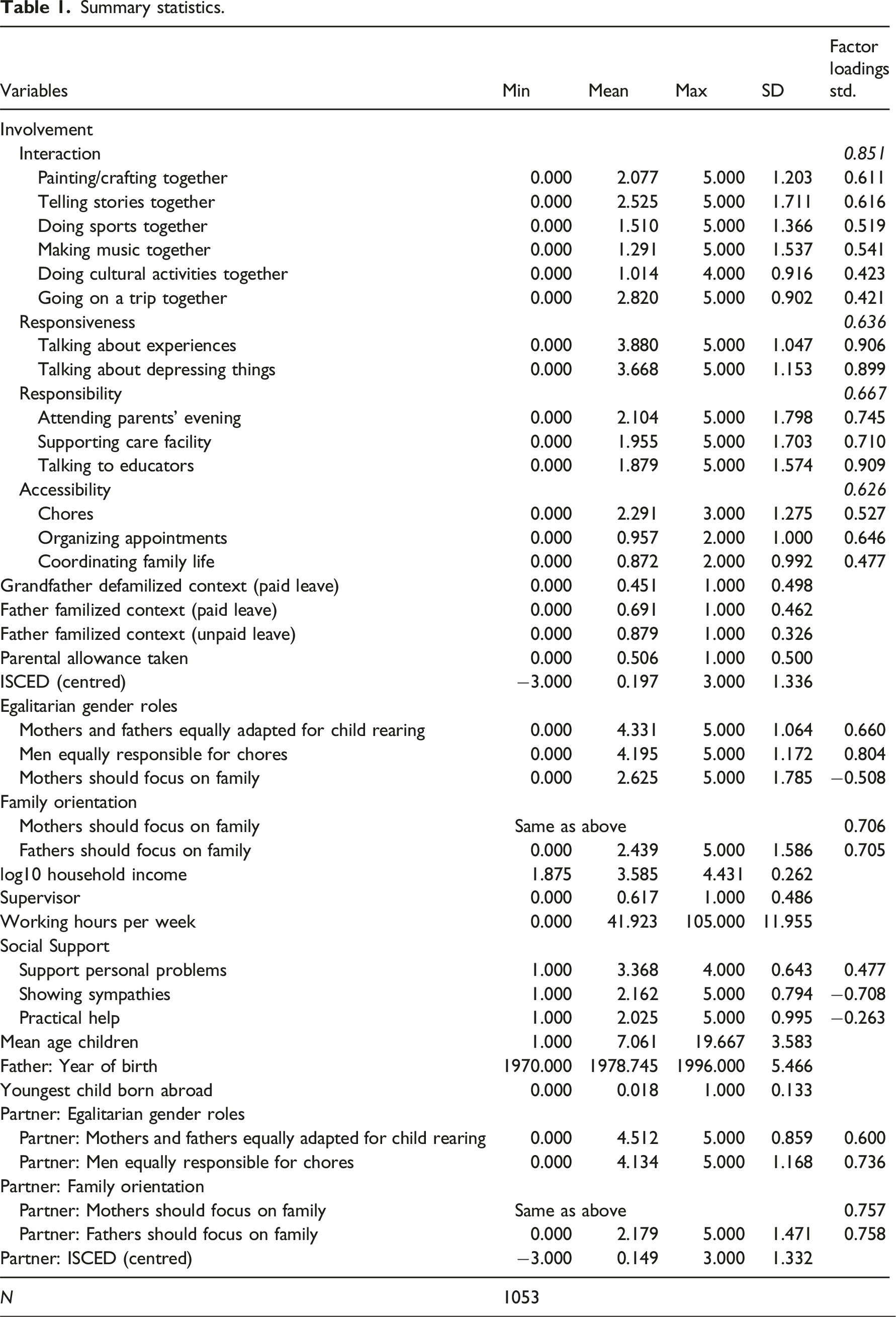
Summary statistics.
Involvement
Following Lamb et al. (1985) and subsequent papers on paternal involvement (Palkovitz, 1997; Pleck, 2010), we measure paternal involvement as a latent multi-dimensional concept using interaction frequency, responsiveness to the child, care, and accessibility as sub-dimensions. To measure interaction frequency, we use statements about how frequently fathers share activities with their children (0 = never, 1 = less often than once or twice a month, 2 = once or twice a month, 3 = once or twice a week, 4 = several times a week, 5 = daily). Therefore, we focus on painting/crafting, telling stories, doing sports, making music, doing cultural activities, and going on a trip together explicitly indicating shared activities without mass or digital media. We measure responsiveness to the child using the frequency of fathers talking to their children about experiences and (negative) feelings the children have made (0 = never, 1 = rarely, 2 = sometimes, 3 = often, 4 = very often, 5 = (almost) always). For the responsibility sub-dimension, we use the school-based school involvement of fathers, for example, how frequently are fathers taking responsibility for their children in front of family external institutions (0 = never, 1 = rarely, 2 = sometimes, 3 = often, 4 = very often, 5 = (almost) always). Fathers answer these questions for every child under 18 years separately; if they have more than one minor child, we use the average over all children. For the accessibility sub-dimension, we consider the hours on an average working day fathers spend doing the chores, organizing appointments for family members (for example, taking the children to school), and coordinating family life (for example, managing tasks). Thus, accessibility represents the time fathers are (potentially) available for their children as they stay locally near them while they are (yet) not engaged in direct interaction.
Leave policies
Our first set of exogenous variables to explain differences in paternal involvement refers to the welfare state as socializing circumstances for fathers. Therefore, we add the information of the amount of paid and unpaid leave weeks from the countries and respective years from the OECD family database (OECD, 2022).
To calculate the total number of weeks, we sum up the weeks of maternity leave (pre- and post-birth), the weeks of paid parental leave available to mothers (shared leave available to mothers and fathers included), and the total weeks of paid leave reserved exclusively for fathers. To compare familizing and defamilizing welfare regimes, we calculate a binary variable assigning fathers living in countries with more than 60 weeks of total paid leave (familizing countries) the value 1, and fathers living in countries with 60 weeks of total paid leave or less (defamilizing countries) the value 0. We, thus, distinguish short and long leave countries as Koslowski et al. (2022) suggest.
To calculate the total number of weeks of unpaid leave, we have to sum up the weeks of maternity leave (pre- and post-birth), the number of weeks of job protected but not paid parental leave available to mothers, regardless of income support, and the total weeks of leave reserved for exclusive use by the father (includes unpaid weeks) to get the total number of available leave weeks. Then, we subtract the total number of paid weeks of leave. To compare familizing and defamilizing welfare regimes, we calculate another binary variable assigning fathers living in countries with more than 52 weeks of total unpaid leave (familizing countries) the value 1, and fathers living in countries with 52 weeks of total unpaid leave or less (defamilizing countries) the value 0 (Lohmann and Zagel, 2016) using the mean of the indicator’s distribution in our sample. However, in AID:A respondents were only asked about their country of birth and when they migrated to Germany. Thus, we need to assume that respondents who have migrated to Germany lived in their country of birth until the year of migration.
Fathers can experience leave policies also indirectly via the welfare state conditions which their own parents experienced when they were born. To control for this transmission channel, we add the total number of weeks of paid leave available to mothers and fathers from the countries of birth of the surveyed fathers’ fathers (=grandfathers) at the year the surveyed father was born from the OECD family database. To compare familizing and defamilizing welfare regimes with this third indicator, we calculate a final binary variable assigning fathers having a father born in a country with more than 26 weeks of total paid leave (defamilizing countries) the value 1, and fathers having a father born in a country with 26 weeks of total paid leave or less (familizing countries) the value 0 using the mean of the indicator’s distribution in our sample.
In Figure 2, we present the data we use as indicators for country- and time-specific socialization contexts. The boxplots show the variance of these indicators represented by the fathers in the AID:A sample across the fathers’ and grandfathers’ countries of birth. For instance, the sample contains 34 fathers with grandfathers born in Poland, who experienced a rather low number of paid leaves (around 16 weeks of total paid leaves) at the time the fathers were born (left figure). Another 13 Polish fathers experienced a low number of paid (around 16; middle figure), but a quite high number of unpaid leave (around 156 weeks; right figure) when they were 20, before migrating to Germany. Parental leave opportunities [in weeks] by country for grandfathers in the year of birth of the responding father and in the year the responding father turned 20.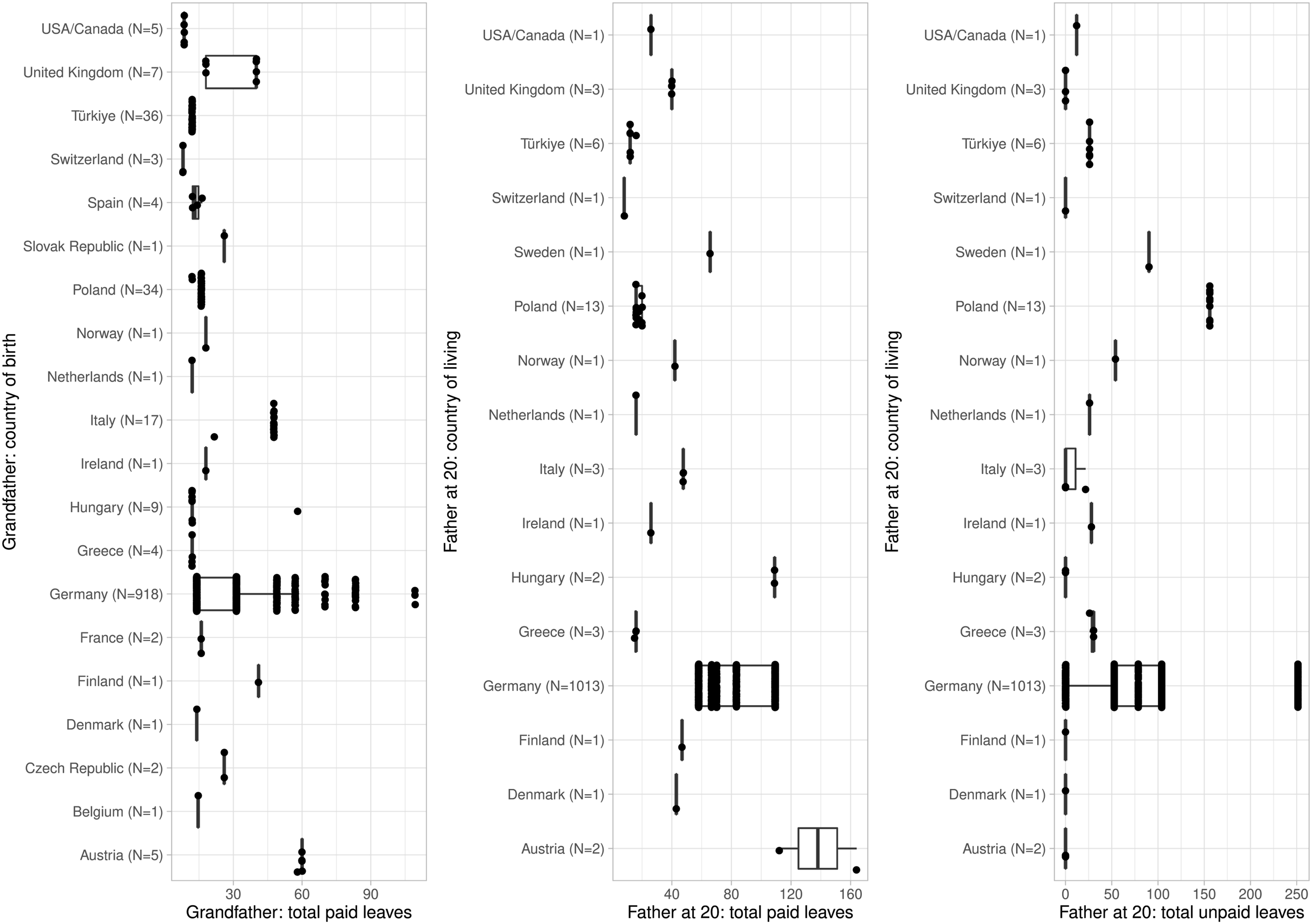
ISCED
To measure the individual level of education, we calculate the ISCED (UNESCO, 2012) based on the highest level of general school or vocational qualification (0 – ‘Primary education’, 1 – ‘Lower secondary education’, 2 – ‘Upper secondary education’, 3 – ‘Post-secondary non-tertiary education’, 4 – ‘Bachelor’s level’, 5 – ‘Master’s level’, 6 – ‘Doctoral level’) of the respondents. To avoid problems with collinearity, we centre the ISCED at the median.
Parental allowance
In AID:A, fathers were asked if they have received a parental allowance called ‘Elterngeld’ or ‘ElterngeldPlus’ in Germany for at least one of their children. We apply this information as a binary endogenous variable mediating the effects of parental leave policy experienced by themselves or transmitted via the fathers’ fathers and the fathers’ education on egalitarian gender roles and family orientation.
Egalitarian gender roles and family orientation
To estimate an egalitarian gender role attitude, we asked respondents to agree whether, first, ‘mothers and fathers are equally adapted to care for children’, second, ‘in a family with children in preschool age, men should take responsibility for doing the chores and caring for the children in the same way women do’, and third, if ‘mothers are supposed to take care primarily of the family instead of pursuing a career when their children are in preschool age’. Using confirmatory factor analysis, we estimated a latent factor variable based on these three indicators. As the third indicator also points to a stronger family orientation, we use it in combination with the question whether they agree that ‘fathers should take care primarily of the family instead of pursuing a career when their children are in preschool age’ to estimate the individual family orientation as a second latent factor variable. All items were asked for agreement on a six-point Likert scale (0 – ‘totally disagree’ to 5 – ‘totally agree’).
Control variables
As we use cross-sectional data, we cannot distinguish between age-, cohort-, and periodical effects. Thus, we control the effects of parental leave policies for the mean age of the responding fathers’ children as an indicator of biographical stages of life. Before 2007 fathers had no opportunity to access Elterngeld although there was a gender neutral parental leave allowance called ‘Elternzeit’ as an earlier parental leave opportunity. In the regression to predict if fathers opted for Elterngeld, we control, thus, for the responding fathers’ youngest child’s age (and the children’s mean age) as well as were they born outside of Germany (no/yes). According to earlier research (Nitsche and Grunow, 2018), we expect paternal involvement to be related to maternal attitudes (estimated using the same unstandardized factor loadings as for fathers) and educational background. Further, the occupational background of the fathers (if they are supervisors and their actual weekly working hours) might influence their actual gender attitudes, family orientation, and paternal involvement. To improve the estimation of the father-related predictors especially on paternal involvement, we control for these characteristics as well. In every regression, we also control for the net household income and social support available to the household to avoid the effects being confounded by economic and social resources. We measure social support using the Oslo Social Support Scale (Kocalevent et al., 2018). Respondents provide information on the number of closely related people on whom they can count when they have great personal problems (1 – ‘none’ to 4 – ‘5+’), about other people’s interest and concern in what they do (1 – ‘none’ to 5 – ‘a lot’), and about access to help from neighbors when you need them (1 – ‘very difficult’ to 5 – ‘very easy’). Table 1 shows descriptive summary statistics for all variables for the final sample of fathers used in the further analysis. Standardized factor loadings are reported regarding the superordinate factor. In the case of paternal involvement, sub-dimensional factors (for example, interaction) have factor loadings (italic) on the second-order superordinate factor involvement.
In the following, we estimate a structural equation model (SEM) to test potential direct and indirect influences of parental leave policy and the educational background of fathers on their actual parental involvement. We report Standardized Root Mean Square Residual (SRMR) and Root Mean Square Error of Approximation (RMSEA) as absolute goodness-of-fit as well as Tucker-Lewis Index (TLI) and the Comparative Fit Index (CFI) as relative badness-of-fit indices (West et al., 2015). To carry out the analyses we use the lavaan package (beta Version 0.6–12: Rosseel, 2012) for R (R Core Team, 2020).
Results
Structural equation model on paternal involvement.
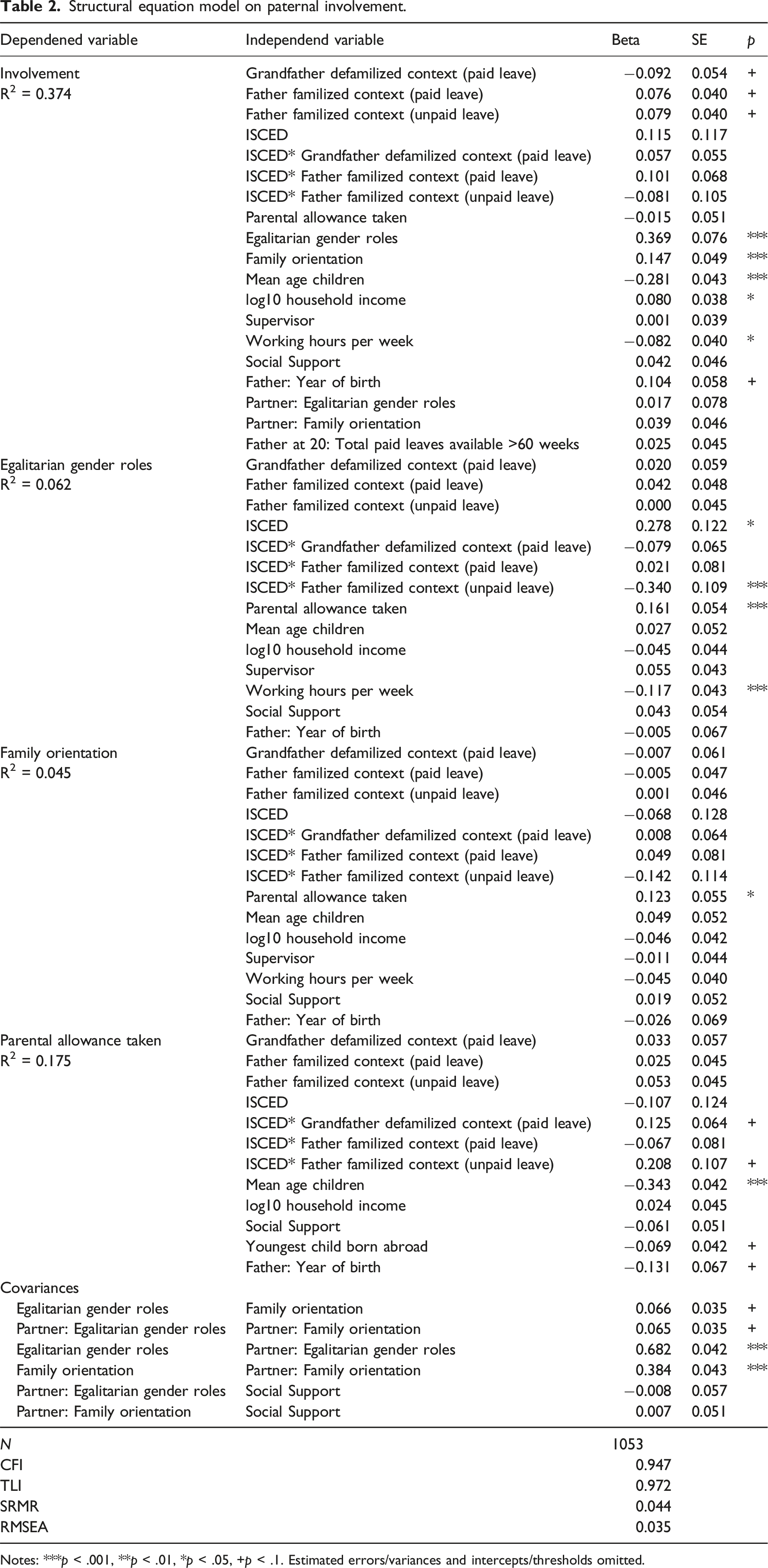
Notes: ***p < .001, **p < .01, *p < .05, +p < .1. Estimated errors/variances and intercepts/thresholds omitted.
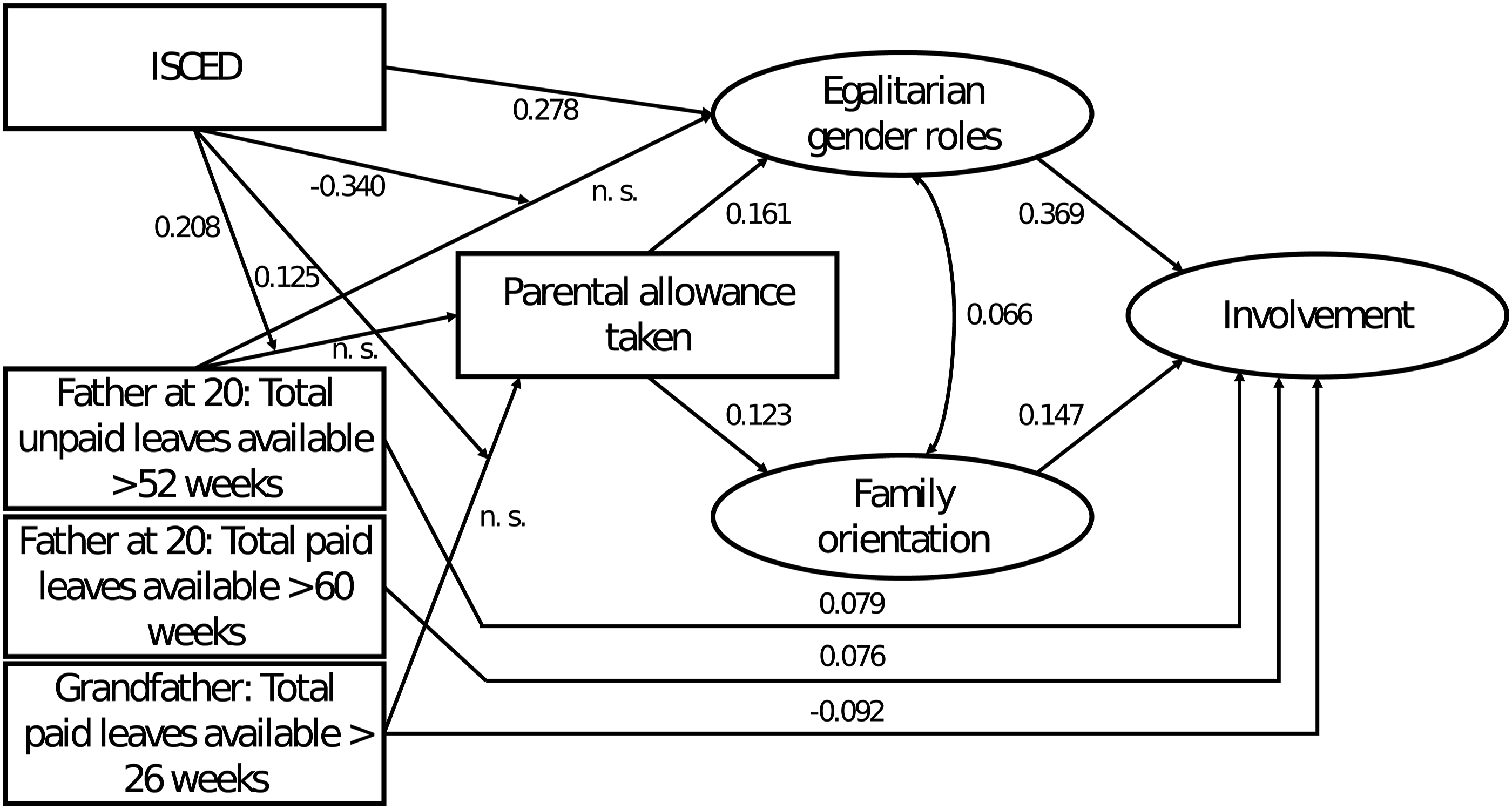
Structural equation model on paternal involvement. Notes: Rectangles represent observed variables; ovals represent latent variables, measurement models omitted. Solid lines represent positive relations (p < .05); dashed lines represent negative relations (p < .05). Estimated insignificant relations, errors/variances, covariances and control variables omitted (see Table 2 for further information). Numbers on lines represent standardized effect sizes.
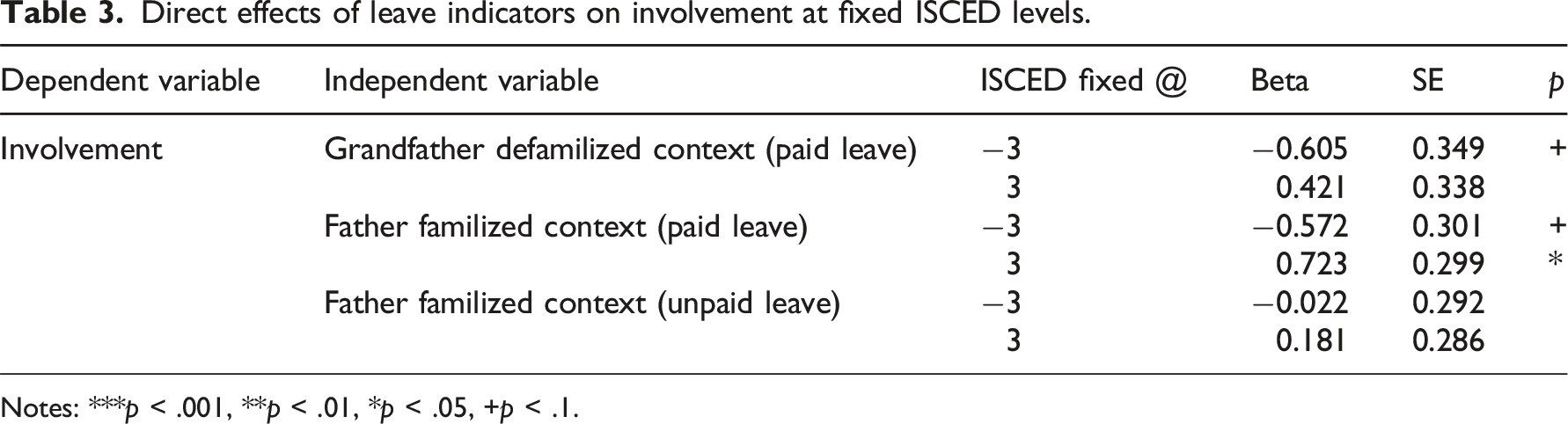
First, we consider the direct regression estimates for paternal involvement in the SEM. The main effects of the indicators for (de-)familizing political framework conditions are only significant at the 10% level. Fathers with defamilized grandfathers are less involved with their children today. On the other hand, familized fathers are more involved today. Neither the educational background nor the interaction between the educational background and the individual indicators for (de-)familizing seems to influence the current involvement significantly. In these cases, the standardized effect sizes are also weak with absolute values often below 0.1, indicating no fundamental association.
Direct effects of leave indicators on involvement at fixed ISCED levels.
Notes: ***p < .001, **p < .01, *p < .05, +p < .1.
Table 2 shows that fathers with stronger gender-egalitarian attitudes and a higher degree of family orientation are more involved in their relationships with their children supporting hypotheses H5a and H5b.
Moreover, while fathers from different (de)familizing contexts do not differ systematically in terms of their family orientation, the results support hypotheses H4a and H4b that fathers who have previously taken parental allowance for at least one of their children in Germany are on average more family-oriented at the time of the survey and have more gender-egalitarian attitudes.
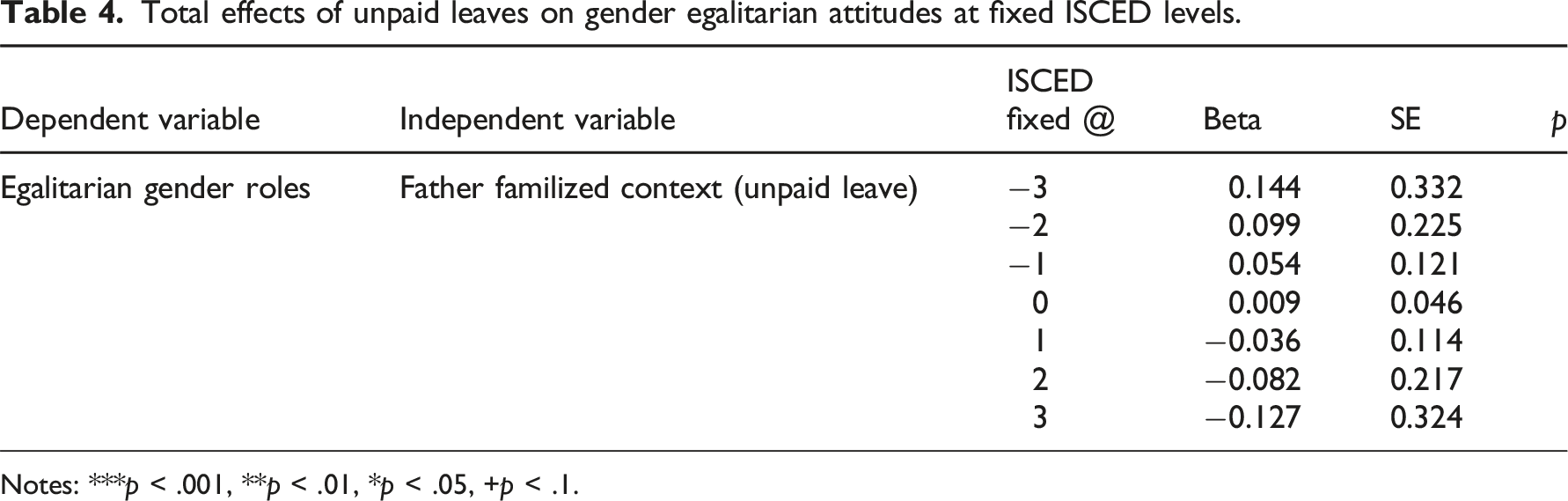
In addition, fathers with a higher education are more gender-egalitarian, especially if they did not live in countries with more than 52 weeks of unpaid parental leave at 20. We did not expect either of these associations, since we assumed that the relationship between educational background and (de-)familization as well as gender attitudes is completely mediated by taking parental allowance in Germany H1a with H4a).
According to the results, taking parental allowance in Germany is also related to (de-)familizing factors. Fathers with grandfathers from defamilizing contexts and a higher education are slightly more inclined to have taken parental allowance for one of their children previously (H2a and H3). However, the same holds for highly educated fathers who by the age of 20 lived in countries with high levels of unpaid parental leave, contradicting hypothesis H1a.
Total effects of unpaid leaves on gender egalitarian attitudes at fixed ISCED levels.
Notes: ***p < .001, **p < .01, *p < .05, +p < .1.
Discussion
The results of our study support to some extent the initial assumption that fathers’ socialization background that is rooted in the welfare state, is associated with their later parenthood (Esping-Andersen, 1999; Korpi et al., 2013; Korpi and Palme, 1998; Neyer, 2021). However, we need to differentiate the concept of socialization over the period of growing up. If fathers grew up in a political framework that is characterized by defamilization, which generally include rather short parental leave durations with a high wage compensation, they are more involved in their relationship with their children when they later become parents themselves. The role of the grandparents’ generation is of major importance as they transmit their experiences with the norms and values of the political framework at their time as parents to the generation of the today’s fathers pointing to the importance of the experiences that fathers had in their childhood (Bourdieu, 1984; Inglehart, 1990). Furthermore, fathers tend to be more involved in parenting as adults when they experienced social policies including a high amount of (more than 60 weeks) well-paid parental leave at the age of 20 (Koslowski et al., 2022). From this perspective, well-paid long-term leaves appear as defamilizing as well, while the current discussion tends to classify low- or unpaid long-term leaves as familizing policy (Lohmann and Zagel, 2016). However, as our data on fathers living in countries with long-term total leaves are mostly limited to fathers from Germany as a country with high wage compensation (see Figure 2), this last result may be a methodological artifact.
An essential prerequisite is the manner of socialization in the education system, which moderates the influence of defamilization political framework conditions on the behaviour of the fathers. In particular, fathers who successfully adopt the norms and value systems (including family and gender ideologies) that are conveyed by the education system can document this through a more involved fatherhood. In other words: highly educated fathers from defamilizing welfare regimes tend to fill the role of a father in a more defamilized fashion than highly educated fathers from familizing welfare regimes but also more than low educated fathers from defamilized welfare regimes. Thus, the educational system has an intermediary role between the welfare state and the individual (Shu, 2004).
Although our results are largely plausible, they are based on rather weak empirical evidence and therefore call for further research with larger international databases. Contrarily to our expectations, we found primarily direct associations between (de-)familizing political frameworks and paternal involvement. Indirect relationships mediated by, for instance, gender attitudes and family orientation were mostly absent. Additionally, we found large variances according to these direct relationships although our results point to some significant differences (on average) between fathers with different educational and social-political backgrounds. We do not want to overstate these differences, but we find it plausible that estimates of associations come with relatively high standard errors as exogenous and endogenous variables in part refer to very different points in the life of the observed fathers. The large error variances may point to strong group differences between fathers from similar socio-political backgrounds, which we were unable to address with our analysis. It would be conceivable that the relationship between socio-political socialization contexts and paternal involvement is mediated, for instance, by another independent attitude. Since we were only able to depict attitudes that related to men and women or fathers and mothers as social groups, attitudes and ideal images that fathers apply to themselves personally and possibly independently of their general gender and family attitudes could fill the gap (Grunow and Baur, 2014; Speck, 2018).
Besides, the measures we use to characterize fathers from different social backgrounds, attitudes, and behaviours reflect a period of more than 20 years in the life of the respondents, during which attitudes and behaviour can be subject to permanent change. In particular, we lack information about the successive development of attitudes and behaviour, so our results only represent an indication of the suspected interactions. Further, we used parental leave indicators for different countries from 1970 until today to account for different family welfare policies according to (de-)familization. The results presented here thus include variations according to the country of birth and living of the fathers and grandfathers examined. As we have no information of the place of residency of the grandfather at the year of birth of the respective father, we use his country of origin as the best approximation of his socio-political background. However, it is possible for grandfathers to have grown up and been socialized in another country other than their country of birth. By using this additional information from the OECD family database, the proportion of fathers available in principle in our sample, however, has been reduced significantly. Finally, parental leave only represents (de-)familizing policies to a limited extent while we could not consider, for instance, father-specific (‘ear-marked’) leave policies, the availability of pre-school care institutions or tax (dis-)advantages for families. Subsequent research projects that take up the results of this study should therefore focus particularly on these two aspects by relying more strongly on fathers of different social and regional origins in longitudinal studies.
Footnotes
Declaration of conflicting interests
The author(s) declared no potential conflicts of interest with respect to the research, authorship, and/or publication of this article.
Funding
The author(s) disclosed receipt of the following financial support for the research, authorship, and/or publication of this article: This work was supported by the German Youth Institute.
