




Abstract
The proportion of total parental leave days taken by fathers has increased in all Nordic countries almost hand in hand with parental leave reforms. However, the average pattern of fathers’ parental leave uptake hides the fact that a considerable proportion of fathers use no parental leave, even when they are earmarked for the father. In this study, we focus on the proportion and characteristics of non-users, that is, fathers who do not use parental leave. We distinguish two non-user groups: fathers who use no parental leave, not even birth-related leave and fathers who do not use the father’s quota. This distinction is relevant because it reflects the design and institutional status of fathers’ parental leave. Further, factors related to using no parental leave are likely to be somewhat different to those related to not using the father’s quota. In Finland, the father’s quota was introduced in 2003, but it became fully independent leave for the father only in 2013. We also investigate if the 2013 reform was followed by any changes in fathers’ parental leave use and in the profiles of non-users. We use a unique longitudinal register data that covers practically (fathers to) all children born in 2010–2015 and follow parental leave use until 2018. We find that the 2013 reform was followed by a considerable increase in the uptake of the father’s quota. The proportion of fathers who used no parental leave remained stable, but the reform encouraged some fathers to take longer, independent leave in addition to the birth-related leave. Overall, less educated and low-income fathers were less likely to use any parental leave, and if they took leave, they were more likely to use only the birth-related leave. However, the 2013 reform slightly diminished socioeconomic disparities in the use of the father’s quota.
Introduction
Over the past decade in Europe, the gendered use of parental leave has received considerable scientific and political attention. Development towards a more egalitarian division of parental leave has been slow despite various policy initiatives and campaigns. In 2017, the European Commission proposed that each parent should have the right to 4 months of individual, paid and non-transferable parental leave. The proposal was part of the Commission’s initiative on social rights and its aim was to promote female employment and better reconciliation of work and family. The European Parliament and the European Council reached a provisional agreement for a directive in January 2019, which was a clear sign that fathers’ equal role in sharing the responsibility for childcare with the mother was recognized on the EU level (European Commission, 2019).
Most European countries have already implemented paid parental leave which can be shared between parents and are increasingly introducing leave periods reserved for fathers (Karu and Tremblay, 2018; Moss and Deven, 2015). Nordic countries were pioneers in this field, as they introduced birth-related paternity leave and shared parental leave in the mid-1970s and early 1980s and have implemented non-transferable parental leave, or, father’s quotas, since the 1990s (Eydal et al., 2015; Haas and Rostgaard, 2011). Finland was one of the first countries to offer birth-related leave to fathers, but the last among the Nordic countries to implement a father’s quota in its parental leave scheme in 2003 (Haataja, 2004). Rather than stressing gender equality and fathers’ independent role as caregivers, there have been two contrasting rationales in developing parental leave in Finland. One is to support families’ free choice in organizing childcare and the other is to promote maternal employment by encouraging fathers’ participation and a more equal sharing of parental leave (Lammi-Taskula, 2007; Saarikallio-Torp and Haataja, 2016). Nevertheless, reforms in the parental leave scheme have mainly concerned reserving more parental leave days for fathers during the first two decades of the 2000s. It is noteworthy that, at first, the father’s quota was not a ‘pure’ quota as it was conditional on the mother’s approval. Fathers gained their own quota independent from the mothers’ consent as late as 2013. Finnish fathers are currently entitled to 9 weeks (54 days, approximately 2.2 months) of paid, non-transferable leave. Three weeks of this leave can be taken right after the child is born (birth-related leave) and the remainder (or all) of the leave (father’s quota) can be taken after the shared parental leave period.
It seems that despite attempts to increase fathers’ participation by introducing non-transferable leave periods, not all fathers are able, or willing, to use parental leave, even the earmarked periods. Evidence from the Nordic countries suggests that the proportion of fathers who use no parental leave is not insignificant, varying from 10% to 25% (Bloksgaard and Rostgaard, 2019; Duvander and Johansson, 2012; Eydal and Gíslason, 2019; Kitterød et al., 2017; Saarikallio-Torp and Haataja, 2016). There are also significant social class differences in fathers’ parental leave use. Previous research on fathers’ leave-taking shows that highly-educated and middle-class families are more likely to use fathers’ parental leave, whereas fathers at the lower end of the social strata or with low incomes lag behind (Lappegård, 2008; Naz, 2010; Salmi et al., 2009; Sigurdardottir and Garðarsdóttir, 2018).
The aim of this study is to investigate the proportion and characteristics of fathers not making use of parental leave. We contribute to previous studies by distinguishing two types of non-use: fathers who used no parental leave, even birth-related leave and fathers who only used birth-related leave but not the father’s quota. To do this, we divide fathers into three categories: (1) Fathers who use no parental leave (total non-users); (2) Fathers who only use birth-related leave (quota non-users); and (3) Fathers who use more than the birth-related leave (father’s quota users). We also investigate whether the characteristics of fathers using different types of parental leave changed in any way after the 2013 reform.
Our motivation in distinguishing between fathers who used no parental leave and fathers who did not use the father’s quota rests on two notions. First, there is considerable ambiguity in the terminology of fathers’ leave. Occasionally, the term paternity leave covers all periods of leave reserved for fathers (see O’Brien, 2013), irrespective of whether the leave is meant to be taken while the mother is on leave (birth-related leave), or as an independent leave during which the father is expected to be responsible for childcare. In some countries, birth-related leave may be considered part of the father’s quota, or the father may use all or some of his quota at the same time as the mother is on maternity/parental leave (e.g. Spain, Germany and Finland since 2013; Meil et al., 2019; Reimer et al., 2019). In others, birth-related leave may not even be included in family leave programmes (e.g. Sweden, Norway), but it may be covered by collective agreements (Koslowski et al., 2019a). Second, and more importantly, these two types of fathers’ leave are based on different ideologies. The main objective of the father’s quota policy has been to encourage fathers to assume the main responsibility for childcare when mothers return to work (Haas and Rostgaard, 2011; Salmi and Lammi-Taskula, 2016). The design of the father’s quota often entails that either it cannot be taken when the mother is on maternity or parental leave, or the number of days to be used together with the mother is restricted. This differs from birth-related leave whose aim is to provide a helping hand to the mother with a new-born baby right after childbirth.
The Finnish parental leave scheme provides a particularly suitable tool to investigate this distinction as it allows us to distinguish between fathers who only use birth-related leave and fathers who are willing to take longer leave. In Finland, birth-related leave and the father’s quota have traditionally been separate types of leave, which can also be seen in the different take-up rates of these two leave schemes (Salmi and Lammi-Taskula, 2016). We expect that factors related to total non-use (that is, not using even birth-related leave) and quota non-use are somewhat different. Fathers’ birth-related leave does not challenge traditional gender roles in the family as much as their independent care leave does, which means that the obstacles to using the father’s quota could be higher.
We use a unique register data set from the Social Insurance Institution of Finland (Kela), focusing on parental leave choices among fathers of children born in 2010–2015. We follow fathers’ parental leave use until 2018. The data set includes detailed information on fathers’ parental leave use and their socioeconomic background, and it covers practically all children born in Finland during that time.
The Finnish context
Until 2003, the Finnish parental leave scheme consisted of 17.5 weeks of maternity leave, followed by 26 weeks of parental leave. Parents were able to divide the parental leave as they wished (shared parental leave). Fathers were also entitled to 3 weeks of birth-related leave. To encourage fathers’ participation in leave-taking, a non-transferable parental leave quota for fathers was introduced in 2003. However, the Finnish model differed considerably from father’s quotas implemented in the other Nordic countries. Fathers were able to use their quota only if the mother was willing to sign over a part of the shared parental leave (2 weeks) to the father. Thus, the quota use was dependent on the mother’s consent. In 2003, fathers also had to use the quota immediately after the parental leave period, when the child was approximately 10 months old. In 2007, this period was extended up until the child was about 18 months old. In 2010, the father’s quota was lengthened by 2 weeks.
In the 2013 reform, fathers finally gained an independent and unconditional leave of their own, when the link between the quota and shared parental leave was abolished. At the same time, 18 days of birth-related leave was included as a part of the new father’s quota. Fathers can still take 18 days of leave during maternity or parental leave, but these days will be reduced from the total amount reserved for fathers. The total duration of the leave for fathers is now 9 weeks and this includes the birth-related leave.
The Finnish parental leave scheme also includes child home care leave (covered by home care allowance (HCA)) which can be taken from the end of the shared parental leave until the child turns 3 years old. Despite the low compensation level many mothers use this leave, often until the child is 1.5–2.5 years old (see e.g. Haataja and Juutilainen, 2014). As HCA cannot be paid at the same time as a father is taking his quota, the father needs to negotiate with the mother when to take his leave if the mother intends to use HCA.
Maternity leave, shared parental leave and leave periods reserved for fathers are income-compensated at a rate of about 70% of previous income. For the first 2 months of maternity leave, the compensation rate is 90%, and many employees are covered by collective agreements entitling them to full pay for 1–3 months. Many branches have started to provide full payment for fathers too, but only for 1–2 weeks of the birth-related leave. There is no upper limit in the earnings-related compensation, but the compensation rate starts to diminish beyond a certain income level. A minimum parental benefit is paid to those who have no previous employment or whose employment period is too short to qualify for the earnings-related benefit.
Theoretical considerations and previous research
There is strong empirical evidence that introducing non-transferable, independent leave quotas for fathers increases fathers’ take-up of parental leave (Duvander and Johansson, 2012; Ekberg et al., 2013; Kluve and Tamm, 2013; Patnaik, 2019). Yet, studies mainly from the Nordic countries show that a considerable proportion of fathers do not use designated leave and that there are marked socioeconomic and demographic disparities in fathers’ parental leave use (Bloksgaard and Rostgaard, 2019; Duvander and Johansson, 2012; Eydal and Gíslason, 2019; Kaufman, 2018; Kitterød et al., 2017; Saarikallio-Torp and Haataja, 2016).
Theoretically, micro-economic models on the division of work in the household (see Becker, 1993) provide some ideas on how socioeconomic resources might be related to father’s parental leave use. According to these views, men’s time away from work is costly, and the opportunity costs as foregone earnings during parental leave would be particularly relevant for men with high earnings potential. Although the parental benefit in Finland compensates up to 70% of previous earnings, the rate diminishes with higher earnings. We could thus expect that especially fathers in high-income groups are less likely to use parental leave, and, in particular, less likely to take longer leave. Also mothers’ income can influence fathers’ parental leave use. If the mother’s income is low, the father is less likely to take parental leave than in households in which the mother has good income and the father’s absence from work does not compromise household finances. In bargaining models (Becker, 1993; see also Ott, 1992), family demands are solved by negotiations between partners where individual economic assets are the major determinants of bargaining power. In this case, if a father earns less or is less educated than his partner, he would be more likely to use parental leave than if his earnings were higher than his partner’s.
So far, empirical evidence is somewhat mixed and not always in line with what could be expected based on economic models. For example, Sundström and Duvander (2002) found that the father’s earnings had a positive effect on his taking leave, although the effect was smaller at a high earnings level. Fathers’ individual earnings were more strongly associated with leave use than mothers’ earnings. In a more recent paper, an inverse U-shaped association was found with the father’s income and his uptake of a longer leave (Ma et al., 2019). In Lappegård’s (2008) study, both mothers’ and fathers’ earned income had a positive effect on fathers’ use of parental leave, but the effect of mothers’ income was more pronounced. Naz (2010) and Trappe (2013) find support for the bargaining model of decision-making: when a woman is more educated than her partner, or when her income is equal to or higher than her partner’s, men are more likely to use parental leave.
Theoretical approaches that focus on social norms and cultural views on gender stress the role of attitudes and gendered expectations in the decisions on the division of domestic work (Berk, 1985; West and Zimmerman, 1987). According to these views, to the extent that low education (and low income) is linked to traditional views on gender roles, fathers in highly-educated and better-off families are likely to adopt a more active parenting role, and could be thus expected to use more parental leave, especially leave that grants them more responsibility for childcare. Furthermore, fathers who hold a lower socio-economic position than their partners might take only a few parental leave days or no leave at all in order to display their masculinity. Also mothers’ attitudes and wishes are found to influence how fathers use their leave (on mothers as gate-keepers, see Allen and Hawkins, 1999). Previous research has shown that highly educated fathers or partners to more educated women are more likely to take leave (Lappegård, 2008; Naz, 2010; Sundström and Duvander, 2002). However, Reich (2010) found a U-shaped association between fathers’ educational level and their take-up of parental leave; fathers with either a low or a high educational level tended to use more leave than fathers with middle-level education. It seems likely, though, that attitudinal obstacles to using the father’s quota may be more severe than to using birth-related leave where the role assigned to the father is more traditional: to provide a helping hand to the mother.
Differences in institutional settings and in the way fathers’ leave is organized could partly explain the mismatch between theoretical expectations and empirical evidence. Configurations of parental leave policies strongly affect available opportunities and thereby parents’ behaviour (see also Haas and Rostgaard, 2011; Koslowski et al., 2019b). In many countries, birth-related leave and the father’s quota have different policy goals, and while birth-related leave can be seen as a stepping-stone towards more progressive use of fathers’ parental leave, they, in a way, represent two different institutions with different views on fatherhood and parental roles (see also Eerola et al., 2019; Haas and Rostgaard, 2011; Valarino and Gauthier, 2016). With its long history, the birth-related leave has become a social norm and its use legitimate whereas the father’s quota is more likely to challenge gendered expectations about parenthood as it encourages fathers to take an active and independent role in childcare. Thus, factors which explain fathers’ parental leave use can depend on the ‘institutional status’ of a specific policy. Consequently, factors related to birth-related leave use could be different from those associated with use of the father’s quota. In one of the rare studies addressing fathers’ use of different types of parental leave, it appeared that, for example, maternal bargaining power was more important in explaining fathers’ use of shared parental leave than his use of a ‘more established’ father’s quota (see Naz, 2010).
Data and methodology
We employ longitudinal register-based microdata of parents who had a child in 2010–2015 and who had received a maternity, parental or paternity leave benefit. Data were drawn from Kela registers and cover over 99% of live births in Finland in 2010–2015. We follow fathers’ parental leave use until 2018 (or until the child is 2 years old, i.e. during which time the father is eligible for father’s quota). Parental benefits are paid to all parents, irrespective of their employment status. Thus, our data also include students, unemployed or inactive persons if they received a parental benefit.
We restricted the analysis to children whose mothers had been on maternity leave resulting in N = 322,778 (excluding multiple births, adopted children and deaths). Information on the father and his use of parental leave was linked to the child through Kela registers and population registers. Data on the sociodemographic characteristics of the parents were obtained from Kela and Statistics Finland.
First, we present the descriptive results where we use data for birth cohorts 2006–2015 to show trends in fathers’ use of different parental leave. Next, we apply multinomial logistic regression to investigate the characteristics of fathers’ parental leave use. We divide fathers into three groups according to their take-up of parental leave: (1) total non-users (fathers who have not used any kind of parental leave: no birth-related leave, father’s quota, or shared parental leave), (2) quota non-users (fathers who used birth-related leave only) and (3) father’s quota users (fathers who took at least some days of the father’s quota). 1
Of the sociodemographic factors, our main interest is in the association between education and income and fathers’ uptake of different types of parental leave. The information on income is derived from taxable income measured at the end of the year preceding the child’s birth. Educational attainment refers to the highest degree ever received and data on demographic indicators are from the child’s birth year.
In the multivariate analyses, we divide the observation period (birth cohorts) into two sections: 2010–2012 and 2013–2015 to reflect the cut-off point of the most recent reform in 2013. Finally, we examine if the 2013 reform was followed by any change in fathers’ parental leave use depending on their income levels.
Demographic variables (see Table 1) are included as controls in the models. Characteristics such as age, number of children and birth order, marital status, immigrant background and whether residing either in an urban or a rural area have also been shown to be associated with how men use their right to parental leave, albeit the findings have not always been consistent (e.g. Geisler and Kreyenfeld, 2019; Lappegård, 2008; Naz, 2010; Sundström and Duvander, 2002; Tervola, 2018; Zhelyazkova and Ritschard, 2018).
Descriptive statistics of the sample (children born 2010–2015, N = 322,778). Distribution of fathers’ parental leave use by independent variables (%).
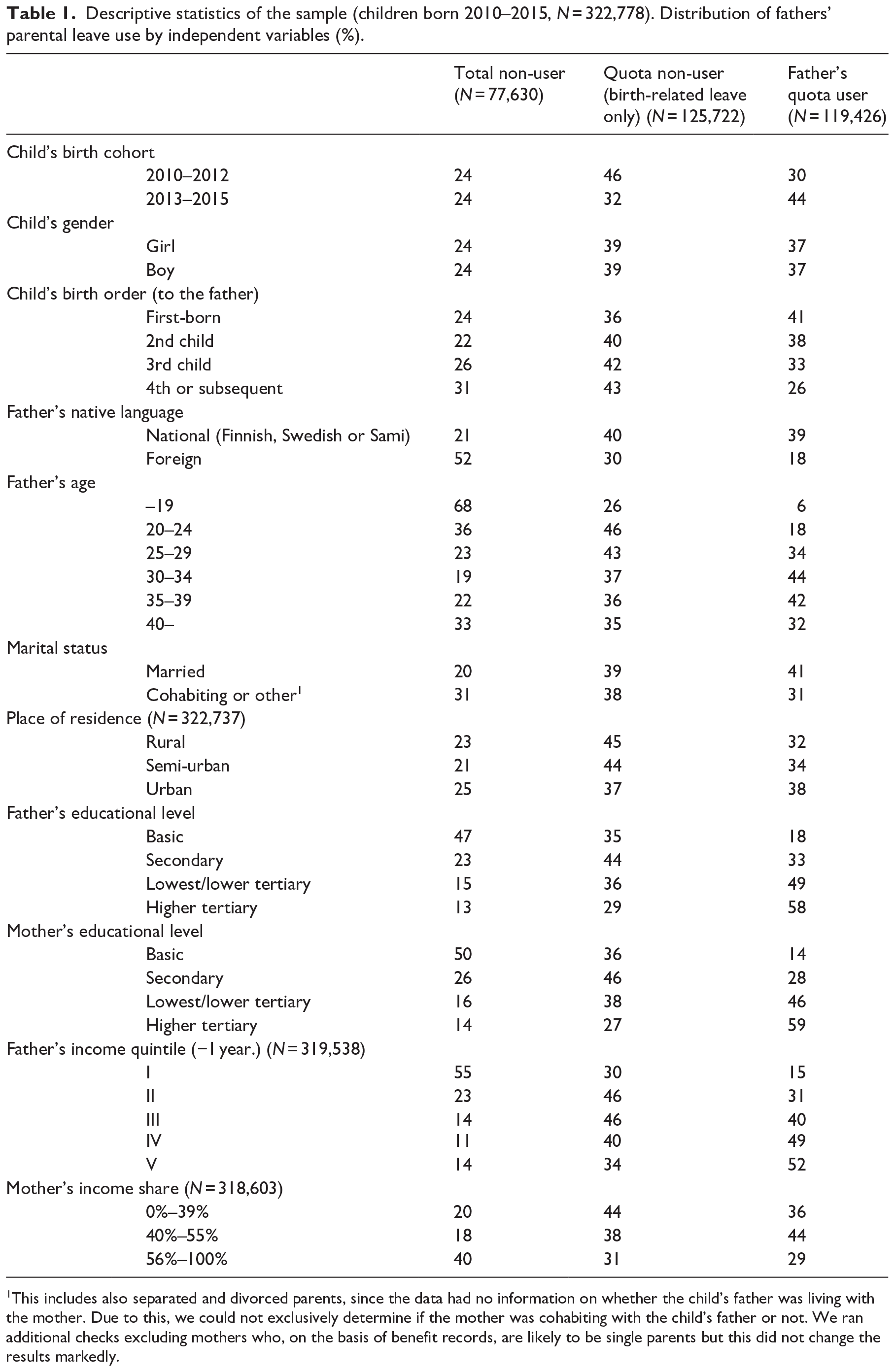
This includes also separated and divorced parents, since the data had no information on whether the child’s father was living with the mother. Due to this, we could not exclusively determine if the mother was cohabiting with the child’s father or not. We ran additional checks excluding mothers who, on the basis of benefit records, are likely to be single parents but this did not change the results markedly.
Results
Fathers’ use of parental leave
The proportion of fathers who have not used any kind of parental leave has remained remarkably stable throughout the years (Figure 1). Starting from 29% in the 2006 cohort, the proportion of total non-users has gradually decreased to 26% in the 2015 cohort. The 2013 reform, while considerably increasing the use of the father’s quota, was not able to alter the behaviour of fathers who used no parental leave.
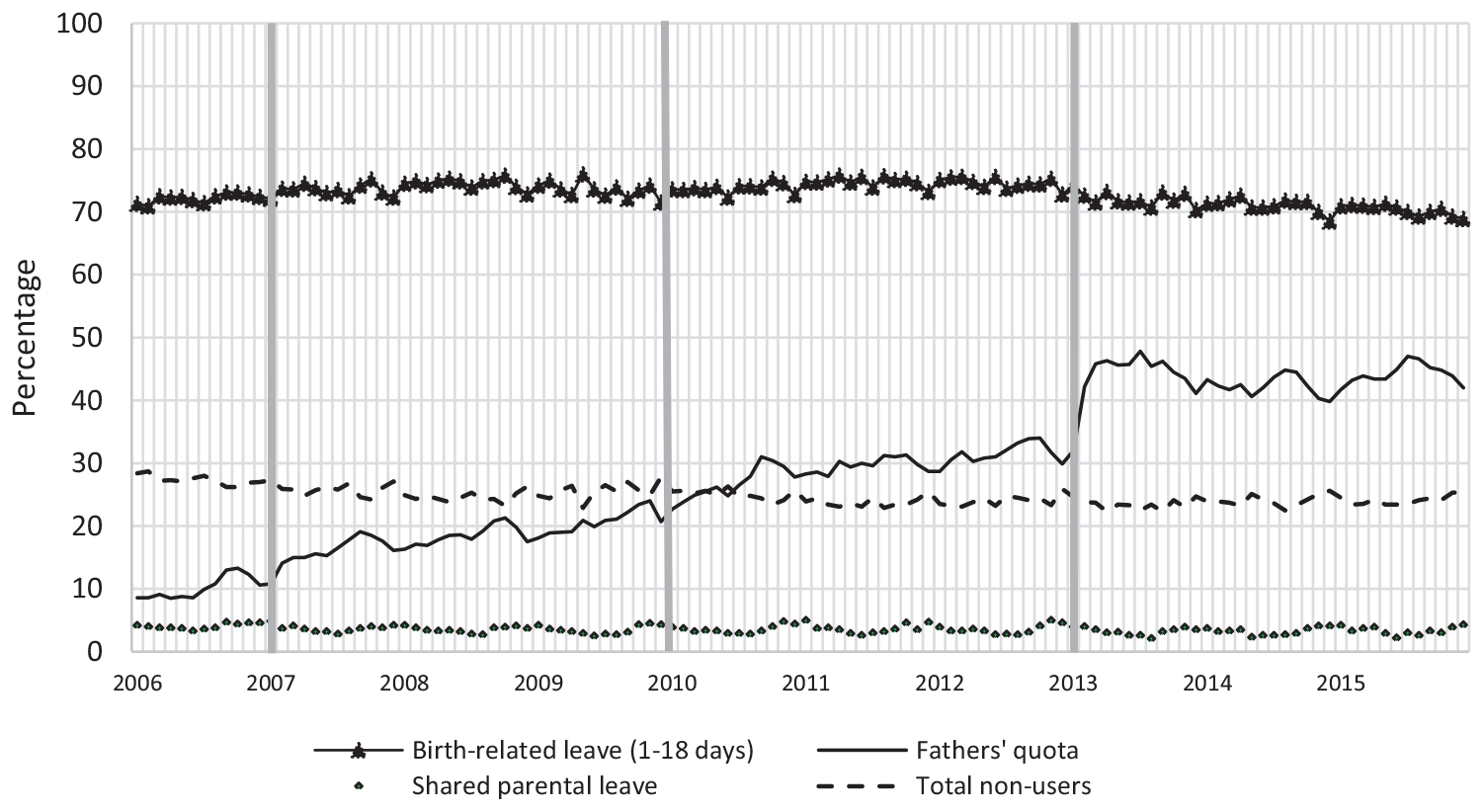
Proportion of fathers taking different types of parental leave and the share of fathers who have taken no parental leave, children in (monthly) birth cohorts 2006–2015 (%), N = 544,222.
Until 2013, the proportion of fathers who took birth-related leave remained fairly stable, at around 70%–75%. Since 2013 there appears to be a slight decrease in fathers’ birth-related leave use: in the 2015 birth cohort, 69% of fathers had used birth-related leave. Note that in Figure 1, the proportion of fathers using birth-related leave includes fathers who may have also used the father’s quota or shared parental leave. 2
Since 2003, each reform of the parental leave schemes shows an increase in the proportion of fathers using the father’s quota, starting from around 10% in the 2006 birth cohort to 20% in the 2009 cohort and to 30% in the 2012 cohort. The 2013 reform has had the strongest impact on fathers’ participation so far: 44% of fathers whose children were born during 2013–2015 have used at least some days of the father’s quota. On the other hand, the proportion of fathers taking shared parental leave has remained very low, at around 3%.
Multivariate analyses
Our main interest is in how socioeconomic resources are related to fathers not using any parental leave, and not using father’s quota. If the mother or the father had only basic level education, the father was less likely to use any parental leave (Table 2). Somewhat surprisingly, educational differences among total non-users were notably small among those who had more than basic-level education. When we turn to look at father’s quota users, it appears that higher education increased the likelihood of quota use, and educational differences were larger when we consider the mothers’ education. It seems, thus, that beyond basic-level education, an increasing educational level does not markedly influence the total non-use of parental leave. However, among fathers who do use parental leave, each ‘educational step’ matters, and highly educated fathers or fathers with highly educated partners are most likely to take leave that support father’s independent role in childcare.
Fathers’ use of parental leave. Odds ratios and 95% CI from multinomial logistic regression models. Quota non-users (fathers who used only birth-related leave) as a reference group.
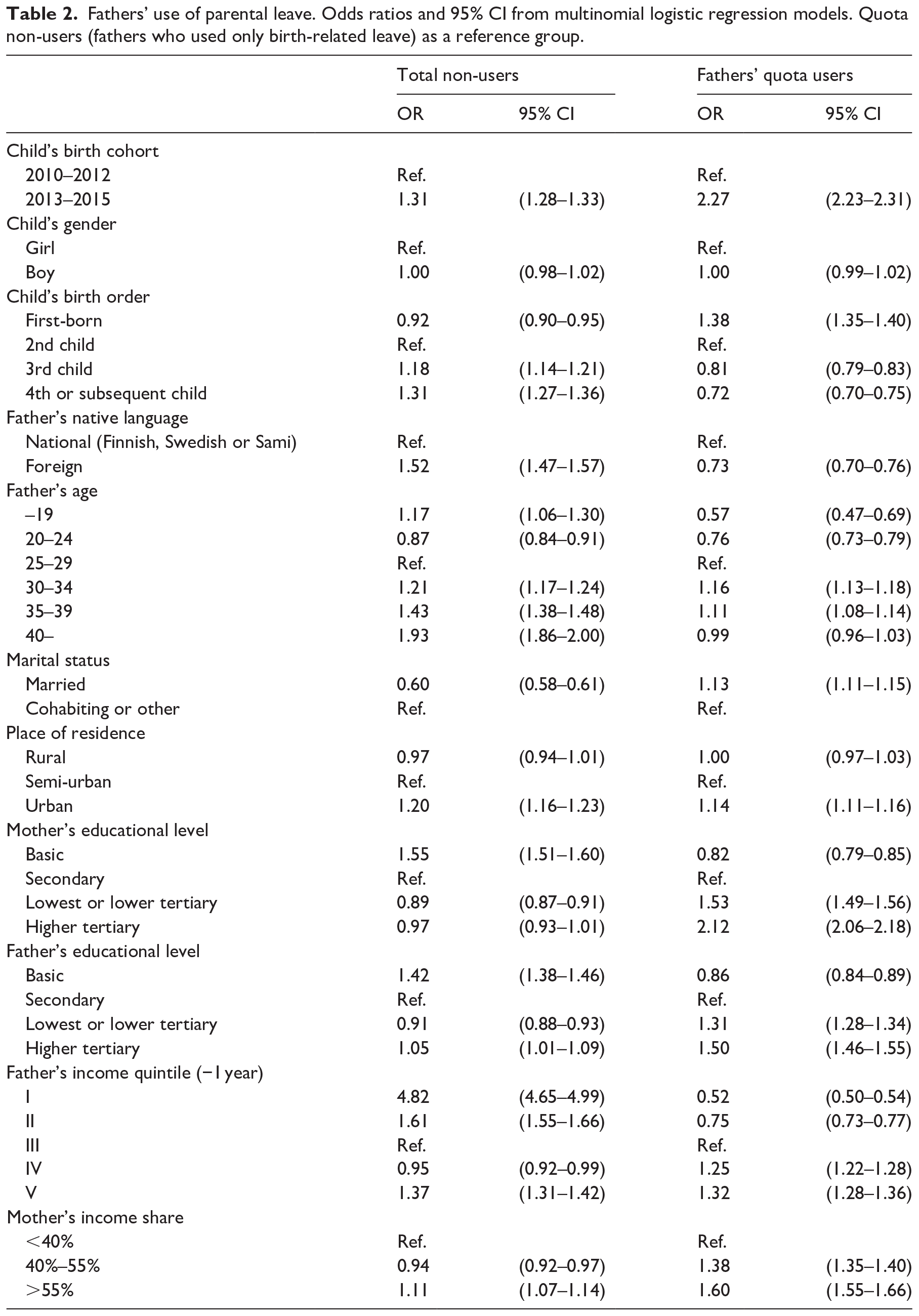
Regarding income, we notice a U-shaped pattern when we look at total non-users: fathers in the lowest income quintile were less likely to use any parental leave, but in the highest income quintile, we also observe an elevated propensity for fathers’ non-participation. In addition, fathers’ income appeared to be more strongly associated with his decision whether to take any parental leave than mothers’ income (results for mothers’ income available on request). We did not have information about parents’ employment status, and it is possible that a larger proportion of fathers in the lowest income groups are unemployed and therefore less likely to use parental leave. On the other hand, fathers in the high-income groups are likely to have more flexible jobs and can take vacation from work (with full pay) more freely than other fathers. In contrast, both parents’ income had a more straightforward and positive relationship with the likelihood of using father’s quota. Here, the income gradient was steeper at the lower end of the income quintiles when looking at fathers’ income and at the higher end when looking at mothers’ income.
We also investigated how mothers’ relative contribution to the household income was associated with fathers’ parental leave use. According to our findings, mothers’ income share plays a role in fathers’ parental leave use. If the mother’s income was equal to the father’s income, the father was more likely to use at least birth-related leave, whereas a lower or higher maternal income share predicted the non-use of parental leave. Mothers’ income share was higher especially in those households in which fathers’ income was low. Since the model controls for the father’s income, low paternal income does not completely explain why higher maternal income was related to the father’s increased propensity to not use any parental leave. As for the father’s quota, the mother’s income share was consistently and positively associated with father’s likelihood to use the quota, quota non-use being more likely in male-breadwinner households.
Of the demographic factors, father’s age shows a U-shaped association with total non-use: young fathers and fathers aged 30 or above are more likely to be non-users than other fathers. On the other hand, father’s age has a positive relationship with using the father’s quota, up until the age of 40 when a slight downward trend appears. Thus, younger fathers are, if they take any parental leave, more likely to use only birth-related leave compared to older fathers.
Unmarried fathers were less likely to use any parental leave than married fathers, and also less likely to use father’s quota. We also found that if the child was the father’s first, he was more likely to use parental leave and the father’s quota than fathers who had previous children.
Fathers living in urban areas were divided between the two extremes compared to fathers in semi-urban areas: urban fathers were more likely to be total non-users but also more likely to use the father’s quota. In contrast, fathers living in rural areas were more likely than others to only use birth-related leave. The father’s foreign background also predicted the non-take-up of parental leave. Foreign fathers were less likely to use any parental leave, and if they did use parental leave, they were more likely to use only birth-related leave than native fathers.
To sum up, our findings on the association of socioeconomic resources (education and income) with Finnish fathers’ take-up of leave largely concur with previous studies. Parents’ low level of education or low income are associated with fathers’ non-use of parental leave, and a better socioeconomic position increases the propensity to use fathers’ leave, although the patterns differed somewhat depending on whether we look at total non-use or not using the father’s quota. As for total non-use, educational differences beyond basic level education were small, whereas the mother’s high education in particular appeared to play a strong role in the father’s quota use. Compared to total non-use, the association between the father’s income and father’s quota use was more consistently positive. Fathers in the highest income quintile were more polarized: in this group, fathers were more likely to not use any parental leave compared to fathers in middle-income groups – but also more likely to be quota-users. A model with pooled household income data (mother’s and father’s income combined) produced similar results (results available on request).
Finally, we investigated the associations between socioeconomic resources and fathers’ (non-)use of parental leave after the 2013 reform, and if the reform made any change in the composition of fathers using parental leave. We ran different models where we included an interaction term of the child’s birth cohort and the father’s education and his income, but only report the results pertaining to income as the results on education largely matched them (results available on request).
Figure 2 depicts predicted probabilities of total non-users and father’s quota users by fathers’ income deciles. Overall, the proportion of fathers who use no parental leave hardly changed with the 2013 reform, especially in the lowest income deciles. However, there seems to be a slight decline in the proportion of total non-users in higher income deciles. A slightly U-shaped pattern in the association between the father’s income and him not using any parental leave persisted, nonetheless.
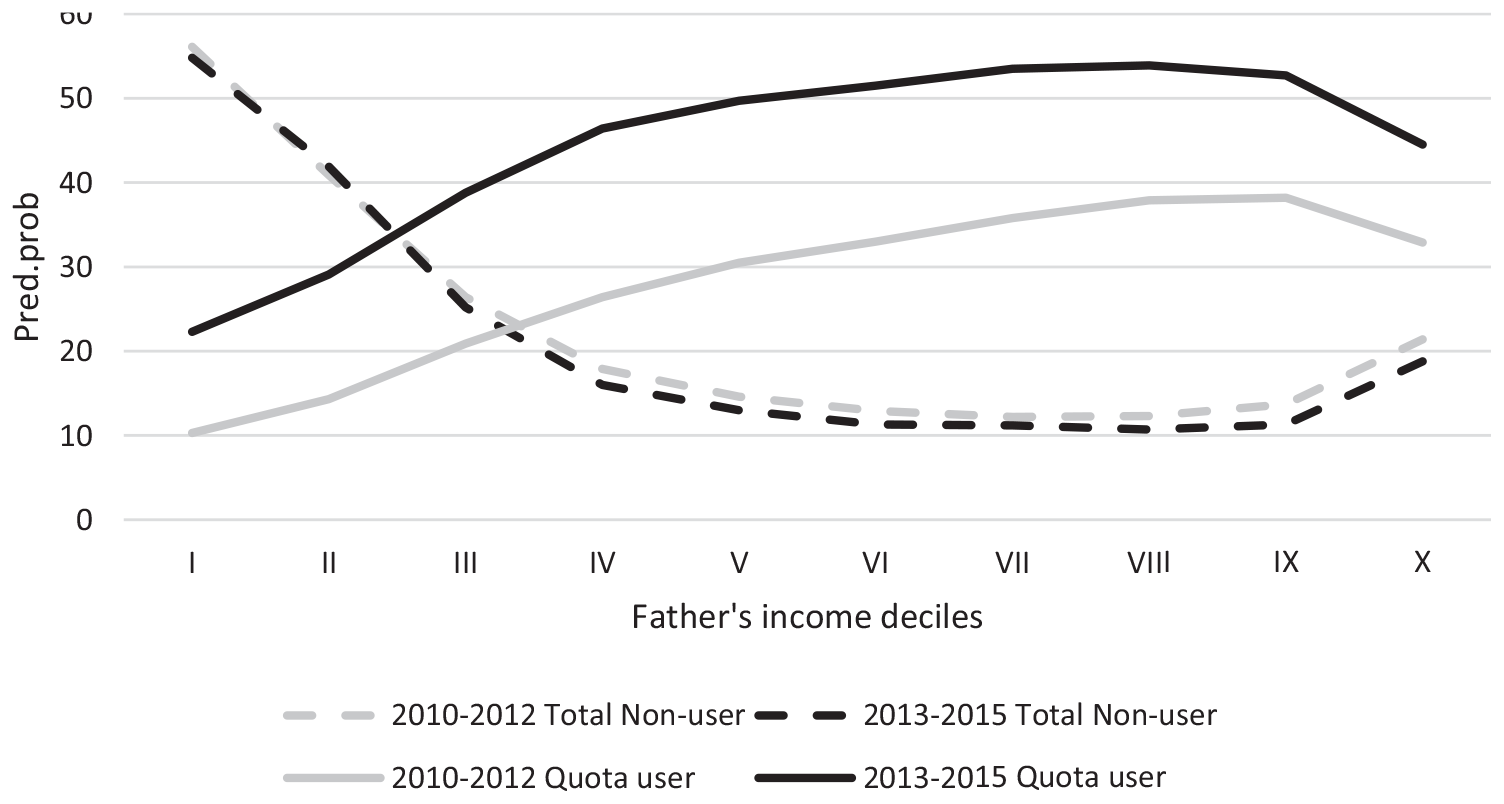
Father’s use of parental leave: total non-use and use of father’s quota. Predicted probabilities for fathers of children born in 2010–2012 and 2013–2015.a
In contrast, the 2013 reform had a marked influence on the father’s quota users. Here, the change was (in relative terms) more significant among fathers in the lowest to middle-income deciles than in the highest income groups. The share of fathers taking the father’s quota increased almost twofold in the three lowest income groups, while in the three highest income groups the increase was about 1.4-fold. The inverse U-shaped pattern in the father’s quota use became also more apparent among fathers with children born in 2013–2015. This means that socioeconomic differences between fathers using the father’s quota have grown smaller since the 2013 reform, whereas socioeconomic disparities in the total non-use have, if anything, slightly increased.
Discussion
Continued gender inequality in the division of parental leave has received much attention during the past decade. Earmarking for fathers an independent part of parental leave, which cannot be transferred to the mother has so far had the greatest impact on fathers’ take-up of leave, confirmed by many studies from the Nordic countries and elsewhere (Duvander and Johansson, 2012; Geisler and Kreyenfeld, 2019; Kluve and Tamm, 2013; Patnaik, 2019; Saarikallio-Torp and Haataja, 2016). Yet it seems that, in Finland, these reforms have only had a marginal effect on parental leave use beyond the reserved quota and not all fathers make use of these opportunities.
In this article, we examined factors related to fathers not using parental leave, dividing fathers into three groups: fathers who did not use any parental leave, fathers who only used birth-related leave, and fathers who used the father’s quota. Distinguishing the use of birth-related leave from the use of the father’s quota is important as these two leave types represent different institutions with different policy goals. We focused on the most recent parental leave reform in 2013 in Finland. Our study is among the few that study the non-use of fathers’ parental leave with register-based data on total population.
Since its introduction in 2003, the father’s quota has gradually become more popular among Finnish fathers. However, the 2013 reform has brought about the largest change in fathers’ participation so far: the proportion of fathers who used the father’s quota increased from 32% in the 2012 children’s birth cohort to almost 45% in the most recent birth cohorts. However, the proportion of fathers not using the father’s quota is still large, 55%. In turn, the proportion of fathers who use no parental leave, not even birth-related leave, has remained remarkably stable over the observation period, decreasing from 29% in the 2006 birth cohort to 26% in the 2015 birth cohort.
In line with previous studies, we found that fathers were less likely to use any parental leave in low-educated or low-income households. However, the association between socio-economic factors and fathers’ parental leave use was more pronounced in the fathers’ quota use. Among Finnish fathers, using birth-related leave has become a social norm, and the small differences between educational groups beyond basic level education in using birth-related leave (or total non-use) seem to prove this. As for the (non-)use of father’s quota, educational differences are much larger, and the mother’s education appears to play a stronger role.
We also found strong, yet different, associations between income and the use of birth-related leave and the father’s quota. Total non-use of fathers’ parental leave (and non-use of birth-related leave) strongly concentrates into the lowest income groups, and the differences are much smaller among fathers in the middle- or higher-income groups. The likelihood of using the father’s quota, in turn, increases consistently with income level. One limitation in our study is that we had no direct measure of the father’s employment status but had to infer it from income level. However, especially in the lowest income deciles, the source of income is more likely to be income transfers than earnings from employment.
Thus, theoretical micro-economic views as well as theories stressing the role of attitudes and social norms find support in our results. In low- and middle-income households men are less likely to opt for longer parental leave but are (in middle-income households) ready to use less challenging birth-related leave. In households with high male income (or high male education), men are more likely than in other families to take a more independent role in childcare. However, as there were marked differences in profiles between fathers not using parental leave and those not using the father’s quota, our findings also confirmed that institutional settings and policy design are relevant if we want to understand why some fathers do not make use of available options. Although birth-related leave can be seen as a first step towards fathers taking greater responsibility in childcare, it seems that different theoretical views are needed to understand how fathers make use of different levels of parental leave. Further studies from other countries distinguishing different institutional settings and policy configurations (including, e.g. shared parental leave and cash-for-care schemes) would be valuable to uncover obstacles for fathers’ parental leave use.
The 2013 parental leave reform made hardly any change in the proportion of fathers who used no parental leave, but it markedly increased the proportions of fathers using the father’s quota. Furthermore, income differences in the use of the father’s quota grew smaller after the reform. Thus, it seems that the latest reform appealed to a wider and more heterogeneous group of fathers than previous reforms, although our study does not allow for causal interpretations. The reform included two important changes in the fathers’ leave policy: a mother’s consent was no longer required, and the flexibility of the quota-use was increased. Since the 2007 reform also increased flexibility in fathers’ parental leave use, it seems that the removal of the mother’s consent and that she was now able to use the whole shared parental leave herself was decisive in the 2013 reform. On the other hand, the reform was unable to affect the ‘core’ of non-users, that is, fathers who use no parental leave. It could be that attitudes and workplace cultures still prevent some fathers from taking longer parental leave (Närvi and Salmi, 2019). Financial compensation during the leave is also important as fathers are less likely to use any parental leave if the income compensation rate is considered low (Haas and Rostgaard, 2011; O’Brien, 2013).
One may also consider the role of family leave policies in bringing about changes. Institutions and policy design matter as they shape the options that are available to families, whose behaviour then determines if a desired outcome is reached (see Koslowski et al., 2019b). In addition, a particular design of fathers’ parental leave rights, such as the requirement for the mother’s consent, may also act as a hindrance to fathers’ leave use. If a substantial proportion of fathers does not use parental leave, reforms increasing earmarked leave have the potential to also increase inequality between families: families where each parent makes use of their share and families whose fathers either choose not to or are unable to use their quota and thus lose the leave. In this respect, father’s non-use of parental leave can also be seen as a test for an implemented reform. As the proportion of Finnish fathers who use no parental leave remains large, it seems that the quota-reforms have now reached the end of the road, and other measures are needed to boost a more egalitarian sharing of parental leave. The reforms seem to have had a greater impact among fathers who were already using some parental leave, suggesting that improvements in parental leave policies over the past few years in Finland seem to have been reactive rather than proactive.
Footnotes
Funding
The authors received no financial support for the research, authorship and/or publication of this article.