



Abstract
This article analyses how educational and initial vocational training systems in Europe vary regarding the way in which they structure educational routes for pupils of different academic ability. The study uses cluster analysis to explore the degree of similarity between 25 European countries, including variables related to: stratification within compulsory education; vocational orientation; links between initial vocational education and the labour market; transitions from secondary education; stratification within tertiary education; and links between educational qualifications and labour market outcomes. I identify three clusters of countries that have distinct patterns of stratification. This article contributes to the literature on educational regimes and school-to-work transitions by adding countries from Central and Eastern Europe (CEE) and integrating multiple dimensions pertaining to the link between educational and social stratification. Thus, it develops a more encompassing representation of the architecture of educational pathways in different European countries.
Keywords
Introduction
Education systems have a multi-stage architecture (Di Stasio and Solga, 2017), composed of institutions which unfold different effects depending on their combination with other institutions (Brzinsky-Fay, 2017). The ensemble of these institutional characteristics contributes to the formation of different ‘worlds of competence production’ (Allmendinger and Leibfried, 2003), structuring transitions between different educational stages and towards work. This article looks at the way in which the organizational structures of different educational systems across European countries shape distinct patterns of stratification. I take educational stratification to mean the selection of students into educational pathways (between and within schools) that guide subsequent transitions to further levels of education and work. Selection by ability into different types of schools, whether academic or vocational, is referred to as tracking. Ability grouping within schools is referred to as streaming if it happens for all subjects, or setting, if pupils are grouped only for some subjects.
An increasing proportion of occupational positions in post-industrial societies are defined by educational credentials or qualifications (Baker, 2009; Esping-Andersen, 1993). In this article, I analyse the allocation of pupils into educational categories, which either puts ‘brakes’ to restrain opportunities (Allmendinger, 1989) or channels high achievers into certain trajectories. This process of allocation is guided by ideal-typical educational routes which have embedded expectations of what pupils can and should achieve (Schels and Wöhrer, 2022).
The article seeks to answer the following questions: How do educational systems in different European countries vary regarding the ways in which they structure different educational routes? Can we identify distinct models of stratification corresponding to different educational regimes? I take ‘regimes’ to mean constellations of institutional characteristics shaped by institutional path-dependencies (Janmaat et al., 2013). In this case, educational systems are conceptualized as institutional frames whose configuration is the one that influences how educational categories are formed (Brzinsky-Fay, 2017). A regime-type model groups countries according to overall rationales (Walther, 2006).
Integrating insights from comparative political economy and educational sociology, Österman (2018) and Busemeyer (2014) point out that vocational orientation is a double-edged sword that could lead to less inequality of income, but also less social mobility in terms of class. Here, vocational orientation is defined as the extent to which an educational system provides individuals with occupation-specific skills rather than general skills (Österman, 2018). Also, Busemeyer (2014) argues that delayed tracking is not a sufficient condition for low levels of social inequality, as there are more subtle ways of stratification within schools that still create a hierarchy of recognition. Informed by their work, I aim to explore different models of stratification by looking at how the nexus between vocational and higher education (VET-HE) in different post-industrial European societies interacts with prior forms of educational differentiation.
To look at patterns of inclusion, exclusion, and segmentation (Andreß and Heien, 2001) associated with different educational routes, I capture what happens at different educational stages and transitions, until after graduation from either vocational or higher education. I treat institutional configurations at different educational stages (primary, secondary, tertiary) as interlinked. This is important because disparities that emerge during early phases of schooling carry over into adulthood, while, at the same time, mechanisms of diversion towards less prestigious tertiary education programmes can be anticipated and affect choices made earlier on (Borgna, 2017). Therefore, the analysis undertaken in this article will include variables focusing on both secondary and tertiary education, as well as variables exploring how educational qualifications at different levels are coupled with the labour market.
Different models of educational stratification
This section reviews the theoretical and empirical literature about different rationales for allocating students to specific educational paths. I bring together multiple classifications focusing on different educational stages to explore the sequence of stratification processes that leads to the formation of distinct educational and occupational routes.
Turner (1960) relates the characteristics of educational selection to the prevailing norms of social mobility in the UK and US by constructing two ideal-typical patterns of accessing the elite – contest and sponsored mobility systems. Contest mobility creates the conditions whereby elite status is ‘won’ through aspirants’ efforts, and credentials are visible enough to be recognized by society at large. Premature judgements are avoided, so as to keep individuals competing for as long as possible. Sponsored mobility is a system where elite membership is ‘given’ by established elite members based on the recognition of complex talents and skills. It operates early selection, to give time for the preparation of the ‘chosen’ future members of the elite.
To go beyond the frameworks developed by Turner and recognize that there are multiple strata other than the intellectual elite and the ‘masses’, it is helpful to upgrade the image of the ‘contest’ for elite accession as a tournament, with some exiting the race at different stages, while fewer remain eligible for the final rounds (Van Zanten, 2015). The tournament model of mobility, coined by Rosenbaum (1979), is characterized by a sequence of competitions that have implications for individuals’ mobility chances in all subsequent selections. Winners have the opportunity to compete at higher levels, while losers are either denied further participation, or only permitted to compete at lower levels. This broadens the focus from only looking at who is selected at different stages, to who is excluded or denied access to further educational opportunities. Thus, this article looks at processes of educational stratification through the lens of three distinct models: sponsored mobility, leading to segmentation of educational routes according to identified potential; contest mobility, whereby individuals’ efforts are channelled towards winning a spot for the most desirable educational route; tournament, a series of competitions in which the aim is to avoid losing or being excluded at each stage.
The recent empirical studies on educational and school-to-work transition regimes have mostly focused either on compulsory education, tertiary education, or vocational education and training, but not on how they are assembled to create stratification and mobility patterns. Existing research on education regimes including the US and EU-15 countries has identified four clusters of countries: the Nordic, Continental, Mediterranean and English-speaking (Green et al., 2006; Lavrijsen and Nicaise, 2016; West and Nikolai, 2013). They have focused on institutional characteristics related to inequality of educational opportunity, public expenditure allocated to different educational levels, and gaps in educational achievement. However, these studies capture the importance of vocational tracks only by looking at enrolment and public spending indicators. This says relatively little about the specificity of vocational skills and their links to academic education and the labour market, which is strongly determined by whether initial vocational education and training (iVET) is school-based, workplace-based, or mixed (Anderson and Hassel, 2011). Studies focusing on comparing countries within these four regimes have found significant differences. For example, the research by Helms Jørgensen et al. (2019) argues that the Nordic model of educational transitions is not very distinctive, since the Nordic countries have been through significant departures from the universal school-to-work transition regime because of the policy shifts that have occurred since the 1990s.
The institutional setup of the education system affects the distribution of income and status, as it influences the educational pathways of individuals placed in different parts of the distribution of academic skills. In short, a well-established VET system might prevent those from the middle segment of the academic distribution from pursuing higher education, but it could also incentivize those at the lower tail of the skills distribution to work hard to secure qualified employment (Busemeyer, 2014).
Looking at how European countries draw distinctions between different institutions providing tertiary education, Cedefop (2019) classifies higher education systems in the European Union as either unified, university-dominated, or binary. Most educational systems in Europe are composed of a mix of institutions that are stratified by prestige and selectivity. In binary systems, the difference between the academic and the vocational institutions is clear cut, whereas, in unified systems, both traditional and vocational tertiary programmes are offered within universities (Willemse and De Beer, 2012).
These typologies construct different categories of European educational systems based on the aspects of differentiation on which they focus, but they do not examine how these processes of educational stratification interact to create educational routes. Therefore, integrating the multiple interrelated aspects of educational stratification in the same analysis will allow for a more holistic exploration of the institutional configurations influencing individuals’ educational transitions throughout their educational trajectories. My analysis will bring together variables related to vocational orientation, and stratification within higher education, which have been treated as disparate by other studies.
Different logics of drawing the divide between higher and vocational education have been previously studied by focusing on a few European countries. Powell et al. (2012) explore how competence is conceptualized in the German, French, and British educational models. Walther (2006) constructs ‘transition regimes’ by looking at how segmented or flexible school-to-work transitions are in Italy, Great Britain, Denmark, and Germany. Both studies only use a few canonical cases.
Very few studies (Borgna, 2017; Dumas et al., 2013) have included the post-socialist countries from Central and Eastern Europe to the analysis. I am including these countries, as they have a history of promoting a strong link between educational attainment and social status, but have adjusted to accommodate less rigid trajectories in post-industrial economies (Bukodi and Goldthorpe, 2010). While West (2013) considers the educational systems from CEE countries as a distinct regime, most research studies comparing educational systems from Eastern and Western Europe (Beblavý et al., 2013; Dumas et al., 2013) identify differences between these countries, challenging the idea that they can be regarded as part of the same educational model (Malinovskiy and Shibanova, 2022; Roberts, 2001).
Methodology
As patterns of stratification are composed of multiple institutional features, I employ cluster analysis, a multivariate descriptive technique that establishes similarity based on a large number of characteristics of the units of interest (Bartholomew et al., 2008). The method has been widely used in institutional regime analyses (Busemeyer, 2014; West and Nikolai, 2013) employing a systemic perspective which allows institutions to ‘hang together and interact’ (Ebbinghaus, 2012: 3). Cases are treated as ‘wholes’ (Byrne et al., 2012) and each case is assigned to a cluster based on how similar or dissimilar the case is relative to other cases.
As cluster analysis establishes categories based on relative relationships between the cases, the grouping can be sensitive to the inclusion of cases and variables (Busemeyer, 2014). Thus, I used theoretical principles to guide my choice of variables. Comparing most European countries at the same time avoids situations where contrasts are overemphasized, like in small-n comparisons. To illustrate this point, a relevant example is how the educational system in Norway is seen as strongly stratified compared to the US (Allmendinger, 1989), but is classified as part of the more comprehensive Scandinavian model when compared to multiple continental countries, such as Germany (Busemeyer, 2014). Therefore, adding the EU member states from CEE allows for an exploration of a wider range of educational characteristics, while still focusing on cases sharing enough commonality in their educational structures to make comparison possible (Ebbinghaus, 2012).
To measure the distance between cases, I employ Ward’s method, as it minimizes variance within clusters and has been found to yield the most accurate partitions in most instances (Bartholomew et al., 2008). As it has been previously used to devise educational regimes by Busemeyer (2014) and West and Nikolai (2013), it is the most suitable approach to allow comparability with prior typologies. At each stage in the clustering process, Ward’s method considers all pairs of clusters and asks how much ‘information’ (measured as the sum of squares about the mean) would be lost if that pair were to be amalgamated (Bartholomew et al., 2008).
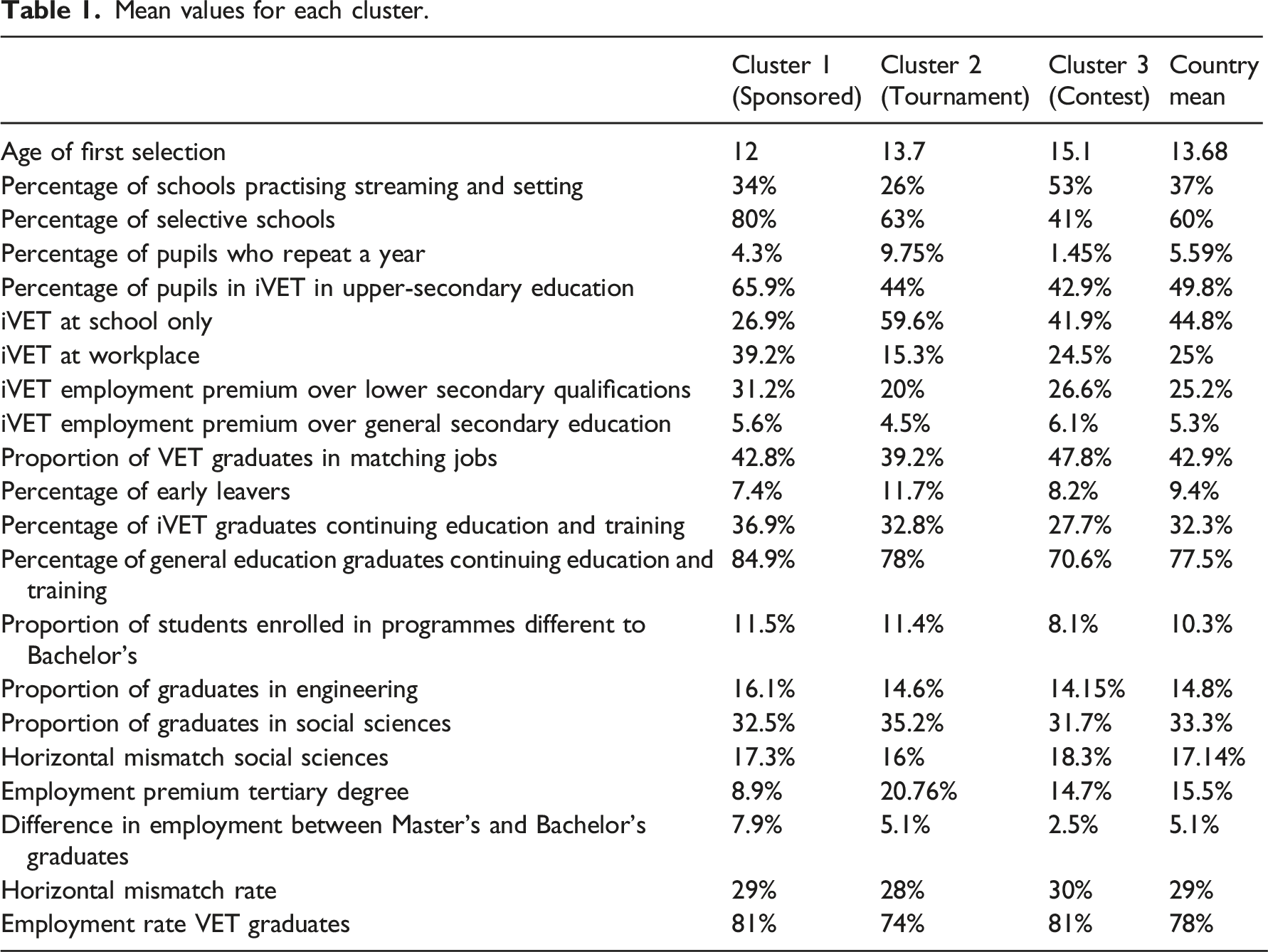
Mean values for each cluster.
In the analysis, I provide short descriptions of each cluster and I illustrate the formation of educational pathways through focusing on one country that is representative of the cluster. The purpose of the descriptions is to shed light on the connection between processes of educational stratification at different educational stages, and to explain how the patterns of stratification in these countries resemble the sponsored, contest, or tournament model.
The dimensions and associated variables that are included in this analysis are presented below. I justify the choice of indicators both in terms of their relevance and how they are connected with other indicators.
Stratification within compulsory education
The variables selected for this dimension capture the age of first formal selection by ability and the various forms of grouping by ability. I look at the allocation of pupils to different school types, as well as into different classes within the same school, as research by Chmielewski (2014) shows that course-by-course grouping constitutes an implicitly unequal system of grouping. Even though the author finds that setting or streaming leads to less segregation by socio-economic status than tracking, it still influences pupils’ future achievement and educational choices.
Vocational orientation
The architecture of opportunities for tertiary education and work is influenced by the proportion of pupils enrolled in vocational education, and the way vocational educational is delivered. The prevalence of vocational education indicates the extent to which vocational routes are common and institutionalized, and the degree to which a country places emphasis on vocational skills. The type of iVET provision indicates whether iVET is rather integrated within the educational system or connected to the labour market.
In relation to social destination, Nylund (2012) argues that the purpose of vocational programmes is socializing pupils for extended working-class positions, although in Germany, for example, the highest segment of apprenticeships offers access to relatively higher skilled occupations (Protsch and Solga, 2016). Nonetheless, iVET might signal lower academic ability and prevent people from lower socio-economic backgrounds from pursuing higher education (Hoidn and Šťastný, 2021). Although iVET that is occupation specific and delivered at the workplace is more effective for reducing unemployment risks (Shavit and Muller, 2000), graduates of school-based iVET have higher chances of pursuing tertiary education (Virolainen and Persson Thunqvist, 2017).
Links between initial vocational education and the labour market
Initial vocational education can act as a safety net, protecting people against unemployment and unskilled work, but can also restrict the range of occupation opportunities available (Di Stasio, 2017). Occupations requiring vocational education and fewer years of training tend to rank lower in terms of social recognition (Abrassart and Wolter, 2020). I include indicators looking at the coupling between initial vocational education and the labour market because it influences transition outcomes: in countries where linkages are strong, qualifications are a prerequisite for working in certain professions. Usually, in these countries, the labour market value of vocational qualifications is higher (Lavrijsen and Nicaise, 2013).
Transitions from secondary education
Looking at transitions between educational stages is important as there are ‘secondary effects’ of social origin that manifest because of the way in which families from different backgrounds evaluate the risks and gains of different educational choices at certain branching points (Boudon, 1974). Assessing the opportunities of young people with vocational and general education to pursue further education can reveal the extent to which graduates of iVET are diverted away from further study. I also capture the proportion of early leavers to assess the extent to which educational systems offer educational opportunities for everyone.
Stratification within the tertiary education system
With the growing number of higher education programmes in many European countries, the diversity of institutions increased. Graduates of tertiary education are increasingly heterogeneous regarding the type of qualifications and the quality of those qualifications (Triventi, 2013). While Bachelor programmes are more accessible, students from disadvantaged families are more likely to study less prestigious types of degrees and less likely to continue with a Master’s degree (Neugebauer et al., 2016). In countries where type of qualification (whether theoretical or vocational, postgraduate or undergraduate) matters more, relative educational achievement and the prestige of universities might matter less, and vice versa. Moreover, the distribution of graduates in different fields of education is relevant for the nature of transitions from education to work. Knowledge economies based on high-end services are rather reliant on high ‘general’ skills, whereas knowledge economies based on advanced manufacturing depend on the higher education system to supply specific skills (Durazzi, 2019). Therefore, this article includes variables linked to both differentiation in terms of types of degrees, and fields of study.
Links between educational qualifications and labour market participation
I look at employment rates of young graduates and compare the employability of individuals with different degrees to see which type of education provides more or less safety when it comes to finding jobs. Marques et al. (2022) argue that different models of capitalism have varying capacities to absorb graduates in jobs that match their qualification levels. The authors mention that some countries invest more in VET, while others invest more in higher education, which leads to cross-national differences in the architecture of educational and occupational routes. The indicators I use highlight differences in employment rates based on types of qualifications, revealing the relative employment advantages of some qualifications in certain economies.
Moreover, I look at mismatch rates between area of occupation and field of education, to capture the degree to which higher education is occupation specific. The type of high skills cultivated by governments and sought by employers varies based on the knowledge economy upon which countries rely. Different ‘families’ of educational disciplines are complementary to different economic sectors with more or less specific requirements in terms of skills needed (Durazzi, 2019). The probability of a good occupational match is higher in countries where qualifications have a stronger link to occupational destinations, but the penalty for a mismatch is also more significant in such countries (Bol et al., 2019).
Analysis
The hierarchical tree diagram (dendrogram) resulting from the cluster analysis illustrates the similarities between the cases considered, and the connections that could be established between large-scale groups. The clustering using Ward’s linkage is illustrated below in Figure 1. Dendrogram for cluster analysis.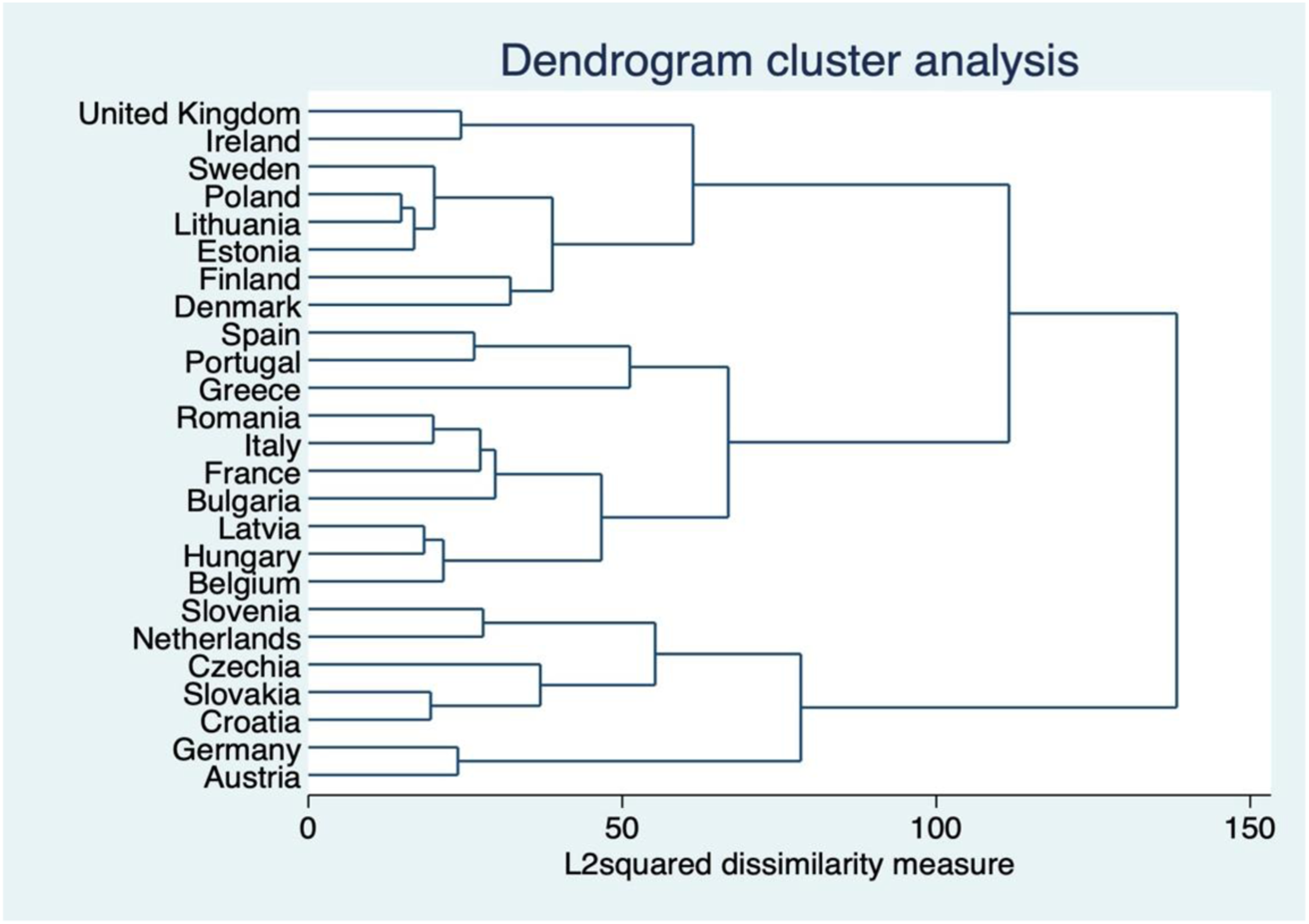
To decide on which cluster solution is the most appropriate based on the results from the cluster analysis, I combine theoretical insights with statistical insights about the extent to which clusters are well-defined and well-separated. I calculated the Calinski-Harabasz stopping index, which was 3.66 for the two-cluster solution and 3.63 for a three-cluster solution. Because the scores were very close, I decided that the three-cluster solution was the most appropriate when also taking into consideration the theoretical perspective. Having three clusters allows for more nuanced distinctions between the different types of educational systems. Moreover, the three-cluster solution can illustrate the differences between the model of sponsored, contest, and tournament stratification. The resulting classification is: Cluster 1: Austria, Germany, Croatia, Slovakia, Czechia, Netherlands, Slovenia Cluster 2: Belgium, Hungary, Latvia, Bulgaria, France, Italy, Romania, Greece, Portugal, Spain Cluster 3: Denmark, Finland, Estonia, Lithuania, Poland, Sweden, Ireland, UK
The mean values per cluster for each variable included are presented in Table 1. They are compared to the overall mean of the values of all countries.
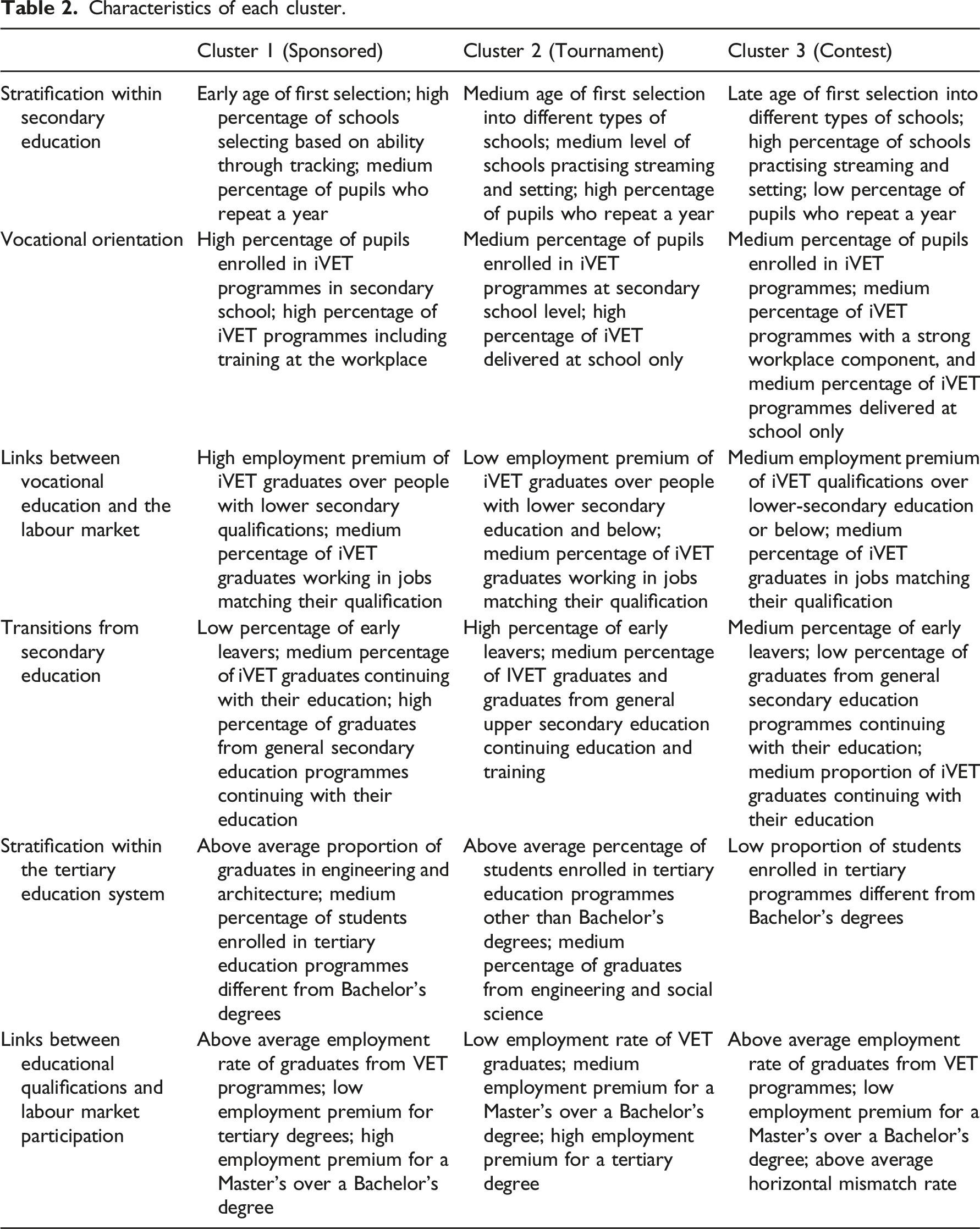
Characteristics of each cluster.
Cluster 1: Sponsored stratification, followed by contest for those following the academic route (Germany, Austria, Croatia, Slovakia, Czechia, Netherlands, Slovenia)
This cluster is characterized by a high proportion of pupils enrolled in iVET programmes, which are provided at the workplace to a high extent. Tracking between academic and vocational education takes place at an early age and is the main form of differentiation during compulsory education, leading to a rigid separation between the academic and vocational trajectories. Vocational education has strong links with the labour market in Germany and Austria, where a high percentage of iVET graduates work in jobs that highly match their qualifications. In other countries from this cluster, the percentage of people with iVET qualifications working in highly matching jobs is slightly lower, which amounts to an overall medium level of matching between occupation and qualification for iVET graduates.
The similarity found between Czechia, Slovenia, Germany, and the Netherlands matches the findings by Beblavý et al. (2013) who look at educational and social stratification in OECD countries. In Czechia and Slovakia, a small proportion of the cohort (around 15%) is selected at the age of 11 for academically oriented secondary schools (Gymnasiums), but there are subsequent points of selection into Gymnasiums. This stratification system combines the early allocation of those academically oriented with their prolonged competition for well-regarded educational credentials, since the employment premium of having a Master’s degree over having a Bachelor’s degree is the highest for this cluster.
With a clear delineation of the academic path, while at the same time providing good occupational opportunities for those pursuing vocational paths, Germany most closely resembles the ‘sponsored’ (Turner, 1960) model of stratification. Selection into different tracks happens early on, at the age of 10, legitimated by the ideology of ‘innate talent’ which is best channelled into either theoretical or practical pursuits (Powell and Solga, 2011). Almost half of the pupils enrolled in secondary education pursue vocational education. The employment rate for iVET graduates is high, while the proportion of iVET graduates working in jobs highly matching their qualifications is also high. Thus, this educational system resembles the sponsored mobility system because selection into different educational routes happens early on, and because there is a strong match between educational and occupational trajectories.
Cluster 2: Tournament (Belgium, Hungary, Latvia, France, Romania, Bulgaria, Italy, Greece, Portugal, and Spain)
This cluster is characterized by a combination of tracking and streaming in upper secondary education. On average, almost half of the pupils in upper-secondary schools follow the vocational track, which is mostly provided in schools. Educational systems in this cluster display considerable stratification within tertiary education. In France, the proportion of people with tertiary degrees different from traditional Bachelor’s programmes is high, whereas the overall diversity of tertiary degrees in this cluster is medium. This is characteristic for systems of stratification that encourage prolonged competition (Turner, 1960). At the same time, the proportion of early leavers from education is also high, which indicates that a considerable minority was left behind. Because of the above average levels of stratification both within secondary and tertiary education, as well as a high percentage of iVET graduates continuing with their education, this system of stratification resembles a tournament. In a tournament, there is a distinction between winners and losers at each selection point, but winners must keep competing, for there is no assurance of subsequent success (Rosenbaum, 1979).
The distinctive aspect of this cluster as a tournament is that the hierarchy established for the selection into upper-secondary schools influences the subjects one chooses to study at university. In Romania, allocation into different streams in high school influences the subjects taken at the Baccalaureate exam, a decision which in turn influences the choice of fields of study at tertiary level. Among all countries included in the analysis, Romania has the highest rate (almost 50%) of iVET graduates who continue with their education and training, as the rate of employment for iVET graduates is below average and the employment premium for people with tertiary degrees is high. Thus, competition is prolonged, but there are clear hierarchies established at every educational transition. Those with low grades have limited options for the kind of educational opportunities for which they can further pursue and compete.
Cluster 3: Contest with sponsored mobility for the most academically inclined (Denmark, Finland, Estonia, Lithuania, Poland, Sweden, Ireland, UK)
This cluster has the lowest proportion of pupils below the age of 15 who attend selective schools. However, there is some ability grouping before the first point of tracking even in Scandinavian countries, where some pupils considered most academically inclined are selected into classes or schools specialized in specific subjects (Heiskala and Erola, 2019). In this cluster, countries have a medium vocational orientation at upper-secondary level. Some iVET programmes are provided at the workplace, and others are provided only at school. The proportion of VET graduates who work in jobs highly matching their qualifications is above average. However, the proportion of people who finish vocational or general upper-secondary education and continue with their education is below average. This might have to do with the fact that the employment premium for having a tertiary degree is below average.
Interestingly, the employment premium for having a Master’s over a Bachelor’s degree is low, meaning postgraduate degrees do not necessarily provide advantages in terms of employability. The horizontal mismatch rate between field of study and occupation is the highest for tertiary graduates in this cluster, which means that there is open competition among graduates from different fields of study (Tholen, 2013).
The English educational system was previously considered the representation of the sponsored mobility ideal-type (Turner, 1960), but it was since reformed to postpone the first tracking for most students from the age of 11 to the age of 16. However, the initial within-school grouping into particular sets is based on notions of ‘educability’, which go beyond prior educational achievement (Wiliam and Bartholomew, 2004). In addition, 5% of secondary schools in England are grammar schools which select pupils at the age of 11 based on their ability (West, 2022). Taken together with the within school grouping, this indicates that individuals considered most academically inclined are still grouped together before the age of 16. Pupils get to choose their optional subjects for the GCSE and A level exams, which leads to complex post-compulsory educational pathways (McMullin and Kulic, 2016). Even though some of these subjects are more valued by (elite) universities than others (McMullin and Kulic, 2016), it is difficult to establish a clear hierarchy between different combinations of subjects. Moreover, in England, occupation-specific fields of study hold less importance, as employers prioritize university prestige (Boliver, 2016) over certified skills (Di Stasio and Van De Werfhorst, 2016).
This cluster mostly resembles a contest-type mobility system, as the definitive sorting is delayed, and there is more flexibility and openness regarding educational trajectories and entry into work. However, for a small percentage of pupils deemed the most academically inclined, there is a form of ‘sponsored’ mobility in the UK, as well as in the Scandinavian countries.
Discussion
This article contributes to the literature on educational regimes and school-to-work transitions by adding countries from Central and Eastern Europe and integrating multiple dimensions pertaining to the link between educational and social stratification. My analysis distinguishes three clusters of countries, which is incongruent with the four regimes of educational stratification previously identified by West and Nikolai (2013) and Green et al. (2006), as they separate between the Nordic and the Anglo-Saxon clusters. Differences occur because this article only focuses on the stratification dimension of educational inequality, while the additional cases included bring qualitatively new dimensions to the analysis of educational regimes. In addition to adding new cases, this analysis brings together variables related to vocational orientation, type of stratification, and the prevalence of different forms of education and training. Thus, it differs from prior studies on educational regimes by focusing on the type of educational allocation and how different pathways fit together. This leads to key differences in how countries cluster.
The Scandinavian countries cluster together with Ireland and the UK, and with Estonia and Lithuania. An explanation for this can be that school-to-work transition policies in Scandinavian countries in recent decades have assimilated some neo-liberal features that have increased individual responsibility for successful transitions (Helms Jørgensen et al., 2019). Also, Busemeyer (2014) points out that what he calls the ‘Anglo-Saxon’ countries, including England, have education systems that are formally comprehensive and characterized by a low level of stratification. The difference between the UK and the Scandinavian countries in Busemeyer’s (2014) study is due to his including variables covering the mix between public and private spending on education; without the inclusion of expenditure, this analysis reveals the similarity between the UK and Scandinavian countries in terms of educational stratification. Comparing educational systems from Baltic countries with the educational systems in France, the UK, and Germany, Saar et al. (2008) find that the weak links between the educational systems and the labour market in some Baltic countries make these systems similar to the UK. Želvys et al. (2017) also point out the similarities between Lithuania and the UK as regards educational selection and ability grouping.
In contrast to the study by West (2013), this analysis identifies multiple patterns of educational stratification among post-socialist countries with EU membership, challenging the idea that post-socialist countries constitute a distinct and coherent educational regime. This finding is aligned with most research comparing CEE countries to ‘old’ EU members (Beblavý et al., 2013; Dumas et al., 2013; Malinovskiy and Shibanova, 2022). This article finds that Romania and Bulgaria are similar to France, while Czechia and Slovakia are similar to Germany. This is aligned with findings by Roberts (2001), who articulates the differences between countries like Czechia, where academic education is considered to be only for those academically inclined, and countries from South-East Europe, where there is more integration between vocational and general education programmes. Policies designed to promote social mobility in CEE countries should take into consideration the fact that educational systems in this region are different and tend to gravitate towards distinct models of educational stratification. Thus, policy borrowing in the area of education and youth policy should be informed by the similarities and differences with Western European countries and other CEE countries.
This article maps the diversity of stratification patterns in European educational systems. To understand how educational systems influence patterns of inclusion and exclusion in certain occupations, it is essential to take into account the multidimensional nature of educational allocation. I use employment rates and employment premiums for graduates from different types of degrees, as well as horizontal mismatch rates, to capture the linkages between education and occupations. I do not include variables related to the status of the occupations linked to certain educational qualifications, so the analysis is rather about the mechanisms through which educational systems allocate people to different pathways than about the success of those who pursue different educational routes.
The educational systems classified as part of the sponsored stratification cluster are characterized by an early selection of pupils into academic tracks, a high percentage of pupils enrolled in iVET programmes, and a relatively strong match between vocational education and the labour market. As a result, educational pathways are segmented based on perceived abilities. Educational systems labelled as part of the ‘tournament’ model of stratification rely on streaming and tracking at upper-secondary school level. While a medium percentage of students are enrolled in iVET programmes, a higher than average proportion of iVET graduates continue with their education. Similar to the sponsored type, this model creates a hierarchy among different educational tracks and streams, limiting the future prospects of students who are not part of the higher-ranking groups. Contest-type educational systems are characterized by late selection into different types of schools, and an increased possibility to customize the choice of subjects of study and post-compulsory pathways. There is a lower proportion of students enrolled in tertiary programmes other than Bachelor’s degrees, resulting in less stratification based on the type of tertiary qualification. The link between field of study and occupation is looser for tertiary qualifications. Consequently, the distinction between winners and losers of different educational transitions is not as straightforward as in the sponsored or tournament models.
All educational systems exhibit institutional characteristics which combine features of the contest and sponsored mobility ideal-types (Turner, 1960), with some resembling a tournament (Rosenbaum, 1979). Classifying processes of educational stratification as promoting either sponsored, tournament, or contest mobility, I create a heuristic device that is useful for investigating different strategies of securing educational advantages. Moreover, Rosenbaum (1979) argues that creating the cognitive representation of ‘tournament’ as an institutional logic will allow people to relate structures at a macro level with behaviours and beliefs at a micro level. This article provides similar cognitive representations for 25 educational systems in Europe. Thus, this article lays the groundwork for interrogating how the architecture of different educational and training systems influences individuals’ motivations, beliefs, and attributions of educational success. Moreover, representing educational systems as contests and tournaments can be useful for directing the attention of policymakers towards the educational and occupational opportunities of those who lose in these competitions and might not have clear alternative routes for further developing their skills.
Footnotes
Acknowledgements
This article benefited substantially from the suggestions and encouragement of Anne West, Sonia Exley, and the two anonymous reviewers.
Declaration of conflicting interests
The author(s) declared no potential conflicts of interest with respect to the research, authorship, and/or publication of this article.
Funding
The author(s) disclosed receipt of the following financial support for the research, authorship, and/or publication of this article: This work was supported by the Economic and Social Research Council.
