



Abstract
This study investigates whether pensioners with a foreign ethnic background are perceived as less deserving to receive a pension than are native pensioners. It focuses on Germany as an example with a strongly achievement-oriented social insurance system which closely links benefits to previous contributions. Hence, the system prevents a citizen from receiving benefits without having contributed. Our study thus adds to existing research by examining a less likely case to find welfare chauvinistic attitudes. To test our expectations, we rely on a factorial survey design and a probability sample of the German population in 2019. Survey respondents decide on the amount of pension benefits that a hypothetical pensioner should receive. Characteristics of the hypothetical pensioner – ethnic background, gender, last income, contribution years, the number of children and other dependents – are randomly varied. Our study finds support for welfare chauvinist attitudes in an achievement-oriented social insurance system. Even for the same achievement, that is, same income, contribution years and number of children, natives grant lower pensions to pensioners with a foreign ethnic background than to natives. Also, even if migrants show the most favourable behaviour (that is, having contributed to the pension system for many years and with a high income), the ethnic penalty in pensions remains significant.
Introduction
Societal developments such as population ageing, immigration or the flexibilization of work are putting similar pressures on western welfare states and on the pension system in particular (Ebbinghaus, 2015; Pierson, 1996). Immigration is seen as one way to counter the socio-economic consequences of an ageing population – but increasing ethnic heterogeneity also raises concerns among some natives as to whether immigrants should have the same access to welfare benefits as natives (Larsen, 2020; Römer, 2017; Schmidt-Catran and Spies, 2016; Schmitt and Teney, 2019). One important factor in reforming pension systems is public attitudes as public opposition has the potential to block reform attempts (Pierson, 1996). As mentioned in the introduction to this special issue, we understand welfare state opposition as an umbrella term covering different forms of protest towards existing welfare policies provided by the state. We focus on public attitudes as one form of protest in this article.
While empirical studies provide little support for the expectation that immigration reduces support for social welfare and hence little evidence for a heterogeneity–redistribution trade-off (Banting and Kymlicka, 2006; Brady and Finnigan, 2014; Hjerm and Schnabel, 2012; Mewes and Mau 2013), welfare chauvinism is widespread among the public (Larsen, 2020). Following the conceptual article of this special issue, we define welfare chauvinism as the exclusion of non-natives who live permanently within a state from social benefits and services (Eick and Larsen, 2022). In order to have both a strong welfare state and little redistribution towards migrants, natives seem to support policies that restrict access to benefits and services for migrants and grant lower benefits to migrants than to themselves (Buss, 2019; Kootstra, 2016; Larsen, 2020; Reeskens and Van der Meer, 2019). Reciprocity (or the assumed lack thereof by migrants) is one important explanation for welfare chauvinist attitudes (Gielens et al., 2019; Reeskens and Van Oorschot, 2013) which then might turn into an important source of opposition to welfare state growth.
Existing research has mainly focused on social assistance and unemployment benefits and is also dominated by empirical studies from liberal welfare states (Buss, 2019; for recent exceptions see, for example, Eick and Larsen, 2022; Kootstra, 2016; Reeskens and Van der Meer, 2019). This is unfortunate, as both contexts are more likely cases to find welfare chauvinist attitudes. First, potential recipients of unemployment benefits or social assistance are usually young or middle-aged people and there might exist a large degree of uncertainty about how the benefit recipients will contribute to the welfare state in the future. So, welfare chauvinist attitudes might mainly be driven by an assumed lack of reciprocity by the migrant population compared to native benefit claimants and much less by identity or taste-based discrimination against migrants. Second, liberal welfare states that rely primarily on means-tested programmes will make reciprocity considerations more likely (Careja and Harris, 2022; Larsen, 2008) than in contribution-based social systems in which benefits are closely linked to (past) contributions. If people express a preference for means-tested benefits being given to natives and not to migrants, we cannot clearly identify whether this welfare chauvinist attitude reflects anti-immigrant attitudes, or whether it is driven by a concern for reciprocity and migrants’ past and anticipated future contributions to the welfare state.
Addressing this gap in the literature, our study investigates whether welfare chauvinist attitudes also exist in other areas of the welfare state. Several studies in this vein show that reciprocity-motivated welfare chauvinism shapes attitudes towards migrants’ access to housing and healthcare (Eick and Larsen, 2022; Hjorth, 2016; Kootstra, 2016; Larsen and Schaeffer, 2021). Our study adds to this line of research by examining a less likely case to find welfare chauvinist attitudes, namely attitudes towards pension benefits in Germany: the German pension system is strongly achievement-oriented so that benefits are closely linked to past contributions. Hence, the institutional context already has a strong built-in protection against misuse and against receiving benefits without having contributed. In fact, reciprocity is – in contrast to universal or means-tested schemes – a defining feature of the system. Moreover, relying on a survey experiment with a vignette design our study controls for the most important achievement factors such as employment history and wages. We argue that the remaining welfare chauvinism is related to identity-, taste-based discrimination and not related to statistical discrimination and reciprocity considerations.
To test our expectations, we rely on a factorial survey design and a random sample of the German population in 2019 (German Internet Panel (GIP); see Blom et al., 2015). Survey respondents decide on the amount of pension benefits that a hypothetical pensioner should receive. Characteristics of the pensioner – ethnic background, gender, last income, contribution years, the number of children and other dependents – are randomly varied. We follow other studies in this field and provide information about ethnic background by using foreign sounding names (for example, Buss, 2019; Larsen and Schaeffer, 2021; Reeskens and Van der Meer, 2019). Moreover, we focus on a comparison of Turkish versus German names because Turks are the biggest groups of immigrants in Germany for whom it is realistic to have employment histories of more than 40 years.
We find support for welfare chauvinist attitudes also in an achievement-oriented, social insurance system. Even for the same achievement – same income, contribution years and number of children – natives grant lower pensions to pensioners with a Turkish name than to natives. The ethnic penalty in benefits does not vary with income or contribution years. So, the public supports a minimum pension for pensioners who have not worked at all for both natives and migrants, yet this preferred minimum pension is lower for Turks than for natives. Also, even if Turks show the most favourable behaviour and have contributed to the pension system for many years and with a high income, the ethnic penalty in pensions and hence welfare chauvinist attitudes do not weaken or disappear.
Overall, our study provides clear support for an ethnic penalty in attitudes towards pension benefits which we can link to identity and discrimination. Such deeply rooted tendencies towards welfare chauvinist attitudes certainly explain the success of populist parties but also are an important aspect to understand why universal social policies run the risk of fuelling polarization between supporters and opponents of welfare chauvinism. In the conclusion, we will further discuss the political implications of these findings.
The German pension system
The German pension system is a Bismarckian social insurance system with a predominant public pension pillar. Despite reform trends towards pension privatization in the early 2000s, public pay-as-you-go pension benefits remain the main income source of retirees. Occupational or private pensions are top-up benefits for small parts of the former workforce. The public pillar consists of a strictly earnings-related pension with few redistributive elements. Most importantly, Germany for a long time was the only European country that did not have a basic or minimum pension that is granted independent of the contribution history. 1 If pensioners have not acquired enough pension benefits and do not have enough savings, they have to rely on social assistance. In 2021, social assistance would be €446 for a single person plus the costs for housing. In 2019, 3.2% of people above the retirement age received social assistance.
The normative basis of the pension benefit system is a continuous career in full-time employment and to some degree the gendered division of paid and care work in married couples (Leisering, 2003). Pension contributions are paid as a percentage of the gross salary up to a ceiling (18.6% (2019) up to €6700 for West Germans and €6150 for East Germans) and are shared between employee and employer. Redistributive elements are mainly targeted at compensating parenthood and child-care related employment interruptions or part-time work. Each child is granted with three Pension Earnings Points, equivalent to 3 years of employment with average earnings. Furthermore, reduced contributions from part-time employment are topped up as long as children below the age of 10 are taken care of. Top-up contributions are also granted for periods of unemployment, however, only up to 1 year, and are less generous.
Migrants and refugees have the same pension rights as natives. They receive a pension if they have previously paid contributions into the public pension system and have a minimum insurance period of 5 years. This minimum insurance period applies to both migrants and natives. So, if migrants and natives have the same employment history (that is, the same number of contribution years and the same wage), they will receive the same pension. Of course, existing employment and wage gaps on the labour market will also translate into the respective pension gaps.
Theory and previous findings
Our main argument focuses on the question of whether the universal achievement orientation inherent in the German pension system prevails or whether the public discriminates against pensioners with an ethnic background. Hence, we mainly focus on the question of whether recipients’ characteristics affect what is considered to be a fair pension.
The existing literature has extensively focused on attitudes towards the welfare state in general (Svallfors, 2010) and also on attitudes towards the pension system more specifically (Ebbinghaus and Naumann, 2018; Fernandez and Jaime-Castillo, 2013; Jaime-Castillo, 2013). This research has shown that public pensions remain quite popular and that the public sees a high responsibility of the state to ensure that older people are provided for (Ebbinghaus and Naumann, 2018). Research focusing on support for specific reform proposals shows that the public would rather increase contributions than cut benefit levels or raise the retirement age (Fernandez and Jaime-Castillo, 2013; Naumann, 2017). Not disputing the contribution of these studies, one of their limitations is that they provide little information to respondents on how pension benefits are distributed, for example, to whom pension benefits are given or who will have to work for longer. This kind of information seems to be a crucial factor in the attitude formation process since the deservingness of the potential benefit recipient is an important aspect for welfare state attitudes (Cavaillé and Trump, 2015). For example, specific characteristics of the benefit recipient strongly affects preferences on how much unemployment support they should receive (Buss, 2019). So, whereas we know that the public does not want to cut government spending on pensions in general, much less is known about how the public would allocate pension benefits based on the earnings history, the family situation or the ethnic background of a pensioner.
Pension chauvinism
The main theoretical approach in the welfare attitudes literature to explain welfare chauvinism is the theory of deservingness (Jensen and Petersen, 2017; Meuleman et al., 2020; Van Oorschot, 2008). The deservingness argument states that people assess the degree to which a person or a group deserves help which in turn shapes support for the respective social policy programmes. Deservingness is assessed on the basis of five criteria: whether someone is in control of the situation, attitude and the degree to which recipients are seen as good citizens, reciprocity with respect to the welfare system, identity (for example, a shared ethnic background) and need (Van Oorschot, 2008). In the deservingness logic, pensioners are broadly considered as very deserving. They are not responsible for their age and their inability to work any longer, they have contributed to the pension system throughout their working life and are in need of support.
In contrast to the elderly, immigrants tend to be considered as less deserving as they should be in control of their situation, have not necessarily contributed to the welfare system yet, and are considered an out-group. Several empirical studies show that natives perceive migrants and ethnic minorities as less deserving of unemployment benefits, social assistance or housing even if both groups are similar in terms of control, need, reciprocity or attitude (Buss, 2019; Ford, 2016; Hjorth, 2016; Kootstra, 2016; Reeskens and Van der Meer, 2019). And even for access to healthcare for COVID-19 patients, Larsen and Schaeffer (2021: 1455) show a ‘general reciprocity-motivated welfare chauvinism against recent immigrants who have not contributed to the welfare state for long’. These studies therefore demonstrate that immigrants are regarded as less deserving, yet have difficulties in disentangling whether this is because of reciprocity or racism and discrimination.
This is mainly because reciprocity might refer to retrospective and prospective contributions (Knotz et al., 2021). So, even if job search behaviour, productivity, education and attitudes are held constant in the experimental setting retrospectively, respondents might still infer from the information on the migration background that migrants did not contribute to the system as long as natives did, might face more difficulties to re-enter employment, face longer unemployment spells and lower future wages. So, even after controlling for education, skills or efforts, an immigrant background might still be used as a proxy to infer a lower productivity or less performance in the future. Prospective reciprocity is very difficult to control for in areas such as unemployment or healthcare.
We address this problem by focusing on pension benefits in a contribution-based pension system as a least likely case for welfare chauvinism. Our vignettes create equal conditions for immigrants and natives and reciprocal, achievement-based indicators (years of contributions, income) are controlled for in our survey experiment. This should reduce most of the statistical discrimination and the remaining migrant gap in assigned pension benefits should be linked to taste-based discrimination only. Based on this identity criterium, we expect that discrimination also shapes attitudes towards pension benefits and derive our first hypothesis as follows:
Pensioners with an ethnic background are perceived as less deserving to receive a pension than natives even if they have contributed to the system in the same way (that is, same average high income and contribution years) than natives.
In addition to exploring the role of reciprocity and identity in shaping welfare chauvinist attitudes, the literature is also inconclusive as to whether the two dimensions interact. Whereas some studies show that ethnic background of unemployment benefit claimants is not a decisive factor of deservingness once immigrants indicate high performance (Kootstra, 2016; Peffley et al., 1997), Reeskens and Van der Meer (2019) conclude that the immigrant gap in unemployment benefits is impossible to overcome by immigrants even if they perform well. Similarly, there is also inconclusive evidence on how the migrant gap in deservingness is affected by low reciprocity. While Buss (2019) finds that low performance and effort of natives and migrants rather lead to equal treatment, Kootstra (2016) shows that migrants are penalised more for a lack of reciprocity. Hence, we examine whether ethnic discrimination is weaker (or non-existent) if pensioners with an ethnic background have contributed a lot to the pension system. Moreover, we explore whether natives might be more hesitant to grant a minimum pension to migrants than to natives if both have not worked at all.
The ethnic penalty in ascribed pension level is stronger in a low reciprocity context, that is, if the pensioner has contributed little to the pension system.
Who supports pension chauvinism?
Is there general support for welfare chauvinism among the public or does support vary? Analysing individual level characteristics which shape attitudes has two goals. First, such analyses can tell us something about the theoretical mechanisms underlying welfare chauvinist attitudes in general. Second, conflict within society over an issue might have as much relevance for the politics of welfare state reform as overall support. Based on these two motivations, we focus on political ideology and education as possible moderators here.
Previous research has shown that education is a strong predictor for welfare chauvinistic attitudes and the low educated usually show more support for welfare chauvinistic policies (Mewes and Mau, 2013). Theoretically, this tendency can be linked to their weaker economic position and a higher labour market competition with migrants. Other more cultural and value-oriented explanations claim that ‘more educated respondents are significantly less racist, place greater value on cultural diversity […], and more likely to believe that immigration generates benefits for the host economy as a whole’ (Hainmueller and Hiscox, 2007). While we do not aim to disentangle these theoretical mechanisms, we follow these approaches and expect the following relationship between education and support for welfare chauvinism:
The ethnic penalty in ascribed pension levels is stronger among low educated respondents.
Differences in support for welfare chauvinism depending on political ideology would contribute to increasing polarization and conflict within society. Welfare chauvinist policies have become key aspects of populist radical right parties (for example, Afonso and Rennwald, 2018) and are in particular strong in social consumption policies (Enggist and Pinggera, 2022). And while most mainstream parties adopt welfare chauvinistic positions fearing electoral losses (Schumacher and Van Kersbergen, 2016), support for welfare chauvinism should be weaker among conservative and social democratic voters and weakest among liberal, green and radical left voters.
The ethnic penalty in ascribed pension levels is strongest among voters of populist right-wing parties, less pronounced among conservative and social-democratic voters and weakest among liberal, green and radical left voters.
Data
Data for the analysis comes from the GIP. The GIP is an online panel based on a probability sample of offline recruited German speaking households and has the German population between 16 and 75 years old as the target population (Blom et al., 2015). We restrict our analysis to native respondents. Data was collected in March 2019 and we can rely on a sample of 4493 respondents.
We use a full factorial survey design to measure respondents’ preferences for the level of pension benefits. Factorial surveys have been developed in justice research to determine what ideas exist about the fair allocation of goods or burdens (Auspurg et al., 2017; Liebe et al., 2020) and are increasingly used in welfare state attitudes research.
In our survey, we describe a pensioner who has just entered retirement and ask respondents which amount of pension this pensioner should receive. The vignette randomly varies several attributes of the pensioner. The fictious name provides information on the gender and the country of origin. We focus on Turkish names only as this is the largest group of migrants in Germany. Furthermore, as Turkish migrants were recruited as so-called ‘guest workers’ as early as the 1950s, it is reasonable that a Turkish migrant has such a long work history in Germany.
We follow previous studies using foreign sounding names as a way to signal foreign ethnic or migrant background and to trigger the respective deservingness attributions (Buss, 2019; Larsen and Schaeffer, 2021; Reeskens and Van der Meer, 2019). Alternatives would be to explicitly mention the country of birth and/or the citizenship of the person (Eick and Larsen, 2022). The advantage of mentioning the name is that it is a more implicit way to evoke identity considerations and hence reduces social desirability bias. Yet, this comes at the cost that the name does not strictly determine foreign migration status. For example, Mr Yilmaz could have been born in Germany and have German citizenship. Also, by marrying someone with a Turkish-sounding name, a German native with German ethnicity could have a Turkish sounding name. While we cannot exclude such considerations to play a role, we assume that they do not dominate the attitude formation process and, in the worst case, would only induce little bias.
We provide five different levels of income, five levels of contribution years, whether the pensioner has children and whether there is a partner who also relies on the pension (Table 1). The following is a sample vignette: [Mrs Yilmaz] is 66 years old and went into retirement last year. [Mrs Yilmaz] worked for [30 years] and her average net income was [€2000]. She has [three children] and she [supports her partner] with her pension. Dimensions and levels of the factorial survey experiment.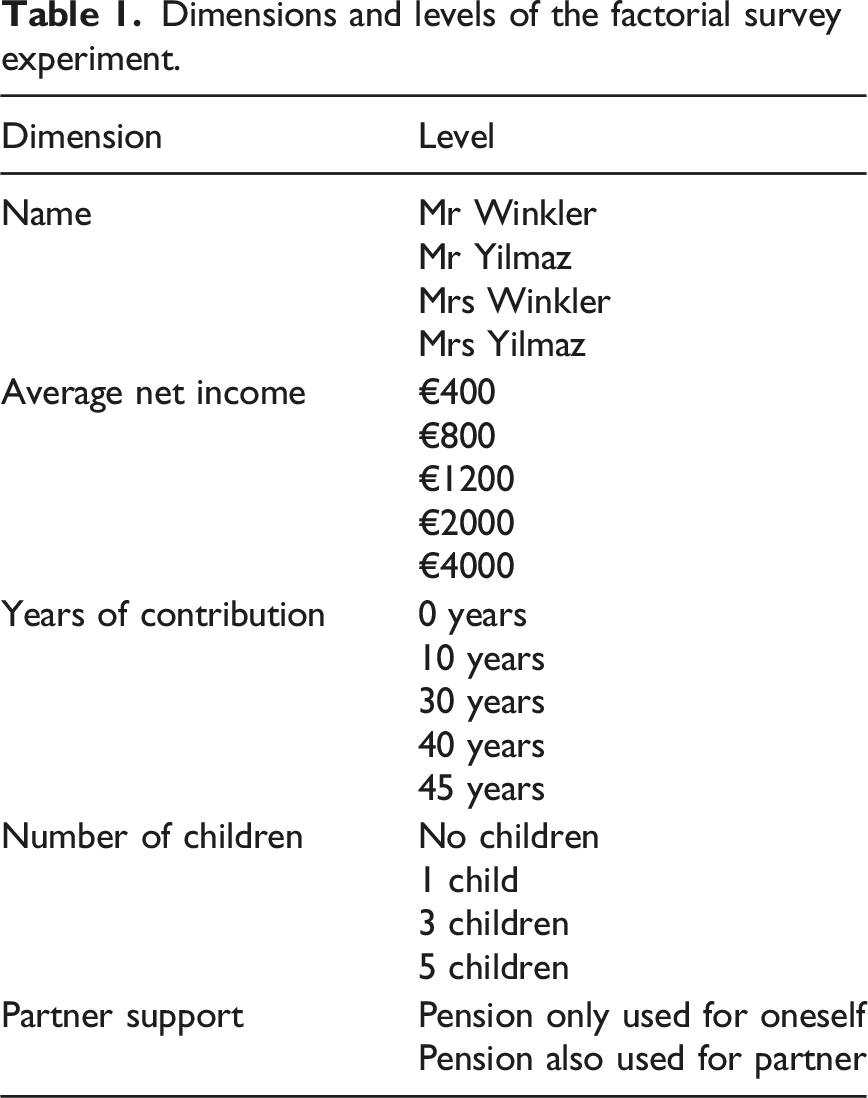
Respondents are then asked which monthly pension this person should receive. Every respondent is asked to rate two of these vignettes and we use a fully randomized design – with the exception that if someone has not worked (that is, has no contribution years) the income is not displayed. After listwise deletion, our data analysis relies on a total of 8967 individual decisions. We use a multilevel hierarchical regression to account for this nested structure of the data (that is, two decisions nested in each individual).
To measure education, we use the highest level of education following the International Standard Classification of Education and distinguish highly educated (tertiary education, ISCED Level 5 and higher) and low-educated respondents (non-tertiary education, ISCED Level 4 and lower). We use vote intention to capture respondents’ political ideology and distinguish between the six parties which were part of the German parliament at the time of the survey (The Left, The Greens, Social Democratic Party (SPD), Liberal Party (FDP), conservative party (CDU) and the populist right-wing party (AfD)). We further control for respondents’ age, gender and whether someone lives in the Eastern part of Germany.
Results
We will start with a null-model without any covariates to show how much of the variance in attitudes towards pension benefits is related to the description of the pensioner and how much is due to the differences between respondents; 27.5% of the variance can be attributed to the vignette dimensions and 72.5% to the respondent characteristics. On average, the fictitious pensioners were granted a pension of €1235, while a native man with no contribution years/no income, no children and no partner to support should receive a pension of €814 according to the public.
Average income and contribution years are two separate attributes in our factorial design although they are collinear because the vignette does not provide information on income for pensioners with no years of contribution (and vice versa no contribution years for pensioners with €0 average income). Therefore, we estimate separate models for vignette pensioners without employment history (left panel in Figure 1) and for those with employment history (right panel of Figure 1). Average effect of vignette attributes on preferred pension levels, estimation results with SEs in Table A1.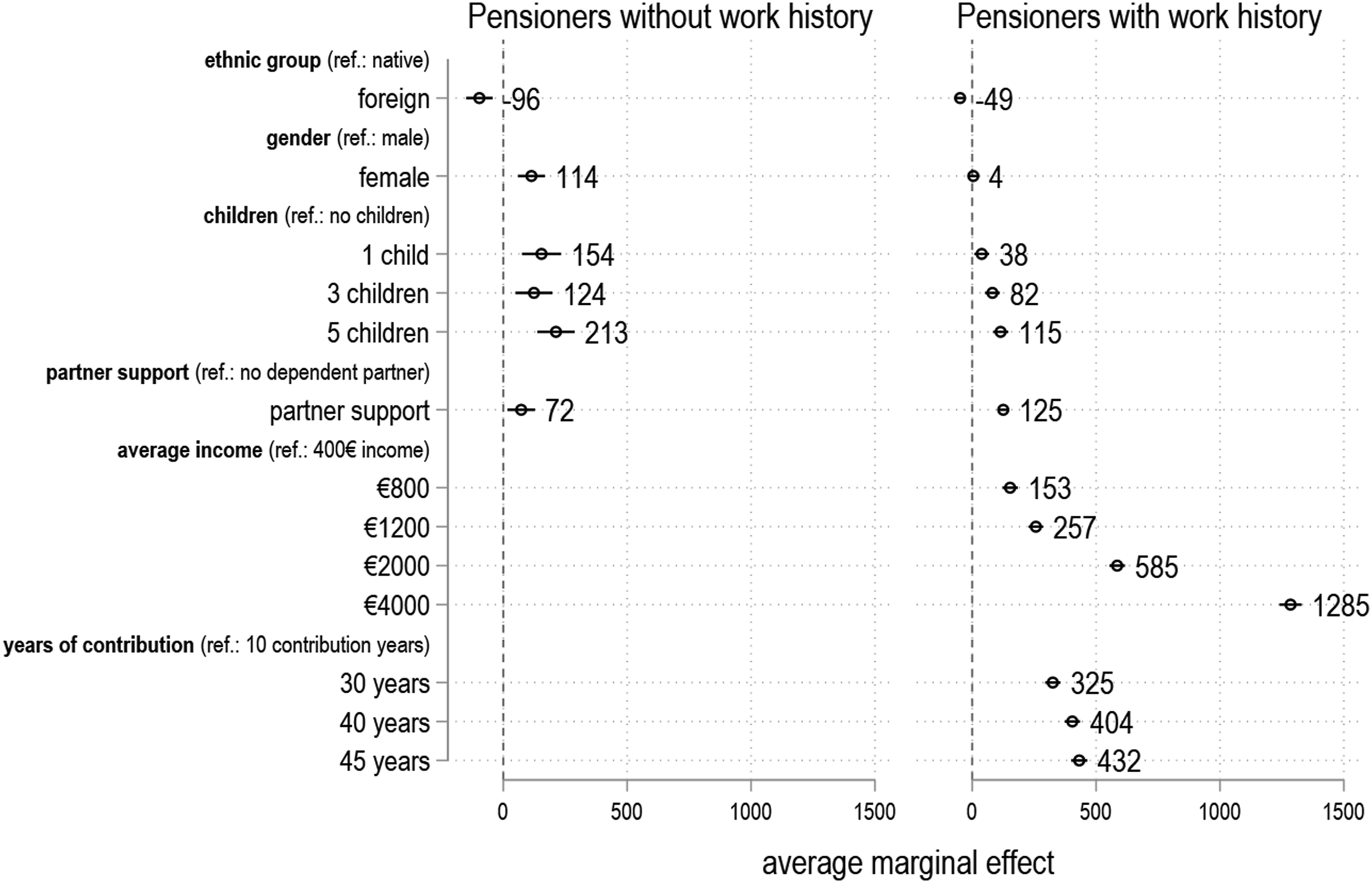
Determinants of ascribed pension levels
Before we specifically focus on the ethnic penalty in pensions, we briefly summarize the main findings of the other pensioners’ attributes in order to link our findings to previous research. Moreover, this provides additional support for the reliability and plausibility of our data and the experiment. An individual’s pension contribution history is most important in determining pension benefits and average income and years of contribution show the strongest effects. This is in line with previous research (Castillo et al., 2019; Schrenker, 2009) and shows the importance of the reciprocity criteria. For example, having an average income of €800 instead of €400 should result in a pension increase of €153 according to the public. Similarly, more contribution years also lead to a higher pension although there is no linear relationship here.
The German pension system grants additional benefits to parents. For the birth cohort in our vignettes, each child would increase pension benefits by almost €70 per month, yet only one parent can claim the full child premium. This child premium finds support among the public. For pensioners with an employment history, the German public would grant a premium of €38 for the first child, €82 for three children, and €146 for five children. The child premium is higher for pensioners without an employment history (+€154 for the first child, +€124 for three children, +€213 for five children). So, overall, the public would prefer a child premium which is lower than what people actually get per child (with the exception of pensioners without work history and one child) and would also favour a decreasing child premium for additional children.
Based on previous findings on the gender wage gap (Auspurg et al., 2017), we would expect a gap in assigned pensions. In contrast, our results do not show a gap between men and women for pensioners with an employment history. For pensioners without an employment history, the public would grant higher pensions to female (+€114) than to male pensioners. Finally, we find that in contrast to the existing pension rules, the public would support a need-based premium if there is a dependent partner to support (+€72/+€123 without/with employment history).
Public support for an ethnic penalty in pension benefits
The main focus of our study is the ethnic penalty in pension benefits and whether a Turkish sounding name has an effect on how much is perceived as a fair pension. Our results show that a foreign ethnic background leads to a penalty in pension benefits of €70 on average. It is somewhat higher for pensioners without previous employment but the penalty also exists for pensioners with previous employment (−€96 vs −€49). So, the ethnic penalty exists even after controlling for most of the retrospective reciprocity considerations which might also result in lower pension benefits for pensioners with an ethnic background, such as differences in income, contribution years or in the family situation. Also, as we have argued before, the pension context should reduce prospective reciprocity to a minimum, since work effort, productivity or re-employment chances should not matter anymore for how much pensioners will contribute to the social system. Hence, we interpret this ethnic penalty as evidence for a purely taste-based discrimination.
With regards to the interaction of the reciprocity and identity criteria, the welfare attitudes literature does not provide clear results on whether the migrant gap in deservingness should be smaller or larger if migrants perform well. Can good performance and a successful integration reduce or even close the gap? And do natives punish migrants more (or less) for not contributing to the pension system? In Figure 2, we explore in more detail whether migrants’ efforts affect the ethnic penalty. We combine average income, contribution years and children to calculate the actual pension the vignette pensioner would receive under the pension regulations that were in place in 2019. We plot the preferred pension level (y-axis) against this actual pension level for natives and foreigners separately. If the preferred pension benefit level would align with the main diagonal (y), the preferred pension income would perfectly match the de facto regulations. Figure 2 shows that the public would grant more pensions to low-income earners than they actually receive. Also, the intercept of €661.5 for a native pensioner without any pension claims shows clear support for a minimum pension among the German public. In contrast, the public would favour lower than actual pensions for high pension earners. For example, the preferred pension level for a pensioner who would receive €2500/month under the de facto pension regulations, is a bit less than €2000, according to the public. Achievement and preferred pension levels for natives and migrants.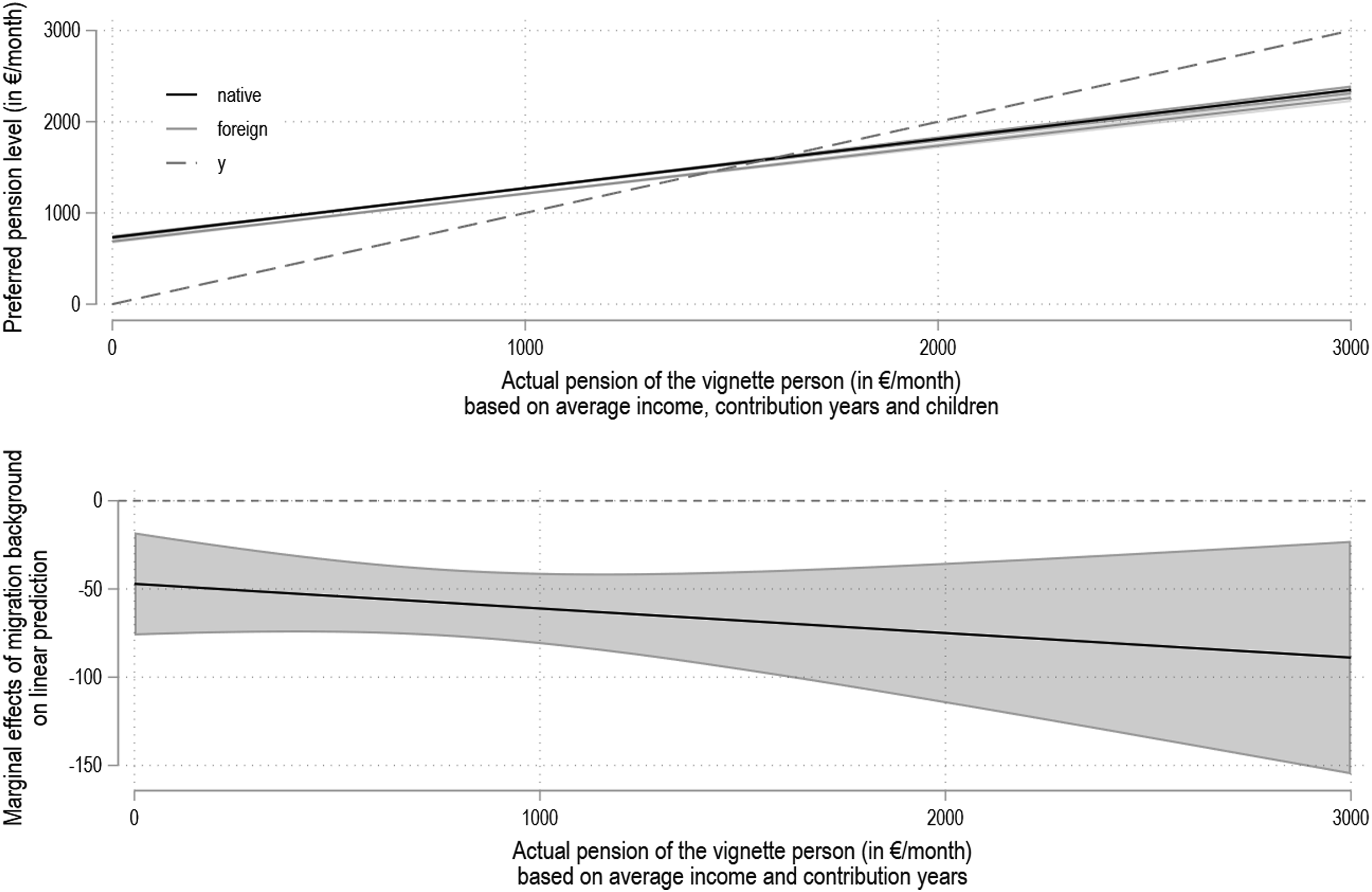
Yet, if we look at the effect of the migration background on preferred pension levels, we do not find that the ethnic penalty varies with the level of acquired rights (lower panel of Figure 2). While the figure shows a slight increase of the ethnic penalty with increasing pension claims, this interaction is not significant (see Table A2). So, native German respondents apply a penalty on pensioners with a foreign ethnic background irrespective of the actual pension level. Overall, our results suggest that the ethnic penalty neither closes nor widens with reciprocity.
The heterogeneity of the migrant gap
Is there a consensus among German natives about the ethnic penalty for pensions? Figure 3 shows how the penalty (for pensioners with a work history) varies for different groups (full models with interaction effects and control variables are provided in the Appendix). The left panel shows that low educated natives hold stronger welfare chauvinist attitudes than highly educated. Low-educated natives support an ethnic penalty of €66 [95%–CI: −93; −39], whereas those who are highly educated apply a €23 ethnic penalty [95%–CI: −57; 11]. The difference in ethnic penalties between the two groups is €44 [95%–CI: 0.05; 87], which is slightly below the usual 5%-level of significance. Hence, as expected, our results support the expectation that the ethnic penalty in ascribed pension levels is significantly stronger for low educated respondents. The heterogeneity of the ethnic penalty for pensions by respondents’ education and party support.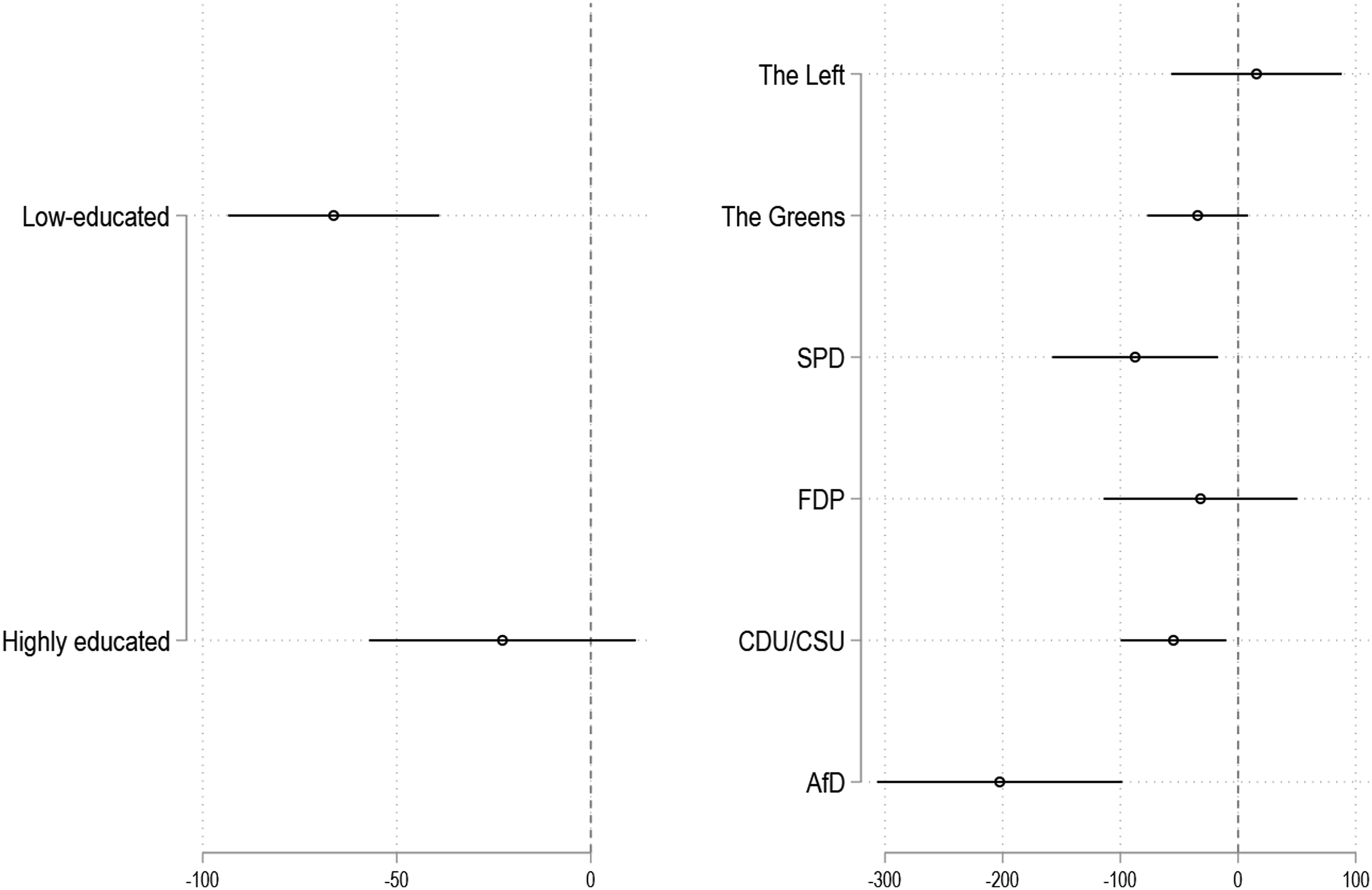
The right panel in Figure 3 shows whether political ideology affects support for an ethnic penalty. We show by how much supporters of different parties would reduce pensions of Turkish compared to German pensioners. In line with our expectation, there is a general tendency that left-leaning voters do not support an ethnic penalty. Voters of The Left are the only group who assign slightly higher pensions to pensioners with an ethnic background (+€15, [95%–CI: −57; 88]). The ethnic penalty is small and not significantly different from zero among Green voters (−€34, [95%–CI: −77; 8]) and voters of the liberal FDP (−€32, [95%–CI: −114; 50]). It is larger and significant for voters of the conservative CDU/CSU–€54 [95%–CI: −99; −10]), and surprisingly even bigger among voters of the social democratic SPD (−€87 [95%–CI: −157; −17]. As expected, the ethnic penalty is strongest among voters of the populist, radical right party, AfD (−€202 [95%–CI: −306; −98]).
Discussion
In this article, we showed that public attitudes towards pensions in Germany are driven by welfare chauvinism. We argued that attitudes towards pensions in a conservative welfare state are a particular well-suited test case for our hypothesis. Compared to other social policy areas both retrospective and prospective reciprocity are reduced to a minimum by design, allowing us to link welfare chauvinism to identity, taste-based discrimination. Moreover, this makes attitudes towards pensions a less likely case for welfare chauvinism, also because a contribution-based pension system in which benefits are closely linked to past contributions already has a built-in protection against misuse, and welfare chauvinism is usually weaker in social democratic welfare states (Careja and Harris, 2022). We show that there is an ethnic penalty in attitudes towards pension benefits in Germany which on average amounts to about €70 per month. So, the ethnic penalty is 5.6% of the average attributed pension. This effect size is comparable to the ethnic penalty found in other studies. For example, Buss (2019) finds an ethnic penalty of 6.5% that is, respondents would assign €30 less in unemployment benefits to migrants compared to natives who are assigned €465 on average. In order to make up for the ethnic penalty and to earn the same pension as natives, pensioners with a foreign ethnic background would have had to have worked for about 2 years more with an average income. This is clear support for the existence of welfare chauvinist attitudes (hypothesis 1) even in a least likely case. Moreover, and in contrast to our hypotheses 2, we do not find evidence that the ethnic penalty in assigned pension benefits varies with the reciprocity context. So, effort and whether migrants were well integrated in the labour market or not, does not affect the ethnic penalty.
Our study does not come without limitations. While we argued that prospective reciprocity should be very small, it could still play a role in shaping welfare chauvinist attitudes. For example, if respondents assume that pensioners with a foreign ethnic background might return to their home country and receive their pension there, then these pensioners won’t contribute to the common good via taxes or other non-material contributions. So, while our research design and empirical case of attitudes towards pensions provides novel insights into identifying identity-based discrimination, we are aware that we cannot entirely rule out alternative explanations for the ethnic penalty.
While we think that income and work history are very relevant indicators for respondents’ evaluation of effort and productivity but also of the integration of migrants, we are aware that these factors do not fully capture and hence control these concepts. So, respondents might still use ethnic origin as a proxy to infer lower productivity or lower effort among immigrants despite the same income and work history and then base their evaluations of a fair pension on this. Including language skills or the skill level of vignette persons might be one way to address this in future research. Moreover, our decision to use the name of the fictious pensioner as an indication for ethnic background does not allow us to distinguish between ethnicity and migration background. For example, native Germans could have foreign-sounding names. Also, persons with a German sounding name can have a migrant and/or ethnic background. Future research might explore whether discrimination and ethnic penalties differ depending on ethnic background, country of origin and/or citizenship.
The strength of our vignette design is its internal validity and the identification of a causal effect. We relied on the theoretical argument that the German pension system is a less likely case to support the external validity of our findings. Nevertheless, it remains an empirical question for future research whether the ethnic penalty varies across countries and also holds in other contributory social systems.
We took the amount of pension benefits for a pensioner without employment history as support for a basic minimum pension which did not exist in Germany at the time of the survey. Pensioners without sufficient pension claims would have to apply for social assistance. So, one should note that we cannot be entirely sure that when granting a pension to persons with no previous income, respondents might also still have social assistance in mind and do not care too much about the exact social policy programme through which the money comes. In this respect, we should also stress that some respondents who gave pensioners with no employment history no pensions – and we took this as opposing a minimum pension – might be aware of and actually support a basic social assistance to pensioners. So, overall, while we are aware that such measurement problems exist with our survey instrument, we have little reason to expect that this would systematically bias our results. For example, our overall findings are robust to excluding very low pension assignments below €200 (which make up about 3% of responses).
Overall and despite these limitations, our study provides clear support for an ethnic penalty in attitudes towards social policies which we can link to identity and discrimination. This is in line with the special issue’s main argument that welfare chauvinism is one important form of protest against existing welfare policies provided by the state. So, these attitudes might be an obstacle to progressive social policy reforms if migrants and natives are expected to benefit from these policies to a similar extent. Also, our results show that welfare chauvinism is supported among the wider public and not only among voters of radical right parties. At the same time, the heterogeneity of such welfare chauvinist tendencies in the population help understand why social policies run the risk of fuelling polarization, for example because they might lead to dissatisfaction among those who would actually want migrants and natives to be treated unequally. In this respect, it is an important part of the resilience of our societies to endure and cope with welfare state opposition in the public sphere.
Supplemental Material
Supplemental Material - The ethnic penalty in welfare deservingness: A factorial survey experiment on welfare chauvinism in pension attitudes in Germany
Supplemental Material for The ethnic penalty in welfare deservingness: A factorial survey experiment on welfare chauvinism in pension attitudes in Germany by Elias Naumann, Marvin M Brinkmann and Katja Möhring in Journal of European Social Policy
Footnotes
Declaration of conflicting interests
The author(s) declared no potential conflicts of interest with respect to the research, authorship, and/or publication of this article.
Funding
The author(s) disclosed receipt of the following financial support for the research, authorship, and/or publication of this article: This work was supported by the Deutsche Forschungsgemeinschaft (SFB 884, Grant/Award Number: 139943784).

Supplemental Material
Supplemental material for this article is available online.
Note
References
Supplementary Material
Please find the following supplemental material available below.
For Open Access articles published under a Creative Commons License, all supplemental material carries the same license as the article it is associated with.
For non-Open Access articles published, all supplemental material carries a non-exclusive license, and permission requests for re-use of supplemental material or any part of supplemental material shall be sent directly to the copyright owner as specified in the copyright notice associated with the article.
