



Abstract
Family policies not only provide money, time and infrastructure to families, but also convey normative assumptions about what is considered desirable or acceptable in paid work and family care. This study conceptualises and empirically investigates how priming respondents with brief media report-like information on existing day care policy entitlements and economic consequences of maternal employment interruptions may change personal normative judgements about parental work–care arrangements. Furthermore, we analyse whether these effects differ between groups of respondents assumed to vary in their degree of affectedness by the information as well as previous knowledge. The theoretical framework builds on the concept of normative policy feedback effects combined with social norm theory and human cognition theories. The study is based on a fully randomized survey experiment combined with a vignette experiment in Wave 12 of the German Family Panel (pairfam). It applies linear and ordinal logistic regressions with cluster-robust standard errors to a sample of 5,783 respondents. Our results suggest that priming respondents with information on day care policy and long-term economic risks of maternal employment interruptions increases acceptance of intensive day care use across the full sample and especially for mothers with children below school entry age. It further increases support for longer maternal hours spent in paid work among childless women and mothers with school-aged children. Norms regarding paternal working hours are largely unaffected by the information given in this survey experiment.
Keywords
Introduction
Despite significant changes over the past decades, large gender differences between mothers and fathers with young children persist in time spent on employment and childcare (England, 2010; Craig and Mullan, 2010; Kühhirt, 2012). This has significant long-term consequences for mothers in terms of lower life-time earnings and pension contributions (Bettio et al., 2013; Sigle-Rushton and Waldfogel, 2007) and also restricts fathers’ choices regarding work–family balance (Gerson, 2009).
To reduce these gender inequalities, many countries have introduced family policy provisions such as publicly subsidised day care institutions (henceforth: day care), paid parental leave and ‘father quotas’ for parental leave. These aim at facilitating work–family balance, increase maternal employment and fathers’ childcare involvement (Gornick and Meyers, 2003). A large international body of literature studied the relationship between welfare regimes and maternal employment (for example, Pfau-Effinger, 2013). With regard to day care policies, literature has provided evidence that day care policies impact maternal employment behaviour (for a comprehensive review on maternal employment, see Ferragina, 2020). Studies on fathers’ employment behaviour are rare and suggest that it is rather inelastic and independent of day care supply (Müller et al., 2013).
Most of this previous literature has concentrated on how economic incentives set by family policies explain variations in behavioural work–care arrangements. Yet, a large feminist literature as well as recent works by normative policy feedback theorists and sociologists stress the ideological nature of public policies. They suggest that family policies also affect individuals’ work–care beliefs through norm-setting effects – that is, by conveying and legitimizing moral normative assumptions of what is desirable or acceptable in the area of paid work and family care (Pfau-Effinger, 2013; Kremer, 2007; Gangl and Ziefle, 2015). A small body of cross-national studies analysed the link between work–family policy setups and gender ideologies in the population (for example, Lomazzi et al., 2019; Sjöberg, 2004; Grunow et al., 2018). More specifically with regard to day care policies, few existing observational or survey experimental studies suggest that day care policies shape individuals’ gender ideologies or preferences for different work–care arrangements among the target groups of such policies as well as the wider public (for example, Bünning and Hipp, 2022; Galasso et al., 2017; Zoch and Schober, 2018). However, in these previous studies the specific mechanisms of how day care policies may change the public’s gender attitudes or ideologies often remained unclear.
In the light of increasing policy support for dual earner/dual carer families in Germany and other post-industrial welfare states and the substantial media attention paid to this topic, we are interested in further exploring the norm-setting effects of day care policies on work–care beliefs. Germany is an interesting case because it has undergone major reforms of publicly subsidized day care in terms of extensions in provision and entitlements for children under the age of 3 since the mid-2000s (in addition parental leave policies have been reformed) (Zoch and Schober, 2018). These day care reforms increased the attendance of young children from about 16% to 34% between 2007 and 2021; however strong regional differences in the availability of places persist (31% of young children in West Germany attended day care in 2021 compared to 52% in East Germany) (Federal Statistical Office, 2021). The reforms have been accompanied by media campaigns that may have additionally promoted changes in day care usage and work–care beliefs among the wider population. For example, around the time of enactment of a major German day care reform, the Child and Youth Welfare Act, in 2013, two of the largest German newspapers (Süddeutsche Zeitung and Frankfurter Allgemeine Zeitung) published between 336 and 598 articles per year on ‘day care’ and related terms (see Table A1). About one third of all reports in these two newspapers since 2000 addressed not just day care but also specifically the consequences of take-up for parents’ employment, careers, and incomes.
We contribute to the literature by investigating how priming, i.e., providing respondents with short policy-related information similar to short media reports about a specific day care policy entitlement reform in 2013 and the economic consequences of its take-up, may change normative beliefs regarding work–care arrangements in families with young children. We connect normative policy feedback concepts (Kremer, 2007; Gangl and Ziefle, 2015) with social norm theory (Bicchieri, 2017) as well as human cognition theories (Evans and Stanovich, 2013). We rely on a fully randomized survey experiment combined with a vignette experiment implemented in Wave 12 of the German Family Panel (pairfam). Linear and ordinal logistic regressions with cluster-robust standard errors are applied to 5,783 respondents. Including the experiment into a large representative sample allowed for a better understanding of how the policy-related information varies in its effects across groups that likely differ in their degree of affectedness as well as in the salience of the policy information, here by gender or parenthood status.
Normative policy feedback: theory and previous evidence on the relation between family policy and work–care norms
In contemporary sociology, gender is widely understood as a social structure (Risman, 2004) that is embedded at the institutional, interactional, and individual levels of society. At the institutional level, gender is embedded in cultural logics and (economic) regulations, like family policies that promote certain ideals of work–care divisions. Men and women internalize these ideals in their gender identities. Moreover, ideals at the institutional level shape which work–care contributions individuals consider appropriate for themselves and others and thus influence social expectations that individuals encounter in interactions. These internalized and encountered gendered expectations and cognitive biases in beliefs finally affect the actual work–care divisions in couples (Risman, 2004).
(Normative) policy feedback theory has identified two main explanatory mechanisms of how family policies can change individuals’ gender ideologies or norms at the different levels of the gender structure (Kremer, 2007; Gangl and Ziefle, 2015; Soroka and Wlezien, 2010). At the micro-level, family policies create economic incentives for specific work–care divisions, and individuals adapt their gendered beliefs through psychological preference adaptation due to role exposure during family policy take-up (Gangl and Ziefle, 2015). At the macro-level, family policies can induce normative feedback effects through cultural diffusion and norm-setting, and thereby likely not only affect the gender beliefs of the policy target group but also the wider public (Bicchieri, 2017; Gangl and Ziefle, 2015). Following cultural diffusion processes, preference adaptation may be further stimulated over time through altered role perceptions and expectations within social networks based on observable changes in other mothers’ and fathers’ work–care arrangements as a result of the family policy reform. Norm-setting processes assume that family policies convey social ideals and norms regarding work–care arrangements and serve as legitimising normative anchors in the process of individual preference formation and change.
Looking at the effect of day care policies, a rather small body of international literature has analysed the relationship between specific day care policies and beliefs regarding the gender division of work and care: two cross-national studies found a positive correlation between a composite measure of family policies (including the level of public spending on day care) and more egalitarian attitudes towards female employment (Neimanns, 2021; Sjöberg, 2004). Pollmann-Schult (2016) showed that the difference in preferred working hours between mothers of young children and childless women was smaller in European countries with higher levels of day care availability for children aged under 3 years. Based on two representative surveys before and after a major day care expansion in Norway, Ellingsaeter et al. (2017) revealed that partnered mothers with children below school entry age shifted their preferences in the direction of greater day care use between 2002 and 2010. Overall, these studies found significant associations between day care policy availability and general attitudes towards maternal employment and day care use but were unable to differentiate between the possible underlying policy feedback effects of the day care policy instruments. Improving on the (repeated) cross-sectional designs of most other studies, a quasi-experimental longitudinal study by Zoch and Schober (2018) analysed how variation in the regional expansion of day care provision for children aged under 3 years between 2007 and 2013 was associated with changes in support for maternal employment. They showed that support grew among West German mothers, including mothers of school-aged children. This points to norm-setting or cultural diffusion mechanisms that go beyond changes due to role exposure among the target group of day care policies. In this study, no effects for fathers or East German mothers were found.
Experiments might be better suited to analyse specific normative policy feedback mechanisms. A few experimental studies provided respondents with short policy-related information before evaluating their gendered beliefs. This mechanism can be called priming. Survey experiments from the United States and Germany have investigated how priming with hypothetical family policy improvements may change work–care preferences of the potential target population (Thébaud and Pedulla, 2016; Pedulla and Thébaud, 2015; Bünning and Hipp, 2022). Thébaud and Pedulla (2016) analysed the effect of priming with hypothetical policies supporting the reconciliation of employment and family care on the preferred future work–family arrangements of young childless adults in the United States. Women were more likely to prefer gender-egalitarian work–care arrangements when supportive work–family policies were available compared to the status quo in the United States (Pedulla and Thébaud, 2015). For men, supportive work–family policies only had an impact when they believed that other men also preferred gender-egalitarian relationships (Thébaud and Pedulla, 2016). For Germany, Bünning and Hipp (2022) tested, as one of three hypothetical policy scenarios, how priming with greater availability of high-quality affordable day care affected working hours preferences among parents with young children. The authors found that mothers would want to work slightly longer hours in the presence of greater day care availability. Closest to our research question, an Italian experimental study (Galasso et al., 2017) provided information about the consequences of public day care, here benefits to children, to a sample of childless women. The priming increased women’s intention to use day care (among high-educated women), whereas it decreased women’s intention to work (among less-educated women).
We extend the literature on normative family policy feedback effects by exploring a specific theoretical mechanism of norm-setting. We examine whether providing respondents with short policy-related information about the day care entitlement and consequences of policy take-up – similar to what may be presented in media reports about day care policies – has the potential to change personal normative judgements about parental work–care arrangements. By relying on a fully randomized survey experiment implemented in a large long-running representative panel, we are able to provide experimental evidence for this mechanism across different population groups. We further contribute to the literature by testing for subgroup differences in norm-setting effects by respondents’ gender and parental status, as these characteristics are likely to impact the degree of affectedness as well as salience of the policy-related information.
Day care policy and work–care arrangements in the German context
Germany is an interesting context, because social and family policies combine defamilialistic elements (for example, entitlement to early formal day care and shorter but relatively well-paid parental leave) with familialistic elements (for example, unpaid parental leave until the child’s third birthday and joint taxation for married couples) (‘optional familialism’, see Zoch and Schober, 2018). So, the German work–family policy framework does not coherently support a traditional or egalitarian work–care model, but supports a relatively wide range of work–care arrangements (Grunow et al., 2018), likely leaving room for normative change.
Since 1996 half-day day care places have been guaranteed to all children between the ages of 3 and 6 and are used by the majority of children, 91.9% in 2021 (Federal Statistical Office, 2021; Spiess et al., 2008). However, day care availability for children under age 3 has been traditionally low, especially in West Germany. Since the mid-2000s, major expansions in publicly subsidised day care for children aged under 3 years took place, starting with the Day care Expansion Act in 2005 (Zoch and Schober, 2018; Stahl and Schober, 2018). In 2008, the Child and Youth Welfare Act granted a legal entitlement to a day care place for all children aged 1 year or over from August 2013 (Zoch and Schober, 2018; Stahl and Schober, 2018). In parallel to the day care reform, the paid parental leave scheme was reformed in 2007, introducing a shorter but better-paid parental leave period and 2 months of non-transferable leave reserved for each parent (Zoch and Schober, 2018; Stahl and Schober, 2018). Attendance rates of children under the age of 3 increased from 9.8% to 30.6% in West Germany and from 40.7% to 52.3% in East Germany between 2007 and 2021 (Federal Statistical Office, 2021). Importantly, it should be noted that about 10 years after the introduction of the legal entitlement to a day care place, day care availability for young children still substantially lacks behind parental demand and more strongly in West Germany than in East Germany (Bertelsmann Stiftung, 2022).
About 30 years after German reunification, maternal employment patterns in the former East and West Germany have converged somewhat, and part-time employment has become the most prevalent arrangement of combining employment and family care for women (Zoch and Schober, 2018; Stahl and Schober, 2018). However, differences still remain with higher approval and usage of (full-day) care as well as (extended) maternal employment in families with young children in East Germany than there is in West Germany (Schober and Spiess, 2015; Bauernschuster and Rainer, 2012; Stahl and Schober, 2018). In 2021, 40.1% of young children in East Germany and 14.3% of children in West Germany attended public full-day care (Federal Statistical Office, 2021). Therefore, in additional analyses we test whether effects of policy information on normative work–care beliefs differ by regional cultural context across Germany.
Parents’ main reasons for not using day care are related to cultural ideals of care, such as the desire to raise their child themselves, believing that the child is too young for institutionalised day care, or informal grandparental care being available (Schmitz and Spiess, 2018). In combination with the prevalence of maternal part-time employment, Germany is therefore a particularly interesting context in which to explore norm-setting effects of day care policies for young children and of drawing people’s attention to the long-term economic risks of intensive labour market interruptions and part-time employment for mothers.
Experimental design
We use data from the German Family Panel pairfam (‘Panel Analysis of Intimate Relationships and Family Dynamics’) (release 13.0, 2020/2021) (Brüderl et al., 2022). The panel initially started in 2008 with a nationwide random sample of the German population register for three age cohorts born in 1971–73, 1981–83, and 1991–93 (15–17, 25–27, and 35–37 years old, respectively, in 2008). This adds up to 12,402 interviews in total in the first wave. Interviews of the main respondents and their current partners, parents, and children have been conducted annually since then. Following the inclusion of replenishment and additional step-up samples in Waves 11 and 12, pairfam contained about 8,197 respondents in Wave 12. A detailed description of the study can be found in (Huinink et al., 2011).
Our experimental design combines an information priming experiment with a vignette study. To investigate effects of priming with policy-related information, we developed a short information experiment in cooperation with the pairfam coordinators (Schober et al., 2022). The information experiment was included in Wave 12 of the panel, conducted between October 2019 and April 2020. A randomly selected half of respondents were presented a short evidence-based information stimulus at the beginning of the experiment, which reads as follows.
Before you start, here is some important information: since 2013, every child has an entitlement to a spot in a day care centre or at a childminder beginning at age one. This allows both parents – if they wish – to pursue employment. For mothers, in particular, earning an income of their own can improve their financial situation in the long term. Scientific studies show that shorter employment interruptions tend to result in higher long-term wages for mothers, which can reduce the risk of poverty in old age.
The information contained two elements. First, it increased the visibility of the legal entitlement to a day care slot since 2013 for all children in Germany beginning at age 1 (Zoch and Schober, 2018). We chose this day care reform for the policy information experiment, as it brought a major change in giving the legal right to all children, and still relevant gaps in knowledge about the entitlement are present among the population (Hermes et al., 2021). Second, it sought to raise awareness that mothers experience lower life-time earnings and old-age poverty significantly more often than fathers (Bettio et al., 2013; Sigle-Rushton and Waldfogel, 2007), which is partly due to mothers’ longer employment interruptions, and that shorter employment interruptions help to overcome these risks. The information stimulus was approved by the ethics commission of the University of Tübingen as well as the scientific committee of the pairfam panel and was based on the results of several peer-reviewed studies. We did not conduct a manipulation check for whether the respondents recalled the priming information. However, the survey experiment was conducted in face-to-face mode, so we expect that the majority of respondents read and understood the priming information.
The information experiment was combined with a vignette experiment (for further information, see Schober et al., 2022). Half of the respondents received the information priming. All respondents were then asked to form judgements about the work–care arrangements of fictitious couples with a 15-month-old child. The age of 15 months was chosen because the current maximum period of paid full-time parental leave following the birth of a child is 14 months in Germany. Each respondent received three descriptions of a hypothetical family that varied on seven vignette dimensions, with each dimension containing different categories. The dimensions were: parental income ratio, division of childcare/parental leave, child temperament, day care centre quality, standard of living, career prospects, and family friendliness of jobs (for an example vignette, see Figure A1 and for more details about the vignette dimensions, see Table A2). By experimentally controlling for these contextual factors, we made sure that respondents built their normative judgements about parental work–care arrangements on the basis of comparable situations.
Conceptual framework and empirical expectations
Following social norm theory (Bicchieri, 2017), legislative interventions, educational, or media campaigns might be a tool to promote individuals’ critical reflection on their beliefs and social expectations, a prerequisite for changing gender norms. We study how providing brief information about a day care reform and the economic consequences of its take-up might impact individuals’ personal normative judgements towards work–care arrangements. Personal normative judgements are defined as individuals’ judgements concerning how they themselves or others should behave (Bicchieri, 2017), here with regard to the appropriate combination of employment and institutional day care for parents of young children.
Priming increases the salience of and attention paid to specific criteria on which individuals base their overall evaluations of a specific topic (Druckman and Holmes, 2004). Dual-process theories of human cognition (Evans and Stanovich, 2013) suggest that after having received the priming information, respondents might be more likely to engage in controlled and reflective reasoning and decision-making instead of more automatic decision-making processes. Priming respondents with evidence-based information on the day care entitlement and long-term economic risks of maternal employment interruptions is likely to increase the salience of economic criteria in respondents’ evaluations of parental work–care patterns compared to other factors. Thus, respondents might reflect more on the option of public day care and the economic long-term costs of different work–care constellations. This is likely to reduce more automatic gender-stereotypical beliefs about work–care arrangements (for example, mothers of young children working no or a few hours, and day care use only for older children). Consequently, we assume that the priming information will increase respondents’ normative support for more intensive day care use as well as longer maternal working hours (Hypothesis 1). We further suppose that normative support for paternal working hours should not necessarily be affected by the priming information because typically mothers rather than fathers adjust their preferred and actual working hours to childcare duties in Germany (Bünning and Hipp, 2022; Kühhirt, 2012).
Personal relevance and previous reflective reasoning about the policy-related information
Furthermore, normative policy feedback theory supposes that the impact of policy-related information on normative beliefs varies between population groups depending on the personal relevance and salience of the policy information (Ellingsæter et al., 2017). The personal relevance of the policy information likely increases the motivation to actively process arguments about day care take-up. Second, policy-related information particularly increases the visibility and attention for respondents with limited previous knowledge or reasoning about the policy information and who otherwise would not have incorporated the information into their evaluations. Following human cognition theories, both higher personal relevance and limited previous knowledge/reasoning about the policy-related information increase reflective reasoning about the priming information. This potentially reduces cognitive gender biases in beliefs and induces normative change. Consequently, effects of the priming information on personal normative judgements should be largest for subgroups of respondents for whom both the priming information is personally relevant and previous knowledge is limited. In the following, we argue that differences in policy relevance and policy salience might be especially prevalent between men and women and among them by parenthood status. Therefore, we test for effects differences in priming by respondents’ gender and parenthood status.
Gender
First, we assume that on average the policy-related information is likely more personally relevant for women than men, as women more often organize childcare and adapt their working hours due to childcare responsibilities (Kühhirt, 2012). However, for the same reason women may be better informed than men about the day care entitlement – but not necessarily about the economic risks of employment interruptions. We expect that the greater personal relevance for women outweighs smaller gender differences in knowledge about the policy information. Overall, we assume that the priming increases normative support for more intensive day care use and longer maternal employment hours more strongly for female compared to male respondents (Hypothesis 2). Previous research supports the argument that day care policies more strongly affect women’s than men’s gender beliefs (for example, Zoch and Schober, 2018), but has not tested for interactions with parenthood status.
Parenthood status
Second, the personal relevance may be strongest for parents with young children under the age of 6. These are the direct beneficiaries of day care policies and have the strongest self-interest in using the policy and avoiding adverse long-term negative economic consequences of reduced maternal employment. The information may be less relevant among childless respondents or parents of older children unless they intend to become parents (again). Regarding the salience of the policy-related information, we assume that childless respondents may be less informed about the day care entitlement as well as about economic consequences of labour market interruptions. Parents who have had a child since the day care reform of 2013 have probably already integrated the day care entitlement into their beliefs about work–care arrangements. However, they may still be receptive to information about long-term economic consequences of labour market interruptions. By contrast, for parents with older children born before the day care reform of 2013 the priming may encourage active reflection on the day care entitlement information. However, the policy information may be less likely to challenge their beliefs about suitable work–care arrangements, as these may be strongly oriented to be in line with their own current and previous practices to avoid cognitive dissonances. Overall, among female respondents for whom the policy-related information is assumed to be generally personally relevant, we expect priming differences by parenthood status and salience of information: We assume that the policy priming increases normative support for more intensive day care use as well as longer maternal working hours most for childless women, followed by mothers of older children and mothers of young children below the age of school entry (Hypothesis 3). Variations in effects among childless men and fathers are difficult to predict a priori.
Measurements and method of analysis
Operationalization of variables
Normative judgements of work–care arrangements
Our dependent variables are respondents’ normative judgements about parental work–care arrangements, here the extent of day care use as well as mothers’ and fathers’ weekly hours in paid work. The extent to which the child should attend day care was measured with the four categories ‘no day care’, ‘a few hours on some days’, ‘a half-day every day’, and ‘a full-day every day’ and is treated as a categorical variable. Half-day attendance was preferred in half of the observations (56%), followed by full-day attendance (22%) and a few hours on some days a week (19%). Respondents were asked to make normative judgements about mothers’ and fathers’ ideal working hours on a seven-point scale: ‘0 h per week’, ‘1–8 h per week’, ‘9–17 h per week’, ‘18–25 h per week’, ‘26–32 h per week’, ‘33–40 h per week’ and ‘more than 40 h per week’. Whether respondents first had to rate the mother’s or father’s working hours was randomly varied. The most frequently chosen categories for mothers were ‘18–25 h’ (31%), ‘26–32 h’ (23%), and ‘33–40 h’ (22%). About half of all responses (46%) indicated that fathers should work ‘33–40 h’, followed by ‘26–32 h’ (22%). For ease of interpretation, we recoded the working hours into interval variables, using the middle value of each category (0, 4.5, 13, 21.5, 29, 36.5, 44). Additionally, we use the mother’s working hours as a share of the sum of both parents’ working hours (ranging between 0% and 100%). Detailed distributions of the dependent variables can be found in Figure A2 and by respondent subgroups in Table A3.
Experimental condition
Our main independent variable is the policy-related priming, which distinguished between respondents who received the policy information (priming group) and respondents who did not receive this information (control group). Despite the random assignment of the groups, the priming and control group significantly differed with respect to a few demographic variables (see Table A4). Respondents in the priming group were less frequently women, partnered, from cohort 1971–73 or 1981–83, and had less frequently completed tertiary education than respondents in the control group. Subsequent regression models control for these demographic characteristics to make sure that differences between the priming and control groups can be allocated to the priming effect.
Gender and parenthood subgroups
To test for heterogeneous effects by policy relevance and salience, we include variables about respondent’s gender and parenthood status. We include a binary variable for respondents’ gender (men and women). Based on respondents’ parental status and the age of the youngest child living in the household, we further distinguished between the categories of childless women, mothers with their youngest child under the age of 6, and mothers whose youngest child was aged 6 or over. We further controlled for children not living in the household.
Control variables
We controlled for a small number of respondent characteristics. Two binary variables measure whether respondents currently live in a partnership and have acquired tertiary education or not based on the CASMIN-1999 classification. An interval variable accounts for respondents’ weekly working hours, including overtime. We included the birth cohort, that is, whether the respondent was born in 2001–3, 1991–93, 1981–83, 1971–73, or whether respondents were a so-called ‘step-up’, a former adolescent respondent born between 1994 and 2003 who became a main respondent in Wave 11 or 12. We further controlled for whether respondents currently lived in West or East Germany. We accounted for the context in which the normative judgements were made by including the categorical vignette dimensions. The seven dimensions were: parental income ratio, partners’ division of childcare, child temperament, day care centre quality, standard of living, career prospects, and family friendliness of the jobs.
Sample selection and method
In total, 6,285 respondents (18,855 vignette observations) took part in the survey experiment. We restricted our analytical sample to observations with valid answers on all dependent variables, thereby excluding 2,055 (10.9%) vignette observations. We further excluded 93 (0.5%) vignette observations with missing values on the respondent level control variables. Our final analytical sample consists of 16,707 vignette observations nested in 5,783 respondents. To examine the average effects of priming information on normative judgements of work–care arrangements, we use linear and ordinal logistic regression models. We applied cluster-robust standard errors to account for vignettes nested in respondents. To assess the moderating influence of respondents’ characteristics, we run separate models by subgroups of gender and parenthood status. We alternatively ran multilevel models which showed very similar results. All data analyses were conducted in the statistical software Stata16.
Results
Ordered logistic regression and average marginal effects of normative judgements about day care use on policy information and OLS regression of normative judgements about parental working hours on policy information.
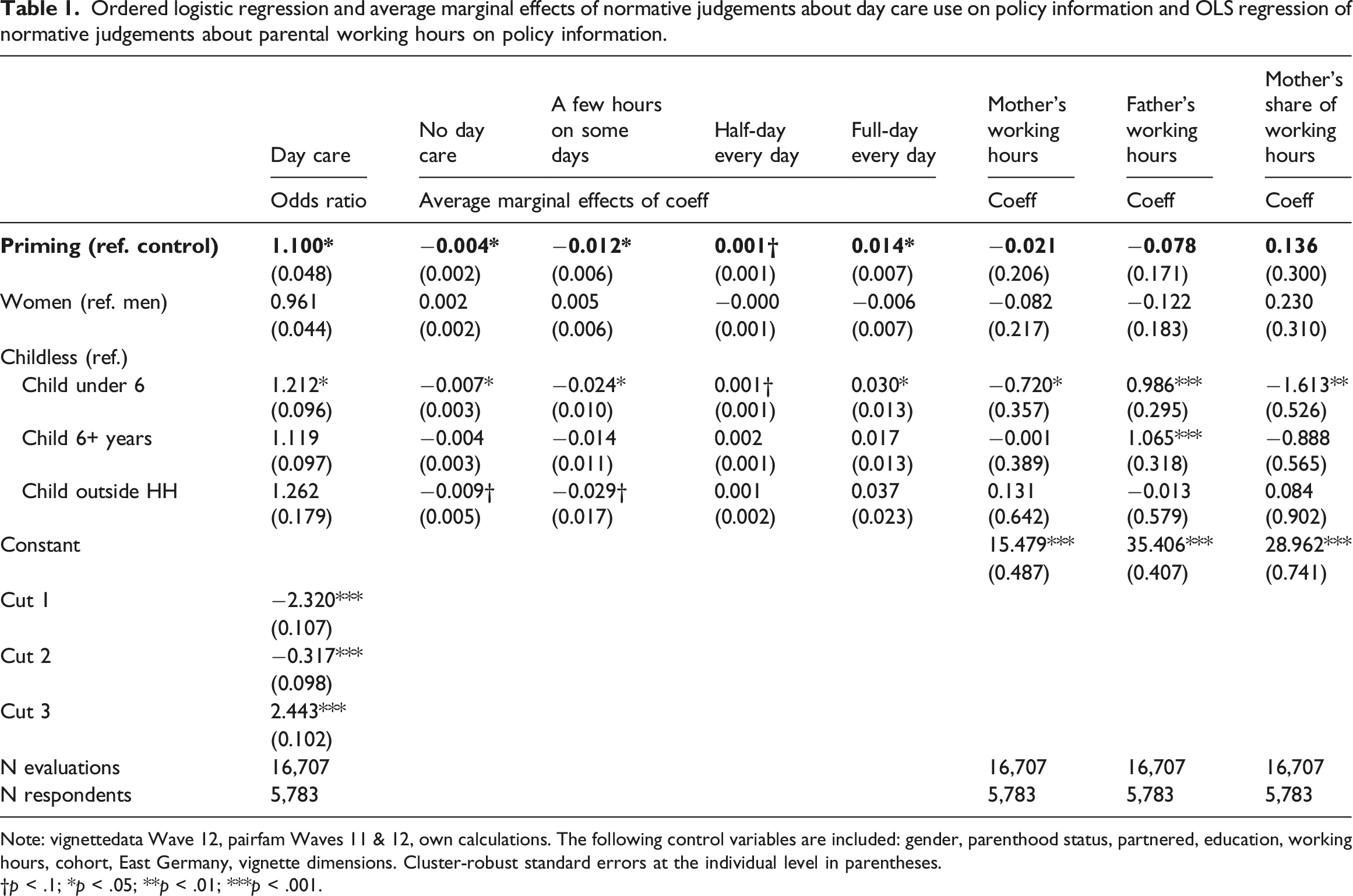
Note: vignettedata Wave 12, pairfam Waves 11 & 12, own calculations. The following control variables are included: gender, parenthood status, partnered, education, working hours, cohort, East Germany, vignette dimensions. Cluster-robust standard errors at the individual level in parentheses. †p < .1; *p < .05; **p < .01; ***p < .001.
Ordered logistic regression and average marginal effects of normative judgements about day care use on policy information and OLS regression of normative judgements about parental working hours on policy information by subgroups of respondents.
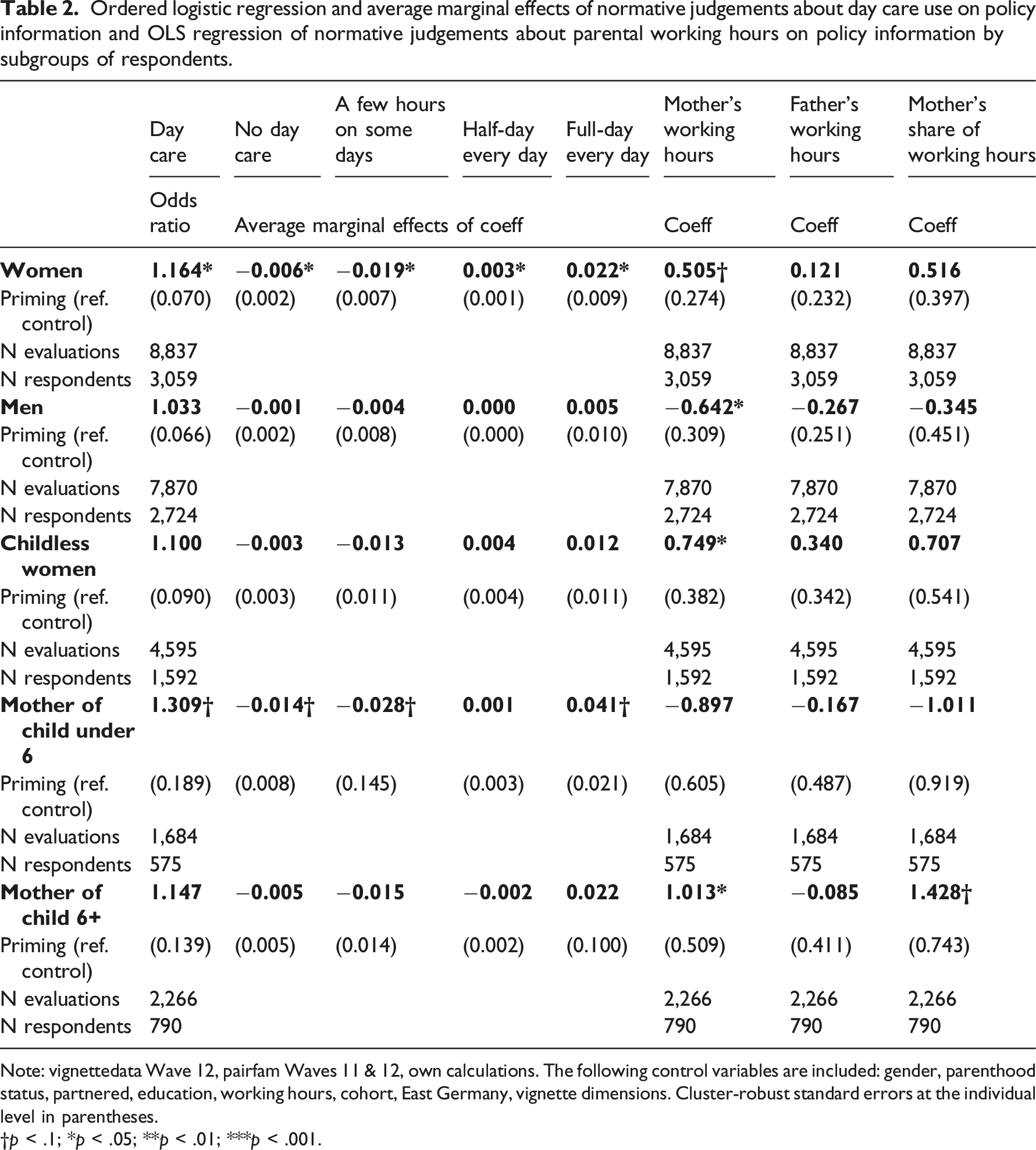
Note: vignettedata Wave 12, pairfam Waves 11 & 12, own calculations. The following control variables are included: gender, parenthood status, partnered, education, working hours, cohort, East Germany, vignette dimensions. Cluster-robust standard errors at the individual level in parentheses. †p < .1; *p < .05; **p < .01; ***p < .001.
The positive effects of the priming information on normative judgements about day care use in the full sample seems to be driven by female respondents. For male respondents, no such priming effects were found, confirming Hypothesis 2 with regard to day care use. More specifically, the positive effect of the information priming on normative judgements about day care among women seems to be driven by mothers of young children, indicated by marginally significant and positive associations for this subgroup. For these mothers, the odds of selecting ‘full-day care’ in the priming group were 1.3 times that of respondents in the control group. These mothers were about 4 percentage points more likely to support ‘full-day care’. This result contradicts Hypothesis 3, which expected the strongest information priming effects for childless women and mothers of older children compared to mothers of children below school entry age. We expected that mothers with children below school entry age would already know some of the information about the day care policy. However, the day care entitlement and maternal employment interruption information might have had the highest personal relevance for these women and induced a more careful reflective reasoning of the information, which in turn resulted in higher support for intensive day care use.
With regard to maternal employment, in line with Hypothesis 3, we found that the priming information increased normative support for intensive maternal working hours among childless women and mothers whose youngest child was above the age of 6. The strength of these effects was modest, with roughly 1 additional working hour per week preferred. For childless women and mothers of school-aged children, the policy information on the reduced economic risks associated with more intensive maternal employment probably contained some novel or for mothers personally relevant elements. This increased the likelihood of reflection on the policy information and a normative shift towards longer maternal employment. Unexpectedly, the priming information decreased support for longer maternal working hours among men (especially among fathers of small children) to a small extent, by half an hour per week (Tables 2 and A6).
To test whether the priming effects in the subgroups were statistically significantly different from each other, we conducted interactions of the priming information with the gender or parenthood status variable. In line with Hypothesis 2, the priming had significantly stronger positive effects on normative judgements about maternal employment among women compared to men (Table A6), but not on judgements regarding day care use. Contrary to Hypothesis 3, we did not find that the priming effects on normative judgements about day care use differed significantly between the three groups of women. However, in line with Hypothesis 3, the priming had significantly stronger positive effects on normative judgements about maternal employment for childless women compared to mothers with young children (Table A7).
Analogous tests for subgroups of men by parental status generally pointed to mostly non-significant effects of the priming information on normative judgements of day care use or parental employment (Table A8 and A9). Possibly, as argued, on average, male respondents did not feel sufficiently personally affected to incorporate the information on the day care entitlement and long-term economic consequences of maternal employment interruptions into their judgements about parental work–care arrangements.
Robustness tests
We conducted several robustness checks for the main priming effects. First, we tested alternative specifications of the dependent variables. As parental working hours were originally assessed as categorial variables, we tested ordered logistic regression models and found similar priming effects as in the main analysis (Table A10). Furthermore, a logistic regression which just distinguished between no day care versus some day care resulted in non-significant effects, probably due to the limited variation (Table A10). Second, the main results remained unchanged after controlling for respondents’ baseline level of beliefs towards maternal employment. Here, by including the item ‘A child under 6 will suffer from having a working mother’ from the previous wave 11 (Table A11).
Third, we tested whether the priming effects depended on further respondent characteristics as well as the specific work–family context presented in the vignettes. Priming effects may be weaker for respondents living in East compared to West Germany as normative support, maternal employment rates, and usage of extended public day care for young children is already much greater in East Germany (Schober and Spiess, 2015). We found no such evidence, as the priming effect in the total sample as well as in the subgroups by gender and parenthood status did not vary with respondent’s region of residence. Only one significant interaction was found which showed that approval of extended maternal working hours among childless women was even higher among respondents living in East versus West Germany (Table A12). Moreover, the priming effects might differ by social class of the respondent. Respondents from low-income/skilled occupations or holding lower levels of education are probably less informed about formal day care usage and on average less likely to use formal day care for young children (Stahl and Schober, 2018; Hermes et al., 2021). These respondents might be more personally affected by the day care entitlement and economic risks information. So, priming effects may be larger among respondents with lower socio-economic status or levels of education (Hermes et al., 2021). In the full sample, the priming effects did not vary by the socio-economic status (measured as International Socio-Economic Index of Occupational Status (ISEI)) or the level of tertiary education of the respondent. Regarding the subgroups by gender and parenthood status, no significant interactions with ISEI were found. However, results point to effect heterogeneity among subgroups of men by level of education: among fathers of young children, policy-related information led to higher support for extended maternal working hours when holding a tertiary educational degree. Interestingly, priming reduced the relative maternal working hours recommended by tertiary educated versus less educated childless men (Table A13).
The priming effects were mostly independent of the specific work–family context. Only a small number of interactions between the priming information and the seven vignette dimensions were statistically significant (Table A14). These point to stronger positive effects of the priming on support for mothers’ (relative) working hours in couples where both partners have equal incomes compared to male breadwinner families as well as for families with children with an adaptive compared to a less adaptive temperament. Moreover, stronger positive effects of information priming on support for day care use were found in families where none of the partners’ employers supported working reduced hours.
Last, we reran our analyses using calibrated design weights, which adjust the data to the target population and control for baseline survey participation and panel attrition bias. These weights were only available for the main pairfam respondents, so we had to exclude the 444 step-up respondents. The unweighted and weighted results were similar, which suggests no major problems due to design, non-response, or attrition biases (Table A15).
Conclusion and discussion
We extended the literature on normative family policy feedback by exploring a specific mechanism of norm-setting effects, namely priming with policy-related information. This study conceptualized and investigated how priming respondents with brief media report-like information on the existence of a day care entitlement policy and economic consequences of maternal employment interruptions has the potential to change normative judgements about day care use and the parental division of employment. We drew on normative policy feedback theory (Gangl and Ziefle, 2015), social norm theory (Bicchieri, 2017), and models of human cognition (Evans and Stanovich, 2013) to formulate our assumptions. We relied on a fully randomized survey experiment combined with a vignette study. The experiment was implemented in a large representative survey of the German population, which allowed to provide experimental evidence for this mechanism in the wider population as well as among specific subgroups.
Drawing respondents’ attention to the legal entitlement to a public day care place and long-term economic risks of maternal employment interruptions increased the normative acceptance of more intensive day care use but did not affect support for maternal and paternal working hours in the full sample. The results regarding day care judgements are in line with a (repeated) cross-sectional Norwegian study finding positive effects of a day care reform on mothers’ preferences of day care as preferred childcare arrangement (Ellingsæter et al., 2017).
Moreover, we found some evidence of heterogeneous priming effects between subgroups of respondents by gender and parental status, which likely differ in their affectedness as well as in their salience of the policy information. In line with the Norwegian study (Ellingsaeter et al., 2017), the positive priming effect on support for more intensive day care use was driven by female compared to male respondents, as women were likely to be most directly affected by the day care policy information. Among women, the priming had larger effects for mothers with children below school entry age, again pointing to personal relevance as an important explanatory mechanism. Moreover, the priming led to higher support for intensive maternal working hours among women who were childless or had older children compared to mothers of young children. The priming may have included more novel and relevant information about the economic benefits of labour market participation for the former two groups of women. Therefore, policy salience seemed important beyond a certain level of personal affectedness that all women might share. Alternatively, childless women or mothers with older children might have been more open to incorporating these aspects into their normative judgements, as they may confront fewer obstacles to pursuing employment and a career in their own lives. We find little evidence that the priming information affected normative judgements regarding fathers’ working hours. These findings are in line with priming studies on men’s preferred work–care arrangements in the United States (Pedulla and Thébaud, 2015) and fathers’ preferred working hours in Germany (Bünning and Hipp, 2022). Future research should continue to explore potential mechanisms that hinder or foster flexibility in normative judgements about paternal employment patterns. The rather modest sizes of the priming effects on normative judgements regarding day care usage and maternal employment are in line with previous priming experiments (Pedulla and Thébaud, 2015; Bünning and Hipp, 2022; Thébaud and Pedulla, 2016). One reason for this could be that our priming information was short and embedded in a large survey that also covered other family-related topics.
Some more limitations and outlooks for future research should be mentioned. Our priming information text contained two separate pieces of information regarding the day care entitlement and the economic risks of maternal employment interruptions. We were only able to hypothesize about how each of these information aspects was incorporated into respondents’ judgements. To examine the mechanisms more specifically, future priming research should ideally also directly assess respondents’ perceived level of personal relevance as well as respondents’ prior knowledge and beliefs about the family policy instrument and the consequences of take-up. Our priming intended to reduce gender biases in beliefs through addressing economic concerns. Future priming studies should also specifically address frequent concerns about day care quality and consequences of using institutionalized day care for children’s development when studying individuals’ work–care assumptions (like Galasso et al., 2017).
More generally for this type of survey experiment, information priming effects depend on high levels of trust in the information-providing institutions, and on the high quality and credibility of the research evidence that the information is based on. Providing evidence-based policy-related information may be particularly relevant in country contexts where gender norms and work–care practices show considerable variations or inconsistencies with constraints set by policies like in Germany (Grunow et al., 2018). Applicability of this experiment in providing unbiased information regarding policy options and different work–care arrangements would be more difficult in country contexts where policies or economic constraints clearly limit the range of feasible or favoured work–care arrangements (for example, Sweden or Poland).
Our results have important practical implications for policymakers and media. In our study we provide experimental evidence for a practical channel of how short, evidence-based policy-related media-like information may change personal normative judgements about parental work–care arrangements within a short time frame. Our results further point to the importance of personal relevance and accessibility of the information among subgroups who are (not yet) the target group of the policy instrument. If repeatedly diffused via different media channels, high quality policy-related information may further produce longer-lasting effects in shaping work–care norms and eventually shape behaviour among the wider public over time through cultural diffusion. To examine further diffusion effects, reference networks of people whose behaviour and expectations matter most for work–care beliefs should be identified (see Thébaud and Pedulla, 2016).
Supplemental Material
Supplemental Material - Day care availability and awareness of gendered economic risks: How they shape work and care norms
Supplemental Material for Day care availability and awareness of gendered economic risks: How they shape work and care norms by Silke Büchau, Marie-Fleur Philipp, Pia S Schober and C Katharina Spiess in Journal of European Social Policy.
Footnotes
Acknowledgments
Previous versions of this article were presented at the International pairfam User Conference (2022) and the autumn conference of the German Family Sociologists Network (2021). We thank Martin Groß and the reviewers for helpful remarks and feedback as well as Keri Hartmann for language editing. This study utilises data from the pairfam relationship and family panel, which was led by Josef Brüderl, Sonja Drobnič, Karsten Hank, Johannes Huinink, Bernhard Nauck, Franz J. Neyer and Sabine Walper. The study was funded by the German Research Foundation (DFG) from 2004 to 2022 as a priority programme or long-term project.
Declaration of conflicting interests
The author(s) declared no potential conflicts of interest with respect to the research, authorship, and/or publication of this article.
Funding
The author(s) disclosed receipt of the following financial support for the research, authorship, and/or publication of this article: This work was supported by the Deutsche Forschungsgemeinschaft Project no. 430968755.

Supplemental Material
Supplemental material for this article is available online.
References
Supplementary Material
Please find the following supplemental material available below.
For Open Access articles published under a Creative Commons License, all supplemental material carries the same license as the article it is associated with.
For non-Open Access articles published, all supplemental material carries a non-exclusive license, and permission requests for re-use of supplemental material or any part of supplemental material shall be sent directly to the copyright owner as specified in the copyright notice associated with the article.
