



Abstract
Immigration to Sweden is dominated by women and men of childbearing age, and many arrive with children. The labour-market integration of newly arrived mothers is of concern, and well directed social policy is crucial. Parental leave is based on residence, and until recently it was granted to all parents of foreign-born children of preschool age. This study uses population and social insurance registers to investigate whether newly arrived immigrant mothers use parental leave upon arrival, and whether use is an obstacle to future labour-market activity. Our results indicate that the majority of the newly arrived mothers do not take any parental leave, but also that there are great differences in uptake in relation to country of birth and reason for residence permit. However, there seem to be only marginal associations between parental leave use and subsequent labour-market attachment. Nevertheless, moderate use is associated with labour-market activity rather than being an obstacle to it. Our results contribute to the debate on the unintended effects of social policy on the integration of immigrants.
Introduction
The increasing trend of international migration to high-income countries has intensified the discussion on how host societies should best facilitate integration. Both the political and the scientific debates have had a particular focus on economic integration, with the notion that it is the first necessary step in facilitating integration in other spheres of life as well (Alba and Foner, 2016; Heath et al., 2008; Joppke, 2007; Waters and Jiménez, 2005). However, despite encouragement and support for immigrant employment as a policy goal for each European government (European Commission, 2016), in most developed countries the immigrant population has lower labour-market participation than the native-born population (International Migration Outlook, 2019). Previous research focusing on immigrant integration in different destination countries has already concluded that, during the first years in a host country, immigrants have lower employment rates and lower earnings, and few individuals reach the participation levels or occupational positions of the native-born (Brell et al., 2020; Clark and Drinkwater, 2002; Helgertz, 2010). However, labour-market participation, for immigrants in particular, is a complex process that involves individual human capital (e.g., education) as well as job searching or other activities (e.g., vocational or language training) leading to employment (Fuller and Martin, 2012; Nee and Sanders, 2001); and, for these reasons, it is to be expected that it might take some time before one begins earning an income (Hilson, 2007).
Sweden has one of the highest proportions of foreign-born individuals in Europe, and labour-market integration is an issue that has constantly been on the agenda in recent decades. Employment rates are about 14 percent lower for immigrants, with immigrant women exhibiting lower levels compared to both immigrant men and native women (International Migration Outlook, 2019; Kogan, 2006); and, actually, the gap in regard to native women is among the largest in Europe (Sainsbury, 2019). Because women and men of childbearing age dominate immigration and many come with children, there is continued concern about how parents, and especially mothers, are integrated into the labour market. This is why most new Swedish integration policies focus mainly on labour-market inclusion and the reduction of inactivity spells (ESO, 2021; Joyce, 2018). On the other hand, Sweden is characterized by generous welfare provision paid directly to resident families, including newly arrived parents. In particular, and until recently, it has been possible to use parental leave insurance for children born abroad without any restrictions. This means that immigrants who arrive with children of preschool age have gained access to the entire parental leave insurance that typically goes to parents of newborns. There has been concern that this may have hindered or delayed migrants’ entry into the labour market and postponed children’s integration, as preschool is not available for children whose parents are on parental leave. Previous studies involving women with children born in Sweden have shown substantial differences in the use of parental leave insurance between immigrants and those who are native-born, even when the main sociodemographic characteristics are considered (Duvander, 2010). Mussino and Duvander (2016) found that immigrant mothers use parental leave insurance more intensively than native-born mothers do, but that when labour-market status is considered the differences between the two groups diminish. However, it is still under discussion whether the Swedish family policy – particularly parental leave insurance uptake – may actually be an obstacle to integration, creating a first spell of inactivity, while the same generosity is beneficial to the native population (Duvander and Mussino, 2021). Such an unintended consequence of a policy aimed at facilitating the combination of work and family is important for how policy is constructed and what effects it has in combination with other policies. In this specific case, the regulations have now changed so that migrants arriving with children above the age of one have a reduced number of parental leave days.
With this study, we want to contribute to the debate on the effects of generous parental leave insurance among subgroups of the population, by providing information on whether immigrant parents actually use parental leave for accompanying children to any great extent. Even if there is a positive correlation between generous parental leave policies and women’s labour-market return after childbearing (Hegewisch and Gornick, 2011; Ruhm, 1998), these policies may create incentives for specific groups to stay out of the labour force (Olli Segendorf and Telijosuo, 2011; Vikman, 2013). Such periods outside the labour market may also be encouraged by civil servants in their interaction with immigrants, as it means lower costs for other integration activities, such as language courses. We will provide knowledge about how the Swedish parental leave insurance is used, but will also contribute to the study of subgroups' use of the parental leave policy and its intended and unintended consequences. We will also offer insight into the intersection of family policy and labour-market integration. We aim to investigate the extent of parental leave use among women who migrate with children, and ask whether generous parental leave insurance serves as an obstacle to labour-market entry. We will look at parental leave use among newly arrived immigrant women who arrive with children, following these women for 2 years after their year of arrival to analyse whether their use of parental leave correlates with subsequent labour-market entry.
In summary, we aim to answer the following research questions: (1) To what extent do newly arrived immigrant mothers use parental leave? (2) Does the use of parental leave constitute an obstacle to future labour-market participation?
Background
Swedish parental leave system
Sweden is a universalistic welfare state, with social policies for parents that do not differentiate by citizenship (Sainsbury, 2016). This means that immigrant parents who arrive with children have parental leave rights to a nearly equal extent as compared to natives and immigrants who had their child in Sweden. Parental leave insurance consists of benefits based on prior earnings, or a flat rate for parents who were not active in the labour market before becoming parents. For parents who worked for at least 8 months in Sweden before the birth of their child, income-related benefits are paid at 77.6 percent of their earlier income. For parents who work in an EU/EES country or Switzerland, it is possible to claim earnings-related leave in Sweden, but after an investigation of the rights in the two countries. For parents who worked in other countries before arriving in Sweden, a flat rate is paid. The flat rate was very low throughout the 1990s, at 60 SEK a day, and began increasing stepwise in 2002. Today, the flat rate is 250 SEK (about €25 or USD$29) a day. The difference in benefits has been regarded as a major incentive to work before becoming a parent. However, it may be hard for some groups of parents, among them immigrants, and in particular newly arrived immigrants, to find a job; this results in a greater share of immigrant parents who are not eligible for income-related leave, thus instead receiving the flat rate. Mothers from Africa and the Middle East are overrepresented among parents receiving parental leave benefit at the flat rate (Försäkringskassan, 2019).
Parental leave is 8 months for each parent, with the right to transfer one’s leave to the other parent except for the 3 months reserved specifically for each parent, the so-called ‘daddy (and mummy) quota.’ 1 As it is still typically the mother who uses most of the leave, the father commonly transfers his days to her; and the reserved part limits such transfers with the aim of creating gender equality in childcare and on the labour market. However, the reserved months did not apply to parents who received benefits at the flat rate until the autumn of 2022. This means that in these cases, often in low-income families, one of the parents (most often the mother) could use the entire 16 months flexibly over the child’s preschool-aged years. Thus, migrant women who arrived with preschool children have had access to a longer leave than the native mothers.
Until 2014, parental leave could be used at any point until one’s child turned 8 years old, and for children born in or after 2014, 90 percent of the days have to be used within the first 4 years, and the rest at any point before the child turns 12. Thus, especially up to 2014, there was great flexibility in how to use the leave, and newly arrived immigrant parents received access to leave benefits when they registered with the Swedish Social Insurance Agency. For example, if a mother arrived with two children under the age of 8, she could use the leave for their two children for 16 + 16 months; that is, for more than two and a half years. Even after the number of available days for foreign-born children was reduced in 2017, 2 there are still 100 days to be used for each child aged 2 years and older, implying that these children do not attend preschool, and the parent (most often the mother), stays out of the labour market for an extended time in relation to immigration. This is obviously not the original intention of the policy, and to date there is scant evidence that parental leave for foreign-born children is used to any great extent (Mussino and Duvander, 2016). There may be short-term incentives for municipalities to encourage the use of parental leave, as it is paid for by the Social Insurance Agency, while other forms of economic support and preschool costs are the municipalities’ responsibility.
Studying the use of parental leave by recently arrived immigrant parents also highlights a number of conflicting goals in the parental leave insurance. The first conflict is between the leave including an incentive to work before becoming a parent, while at the same time providing economic security for families with young children, especially when they have not worked before parenthood. Second, there is a conflict between parental leave legislation encouraging gender-equal sharing, and the parental couples’ right to decide how to share the caring for their children. Third, there is a conflict between offering flexibility in how parental leave may best be used in each individual family, and avoiding unintended consequences of such use on the labour market. As parental leave extends mothers’ period at home, it might make it more difficult for them to enter the labour market, and income development may suffer for an extended period. Mothers also run the risk of becoming economically dependent on the other parent, and in the case of separation, a mother without work may face an economically difficult situation. There is an elevated risk of child poverty in families in which both parents do not work, as well as in single parent families.
Immigration and parental leave use among immigrants in Sweden
Since the Second World War, Sweden has been a country of immigration; however, there has been great variation in who has immigrated over time. In the early 1970s, immigrants came mainly from the other Nordic countries, particularly Finland, and they (both men and women) had very high rates of labour-market participation. Today the inflows are heterogeneous, as both the diversification of reasons for migration and countries of origin have increased, and the employment gap between native and immigrant has grown larger (International Migration Outlook, 2019; Kogan, 2006; Lemaître, 2007). Previous research has found that the reasons behind immigrants’ disadvantage on the labour market are related to a lack of human capital and social networks, as well as discriminatory practices (Behtoui and Neergaard, 2010; Carlsson, 2010; Scott, 1999). Additionally, for immigrant women in Sweden, the gender segregation on the labour market contributes to an increase in their disadvantage compared to men (Brandén, 2014). Nevertheless, in the political debate, the generous welfare, and particularly parental leave use, were seen as risk factors for successful economic integration (see, e.g., Olli Segendorf and Telijosuo, 2011). To test the importance of parental leave for economic integration, Vikman (2013) analysed the effects of parental leave use in the first years after arrival, showing that labour-market entry is slightly delayed for mothers if they had access to parental leave insurance when they came to Sweden.
In this article, we aim to provide a more extensive picture of the practice of parental leave uptake, and related consequences on labour-market attachment, around the timing of migration: for instance, investigating how common it is to use parental leave among specific immigrant groups (e.g., by country of birth and reason for residence permit) and how, for these groups, the different use relates to different labour-market outcomes in the subsequent years. Our reasoning is that, although the parental leave policy contains stated goals of combining work and family (Ferrarini and Duvander, 2010; Ruhm, 1998), this may work differently for groups that have not yet gained access to the labour market (as non-labour immigrants).
Previous research on parental leave uptake by immigrant background is limited. However, previous studies show lower uptake by immigrant groups, particularly in contexts such as the Netherlands, Belgium and Spain, where eligibility criteria are related to labour-market participation (Kil et al., 2018). In the Swedish context, where all individuals are eligible, immigrant mothers do take parental leave, but more intensively than natives, due to their lower disposable income (Mussino and Duvander, 2016). Immigrant fathers use the leave to a lesser extent (Mussino et al., 2018). However, these studies look at parental leave uptake for children born in the destination country and not those who are born before migrating with their mothers.
In summary, in this study, we look at mothers who migrate to Sweden with children. Because the policy construction has not historically included this segment of the population (Sainsbury, 2006, 2016, 2018), its effect might affect immigrants’ entitlement and social rights or result in unintended consequences, especially for newly arrived migrants.
Regarding family policy, and particularly parental leave, eligibility and entitlement rights are crucial (Kil et al., 2018). Regarding entitlement, the scope of inclusion obviously determines the access to benefits. Regarding eligibility, there are clearly stratifying effects of a universal policy versus a work performance policy. This will have major effects on immigrants who have not yet had time to perform in the labour market. Here, the benefit level may influence decisions regarding whether to use the benefits (Sainsbury, 2018), as well as have an effect on future labour-market outcomes. Consequently, the greater the difficulties that immigrants experience in the labour market, particularly for non-labour migrants, the more this could affect their use of parental leave after arrival, and vice versa.
The results discussed in this study will have implications for both parental leave and integration policies. They will also offer insight into how different dimensions of integration may be related to each other, and shed light on how social policy, and particularly family policy, will affect the integration of immigrants in society.
Data, variables and method
To address our research question, we use data from the population registers, which cover the entire population living in Sweden, including children and newly arrived immigrants. Swedish population registers collect all demographic events with monthly or daily precision (birth, death, marriage formation, divorce, international migration and internal mobility). They also provide yearly information on educational level, income, labour-market attachment, and social insurance benefits, including parental leave benefits. As individuals can be linked to their parents using the parents’ personal identification numbers, all the fertility, migration and parental leave use trajectories can be reconstructed.
We focus on children who arrived in Sweden between 1995 and 2014 when they were under the age of 8 years. We link them to their biological parents (adopted children are excluded) and move our focus to the mothers; the population includes 89,216 women arriving in Sweden with at least one child under the age of 8, and thus with the legal potential to use parental leave. We exclude from our analysis 886 women because of inconsistency between month of arrival and parental leave use, and 5530 who have another child in Sweden in the year of arrival. Our final population is 82,800 women who immigrated between 1995 and 2014 with at least one child under the age of 8.
The information on
The main independent variables are
We observe mothers’ leave use for the year of arrival (Year 0) and simultaneously evaluate the risk of having no use or full-time use, as compared to having part-time use, on a monthly basis using multinomial logistic regression. With the same approach, we look at the association between parental leave use and labour-market attachment for subsequent years (Year one and Year 2). In this model, our main independent variable is whether the mother has used
Results
To what extent do newly arrived immigrant mothers use parental leave?
To answer this question, we present predicted probabilities of using parental leave the year of arrival for immigrant and native mothers who arrived in Sweden with at least one child aged seven or younger by country of birth (Figure 1) and, only for the foreign-born immigrants, the reason for residence permit (Figure 2). In Figure 1, which presents the results for the main groups representing this segment of movers, we can clearly see that most of the women do not take parental leave, but that the patterns are different by country of origin. Danish women, for example, have a very low level of uptake, as do German women. One reason for the low uptake is that Danish mothers could have moved to Sweden while being employed and received parental leave in Denmark. However, this does not explain the low uptake for mothers coming from German-speaking countries. On the other hand, Thai- and Syrian-born mothers are among those who use more parental leave, particularly full-time. Native-born returnees take parental leave to a relatively large extent. This might reflect their knowledge of the parental leave insurance, allowing them to use it as a buffer during the first period back in Sweden. For all these women, in fact, it is possible that the parental leave benefits function as a buffer during the first year before they enter the labour market, before preschool starts for their children, and before other things in life fall into place, but that they do not need the benefits to the same extent thereafter. Predicted probability of using parental leave the year of arrival, by country of origin. Source: Swedish administrative register data, compiled by the authors. Note: all models are controlled for year and month of arrival, age of the youngest child, number of children at migration, civil status, father’s country of birth, mother’s age, and other benefits. Labels: no use (NU), part-time use (PT), full-time use (FT). Predicted probability of using parental leave the year of arrival, looking only at immigrants, by residence permit. Source: Swedish administrative register data, compiled by the authors. Note: all models are controlled for year and month of arrival, age of the youngest child, number of children at migration, civil status, father’s country of birth, mother’s age, and other benefits. Labels: no use (NU), part-time use (PT), full-time use (FT).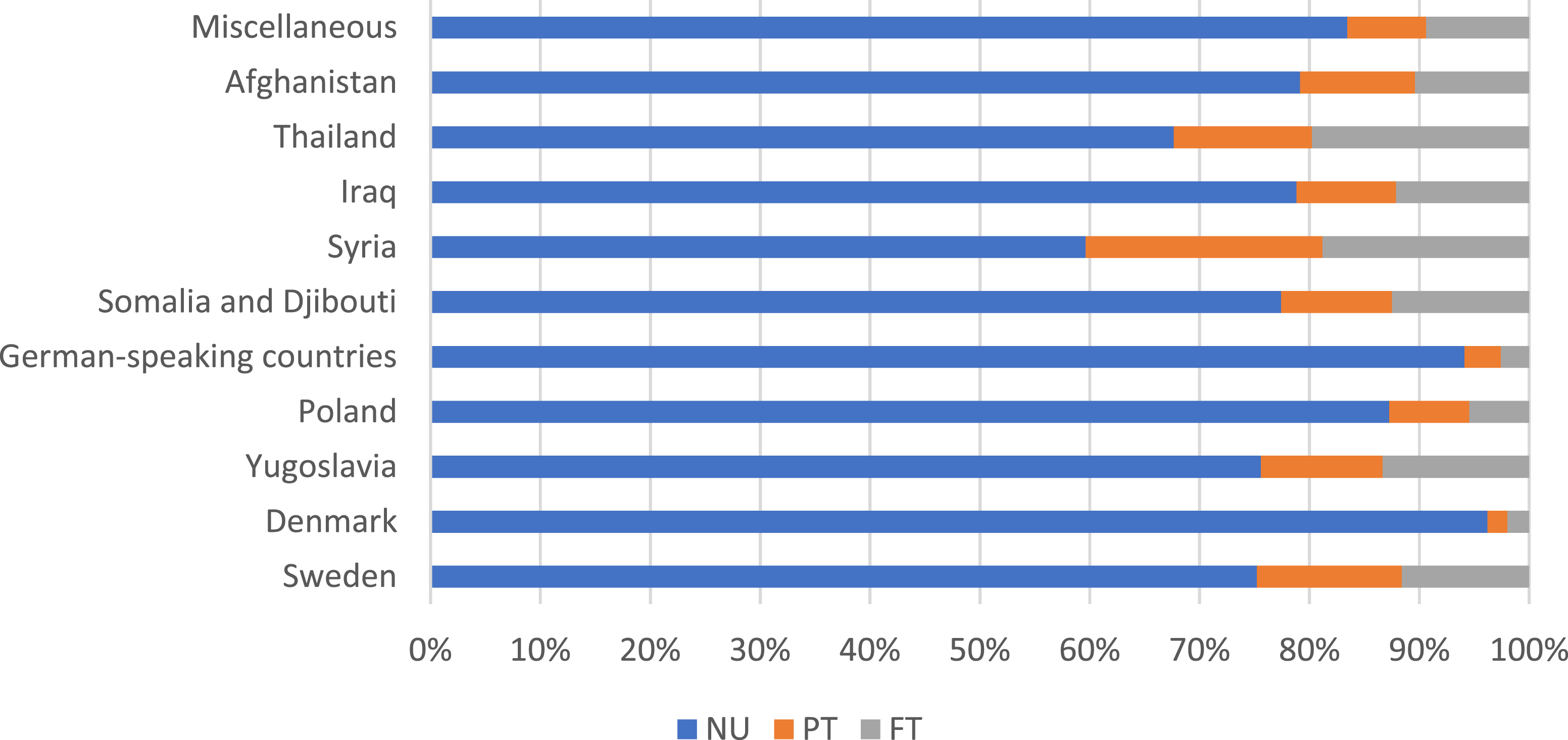
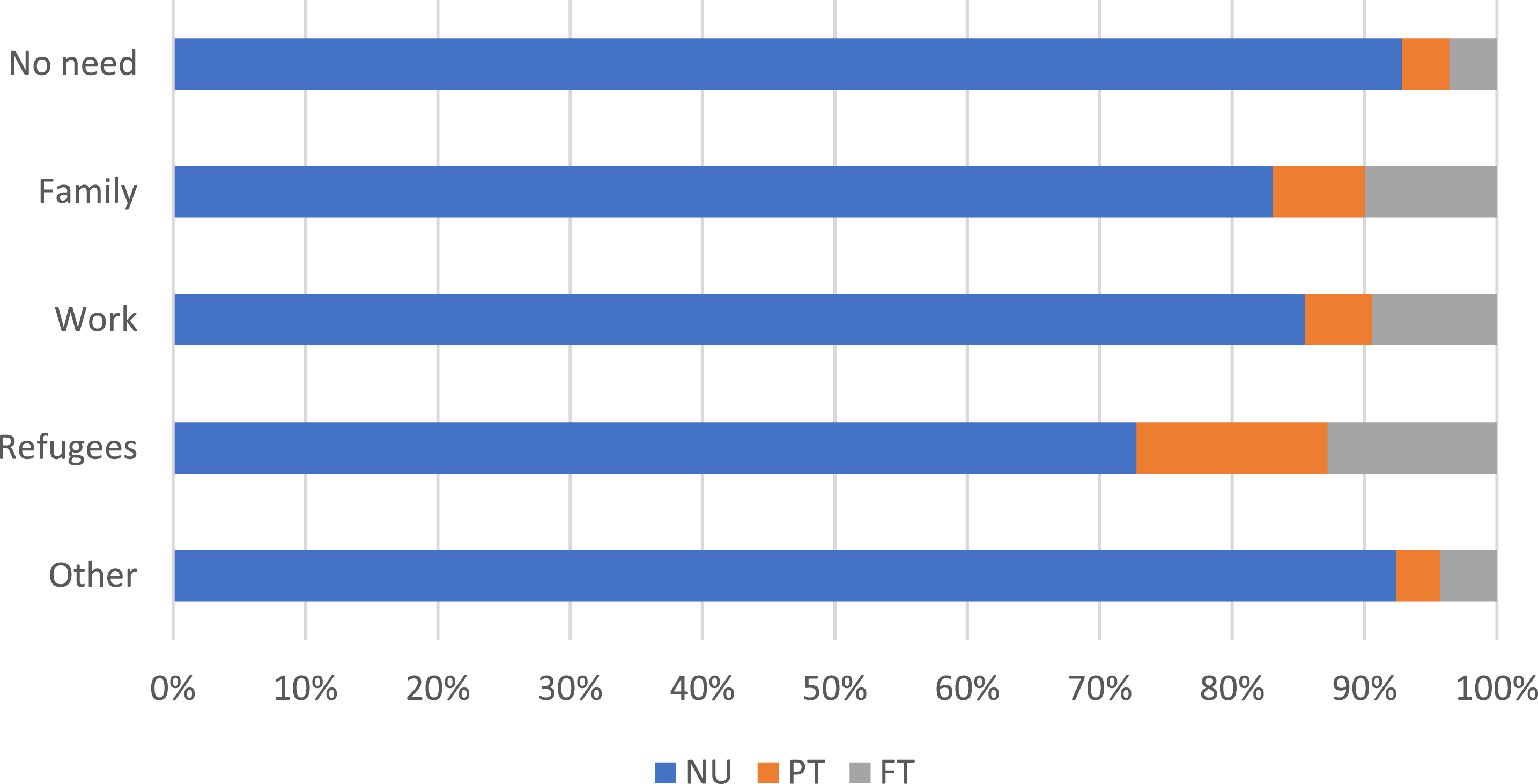
Figure 2 shows, looking only at foreign-born women, predicted probabilities of using parental leave by reason for residence permit. Women who do not need a residence permit seem to take very little parental leave, a result probably driven by immigrants from EU countries, for example, Denmark and German-speaking countries. A similar pattern is seen for women with an ‘other’ permit. The group which uses parental leave most often, particularly part-time, are those who come as refugees. Work and family immigrants do not take leave in 80 percent of the predicted cases, but if they do, they mainly take it full-time. One interpretation of this is that the reception of refugees is very different from work immigrants and they may more often be encouraged (by receiving authorities) to use parental leave upon arrival in Sweden.
Does the use of parental leave constitute an obstacle to future labour-market participation? First full year in Sweden
When we examine whether labour-market attachment during the first full year, that is, the second year in Sweden, differs between women who used parental leave benefit during the preceding year of arrival, we find that certain differences emerge.
Figure 3 shows the predicted probabilities of labour-market attachment by different uses of parental leave. In all groups, few women re-emigrate and just over one tenth have an additional child. Most women are inactive in the second year, but this is somewhat less the case among those who have used parental leave part-time (1–14 days a month). Predicted probability of labour-market activity the year after arrival, by parental leave use in the year of arrival. Source: Swedish administrative register data, compiled by the authors. Note: all models are controlled for country of birth, year of arrival, age of the youngest child, number of children at migration, civil status, father’s country of birth, mother’s age, and other benefits.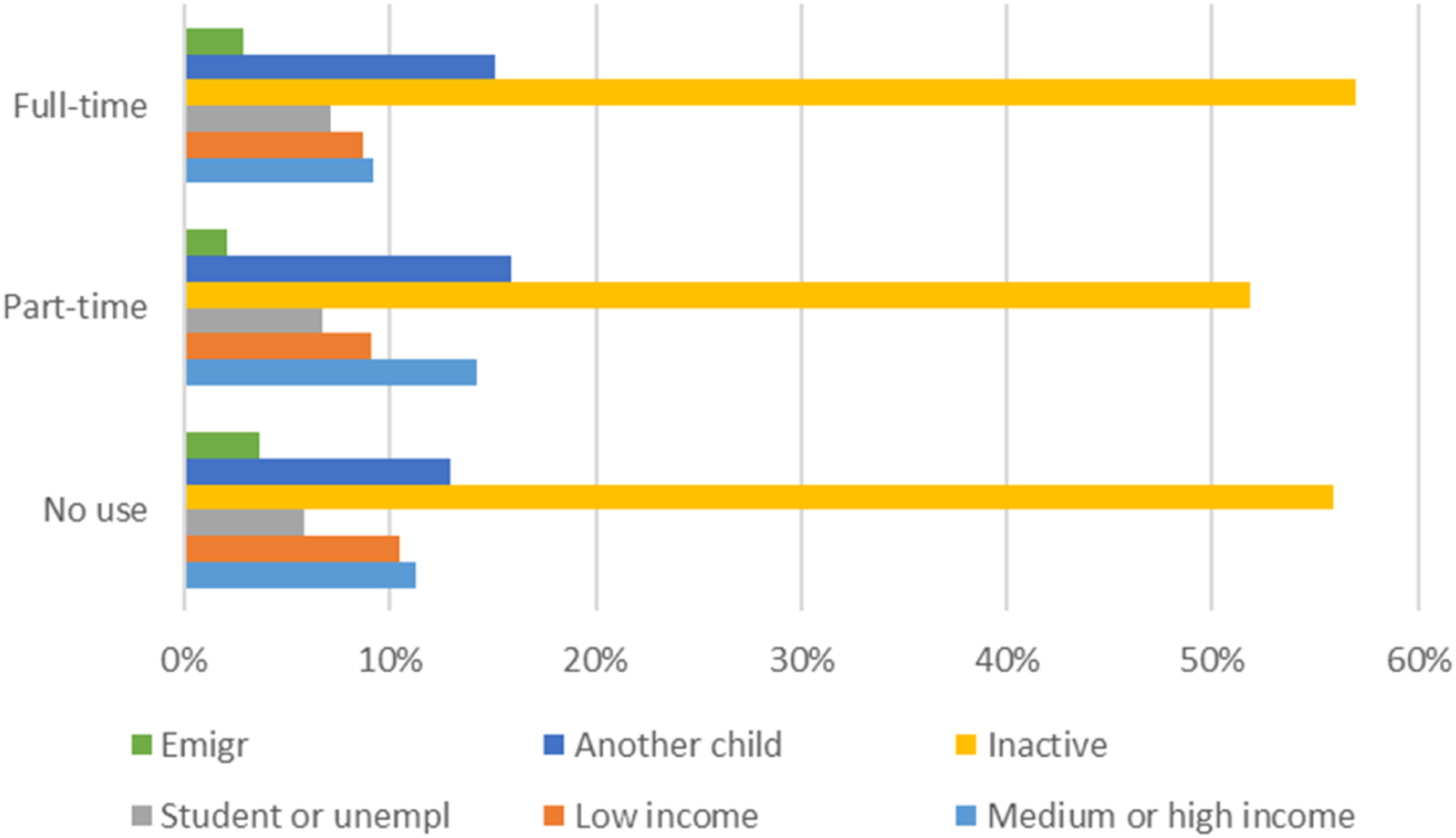
Our main interest is whether the use of parental leave delays employment or employment-related activities that can be considered a first step toward labour-market integration (studies, reported unemployment, or income), and we find that the differences between the groups with different leave uses are not large. Meanwhile, it is clear that those who used parental leave part-time during the first year have the greatest propensity for a medium or high income. Even though these differences are statistically significant, they are still marginal in size and we conclude that the use of parental leave benefit does not have a major impact on employment during the second year in Sweden.
When we compare the results regarding parental leave use by women from different countries of birth in Figure 4, it is striking that the patterns are quite different. Starting with the native-born women, it is hardly surprising that they typically have an income in their second year back in Sweden. Especially native-born women who took parental leave on a part-time basis are employed the following year. Predicted probability of labour-market activity the year after arrival, by parental leave use in the year of arrival and women’s country of birth. Source: Swedish administrative register data, compiled by the authors. Note: all models are controlled for year of arrival, age of the youngest child, number of children at migration, civil status, father’s country of birth, mother’s age, and other benefits. Labels: no use (NU), part-time use (PT), full-time use (FT).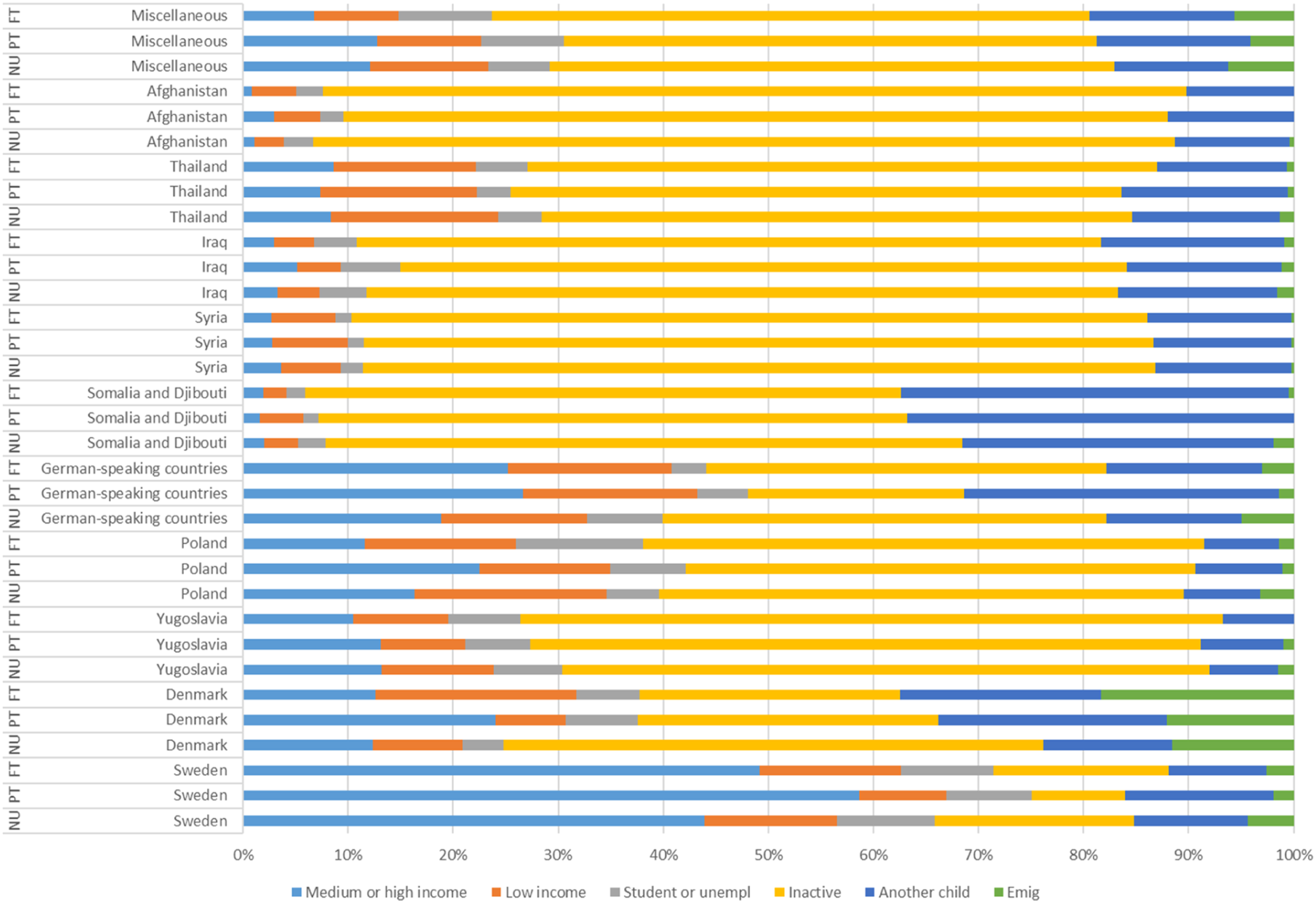
For women from both Denmark and German-speaking countries, it is those who have not taken parental leave at all who are most often inactive and have no income. Among these women, parental leave either full- or part-time tends to be associated with an income or studies. For women from Poland, the former Yugoslavia and Thailand, there are very small differences related to whether they have used parental benefits; but among women from Poland, most of those who have used parental leave part-time have an income the year after arrival.
Among women who come from Syria, only a very small proportion have an income or study during their second year in Sweden, and it does not seem to matter whether they have used parental leave. About 10 percent have an income or study during their second year in the country, and the same applies to women from Iraq, Afghanistan and Somalia. It can be pointed out that, among women from Iraq and Afghanistan, part-time users have a slightly higher tendency to have an income or study, the same pattern (but at a lower level) as among native-born women.
Interesting differences also emerge when we consider the reason for the immigrant women’s residence permits: see Figure 5. The associations with part-time use are quite similar across the group, with the exception of refugees (among whom, regardless of parental leave use, we see no differences in the outcomes) and women who came for work reasons. The latter have, on average, a higher income the year after arrival if they used parental leave part-time or not at all, but not if they were on full-time leave. For all the other groups, the probability of having a medium or high income is higher for women who used the leave part-time the year before. Predicted probability of labour-market activity the year after arrival, looking only at immigrant mothers, by parental leave use in the year of arrival and woman’s residence permit. Source: Swedish administrative register data, compiled by the authors. Note: all models are controlled for year of arrival, age of the youngest child, number of children at migration, civil status, father’s country of birth, mother’s age, and other benefits. Labels: no use (NU), part-time use (PT), full-time use (FT).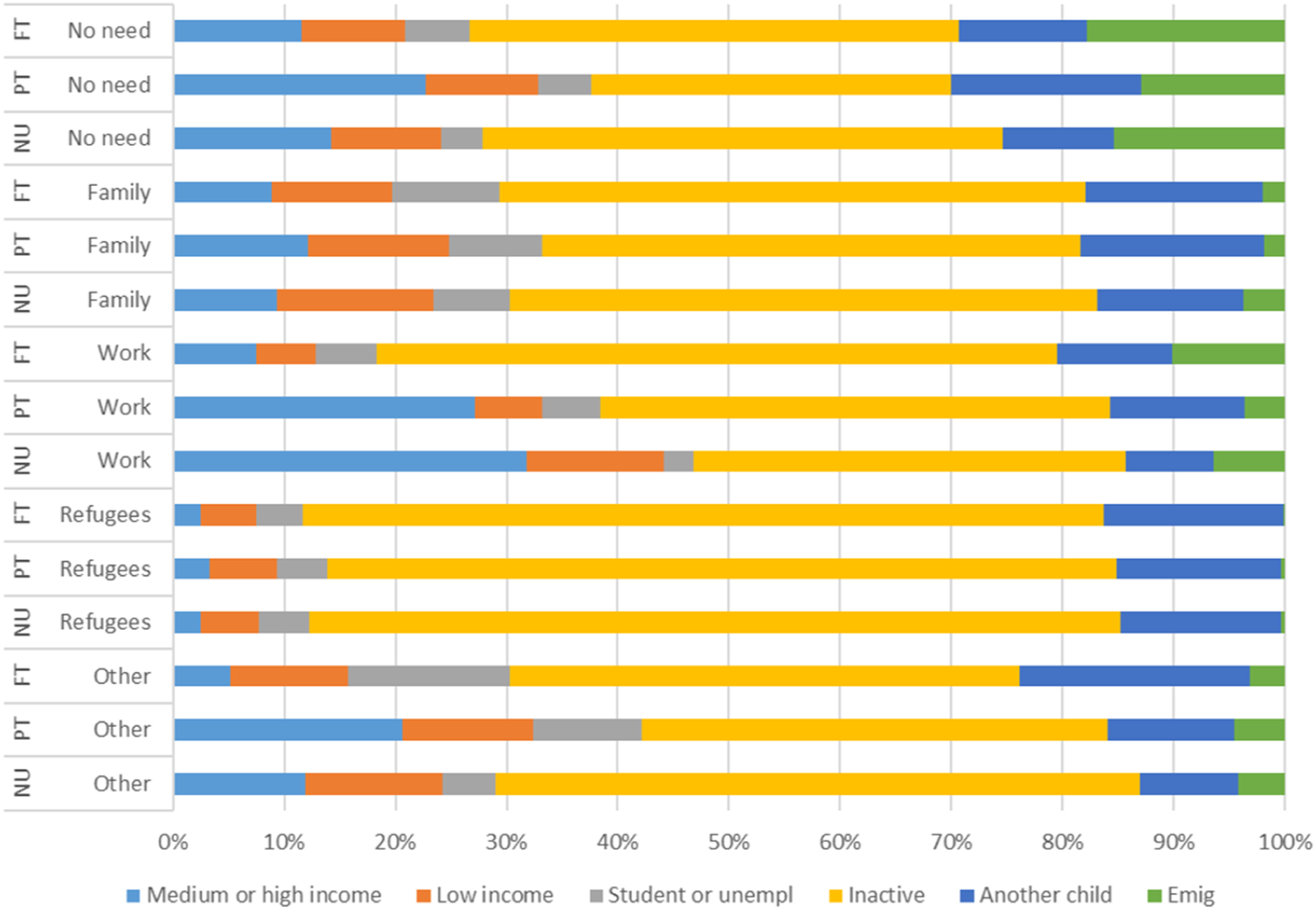
Second full year in Sweden
In the second full year, it is more common for women from all countries of birth to work or study, and for women from several countries we can see a clearer difference depending on whether they used parental leave in the first year. For women from most countries, it is those who have not used parental leave who are most often inactive, while women who have used parental leave tend to more often be studying or having an income during their second full year in Sweden (see Figure 6). Predicted probability of labour-market activity the second full year after arrival, by parental leave use in the year of arrival and woman’s country of birth. Source: Swedish administrative register data, compiled by the authors. Note: all models are controlled for year of arrival, age of the youngest child, number of children at migration, civil status, father’s country of birth, mother’s age, and other benefits. Labels: no use (NU), part-time use (PT), full-time use (FT).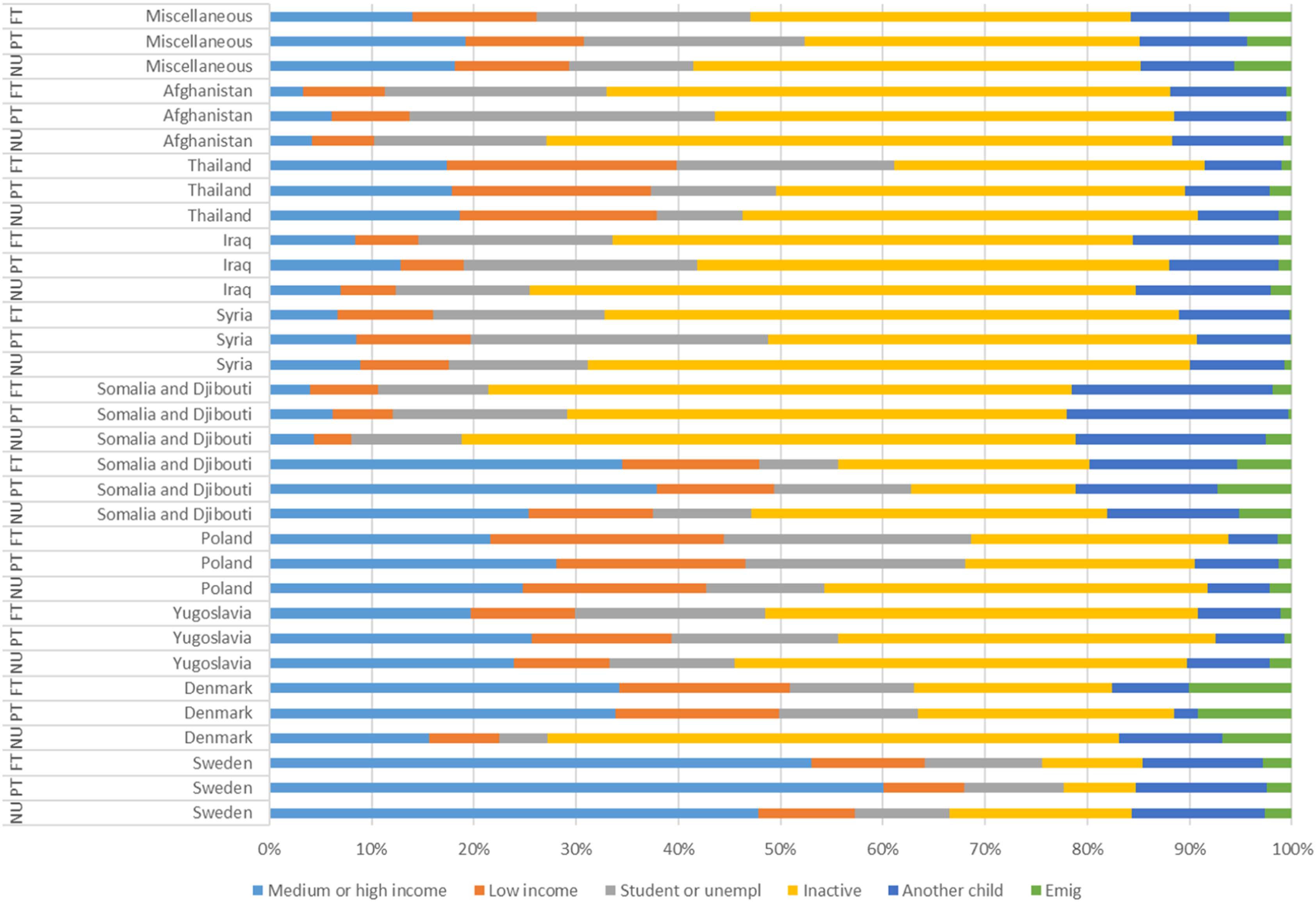
For native-born women, there is a difference of approximately 10% points in the probability of having a medium or high income when those who have not used parental leave are compared to those who have used it part-time. Among women from Denmark, German-speaking countries, and Poland, it is clear that those who have not used parental leave are more often inactive. Since these countries are geographically close to Sweden, in some cases it is possible that they have returned to their home countries without registering, which explains the inactivity in Sweden. Danish-born women in particular can also choose to use parental leave from Denmark while living in Sweden. Women from the former Yugoslavia and Thailand have an income slightly less often compared to women from other countries in Europe, but the differences are relatively small; and even for these groups, those who did not use parental leave in the first year are more often inactive. The proportion which has an income or who study is slightly smaller among women from Syria, Afghanistan, Iraq and Somalia, but for women from all these countries the pattern clearly indicates that those who have used parental leave part-time more often have an income or study during their second full year in Sweden.
In Figure 7, the effect of parental leave use is similar to that in the first full year in Sweden: women who did not use parental leave insurance in the year of arrival are more often inactive in the third year (i.e., the second full year in the country), except for those who came for work reasons. We conclude that the use of parental leave generally does not lead to poorer opportunities for earning an income or studying, or increase the likelihood of unemployment.
8
Predicted probability of labour-market activity the second full year only, looking at immigrant mothers, by parental leave use in the year of arrival and women’s residence permit. Source: Swedish administrative register data, compiled by the authors. Note: all models are controlled for year of arrival, age of the youngest child, number of children at migration, civil status, father’s country of birth, mother’s age, and other benefits. Labels: no use (NU), part-time use (PT), full-time use (FT).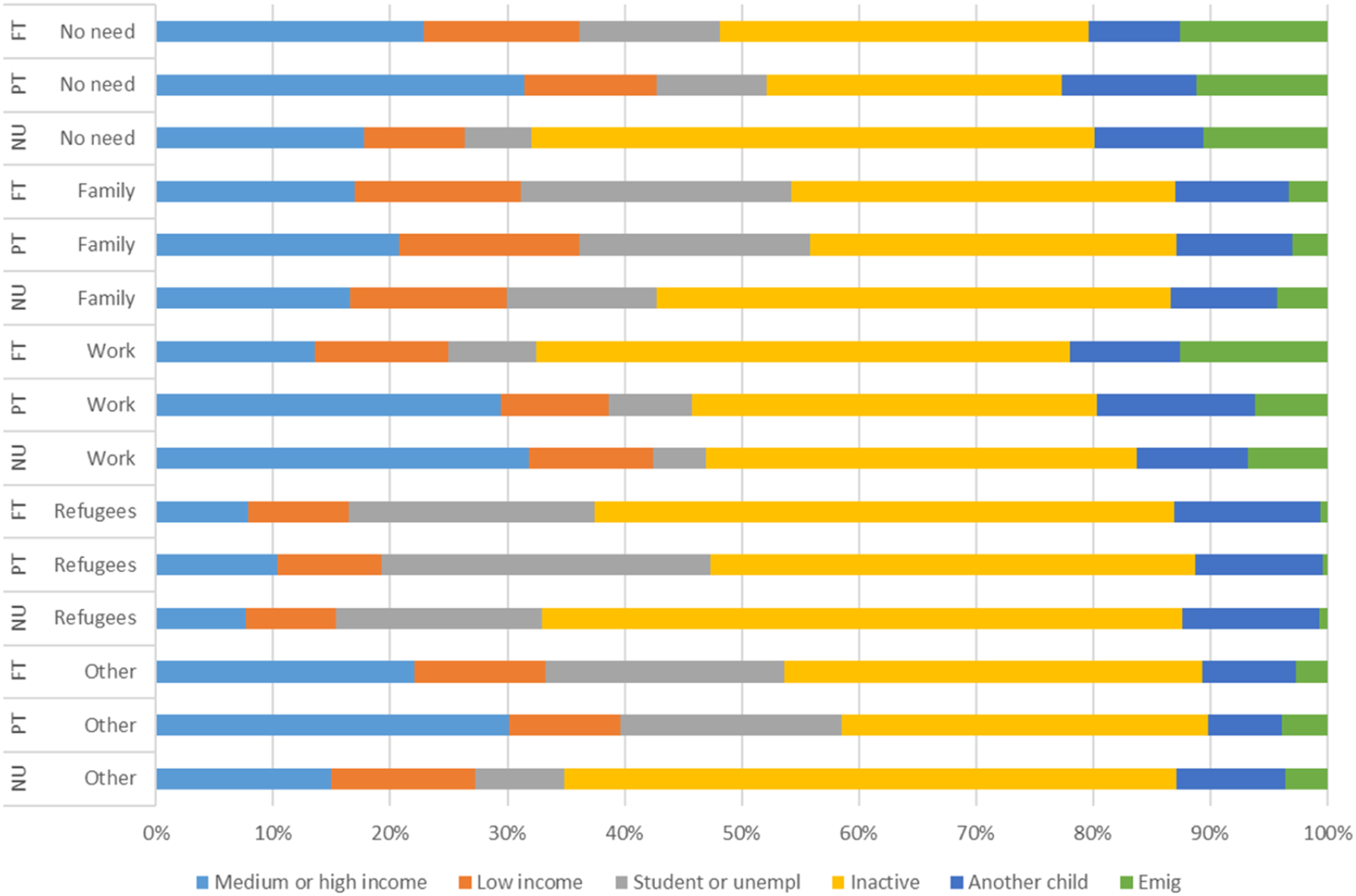
Conclusion
In Sweden, until 2016, the offer of parental leave for children born abroad was very generous. Immigrants who arrived with children of preschool age had access to the entire parental leave period that usually goes to parents of newborns. In the short term, it is financially advantageous for municipalities to encourage immigrant parents to use parental leave instead of enrolling them in integration programmes or providing social welfare. The reason for this is that the parental leave is paid at the national level, but social welfare, integration programmes, and preschool are all paid at the local level. It has also been highlighted that, for this reason, parental leave can become an obstacle, impeding labour-market integration. Such an unintended consequence of a generous parental leave policy aimed at facilitating the combination of work and family, may thus disadvantage certain groups. In 2017 the parental leave was reformed to include age restrictions. For children arriving after their first birthday, 200 days can be used, and for those arriving after their second birthday, 100 days can be used (proposition 2016/17: 154). These numbers of days could be compared to the 480 days that parents of children born in Sweden get to share. We argue that, even though the legislation has changed, it is important to determine whether parental leave actually has hindered labour-market integration. Such knowledge is important for the future construction of family and labour-market policy, especially such that is targeted at immigrants. This could indicate whether an extended period at home before labour-market integration may have consequences in the long run. Here we explored how parental leave is used the year of migration, and how such use is associated with labour-market-related activities in the years that follow.
We find that parental leave use is polarized, with a large proportion of mothers not using it. Furthermore, our analysis shows that some groups who arrive with preschool children – especially immigrant mothers from Syria, Somalia and Thailand – use parental leave more often than others, but that native-born mothers also use parental leave often. We also find clear differences in use by residence permit: in particular, we find that refugees have a higher use of parental leave. One possible reason for this is that different groups of immigrants have a very different reception in Sweden. Refugees are more likely to get information and advice from receiving civil servants on the local level, and they may more often direct the mothers to parental leave use. When we examine who uses parental leave in the first years by country of birth, it is important to remember that women in different groups come to Sweden with different knowledge and conditions for making active choices regarding the use of parental leave. It was not the focus of this study, but we also find that the risk to not taking any leave is decreasing over the investigated time period (1995–2014) and use of full-time parental leave is increasing, particularly during the early 2000s (Table A2).
Our study finds that parental leave use plays a relatively small role in future labour-market activity. However, part-time use (1–14 days a month), is most often associated with having an income or studying in the following years. This confirms the notion that short periods outside the labour market may not always be detrimental to future employment (Fuller, 2015; Fuller and Martin, 2012). We interpret the results to indicate that part-time use of parental leave means contact with Swedish society, and that these immigrant mothers may get help and contacts during their first period in the country. If this time is spent in training or language acquisition, it may facilitate future employment.
Great differences in employment are found between women from different countries of birth, regardless of whether they have used parental leave. This does not contradict what previous studies have shown (e.g., Vikman, 2013). However, this study shows that although extensive parental leave may be related to later work, the effect does not seem to be crucial.
It is possible that the use of parental leave here indicates that these women received information about social insurance and other benefits in Sweden, and this might indicate that they also received other information that leads to activities that facilitate labour-market entry. If this is true, the parental leave insurance has mostly served as a buffer for support during the initial period of orientation in the country.
Full-time parental leave use, however, tends to be associated with a slightly higher probability of inactivity in following years. It is possible that those who do not use parental leave have not received information about their right to take leave and are thus distanced from access to national social insurance as well as measures for labour-market integration.
Unfortunately, our data did not capture the recent restrictions of parental leave days for foreign-born children. However, given the results in our analysis, we can expect minimal, or no, impact on labour-market integration due to this policy change. While this is not an argument against the restriction in the policy, our results urge policymakers to look at other reasons for the poor integration of immigrant mothers – and to actually include specific support for women who come to the country with preschool children, for two reasons: the unintended generosity of the parental leave is not a reason for the difficulties with integration into the labour market; and part-time use actually seems to be beneficial. Part-time parental leave might both unintentionally limit access to preschool for newly arrived children and act as a buffer in the individual situation, as neither child nor parent is ready to start preschool or work. We see that, during the first year in the country, parental leave is used by different groups of women, not only those with preschool children or those from countries that can be assumed to face a more difficult labour market. The differences between whether or not a woman has used parental leave are not dramatic, and it is likely that a certain type of flexibility benefits a situation in which adjustment can take time. It may be that extra days are required for a smooth start in preschool; perhaps it takes a few months before one can begin work. It can be discussed whether this financial flexibility at the beginning of a life in Sweden should be part of the parental leave insurance, but from a child’s perspective some available parental leave may cover the child’s needs that may show up in unpredictable ways. The days that are now available depending on the child’s age may be sufficiently flexible here.
Additionally, since most women who immigrate with children receive compensation at the flat rate, it was also possible that a parent, usually the mother, used the whole parental leave because the reserved months did not apply in this case. An unintended consequence of this is that women who receive the flat rate benefit can be on parental leave for a longer time than women who receive income-related compensation. Thus, in most cases, women who immigrated with children of preschool age received longer leave because they can use the part usually reserved for the other parent, currently 3 months. This resulted in the group which receives the lowest compensation having more decision making over how the parental leave benefit is distributed, compared to parents who receive income-related compensation. It is precisely these women with poor labour-market connections who are served by a more gender-equal distribution of responsibility for both the children and the household finances. We see a certain increased risk of inactivity among women who have taken a great deal of parental leave benefit, indicating potentially negative effects of exclusion in the long term.
While this study contributes to an underexplored aspect of the research on family policy and integration of migrants, some limitations must be taken into consideration when evaluating our results. First, we unfortunately have annual information of the parental leave uptake, from which we estimate a monthly estimate of parental leave uptake. Second, labour-market attachment is measured in terms of annual level of earned income, studying or being unemployed and this gives only a partial picture of difficulties that immigrants experience in the labour-market. This limits the flexibility of our analysis, as discussed in the data and method section.
Future research should utilize the data at hand, and also, when possible, make use of more detailed data that in some cases is available from the administrative registers. Such work is ongoing regarding parental leave in Sweden, and we look forward to future more nuanced and detailed studies.
Despite these limitations, this study shows that family and labour-market policies are closely linked to each other and should be studied, discussed, evaluated and developed together. It is unfortunate if family policy generates effects that run counter to the objectives of labour-market policy. An extended period at home without establishment efforts or the possibility for integration activities should be avoided. Here, long parental leave can be a danger. However, a slight buffer, in order to ensure an extra margin during the vulnerable initial time in a new country, can make the possibilities for integration greater in the long run.
Our conclusion is that globalization and international migration are posing challenges to the Swedish welfare states, and not least the family policy. The welfare state idea of inclusion of the full population is challenged by the need to attend to the heterogeneity of both needs and behaviour in the current society. Sweden is still in a state of recognizing the heterogeneity of its present population while not limiting entitlement and social rights to specific segments. While figuring out how to adapt the welfare state to a new situation, the political aim is still to keep the fundamental ideas of the family policy: gender equality, labour-market integration and reduced poverty. Whether this can be achieved at the same time within the parental leave insurance remains to be seen and further studies are certainly needed.
Supplemental Material
Supplemental Material - Parental leave use among newly arrived immigrant mothers in Sweden: Causes and consequences
Supplemental Material for Parental leave use among newly arrived immigrant mothers in Sweden: causes Causes and consequences by Eleonora Mussino and Ann-Zofie Duvander in Journal of European Social Policy.
Footnotes
Declaration of conflicting interests
The author(s) declared no potential conflicts of interest with respect to the research, authorship, and/or publication of this article.
Funding
The author(s) disclosed receipt of the following financial support for the research, authorship, and/or publication of this article: The authors are grateful for financial support from the Swedish Research Council for Health, Working Life and Welfare (FORTE), grant numbers: 2016-07105, 2018-00310 and 2023-00438. Financial support was also received from Swedish Foundation for Humanities and Social Sciences (Riksbankens Jubileumsfond), grant registration number M18-0214:1.

Supplemental Material
Supplemental material for this article is available online.
Notes
References
Supplementary Material
Please find the following supplemental material available below.
For Open Access articles published under a Creative Commons License, all supplemental material carries the same license as the article it is associated with.
For non-Open Access articles published, all supplemental material carries a non-exclusive license, and permission requests for re-use of supplemental material or any part of supplemental material shall be sent directly to the copyright owner as specified in the copyright notice associated with the article.
