




Abstract
Although social investment has become an increasingly important topic in the welfare policy discourse, reform efforts are stalling in many contexts. We examine whether labour unions and their members may be one factor contributing to the varying implementation across countries. In particular, we focus on the difference in the policy attitudes of union members and non-members. Using a new comparative survey, we investigate how union member attitudes toward social investment and classic compensatory policy differ from those of non-members, and how these differences vary across countries. We find that union members appear to be lukewarm supporters: even though union members are generally supportive of social investment policies, they tend to support compensatory policies even more. We also find cross-national variation in these associations, for which we provide some tentative explanations.
Keywords
Introduction
In recent years, political support for the transformation of European welfare states from a traditional, transfer-oriented model towards a more activating, future-oriented social investment model has been growing across countries (Bonoli, 2013; Busemeyer et al., 2018a; Garritzmann et al., 2018; Hemerijck, 2013, 2018; Morel et al., 2012). However, when it comes to concrete reform efforts, the transition from the traditional towards the social investment welfare state has often met political resistance (De la Porte and Jacobsson, 2012; Nikolai, 2012). In this article, we explore the question of whether labour unions and their members, in particular, might be one factor contributing to the varying political success of the social investment welfare state across countries. Unions have historically played a crucial role in the construction and expansion of the welfare state (e.g. Calmfors et al., 2001; Esping-Andersen, 1990). Given their attachment to the traditional welfare state, unions and their members might be less inclined to support the full-scale transformation towards the social investment model.
In spite of declining membership across the board during the last decades, unions still represent a sizable number of citizens and thus remain a potentially important actor in the politics of the welfare state. As unions are generally voluntary and democratic membership organizations, union positions and their behaviour are ultimately driven by the preferences of their members. Therefore, in this article, we study to what extent union membership is associated with support for social investment (SI) policies on the one hand or rather more traditional compensatory policies (CP) on the other. While research on unions and the welfare state in the past is abundant (see below), there is little research focusing on their current role in the politics of welfare state reform, in particular with regard to the question of whether they support the turn towards the social investment welfare state or whether they defend the traditional, transfer-oriented model.
This article contributes to filling this gap by addressing two specific research questions. First, we ask to what extent the attitudes of union members and non-members differ with regard to support for CP and SI. Second, we study how the association between union membership and support for different kinds of social policies varies across countries as well as union types (private and public sector unions). We address these questions by analysing data from the INVEDUC survey (Busemeyer et al., 2018b) – a representative survey of public opinion on education and SI policies, conducted in eight European countries in 2014. In contrast to other comparative social surveys, this survey has the advantage of including a battery of questions explicitly aimed at capturing social investment and compensatory welfare policy attitudes, thus providing us with a much more encompassing measure of support for SI than previously available.
Our main results suggest that union members are rather ‘lukewarm supporters’ of the SI model of the welfare state. On the one hand, we find evidence that union members are more supportive of SI than non-union members, controlling for a range of other factors. On the other hand, support for traditional CP is usually higher among union members than support for SI. We also find evidence for variation of the association between union membership and SI/CP support across countries, but this variation does not seem to follow a clear pattern, although we provide some tentative explanations.
The remainder of the article proceeds as follows: we briefly review existing literature on unions and union members in the welfare state, as well as literature on union member preferences. Subsequently, we introduce and discuss our theoretical framework and our expectations with regard to union member preferences and their relation to country contexts and union type. We go on to present the INVEDUC data set and our methodology, followed by the results and a concluding section.
Existing literature on unions and union members in the welfare state
The classic welfare state literature considers unions as one of the major forces in the construction and expansion of the welfare state (e.g. Calmfors et al., 2001; Huber and Stehphens, 2001; Esping-Andersen, 1990). In particular, power resource theory (PRT) regards strong unions as the ultimate driving force behind the expansion of the welfare state (Korpi, 1983, 2006; Stephens, 1979). More recent work demonstrates that systems of industrial relations remain deeply intertwined with welfare state policies and politics, indicating the continued importance of unions in social policy (Ibsen and Thelen, 2017; Trampusch, 2007). However, scholarship in this tradition remains very much at the macro level, basically assuming a shared interest among union members for greater redistribution and equality, while neglecting potential variation in union members’ preferences across union types and time.
Our article therefore aims at developing a better understanding of the attitudes and preferences of union members regarding priorities in welfare state policymaking. Our focus here is on the question of how union members perceive the recent transformation of many welfare states towards the social investment model (Hemerijck, 2018; Morel et al., 2012). Given the wealth of scholarship on the role of unions in traditional welfare state research, there is a surprising lack of studies that explore the association between unions and SI policies. Tepe and Vanhuysse (2013), for example, find a strong positive association between union density and public spending on active labour market policy. Similarly, Wolf (2009) finds a positive relationship between union powers and public education spending. Gordon (2015) shows how ‘inclusive unionism’ is associated with both more generous unemployment insurance schemes as well as higher spending on active labour market policies. While this research indicates that unions are still a relevant actor in the welfare state, it does not provide an idea of unions’ role in SI policies more broadly conceived. Moreover, the authors do not take into account the preferences of members in their main empirical analysis, although Gordon (2015) and Tepe and Vanhuysse (2013) actually point to the importance of the micro level of preferences in their theoretical arguments.
Related to the last point, our analysis builds on and extends a small literature that studies policy preferences among union members, as compared to non-members. For instance, research shows that union membership is positively related to support for redistribution (Checchi et al., 2010; Mosimann and Pontusson, 2017), positive views on immigration (Donnelly, 2015), as well as support of trade restrictions
(Kim and Margalit, 2016), among other things. Using a similar research design to ours in this article, Lynch and Myrskylä (2009) find a positive association between union membership and support for pension expenditure, which varies in strength across countries.
Regarding the nature of the association between union membership and preferences there is an ongoing debate about the direction of causality and the role of self-selection, that is, does union membership actually change member preferences or are certain individuals with particular attitudes more likely to become union members in the first place. Most of the studies in this domain – including our own in this article – use observational and often cross-sectional data; hence, no strong claims about causality can be made, given the limitations of this kind of data. The study by Kim and Margalit (2016) probably comes closest to a natural experiment by exploiting variation in the legal framework for joining a union across the US states, which allows them to make a causal statement about the influence of union membership on policy views. Mosimann and Pontusson (2017) also claim an effect of union membership on support for redistribution, although using observational data. In contrast, another strand of research argues the opposite, namely that subscribing to particular attitudes (egalitarian values) influences the likelihood of becoming a union member (Checchi et al., 2010; Hadziabdic, 2016). Schnabel (2013) argues that individuals with liberal, post-materialist and individualistic values, which are more prevalent among the young, seem to be less likely to become union members, which contributes to declining union membership rates over time. All in all, the literature does not present clear-cut evidence one way or another, and therefore in this article, we adopt a pragmatic, but also conservative approach by pointing out the correlates of union membership in terms of attitudes without making strong claims about causality.
Even though the number of articles that explicitly focus on the association between union membership and preferences or attitudes is limited, quite a few researchers have included it as a control variable when investigating welfare policy or redistribution preferences more generally. While many of them find a significant positive relation between union membership and preferences for, for example, redistribution (Checchi et al., 2010; Finseraas, 2009; Kitschelt and Rehm, 2014; Rehm, 2009), it is seldom analysed further or theorized. Our article takes up this challenge by theorizing about the potential effect of union membership on support for compensatory and SI policies.
Theoretical framework
Union members’ attitudes towards social investment and compensatory policies
Unions are intermediary associations, located between the demands of citizens, workers and individuals on the one hand and political policymaking elites on the other (Ebbinghaus and Naumann, 2018). As participants in the policymaking process, they represent their members’ interests in protecting workers’ rights and expanding or at least maintaining the welfare state (Hyman, 2001: 38ff.; Schulze, 2012: 15ff.). As partners in collective wage bargaining, they aim to influence the primary distribution of wages in the labour market (Hyman, 2001: 38ff.; Trampusch, 2007). In their efforts, they need to balance the interests of their members (as well as different sub-groups in their membership) with strategic concerns of the union leadership aimed at maximizing the influence of unions in the decision-making process. Even though we are aware of the complexities regarding the relationship between unions’ membership base and union leadership (Baccaro and Simoni, 2010), we focus in this article on exploring the variation of social policy attitudes, comparing union members with non-members as well as members of different kinds of unions.
This is important for two reasons. First, even if the difference is exclusively due to self-selection, attitudinal differences between union members and non-members would still have political consequences as unions as intermediary organizations bundle and amplify their members’ interests, while non-members have a harder time getting heard in the political process. The mechanism through which welfare preferences are assumed to influence politics and policy outcomes in democracies is often via elections (cf. Persson and Tabellini, 2000), yet organized interests, such as unions, present an additional channel. Unions can influence decision-making via lobbying, campaigns, corporatist decision-making structures or strikes (see, e.g. Calmfors et al., 2001; Hyman, 2001: 38ff.; Kreft, 2006). To the extent that unions selectively represent the interests of their members, union members thus possess an additional potential channel of influence compared to regular voters and non-members (Ebbinghaus and Naumann, 2018).
Second, if there is also a causal component to the association between union membership and welfare policy preferences, there is an additional motivation for investigating these differences: unions may then not only play a role in translating members’ preferences into policies, but also actively shape and influence these preferences themselves. Unions as organizations have incentives to influence their members’ attitudes and, ultimately, political behaviour, in order to recruit and retain members as well as in order to wield influence, for example, by mobilizing voters. 1 Moreover, unions constitute social groups in which certain types of people interact and these interactions may further contribute to shaping preferences. As a social network, unions encourage norms and set social incentives for members to get involved politically. As information providers, unions (and union leaders in particular) actively try to forge a set of coherent policy preferences among members (Mosimann and Pontusson, 2017; Kim and Margalit, 2016).
Building on the existing literature cited above, a generic expectation is that union members should be more supportive of expansive welfare state policies compared to non-members, controlling for other individual determinants of welfare state support. Once we move beyond the above cited literature and look at a more differentiated set of welfare state attitudes, distinguishing between attitudes towards CP and SI policies, the theoretical expectations are less clear-cut.
For CP, the association is still rather straightforward. Union members’ characteristics lead them to be likely to benefit from CP, with some degree of variation depending on individual risk exposure and labour market position. Union members are typically in more or less stable employment and increasingly rather old, meaning that they should profit from more generous pension policies and other social transfers related to old age. They should also be in favour of status-preserving unemployment benefits, at least to the extent that unions increasingly represent labour market insiders and middle-class workers, as is frequently claimed (e.g. Jensen, 2020; Rueda, 2007).
With regard to SI, expectations are harder to formulate. On the one hand, compared to traditional transfer policies (such as unemployment benefits and pensions), the effects of typical SI policies such as investing in early childhood education, universities or family policies on labour market outcomes are more long term in nature and potentially less redistributive (Cantillon, 2011; Pavolini and Van Lancker, 2018). Furthermore, SI policies benefit predominantly younger people, families with children and women – and union members tend to be increasingly old and – on average – male, even though this differs greatly across unions and countries (Visser, 2019). Moreover, in times of tight budgets, SI policies are likely to compete with CP for funding and thus more expenditure on one type of policy may come at the expense of the other (Busemeyer and Garritzmann, 2017).
On the other hand, SI policies are still part and parcel of the universal welfare state model and can have significant positive effects on redistribution, at least in the long run. Furthermore, some types of SI, in particular active labour market policies and lifelong learning, are of direct material relevance for union members as well. Finally, as already argued by Boix (1998), SI policies that aim at equalizing resources on the supply-side of the labour market are more likely to withstand the pressures of globalization compared to traditional demand-side oriented transfer policies.
Further, it is important to distinguish between skill-enhancing SI policies on the one hand and workfare policies on the other, which primarily rely on work incentives that prioritize labour market participation above other goals (Bonoli, 2013: 18ff.). Concerning workfare policies, expectations for union member attitudes are quite clear: union members should tend to oppose workfare measures more than non-members since they might either be opposed to these measures for ideological reasons or directly and negatively affected by them.
In sum, our core hypothesis is that there should be a clearly positive association between union membership and support for CP, a clearly negative association between membership and support for workfare policies, and a less clear, but still positive association between membership and support for SI policies (Hypothesis 1). In short, we argue (and expect) that union members are certainly supportive of SI policies, but compared to CP, this support is rather lukewarm and less enthusiastic.
Differences across union movements and union types
In the previous section, we developed a broad argument about the association between union membership and social preferences, independent of context. We are, of course, aware that this is a simplifying assumption and that there is a significant degree of variation in terms of country contexts as well as union types.
Starting with different union types, we explore – given the limitations of the data – the potential difference between public and private sector unions. Compared to private sector workers, public sector employees tend to be in relatively privileged labour market positions, concerning employment security and income (Oesch, 2006). Furthermore, since many public sector employees work in the provision of welfare, educational and other social services, public sector union members have a direct material interest in the expansion of the welfare state, and in particular its social investment pillar since this is more personnel-intensive compared to transfer policies. Hence, we expect union membership in unions in the public sector to be more strongly related to SI support than those in the private sector (Hypothesis 2).
Regarding differences of unions across countries, we focus on different characteristics of union movements and the welfare state context. The survey data used in this article only covers eight Western European countries; hence, our cross-country analysis has to remain somewhat exploratory. In countries with strong union movements, combining high levels of union density with a high degree of centralization, union members should be less concerned about a potential trade-off between CP and SI policies since they have the political power and influence to demand both. In countries with weaker and less encompassing unions, in contrast, members could be more concerned about policies with immediate implications for the labour market, that is, support for CP among union members should be higher than for SI policies.
To some extent, welfare state regimes, of course, go along with differences in union strength. Still, there is leeway for varying expectations, depending on the welfare state status quo. For instance, in countries in which SI policies are already well developed, there could be less demand for a further expansion of these policies, including less demand among union members. This kind of saturation effect might be felt more quickly for union members compared to non-members, since the former are hypothesized to be lukewarm supporters of SI policies, but enthusiastic supporters of CP (see above), leading them to think of SI policies as being sufficient at a lower level. Furthermore, we expect that support for CP among union members should be higher in those countries in which unions are deeply entrenched in the administrative architecture of the welfare state, that is, in the corporatist/conservative welfare states of Continental Europe. Overall, even though we can formulate some reasonable theoretical expectations regarding variation across countries, this issue is too complex and exploratory to be able to formulate a clear-cut hypothesis; hence, we refrain from formulating an explicit hypothesis here and approach this issue more in an exploratory manner in the analysis.
Empirical analysis
Data and methods
In order to investigate the research questions discussed above, data on the preferences of individuals with regard to SI and CP is needed. While several surveys include questions on specific policies that can be seen as belonging to either type, most surveys do not include questions that measure support for these two policy types more generally. The exception is the INVEDUC survey (Busemeyer et al., 2018b) which we use in this article. The survey includes a set of questions on attitudes towards several policies (or rather policy reform proposals) which can be related to the different types of policies (social investment, compensatory policies and workfare). It also contains a second set of questions on preferences for public spending in different areas of the welfare state, which also allows for a distinction to be made between SI and CP spending items. The survey was conducted in 2014, in eight European countries (Sweden, Denmark, Great Britain, Ireland, Germany, France, Spain, and Italy) and includes a total of 8,905 observations. Further details can be found in Busemeyer et al. (2018b).
Our first set of dependent variables are composite indicators for an individual’s support for SI, CP and workfare policies. These indicators are constructed by conducting a factor analysis of a set of variables measuring support for different policies, based on the following question: Governments and political leaders like to propose new policy reforms in order to address important social issues. Please indicate whether you would strongly agree, agree, neither agree nor disagree, disagree or strongly disagree with the following reform proposals:
Giving the unemployed more time and opportunities to improve their qualification before they are required to accept a job.
Expanding access to early childhood education and improving its quality.
Investing more money in university education and research at universities.
Forcing the unemployed to accept a job quickly, even if it is not as good as their previous job.
Increasing old age pensions to a higher degree than wages.
Lowering the statutory retirement age and facilitating early retirement.
Factor analysis reveals that support for different policies does indeed cluster along three dimensions: SI, CP, and workfare (WF) policies (Garritzmann et al., 2018). The first three items (investing in labour market training, expanding early childcare, investing in universities) load heavily and positively on the SI factor, as expected. CP is represented by the items on increasing old age pensions (item 5) and facilitating early retirement (item 6). The workfare factor is mostly defined by strong agreement with item 4 (forcing unemployed workers to accept jobs), but also loads negatively on the first item (Table 3 in the Supplemental Appendix displays the Eigenvalues and the rotated factor loadings). We use the three rotated factor loadings, SI, CP, and WF, as our main dependent variables in the subsequent analyses. In order to look at differences between different types of SI and CP we also investigate models with the separate variables which underlie the composite indicator as dependent variables. In the latter case, we transform the 5-point scale of agreement into a binary indicator of agreement vs. indifference and non-agreement.
As mentioned above, we also employ a set of questions asking for spending preferences on different policy areas as dependent variables in order to probe the robustness of our findings. The wording of this question is:
In the following, I will name several areas of government activity. Please tell me whether you would like to see more or less government spending in each area. Keep in mind that ‘more’ or ‘much more’ might require a tax increase.
These areas include unemployment benefits, old age pensions, financial support for families, education, and labour market and public employment programmes, which are relevant for our research question here. Responses to this question were measured on a 5-point Likert scale (much more, more, the same as now, less, much less spending). We transform this ordinal variable into a binary dummy indicating support for much more or more spending on the one hand and the same as now or less spending on the other.
Our main explanatory variable is an indicator for whether someone is a union member. Unfortunately, as almost all surveys that include a question on union membership, the survey does not ask which union or what type of union someone is a member of. In order to distinguish at least roughly between different types of unions we include an indicator for whether someone works in the public or the private sector, which is explicitly asked in the questionnaire.
Further explanatory variables are measures of material and ideological characteristics such as the respondent’s age, income, employment status, whether there is a child in the household, education level, and gender. With regard to ideological predispositions, we look at general social spending preferences, and at the economic left–right dimension as well as at the social values (Green-Alternative-Libertarian–Traditional-Authoritarian-Nationalist, GAL–TAN) dimension. The latter indicators are constructed using a number of items that tap into attitudes, following the approach of Garritzmann et al. (2018).
For our composite dependent variable, we run linear OLS regressions, which include country dummies in order to take into account country-specific confounders. For our other dependent variables, we estimate logit regressions, also including country dummies. To get an idea about how the relation between union membership and welfare preferences varies across countries we estimate separate regressions for the eight countries. In order to investigate the difference between public and private sector unions we include an interaction between the public sector variable and union membership.
Results
Union member attitudes towards social investment and compensatory policy
Turning first to our composite dependent variables, our descriptive findings show that the overall support varies for the different policy fields: on average around 70% of respondents support SI reforms (i.e. they agree or agree strongly with the above mentioned reforms), while the support for CP is around 40% (see Figures 3–5 in the Supplemental Appendix). The variation between countries is markedly greater in the case of CP, SI policies are popular in all country contexts (see also Garritzmann et al., 2018). Concerning the differences between union members and non-members, union members are more likely to support both SI and CP in most countries, although the variation in support across countries is stronger in the latter case. The descriptive statistics (Figures 6 and 7 in the Supplemental Appendix) for spending preferences show a similar overall pattern. Overall, SI policies appear to garner substantially more overall support than CP, in particular in the case of expansive education policies, which are supported by large majorities. Union members tend to be more supportive of policies and increased spending compared to non-members, although not in all cases. We next turn to regression analyses.
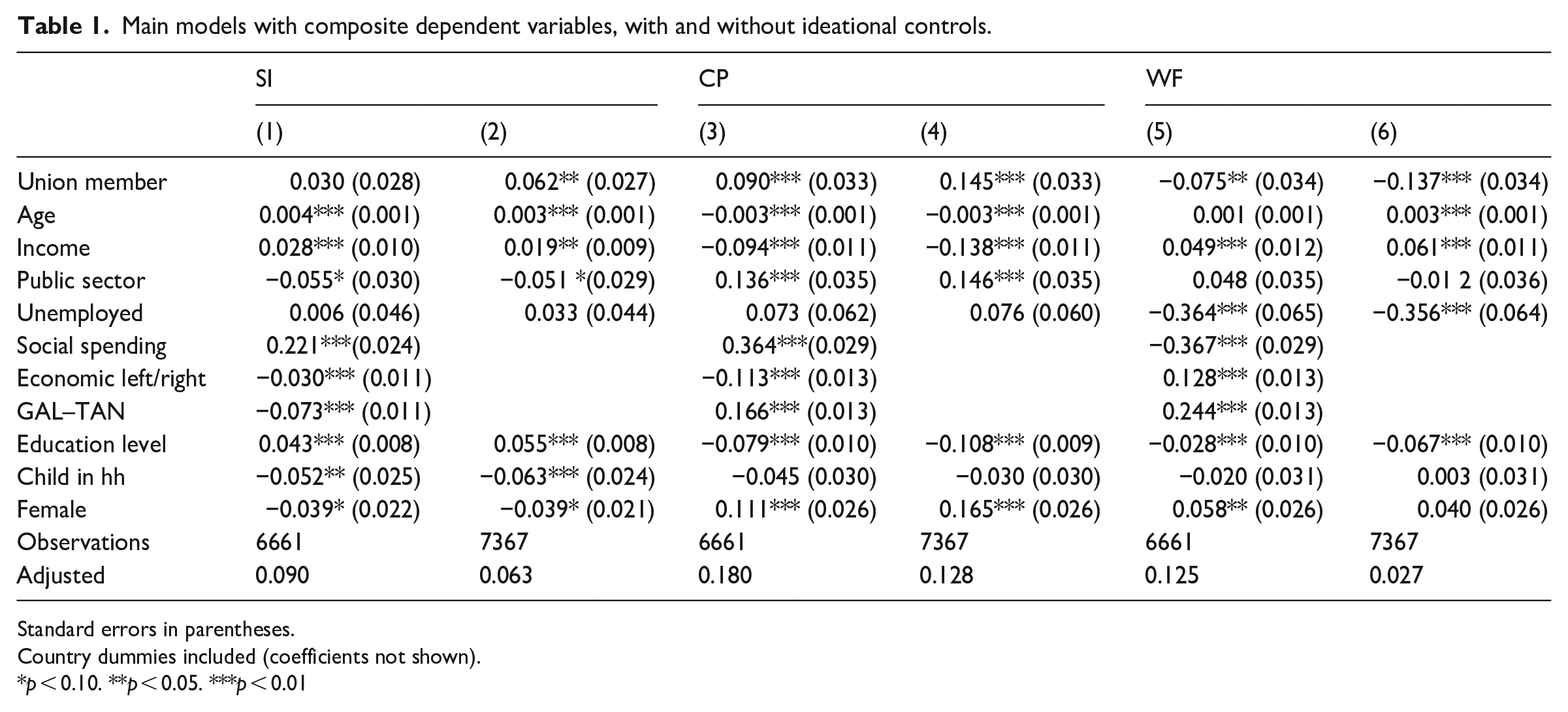
Table 1 displays the results from our main regression models with the composite dependent variables, that is, the factor score variables for the factors SI, CP and WF. For each dependent variable we estimate one model including our complete set of controls as well as country dummies, and one including all explanatory variables except for the ideological controls (economic left–right, GAL–TAN, general attitudes towards social spending). We do this to take into account that people may not only self-select into unions according to these characteristics, but they may also change their ideological positions as a consequence of being a union member. Given the fact that we use observational cross-sectional data, we cannot fully disentangle these effects. Nevertheless, comparing models with and without additional ideological controls at least indicates to what extent the inclusion of these variables, which are also likely to explain trade union membership to some extent, mediate the association between union membership and our core dependent variables.
Main models with composite dependent variables, with and without ideational controls.
Standard errors in parentheses.
Country dummies included (coefficients not shown).
p < 0.10. **p < 0.05. ***p < 0.01
First of all, we find that the association between union membership and support for SI policies is positive, but statistically insignificant. Excluding the ideological controls (reduced model) the coefficient for union membership is somewhat larger and significant at the 5% level, indicating that either there is self-selection on these variables which is now hidden in the union membership coefficient or that some of a potential effect of union membership runs through these variables. The increase in the R2 from 0.06 to 0.08 in the model including the ideological controls increases our confidence that they are of importance (Oster, 2017). For CP as the dependent variable the coefficient for union membership is also positive, but in this case it stays positive and significant even when ideological variables are included. Hence, as expected, the association between union membership and support for CP is stronger and more robust than in the case of SI policies. For WF, the coefficient for union membership points in the expected negative direction, and is significant at the 5% level. Without ideological controls the coefficient more than doubles and is highly significant. For all three dependent variables most of the control variables perform as expected, with the exception of age and having a child in the household for SI, with the former being positive and the latter negative.
In sum, these findings suggests that union members are indeed lukewarm supporters of SI policies. Once we control for general ideological predispositions, the positive association between union membership and support for SI disappears, whereas it remains robust and positive in the case of transfer policies and robust and negative in the case of workfare policies. Hence, a preliminary conclusion is that union membership is a more robust determinant of policy preferences in the cases of transfer policies and workfare policies compared to the case of SI.
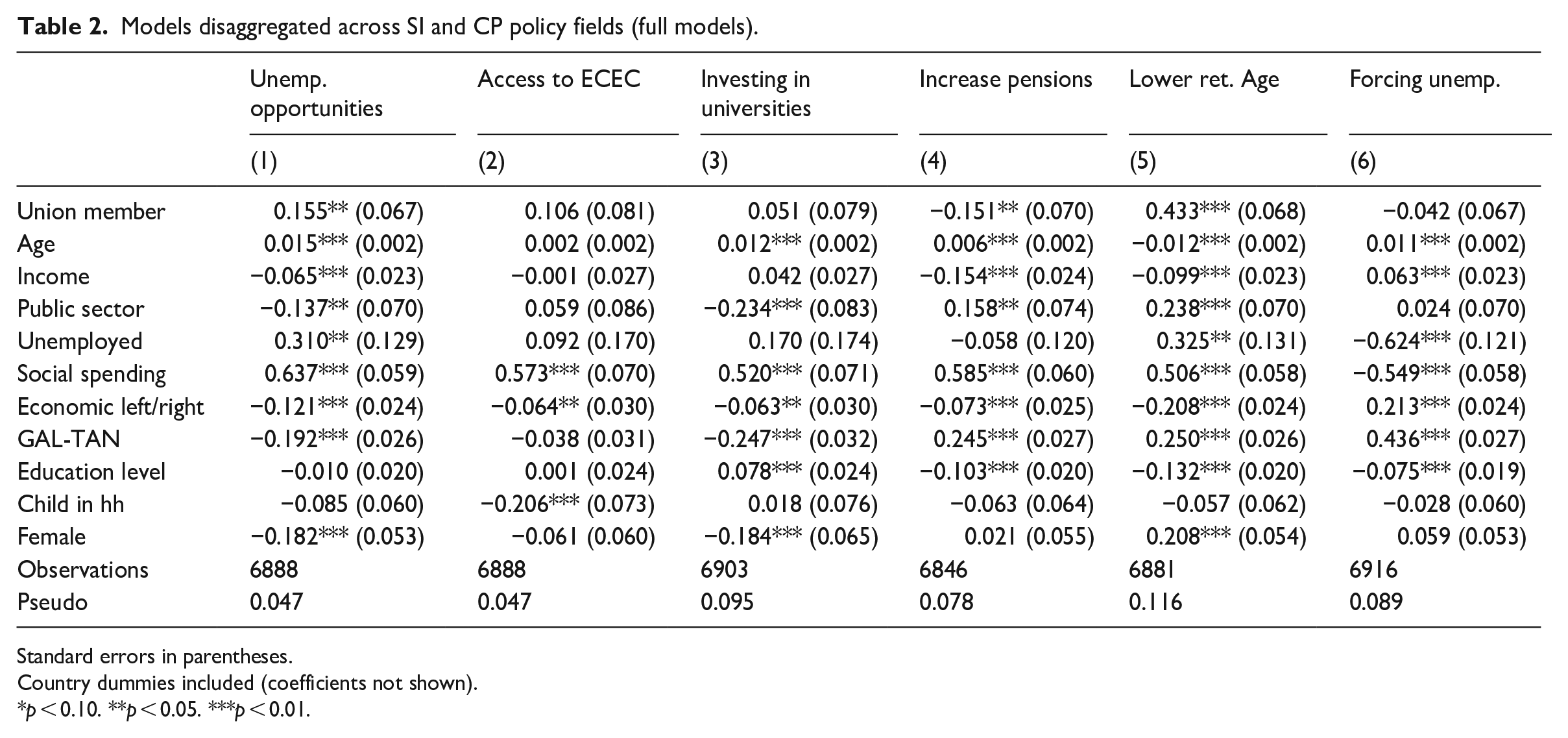
In a next step, we disaggregate preferences across the policy fields that make up our composite indicators. Table 2 displays the results. In the case of SI, the models reveal a positive association between union membership and SI for all policies, but the coefficient estimate is statistically significant only in the case of support for giving the unemployment more time to get qualified. Hence, these findings indicate that union members’ support for SI policies is mostly focused on policies that are of immediate relevance for them (i.e. labour market training). With regard to CP, we find that union members are significantly more likely to support lowering the retirement age. Somewhat counterintuitively, union members are less likely to support increasing pensions more than wages, which may be related to the fact that this would entail a form of redistribution from current workers (who are often union members) to current pensioners (who may or may not continue to be union members). As before, union members are less likely to support workfare policies, although this effect turns insignificant once other ideological controls are included. In terms of effect size, the average marginal effect (AME) (calculated for the reduced model) for being a union member on, for example, support for opportunities for the unemployed is 5.2 percentage points. In comparison, being unemployed increases the likelihood of support for this variable by 7.5 percentage points. The AME for lowering the retirement age is considerably larger: being a union member increases the likelihood of support by 10 percentage points.
Models disaggregated across SI and CP policy fields (full models).
Standard errors in parentheses.
Country dummies included (coefficients not shown).
p < 0.10. **p < 0.05. ***p < 0.01.
Broadly speaking, the findings from regressions with the binary and disaggregated dependent variables confirm the findings using the composite factor variables from above. Overall, union members are more likely to support CP as well as those SI that directly benefit them, such as more generous labour market training policies. They are strongly opposed to policies that could hurt them (e.g. workfare policies) and rather lukewarm supporters of other SI.
The findings from our second set of dependent variables, the spending questions, are similar (see Tables 6 and 7 in the Supplemental Appendix). As with the policy questions, the coefficient for union membership is positive for all three SI spending areas, and significant across the reduced and full models for education and labour market spending. In the case of education spending and labour market spending, it is statistically significant, while for family spending it is insignificant once ideological variables are included. Regarding support for education spending, the AME (calculated for the reduced model) for being a union member is 4 percentage points, which is higher than the effect associated with having a child in the household (2.4 percentage points). With regard to compensatory spending preferences, union members are significantly more supportive of both spending on unemployment and on retirement, which is broadly in line with the findings from above, where we used support for policy reforms as dependent variables.
When comparing the association between union membership and support for different types of social spending, the crucial take-away in light of our argument is to note that the association between support for typical SI policies (education investments and family policies) is weaker and less robust compared to the association between union membership and support for transfer policies, for example, pensions and spending on unemployment. Nevertheless, union members do also support SI policies in general, hence they can be considered lukewarm supporters.
Variation across union types and countries
A major limitation of available surveys – including the data we use in this article – is that it does not allow a more detailed distinction between members of different unions or union types. To some extent, our analysis captures the diversity of union membership via the inclusion of additional control variables. Regarding union types, we can only reliably distinguish between public and private sector unions, given data limitations. This is what we do in the next step by considering the interaction between being a union member and working in the public vs. the private sector.
Concerning descriptive statistics, public sector union members tend to have a higher level of education, higher income, and a lower likelihood of being unemployed. They also are somewhat younger on average and more likely to be female. Including the interaction term between union membership and working in the public sector in a regression model (see Table 5 in Supplemental Appendix) of policy preferences for SI, CP and workfare policies does not yield any statistically significant results. Hence, Hypothesis 2 from above is rejected. However, this non-effect could also be due to the fact that the specific operationalization of public vs. private sector unions masks a high degree of heterogeneity within the two groups, in particular regarding private sector unions. Therefore, these non-findings should be further investigated with better measures.
Besides varying between different types of unions, the effect of union membership is likely to vary across countries. This motivates analysing separate regressions for the eight countries included in our data set. Figure 1 displays the coefficients for union membership from the basic model with SI and CP applied to each country separately (Tables 8–10 in the Supplemental Appendix).
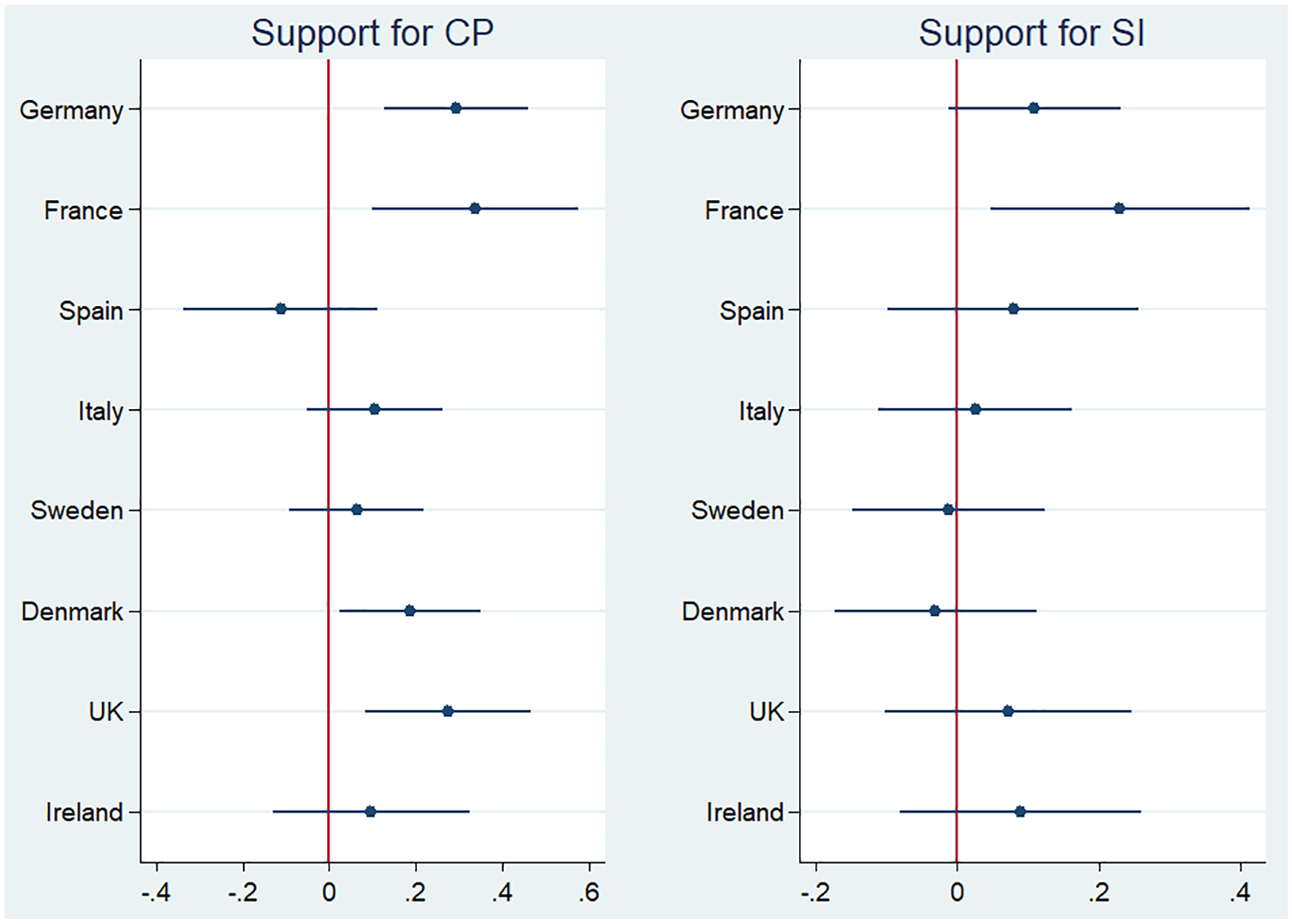
Coefficients of union membership across countries for SI and CP as the dependent variables.
Looking at our first set of dependent variables, for most countries the findings resemble those in the main model with country fixed effects: in the case of SI, the association of union membership and the dependent variables is positive and substantial, but they are larger and significant in more cases (about half the countries) for CP. The association between union membership and the traditional compensatory model of the welfare state is particularly strong in the case of the continental European countries (Germany, France) as well as in the UK and Denmark. Potentially, this is due to the fact that unions are particularly involved in the corporatist governance structure of social insurance (with the exception of the UK). As before, the association between union membership and support for SI is less robust and less clear-cut. Coefficient estimates usually include the zero line, indicating small differences between union members and non-members in these cases. Partly this is due to the lower number of cases in individual countries and therefore less of an issue in the pooled sample used above. A partial exception is France, where support for SI is significantly higher among union members compared to non-members, although the coefficient is smaller than the one for CP. This may be due to peculiarities in French unionism (Milner and Mathers, 2013): union density is particularly low in France, hence union members tend to be concentrated in the public sector, which is associated with an exceptionally low share of working-class individuals in the membership of unions (Jensen, 2020). Hence, French union members are likely to be supportive of a general expansion of the public sector, including both the transfer pillar of the welfare (as they might be more radical in their ideological predispositions compared to union members in other countries) and the public service/social investment pillar (since this is a more important source of employment for French union members compared to other countries). In general, however, these findings confirm that the association between union membership and support for social policies is stronger in the case of CP compared to SI policies, and it is particularly strong in the continental corporatist welfare state regime.
A further analysis of the association between union membership and support for different types of spending (the second set of dependent variables we use) for individual countries confirms this broad picture (Tables 11–18 in Supplemental Appendix). The coefficients for union membership are positive for all spending types for nearly all countries. In the case of CP, they are also significant in half the countries or more. For SI they are significant in fewer countries. Here the Nordic countries (Sweden and Denmark), Germany, and the UK show the highest consistency in the significance of union membership as a predictor of welfare state support. These analyses confirm the broad trends from above, namely that the association between union membership and support for CP is strongest in the cases of Germany – a corporatist welfare state – and the UK, where unions are weaker and therefore more likely to support welfare state expansion. In Denmark and Sweden, the association between union membership and support for SI is weak, which is probably related to the fact that SI policies are already well developed in these countries (Nikolai, 2012) and there is less need for further expansion.
Conclusion
This article has studied the relationship between union membership and support for SI vs. CP. Our main finding is that union members as a group are reluctant supporters of the social investment welfare state model. They are not openly opposed (whereas they are deeply critical of workfare policies), but the link between union membership and support for CP is more robust and larger in magnitude. Furthermore, we found that union members are more likely to support those types of SI which provide direct and concrete benefits for them, such as giving the unemployed more opportunities to get qualifications as well as spending on labour market policies. The partial exception to this trend is education spending, which is highly supported by union members as well.
In terms of variation across unions we did not find significant differences, which may be due to our indicator for the public sector being insufficiently fine-grained. We did find variation across countries: while the picture that emerges is not very clear, a tendency that can be discerned is that, first, union membership seems to be a predictor for policy support for both SI and CP in particular in countries with relatively strong union movements, and, second, in countries with extensive SI policies there appears to be relatively less support from union members.
In political terms, we conclude that unions and their members are not hostile to the transformation of European welfare states from the traditional towards the social investment model, but they are unlikely to be at the spearhead of this development. Potentially, however, putting a strong emphasis on SI policies could be a winning strategy for unions to recruit new members, in particular among the educated middle classes as other research has shown that SI policies are broadly popular across different classes (Garritzmann et al., 2018). Hence, in some countries, for example, Denmark and the Netherlands, unions have started to form new coalitions with other associations or with governmental actors to implement social investment type policies, in particular continuing vocational education and training, in collective wage bargaining agreements (Ibsen and Thelen 2017; Trampusch, 2007). On the one hand, these kinds of strategies are likely to stabilize public and political support for unions, although, on the other hand, they might lead to a further erosion of the labour market position of outsiders and low-skilled workers.
Future research should focus on exploring the policy positions of union leaders and elites on SI vs. CP. In this article, we focused on the micro-level of individual attitudes and preferences. This type of analysis needs to be complemented with studies on the macro level, focusing on the role of unions in actual policymaking processes and considering how different ways of union action in the welfare state are related to the different policy types. Putting together micro- and macro-level analysis could also reveal potential tensions in the positioning of union leaders vis-a-vis their membership and would therefore provide a more encompassing analysis of the role of unions in the contemporary politics of the welfare state.
Supplemental Material
sj-pdf-1-esp-10.1177_0958928720974182 – Supplemental material for Lukewarm or enthusiastic supporters? Exploring union member attitudes towards social investment and compensatory policy
Supplemental material, sj-pdf-1-esp-10.1177_0958928720974182 for Lukewarm or enthusiastic supporters? Exploring union member attitudes towards social investment and compensatory policy by Nona Bledow and Marius R Busemeyer in Journal of European Social Policy
Footnotes
Funding
The author(s) received no financial support for the research, authorship, and/or publication of this article.
Supplemental material
Supplemental material for this article is available online.
Notes
References
Supplementary Material
Please find the following supplemental material available below.
For Open Access articles published under a Creative Commons License, all supplemental material carries the same license as the article it is associated with.
For non-Open Access articles published, all supplemental material carries a non-exclusive license, and permission requests for re-use of supplemental material or any part of supplemental material shall be sent directly to the copyright owner as specified in the copyright notice associated with the article.
