




Abstract
Most research on the social policy–migration control link focuses on indirect control, that is, denying access to welfare. This article instead draws attention to how welfare institutions are made directly involved in migration control through duties to report certain categories of migrants to migration authorities. We ask how these obligations are put into practice and how local governments shape this process. In so doing, we place special emphasis on local organisational fields – that is, the close horizontal connection between public and non-public actors involved in basic needs provision. The article builds on exploratory research across four German cities, drawing on 61 interviews conducted in 2019–2020 with welfare actors catering to basic needs (housing/shelter, healthcare, social assistance, social counselling) and document research. Based on this, we, first, explore patterns of reporting practices and provide a typology of different responses, ranging from elaborate circumvention strategies to over-compliance. Second, we analyse the domino effects of reporting obligations, namely how welfare actors that are exempted from reporting adopt their practices too, with consequences both for migrants' welfare access and for other authorities' ability to report. Finally, we discuss how local governments can shape reporting practices, demonstrating how some cities actively sanction circumvention strategies. The last part identifies venues for further research.
Introduction
States control immigration not only at their borders but also within and beyond their territories (Shachar, 2020; Helbling et al., 2017). One site at which such ‘remote control’ (Zolberg, 1999: 75) is increasingly happening is welfare provision (for example, Ataç and Rosenberger, 2019), such that the ‘wall’ that migration control constitutes no longer runs only ‘around the institutions of the welfare state’ (Broeders and Engbersen, 2007: 1595) but ‘right through them’ (Schweitzer, 2019). Delegating border control to welfare institutions implies some clear tensions. On the one hand, migration control’s exclusionary aims can contrast with the inclusive aims of welfare provision, especially where basic needs are addressed (Ataç and Rosenberger, 2019; Schweitzer, 2019; Van der Leun, 2006). On the other hand, welfare provision is, by definition, exclusive as it is about allocating resources and requires the demarcation of beneficiaries.
Most research addressing this tension to date has explored indirect forms of control through social policy, that is, the exclusion of certain groups of migrants from social entitlements. Less well understood are the complex ways in which welfare institutions are made to be directly involved in migration control, for instance by being obliged to report irregular legal statuses to migration authorities. This sort of delegation exists across countries. In Germany, which is the focus of our study, public actors have a duty to report persons with irregular legal status who, for example, apply for social benefits to the German migration authorities. In Sweden and Switzerland, welfare bodies are similarly obliged to report foreigners to the migration authorities or the police. 1 In Austria, public bodies are authorised and, upon request, required to provide information about foreigners to the migration authority. 2
In line with research on indirect control, there is reason to expect variation in how direct control is put into practice. Existing accounts demonstrate ample difference within countries, driven for example by varied street-level decisions (Chauvin and Garcés-Mascarenas, 2020; Perna, 2021), but also by local context, because local or regional governments often take very different approaches as regards basic needs provision for irregular migrants (Piccoli, 2020; Spencer, 2020; Dobbs and Levitt, 2017). What is more, existing research suggests that delegating the policing of border control to certain actors can result in a spread of control practices to additional, often unintended, actors (Walsh, 2014). Given that different kinds of actors – state, private and third sector – are involved in the provision of services and that direct control obligations may vary depending on their legal status, research is needed that examines how different types of welfare actors respond to such duties.
Against this background, this article offers an account of how reporting obligations are put into, as well as alter, practice by public and non-public welfare actors catering to basic needs (housing/shelter, healthcare, social assistance, social counselling) and how local governments can shape this process. Specifically, we provide a typology of different practices, based on an analysis of recurring reporting practices within welfare institutions, which we use interchangeably with ‘welfare actors’, to refer to institutions involved in the provision of services and benefits targeting basic needs. We use ‘marginalised’, or ‘vulnerable’, migrants to refer to non-nationals with limited or no access to formal social provision and typically insecure legal statuses. We pay particular attention to domino effects of delegated migration control, meaning how third sector welfare providers involved in social service provision, but having no reporting duties, adapt their practices in response to others’ reporting obligations – something which has been given little ‘if any’ focused attention in previous literature.
To uncover reporting practices, we draw on in-depth research across four cities in Germany, based primarily on interviews as well as document research. The cities, Berlin, Duisburg, Leipzig and Stuttgart, were selected based on differences in contextual factors that could bear on their approach to immigration and marginalised populations’ access to welfare. First, we construct a typology of reporting practices. Second, we consider in detail how welfare actors without reporting duties respond to others’ obligations. Third, we consider how local governments can shape reporting practices. In the final discussion, we draw out avenues for future research.
Direct migration control through social policy
In the modern welfare state, rights are one important tool for regulating international migration (Hollifield, 2004) and access and entitlement to public welfare provisions are a crucial form of internal, or post-entry, migration control (Bommes and Geddes, 2000). The latter is especially evident in how states try to regulate irregular migration by restricting access to employment, housing, healthcare or other services for unlawful residents (Spencer and Hughes, 2015; Broeders and Engbersen, 2007; Van Der Leun, 2006; Guiraudon and Lahav, 2000).
In the European context, the European Union’s free movement regime has increased the salience of the connection between migration control and social policy. As traditional border control has largely been dismantled between Schengen countries, 3 the regulation of migration has partly shifted to welfare institutions. Since mobile EU citizens’ social entitlements are closely tied to lawful residence, welfare institutions have become closely involved in assessing the residence status of welfare applicants and in checking or reporting claimants’ legal statuses to migration authorities (Kramer and Heindlmaier, 2021; Lafleur and Mescoli, 2018).
Welfare actors can be implicated in internal migration control either indirectly or directly. Limited or no access to welfare provision makes life difficult for those who reside unlawfully and thus, supposedly, acts as a deterrent. By providing access for otherwise unentitled migrants, welfare actors can consequently influence migration policy aims, amounting to indirect migration control. Most existing research on the migration control–social policy nexus focuses on this dimension and explores marginalised migrants’ access to welfare, in particular at the local or regional level (Piccoli, 2020; Spencer, 2020; Dobbs and Levitt, 2017; Ratzmann, 2019).
Direct involvement in migration control in contrast means that those working in welfare institutions may be required to report clients with precarious legal statuses to migration authorities, and/or must contact migration authorities to acquire information about a person’s residency status to determine welfare eligibility (Kramer and Heindlmaier, 2021). Making welfare actors directly responsible for reporting migrant irregularity can be seen as what Walsh (2014: 242) has described as a form of ‘deputisation’, namely ‘the activation and empowerment of certain individuals [and institutions] to participate in preventing and controlling legal transgressions’.
Yet, which welfare actors are charged with direct control duties and how they put these into practice has to our best knowledge been much less studied. Some exceptions include Van der Leun’s (2006) study of the so-called Linking Act in the Netherlands which examines how street-level bureaucrats handle the tension between human services’ ethics and direct migration control imperatives. Schweitzer (2020) in turn demonstrates how British hospitals, universities, and local welfare organisations have established specialised sub-units to deal specifically with reporting duties, and as such, isolated the control task to allow, for example, health professionals to maintain their professional role. In this article, we contribute to these accounts with a study of Germany, providing a typology of different strategies with which welfare actors respond to reporting duties, including ways in which those without reporting obligations respond to delegated migration control. In addition, we demonstrate ways in which local governments can crucially shape the conditions for how reporting duties are put into practice, just as they can condition indirect control, as shown by previous research (for example, Spencer, 2020; Dobbs and Levitt, 2017). These findings are important for understanding how the delegation of migration control shapes boundaries of welfare inclusion and access.
Local organisational fields and delegation
Analysing practices and their consequences requires taking the full range of actors involved in the organisation and delivery of welfare into account, including any not charged with reporting duties. This is important because delegating control can, as Walsh (2014) highlights, have domino effects. Walsh gives the example of how non-state actors or additional state actors may be encouraged to engage in control spontaneously and even against the will of authorities, but may, as our research shows, also result in precautionary strategies by those not wanting to engage in control.
Such domino effects are likely where actors with different migration control duties are closely intertwined. Welfare institutions addressing basic needs are primarily located and often regulated at the local level (Panican and Johansson, 2016) where they operate within the same ‘organisational field’ (Powell and DiMaggio, 1991; Grohs, 2014). They often work closely together in catering to their clients’ needs, each providing different services, benefits and know-how, in combined efforts to guarantee social protection (Panican and Johansson, 2016). Such horizontal aspects of welfare and migration governance have also been highlighted in recent literature on immigrants’ access to welfare (Ataç et al., 2020; Campomori and Caponio, 2017), which has noted that civil society organisations often form part of local welfare arrangements in their capacity as intermediaries between local authorities and immigrants (Bruzelius, 2020; Ambrosini and Boccagni, 2015).
Such horizontal networks could shape how ‘deputisation’ (Walsh, 2014) is put into practice, as altered rules and practices in one part of the field may also change the behaviour in other parts. If one actor is tasked with and carries out reporting duties while another seeks to avoid reporting or is not tasked to do so, the latter must consider how they adapt to the new situation and interact with the reporting institution if the aim is to protect clients. Equally, if some actors try to avoid reporting and find strategies around it, this changes the ability of others to carry out migration control.
The composition and operation of organisational fields, moreover, vary by local context in ways that may condition reporting practices. As already alluded to, it is well known that local governments often pursue their own strategies in dealing with immigration-related issues (de Graauw and Vermeulen, 2016; Borkert and Caponio, 2010). Not least is this the case in Germany where integration policy has evolved bottom-up (Dekker et al., 2015). This tends to also shape welfare provision, as local governments that reject the exclusive imperatives of national restrictive migration laws, for example, often choose to provide basic welfare, especially healthcare, to these groups (Piccoli, 2020; Spencer, 2020; Ataç, 2019; Dobbs and Levitt, 2017). It also reflects that local governments are the ones left to deal with the social consequences of restricting access (Bruzelius, 2022).
Where local governments offer additional services to those otherwise not entitled, situations where reporting should be executed may materialise less often, precisely because those who should have been reported through regular channels of provision are ensured access otherwise. Equally, local governments that adopt an inclusive approach may rely on forms of service provision that evade reporting duties as one of their inclusive strategies. Research on indirect control has, for example, shown that cities tend to involve non-governmental organisations to be able to offer services without exposing municipal employees to the risk of breaching national rules or migrants to the fear of detection and removal (Delvino, 2017: 36). This could mean that the more inclusive local service provision is, the more welfare actors may be reassured and/or incentivised to avoid reporting, and vice versa in less inclusive contexts. For these reasons, we expect practices by welfare actors to look different across cities, depending on the city governments’ efforts in catering to marginalised groups.
Methodology
This article builds on research conducted as part of a project investigating social protection for marginalised, or ‘vulnerable’, migrant groups in Germany, by which we understand those who have limited or no access to formal social provision and typically insecure legal statuses. Marginalised migrants in Germany include irregular migrants, EU citizens lacking (access to) social entitlements, asylum seekers and persons with so-called ‘tolerated’ status’ 4 (Geduldete).
A total of 61 semi-structured interviews (Appendix, Table 1) were conducted between October 2019 and December 2020 with public and non-public welfare actors involved in the provision of basic services and benefits, including civil society organisations (counselling, healthcare, shelter/housing, food supply), local social offices (Sozialämter: social assistance benefits, counselling, healthcare, housing), local health offices (Gesundheitsämter: low-threshold medical services), integration offices (social counselling) and jobcentres (social assistance). Similar to other conservative welfare states with corporatist structures and subsidiarity (Arts and Gelissen, 2002: 142), the civil society sector is the main provider of social services in Germany. The latter are mainly publicly funded but can also be partly or fully funded by donations. Social counselling was included as the aim thereof is to enable access to benefits and services, and because it can be considered an integral part of the German social service system.
We mostly interviewed one representative per organisation, with a case worker (working specifically with our target groups) and/or managerial position, which we identified via purposive and snowball sampling. Interviewees were asked about access to different forms of social provision for immigrants with insecure legal statuses and the connections between social provision and migration control. In the analysis, we did not differentiate between different groups of migrants. Most interviews were with third sector actors. The latter, and especially those providing social counselling, typically have a very good understanding and overview of practices in and across other welfare institutions. Interviews were complemented with policy and legal document research. All interviewees agreed to the information being used in an anonymised form.
The research was carried out across four larger cities, namely Berlin, Duisburg, Leipzig and Stuttgart. A couple of additional interviews were collected in Frankfurt am Main to substantiate findings. We wanted to achieve a spread in contextual factors that we expected would shape local approaches regarding marginalised migrant groups’ access to welfare. Specifically, we looked at the share of foreigners as part of the local population, the composition of the foreign population, economic conditions (GDP/person, revenue and debt) and geographical location (former Eastern/Western Germany). For the analysis in this article, we did not see clear patterns between reporting practices or service provision and the latter factors, hence they do not figure prominently.
Our focus was on recurring practices of reporting. With one interviewee per organisation, our ability to assess (in)coherence in how reporting duties are practised within one institution is limited. That said, interviews were asked about standard procedures within their organisation, and because of the close connection between local actors we were also able to corroborate information about practices within certain organisations with the help of interviews from other organisations. While we know from street-level bureaucracy research (for example, Brodkin, 2013) that recurring street-level practices can be shaped both by individual ideas/preferences and the institutional environment, our data does not always allow us to clearly distinguish which of the latter two is at play. Nonetheless, respondents often spoke about practices that they referred to as formally or informally established at an organisational level. The analysis of practices was inductive and driven by an iterative exchange between data and existing literature.
The German residency act
According to the German Residency Act (§87 Aufenthaltsgesetz) from 2003, public bodies 5 must notify the foreign office of the whereabouts of foreigners who lack legal residence (for example, irregular migrants), breach their geographic restrictions (for example, asylum seekers), 6 draw on or apply for social benefits for themselves, their families or other household members and/or face deportation. The Foreign Office (Ausländerbehörde) is the German migration authority which has local branches to which public institutions are meant to disclose information. Non-public bodies are in contrast mostly excluded from reporting duties – unless they fulfil very specific tasks that are normally the responsibilities of public bodies (hoheitliche Aufgaben). Moreover, some occupational groups such as healthcare professionals and registered social workers are exempted from reporting duties due to their professional confidentiality, which prohibits the disclosure of information about clients unless they are involved in serious criminal activity. 7 Civil society welfare actors and (public) healthcare providers are hence largely exempted from direct control.
According to the ‘extended confidentiality’ rule (erweiterter Geheimnisschutz), public bodies’ responsibility to report changes when they receive information from a person is bound by professional confidentiality. For example, irregular migrants are entitled to emergency healthcare paid for by local social offices. If a person’s legal status is disclosed to a public body by medical professionals (who are bound by professional confidentiality) in the process of cost coverage, the confidentiality is effectively extended to the public body. Under these circumstances, the social office is not meant to notify the foreign authority, despite being a public body. However, when persons defined in paragraph 87 of the Residency Act apply for in-cash or in-kind benefits themselves or through persons not bound by confidentiality (for example, family members), public bodies must report them to the foreign authority.
In sum, reporting duties vary according to occupation, actor (public vs non-public) and type of service/benefit. The obligation to report sometimes trumps confidentiality when the two overlap, such that actors otherwise enjoying discretion are no longer exempted from reporting. All public welfare institutions are implicated in direct migration control. Contrary to the general tendency of delegating migration control observed in existing research, large parts of German welfare providers remain exempted from reporting because of their third sector status and associated safeguards – however, as we show below, they become entangled in direct migration control, nonetheless. In the next section, we outline types of responses to reporting duties.
Types of responses by actors with reporting duties
Typology of practices.
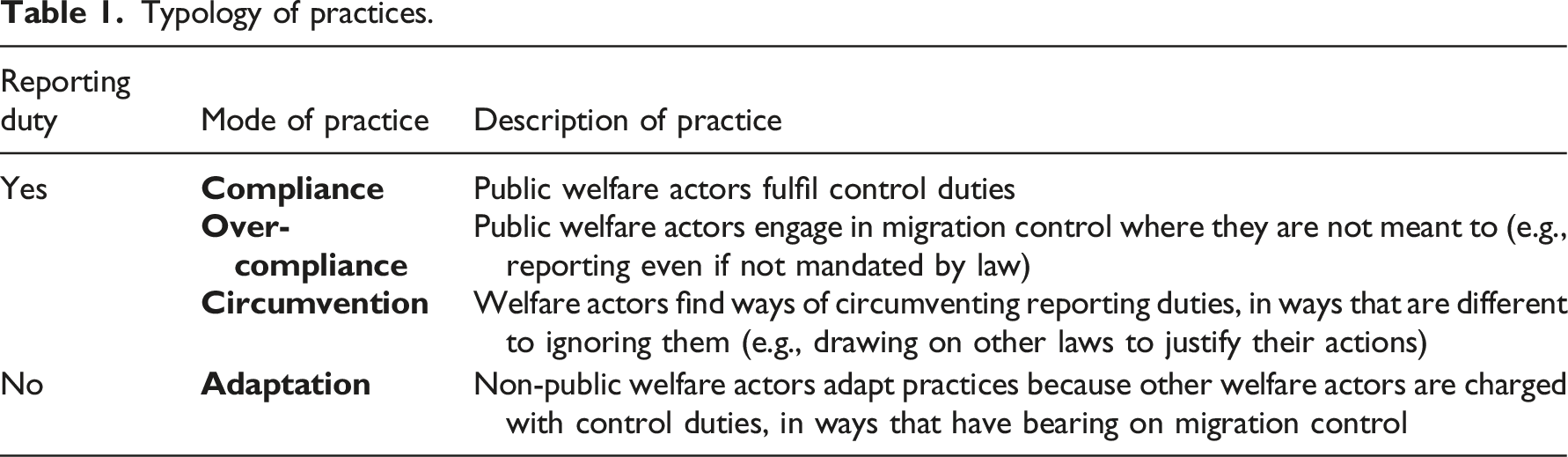
The first form of identified response is compliance, whereby welfare institutions simply execute reporting obligations as foreseen. Several interviewees explained that social offices frequently report clients when receiving a social benefit claim from foreign claimants (for example, PA08; PA09; PA11). In some institutions, reporting duties have been institutionalised and are carried out according to procedures defined centrally by the respective body. ‘This means that the employee who receives the application also reports to the foreign office’ (PA09). In contrast, whether and how the reporting task is carried out in welfare institutions where no systematic procedure for reporting exists, appears to often depend on the individual street-level bureaucrats in charge of the case, as suggested by this jobcentre interviewee: ‘Hopefully, our colleagues also do this ex officio. But there is no established procedure between us and the foreign office’ (PA08). In some instances, in both social offices and jobcentres, such processes are happening without further intervention of social administrators, as they have been transformed into automatic reporting to migration authorities (PA09; PA11). For instance, one jobcentre representative acknowledged that ‘the reporting to the foreign office is automatised’ in the respective local institution.
Automatic reporting, however, walks a fine line between compliance and our second type of response – over-compliance, whereby welfare administrators report individual migrant claimants even when not obliged by law to do so (NP08; NP30; PA10). As conveyed by one interviewee: ‘We also had some excessively eager people in the social offices who then reported to the foreign office’ (NP08). Over-compliance is at times tied to automated reporting procedures such as those mentioned above, whereby institutions blanketly report foreign clients claiming any form of social support – even in situations where the principle of extended confidentiality applies (and reporting should not happen). For instance, social office employees were repeatedly said to report when covering costs for migrants’ emergency hospitalisation (NP08; PA10). Hospitals bill social offices directly in the case of emergency treatments of migrants without health insurance, and therefore the extended confidentiality rule applies. In contrast, in non-emergencies, migrants must submit a request for cost coverage themselves, thereby becoming subject to reporting.
Third, actors obliged to report to migration authorities also often find ways to circumvent these obligations. One public counselling service (which in principle does have an obligation to report) described the organisations’ perspective as: ‘[We are] especially responsible for […] the rights of migrants… that is, to advise on what rights migrants have and to support their enforcement. And in this context, we are at least of the opinion that we have no duty to report if people have no status’ (PA03).
A recurrent example of circumvention is how welfare actors take ownership in legally ambiguous situations and interpret laws as they see fit or draw on other laws, such as the medical non-disclosure clause, to avoid having to report clients with vulnerable residence statuses. For example, one public body providing healthcare and social counselling in Frankfurt/Main, based on an internal organisational agreement, decided to draw on a regional/state law ensuring healthcare access for ‘persons in precarious living conditions’. By re-framing both counselling services as medical services, the public body can employ the extended confidentiality clause also when offering social counselling (PA10).
In another instance, a public counselling service in Stuttgart draws on a clause protecting municipalities’ autonomy to make the case that reporting duties do not apply to their organisation – despite being a public actor – because they provide a service created voluntarily by the local municipality. In their legal interpretation, only statutorily mandated services are covered by §87 of the German Residency Act (PA02-2), and so they could bend ambiguous legislation in their interest. As a third example, both the city of Leipzig and Berlin fund anonymous health vouchers for persons without health insurance, which allows access to basic healthcare without triggering the duty to report (NP30; NP38).
Adaptation by welfare actors without reporting duties
We also identified a fourth category of responses, namely adaptation, which differs from the other three types in terms of the actors involved. Adaptation refers to how welfare actors who are not themselves tasked with reporting (mainly non-public actors, but also in some instances public actors providing healthcare) adapted their behaviour in response to others’ obligation to report. The adaptation we observed mostly followed one of three objectives: (1) prevent public actors with reporting duties from detecting those otherwise meant to be reported, (2) create safe pathways for vulnerable migrants into the public aid system, through negotiation with public welfare and migration authorities, and/or (3) create alternative services, so that clients do not have to take up publicly provided services which come with a reporting duty to the local foreign office. These adaptations are important because of the bearing they have on both other welfare actors’ ability to carry out reporting and marginalised migrant groups’ access to basic social protection.
Adaptation especially occurs where non-public welfare actors (without reporting duties) collaborated with public welfare actors to ensure their clients’ access to services such as homeless shelters or non-emergency medical aid. Simply referring clients would make them complicit in disclosing clients’ identities to migration authorities despite not having a reporting duty themselves. Accordingly, they invent strategies to avoid complicity. To thwart welfare institutions’ ability to report, some non-public actors would, for instance, only selectively record sensitive client information to conceal clients’ identities (NP32; NP34; NP38; NP40-1). One strategy was to invent pseudonyms when social offices require information about clients before remunerating the cost of the service provided by non-public actors: ‘We write down a name, whether that’s Mickey Mouse or Spongebob doesn’t matter. It’s … about getting some [financial] commitment [from the social office] and then the person is sheltered’ (NP34).
Another form of adaptation by actors without reporting duties occurs as the latter try to raise awareness among their clients of the risk of exposure and discourage them from contacting public actors, for example, to apply for social support (NP37; NP39). Accordingly, some non-public actors make sure that their client: ‘understands … that if she goes to the foreign office, for example, they have to pass that information on as well, or if she goes to another authority, they in turn have to pass that on to the foreign office, so that the connections are clear to her, which exact authorities have a duty to report.’ (NP37)
Notably, such practices also limit public welfare authorities’ ability to report vulnerable migrants and hence to carry out delegated migration control.
Besides strategies aimed at preventing detection, actors without reporting duties also repeatedly tried to create safe pathways into the regular public system by lobbying other welfare actors as well as local and regional governments (PA04-1; PA10; PA11; NP30). Put differently, they use reporting duties to the advantage of their clients. For example, to ensure access to healthcare for pregnant foreigners lacking regular legal status, a public health office in Berlin without reporting duties (which does not have reporting duties as a healthcare provider) initiated talks with public and non-public actors (PA10). As a result of these negotiations, birth clinics and local administration created a maternity programme that ensures the safety of the mothers during and after birth while also providing the children with legal documents. In Leipzig, third sector actors successfully lobbied for the introduction of health vouchers that cover basic medical care for irregular migrants and are funded by the city and issued by a local non-public actor (NP30).
In another instance, negotiations between public and non-public actors at the initiative of those without reporting duties resulted in a deal with the foreign office in Berlin. Instead of circumventing or avoiding reporting, the actors settled for a solution in which reporting does not have negative implications for pregnant migrants. Since 2011, ‘pregnant women can go to the foreign office 12 weeks before giving birth and get a tolerated status (‘Duldung’) or something similar, with which they can then also receive benefits from the social welfare office and be insured’ (PA11).
Moreover, since May 2021, non-public actors across Germany (who themselves must not report) have been campaigning against paragraph 87 of the German Residency Act precisely because it undermines their ability to ensure social protection for their clients. 8 In response to this, the current federal government announced in their coalition agreement that ‘We want to revise the reporting requirements for people without papers so that sick people are not discouraged from seeking treatment’ (SPD, Bündnis 90/Die Grünen, Freie Demokratische Partei FDP, 2021: 111). The law has, however, yet to be changed.
A final form of adaptation involves the creation of alternative services by non-public actors in response to the negative implications of public actors’ reporting duty. In fact, multiple health services offered by non-public actors in the analysed cities were created in response to repeated disregard of the extended confidentiality by public bodies (NP30; NP22). A provider of medical aid for persons without health insurance in Leipzig explained that ‘the only reason why we exist is because it’s not clear whether or not extended confidentiality kicks in’ (NP30). As outlined earlier, where social offices were involved in the reimbursement of services, repeated breaches of the extended confidentiality occurred, which seems to be a problem across Germany (Gesellschaft für Freiheitsrechte/Ärzte der Welt, 2021). Service provision for irregular migrants in Germany, especially in the field of medical aid, is therefore mainly operated by donation-funded non-public actors. When funded by donations, the uncertainty of whether social offices will report at the point when they reimburse services is effectively avoided.
How local governments can shape reporting duties
In line with the research that places emphasis on the role of city context for indirect control and because of differences in circumvention and adoption practices across cities, we examined more closely how city context can condition practices – more specifically the difference local governments’ (non)intervention can make. It turned out that some local governments, notably Berlin but also Stuttgart and Leipzig, actively supported circumvention strategies by shifting services from public to non-public actors in order to sidestep reporting. The same cities also funded civil society organisations (which do not have reporting duties) to support migrants’ transition into regular services or to fill gaps of provision (without these being explicit circumvention strategies). Whether or not cities provided additional services also shaped adaptation strategies since authorised circumvention reduced the need for adaptation.
Such differences across cities seem closely related to variation in local governments’ broader approach to immigration, as deduced based on interviewees’ own perceptions of local politics. Where local governments expressed concerns about too many immigrants and limited resources, hardly any additional publicly funded services were offered, with fewer opportunities for circumvention and more need for adaptation. Where the city government in contrast did not voice such concerns, held a generally more welcoming stance towards immigrants, and expressed a commitment to ensure basic social rights, circumvention was sanctioned, and targeted services were provided. This came out most clearly in the case of Berlin and Duisburg.
Interviewees in Berlin as well as other cities moreover described Berlin as welcoming and inclusive of immigrants, especially since the current left-centre local government assumed office in 2016. They often pointed to how the city has sought ways to also enable legal residence and access to basic social services for irregularly residing persons (PA03; PA04-1; PA04-2). Several interviewees contrasted Berlin to other local governments, pointing out that others are more restrictive and that welfare providers elsewhere more frequently report to migration authorities (NP39; NP45). Similarly, non-public actors in Berlin appeared less concerned than those in other cities with public institutions’ reporting practices and thus also less wary of referring clients to public institutions (NP40-2). Some reported never having seen their clients being reported when collaborating with the social office (WO27-1).
Berlin government representatives explicitly rejected the use of restrictive access to material social provision as an instrument of migration control in interviews (PA04-1). Correspondingly, the government has in recent years shifted the provision of healthcare services
9
for migrants with precarious resident statuses from public to non-public providers (see Wilcke and Manoim, 2019). By delegating service provision specifically to non-public actors, reporting can be avoided, and protection provided: ‘Our goal is to reach the people, and the best way to do that is to do it through an institution that comes from the …[non-public] sector, instead of doing it through an institution that could probably be bound by this duty to report. [...] This is one of the reasons why the people [...] go to civil society organisations to get advice, because they are more independent, and they then don’t have to fear that there are such reporting duties.’ (PA04-2)
The Berlin interviewees argued that, since the right to healthcare is not being realised when reporting duties are in place, ‘the state of Berlin has come up with another way to give people the right to healthcare by anchoring these counselling centres and healthcare services in civil society’ (PA04-2). This, they said, reflects that the current Social Democratic-Green government builds on a coalition agreement that ‘explicitly articulates the creation of prospects to remain [in Berlin/Germany] as a goal of the Senate’ (PA03). Using state funding, the city-state Berlin has also funded more additional substantive (that is, not exclusively counselling) third sector welfare services for marginalised migrant groups than Duisburg. Notably, such local government-initiated circumvention strategies can go hand in hand with certain adaption strategies by welfare actors without reporting duties: anonymous health vouchers for example supported the sort of anonymisation tactics which we described under adaptation (PA04-2; NP38; NP30), demonstrating how circumvention strategies and certain adaption strategies can go hand in hand.
In Duisburg, in contrast, we found no examples of government-sanctioned circumvention strategies like those of Berlin. Similarly, a scanning of available third sector services to fill gaps in social provision showed that Duisburg only funded third sector actors delivering counselling but not substantial services such as medical aid. Third sector organisations were also providing services based on donations that would normally be a public task, such as vaccinations for school children, which the city government ignored, even though this was – in the view of the organisations – effectively ‘doing good for the city [and public health]’ (NP22).
This corresponded to a portrayal of Duisburg's government as comparatively exclusive: interviewees frequently depicted the city government in a negative light, for example saying that Duisburg ‘is not a city that has excelled when it comes to the integration of immigrants’ (NP21) and that the city administration is ‘institutionally racist’ (NP35). Notable in this regard is that the city government is a coalition between Social Democrats and Christian Democrats, in contrast to the Social Democratic-Green coalition in Berlin. A concrete example of the local governments’ hostile position towards immigration is that the Duisburg government, together with few other German cities, actively lobbied the federal government to find ways to limit ‘poverty immigration’ from eastern Europe and professed benefit fraud (Schmidt, 2019: 42; Deutscher Städtetag, 2013). It is possible that this political context also had ‘signalling effects’ on the actors implementing reporting (see Blauberger and Schmidt, 2017), prompting them to report as intended rather than circumvent the obligation. As one interviewee put it: ‘Of course, what is happening right now in society [regarding contestation of immigration] is reflected not only in politics but also in administration’ (NP16). This also shaped the strategies of those without reporting duties: third sector actors in Duisburg directly lobbied the state level (North Rhine-Westphalia, NRW) for the creation of a fund covering the medical treatment of irregular migrants when they could not get the local government to do something (NP31). 10
Concluding discussion
Our exploratory study of direct migration control through welfare providers in Germany reveals a range of reporting practices, ranging from compliance to non-compliance. In line with Walsh’s (2014) observation that delegating migration control to additional public bodies not only amplifies control practices but also leads to unintended ones, we recorded many instances of over-compliance, where actors report when they should not. Similarly, we identified domino effects of delegating migration control, namely practices adopted by non-public actors without reporting obligations that have bearings on the capacity of others to carry out reporting obligations.
Adaptation strategies of the latter sort have been given little attention in the social policy–migration control nexus research, yet they likely have important bearings on access and provision of welfare and clearly suggest that delegating migration control can have more extensive implications than (probably) intended. Civil society actors without reporting duties are often important intermediaries between migrant clients and public services (Bruzelius, 2020; Ambrosini and Boccagni, 2015). Unsurprisingly, those with precarious residence statuses often avoid health offices and other public welfare actors because of the threat of being deported, as was confirmed in our interviews (PA03; PA10). What is perhaps more notable is the role intermediary actors can play in this when they discourage clients from applying for welfare as a measure of precaution, potentially further limiting these groups’ access to basic social support. Nevertheless, some third sector welfare actors were able to use the reporting duties and the need for anonymisation to try to further these groups’ access to healthcare, as it reinforced the case for introducing anonymous healthcare vouchers. At the same time, these adaptation strategies constrain public institutions’ ability to fulfil both migration control and social protection mandates. Domino-effects like these are, in other words, important to consider to understand the famous ‘implementation gap’ of migration control (Joppke, 1998).
Second, when those without reporting duties introduce new services – as in the case of the non-public medical provision for uninsured patients in all cities – to cater to the needs of those who would otherwise risk being reported, they are effectively increasing the number of parallel services. This is something that the German government explicitly seeks to avoid. The intended function of almost all publicly funded immigrant counselling is to channel persons into the regular system, precisely to steer clear of the construction of a parallel system (BMAS, 2014). This, again, illustrates the relevance of taking horizontal networks of actors into account for better understanding the consequences of delegating migration control duties.
Our research has also shown how local governments can condition reporting practices. In some cities, they support circumvention through the reorganising of existing services or provision of additional ones, in others, not. This in turn conditions adaptation behaviour by those without reporting duties, as local contexts where circumvention is actively supported reduce their need to take precautions or set up additional services. As such, local governments can reduce both indirect and direct control when they find alternative ways to provide access to services. City differences were moreover tied to interviewees’ portrayal of cities as more or less inclusive of immigrants, suggesting that cities’ immigration politics and policy more broadly could shape reporting, in the same way that it has been shown to shape welfare provision to irregular migrants (for example, Piccoli, 2020; Spencer, 2020).
Explaining differences between cities is beyond what we can do in this article. That said, we would like to highlight two common ways to make sense of differences. First, there is a potentially relevant variation in the ideological orientation of local governments (compare de Graauw and Vermeulen, 2016) between the two cities we looked more closely at: Berlin and Duisburg. Both cities had Social Democrats in power for a long time, but in coalition with the Greens (Berlin) or Christian Democrats (Duisburg). This political difference would be worth teasing out further in future research. A second thing often assumed to shape policy responses is problem pressure. Multiple respondents linked Duisburg’s comparatively hostile discourse and non-support for substantive services to lacking resources. They described the city administration as being ‘overwhelmed’ by the inflow of Eastern European immigrants (NP19; NP21; NP35) as well as an ‘extreme inflow of refugees’ around 2015 (NP21), while the city simultaneously is undergoing economic reform programmes to reduce public debt (NP31; NP35). At the same time, lacking resources and problem pressures were not thematised in Berlin, which is the city in Germany with the highest debt, high unemployment, and neighbourhoods with concentrated social precarity very similar to those of Duisburg. The two cities equally have comparatively high shares of foreign populations and yet reporting is practised differently in these cities. One could hypothesise, that a more important difference lies in the cities’ self-perceptions. Berlin has long seen itself as a city of immigration (Mushaben, 2008), whereas Duisburg seemingly feels overrun by immigrants.
Our study is limited in scope and of an exploratory nature, more research is necessary to further substantiate and confirm the observed patterns. In the following, we would like to highlight what we believe are important avenues for future research. First, we have placed emphasis on horizontal networks. However, vertical relationships between institutions could also play important roles. Berlin is the only city in our sample that is a so-called city-state, the others are municipalities. Being a municipality means that another level of government – the state (Land) – is involved in providing and steering the investment of public funds at the municipal level in a way that may be more disconnected from the specific local context than in a city-state. This does not explain variation between cities, as Stuttgart’s local government took similar initiatives to Berlin, without being a city-state, but it seems to shape practices. We saw how civil society organisations in Duisburg strategically used the different levels of the federal systems and lobbied the state level rather than the city when trying to create safe access to healthcare.
Second, we have looked at welfare actors catering to basic needs without differentiating much between them. It is, however, likely that practice differs between institutions (compare Perna, 2021; Schweitzer, 2019; Van der Leun, 2006). In line with our focus, there is reason to expect variation between institutions depending on their embeddedness in local organisational fields. Our data indicate, for instance, that local social offices (with reporting duty) usually collaborate more closely with non-public organisations than do jobcentres (who also have a reporting duty). The latter are more disconnected from other local actors involved in catering to basic needs and most often managed by a federal agency rather than local government. This may help explain why non-public actors across the studied cities perceived reporting practices in jobcentres to be less flexible than those of local social offices. Another important difference is the type of service. We looked at different services and benefits catering to basic needs. However, health clearly has a particular standing. First, emergency healthcare situations are exempted from reporting. Second, where city governments were directly involved in circumvention it almost exclusively had to do with healthcare access. This may reflect broader concerns with public order, whereby offering basic healthcare to all is a way to protect the wider population (Spencer, 2018; Bruzelius and Ratzmann, 2020)
Third, there are of course many other reasons why reporting may be carried out in certain ways than welfare actors’ non/public status and local governments’ support of circumvention. Our interview data, for example, indicate that issues that we know shape implementation from the street-level bureaucracy literature are also at play when reporting duties are put into practice. Notably legal ambiguity, as the rules on when and for whom the obligation to report kicks in are far from straightforward and leave room for interpretation and misunderstanding and felt tensions between migration control and needs provision mandates were referred to in interviews. Such factors have been examined regarding indirect control and should be assessed also for direct control.
Finally, our study is limited to the German context, which stands out in at least two important respects. It is a federal country with relatively strong local autonomy and a tradition of pursuing integration policy at the local rather than the national level (Dekker et al., 2015). Non-public welfare actors’ significant role as service providers is moreover a particular feature of the German welfare state. Not only does this seem to be one reason why some welfare actors are charged with reporting duties and others not – third sector actors have a protected status in Germany –, it also provides public welfare institutions with opportunities to circumvent migration control by way of outsourcing. Further research should adopt cross-country perspectives and map whether and in what precise ways welfare actors are directly implicated in migration control, how this is put into practice, and with what consequences.
To sum up. This article has provided an overview of how the obligation to report irregular foreigners to migration authorities is put into practice by welfare actors. It thereby sheds light on direct control, which has received much less attention than indirect control, that is, the granting or non-granting of welfare benefits and services. Another novelty of the article is its focus on local organisational fields: by taking networks of actors into account we have demonstrated that the delegation of migration control can have very far-reaching social, administrative, and political consequences.
Supplemental Material
Supplemental Material - Delegating migration control to local welfare actors: Reporting obligations in practice
Supplemental Material for Delegating migration control to local welfare actors: Reporting obligations in practice by Cecilia Bruzelius, Lea Reiss and Nora Ratzmann in Journal of European Social Policy
Footnotes
Acknowledgements
We would like to thank the two anonymous reviewers, Lisa Borelli, Anita Heindlmaier and other participants in the VirEUs workshop organised by Michael Blauberger, for constructive comments and helpful input. Extra thanks goes to our interviewees for their time and patience.
Declaration of conflicting interests
The author(s) declared no potential conflicts of interest with respect to the research, authorship, and/or publication of this article.
Funding
The author(s) disclosed receipt of the following financial support for the research, authorship, and/or publication of this article: Cecilia Bruzelius thanks the Baden-Württemberg Stiftung/Eliteprogram for Postdocs and the German Federal Ministry of Labour and Social Affairs/Fördernetzwerk Interdisziplinäre Sozialpolitikforschung for the financial support that made this research possible.

Supplemental Material
Supplemental material for this article is available online.
Notes
References
Supplementary Material
Please find the following supplemental material available below.
For Open Access articles published under a Creative Commons License, all supplemental material carries the same license as the article it is associated with.
For non-Open Access articles published, all supplemental material carries a non-exclusive license, and permission requests for re-use of supplemental material or any part of supplemental material shall be sent directly to the copyright owner as specified in the copyright notice associated with the article.
