




Abstract
Redistribution is one of the main characteristics of the welfare state, and welfare state research has dealt intensely with various facets of it. The main focus in analysing redistribution is on the redistributive logics of welfare states in terms of work-related rights. Family as a major principle of welfare state redistribution, though, has hardly been included in these welfare state analyses. It has mainly been addressed by analysing outcome data or by analysing care as the most relevant characteristic of the family. We argue, though, that comparative welfare state analysis that addresses differences in welfare state intended redistribution needs to also include family as a redistributive principle to gain a more complete picture of societal redistribution. In this study, we are analysing the redistributive logics of welfare states in terms of family. We answer the question of how and in how far welfare states institutionalize family as a redistributive principle. We examine by means of the tax–benefit microsimulation model EUROMOD and its Hypothetical Household Tool (HHoT) welfare state regulations on family for three countries that are generally classed as different regime types. We differentiate between a great variety of family forms (referring to marital status, children and different forms of couples’ income distribution) to adequately test our theoretical assumptions. The findings show that family is a major redistributive principle of the welfare states analysed here and applied in different redistributive logics to the various family forms. This, then, results in an increase in income for certain family forms and a decrease in income for other family forms. These differences are not the result of one coherent set of regulations, but of an interplay of in part contradictory regulations that reflect a great variety of family-related redistributive logics within the single countries. Thus our study provides new insights into the redistributive logics of welfare states, and may contribute to the analysis of welfare state complexity in terms of theory, methodology and empirics.
Introduction
Redistribution is one of the main characteristics of the welfare state, and welfare state research has dealt intensely with the various facets of it. Major scholars such as TH Marshall and Esping-Andersen have shown that welfare states do not differ solely in terms of outcomes, but first and foremost in the principles of redistribution and in their particular logics as reflected in welfare state regulations. A major strand of this research has dealt with the question of how and in how far welfare states redistribute financial resources that are based on work as one of the major redistributive principles (for example, Korpi and Palme, 1998). The family though – another major principle of welfare state redistribution – has rarely been the object of comparative welfare state analysis. Family has mainly been addressed as simply affected by the ‘higher-level’ redistributive logics, and as mirroring the social effects of other forms of welfare state redistribution (among many others, see Mahler and Jesuit, 2006; Dallinger, 2013).
All welfare states, though, have a body of regulations directly addressing redistribution in terms of family, and these too are subject to particular conditions as a kind of societal negotiation of rights and obligations. The importance of obligations on families in welfare state redistribution has been pointed out earlier (see Millar and Warman, 1996), but it has hardly been included in comparative welfare state analysis. However, this two-foldedness of the rights and obligations in welfare state redistribution in terms of family might reduce differences between the addressees of welfare state redistribution when focusing on either of the two facets of redistribution; but it might also increase them. Against this background it is surprising that – as we show in the following section – prominent theoretical concepts developed to analyse welfare state redistribution often do not adequately take family as a redistributive principle into account. This, however, is essential to comprehending the redistributive logics of welfare states.
In this article we analyse family-related redistribution in three welfare states – the Czech Republic, Denmark and the United Kingdom. The choice of cases results from the literature insight that these countries represent different regime types both in their dominant perspective on welfare state differences (see Ferragina and Seeleib-Kaiser, 2011) as well as in a family- and gender-sensitive perspective (see Daly, 2020). But the choice is also based on recent research that has revealed and emphasized significant similarities between these welfare states (Mahon et al., 2012) that are of particular relevance for our focus. The comparison of these cases, therefore, allows for testing of the most relevant theoretical assumptions, as will be shown in the next part.
Aiming to better comprehend the redistributive logics of a welfare state (but not the factual differences in available resources), we carry out a pure regulation analysis. We calculate and map the redistributive logics as comprehensively as possible by taking into account the interplay of different redistributive instruments. We use the tax–benefit microsimulation model EUROMOD and its ‘Hypothetical Household Tool’ (HHoT) to map welfare state regulations in terms of family for a total of 72 family forms based on differences in marital status, couples’ income distribution, and the number of children. The approach is innovative theoretically, methodologically and empirically, and thus contributes to the corresponding debates in welfare state research. It will, in an international comparison, reveal family-related redistributive logics.
The contribution is structured as follows: in the next section we present the state of the art in relation to welfare state redistribution and family. The third section introduces the methodology of our analysis, and the fourth presents the findings. After discussing the results in the fifth section, we conclude.
State of the art
Welfare states are institutionalized forms of social order. Redistribution in one form or another is one of the fundamental characteristics of welfare states (Esping-Andersen and Myles, 2009; Marshall, 1964). Resources from various taxes and contributions are used to support the societal participation of citizens and residents. Some of the most well-established research on welfare state redistribution is on the redistribution of resources between the currently working and currently not working population (such as pensioners and unemployed persons). This research focus became famous with the concept of de-commodification and particularly with Esping-Andersen’s 1990 study The Three Worlds of Welfare Capitalism that proposes decommodification as one of the major analytical components explaining international variations in redistributive logics. Most importantly, the corresponding research strand aims to identify the different goals and logics of welfare state redistribution. It understands welfare states as based on national or regime-typical perspectives on societal phenomena and social values and founded on different dominant principles. In this context it identifies a strong relatedness between the societal role of the family and the welfare state setups. Differently however from decommodification and related redistributive logics (and factual effects) of welfare states’ various vertical and horizontal redistributions, the redistributive logic of family as a principle of welfare state redistribution has hardly ever been the focus of welfare state research.
This research gap is surprising, since all welfare states have a body of regulations that directly address redistribution in terms of family (Frericks et al., 2016). This redistribution, as are other types of redistribution, is subject to particular conditions as a kind of societal negotiation of rights and obligations. Family as a redistributive principle manifests itself as rights by means of entitlements to additional benefits, derived rights, or tax deductions, and studies have analysed how families or individuals with family benefit from such measures (for example, Van Lancker and Van Mechelen, 2015). At the same time, welfare states oblige families or individuals with family to provide financial (and other forms of) resources to family members before the state is called upon to intervene. The most pronounced obligation is maintaining needy family members on the basis of family means-testing. Research has paid rather little attention to this two-foldedness of the rights and obligations of welfare state redistribution in terms of family. Though there are some exceptions (Daly and Scheiwe, 2010; Millar, 2004; Millar and Warman, 1996; Saraceno, 2004), the degree to which regulations redistribute resources is not part of their investigations. Saraceno (2018) and Naldini and Long (2017) pointed out that the legal definition of the family is crucial to the exercise of social rights and obligations. Indeed, without modelling different family forms and their rights and obligations, we understand rather little about welfare state redistribution in terms of family.
Several dimensions have been identified that are involved in family policies and have different goals which they are attempting to address (Saraceno, 2011). Among the most prominent are studies that try to identify welfare state models of social care services and care responsibilities (Anttonen and Sipilä, 1996), employment support for mothers of young children (Gornick and Meyers, 2004) or state support for the family–work relationship and family income (Bahle, 2008). Here, different family policy packages and designs across welfare states have been identified that cumulate into four models (Gauthier, 2002; Thévenon, 2011): the Nordic, liberal, Mediterranean and Continental types (the latter with two subtypes). Also, Kaufmann (2002) argues for four family policy profiles, called ‘families of nations’, within Western Europe. Only very few comparative welfare state analysts do not reaffirm this country grouping, stressing instead the wide range of cross-country variation in family policies that hardly – or not at all – corresponds to this grouping (Frericks et al., 2016; Saraceno, 2011, 2022). Mary Daly gives an overview of this scientific phenomenon and summarizes: ‘The general consensus in the field on the basis of the gender-oriented typologizing is that the countries of the EU cohere into five main groupings in terms of their family/gender model’ (2020: 40). This general agreement on welfare state differences, also in terms of family and care policies, cannot be ignored for the purposes of this study.
For the study of welfare state differences regarding family, two major concepts significantly contribute to our understanding: defamilialization and individualization. The concept of defamilialization was developed to study in how far paid work or social security systems reduce individuals’ financial dependence on family, thereby enabling them to enjoy a ‘socially acceptable standard of living’ (Lister, 1994) or ‘well-being’ (McLaughlin and Glendinning, 1994). Defamilialization studies focus either on redistributive mechanisms allowing for women’s relative independence from family resources and also when they must care for family (for example, Bambra, 2004), or they analyse ‘the degree to which social policy frees women from the burden of family obligations, [and] the extent to which motherhood is compatible with careers’ (Esping-Andersen, 1999: 88 and 178; see also, Korpi, 2000). Individualization can be conceptualized as a process of the continuing separation of an individual from traditional and familial dependencies which ‘come to be replaced by dependencies on the market’ (Daly and Scheiwe, 2010: 181). Individualization refers to European welfare states’ general reconceptualization of social citizenship based on the male breadwinner model towards an individualized adult worker model (Lewis and Giullari, 2005). While there has been indeed a political and cultural shift in European societies towards the primacy of the individual, redistributive regulations are far from being individualized: studies have shown that family-related benefits have been extended or newly introduced (Ferragina and Seeleib-Kaiser, 2014; Frericks, 2012), and that welfare state change has been rather ambiguous in this regard (Pfau-Effinger and Rostgaard, 2011).
For three main reasons none of these key concepts of welfare state analysis in terms of family can be applied in our planned analysis. First, they take a one-dimensional perspective on family, while redistributive regulations in part strongly differ across family forms (Frericks et al., 2016). Consequently, we might identify various logics of redistribution in terms of family in one single welfare state as has been shown for Germany (Frericks et al., 2022b), and rights and obligations might differ between the particular family forms. Identifying such differences in redistribution is highly relevant from a welfare state perspective. Second, their prior focus has been on the question of a citizen’s making a living completely independent of the family, while we aim to understand the gradual differences in welfare state redistribution. And third, both concepts address societal effects and therefore usually conflate the analysis of welfare state regulations with that of outcomes (for example, Daly, 2020; Esping-Andersen, 1999; Leitner, 2003; Lohmann and Zagel, 2016). Factual outcomes though are affected by numerous other factors in addition to welfare state regulations, such as preferences, culture and structures in various ways (Pfau-Effinger, 2004), and by implicit family policies, that is, family-related, unintended effects of non-family-focused policies (Kamerman, 2010). The results, therefore, do not reflect so much the redistributive logics of welfare state regulations as they do overall societal differences.
For the empirical investigation of the family as an essential redistributive principle of welfare states, three countries were chosen for analysis: the UK, Denmark and the Czech Republic. There are three reasons for this choice. First, they represent different regime types or models in terms of both the decommodification literature on redistribution as well as on family-sensitive cross-country differences, as explained above: the UK is an archetype of the liberal welfare regime, Denmark is an archetype of the social democratic regime, and the Czech Republic is an East-European hybrid regime decidedly moving in a liberal direction (Saxonberg and Sirovátka, 2009). Second, they represent one type of country that has been identified as similar in a way that is highly relevant for the subject of this study: there, social order has been identified, although manifested differently, as liberal (Mahon et al., 2012). The different understandings of liberalism include concepts of classical liberalism, modern (social) liberalism, neoliberalism, inclusive liberalism, and other strands of it. However, what all the different interpretations of liberalism have in common is the idea of restricted state intervention in family affairs as the societal reference is rather the individual than the social unit of the family, resulting in modern societies in the adult worker family (Mahon, 2008; Craig and Porter, 2006). This is of particular relevance to understanding family-related regulations. But it has not yet been analysed whether and in how far these countries differ in institutionalizing family as a principle of societal redistribution.
Our case selection is therefore relevant to both the major welfare state discourse on regime-typical differences, and to recent research that reveals and emphasizes significant similarities between these welfare states. We now can formulate the theoretical assumptions of our investigation. These assumptions are necessarily contradictory in part since they build on different strands of the relevant literature as explained below.
All three welfare states conceptualize family as a private concern. Regulations that let us identify family as a redistributive principle are not to be found in our study countries. This assumption is based on the literature which considers the study countries to be liberal, who put the individual at the centre of their social order in terms of financial redistribution (Mahon, 2008; Saxonberg and Sirovátka, 2009). This assumption will be tested particularly on the redistributive regulations regarding marital status, that is, the adults in a family.
A redistributive principle in all three welfare states, though, is that children in need is not a private issue. Regulations that redistribute public resources to children of poor families are expected to be found in all our countries. This assumption is based on previous research showing that all welfare states support needy children, and that poor children in all countries, also the liberal ones, are considered as ‘deserving poor’ (for example, Bradshaw et al., 1993, Daly and Ferragina, 2018; Van Oorschot, 2006).
The redistributive logics of the study countries differ in terms of obligations. We expect to find differences between our countries in terms of legal obligations to support family members in financial need. Since the literature on defamilization observes that a high degree of decommodification correlates with a high degree of defamilialization and vice versa (for example, Lohmann and Zagel, 2016), we assume that there are differences between Denmark on the one hand, and the UK and the Czech Republic on the other. In concrete terms, we expect to find no regulations in Denmark, for any family form, that oblige family members to support others before these can be entitled to public support. In the Czech Republic and the UK on the other hand, we do expect to find such regulations. This assumption is based on the characterization of both countries as male breadwinner regimes (for example, Ciccia and Verloo, 2012) and as having particularly strong means-tests in their policies (Esping-Andersen, 1990; Nelson, 2010) requiring mutual support within the family (Daly and Scheiwe, 2010). These three manifestations of redistributive principles of welfare states have to date scarcely been analysed, neither systematically nor together, and doing so results in an innovative evaluation of the question how and in how far family-related redistributive logics differ between our countries.
Methodology
There are various ways family-related redistribution can be analysed. Our focus requires particular methodological decisions and explanations. First, we need to define our concepts. Family as a redistributive principle is the overall welfare state set-up that includes family in its regulations. Welfare state logics instead are the concrete redistributions to different family forms; that is, the logic might be that only married couples are supported or that only parents of dependent children get benefits. In short, the principle is concretized in particular redistributive logics. Second, as explained in detail above, we are interested in the welfare state’s set-up, not in its outcomes, which depend on various additional factors. We, therefore, apply a regulation analysis. And third, since we aim to identify the redistributive logics of current welfare states, we decided to model families. This allows us to identify redistribution as intended by the welfare state without interference with questions of take-up, for instance. We define family pragmatically as a personal status (different from the status of an individual) that is possibly addressed in redistributive regulations. The family forms we model draw on acknowledged discussions in welfare state research (Korpi, 2000; Lewis et al., 2008), of which one major criterion in differentiating family forms is the adults’ position within or outside the labour market. We refer to this differentiation and apply different income combinations to our family forms. In terms of the so-called dual-earner model, for instance, we model a family with two parents, both participating in the labour market and earning the same income. Also, the so-called supplementary earner family manifests itself by both adults’ activity on the labour market, yet this time at an unequal distribution of income which we will concretize later. The single-earner family model again refers to a situation when one of the partners is outside the labour market. Another family model that one might call the absence of breadwinner model is characterized by no market income of the adults.
With regard to income, we decided to cover a variety of typical income levels of people in modern welfare states that are, in addition, also the most relevant for redistribution, so that in order to identify the various redistributive logics, our analysis consists of families with different incomes, including no market income, half the average, average, and double the average income.
We then added children to these family forms, also to test our second hypothesis that children constitute a redistributive logic in our study countries. We additionally modelled single-parent family forms with the parent being active or inactive on the labour market. Arbitrary choices had to be made with regard to children, and we decided to include regulations on families with one or two children. We added older but dependent children aged 11 to 15, but excluded younger children who are subject to a large number of exceptions and specific regulations, and who have not only been widely investigated and discussed in their cross-country variation (see Thévenon, 2011), but are also affected by regulations on care and education that cannot be directly translated into the modelling (Frericks, 2022a). Lastly, we included marital status in the analysis, which will also enable us to test our first assumption. In total, 72 family forms were analysed.
Having set up the family forms, we designed an appropriate tool to identify the logics of family-related redistribution. In addition to identifying the supported family forms, we also assess the degree of this support, that is, we measured the degree of redistribution that the regulations intend. For this, we set a reference point which is the single individual, that is, a person without a (legally identified) partner or child, in whose case no family-related redistribution can apply. We differentiated four variations of this reference person, in respect to their market income. In other terms, the income level at which direct welfare state intervention is still absent, serves as the starting point, as the ‘counterfactual’ (Shaver and Bradshaw, 1995). Welfare state redistribution that is not modified by other factors such as intra-household redistribution is reflected in the net disposable income. We therefore measure the net disposable income of the reference point(s) on the one hand, and the net disposable income of the individual(s) with the exact same market income, yet this time with the effect of being a part of a family. Differences in the net disposable income between the reference point(s) and the adult(s) with a family indicates redistribution in terms of family (see Figure 1). They were systematically analysed for every family form, which allowed us to precisely identify the redistributive logics in terms of family for the respective welfare states. Calculation formula for redistribution in terms of family.
Family-related redistribution is measured as the extent to which a family’s resources increase or decrease in comparison to the reference point. That is, there is redistribution towards the family if the difference in net disposable incomes of the adults in a family and their respective reference points is higher than zero. Here, the income increases because of family-related regulations. To this granting of resources, we add also indirect increases in the net disposable income, for example, through exemptions from paying compulsory social insurance. If instead the difference is below zero, this indicates that there is redistribution from the family. Here, the income decreases because of family-related regulations. This logic applies when families, or individuals within a family, are legally obliged (upon means-testing) to financially support a family member before that person is entitled to public support, or when their resources are reduced as a consequence of higher income tax or social insurance contributions. Consequently, by analysing the differences between the net disposable income of the reference point(s) and the family forms we show whether, to what degree, and which family forms are subject to family-related redistribution and identify the redistributive logics of the respective welfare state.
Use of the net disposable income makes for the most encompassing study possible in terms of welfare state areas, since it includes all relevant fiscal regulations that affect redistribution with regard to family. These are child benefits, social insurance contributions (with health insurance particularly family-related), means-tested benefits, and fiscal welfare (particularly tax regulations on income tax). The latter, while highly determining of redistribution (Dingeldey, 2001; Orton and Davies, 2009; Titmuss, 1958), have often been neglected in welfare state analysis. We intentionally include solely family-related regulations, that is, explicit family policies (Kamerman, 2010), in the calculation in order to picture the redistributive logics as intended by the welfare state.
As a tool to calculate the redistributive differences that result from the various regulations we used the tax–benefit microsimulation model for the European Union EUROMOD (version I3.0+). It is often used in comparative research on tax–benefit policies; it also comprises comprehensively regulative data which makes it most suitable for our analysis. Its HHoT allows us to study the effects of welfare state regulations on the income of various hypothetical family forms (Sutherland and Figari, 2013). We use data from 2020 as the last year available at the time of analysis.
Findings
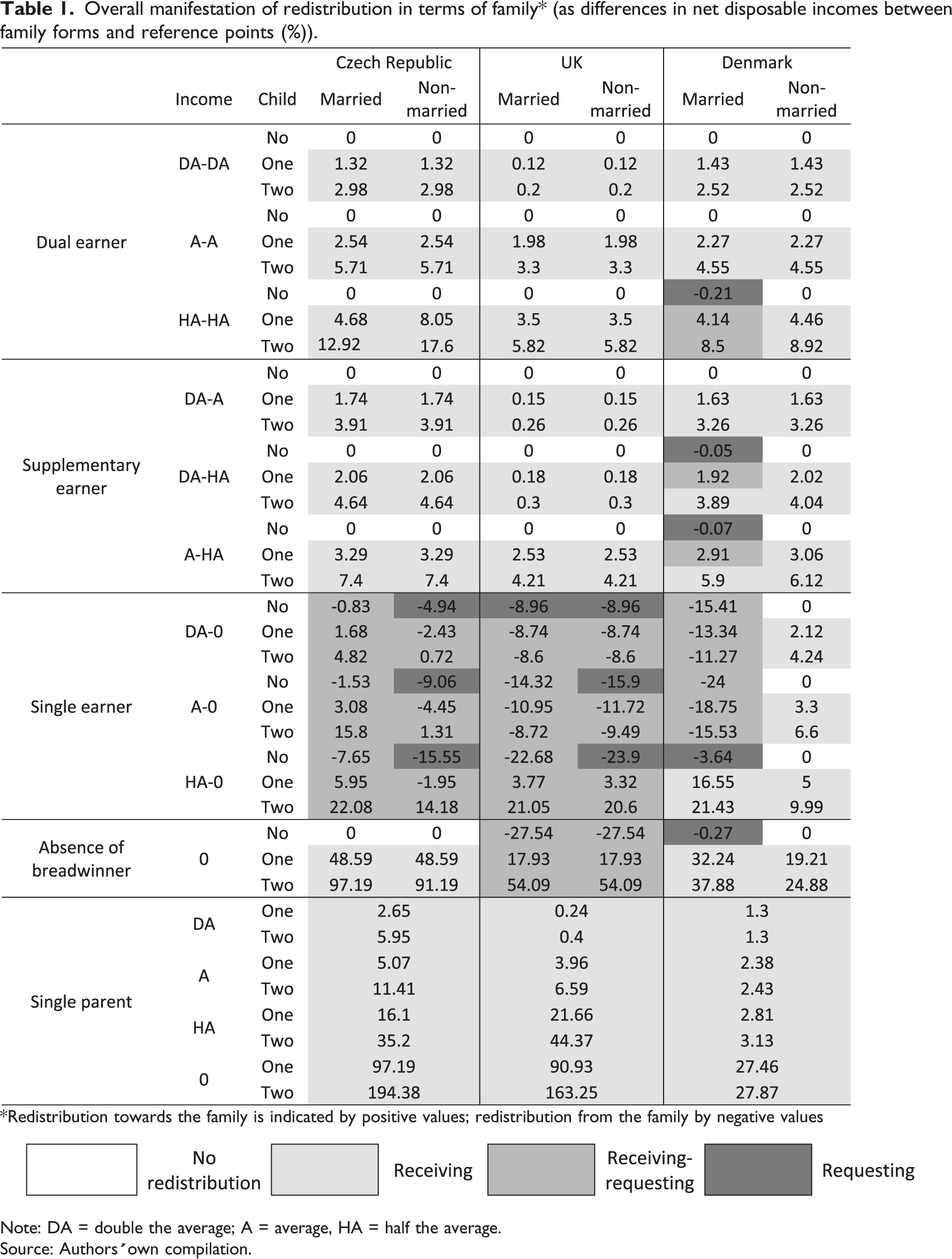
Overall manifestation of redistribution in terms of family* (as differences in net disposable incomes between family forms and reference points (%)).
*Redistribution towards the family is indicated by positive values; redistribution from the family by negative values

Note: DA = double the average; A = average, HA = half the average.
Source: Authors’ own compilation.
One of the logics of this redistribution relates to marital status. Table 1 shows that the UK, with its marginal differences between married and non-married family forms that are limited to single-earner family forms of lower income, supports our first assumption. The Czech Republic and even more so Denmark, instead, contradict it: their regulations often markedly distinguish between married and non-married family forms, in particular when one partner is not participating in the labour market, and consequently differ with regard to whether these family forms are granted more resources or obliged to provide them. For the Czech Republic we observe that it is married families that are particularly granted financial resources by welfare state regulations, resulting in 4.1–14.5% higher net disposable income than unmarried families are entitled to. The only deviation from this marriage-supportive logic can be found in dual-earner families earning half the average income who – when children are included – are less well-off than unmarried family forms. Also, for Denmark we observe strong differences in the net disposable income based on marital status. Here, though, it is mainly the unmarried family forms who are more supported than the married family forms, up to a difference of 24%. Married single-earner family forms are, in addition, strongly obliged to support family members, while their unmarried counterparts are not. More supported than the unmarried are married family forms, only when they are low-income single earner or no-income earner families, both with children. As a result, we identify pronounced differences in the redistributive logic between married and unmarried family forms, and legal obligations cause the former in Denmark and the latter in the Czech Republic in fact to lose income.
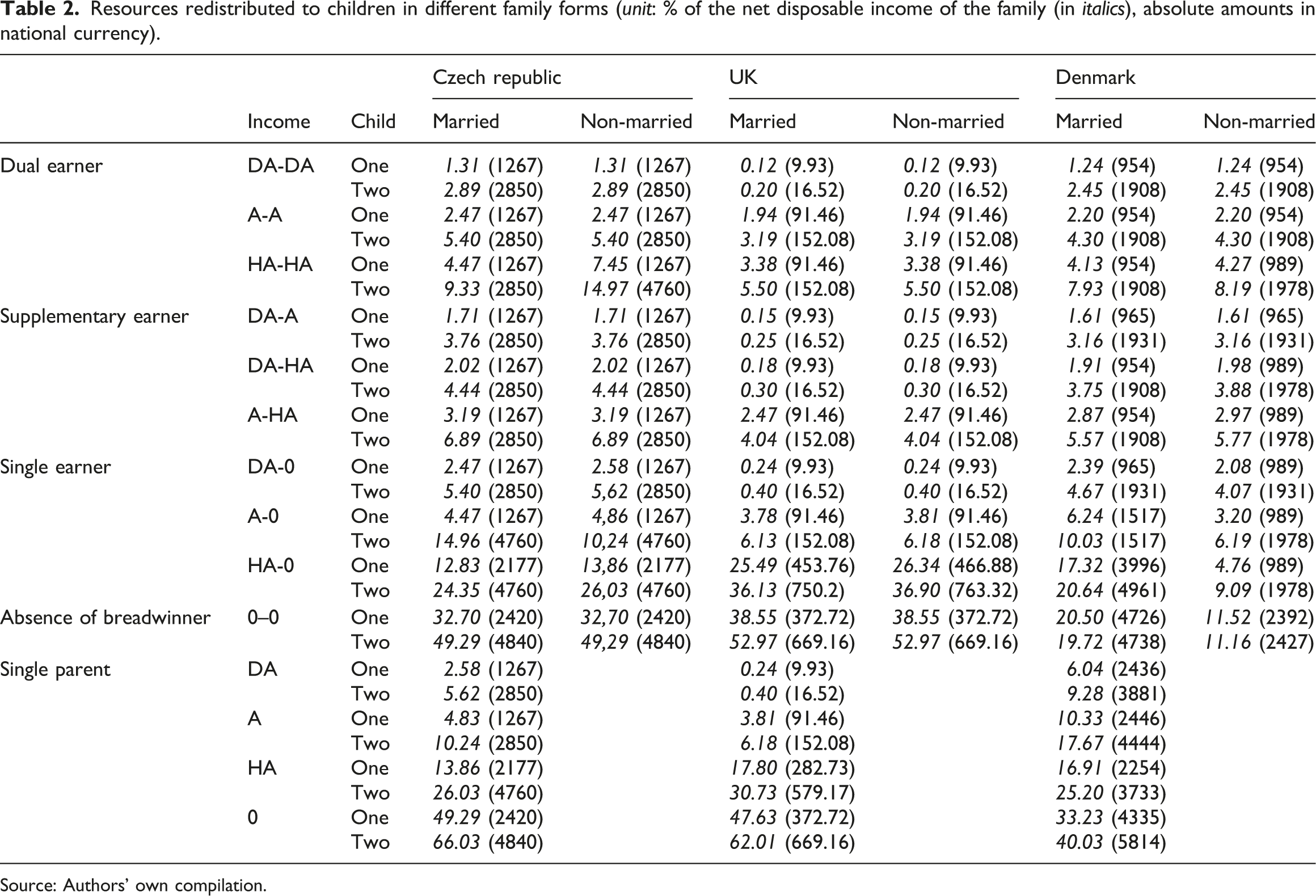
Resources redistributed to children in different family forms (unit: % of the net disposable income of the family (in italics), absolute amounts in national currency).
Source: Authors’ own compilation.
The third and last assumption – the expectation to find a legal obligation to support family members in financial need in only two of the three countries – cannot be confirmed. It is true that we found this redistributive logic in both the Czech Republic and the UK, but also Denmark includes the obligation of mutual support within the family in its regulations. Our study countries differ in the concretization of this requesting logic. A robust request to provide resources before public support is granted is imposed on both married and non-married single-earner family forms in the Czech Republic. Some families, as a result, lose income as is indicated by the lower net disposable income in comparison to the reference points (varying from −0.83% to 15.55%) (see Table 1). The situation in the UK looks similar. A legal obligation to support family members is imposed on both married and non-married single-earner families. Such obligations are, though, more consequential in the UK, as the considerable decrease in income shows (from approximately −9% to almost −24%). On top of that, financial obligations are also imposed on families with no adult worker whose net disposable income – gained from means-tested benefit – is decreased in comparison to the reference points. In other words, such families are entitled to fewer resources than two single individuals are. In Denmark, again, no support-requesting regulation was found for unmarried family forms of single earners or those with no adult worker, while they do exist for their married counterparts. A financial request to high-income family forms is accompanied by some additional resources, but still results in decreased income (varying between −11.27% to −15.1%). The request imposed on low-income family forms is substantially lower and not accompanied by the granting of additional resources. These findings are contra-intuitive and unexpected, again supporting our argument for renewing concepts and measurements of welfare states in order to also shed light on still under-researched facets of their redistributive principles.
Discussion
The findings we present are, in great part, contradictory to the assumptions drawn from the various strands of acknowledged literature, and in part even surprisingly so. Here, we briefly discuss three major issues from the related literature.
While previous welfare state research identifies significant differences between our study countries when focusing on redistributive logics in terms of labour, our study reveals substantial similarities between the study countries when focusing on redistributive logics in terms of family. Our findings correspond much more to the ‘varieties of liberalism’ literature (Mahon et al., 2012) than to the ‘welfare regime’ literature with its focus on redistribution in terms of labour, or the ‘family regime’ literature with its focus on care supply. We observe this similarity in the overall picture of redistribution with regard to family. The liberal, individual-focused perspective on redistribution is found for example for family forms of two adult labour-market participants with no children. Here, no family-related redistributive regulations exist. In addition, and still in line with the liberal interpretation of these countries, all countries grant resources to families with (poor) children. The third similarity of our study countries, which is (in all of them though in different forms and to different degrees) to grant and/or request resources with regard to financially dependent partners, does not fit well with the liberal reading. In short, the family is a principle of redistribution in all our countries; only the redistributive logics in part differ. This insight contradicts both the regime-typical and liberal interpretations, regardless of whether in terms of the countries’ similarities or the positioning of family in the intended redistribution.
As to the redistributive logics, prominent debates have argued that individualized social rights are replacing the formerly dominating marriage-related ones (Lewis, 2001). Our results do not confirm this, as in the Czech Republic and Denmark marriage in 2020 is still a relevant redistributive logic. This is particularly true for family forms where one or both adults are outside the labour market, and there are fundamental differences in the redistribution of resources to married and non-married family forms. Marriage thus results in additional resources, as in the Czech Republic, but also in heavier obligations than those put on the non-married, as in Denmark. These results put the findings of earlier studies into perspective that show, for Germany, that unmarried family forms are disadvantaged compared to married ones, since they are denied certain family-related entitlements while being obliged to support family members (Daly and Scheiwe, 2010).
Lastly, social policy debates deal mainly with the question of how much welfare regulations add to family incomes (for example, Ferragina and Seeleib-Kaiser, 2014; Shaver and Bradshaw, 1995; Van Lancker and Van Mechelen, 2015). Our study also shows that the opposite needs to be considered, that is, to what extent welfare state regulations decrease the income of families. If family members receive lower means-tested benefits than two single individuals do, as shown for the UK, this determines the minimum standard that people outside the labour market are granted. Particular attention should also be paid to welfare state policies with regard to single-earner family forms that are the most disadvantaged in the analysed countries, a finding that contradicts the general understanding of them in terms of welfare regimes. This is because, first, targeting the most needy with public benefits is considered the ‘hallmark’ of liberal social orders in terms of redistribution. Family as a rather overlooked redistributive logic, however, challenges this understanding, as low or no-market income families are also subject to robust financial obligations. Second, great differences in redistribution between the married and non-married family forms, and the considerable income decrease in single-earner family forms in Denmark again contradicts the major literature which emphasizes universalism and a strong commitment to equalize living conditions across the citizenry as the primal redistributive logic of social democratic regimes. In short, our analysis shows that comparative welfare state analyses that intend to address differences in welfare state redistribution need to include other major redistributive principles and their concretized logics, in addition to the traditional work-related one. Including other principles, and the family as a major redistributive principle in particular, better pictures the complexity of societal redistribution and also helps reveal contradictory characteristics of social orders in terms of redistribution.
We conclude the discussion with a note on the limitations of this study. Surely, it would be desirable to get a more complete picture of societal redistribution in terms of family by including regulations on care supply, that is, both services and support to the familial care supply (for an overview, see Frericks, 2022a). As explained above this is not possible here since we cannot include the respective regulations in the same way as we do the regulations directly related to financial redistribution. With regard to the database we use, further studies are necessary to show possible weaknesses and limitations of EUROMOD for these kinds of analyses.
Conclusion
Redistribution is one of the fundamental characteristics of the welfare state and of the social order of European countries. Welfare state research has thus far attempted to reveal and understand redistribution in terms of workers and individuals. Family has mainly been addressed as only affected by these ‘higher-level’ redistributive logics, but not as a redistributive principle in itself. All welfare states, though, have a body of regulations that directly address redistribution in terms of family. The aim of this contribution was to help fill this research gap in understanding family-related redistribution. To do so, we examined three welfare states – the Czech Republic, Denmark and the UK – that have been classified as different in terms of the concept of decommodification (the major concept in understanding welfare state-intended financial redistribution), but as similar in terms of liberalism, which is most relevant as to the dimension of the unit of redistribution. Using the tax–benefit microsimulation model EUROMOD and its HHoT, we analysed welfare state regulations in terms of family. We modelled and differentiated 72 family forms with reference to their marital status, children, income levels, and different forms of couples’ income distribution, and considered both the financial resources granted to families as well as the financial resources requested from them. That is, we considered the interplay of different redistributive regulations (means-tested and non-means-tested) on benefits, taxes and social insurance contributions.
Our findings contradict, as follows, the three theoretical assumptions we derived from the relevant literature: (1) In contradiction to the literature that considers our study countries to be liberal, with the individual at the centre of their social order in terms of redistribution, in all welfare states we find regulations that redistribute in terms of family, and differences based on marital status have been one of the particular manifestations of this redistribution. (2) As assumed, we found regulations that redistribute resources towards children in all our countries. This support, though, is not targeted specifically at children in poor families, but granted to all family forms with children, and independent of income. Children of low-income families are granted higher resources, in absolute and relative terms, and in the case of Denmark, also the status of single parent is a source of higher support. (3) A difference in the policies of the UK and Denmark, respectively the Czech Republic and Denmark, in terms of legal obligations to support family members in financial need, as theoretically assumed, was not verified. Our findings here indicate that redistribution in terms of family is not only about benefiting from regulations but also about losing income because of them. These legal obligations form an important additional source of similarity between our study countries. In all of them, requesting resources from the family as a redistributive logic was manifested, yet in quite different ways and to different degrees. Since none of these aspects have been systematically analysed before, combining them in a comparative analysis allowed a clear evaluation of family-related redistribution.
The findings show that family is a major redistributive principle of the welfare states analysed here. Family as a redistributive principle manifests itself not only in terms of additional benefits to families but also in obligations of families to financially support family members before these are entitled to public support. Our data shows that welfare states apply this principle in different redistributive logics to the various family forms. This, then, results in an increase in income for certain family forms and a decrease in income for other family forms, in particular for single-earner families. These differences are not the result of one coherent set of regulations, but of an interplay of in part contradictory regulations that reflect a great variety of family-related redistributive logics within the single countries. Thus, our study has provided new insights into the redistributive logics of welfare states, and may contribute to the analysis of welfare state complexity in terms of theory, methodology and empirics.
Footnotes
Acknowledgements
The results presented here are based on EUROMOD version I3.0+. Originally maintained, developed and managed by the Institute for Social and Economic Research (ISER), since 2021 EUROMOD has been maintained, developed and managed by the Joint Research Centre (JRC) of the European Commission in collaboration with EUROSTAT and national teams from the EU countries. We are indebted to the many people who have contributed to the development of EUROMOD. The results and their interpretation are the authors’ responsibility.
Funding
The author(s) disclose receipt of the following financial support for the research, authorship, and/or publication of this article: this article is a result of the research project FaSo (‘The relevance of family for social rights in international comparison: between family allowances and legally obliged family solidarity’) which is financed by the German Research Foundation (DFG).
