




Abstract
How do welfare state policies affect the political support for environmental action of economically vulnerable social groups? Two competing hypotheses can be delineated. On the one hand, a synergy logic would imply that welfare state generosity is associated with higher support for environmental action among economically vulnerable groups due to the insecurity reducing effects of the welfare state. On the other hand, a crowding-out logic would suggest that welfare state generosity is associated with lower support for other policy priorities like environmental action. We test these two hypotheses using 2019 Eurobarometer survey data and country-level indicators of welfare state generosity in 22 European countries. We find that the working class and the elderly are particularly opposed to individual and national environmental action and that the welfare state plays a complex moderating role. Consistent with a synergy logic, welfare state generosity increases pro-environmental behaviour among the working class, but its association with more positive attitudes towards national environmental policies is less strong. Consistent with a crowding-out logic, the elderly appear less likely to behave in environmentally friendly ways if retirement benefits are high. To explore the mechanisms behind this association, we show that the working class who struggle to pay their bills are most opposed to environmental action. Overall, economic insecurities are key obstacles for support of environmental actions and the effects of the welfare state depend both on which social group is concerned and whether individual behaviour versus policy preferences are considered.
Keywords
‘Protests in Paris are a reminder that altering energy policy hits the worst-off hardest.’ (Martin Sandbu, Financial Times, 4 December 2018)
Introduction
Preventing the imminent climate change crisis calls for urgent and drastic environmental actions by both governments and individuals. Yet, these required environmental actions are often politically unpopular, especially among economically insecure social groups that would prefer governments to address their more immediate material concerns. Since broad political coalitions are needed to undertake any large societal transition such as tackling the climate crisis, it is crucial to understand which policies – if any – can increase support for individual and national actions to address environmental challenges. To contribute to this understanding, this article analyses the relationship between the welfare state and support for environmental action among insecure social groups in Europe. Specifically, we explore whether the welfare state exacerbates or attenuates the tensions between the often pressing need to address rising economic insecurity among many social groups and the urgent government actions required to address the environmental crisis.
While there are many valuable studies on the extent of climate change and the most adequate possible solutions (for example, Gough and Meadowcroft, 2011; Jordan et al., 2022; Maor et al., 2017), the key question of the political viability of environmental policies necessary to achieve climate mitigation and adaptation has so far received less attention. 1 This is potentially problematic given that, as recent events such as the Gilets Jaunes protests suggest, solutions to the climate crisis will not be chosen on technical or economic grounds alone, but will crucially depend on the ability of governments to create sufficient electoral support to implement the necessary policy solutions.
One challenge in creating the required electoral support for these policies is that the costs of adaptation and mitigation are potentially very large and hence cannot be borne exclusively by a few economically very well-off social groups. It is therefore necessary to distribute the costs of environmental solutions across social classes. However, the ability and willingness of (partly) self-interested and (often) short-termist individuals to support environmental action depends crucially on their economic insecurity. When faced with a choice between reducing economic or climate risks, it is plausible that at least some individuals will prioritize the former. A first reason is that economic risks take place in the present and/or the near future, whereas most ecological risks (are perceived to) materialize over longer periods of time (for example, Gough et al., 2009). A second reason is that environmental risks and their solutions might appear more uncertain, harder to predict and/or requiring more collective action.
In this article we ask whether and how the welfare state can affect the policy preferences and individual actions of insecure groups to protect the environment. Building on existing literature, we theorize two competing hypotheses (Jakobsson et al., 2018; Marquart-Pyatt et al., 2019; Spies-Butcher and Stebbing, 2015). First, a synergy logic would imply that welfare state generosity is associated with more support for environmental action among economically vulnerable groups due to the insecurity reducing effects of the welfare state. Second, a crowding-out logic would suggest that welfare state generosity is associated with lower support for environmental mitigation as individuals prioritize their material concerns and protecting welfare state policies.
To test these two competing hypotheses, we estimate multilevel regressions and structural equation models using a dataset combining a 2019 Eurobarometer survey on environmental attitudes across 22 European countries (European Commission, Brussels, 2019) and national level data from OECD datasets and Eurostat. This survey includes questions about both individual environmental behaviour and policy preferences for national action. This allows us to study how welfare state generosity alters the environmental attitudes and behaviours of insecure social groups. We focus in particular on two characteristics that are typically associated with higher economic insecurity: the class position and age of respondents.
Our empirical analysis proceeds in four steps. First, we test which individual characteristics are associated with pro-environmental behaviour and preferences. Second, we explore whether more generous welfare states are negatively or positively associated with more overall support for individual and national environmental actions. Third, using interaction models, we analyse whether generous welfare institutions have stronger or weaker effects on support for environmental action among our two selected insecure groups – the working class and the elderly. Fourth, using structural equation models we examine a possible causal mechanism by focusing on individuals’ ‘inability to pay bills’.
Our results are as follows. First, we find that the elderly and working class are both less likely to support national action regarding energy efficiency and to adopt environmentally-friendly behaviour. Second, welfare state generosity influences their willingness for individual environmental action differently: while increasing welfare state generosity is associated with more environmental behaviour among the working class (synergy logic), the opposite is true for the elderly (crowding-out logic). Third, we find that the role of the welfare state is weaker in the case of attitudes towards national environmental action. Finally, we find support for a material mechanism linking economic insecurity to environmental attitudes, which operates via the ‘ability to pay bills’ of individuals, rather than a more ideological mechanism operating via the left–right self-placement of different classes and age groups. Taken together, our findings contribute to an emerging literature on the determinants of political support for different environmental policies (for example, Fritz and Koch, 2019; Tvinnereim and Ivarsflaten, 2016).
In the next section, we review previous literature to derive our eight hypotheses. Next, we describe our data and our multilevel estimation method. In the third section, we present and discuss our findings. In the last section, we explore the wider implications of our findings for research on the welfare–environment nexus.
The welfare state and support for environmental action
The climate crisis and the necessary politics of environmental action
Adopting renewable energy sources and making energy use more efficient are considered to be key factors for reducing greenhouse gas emissions. Although best practices are shared by the OECD and the necessary instruments such as technologies and carbon tax schemes are widely known, governments often struggle to implement the required policies needed to address the unfolding climate crisis. Assuming consensus on what has to be done, why do governments not implement the required policies more fully? A reason might be that governments fear punishment at the next elections: the short-term politics at the core of the democratic process undermines societies’ ability to address long-term negative externalities of current production and consumption models, because these mainly affect future electorates. In other words, current electorates might face most of the costs of adaptation and few of the benefits, whereas future electorates face most of the benefit but less of the cost.
Further compounding this temporal challenge, climate change and environmental policy efforts towards its mitigation also entail a distributional challenge in the present because these policies often have different implications for distinct social groups and the existing social policy arrangements meant to protect insecure groups (Gough et al., 2009). Whereas climate change affects especially strongly the poor due to their higher exposure and lower adaptive capacity (Gough and Meadowcroft, 2011; Schaffrin, 2014; Tol et al., 2003), it is precisely these groups that are often – somewhat paradoxically – most opposed to environmental action. This puzzling opposition and the need to have a wide political coalition to support environmental adaptation raise the question of the conditions under which different social groups support environmental action.
Given the importance of democratic politics for tackling environmental challenges and climate change, recent literature has increasingly focused on individual attitudes and environmental policy preferences. A consistent finding across these studies is that insecure groups are less likely to support environmental action at the national level and to engage in environmentally friendly behaviour. As economic risks become apparent earlier (or more clearly) than environmental risks, economically insecure individuals seem to prioritize increasing social spending to address their immediate economic risks, even if this is at the expense of allocating more funds and resources to address environmental risks in the future. In fact, to account for the choice between social and environmental policies, self-interest has been found to be the most important factor, as demonstrated in a recent experiment in Switzerland (Armingeon and Bürgisser, 2020).
Thus, the distribution and level of insecurity also affects the distribution and level of popular support for environmental action. The resulting potential gap in support echoes a wider literature in political economy and political science, which documents how risks are unequally distributed between secure and insecure groups and how these risks in turn lead individuals to adopt distinct policy preferences (see Busemeyer and Garritzmann, 2017; Emmenegger et al., 2015; Vlandas, 2013a, 2018, 2020; Vlandas et al., 2021) and voting behaviour (for example, Bojar and Vlandas, 2021) which in turn shapes government policy responses (for example, Simoni and Vlandas 2020). In the rest of this section, we focus on two prominent political dividing lines in society: age and social class; and then theorize how these two social groups differ in their environmental actions and policy preferences.
First, with respect to social classes, individuals with low income and low economic opportunities are more likely to focus on more immediate pressing material needs. This then leads them to express lower support for policies that are not immediately conducive for increasing individual welfare (Fritz and Koch, 2019). In this view, the material interests of economically less well-off social classes affect their attitudes towards environmental behaviours and policies due to their more limited material resources. Marquart-Pyatt et al. (2019) for instance confirm this effect for environmental attitudes and for pro-environmental behavioural intentions in advanced industrial countries. Similarly, those who are economically insecure have a lower likelihood to be concerned about the environment (Panarello, 2020) and working-class individuals are also less likely to have environmentalist values (Garner, 2011: 13ff). Conversely, using a survey in the UK, Graham et al. (2019) find that the highest-income group is twice as willing to pay for policies that reduce future increases of climate-related deaths as the lowest-income group.
Thus, there are good reasons to expect lower social classes with more limited economic resources to be less likely to engage in environmentally-friendly behaviour (for example, buying organic food) and to support environmental policies, especially if they fear this will lead to cuts in much needed welfare benefits. In line with this literature, we hypothesize that members of the working class have fewer environmentally friendly behaviours and exhibit lower support for environmental policies. Hypothesis 1: The working class is less likely to support environmental actions. Hypothesis 2: The elderly are less likely to support environmental actions.
The welfare state and environmental action: synergy or crowding out?
While existing literature has looked at different aspects of the relationship between welfare states and the environment, to the best of our knowledge, there are few (if any) studies looking at how welfare state generosity influences the environmental preferences of different social groups. Existing literature has compared attitudes towards social and environmental policies (for example, Fritz and Koch, 2019; Jakobsson et al., 2018; Otto and Gugushvili, 2020). More recent studies have also analysed more specific survey questions where respondents need to choose between competing options (Armingeon and Bürgisser, 2020). Yet, previous research has not explicitly conceptualized how the welfare state could influence the environmental attitudes and behaviours of social groups.
Two opposing logics linking the welfare state and support for environmental actions can be theorized. On the one hand, where economic needs are effectively addressed by welfare state policies, individuals might become both more willing and able to be environmentally friendly and support national action on the environment. In this synergy logic the welfare state increases support for climate change mitigation by tackling the economic insecurity that undermines support for environmental action at the individual and national levels. Consistent with the policy feedback literature, welfare state institutions in this scenario lead to synergies between addressing socioeconomic and ecological risks. Generous welfare state policies make people safer by satisfying their short-term material needs (see Campbell, 2012; Pierson, 1994), thereby enabling them to focus on longer-term and more ‘post-material’ concerns (Inglehart, 1981), most notably support for environmental action. This synergy logic can in principle operate at two distinct levels. At the individual level, generous welfare states enable individuals to engage in (often economically costly) pro-environmental behaviour, such as buying organic food or more environmentally beneficial goods and services. At the national level, since individuals’ material needs are taken care of by a generous welfare state, social groups become more supportive of policies to address environmental problems.
On the other hand, previous research examining the effect of welfare state regimes on public opinion towards the environment yields mixed results: while some point to a higher willingness to cut standard of living for the sake of the environment among respondents living in countries with advanced welfare institutions (Fritz and Koch, 2019; Koch and Fritz, 2014), others find no or only small empirical support for this synergy logic (Jakobsson et al., 2018). In addition, an alternative crowding-out logic suggests that there might be lower individual actions on the environment as well as fewer available resources at the national level to address environmental issues in more generous welfare states. If ecological and social risks and policies are seen as substitutes, then individuals will prioritize one at the expense of the other (for example, Fritz and Koch 2019; Jakobsson et al., 2018). With respect to individual environmental behaviour, generous welfare states increase individual resources which might make individuals more focused on materialist values; hence environmental concerns fade in the background. In this logic, generous welfare state institutions reinforce self-interest and individuals’ focus on short-term social risks.
Moreover, in terms of attitudes towards national action on the environment, individuals may have more to lose from a reallocation of resources away from a generous welfare state and towards environmental policies targeted at promoting climate mitigation and adaptation. Conversely, when welfare states are not generous, individuals may already rely on alternative market or family-based modes of insurance, and hence have less to fear from a government focus on the environment. More generous welfare states also often require higher taxes, which in turn may reduce individual support for other policy priorities such as the environment that may also entail even higher taxes.
In sum, our two opposite hypotheses concerning the potential association between welfare state generosity and environmental actions are as follows: Hypothesis 3: Welfare state generosity is associated with higher support for environmental actions; Hypothesis 4: Welfare state generosity is associated with lower support for environmental action.
Insecurity, support for environmental action and the moderating role of the welfare state
An implicit assumption in existing studies on the topic (for example, Fritz and Koch, 2019; Graham et al., 2019; Marquart-Pyatt et al., 2019) is that insecure groups are similarly against environmental policies and actions, regardless of institutional difference across these countries. This strikes us as partly implausible because the mechanisms linking these social groups to opposition to environmental support – that is, their economic insecurity – is crucially shaped by welfare state policies. This has been well-documented by a large literature exploring how social policies emerged specifically to address social risks and insecurities (see for instance Barr, 2001; Esping-Andersen, 1990, Vlandas, 2013b). As a result, it is necessary to bring the welfare state more centrally into the study of environmental preferences by theorizing how it might shape environmental support of economically insecure groups.
Since income and labour market risks are not distributed equally across social groups, the welfare state does not affect them in a similar way (for example, Radl, 2013, on timing of retirement; Sørensen, 2000). As a result, the aforementioned synergy logic might in turn be expected to have a particularly strong impact on more insecure groups, such as the working class and the elderly. In this scenario, welfare state generosity mitigates the level of economic insecurity of different social groups, which makes them more likely to support environmental action than they would have been if social policies did not protect them. Conversely, the aforementioned crowding-out logic could be stronger for insecure groups if they are especially reliant on welfare state institutions. Groups that depend on very generous welfare state policies may have more to lose from a reallocation to other policy priorities and/or might be more able to focus on their immediate material needs, at the expense of more post-material considerations.
More specifically, with respect to the working class, we posit that overall welfare state spending is especially relevant. Indeed, the working class often has lower education and/or lower income and/or higher risks of unemployment. Thus, their reliance on the welfare state is higher than for the general population. If the crowding-out logic dominates then the working class will be less environmentally friendly in generous welfare states, whereas the opposite will be the case if the synergy logic dominates.
Similarly, given the relevance of pension generosity for elderly people’s economic insecurity, it should affect their environmental policy preferences and behaviours. For instance, the minimum pensions’ replacement rates have been shown to be especially important for reducing old-age poverty (Ebbinghaus et al., 2019). According to the synergy logic, generous pensions should be associated with more positive attitudes towards individual and government environmental action among the elderly. Conversely, the crowding-out logic would instead make us expect that the elderly living in countries with more generous pension systems are especially dependent on the welfare state, and hence would be particularly worried about supporting environmental action if they fear this might lead to retrenchment.
To sum up, the following hypotheses on the interactions between welfare state generosity, social groups and environmental actions can be delineated for the synergy logic: Hypothesis 5: The working class is more favourable to environmental action if the welfare state is more generous. Hypothesis 6: The elderly are more favourable to environmental action if the welfare state is more generous. Hypothesis 7: The working class is less favourable to environmental action if the welfare state is more generous. Hypothesis 8: The elderly are less favourable to environmental action if the welfare state is more generous.
Data and method
To test our hypotheses, we merge the cross-national individual level Eurobarometer 91.3 (European Commission, Brussels, 2019) survey with national level data on welfare state indicators taken from the OECD Social Expenditures (2019) and (Eurostat 2018). Our survey data was therefore collected when environmental action to tackle climate change was a salient topic and our more recent time period distinguishes our study from others that largely rely on older data, for instance based on the European Social Survey from 2016 (for example, Fritz and Koch, 2019; Stadelmann-Steffen and Eder, 2020).
We create two dependent variables in our empirical analysis to capture two distinct dimensions of environmental action: one for individual level environmental behaviour and another capturing individual support for national level environmental action. This distinction allows us to differentiate how economic risks and insecurities shape individual behaviour as opposed to policy preferences. More specifically, to measure policy preferences for government environmental action, we rely on two questions: ‘How important do you think it is that the government provides support for improving energy efficiency by 2030 (for example, by encouraging people to insulate their home or buy electric cars)?’; and ‘How important do you think it is that the government sets ambitious targets to increase the amount of renewable energy used, such as wind or solar power, by 2030?’ We construct an index combining answers to both questions and then dichotomize the resulting index to facilitate interpretation. Since our data do not include questions on other policy areas of environmental action to tackle climate change, we can only focus on energy policies. This strikes us as a reasonable proxy since energy (electricity and heating) represents the largest source of greenhouse gas emissions from human activities.
Next, for our second dependent variable capturing individual environmental actions, we create a summary index based on survey respondents’ answers to questions about eight environmentally related actions they have done. Note that all actions included in the survey are part of the ‘private-sphere environmentalism’ in the classification of environmental behaviours developed by Stern (2000). We only include those items that have no socio-economic bias and are in principle feasible for all respondents. 2 Most notably, we exclude ‘buying an electric car’ because we expect mostly better-off individuals to engage in such a behaviour (see also online appendix A1.1).
Specifically, our summary index was calculated by summing up the answers to an extensive list of items 3 where each item is coded 1 if it is an action that the respondent has taken, and 0 otherwise. Since the median of the distribution of answers is located at value 3 (that is, three actions), for simplicity we classify all persons who do three or more actions as environmentally conscious (coded 1) and all with strictly fewer than three actions as less environmentally conscious (coded 0), but our results do not depend on this dichotomization (see online Appendic A2.16 and A2.17).
Our key independent variables at the individual level are age and subjective social class affiliation. To facilitate our group-based analysis, we use a binary coding here. All individuals aged 65 years or above are ‘elderly’ (coded 1) and those below that threshold are not (coded 0). We decided against using pensioners instead of age due to endogeneity issues and because of more limited data availability of this variable. Next, all individuals who consider themselves as ‘working class’ are coded 1, while subjective self-location in other class schemes is coded 0. We use subjective social classes instead of income levels because classes allow us to capture wider and more dynamic socio-economic characteristics that are crucial for our argument (see Goldthorpe and McKnight, 2006; Sørensen, 2000). However, we also test our argument when using occupations as more objective markers of class position. To measure occupational groups, we rely on Gingrich and Häusermann (2015) but combine routine workers and working class (see online appendix A2.2).
Gender, education, left–right orientation and place of residence are included as control variables. With regard to gender, previous studies contend that women are more favourable to environmental policies due to higher climate change concern and higher willingness to engage in climate change action (Jylhä and Akrami, 2015; McCright, 2010; Poortinga et al., 2019). With respect to education, previous research has shown that individuals with higher educational attainments have a higher likelihood to have pro-environmental preferences (Fritz and Koch, 2019; Gelissen, 2007). Ideology is a key explanatory variable in other studies which found that right-wing and conservative individuals are less likely to believe in anthropogenic climate change (for example, Benegal, 2018) or to support environmental action (for example, Marquart-Pyatt et al., 2019). Place of residence is dichotomized (coded 1 if respondent lives in a large town, and 0 otherwise) and we expect those living in large cities to have more positive environmental attitudes due to their low labour dependency on ‘old’ industries and since they often hold more liberal and progressive values.
To test whether the mechanism linking social groups and attitudes operates via economic insecurity, we use the item ‘inability to pay bills’. Here, respondents are asked whether they faced difficulties to pay bills at the end of the month during the last 12 months, where they can answer ‘most of the time’, ‘from time to time’ or ‘almost never’. Note that economic insecurity is often associated with an inability to pay bills which is why this indicator is often used to measure this latent concept (for example, Rohde et al., 2016).
We rely on OECD data on welfare state generosity as percent of social expenditures of GDP in 2015 as our main national level independent variable. Welfare state generosity comprises various kinds of services and benefits and provides public goods that might have an association with behavioural or attitudinal environmental action and preferences of different social groups. As a robustness check, we also used welfare regimes instead of welfare state generosity: the results are discussed in the empirical section and shown in online appendices A2.4 to A2.7, and A2.15. We also rerun our analysis with a more disaggregated measurement of welfare state generosity, unemployment replacement rates (see online appendix A2.8), which can be expected to be important to working-class individuals. Whereas total welfare state spending captures overall generosity fairly well (for example, Scandinavian countries rank very highly), we believe spending on pensions cannot properly capture generosity of pensions, which is heavily influenced by share of elderly in the population. Thus, we rely instead on the Eurostat pension replacement ratio in 2018 (but we also test the effect of social expenditures on old age in 2015 in online appendix A2.9).
In the online appendices A2.9 and A2.10, we report the results for other national level indicators such as GDP per capita. However, due to the limited degrees of freedom and multicollinearity issues, we do not include national-level controls in our baseline models. We acknowledge this may lead to omitted variable bias, but consider multicollinearity a greater risk given the high correlation (0.6) between social expenditures and GDP (see Shieh and Fouladi, 2003). Due to multicollinearity issues, we also do not control for whether countries are located in Central and Eastern European Countries (CEECs) or not (see online appendix A2.14) but carry out some robustness checks to explore the effect of individuals being in different welfare state regimes in online appendices A2.4 to A2.7. Definitions and sources for our variables are summarized in online appendix A1.1. While descriptive statistics for all individual and national-level variables can be viewed in online appendix A1.2.
Our estimation method for our hypotheses relies on mixed effects random intercept logistic regressions which allow us to predict probabilities for our two binary outcome dependent variables. Since effects are similar to a random slope model, we opted for the former to facilitate interpretation. For predictions based on regressions, we report the fixed portion of the model only. We also report results for alternative estimations methods such as linear and ordinal multilevel regressions in online appendices A2.16 and A2.17. Finally, to test the insecurity mechanism via inability to pay bills, we estimate generalized structural equation models.
Results
We start by running a baseline model for each of our dependent variables including only individual level variables. Next, we include social expenditures as a percentage of GDP in our models. Figure 1 reports the marginal effects (with 95% confidence intervals) of all our variables for both regressions. In the left panel, we show the results for individual environmental action, while the right panel displays the results when using support for national environmental action as the dependent variable. Coefficient plots for individual environmental action (left hand side) and support for national environmental action (right hand side). Notes: This figure plots the marginal effects of different variables using results from mixed effects random intercept logistic regressions for support for environmental action with 95% confidence intervals, based on data from the Eurobarometer 91.3 (European Commission, Brussels, 2019) and OECD Social Expenditures (2019).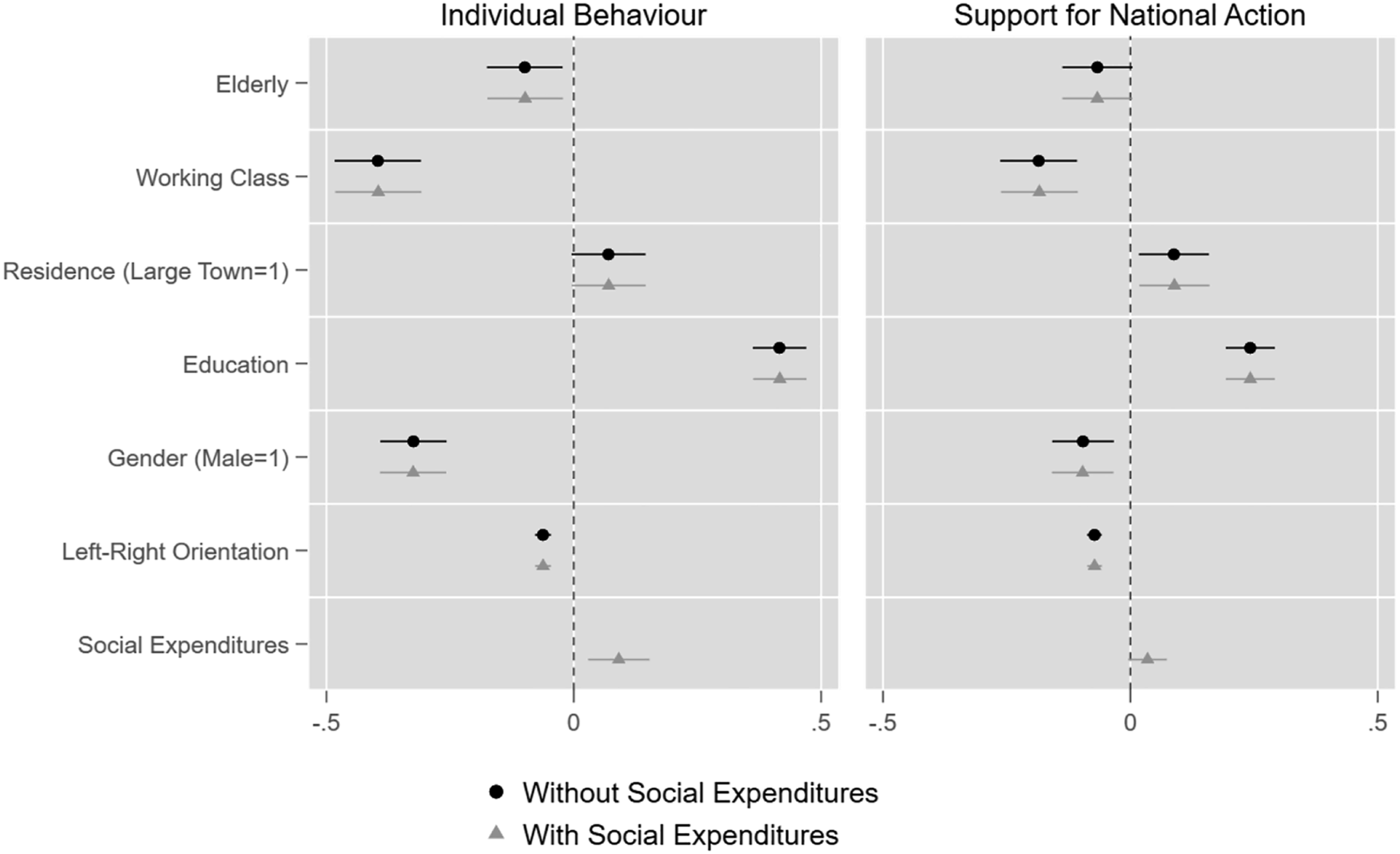
The results show that the elderly are less likely to support environmental action both at the individual and national levels. The effect is statistically significant at the 1% level for individual behaviour. We further find that the working class is also significantly less likely to favour environmental action. We also ran regressions by welfare regimes (see online appendices A2.4 and A2.5), which revealed that the working class is consistently and significantly less engaged in environmental action across all five welfare regimes, whereas the results for the elderly and support for national action are mixed.
Moreover, for both dependent variables, it is clear that women are more likely to support the environment both in terms of their behaviour and policy preferences. More highly educated individuals exhibit higher support for individual and government environmental actions. With regard to individual environmentally-friendly behaviour, we find that elderly individuals with no education have a predicted probability of 21% compared to a probability of 47% for a similar individual with the highest education. Individuals with a left-wing political orientation are more likely to engage in environmental behaviour and to support national action than individuals with a right-wing orientation. Next, the effect of place of residence is different for each dependent variable: while living in a large town increases the likelihood to support national action towards energy efficiency, it decreases the likelihood for individuals’ environmentally-friendly behaviour. However, the effect size for the place of living is small compared to education, subjective social class affiliation and age.
Turning our attention to cross-country differences, individuals in countries with high social expenditures appear more likely ceteris paribus to behave in an environmentally-friendly way. This effect is statistically significant at the 1% level and the change in predicted probabilities associated with different welfare state generosity is very high for individual behaviour: individuals living in the country with the lowest generosity in our sample – Lithuania with 13.7% of GDP – have an average predicted probability of 27% compared to those in the most generous welfare state – France with 31.7% of GDP – with a nearly 62% predicted probability. By contrast, the effect of welfare state generosity on support for national environmental action is only statistically significant at the 10% level, although the magnitude of the effect is also high: the predicted probability increases from above 17% to nearly 80% when social spending is at its minimum versus maximum sample value.
In online appendix A2.15, we report the average values for support for environmental action by welfare regimes. We find that individuals living in welfare state regimes with high generosity (Nordic and Continental) show significantly higher environmental individual behaviour than individuals in Eastern and Southern welfare states. By contrast, the results are again less clear for support for national action. Overall, we therefore find only partial empirical support for our hypothesis on the synergy logic of the welfare state: while we find clear support for the enabling role of the welfare state on individual behaviour, the results for support for national environmental action are less clear. We find no support for our hypothesis following crowding-out logic. 4
In a second step, we want to find out whether the effect of welfare state generosity is particularly strong among insecure groups. We start by rerunning our models while including an interaction term between social spending as percent of GDP and the working class (subjective affiliation and occupation-based). The results are presented as predicted probabilities in Figure 2. Being working class has a predicted probability of less than 20% to engage in environmental behaviour in the least generous welfare states, whereas this predicted probability increases to more than 40% when social spending is at its most generous. The findings for the occupational working class are comparable: the predicted probabilities for environmental behaviour increase by more than 25 percentage points if social spending is set from its minimum to its maximum level. Predicted probabilities for environmental individual behaviour (top panel) and support for environmental national actions (bottom panel) at different levels of social expenditures. Notes: This figure plots predicted probabilities for environmental action at different levels of social spending and for different social classes, with 90% confidence intervals, based on data from the Eurobarometer 91.3 (European Commission, Brussels, 2019) and OECD Social Expenditures (2019).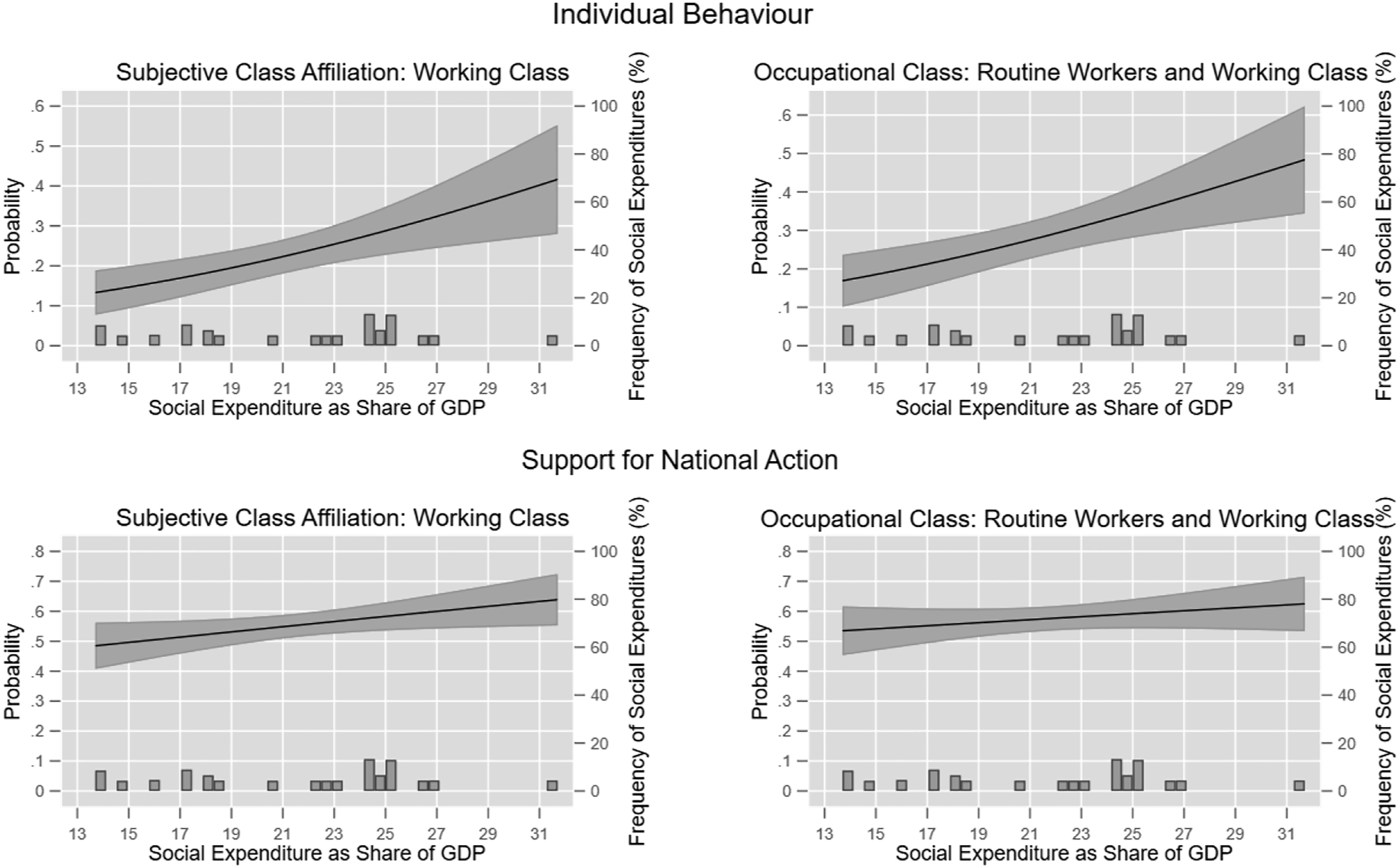
The effect for support for national action is shown in the lower part of Figure 2. While the association is statistically significant, the magnitude of the effect is much smaller: the predicted probabilities increase from below 50% to above 60% if social spending increases from its minimum to its maximum sample values. The results for occupational classes (shown in the right panel) are comparable to those of subjective class affiliation. We also rerun our analysis when using interactions with welfare regimes instead of welfare state generosity (shown in online appendix A2.6): the average marginal effects for working-class people to engage in environmental behaviour or to support national policies is lowest in Eastern regimes and highest in Nordic regimes, which is consistent with our finding in Figure 2.
Taken together we interpret these results to be inconsistent with a crowding-out logic, but in line with a synergy logic between the welfare state and environmental support: by reducing economic risks and insecurities, social spending makes insecure groups more likely to support environmental action at the individual and national levels. However, we find important differences between the behavioural and attitudinal dependent variables: the welfare state seems to influence individual environmental behaviour more strongly than environmental policy preferences.
In a third step, we explore how more specific social benefits influence the behaviour and preferences of the elderly for environmental actions. Focusing on the interaction between being elderly and the pension replacement ratio allows us to test more closely the logic of our argument for the case of a large and politically powerful social group. In Figure 3, we plot the predicted probabilities of both dependent variables among the elderly, for different levels of the pension benefit replacement rates. Individual environmental action is shown on the left-hand side, while support for national energy efficiency is shown on the right-hand side. Predicted probabilities for individual environmental action (left-hand side) and support for environmental national action (right-hand side) at different levels of pension benefit generosity. Notes: Own illustration of predicted probabilities for different levels of pension replacement ratio and the elderly with 90% confidence intervals, based on data from the Eurobarometer 91.3 (European Commission, Brussels, 2019) and Eurostat (2018).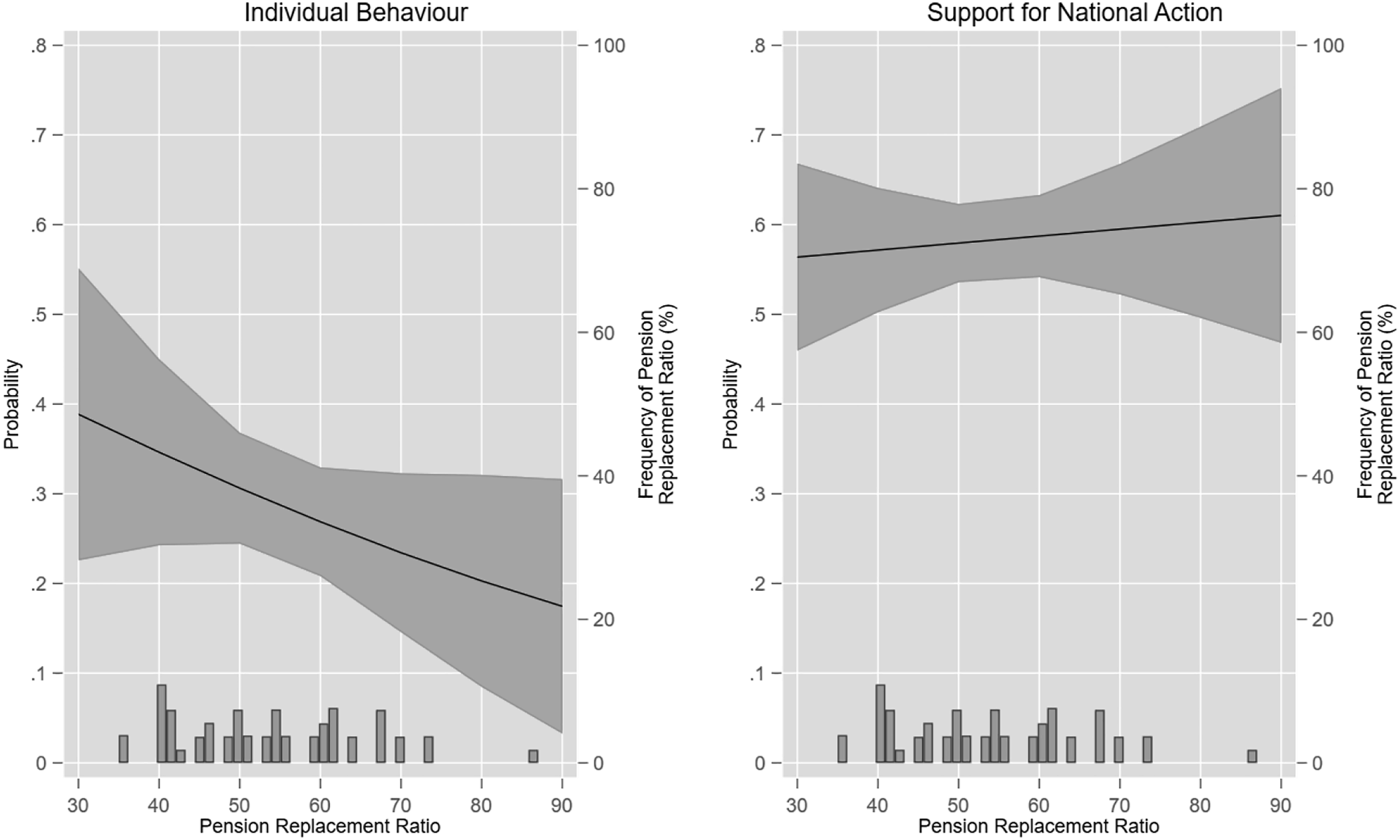
Starting with individual environmental behaviour, we find that the elderly are less likely to engage in environmental actions when the pension replacement ratio increases. The elderly have nearly 20 percentage points lower predicted probability to engage in environmental behaviour when the pension benefits are at their most generous compared to their lowest level: the predicted probability of pro-environment behaviour falls from around 37% to under 20%. However, the confidence intervals around these predicted probabilities are rather large. While these results therefore do not provide strong support for a crowding-out logic given the weak trade-off between welfare state generosity and environmental behaviour, they are at minimum not consistent with a synergy logic. Turning to the right side of Figure 3, we find a very weak positive relationship with large confidence intervals between pension replacement rate and support for national action among the elderly. In sum, we are able to reject the synergy logic for the elderly, but can only partly confirm the crowding-out logic for this social group. This suggests that the interplay between welfare states, social groups and environmental support are complex and partly dependent on the specifics of the social group and type of environmental actions under consideration.
We have so far only presented evidence linking individual characteristics, welfare state generosity and environmental attitudes. To explore the mechanisms underpinning these correlations, we turn our attention to a variable in the Eurobarometer capturing insecurity: individuals’ ability to pay bills. As shown in Figure 4, the negative effects of being elderly and working class appear mediated by whether the respondents struggle to pay bills. More specifically, being working class is associated with a higher likelihood of being unable to pay bills, which in turn is associated with fewer individual environmental actions and – to a lesser extent – lower support for national environmental action. The mechanism via inability to pay bills remains statistically significant when controlling for other variables (see online appendix A2.12). By contrast, while the elderly are also less likely to support environmental action, they are less (rather than more) likely to be unable to pay bills. This could suggest either that other economic risks are at play or that the environmental attitudes of the elderly derive from other more ‘cultural’ factors, and/or are shaped by generational differences (see Inglehart, 1981). Generalized structural equation of mechanism ‘inability to pay bills’. Notes: Own illustration of the GSEM results for support for environmental action, based on data from the Eurobarometer 91.3 (European Commission, Brussels, 2019). *** = 1% significance level, ** = 5 % significance level, * = 10% significance level, standard errors in parentheses, Ɛ = error variance.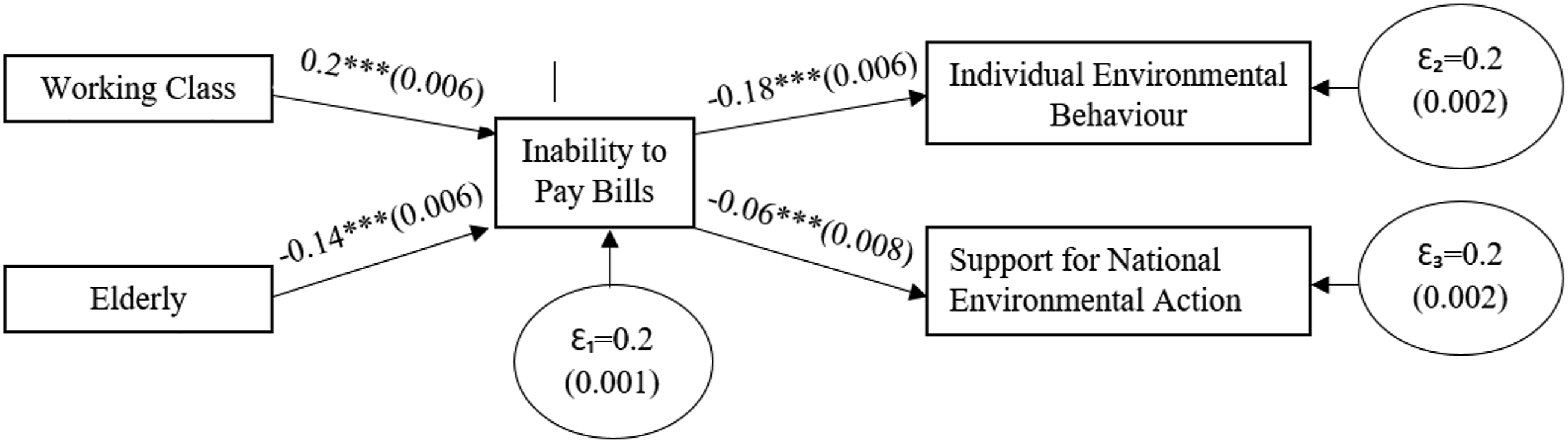
In online appendix A2.13, we test an alternative mechanism operating via political ideology. For instance, the elderly might be less likely to support environmental action due to right-wing beliefs. While plausible, the results demonstrate that this is not the mechanism linking social groups to environmental preferences and actions. While a left-leaning political ideology is associated with higher support for environmental action, the elderly and working-class people are statistically not different to other social groups in terms of their political ideology. Therefore, we find some preliminary evidence consistent with a mechanism operating through economic insecurity linking social groups to varying support for environmental action.
Discussion and conclusion
This article investigates how insecurity and welfare state generosity influence environmental support by examining the preferences and behaviours of two insecure groups – the elderly and working-class people – and two kinds of environmental action – individual behaviour versus policy preferences. We theorize two opposing logics from the literature: while a synergy logic would imply that welfare state generosity is associated with more support for environmental action, especially among economically insecure groups, a crowding-out logic would suggest that it is associated with lower support for environmental mitigation.
Summary of findings.

Notes: summary of the empirical results in paper and appendix, based on data from the Eurobarometer 91.3 (European Commission, Brussels, 2019), (OECD Social Expenditures 2019) and Eurostat (2018).
The correlations we show can only be interpreted as consistent with our argument rather than definite evidence of a causal effect and our research design is by necessity further constrained by limited degrees of freedom at the national level. Nevertheless, our article represents a first attempt to theorize and empirically explore the relationship between the welfare state and environmental attitudes as well as behaviours, whereas previous work had focused on links between social policy preferences and environmental preferences or between environmental policies and social policies (for example, Fritz and Koch, 2019; Gough and Meadowcroft, 2011; Spies-Butcher and Stebbing, 2015).
While exploratory, our findings also have important wider theoretical and policy implications. Theoretically, we provide a framework linking economic insecurity and welfare state policies, which have already extensively been discussed in political economy and welfare state literatures, to individual characteristics and environmental preferences, which have been the focus of political science and environmental studies. In terms of policy implications, our findings suggest that in countries where insecurity is high and/or not effectively addressed by welfare state institutions, governments will be less able to form a viable wide political coalition with the working classes in support for climate change mitigation. The importance of welfare state institutions for environmental actions intersects with other recent debates about the appropriate trajectory of future welfare state reforms, most notably universal basic income (Parth and Nyby, 2022; Rincón et al., 2022; Schwander and Vlandas, 2020; Vlandas, 2019). At the same time, they show that welfare state policies do not increase support for all social groups for all types of environmental solutions, since those who are elderly appear less likely to undertake environmental actions at the individual level, and do not change their support for environmental action at national level when pensions are more generous.
Finally, there are several avenues for further research. First, future studies may need to further explore how synergy and crowding-out operate in different welfare regime contexts, for instance through more detailed country case studies. Second, we still do not have enough knowledge about what role (if any) other social and non-social policies have to address the source of this reluctance. Third, the temporality of the potential trade-offs between welfare state spending and environmental policies is not fully resolved. Fourth, trade union organizations and wage bargaining institutions could also in principle help address the insecurity of certain workers’ groups (see Benassi and Vlandas, 2015 and 2021).
While it is true that in the long run climate change adaptation might be a ‘free lunch’, especially if the short-term costs of adaptation are lower than the long-term costs of doing nothing, in a democracy the size and distribution of costs and benefits in the short term are the politically salient and important variables. To undertake a large-scale ecological transition requires political support by a large majority of the population and this is unlikely to be possible if both elderly and working-class individuals oppose such a transition. Thus, future research should therefore explore whether and how social policies can play a role in shaping a sufficient and politically viable coalition in favour of environmental action.
Supplemental Material
Supplemental material - The welfare state and support for environmental action in Europe
Supplemental material for The welfare state and support for environmental action in Europe by Anne-Marie Parth and Tim Vlandas in Journal of European Social Policy
Footnotes
Declaration of conflicting interests
The author(s) declared no potential conflicts of interest with respect to the research, authorship, and/or publication of this article.
Funding
The author(s) received no financial support for the research, authorship, and/or publication of this article.

Supplemental Material
Supplemental material for this article is available online.
Notes
References
Supplementary Material
Please find the following supplemental material available below.
For Open Access articles published under a Creative Commons License, all supplemental material carries the same license as the article it is associated with.
For non-Open Access articles published, all supplemental material carries a non-exclusive license, and permission requests for re-use of supplemental material or any part of supplemental material shall be sent directly to the copyright owner as specified in the copyright notice associated with the article.
