




Abstract
This article explores the (in)equality dynamic of childcare-related policy reforms in post-Yugoslav countries to expose ‘silent’ cleavages embedded in parenting leaves and early childhood education and care policies design that may challenge or reinforce parental (in)equalities in employment and care opportunities. It is guided by the principles and (sub-)questions of intersectionality-based policy analysis to determine who benefits and/or is excluded from the policy goals and allocation of childcare-related resources. All former Yugoslav republics initially relied on gendered and selective childcare-related policy design, empowering only a fraction of working mothers. In the last three decades only Slovenia equalized the potential of childcare-related policy allowing various parents to more easily engage in care and employment. The other post-Yugoslav countries that were more exposed to the post-1990 societal re-traditionalization and cost-containment measures mostly exacerbated the existing or created new layers of inequalities and (dis)advantages intersecting along gender, class, ethnical and spatial lines. While enacting more socially inclusive leaves, they also amplified the systematic exclusion of some parents from access to childcare-related rights and the opportunity to work and care. Parents, particularly mothers in precarious employment, ethnic minorities and ‘new’ migrants, as well as those living in less developed areas, were the most affected by the (absence of) reforms.
Keywords
Introduction
Emerging evidence on inequalities in access to paid parenting leaves 1 and early childhood education and care (ECEC) that disproportionally affect disadvantaged families (McKay et al., 2016; Pavolini and Van Lancker, 2018) prompted the debate on a need to reconfigure leave and ECEC policy (hereinafter ‘childcare-related policy’) to serve equally all parents (Koslowski et al., 2019). Policy design was identified as one of the crucial conditions behind inequalities in access to affordable ECEC and paid parenting leaves (McKay et al., 2016; Dobrotić and Blum, 2020), possibly reinforcing inequalities in everyday care and employment. Legal entitlement to ECEC that may overcome gender and social inequalities in parents’ capabilities to engage in employment and care (Yerkes and Javornik, 2018) is not equally implemented across Europe (Eurydice, 2019a), while many parents are ineligible for paid leaves because such schemes are poorly accommodated to the growing diversity in employment patterns, family forms and lifestyles (Dobrotić and Blum, 2020; Koslowski et al., 2019; McKay et al., 2016). Consequently, this creates multiple and intertwined inequalities in parents’ opportunities to work and care that demand further elaboration and empirical evidence.
Against this backdrop, this article explores the (in)equality dynamic of childcare-related policy reforms in post-Yugoslav countries (PYCs), exposing more ‘silent’ elements of policy design that may challenge or reinforce parental (in)equalities in employment and care opportunities. It contributes to the critical analysis of childcare-related policy development, emphasizing a need for a growing body of intersectionality-led policy analyses to highlight that policy instruments (or configurations) are not neutral and experienced in the same way by all (Hankivsky and Jordan-Zachery, 2019). The intersectionality lens transcends the gender-only approach, contributing to studies acknowledging that all women and men are not equally positioned regarding institutions such as the family, economy, state and nation (Williams, 2018) and is determined to unravel multiple inequalities embedded in policy design and the division of welfare.
The article first draws upon insights from the comparative childcare-related policy literature and intersectionality literature, developing a framework to guide the analysis. The analysis utilizes the empirical evidence on childcare-related policy development in PYCs to expose less visible reforms and policy design aspects critical to understanding disadvantages or/and privileges one can experience under various policies. PYCs are well suited for such analysis because they have experienced abrupt shifts in assumptions behind childcare-related policy in the last three decades, with frequent changes in entitlements and redistribution between and among various groups of parents, providing the opportunity to explore the (in)equality dynamic of reforms. The final section highlights complexities in assessing the interconnection of policy design and multiple determined and intertwined inequalities in care and employment.
Childcare-related policy and intersectional inequalities
The welfare state and gender literature have made an important contribution in revealing the differences in normative assumptions about gender roles that underline social policies, advancing an understanding of their differential impacts on men and women. More sophisticated and systematic incorporation of gender into welfare state research resulted in gender-based typologies and concepts that were particularly telling in childcare-related policy. This is especially the case for typologies built around the ideal-typical divisions of labour (e.g. Fraser, 1994) or the concept of (de)familization (e.g. Leitner, 2003), which allowed for a more nuanced insight into the elements and configurations of childcare-related policy design prone to (re)produce gender (in)equalities in care and employment (e.g. Ciccia and Verloo, 2012; Javornik, 2014). However, comparative childcare-related policy studies mainly focused on the undifferentiated notion of women and employment-based entitlements (Ciccia and Sainsbury, 2018), underlining the importance of extending comparative research behind concepts and policy indicators aimed at assessing policies ‘tailored to dual-earner heterosexual couples’ (Javornik, 2014: 254).
The need to consider diversity among parents while assessing childcare-related policy design is increasingly highlighted, stressing the role of the context (e.g. Javornik and Kurowska, 2018 relying on a capability approach) and the importance of ‘unpacking’ more silent aspects of policy design to avoid erroneous conclusions about the implications of policies for different groups of mothers and fathers and their ability to engage in care and employment (e.g. Yerkes and Javornik, 2018 for ECEC relying on a capability approach; Dobrotić and Blum, 2020 for leaves relying on a social rights approach). Yet, (elements of) leave and ECEC policy designs are typically assessed separately with limited attention given to policy developments, while a more nuanced view in (in)equality aspects of leave and ECEC reforms asks for a consideration of their compound effects (e.g. eligibility criteria for leave together with length and benefits level, plus ECEC entitlements) and various processes through which privilege or social marginalization may be shaped.
Although at the early stages of development regarding its application to policy (Hankivsky and Cormier, 2019), the intersectionality approach provides an opportunity to advance the understanding of multiple and intersectional inequalities that underline childcare-related policy designs and developments, including their implications for various groups of parents. Intersectionality-led policy analysis suggests that ‘who is at issue matters just as much as what is at stake’ (Hancock, 2007: 65) and is also sensitive to situating policy analysis in a broader historical and societal context allowing one to anticipate better possible implications of a particular policy (Hankivsky and Cormier, 2019). This is particularly important for childcare-related policy since there is a growing diversity in living conditions among women and men (e.g. working conditions or economic abilities) that is poorly addressed by current entitlements (Daly, 2020). Engagement with the intersectionality perspective thus allows for critical policy analysis which is able to reveal layers of inequalities and (dis)advantages inherent in existing policies (Hankivsky and Jordan-Zachery, 2019) and recognizes multiple and interdependent stratification processes embedded in policy (Daly, 2020).
Analytical framework
This analysis is guided by the principles and (sub-)questions of an intersectionality-based policy analysis (IBPA) developed by Hankivsky et al. (2012). Intersectionality-based policy analysis enables a nuanced insight into how policy constructs the relative power and privileges of individuals/groups concerning their socioeconomic and political status, and therefore, equality-related policy implications. Developed as a flexible framework adjustable to various policies and policy analysis goals, IBPA can be easily tailored to this article’s interest in the (in)equality dynamic of childcare-related policy reforms and elements of policy design that may challenge or reinforce parental (in)equalities in employment and care. It allows putting the question of who is benefiting or excluded from the policy goals and allocation of childcare-related resources at the centre of the analysis. A set of descriptive questions 2 developed within IBPA guides the answering of this question, revealing ‘assumptions that underpin existing government priorities, the populations targeted for policy interventions, and what inequities and privileges are created by current policy responses’ (Hankivsky et al., 2012: 34). They elucidate both the nature of the ‘problem’ (what is the policy ‘problem’ and how are groups differently affected by the ‘problem’ representation) and the policy response (what are policy responses to the ‘problem’ and how do existing policies see target groups, that is, address, maintain or create inequalities between different groups) while being sensitive to changes over time or across different places (Hankivsky et al., 2012).
The analysis relies on the policy dataset built as part of the InCARE project, capturing policy rules on parenting leaves (types, duration, benefits, ceilings, eligibility) and ECEC entitlements (age and hours of legal entitlement, enrolment criteria, fees) in five PYCs during 1945–2020 (Bosnia-Herzegovina, Croatia, Montenegro, Serbia, Slovenia). 3 Entitlements may differ along numerous dimensions, thus the analysis of them all exceeds the scope of one article. This article systematically presents how policy creates inequalities along gender, socioeconomic status (assessed through labour market positioning and income) and nationality/ethnicity (assessed through citizenship and immigration status), dimensions most prominent in PYCs’ reforms in the last three decades. It slightly touches upon ‘other’ divisions (e.g. family, territory) when necessary to better understand the implications for inequalities in parents’ opportunities to engage in care and employment. These lines of division are treated as co-constituted, producing policies that favour some parents while marginalizing others. Also, (dis)advantage is not necessarily cumulative as membership in one axis of disadvantage (e.g. gender) does not exclude a privilege on another axis (e.g. being in regular employment).
Assessing childcare-related policy response through the intersectionality lens is challenging because the heterogeneity of entitlements is typically not captured by ‘standard’ comparative policy indicators. Pertaining to parenting leaves, indicators are typically focused on the scope of the rights (what kind of policy, e.g. length of well-paid leave) and calculated to reflect the experience of average (dual-)earners in stable employment (see Ray et al., 2010; Bártová and Emery, 2018). However, an analysis aiming to expose multiple inequalities embedded in policy design must understand the scope of the rights of different groups of parents. This article thus relies on policy indicators that closely connect the scope of the rights (e.g. leave duration, beneft level) with entitlement principles (who is entitled) and eligibility criteria (under which conditions), two ‘silent’ elements of policy design crucial for exploring childcare inequalities (McKay et al., 2016; Dobrotić and Blum, 2020). Besides, following the intersectionality’s emphasis on equity (that is, the recognition of different circumstances and varieties of needs in the redistribution of resources and consideration of outcomes) (Hankivsky et al., 2012), leave is considered as a care-related right available to parents regardless of their employment or another status (e.g. citizenship/immigration) allowing all parents to incorporate care in their everyday life without endangering their autonomy, independence and self-development (see Dobrotić and Blum, 2020). This analysis, therefore, encompasses both employment-based (that is, job-protected leaves and benefits) and citizenship-based entitlements (that is, leave benefits aimed at unemployed/inactive parents), also considering the gendered distribution of leaves, particularly fathers-only entitlements. Based on previous research, the equalizing potential of a leave scheme is considered to be stronger in countries with well-paid leaves of optimal length (about a year) (Gornick and Meyers, 2003; Javornik, 2014), which contain well-paid fathers’ entitlements that can facilitate gender equality outcomes (Ciccia and Verloo, 2012; Doucet and McKay, 2020). Also, leave entitlements that extend protection to all workers (including those in unstable/atypical employment, informal economy) or transcend the labour market, having a property of a social right, are more inclusive for various groups of parents (Dobrotić and Blum, 2020; Doucet, 2021).
To capture the relationship between the eligibility criteria (who is at issue) and the scope of the rights (what is at stake), bringing the analysis closer to lived experiences, policy indicators revealing differences in statutory leave entitlements for different status groups are presented, that is, men and women of varying: 1) labour market positioning reflecting leave entitlements of parents in stable or precarious employment (the insurance period needed for entitlement to full leave benefit is used as a proxy), self-employment and unemployment/inactivity; 2) income reflecting leave entitlements of under- and above-average wage earners; and 3) citizenship and/or immigration status (citizenship and the residency period needed for paid leave eligibility is used as a proxy). Since the differences in entitlements are most pronounced in leave benefits (Dobrotić and Blum, 2020), leave entitlements for each status group are expressed in full-rate-equivalents (FREs) calculated as the duration of paid months of leave multiplied by the wage replacement rate (see Gornick and Meyers, 2003; Ray et al., 2010; Javornik and Kurowska, 2018). When calculating fathers’ and mothers’ FREs, leave entitlements are allocated to mothers and fathers based on the likelihood of their actual use and their (de)genderizing potential: as primarily women take transferable and citizenship-based leave (Doucet and McKay 2020; Dobrotić and Stropnik, 2020), only nontransferable employment-based leave is allocated to fathers.
Similar is the case with ECEC, that is, analysis interested in multiple inequalities embedded in ECEC policy design needs to surpass overreliance on ‘standard’ indicators showing coverage rates in public/publicly subsidized facilities, placing more weight on indicators to assess ECEC inclusiveness (Gornick and Meyers, 2003; Yerkes and Javornik, 2018). Therefore, besides ECEC coverage rates (availability), this analysis relies on policy indicators that are more telling in assessing an equalizing potential of ECEC systems: 1) ECEC accessibility indicators (that is, presence and scope of a child’s right to ECEC; providers’ autonomy in defining preferential admission criteria) and 2) ECEC affordability indicators (that is, presence of state-defined affordability mechanisms such as caps on parental fees or sliding-fee scales) (see Dobrotić et al., 2018; Yerkes and Javornik, 2018). Following previous research, it is considered that the ECEC’s potential to mitigate gender or social (in)equalities in parents’ opportunities to engage in employment and care is weaker in countries without legal entitlement to ECEC and with access to scarce ECEC capacities being instead governed by locally defined preferential criteria (typically favouring dual-earners), and in countries without state-defined affordability mechanisms (Abrassart and Bonoli, 2015; Dobrotić et al., 2018; Gornick and Meyers, 2003; Yerkes and Javornik, 2018).
Finally, a deeper understanding of inequalities in different parents’ opportunities to engage in care and employment asks one to assess leave and ECEC policy designs simultaneously with a particular focus on their relationship and coherence (Koslowski et al., 2019), which is critical for ‘an equitable and sustainable relationship between care, employment and gender’ (Moss and Deven, 2020: 434). Therefore, both leave and ECEC policy design is assessed in this article, with particular attention being given to the well-paid leave-affordable ECEC entitlement gap (‘childcare gap’). Parents’ opportunities to engage in employment and care are considered weaker in countries with a (longer) ‘childcare gap’ (Koslowski et al., 2019).
While methodologically this analysis – being interested in overall patterns in inequalities and how they are changing, rather than with the representation of different groups per se – employs social categories (unit of analyses) as ‘anchor points’ (Glenn, 2002 in McCall, 2005: 1785), it leaves open the possibility that ‘broad social groupings more or less reflect the empirical realities of more detailed social groupings, thus minimising the extent of complexity’ (McCall, 2005: 1785). That is, it follows an intercategorical approach to measure ‘the extent and shifting of social relations of inequality between and across multiple groups’ through a ‘strategic categorising’ (Williams, 2018: 44) while acknowledging the fluidity and heterogeneity of these categories.
The (in)equality dynamic of childcare-related policy development in PYCs
Selective childcare-related policy founded around a ‘typical’ female employee of the socialist period
To understand the inequalities dynamic of post-1990 reforms in PYCs, it is necessary to briefly refer to the legacy of the socialist period when the foundations of leave and ECEC systems were built. The rapid industrialization and a state-led women’s emancipation inherent to the socialist period requested an increase in women’s employment (Woodward, 1995). Such a nature of the policy ‘problem’ prompted paid maternity leave development and investments in affordable ECEC. Yet, although by 1990 all PYCs introduced rather generous leaves (9–13 months paid at the previous salary level (Figure 1) (see Dobrotić and Stropnik, 2020), investments in ECEC were scarce (Zrinščak, 2002). Moreover, a deeper insight into the eligibility criteria (who is at issue) and the scope of the rights (what is at stake) indicates a high degree of stratification embedded in the policy design. It reveals multiple and intertwined inequalities in access to both parenting leaves and ECEC, the most explicit at that time being across gender, class and territory lines. Post-natal leaves in PYCs 1945–2020 (first child; paid months; state-level statutory entitlements).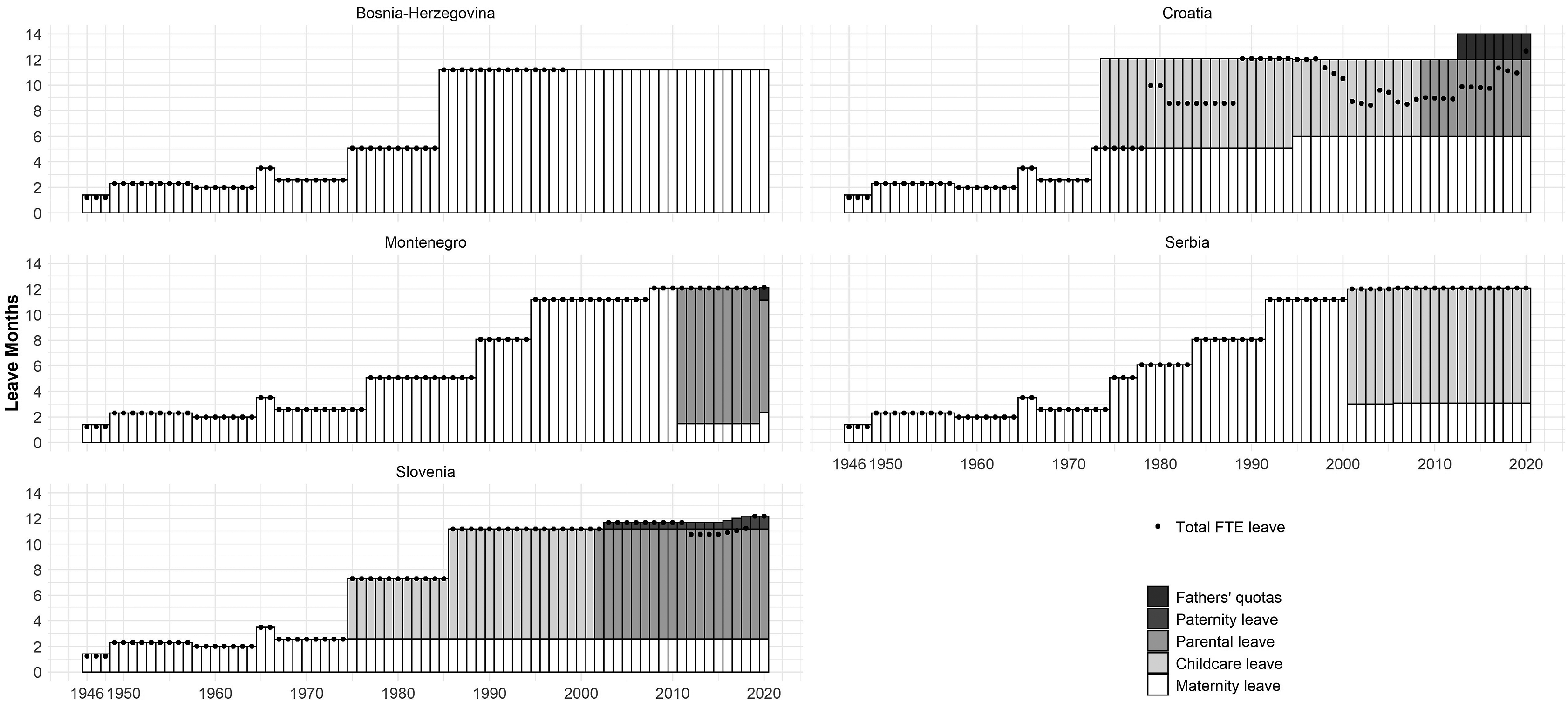
While PYCs were nominally committed to women’s emancipation, gender equality was not a goal per se. Childcare-related policies were built on maternalist assumptions that women would ‘cut back on or in some way made accommodations in formal economic activities in order to carry out their responsibilities for caregiving’ (Orloff, 2006: 236–237). Gendered division of labour in the private sphere was not questioned (Dobrotić et al., 2013) and parenting leaves developed as a mothers’ right, while fathers were not an explicit target of leave policy (Figure 1). In addition, ECEC services remained underdeveloped, limiting female employment. For example, in 1990, less than one-tenth of children aged 3–6 participated in ECEC in Bosnia-Herzegovina, around one-quarter in Croatia, Serbia and Montenegro and 55.7% in Slovenia, much less than 75.2% in Czechia or 85.3% in Hungary (Dobrotić and Obradović, 2020; Zrinščak, 2002). Enrolment rates also varied within countries, with more developed (typically urban) areas performing better (Stropnik, 1989), thus limiting affordable ECEC to employees in more developed areas, and dual-earners were prioritized through preferential enrolment criteria (Dobrotić, 2019; Savezna skupština, 1966).
Except that policies were gendered (and heteronormative, 4 care work was not recognized in a strong right-based modality. Instead, leaves developed as an employment-based right closely linked to social-insurance principles (Dobrotić, 2019), creating a selective policy design that excluded a sizable population of parents (that is, mothers) from the right to decommodification to care for children. Except for comparatively low female employment in Yugoslavia (Woodward, 1995) that limited the potential circle of leave beneficiaries, leaves targeted a ‘typical’ female employee endorsed in the socialist period – an employee in ‘standard’ employment in public enterprises/institutions. A sizable proportion of workers outside the public sector was thus ineligible to paid leave. Even after the rapid reduction in agriculture in Yugoslavia, one-fourth of all employees in the early 1980s worked in agriculture and an additional 14% in the private sector (Matković, 2009), with both groups excluded from leave schemes at that time. Only from the late 1980s did PYCs begin to open leave schemes to farmers and self-employed workers (mainly providing them with weaker entitlements), while occasionally employed people remained excluded (Dobrotić, 2019; Dobrotić and Stropnik, 2020). Finally, not only that policies privileged and empowered only a fraction of working mothers but care rights of the unemployed 5 or inactive were not acknowledged, with female unemployment and inactivity being more prevalent in rural and less developed areas (Woodward, 1995). Therefore, PYCs’ childcare-related policies were primarily developed to recognize and resource care arrangements of one specific group of parents – employees in the public sector, with the gendered dual-earner norm deeply embedded in policy design.
Post-1990 reforms: a growing divergence among and within PYCs
ECEC entitlements and childcare gap in PYCs 1990–2020.
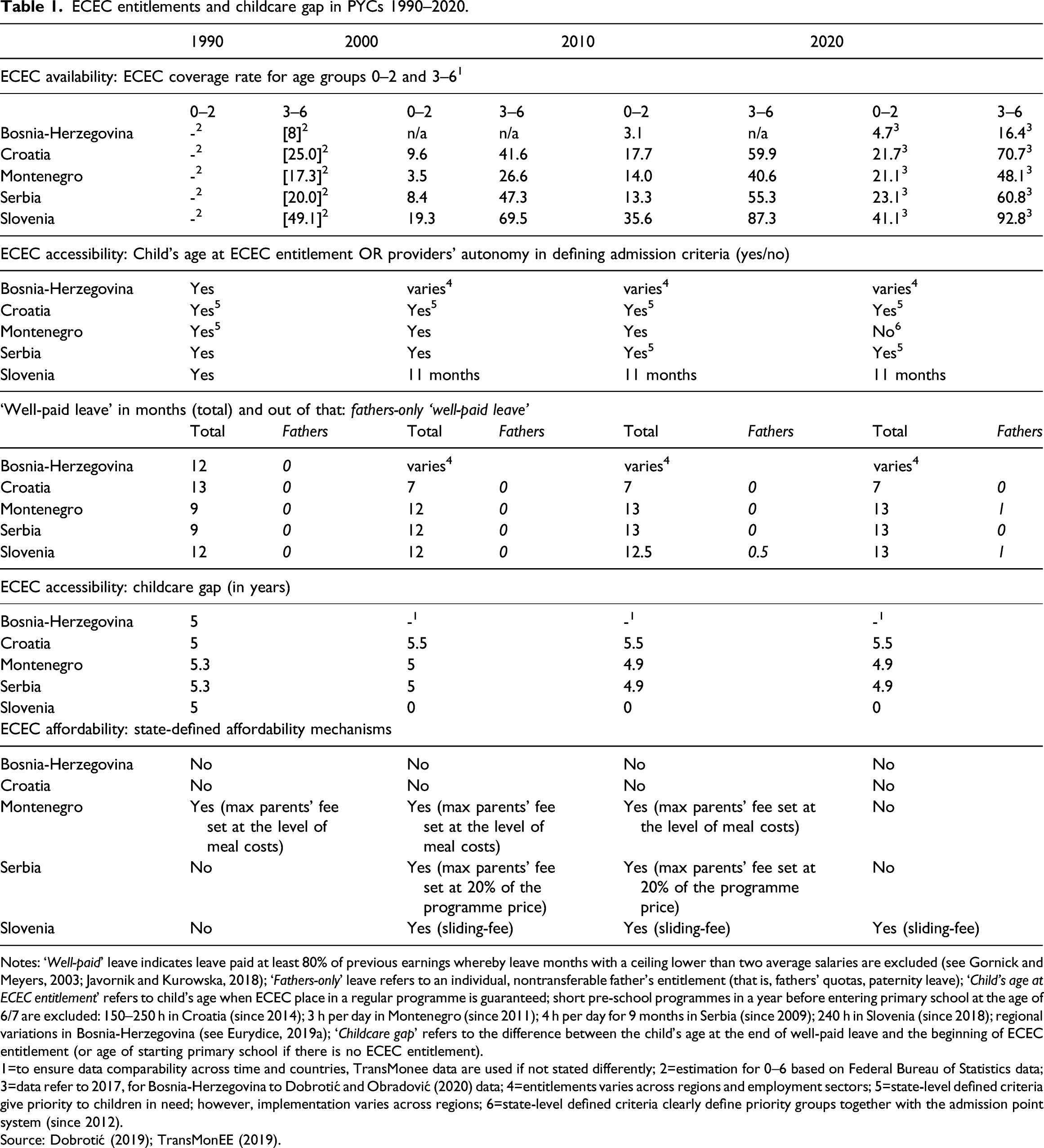
Notes: ‘Well-paid’ leave indicates leave paid at least 80% of previous earnings whereby leave months with a ceiling lower than two average salaries are excluded (see Gornick and Meyers, 2003; Javornik and Kurowska, 2018); ‘Fathers-only’ leave refers to an individual, nontransferable father’s entitlement (that is, fathers’ quotas, paternity leave); ‘Child’s age at ECEC entitlement’ refers to child’s age when ECEC place in a regular programme is guaranteed; short pre-school programmes in a year before entering primary school at the age of 6/7 are excluded: 150–250 h in Croatia (since 2014); 3 h per day in Montenegro (since 2011); 4 h per day for 9 months in Serbia (since 2009); 240 h in Slovenia (since 2018); regional variations in Bosnia-Herzegovina (see Eurydice, 2019a); ‘Childcare gap’ refers to the difference between the child’s age at the end of well-paid leave and the beginning of ECEC entitlement (or age of starting primary school if there is no ECEC entitlement).
1=to ensure data comparability across time and countries, TransMonee data are used if not stated differently; 2=estimation for 0–6 based on Federal Bureau of Statistics data; 3=data refer to 2017, for Bosnia-Herzegovina to Dobrotić and Obradović (2020) data; 4=entitlements varies across regions and employment sectors; 5=state-level defined criteria give priority to children in need; however, implementation varies across regions; 6=state-level defined criteria clearly define priority groups together with the admission point system (since 2012).
Source: Dobrotić (2019); TransMonEE (2019).
Intersectionality-based policy analysis, however, which requires an assessment of the position of different groups of mothers and fathers within the policy and context (e.g. also those with weak/no connection with labour markets), provides a basis for more nuanced analysis. As detailed in the following subsections, the political and economic transition in the 1990s, which commenced in parallel with wars and conflicts that led to ‘a re-constitution of various nation-states, mini-states and territories with a complex relationship to each other’ and unstable citizenship claims (Stubbs and Zrinščak, 2009: 122), affected both the nature of the policy ‘problem’ and the character of changes (policy responses). Two reform streams dominated – reforms supporting familial care and cost-containment reforms – that mainly affected parenting leaves and incorporated complex configurations of inequalities and privileges in childcare-related policy design, amplifying divergence in parents’ care and employment opportunities among and within PYCs.
Reforms supporting familial care: towards a universal right to care and extended leaves?
The societal re-traditionalization 7 inherent to the 1990s and supported by an explicit pronatalist agenda closely intertwined with (ethnicized) nationalist discourse (Shiffman et al., 2002) changed the nature of the policy ‘problem’ from how to facilitate women’s employment to how to ‘help’ them to withdraw from the labour market. The dual-earner norm embedded in socialist policy design became challenged by a new aim put in front of PYCs – to restore the traditional patriarchal and heteronormative family and ‘natural’ gender roles (Dobrotić et al., 2013; Korintus and Stropnik, 2009). A new view of the policy ‘problem’ failed to find broader support in Slovenia (Korintus and Stropnik, 2009), which continued with investing in ECEC and well-paid leaves, improving access to childcare-related rights across gender, class and territory. In addition to gradually introducing well-paid 1-month paternity leave and improving ECEC availability (Figure 1; Table 1), Slovenia introduced two reforms that equalized the accessibility and affordability of ECEC across territory and class. First, in 1996, a legal entitlement to ECEC starting after well-paid leave was introduced and gradually implemented, making the ‘childcare gap’ formally non-existent (Table 1) 8 and facilitating women’s (continuous) employment. Second, in 1998, a uniform progressive scale for determining parental fees was introduced, alleviating regional inequalities in ECEC affordability and making services accessible to the lower social strata (see Stropnik, 2001).
In the other four PYCs, the ECEC enrolment rates grew slowly (Table 1). Providers’ autonomy and selective practices in child’s enrolment were prevalent, with preferential criteria prioritizing dual-earners in allocating scarce places and aggravating social and gender inequalities in employment and care. A childcare gap of 4.9–5.5 years primarily affected parents (that is, mothers) of weaker connection with labour markets and lower socioeconomic status (Dobrotić et al., 2018; Mladenović, 2016; Prica et al., 2014). In many cases, these parents could only benefit from compulsory pre-school programmes introduced through the last decade (Table 1, notes), typically lasting a few hours per week/day in a year before primary school and having a weak potential to enable parent’s (that is, women’s) continuous employment. Also, ECEC affordability did not improve, rather, Montenegro (in 2016) and Serbia (in 2017) abolished the state-defined ECEC affordability mechanisms (Table 1), opening space for greater providers’ autonomy in defining (higher) parental fees and possible deepening of class and territorial inequalities in ECEC affordability. Providers’ autonomy in determining parental fees remains in Bosnia-Herzegovina and Croatia, primarily affecting low-income mothers in less developed (typically rural) areas where fees are typically higher (Dobrotić et al., 2018; Dobrotić and Obradović, 2020).
Instead of investments in ECEC with the transition, the other four PYCs started to prioritize reforms aiming to support familial (that is, women’s) care in the early parenting phase. First, these countries reconfigured leave policy design to divert it from being considered as an employment-based right towards a more universal right to care. On top of employment-based leave benefits, they introduced citizenship-based leave benefits for unemployed and/or inactive mothers (that is, flat-rate maternity/parental allowances),
9
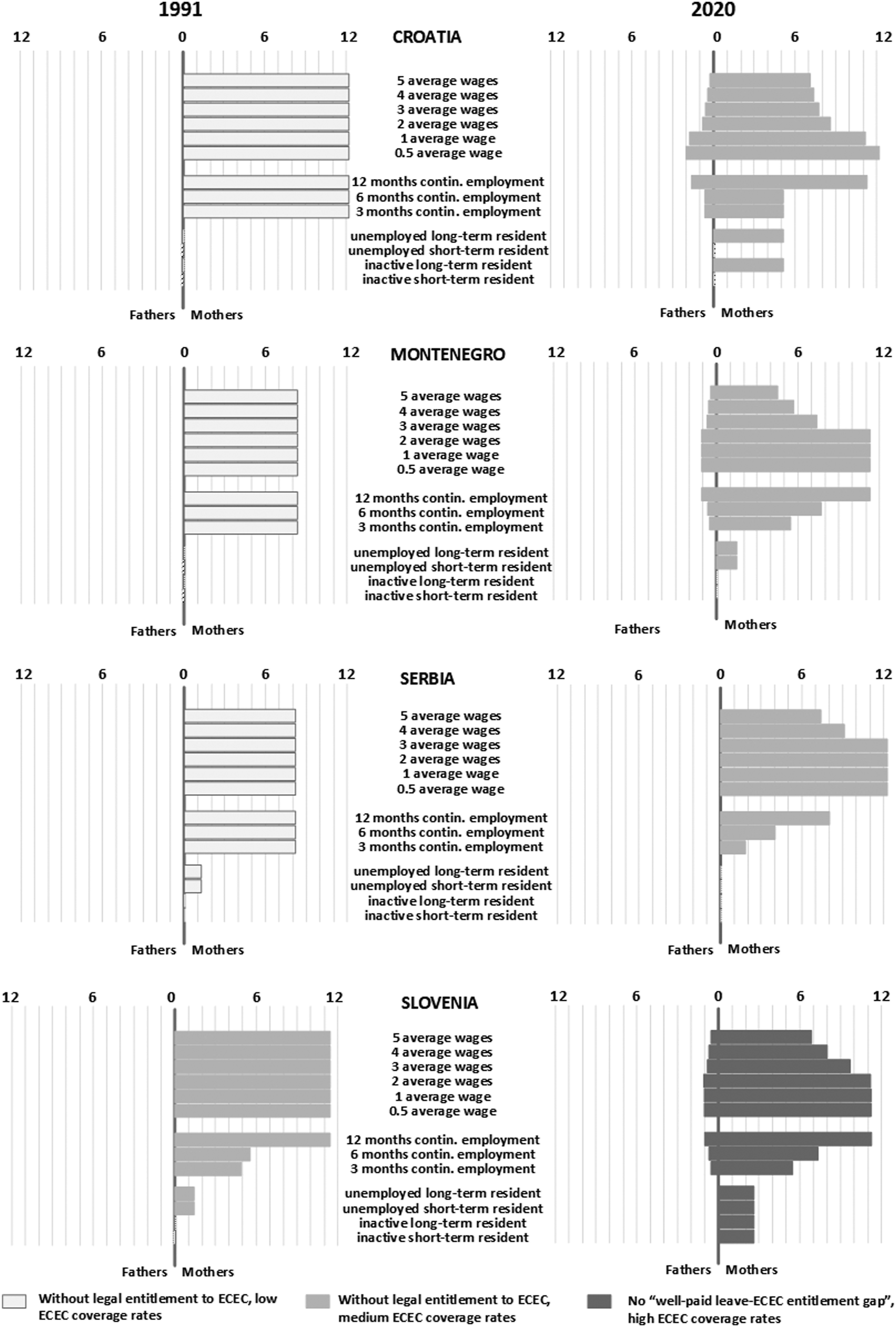
thereby partially recognizing women’s unpaid care work. These benefits are typically paid throughout the period matching the post-natal employment-based leave and range from a tenth (Montenegro) to a third of the average net salary (Croatia) (see Appendix 1). Although not generous (they correspond to only a few months of FRE leave) (see Figure 2 ‘unemployed mother’) and posing a risk to institutionalize further the gendered division of care (see Daly, 2020), citizenship-based benefits contributed to the inclusiveness of leaves by making them (almost) universally available (see Dobrotić and Blum, 2020) and female economic agency in contexts where many mothers could not enter (stable) formal employment and fulfil eligibility criteria for employment-based benefits. However, citizenship-based leave benefits were withdrawn in Serbia in the early 2000s, while some PYCs still privilege ‘their’ citizens (e.g. Croatia long-term residents, excluding migrants) or certain status groups (e.g. Montenegro registered unemployed parents/students, excluding inactive parents) (Figures 2 and 3, Appendix 1). Post-natal leaves according to gender, position in the labour market and earnings (first child; paid months). ECEC accessibility and FRE leave (first child; months) by gender, position in the labour market, earnings and residency status (1991 and 2020).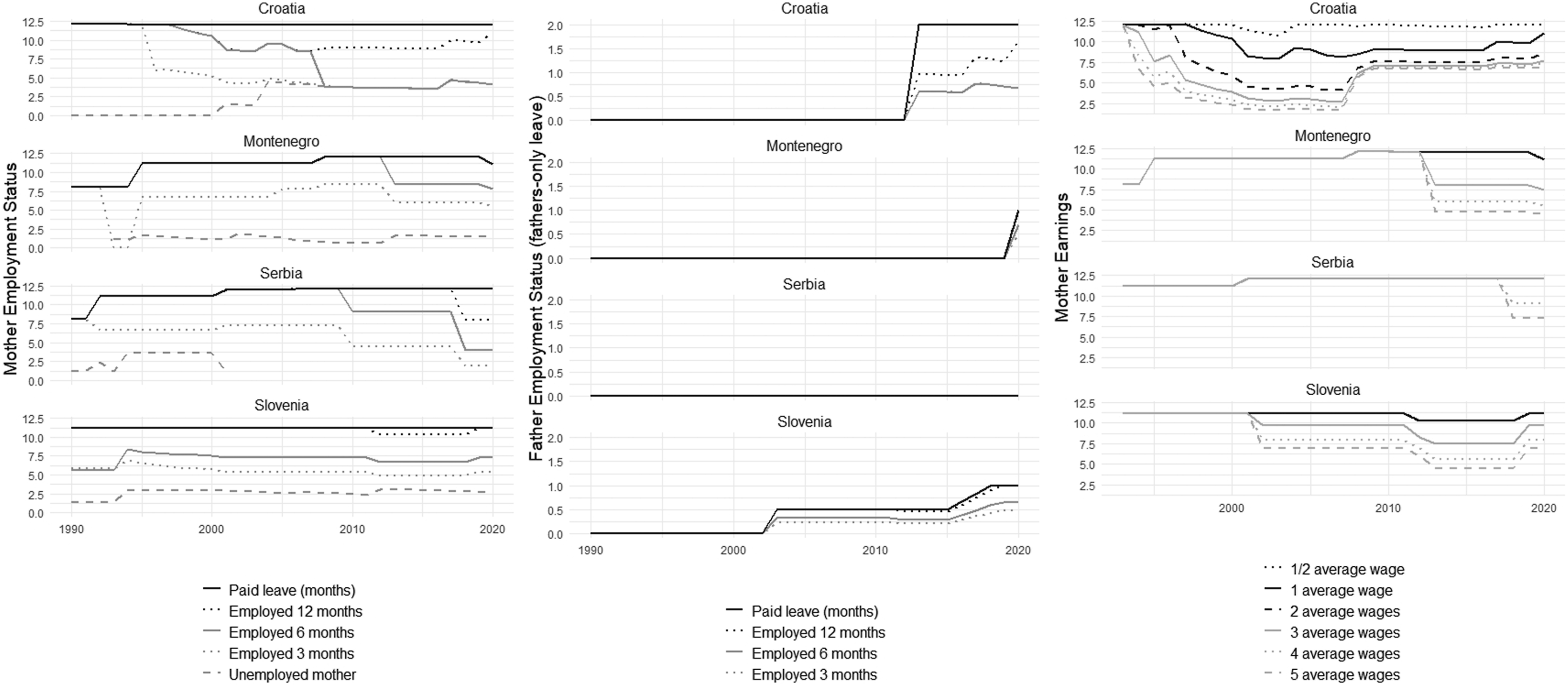
Second, the other four PYCs started incorporating pronatalist elements in leave policy design by introducing extended leaves for parents with three (or more) children. While the 2-year maternity leave in Montenegro was withdrawn after a short implementation period (1995–2003), prolonged leaves persist in Croatia, Serbia, and parts of Bosnia-Herzegovina. When introduced, the two-year-leave in Serbia explicitly targeted (self-)employed mothers with three children (four only if low-fertility areas), while in Croatia both (self-)employed and unemployed mothers with three or more children were entitled to three-year-leave (Appendix 1). Shiffman et al. (2002: 638) argue that these reforms, besides pronatalist goals, had an ethnic dimension: low fertility rates among Serbs in Serbia and Croats in Croatia frightened leaders and convinced them that without active intervention their nations might wither away. Contributing to this perception in Serbia were the high fertility rates among other ethnic groups, particularly Albanians and Muslims, which created the possibility of Serbs becoming a minority in their ‘own’ nation […]. Elites of both nations viewed their geopolitical environments as dangerous, and population growth as essential to the preservation of national power and the creation of a bulwark against perceived external enemies.
Such an understanding of a policy ‘problem’ additionally layered leave policy design that privileged some while excluding ‘others’, creating inequalities also along ethnic lines. For example, in Croatia, unemployed mothers without Croatian citizenship (since 2009 EU-citizenship) and ‘new’ migrants (citizens without 3–5 years uninterrupted residency) were excluded from leave schemes. In Serbia, the 1992–1996 practice of granting employed mothers with more than three children a shorter maternity leave of 9 months and lower leave benefits (50–80% of previous earnings; Dobrotić, 2019) also disproportionally affected ethnic minorities as in the 1990s, families with more than three children were mostly Albanian (Shiffman et al., 2002). 10 The latter practice was withdrawn, while in the 2000s all employed parents (that is, mothers) with three or more children in Serbia became entitled to two-year-leave (self-employed only in the 2005–2018 period; see Appendix 1).
Cost-containment reforms: reductions and (re)distributive recalibration of leave benefits
The second stream of reforms driven by states’ limited (re)distributional capacities in times of ‘crises’ (the 1990s and Great Recession) reduced employment-based leave benefits inherited from the socialist period. These reforms were particularly pronounced in Bosnia-Herzegovina and Croatia (Figures 1 and 2), countries strongly affected by the socioeconomic consequences of the 1990s wars and faced with newly emerging demands for extensive war veterans’ social rights (Stubbs and Zrinščak, 2009; Obradović, 2017). (Re)distributive recalibration of the welfare state brought direct cuts in leave benefits, creating new layers of inequalities and (dis)advantages in care and employment. More precisely, after maternity benefits in Bosnia-Herzegovina were decentralized in the late 1990s, they were paid continuously in only a few geographical areas. 11 In others, maternity benefits were possibly provided through collective agreements, typical for the public but not the private sector, resulting in inequalities in access to leave benefits (and their scope) based on locality and occupational status (Dobrotić and Obradović, 2020). In Croatia, reforms – the 1997 transformation of earnings-related childcare (future parental) benefit into a flat-rate benefit and a low ceiling set on maternity benefits (in the 1993–2008 period) – protected low- but not middle-earners as did Montenegro, Serbia and Slovenia. The latter countries set higher ceilings on leave benefits (2–5 average salaries) (Figure 2, see 1/2 to 5 average wages).
Croatia, Serbia and Montenegro also chose a more indirect root of cost-containment by introducing stricter eligibility criteria for employment-based leave benefits affecting parents in unstable employment. More precisely, while these countries granted full leave benefits (100% of previous earnings) to all employees regardless of their employment history in the early 1990s, until the mid-1990s full benefits became granted only to parents with at least 6 months of uninterrupted employment, and since the late-2000s/early-2010s, 12 months of uninterrupted employment period before the leave commencement. This lowered FREs of parents with unstable careers (Figure 2, see employed 3–12 months), to intensify further in Serbia in 2018 when leave benefits became calculated based on average earnings over 18 months before the leave (for the insured in agriculture, 24 months), while a minimum benefit during the ‘childcare leave’ failed to be defined (Dobrotić, 2019). The implications of stricter eligibility criteria must be considered in light of the post-1990 economic liberalization that dovetailed with the deregulation in the labour market and increasingly uncertain employment (e.g. temporary/seasonal/casual/short-term contracts) bringing less stable employment patterns (Matković, 2008). For example, temporary contracts in the total number of employees (25–34) rose from 13.1% (2002) to 29.2% (2018) in Croatia; 26.8% (2011) to 47% (2018) in Montenegro; and 19.9% (2010) to 33.9% (2018) in Serbia. Such temporary contracts are, on average, of short duration, up to 6 months in 45–60% of cases (Eurostat, 2019), further aggravating the effect of these reforms and deepening class inequalities in care and employment. Moreover, parents in atypical employment (e.g. on service contracts) have never been fully included in social-insurance schemes and could eventually receive low citizenship-based benefits. 12
In summary, while the post-1990 reforms tended to challenge a dual-earner norm embedded in childcare-related policy design, both leave and ECEC entitlements remain contingent on labour market ‘productivity’, privileging mothers and fathers in stable and ‘standard’ employment (especially dual-earners). Inequalities were more visibly mitigated in Slovenia, which improved the social and gender equalizing potential of childcare-related policy through a legal entitlement to affordable ECEC and slightly reduced differences in leave entitlements among various status groups (including improved fathers’ rights) (Figure 3). In other PYCs faced with more comprehensive cost-containment measures and a stronger pressure of a new understanding of the policy ‘problem’ (especially regarding low fertility and possible solutions in women’s withdrawal from the labour market), reforms deepened the complexity and multiplicity of social locations in the distribution of childcare resources. While in some PYCs (e.g. Croatia) citizenship-based entitlements brought more socially inclusive leaves, reforms also created new polarizations between employed parents (Figure 3). Parents in stable employment, and above all dual-earners (often higher social strata) continued to be supported via well-paid leave and affordable ECEC, whereas parents (mostly mothers) with weak or low-quality labour market attachment (often lower social strata living in less developed areas) were ‘forced’ to curtail or make accommodations in employment to provide care. This resulted from both suppressed investments in ECEC and distribution of leave entitlements towards the more ‘deserving’, often through less visible policy elements such as eligibility criteria that put certain parents (primarily women) such as those in precarious employment or foreign nationals/migrants at a disadvantage. Besides, even in countries with a similar policy ‘problem’, policy responses were not unique, privileging various status groups. For example, while pronatalist reforms in Croatia favoured leave benefits aimed at unemployed/inactive mothers and lower-earners, Serbia tended to privilege employed mothers and middle-/higher-earners (Figures 2 and 3). Finally, only (self-)employed fathers were a target of gender equality-oriented reforms, with the newly introduced reforms being moderate and leaves continuing to be redistributed towards mothers, especially if they are inactive/unemployed, as in these cases fathers-only entitlements are absent.
Conclusion
From a general perspective and relying on ‘standard’ policy indicators constructed around the experience of average workers/households, it could be argued that in the last three decades there has been much continuity with childcare-related policy design inherited from the socialist period in all PYCs except Bosnia-Herzegovina, where state-level maternity benefits ceased to exist as a statutory right and parents’ rights deteriorated. However, IBPA allowed for a more nuanced view in the (in)equality aspects of policy developments, exposing less visible reforms and more ‘silent’ cleavages embedded in policy design and a lack of equal opportunities for all parents. A closer connection of the scope of the rights (what) with entitlement principles and eligibility criteria (who) was particularly telling in exposing complex and intertwined inequalities in parents’ abilities to care and work among and within the PYCs.
Through the last three decades, only Slovenia visibly improved the equalizing potential of childcare-related policy design (e.g. through a legal entitlement to affordable ECEC, and father’s entitlements), allowing various parent groups to more easily engage in care and/or employment. The other PYCs that were more exposed to the post-1990 societal re-traditionalization and cost-containment measures mostly exacerbated the existing disadvantages and privilege (e.g. Bosnia-Herzegovina) or created new layers of disadvantages and privilege intersecting along gender, class, ethnic and spatial lines. While enacting more socially inclusive leaves (e.g. through citizenship-based entitlements or providing leaves to occasionally employed/self-employed), they also amplified an opportunity gap, that is, the systematic exclusion of some parent groups from access to childcare-related rights and the opportunity to work and care. Parents (particularly mothers) in precarious employment, ethnic minorities and ‘new’ migrants, especially those living in less developed areas where ECEC services are underdeveloped, were most affected by these reforms.
This analysis emphasizes the need to further engage in critical policy analysis determined to unravel the more ‘silent’ elements of policy design to better understand the complexity and multiplicity of social locations in the distribution of policy resources, and therefore of disparities in opportunities of various groups of mothers and fathers to engage in care and work. As Daly (2020: 163) argued, it is important to be aware that ‘often when we speak about change and improvement, these tend to be read from the template of highly-educated, ethnic majority women (thereby also running the risk of over-estimating [or under-estimating, author’s remark] the degree of change)’. To fully understand how policies construct inequalities between (groups of) parents so that they are not only genderizing but also, for example, heteronorming or classing, it is necessary to focus more on the ‘obligations’ of the social rights relationship (Clasen and Clegg, 2007). Besides being a conceptually challenging task that always carries a risk of concealing the heterogeneity of parents’ experiences (e.g. through ‘strategic categorising’, also applied in this article) (Williams, 2018), it also calls for the need to develop more comprehensive comparative indicators, particularly those more closely connecting eligibility criteria and the scope of the rights for a more nuanced insight into the rights of different parents (particularly those with weaker attachment to the labour market or ‘atypical’ families) and inequalities embedded in policy design. These indicators should also provide a basis for future research to understand better the resources and opportunities the childcare-related policy produces for parents of various social statuses to incorporate care and employment in their life-cycle, how they interact with parenting practices and country-specific structural and cultural circumstances, and whether all children could benefit from involvement in ECEC and ‘parents having more time to devote to them’ (Koslowski et al., 2019: 365). This may also provide a more profound insight into the changing role of childcare-related policies in the redistributive processes, including a reimagining of the concepts such as equality, universalism, selectivity and targeting within childcare-related policy design.
Supplemental Material
sj-pdf-1-esp-10.1177_09589287221088167 – Supplemental Material for The (in)equality dynamic of childcare-related policy development in post-Yugoslav countries
Supplemental Material, sj-pdf-1-esp-10.1177_09589287221088167 for The (in)equality dynamic of childcare-related policy development in post-Yugoslav countries by Ivana Dobrotić in Journal of European Social Policy
Footnotes
Acknowledgements
I would like to express my deep gratitude to Professor Mary Daly who provided insightful comments on the earlier version of this article.
Declaration of conflicting interests
The author(s) declared no potential conflicts of interest with respect to the research, authorship, and/or publication of this article.
Funding
The author(s) disclosed receipt of the following financial support for the research, authorship, and/or publication of this article: This work was supported by the research is part of the project that has received funding from the European Union’s Horizon 2020 Research and Innovation Programme under grant agreement No. 786826.

Supplemental Material
Supplemental material for this article is available online.
Notes
References
Supplementary Material
Please find the following supplemental material available below.
For Open Access articles published under a Creative Commons License, all supplemental material carries the same license as the article it is associated with.
For non-Open Access articles published, all supplemental material carries a non-exclusive license, and permission requests for re-use of supplemental material or any part of supplemental material shall be sent directly to the copyright owner as specified in the copyright notice associated with the article.
