




Abstract
While disability benefits make up the largest group of claimants in high-income countries, we know surprisingly little about which disabled people are seen as ‘deserving’ benefits, nor whether different people in different countries judge deservingness-related characteristics similarly. This is surprising given they are increasingly the focus of retrenchment, which often affirms the deservingness of ‘truly deserving’ disabled people while focusing cuts and demands on those ‘less deserving’. This article addresses this gap using two vignette-based factorial survey experiments: (i) the nine-country ‘Stigma in Global Context – Mental Health Study’ (SGC-MHS); (ii) a new YouGov survey in Norway/the UK, together with UK replication. I find a hierarchy of symptoms/impairments, from wheelchair use (perceived as most deserving), to schizophrenia and back pain, fibromyalgia, depression and finally asthma (least deserving). Direct manipulations of deservingness-related characteristics also influence judgements, including membership of ethnic/racial ingroups and particularly blameworthiness and medical legitimation. In contrast, the effects of work ability, age and work history are relatively weak, particularly when compared to the effects on unemployed claimants. Finally, for non-disabled unemployed claimants, I confirm previous findings that right-wingers respond more strongly to deservingness-related characteristics, but Norwegians and Britons respond similarly. For disabled claimants, however, the existing picture is challenged, with, for example, Britons responding more strongly to these characteristics than Norwegians. I conclude by drawing together the implications for policy, particularly the politics of disability benefits, the role of medical legitimation and the legitimacy challenges of the increasing role of mental health in disability benefit recipiency.
Keywords
Social security systems cannot be understood without considering whether claimants are perceived by the public to ‘deserve’ support. While deservingness is not the only path to legitimacy (it is less relevant where claims are seen as earned entitlements) (Larsen, 2006), it is clear that the legitimacy of benefits is often challenged where claimants are seen as undeserving. Moreover, while the link between public attitudes and policymaking is complex, the fault lines of legitimacy are visible in the contours of welfare states (van Oorschot and Roosma, 2017: 20–21) – for example, claimants seen as more deserving typically receive higher benefits (Schneider and Ingram, 1993) and are less likely to be stigmatised (Larsen, 2006). To understand or intervene in social security policy debates, we must understand these fault lines of deservingness.
Several decades of research have helped us understand which groups of claimants are seen as deserving, by whom and why (see below). From this, we know that disabled claimants are generally seen as more deserving than most other claimants – yet we have almost no knowledge of which disabled benefit claimants are seen as deserving. This is despite such claimants comfortably outnumbering unemployment benefit claimants across the OECD, 1 and despite disability benefits being central to the formation of social security systems (Kangas, 2010). Moreover, disability benefits are increasingly the focus of retrenchment in high-income countries worldwide, which often affirm the deservingness of ‘truly deserving’ disabled people while focusing cuts and demands on ‘less deserving’ disabled people (e.g. Geiger, 2017; Morris, 2016; Mays, 2012; Pennings, 2011; Soldatic and Pini, 2009).
In other words, disability benefits are a central part of social security systems worldwide, in which deservingness judgements are increasingly important for policy – yet they have hitherto been largely ignored in the literature on deservingness. In this article, I aim to contribute to a better understanding of the deservingness of disability benefit claimants. I ask two questions: (1) which characteristics lead disabled claimants to be judged as deserving?; and (2) do some people respond more strongly to these characteristics than others? I answer these questions using vignette-based survey experiments, a design that permits strong causal inference. These vignettes are embedded in an existing nine-country study (Study 1), and a purpose-collected UK–Norway study (and UK replication) (Study 2). I begin by outlining my hypotheses.
A conceptual model of deservingness
A touchstone in the deservingness literature is van Oorschot’s (2000, 2006) ‘CARIN’ model of the criteria underlying deservingness judgements: Control, Attitude, Reciprocity, Identity and Need (van Oorschot and Roosma, 2017). Control refers to whether a claimant is blameworthy for getting into their situation or failing to get out of it. Identity is about whether a claimant is seen as ‘one of us’, particularly nationality/ethnicity. Reciprocity is about whether claimants are seen to have ‘earned’ benefits through payments or societal contributions. Where entitlements are not seen as earned, then attitude matters: deserving claimants provide the ‘reciprocative substitute’ (van Oorschot, 2000: 356) of gratitude. Finally, need refers to hardship. While it has been argued that control (Petersen, 2012) and identity (Reeskens and van der Meer, 2019; Ford, 2016) matter most, it is perhaps ‘more likely that the weights of criteria differ between individuals and contexts’ (van Oorschot and Roosma, 2017).
Real-world images of benefit claimants do not signal these criteria directly; instead we see ‘characteristics that influence deservingness’ (Buss, 2019), and these do not neatly map onto criteria. For example, the characteristic of older age has been argued to connote both greater reciprocity (older people are likely to have paid into the system for longer) and lower control (older unemployed people are likely to find it harder to get work) (Buss, 2019; van Oorschot and Roosma, 2017). Characteristics can also be ambiguous in terms of the deservingness criteria they reflect; for example, efforts to find work can be taken to reflect control (Buss, 2019) or reciprocity (Reeskens and van der Meer, 2019). In other words, while the logic of deservingness judgements can best be understood through the CARIN criteria, in practice these are communicated indirectly via characteristics.
The most commonly studied characteristics are reference groups. Elderly and sick/disabled people are widely viewed as most deserving of state support, whereas unemployed people and migrants are seen as less deserving (van Oorschot, 2000, 2006; van Oorschot and Roosma, 2017). There are obvious links between these characteristics and the CARIN criteria – we have already seen how age is associated with reciprocity and control – and these studies have been taken as evidence for the criteria per se. Adapting van Oorschot and Roosma (2017), in turn based on Van Lancker et al. (2015), we can term these primary characteristics, to be distinguished from secondary characteristics connoting deservingness within each reference group. This distinction is context-dependent: age is a primary characteristic where it is the organising principle of a benefit (e.g. pensions), but a secondary characteristic elsewhere (e.g. for unemployment benefits).
Disability and deservingness
My focus here, however, is the deservingness of disability benefit claimants. On the level of reference groups, we have considerable evidence that sick/disabled claimants are seen as more deserving than unemployed claimants (e.g. Blekesaune and Quadagno, 2003; van Oorschot, 2000; 2006). This is generally explained by the association of disability with lack of control (van Oorschot and Roosma, 2017), whether or not we agree with Jensen and Petersen’s (2017) contention that all humans have a preconscious bias that tags disabled people as deserving. It is therefore unsurprising that disability benefits were widely introduced before unemployment benefits (Kangas, 2010), are less stigmatised (Larsen, 2006), require less of claimants (Geiger, 2017), and are more generous (Browne et al., 2018).
Yet the real-world politics of disability benefits involves arguments within the primary category of disability, with many countries reducing the generosity of disability benefits and placing increasing requirements on claimants (Böheim and Leoni, 2018; Geiger, 2017). Given that ‘disability’ (as a primary characteristic) connotes deservingness, such developments have been justified via a claimed focus on ‘less deserving’ disabled people (e.g. Geiger, 2017; Morris, 2016; Mays, 2012; Pennings, 2011; Soldatic and Pini, 2009). Nevertheless, we have little understanding of which disabled people are seen as deserving. This is partly because the deservingness literature has focused on primary rather than secondary characteristics (Buss, 2019). But there is also a lack of studies on disability benefits, especially when compared to recent studies on unemployment benefits (Buss, 2019; Kootstra, 2016; Reeskens and van der Meer, 2019).
I here fill this gap. My hypotheses are based on the few studies on disability benefits, combined with broader literatures on healthcare deservingness and disability stigma (some hypotheses are preregistered; see Supplemental Appendix B5).
Hypotheses
It has long been observed that there is a ‘hierarchy of disability’, with chronic physical conditions being less stigmatised than mental ill-health/addiction (Grue et al., 2015). This is partly because conditions/disabilities vary in their perceived ‘genuineness’ – how far they are accepted to be medically-caused, rather than wilful deception or psychological weakness – with only ‘genuine’ sickness/disability connoting a lack of control (Jensen and Petersen, 2017). Policymakers believe that the ideal claimant has medically-legitimated, outwardly-visible disabilities (Mcallister, 2020), and Australian and UK retrenchment has explicitly focused on ‘non-genuine’ claimants lacking these (Mays, 2012; Morris, 2016; Soldatic and Pini, 2009).
Hypothesis 1: claimants with characteristics that suggest ‘genuineness’ – either medical legitimation, or conditions/impairments associated with medical proof and observable cues – will be seen as more deserving.
The ‘hierarchy of disability’ also reflects controllability, with stigma being higher for disabilities that are seen as blameworthy, particularly mental illness (Weiner et al., 1988). We also see this for healthcare-related deservingness judgements (Gollust and Lynch, 2011; Murphy-Berman et al., 1998; van der Aa et al., 2018) and directly for disability benefit claimants, with greater public support for those who are ‘disabled due to their own behaviour’ versus those ‘disabled due to an illness or injury at work’ (Jeene et al., 2013; Jensen and Petersen, 2017). Judgements reflect both conditions/impairments and explicit information about blame: for example, people generally regard heart disease as uncontrollable, but nevertheless stigmatise someone with heart disease if told it was caused by smoking and drinking (Weiner et al., 1988).
H2: claimants with characteristics that suggest blamelessness – via either direct cues or conditions seen to be uncontrollable – will be seen as more deserving.
The seriousness of disability is likely to connote both blamelessness and need, and those with more work-limiting, serious and permanent disabilities are therefore perceived to be more deserving (Grue et al., 2015; Mcallister, 2020; van der Aa et al., 2018; Weiner et al., 1988). Both UK and Dutch policymakers have justified retrenchment via a focus on less serious disabilities (Morris, 2016; Pennings, 2011).
H3: claimants with more permanent, serious and work-limiting disabilities will be seen as more deserving.
Non-disability-related characteristics may also influence the perceived deservingness of disability benefit claimants. Reciprocity matters in one study, with Dutch people (on average) believing that age, past contributions and a strong work history should lead to higher disability benefit payments (Jeene et al., 2013). However, in-group status shows a mixed picture: it does not directly affect healthcare-related deservingness perceptions (Gollust and Lynch, 2011; Murphy-Berman et al., 1998), but does affect the perceived deservingness of (some types of) disability benefit claimant (Ford, 2016).
H4: claimants who have contributed to the system and who are members of ethnic/racial in-groups will be seen as more deserving.
Finally, it is sometimes suggested that primary characteristics can provide sufficiently strong cues of deservingness that they render secondary characteristics unimportant (Reeskens and van der Meer, 2019). Jensen and Petersen (2017) make this argument for disability: once a claimant is tagged as ‘disabled’, then this is sufficient for them to be seen as deserving, irrespective of secondary characteristics. Supporting this, they experimentally show that characteristics connoting deservingness – for example, laziness or the claimant’s responsibility for getting in their situation – have a much weaker influence on deservingness judgements of sick (vs unemployed) people.
We qualify this argument for two reasons. First, disability connotes deservingness only where it is ‘genuine’ disability; even Jensen and Petersen themselves present evidence that people perceive greater deservingness for conditions seen as caused by a disease (2017 Study A5). Second, the evidence above suggests that people distinguish between sick/disabled people on other grounds too. We therefore expect that people are sensitive to characteristics connoting deservingness among disability benefit claimants, but (following Jensen and Petersen) these effects are less powerful than for non-disabled people.
H5: where characteristics apply to both disabled and unemployed (non-disabled) claimants, the effect of these characteristics on deservingness will be weaker for disabled claimants.
Who is most sensitive to deservingness criteria?
Even if we confirm that these characteristics influence deservingness judgements, different people may not respond to them identically. Some people may be more judgemental than others, penalising claimants to a greater extent for any characteristics that suggest undeservingness. Alternatively, there may be a universal ‘deservingness heuristic’ (Aarøe and Petersen, 2014; Jensen and Petersen, 2017; Petersen, 2012): any differences in perceived deservingness are because people hold different beliefs about claimants’ characteristics, and not because they weight the characteristics differently when judging deservingness. (We return to the policy implications of this distinction below.) We explore this distinction with respect to both ideology and country.
First, it is well-known that countries vary in how deserving they regard typical claimants to be, with the Nordic countries being most positive and the US, UK and some Eastern European countries being most negative (Blekesaune and Quadagno, 2003; van Oorschot et al., 2012). This is most commonly attributed to the universality of Nordic welfare states: universalism ‘closes’ debates on whether recipients are deserving, whereas US/UK selectivity ‘opens the discussion’ (Larsen, 2006). Other mechanisms are also likely to play a part, including the extent of income differences between claimants and wider society (Larsen, 2006), and for disability benefits, levels of benefit eligibility (which may partly determine the broadness of the category of ‘disability’) (Kapteyn et al., 2007). Our question here, however, is different: do people in different countries respond differently to deservingness-related characteristics?
To the extent this has been considered, it is argued that they do not. Larsen (2006) suggests that country differences stem from differing perceptions of benefit claimant characteristics, and not because people respond to characteristics differently (pp. 50, 55). There are few direct tests of this, but Aarøe and Petersen (2014) find evidence that ‘despite decades of exposure to different cultures and welfare institutions, two sentences of information can make welfare support across the US and Scandinavian samples substantially and statistically indistinguishable’ (p. 684), while Jensen and Petersen (2017) find that people across countries respond particularly similarly to the primary characteristic of disability.
H6: people in different countries will respond similarly to deservingness-related characteristics, particularly for disability benefit claimants.
The situation for ideology is somewhat different. It is not just that right-wing people judge claimants as more undeserving on average (Blekesaune and Quadagno, 2003), but that they prioritise those perceived as most deserving, unlike left-wingers who prefer to help everyone (Buss, 2019; Skitka and Tetlock, 1993). Those with ‘genuine’ disabilities may therefore be seen as equally deserving by left-wingers and right-wingers alike (as argued by Jensen and Petersen, 2017), but right-wingers may judge other disabled people more harshly (as suggested by Jeene et al., 2013; van der Aa et al., 2018).
H7: right-wing people will respond more strongly to deservingness characteristics.
Research design
I test these hypotheses using factorial survey experiments (presenting respondents with vignettes that are given randomly varied characteristics). These provide strong internal validity: random allocation means that we can be reasonably confident that differences in responses are truly attributable to deservingness criteria (Auspurg and Hinz, 2015). They are also tangible; it is hard to know exactly what is in the public’s mind when they are asked to consider ‘disabled people’ as a whole. While vignette-based survey experiments have been used to study the perceived deservingness of benefit claimants (Aarøe and Petersen, 2014; Buss, 2019; Petersen, 2012), none are focused on disability benefits; indeed, there are almost no previous comparative studies of attitudes to disability benefit claimants per se.
Study 1: SGC-MHS
Methods
Only one existing survey experiment contains data on deservingness and disability benefits: the ‘Stigma in Global Context – Mental Health Study’ (SGC-MHS) 2004–2007. Countries were selected for SGC-MHS based on variation in economic development and ‘cultural type’ (Pescosolido et al., 2015); given our focus here, we focus on high-income countries (Belgium, Cyprus, Germany, Iceland, New Zealand, Spain, South Korea, UK, USA), representing a variety of welfare regimes. Sample sizes are ≈1000 per country, and further details are given in Supplemental Appendix B1.
Each respondent received one vignette describing symptoms of schizophrenia, depression (to investigate mental health stigma) or asthma (chosen for contrast), without ascribing a medical label. These conditions are not ideal for our hypotheses, but do provide some variation in outward observability (H1), controllability (H2) and seriousness (H3), as discussed below. Vignettes were also varied by gender and race/ethnicity (H4); full text is given in Supplemental Appendix B1.
Respondents are then asked whether the government should be responsible for helping people like this in particular ways, including to ‘provide disability benefits’. Other questions probe seriousness (‘how serious would you consider (their) situation to be?’) and proxies for genuineness (how likely that their ‘situation is caused by a mental/physical illness’) and blameworthiness (how likely that their ‘situation is caused by (his/her) own bad character’). Finally, a bank of sociodemographic questions was asked; details are given in Supplemental Appendix B1 and descriptive statistics in Supplemental Appendix B4.
These categorical outcomes are analysed using multinomial logit models of the form:

where
Results
Characteristics (H1–4)
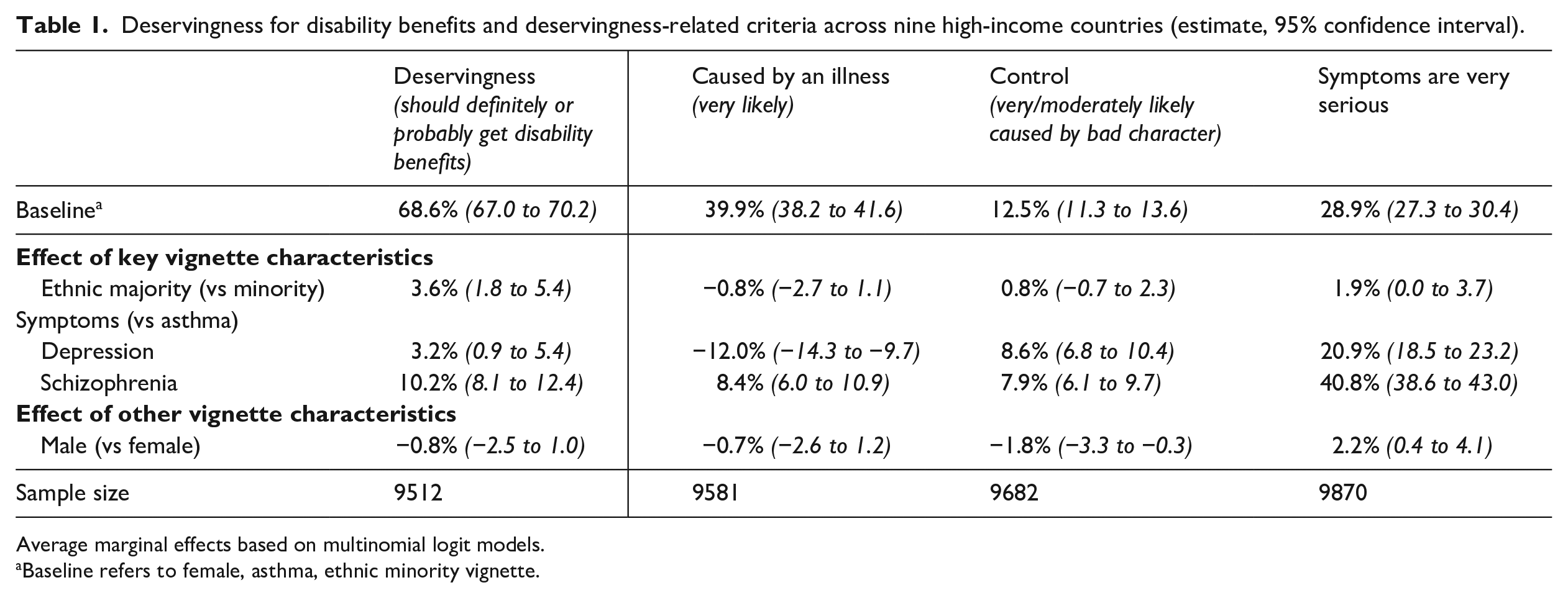
SGC-MHS does not include direct manipulations of genuineness/blamelessness/seriousness, instead varying claimants’ symptoms. Prima facie, we would expect these to vary in perceived genuineness (depression being least outwardly observable and medically demonstrable), blamelessness (mental ill-health being seen as more blameworthy), and seriousness (the schizophrenia symptoms being most serious). SGC-MHS allows us to test these empirically, and Table 1 shows our expectations are largely borne out. Depression was least likely to be seen as caused by an illness (our proxy for genuineness), both mental health conditions were seen as more likely to be caused by bad character (our proxy for blameworthiness), and schizophrenia was most likely to be seen as serious.
Deservingness for disability benefits and deservingness-related criteria across nine high-income countries (estimate, 95% confidence interval).
Average marginal effects based on multinomial logit models.
Baseline refers to female, asthma, ethnic minority vignette.
We can now make sense of respondents’ deservingness judgements. Table 1 shows that people with symptoms of depression and particularly schizophrenia were seen as more deserving of disability benefits than people with asthma (by 3.2% and 10.2%). This hierarchy reflects perceived seriousness (which follows the same ranking), but does not fit perfectly with genuineness (with asthma more commonly being viewed as an illness than depression), and not at all with blameworthiness (the condition seen as least blameworthy was also judged as least deserving of benefits). We therefore see support for H3 (seriousness), less support for H1 (genuineness), and no support for H2 (blameworthiness).
We also hypothesised that in-group status would affect deservingness of disability benefit claimants (H4). This is supported by Table 1, with ethnic majorities being 3.6% more likely to be seen as deserving (95% CI 1.8–5.4%).
Do some people respond more strongly to these characteristics? (H6–7)
SGC-MHS is ideal for testing whether people in different countries respond similarly to these characteristics (H6). While the visual picture is suggestive (Supplemental Appendix A1), I tested this by interacting each vignette characteristic (from equation (1)) with country dummies. This shows that countries do not systematically differ in slightly prioritising ingroups (the joint significance of the country dummy interactions is p = 0.29, χ2(8) = 9.7) but do systematically differ in their responses to symptoms (p < 0.0001, χ2(16) = 57.6). It is not that the ranking of conditions changes, but the size of the differences does; for example, in Spain schizophrenia symptoms are seen as 21.4% more deserving than asthma (95% CI 15.1–27.6), whereas in South Korea it is 2.2% (–5.2% to +9.6%). There is therefore only mixed support for H6.
Finally, I tested whether right-wing people respond more strongly to deservingness-related characteristics (H7), by interacting each vignette characteristic with a binary measure of ideology. 2 Right-wingers do indeed more strongly differentiate ingroups versus outgroups, but this effect was small and imprecisely estimated (95% CI for difference = −3.2–6.3%). In contrast, right-wing people were slightly less responsive to symptoms than left-wingers, although again the difference by ideology is small and imprecisely estimated (95% CI for difference = −8.0–3.5%). We therefore find evidence against H7 – although this may also reflect the limited range of characteristics covered by SGC-MHS and its imperfect measure of ideology (Supplemental Appendix B1).
Study 2: Purpose-collected YouGov data
Methods
To more fully test my hypotheses, I commissioned a new survey in Norway (which has a strong welfare culture) and the UK (which has adopted a punitive approach to disability benefits) (Geiger, 2017). Norway also has one of the highest levels of disability benefit receipt in the world; 21% of Norwegian respondents said that they currently claimed incapacity benefits, compared to only 5% in the UK (Supplemental Appendix B4). The surveys were conducted using YouGov’s opt-in panels in Feb–May 2017, achieving sample sizes of 1998 (Norway) and 1973 (UK); ethical approval was given by the University of Kent. While opt-in panels are commonly-used for academic survey experiments, these samples can occasionally be unrepresentative (Sturgis et al., 2016: 67). UK replication data was therefore collected in April–May 2017 using NatCen’s probability-based panel, the methodology recommended by Sturgis et al. (2016). The resulting dataset is formed of 2223 participants (see Supplemental Appendix B3).
Three vignettes were asked to each respondent at the start of the YouGov survey (a mixture of ≈80% disability vignettes and ≈20% unemployment vignettes). Disability vignettes were varied by gender and seven substantive dimensions: (i) symptoms (back/leg pain, paraplegia, depression, schizophrenia, fibromyalgia); (ii) blameworthiness for back pain/schizophrenia; (iii) medicalisation, (iv) duration; (v) prospective control (work ability); (vi) work history; and (vii) age. Following each vignette, respondents were asked whether the respondent ‘deserves to receive support from the Government while [he/she] is out of work?’, giving answers on a 0 (definitely does not) to 10 (definitely does deserve support) scale. For the disability vignettes, respondents were also asked how easy/difficult it would be for them to get a job (or in the NatCen data, their blame for being out of work). At the end of the survey all respondents were also asked to place themselves on a left-right scale. Full details of vignettes, questions and sampling are given in Supplemental Appendices B2 and B3, and descriptive statistics in Supplemental Appendix B4.
I follow the same analytical approach as Study 1, but now using OLS models (using cluster-robust OLS to account for the clustering of vignettes within respondents). Again, main estimates exclude sociodemographic controls and survey weights, but results are effectively identical if these are included; results are also identical if I exclude inattentive respondents (Supplemental Appendix A2).
Results
Characteristics (H1–4)
I begin by looking at symptoms/impairments associated with blamelessness/genuineness/seriousness. Prima facie, I expected mental health symptoms to be seen as less deserving due to perceived blameworthiness (H2). Within mental ill-health, I expected schizophrenia to be seen as more deserving than depression, due to its greater perceived genuineness (H1) and severity (H3). For physical ill-health, I expected wheelchair use (the prototype of ‘genuine’ disability, which is easily outwardly observable and widely seen as serious) to be judged as more deserving than back pain (which is less observable and seen to be less serious). These were complemented by a fibromyalgia vignette, a physical condition that the public and doctors alike sometimes attribute to mental illness.
I find a clear hierarchy of deservingness, with wheelchair use at the top, followed by schizophrenia (0.9 points lower, 95% CI −1.1 to −0.8), back pain (-1.1 points, 95% CI −1.3 to −0.9), chronic widespread pain (−1.7 points, 95% CI −1.9 to −1.5), and depression (−2.5 points, 95% CI −2.7 to −2.3). Perceived severity and external observability seem to matter (H1 and H3): as expected, schizophrenia is seen as more deserving than depression, and wheelchair use than back pain or chronic widespread pain. In Study 1, I did not find that physical health conditions are seen as more deserving than mental health conditions – but SGC-MHS is limited by only including a physical health condition (asthma) that is seen as less serious than the mental health conditions. In Study 2 we can look at conditions with a roughly similar level of severity, which reveals that physical health conditions are indeed seen as more deserving (linked to H2): wheelchair use is seen as more deserving than schizophrenia (even though the schizophrenia vignette included suicidality), and back pain is seen as more deserving than chronic widespread pain, which in turn is seen as more deserving than depression. We should note however that the characteristics in H1–H3 are entwined within symptoms/impairments, and teasing apart the precise contributions of these hypotheses is difficult.
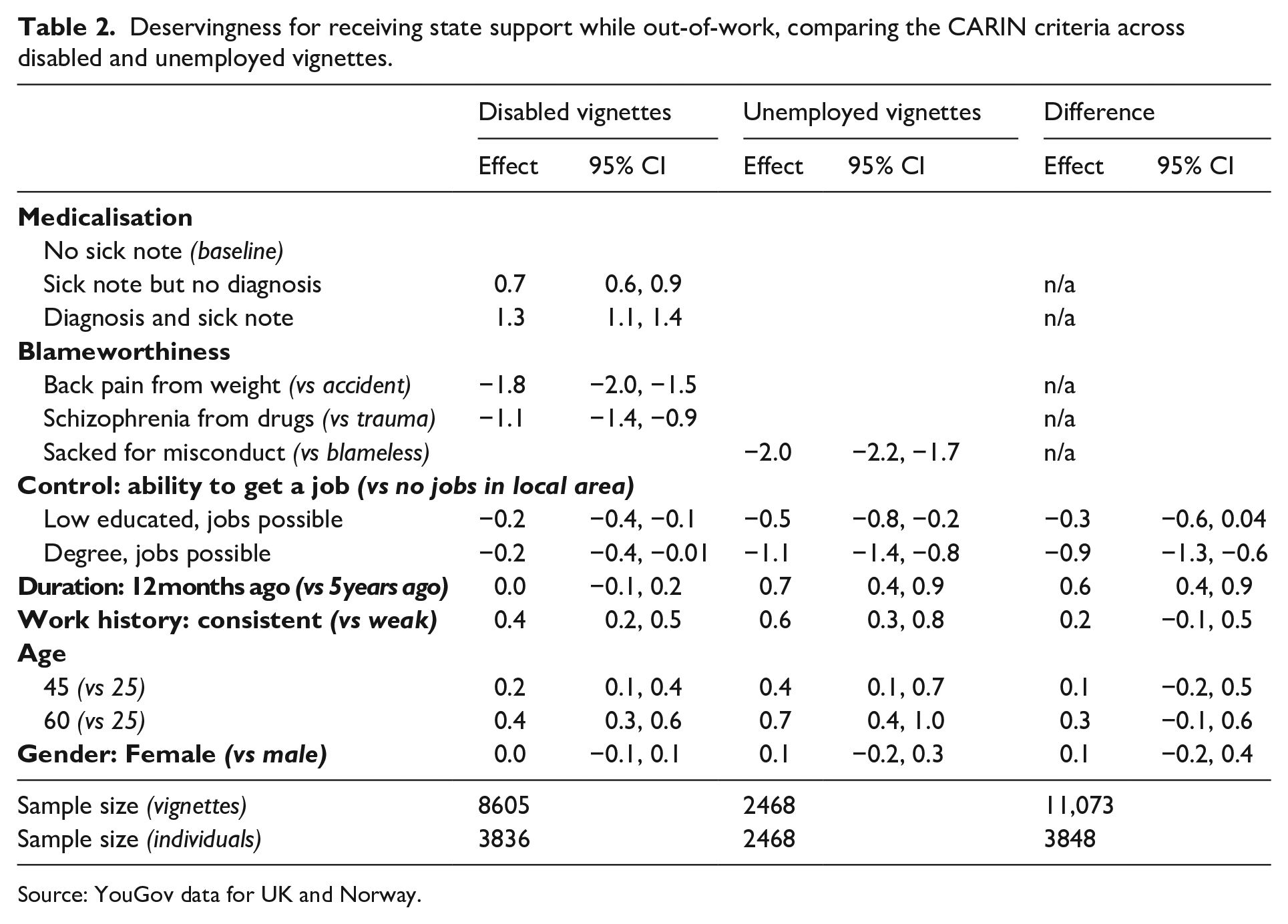
The more direct tests of my hypotheses are shown in Table 2 below. We find strong support for H1 and H2: medical legitimation increases perceived deservingness (by 1.3 points for a sick note plus diagnosis, 95% CI 1.1–1.4), while blameworthiness strongly reduces it (e.g. by 1.8 points if back pain is described as caused by being overweight rather than a car accident, 95% CI 1.5–2.0). Claimants who have contributed to the system are also seen as slightly more deserving (H4), whether through their work history (0.4 points, 95% CI 0.2–0.5) or greater age (for 60 vs 25-year-olds, by 0.4 points, 95% CI 0.3–0.6).
Deservingness for receiving state support while out-of-work, comparing the CARIN criteria across disabled and unemployed vignettes.
Source: YouGov data for UK and Norway.
Other characteristics associated with seriousness, however, are contrary to H3. Permanence (proxied via duration) has no relationship with deservingness (95% CI −0.1 to +0.2). Even more surprisingly, an explicit description that someone could (not) get a job had only a small effect (0.2 points, irrespective of whether the person was low- or high-educated). On closer inspection, this is because a statement about someone’s ability to get a job only raises perceived work ability by 0.8 points (95% CI 0.6–0.9), lower than the perceived difference in work ability between wheelchair use and depression (1.8 points, 95% CI 1.6–2.0) – suggesting that people infer seriousness from symptoms/impairments and discount further cues.
Unemployed versus disabled claimants (H5)
We hypothesised that the effect of any given characteristic will be weaker for disabled claimants than unemployed claimants (H5). Table 2 above partially supports this; an unemployed person with a degree and the possibility of finding work is seen as 1.1 points (95% CI 0.8–1.4) less deserving than someone with no jobs in their local area, whereas the equivalent effect for disabled claimants is only 0.2 (95% CI 0.01–0.4). The same is true for duration of worklessness, and – to a weaker and less precisely estimated extent – work history and age. However, while it is difficult to describe blameworthiness in identical ways for the two types of claimants, I nevertheless find that blameworthiness can have powerful effects for disabled and unemployed claimants alike, partially contradicting H5. I return to this in the Conclusion.
Do some people respond more strongly to these characteristics? (H6–7)
The final hypotheses tested whether some people respond more strongly to these characteristics than others. I expected Norwegians and Britons to respond similarly to deservingness-related characteristics (H6), but right-wingers to respond more strongly than left-wingers (H7). To test these parsimoniously, I created a single deservingness score for each vignette based on the characteristics in Table 2. For the disability vignettes, the deservingness score varies between 4.2 out of 10 (a vignette with back pain partly caused by obesity, no sick note/diagnosis, who can think of other sorts of jobs he/she could do, and who has often been unemployed) to 9.4 (a vignette with paraplegia, a diagnosis, no blame, no jobs they can do, and has worked all his/her life). We then test if people are more/less sensitive to this deservingness index in Norway versus the UK (or among right- vs left-wingers). 3
The results are presented in Figure 1. Looking first at unemployed claimants in the right-hand panels, we see strong evidence for both hypotheses. Norwegians and Britons do indeed respond near-identically to deservingness-related characteristics (H6), even if Norwegians consistently rate them as slightly more deserving (by about 0.8 on the 0–10 scale). In contrast, right-wingers respond more strongly to these characteristics (H7), differing from left-wingers by 1.3 percentage points for the least deserving vignettes but only 0.5 points for the most deserving. (The underlying models and p-values are given in Supplemental Appendix A2.)
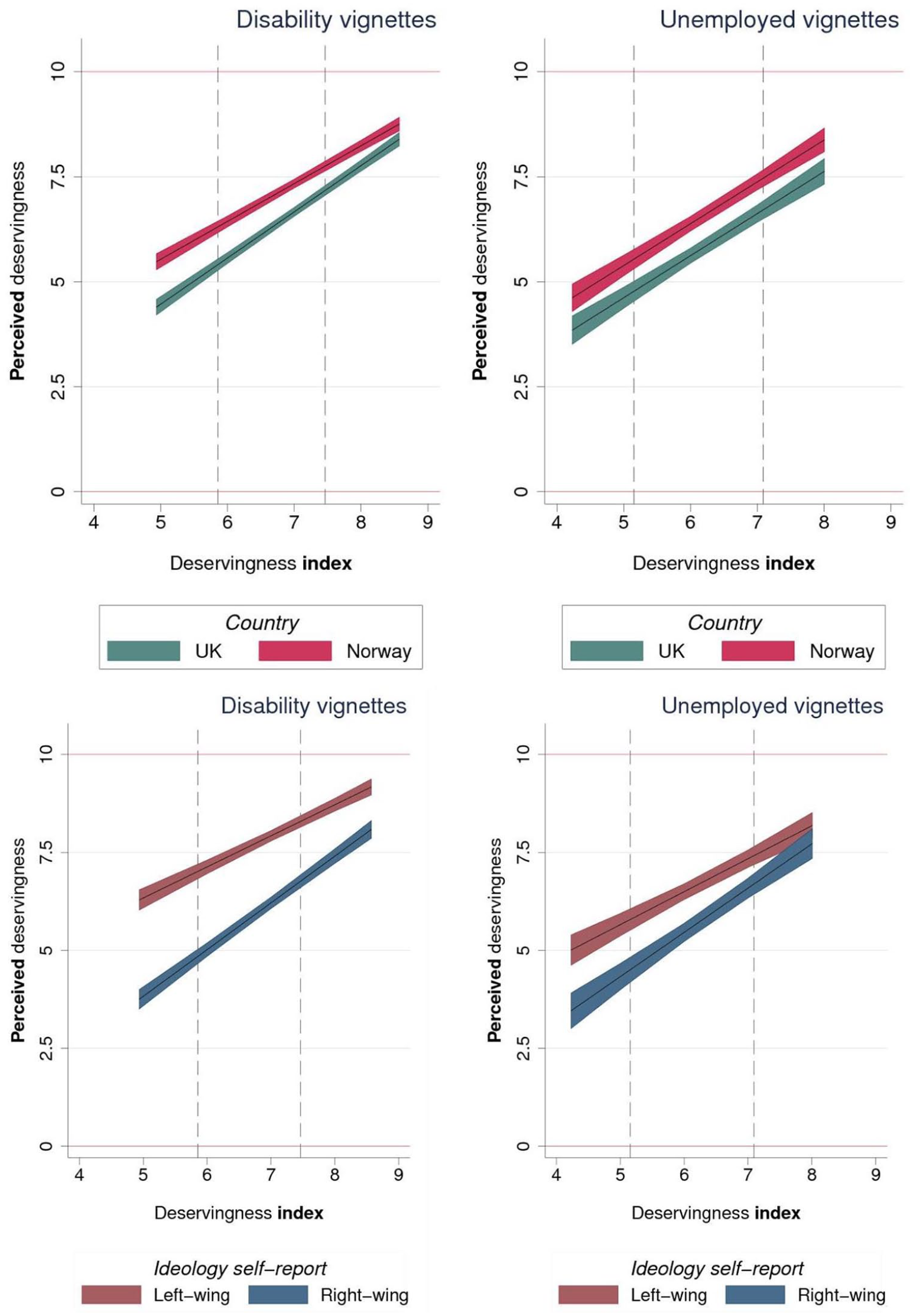
How deservingness judgements vary by country and ideology.
Yet when we turn to the disability vignettes (left-hand panels), we see a more complex picture. We still find that right-wingers respond more strongly to deservingness-related characteristics (supporting H7), but the gap between left- and right-wingers is now consistently larger, such that there is an ideological divide even for the disability vignettes that most strongly connote deservingness. (This differs slightly from Study 1, where we did not find evidence that left- and right-wingers responded differently. However, the confidence intervals for effects in Study 1 are large and not inconsistent with the results for Study 2; moreover, the measure of ideology in Study 1 is weaker than in Study 2, as discussed in Supplemental Appendix B1.)
More strikingly, we find evidence against H6: Britons respond slightly more strongly to the deservingness-related characteristics of disabled claimants than Norwegians do, such that there is moderately greater support among Norwegians for the least deservingness vignettes (a difference of 1.1 (95% CI 0.8–1.8) when desert = 5,) but a smaller difference for the most deserving (a difference of 0.5 (95% CI −0.1– to +1.0) when desert = 9). Just as in Study 1, we see that people in different countries respond differently to disability benefit claimants’ deservingness-related characteristics, contradicting H6. We consider the policy implications in the Conclusion below.
Conclusion
While there is an extensive literature on the deservingness of benefit claimants, there is almost no evidence on which disabled benefit claimants are seen as deserving. This is despite the widespread retrenchment of these benefits, often justified by the purported targeting of reform on only ‘less deserving’ claimants (Mays, 2012; Morris, 2016; Pennings, 2011; Soldatic and Pini, 2009). In this article, I investigated which disabled benefit claimants are seen as deserving, using vignettes in nine high-income countries (Study 1) and the UK/Norway (Study 2). Such vignettes are not immune to criticism – even the tangible vignettes here provide thinner pictures of claimants than we interact with in everyday life – but they nevertheless offer a powerful way of untangling the multiple different characteristics that influence deservingness (Auspurg and Hinz, 2015), and are particularly valuable in a comparative context where terms like ‘disabled people’ have variable meanings.
I find that medical legitimation – both a sick note and a diagnosis – strongly raises deservingness perceptions (supporting H1), while describing claimants as blameworthy for their symptoms/impairments strongly reduces them (supporting H3). There is also evidence that claimants are seen as more deserving if they have lower work ability (supporting H2), have contributed to the system (proxied via age and work history) and are from an ethnic/racial in-group (both supporting H4). However, the effects of work ability, age and work history are relatively weak, and the effect of duration of non-employment is weaker still – all of which have noticeably stronger effects on judgements of unemployed, non-disabled claimants (supporting H5). There is one caveat to this: the effect of blameworthiness was similar for unemployed and disabled claimants, directly contradicting the findings of Jensen and Petersen (2017), perhaps because our blameworthiness cues for disability are much stronger.
I also find a hierarchy of symptoms/impairments, from wheelchair use (most deserving), to schizophrenia and back pain, fibromyalgia, depression and finally asthma (least deserving). While it is difficult to disentangle which aspects of these impairments matter most, this hierarchy closely tracks perceptions of how serious/work-limiting they are (H3). This contradicts my finding above that direct cues of seriousness (work ability/duration) had relatively weak effects; it seems that people judge seriousness primarily via impairments, which are more powerful than explicit descriptions of seriousness. Mental health impairments are judged as less deserving for a given level of seriousness, possibly due to their lower perceived blamelessness (H2) and genuineness (H1). Nevertheless, serious mental health impairments are judged as much more deserving than less serious physical ones, even though they are seen as less of an ‘illness’ and more blameworthy.
Regarding who responds most strongly to these characteristics, it is worth emphasising that the existing literature was supported for unemployed, non-disabled claimants – right-wingers responded much more strongly than left-wingers to deservingness-related characteristics (H7), but Norwegians and Britons responded to them similarly (H6). For disabled claimants, however, the picture was more complex: the gap between left- and right-wingers is larger (even if right-wingers still respond more strongly to the characteristics), and deservingness-related characteristics affect the judgements of Britons slightly more than Norwegians (contradicting H7). The latter finding may be due to the effect of benefits eligibility on perceptions of disability per se (Kapteyn et al., 2007): the more generous eligibility in Norway may change the threshold that the public uses for saying that someone is disabled enough to deserve benefits.
This has two implications for theories of deservingness. First, I do not find support for some of the stronger claims about how comparative differences evaporate in the face of strong deservingness cues (Aarøe and Petersen, 2014; Jensen and Petersen, 2017). This is not to deny that people in different countries respond somewhat similarly to disability-related deservingness – for example, an impairment seen as more deserving in one country tends to be seen as more deserving in other countries – but people in different countries nevertheless respond much more/less strongly to these characteristics. Second, given that I find substantial differences in responses to unemployment versus disability vignettes, an empirical literature that is based primarily on attitudes towards unemployed claimants may lead to misleading theories about attitudes to disability and other types of claimants. There is therefore a need to broaden welfare attitudes research to looking at attitudes towards different of claimants, particularly in comparative perspective.
Policy implications
These results have several implications for policy. First, they suggest two axes through which to study the politics of disability benefits. On the one hand, people in developed welfare states – left-wingers and right-wingers alike, across a variety of wildly differing high-income countries – see some disability benefit claimants as more deserving than others. Public attitudes to disability benefit policies therefore depend on which disabled people are seen to be affected, and political actors may compete to argue that reforms affect different target groups in different ways. For example, the initial public support for the Reinfeldt reforms in Sweden later evaporated when cancer patients were seen to be part of the target group (Stendahl, 2011), while support for Dutch disability benefit retrenchment is arguably due to emphasising migrant claimants (Kurzer, 2013). On the other hand, there are considerable differences in how left- and right-wingers judge a given claimant; perhaps surprisingly, these differences are even greater than for unemployment benefits. Even for a given target group, then, political actors will compete to frame them as more/less deserving (Cox, 2001; see also Morris, 2016).
Second, policymakers face a tension in assessing eligibility for disability benefits. Contemporary best practice is to directly assess claimants’ work capacity, rather than to rely on medical conditions or functional impairments (Geiger et al., 2018). However, public opinion is closer to the medical than the social model of disability: it places more weight on symptoms/impairments and medical legitimation than direct work ability. One way to manage this tension is found in the Netherlands: the Dutch assessment starts with the ‘causality principle’ that ensures medical legitimation, but culminates in a detailed, direct assessment of work capacity (Geiger et al., 2018). Finally, mental health problems constitute an ever-greater share of disability benefit claims (OECD, 2015). This raises potential problems of legitimacy, given that the public (on average) judge those with mental health-related symptoms/impairments as less deserving. It is not that such claimants are automatically seen as undeserving – the public judges serious mental health impairments as more deserving than less serious physical health impairments – but rather that it raises the importance of for example, medical legitimation to confer visible markers of deservingness.
The existing benefits-related deservingness literature has to some extent ignored disability benefits; my hope is that the present article provides a useful basis for studying one of the most significant, under-studied elements of welfare states worldwide.
Supplemental Material
sj-pdf-1-esp-10.1177_0958928721996652 – Supplemental material for Disabled but not deserving? The perceived deservingness of disability welfare benefit claimants
Supplemental material, sj-pdf-1-esp-10.1177_0958928721996652 for Disabled but not deserving? The perceived deservingness of disability welfare benefit claimants by Ben Baumberg Geiger in Journal of European Social Policy
Supplemental Material
sj-pdf-2-esp-10.1177_0958928721996652 – Supplemental material for Disabled but not deserving? The perceived deservingness of disability welfare benefit claimants
Supplemental material, sj-pdf-2-esp-10.1177_0958928721996652 for Disabled but not deserving? The perceived deservingness of disability welfare benefit claimants by Ben Baumberg Geiger in Journal of European Social Policy
Footnotes
Acknowledgements
Many thanks to Erik Larsen and Laura Sudulich for invaluable comments.
Funding
The author(s) disclosed receipt of the following financial support for the research, authorship and/or publication of this article: This project (including the data collection in Study 2) was funded by the UK Economic and Social Research Council (ESRC), grant number ES/K009583/1. The data used in Study 1 in this publication were made available (entirely or in part) by Indiana University through the Stigma in Global Context – Mental Health Study (SGC-MHS), Principal Investigators – Bernice A. Pescosolido, Jack K. Martin, J. Scott Long and Tom W. Smith. The SGC-MHS was supported by Grant Number R01 TW006374 from the National Institutes of Health (Fogarty International Center, National Institute of Mental Health and the Office of Behavioral and Social Science Research). The contents of this publication are solely the responsibility of the authors and do not necessarily represent the official views of the Principal Investigators or of the NIH.
Supplemental material
Supplemental material for this article is available online.
Notes
References
Supplementary Material
Please find the following supplemental material available below.
For Open Access articles published under a Creative Commons License, all supplemental material carries the same license as the article it is associated with.
For non-Open Access articles published, all supplemental material carries a non-exclusive license, and permission requests for re-use of supplemental material or any part of supplemental material shall be sent directly to the copyright owner as specified in the copyright notice associated with the article.
