



Abstract
Policy access biases worry social policy scholars because they generate Matthew effects that exacerbate socioeconomic divides. Yet, access biases in many social investment policies, like training during unemployment, remain under-researched. Such access biases may be detrimental to a critical objective of social investment: to improve and uplift workers with precarious economic prospects. We focus here on access bias in training provided by public employment services against lower-educated workers. They are vulnerable to unemployment and fractured employment and should thus be targeted for training. While there is burgeoning attention on access biases in training against disadvantaged youths and non-citizens, fewer studies have focused on similar access bias against lower-educated workers. We highlight that access bias against such workers may stem from their lower willingness and demand for training, as well as policy design, informal eligibility criteria and caseworkers’ creaming practices. We suggest, however, that greater availability of training opportunities may ease this access bias against lower-educated workers. Using the Finnish Income Distribution survey data (2007–2012), we find evidence of training access bias: primary-educated workers are significantly less likely to participate in training than upper secondary and vocationally educated workers. Concurrently, our results show that availability of training is not significantly associated with the extent of training access bias against primary-educated workers. With a Nordic welfare model that prioritizes training to remedy labour market vulnerability and stresses that access to benefits and services is based on need, Finland represents a least likely case to find such access bias in training. We therefore consider these results worrying: if it is found here, it may be prevalent in countries with other welfare models.
Introduction
Interest in social investment has grown substantially among European academics and policymakers. It seeks to achieve adaptability, flexibility, security and employability (European Commission, 2004), and views social policy as a productive factor to attain such outcomes. It also invests in the future by providing equal opportunities to prepare workers for new risks as economies and societies change (Busemeyer et al., 2018; Hemerijck, 2017; Morel et al., 2012). Social investment therefore departs from traditional social protection by moving beyond ‘redistributive, consumption-based social welfare centred around benefits and rights, to one that, through investment in human capital, enhances people’s capacity to participate’ (Cantillon, 2011: 442). In this regard, one key policy instrument is early childhood education and care (for example, Pavolini and Van Lancker, 2018). Another is training (Bengtsson et al., 2017; Hemerijck, 2017): it may improve vulnerable workers’ low stock of human capital and upgrade workers’ skills to strengthen their previously weak labour market attachment. 1
Social investment’s positive view of training is supported by the evaluation literature which demonstrates that training improves vulnerable workers’ employment chances and wages (for example, Card et al., 2017; Doerr et al., 2016). Despite these positive effects, it remains unclear if training will lead to more equal labour market outcomes in the long run. Figure 1 illustrates that the effectiveness of training in diminishing such inequalities also depends on who gets training. If training access is skewed towards better-off workers, the benefits of training may be accrued at the expense of more vulnerable workers. Access bias in training may hence yield Matthew effects which exacerbate existing labour market inequalities rather than correct them (Bonoli et al., 2017; Bonoli and Liechti, 2018), and thus undermine the aims of social investment. Pathway between unemployment, training and labour market outcomes.
In fact, a substantial body of research demonstrates that the use of social investment policies is socially stratified (Cantillon, 2011; Cantillon and Van Lancker, 2013; Ghysels and Van Lancker, 2011). For instance, Ghysels and Van Lancker (2011) find that higher income groups utilize early childhood education and care, which are policies that enable the accumulation of human capital to prevent subsequent labour market disadvantages (Vandenbroucke et al., 2011), more than lower income groups. Likewise, Cantillon (2011) notes that social expenditures that incentivize labour market participation such as in-work benefits, subsidies and tax credits are inadvertently used more by work-rich households composed of individuals with stronger labour market attachment than work-poor households composed of individuals with weak labour market attachment (p. 441). In short, disproportionate access and thus unequal accrual of benefits from social investment policies may worsen prior socially stratified inequalities (Cantillon, 2011; Cantillon and Van Lancker, 2013).
Despite these concerns about social investment, there are surprisingly few studies to date which focus on access biases in training provided by public employment services (PES) (for example, Auer and Fossati, 2020; Bonoli and Liechti, 2018; Pisoni, 2018). It contrasts with the voluminous evaluation literature focusing on the effects of training (see Card et al., 2017). The few studies on this issue find that training access may be biased against unemployed workers with poorer labour market prospects, even though they ought to be targeted for training from a social investment perspective. We contribute to this discussion by focusing on lower-educated workers who frequently suffer labour market disadvantage. Among the few studies which explore access biases in PES-provided training, only Bonoli and Liechti (2018) to our knowledge focus on lower-educated workers, albeit with an emphasis on differences across welfare regimes.
We posit here that access to training may be biased against lower-educated workers for both demand and supply-side reasons. On the one hand, lower-educated workers may be less willing to participate or demand training (see related Fouarge et al., 2013). On the other hand, training may be targeted at better-educated workers by policy design (see related Pisoni, 2018), informal eligibility requirements to attend training may be disadvantageous to lower-educated workers (Bonoli and Liechti, 2018), and caseworkers may cream better-educated workers for training. In this context, creaming refers to the tendency of caseworkers to allocate unemployed workers with better chances of completing training courses and gaining reemployment to such programmes to meet their performance targets or ease their workload (Auer and Fossati, 2020; Bonoli and Liechti, 2018; Brodkin, 1997; Pisoni, 2018). We further suggest that the availability of training opportunities may shape the extent of training access bias. Namely, when there are more training opportunities available, caseworkers may feel less pressure to apply overly stringent selection to ration their allocation (Brodkin, 1997: 17), and access bias against lower-educated workers may hence be smaller. We conduct our analyses on Finland using the Finnish Income Distribution Survey data (2007–2012), which contains register-derived individual-level data on personal income and transfer payments, and combine it with regional data on expenditures on training, unemployment rates and gross domestic product at the regional level. According to Bonoli and Liechti (2018), the Nordics, such as Finland, are least-likely cases to find access biases in training. If they are found in Nordic welfare states such as Finland, they may be found elsewhere. Furthermore, we consider access bias in training to be a major worry, as welfare states spend less on social protection to spend more on social investment (Cantillon, 2011). As social protection offers less compensation for economic disadvantage to vulnerable social groups such as lower-educated workers, access bias in training and other social investment policies against these groups would set them back even further.
In the subsequent sections, we first describe the importance of training to the social investment strategy and its impact on labour market outcomes for lower-educated workers. We next briefly review various access biases in training before elaborating on potential sources of bias against lower-educated workers. We then expound on how the availability of training opportunities may influence the extent of this access bias before describing the Finnish case. Thereafter, we elaborate on our data and methods. The penultimate section presents the results, and the final section discusses them.
Training and labour market outcomes
Social investment adopts a life-course perspective and seeks to prevent risks from accumulating and materializing into actual disadvantage (Hemerijck, 2017). Social investment policies may thus enable policymakers to uplift the most vulnerable in society. Although training is frequently classified as an activation policy (Bonoli, 2013), it may also be viewed as a social investment policy (Bengtsson et al., 2017). From a social investment perspective, training may develop the stock of human capital among workers and prevent risks from materializing into actual disadvantage among vulnerable workers by updating and improving workers’ skills (Hemerijck, 2017).
It is imperative to pay attention to lower-educated workers because lower education frequently corresponds with greater labour market disadvantage. In addition, they are vulnerable to recent labour market transformations such as workplace automation and economic globalization. Labour market outcomes today are increasingly determined by workers’ skills (Acemoglu and Restrepo, 2018; Fernández-Macías and Hurley, 2017): higher-educated workers tend to possess skills that are in demand in contrast to lower-educated workers. Social investment scholars hence view training as an important policy to help lower-educated workers reduce their labour market disadvantage (Bengtsson et al., 2017; Hemerijck, 2017). It allows vulnerable lower-educated workers to upgrade their skills and progress into better jobs or acquire new skills that are demanded by the labour market.
Evaluation studies affirm social investment scholars’ positive view of training (for example, Card et al., 2017; Doerr et al., 2016): training participation improves workers’ reemployment probability, reemployment duration and wages. For instance, after three to four years of being locked into attending training, Doerr et al. (2016) showed that German workers without vocational degrees and who received training were 5% more likely to be employed and earned about €110 more than their counterparts who did not receive training. Crucially, the authors find that the effect of training on employment probability and income is greater for lower-educated workers than for higher-educated ones. Likewise, Card et al. (2017) conducted a metareview of 200 recent evaluation studies on active labour market programmes (ALMPs) and found that training yields a large improvement in employment probability in the medium and long term after an initial lock-in period in the short term owing to training participation, whereas the initial positive effects of other programmes such as job search assistance decline over time. 2 The contrast in effects between training and job search assistance suggests that improving human capital is instrumental to better labour market outcomes in the long run. The authors also find that public sector and private sector employment programmes have negligible and duration invariant effects, respectively, on labour market outcomes. The long-lasting positive effects from training thus reinforces its importance to the social investment strategy of reducing labour market inequalities in the long run.
Access biases in training
Studies reveal access biases in certain social investment policies such as the use of childcare services and higher education (Bonoli and Liechti, 2018; Pavolini and Van Lancker, 2018). They show that advantaged and privileged segments of society obtain such public services more readily than disadvantaged and vulnerable segments of society which yield Matthew effects that exacerbate existing socioeconomic inequalities. Despite its importance to the social investment strategy, few studies have focused on access biases in training provided by PES to date (Bonoli and Liechti, 2018: 895). If training is biased against vulnerable workers, they will experience a persistent risk of precarious and interrupted employment biographies and will remain in entrenched economic disadvantage. These few studies unfortunately find that there are indeed access biases in training. For instance, Auer and Fossati (2020) show that immigrants in Switzerland are generally assigned to ‘parking’ programmes, such as temporary employment, rather than training. Parking programmes do little to improve participants’ human capital and labour market prospects. Similarly, Pisoni (2018) demonstrates that Swiss youths who suffer from multiple disadvantages, such as drug use and family problems, frequently receive less training.
Besides Bonoli and Liechti (2018), these studies do not, however, focus on training access bias for one critical social group: lower-educated workers. The authors conducted a systematic review of existing evaluation studies and assessed the degree to which these studies show variations in the extent of training access bias against lower-educated workers across different welfare regimes. Country-specific evaluation studies provide an overview on how the (training) participant sample differs from the non-participant sample on various sociodemographic characteristics, including education. 3 Using such data, the authors find that training access bias is more prevalent in countries with Continental welfare regimes than in the Nordics. However, their country-level data does not permit them to assess for an individual-level phenomenon, namely, if individual lower-educated workers experience a significantly lower likelihood of obtaining training across these countries, which is the focus of our study.
Potential sources of access bias against lower-educated workers in training
Access bias against lower-educated workers in training may result from demand- or supply-side reasons. On the demand side, a handful of studies find that these workers are less willing to participate in continuous vocational training (CVT) provided by employers (for example, Fouarge et al., 2013). Exams or similar methods are typically used to assess participants during training and to award their qualification. Based on an observational study, Illeris (2006) argues that lower-educated workers avoid training because of exam anxiety (Fouarge et al., 2013: 2594) arising from scarring experiences related to their poor educational performance during their youth.
In addition, lower-educated workers may be less willing to participate in training if they expect little economic return from training. Training typically involves a lock-in period where participants suspend their normal job search efforts, and thus lose out on potential reemployment and earnings, to participate in training. Training hence leads to worse labour market outcomes in the short run, even if it yields substantial gains later (Card et al., 2017; Doerr et al., 2016). Lower-educated workers may feel that they gain little from giving up on employment and earnings to participate in job training schemes in the short run. They may also feel that they benefit little from training participation in the long run. They may therefore view training as a burden and favour other types of ALMPs which may be suggested by caseworkers at PES. Fouarge et al.’s (2013) study supports these propositions about such workers’ lower willingness to participate in training through their examination of CVT. They find that it is partly explained by their perceptions that training is not worth spending time and investing in for future economic returns (p. 2594). Such perceptions may compound fears that participating in PES-provided training may result in stigmatization by employers (Meager and Evans, 1998) and depress lower-educated workers’ willingness to participate in training.
In comparison to CVT, fewer studies examine lower-educated workers’ demand for PES-provided training. In this light, Garritzmann et al.’s (2018) recent study on public opinion towards different welfare programmes is instructive. They find that lower-educated workers tend to demand social investment-type policies such as training, early childcare and higher education rather than workfare and passive compensation such as early retirement. These findings suggest that lower-educated workers may have a lower willingness to participate in PES-provided training, even if they stand to benefit from it (see Card et al., 2017; Doerr et al., 2016). They may also reject training even if it is offered to them by PES offices.
Access bias against lower-educated workers may also arise from supply-side factors. First, training may be targeted at other groups of workers by policy design (Pisoni, 2018: 295). Policymakers may designate specific ALMPs to different types of workers depending on their policy objectives. For instance, policy may be designed to assign lower-educated workers primarily to job search assistance or public or private subsidized employment programmes, if policymakers prioritize these workers’ reemployment rather than long-term labour market integration.
In addition, eligibility criteria for training may also inadvertently exclude lower-educated workers (see Heckman and Smith, 2004). Although formal eligibility criteria are frequently favourable to disadvantaged groups such as lower-educated workers, there are nevertheless additional criteria outside of these formal requirements which may exclude these workers (Bonoli and Liechti, 2018). These additional criteria may include knowledge of ‘the local language, a given level of cognitive and/or non-cognitive skills, motivation’ (Bonoli and Liechti, 2018: 898); some of these criteria are unfavourable to lower-educated workers and may limit their access to training.
Furthermore, research from street level bureaucracy (SLB) suggests that caseworkers at PES offices may contribute to training access biases (for example, Auer and Fossati, 2020; Brodkin, 1997; Pisoni, 2018; see also Caswell et al., 2017). Caswell et al. (2017) note that formal policies may contain rules, recommendations and regulations that are ambiguous which then leaves caseworkers with some degree of interpreting and applying them (see also Brodkin, 1997: 12). The authors note that caseworkers exercise discretion when they classify unemployed workers as part of their work, and then assign people to welfare programmes and ALMPs, and dispense sanctions.
Caseworkers may favour allocating training to individuals who need them most, such as lower-educated unemployed workers. However, they face pressures that impinge on their decision-making which may limit the extent to which they may allocate it to these workers. Both Brodkin (2017) and Caswell et al. (2017) underscore that new public management’s focus on efficient resource use and means of organizational evaluation as well as governments’ growing emphasis on swift labour market re(integration) have affected caseworkers’ decision-making. They pressure caseworkers to meet performance targets which are typically related to the rate of benefit exits and labour market (re)entries (Auer and Fossati, 2020: 391). This pressure affects caseworkers because it may be part of their individual work assessment. However, the pressure to meet performance targets may also be exerted at an organizational level: for instance, funding for regional PES offices may be tied to their fulfilment of performance targets, as in the Netherlands (Caswell et al., 2017: 193). Separately, caseworkers may also want to reduce their own caseload by maximizing benefit exits and labour market (re)entries, thus yielding similar outcomes as results attained from meeting performance targets. In addition, Pisoni (2018) notes that political leaders may desire results to justify expensive outlays (Koning and Heinrich, 2013) which may in turn compel high ranking civil servants to pressure caseworkers to meet performance targets (Pisoni, 2018: 295).
These pressures allied with caseworkers’ scope for discretion may lead to the practice of creaming certain workers. Recent studies thus demonstrate that Swiss caseworkers cream non-foreign workers (Auer and Fossati, 2020), and non-disadvantaged youth workers (Pisoni, 2018) over foreign workers and disadvantaged youth workers, respectively. The latter group of workers are instead ‘parked’ into ALMPs (Auer and Fossati, 2020) that guarantee short-run reemployment but offer little human capital development or improvement on these workers’ long-run labour market outcomes (Card et al., 2017). Likewise, it is plausible that caseworkers may cream better-educated workers who are more willing to participate in training, more motivated to complete training (see Fouarge et al., 2013) and who have better reemployment prospects to meet their performance targets or ease their caseload. Caseworkers may therefore act as gatekeepers: they select better-educated workers over lower-educated workers, even if a policy design such as eligibility criteria for training does not exclude lower-educated workers (for eligibility, see Bonoli and Liechti, 2018; Heckman and Smith, 2004) and these workers stand to benefit most from training (for example, Card et al., 2017; Doerr et al., 2016). We formulate our expectations based on these factors from both the demand and supply sides.
Lower-educated unemployed workers are less likely to receive training than better-educated ones.
Availability of training opportunities and extent of training access bias
Concurrently, the availability of training opportunities may also influence the extent of training access bias against lower-educated workers. To begin, training is costlier than other ALMPs (European Commission, 2017). Training opportunities may thus be scarcer than those of other ALMPs. For instance, an equivalent expenditure is likely to yield fewer training opportunities than job search assistance opportunities. If there is ample demand for training and pressure on caseworkers to meet performance targets, caseworkers may apply more stringent selection to ration its allocation. They may then favour candidates who are more motivated to attend training, more able to complete training successfully, and more likely to gain reemployment. For instance, Brodkin (1997) noted that a caseworker in the United States justified her stringent selection on the grounds that training slots are ‘very precious […] I talk to my clients and find out which ones are very serious about getting an education… I’m being very choosy as to who I give a slot in education’ (Brodkin, 1997: 17).
By contrast, greater availability of training opportunities may ease the need for excessively stringent selection to ration its allocation, even if caseworkers are still pressured to meet performance targets. Caseworkers may then feel less compelled to pass over lower-educated unemployed workers in favour of better-educated ones. Furthermore, if training opportunities exceed demand such that they cannot be filled by better-educated unemployed workers alone, it is plausible that caseworkers may redirect lower-educated unemployed workers away from other programmes and into training. We therefore expect the availability of training opportunities to be associated with the extent of access bias against lower-educated workers in training.
Training access bias against lower-educated workers is conditioned on the availability of training opportunities.
The Finnish case
We examine training access bias in Finland between 2007 and 2012. The Finnish welfare model resembles those in other Nordic countries such as Sweden and Norway (Blomberg et al., 2018), which are viewed as leading examples of the social investment approach (Kvist, 2015). They seek to reduce and prevent socioeconomic disadvantages from materializing. Such disadvantages, when they materialize, may threaten the welfare model’s ability to finance generous and expansive social benefits and services (Blomberg et al., 2018), and reduce solidarity and public support for the Nordic welfare model. The Nordic models spend heavily on training (Bengtsson et al., 2017) because they view it as an important tool to address entrenched economic disadvantage especially within vulnerable segments of society. Nordic countries like Finland hence represent the least likely cases to find training access bias (Bonoli and Liechti, 2018).
Unemployed workers in Finland are managed by local PES offices (Työ-ja elinkeinotoimisto: TE-palvelut) which are supervised by the Centres for Economic Development, Transport and the Environment (ELY-Keskus) in 15 regions, which themselves come under the administrative branch of the Ministry of Economic Affairs and Employment of Finland. These PES offices have leeway in choosing training programmes, allocating funding to different training programmes and selecting training participants (Duell et al., 2009). The total budget accorded to these employment offices is, however, decided by the Centres for Economic Development, Transport and the Environment at the regional level. Although Finland spends less on ALMPs than the other Nordic countries, it nevertheless earmarks a substantial share of its expenditure on ALMPs for training, as do the other Nordic countries (Duell et al., 2009) which then dictates the availability of training opportunities.
Workers first register as a job seeker with their local PES office when they become unemployed and formulate their employment plans (Kangas and Kalliomaa-Puha, 2015). Caseworkers follow up on these employment plans after their submission but pay less attention to cases whose unemployment duration is shorter than 3 months (Duell et al., 2009). Once this duration elapses, caseworkers review and revise these employment plans jointly with unemployed workers to provide the unemployed with individualized support that is tailored to their individual needs (Duell et al., 2009: 71; Kangas and Kalliomaa-Puha, 2015). Employment plans typically include various ALMPs including training. Caseworkers themselves may also propose training to unemployed workers, and training includes both shorter preparatory and longer vocational programmes. Although unemployed workers may make a request for training, their requests are subject to the approval of caseworkers. Caseworkers triage these requests when there are limited places for training.
Unemployed workers are obliged to implement their jointly agreed employment plans or face sanctions (Kangas and Kalliomaa-Puha, 2015). However, as unemployed workers who attend training as part of their jointly agreed employment plans receive a daily allowance in Finland, sanctions meted out for absence from training are infrequent (Duell et al., 2009).
Data and method
Data
We use microdata from the Finnish Income Distribution Survey (2007–2012). It contains information on respondents’ incomes, benefits and taxes. It is conducted annually based on a rotating-panel design: each household remains in the data for four consecutive years and new households replace some of the respondents each year. It is therefore possible to trace changes in respondents’ employment status. The survey data also contains some sociodemographic information and a limited amount of register-derived information on usage of different social benefits such as the total amount of daily allowance for training which an individual received each year. We supplement this dataset with regional-level data provided by the Finnish PES and Statistics Finland. It contains a limited amount of information on regional PES offices such as the total annual budget of regional employment offices and the number of training participants.
We are interested in access bias in PES-provided training offered to adults during unemployment, and not access bias in youth training. We thus excluded observations of those who are below 25 years old, who are not unemployed and who have been unemployed for less than 3 months. We excluded observations of those who have been unemployed for less than 3 months because they are unlikely to be targeted for training (Duell et al., 2009). Furthermore, we omitted observations of those who have educational qualifications equivalent to a bachelor’s degree or higher. We consider them to be highly educated with good labour market prospects. They are thus unlikely targets of training because they may find reemployment readily and easily without help. Even if their unemployment duration stretches beyond 3 months, they may not require substantial assistance from caseworkers or need training to obtain reemployment. Our final sample consists of 6275 observations which are nested in 90 region-year clusters.
Variables
Our outcome variable is training participation. We distinguished participants by identifying whether they received a daily allowance for attending training. If they received it, we considered them to have participated in training. Training here excludes self-study but includes both short and long training courses. We could not reliably distinguish between participation in shorter and longer training. Training participation is a binary variable for which 1 indicates participation, and 0 indicates non-participation.
Our first explanatory variable is individuals’ highest educational qualifications. We distinguished between the following categories: (1) primary, (2) upper secondary, (3) vocational education. Our second explanatory variable attempts to capture the availability of training opportunities. Without an indicator of the number of training slots available at a given year and region, which is typically available in administrative data, measuring this availability becomes a complex task. We opted to proxy it as the ratio of unemployed training participants to unemployed jobseekers by region and year. It is worth pointing out that these two indicators are only moderately correlated (r = 0.480) when averaged over regions and years. 4 Furthermore, changes in the number of unemployed jobseekers and the number of training participants by region averaged across years do not always mirror each other. 5 Even if they do, their magnitude of change differs. Overall, the number of training participants appears to be influenced by other numerous considerations of which the number of unemployed workers is only one of them. Others may include the overall budget devoted to training, cost of training, and demand for training. We therefore consider the ratio of the number of training participants to the number of unemployed jobseekers to be an appropriate albeit imperfect measure to tap into the availability of training opportunities. Higher values on this measure show that more unemployed workers had been accepted for training, which may also indicate that there are more training opportunities available.
We also included the following individual level sociodemographic controls: age, gender, marital status, if respondent has children at home, household income (in deciles), trade union membership, if respondents received basic income support, and domicile. Basic income support (Toimeentulotukikuukaudet) is typically given to individuals who cannot participate fully in the labour market. These individuals typically suffer from health or social problems (Farchy and Immervoll, 2020). We used the receipt of basic income support to purge this group of workers because they may receive training for reasons that differ from workers who are able to participate fully in the labour market. 6 At the regional level, we included logged annual gross regional domestic product (GRDP), annual regional unemployment rate, and annual public expenditure on training divided by the annual total expenditure of a regional PES office. These variables are summarized in Supplementary Table A1 found in the appendix.
Method
We utilized a fixed-effects model approach that absorbs all region and year variance to assess individual-level effects, and a random-effects models that relaxes such region and year variance to assess contextual effects.
We evaluated the individual-level association between educational qualifications and training participation with a pooled fixed-effects model and applied logit estimation. We also applied robust wave (panel)-clustered standard errors to minimize correlation between observations that belong to the same unit (respondent) and included region and year dummies (Model 1).
We then examined the contextual impact of the availability of training opportunities by using random-effects models which nest individuals within region-years in Models 2 to 5. In total, we have 90 region-year clusters that contain a minimum and maximum of 29 and 166 observations. We applied logit estimation with random region-year intercepts and conducted our analyses in a stepwise manner. In Model 2, we included only individual-level covariates. We next added the region-year variable of interest, availability of training opportunities in Model 3, and then controlled for regional unemployment rates, and GRDP in Model 4. In Model 5, we added a cross-level interaction term composed of respondents’ educational qualifications and availability of training opportunities.
Finally, we conducted two sets of robustness checks. In the first check, we replaced our variable measuring availability of training opportunities with the ratio of unemployed training participants to the number of unemployed jobseekers from the previous year. We lagged the number of unemployed jobseekers to consider the possibility that the availability of training opportunities may be determined by the previous year’s unemployment rate. This lag may occur when policymakers plan and lock in their budgets based on macroeconomic indicators from the previous year. In the second check, we replicated the first check and replaced unemployment rate with its 1-year lagged unemployment rate.
Results
Ratio of training participants to non-participants by education level, and education level and availability of training opportunities.
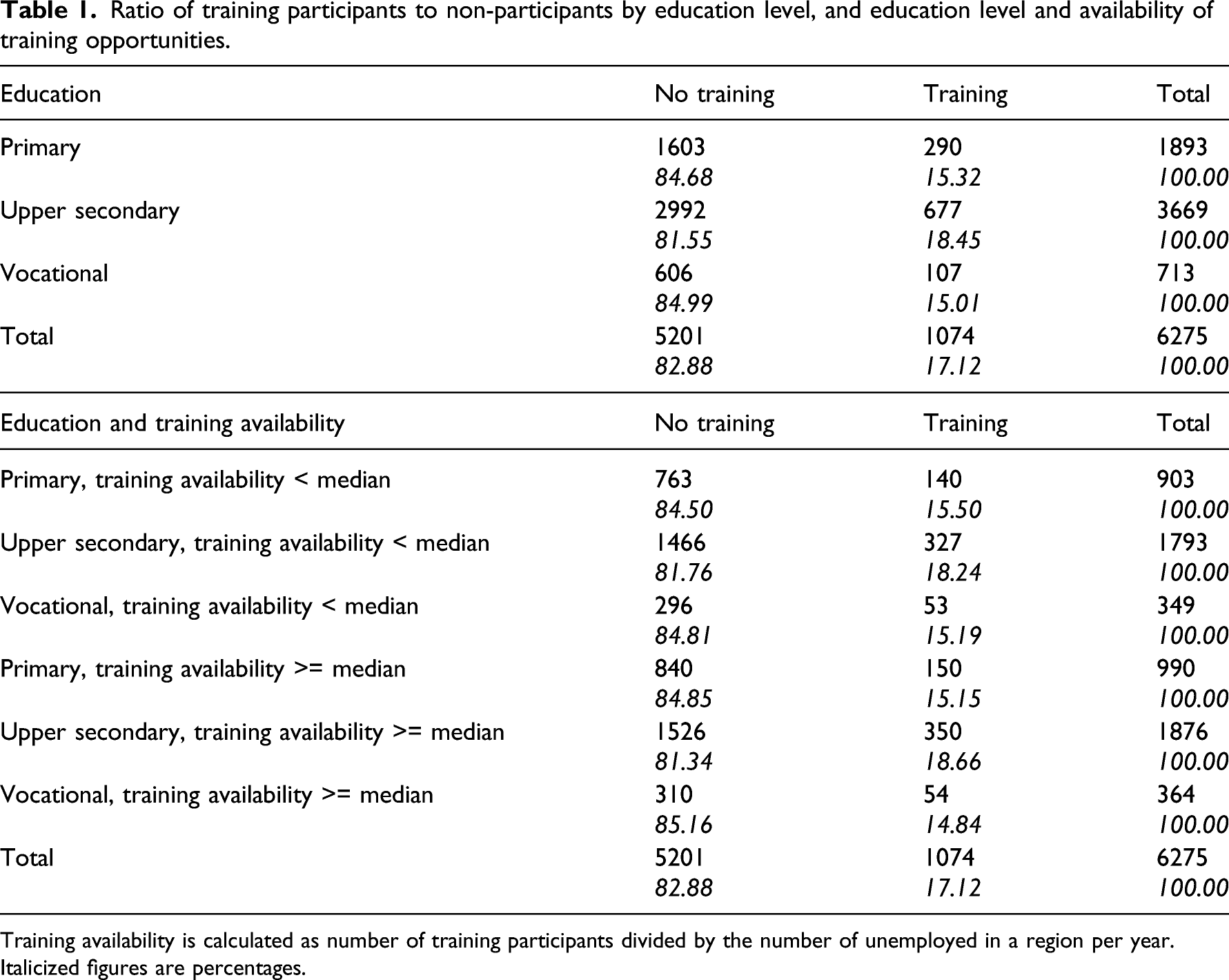
Training availability is calculated as number of training participants divided by the number of unemployed in a region per year.
Italicized figures are percentages.
Table 1 shows that most unemployed workers do not receive training regardless of their educational background. The percentage of unemployed workers who received training is highest among those with upper secondary education, and lowest among those with vocational education. The percentage of unemployed workers with primary education who received training straddles these two groups. Table 1 thus suggests that there may be some training access bias against one vulnerable segment of society, namely unemployed workers who only have primary education. If there were no access bias, they should have the highest percentage of unemployed workers who received training.
The bottom half of Table 1 explores whether the percentage of unemployed workers who received training varies according to the levels of education and availability of training opportunities. To ease interpretation, we categorized region-years into two groups by the median level of available training opportunities. The table shows that differences in frequencies of training participation are marginal at different availabilities of training opportunities and across all education groups. In addition, patterns for frequency of training for different education groups remain similar to the patterns observed in the top half of the table.
Regression results.
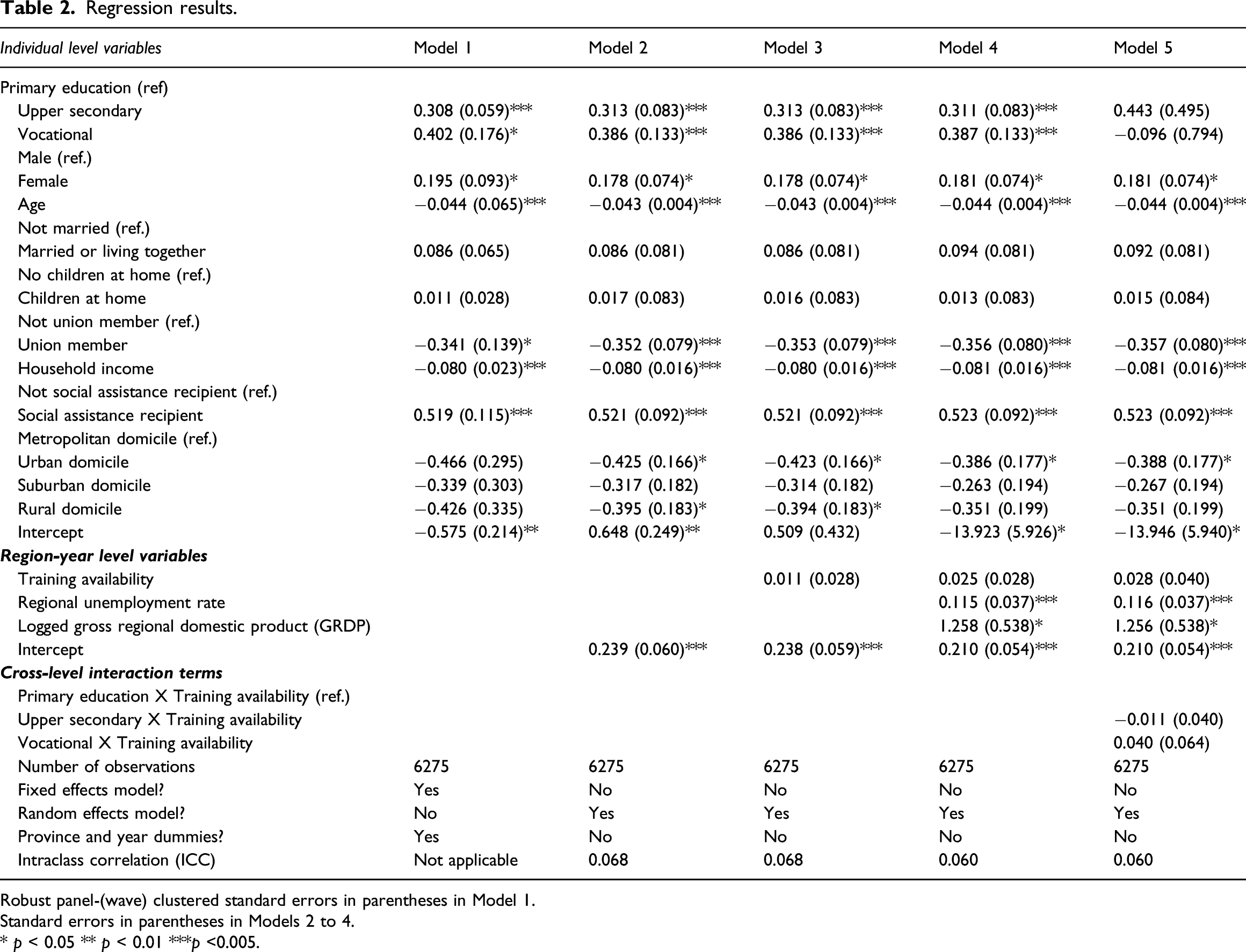
Robust panel-(wave) clustered standard errors in parentheses in Model 1.
Standard errors in parentheses in Models 2 to 4.
* p < 0.05 ** p < 0.01 ***p <0.005.
Results from Model 1 also highlight other access biases. Older, male, unionized, unemployed workers who have higher household income and did not receive basic income support are less likely to receive training than younger, female non-unionized unemployed workers who have lower household income and received basic income support.
We now turn to our estimates from our random intercept models (Models 2 to 5). The intraclass correlation values across Models 2 to 5 suggest that there is more variance to be explained at the individual level than at the region-year level. We turn our attention first to our individual level parameters. Models 2 to 4 demonstrate that unemployed workers with primary education remain less likely to receive training than their better-educated counterparts. These results resemble estimates from our fixed effects model (Model 1).
We next turn to estimates for our region-year parameters. Crucially, the region-year intercepts in Model 2 show that there is significant variation in training participation across regions and years. Model 3 highlights that this variation is not significantly related to the availability of training opportunities. By contrast, Models 4 and 5 demonstrate that it is significantly related to regions’ unemployment rate and logged GRDP. However, estimates for the region-year intercept remains significant in Models 4 and 5 which suggests that only some of this variation is explained by these factors.
We then move away from the direct association between education and training participation (Model 4) towards the association between these two variables conditional on the availability of training opportunities (Model 5). Model 5 shows that estimates for the cross-level interaction between education and availability of training opportunity do not reach conventional levels of statistical significance. That is, the availability of training opportunities does not condition the extent to which primary educated unemployed workers are less likely to participate in training than vocational and upper secondary educated unemployed workers.
Finally, we conducted robustness checks where we utilized an alternate measure of availability of training and 1-year lagged unemployment rate. Using this alternate measure, and then utilizing it with 1-year lagged unemployment rate does not yield any significant change in results. 7
Discussion and conclusion
Social policy scholars are concerned about Matthew effects that accrue from poorly targeted social policies. When social policies are directed away from their targeted group towards better-off groups, they may worsen existing socio-economic divides. Yet, studies about access biases currently focus on a narrow range of social policies such as childcare use and parental leave uptake (for example, Pavolini and Van Lancker, 2018). We fill a part of this gap by contributing to emerging discussions about access biases in training (Auer and Fossati, 2020; Bonoli and Liechti, 2018; Pisoni, 2018) with a focus on lower-educated workers.
We find that unemployed workers with the lowest educational qualifications are least likely to receive training in Finland between 2007 and 2012. By contrast, better-educated unemployed workers with vocational education, who arguably experience less labour market vulnerability, are significantly more likely to obtain training. We view this finding as evidence of training access bias. We thus cannot reject Hypothesis 1 (i.e. lower-educated unemployed workers are less likely to receive training than better-educated ones). We also find that the probability of unemployed workers receiving training varies across regions and years, and part of this variation is explained by differences in regional unemployment rates and GDP but not differences in availability of training opportunities. Differences in availability of training opportunities also do not explain the extent of training access bias against lower-educated unemployed workers. We thus reject Hypothesis 2 (i.e. training access bias against lower-educated workers is conditioned on the availability of training opportunities).
Separately, we also find some other access biases in training. Some of these access biases may close inequalities in the long run, whereas others may worsen them. For instance, we find that training appears to reach three groups of unemployed workers who would benefit from it: women, low-income workers, and workers in need of help and thus requiring basic income support. Positive access biases thus offer an opportunity to close the inequalities that beset these three groups of unemployed workers. For instance, since women frequently have more truncated employment biographies and suffer more human capital depreciation than men (De la Porte et al., 2020), as they tend to take the lion’s share of care responsibilities (Duvander and Cedstrand, forthcoming), positive access bias for women may improve their labour market integration and prospects. By contrast, we find that training participation appears biased against older workers. Older workers may struggle to adapt to a changing world of work, and thus suffer great labour disadvantage. Access bias against them may then entrench age-based labour market inequalities.
Additionally, we also find that unionized unemployed workers are less likely to participate in training, which may relate to Finnish unions providing extensive job information and occupational training for their members (Shin and Böckerman, 2019). They may hence feel less need to participate in PES-provided training. Furthermore, Finland has operated a voluntary unemployment insurance scheme where unions play an important role in managing unemployment insurance. In this scheme, most workers join both a trade union and an earnings-related unemployment insurance fund concurrently which provided them with generous earnings-related compensation for a maximum of 100 weeks. 8 As such, they may be disincentivized from participating actively in training (see also Moffitt and Nicholson, 1982).
Overall, these findings have a bearing on social investment’s objectives of closing existing socioeconomic inequalities by improving disadvantaged workers’ human capital. As shown by the evaluation literature, training is an effective instrument to achieve these objectives. However, it needs to be targeted efficiently at disadvantaged social groups. Our findings show a mix of positive and negative access biases which suggest that training may only partly meet social investment’s objectives. Furthermore, negative access biases in training are worrying from a life course perspective in which social investment is rooted: training is one of the last few policies available to correct disadvantage accrued from having a poor socioeconomic background, especially when early childhood education and care fails to remedy it initially (Ghysels and Van Lancker, 2011; Pavolini and Van Lancker, 2018). Our contribution therefore lies in qualifying the positive view of training provided by evaluations studies and trumpeted by both policymakers: the positive effects of training matter, if and only if, they reach the social groups which need them most. Policymakers should therefore pay attention to both access and effectiveness of training policies. Otherwise, multiple access biases in social investment policies against vulnerable social groups across their life course would entrench or exacerbate these social groups’ poor life chances.
To date, evidence of access biases in training has largely been based on Switzerland (for example, Auer and Fossati, 2020; Pisoni, 2018). Our results show, however, that access biases in training also occur in the Nordic countries where such biases are expected to be minimal (Bonoli and Liechti, 2018), because welfare is dispensed universally according to need and not to status. We therefore contend that if such access biases are present in one of the Nordic countries, they may also be present in countries with other welfare regimes.
Although our study reveals access bias against lower-educated unemployed workers in training, our data prevents us from identifying the source of this access bias. It probably results from a combination of both demand- and supply-side factors. Future studies could therefore utilize analytical approaches that distinguish which of these factors are dominant. Next, we are unable to distinguish between different types of training. Some training may yield more human capital development than others. If lower-educated unemployed workers are prioritized for training that yields less human capital development, it will still yield Matthew effects. Although our survey-based dataset contains some register-linked information about respondents’ income and taxes, they do not provide details on the type and length of training. Future studies could leverage more informative datasets and compare access biases for different types of training. Furthermore, we lack a more direct and accurate measure of training availability. Although our proxy does capture aspects of training availability and its variation across regions and years, future research could nevertheless tap into administrative data to directly capture it. Lastly, we focused on access bias in one specific policy for one disadvantaged social group. Aside from childcare use, parental leaves and education (for example, Bonoli et al., 2017; Duvander and Cedstrand, forthcoming; Pavolini and Van Lancker, 2018), access biases in these other policies and for other disadvantaged social groups remain under-researched. Future studies could explore access biases in other social policies and for other social groups.
Supplemental Material
sj-pdf-1-esp-10.1177_09589287211066408 – Supplemental Material for Who gets labour market training? Access biases of social investment in Finland
Supplemental Material, sj-pdf-1-esp-10.1177_09589287211066408 for Who gets labour market training? Access biases of social investment in Finland by Zhen Jie Im and Young-Kyu Shin in Journal of European Social Policy
Footnotes
Acknowledgements
An earlier version of this article was presented at the Nordic ESPANet Workshop for Doctoral Students 2020. We would like to thank Caroline de la Porte, Janine Leschke, Melike Wulfgramm, Jonas Felbo-Kolding, Minna van Gerven, Heikki Hiilamo, Mikkel Mailand, Paula Saikkonen, Petri Bockerman, Lizaveta Dubinka-Huscha, Lore van Herreweghe, Emma Villman and participants of the ReNEW Small States Seminar (15 November 2019), participants of the Nordic ESPANet Workshop for Doctoral Students (2020), participants of the DaWS Early Career Workshop, and participants of the University of Helsinki’s Social Policy Seminar for their helpful comments and insights. We would also like to thank Anu Jänkälä (Suomen Työ-ja elinkeinoministeriö) for providing us with access to data on regional employment offices in Finland.
Declaration of conflicting interests
The author(s) declared no potential conflicts of interest with respect to the research, authorship, and/or publication of this article.
Funding
The author(s) disclosed receipt of the following financial support for the research, authorship, and/or publication of this article: This study was supported by Palkansaajasäätiö, Koneen Säätiö, the ReNEW mobility grant, and the Strategic Research Council at the Academy of Finland (312710).

Supplemental material
Supplemental material for this article is available online.
Notes
References
Supplementary Material
Please find the following supplemental material available below.
For Open Access articles published under a Creative Commons License, all supplemental material carries the same license as the article it is associated with.
For non-Open Access articles published, all supplemental material carries a non-exclusive license, and permission requests for re-use of supplemental material or any part of supplemental material shall be sent directly to the copyright owner as specified in the copyright notice associated with the article.
