



Abstract
An emerging consensus claims that ‘subjective’ (mis)perceptions of income inequality better explain redistributive preferences than actual ‘objective’ conditions. In this article, we critically re-assess this view. We compare perceived and actual income positions as predictors for preferences for redistribution. We argue that perceived income is partly endogenous to actual income and its effect on preferences conditional on ideology. Using an original survey experiment from Switzerland, we show that the predictive power of perceived income is lower compared to actual income. Perceived income is only associated with redistribution preferences among centre-right respondents, but not among left-wing respondents. Furthermore, providing respondents with corrective information about their true position in the income hierarchy has no effect on redistribution preferences. These findings go against the new consensus about the superior explanatory power of subjective perceptions of income inequality. We argue instead that absolute objective conditions should be at the centre of explaining redistributive preferences.
Keywords
Introduction
Voters’ position in the income distribution predicts redistributive preferences, according to the famous model by Meltzer and Richard (1981). The Meltzer–Richard model has been criticised on various fronts (see e.g. Kenworthy and McCall, 2008; McCarty and Pontusson, 2009). One important criticism concerns its micro-foundations: there appears to be widespread misperceptions of income inequality. Thus, many recent studies claim that subjective perceptions are a better predictor for redistribution preferences than actual objective conditions (Becker, 2020; Bobzien, 2020; Bussolo et al., 2019; Cansunar, 2021; Choi, 2019; Engelhardt and Wagener, 2014; Fatke, 2018; Gründler and Köllner, 2017; Kuhn, 2020). Gimpelson and Treisman (2018: 27) even suggest that ‘most theories about political effects of inequality need to be reframed as theories about effects of perceived inequality’.
We take issue with this view about the superiority of subjective perceptions. We ask whether perceived income is a better predictor of preferences for redistribution than actual income. The existing research mostly focuses on the effect of perceived inequality, a macro-level outcome. However, a more direct test with better micro-foundations would be to examine the effect of people’s perceived position in the income distribution at the individual level. We argue that the effect of perceived income on redistribution preferences is in fact weaker than assumed for two reasons: (1) income perceptions are partly endogenous to actual income and (2) income perceptions matter much more for some ideological groups than others.
The first argument is that income perceptions are partly endogenous to actual income and, therefore, the crucial variable for preference formation is indeed actual income. Perceived income is a function of actual income and misperceptions. However, misperceptions are not random: high-income groups underestimate their income; low-income groups overestimate it. This tendency towards the middle of the income hierarchy can be explained by psychological heuristics and reference group processes (Cansunar, 2021; Evans and Kelley, 2004; Kelley and Evans, 1995). It does not mean that people do not know their actual income. They might not accurately place themselves in the relative hierarchy of the entire income distribution, but it is reasonable to assume that people have at least a basic idea about their own absolute income level, especially when it comes to paying taxes or paying their bills. As Evans and Kelley (2004: 4) note, ‘the harsh reality of stratification is not entirely muted by the rose-colored glasses of reference-group based perceptions’.
The second argument is that political ideology determines whether and how perceived income position matters for redistribution preferences. Among left-wing voters, we expect that perceived income is not associated with redistribution preferences because their ideological beliefs, values and inequality aversion lead to uniformly high support for redistribution among both poor and rich leftists. Among non-left voters, ideological concerns about equality play a much lesser role and therefore we instead expect that perceived income is negatively associated with redistribution support. Unhampered by ideology, non-left voters may assign greater weight to material self-interest when forming preferences. Correspondingly, centre-right respondents who see themselves as rich opt for less redistribution as compared to centre-right respondents who see themselves as poor. Even for these non-left respondents, however, we expect that actual income ultimately holds larger substantive explanatory power than perceived income – for the reasons discussed above that perceived income is not exogenous from actual income.
If income perceptions are deeply rooted in actual income and political ideology, our arguments also imply that providing individuals with information about their ‘correct’ placement in the income distribution should not necessarily have any effect on their preferences for redistribution. This implication would go against other studies that do find some effects of information treatments on redistribution preferences (Becker, 2020; Boudreau and MacKenzie, 2018; Cruces et al., 2013; Fernández-Albertos and Kuo, 2018; Karadja et al., 2017; Kuziemko et al., 2015). These effects, however, sometimes appear to be weak and limited to specific subgroups, so it is difficult to draw firm conclusions about when and how information about the gap between perceived and actual income matters for respondents with different political predispositions.
To test the implications of our arguments about perceived and actual income, political ideology and information, we therefore need experimental data. In this article, we rely on an original survey experiment from Switzerland. We present four types of empirical evidence: (1) Responses on questions about perceived position in the income distribution are distorted towards the middle, but systematically related to actual income levels. (2) The predictive power of perceived income on preferences for redistribution tends to be lower than the predictive power of actual income. (3) The crucial intervening variable between income and redistributive preferences is ideology. Among leftist respondents, neither perceived nor actual income is correlated with preferences for redistribution, while there is a significant correlation among centre-right respondents. (4) If respondents who under- or overestimate their position in the income hierarchy receive corrective information, this does not change their redistributive preferences.
Overall, our theoretical argument and findings from the Swiss experiment go against the consensus in the recent experimental literature on perceptions of income inequality. This consensus posits that subjective perceptions of position in the income distribution are more important predictors of redistribution preferences than objective indicators. We would argue that relative (mis)perceptions are interesting outcomes worth studying, but absolute objective conditions should be at the centre of studies on redistributive preferences and income situation.
The argument
Redistributive preferences are a major intervening factor between the objective income distribution and redistributive policies. In the influential median voter model by Meltzer and Richard (1981), higher market inequality leads to the outcome of more redistribution. It is commonplace to note that empirical support for the Meltzer–Richard model is very limited. For example, in cross-national perspective, more unequal societies tend to have lower levels redistribution (Iversen and Soskice, 2009; Moene and Wallerstein, 2001). If we scrutinise the Meltzer–Richard model, there are several major steps in its causal chain, summarised as follows by Kenworthy and McCall (2008: 36): citizens are ‘aware of the true level of market inequality’; the median-income voter favours more redistribution if inequality increases; these preferences will be expressed in voting and, finally, translated into redistributive policies by governments. This long causal chain between objective economic conditions and public policy has often been overlooked in extant analysis (Choi, 2019; Kenworthy and McCall, 2008).
A vibrant recent literature, however, has scrutinised these assumptions and reached a consensus: perceived income inequality is more important than actual ‘objective’ income inequality, which respondents frequently cannot accurately assess (Becker, 2020; Bobzien, 2020; Bussolo et al., 2019; Cansunar, 2021; Choi, 2019; Engelhardt and Wagener, 2014; Fatke, 2018; Gründler and Köllner, 2017; Kuhn, 2020). Misperceptions of pay differentials (Osberg and Smeeding, 2006), wealth inequality (Norton and Ariely, 2011), income inequality (Niehues, 2014) and individuals’ own relative position in the income distribution (Cruces et al., 2013) have been documented across a variety of contexts. However, extant research still argues that these biased perceptions are much more relevant for policy preferences than the objective situation. Based on their finding that redistribution preferences are unrelated to actual inequality indicators but correlated with perceived inequality, Gimpelson and Treisman (2018: 28) have called for a reformulation of theories on preferences for redistribution as theories on the effects of perceived inequality, not actual inequality.
The consensus in favour of subjective perceptions is largely based on macro-level indicators for perceived income inequality and therefore assumes that a given income perception triggers the same demand for redistribution among all citizens. Many studies cited above have operationalised perceived income inequality on the basis of diagrams in the International Social Survey Programme. Respondents were asked to choose which diagram best characterises the ‘type of society’ in their country, and a Gini coefficient was estimated for each diagram under the assumption that the diagrams represent an income distribution (Gimpelson and Treisman, 2018: 31; Niehues, 2014). However, following the Meltzer and Richard (1981) model, higher inequality leads to higher (support for) taxation by increasing the distance between the median voter’s income and the average income. Therefore, the relevant criterion for an individuals’ demand for redistribution is her perceived distance from the average income. Such individual-level measures of perceived income position would be a more accurate test of the Meltzer–Richard hypothesis.
We disagree with the consensus view about the superiority of perceived versus actual income on two counts. First, the expressed income perceptions are partly endogenous to actual income. People often have a pronounced tendency to perceive themselves as being in the middle of social hierarchies. On the one hand, subjective perceptions are largely formed based on comparisons to reference groups in people’s immediate environment that do not represent the whole societal distribution (Cansunar, 2021; Evans and Kelley, 2004; Kelley and Evans, 1995). On the other hand, social desirability may also be at work: ‘Social desirability is the tendency of some respondents to report an answer in a way they deem to be more socially acceptable than would be their “true” answer. They do this to project a favorable image of themselves and to avoid receiving negative evaluations’ (Callegaro, 2008: 826). Thus, relatively poor respondents might overreport their income because they do not want to be seen at the bottom of society, while rich respondents may be willing to downplay their favourable social situation. There is empirical evidence for precisely this tendency of individuals to be drawn towards the middle of perceived position with a clear grading in actual income (Cruces et al., 2013; Engelhardt and Wagener, 2018; Fernández-Albertos and Kuo, 2018).
The expected tendency of people’s perceptions towards the middle does not imply that they do not know or care about their actual ‘objective’ income. In fact, respondents probably care much more about their own absolute income level than about their perceived distance to others’ incomes. The latter is mainly reputational information without a direct consequence for the fulfilment of material needs. For example, for a millionaire, the objective need for additional transfer income is very low, even if their perceived relative position to the average income would be affected by the presence or absence of billionaires. A respondent who has difficulties in making ends meet will care much more about being able to pay the bills instead of being concerned about belonging to the lowest decile of the income distribution. Likewise, if a respondent hardly pays any taxes because she earns so little, she will fear nothing from redistribution, while upper–middle class income earners have good reasons to care about a high marginal tax rate due to additional redistribution. In all these examples, individuals’ own absolute objective income levels and the related tax load count, but not the perceived relative position compared to others in the income distribution.
Our second objection against the recent consensus concerns the assumption that the own income position – whether perceived or actual – has similar relevance for all citizens. We argue that this assumption only holds if we neglect political ideology. We define political ideology as a coherent set of values, general convictions and attitudes (Converse, 2006: 3). Ideology is an explanation of redistributive attitudes that often interacts with economic self-interest and can render the direct effect of self-interest less relevant (Armingeon and Weisstanner, 2021; Margalit, 2013; Stiers et al., 2021). When citizens develop preferences, a crucial early step is the accommodation with previously held values and beliefs (Lodge and Taber, 2013). If a citizen is deeply convinced of the value of an equal society, the idea that self-interest is the sole driver of redistributive attitudes is not appealing. For such left-leaning respondents, their own position in the income distribution – even if they perceive themselves to be as relatively rich – then may become irrelevant for the support of redistributive goals. In contrast, a citizen who emphasizes the role of market and competition and principally accepts inequality as a necessary correlate of a free market (Friedman, 1982) is more likely to support the idea of self-interest as a guiding principle of political activity. Such non–left-leaning respondents should derive their support of redistribution from their relative position in the income hierarchy.
Hence, another major intervening factor between individual income and demand for redistribution is ideology, or more specifically, the value-compatibility of self-interest in redistributive politics. 1 For leftist respondents, we expect that neither perceived nor actual income matters for their redistributive preferences. For non-left respondents, we expect that income matters along the lines of self-interest based models – although as argued above, actual income levels may hold greater substantive explanatory power than perceived income levels.
Both our objections also have implications for the role of information for preference formation. Several recent experimental studies find some effect on redistribution preferences when individuals’ misperceptions are corrected with information about their true placement in the income distribution. However, these effects are often small and conditional on specific subgroups. Information only has an effect on redistributive preferences among individuals who overestimate their income position (Cruces et al., 2013; Fernández-Albertos and Kuo, 2018), who underestimate their income position and are ideologically right-leaning (Karadja et al., 2017), or who are informed of being net contributors to the tax-transfer system (Engelhardt and Wagener, 2018). Kuziemko et al. (2015) find that information has only substantively small effects on income tax preferences, while Becker (2020) and Boudreau and MacKenzie (2018), however, find stronger effects that are shaped by party cues. Given this contradicting evidence, no agreement on the strength and direction of information treatments has yet emerged. In our theoretical framework, income misperceptions do not simply indicate a lack of knowledge or information, but instead are deeply rooted in actual income levels and ideology. Thus, we would not be surprised to find no effect of correcting individuals’ expressed views about their position in the income distribution on preferences for redistribution.
Based on this discussion, we derive the following four hypotheses that we empirically test in our survey experiment. H1: There is a strong correlation between perceived and actual income position (despite the expected tendency that income perceptions are biased towards the middle). H2: The substantive predictive power of perceived income on preferences for redistribution is lower than that of actual income. H3: The association between perceived income and preferences for redistribution is moderated by political ideology. H4: Experimentally informing individuals about misperceptions of their income position does not have an impact on their preferences for redistribution.
The survey experiment
The first part of the empirical analysis uses an original survey experiment that has been run online to a sample of 1027 respondents in the summer of 2017 in the German-speaking part of Switzerland. 2 Switzerland is a suitable case for the analysis with its intermediate and relatively stable levels of income inequality in comparative perspective – distinguishing it from the high inequality levels of the US, the low inequality levels of the Nordic countries, and the trends towards rising inequality in several advanced democracies (Nolan and Thewissen, 2018). To ensure an accurate representation of socio-economic groups within the adult population, the gross sample was stratified with respect to age, gender and party preference (including no preference). The net sample implemented a quota of three income categories. 3 As shown in Supplemental Appendix 1, the non-random sample from our online panel is largely comparable to the representative European Social Survey based on random sampling. 4
Actual income, perceived income, and the information treatment
In the following, we distinguish between actual income, that is, the assignment of respondents into income deciles based on ‘objective’ information about their income level, and perceived income, that is, the perceived ‘subjective’ position, or self-rank, of respondents in the income distribution. Note that by assigning incomes into deciles, we treat both income concepts as measures of rank in the income distribution. However, as explained below, the underlying information about actual income is based on respondents’ own absolute income levels, while perceived income is based on respondents’ relative income position compared with others.
To measure actual income, we implement the innovative method by Fernández-Albertos and Kuo (2018). Their idea is to increase the validity of the actual income measure by avoiding the high refusal or non-response rates when respondents are asked open-ended questions about their income. We also want to avoid obvious hints to the income distribution with pre-defined income intervals, which are common in international surveys. Instead, we generated cut-off points to allocate respondents into income deciles of total monthly household income (before taxes), adjusted for the number of household members (using the square root equivalence scale) and based on European Union Statistics on Income and Living Conditions (EU-SILC) 2015 microdata (referring to incomes in 2014). For example, we allocate a respondent living in a two-person household into income deciles using the following nine cut-off points: 3500 Swiss Francs; 4500; 5400; 6200; 7000; 8000; 9000; 10,500; and 13,300 Swiss Francs. In the survey, we randomly selected one of these cutoff points and asked whether the respondent’s household income was above or below this threshold. If her income is below [above] the threshold, a lower [higher] cutoff point is randomly selected, and the respondent again needed to indicate whether her income is above or below it. This process is reiterated until the respondent’s income decile can be unambiguously assigned. 5
For our measure of perceived income, we asked respondents to estimate their income position relative to other households. The specific question asked was: ‘What do you think is the share of households in Switzerland having a higher income than your own household?’ Respondents could choose percentiles between 1% and 99%, but like Fernández-Albertos and Kuo (2018), we prevented them from selecting the ‘50%’ option. This forces all respondents to choose sides and to indicate whether they think that they earn more or less than the typical household. We recoded both actual and perceived income into deciles between 1 (lowest income) and 10 (highest income).
Finally, we randomly assigned respondents into one treatment and one control group. 6 After estimating their perceived income, respondents in the treatment group were informed about their actual position. Their own estimates were first repeated (‘you indicated that [x] percent of Swiss household have a higher income than your own household, and [1-x] percent a lower income’). Then, they were informed about their actual relative income (‘In fact, according to data from the federal statistical office, your own position in the income distribution is as follows: roughly [z] percent of Swiss household have a higher income than your own household, and [1-z] percent a lower income’). 7 Those respondents who provided exact guesses of their income decile were informed additionally about their correct guess (‘You were right’). Respondents in the control group did not receive any information about the accuracy of their perceived income position.
Redistribution preferences
Our measure for preferences for redistribution is the standard question whether ‘the government should reduce income differences in Switzerland’. The five-point answer scale is coded as 1 ‘strongly disagree’, 2 ‘disagree’, 3 ‘neither/nor’, 4 ‘agree’, and 5 ‘strongly disagree’ (‘don’t know’ and ‘no answer’ coded as missing). According to this measure, 63% of respondents support redistribution (20% strongly agree, 43% agree), 16% disagree or strongly disagree, and 20% neither agree nor disagree.
Ideology and control variables
We rely on respondents’ self-placement on the left-right scale as our measure of ideology. Left–right placement is a useful heuristic to denote political stances related to more or less equality. We coded individuals placing themselves between 0 and 3 on the 0–10 scale as ‘left’. This amounts to 30% of respondents (counting ‘don’t know’ and ‘no answer’ as missing). Our substantive findings with respect to the role of ideology are robust to using alternative measures based on the left–right scale (0–2, 0–4, or 0–5 as ‘left’) or party preferences (social democratic and green parties as ‘left’). Finally, we control for standard socio-demographic characteristics: age, gender, education, being unemployed, retired and union membership.
Methodology
We begin with descriptively assessing the accuracy of respondents’ perceived income position compared with their actual income. We then estimate ordered logistic regression models of redistribution preferences measured on a five-point scale, where higher values indicate higher support for redistribution. We use robust standard errors. To interpret the regression coefficients, we present ‘average marginal effects’ (AMEs) that estimate the predicted probability of respondents selecting the top two categories (agree or strongly agree). These AMEs can be interpreted as the expected changes of covariates on the probability of supporting redistribution. After accounting for missings on the dependent and independent variables, all the results reported below are based on a final sample consisting of 958 observations.
Findings
Are income positions in Switzerland as widely misperceived as found by experimental studies on perceptions of income and income inequality in other countries? Figure 1 shows the distribution of perceived income (dark-grey bars) and actual income (white bars) in deciles. Indeed, we find substantial misperceptions and a strong tendency towards the middle of the perceived relative position in the income distribution. While the actual income distribution is evenly spread out across income deciles, very few respondents indicate that they belong to the bottom or the top two deciles. Conversely, middle categories are over-represented. Almost a quarter of respondents perceive their income to be just below the median income (decile 5). The distribution of perceived and actual income position.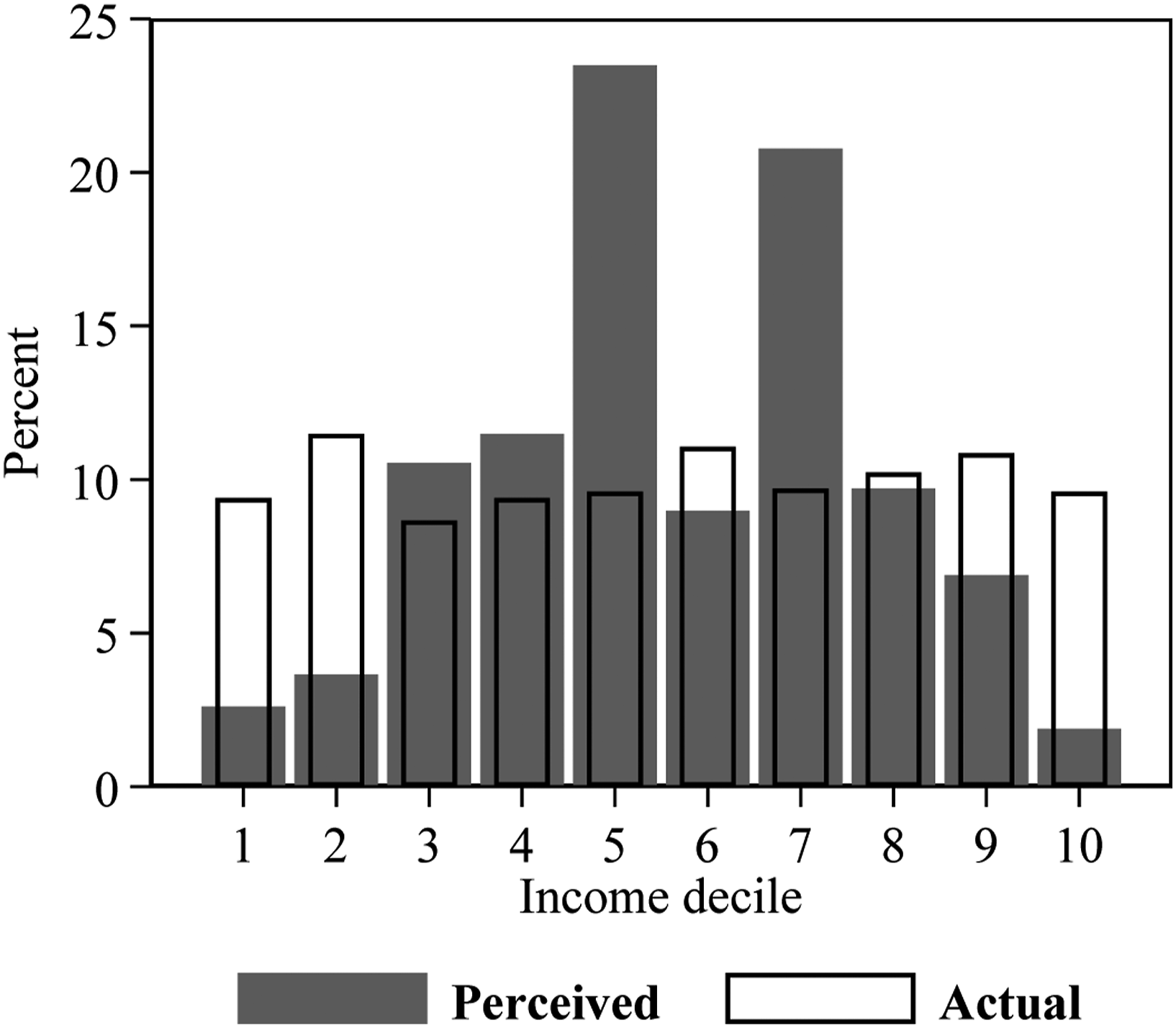
This bias towards the middle is consistent with social-psychological explanations like social desirability or reference group comparisons. As a result, only 37% of respondents are able to correctly identify their income within one decile above or below of their actual income position; 64% can indicate their position within two income deciles. However, Figure 1 also indicates that there is some overlap between perceived and actual income. In fact, there is a fairly strong correlation of r = 0.57 between perceived and actual income deciles.
Figure 2 is based on a bivariate multinomial logistic regression model of three types of estimations. It predicts the probability of each decile of actual income of overestimating, underestimating, or correctly estimating (within ± one decile) their income position. The figure shows that income misperceptions are clearly a function of actual income. The lower the actual income, the more likely they are to overestimate their income. The higher the actual income, the more likely they are to underestimate their income. More than 80% of respondents in the top two deciles are likely to underestimate their income by more than one decile. Finally, middle- and lower-middle income groups are most likely to correctly indicate their perceived position within one decile of their actual income. Probability of overestimating, correctly estimating, or underestimating one’s income position, by actual income decile. Note: Probabilities with 95% confidence intervals based on a bivariate multinomial logistic regression model of respondents’ income estimate and actual income (no control variables).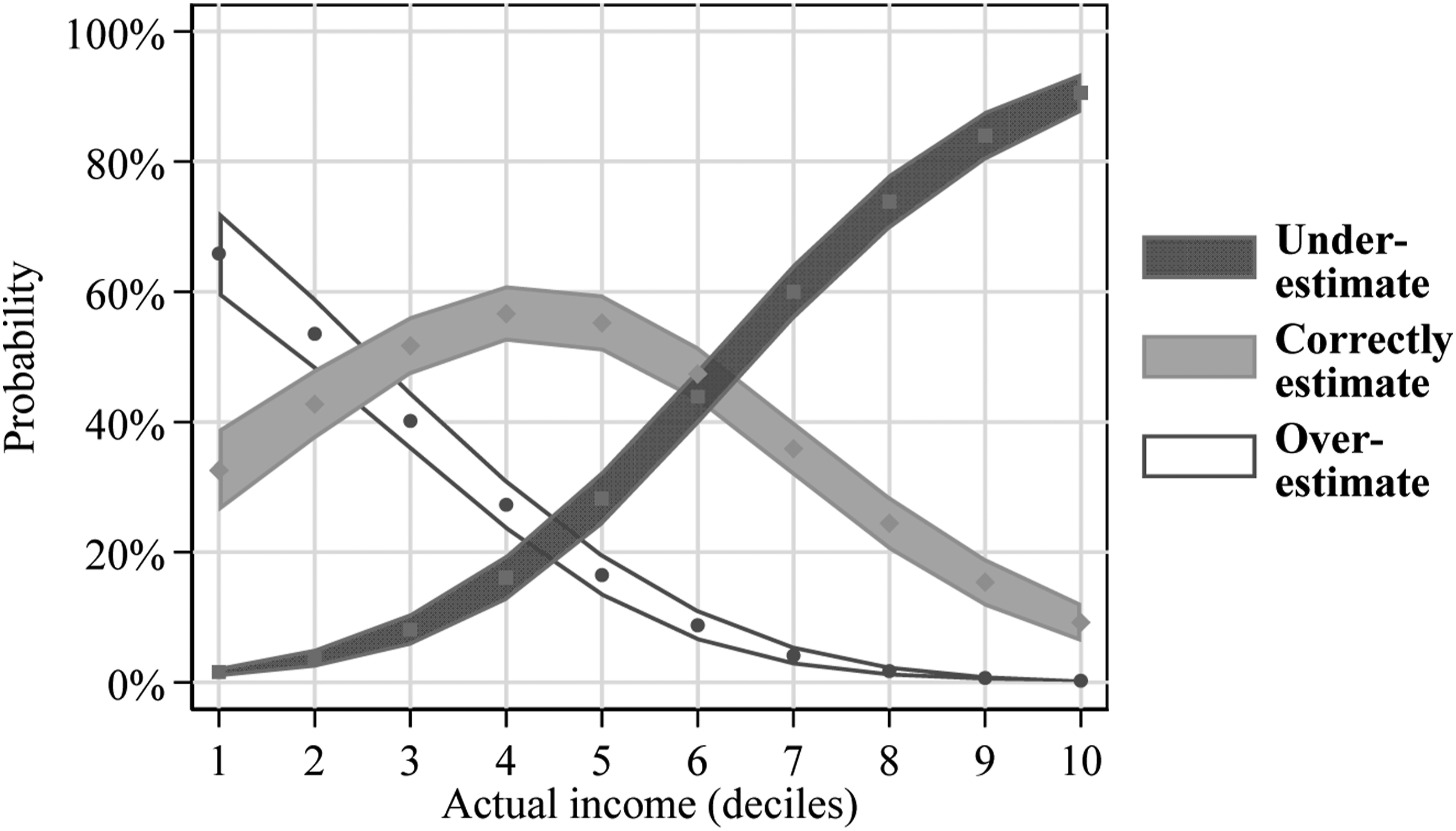
Ordered logistic regressions of redistribution support.
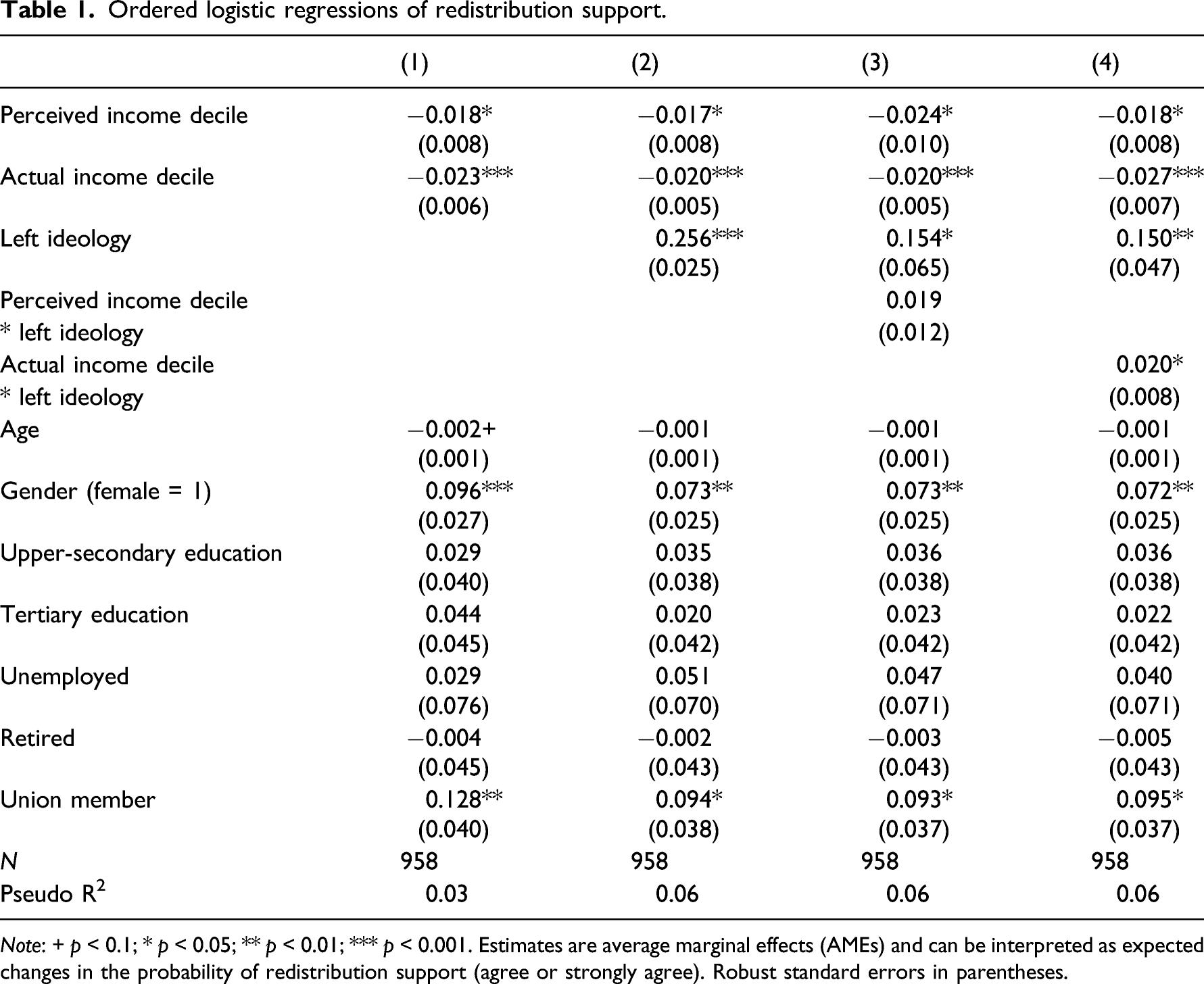
Note: + p < 0.1; * p < 0.05; ** p < 0.01; *** p < 0.001. Estimates are average marginal effects (AMEs) and can be interpreted as expected changes in the probability of redistribution support (agree or strongly agree). Robust standard errors in parentheses.
To assess the predictive power of the two income concepts, we can compare the change in predicted redistribution support for typical values of ‘low’ and ‘high’ perceived and actual income in our sample. For example, a respondent in the lower quartile (25th percentile) has a perceived income in the fourth decile and an actual income in the third decile, while a respondent in the upper quartile (75th percentile) has a perceived income in the seventh decile and an actual income in the eighth decile. Thus, the income distance between comparable respondents in the bottom and top quarter of the respective income distributions is three deciles for perceived income compared to five deciles for actual income. This implies that the expected change in redistribution support from lower to upper quartile is −5.4% (3*−0.018 = −0.054 from Table 1, Model 1) for perceived income and −11.5% (5*−0.023 = −0.115) for actual income. Hence, although both perceived and actual income are significantly correlated with redistributive preferences, the latter has a superior substantive explanatory power.
In Model 2, we add a measure for left political ideology. Unsurprisingly, ideology is strongly associated with redistribution preferences. The predicted probability to support redistribution is almost 26 percentage points higher among left-wing respondents (0–3 on the left–right scale) compared with centre-right respondents. The other explanatory variables are not strongly affected by the inclusion of ideology. Our control variables generally show an expected higher support for redistribution among females and union members as well as some insignificant effects.
Next, we test whether the effects of perceived and actual income are conditional on ideology. Models 3 and 4 introduce an interaction between left ideology and perceived income (Model 3) and actual income (Model 4), respectively. This interaction (more precisely, the difference in the AME of actual/perceived income between left and non-left respondents) is positive and narrowly statistically insignificant at p = 0.115 for perceived income (Model 3), but significant at p = 0.017 for actual income (Model 4). The interaction indicates that the conditional effect of perceived income (Model 3) is statistically significant only among non-left respondents (the AME estimate from Table 1 is −0.024, p = 0.014), but not significant among left respondents (the AME estimate is −0.024 + 0.019 = −0.005, p = 0.553). Likewise, the conditional effect of actual income (Model 4) is statistically significant only among non-left respondents (the AME estimate from Table 1 is −0.027, p = 0.000), but not significant among left respondents (−0.027 + 0.020 = −0.007, p = 0.300).
Figure 3 graphically displays the predicted probabilities of redistribution support from these interaction models. The plots clearly show that the effects of both perceived and actual income on support for redistribution are highly conditional on political ideology. Among left-leaning respondents, self-interest considerations, captured by either perceived or actual income, barely have any explanatory power for redistribution preferences. In contrast, both perceived and actual income are statistically significant predictors of redistribution support among centre-right respondents. As shown in Supplemental Appendix 3, this conditional effect is robust to several alternative operationalisations of political ideology. The effects of perceived and actual income conditional on ideology. Note: Predicted probabilities with 95% confidence intervals based on Models 3 and 4 in Table 1. Light grey = distribution of respondents across income deciles (kernel density).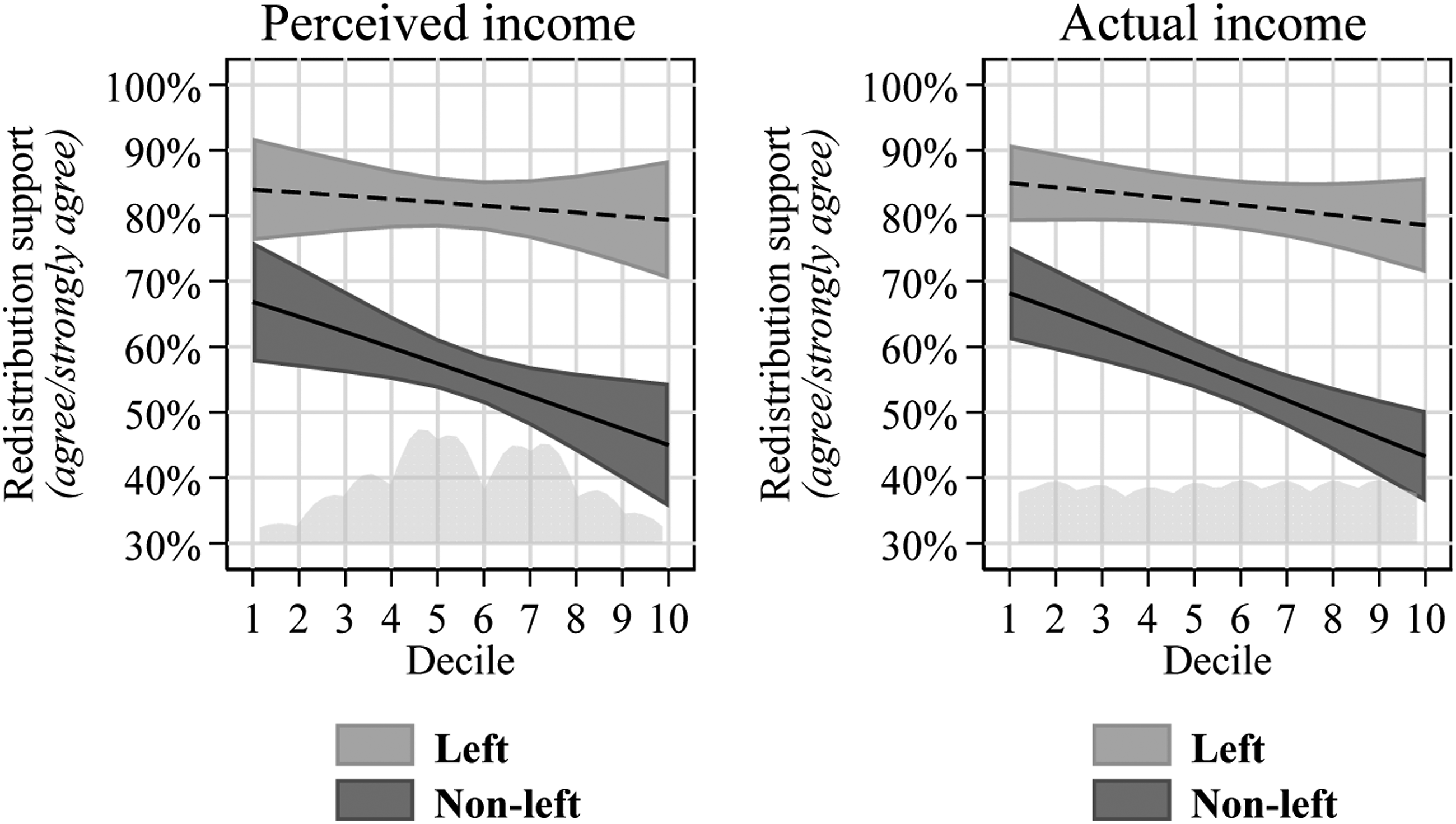
The second purpose of Figure 3 is to again compare the differential effect of actual versus perceived income on redistributive preferences. Neither type of income matters for left respondents. But it is worth noting that even among non-left respondents, the substantive predictive power of perceived income is lower than for actual income. It is true that the slopes in Figure 3 are similar. Table 1 also shows that both actual and perceived income are statistically significant predictors of redistribution preferences, and the difference in the estimated coefficients for actual and perceived income is statistically significant in none of the models. However, the slopes in Figure 3 alone do not take into account the distribution of respondents. Perceived income is mostly clustered around the middle, whereas actual income covers a wider range of income situations and therefore matters for a higher number of people with very low or very high incomes in the population. If we compare the change in redistribution preferences between the 25th and 75th percentile of non-left respondents’ income position, we find that redistribution preferences decrease by 7.2 percentage points between non-left respondents at the 25th and 75th percentile of perceived income, and by 13.6 percentage points between non-left respondents at the 25th and 75th percentile of actual income. In our view, this is a non-negligible difference. Hence, we conclude that the substantive predictive power is lower for perceived income than for actual income and only matters for groups with certain political beliefs and values.
Information treatment effects on support for redistribution.
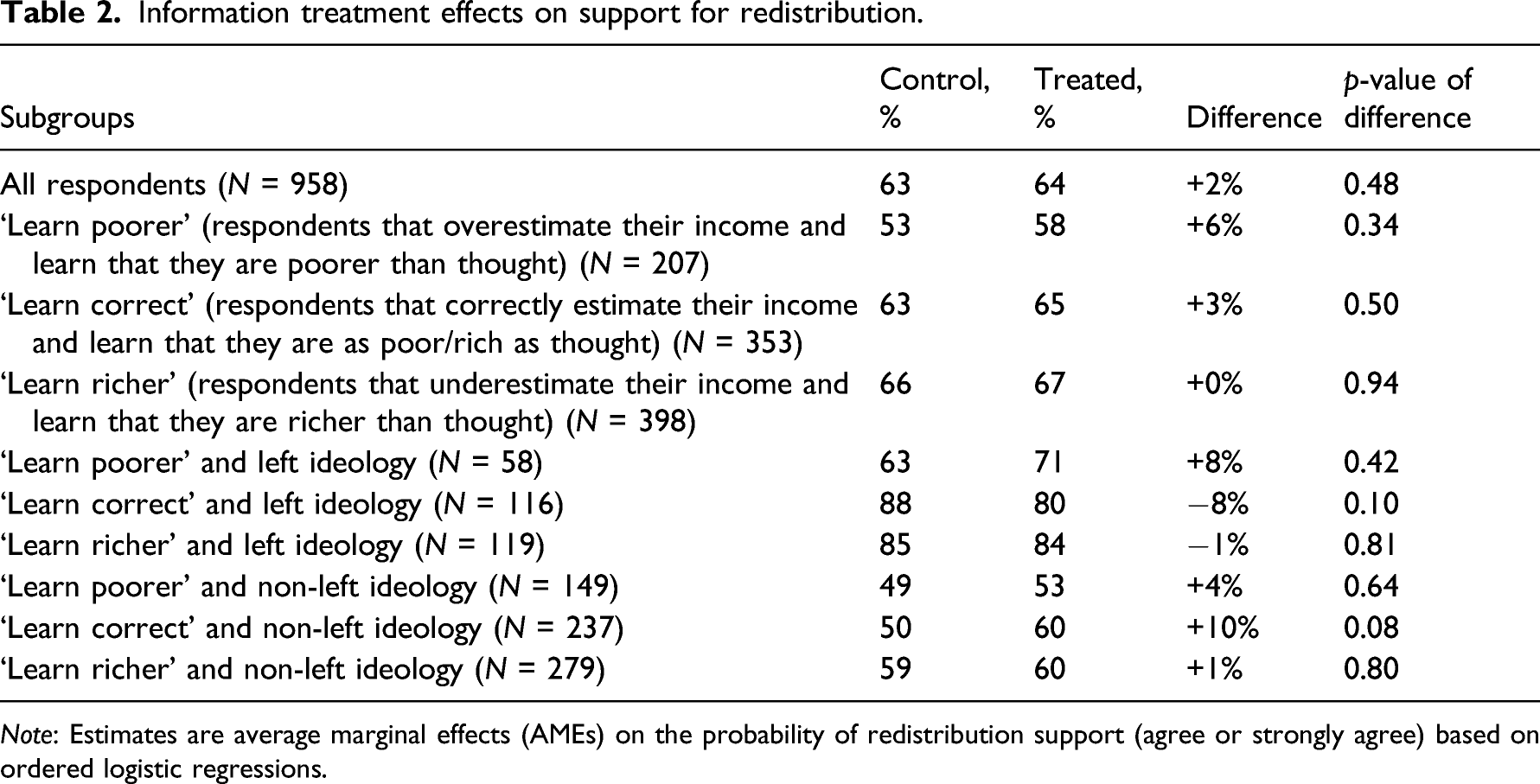
Note: Estimates are average marginal effects (AMEs) on the probability of redistribution support (agree or strongly agree) based on ordered logistic regressions.
Conclusion
We started from the question whether actual or perceived income is a better predictor of preferences for redistribution. We took issue with the emerging consensus in the extant research that perceived income outperforms actual income. Rather, we argued that income perceptions matter differently for different ideological groups, in addition to perceived income partly being endogenous to actual income.
We found empirical evidence in favour of these arguments in our original survey experiment from Switzerland. The predictive power of subjective perceptions is lower than assumed in the recent consensus in the literature. We also found that income – whether actual or perceived – has no explanatory power among left-leaning respondents, and that information about misplacement has no ‘corrective’ effect on preferences for redistribution. Switzerland, with its intermediate levels of income inequality (Nolan and Thewissen, 2018), may be a more representative case for the generalisability of our results to advanced democracies compared to similar studies conducted in contexts of more extreme levels of inequality, such as the US. Even so, future research should further explore the external validity of experimental findings on income perceptions in different contexts.
In contrast, we find that preferences for redistribution are consistently shaped by actual ‘objective’ income, which we measured in a reliable way by asking respondents whether their own absolute income lies above or below a given threshold. The strong correlation between actual income position and redistributive preferences does not necessarily imply support for the Meltzer–Richard model. In the Meltzer–Richard model, the relative position in the income distribution compared to the average income earner is the major explanatory factor, which implies that citizens have some reliable idea about how far away they are from other citizens. Our study finds no evidence that respondents in Switzerland are particularly accurate at estimating their own relative position, consistent with the literature on income and inequality misperceptions. However, we show that objective income levels, without any information about the relative position, are key. For respondents, it matters more how much they can spend and how much taxes they pay as compared to how much less or more they think they earn than others. Basically, this corresponds to the insight that ‘[i]t is not the consciousness of men that determines their existence, but, on the contrary, their social existence determines their consciousness’ (Marx, 1904: 11–12).
Supplemental Material
sj-pdf-1-esp-10.1177_09589287211037912 – Supplemental Material for Redistributive preferences: Why actual income is ultimately more important than perceived income
Supplemental Material, sj-pdf-1-esp-10.1177_09589287211037912 for Redistributive preferences: Why actual income is ultimately more important than perceived income by David Weisstanner and Klaus Armingeon in Journal of European Social Policy
Footnotes

References
Supplementary Material
Please find the following supplemental material available below.
For Open Access articles published under a Creative Commons License, all supplemental material carries the same license as the article it is associated with.
For non-Open Access articles published, all supplemental material carries a non-exclusive license, and permission requests for re-use of supplemental material or any part of supplemental material shall be sent directly to the copyright owner as specified in the copyright notice associated with the article.
