




Abstract
Automation has permeated workplaces and threatens labour in the production process. Concurrently, European governments have expanded workfare which imposes stringent conditions and sanctions on unemployed workers after the onset of austerity. We explore how automation risk affects workfare support. Recent research finds that most routine workers ‘survive’ in their routine jobs. Despite avoiding unemployment, routine workers may face the threat of status decline as automation erodes the value of routine work. They may respond by differentiating themselves from lower-ranked social groups such as unemployed workers. Such boundary drawing may manifest views that the unemployed are less deserving of welfare. We thus posit that routine workers may support workfare to assuage their fears of status decline. We further explore if worsening economic hardship, proxied as rising unemployment rates over time, increases their support for workfare. We conducted pooled and multilevel analyses using data from the European Social Survey. We find that routine workers significantly support workfare. We also find that routine workers support workfare when economic hardship worsens, but oppose it when conditions ameliorate. Findings suggest that status threat is an important channel by which automation risk may affect workfare support, but its impact depends on social context, hence yielding country-differences. Worsening economic hardship may exacerbate routine workers’ status decline fears, and intensify their harsh views against unemployed workers. Automation risk may thus have a greater impact on workfare support under such conditions. Policymakers can use these findings to assess how workfare may be publicly received and under various economic conditions.
Introduction
Contemporary European governments have expanded workfare to address unemployment by applying conditions and sanctions to unemployment benefit recipiency to pressure unemployed workers into reemployment (Clasen et al., 2016; Knotz, 2018). It is attractive to governments because it might reduce public social spending and tackle stubborn unemployment. Governments particularly welcome these effects in time of fiscal austerity (Bengtsson et al., 2017).
Automation is a major source of labour market disruption today (Biagi and Sebastian, 2020; Goos et al., 2014). It refers to robots and computers replacing labour in the production process. Although labour economists agree that automation has uneven distributive effects across all occupations, they disagree on which occupations are worst affected by this change (contrast Fernández-Macías and Hurley, 2017; Goos et al., 2014). They disagree on whether automation hurts low-skilled or medium-skilled occupations most. However, a meta-review by Biagi and Sebastian (2020) finds that most of the reviewed studies concur that employment shares of workers in medium-skilled occupations performing repetitive and codifiable (routine) tasks have declined. By contrast, high-skilled, and to a lesser extent, low-skilled workers seem to have grown. This job polarisation may have taken place because automation is more efficient in producing routine tasks than human labour (Autor et al., 2003; Goos et al., 2014). At the individual-level, job polarisation may imply that workers in routine occupations face a greater threat of unemployment.
Governments could consider workfare as an attractive policy to address such labour market disruptions, especially under fiscal austerity. However, does the public support workfare? Although recent studies show that current employment status significantly affects workfare support, we know less about how risk affects such support (Buss, 2018; Fossati, 2018). More precisely, do automation-threatened routine workers support workfare? This is pertinent since they may run the risk of bearing costs imposed by workfare, if they face a greater threat of unemployment. Studies on economic risk show that economically-threatened workers support policies which minimise their vulnerabilities, and conversely, oppose policies which exacerbate their burdens (Iversen and Soskice, 2001; Rehm, 2009; Thewissen and Rueda, 2017). If automation risk presents itself primarily as an economic threat, routine workers may oppose workfare.
Yet, we argue that routine workers may support workfare. Recent studies which examine the labour market trajectories of routine workers find that most survive in their routine jobs; only a minority become unemployed (Kurer, 2020; Kurer and Gallego, 2019). These studies attribute declines in employment shares of routine occupations to a declining number of workers entering these occupations rather than an increasing number of currently employed workers exiting these occupations. Although their ‘survival’ does not yield economic duress in the form of actual unemployment, it still creates status anxiety arising from perceptions that their relative position in the social hierarchy is declining (Kurer, 2020). When individuals worry about status decline, they may try to maintain their social distance from social groups commonly viewed to be at the bottom of the social ladder to validate their own threatened social position (Gidron and Hall, 2019; Kuziemko et al., 2014; Lamont, 2000). They may differentiate themselves by casting themselves positively vis-à-vis these groups (Jeene et al., 2014; Lamont, 2000). We suggest that ‘surviving’ routine workers may do the same since status threats may be more salient than unemployment threats, especially in the short-term. They may contrast themselves from unemployed workers by stressing that they work harder and take more responsibility for their employment than the latter (for related arguments, see Hochschild, 2016: 157; Lamont, 2000: 3). Such views may reinforce opinions that unemployed workers deserve welfare less (Laenen et al., 2019; Van Oorschot, 2006). Routine workers may hence support workfare policies that restrict unemployed workers’ access to unemployment benefits.
Public support for workfare has relevant political consequences. Opposition to social policies could restrict their implementation, especially if parties fear going against the interests of their electorate and being punished at the polls. Workfare is unlikely to be an exception (for contrast, see Fossati, 2018).
Our article contributes to a burgeoning literature on individual-level determinants of workfare support (Buss, 2018; Fossati, 2018; Garritzmann et al., 2018). Earlier studies studied workfare within the framework of other labour market policies (Clasen et al., 2016): determinants of support for workfare were not well distinguished from determinants of support for these other policies (Fossati, 2018). The studies listed above improve our understanding of workfare by unbundling different types of labour market policies and disaggregating motivations for their support. We build on these studies and extend them to automation. We further consider if public support for workfare is influenced by worsening economic hardship proxied as changes in unemployment rates over time. Recent studies show that individuals develop feelings of marginalisation and status decline when economic conditions worsen over time (Anelli et al., 2019; Ballard-Rosa et al., 2020; Bromley-Davenport et al., 2018), which may then exacerbate routine workers’ existing status fears. Under such conditions, routine workers may seek to sharpen the boundaries between themselves and lower-ranked social groups such as unemployed workers. Worsening economic conditions may thus intensify their views that unemployed workers are less deserving of welfare, and increase their support for workfare. Our research questions are: (1) Are workers at risk of automation supportive of workfare?, and (2) Do these workers support workfare more in countries that experience worsening unemployment rates over time?
Workfare
Workfare attaches stringent conditions and sanctions to benefit recipiency to pressure unemployed workers into reemployment (Bonoli, 2013; Clasen et al., 2016; Knotz, 2018). These conditions include making access to welfare and unemployment benefits conditional on participation in labour market training programmes and active job search. Workfare may also require unemployed workers to accept jobs that pay lower wages (Buss, 2018), differ from an unemployed worker’s previous occupation (Knotz, 2018), or require skills which she does not readily possess (Fossati, 2018). Non-compliance may lead to pauses or cuts to unemployment benefits. Fossati (2018) emphasises that workfare reflects a change in ‘understanding of social rights from being universally granted to being an entitlement to be “earned” through individual effort and compliance with the system’ (p. 80).
Workfare differs from ‘enabling’ labour market policies because they place less emphasis on upskilling and human capital development (Bonoli, 2013). The latter may be more effective in addressing unemployment from structural changes. Yet, Bengtsson et al. (2017) noted that workfare has become more prevalent than enabling labour market policies because they are cheaper and are thus more attractive to governments which are under pressure to contain costs (Häusermann and Kriesi, 2015). Workfare’s growing prevalence motivates our focus on determinants of its support.
Economic and status threat from automation
Recent studies demonstrate that employment structures have changed in advanced capitalist countries (Fernández-Macías and Hurley, 2017; Goos et al., 2014). Some economists attribute it to automation (Autor et al., 2003; Biagi and Sebastian, 2020; Goos et al., 2014). There are two dominant approaches to explain how automation has shaped contemporary employment structures: skill-biased technological change (SBTC), and routine-biased technological change (RBTC). SBTC sought to explain employment pattern changes in the 1980s, whereas RBTC built on SBTC to explain employment pattern changes from the late 1990s (Sacchi et al., 2020). Both approaches concur that high wage occupations, which tend to require higher skills, have benefited most from automation. They differ, however, on employment pattern changes for low and medium wage occupations which tend to require low and medium skills respectively. SBTC argues that automation substitutes labour performing low-skilled jobs, whereas RBTC posits that automation substitutes labour performing repetitive and codifiable (routine) tasks that are generally concentrated in medium-skilled jobs (Biagi and Sebastian, 2020; Cirillo, 2018). These different perspectives yield varying predictions on the shape of employment pattern change. SBTC predicts that employment shares would grow monotonically with skill, whereas RBTC forecasts that employment share would grow in a polarised U-shaped manner. According to Cirillo (2018: 40), the empirical literature seems to find more evidence of polarisation in both Europe and the US, and this view is affirmed by Biagi and Sebastian’s (2020) meta-review of the literature. However, Fernández-Macías and Hurley (2017), who used a different dataset and empirical strategy, challenge the traditional RBTC perspective by showing that routine tasks are concentrated in low-skilled occupations, rather than in medium-skilled ones in Europe. They also find that the shape and extent of employment pattern changes vary across Europe. They argue that such variations are attributable to differences in institutional context (see also Arntz et al., 2017), which contrasts with canonical RBTC approaches that abstract away the effect of automation from its institutional context (see Goos et al., 2014).
Yet, employment pattern changes alone do not fully capture the level of risk which individual workers face. Although the share of routine occupations has declined, it would be premature to conclude that routine workers face greater economic risk than non-routine workers. Changes in employment patterns reflect two flows: entries and exits from occupations. Entries represent new workers who join these occupations, whereas exits represent current workers leaving them. Recent studies on routine workers’ employment trajectories in Switzerland, Germany and Great Britain reveal that only a minority become unemployed; most remain employed in routine jobs (Kurer, 2020; Kurer and Gallego, 2019). They find that routine jobs disappear gradually over generations through declines in entry rates for such jobs. In short, the decline in routine occupations is attributable to a steep drop in entry rather than a large number of involuntary exits.
Even if automation risk does not yield significant economic threat arising from unemployment, routine workers may still experience other threats. Gidron and Hall (2019) posit that labour market disruptions may engender both economic and social risks. Kurer (2020) argues that routine workers face the threat of social decline even if they cling onto their routine jobs, because societal recognition and status go hand in hand with the level of demand for jobs (Ballard-Rosa et al., 2020; Jahoda, 1982). When demand for non-routine jobs outstrips demand for routine ones, the status of routine work declines vis-à-vis the status of non-routine work. Automation thus ‘reshapes the employment structure and hence the relative importance and value attached to different kinds of work’ (Kurer, 2020: 1804). As routine occupations slowly die out, the value of routine work also diminishes, leaving routine workers with the threat of social decline (Gidron and Hall, 2019: 6; Hochschild, 2016: 141; Kurer, 2020). Worse, these jobs previously accorded routine workers dignity through permanent employment (Sacchi et al., 2020). Routine workers may hence further agonise about the decline in values attached to these jobs (Kurer, 2020). In short, automation risk may engender the threat of social decline even in the absence of economic threat from unemployment.
Automation risk and attitudes towards workfare
Studies show that vulnerable workers prefer policies which reduce their risk, and oppose policies which worsen it (Iversen and Soskice, 2001; Rehm, 2009). We may expect routine workers to do the same if automation risk manifests as an economic threat. If routine workers face an elevated threat of becoming unemployed and being subjected to workfare, they may oppose workfare because it exacerbates their economic travails. 1
Routine workers, however, may react differently if automation manifests primarily as a status threat. Research shows that people care about their status: when faced with the threat of social decline, they may seek to ‘draw sharp boundaries between “respectable” people like themselves and others to whom less social standing can be ascribed’ (Gidron and Hall, 2019: 8). This boundary drawing may be led by ‘last place aversion’, which is the fear of falling into social groups viewed as having lower social status (Kuziemko et al., 2014). Status-anxious individuals thus seek to distinguish themselves from these groups to validate themselves. They may hence draw boundaries based on characteristics that allow ‘members of other groups to be [seen as] deficient in respect to the criteria they value most’ (Jeene et al., 2014; Lamont, 2000: 241).
We think that unemployed workers may be one social group which status-anxious workers may seek to distinguish themselves from (Hochschild, 2016). Unemployed workers are generally viewed unfavourably because employment is frequently considered as a marker of individuals’ place in society (Jahoda, 1982; Tajfel and Turner, 1986). 2 Lamont (2000) gives evidence of this boundary drawing: American, and to a lesser extent, French workers who belong to lower socioeconomic groups may seek to maintain their distance from welfare recipients to protect their own precarious status. These precarious workers judge members of other groups to be deficient in traits which they value and believe that they possess: hard work, discipline, responsibility for one’s own employment circumstance (see also Hochschild, 2016).
If routine workers view automation risk more as a status threat than an economic one, and recent research on their labour market trajectory suggests it to be the case (Kurer, 2020; Kurer and Gallego, 2019), we may expect routine workers’ support for workfare to turn on their status fears rather than their desire to insure against economic risk. 3 They may seek to assuage their status anxiety by drawing boundaries against groups commonly viewed to be of lower social standing. Such status fears may perhaps explain why routine workers oppose immigrants (Gamez-Djokic and Waytz, 2020). Routine workers may also seek to differentiate themselves against unemployed workers by casting the latter in an unfavourable light: they may judge unemployed workers as lazy and lacking responsibility for their employment situation. As studies on welfare deservingness show, such views may diminish the extent to which routine workers consider unemployed workers as deserving of welfare (Laenen et al., 2019; Van Oorschot, 2006), and increase support for stringent conditions on unemployment benefit recipiency. We hence expect: as automation risk increases, workers support workfare more (Hypothesis 1).
How worsening economic hardship conditions workfare support
Recent research shows that individuals respond politically when economic conditions deteriorate over time (Anelli et al., 2019; Ballard-Rosa et al., 2020). We distinguish here between current economic conditions and changes in economic conditions, and focus on the latter. Studies show that worsening economic conditions spur a range of political responses such as feelings of marginalisation and status insecurity, authoritarian values and voting behaviour (Anelli et al., 2019; Ballard-Rosa et al., 2020; Bromley-Davenport et al., 2018).
We focus here on its effects on feelings of status decline. Worsening hardship, which may be reflected as worsening unemployment over time (Autor et al., 2013), spurs feelings of social status decline within the community. Ballard-Rosa et al. (2020 demonstrate that Americans living in communities suffering from worsening economic hardship over the long term develop sociotropic feelings of status decline, even if they themselves do not suffer direct economic costs. Bromley-Davenport et al. (2018) also show that British citizens who live in regions that have suffered economic decline experience feelings of marginalisation and exclusion. Such feelings are associated with fears of status decline (Gidron and Hall, 2019).
One may thus expect worsening economic conditions to influence support for workfare by spurring feelings of status decline. When economic conditions worsen over time and individuals feel cut adrift, these feelings may exacerbate existing fears of status decline among routine workers. They may respond more strongly to the threat of social decline arising from automation, and draw sharper boundaries against lower-ranked social groups, such as unemployed workers. Deteriorating economic conditions, represented by worsening unemployment rates (Autor et al., 2013), may hence intensify routine workers’ fears of status decline and aggravate their opposition to unemployed workers. They may then view unemployed workers as even less deserving of welfare, and support imposing stringent conditions on unemployment benefit access even more. We may therefore expect: as automation risk increases, the rise in workers’ support for workfare is steepest in countries where unemployment rates have worsened most over time (Hypothesis 2).
Data and method
Data
We used cross-sectional data from Round 8 (2016) of the European Social Survey (ESS). The ESS is a large-scale cross-national individual-level survey conducted biennially. We chose Round 8 because it contains a module with variables measuring attitudes on specific aspects of workfare.
Our sample comprises 22 countries and 41,957 cases. As a design feature of the ESS, only a quarter of respondents were randomly assigned to questions on workfare via split ballot (10118 cases) (European Social Survey, 2016).
We are interested in how automation-threatened workers respond to workfare. We therefore focused on currently employed workers (4601 cases). We excluded unemployed workers, retirees, the permanently sick or disabled, students, respondents in community or military service, homemakers and the self-employed. We conducted list-wise deletion by dropping cases with missing values on the covariates included in the analysis. Within this sample, analysis shows that they are missing at random (average r = 0.01). 4 The final sample comprises of 4228 cases, 192.18 cases per country on average and a minimum and maximum of 67 and 349 cases respectively.
Variables
We operationalised workfare support using a variable that asked respondents if they agreed that the unemployed should receive unemployment benefit cuts if they refuse lower-wage jobs. 5 We consider it appropriate because workfare may frequently require unemployed workers to make concessions about wages to gain reemployment (Fossati, 2018; Knotz, 2018). Our dependent variable is ordinal and ranges from 1 to 4: (1) keep all, (2) lose a small part, (3) half, (4) all of their unemployment benefits.
Our first explanatory variable is automation risk measured at the occupational level and operationalised using the Routine Task Intensity index (RTI). It may proxy the likelihood of occupations being replaced by automation (Autor et al., 2003), and is frequently used in studies exploring the political and social consequences of automation risk (Gingrich, 2019; Kurer and Gallego, 2019; Thewissen and Rueda, 2017). We used RTI values calculated in Owen and Johnston’s (2017) study which assigned these values to occupations categorised according to the International Standard Classification of Occupations (ISCO) 88 system. It ranges from -3.46 to 1.14. Higher values indicate greater automation risk. Although RTI is derived from a US labour database, Biagi and Sebastian (2020) show that it yields comparable results on the shape and extent of employment pattern changes to indices based on other non-US centric datasets
Our second explanatory variable uses changes in unemployment rates as a proxy for changes in economic hardship over time. Changes in unemployment rates are suitable because they are sensitive to changes in the levels of economic hardship in a country (Autor et al., 2013; Ballard-Rosa et al., 2020). As we are interested in long-run changes, we operationalised it as the average year-on-year change in countries’ unemployment rates over a ten-year period from 2006 to 2016. Higher positive values indicate worsening unemployment which we consider to reflect worsening economic hardship over time.
At the individual level, we controlled for age, gender, prior unemployment experience, marital status, if respondents have children at home, belong to ethnic minority groups, their personal health and domicile. We also included respondents’ economic ideology proxied as their support for redistribution, and their cultural conservatism proxied as their opposition to LGBT rights which may influence their support for workfare (Häusermann and Kriesi, 2015). At the country level, we controlled for differences in countries’ approach to labour market policies which may influence automation risk (Arntz et al., 2017). We proxied it as ALMP expenditure expressed as a percentage of annual Gross Domestic Product. 6 Table 1 presents descriptive statistics for all variables included in our main models and robustness checks.
Summary statistics.
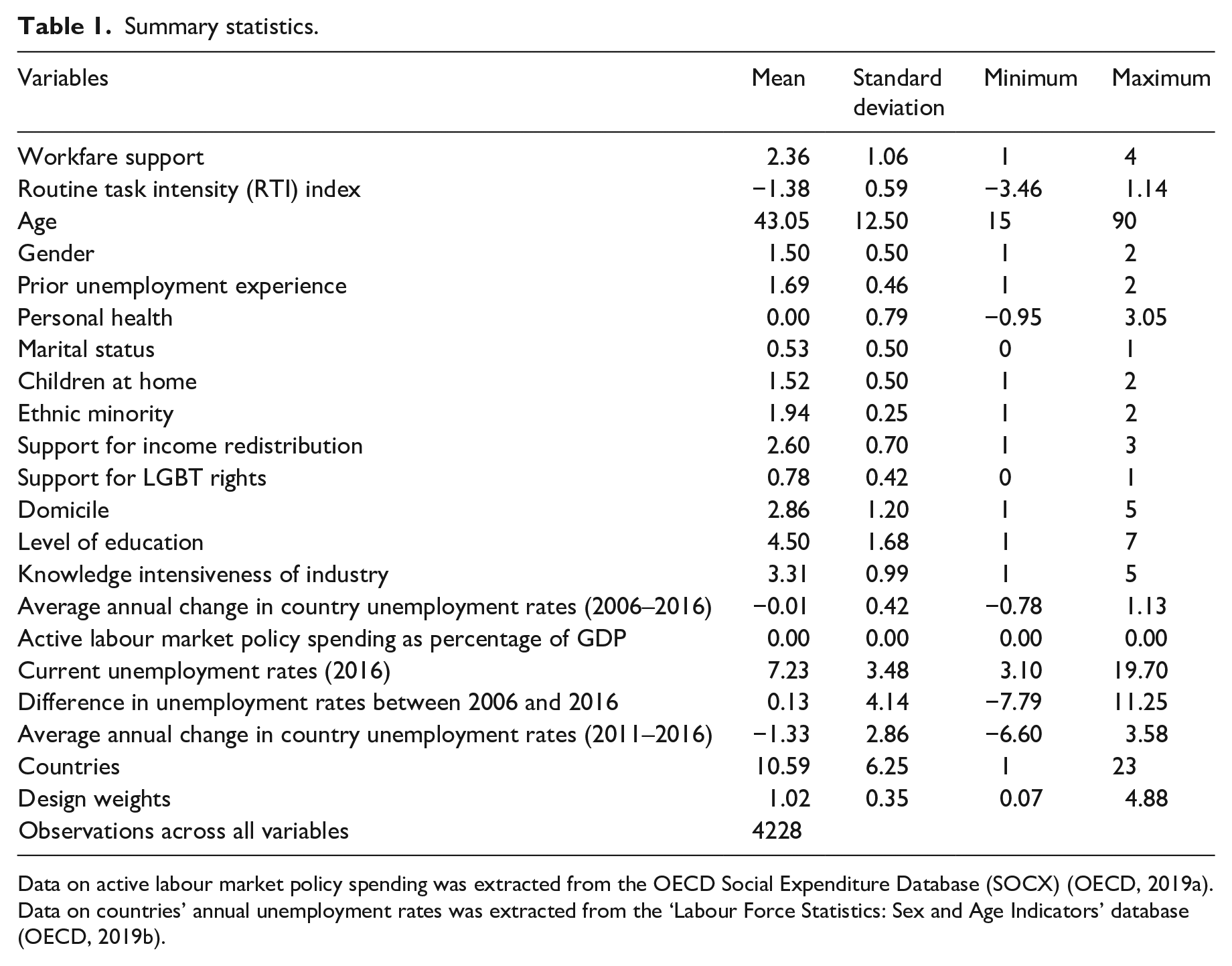
Data on active labour market policy spending was extracted from the OECD Social Expenditure Database (SOCX) (OECD, 2019a). Data on countries’ annual unemployment rates was extracted from the ‘Labour Force Statistics: Sex and Age Indicators’ database (OECD, 2019b).
Method
We conducted our analysis through two approaches. The first approach focuses on the individual-level impact of automation risk. We pooled observations from all countries into a single model and estimated the impact of automation risk using ordinary least squares (OLS) regression with design weights. Our approach follows recent studies which treat ordinal variables as continuous (Thewissen and Rueda, 2017). We controlled for country-related idiosyncrasies, such as labour market and social policy institutions, by applying country dummies. We proceeded our analysis in a stepwise manner. Our first model is an intercept-only model. We next added sociodemographic controls, and then added automation risk. Finally, we included respondents’ economic ideology and cultural conservatism to control for their impact on workfare support.
Our second approach focuses on how contextual factors influence the impact of automation risk on workfare support. We nested individuals within countries and employed multilevel models with random country intercepts and design weights. Our sample of 22 countries approaches Bryan and Jenkins’s (2016) recommended number of level-2 cases to obtain reliable OLS estimates from level-2 predictors. We proceeded our analysis in a stepwise manner. Our first model is an intercept-only model. We next added individual-level covariates, and then country-level covariates, and automation risk thereafter. Finally, we included a cross-level interaction term between automation risk and changes in unemployment rate.
Results
Table 2 provides descriptive statistics for automation risk and workfare support, and lists the average year-on-year change in unemployment rates across countries. The mean and standard deviation of automation risk is broadly similar across all countries. There is some variation in workfare support across countries: workers support it most in Slovenia and least in Israel. Finally, it is clear that Spain and Italy experienced rising unemployment rates, whereas Poland and Germany experienced declining unemployment rates over the period observed.
Summary of dependent and explanatory variables across countries.
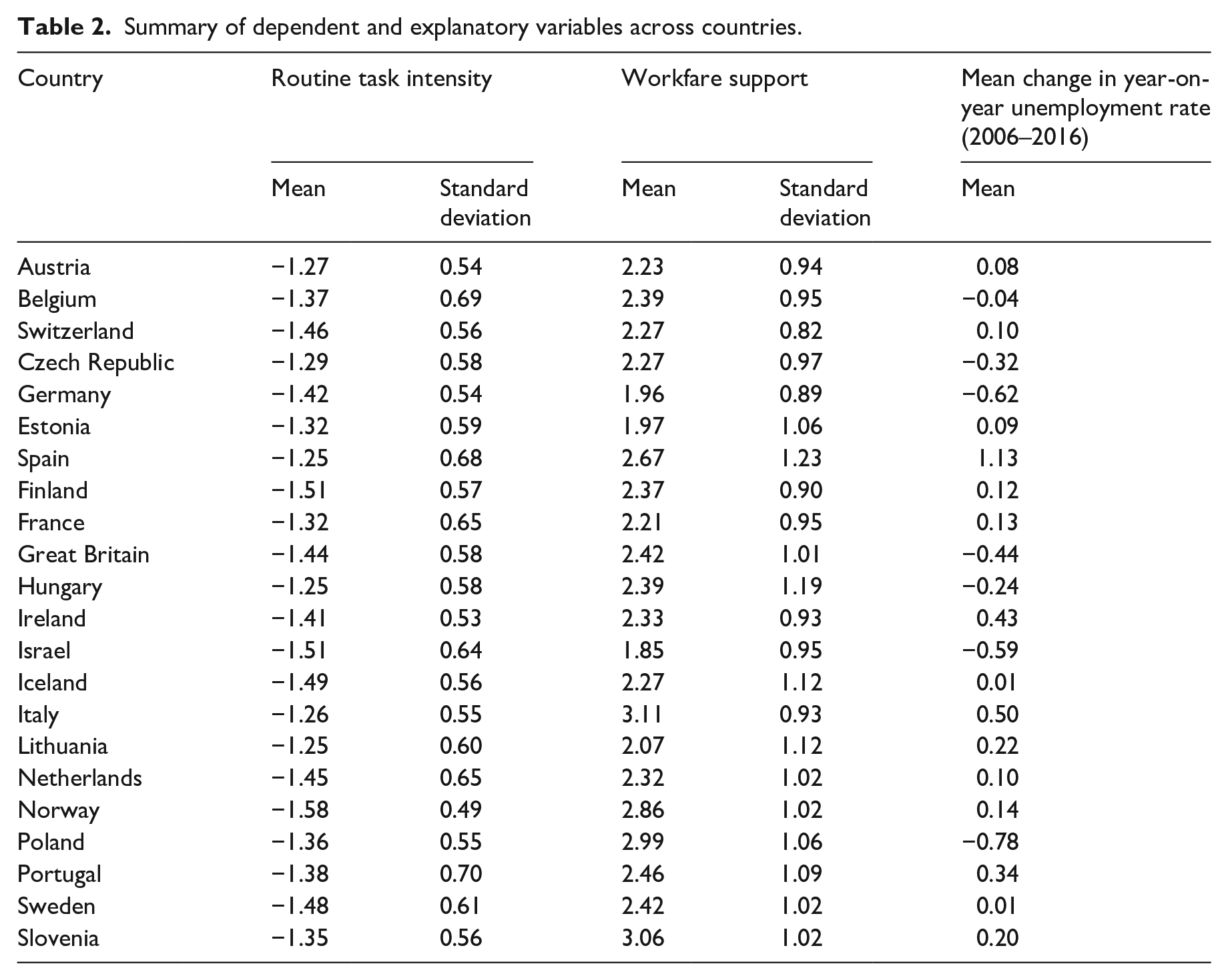
Our first set of analyses focus on the individual-level impact of automation risk (Table 3). Model 1 shows that the coefficient of the population is 2.23 and is significant: on average, respondents support small cuts to unemployed workers’ unemployment benefits when they refuse lower-paying jobs. Model 2 demonstrates that workers’ support for workfare is stratified by their gender, prior unemployment experience, ethnic minority status and domicile. These results echo findings from recent studies on individual-level determinants of workfare support (Fossati, 2018; Garritzmann et al., 2018). In Model 3, we find that automation risk (RTI) significantly increases workers’ support for workfare (p < 0.05). In Model 4, we find that automation risk (RTI) remains significant and positively associated with workfare after controlling respondents’ economic ideology and cultural conservatism.
Individual-level regression estimates.
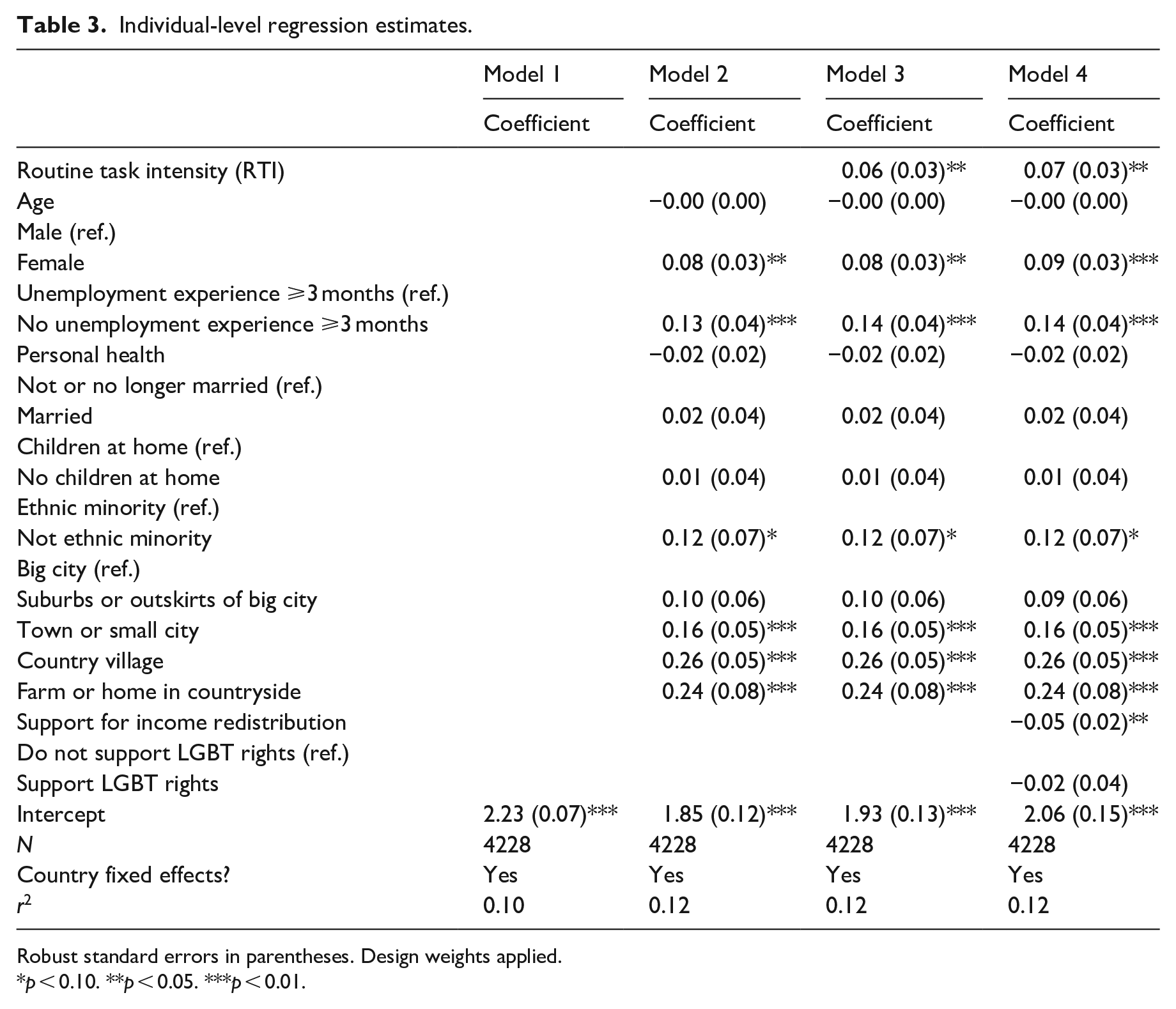
Robust standard errors in parentheses. Design weights applied.
p < 0.10. **p < 0.05. ***p < 0.01.
Our second set of analyses focus on contextual impacts (Table 4). The intraclass correlation across all models suggests that there is more variance to be explained at the individual than at the country level. In Model 1, the population intercept coefficient is 2.40 across all countries signifying that respondents support some workfare – cutting a small part of recipients’ unemployment benefits when they refuse lower-paying jobs. There is however significant variation across countries. Across countries, the mean standard deviation from the population intercept is 0.33 and is significant. In Model 2, we also find that gender, prior unemployment experience and domicile significantly affect workfare support. In Model 3, we find that the ALMP expenditure does not have a significant association. However, average change in year-on-year unemployment rate is positively and significant associated with workfare support: as unemployment rates climb, workfare support increases. In Model 4, we also find that RTI is significantly and positively correlated with workfare support (p < 0.05). Changes in unemployment rates remain significantly correlated with workfare support.
Country-level regression estimates.
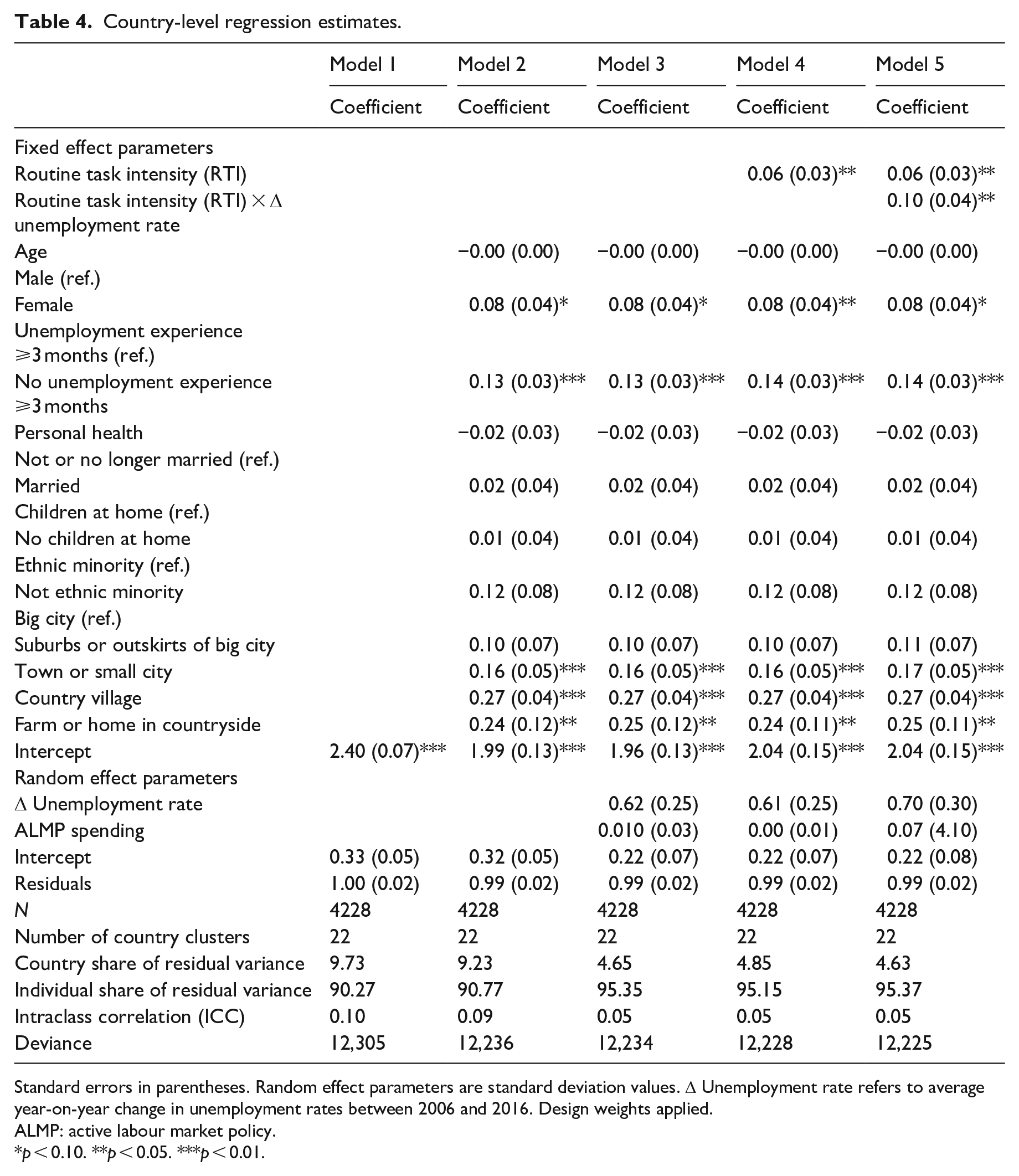
Standard errors in parentheses. Random effect parameters are standard deviation values. Δ Unemployment rate refers to average year-on-year change in unemployment rates between 2006 and 2016. Design weights applied.
ALMP: active labour market policy.
p < 0.10. **p < 0.05. ***p < 0.01.
In Model 5, the cross-level interaction term yields a significant and positive coefficient (p < 0.05) indicating that automation risk is correlated with higher workfare support when unemployment rates rise over time. We explore this conditional impact in Figure 1: automation risk and countries are displayed on the horizontal and vertical axes respectively. Countries are sorted by their rise in unemployment rates in descending order. Support for workfare policies is illustrated through two markers per country that show workers’ support for workfare at RTI’s minimum and maximum values.
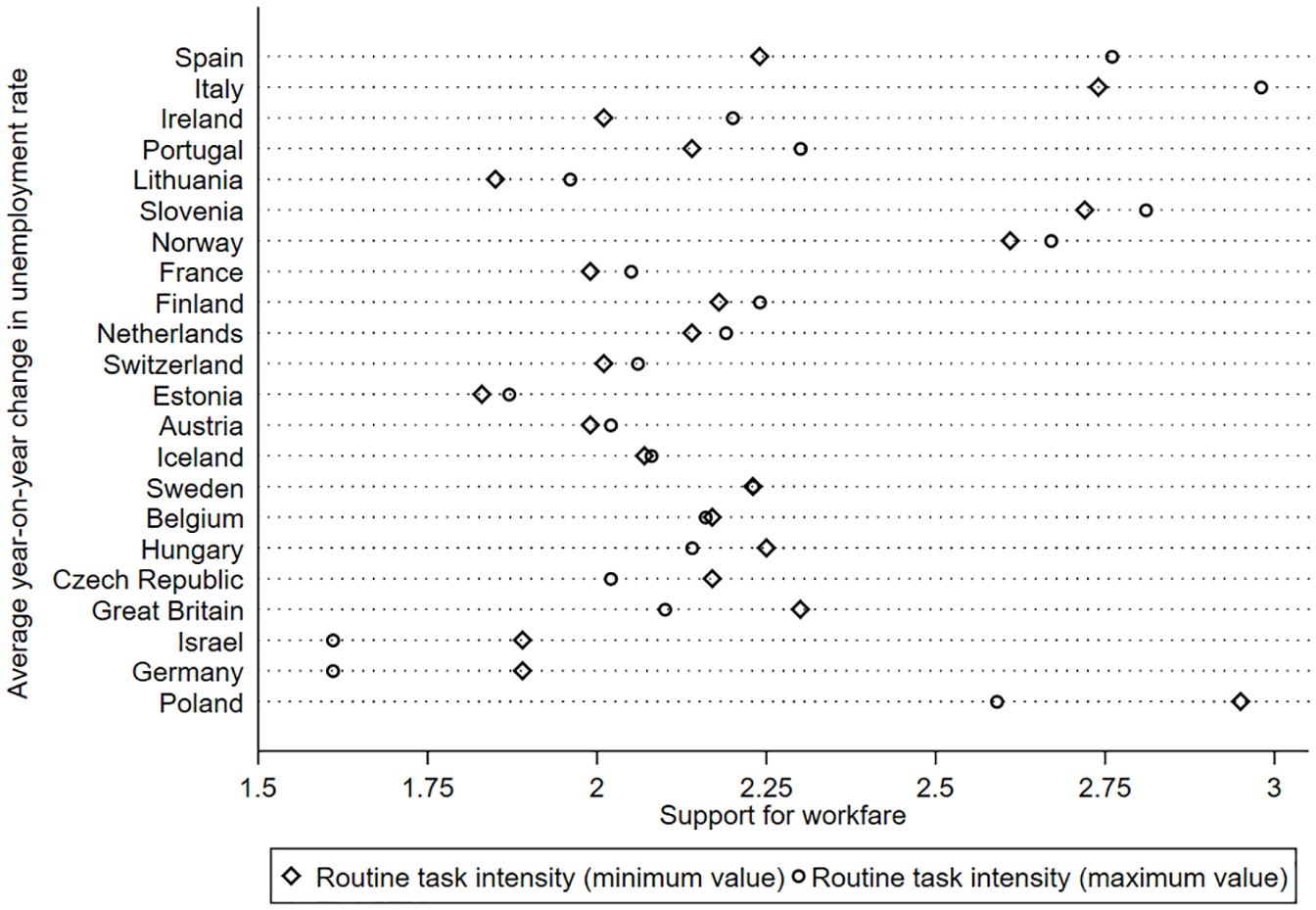
Predicted workfare support at minimum and maximum values of automation risk.
Respondents at RTI’s maximum value support workfare substantially more than respondents at RTI’s minimum value when unemployment rates have risen over time, as in Spain, Italy and Ireland. By contrast, respondents at RTI’s maximum value oppose workfare substantially more than respondents at RTI’s minimum value when unemployment rates have declined over time, as in Poland, Germany and Israel. Such differences are, however, insubstantial in countries with negligible changes in year-on-year unemployment rates. The difference between workers at the maximum and minimum values of RTI in Spain and Italy are 0.52 and 0.26 respectively, and the difference between workers at these same RTI values in Poland and Germany are 0.36 and 0.28 respectively. While these numbers might seem insubstantial, it is worth contextualising them vis-à-vis the dispersion on workfare support in these countries. When we divide these numbers by their respective countries’ standard deviation values on workfare, they translate to 42.4, 28.1, 33.9, and 31.5 percentage points in Spain, Italy, Poland and Germany respectively. In short, when most workers’ support for workfare falls within a narrow range between cutting a small part or half of unemployed workers’ unemployment benefits, the impact of RTI on workfare support may be considered substantial in countries with worsening or declining unemployment rates.
Robustness checks
Table 5 summarises results from our robustness checks. We first excluded Spain, which has the highest average rise in unemployment rates, from our single-level pooled model to assess if it drove our results. RTI remains significant and positively associated with workfare support.
Robustness checks.
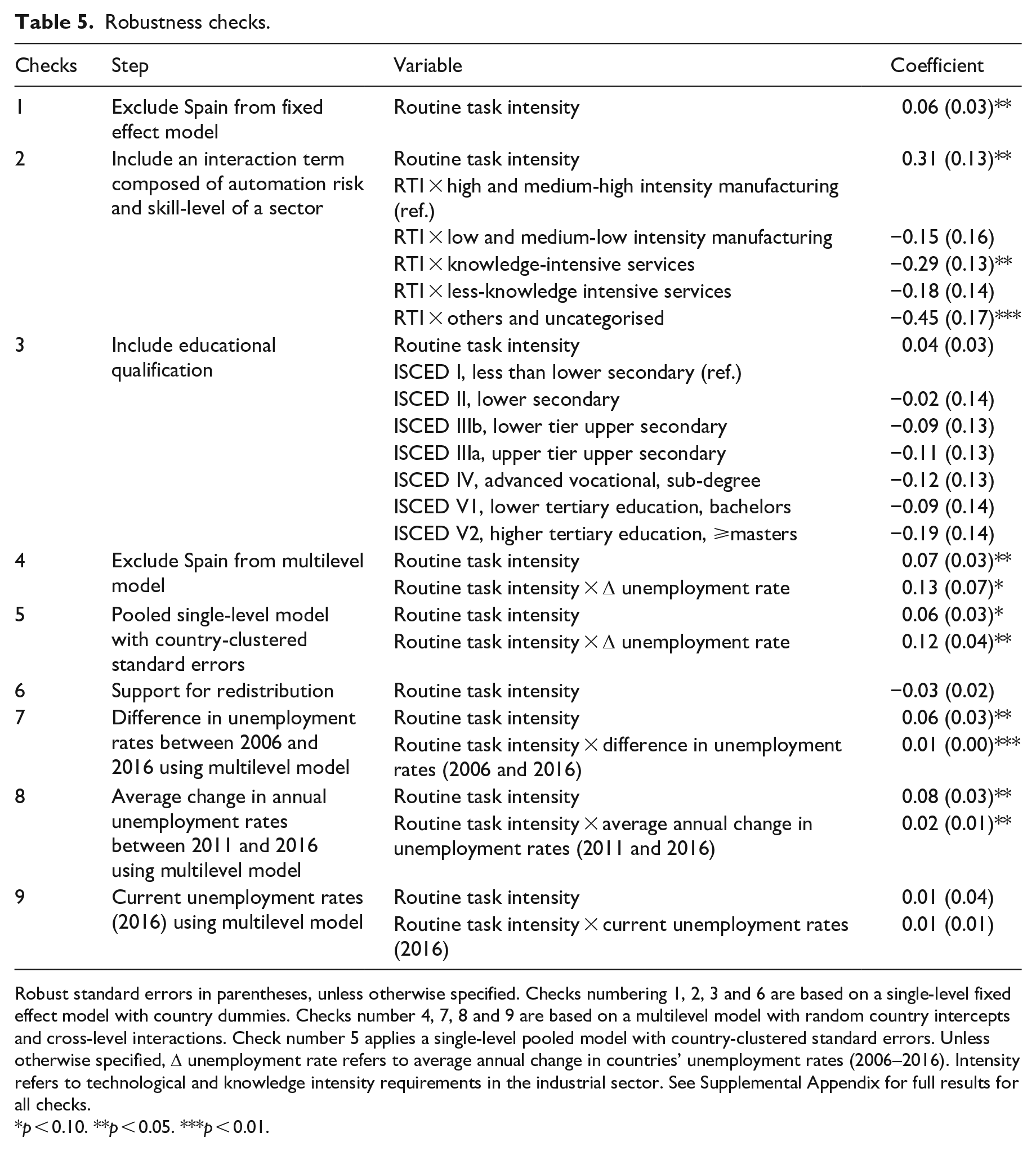
Robust standard errors in parentheses, unless otherwise specified. Checks numbering 1, 2, 3 and 6 are based on a single-level fixed effect model with country dummies. Checks number 4, 7, 8 and 9 are based on a multilevel model with random country intercepts and cross-level interactions. Check number 5 applies a single-level pooled model with country-clustered standard errors. Unless otherwise specified, Δ unemployment rate refers to average annual change in countries’ unemployment rates (2006–2016). Intensity refers to technological and knowledge intensity requirements in the industrial sector. See Supplemental Appendix for full results for all checks.
p < 0.10. **p < 0.05. ***p < 0.01.
Second, we examined if the impact of automation risk varies across sectors with different technological requirements. We classified sectors’ technological requirements using EUROSTAT’s (2016) classification of industries by their technological and knowledge intensity. Vis-à-vis workers employed in high and medium-high intensity manufacturing sectors, we find that the impact of automation risk is only significantly different for workers employed in knowledge-intensive services and in uncategorised (mining, waste collection, husbandry, construction) sectors. We find these results unsurprising if it is easier to automate tasks in manufacturing sectors and less knowledge-intensive services (Cirillo, 2018). By contrast, it may be more difficult to automate tasks in knowledge-intensive service sectors. Likewise, sectors in the uncategorised group contain physical tasks that may be difficult to automate.
Third, we assessed the impact of automation risk while controlling for workers’ educational qualifications. We find that education and automation risk are statistically insignificant. The impacts of education and automation risk may cancel each other out because these variables are correlated (r = 0.37). This correlation may relate to how education influences workers’ choice of occupations, which in turn affects their automation risk.
Fourth, we replicated Model 5 in Table 4 but excluded Spain. We find that the direct and conditional impacts of RTI remain significant. We also find similar results in our fifth check which re-estimated Model 5 in Table 4 as a single-level pooled model with robust country-clustered standard errors. These results increase our confidence in the estimates from our multilevel models.
Fifth, Model 6 finds that the association between RTI and support for redistribution does not achieve conventional levels of significance (p < 0.1) but the 90% confidence intervals clearly indicate that its estimated effect lies predominantly in the positive territory (−0.0002, 0.0600). We suspect that these weak results may relate to our smaller sample than the bigger samples used in these other studies. 7 It may also hint at routine workers being less aware of the extent of their economic risk, especially in the long-run, when only a minority experience unemployment (Kurer, 2020). Nevertheless, the coefficient direction suggests that higher RTI increases support for redistribution and echoes recent findings that routine workers may demand more redistribution to insure against potential economic risk arising from automation (Dermont and Weisstanner, 2020; Thewissen and Rueda, 2017). We discuss this finding in the section below vis-à-vis workfare support.
Last, we assessed if our contextual results are sensitive to other operationalisations of worsening economic hardship. Models 7 to 9 substituted average year-on-year change in unemployment rates between 2006 and 2016 for differences in countries’ 2006 and 2016 unemployment rates, average year-on-year change in unemployment rates between 2011 and 2016, and countries’ current (2016) unemployment rates respectively. The first two operationalisations yield similar results. The third operationalisation does not yield a result that approaches conventional levels of significance (p < 0.1). Nevertheless, the 90% confidence intervals suggest that its estimated effects lie predominantly in the positive territory (0.002, 0.015) and its coefficient direction is similar to our main results.
Discussion and conclusion
Although automation has disrupted labour markets (Fernández-Macías and Hurley, 2017; Goos et al., 2014), most routine workers ‘survive’ in their routine jobs thus far (Kurer, 2020; Kurer and Gallego, 2019). Despite not yielding economic threat in the form of unemployment, automation may still engender fears of social decline which then influence routine workers’ political response to automation. Recent studies on the political consequences of automation stress this point (Im et al., 2019; Kurer, 2020). We do the same and extend it to routine workers’ support for workfare. Studying workfare is relevant because they have become a cornerstone of governments’ social policy toolkit (Bengtsson et al., 2017), despite their divisiveness among the public (Fossati, 2018).
Routine workers who fear status decline may seek to distinguish themselves from groups that they view to be below them (Kuziemko et al., 2014; Lamont, 2000). They may then adopt harsh views against the unemployed which increase their propensity to support stringent conditions and sanctions on the unemployed. We find that routine workers do support workfare. We interpret it as routine workers paying more attention to their status worries than their economic concerns, which motivates their support for workfare. We thus fail to reject Hypothesis 1.
Results from our contextual analyses, however, highlight a more nuanced association. We hypothesised that worsening economic hardship over the long-run may aggravate routine workers’ fears of status decline and compel them to draw sharper boundaries against unemployed workers, which may then increase support workfare. We find that routine workers do support workfare more than non-routine workers when economic hardship has worsened, and the reverse when economic hardship has diminished. We thus cannot reject Hypothesis 2.
These findings appear consistent with those from recent findings about the political consequences of extended economic hardship. Worsening economic hardship may engender feelings of marginalisation and status concerns which then drive political responses such as opposition to immigration and minorities, anti-elite sentiments, party choice (Anelli et al., 2019; Ballard-Rosa et al., 2020; Bromley-Davenport et al., 2018), and support for workfare. Our finding may help explain why individuals in economically-decaying areas paradoxically support harsh welfare policies such as workfare that may not be in their interest (Hochschild, 2016). We think that their status concerns motivates such support.
Overall, our findings suggest that public support for workfare might be motivated by multiple concerns of which the actual costs/benefits of workfare are only one of them. These findings resonate with studies suggesting that individuals’ support for different types of social policies – passive transfers, social investment and workfare – may be motivated by different mix of concerns (e.g. Garritzmann et al., 2018). We concur with conventional risk insurance theories that redistribution support is motivated by individuals’ economic concerns (Dermont and Weisstanner, 2020; Iversen and Soskice, 2001; Rehm, 2009; Thewissen and Rueda, 2017). However, we contend that workfare support is motivated by a mix of both status and economic concerns. Specifically, we think that because status and economic concerns may motivate diverging views on workfare, individuals’ support for workfare depends ultimately on whether their economic or status concerns are more dominant on balance. For automation, most routine workers may find economic concerns less salient than status ones because they manage to avoid unemployment (Kurer, 2020). They may hence support workfare because they prioritise their status concerns. We thus reiterate that we do not discount the relevance of conventional risk insurance theories in explaining workfare support. Rather we highlight that there may be other competing concerns. And for automation, they may have greater salience in motivating workfare support. This argument should come as unsurprising: Häusermann and Kriesi (2015) underscore that individuals’ support for social policies is influenced by their position on non-economic issues.
Our findings suggest that social policies that compensate for labour market disadvantage alone may not alleviate status worries experienced by automation-vulnerable workers (Gingrich, 2019). Instead, policies that help retain dignity and status previously conferred by routine jobs may better avert the political fallout from automation (Im et al., 2019).
Finally, we focused here on support for workfare targeting unemployed workers who refuse lower-wage jobs. Future studies could assess the impact of automation threat on other workfare policies and other branches of social policies, especially enabling labour market policies which help governments address changing labour demands by upskilling their workforce. Furthermore, future studies could exploit panel data to assess if workers’ workfare support varies with their employment status. Additionally, future studies could test if automation indices that are calculated from non-US labour data and from different periods yield similar findings. Lastly, future studies could focus on local economic hardship.
Supplemental Material
sj-pdf-1-esp-10.1177_09589287211002432 – Supplemental material for Automation and public support for workfare
Supplemental material, sj-pdf-1-esp-10.1177_09589287211002432 for Automation and public support for workfare by Zhen Jie Im and Kathrin Komp-Leukkunen in Journal of European Social Policy
Footnotes
Acknowledgements
We would like to thank Erica Owen and Noel Johnston for generously sharing their data. We also thank Anne Kouvonen, Heikki Hiilamo, Jo Abbas and two anonymous referees for their helpful comments on earlier drafts of this article. We also acknowledge the Jos Berghman Welfare Studies stipend provided by the Centre for Sociological Research at KU Leuven.
Funding
The authors disclosed receipt of the following financial support for the research, authorship and/or publication of this article: This work has been funded by the Strategic Research Council at the Academy of Finland. Number of grant: 312710.
Supplemental material
Supplemental material for this article is available online.
Notes
References
Supplementary Material
Please find the following supplemental material available below.
For Open Access articles published under a Creative Commons License, all supplemental material carries the same license as the article it is associated with.
For non-Open Access articles published, all supplemental material carries a non-exclusive license, and permission requests for re-use of supplemental material or any part of supplemental material shall be sent directly to the copyright owner as specified in the copyright notice associated with the article.
