




Abstract
The aim of the article is to examine if and how the welfare state regime typology translates into a violence regime typology in a European context. It builds on the concept of violence regimes (Strid et al. 2017; Hearn et al. 2020) to empirically examine whether the production of interpersonal violence constitutes distinct regimes, and how these correspond (or not) with welfare regimes, gender regimes, and with other comparative metrics on violence, gender equality and feminist mobilisation and transnational actors. Its main contribution is to operationalise the concept of violence regimes, thereby moving from theory to a first empirical measurement. By first constructing a new composite measure of violence, a Violence Regimes Index, based on secondary administrative and survey data covering the then 28 EU member states, countries are clustered along two axes of violence: ‘deadly’ violence and ‘damaging’ gender-based violence. This serves to examine if, and how, the production of gendered violence in different states constitutes distinct regimes, analogous to welfare state regimes, as well as to enable future research and further comparisons and contrasts, specifically related to violence and the welfare state. By providing an empirical measurement of violence regimes in the EU, the article then contributes further to the debates on welfare, welfare regimes, and violence. It specifically contributes with discussions on the extent to which there are different violence regimes, comparable to welfare regimes, and with discussions on the relevance of moving from thinking about violence as an institution within other inequality regimes, to thinking about violence as a macro-regime, a way of governing and ruling in its own right. The article concludes that the exclusion of violence from mainstream social theory and research has produced results that may not be valid, and offers an alternative classification using the concept of violence regimes, thereby demonstrating the usefulness of the concept.
Introduction
This article starts from two simple assumptions: violence matters, and violence is gendered. Yet, mainstream social sciences have often either avoided it or underestimated its importance (Hearn, 2013; McKie, 2006; Ray, 2011; Walby, 2009). The perspective of violence has been left unaddressed within the well-developed literature on welfare state regimes, even though the field has been successfully shaped by feminist critiques that yielded insights into gender (welfare) regimes. This article thus argues that any further development of the concept of welfare state regime must incorporate violence, to paraphrase Lewis’s (1992) 30-year-old statement in this journal. Our focus on violence is a holistic one, where we consider all forms of interpersonal violence, often with deadly consequences, but also, the more specific gender-based expressions of violence with damaging effects on society (and women on the whole) as manifestations of unequal power relations. The article is the result of a collaborative research project on violence regimes (Strid et al. 2017) and develops our previous work on the concept of violence regimes (Hearn et al. 2020), by providing new empirical data and analyses. While our previous work developed the theoretical argument, this article develops a new Violence Regimes Index (VR-index) and compares it with a series of other indexes and unique data to empirically examine whether the production of interpersonal violence constitutes distinct regimes, and how these correspond with welfare regimes, gender regimes, and with other comparative metrics on violence, gender equality and feminist mobilisation.
Welfare state regimes research, with a long history in comparative social policy research (Esping-Andersen, 1990; Therborn, 1983; Titmuss, 1963; Wilensky, 1975), including that on gender welfare regimes (for example, Duncan, 1995, 2002; Lewis, 1992; Sainsbury, 1999), indicated that some welfare regimes were more women-friendly than others. Women-friendliness, a contested concept originally used by Hernes (1987), views the women-friendly welfare state as an instrument for the empowerment of women as citizens, workers and mothers. Critics of the concept of the women-friendly welfare state suggested reformulation and contextualisation with gender equality as the key notion, focusing on which social policies to be considered women-friendly, and for which women (Borschorst and Siim, 2002; Sainsbury, 2006). The vast feminist scholarship on gendered violence has challenged conventional understandings of the welfare state and women’s relationship to it (e.g. Elman, 1996; MacKinnon, 1989; Weldon, 2002), including for example the relationship between feminist mobilisation and progressive policy on gender-based violence (Htun and Weldon, 2012). However, the empirical bases on which welfare regimes typologies build on classifying and theorising the women-friendly welfare state regimes continue to exclude violence. Welfare state regimes research, producing one of the most influential typologies of welfare states, has thereby overlooked one of the most substantial, deep-rooted causes and consequences of gender inequalities.
The purpose of this article is exploratory: to conceptually and empirically examine if and how the welfare state regimes typology translates into a violence regimes typology. The article develops the concept and framework of violence regimes to examine whether the production of interpersonal violence constitutes distinct regimes, how these correspond (or not) with welfare regimes, gender regimes, and with other comparative metrics on violence (EIGE, 2017), gender equality (EIGE, 2013, 2019) and feminist mobilisation and transnational actors (Htun and Weldon, 2012; Weldon, 2002). By first constructing a new composite measure of violence, VR-index, we cluster countries along two pillars of violence: ‘deadly’ and ‘damaging’ violence (Hearn et al., 2020). We then expand on these clusters to develop the concept and framework of violence regimes. This serves to examine if and how the production of gendered violence in different states constitutes distinct regimes, analogous to welfare state regimes, as well as to enable future research and further comparisons and contrasts, specifically related to violence and the welfare state.
The article contributes to the debates on welfare, welfare regimes, and violence. It specifically contributes with discussions on the extent to which there are different violence regimes, comparable to welfare regimes and gender welfare regimes, and with discussions on the relevance of moving from thinking about violence as an institution within other inequality regimes, to thinking about violence as a macro-regime, a way of governing and ruling in its own right, and as a form of inequality (Hearn, 2013; MacKinnon, 1989). We thereby explore what happens when violence, rather than social stratification, class or gender, is placed centre-stage (Hearn, 2013; Hearn et al., 2020). Theoretically, this approach concerns the ontology of violence and questions whether violence is always to be explained by something else, such as for example social exclusion, minoritisation, dysfunctional families or individual pathologies. Put differently, the issue is the level of autonomy of the violence regime – or, in other words, how autotelic violence is (Schinkel, 2010).
In the following paragraphs, we first revisit the welfare state regimes and the gender regimes literature, typologies and indicators, as developed by Esping-Andersen and feminist critics. We then engage with some of the broader feminist critiques of the welfare state, in particular those addressing violence. We then draw on empirical data to build the VR-index and use these results to derive a violence regimes typology based on country clusters along the two pillars of the VR-index (‘deadly’ and ‘damaging’ violence). Although this empirical measurement is not without its limitations since it summarizes the complexity of violence into a single number, we nevertheless regard it as a useful tool to conduct further analysis and understand how the autotelic nature of violence relates to other regimes. We use this emerging typology to discuss and contrast different types of violence regimes to existing typologies of welfare and gender regimes. We also examine the VR-index in relation to other composite indicators measuring related aspects, such as feminist mobilisation, gender equality and violence against women. Finally, we discuss what appears to be a number of problems with the implications of the women-friendliness of the welfare state regimes paradigm, some of which are related to the tension between women-friendly countries such as Sweden, but which yet have high levels of disclosed violence against women, the so-called Nordic Paradox (Gracia and Merlo, 2016; Humbert et al., 2021; Wemrell et al. 2019). We conclude by arguing for a broad, multi-level and multi-pillar understanding of violence and empirical measurement that can be used to provide alternative typologies that incorporate violence, and alternative understandings of policy development, both now and in future research.
Welfare state regimes and gender regimes
For three decades, the debate on comparative welfare state research has been dominated by the threefold typology developed by Esping-Andersen (1990) and the avalanche of welfare regimes studies which followed (Hudson, 2018). Esping-Andersen connected the class origins of welfare regimes, their distinctive modes of provision and their consequences for social and economic inequality, and built a decommodification index based on unemployment, sickness and pensions in 18 OECD countries. This work took the debate further by suggesting that welfare is more than services and transfers, and by arguing that the distinct patterns of welfare/social provision co-varied with distinctive labour market formations. Arriving at a Weberian ideal-model typology of welfare, he identified three distinct regimes of welfare production: Liberal UK, conservative Germany, and social-democratic Sweden, which typified the ideal models of each welfare state category.
Critics argued that Esping-Andersen did not take his framework far enough; his sample was too narrow and excluded the Mediterranean (Ferrera, 1996) and East Asian welfare states (Goodman and Peng, 1996) and he failed to consider healthcare and other social policies (Bambra, 2005). Nonetheless, as Ebbinghaus (2012) shows, the alternative models of welfare states delivered consistent results in terms of the typology: in alternative models by for example Bonoli (1997), Castles and Mitchell (1993), Esping-Andersen (1999), Ferrera (1996), Korpi (2000), and Korpi and Palme (1998), Sweden remains a social democratic welfare regime, Germany conservative and the UK liberal, although there are two exceptions in the case of the UK (Bambra, 2005; Castles and Mitchell, 1993).
In gendering the welfare state regimes typology, the focus shifted towards the family, unpaid work and care (Lewis, 1992; O’Connor et al., 1999; Orloff, 1993, 1996; Sainsbury, 1999), and to defamilisation and women’s dependency on the welfare state, in turn drawing on feminist work on private and public patriarchies (Siim, 1987). Lewis (1992) proposed a typology based on unpaid and paid work, measuring the proximity to the male breadwinner model. Sainsbury (1996) developed an analysis based on two contrasting ideal types – the male breadwinner model and the individual model – and examined comparative variations around familial ideology, entitlement, benefits, taxation, employment and wage policies, and the organisation of care-work (Sainsbury, 1996). O’Connor et al. (1999) included three policy areas affecting gender relations: the labour market, income maintenance, and the regulation of reproduction. These different analyses showed alternative classifications to that of the original welfare state typology (see Supplemental Annex 1).
Feminist critics concluded that a wider range of issues needed to be included in the theorisation of gender regimes. They showed how women and policies ostensibly adopted for their benefit, have long been used to diminish labour shortages, increase production, or cheapen the costs of doing business – often in ways that tell us little about the state’s position on women per se (Elman, 1996; Hirdman, 1994). Moreover, feminist scholars interrogated the oft-repeated claim that women, not men, are more dependent on the state by questioning how one measures dependency and defines welfare (e.g. Pateman, 1988). More recent developments have criticised the welfare state regimes typology for neglecting diversity, migration (Sainsbury, 2006) and intersectionality, not least ‘race’ and intersectional relations (Dahlstedt and Neergaard, 2019; Siim and Borchorst, 2017). This literature proposes to rethink both gender and welfare regimes using an intersectional approach to analyse the interrelations between different forms of inequalities. A possible lack of correspondence is observable with gender/ethnicity/multiculturalism, anti-racist policy/practice, migration regimes, bodily integrity – what Pringle (2011) called ‘turning Esping-Andersen on his head’ (also see Balkmar et al., 2009; Sainsbury, 2006). But in doing so, critics have overall failed (a) to engage with violence, as a form of inequality in its own right, and (b) to consider what could be learnt from placing violence centre stage and looking instead at violence as a regime.
Violence and violence regimes
Feminist research on violence and the state has a long tradition (Elman, 1996; Hearn, 1998; MacKinnon, 1989; Walby, 1986), challenging our understandings of the welfare state and women’s relationship to it. One of the more explicit approaches is MacKinnon’s (1989), who argues that the state itself is patriarchal through male dominance and violence. Nonetheless, violence is not as yet fully addressed by mainstream social theory, with the role of violence as a source of social stratification within and between welfare states underexplored. The consequences, when considering welfare responses to gendered violence are, first, that one might miss greater differences between the same welfare regimes and gender regimes than commonly assumed (Lister, 2009; Pringle, 2005), and second, that those welfare regimes deemed women-friendly may not turn out to be women-friendly at all.
Our approach to violence is violence as a regime, where violence is approached holistically on inter-personal/micro (e.g. murder, sexual assault), intra-state/meso (e.g. death penalty) and inter-state/macro (e.g. war) levels. This addresses the fragmentation of the study of violence into sub-disciplines, which has led to an under-theorising of violence (Lundgren, 2014; Walby, 2013). Violence regimes is a new concept developed to set up a theoretical framework by which states/societies can be compared and contrasted according to how violent they are, how much violence they produce at micro, meso and macro levels (Hearn et al., 2020; Strid et al., 2017, 2019). The concept violence regimes is however not entirely new. Drawing on Weber’s understanding of the modern state, Kössler (2003) uses regimes of violence to discuss the state’s monopoly on the legitimate use of violence after 9/11. Later, Schinkel (2013) introduces the idea of a regime of violence to describe the relation between various forms of violence. This is useful, but different from the way violence regimes is developed here, namely as a framework for comparative state analysis and as a form in which states themselves are constituted, as the theorising (and ultimately empirical operationalisation) of autotelic violence. More relevant for this article is an approach to violence that considers the co-variance and interrelations between different forms of violence and shows how many forms of violence are inter-related. These links, the interconnectedness of different forms of (autotelic) violence, can then be used to derive different systems of violence, using violence regimes. This use of regime is analogous to Esping-Andersen’s who used regime to draw attention to ‘the complex ways in which welfare states [. . .] can both reshape and reproduce inequalities’ (Hudson, 2018: 48).
The approach to violence regimes forces us to outline what is to be meant by violence, and related concepts. The problem of what violence is, or could be, pervades these discussions. We see violence as a form of inequality, beyond the mere physical and measurable (Hearn et al., 2020; cf. Walby et al., 2017). This approach concerns the ontology of violence and questions whether violence is always to be explained by something else, for example, as social exclusion, economic marginalisation or individual pathologies. Violence can be more or less direct and indirect, with variations in both manifestation and understanding, across multiple pillars moving from direct and deadly violence, such as homicide, femicide, suicide; to broader conceptions of direct and damaging violence, such as recorded assault, intimate partner violence and stalking. Understandings of violence can take even broader forms (Demmers, 2016; Žižek, 2008). However, for the scope of the operationalisation into violence regimes, forms of interpersonal violence categorized as damaging and deadly, are included in this article.
Methods and materials
We operationalize a measurement of violence using a composite indicator. The VR-index is informed by a conceptual framework, developed in Hearn et al. (2020), which distinguishes between different forms of violence (see Supplemental Annex 2). These forms of violence have been loosely placed in a typology which distinguishes between more direct forms of violence, itself subdivided into deadly and damaging forms, and indirect forms which could be diffused and dispersed. In doing so, we can move across a spectrum that moves from violence, violations, their underpinnings and what has yet to be considered as forms of violence such as environmental and slow violence. Empirically, as part of a wider project on contemporary violence regimes (Strid et al., 2017), a database of possible indicators has been developed. This database includes indicators for EU Member States, drawing on a range of sources such as Eurostat or the European Union Agency for Fundamental Rights (FRA), and used to create a measurement framework for the first two pillars of the typology. The latter two pillars are currently left largely unmeasured due to lack of comparable and available data.
First, direct and deadly interpersonal violence is measured as: (1) Intentional homicide rate 2016 – Women; (2) Intentional homicide rate 2016 – Men; (3) Suicide rate (per 100,000) 2015 – Women; (4) Suicide rate (per 100,000) 2015 – Men. All four indicators are available from the online Eurostat database (https://ec.europa.eu/eurostat/data/database). Second, direct and damaging interpersonal violence is measured as: (5) Physical violence by a partner since the age of 15 among women 2012; (6) Sexual violence by a partner since the age of 15 among women 2012; (7) Physical violence by a non-partner since the age of 15 among women 2012; and (8) Sexual violence by a non-partner since the age of 15 among women 2012. These four indicators are available from the FRA (https://fra.europa.eu/en/publications-and-resources/data-and-maps/survey-data-explorer-violence-against-women-survey?mdq1=dataset) (see Table 1).
Indicators used in the violence regime index.
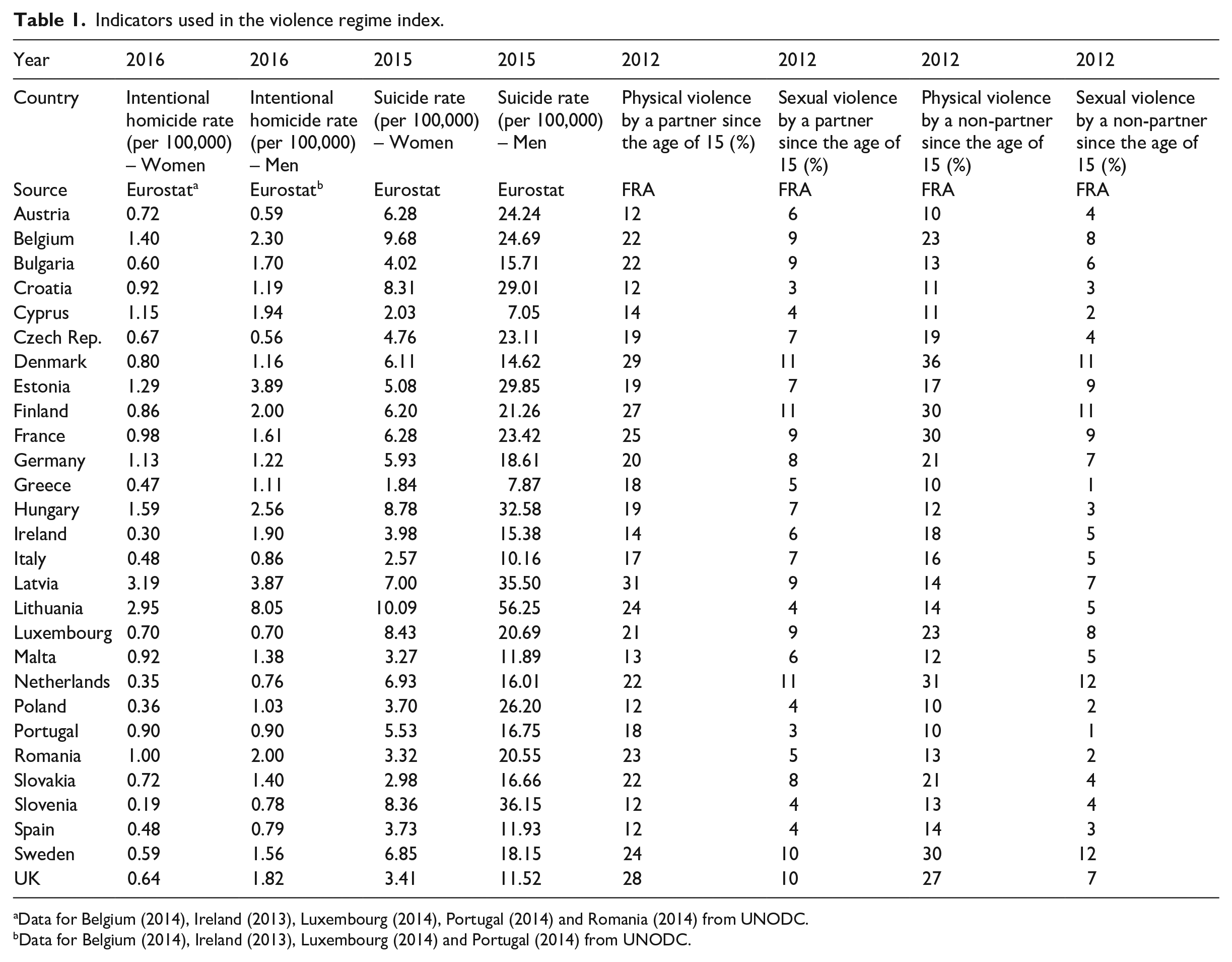
Data for Belgium (2014), Ireland (2013), Luxembourg (2014), Portugal (2014) and Romania (2014) from UNODC.
Data for Belgium (2014), Ireland (2013), Luxembourg (2014) and Portugal (2014) from UNODC.
The choice of indicators is motivated by considerations around validity and data quality. By relying on official sources such as Eurostat and FRA, it is reasonable to assume that comparisons between countries can be made. The first four indicators, on homicide and suicide rates, are likely to have high validity as they represent events that are perceived as serious, and thus recorded, and with limited room for subjective interpretation (Gove et al., 1985). However, the indicators made available by FRA have been questioned. The development of the survey questionnaire followed the strictest methodological criteria and was the result of a comprehensive consultation process with experts in data collection and analysis on the topic of violence against women. The questionnaire also referred to concrete descriptions of acts of violence rather than terms such as ‘violence’ or ‘rape’, to ensure that women did not respond according to preconceived ideas of incidents and/or perpetrators involved. The aim of this approach, as also adopted by other national and international surveys on violence against women, is to make responses more comparable (FRA (EU Agency for Fundamental Rights), 2014a, 2014b). Nonetheless, the results of the FRA survey have been the subject of debate since they point to a so-called ‘Nordic Paradox’: higher reported violence against women in countries that are identified as more gender equal, such as Sweden (Gracia and Merlo, 2016; Humbert et al., 2021; Wemrell et al., 2019). The contestation relates to if and how physical and sexual violence by a partner, and some measurements thereof, might increase in contexts with advanced gender equality legislation, and women’s growing independence, education, and visibility in the public sphere, such as is the case in the Nordic countries. Research has suggested that there is relative measurement invariance, that is, supporting comparison across countries (Gracia et al., 2019), while others have shown how this effect is related to other factors such as knowing victims of violence among friends or colleagues, or perceptions of how common violence is in the country of residence (Humbert et al., 2021).
The construction of the VR-index follows established methodological international conventions established by the OECD and the European Commission’s Joint Research Centre (Nardo et al., 2005). Indicators are rescaled between 0 and 1 using a min–max procedure, and subsequently aggregated into their respective pillars using equal weighting and an arithmetic average. Once a score for the two pillars is obtained, these are aggregated also using equal weighting and an arithmetic average. This method, while in appearance simple, makes it necessary to acknowledge that equal weighting is not a neutral decision and that the choice of using an arithmetic average allows for full compensation between indicators. Other alternatives that can affect the composite measure, such as using a geometric mean (i.e. limiting the extent to which different forms of violence could compensate each other) produced similar results and are available upon request. The development phase was complemented by rigorous checks on the integrity of the statistical structure of the composite measures following the recommendation of the European Commission’s Joint Research Centre (these results are available in the Supplemental Annex 3). This is even more important given that composite indicators summarize complex quantitative information which, despite the criticisms describing them as ‘black boxes’, can be understood as meaningful in that quantitative information can be ‘just another terrain of argumentation [. . .] just another modality of the truth regimes’ (Walby et al., 2017: 11). Indicators for welfare regimes, gender regimes, and violence regimes can be compared and show which regimes coincide and to what extent. These comparisons help in evaluating the case for thinking in terms of violence regime. Thus, we are not arguing here for violence as a domain next to, or alongside, other domains, but rather seeing and operationalising violence as inequality, alongside other existing regimes of inequalities, such as gender, ethnicity and racialisation (Walby, 2009). The VR-index is then used to map countries into different clusters. To this end, Tableau (version 2019.1) is used to carry out a k-means cluster analysis and to provide visualisations of our results. This allows us to compare the results against that of the typologies of welfare state regimes (Esping-Andersen, 1990) and gender regimes (Lewis, 1992; Sainsbury, 1999).
Due to the chosen quantitative methodology, there are important limitations to consider. First, violence is measured via output variables, not input variables, and subsequently does not examine institutional aspects of violence production. Adding these types of variables might produce alternative accounts. Second, due to the chosen quantitative methodology and the operationalisation, the empirical analyses can only address interpersonal violence, which leaves out the role of perpetrators, actors, and causes (of different forms of violence). Instead, in keeping with feminist violence studies, the focus is on seeing violence, not explaining it or its perpetration (Westerstrand, 2010). Third, the FRA indicators used are based on disclosed levels of violence, which may differ from actual levels of violence. To mitigate this, we have also used indicators on homicide and suicide. Fourth, as cluster analysis requires quantitative indicators, qualitative measures that may have been able to capture relevant aspects of institutional arrangements could not be included in the analysis. The resulting violence regimes are therefore unable to reflect such institutional matters. Subsequently, caution should be applied to the results and their interpretation. Lastly, cluster analysis and other statistical techniques of regimes construction could be viewed as overly quantifying to the detriment of the more qualitative and theoretical aspects of typology construction. These results should therefore not be seen as definite, but instead as a point of departure for generating insights and theorising violence comparatively.
Deadly and damaging violence regimes
The scores of the violence regimes overall in the two pillars of deadly and damaging violence are provided in Annex 4. The scores of the VR-index vary from 0.09 in Greece to 0.64 and 0.65 in Latvia and Lithuania respectively. This represents a range of 0.56, which is used to categorize countries into a weak violence regime (0.09–0.28); a moderate violence regime (0.29–0.47); and a strong violence regime (0.48–0.65) (Figure 1).
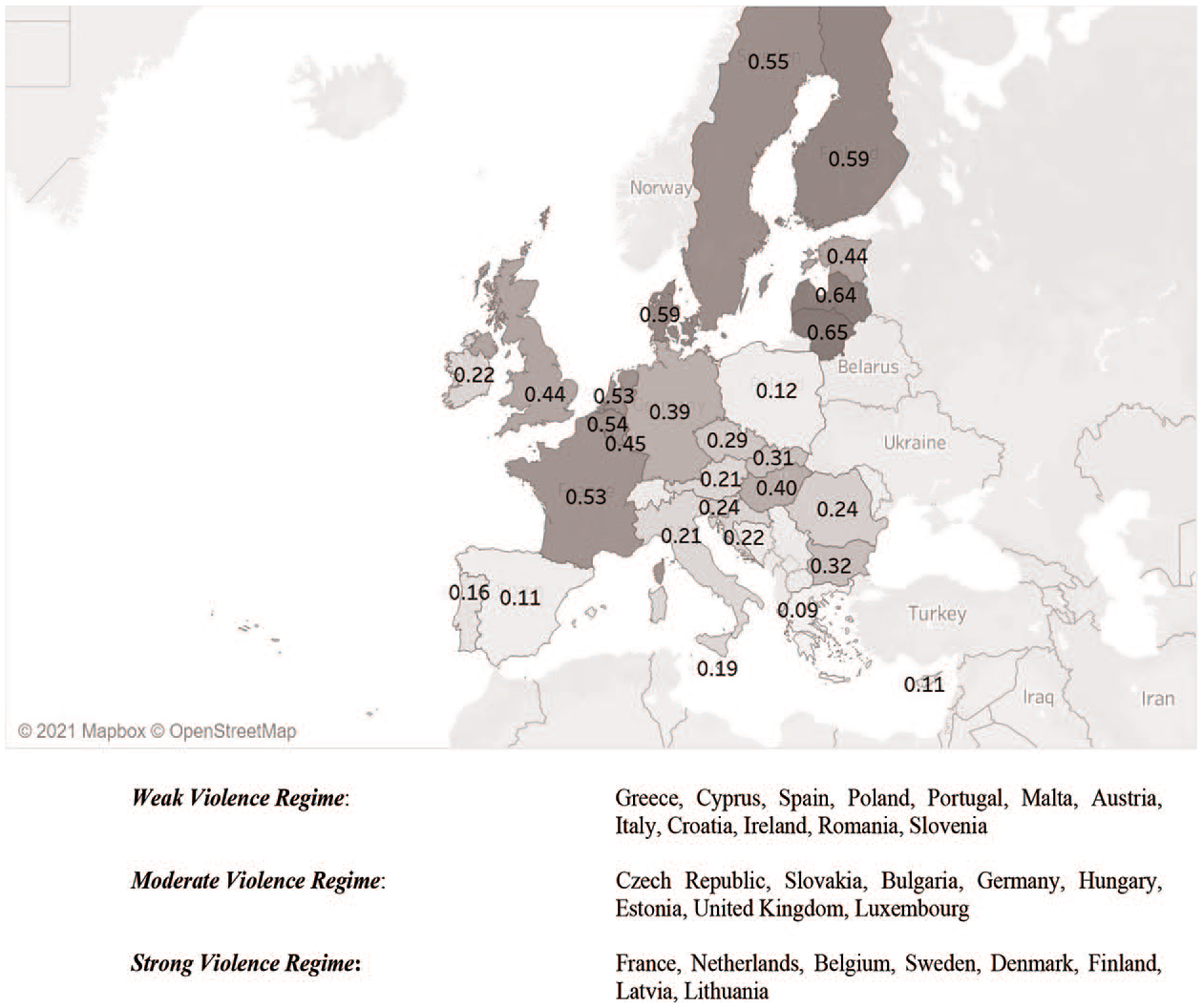
VR-index scores in the EU.
An interesting feature of the VR-index is that it shows that, although ‘deadly’ forms of violence and gender-based violence are related, as evidenced by the strong correlation both pillars have with the overall index (see Supplemental Annex 3), they nonetheless operate independently and can be allocated to two distinct components. This might reflect issues in measuring gender-based violence and prevalence surveys more specifically (see, e.g. Walby and Olive, 2014), or might reflect an actual ontological difference in these forms of violence. In any case, the positive correlation between the two pillars confirms the autotelic nature of these forms of violence.
Scores for the deadly violence pillar vary from 0.05 to 0.07 in Greece and Italy respectively, to 0.98 in Lithuania. This represents a much wider range than the overall VR-index. This is used to categorize countries into a weak deadly violence regime (0.05–0.36); a moderate deadly violence regime (0.37–0.65); and a strong deadly violence regime (0.66–0.98). This shows that deadly violence is comparatively much higher in just a minority of countries in the Baltic area (Figure 2).
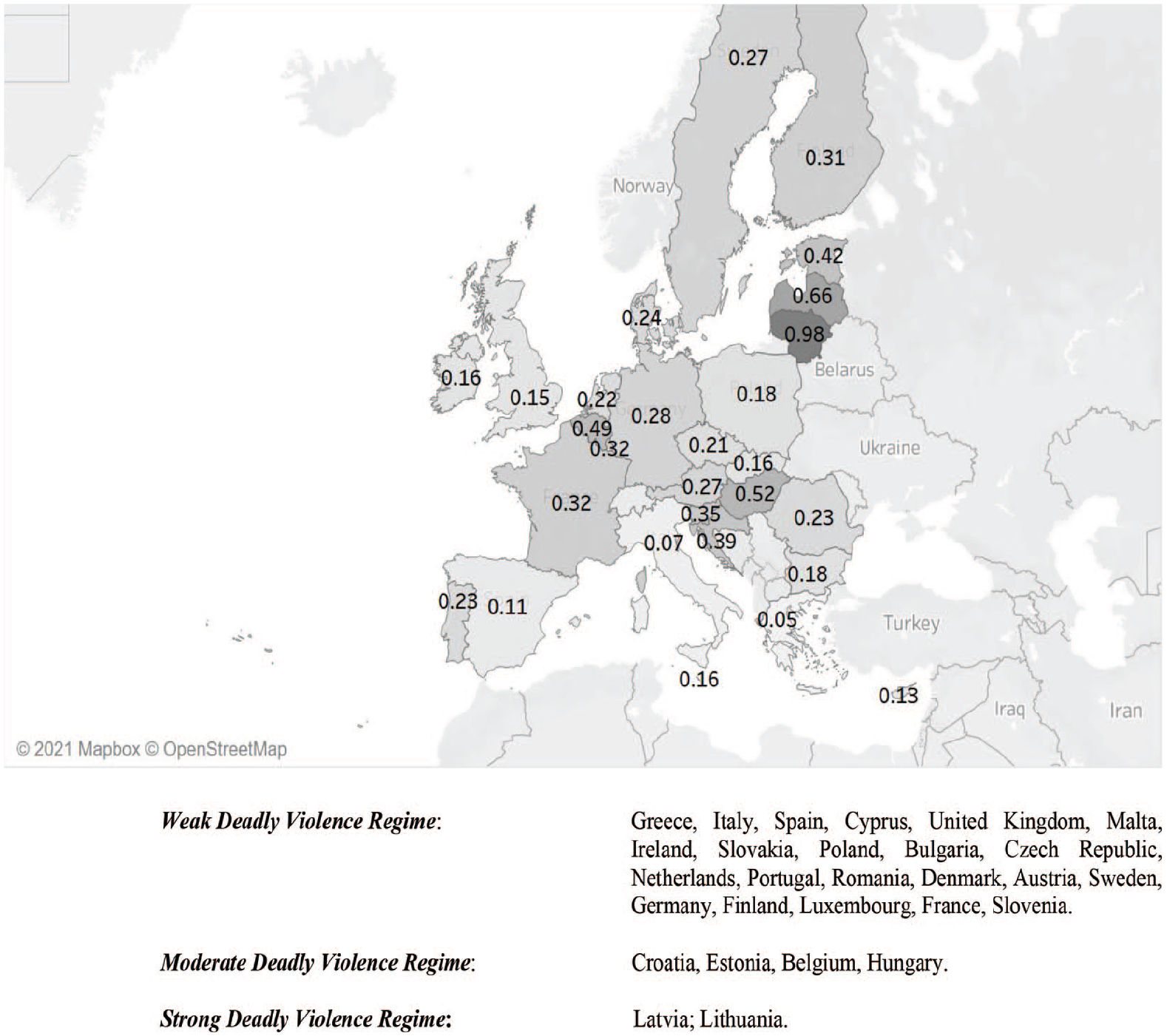
Deadly violence regimes in the EU.
Scores for the damaging gender-based violence pillar also vary widely, from 0.05 in Poland to 0.95 in Denmark. This represents a range of 0.9, used to categorize countries into a weak gender-based violence regime (0.05–0.35); a moderate gender-based violence regime (0.36–0.66); and a strong gender-based violence regime (0.67–0.95). This makes the ‘Nordic paradox’ apparent, with gender-based violence levels much higher in the Nordic countries, although they are associated with higher levels of gender equality according to international gender equality indices (see World Economic Forum, UNDP, EIGE) (Figure 3).
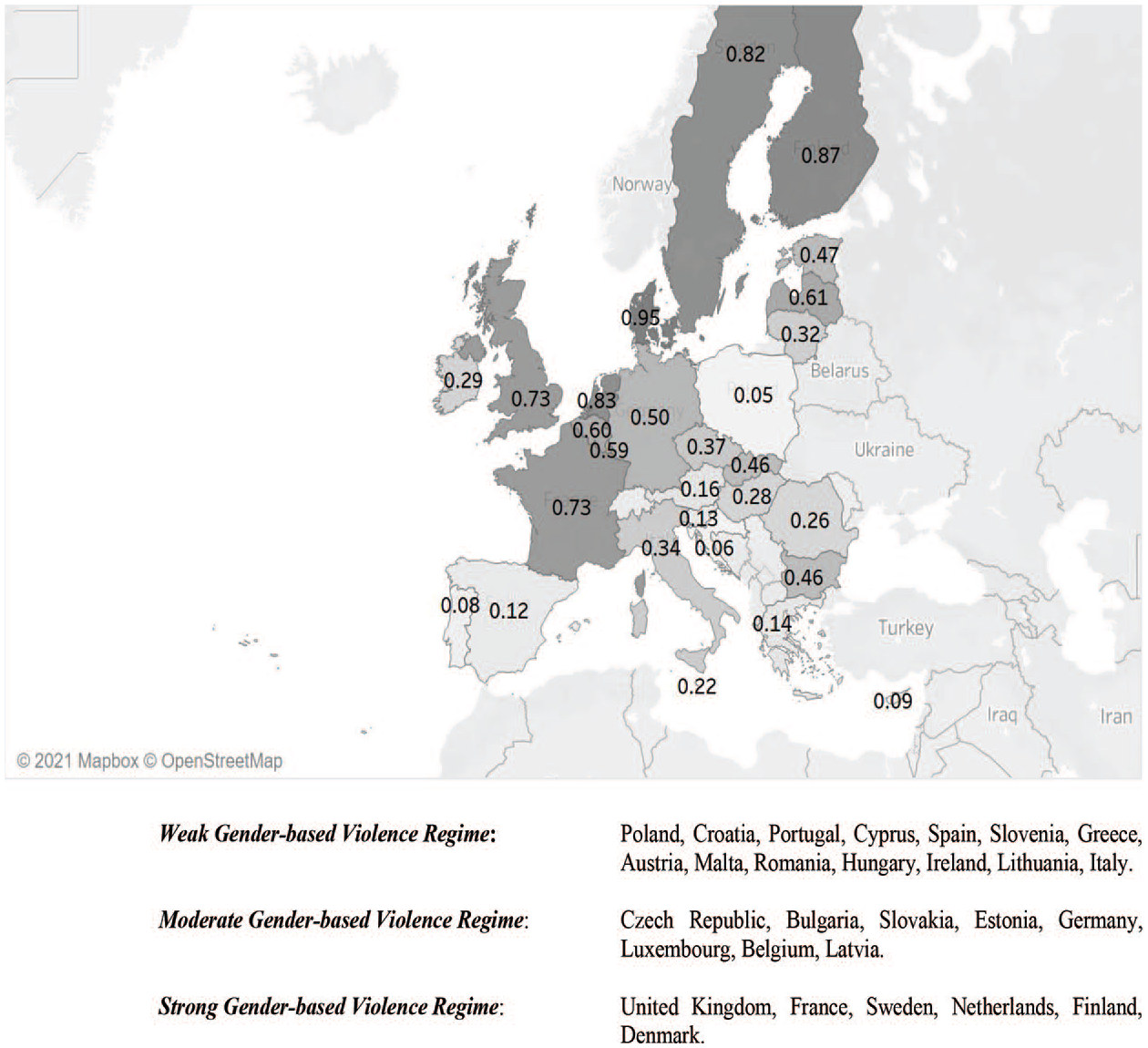
Damaging violence regimes in the EU.
Relationship between the pillars and the VR-index
To better understand the relationship between the pillars of deadly violence and damaging violence, a k-means cluster analysis was performed. The results are visualized in Figure 4. This shows the results of a five-cluster solution. Cluster 1 regroups nearly half of the EU Member States and is characterized by lower levels of both deadly and damaging violence: Cyprus, Croatia, Portugal, Spain, Slovenia, Poland, Romania, Malta, Greece, Austria and Ireland. Cluster 2 combines higher levels of deadly and moderate levels of damaging violence. These correspond to the Baltic states Estonia and Latvia, along with Hungary and Belgium. Cluster 3 combines lower levels of deadly violence with moderate levels of damaging violence. These are mainly central European states – Germany, Luxembourg, Czech Republic, Slovakia – with Italy and Bulgaria. Cluster 4 combines lower levels of deadly violence but higher levels of damaging violence. These correspond to the Nordic region – Finland, Sweden and Denmark – along with the Netherlands, UK and France. A fifth ‘cluster’, or outlier, namely Lithuania, combines very high levels of deadly violence and moderate levels of damaging violence.
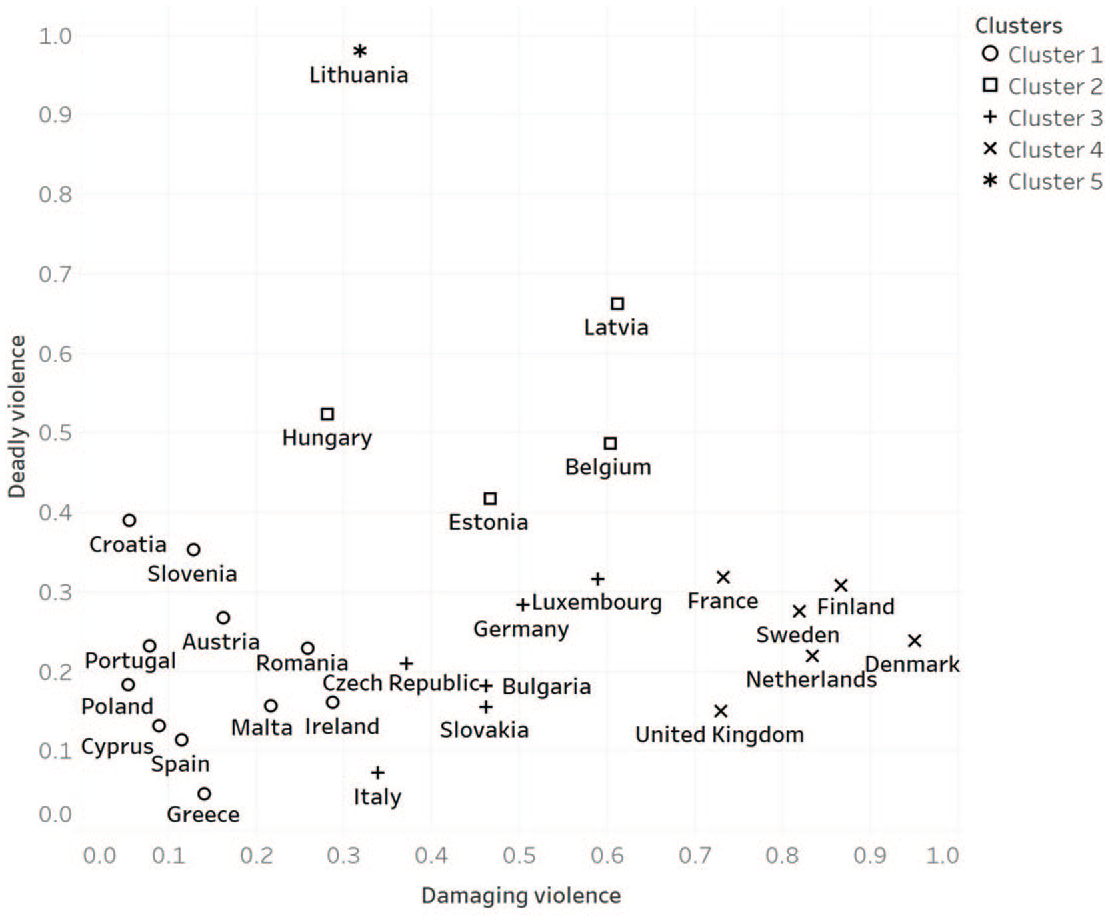
Violence regimes by deadly and damaging violence.
Regimes compared
In this section, we examine the extent to which welfare regimes, gender welfare state regimes and other gender and/or violence composite indicators map onto the VR-index described above (see Table 2 below and Supplemental Annex 5). Comparing how different countries are classified across the different typologies shows that adding the perspective of violence provides different results from welfare regimes, their feminist criticisms and adaptation (see Supplemental Annex 5). For example, out of the six countries with a conservative regime according to the Esping-Andersen model (Austria, Belgium, France, Germany, Italy, the Netherlands), two have a weak violence regime (Austria, Italy) and three a strong violence regime (Belgium, France, the Netherlands). The countries covered by these typologies are all but one (Belgium) classified as having a weak deadly violence regime. Thus, differences are to a large extent driven by differences in damaging violence, further demonstrating the importance of adopting not only a violence perspective but incorporating gender. All three countries with a social democratic regime (Denmark, Finland, Sweden) are also classified as having a strong violence regime, as a result of having strong damaging violence regimes. To some extent this also extends to classification into childcare regimes and gender/class inequality regimes, since there is some correspondence with the welfare regimes typology for the Nordic countries. Overall, what the results show is that a typology of violence regimes adds to these existing classifications by providing alternative accounts.
Comparison between the VR-index and other composite measures.
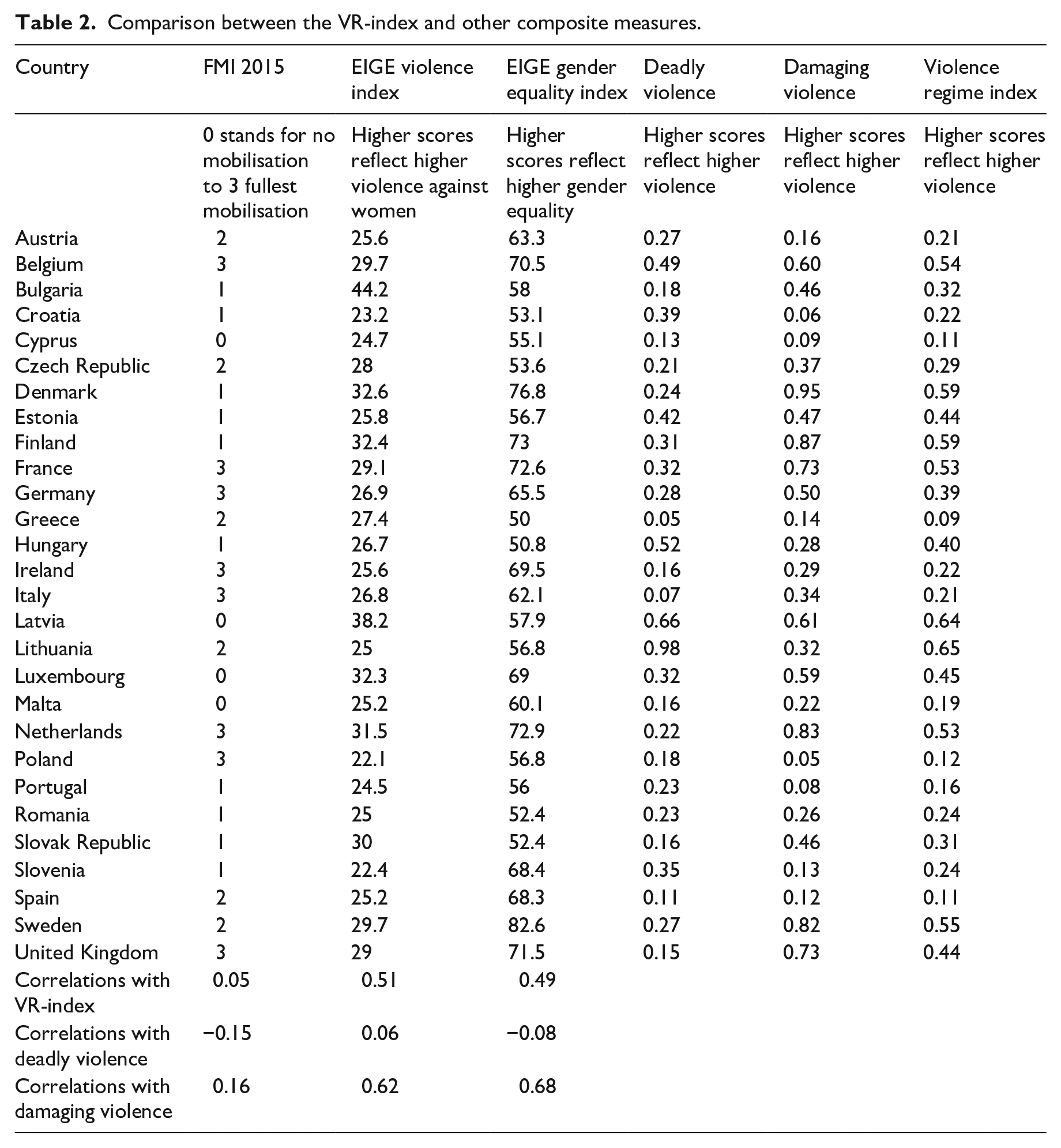
Next, we assess the results of the VR-index against other known composite measurements (see Table 2). We examine the Feminist Mobilization Index (Weldon, 2002), and find no correlation. This therefore provides no evidence of a relationship between feminist mobilisation and violence, including gender-based violence. However, both the Gender Equality Index and the one-off satellite account on violence against women are positively correlated to the VR-index (r = 0.49 and r = 0.51 respectively). The correlation is even stronger (r = 0.68 and r = 0.62 respectively) when only considering the pillar of damaging violence. This is to be expected since these composite measures share some common indicators, and these results contribute to demonstrating the measurement validity of the VR-index.
Discussion and conclusion
In this section, we discuss what appears to be problematic with the implications of the women-friendliness of the welfare state regimes paradigm. One puzzle relates to the inclusion and exclusion of violence in any analytical framework and typology, and some related methodological challenges of measuring violence, constructing violence regimes and gender regimes, and to the analysis of how they correspond (or not) to welfare regimes. One contested question to be explored by future research concerns the relations between diverse indicators, for example, whether the explanations of the high violence towards women reported in the Nordic countries in the public/private arena is related to women’s greater visibility in the public arena, with advanced gender equality legislation or the greater policy focus on the very problem of violence against women. The section concludes by discussing a holistic, multi-level and multi-pillar understanding of violence and the usefulness of the violence regimes framework.
Our focus here has been to address how welfare (gender) regimes relate to violence and violence regimes. We have drawn on a wide range of violence indicators, capturing deadly and damaging violence. The results show that welfare regimes and gender regimes do not translate into violence regimes: the typologies of welfare state regimes, including its gendered versions, do not map on to a violence regimes typology. We have argued that the exclusion of violence from mainstream social theory and welfare state regimes research has produced results that may not be valid, or at the very least partial. Violence, in its multiple and gendered forms, should be included in any typology, classification or comparison of welfare states, not least typologies that claim to say something about the level of women-friendliness of the welfare state. We have also argued that violence is an inequality, non-reducible to other inequalities, and structured by an autotelic logic, empirically observed by the positive correlations between multiple forms of violence.
The first contribution of this article is to have shown that the production of violence in different states constitutes distinct regimes, analogous to those of welfare state regimes and gender regimes, but they are not the same. It suggests that the exclusion of violence from mainstream social theory and research has produced results that may not be valid. These results are hardly surprising, the empirical data and their operationalisation into a VR-index substantiate previous social policy-oriented feminist scholarship on violence and the state.
The second contribution of this article relates to the critical interrogation of the welfare state regimes research and the conclusions on women-friendliness. Neither the welfare state regime nor the gender regime appear as particularly women-friendly regimes when violence is considered. Whether it is sexual violence, physical violence or homicide, a significant number of countries have violence scores placing them ‘in the wrong regime’. Making violence central changes existing frameworks and paradigms. A key implication of this article is therefore that we should try to update the measurement of three aspects: welfare regimes, gender welfare regimes, and violence regimes. For the welfare regimes and gender welfare regimes, this could be done by adding violence to their indicators.
The third contribution of this article is to have built upon the newly developed concept and framework of violence regimes by providing a first operationalisation to examine and enable comparisons of the production and organisation of violence in welfare states. Violence regimes can be seen as relatively autonomous and contradictory, across different scopes of violence. In this article, to analyse the congruence between welfare regimes, gender regimes, women-friendliness and violence, we have used different forms of direct and indirect violence, with variations in both manifestation and understanding of violence (Hearn et al., 2020). The framework of violence regimes is promising as it forces consideration of the full scope of violence, ranging from manifest, easily visible, intended, instrumental, direct physical injury such as intentional homicide, to more open-ended meanings of violence which go beyond physicality, visibility and intentionality (so-called symbolic violence), to forms of violence not yet recognized as violence. Violence regimes, we argue, suggests a much more open-ended understanding of the production of violence and connects with theorising on violence as a constituent element of social and societal life.
We have explored what happens when violence – rather than social stratification, class or gender – is placed centre-stage. Theoretically, this approach concerns the ontology of violence and questions whether violence is always to be explained by something else, as for example social exclusion, economic marginalisation or individual pathologies. Put differently, the issue is the level of autonomy of the violence regime: how autotelic is violence (Schinkel, 2010)? Empirically, violence may respond to this autotelic logic if one observes positive correlations between multiple forms of violence. Since a composite indicator, by construction, relies on correlations between different forms of violence, it is particularly apt at capturing the potential autotelic nature of violence. Future research should refine this first proposal for operationalisation into an empirical measure.
The implications of the methodological limitations for the understanding of violence regimes points to the need for further research that includes a broader range of violence and violations in empirical analyses. Future research should aim to expand the measures of violence regimes to cover additional pillars of violence that go beyond the physicality, visibility and intentionality as measured and included in this article. Such additional pillars would include non-direct dispersed violence and more diffuse forms of violence, forms not usually (yet) recognized as violence, such as for example environmental violence, sexualisation of public space and meat-eating. This pillar of dispersed post-disciplinary violence of what is not yet accepted, measured or politicized as violence, raises wider questions of what constitutes violence and requires thinking beyond disciplinary boundaries. Including these diffuse and dispersed forms of violence in a framework of violence regimes may very well produce different results/regimes. Furthermore, the point that research on the intersections of different inequalities categories, such as gender, race/ethnicity and gender and class, has failed to engage with violence as a form of inequality in its own right, raises complex and contested questions about how to define violence and how to relate violence to other inequality regimes, that is, how gender, sexual, class and ethnic inequalities intersect and should be addressed in future research.
Supplemental Material
sj-pdf-1-esp-10.1177_09589287211002370 – Supplemental material for States of violence: Exploring welfare state regimes as violence regimes by developing a violence regimes index
Supplemental material, sj-pdf-1-esp-10.1177_09589287211002370 for States of violence: Exploring welfare state regimes as violence regimes by developing a violence regimes index by Sofia Strid, Anne Laure Humbert, Jeff Hearn and Dag Balkmar in Journal of European Social Policy
Footnotes
Acknowledgements
We would like to thank the anonymous reviewers for their constructive critique; Birte Siim and Johanna Kantola, discussant and section chair at the European Conference on Politics and Gender 2019, for their helpful and constructive comments, and Mieke Tyrrell for the final editing and proofreading.
Funding
The author(s) disclosed receipt of the following financial support for the research, authorship and/or publication of this article: This article derives from the project ‘Regimes of Violence: Theorising and Explaining Variations in the Production of Violence in Welfare State Regimes,’ funded by Swedish Research Council, Grant 2017-01914.
Supplemental material
Supplemental material for this article is available online.
References
Supplementary Material
Please find the following supplemental material available below.
For Open Access articles published under a Creative Commons License, all supplemental material carries the same license as the article it is associated with.
For non-Open Access articles published, all supplemental material carries a non-exclusive license, and permission requests for re-use of supplemental material or any part of supplemental material shall be sent directly to the copyright owner as specified in the copyright notice associated with the article.
