




Abstract
Unemployment insurance systems are designed to provide income security for those who drop out of work temporarily. This form of social protection is particularly relevant for foreign-born workers who are, on average, more likely to become unemployed during layoffs. The article explores how the social protection of immigrants differs in cases where payments are tied to voluntary rather than mandatory contributions. This is done by focusing on a recent welfare reform in Sweden which led to both a sharp increase in costs and a decline in benefit generosity overnight. It is argued that migrants lost their social protection at a disproportionate rate over the course of the reform. Both their status on the labour market and position as newcomers to the norms and rules of society are expected to impede on their decision to obtain or prolong insurance membership, leading to a decline in eligibility to income security. Difference-in-difference estimates with administrative data from all unemployment insurance funds show that the share of benefit recipients with earnings-related payments decreased at a higher rate among the foreign-born as expected, especially if they had arrived in the country only recently.
Introduction
Immigrants’ access to unemployment benefits is, to put it mildly, a rather controversial topic. Developed welfare states often co-exist with polarised labour markets where the foreign-born are concentrated in precarious jobs with high turnover rates (Schwander and Häusermann, 2013). Such a combination of generous social protection and migrant-specific job insecurity generates an over-representation of the foreign-born in public unemployment benefit systems (Organisation for Economic Co-operation and Development [OECD], 2018: 77) which in turn nurtures the stigma of immigrants as undeserving ‘benefit tourists’ (van der Waal et al., 2013). It is therefore no surprise that immigrants are featured very prominently in research on the determinants of unemployment benefit receipt (Blau, 1984; Borjas, 1999; Hansen and Lofstrom, 2011).
A limitation of the current literature on migrants’ use of unemployment benefits, however, is its preoccupation with barriers to labour market participation. The focus is understandable given the described concentration of immigrants in precarious jobs. However, it leaves very little room for the role of unemployment benefit systems themselves. Omitting institutional design as a determinant of benefit receipt is particularly problematic for systems that combine flat-rate benefits with voluntary earnings-related unemployment insurance, such as those found in Sweden, Denmark and Finland (Sjöberg et al., 2010: 421). These systems are fairly generous and unique from a comparative perspective. Access to income security during times of unemployment is work-tested, but not strictly tied to labour market participation via means-testing or mandatory social insurance. It is instead based on a person’s choice to pay contributions voluntarily into an unemployment insurance fund (Vandaele, 2006: 648).
The purpose of this study is to shed more light on the relationship between migration and public welfare under the described institutional setup. It aims to answer the question of whether and how social protection is stratified between the foreign- and native-born if income security is made conditional upon voluntary membership in unemployment insurance. The study employs a combination of theoretical considerations drawn from economics, sociology and political science. It is applied empirically to a recent reform of the unemployment insurance system in Sweden. Selecting this case is particularly useful, not only because of the country’s growing migrant population (Organisation for Economic Co-operation and Development [OECD], 2018: 41), but also to help uncover causal relationships between institutional design and social protection which often remain hidden in cross-sectional approaches.
Migration and unemployment benefits
Research on migrants’ access to and use of unemployment benefits is largely dominated by the question of ‘residual benefit receipt’, that is, whether immigrants receive benefits at a lower or higher rate than native-born residents, once socio-economic characteristics are taken into account. Survey analyses for the United States by Blau (1984) show that households of foreign-born immigrants are generally more likely to receive social assistance benefits when compared to those with native-born residents. However, significant differences disappear once controls for gender, age, education, income, language skills and household structure are taken into account. Other studies on the US corroborate these findings. Benefit receipt probability is to a large extent explained by the over-representation of migrants in households with low income, weak labour market attachment and few financial assets (Borjas, 1999; Tienda and Jensen, 1986).
Studies on European welfare states point to large differences both between countries and among migrant populations. Findings for Ireland indicate benefit receipt below the level of natives among recently-arrived migrant cohorts, but slightly higher rates among earlier ones (Barrett and McCarthy, 2007). Results for Sweden and Finland point to higher rates of benefit receipt upon arrival, followed by gradual, but incomplete assimilation over time (Hansen and Lofstrom, 2011; Sarvimäki, 2011). Comparatively small initial gaps and faster assimilation rates can be found in Germany (Wunder and Riphahn, 2014). Recently published studies for the cases of Denmark and Norway, in contrast, indicate a reversed pattern for refugees. Welfare rates drop sharply during the first years, but grow subsequently in the long-term (Bratsberg et al., 2017; Schultz-Nielsen, 2017).
All contributions reviewed so far have in common that they focus on means-tested social assistance for the unemployed. Only a few studies are concerned with contributory unemployment insurance programmes for those who drop out of work temporarily. Results of a study in Canada indicate that migrants are less likely than natives to receive unemployment insurance benefits, once controls are added (Baker and Benjamin, 1995). The authors also find that migrants’ rates of benefit receipt assimilate to those of natives over time. Results of a study by de Silva (1997) corroborate the findings while also highlighting that there are substantial differences in benefit receipt trajectories based on country of origin and ethnicity.
The review of prior research shows that few studies account for the role of institutions, let alone their reform. This omission can be explained with a common analytical perspective: most scholars depart from the assumption that differences in benefit receipt are to be found in observable characteristics on the individual level, while all other factors are subsumed under the ‘residual benefit receipt’ that remains after controlling for these differences. Such an approach leaves very little room for the role of institutional characteristics such as funding principles or eligibility rules. This gap will be addressed in the next section.
Theoretical considerations
The stratifying mechanisms of voluntary unemployment insurance can, at a basic level, be understood from the viewpoint of rational choice theory (Becker, 1976). Workers pay contributions into an insurance fund in exchange for the benefit of earnings-related income security in the event of unemployment. Tax subsidies and strict regulations keep the monthly contributions fairly low and relatively even across economic sectors. However, all systems also provide basic flat-rate payments free of charge. This makes contributory membership more valuable for middle-income earners than for those employed in low-wage jobs, even if the risk of unemployment itself is higher for the latter (Korpi and Palme, 1998: 668). The institutional setup of voluntary insurance thus creates economic incentives that vary by skill, income and sector of employment. This means, from the perspective of immigrants, that the likelihood of earnings-related social protection is closely tied to a person’s trajectory of economic assimilation into the labour market (Chiswick, 1978).
A rational choice approach has its merits as it emphasises what is unique about voluntary insurance: free choice. However, it also simplifies citizens’ relationship with the welfare state. Social insurances do not merely pool the risks of job loss, sickness or old age as a car insurance policy does for the risk of damage. They also form a normative basis for distributional justice and social citizenship in society (Marshall, 1950). Welfare institutions structure the way we think about social risks to begin with and ‘affect what values are established in a society, that is, what we regard as a common culture, collective identity, belonging, trust, and solidarity’ (Rothstein, 1998: 7).
The conceptualisation of social policies as norm-generating institutions is particularly relevant for the case of voluntary unemployment insurance. This form of social protection has its origins in the workers’ movements of the late 19th century and is still largely in the hands of trade unions (Vandaele, 2006). Some scholars even argue that it is the primary source of legitimacy for trade union membership in Denmark, Finland and Sweden (Lind, 2009; Loxbo et al., 2019). This strong focus on a self-organised solution to the problem of unemployment forms a collective identity among workers into what Ahlquist and Levi (2017) refer to as a ‘community of fate’. Paying into unemployment insurance thus means more than just protection against the risk of income loss; it can be facilitated by economic incentives and social norms at the same time.
Studying unemployment insurance as a norm opens up for social integration theory as a new angle (Durkheim, 1951). This viewpoint suggests that each person’s choice to join or leave voluntary membership is moderated by the degree of inclusion into the workforce as a social group. This approach puts a considerable weight on family, education and tenure as contextual rather than individual factors. Those who already had contact with members of an insurance fund before applying for a job can be expected to sign up more readily themselves. Equally, those who have been paying into the system for a long time are more likely to stay, no matter the cost. After all, ‘people who are strongly integrated into a social group are assumed to be more likely to comply with the norms of that group’ (van Tubergen et al., 2004: 748).
Social integration theory further emphasises length of residency as a determinant of migrants’ social protection. Findings in comparative research on welfare attitudes indicate that immigrants tend to hold views about the welfare state that roughly match those of the native-born in their country of residency (Reeskens and van Oorschot, 2015). However, significant variations can be found depending on country of origin and length of residency. The way someone perceives the welfare state depends highly on the system in which the person grew up, especially during the first years after arrival. This changes gradually through contact with society and welfare institutions, leading to an acculturation of values and attitudes over time (Adman and Strömblad, 2015; Gordon, 1964; Reeskens and van Oorschot, 2015).
Accounting for the role of acculturation implies that the prior focus on rational choice needs to be re-considered. Immigrants cannot be expected to join a voluntary insurance system as readily as native-born workers with a comparable labour market status, especially if they arrived in the country only recently. Norms and rules might not be entirely clear and language barriers might impede access to information. The same mechanisms can also lead to higher drop-out rates if the cost of membership increases relative to its benefits. The normative bonds that tie members to their insurance are less likely to exert the same effect on workers who are newcomers to both society and the labour market. The institutional setup of voluntary unemployment insurance systems is therefore expected to shape the stratification of social protection in two ways at the same time: through economic assimilation, on the one hand, and acculturation on the other. This combination of theoretical expectations informs the development of three interconnected hypotheses about a recent reform of the Swedish unemployment benefit system which are introduced in the next section.
Swedish unemployment insurance and its reform in 2006
Social protection for the unemployed is provided through two separate insurance plans in Sweden. Basic flat-rate benefits (grundförsäkring) of 365 Swedish Crowns per day (about US$37) are paid free of charge to everyone with a minimum 6 months of recorded employment. The requirement of insurance membership for these payments was abandoned in 1998, but provision is still organised through about two dozen unemployment insurance funds which are roughly divided by economic sector and in their majority owned by trade unions. The second, more generous plan for earnings-related benefits (inkomstförsäkring) is only offered to members who have paid into the system for at least 12 months. Additional supplemental benefits are provided by some of the insurance funds to bridge the gap between benefit ceilings and prior earnings. These benefits are, however, not state-subsidised and thus require a higher level of private contributions (Anderson, 2001; von Buxhoeveden, 2019).
The described system was altered several times in the past, but its basic setup has now been in place for over a century (Anderson, 2001). One of its most substantial reforms was initiated in 2006, when an alliance of centre-right parties won the majority of seats in parliament. The new government introduced a tax credit to generate economic incentives for employment. Costs of the reform were balanced with cutbacks in subsidies to the unemployment insurance funds. This led to both a lowering of benefit ceilings and a regressive grading of replacement rates based on the length of unemployment. Subsidies were also cut with the help of a sharp rise in monthly contributions. Membership fees were set at around 100 Swedish crowns before the reform (about US$10). This price suddenly increased on 1 January 2007, with new levels varying between about 250 crowns for teachers and 400 crowns for musicians. The new fees were then altered again 1 year later to tie them closer to the costs of each insurance fund (Kjellberg, 2014a: 20).
A range of studies were published shortly after the reform, most of them being concerned with its effects on employment and wages (Andersson and Hammar, 2008; Bennmarker et al., 2013; von Buxhoeveden, 2019). Only a series of descriptive analyses by Kjellberg (2014b) hint at some particularities regarding social protection. Membership in the insurance funds declined by 9% from 2006 to 2013 (p. 48). Drop-out rates were particularly high at the bottom of the wage distribution (p. 36) and in sectors with a large share of low-skilled workers (p. 53). The results also show that the number of foreign-born trade union members dropped by 11%, while only by 5% among the native-born (p. 68). However, these figures are only available for membership in the trade unions themselves, not for the funds that they administer.
The theoretical considerations that were proposed in the last section enable an interpretation of the described statistics. Rational choice theory suggests that high drop-out rates among workers with low earnings can be explained by the small, and now even lower, added value of contributory social protection in comparison to the cost-free basic insurance plan. Social integration theory puts this assessment into perspective. Unemployment insurance coverage is well established as a norm in Sweden, standing at about 85% prior to the reform (Kjellberg, 2014b: 59). This strong anchoring in society can be expected to cushion the effect of the institutional changes even among workers for whom it would be most rational to leave. This implies that drop-out rates would have been even higher, were it not for the community of fate formed among insurance members.
Declining insurance coverage can be expected to decrease the level of social protection in the Swedish workforce, even if the drop in membership is mitigated in some way or another. Rational choice theory suggests that the country’s migrant population has been affected disproportionately by these developments. Basic insurance is free of charge which means that it is rational for labour market entrants with low earnings to avoid paying contributions, even more so if the cost of membership increases sharply relative to its benefits. Social integration theory further underpins this argument. The decision to join or leave is not mitigated to the same degree by social integration among those who are less exposed to membership as a norm. This implies that both level and continuity of earnings-related income security is expected to be lower among foreign-born workers over the course of the reform, even if their status in the labour market would suggest otherwise. The following two hypotheses reflect this combination of theoretical expectations:
Hypothesis 1: Foreign-born immigrants are less likely to receive earnings-related payments than native-born workers with a similar labour market status in a voluntary unemployment insurance system.
Hypothesis 2: The benefit gap between foreign- and native-born workers (H1) widens if the relative cost for unemployment insurance increases.
Considering the role of time in relation to acculturation and economic assimilation helps to further refine the proposed arguments. Time spent in the country of destination contributes to a person’s exposure to both economic opportunities and established societal norms. The starting point may vary depending on a person’s level of human capital and views on welfare. However, the trajectory from there is still expected to be rather uniform for the large majority of the migrant population. Both the decision to join an unemployment insurance fund and the one to stay on despite the costs increase in likelihood with each year spent in the country. Pre-reform levels of social protection are maintained to a larger degree as a result:
Hypothesis 3: The effect of rising unemployment insurance costs on the benefit gap between foreign- and native-born workers (H2) declines with length of residency.
The proposed hypotheses show how the combination of economic assimilation and acculturation can be adopted for the study of migrants’ social protection during times of unemployment. An empirical test for each of the three hypotheses is presented in the next section using data on socio-demographic characteristics, labour market status and unemployment benefit receipt derived from administrative records of the Swedish unemployment insurance funds and other public registers.
Data
Social protection for the unemployed in Sweden can be studied with help of the so-called ASTAT database. 1 This source of information is generated directly from the registers of the unemployment insurance funds and contains weekly entries for all unemployment benefit payments provided over the past 20 years. The type of benefit is identified with a binary indicator that differentiates between earnings-related and flat-rate payments. Data can be pooled for several years preceding and following the year of the reform (2006). The total period of observation ranges from 2002 to 2012. Benefit spells are selected for the week in which a person first appears in the database. Payment receipt is therefore only recorded once for each person over the entire period.
The main theoretical considerations for this study are supported by arguments relating to both economic assimilation and acculturation. However, only the latter predicts migrant-specific stratifying effects of the reform under control for labour market status more explicitly. The ASTAT database is complemented with additional data sources to gauge the relevance of this argument. The first is a subset of the Longitudinal Integration Database for Health Insurance and Labour Market Studies (LISA). 2 This source contains detailed yearly information on all individuals aged 16 or older who are registered in Sweden. Three indicators are extracted from the dataset reflecting prior findings on drop-out rates for the voluntary component of the unemployment benefit system (Kjellberg, 2014b): annual earnings, educational attainment and economic sector (all prior to unemployment). Variables for gender, age and number of children in the household are added in order to account for varying levels of risk aversion independently of labour market status (Halek and Eisenhauer, 2001). Finally, the dataset also provides information on length of residency coded as years since arrival.
A limitation of the LISA dataset is that it does not contain longitudinal information on employment. It is therefore not possible to identify whether someone received flat-rate benefits out of choice or simply because the person did not fulfil the requirement of 12 months of prior contributions. The dataset is therefore combined with information from the register-based labour market statistics (RAMS). 3 They contain a full coverage of all employment records from both the public and the private sector. Individuals without a full year of recorded employment prior to benefit receipt were dropped from the dataset with the help of this information.
The third and final source of data is the Swedish population registry (RTB) 4 which adds individual-level information on country of birth. The original variable was recoded into one with 12 categories, 5 roughly following the standard clustering of countries used in comparative welfare state research (Arts and Gelissen, 2010). The effect of the reform in relation to length of residency can, in this way, be controlled for differences in the level of norm adoption and familiarity with voluntary unemployment insurance on the day of arrival. The resulting dataset consists of about 850,000 individuals observed over the period of 2002 to 2012.
Analytical strategy
The reform is studied empirically with the help of standard difference-in-difference estimates (Bertrand et al., 2004), using 1 January 2007 as a cut-off point. The dependent variable takes on the value 1 if a person received earnings-related benefits and 0 if payments were flat-rate. The main variables of interest are country of birth and length of residency. Control variables and fixed effects are used in order to test whether the main relationship remains robust even if individuals with a similar labour market status are compared. Prior earnings are log-transformed to reduce the impact of outliers. All continuous control variables are centred at their mean to ease interpretation.
Ordinary least squares (OLS) regressions with robust standard errors are used for the main analysis, primarily because they facilitate an interpretation of interaction terms (Ai and Norton, 2003). The main problem with this technique is that it violates the assumption of a continuous dependent variable implied in standard OLS regression. Robustness checks with probit link functions and maximum-likelihood procedures were performed for all models in order to evaluate differences between the two analytical techniques. Results can be found in the online appendix.
Another shortcoming of the proposed approach is that it only allows for indirect causal inference. The reform was implemented at once for all members of the workforce; no control group can be studied to estimate its true effect on social protection. Control variables help to approximate a causal design, but only under risk of unaccounted parallel trends and omitted variable bias. Such problems could be mitigated by shortening the observation period. However, such a change would, in turn, lead to an omission of long-term effects and diminish the statistical power of the regressions. The main analyses thus use the full dataset. Robustness checks on the basis of a shorter timeframe and placebo tests with cutoff points prior to the reform are performed separately and presented in the online appendix.
Results
A first descriptive analysis shows that about 80% of individuals in the dataset received earnings-related instead of basic flat-rate benefits. The share among migrants is about 3 percentage points lower than that among the native-born. Figure 1 illustrates the breakdown of this number by year and country of birth. It indicates that there were almost no differences between migrants and natives before the reform. This changes in 2006, when the gap suddenly jumps to –4 percentage points. The difference then oscillates around this new level for the remainder of the observation period.
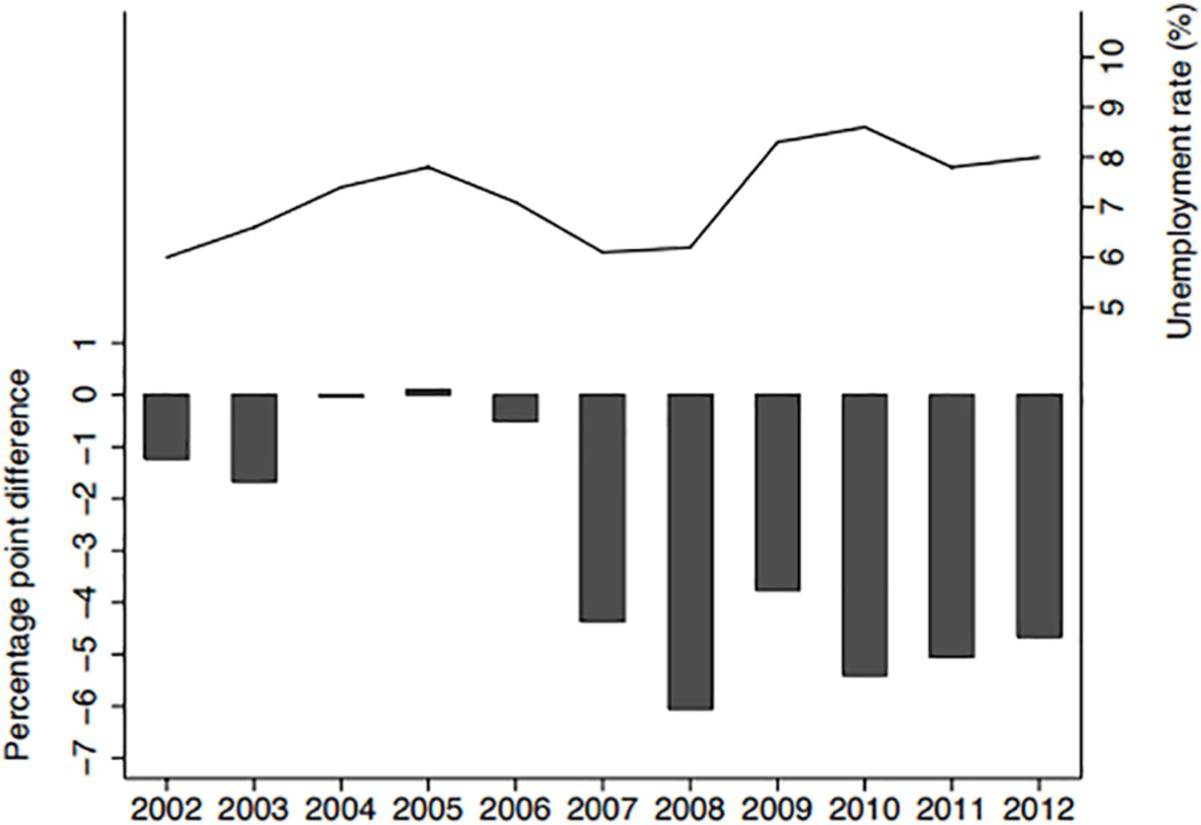
Foreign-/native-born gap in the share of recipients with earnings-related benefits.
The descriptive statistics appear to lend support to the main arguments of this study at first glance. However, it should be noted that the period of observations coincides with strong fluctuations in the Swedish economy. This is shown in Figure 1 by overlaying the graph with a trend line for the unemployment rate. The level of unemployment increased slowly until 2005 and then again sharply in 2009. A change in the share of recipients with earnings-related benefits over time could thus simply be a shift in the source of unemployment between economic sectors with low insurance coverage and those with higher levels, rather than an effect of the reform itself. Migrant-specific changes in social protection over the course of the reform can therefore only be uncovered with more advanced statistical analyses.
Summaries of the main multivariate regressions are listed in Table 1. Details can be found in the online appendix. Estimates for the effect of the reform on benefit receipt probability appear to be positive at first (Model 1). However, the sign turns to negative once controls and fixed effects are added (Model 2). These results imply that the share of recipients with earnings-related benefits dropped by about 2.5 percentage points over the course of the reform. Estimates for the foreign-born reflect the findings of the descriptive analyses. Immigrants are overall less likely to receive earnings-related benefits (Model 1). This gap widens even further once controls and fixed effects are added (Model 2). Foreign-born immigrants are thus found to receive earnings-related benefits at a lower rate than native-born workers with a similar labour market status (Hypothesis 1).
Regression results for the probability to receive earnings-related instead of flat-rate unemployment benefits.
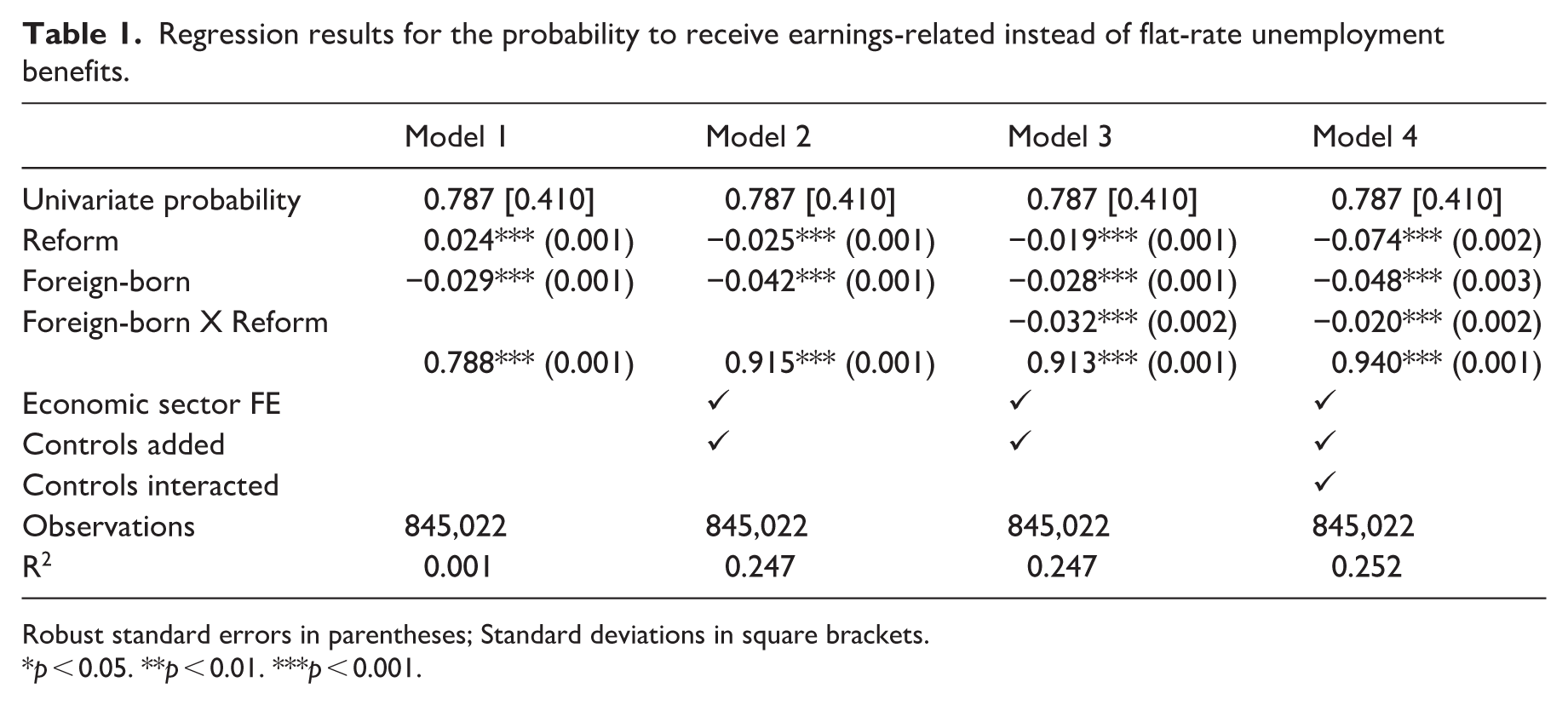
Robust standard errors in parentheses; Standard deviations in square brackets.
p < 0.05. **p < 0.01. ***p < 0.001.
Differences between migrants and natives are shown separately from the effect of the reform in the first two regression models. A widening of the gaps only appears once interaction terms are added to the regression (Model 3). Findings of this modified analysis show that the initial difference of 2.8 percentage points more than doubles over the course of the reform. This effect weakens somewhat once interacted control variables are included (Model 4), but it is still negative and statistically significant. Initial gaps between foreign- and native-born unemployment benefit recipients are thus found to increase substantially over the course of the reform as expected (Hypothesis 2).
The results of model 4 can be broken down by country of origin in a separate set of analyses. Findings of the regressions are summarised in Figure 2. They indicate that the reform had only a mild impact on the social protection of individuals from any of the three countries with voluntary unemployment insurance systems (Denmark, Finland and Sweden). Gaps among the remaining groups increase roughly in correspondence with the distance between migrants’ country of birth and their country of destination. This appears to indicate that the source of migration plays a role for the reform’s effect on the stratification of social protection. However, the standard errors for these results are relatively large, which prevents a more substantive interpretation.
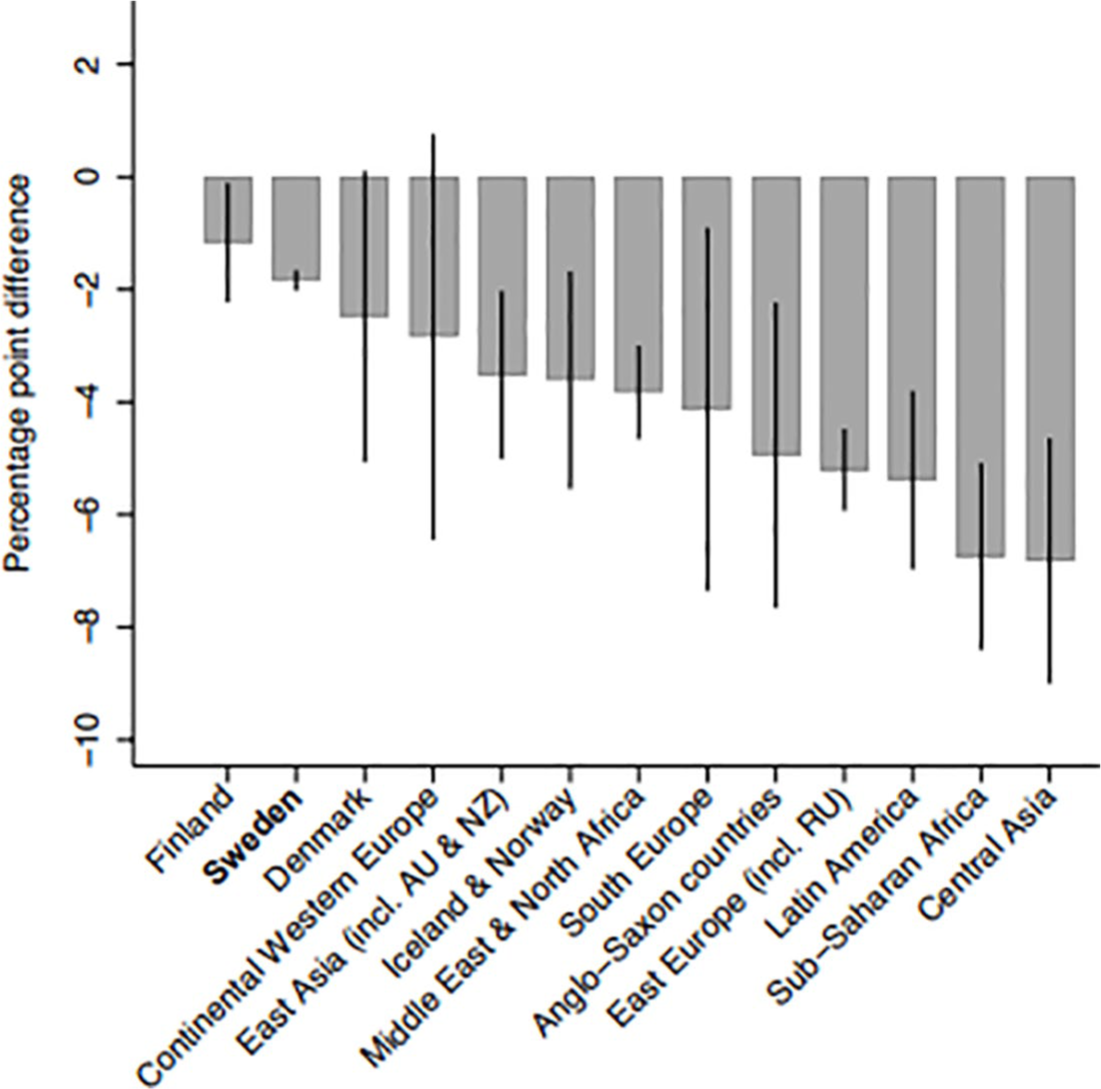
Pre-/post-reform gaps in benefit receipt probability by country/region of birth (incl. 95% confidence intervals).
All estimates are re-run for a differentiation by length of residency using the same specifications, but for a sample that excludes the native-born. The binary variable for being foreign-born is replaced by a categorical one for length of residency measured in years. Fixed effects for country of origin are included in order to control for variations found in the analyses before. Results of these estimates are depicted in Figure 3. They indicate that the probability decreases by about 7 percentage points among those who had just arrived in the country. The gap closes with each five-year step, apart from a small rebound after 20 years. Length of residency thus appears to mitigate the negative effect of the reform on the social protection of immigrants as expected (Hypothesis 3).
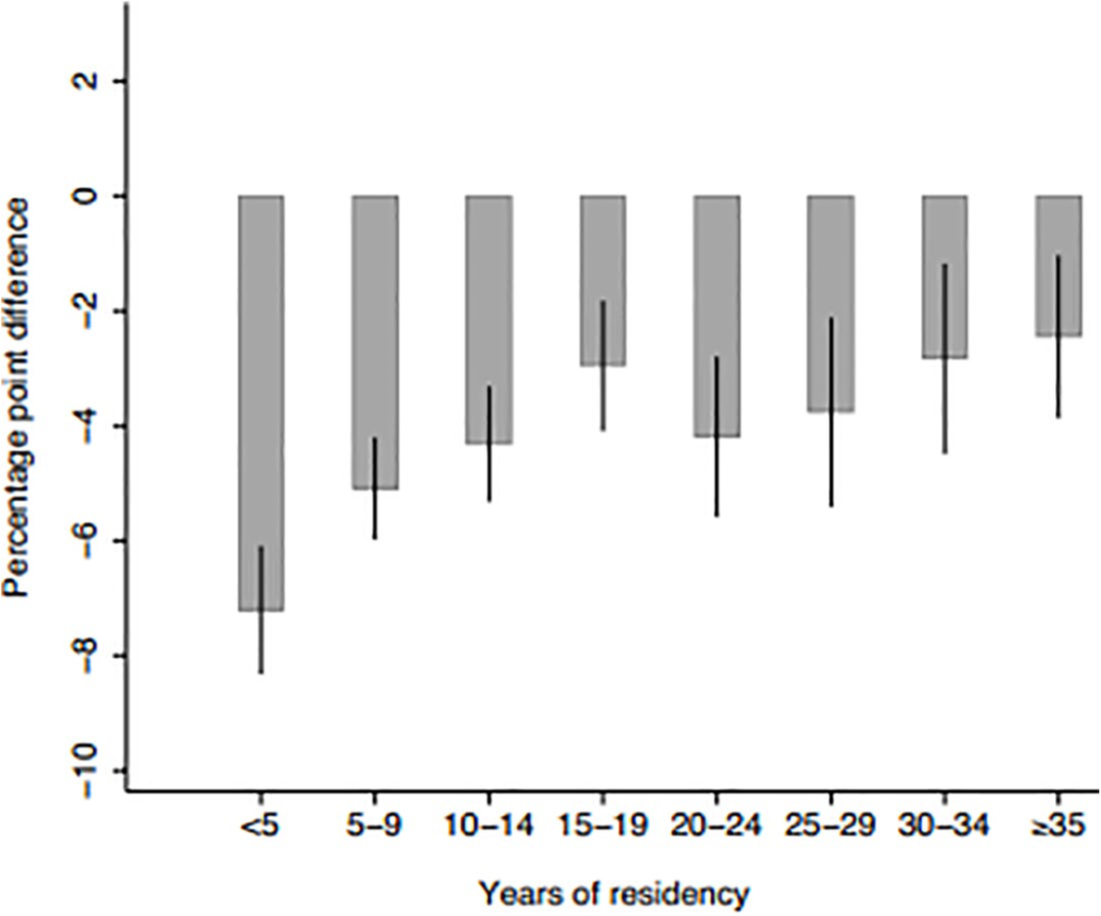
Pre-/post-reform gaps in benefit receipt probability by years of residency (incl. 95% confidence intervals).
Support for all three proposed hypotheses could be found in the empirical analysis of the 2006 reform. Robustness checks show that this is the case even if probit link functions are used instead of standard OLS regressions. This is further validated by placebo tests with cut-off points prior to 2007. Theoretical expectations for the study are also supported when the calculations are re-run with a much shorter timeframe (2005–2008). However, the share of native-born benefit recipients with earnings-related benefits appears to be unaffected by the reform in this case. Their decline in earnings-related payments might therefore be less related to immediate drop-outs, but more to a combination of membership cancellations and a lack of new sign-ups in the long run which further supports the study’s theoretical considerations about the mitigating role of social norms.
Discussion and conclusion
The design of welfare institutions is often overlooked when studying the social protection of immigrants. This is particularly problematic for the case of state-subsidised voluntary unemployment insurance which stratifies benefit access both by labour market status and by the choice to pay contributions in return for income security. Immigrants are newcomers to their destination country’s labour market as well as to the norms and principles that underpin unemployment insurance membership. A sound analysis of social protection thus needs to combine rational choice and social integration theories in this context. The study provides an approach with this ambition in mind and applies it to a recent reform of the Swedish unemployment insurance system which at the same time lowered the level of generosity and raised the cost of social protection.
The study’s findings indicate that the reform led to a decline in earnings-related payments among unemployment benefit recipients. This drop in social protection appears to be more pronounced for the migrant population, especially among those who arrived in Sweden only recently. The result cannot be interpreted in terms of a direct causal effect. After all, the reform was implemented at once for the entire workforce and in combination with adjustments to other labour market policies. Nevertheless, observing changes in the stratification of social protection among benefit recipients over the course of the reform still allows for more robust conclusions about the relationship between welfare conditionality and migrants’ social protection than could be achieved with cross-sectional analyses.
Perhaps most striking of all is the finding that the described stratification in social protection occurred even if benefit recipients with a similar labour market status are compared. It is not possible to rule out that the analyses simply fail to fully capture the (self-)selection of migrants into jobs and sectors that were most affected by the reform. Nevertheless, it is still noteworthy that the decline in earnings-related benefit payments appears to have been milder among established immigrants and those from countries with similar unemployment benefit systems, even if educational attainment, prior earnings and economic sector of employment are taken into account. This result speaks for a relationship between the institutional setup of unemployment insurance and the social protection of immigrants that goes beyond economic incentives. The study provides evidence that acculturation might play a central role in this context. However, more research is needed to fully understand when and how underlying norms and values contribute to the stratification of social protection in countries with voluntary unemployment insurance systems.
The study at hand can, in a narrow sense, be read as an addition to the literature on the 2007 reform of the Swedish unemployment insurance system. It would in this regard be important to further evaluate how later changes, such as the 2014 re-instalment of pre-reform membership fees (Kjellberg, 2014b: 82), affected the distribution of benefits in the long run. However, the study also shows, more broadly speaking, that an explicit institutionalist perspective is needed for research on the relationship between welfare and migration. Taking the complex interplay between institutional design, labour market participation and migrants’ views on the welfare state into account helps to better understand outcomes of reforms that aim to redraw the landscape of benefit entitlement in times of increasing cross-border migration.
Footnotes
Acknowledgements
I am grateful for helpful comments from Karl-Oskar Lindgren, Olof Åslund, Martin Lundin, Per Adman, Joakim Palme, Henrik Andersson, Jenny Jansson, Carin Atterby, Ingegerd Wallén, Keith Mattingly, the committee of the 2020 JESP/ESPAnet Doctoral Researcher Prize and seminar participants at Uppsala University, IFAU Uppsala and the 2019 ESPAnet conference.
Funding
The author received no financial support for the research, authorship, and/or publication of this article.
Supplemental material
Supplemental material for this article is available online.