




Abstract
In analysing heterosexual couples’ work–family arrangements over time and space, the comparative social policy literature has settled on the framework of the ‘male-breadwinner’ versus the ‘dual-earner’ family. Yet, in assuming men in couple-families are (full-time) employed, this framework overlooks another work–family arrangement, which is the ‘female-breadwinner’ couple. Including female-breadwinner couples matters because of their growing prevalence and, as our analysis shows, greater economic vulnerability. We perform descriptive and regression analyses of Luxembourg Income Study microdata to compare household incomes for female-breadwinner couples and other couple-types across 20 industrialized countries. We then consider how labour earnings and benefit incomes vary for ‘pure’ breadwinner couples – comprising one wage-earner and one inactive/unemployed partner – according to the gender of the breadwinner. We find that pure female breadwinners have lower average individual earnings than male breadwinners, even after controlling for sociodemographic characteristics and occupational and working-time differences. Furthermore, welfare systems across most countries are not working hard enough to compensate for the female breadwinner earnings penalty, including in social-democratic countries. Once controls are included in our regression models, it never happens that pure female breadwinners have higher disposable household incomes than pure male breadwinners. Thus, our study adds to a growing body of evidence showing that female-breadwinner families sit at the intersection of multiple disadvantages. In turn, these couples offer comparative scholars of the welfare state an ‘acid test’ case study for how effectively families are protected from social risk. Our results additionally highlight how cross-national differences in the female breadwinner income disadvantage do not fit neatly with established welfare typologies, suggesting that other factors – in particular, labour market characteristics and the economic cycle – are also at play.
Keywords
Introduction
The gendered division of paid and unpaid work within heterosexual couple-households has transformed across industrialized countries in recent decades. In describing and analysing this change, studies of work–family arrangements and policies have settled on the framework of the ‘male-breadwinner’ versus the ‘dual-breadwinner’ family (e.g. Esping-Andersen, 1999; Gornick and Meyers, 2009; Von Gleichen and Seeleib-Kaiser, 2018). At the normative level, social policies have shifted away from explicitly supporting men to do all the paid work and women to do all the unpaid domestic work, and towards assuming and prescribing ‘employment for all’ (Orloff, 2006). This is evidenced by the expansion of work–family policies designed to encourage women’s employment, the trend towards ‘defamilializing’ services that enable care to take place outside of the family, and a tightening of the link between employment and social rights. Furthermore, in terms of actual behaviours, the proportion of couples with two wage-earners has increased, while the share with one wage-earner has declined (e.g. Daly, 2011; Lewis, 2001; Lewis et al., 2008).
However, an additional ‘type’ of household employment is becoming more prevalent among couples, whereby the woman is the sole or main wage-earner: the so-called ‘female-breadwinner’ arrangement. 1 While female-breadwinner families have featured in cross-national studies of couple-households’ employment arrangements, these studies do not analyse in-depth female breadwinners’ economic characteristics or compare them with male breadwinners (Dotti Sani, 2018; Haas et al., 2006; Hook, 2015; Sánchez-Mira and O’Reilly, 2019). Our study contributes to filling this ‘gap’. Using microdata from the Luxembourg Income Study (LIS), we compare the economic characteristics of female-breadwinner couples with those of other couple-types across 20 industrialized countries. We then dig deeper into observed income inequalities between couples in which the woman is the only wage-earner and couples in which the man is the only wage-earner, examining how individual labour earnings and household benefit incomes vary between these two couple-types across countries.
Comparing the situations of female-breadwinner versus male-breadwinner couples is imperative for ensuring that families are not unduly penalized when the woman rather than the man is the breadwinner, especially since female breadwinning is often not a short-lived arrangement (e.g. Bryan and Longhi, 2018; Drago et al., 2005). Although mainstream and feminist scholars typically describe the dual-earner model as the most gender-egalitarian arrangement, relying on a single breadwinner may be the only realistic option for some families during some parts of the life-course. Job loss, career changes and breaks, parenthood, caring for a sick or elderly relative, illness, disability, and individual agency and choice can mean that it is neither feasible nor desirable for both members of the couple to be in employment at the same time, at least on a full-time basis. Consequently, breadwinning should be a genuinely non-gendered opportunity so that men and women can, if necessary, ‘take turns’ in being the main wage-earner according to the shifting needs and wants of the family and individuals (Gerson, 2010). Supporting such fluidity in couples’ employment arrangements can also make families more resilient in the face of economic uncertainty: if one member of the couple has their hours cut or becomes jobless, then the partner might be able to ‘compensate’ by increasing their labour supply, thereby helping to reduce inequalities between work-rich and work-poor households.
It is not immediately clear whether families headed by a female breadwinner will be worse off than male-breadwinner couples. On the one hand, some studies explain the rise in female-breadwinner households as a by-product of poor economic outcomes among low-skilled men (e.g. Dotti Sani, 2018; Harkness and Evans, 2011). When the man loses his job, the woman becomes the sole provider out of economic necessity. Women’s more disrupted and part-time career histories and broader gender segregation and inequalities in the labour market may in turn mean that female breadwinning is associated with lower household incomes and earnings compared with male breadwinning (e.g. Harkness and Evans, 2011). On the other hand, studies have drawn attention to the rise in educational hypogamy, whereby the woman has a higher level of education than her partner. Educational hypogamy increases the odds that the female partner will be the breadwinner (e.g. Klesment and Van Bavel, 2017). Women in educationally hypogamous couples can potentially exert more power within their relationships and influence their partners to cut their hours of employment, which may reduce men’s relative contribution to household earnings (Kanji, 2013). Hence, it is plausible that female breadwinners have similar if not higher incomes compared with male breadwinners, especially since male breadwinning is concentrated among those who are lower-educated (e.g. Hook, 2015).
Yet, against this second hypothesis, our results suggest that female breadwinning as compared with male breadwinning and dual breadwinning places couples at risk of having a low income. We find that across all 20 countries, female breadwinners never achieve higher disposable household incomes than male breadwinners. This is partly explained by a female breadwinner earnings penalty: once controls for sociodemographic characteristics and occupational and working-time differences are included in our regression models, women who are the sole wage-earners in their household earn less as individuals than men who are sole wage-earners in their household. Yet, despite their lower average earnings, female-breadwinner households in many countries – including the most generous social-democratic ones – do not always receive higher average benefit incomes than their male counterparts. Furthermore, our results highlight that cross-national differences in the female breadwinner income penalty do not fit neatly with established welfare typologies. We suggest that economic and labour market conditions and other broader structural conditions, in addition to social policies and welfare regimes, matter for explaining these cross-national differences and should also be brought into studies of household employment and incomes.
Data and approach
To carry out our analyses, we use individual and household-level data from the LIS for 20 countries. Data are from Wave 10 – corresponding to 2016 – for Austria, Finland, Spain, Poland, the UK and the US. For the remaining countries, data are from Wave 9, which corresponds to 2013 except for Slovenia (2012), Germany (2015), and Australia and Italy (2014). A key advantage of the LIS dataset is that, unlike datasets focused on Europe, it allows for including three additional liberal welfare states besides the United Kingdom – namely, Australia, Canada, and the United States – so that our sample is more balanced in terms of different welfare regimes.
Our sample is restricted to households containing two heterosexual cohabiting spouses/partners aged 18 to 65, with or without children. Couples in which one or both partners are in education, disabled, or retired are excluded. Also excluded are couples in which both partners are unemployed/inactive, couples living solely on capital income, and couples living with other adults who are not their children.
Our main independent variable is the couple’s employment arrangement (variable ‘emp’), which captures the main current activity status as self-assessed by the respondent at the time of the survey or in the income reference time period. 2 Definitions of full/part-time employment are based on the regular or usual hours worked at all jobs currently held (variable ‘hourstot’). Thus, this variable has five categories:
‘Pure’ male breadwinner (MBW). Man employed; woman not employed.
One-and-a-half male breadwinner (1.5M). Man employed full-time (⩾30 hours per week); woman employed part-time (<30 hours).
Dual earner (DE). Man and woman both employed full-time (⩾30 hours), or both employed part-time (<30 hours).
One-and-a-half female breadwinner (1.5F). Woman employed full-time; man employed part-time.
‘Pure’ female breadwinner (FBW). Woman employed; man not employed.
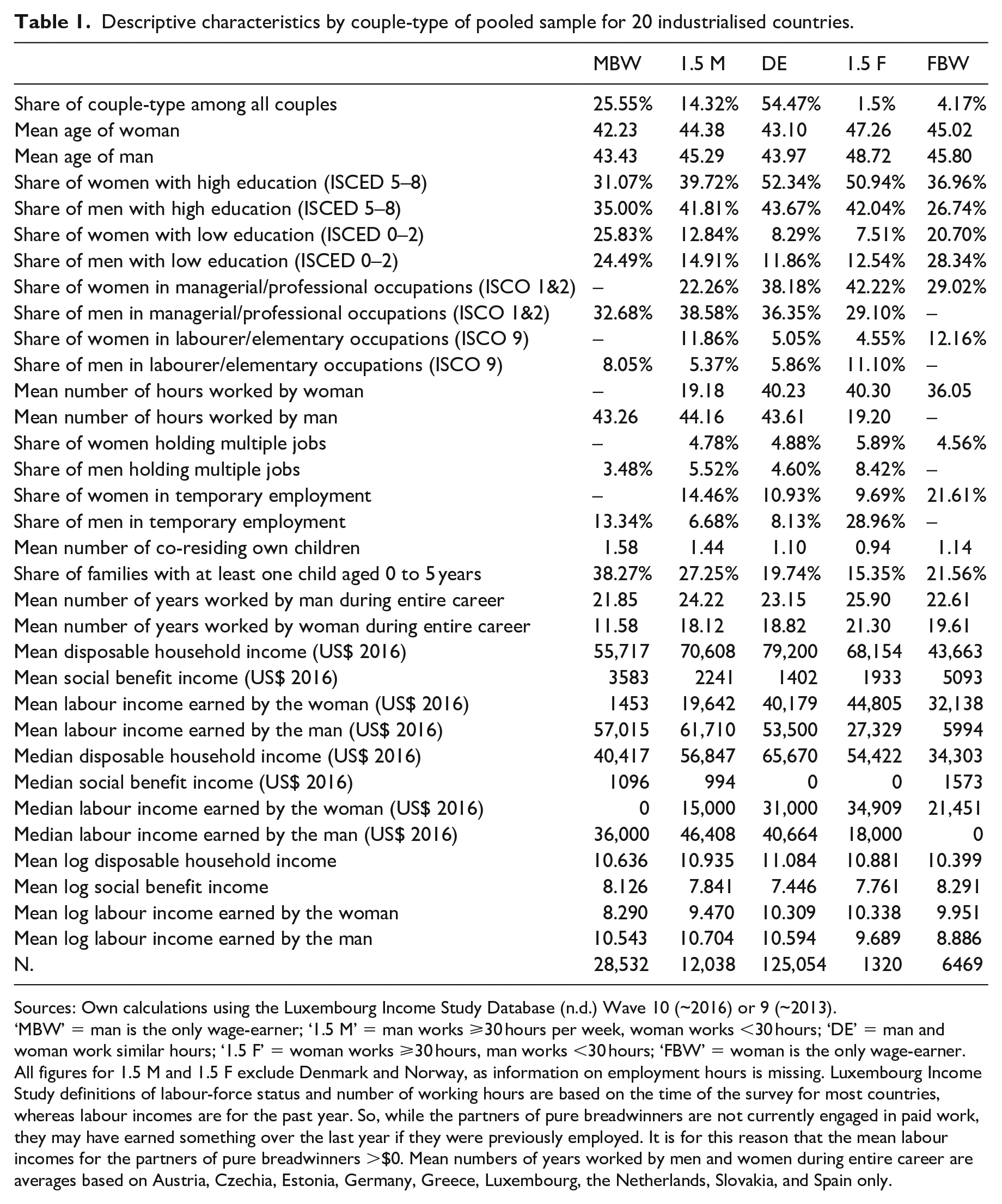
For four countries, information on number of hours worked is unavailable. For two of these countries – Poland and Slovenia – we use self-reported information on whether the person works part time (variable ‘ptime’). For the remaining two countries – Denmark and Norway – we can only use three categories of employment arrangements: (i) ‘pure’ male breadwinner, which corresponds with Category 1 above; (ii) dual breadwinner, which merges Categories 2–4; and (iii) ‘pure’ female breadwinner, which matches Category 5. Table 1 reports basic descriptive statistics of the pooled sample across all countries by couple-type.
Descriptive characteristics by couple-type of pooled sample for 20 industrialised countries.
Sources: Own calculations using the Luxembourg Income Study Database (n.d.) Wave 10 (~2016) or 9 (~2013).
‘MBW’ = man is the only wage-earner; ‘1.5 M’ = man works ⩾30 hours per week, woman works <30 hours; ‘DE’ = man and woman work similar hours; ‘1.5 F’ = woman works ⩾30 hours, man works <30 hours; ‘FBW’ = woman is the only wage-earner. All figures for 1.5 M and 1.5 F exclude Denmark and Norway, as information on employment hours is missing. Luxembourg Income Study definitions of labour-force status and number of working hours are based on the time of the survey for most countries, whereas labour incomes are for the past year. So, while the partners of pure breadwinners are not currently engaged in paid work, they may have earned something over the last year if they were previously employed. It is for this reason that the mean labour incomes for the partners of pure breadwinners >$0. Mean numbers of years worked by men and women during entire career are averages based on Austria, Czechia, Estonia, Germany, Greece, Luxembourg, the Netherlands, Slovakia, and Spain only.
In a first step, we model household incomes via linear regression as a function of couple-type in interaction with country. Our dependent variable, disposable household income (variable ‘dhi’), encompasses cash and non-cash labour income, income from capital, public and private pensions and other public social benefits, and cash and non-cash private transfers net of taxes and social contributions. We control for the following basic characteristics: age of woman and man (linear and quadratic term); education of woman and man: low (ISCED 0–2), medium (ISCED 3&4), or high (ISCED 5–8); number of children (0,1,2,3+); and whether there is a child aged 0–5. For Denmark and Norway, we run the regression on the subsample of couples that are either dual earners, pure male breadwinners, or pure female breadwinners.
In a second step, we compare the economic characteristics of pure male-breadwinner and pure female-breadwinner households by running two additional linear regression models. (We focus on differences between pure-breadwinner couples only in this part of the analysis, as the small sample sizes of one-and-a-half female-breadwinner couples in each country prevent us from running meaningful regression models to compare their situation with one-and-a-half male-breadwinner couples.) Our dependent variables are:
I. Individual labour income earned by the breadwinner over the last year (variable ‘pilabour’). This includes cash payments and the value of non-monetary goods and services received from dependent employment in addition to profits and the value of goods from self-employment and the value of own consumption.
II. Benefit income for the household over the last year (variable ‘ipubsoc’). This includes all cash social security transfers (excluding public pensions) stemming from insurance, universal or assistance schemes, and in-kind social assistance transfers.
Again, the main independent variable is couple-type interacted with country. In a first set of models, our control variables are the same as in the model for disposable household income. In a second set of models, we also control for the occupation of the main breadwinner – labourer/elementary (ISCO 9), other skilled workers (ISCO 3–8, 10), managerial/professional (ISCO 1&2) – and number of hours worked. When introducing these two controls, the regression is run on a restricted sample, as information on occupation is missing for Canada, Italy and Norway while information on hours worked is missing for Denmark, Norway, Poland and Slovenia.
For cross-national comparability, our dependent variables are expressed in 2016 US dollars using the Purchasing Power Parity and a deflator obtained from World Bank indicators. To reduce distortions from extreme values, we bottom-coded incomes to zero and top-coded them to ten times the country median. Additionally, we use a logarithmic transformation for all dependent variables. This transforms the originally skewed income distributions into variables that are approximately normally distributed, making them suitable for linear regression. We use robust standard errors to correct for possible heteroskedasticity.
Context: Patterns of breadwinning
Since the mid-1990s, the concept of ‘social investment’ has dominated debates on the welfare state. Behind this concept is the idea that social policies designed to ‘invest’ for the future can help welfare states adapt to increased demands for state social provision and a smaller tax-base under post-industrialism. Crucial to achieving these goals is the promotion of a ‘dual-breadwinner’ family model, whereby men and women provide for their own welfare through their individual participation in paid employment. Proponents of social investment highlight the lower rates of childhood poverty and higher rates of fertility among dual-earner couples (e.g. Esping-Andersen, 2002, 2016).
As Figure 1 shows, dual, full-time breadwinning is most common in Nordic countries. This is rooted in cultural support for women’s employment (e.g. Haas et al., 2006), a recognition that care is important and a shared social concern (e.g. Craig and Mullan, 2010), and highly ‘defamilializing’ policies (e.g. Gornick and Meyers, 2009). Similarly, Central and Eastern European countries have high levels of dual, full-time breadwinning. This reflects the legacy of socialism, which encouraged women’s full-time employment, even if women retained responsibility for unpaid work in the family (e.g. Pascall and Lewis, 2004). It also reflects the economic necessity of having two full-time earnings in the less prosperous Central and Eastern European countries (e.g. Haas et al., 2006). Still, rates of dual breadwinning are lower than in Nordic countries, while male breadwinning is more prevalent. This is partly because mass deindustrialization under the collapse of communism and the dismantling of highly feminized public services had a negative impact on women’s employment rates. In addition, there has been resistance to feminism in certain post-Soviet countries and a ‘refamilialization’ of policies away from supporting women’s employment and towards promoting traditional gender roles, whether implicitly or explicitly (e.g. Glass and Kawachi, 2001; Pollert, 2003; Saxonberg and Sirovátka, 2006).
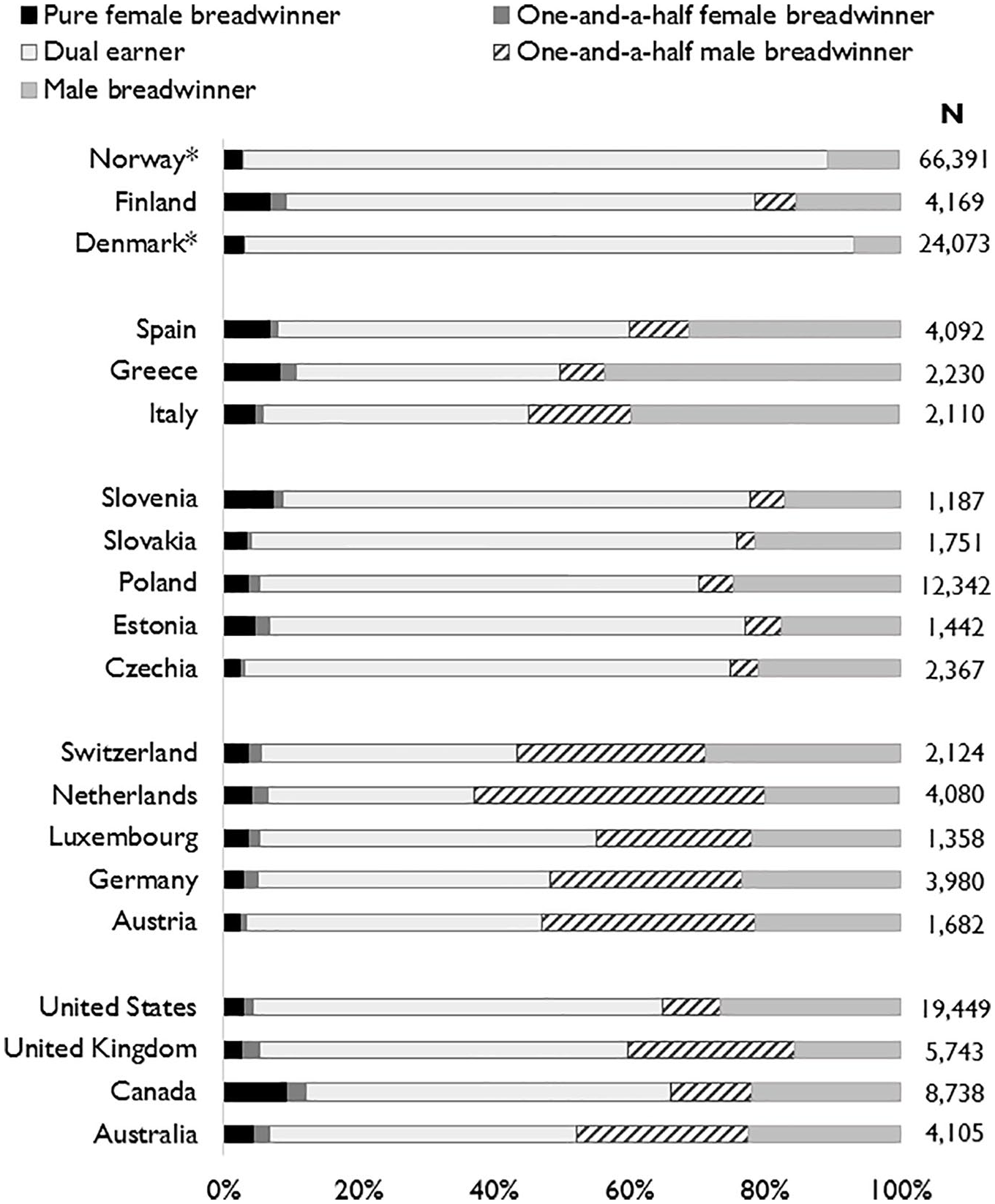
Distribution of household-level employment arrangements among heterosexual couples across 20 countries.
Elsewhere, dual, full-time breadwinning is less pervasive. In most Anglo-Saxon countries (bar the US) and Continental countries, many couple-households approximate a ‘one-and-a-half’ male-breadwinner model, under which the man works full time and the woman works part time (Lewis, 2001: Figure 1). This reflects predominantly market-based provision of care services (e.g. the United Kingdom) and/or partial state care services (e.g. the Netherlands), as well as strong male-breadwinning norms and extensive part-time employment opportunities (e.g. Hook, 2015; Lewis, 2001; Lewis et al., 2008). Meanwhile, in Southern European countries, most couples are either sole male breadwinners or dual, full-time breadwinners. Here, the higher incidence of male breadwinning is connected with strong familialism, whereby the family is expected to be the main provider of care and welfare. However, overall figures mask a polarization in breadwinning: while higher-educated women are primarily in full-time employment with a full-time employed partner, lower-educated women are mostly inactive or unemployed with a breadwinning partner (Hook, 2015; Lewis et al., 2008; Sánchez-Mira and O’Reilly, 2019). The under-provision of state care services and work–family reconciliation policies, together with the relative scarcity of part-time jobs, shut lower-educated and poorer mothers who are unable to afford market solutions to work–family conflicts out of the labour market; conversely, higher-earning women can afford a nanny or other private childcare. Similar factors in the US mean that, in contrast to other Anglo-Saxon states, it too displays high male breadwinning among lower-educated couples and high dual breadwinning among highly educated couples (e.g. Esping-Andersen, 2009; Hook, 2015).
Yet, Figure 1 highlights another set of work–family arrangements, which is currently overlooked in the male breadwinner/dual breadwinner framework that dominates comparative studies of work–family arrangements and policies. Here, we are referring to the ‘female-breadwinner’ couple. Replicating the distinction made in existing literature between male-breadwinner families according to whether the woman is not in employment or is working part-time, we differentiate between ‘pure’ female-breadwinner couples, in which the woman is the only wage-earner and the man is either inactive or unemployed, and ‘one-and-a-half’ female-breadwinner couples, in which the woman is in full-time employment and the man is in part-time employment.
Figure 1 shows that while female-breadwinning remains relatively rare in Denmark, Norway, Czechia, Austria, Slovakia, the United States and Germany, it is more prevalent elsewhere. In Canada and Greece, female breadwinners account for 12 percent and 11 percent of couples respectively. In Finland, Slovenia and Spain, 8–9 percent of couples have a female breadwinner. In other countries, the figure is around 5–7 percent. Still, a finding common to all countries is that ‘pure’ female breadwinners outnumber one-and-a-half female-breadwinner couples considerably: of all female breadwinners, around three-quarters, on average, belong to the pure subtype.
So, while the prevalence of male/dual breadwinning aligns with established welfare regime typologies, patterns of female breadwinning are a less neat fit. Higher rates of female breadwinning are found in countries that are representative of different welfare regime types. Arguably, cross-national patterns of female breadwinning are indicative of broader factors besides welfare regime types and social policies alone, including cultural ideals and models, economic necessity, and labour market opportunities, which are factors often side-lined in the comparative literature on work–family arrangements (Pfau-Effinger, 1998; Sánchez-Mira and O’Reilly, 2019).
Slovenia and Finland illustrate how a complex mix of labour market factors, cultural and policy legacies, and welfare-state characteristics might help to explain a higher prevalence of female breadwinners, especially ‘pure’ female breadwinners. Figure 2a provides a breakdown of the labour force status (inactive versus unemployed) of men in pure female-breadwinner couples by country. In Finland, 91 percent of men in pure female-breadwinner couples are unemployed; in Slovenia, all men in pure female-breadwinner couples are unemployed. Rates of dual, full-time breadwinning are also high in these countries (Figure 1). Altogether, these figures suggest that pure female-breadwinner families in these countries may often be a ‘default’ arrangement: when the man in a dual-earner household loses his job, the already-employed woman automatically becomes the sole breadwinner. After all, women’s full-time employment is the norm in both countries. In Slovenia, the state has a long-standing commitment to women’s full-time, continuous employment, having followed Nordic countries in the design of its work–family policies (Grönlund and Javornik, 2014). Less widespread female breadwinning in other post-Soviet countries may be linked to lower public support for women’s employment (Poland and Slovakia) and policies that are more encouraging of women’s long-term withdrawal from employment (Czechia and Estonia) (e.g. Javornik, 2014). Meanwhile, in Finland, the legacy of the agrarian family-economy model in which women contributed equally to the family business, together with the political weakness of groups in trying to establish the housewife model, have kept women’s full-time employment rates higher than in other Nordic countries (Pfau-Effinger, 2004). More prevalent female breadwinning in Finland may also relate to higher male unemployment: as of 2016, 9 percent of men in Finland were unemployed compared with 6 percent in Denmark and 5 percent in Norway (OECD, 2020).
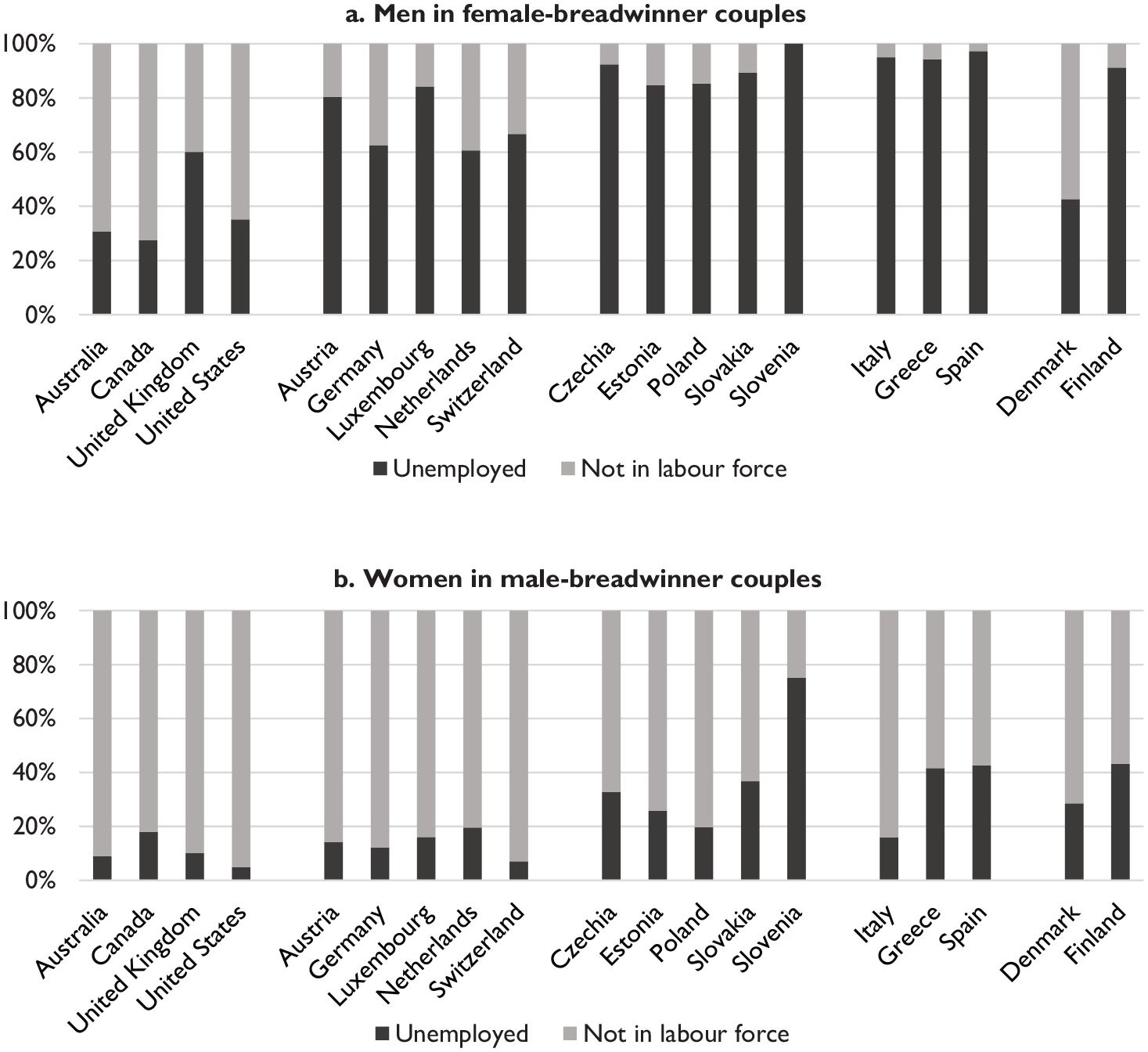
Labour force status of non-employed partners in (a) female-breadwinner couples and (b) male-breadwinner couples, by country.
The frequency of female breadwinning in Spain and Greece similarly reflects labour market and economic factors in addition to welfare state ones (Sánchez-Mira and O’Reilly, 2019). Couples comprising an employed man and inactive/unemployed woman are commonplace in these countries, particularly among the lower-educated (Hook, 2015; Lewis et al., 2008; Sánchez-Mira and O’Reilly, 2019). At the same time, studies have suggested a strong ‘added worker effect’ in Mediterranean countries: when the male partner loses his job, the female partner is likely to compensate by increasing her labour supply (Bredtmann et al., 2018). In this context, then, a high share of ‘pure’ female breadwinners is likely associated with job loss among male breadwinners. Indeed, Spain and Greece shared high male unemployment rates in 2016 of 17 percent and 19 percent respectively (OECD, 2020), reflecting the prolonged impacts of the 2008 recession on male-dominated industries (e.g. Sánchez-Mira and O’Reilly, 2019). The strength of familialism and low levels of social protection in Mediterranean countries add to the financial incentives and pressures for inactive women to enter employment when the male breadwinner loses his job.
High rates of female breadwinning in Canada are more perplexing, mainly because prior comparative studies on household-level employment arrangements have neglected this country. They could be linked to a higher male unemployment rate in Canada compared with other Anglo-Saxon countries (OECD, 2020). They could also relate to the incentive structures embedded in the welfare state. For Canada and other Anglo-Saxon countries, a comparatively high percentage of men in female-breadwinner households are inactive rather than unemployed (Figure 2). More generous inactive benefits compared with unemployment assistance can discourage non-employed individuals with a full-time employed partner from registering as unemployed. In addition, the means-testing of benefits in Anglo-Saxon countries – which are based on a couple’s circumstances rather than those of the individual and are targeted at low-income families – creates poor financial incentives for the inactive partners of breadwinners to enter employment. The labour income that would be gained is often negated by the sharp drop in income from benefits, which are withdrawn steeply as household earnings rise (e.g. Kell and Wright, 1990; Nolan, 2006).
Overall, then, we see that a non-negligible share of heterosexual couple-households across industrialized countries is now headed by a female breadwinner, even if the prevalence varies across different countries. But what are the economic (dis)advantages of being in a female-breadwinner couple rather than a male-breadwinner one? Thus far, studies have neglected this issue. We contribute to addressing this ‘gap’.
Results
Figures 3–5 present the results of our regression models in a graphical form; the supplemental material gives details of our estimates. As Figure 3 shows, dual-earner couples have the highest incomes of all couple-types. ‘Pure’ breadwinner couples, in which only one member of the couple is employed, tend to have the lowest disposable household incomes of all couple-types after controlling for basic sociodemographic variables. Moreover, in 12 out of 20 countries, pure female breadwinners have lower total disposable household incomes than pure male breadwinners. Such differences remain statistically significant after controlling for occupation and number of hours worked (see also Figure S1 in the supplemental material). In the remaining eight countries (Austria, Canada, Finland, Greece, Luxembourg, Netherlands, Slovenia and Switzerland), differences are not statistically significant. Even so, the results show that, when controlling for basic sociodemographic information, it never happens that pure female breadwinners have higher household incomes than pure male breadwinners.
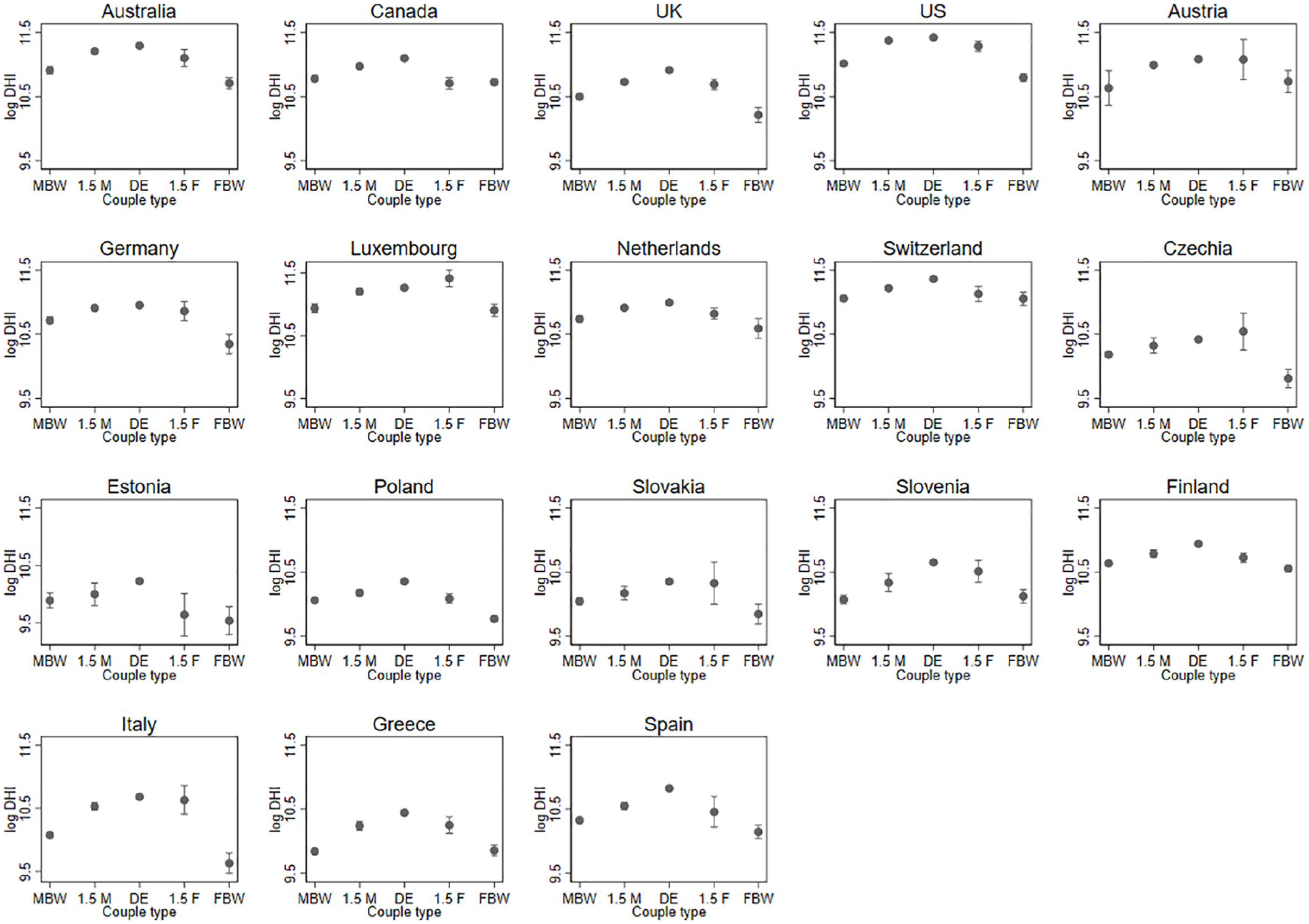
Predicted logarithm of disposable household incomes from linear regression model with 95% confidence intervals.
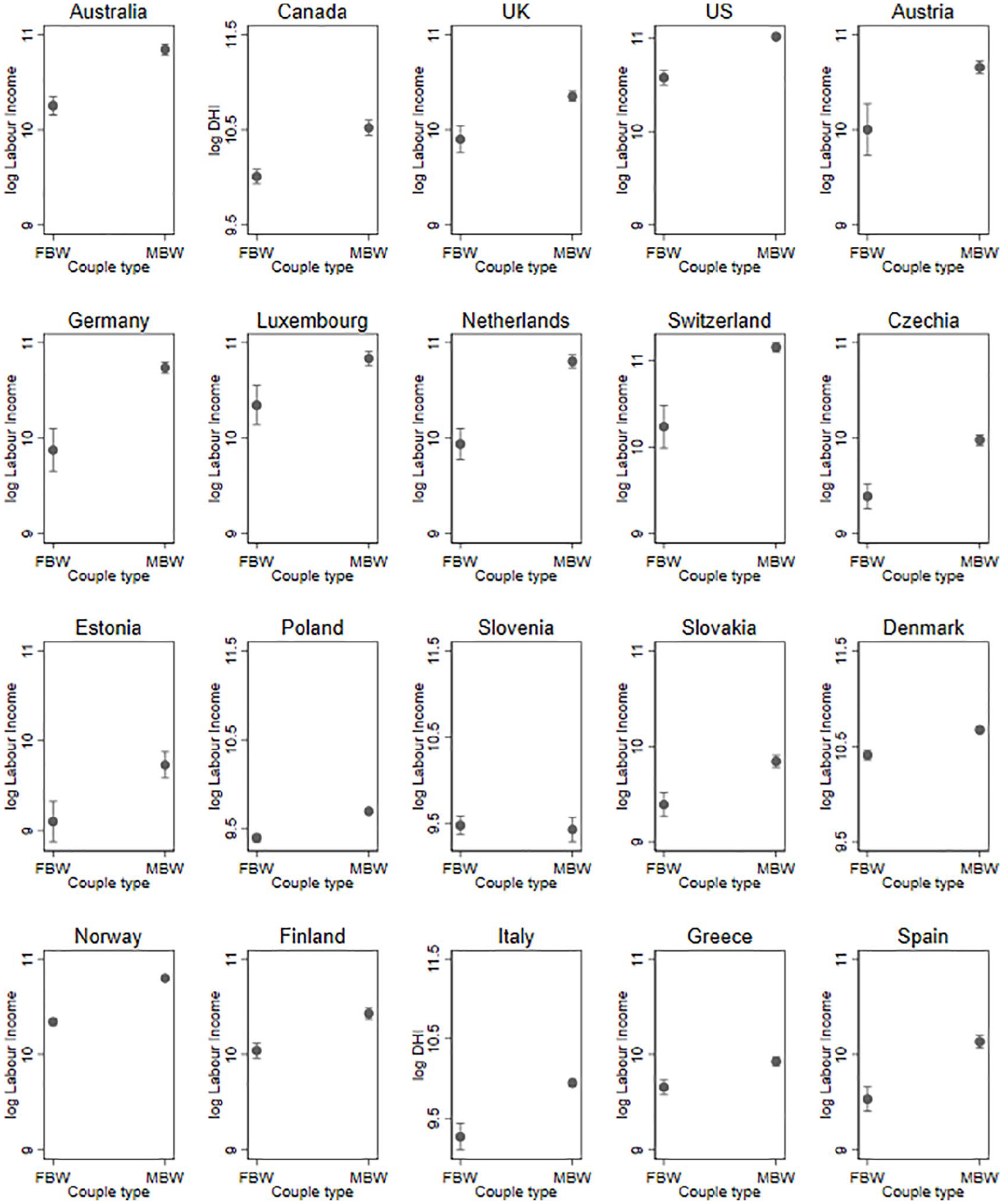
Predicted logarithm of individual labour income earned by the breadwinner from linear regression model with 95% confidence intervals.
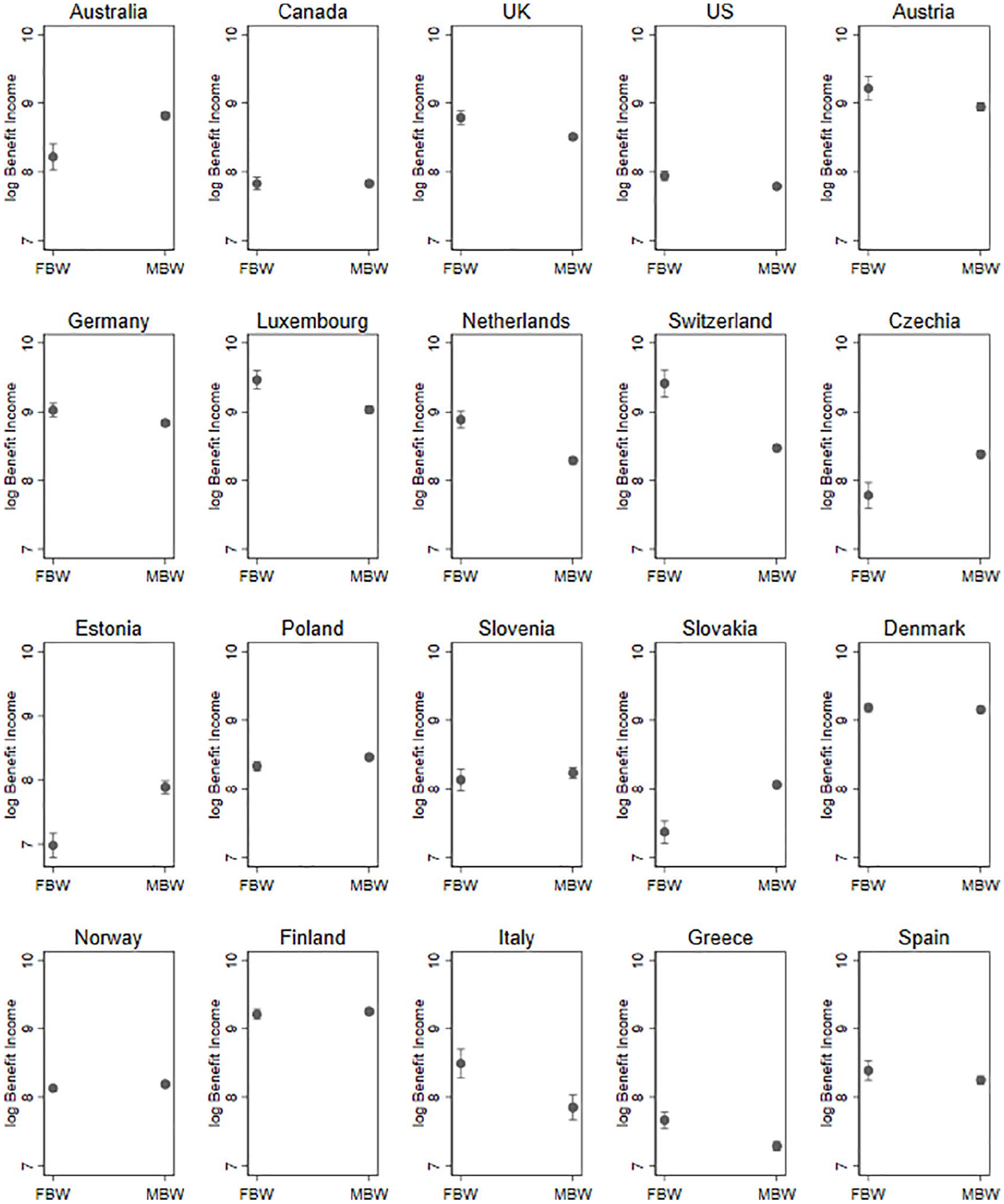
Predicted logarithm of household social benefit income from linear regression model with 95% confidence interval.
Earnings play a role in explaining this income disadvantage for pure female-breadwinner couples. Slovenia is the only country for which we see no earnings difference between pure female breadwinners and pure male breadwinners, which might help to explain why differences in total household incomes are also not significant between these two couple-types. Nevertheless, in every other country, pure female breadwinners’ average individual labour earnings are lower compared with those of pure male breadwinners (Figure 4). This earnings disadvantage is statistically significant everywhere. Table 1 shows that men heading pure male-breadwinner households typically work longer hours than women who head pure female-breadwinner couples and are more likely to work in managerial and professional occupations but less likely to be in elementary occupations. Yet, earning differences between pure male and pure female breadwinners persist even when controlling for working hours and occupation (Models 2–4 in Table S3 in the supplemental material). Similarly, earning differences generally persist between pure male and pure female breadwinners with the same levels of education (Figure S1 in the supplemental material). Lower-educated pure female breadwinners have significantly lower earnings than lower-educated pure male breadwinners, except for Slovenia. The earning differences are present also among the higher-educated, but they are not statistically significant in seven out of 20 countries (Canada, Austria, Germany, Luxembourg, Czechia, Estonia and Slovenia). Furthermore, in most countries, there is no statistically significant difference between low/medium educated male breadwinners and highly educated female breadwinners in terms of individual earnings.
Benefit incomes also help to explain observed differences in household incomes. Among couples in receipt of social-security transfers, pure female-breadwinner households receive higher average benefit incomes than pure male-breadwinner households in half of the countries (Figure 5). However, female breadwinners’ higher benefit incomes are statistically significant only in Greece, Luxembourg, the Netherlands, and Switzerland. Unlike elsewhere, higher benefit incomes in these countries help to bring female breadwinners’ total household incomes in line with those of male breadwinners, so that differences in disposable houshold incomes between the two couple-types are not statistically significant. 4 Conversely, in the remaining half of the countries, pure female-breadwinner couples receive less in benefits than pure male-breadwinners couples, despite female breadwinners’ significantly lower labour incomes. Female breadwinners’ lower benefit incomes are statistically significant for Australia, Czechia, Estonia and Slovakia.
Turning to differences within the female breadwinner category, the results reveal substantial heterogeneity. Across all 18 countries for which we have data on one-and-a-half female breadwinners, we find that these women have higher average household incomes than pure female breadwinners, although these differences are not statistically significant in six countries (Figure 3). (This mirrors the differences observed between pure male-breadwinner and one-and-a-half male-breadwinner couples, in that the latter tend to have higher average incomes.) As the descriptive statistics show (Table 1), women heading one-and-a-half female-breadwinner couples are of a higher socioeconomic status than women heading pure female-breadwinner couples across the pooled sample and have the highest average labour incomes of women across all couple-types. The household incomes of one-and-a-half female breadwinners are further boosted by higher individual labour earnings for male secondary earners, who are more likely to be highly educated and less likely to be lower-educated than men in pure female-breadwinner couples.
Finally, regarding differences between one-and-a-half breadwinners by gender, we find smaller household income disparities than for pure breadwinners (Figure 3). Furthermore, after controlling for basic sociodemographic variables, these differences are not statistically significant, with only two exceptions: in Canada, one-and-half male-breadwinner couples have a higher disposable household income than their female counterparts, whereas the opposite holds for Luxembourg. Yet, one-and-a-half female breadwinners still earn less as individuals, on average, than their male counterparts, despite their higher levels of education (Table 1).
Study limitations
Our study presents some limitations. First, for some countries, we have incomplete information on certain variables – in particular, hours worked and occupation – which in some of the analyses limits the cross-national comparison. Benefit incomes are also not fully comparable, as data on family benefits are unavailable for Italy and definitions of family benefits and unemployment support vary across countries. Furthermore, we do not consider use of public services, even though these are also important for explaining employment levels and earnings, especially for women as both recipients and employees of welfare services.
Second, individual labour and benefit incomes in LIS are reported gross of taxes and social contributions for most but not all countries. Such differences in measurements might result in differences in income levels across countries (Nieuwenhuis et al., 2017) 3 , as results based on net measures can, in principle, differ from results based on gross measures. That said, results based on disposable (i.e. net) household incomes confirm those based on (gross) labour income, thereby indicating the robustness of our findings.
Third, the LIS data used in this study are based on cross-national surveys that took place in different years spanning from 2012 to 2016. Therefore, for some countries more than others, the findings might be influenced by the backlash of the 2008 economic crisis, which affected male unemployment more than female unemployment and resulted in a (temporary) increase in the share of female-breadwinner couples (Sánchez-Mira and O’Reilly, 2019; Vitali and Arpino, 2016). This could also contribute to explaining female breadwinners’ economic disadvantage compared to other couple-types.
Finally, in our modelling strategy we assumed that the effects of the control variables measuring hours worked and occupation are the same across all countries and for women and men. Future studies including more countries might benefit from a multilevel modelling strategy that allows for the effect of hours worked and occupation to vary across countries and genders.
Discussion and conclusion
The purpose of this paper has been to highlight a case for integrating the female-breadwinner couple-type into the male-breadwinner/dual-breadwinner framework that underpins the literature on work–family arrangements and policies. Including female-breadwinner couples matters because of their growing prevalence and, as our analysis has shown, greater economic vulnerability. Prior research has drawn attention to the lower average incomes of sole-earner couples compared with dual-earner ones (e.g. Esping-Andersen, 2002). Our analysis has revealed that the gender of the sole earner also matters; it never happens that pure female breadwinners have higher average household incomes than pure male breadwinners across all 20 countries in our study.
Even where gaps between pure female-breadwinner and male-breadwinner couples in terms of overall household incomes are narrow, this conceals the former’s lower average individual earnings. The female breadwinner earnings penalty persists even after controlling for occupation and number of hours worked in addition to sociodemographic characteristics. In other words, the earnings gap between female and male breadwinners is only marginally explained by gender differences in occupation and number of hours worked. Education also does not explain the gap. Instead, our findings suggest the rise in educational hypogamy is largely irrelevant: for most countries, labour incomes are significantly higher for highly educated male breadwinners compared with highly educated female breadwinners; and highly educated female breadwinners do not have significantly different incomes from male breadwinners with low/medium levels of education.
The female breadwinner earnings penalty likely reflects women’s secondary labour market position, which is upheld by gender cultures and policies that, despite being couched in such gender-neutral language as ‘parents’, encourage women to withdraw or reduce their labour force participation for motherhood and caregiving purposes without adequately targeting men’s behaviour as fathers (e.g. Daly, 2011). In turn, women accumulate less on-the-job experience and seniority than men, are more likely to pass up additional workplace responsibilities that clash with family responsibilities, and experience greater discrimination from employers who (falsely) assume that women are less committed to their careers. Thus, women’s earnings growth is lower over time compared with men (e.g. Budig and England, 2001). These factors might also help to explain why we see larger earnings penalties for breadwinning women in countries where policies encourage mothers to take long breaks from employment, adequate alternatives to home-based childcare are lacking, traditional gender norms remain strong, and/or the ‘one-and-a-half male breadwinner’ prevails; for example, Czechia, Germany, Italy, Poland, and the UK (e.g. Ciccia and Bleijenbergh, 2014; Hook and Pettit, 2016). In these settings, breadwinning women are more likely to have had discontinuous employment histories and/or periods spent working in part-time (and often lower-paid) jobs when compared with male breadwinners.
The female breadwinner earnings penalty may also reflect that some of these women are ‘emergency’ breadwinners, in that their breadwinner status is less a deliberate choice and instead a reaction to adverse economic circumstances (e.g. Drago et al., 2005). This fits with research that explains the rise in female breadwinners as a by-product of poor economic outcomes for low-skilled men (e.g. Dotti Sani, 2018). Indeed, prior research has found evidence for an ‘added worker’ effect across Europe, whereby non-employed women enter employment to compensate for a partner’s job loss (Bredtmann et al., 2018). For such women, finding a ‘good’ job is complicated by time spent outside of the labour market and the aforementioned penalties associated with this, as well as a lack of demand-side opportunities if overall unemployment is high. Correspondingly, we find that pure female breadwinners in Mediterranean countries – where prior research has found a strong added worker effect for women under high male unemployment (Bredtmann et al., 2018) – have fewer years of labour market experience than pure male breadwinners, even if they have more years of experience than women in other couple-types. For instance, in Spain, pure male breadwinners have, on average, 26 years of employment experience compared with 19 years for pure female breadwinners. 5 A theoretical implication of this finding is that labour market characteristics and economic cycles should be considered alongside family and other social policies in studies of work–family arrangements and incomes. As Haas et al. (2006) argue, women’s employment behaviour cannot be directly read off from policies. Economic and labour market conditions and other broader structural conditions shape the structure of constraints and opportunities for women and help to explain cross-national patterns in female breadwinning. Potentially, these factors also shape households’ incomes under the female-breadwinner arrangement and serve to widen inequalities between male-breadwinner and female-breadwinner households.
Arguably, then, the current policy imperative towards ‘employment for all’ (Orloff, 2006) is found wanting. Despite some acknowledgement by proponents of this agenda of gender disparities in paid work, getting more women into (any) employment to secure the financial sustainability of the welfare state is considered ‘of utmost priority’ (Hemerijck et al., 2016: 22). Nevertheless, we require a broader array of policies to reduce gender gaps in earnings and employment outcomes and not just employment rates, such as educational programmes to counter gender stereotypes and gendered educational choices, or policies that encourage men to take up parental leaves (Bettio and Verashchagina, 2009). Such policies can better support families to hedge market risks, so that if the woman becomes the only wage-earner following her partner’s job loss, this does not have the effect of widening inequalities between work-rich and work-poor households. They can also help to challenge norms that emphasize men’s breadwinning: it is only through degendering unpaid care and paid employment that the gendered division of labour can be ‘undone’.
Our analysis additionally suggests that benefits systems generally do not compensate for female breadwinners’ lower average earnings. Descriptive analyses show that male-breadwinner couples receive considerably more family-related benefits than female-breadwinner couples, while female-breadwinner couples receive more unemployment-related benefits. 6 Yet, unemployment-related benefits are likely to be more short-lived. Moreover, when we look at overall benefit incomes received by pure male-breadwinner versus pure female-breadwinner couples, we find that differences are not statistically significant, despite the latter’s lower labour earnings. And in Australia, Czechia, Estonia and Slovakia, pure female-breadwinner couples actually receive statistically significantly lower benefit incomes than their male counterparts. For Czechia, Estonia and Slovakia, this likely reflects lean employment benefits, as the partners of female breadwinners are overwhelmingly unemployed. Conversely, women in male-breadwinner couples are more likely to be out of employment for domestic reasons and receive leave and family allowances, which have become more generous since the transition to a market economy, particularly in Czechia and Estonia (e.g. Javornik, 2014). For Australia, it is potentially explained by the high proportion of pure female breadwinners with an inactive partner (69 percent), as these couples receive less in benefit income than male-breadwinner couples with an inactive woman. 7
Other literatures have similarly identified female breadwinners as a distinct analytical category due to their exposure to other forms of vulnerabilities, such as poorer relationship satisfaction, lower wellbeing and higher rates of union dissolution (e.g. Blom and Hewitt, 2019; Brennan et al., 2001). Thus, our study adds to a growing body of evidence that female-breadwinner families sit at the intersection of multiple disadvantages and social risks, such as having a low income, work–family conflicts, and becoming a single parent through relationship breakdown. Consequently, the female-breadwinner couple offers scholars of the welfare state an ‘acid test’ case study for how effectively institutional arrangements protect families from social risk.
That said, our analysis uncovered heterogeneity among female breadwinners. Regression models showed that one-and-a-half female-breadwinner couples, comprising a full-time employed woman and part-time employed man, have higher average household incomes than pure female-breadwinner couples across almost all countries. Descriptive statistics further revealed that, compared with pure female breadwinners, one-and-a-half female breadwinners are of a higher socioeconomic status as measured by individual labour earnings, occupation, and education. Accordingly, it is possible that the rise in female breadwinning will, alongside the growth of single-mother families among lower-educated women and dual breadwinning among higher-educated women, consolidate the ‘diverging destinies’ of families: while children born to higher-educated mothers are gaining advantages, children born to lower-educated mothers are falling behind (Hook, 2015; McLanahan, 2004). This is another reason why the social policy literature should pay attention to the trend towards greater female breadwinning.
Supplemental Material
sj-pdf-1-esp-10.1177_0958928720971094 – Supplemental material for Breadwinning or on the breadline? Female breadwinners’ economic characteristics across 20 welfare states
Supplemental material, sj-pdf-1-esp-10.1177_0958928720971094 for Breadwinning or on the breadline? Female breadwinners’ economic characteristics across 20 welfare states by Helen Kowalewska and Agnese Vitali in Journal of European Social Policy
Footnotes
Acknowledgements
The authors thank participants of the Family Lunch Research Group at the University of Southampton and the Female-Breadwinner Families Workshop, London, 12 December 2018, for their helpful comments on the research. Thanks also go to two anonymous referees and the editor for their valuable feedback on an earlier draft of this paper.
Funding
The author(s) disclosed receipt of the following financial support for the research, authorship, and/or publication of this article: This research was funded by the Economic and Social Research Council under the Future Research Leaders Grant, ‘Female-Breadwinner Families in Europe,’ reference number ES/N00082X/1, and the Postdoctoral Fellowship, ‘Social Policies to Support Women’s Employment and Achieve Gender-Friendly Workplaces’, reference number ES/S010793/1.
Supplemental material
Supplemental material for this article is available online.
Notes
References
Supplementary Material
Please find the following supplemental material available below.
For Open Access articles published under a Creative Commons License, all supplemental material carries the same license as the article it is associated with.
For non-Open Access articles published, all supplemental material carries a non-exclusive license, and permission requests for re-use of supplemental material or any part of supplemental material shall be sent directly to the copyright owner as specified in the copyright notice associated with the article.
