




Abstract
In this article, we examine the impact of the introduction of parental leave policy in 1999 on the labour-market engagement of mothers with one and two children in Luxembourg, who had been working 20 or more hours per week before childbirth. Labour-market engagement is measured by the number of hours worked monthly, 1, 2 and 3 years following the birth of the last child. Analyses are conducted using longitudinal social security records data from 1995 to 2002. The difference-in-differences (DiD) method is used to establish a causal relationship between the introduction of the policy and its outcomes. The results of the analyses reveal that among mothers with one child, the introduction of the policy had a significant and positive impact on the working hours during the first 3 years after childbirth. Among mothers with two children, the impact of the policy was significant for 1 year after childbirth. Heterogeneity effect analysis shows that single-child mothers who worked part-time before childbirth were substantially more responsive to the policy than their full-time working counterparts.
Introduction
Work–family reconciliation policies, such as parental leave, are designed to reduce the negative consequences of parenthood (among other things, lower labour-market participation of mothers) and promote gender equality in the division of labour (Gornick and Meyers, 2003). Having children might have a negative impact on mothers’ future career (Dex et al., 2008; Evertsson and Grunow, 2012). Parental leave represents a temporary career break. It allows parents to dedicate some time to childcare while retaining the right to return to their previous job, so that their likelihood of remaining in the labour market after the birth of a child is enhanced.
There is a vast body of literature dealing with the effect of parental leave policy on post-birth labour-market outcomes for women, mainly focusing on labour-market participation and, in particular, returning to the labour market. The studies that analyse the intensity of labour-market participation, measured by the hours worked by mothers after childbirth are scarce (for exceptions, see Akgunduz and Plantenga, 2013; Merz, 2004; Rossin-Slater et al., 2013; Thevenon and Solaz, 2014). Even though examining the intensity of women’s labour-market participation in the current context has become increasingly relevant over recent decades, the younger generation of mothers, especially in countries where part-time work is possible and common (for example, Luxembourg), do not tend to withdraw completely from the labour market but tend to reduce their working hours (Musumeci and Solera, 2013; Valentova, 2011). Therefore, the average number of hours worked after childbirth seems to be a more informative and less crude indicator of labour-market engagement than a binary variable measuring whether or not mothers return to work.
Several gaps can be identified in existing literature dealing with the effect of parental leave policy on mothers’ working hours after childbirth. First, these studies mainly use aggregated data from different countries (e.g. Akgunduz and Plantenga, 2013; Thevenon and Solaz, 2014), which preclude detailed analysis of the causal mechanisms related to actual policy changes. Second, studies using individual data (e.g. Merz, 2004; Rossin-Slater et al., 2013) cover only a few countries, for example, the United States and Germany, which have particular parental leave schemes in terms of duration: either very short or relatively long. Third, existing evidence focuses mainly on the general effects of parental leave policy, such as the hours worked by mothers after childbirth rather than differences in the effect of the policy among sub-groups of parents with different workplace characteristics. Detailed evidence about the duration of the effect of parental leave policy on the number of working hours after childbirth is also missing. Therefore, it is not clear whether parental leave policy only has an impact on mothers’ labour-market participation during the first months after childbirth or has longer term effects. In this article, we aim to address these gaps in literature. We examine the causal effect of the introduction of parental leave policy in Luxembourg on the intensity of mothers’ labour-market participation after childbirth and on the duration of this effect. In concrete terms, we analyse the effect of the policy on the hours worked, 1, 2 and 3 years after childbirth. 1 We also examine differences in responses to parental leave policy between mothers of one and two children (analysed separately) and between mothers who were working full-time and those working part-time before childbirth. The analysis is restricted to women who had been working 20 or more hours per week before childbirth. This implies that women not working or working on marginal basis (which represents 4% of the original sample of childless women, 6% of mothers of one child and 11% of mothers of two children) are not part of this study. Social security administrative data from L’Inspection Générale de la Sécurité Sociale (IGSS) from 1995 to 2002 and the difference-in-differences (DiD) method are used to estimate the effect of the policy on selected outcome variables.
We chose Luxembourg for this study for various reasons. The first reason is because the unanticipated introduction of parental leave policy in 1999 created a natural experiment that allows for the assessment of the causal effects of the policy on labour-market engagement. The second reason is because of the availability of unique social security data for the period before and after the introduction of the policy, which allows us to use the DiD method. The third reason is due to the specific Luxembourg welfare and family policy context at the time parental leave was introduced, where its introduction represented a ground-breaking intervention in the existing, traditional family policy structure and where analysis of the effect of the policy on labour-market intensity is relevant due to widespread part-time employment among young mothers. In addition, the parameters for parental leave in Luxembourg (mainly the duration and level of wage replacement) are very different from those in countries where the effects of leave have already been analysed. The fourth reason is because a case study based on one country has advantages over a cross-country estimation of the causal effect of a policy on labour-market outcomes. Countries differ in terms of overall policy regimes, which makes it difficult to determine whether a specific policy or instead a unique combination of policies might be responsible for empirically observed cross-country differences in the outcomes of interest (Ziefle and Gangl, 2014).
This article contributes to existing literature in several ways. First, we provide information about the impact of the policy on the number of hours worked during the first 3 years after childbirth, which allows us to measure not only the magnitude of the effect but also its duration. Second, we shed more light on the heterogeneity of the effect between mothers of one or two children and between mothers working full-time or part-time prior to childbirth. Finally, we examine Luxembourg, where the impact of parental leave on the labour-market behaviour of mothers has not previously been explored.
Theory and existing evidence
One of the primary aims of parental leave policy is to allow the reconciliation of work and family life, thereby promoting female labour-market participation (Gornick and Meyers, 2003). This is why a vast body of empirical literature focuses on labour-market participation in terms of whether or not women return to work after childrearing (i.e. a binary outcome). Existing evidence from various countries suggests that parental leave has a positive impact on mothers’ return to work after the birth of a child (Akgunduz and Plantenga, 2013; Han et al., 2007; Lalive and Zweimüller, 2009; Misra et al., 2007; Ondrich et al., 1996; Pronzato, 2009; Ruhm, 1998; Thevenon and Solaz, 2014). Parental leave arrangements motivate women to enter employment before childbirth (Han et al., 2007; Ruhm, 1998) in order to gain eligibility for leave, as well as to re-enter the labour market subsequently (Bergemann and Riphahn, 2011; Pronzato, 2009). It has also been found that paid parental leave entitlement of up to a year after childbirth is positively related to the likelihood of mothers returning to their job (Pronzato, 2009; Ruhm, 1998; Waldfogel et al., 1999). With regard to leave longer than approximately 1 year, the association is not as straightforward (Ondrich et al., 2003). In line with this, Ejrnaes (2011) shows that mothers perceive longer leave arrangements as more harmful to their further career than shorter ones.
There are notably fewer studies that focus on the intensity of labour-market participation, measured by the working hours after the birth of a child, despite the fact that this approach provides a more comprehensive picture about mothers’ labour-market behaviour (Akgunduz and Plantenga, 2013; Buligescu et al., 2009; Merz, 2004; Rossin-Slater et al., 2013; Thevenon and Solaz, 2014). Merz (2004) argues that the number of hours worked has not yet been widely explored, but that it is a very important labour-market outcome variable as it allows measurement of the intensity of women’s involvement in the labour market, not just its existence. As female labour-market activity continues to increase and voluntary labour-market withdrawal for family reasons has become less frequent among younger women during recent decades (Eurostat, 2015), measuring the intensity of their engagement should provide more insight into real labour-market behaviour. Existing studies analysing the effect of parental leave on the hours worked by mothers after the birth of a child provide inconclusive results. Merz (2004) states that the lengthening of parental leave in Germany is associated with a decrease in the number of hours worked. However, Rossin-Slater et al. (2013), using data from the United States, suggest that parental leave policy leads to an increase in working hours. Based on aggregated data from European countries, Akgunduz and Plantenga (2013) and Thevenon and Solaz (2014) claim that parental leave shorter than 2 years is linked to an increase in working hours after childbirth, whereas extending parental leave above this threshold is associated with the opposite effect.
Existing theory and empirical research suggest the following possible reasons for the causal effect between parental leave policy and the number of hours worked after childbirth. The first reason concerns the fact that parental leave policy guarantees returning to the same employer and an equivalent position occupied before childbirth. This prevents mothers from facing several costs related to returning to the labour market (e.g. loss or deterioration of the job and company-specific human capital and job search costs), which are typical for mothers who become inactive in the labour market due to childcare responsibilities (Akgunduz and Plantenga, 2013; Pronzato, 2009; Ruhm, 1998). Mothers who are able to benefit from parental leave policy can avoid these costs and, consequently, are more likely return to work earlier after childbirth than their counterparts who made their choices in the absence of the policy. This mechanism has a direct impact on the working hours of mothers. If parental leave policy exists, mothers are more likely to return to paid work faster and, therefore, will work more hours than they would have done at a particular point in time after birth in the absence of this policy.
Second, Klerman and Leibowitz (1997) posit that as the child grows older, the value of the mother’s time at home decreases. Accordingly, parental leave represents a bridging period, during which the mother can dedicate time to care when it is most needed and return to work when the utility of staying at home is lower. In the absence of parental leave policy, women would be more likely to assume their care responsibilities for young children by reducing their work engagement. The availability of parental leave changes this way of proceeding among eligible women. The Organisation for Economic Co-operation and Development (OECD; 2004) shows that parental leave policies affect parents’ choices after childbirth, not only between activity and inactivity but also between full-time and part-time work. The disadvantages resulting from labour-market withdrawal due to childcare are noted above, however, a reduction in working time also has risks. If someone becomes a part-time worker, she has a tendency to stay in this status for a long time; the transition from part-time to full-time work is infrequent in European countries (OECD, 2010). In line with this, O’Reilly and Bothfeld (2002) show that in Germany and the United Kingdom, only a small proportion of women are able to use part-time work as a bridge to full-time employment.
Third, the introduction of parental leave policy can contribute to changing normative attitudes to female labour-market participation, leading to higher acceptance of continuous engagement of women, both by employers and women themselves (Thevenon and Solaz, 2014). These women become more attached to the labour market and tend to work more hours (i.e. they are less likely to opt for part-time work or labour-market withdrawal).
A fourth reason for expecting an effect of parental leave policy on the number of working hours after childbirth is related to the gender neutrality of parental leave. This gender neutrality allows fathers to also be engaged in care responsibilities and, consequently, reduces the costs related to caring among mothers (Duvander and Jans, 2009). Mothers whose partners take parental leave, gain time and have the opportunity to be engaged in paid labour, which would not be the case in the absence of the policy. Reich et al. (2012) also argue that greater engagement of a father in childcare due to taking parental leave will have an impact on the distribution of paid and unpaid labour in the household in the long term. If men take leave when their child is at an early age, they will develop their caring potential. Consequently, they will be as equally likely as mothers to also take carer’s leave in the longer term.
To the best of our knowledge, there is no study that explores the heterogeneity of the effects of parental leave policy on the post-childbirth hours worked by mothers. This issue remains unexamined, mainly due to a limited sample size (Rossin-Slater et al., 2013), and represents a gap in relevant literature. In the absence of any previous research or existing evidence, we review and take inspiration from published research showing the varying effect of parental leave on mothers’ return to work after childbirth across mothers with different pre-childbirth wages, occupational status (Lalive and Zweimüller, 2009), level of education and marital status (Washbrook et al., 2011). In concrete terms, women with a higher level of education, occupational status and earnings are more likely to return to the labour market than women who have a lower level of education, a lower occupational status and less pay. Based on this evidence, we make deductions relevant for this article, that is, we assume that the effect of the policy on the intensity of labour-market participation will also vary across these different groups of mothers. Thus, more precisely, it can be hypothesized that after birth, higher skilled women will exhibit more hours worked per month than their lower skilled counterparts. Heterogeneity of the effect of the policy can be also expected among mothers with different numbers of children or different levels of work engagement at childbirth (i.e. full-time or part-time work).
The number of children also affects the labour-market strategies of a mother. In most countries, the negative impact increases from the first to the second child (Lalive and Zweimüller, 2009; Musumeci and Solera, 2013; Vlasblom and Schippers, 2006). There are several possible explanations for this. The first may be that having two children represents greater risk to a woman’s further career development due to longer career interruptions for childcare and the heavier daily caring burden on mothers with more children. Another explanation is based on selection into multiple motherhood, where women with specific characteristics (e.g. sociodemographic characteristics, work–family preferences and level of work attachment) tend to have more children, and the same characteristics also affect their post-birth labour-market strategies. Single-child mothers may be more work oriented and thus more attached to the labour market, which means that they will be more likely to return to the labour market after childbirth than mothers with more children.
When analysing the effect of parental leave policy on the hours worked after childbirth, the available evidence focuses on employed mothers (Merz, 2004; Rossin-Slater et al., 2013), without accounting for the intensity of their previous labour-market engagement (i.e. the hours worked before childbirth). As the intensity of labour-market involvement before childbirth might be related to post-birth labour-market behaviour, it is crucial to explore differences between mothers who worked full-time and those who worked part-time before childbirth. Existing literature suggests that women who were working part-time before the birth of their first child might differ systematically from those who were working full-time. Among part-time employees, there is a higher concentration of low-skilled, lower paid workers with fewer opportunities for career advancement (Fagan and O’Reilly, 2002). In addition, part-time workers might differ systematically from their full-time working counterparts in terms of their work orientation. A higher proportion of part-timers is found among women with an adaptive preference (i.e. women who aim to reconcile work and home equally). A higher concentration of full-timers is found among work-oriented women (Hakim, 2002).
There are only a few studies that examine parental leave and the post-childbirth labour-market behaviour of women in Luxembourg (Bousselin, 2007; Lejealle, 2005, 2008; Valentova, 2011; Zhelyazkova, 2014). However, these studies do not analyse the intensity of labour-market participation and do not allow for a causal interpretation of the relationship between parental leave and labour-market behaviour.
Luxembourg context
A universal scheme for parental leave was introduced in Luxembourg in 1999, 3 years after the European Union (EU) directive on parental leave (Council Directive 96/34/EC). One of its main objectives was to improve the balance between family and professional life, therefore also the labour-market participation of women (Feyereisen, 2008). Motivating women to remain in the labour market after having children is one of the goals of the country’s employment policy (National Action Plan). Parental leave may have an important role in this process because at the beginning of 2000, it was the only policy apart from part-time job arrangements and limited childcare services to directly encourage balancing family and work life. 2
Parental leave in Luxembourg is fully job protected, meaning that eligible parents (both mothers and fathers) are guaranteed the right to subsequently return to the same or an equivalent work position. Eligibility requirements for parental leave are a minimum of 1 year’s employment with the same employer prior to the start of the leave, and a reduction of at least 50 percent of working hours in the case of taking part-time leave. Self-employed workers are also eligible if they have been self-employed for at least a year and for at least 20 hours per week. Single parents are entitled to only one period of parental leave; however, they do not necessarily have to take it immediately after maternity leave. Eligible parents (each of them) can take either a period of 6 months’ full-time leave or 12 months’ part-time leave. The leave can be taken up to the fifth birthday of the child. The right to take leave is not transferable between parents. There is a requirement that the first period of leave in a two-parent family must be taken immediately after maternity leave. If parental leave is not taken immediately after maternity leave, the right to it is forfeited. However, the second period of leave (for a family of two parents) can be taken at any time until the child turns five.
The leave is paid, and the flat-rate benefit up to 2006 was equal to €1496 for full-time leave. In 2007, it increased to €1778, which is approximately equivalent to the minimum wage for an unqualified worker. Valentova and Bia (2013) show that the average take-up rate was 46.3 percent for the population of single-child mothers between 1999 and 2007, and the rate increased over this period. On average, 19 percent of mothers who took parental leave opted for the part-time model. Only about 1.5 percent of mothers with one child who took parental leave also took a second period of leave. Parental leave is gender neutral, meaning that both eligible mothers and fathers can apply for it, and it is important to note that the parental leave take-up by fathers was relatively high (about 10%) between 1999 and 2007 (Zhelyazkova et al., 2015). This indicates that part of the care responsibilities for young children was taken up by fathers.
At the time of the introduction of the parental leave policy in 1999, Luxembourg exhibited prevailing pro-familialistic characteristics (pro-male-breadwinner), as defined by Leitner (2010) and Sainsbury (1996). To state the most influential features, Luxembourg had – and still has – a joint taxation system, in which a married couple is treated as one tax unit and the tax rate is based on the average income of the partners. The larger the discrepancy between the spouses’ incomes, the higher the tax relief. This tax arrangement discourages women from participating in the labour market and favours the male-breadwinner model for the household division of labour. Another pro-familialistic feature is the ‘child allowance’, which provides parents of a child under the age of 2 years, who decide to quit the labour market to dedicate themselves fully to bringing up the child, with a sum of money equal to approximately one-third of the minimum wage. 3 In this case, returning to a previous job is not guaranteed by law.
As the labour-market outcomes of the parental leave policy might be confounded by the change in childcare policies (OECD, 2004), this paragraph details formal childcare arrangements. According to the OECD (2010), in 2004, the cost of childcare in Luxembourg was the highest in the EU, and the enrolment of children under 3 years of age in day care was among the four lowest in the EU countries. In 2002, there were only 2500 available places in formal childcare. Childcare subsidies were only introduced in 2009, when the state provided parents with financial support (the Le Cheque-Service Accueil) to benefit from childcare provision for children aged 0–12 years. The support is universal and means tested. Up to 2009, no financial compensation for the high cost of formal childcare was provided to parents (Bousselin, 2014), which is in line with the pro-familialistic legacy of the country’s welfare system. To make sure that the changes to the statutory childcare policies do not affect our research design and results, the following should be noted. First, the parental leave policy was introduced in 1999, and second, this article analyses the labour-market outcomes of parental leave as close to the introduction of the policy as possible to avoid any confounding effect of other policies (for more details, see Note 6).
The outlined pro-familialistic welfare legacy is very closely related to the high level of female labour-market inactivity due to family responsibilities. Eurostat data show that in 2004, more than 30 percent of the female labour force still belonged to this category (Valentova, 2011). OECD (2004) figures show that in 1998, in about 49 percent of households, men worked full-time and women were not employed, whereas only 12 percent of couples preferred this arrangement. This indicates a substantial discrepancy between reality and preference, and consequently, there was motivation on the supply side to change the situation.
However, the beginning of 2000 was also characterized by extraordinarily high growth in female employment in Luxembourg. The growth rate in 2000 was 6 percent compared with an average of 2 percent in the other EU-15 countries. This made Luxembourg the fastest changing country in the EU-15 zone with regard to female engagement in paid labour (Eurostat, 2015).
Part-time work plays a very important role in female labour-market engagement and is one of the ways how women reconcile work and family life. In the late 1990s and the beginning of 2000, almost every fourth employed woman in Luxembourg worked part-time (Blond-Hanten et al., 2002; OECD, 2004, 2016). More than half of the female part-time workers stated that they limited their labour-market engagement due to the responsibilities of caring for significant others.
Hypotheses
In this article, we build on the aforementioned evidence and suggest hypotheses for a causal link between the introduction of parental leave policy in Luxembourg and the intensity of labour-market participation by mothers. Among women in full-time or non-marginal part-time employment (working more than 20 hours per week) at the time of childbirth, we hypothesize that the introduction of the policy had a positive effect on the average number of hours worked after childbirth, both among single-child mothers (Hypothesis 1) and mothers of two children (Hypothesis 2). These hypotheses are based on the theoretical arguments and existing empirical evidence presented above, namely, on arguments related to a reduction in the cost of returning to the labour market, the decrease in mothers’ childcare utility with the increasing age of a child and the gender neutrality of parental leave policy (less intense involvement of mothers in childcare responsibilities as fathers may be taking the leave instead of mothers).
With regard to persistence, we also expect that the effect of the policy after its introduction lasted for at least a year after childbirth among mothers of one and two children (Hypothesis 3). Why do we expect the policy to have a persistent impact (i.e. an effect of at least 1 year)? There are several possible reasons for formulating this hypothesis. First, as the parental leave policy guarantees the subsequent return of eligible parents to their job, parents can return to employment faster (immediately after parental leave) and without additional effort (e.g. job search efforts or company-related or job-specific human capital) than would be the case for other career interruptions, such as labour-market inactivity. The second reason is related to the theoretical argument of Klerman and Leibowitz (1997), which is based on the assumption that as a child grows older, the value of the mother’s time at home decreases. If a woman can benefit from parental leave (and care for the child when this is the most needed and valuable), she is less likely to withdraw from the labour market or to reduce her working hours after taking leave than a woman who had a child before the introduction of the policy.
Another argument relates to the gender neutrality of parental leave, which reduces the childcare-related costs among mothers (e.g. reduction of their work engagement or career interruption; Duvander and Jans, 2009). Thus, the introduction of the policy can positively affect women’s post-birth employment because their caring duties diminish as their partner can also take leave. This liberation of time for mothers to work would not be the case in the absence of the policy. The introduction of the policy is thus the driver of changes in the intensity of female labour engagement. As fathers’ take-up of parental leave exists in Luxembourg, a beneficial effect of the introduction of the policy on mothers’ working hours may be expected, both in the short and long term (in line with Reich et al., 2012).
We also assume that the duration of the policy’s effect will be shorter among mothers of two children than among single-child mothers (Hypothesis 4). This is based on evidence that in most countries, including those where parental leave policy was introduced a long time ago, having two children hinders mothers’ labour-market participation more than having one child does (Musumeci and Solera, 2013). Therefore, it is plausible to assume that eligible mothers who had a child after the introduction of the policy would take parental leave but would subsequently reduce their work engagement to a similar extent as mothers who had a second child before the introduction of the policy.
With regard to the heterogeneous response to the policy among mothers working full-time or non-marginal part-time before childbirth, it is expected that the introduction of the policy had a longer-lasting significant effect on the hours worked among part-timers than among full-timers with one or two children (Hypothesis 5). Women working full-time are more likely to have a stronger labour-market orientation and attachment (Hakim, 2002) compared with part-timers. They are also more likely to have a better and higher qualified job and will face greater opportunity and income losses if they notably reduce working hours after childbirth (Fagan and O’Reilly, 2002). Therefore, full-time workers have strong incentives to return quickly to the labour market, and the greatest impact of parental leave policy will be observed a year after childbirth and will decrease afterwards. Among part-timers, the effect will persist longer because the policy is more likely to prevent them from labour-market withdrawal after childbirth and, in this way, will increase their labour-market attachment.
Data
Our analyses are based on anonymized administrative social security records (IGSS data) from 1995 to 2002. The data are compiled quarterly, meaning there are four observations per year per person. This data cover the entire population of workers in Luxembourg and provide detailed information about employment histories, children, parental leave take-up and other key socioeconomic characteristics necessary to carry out a causal inference analysis. Information about monthly working hours and wages was supplied by employers. Originally, these data were demanded to prepare the policy report for the Luxembourg Ministry of Family and Integration (Valentova and Bia, 2013). In this article, we use the treated data to run our new analysis for scientific publication purposes.
Non-resident workers – also termed cross-border workers – represent a significant proportion of the Luxembourg labour force and are also eligible for parental leave). However, they are not included in our analysis because for these individuals, it is not possible to link individual data with information about children. The IGSS data also provide information concerning other variables that are very important for correct estimation of the effect of the policy on selected outcomes. The role of these variables is explained in the following sections.
Our sample contains only women. Because withdrawal from the labour market due to childcare among fathers was a marginal phenomenon before the introduction of the policy, it is mainly mothers who are assumed to have been affected by it. Furthermore, we only include women who were between 18 and 38 years of age during the observation period. The lower age was chosen in order to select only adult women. The upper limit had to be set for a pragmatic reason: data availability. The data available are restricted to this upper age category, and it was not possible to obtain a broader age range from the data provider for this article. However, this age category allows us to analyse women in a similar period of life and labour-market seniority, where they make similar work–family decisions. It is also similar to the age (i.e. 39 years) used by the OECD (2010).
In line with Bartel et al. (2015), we condition on mothers’ employment status at childbirth, and the analysed sample only includes women who were working at least 20 hours a week at the beginning of the reference year quarter (i.e. the quarter when the child was born). This means that they were potentially eligible for parental leave.
The sample is further limited to mothers of one or two children of particular birth years and sibling constellation, and childless women who are used as the control group (for more details regarding this and the selection criteria, please see the Research design section). Mothers of three or more children are not included because the available data do not contain enough observations to allow reliable analysis. This lack of observations is due to several reasons. First, the incidence of having three children is substantially lower than having one child or two children. Second, the data do not cover a long enough period after the introduction of the policy to have sufficient observations of mothers of three children who were all born after the introduction of the policy. Moreover, given our restrictions regarding childbirth timing (in terms of years and months) and sibling spacing (i.e. time constellation) – which are elaborated on in the following section (Research design) – the number of observations that could be used in our analysis would reduce to close to zero.
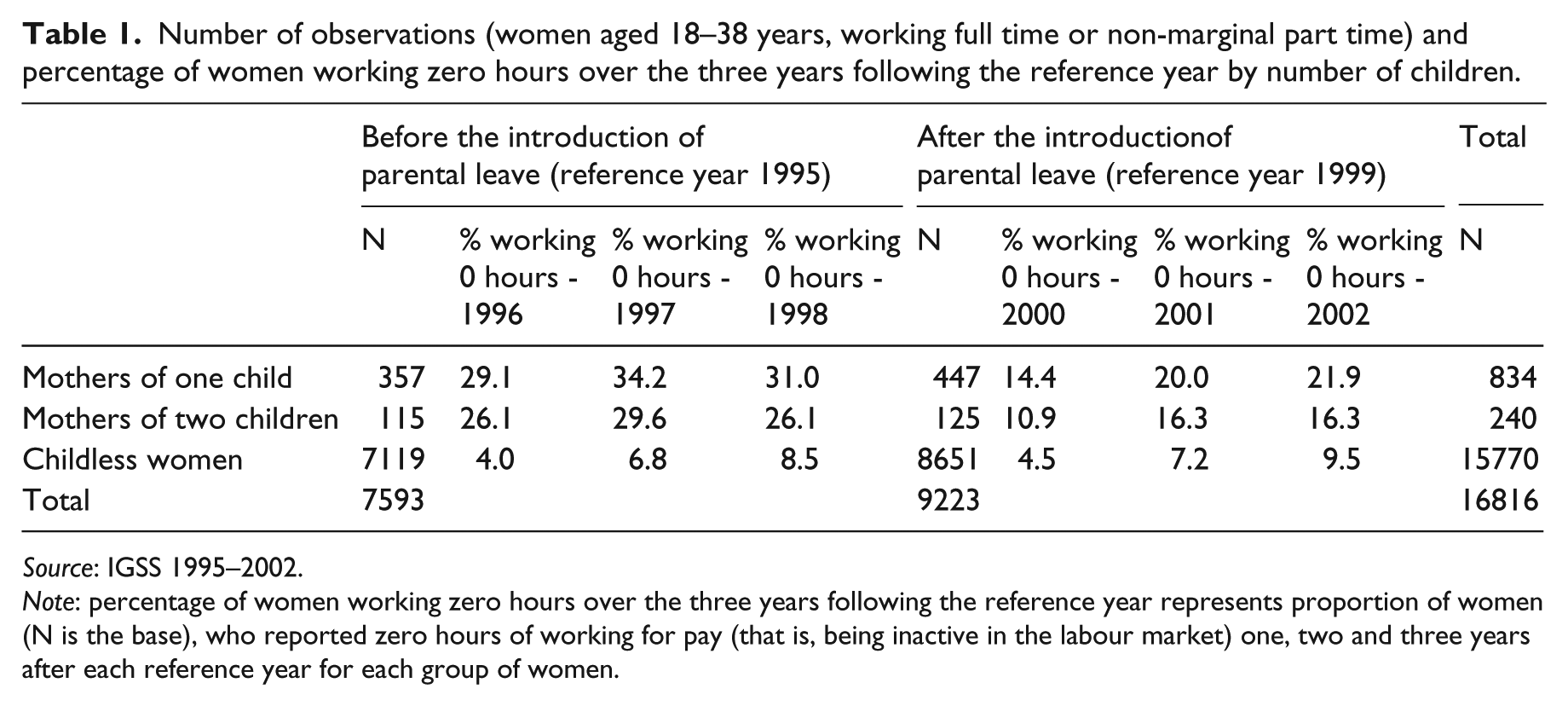
The Table 1 shows the number of observations for each group of interest entering our empirical analysis. 4
Number of observations (women aged 18–38 years, working full time or non-marginal part time) and percentage of women working zero hours over the three years following the reference year by number of children.
Source: IGSS 1995–2002.
Note: percentage of women working zero hours over the three years following the reference year represents proportion of women (N is the base), who reported zero hours of working for pay (that is, being inactive in the labour market) one, two and three years after each reference year for each group of women.
Research design
To correctly analyse the impact of parental leave policy on the hours worked by mothers of a single child, 1, 2 and 3 years after childbirth, it is not sufficient to simply compare the number of hours worked before and after the introduction of the policy. This is because there are many other institutional factors and developments that could affect the hours worked. For example, it is known that the labour-market participation of women has dramatically increased in Luxembourg during recent decades. This is due to many confounding factors, and parental leave might be only one of them. Therefore, we use the DiD technique; an evaluation technique that accounts for all these factors, and this way singles out the impact of the parental leave policy. DiD is based on examining the difference in outcomes (here, the number of hours worked after childbirth) before and after an intervention (here, the introduction of the parental leave policy) for the groups affected by it (the treatment groups) compared with this difference for unaffected (control) groups. Thus, here are two groups (one control and one treatment) observed before the policy intervention and two distinct groups (one control and one treatment) observed after the intervention. The estimation of the DiD between control and treatment groups before and after the intervention is the key contribution of the DiD technique and allows for identification of a causal effect of the intervention on the outcome.
This method avoids many of the endogeneity problems that are typical of comparisons between heterogeneous individuals (Bertrand et al., 2001). The method is based on three basic assumptions: the assumption of parallel pre-treatment trends of control and treatment groups, the non-anticipation of the reform and the non-existence of other confounding factors. Throughout the text, we show how these assumptions are met.
To illustrate the DiD design, consider the formula:
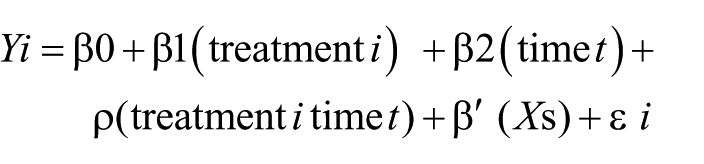
where Yi stands for the outcome variable: the number of hours worked monthly. To be able to investigate how the effect of the policy evolved over time, we measure the outcome variable at three different points: 1, 2 and 3 years after childbirth. For women observed in the baseline year 1995, we examine the number of hours worked per month at the beginning of 1996, 1997 and 1998. For women in the 1999 baseline, we use the number of hours worked in 2000, 2001 and 2002. This approach gives a more comprehensive picture regarding the intensity of the effect of the policy introduction over a period of time. The number of hours is coded as a continuous variable with a minimum of 0 for women who did not work and a maximum of 350 hours per month. 5 As the outcome variable allows for a zero value (women who left the labour market after the reference year), no cases drop out of our analysis across the observation period. To check the robustness of our results, we re-estimated our models for log-transformed outcome variables to account for normal distribution of the outcome variables. Zero values were replaced by small values (0.0000001), in line with Gaudry and Quinet (2010). The results remained in accordance with the general findings of the paper.
With regard to the outcome variable, the potential source of bias due to non-compliance with the common trend assumption is addressed. This assumption stipulates that in the absence of treatment, the outcome for treated (mothers with one or two children) and control (childless women) groups should evolve in parallel. To test this assumption, we inspected and plotted the outcome variable for treatment and control groups for more pre-treatment time points. We calculated the number of hours worked monthly, 1, 2 and 3 years after childbirth among mothers with one child, born in 1994–1997, and compared them with the outcomes for childless women. The process was duplicated for mothers of two children. Supplementary Appendix 1 presents the figures, showing that the common trend assumption is met.
The term treatment i represents the dummy treatment variable and is equal to 1 if a person is in a group of mothers with one or two children (treatment group) and 0 for a childless woman (control group). The effect of the introduction of the policy is estimated separately for single-child mothers and mothers of two children. We do this for several reasons. The first is that single-child mothers exhibit, among other differences such as experiencing a disruption of a union, substantially different labour-market behaviour than mothers of more children (Bousselin, 2007; Lalive and Zweimüller, 2009). There are many possible explanations for these differences in labour-market behaviour, out of which one can be the difference in levels of work attachment and family–work preferences (Hakim, 2002). Second, the technique we use to analyse the impact of the policy introduction on the hours worked requires us to select the maximum possible number of homogeneous groups of individuals who can be affected by the policy. Therefore, mixing mothers with one child and those with more would not allow a reliable analysis.
Single-child mothers are defined as having had only one child up to the end of the observation period. From these, we selected those who gave birth to their child either during the first 3 months of 1995 or during the first 3 months of 1999. Choosing children born during the same months before and after the introduction of the policy helps to control for seasonality of birth (Bobak and Gjonca, 2001) and assures the comparability of analysed groups before and after the introduction of the policy. Mothers of two children are defined as those who gave birth to two children during the entire observation period. It is necessary to ensure that both children were born in the period either up to 3 years before or up to 3 years after the introduction of the policy. Therefore, on the one hand, we selected women who gave birth to their first child in either 1993 or 1994 and to their second during the first 3 months of 1995 and on the other hand, women who gave birth to their first child in either 1997 or 1998 and to their second during the first 3 months of 1999. This also ensures that only women who did not have any additional children during the observation period are included. By selecting only precisely defined sibling constellations (in terms of their birth dates) before and after the introduction of the policy, we make sure that only similar sibling constellations are being compared, in other words, we are comparing ‘like with like’. In this way, we control for (or remedy) any possible effect of the introduction of the policy on birth spacing between siblings (Pettersson-Lidbom and Skogman Thoursie, 2009). Childless women are defined as having had no children up to the end of the observation period.
The dummy variable time t distinguishes between the pre- and post-intervention periods. It is equal to 1 if a woman starts to be observed after the introduction of the policy (i.e. the baseline year is 1999) and 0 otherwise (i.e. the baseline year is 1995). These two baseline (i.e. reference) years were chosen for the following reasons. Using 1995 and 1999 rules out any undesirable potential effect of anticipation of the policy (adaptation of behaviour due to the anticipated introduction). In 1995, there was no information about parental leave policy legislation, or the EU parental leave directive. In 1999, the introduction of the policy and its parameters was largely unanticipated due to lengthy internal tripartite negotiations and, in particular, due to objections from employee and employer organizations (Feyereisen, 2008). Another reason for choosing these baseline years is that during this period, no other policy, in particular, no childcare-related policy, was introduced or reformed (for more details see ‘Luxembourg context’ section) that could have affected the labour-market behaviour of mothers of young children and, therefore, could bias the estimated effect of the parental leave policy. In other words, the assumption of the non-existence of other confounding factors holds. 6 It should be also noted here that the effect of parental leave reform on post-childbirth working hours is possibly through selection into childbirth, that is, career-minded women are more likely to change their birth timing as a response to parental leave policy. The selection into childbirth is, however, not part of this investigation. 7
The term treatment i time t denotes the interaction between the treatment and time variables. The key coefficient ρ therefore measures the DiD estimate of the effect of introduction of parental leave policy on the treatment group. If it is significant and substantial, then the introduction of the policy affected the outcome.
The term Xs captures the control variables. To ensure that the outcomes of the DiD estimates are not affected by differences in the observed individual characteristics of women in compared groups before and after the introduction of the policy, the following pre-treatment control variables are used in the estimation procedure: age, marital status, nationality, employment status, private or public sector employment, blue- or white-collar worker, statistical classification of economic activities in the European Community (NACE2), size of company 8 and hourly salary, categorized into a set of 24 response categories. 9 The number of these control characteristics is limited due to the restricted scope of the IGSS data. For a detailed descriptive analysis of the control variables by period and control status, please see Supplementary Appendix 1, Tables A1 and A2. With regard to the comparability of analysed groups over time, the data presented in Supplementary Appendix 2 demonstrate that there are no substantial differences between the treatment groups of 1995 and 1999 or between the control groups of 1995 and 1999, particularly with regard to age. The descriptive statistics also show that when we compare control and treatment groups separately in the period before and after the intervention, the control and treatment groups are reasonably well balanced with respect to all observed covariates, with the exception of marital status. This is to be expected because women who have a child or children are more likely to be married than childless women. It also needs to be noted that in our analysis, we control for all the mentioned variables.
Due to the fact that about 99 percent of eligible mothers in Luxembourg take parental leave immediately after maternity leave (Zhelyazkova et al., 2015), it may be deduced that for the mothers in our data, the vast majority took parental leave 2 or 3 months after childbirth. The duration of formal maternity leave is 2 months if the mother is not breastfeeding and 3 months if she is.
Results
In the first step, we present the results of the DiD analysis for mothers, conditional on their employment status before childbirth among single-child mothers and before the birth of the second child among two-child mothers (in line with Bartel et al., 2015). This is due to the fact that mothers who were not employed or in marginal part-time work (less than 20 hours a week) would not have been eligible for parental leave and therefore will not be included in taking leave. Only women who were working full-time or non-marginal part-time at the beginning of the reference year are included in the analysis. As indicated in the ‘Data’ section, our data are of a quarterly nature. Therefore, the employment status was measured at the beginning of the quarter during which the child (the first child for single-child mothers and the second child for two-child mothers) was born. Consequently, we estimate the effect of the policy for more-targeted populations.
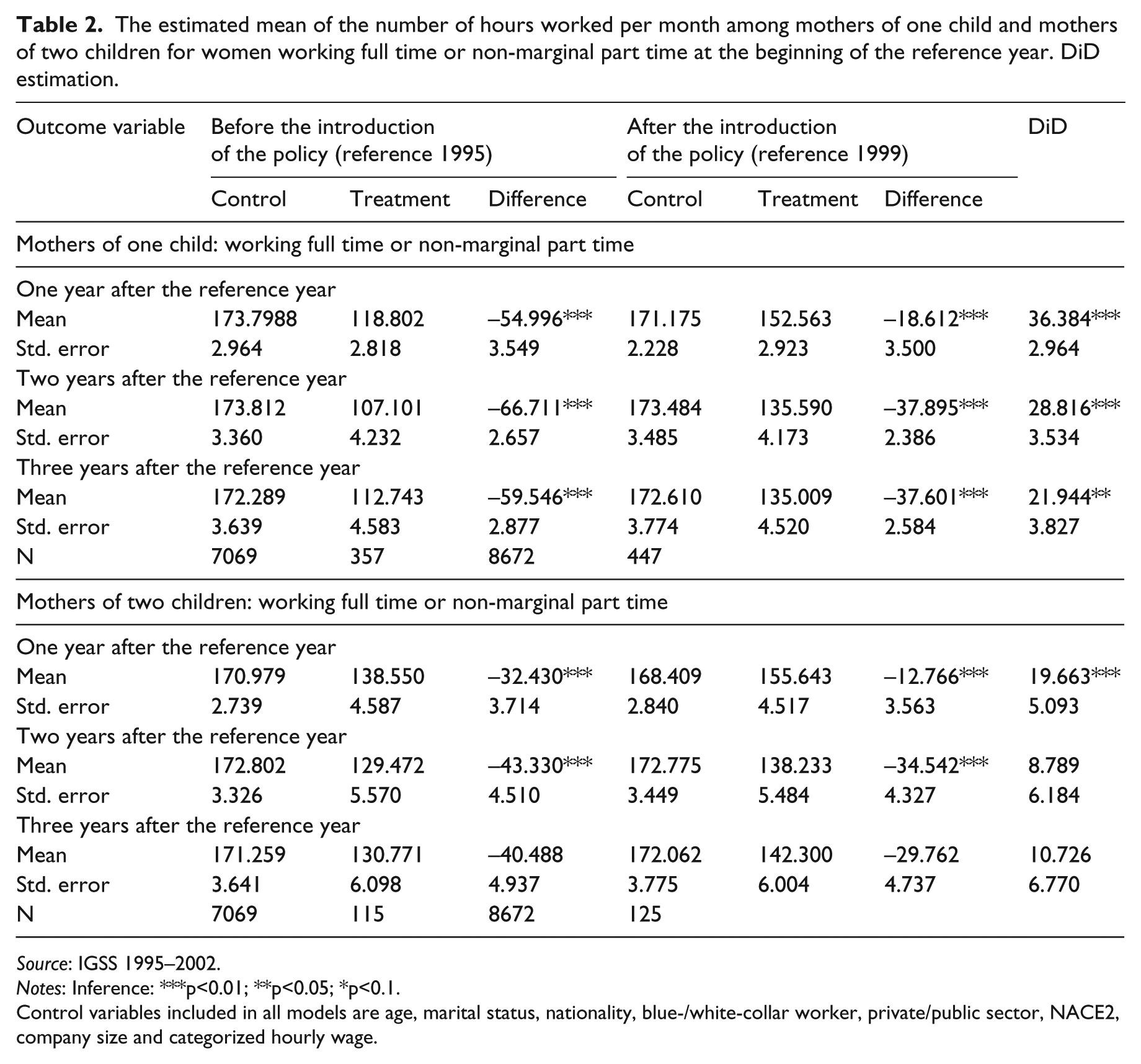
With regard to single-child mothers, the data (see Table 2) indicate that the differences in the number of hours worked after the reference year between childless women and single-child mothers before and after the introduction of the policy is relatively large and statistically significant, 1, 2 and also 3 years after childbirth (36, 29 and 22 hours, respectively). 10 This was the intended outcome of the policy and supports Hypothesis 1.
The estimated mean of the number of hours worked per month among mothers of one child and mothers of two children for women working full time or non-marginal part time at the beginning of the reference year. DiD estimation.
Source: IGSS 1995–2002.
Notes: Inference: ***p<0.01; **p<0.05; *p<0.1.
Control variables included in all models are age, marital status, nationality, blue-/white-collar worker, private/public sector, NACE2, company size and categorized hourly wage.
For mothers with two children, the data show that the introduction of the policy had a positive and significant effect on the number of hours worked, but only for a year after the birth of the second child. A year after childbirth, the difference between childless women and mothers of two children before and after the introduction of the policy is approximately 20 hours. This corroborates Hypotheses 2 and 3.
When focusing on differences in the persistence of the effect of the policy between mothers of one and two children, we find that the effect was less persistent (1 year after childbirth) among mothers of two children than among single-child mothers (3 years after childbirth), which corroborates Hypothesis 4.
Heterogeneity effects
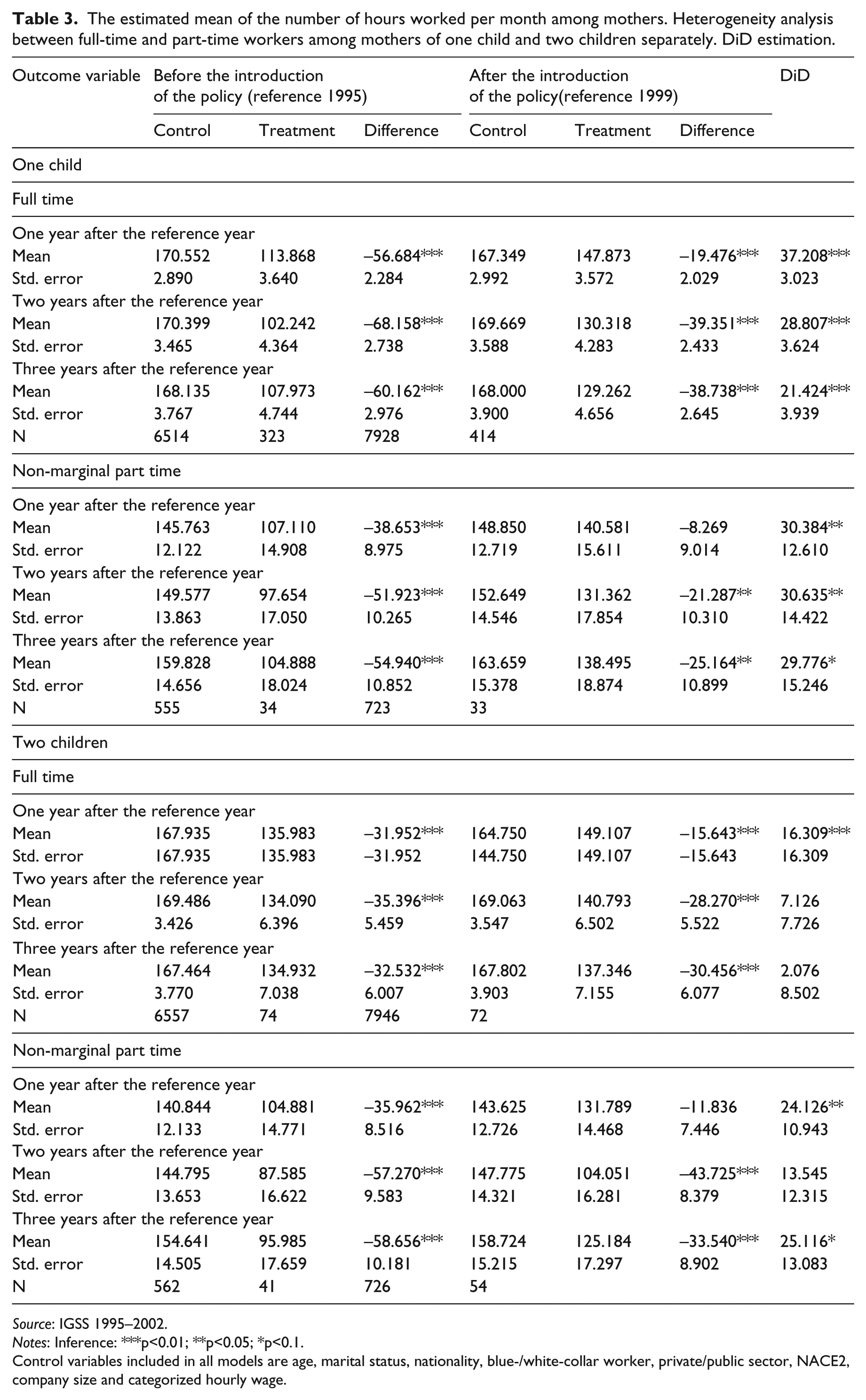
Table 3 shows the results for the heterogeneity effect of the parental leave policy between women who worked full-time and those who worked part-time before childbirth. The results are presented separately for first-time mothers and mothers of two children.
The estimated mean of the number of hours worked per month among mothers. Heterogeneity analysis between full-time and part-time workers among mothers of one child and two children separately. DiD estimation.
Source: IGSS 1995–2002.
Notes: Inference: ***p<0.01; **p<0.05; *p<0.1.
Control variables included in all models are age, marital status, nationality, blue-/white-collar worker, private/public sector, NACE2, company size and categorized hourly wage.
We first look at single-child mothers. Among full-time workers, it is observed that the response to the introduction of the parental leave policy is statistically significant and large in magnitude a year after childbirth, and to a lesser extent, after 2 and 3 years. The difference in the average number of hours worked between childless women and mothers of a single child of 1, 2 and 3 years of age, before and after the policy, is 37, 29 and 21 hours, respectively. When looking at part-time workers, a significant difference between the behaviour of childless women and mothers with one child, before and after the introduction of the policy, is found 1, 2 and 3 years after childbirth (30, 31 and 30 hours, respectively). This implies that there is a persistent impact of the policy among part-time workers, which slightly increases over the observed period of 3 years after childbirth.
Focusing on mothers of two children, slightly different results are observed and suggest that in terms of magnitude, the policy had a smaller effect among mothers who were employed full-time at childbirth than among part-timers (16 hours for full-timers a year after childbirth compared with 24 hours for part-timers). The data also indicates that the effect of the policy among part-timers persisted longer than among full-timers (3 years compared with 1 year). The aforementioned evidence fully corroborates Hypothesis 5 for mothers of two children, but only partially for single-child mothers. However, the results regarding part-timers should be treated with caution due to the relatively small number of observations in the treated group, which reduces the precision of these findings.
To check the robustness of the above presented results, we conducted a set of sensitivity analysis, which are available in Supplementary Appendix.
Discussion and conclusion
In this article, we study the effect of the introduction of parental leave on the number of hours worked after childbirth by single-child mothers and mothers of two children residing in Luxembourg, and depending on their pre-childbirth employment status. We also analyse the heterogeneity of this effect between mothers who worked full-time and those who worked part-time.
We had to overcome certain limitations in this study, including the problem of non-availability of some control variables in the estimated models, such as education level, occupation and partners’ characteristics. However, the pre- and post-treatment periods are not far enough apart to suggest substantial changes in group composition regarding these variables. The data we use do not contain information about partners, and there are few ways in which this could be substituted in our analysis. Only including data when information about partners was available would be restrictive and would affect the generalizability of our outcomes to the entire population of selected mothers. Further research is needed in order to address these drawbacks, for example, by running separate analyses only for married women. It would also be desirable to control for women’s work–family preferences (Hakim, 2002) and gender-role attitudes (Kangas and Rostgaard, 2007) as these are important determinants of women’s labour-market attachment and behaviour.
Another possible limitation is the fact that the sample is restricted only to women with children born in a particular period of the year (i.e. the first 3 months) and/or in a particular sibling constellation (for mothers with two children). Therefore, there is a potential problem with external validity and the possibility of generalizing to a broader category of mothers. However, the potential issue of external validity is compensated for by the internal validity of our findings through ensuring that the mothers before and after the introduction of the policy are as comparable as possible. Future research could include broader groups of women, which would increase the number of observations and, consequently, improve the power of analysis dealing with heterogeneity of the policy effect (i.e. mainly among part-time workers).
When looking at the results for mothers, conditional on employment at the time of childbirth, the data indicate that the introduction of the policy had a positive effect on the number of hours worked, both among mothers of one and of two children. With regard to persistency, we find that the effect of the policy is substantial and significant during the 3 years after childbirth among single-child mothers and during 1 post-birth year among mothers of two children. This might be explained by the fact that mothers of two children probably have a greater pro-family orientation (in line with Hakim, 2002), which makes them reduce their work engagement in the longer term, overruling the effect of the parental leave policy. It is also plausible to assume that having two children is more demanding in terms of the family–work balance, and even in countries with high policy support for female labour-market participation, mothers of two children are less likely to participate in the labour market or to work full-time (see Musumeci and Solera, 2013). Therefore, the benefits of the policy persist for a shorter time among mothers of two children than among single-child mothers.
When analysing the heterogeneity of the effect of the policy between full-time and part-time working mothers (analysed separately for single-child mothers and mothers of two children), we find that the introduction of the parental leave policy had a slightly different effect for full-time than for part-time workers, depending on the number of children.
Among single-child mothers, the effect of the policy was significant and large, both among full-time and part-time workers. In terms of persistence, the effect lasted over the 3 observed years after childbirth for both categories but decreased among full-timers and increased among mothers who were working part-time before childbirth. These results should, however, be interpreted with caution due to the low number of observations among part-time workers. Among mothers with two children, the effect among full-timers is smaller compared with the findings for single-child mothers, and it is observed only for a year after childbirth, whereas part-timers seem to respond more persistently to the policy over 3 observed years after childbirth.
The findings regarding the heterogeneity of the policy’s effect among full-time and part-time workers – mainly the findings for mothers of two children – might have several possible explanations. In a country such as Luxembourg, where part-time employment among mothers is common, the fact that a mother pregnant with her second child works full-time might indicate stronger work-orientation and attachment, in line with Hakim’s (2002) arguments. Therefore, the effect of the policy might be reduced because these women would probably return to work early even in the absence of the parental leave policy. However, if a mother works part-time when expecting her second child, the existence of the policy can help her significantly during the first year after childbirth in terms of keeping her job, and thus longer term labour-market attachment.
In sum, it can be concluded that the policy has met one of its stated objectives and has positively affected the intensity of the labour-market participation of mothers with young children. Together with existing information about relatively high take-up (Zhelyazkova et al., 2015), it is clear that the policy has had a positive effect in the target population and met its set objective regarding mothers’ labour-market participation. Further research would be needed to analyse what proportion of the change in the post-birth number of hours worked before and after the introduction of parental leave policy was due to the fact that mothers decided to return to the labour market and what proportion was due to non-reduction of working hours after childbirth.
Supplemental Material
Appendices – Supplemental material for The impact of parental leave policy on the intensity of labour-market participation of mothers: Do the number of children and pre-birth work engagement matter?
Supplemental material, Appendices for The impact of parental leave policy on the intensity of labour-market participation of mothers: Do the number of children and pre-birth work engagement matter? by Marie Valentova in Journal of European Social Policy
Footnotes
Acknowledgements
I would like to thank the Luxembourg Ministry of Family, Integration and the Greater Region and the IGSS for their help with obtaining the access to the required anonymized administrative data, Michela Bia from LISER and the two anonymous reviewers for their useful feedback and comments.
Funding
The authors disclosed receipt of the following financial support for the research, authorship, and/or publication of this article: FNR CORE 2016 C16/SC/11324101/PARENT - Evaluation of parental leave in Luxembourg, focus on couples� strategies and the role of workplace characteristics supported by the Luxembourg National Research Fund (FNR).
Notes
References
Supplementary Material
Please find the following supplemental material available below.
For Open Access articles published under a Creative Commons License, all supplemental material carries the same license as the article it is associated with.
For non-Open Access articles published, all supplemental material carries a non-exclusive license, and permission requests for re-use of supplemental material or any part of supplemental material shall be sent directly to the copyright owner as specified in the copyright notice associated with the article.
