



Abstract
Social trust is a moral resource with a normatively highly desirable pay-off. Previous research argues that universal welfare state programmes ‘make’ social trust whereas means-testing programmes ‘break’ it. Despite its important implications for welfare-state design, comparative longitudinal evidence for this hypothesis is scarce. To test whether within-country changes in social trust are associated with within-country changes in total, means-tested, and non-means tested social protection expenditure, I thus merge country-year specific ESSPROS welfare spending data with cross-country survey data from 30 countries that participated in the 2002–2019 European Social Survey. Results from multilevel regression models show that neither within-country changes in total nor means-tested or non-means tested social protection expenditure predict social trust. Based on insights from the welfare deservingness literature, the second part of my analysis concentrates on welfare spending directed at two different life-course risks, with sickness representing a risk that the public widely considers to be ‘deserving’ of welfare support, and unemployment acting as an ‘undeserving’ risk. I find that, within countries over time, means-tested healthcare expenditures predict decreases in social trust, whereas non-means tested healthcare expenditure is associated with increasing social trust. My results thus lend support for the hypothesis that welfare-state selectivity and universality can contribute to the making and breaking of social trust, but only when interventions target life-course risks that the public considers ‘deserving’ of welfare state support.
Introduction
Social trust, the belief that most other people can be trusted (Uslaner, 2002), comes with a lot of normatively desirable benefits. As a collective resource, social trust improves democratic functioning (Newton, 2001), stimulates economic growth (Knack and Keefer, 1997; Zak and Knack, 2001; Bjørnskov, 2012), helps to solve large-scale collective action dilemmas (Sønderskov, 2009) and elevates support for environmental protection (Fairbrother, 2016). On the individual level, social trust is associated with longevity (Miething et al., 2020) and better self-rated health (Giordano et al., 2012). In an effort to design and develop interventions to promote this ‘most important part of social capital’ (Rothstein and Stolle, 2008: 441), many policymakers put their hopes on the trust-‘crafting’ (Freitag and Buhlmann, 2009) power of the welfare state (for an overview, see Kumlin et al., 2018).
An important strand of research devoted to the relationship between welfare states, equality, and social trust (Uslaner, 2002; Rothstein and Stolle, 2003; Kumlin and Rothstein, 2005; Rothstein and Uslaner, 2005) argues that non-means testing (universal) welfare-state programmes contribute to ‘craft’ trust while selective (means-testing) welfare state programmes undermine it. Depending on those principles of redistribution, welfare states thus have the potential to both ‘make’ and ‘break’ (Kumlin and Rothstein, 2005) social trust. This hypothesis has, however, so far only been corroborated in studies based on cross-sectional data (Rothstein and Stolle, 2003; Kumlin and Rothstein, 2005; Rothstein and Uslaner, 2005; Kouvo et al., 2012; but see Betkó et al., 2022). While there is an extensive literature regarding the extent to which welfare state regimes, welfare state size and/or welfare state generosity predict social trust both between and within countries (Van Oorschot and Arts, 2005; Kääriäinen and Lehtonen, 2006; Larsen, 2007; Lee, 2013; Brewer et al., 2014; Ferragina, 2017), robust comparative evidence concerning the relationship between within-country changes in welfare state selectivity, universality, and social trust is still missing.
To address this research gap, I merge country- and year-specific ESSPROS social protection expenditure data (European Commission, 2019) from 30 countries located in Europe and its vicinity with cross-country survey data from the 2002–2019 rounds of the European Social Survey. Using both country-fixed effects and within-between multilevel regression models (Fairbrother, 2014; Giesselmann and Schmidt-Catran, 2019), I analyse, first, whether within-country changes in means-tested and non-means tested social protection expenditure predict within-country changes in social trust.
Informed by research showing that the public considers certain groups of beneficiaries more deserving of welfare support than others (Coughlin, 1980; Larsen, 2008; Van Oorschot, 2000, 2006), I analyse, second, whether within-country changes in overall welfare-state selectivity and universality predict social trust, or whether this association is mediated by how ‘deserving’ the public perceives the recipients of different welfare-state programmes to be (Kouvo et al., 2012). Here, I draw on insights from recent survey experiments conducted in a diverse set of countries (Jensen and Petersen, 2017) showing that sickness is a life-course risk that the public considers, irrespective of context, especially ‘deserving’ of welfare state support, whereas the opposite is found in regard to unemployment.
Theory and previous research
Social trust and its benefits
Social trust is, not least due to its capacity to lower transaction costs in situations involving interactions between strangers (Fukuyama, 1995), often considered to be ‘the most important part of social capital’ (Rothstein and Stolle, 2008: 441). The more people in a society trust each other, the easier to deal with large-scale collective action dilemmas and free-riding problems (Sønderskov, 2009). This might explain why social trust is often associated with better democratic functioning (Newton, 2001), economic growth (Knack and Keefer, 1997; Zak and Knack, 2001; Bjørnskov, 2012, 2022), healthier communities (Subramanian et al., 2002) and more support for environmental protection (Fairbrother, 2016). Besides being such a normatively desirable collective good, social trust also constitutes an individual health determinant (Giordano et al., 2012; Ljunge, 2014) contributing – likely as a stress buffer – to protect people from both (cardiovascular) disease and death (Miething et al., 2020).
Despite its relatively well-documented individual and collective benefits, it remains unclear whether or not social trust can be ‘generated’ (for an overview, see Nannestad, 2008). Attributing trust to historical and contextual determinants such as Protestantism (Delhey and Newton, 2005), ethnic diversity (Delhey and Newton, 2005; Dinesen and Sønderskov, 2015; Ziller, 2015), monarchism (Bjørnskov, 2007) and micro-level factors such as intelligence and genetic dispositions (Sturgis et al., 2010; Reimann et al., 2017), many studies cast doubt on the hypothesis that any short- or mid-term social policy intervention could increase trust among adults. Proponents of the institutional approach to social trust are, however, more optimistic about this endeavour (e.g., Rothstein and Stolle, 2008; Freitag and Buhlmann, 2009). In the following, I briefly outline four theoretical mechanisms through which welfare states are assumed to shape people’s social trust (for a recent overview, see also Kumlin et al., 2018; Herreros, 2023).
Welfare states and social trust
Previous studies theorize four different mechanisms through which welfare states affect people’s social trust: 1) redistribution (reduction of income inequality), 2) quality of government (fair and impartial government institutions), 3) ‘crowding out’ (the more generous the welfare state, the more it crowds out mutual informal solidarity and social trust) and 4) welfare-state selectivity versus universality (allocation of welfare-state benefits along the principles of selection vs universalism).
Due to my focus on the potential direct effects of welfare states on social trust, my literature review does not touch upon the related research on welfare states, (active) labour market policies, labour market vulnerability and trust (Lee, 2013; Nguyen, 2017; Kevins, 2018).
The first mechanism, redistribution, focuses on welfare states’ capacity to increase income equality. According to this literature, unequal societies exacerbate differences between the rich and the poor (Uslaner, 2002; Rothstein and Uslaner, 2005; Larsen, 2007; Freitag and Buhlmann, 2009), making the two groups ultimately more wary of each other. Empirically, evidence for this hypothesis is however inconclusive (Fairbrother and Martin, 2013; Fairbrother, 2014; Hastings, 2018; Kanitsar, 2022). To the extent that previous research establishes a causal relationship between redistribution and social trust, it points to reverse causality, with historically high trust levels explaining highly redistributive welfare states rather than the other way around (Bergh and Bjørnskov, 2011, 2014; Bjørnskov and Svendsen, 2013; Gärtner and Prado, 2016).
The second mechanism, quality of government, is elaborated in Rothstein and Stolle’s (2008) institutional theory of generalized social trust. Their key argument is that fair and impartial government institutions increase people’s trust in order and political institutions. Recent studies find strong empirical support for both what Rothstein and Stolle (2008: 443) label the ‘institutional-structural’ (e.g., Bergh and Öhrvall, 2018; Fairbrother et al., 2022; Ziller and Andreß, 2022) approach and for the ‘attitudinal mechanism’ linking social trust to trust in institutions (e.g., Sønderskov and Dinesen, 2014; Seifert, 2018; Mewes et al., 2021), with strong evidence for the causal arrow running from institutional to social trust rather than the other way around (Sønderskov and Dinesen, 2016; Dinesen et al., 2022).
A third strand of literature studies the extent to which generous welfare states render informal social support networks redundant. Envisioning a zero-sum situation of sorts where social support (e.g., caring) is either taken over by the state, by private actors or by families, a recurring critique of welfare state expansion is that it could lead to an erosion of networks of informal solidarity and mutual trust (Fukuyama, 2001). Empirical evidence for this ‘crowding out’-hypothesis is, at least in regard to social trust, however, inconclusive. In their seminal cross-national study on welfare spending and different facets of social capital in European countries, Van Oorschot and Arts (2005) find neither a positive nor a negative association between welfare spending and social trust. Focusing on variation within different European countries over time, Brewer et al. (2014) point to an opposite crowding-in effect of welfare spending on social trust, where within-country increases in social protection expenditure predict increases in social trust. Distinguishing between welfare-state size and welfare-state generosity, Ferragina (2017) observes, interestingly, a dual relationship where the former predicts decreases and the latter predicts increases in social trust.
The fourth mechanism through which welfare states are assumed to affect social trust highlights the two opposing principles of redistribution along which welfare states allocate their benefits: selection versus universalism (Titmuss, 1968). This strand of research (Uslaner, 2002; Rothstein and Stolle, 2003; Kumlin and Rothstein, 2005; Rothstein and Uslaner, 2005) argues that selective, means-testing welfare state programmes destroy social trust in a twofold way. On the ‘receiving’ side of redistribution, poor people’s trust is at risk of being undermined by feelings of stigmatization and perceptions of being victim to ‘arbitrary’ and ‘unfair’ administrative processes that come along with means-testing welfare state interventions. On the ‘giving’ side of redistribution, (overly) selective welfare state programmes may make the rich perceive welfare beneficiaries as lazy free-riders (Gilens, 1999). Universal (i.e., non-means tested) welfare state programmes are, by contrast, expected to nurture perceptions of strangers’ trustworthiness because they avoid a salient distinction between ‘them’ and ‘us’ (Rothstein, 1998), thus contributing to a decrease in the cultural distance between the rich and the poor (Titmuss, 1968; Larsen, 2007). Based on cross-sectional survey data from Sweden (Rothstein and Stolle, 2003; Kumlin and Rothstein, 2005) and the US (Uslaner, 2002; Rothstein and Uslaner, 2005), these studies point, empirically, to comparably lower levels of social trust among people with a history of receiving means-tested benefits and to relatively higher levels of trust among those who had received non-means tested benefits (see also Kouvo et al., 2012). However, comparative evidence that robustly links individual-level social trust to within-country institutional variation in means-tested versus non-means-tested welfare spending is still missing, making my study a contribution to fill this void. Based on the previous discussion, my first couple of research hypotheses guiding my empirical analysis read:
Within-country increases in non-means tested social protection expenditure predict within-country increases in social trust.
Within-country increases in means-tested social protection expenditure predict within-country decreases in social trust.
In the following, I discuss why I expect that public perceptions of ‘welfare deservingness’ (Van Oorschot et al., 2017; Laenen, 2020) mediate the relationship between welfare-state selectivity, universality and social trust.
Deservingness, welfare state selectivity-universality, and social trust
Despite urging scholars to pay attention to welfare-state selectivity and universality when studying social trust, Rothstein and colleagues (Rothstein and Stolle, 2003; Kumlin and Rothstein, 2005; Rothstein and Uslaner, 2005) do not distinguish between different groups of welfare beneficiaries (Tamilina, 2008). This runs, however, counter to research showing that the public tends to consider some life-course risks more deserving of welfare state support than others (Coughlin, 1980; Van Oorschot et al., 2017). Those deservingness perceptions might, in turn, bear important implications for the association between welfare state selectivity, universality, and social trust (Larsen, 2008; Kouvo et al., 2012). Van Oorschot, 2000 identifies five different dimensions that determine public views towards the perceived deservingness of welfare beneficiaries: 1. Control: Beneficiaries that are perceived to be personally responsible for their situation are perceived to be less deserving than those who are perceived to be out of control over their situation. 2. Need: The greater the perceived need, the higher the perceived deservingness. 3. Identity: Members of a perceived in-group are considered to be more deserving than out-group members. 4. Attitude: ‘Grateful’ recipients of welfare benefits are perceived to be more deserving than ‘demanding and impudent’ beneficiaries. 5. Reciprocity: Recipients who have contributed in the past or that can be expected to ‘pay back their dues’ in the future are perceived to be more deserving of welfare state support than those who don’t.
These five dimensions implicitly underlie what is sometimes coined a ‘universal rank order’ (Coughlin, 1980) of public support for welfare-state interventions, according to which the public ascribes the highest levels of ‘deservingness’ to old people, followed by sick people, disabled people, and families with children. The unemployed, people ‘on the dole’ and immigrants are, by contrast, often found at the bottom of the deservingness rank order (Blekesaune and Quadagno, 2003; Van Oorschot, 2006; Reeskens and Van der Meer, 2019).
Recent work (Laenen and Meuleman, 2020) questions, though, the geographic and temporal invariance of this allegedly ‘universal’ rank order of perceived deservingness. The currently best available empirical evidence for such a rank order comes from a cross-country survey experiment (Jensen and Petersen, 2017) tapping into two different life-course risks that are frequently targeted by welfare state interventions: sickness/illness and unemployment. Jensen and Petersen (2017) find that, irrespective of cultural, economic or welfare state context, public opinion concerning welfare state support for people dealing with sickness and health struggles is highly favourable, whereas the public is much more split and often negative in regard to interventions addressing unemployed beneficiaries (see also Laenen and Meuleman, 2020). Empirically, I will therefore concentrate on means-tested and non-means-tested welfare spending targeted at healthcare and unemployment, hypothesizing that welfare-state selectivity and universality should only matter for shaping people’s trust when intervention targets a life-course risk ‘deserving’ of welfare state support:
Within-country increases in non-means-tested social protection expenditure targeted on healthcare predict within-country increases in social trust.
Within-country increases in means-tested social protection expenditure targeted on healthcare predict within-country decreases in social trust.
Data, measurement and methods
Data
At the individual level, I used cross-national survey data from the first nine rounds (fielded between 2002 and 2019) of the European Social Survey. Analytically, my empirical focus lies on explaining within-country changes rather than between-country variation in social trust. My sample therefore only includes countries that have been surveyed at least twice. Moreover, I excluded data from Israel, Russia and Ukraine because of a lack of contextual social-protection expenditure data for those countries. Those choices led to a working sample consisting of 365,287 respondents from 30 countries situated in Europe (n = 29) and its vicinity (n = 1, Turkey).
Variables
Dependent variable
Social trust was measured using a scale comprising the following three items (Smith, 1997; Reeskens and Hooghe, 2008): (1) ‘Generally speaking, would you say that most people can be trusted, or that you can’t be too careful in dealing with people?’, (2) ‘Do you think that most people would try to take advantage of you, or would they try to be fair?’ and (3) ‘Would you say that most of the time people try to be helpful or that they are looking out for themselves?’ Respondents’ answers were measured on 11-point scales ranging from 0 to 10, with 10 indicating the highest possible levels of trust, perceived fairness and perceived helpfulness. To facilitate future comparisons with studies using dichotomous trust measures (as e.g., in the European and World Values Studies), I transformed the trust scale to a 0–1 value range. Both the overall reliability (Cronbach’s alpha = 0.78) and country-specific reliability of the scale were satisfying, with the country-specific reliability ranging between 0.63 (France) and 0.82 (Lithuania). For a robustness check, I replicated the key findings using the single-item trust standard trust measure (Uslaner, 2012) as the outcome variable. Comparing results from models that use either the single-item or the three-item trust measures as dependent variables, Figure S1 in the supplementary materials illustrates that results do not significantly differ between the two alternatives.
Country-level variables
Inspired by two recent studies that draw on time-variant macro-level indicators to measure within-country changes in (i) welfare universalism (Jacques and Noël, 2018) and, respectively, in (ii) social protection expenditure directed at different groups of beneficiaries (Visser et al., 2018), I used ESSPROS data (European Commission, 2019) to distinguish the survey-year-specific GDP share that countries spend on (i) social protection expenditure (sometimes labeled as ‘welfare effort’ or, alternatively, ‘welfare state size’, see e.g.,Van Oorschot and Arts, 2005; Ferragina, 2017), (ii) means-tested social protection expenditure, and (iii) non-means tested social protection expenditure.
I further concentrated on means-tested versus non-means-tested spending regarding two specific types of social protection, with healthcare spending representing an intervention directed at a ‘deserving’ category of beneficiaries and unemployment spending standing for a policy domain dealing with a target group that the wider public frequently considers ‘undeserving’ of welfare state support. All welfare-state spending indicators are measured in percentage of the total country-year specific GDP. I additionally controlled for countries’ year-specific unemployment rates, thus taking into account that social trust or its determinants could be responsive to economic crises (Iglič et al., 2021).
Level-1 controls
To disentangle potential age, period and cohort effects on social trust (Uslaner, 2002; Poulin and Haase, 2015), I included controls for the respective year of measurement (round dummies) and respondents’ age (continuously measured). As recent studies based on individual panel data suggest that institutional trust antecedes social trust (Bargsted et al., 2023; Dinesen et al., 2022; Seifert, 2018), I measured institutional trust using a three-item scale referring to respondents’ trust in (i) the country’s parliament, (ii) the legal system, and (iii) the police. Respondents’ answers have a value range from 0 to 10, with 0 indicating no trust at all, and 10 indicating complete trust. The institutional trust scale displayed a highly satisfactory reliability, with an overall alpha of 0.82 (country-specific alphas ranging between 0.72 and 0.84). To prevent bias stemming from the fact that respondents from different countries differ in regard to their reliance on welfare benefits, I included a welfare dependency dummy that took the value one if, according to the respondents’ self-reports, the main source of household income came from welfare benefits. I further employed controls for labour force status at the time of interview, unemployment experiences (Azzollini, 2023; Laurence, 2015; Mewes et al., 2021), self-rated health (Glanville et al., 2013), income (Brandt et al., 2015), biological sex (Mewes, 2014) and immigration background (Dinesen, 2013). Household size was included as a crude proxy for embeddedness in trust-building networks of social connections to familiar people (Freitag and Traunmüller, 2009; Glanville et al., 2013). Additionally, I included respondents’ years of education (Huang et al., 2011; Hooghe et al., 2012; Oskarsson et al., 2017; Wu, 2021). Table S1 in the supplementary materials provides a descriptive overview over all variables included in the multivariate models.
Methods
My empirical focus lies on explaining changes within countries rather than on explaining time-invariant differences between countries. I thus estimated country-fixed effects models (Giesselmann and Schmidt-Catran, 2019) that treat respondents (level (1) as nested in country-round units (level 2). Country-fixed effects absorb any time-invariant variation stemming from between-country differences. As a robustness test and for being able to properly model potential cross-level interactions (Giesselmann and Schmidt-Catran, 2019), I additionally report findings from models employing a within-between random effects structure for the final model (Fairbrother, 2014; Bell and Jones, 2015) where each contextual variable entered the equation twice (Fairbrother, 2014): (1) in the form of the country-specific observed mean over all ESS rounds (the cross-sectional component) and (2) as the country-year specific deviation from said country-specific mean (the longitudinal component). While increasing model complexity, this specification offers the advantage that it allows the slopes of key predictors to randomly vary between countries (Schmidt-Catran and Fairbrother, 2015), making such a model particularly appealing for confirmatory hypothesis testing (Barr et al., 2013). All analyses were weighted using the ESS probability weight anweight to correct for differential selection probabilities within each country as specified by sample design, nonresponse, noncoverage, and sampling errors.
Findings
Descriptive findings
Figure 1 visualizes the country-specific development of social trust in each of the 30 countries under scrutiny. Over time, only two countries (Cyprus and in Turkey) display a negative trend in trust, whereas trust increased or remained stable in the remaining 28 countries. Unlike in the US, where social trust has been steadily declining since the 1960s (Putnam, 2000; Uslaner, 2002), any potential notions of a general crisis of social trust in Europe are thus clearly not warranted by the data. Trends in Social Trust in 30 Countries, 2002–2019.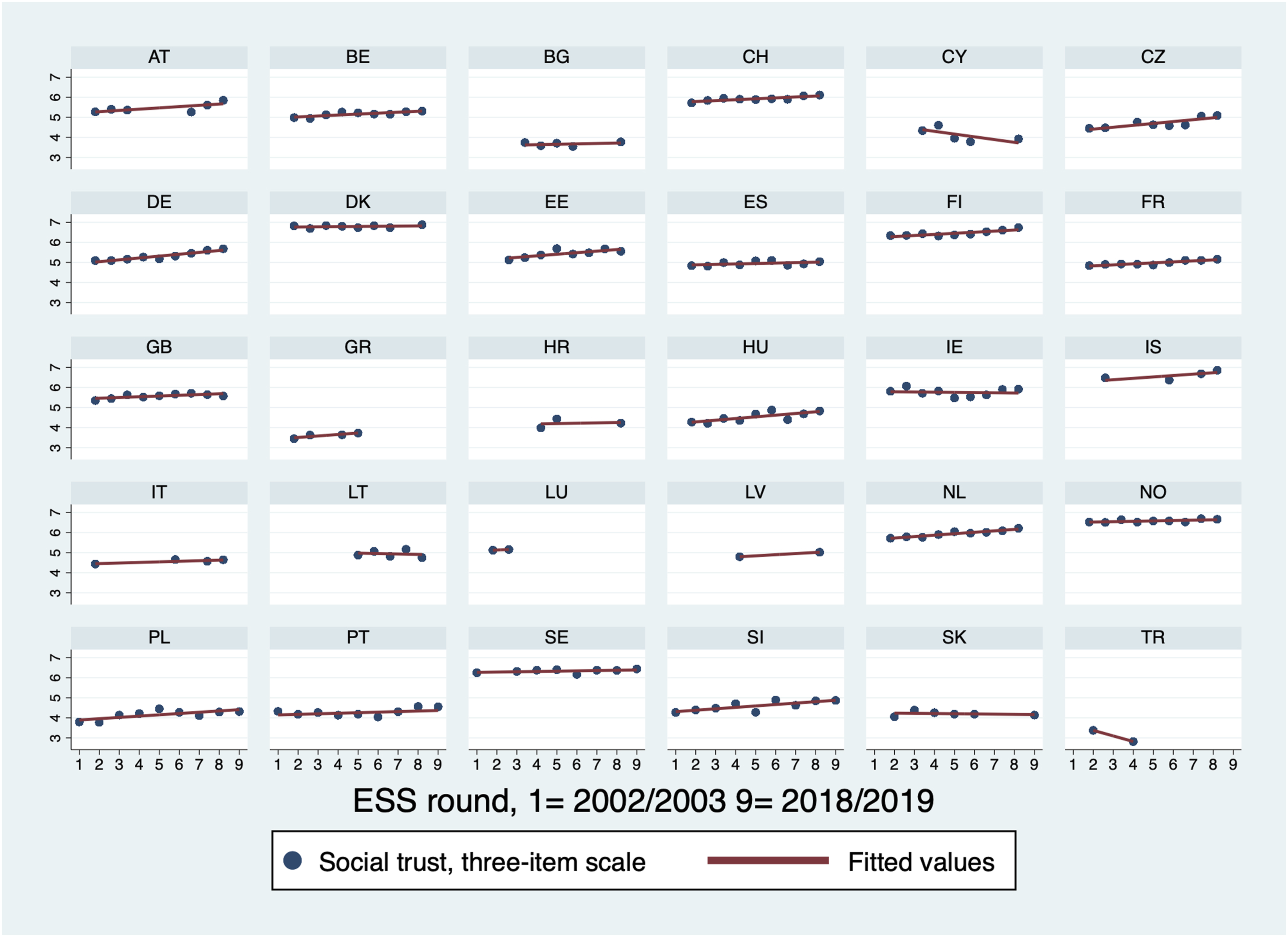
Figure 2 plots within-country changes in social trust against within-country changes in (1) total social protection expenditure, (2) means- and (3) non-means tested social protection expenditure (displayed from the panel upper left to the panel lower left), showing that within-country changes in non-means tested (universal) social protection expenditure positively correlate with within-country changes in social trust, whereas more means-tested social protection expenditure is, within countries over time, associated with lower levels of trust. Means-tested and non-means tested total social protection expenditure and social trust in Europe: trends and bivariate longitudinal correlations.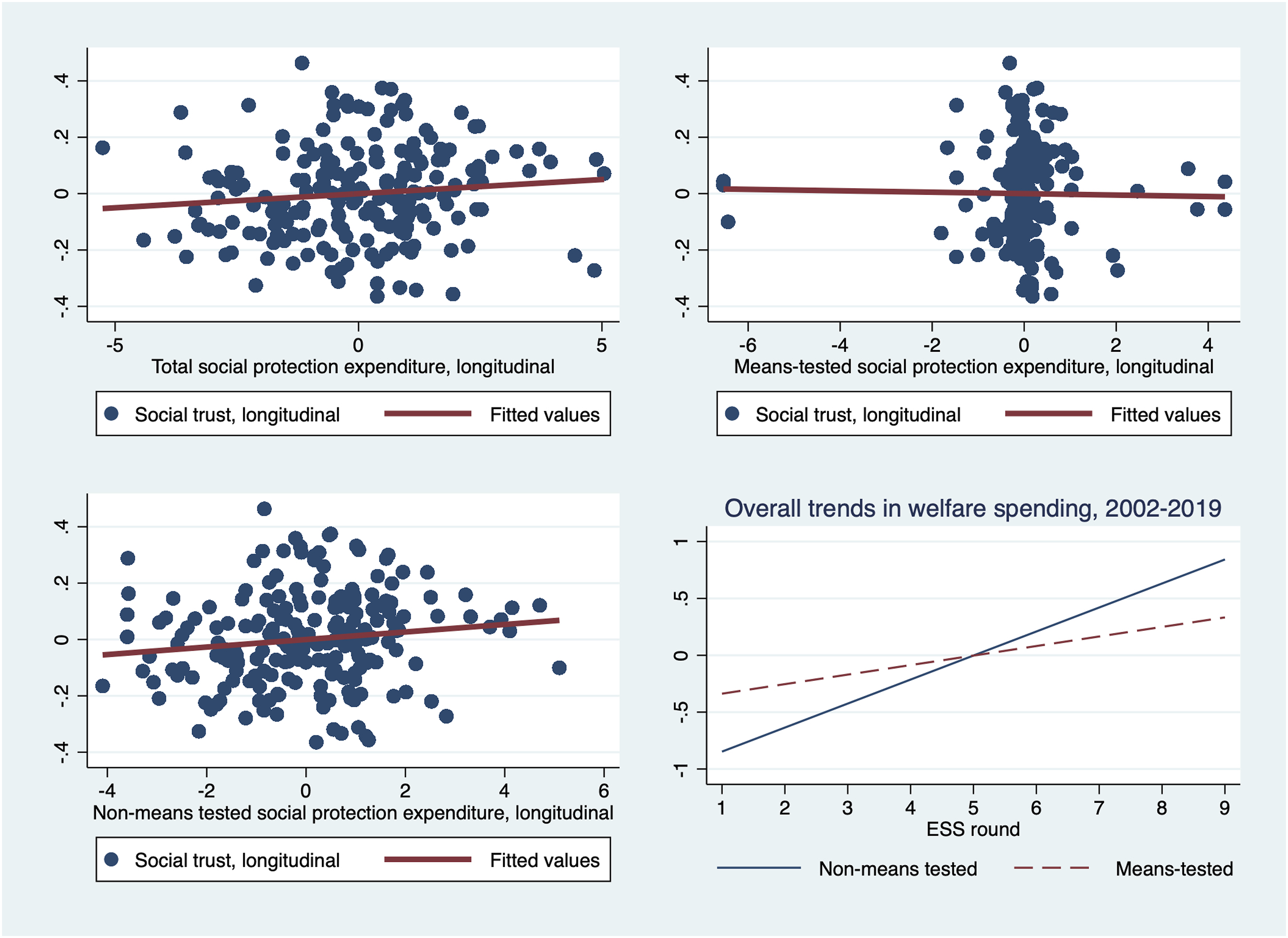
The bivariate macro-level correlation analyses shown in Figure 2 support such narratives linking the ‘making’ of trust to increases in welfare state size (Brewer et al., 2014) and non-means tested (universal) spending, all the while means-tested welfare state expenses are associated with lower levels of trust. Altogether, the bivariate correlations preliminarily support both hypothesis H1 and hypothesis H2. Note however that those aggregate correlations are very weak and potentially driven by omitted variable bias. The last panel (on the lower right) displays, finally, the overall trends in means-tested versus non-means tested social protection expenditure (all functions, as per cent of the GDP).
Figure 3 plots the within-country associations between social trust and (i) healthcare spending, respectively, (ii) unemployment spending. Each type of spending is further divided into means-tested and non-means tested expenditures. The two upper panels display the correlations in regard to healthcare spending (upper left: within-country changes in means-tested spending, upper right: within-country changes in non-means tested spending), whereas the two lower panels describe the longitudinal association between trust and unemployment spending (means-tested vs non-means tested). Correlations between with-country changes in means-tested vs. non-means tested social protection expenditure spent on healthcare and unemployment vs. within-country changes in social trust.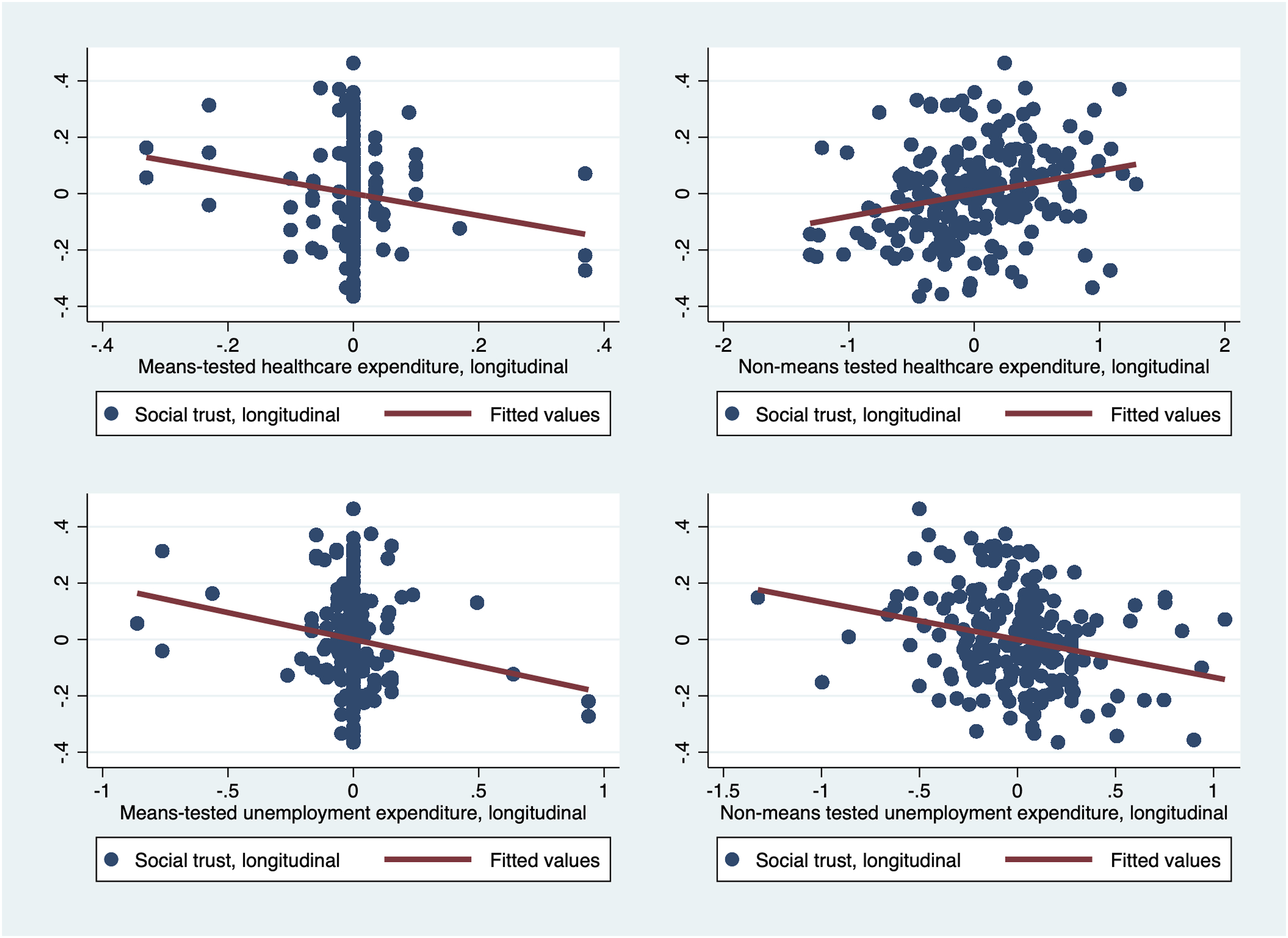
In line with hypothesis H3, increases in non-means-tested spending targeting the ‘deserving’ group of sick people correlate with increases in social trust, whereas more means-tested healthcare spending is associated with lower trust, thus supporting hypothesis H4. In regard to interventions targeted at unemployment, the picture is much blurrier because both means- and non-means tested spending are associated with decreases in trust. In the next section, I report findings from multilevel models showing how robust the above-mentioned bivariate aggregate correlations are when taking into account (1) within- and between country clustering of observations and (2) potentially confounding variables at the individual level.
Multivariate findings
Despite Rothstein and Uslaner’s (2005) claim of social trust being ‘sticky’, I observe non-trivial change in social trust within the 30 countries under scrutiny. Modelling the data through a three-level hierarchical linear regression model (with respondents at level 1 nested within country-round units at level 2 nested within countries at level 3) and estimating the intraclass correlation coefficients in so-called ‘empty’ models that do not include any explanatory variables (Snijders and Bosker, 2011), I find that 22% of the total variation in social trust (as measured by the three-item trust scale) stems from differences within countries over time (see Table S2 in the supplementary materials). Including predictor variables at both the individual and contextual level, my following analysis discusses the extent to which these changes can be attributed to within-country changes in welfare-state selectivity and universality.
Panel A (Figure 4) depicts the regression coefficients (including 95% confidence intervals) from two different two-level country-fixed hierarchical regression models that treats respondents (level 1) as nested within country-time (level 2). Both models include year dummies and all individual-level control variables per Table S1 in the supplementary materials. The contextual measures (social protection expenditure, unemployment) were z-standardized for an easier readability of the findings. Contextual determinants of social trust, summaries of findings from two- and three-level multilevel regression models.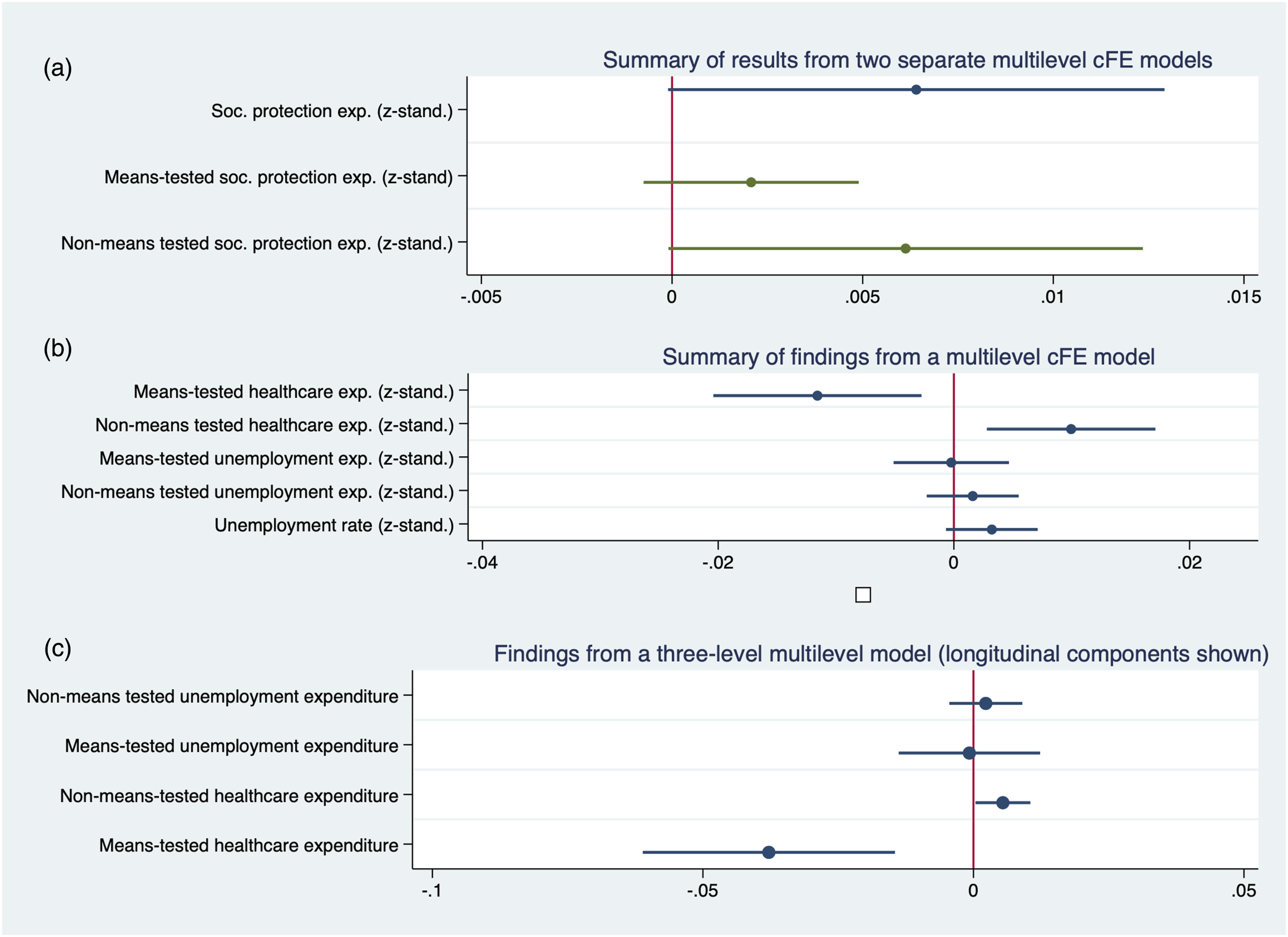
My multilevel results reject hypotheses H1 and H2 according to which universal (means-tested) welfare spending predicts increases (decreases) in social trust. Neither do they corroborate earlier findings (Brewer et al., 2014) of a positive association between increases in total social protection expenditure and within-country levels of social trust. The statistical insignificance of the multilevel findings also implies that the ecological associations depicted in Figure 2 are likely subject to omitted variables bias.
When, however, shifting the focus from overall levels of means-tested versus non-means tested social protection expenditure to welfare-state programme-specific spending where I concentrate on spending targeted at healthcare/sickness on the one hand and at unemployment on the other hand, my findings paint a different picture. Supporting both hypothesis H3 and H4, Panel B (Figure 4) suggests indeed that welfare-state selectivity/universality matters when social policy interventions target a group that large shares of the public consider deserving of welfare state support (Jensen and Petersen, 2017): within-country increases (decreases) in means-tested (non-means tested) healthcare expenditure predict decreases (increases) in social trust, with the direction of those associations being in line with Rothstein and colleagues’ (Rothstein and Stolle, 2003; Kumlin and Rothstein, 2005; Rothstein and Uslaner, 2005) theoretical reasoning. No such an association is found in connection to welfare spending on unemployment, a life-course risk that the public frequently perceives to be ‘undeserving’ of welfare state intervention.
Next, I ran a three-level within-between random-effects multilevel regression analysis where I allowed the slopes for the welfare-spending variables to randomly vary between countries (Fairbrother, 2014). While the findings depicted in Panel C (Figure 4) still lend some empirical support for the narrative of the trust-crafting capacity of universal (non-means testing) welfare state institutions, the 95% confidence interval of the coefficient pertaining to the longitudinal component of non-means tested healthcare spending almost crosses unity, thus casting some doubt on hypothesis H3 positing a path from non-means tested healthcare spending to social trust. The results yield however more robust support for the hypothesis (H4) of the trust-destroying capacity of means-tested (healthcare) spending. Table S3 and Table S4 in the supplementary materials give a more detailed overview about the multilevel regression findings summarized in Figure 4.
I also found cautious evidence for a positive cross-level interaction (Giesselmann and Schmidt-Catran, 2019) between non-means tested welfare spending on unemployment and being unemployed (Table S5 in the supplementary materials). Even though this cross-level interaction is borderline significant (p = .036), the model fit comparison based on AIC and BIC tends to favour the model including the cross-level interaction term over the one without it, suggesting that increases in non-means tested unemployment spending might contribute to increases in social trust among the unemployed but not among the public in general. This finding resonates with those from an earlier study according to which the relationship between welfare spending and social trust is mediated by membership/non-membership in the welfare state’s specific target groups (Tamilina, 2008).
Discussion and conclusion
Do the principles of selection versus universalism (Titmuss, 1968) along which welfare states allocate their benefits matter for shaping people’s social trust (Rothstein and Stolle, 2003; Kumlin and Rothstein, 2005; Rothstein, 2005)? Drawing on individual cross-country survey data from the 2002–2019 rounds of the European Social Survey merged with country-year specific contextual ESSPROS welfare-state spending data and using advanced multilevel modelling techniques, I tested whether means-testing welfare-state programmes ‘break’ social trust and, vice versa, whether non-means testing programmes contribute to its ‘making’ (Kumlin and Rothstein, 2005). My findings showed that, within countries over time, neither means-tested nor non-means tested social protection expenditure predict social trust, thus rejecting the hypothesis of a general relationship between welfare-state selectivity, universality, and social trust.
In line, however, with theoretical arguments derived from the literature on welfare deservingness (Coughlin, 1980; Van Oorschot et al., 2017), the institutional logic of welfare-state interventions targeting a life-course risk commonly perceived as ‘deserving’ matters, with means-tested healthcare spending predicting within-country decreases in social trust and, vice versa, non-means tested (universal) healthcare spending predicting increases in trust. No such a pattern was found in regard to spending directed at unemployment. For this social policy domain, I only found tentative evidence for a potential trust-inducing effect of non-means tested unemployment spending among the very target group of the ‘undeserving’ unemployed but not among the general public.
Despite its important implications for re-considering the trust-related consequences of welfare-state selectivity versus universality (Kumlin and Rothstein, 2005; Rothstein and Uslaner, 2005), my study is limited by the fact that I rely on findings from survey experiments (Jensen and Petersen, 2017) for framing my assumptions concerning popular deservingness perceptions regarding healthcare and unemployment spending rather than including actual individual-level measures of perceived welfare state deservingness in my statistical models. But unfortunately, the European Social Survey lacks repeated measures concerning respondents’ welfare deservingness perceptions.
Another important caveat of my study is that my main indicators for ‘welfare stateness’ – social-protection expenditure and the degree to which those are allocated along principles of selection and universalism – hardly discriminate between benefit coverage and benefit levels (Bergh, 2004; Ferragina, 2017). Unfortunately, however, quantitative indicators for measuring welfare state generosity by for example, country- and year-specific levels of ‘decommodification’ (Esping-Andersen, 1990) are as yet unavailable.
While the empirical findings support the hypothesis of a relationship between welfare-state selectivity, universality, and social trust only in regard to parts of the welfare state, it is important to recall that healthcare expenditures currently constitute the second highest bulk of total welfare spending in the EU. In 2020, the average EU27 country spent, according to Eurostat data, 8.8% of its GDP for healthcare expenses, a number that was only topped by those for expenses targeted at old age (2020 average: 11.7%, data from Eurostat). In comparison, other groups of beneficiaries such as the unemployed (EU27 2020 average: 2.2%), families with children (EU27 2020 average: 2.5%) and disabled people (EU27 2020 average: 2.2%) attracted considerably less welfare state support.
The salience of the relationship between social trust and means-tested, respectively, non-means tested healthcare expenditures could, finally, also help to explain why levels of social trust have been steadily declining in the United States, a country that has, for decades, been involved in on-going political partisan struggles over the introduction of universal and affordable healthcare (Béland et al., 2016; Mewes and Giordano, 2017).
Overall, my results emphasize once again the importance of deviating from the ‘static’ and ‘aggregate’-centred measurement of ‘welfare stateness’ as an independent variable to give way to a more disaggregated approach that studies how within-country changes in specific social policy domains affect changes in specific welfare-state outcomes (Jacques and Noël, 2018; Kunißen, 2019).
Supplemental Material
Supplemental Material - Welfare-state selectivity, universality, and social trust in Europe, 2002–2019: Bringing deservingness back in
Supplemental Material for Welfare-state selectivity, universality, and social trust in Europe, 2002–2019: Bringing deservingness back in by Jan Mewes in Journal of European Social Policy
Footnotes
Declaration of conflicting interests
The author(s) declared no potential conflicts of interest with respect to the research, authorship, and/or publication of this article.
Funding
The author(s) disclosed receipt of the following financial support for the research, authorship, and/or publication of this article: This work was supported by the Riksbankens Jubileumsfond; (NHS14-2035:1), Riksbankens Jubileumsfond; (P21-0467)

Supplemental Material
Supplemental material for this article is available online
References
Supplementary Material
Please find the following supplemental material available below.
For Open Access articles published under a Creative Commons License, all supplemental material carries the same license as the article it is associated with.
For non-Open Access articles published, all supplemental material carries a non-exclusive license, and permission requests for re-use of supplemental material or any part of supplemental material shall be sent directly to the copyright owner as specified in the copyright notice associated with the article.
