



Abstract
The transition to a circular carbon economy (CCE) is critical for reducing CO2 emissions and climate change mitigation. However, existing studies have overlooked the role of ecological foundations such as biocapacity and renewable energy. As a results, most of these struggle to establish the extent of the complexities underpining the interaction amongst the drivers of carbon economies. This study addresses these gaps by employing advanced machine learning (ML) models (Random Forest and Gradient Boosting) and linear fixed effects model to analyze data from 16 belt and road initiative (BRI) countries from 2000 to 2022. The results predicted and quantified the impact and the relative importance of renewable energy, technological innovation, and biocapacity on CO2 emissions across 16 Upper-Middle Income countries in the Belt and Road Intiative (BRI) region. Both the RF and GB models demonstrated high predictive accuracy and robustness (R2 > 0.98 on the full dataset). The linear FE model also achieved an R2 (within) of 0.74, confirming the presence of significant unobserved country-level heterogeneity across the region. The most significant finding reveals that biocapacity surpasses both renewable energy and technological innovation as the most influential predictor of CO2 emissions across the BRI region. This underscores the critical, yet neglected, role of ecological carrying capacity as the foundation for a circular carbon loop. This study contributes a novel, data-driven methodology for sustainability transition analysis and offers a crucial policy insight. The study therefore noted that achieving carbon circularity in the BRI region requires a re-prioritization towards biocapacity protection as a non-negotiable prerequisite, alongside the acceleration of clean energy and technology adoption.
This is a visual representation of the abstract.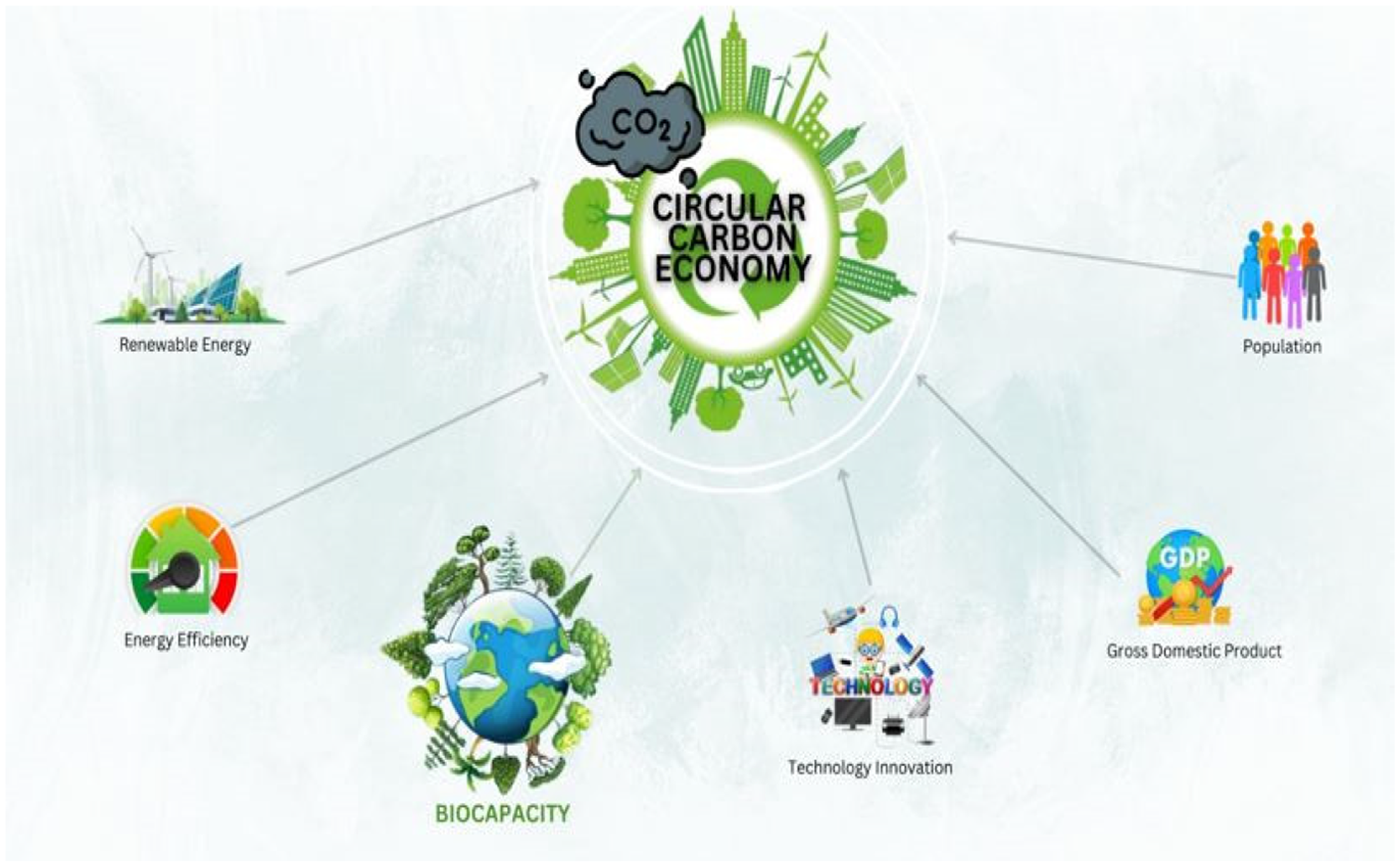
Keywords
Get full access to this article
View all access options for this article.