




Abstract
Recent studies in human geography and political ecology have examined the anticipatory politics of proposed infrastructure and their effects. Less work analyses how speculation and rumour are mobilised to promote or resist such infrastructures. In this paper, I examine how speculative ideas about long-proposed hydropower dams and transbasin water diversions in the Salween River Basin are strategically deployed by differently placed actors working towards project development or demise. I draw on empirical research on the proposed Yuam River water diversion project in Northwest Thailand and near the Thai–Myanmar border. I develop a conceptualisation of proposed infrastructures as amorphous as they constantly change form and enrol a shifting network of actors, and development plans and imaginaries. The Yuam diversion becomes amorphous through the contested ‘facts’ of the case and over time. I illustrate this using two longitudinal examples. First, infrastructure is made amorphous through protracted development processes for the Yuam diversion and earlier iterations. Second, I examine speculative ideas about how the Yuam diversion is intertwined with proposed dams in the Basin including the Hatgyi Dam in Myanmar. In this case, the lack of confirmed project developers and financiers for the Yuam diversion, and rumours of Chinese actors’ involvement under the Belt and Road Initiative, creates strategic space for project promotion and resistance. What is at stake is not just theorising proposed infrastructures as speculative ideas but how the ‘amorphous’ qualities of infrastructure are deployed strategically, by whom, and to what effect.
Introduction
Recent studies in human geography and related disciplines have reconceptualised infrastructure as not only material but comprised of shifting ideas, imaginaries, practices, institutions and social relations (Appel et al., 2018; Hommes et al., 2022). Using a lens of anticipation, scholars have shown how proposed infrastructures are ‘conjured through rumour, conjecture and elusive documentation’ and generate a range of impacts prior to their materialisation (Haines, 2018: 393; Murton and Lord, 2020). Yet less work has examined how speculative ideas about proposed infrastructures are mobilised strategically by different actors working towards project development or demise, as I do here
In this paper, I examine how speculative ideas about long-proposed hydropower dams and transbasin water diversions in the Salween River Basin are deployed strategically by state actors, diverse civil society actors and residents. I focus on the proposed Yuam River water diversion project (hereafter, Yuam diversion), the latest in a series of projects that have been proposed and resisted since 1979 in the Thai–Myanmar borderlands of the Basin (TERRA, 1997: 36). This Thai state-led project would divert water to Central Thailand for irrigation. Yet who will construct and finance the project remains subject to speculation, particularly with regards to the role of Chinese actors under the Belt and Road Initiative (BRI).
Following Björkman (2014b: 10), I treat speculative ideas about water infrastructure as a key site of ethnographic inquiry. I found that the ‘facts’ of proposed dams and diversions evolve over time and are thus difficult to pin down or identify clearly. The information that proponents share with communities and the public also shifts over time, highlighting how state and corporate actors actively produce uncertainty in the pursuit of dam development (Whitington, 2018). I suggest that there is no singular or fully ‘knowable’ Yuam diversion but multiple proposed projects that merge into one another over time. The project is imagined by different actors as expanding materially in future phases, albeit in different configurations, to evoke promise or imagined destruction. To this extent, I develop a conceptualisation of proposed infrastructures as amorphous and comprised of a shifting set of ‘facts’, claims and development plans and imaginaries. I contend that the Yuam diversion becomes, and is made, amorphous through the conflicting ‘facts’ of the case and protracted processes of development, including the Environmental Impact Assessment (EIA). This reflects that EIAs are key sites where claims and knowleges about proposed infrastructures are (re)made and contested in Southeast Asia (Lamb, 2014b; Sangkhamanee, 2015).
I draw out the notion of amorphous infrastructure using two longitudinal examples. First, I excavate the linkages between a series of dams and diversions proposed along the Yuam River. While the Yuam diversion, and earlier iterations, enrol a shifting network of state and corporate actors, both domestic and international (Akimoto, 2004), I show how key features of these projects are ‘recycled’ across multiple EIA reports. Yuam River residents framed these multiple proposed projects, and their struggles, as interconnected over time. In this case, the ‘specter of dispossession once again’ (Goett, 2016) generates affective impacts and an enduring resistance movement (Fung and Lamb, 2023).
Second, I analyse speculative ideas about how the Yuam diversion is intertwined with proposed dams and diversions over time and across borders in the Basin, including the Hatgyi Dam, which is proposed on the Salween mainstem in Myanmar. What is being presented as new is the speculative role of Chinese capital and expertise in facilitating the Yuam diversion, potentially as part of the BRI (Macan-Markar, 2021). The ways in which different actors mobilise such claims is strategic. For instance, Thai politicians aligned with the ruling military junta at the time positioned the Yuam diversion as an opportunity for faster and cheaper Chinese-backed development across the Basin. Civil society actors and residents cautioned that the Yuam diversion, if backed by Chinese actors, would be a ‘stepping stone’ towards the development of multiple destructive dams and diversions. They mobilised such claims to draw (inter)national attention to an otherwise overlooked water diversion and their enduring struggles over development. In this case, the absence of confirmed project developers and financiers creates strategic space for project promotion and resistance, albeit under conditions of inequitable power in state-led development.
I develop a framing of amorphous infrastructure to examine how speculative ideas about proposed projects are mobilised strategically by different actors working towards divergent futures. I draw on critical scholarship from human geography and political ecology that examines how knowledge (Björkman, 2014a, 2014b; Sangkhamanee, 2015; Whitington, 2018) and time and anticipation (Cross, 2015; Murton and Lord, 2020) are key to understanding contests over infrastructure and their effects. Next, I examine the (anticipatory) politics of infrastructure and outline a framing of ‘amorphous’ infrastructure. I then present the two longitudinal examples to illustrate this concept, before concluding.
Infrastructural politics across temporal phases and forms
Amidst an ‘infrastructural turn’ in geography and related disciplines (Hommes et al., 2022, 1), scholars have reconceptualised infrastructure as material, social and spatiotemporal processes (Appel et al., 2018; DiCarlo, 2024; Ramakrishnan et al., 2021). Infrastructures are always shifting and contested, even during operation. For instance, Rogers et al. (2019: 50) show how the material and institutional ‘boundaries’ of China's South-North water diversion keep shifting. Meanwhile, Thailand's Pak Mun Dam remains ‘perpetually contested’ (Foran and Manorom, 2009). Examining the ‘sociotechnical imaginaries’ of engineers and scientists, Cousins (2020) contends that infrastructural ‘malleability’ enables California's Morris Dam to persist and be reconfigured to address different political goals and crises over time. While ‘modernist dreams’ of ‘taming’ nature spurred the dam's construction in the 1920–1930s (Ibid: 6), this operational dam was then ‘retrofitted’ into a naval weapons’ testing site during the Cold War and most recently to bolster water security in an era of climate change.
Björkman (2014a) investigates how Mumbai's residents access water on a daily basis, given that household taps often run dry. While Björkman initially sought to map the ‘facts’ and spatiality of the city's underground water network (Ibid: 21), her efforts were ‘frustrated by the deeply fragmented nature not only of my own knowledge … but of the grid's very knowability … even “official” knowledge of the grid is multiple, conflicting, infused with rumor and … based on speculation’ (Björkman, 2014b: 10). Without ‘reliable’ maps, the knowledges and everyday practices of engineers, plumbers, valve operators, brokers and residents were key to ‘knowing’ infrastructure and understanding water access (Björkman, 2014a).
In the absence of material infrastructures to map and ‘know’ (Björkman, 2014b), I study the various plans, proposals and contested EIA processes for proposed Salween dams and diversions. While the idea of the Yuam diversion is also ‘malleable’ and reconfigured in response to changing (geo)political contexts (Cousins, 2020), amorphous infrastructure captures how a broader conglomeration of actors – international and domestic, state and private, civil society and residents – differently imagine the Yuam diversion towards divergent ends. Moreover, the proposal phase creates additional scope for uncertainty as the project developers and financiers are often unknown or not revealed to the public (Murton and Lord, 2020). This fuels speculation and creates strategic space for negotiation and resistance.
Whitington (2018) shows how a range of proponents – state actors, consultants and hydropower company managers – mobilise uncertainty to push forward purportedly ‘sustainable’ hydropower development in Laos. For Whitington, proposed dams are ‘predicated on anticipation and promise’ rather than ‘facts’ or the authority of ‘expert’ environmental knowledge (Ibid: 64). Incorporating and managing uncertainty is strategic, given that, since the 1990s, transnational anti-dam activists have targeted the dam industry's lack of knowledge about dams’ impacts on riverine ecologies and livelihoods (Ibid: Ch. 2). Uncertainty persists even as dams’ socioecological impacts are well-documented. For instance, hydropower dams in the Mekong River Basin have negatively impacted fisheries and resource-dependent livelihoods (Baird et al., 2020; Soukhaphon et al., 2021), with similar impacts observed globally (Richter et al., 2010; WCD, 2000). Such impacts are anticipated by residents waiting for dams to materialise as residents hear about other displaced communities’ experiences (Braun, 2020: 870). Building on Whitington (2018), I show how a range of actors deploy uncertainty, or make proposed infrastructure amorphous, as a strategy not only of project promotion but also resistance. In doing so, I show how civil society actors and residents exploit uncertainty about the very foundations of infrastructure – what will emerge materially, over what timescales, the actors and financial networks involved – and how the Yuam diversion is interconnected with other proposed infrastructures.
Anticipating infrastructure
Time and temporality have been engaged in diverse ways to analyse infrastructure across multiple temporal phases and forms (Appel et al., 2018; Campbell, 2012; DiCarlo, 2024; Joniak-Lüthi, 2019; Lord et al., 2020; Ramakrishnan et al., 2021; Yeh, 2022). In this paper, attention to time highlights the interconnections between contemporary infrastructure proposals and previous iterations over long durations and the anticipatory politics of infrastructure. The proposal phase often extends over decades and generations, reshaping lives and livelihoods in the process. 1 For instance, Thailand's Kaeng Suea Ten Dam has been proposed for more than four decades. The looming threat of displacement from this dam led to a withholding of government and personal investment around the dam site, land speculation, anxiety and stress for residents and resistance (Kirchherr et al., 2018). I found Carse and Kneas’ (2019, 22) heuristic of the ‘zombie’ useful, which ‘invites analysis of infrastructure projects over multiple iterations and across temporal frames’. Proposed infrastructures become zombies as ‘one after the other is proposed, approved by the state, eventually killed due to lack of feasibility or popular resistance, only to return … with the specter of dispossession once again’ (Goett, 2016). Salween dams and diversions are ‘zombies’ that are (re)proposed by a shifting network of actors and resisted by multiple generations of residents and activists (Fung and Lamb, 2023: 1673).
Scholars have engaged anticipation as a lens to highlight the material and affective impacts of proposed infrastructures and thereby demonstrate ‘how [infrastructures] come to matter before they become “matter”’ (Haines, 2018: 397; see also Geschewski, 2024). For Cross (2015: 425), proposed infrastructures generate ‘economies of anticipation’ where ‘diverse ways of knowing about, imagining and living toward the … future converge’. Anticipation generates hope, aspiration and despair for differently placed actors (Braun, 2020; Cross, 2014; Geschewski and Islar, 2022; Murton and Lord, 2020). Proposed infrastructures can generate an ‘economy of appearances’ (Tsing, 2000) that spurs the ‘speculative exuberance of investors’ and reroutes global capital flows (Cross, 2015: 426). Yet anticipation also generates ‘vernacular dreams’ of ‘improvement’ for residents, even when the promises of infrastructure are neither plausible nor credible (Cross, 2014: 67). Given that the promises of dams in Southeast Asia have largely failed to materialise (Hirsch, 2010; Shoemaker and Robichaud, 2018), proposals to dam and divert the Yuam River prompted sadness, anger and resistance amongst residents, as I detail below.
EIA: Making and contesting knowledge about proposed infrastructure
Rather than ‘blueprints’ for infrastructural development, EIAs do political work. For example, state and corporate actors use EIAs to highlight project benefits and obscure impacts and thereby justify development (Braun, 2020; Fent, 2020; Westman, 2013). EIAs seek to delineate whose voices and which impacts ‘count’ or are discounted in development decision-making processes and are thus deeply contested. Moreover, the ideas contained in EIAs shape the ‘social and material outcomes of dam projects’ regarding what is built, who gets compensation and mitigation efforts (Green and Baird, 2020: 1).
What is recognised as an impact area is a key arena for debate and negotiation during EIA (Fent, 2020; Green and Baird, 2020). For example, in the EIA for the Hatgyi Dam, consultants ‘re-scaled’ the project to exclude impacts on the Thai side of the border (Lamb, 2014b). Doing so suggested that ‘residents do not have a legitimate, impact-based claim to participate’ in state-led development decision-making (Lamb, 2014a: 7–8). Similarly, the EIA for the Yali Falls dam in Vietnam excluded impacts on the Cambodian side (Wyatt and Baird, 2007). State-led EIAs often draw on ‘foreshortened’ timescales that exclude long-term, multi-generational and non-human impacts from consideration (Awâsis, 2020). In response to such exclusions, residents and civil society actors engage their own anticipatory practices. For both the Yuam diversion (Fung and Lamb, 2023) and a proposed mine in Senegal (Fent, 2020), residents expanded the spatiotemporal boundaries of the impact area to highlight impacts that were overlooked in the EIA and demanded that further studies be undertaken, thereby strategically delaying development.
Knowledge production is a key ‘part of the contested ground in hydropower decision-making’ in Southeast Asia (Sangkhamanee, 2015: 90). Scholars have highlighted the contested narratives and opaque decision-making processes around proposed dams in the Mekong Basin (Geheb et al., 2014; Hensengerth, 2015; Suhardiman and Geheb, 2021; Wells-Dang et al., 2016; Yong and Grundy-Warr, 2012). Residents and civil society actors have challenged the authority of technical or ‘expert’ environmental knowledge, including EIA, through counter-knowledge production. For example, Thai Baan or villager-led research is a ‘counter-hegemonic methodology’ (Heis and Vaddhanaphuti, 2020) that was developed in the early 2000s by dam-affected villagers and local civil society to document dams’ socioecological impacts based on villagers’ expertise (Scurrah, 2013; Sretthachau and Deetes, 2004). Thai Baan repositions who can be an expert (Lamb, 2018) and has been used to contest the findings of state-led EIAs for proposed dams in the Mekong and Salween Basins including the Hatgyi Dam (Lamb, 2014b; Rogers et al., 2023; Yong, 2020). Thai Baan also highlights the importance of strategic alliances between local NGOs, academics and communities in contesting dams and diversions over the long-term (Green and Baird, 2020; Hengsuwan, 2019; Sangkhamanee, 2015: 91). Next, I present amorphous infrastructure as a framing to analyse how speculative ideas about proposed infrastructure are deployed strategically by different actors.
Amorphous infrastructure
When I commenced the research, I felt an ‘an anxious compulsion to “get the facts straight”’ about the Yuam diversion (Björkman, 2014b: 10). As I engaged with project development, I encountered a range of speculative ideas about the project, the actors and financial networks involved and how it is intertwined with development proposals over time and across borders in the Salween River Basin. I found there is an unknowable quality about the Yuam diversion as it constantly shifts and changes form over time. I began to treat the conflicting ‘facts’ and ideas about the Yuam diversion as a focal point for ethnographic inquiry (Björkman, 2014b). In doing so, I take inspiration from scholars who position infrastructure as both an ‘object … and as a medium of social analysis’ (Yeh, 2022: 15) and a ‘methodological entryway’ to understand the political processes and social relations that animate these infrastructures (Appel et al., 2018; Björkman, 2014b: 1; Pasternak, 2023).
Infrastructures not only materialise but reproduce social relations (McDuie-Ra, 2021). Reflecting this, Björkman (2014b: 10) studies water infrastructure to understand uneven processes of ‘urban transformation and contestation’ in Mumbai. In the absence of material infrastructures, the ‘object’ of inquiry in this research are the various plans, proposals and contested EIA processes for Salween dams and diversions. Studying ‘immaterial’ infrastructures (Motta et al., 2023) in this way reveals new insights about strategies of project promotion and resistance and the broader dynamics of uneven development in the Salween Basin, where multiple projects remain proposed but as yet unbuilt.
The term ‘amorphous’ refers to a thing or idea that lacks a clear form, structure, or details (Cambridge Dictionary, 2023). This is how the idea of the Yuam diversion emerged in this research. This led me to question: through what processes and practices does proposed infrastructure become amorphous? For what purposes might differently placed actors make infrastructure amorphous? Building on scholarship on the anticipatory politics of infrastructure (e.g., Cross, 2015; Murton and Lord, 2020), I show how a range of actors deploy speculative ideas about proposed infrastructure as they work towards project development or demise. I contend that what makes the Yuam diversion amorphous are the contested ‘facts’ of the case and the prolonged processes of development.
By tracing the extensive ‘before life’ of the Yuam diversion, I show how different iterations of the project are (re)proposed by a shifting conglomeration of actors in response to changing (geo)political conditions and the demands of social movements over time. The project is imagined in ever-shifting configurations and as expanding materially – via pipelines, dams, ancillary infrastructures and flows of water – in future phases across the Basin, to evoke the promises and perils of infrastructure. Many of these debates play out during contested EIA processes and through counter-knowledge production.
Like Whitington (2018), this paper highlights how state actors and consultants produce uncertainty about the Yuam diversion to push forward development, for instance, as they change and obscure the information that they share with communities in EIAs and public hearings. In this case, the lack of confirmed developers and financiers and the speculative role of Chinese actors in facilitating development under the BRI, creates room not only for project promotion but also resistance. Extending Whitington (2018), I show how civil society actors and residents also produce uncertainty, or make proposed infrastructure amorphous, by deploying BRI narratives and rumours of Chinese actors’ involvement. In doing so, they successfully draw attention to an otherwise overlooked water diversion proposal and build momentum against multiple proposed projects in the Basin. Given that the Yuam diversion is rumoured to be part of the BRI, I review scholarship on speculative BRI infrastructures next.
Speculative belt and road infrastructures
Rather than a ‘monolithic, infrastructural spatial fix’ (Murton and Lord, 2020: 6) or a coherent policy that emanates downwards from Beijing (Chen, 2020), scholars have (re)conceptualised the BRI as a ‘relational, contested process – a bundle of intertwined discourses, policies and projects that … are sometimes contradictory’ (Oliveira et al., 2020: 1). The Chinese government has developed environmental and social safeguards for BRI infrastructures (MoEE, 2017) and Chinese dam developers are increasingly employing domestic and international safeguards to improve their reputations (Kirchherr et al., 2017). In response, international NGOs have published guidelines on how civil society actors can deploy these standards in their advocacy (IDI, 2019). Yet scholars have noted that the implementation of such standards by Chinese actors is inconsistent for hydropower dam development (Käkönen, 2023: 274) and ‘weak’ for BRI-linked projects in Southeast Asia (Mackenzie et al., 2022: 20).
Political geographers have examined the lived experiences of residents anticipating BRI infrastructures in the region. For instance, Lao residents living ‘in the shadow’ of the Laos-China Railway (LCR) experience an ‘intimate state of suspension and stasis’ as they wait and hope for compensation for lost land and livelihoods with limited access to information (DiCarlo, 2024: 208). While the ‘speed of Chinese-assisted development is a common trope internationally’ (Murton and Lord, 2020: 6), residents’ experiences of waiting disrupt such assumptions of ‘China speed’ (DiCarlo, 2024). Both Chen (2020) and DiCarlo (2024) question the assumed speed and efficiency of Chinese-backed infrastructure development under the BRI. Chen (2020) shows how the Chinese government delayed the provision of credit to the Lao state to construct a segment of the LCR and instead coerced Chinese enterprises into financing construction themselves. The wages of workers were, in turn, reduced, delayed and withheld, leading to labour exploitation and resistance. The messiness of this project highlights ‘how, even at the core of BRI, centralised state orchestration is … overstated’ (Ibid: iii).
In Myanmar, speculative cross-border BRI infrastructures generate ‘sovereign anxiety’ for residents and this is exacerbated by a lack of transparency and the ‘BRI's indeterminate nature’ (Mostafanezhad et al., 2023: 133). While BRI infrastructures in the Salween River Basin promise ‘new planned connections … to and from distant sites, territories and markets’, there are few details about what these ‘amorphous’ projects would mean for Salween ecologies and livelihoods (Lamb et al., 2019: 2). In Nepal's borderlands, imaginaries of BRI-linked hydropower futures are already reconfiguring ‘local livelihoods, political economies, mobility regimes and center-periphery relations’ (Murton and Lord, 2020: 10). For instance, Nepalese state actors promote the long-proposed Budhi Gandaki Hydropower Project (BGHPP) as an ‘infrastructurally enhanced landscape with dams and electricity, roads and resources and local economies inextricably joined to China’ via the BRI (Ibid, 10). This reflects how proposed infrastructures promise ‘speed, political integration and economic connection’ (McDuie-Ra, 2021: 51). Project financing has shifted between loans from India (when tense geopolitical relations allow), multiple cancelled and renewed contracts with Chinese state-owned enterprises (SOEs) and funding from Nepalese state agencies. Yet the ‘official modality for the development of the BGHPP remains unclear and unconfirmed’, as does the project's incorporation into the BRI (Murton and Lord, 2020: 11). The BGHPP draws many parallels with the Yuam diversion, both of which can be conceptualised as amorphous.
Research context, fieldsites and methods
This paper draws on ethnographically oriented fieldwork conducted in Northwest Thailand and the Salween River Basin. The Salween River commences in Tibet and flows through China and Myanmar, before forming the Thai–Myanmar river-border for 120 km and continuing through Myanmar and into the Andaman Sea (Fung and Lamb, 2024). Seven dams are proposed along the lower Salween River in Myanmar (see Figure 1).
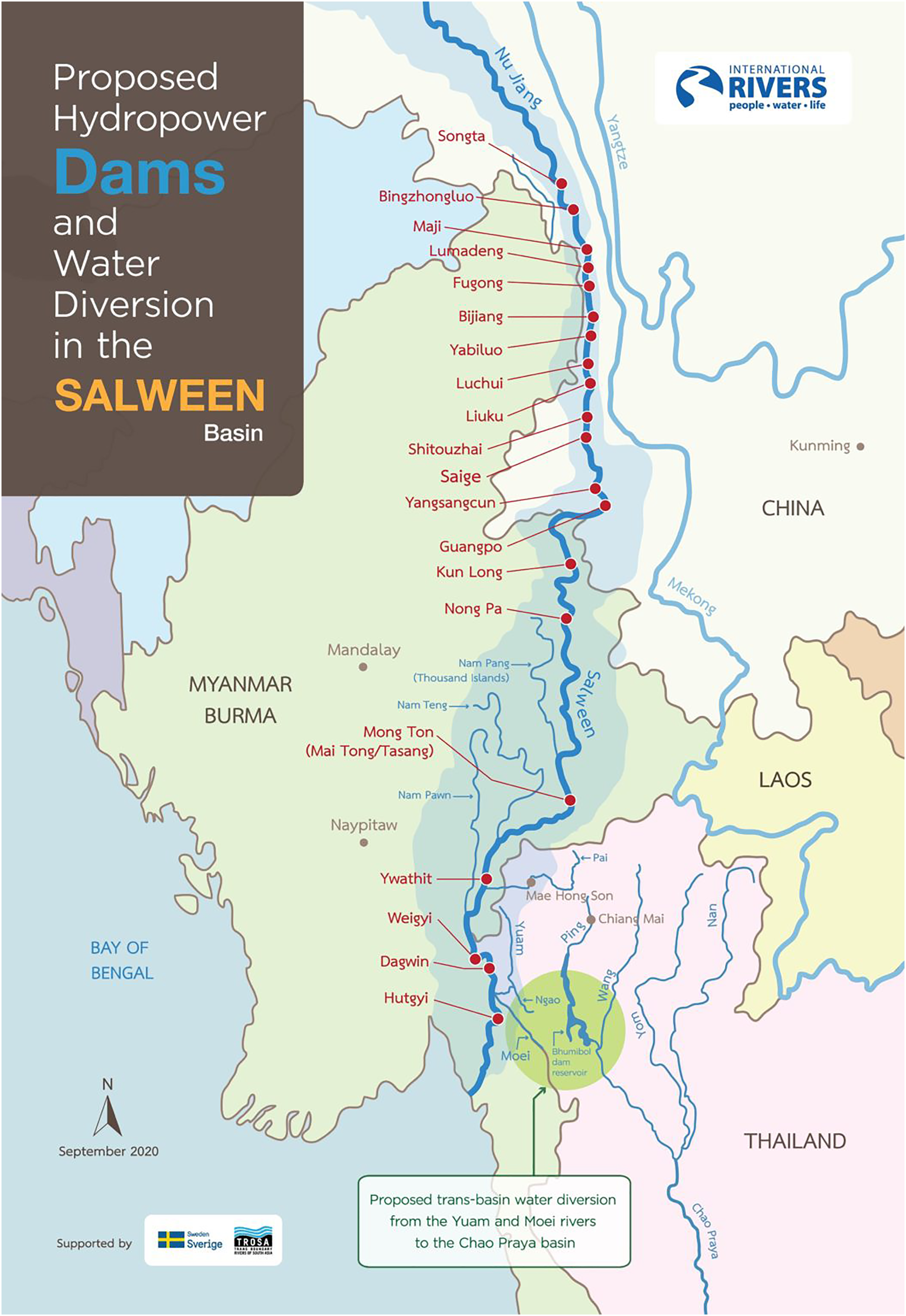
A map of proposed hydropower dams and water diversion projects in the Salween River Basin. Source: International Rivers (2020). This map is licensed under the Creative Commons, which allows materials to be reproduced for educational and non-profit purposes.
The Hatgyi Dam, proposed since the late-1990s, would be built on the Salween River in Myanmar's Karen State and across the border from the Yuam diversion. Communities on both sides of the border are concerned about the dam's transboundary impacts on fish migration, riverine ecologies and the inundation of residential and agricultural land (Hengsuwan, 2019: 189; Salween Watch, 2016). Investors for this dam include the Electricity Generating Authority of Thailand (EGAT), Sinohydro – a Chinese SOE and the world's largest dam builder (Han and Webber, 2020: 63), Myanmar's Department of Hydroelectric Power and IGE, a Myanmar conglomerate (Lamb, 2014a: 4). EGAT would purchase 75–90% of the electricity generated by this dam (EarthRights International, 2018). This case highlights Thailand's role in enabling hydropower development in Myanmar and other neighbouring countries including Laos (Sangkhamanee, 2015; Whitington, 2018). The dam site is within an active conflict zone (EarthRights International, 2018). Hydropower proposals have increased militarisation and exacerbated ongoing conflict around proposed dam sites. For instance, civil society organisations linked conflict in Karen State in 2014 and 2016 to attempts by the Myanmar military to expand control over Karen-controlled territory and develop the Hatgyi Dam (KRW, 2016; see also Middleton et al., 2019: 39; Roney, 2024).
While details about the status of proposed Salween dams remain opaque, following a coup d'état in February 2021, Myanmar's military junta expressed renewed interest in constructing the Hatgyi Dam and a range of extractive projects (KHRG and KRW, 2021; Roney et al., 2021). Signals about the revival of dams and diversions ‘come from the Myanmar government, investors and Thai politicians. If projects move forward, related human rights violations are likely to emerge once again’, highlighting what is at stake if long-proposed dams and diversions materialise (Tano and Sukkaew, 2023). Thailand was also ruled by a military government following a coup in May 2014 until contested elections in May 2023.
The Yuam River originates in Northwest Thailand and flows southwards alongside the Thai–Myanmar border. The Yuam Dam is proposed on the Yuam River in Sob Moei District, Mae Hong Son Province and approximately 14 kilometres from the Thai–Myanmar border (Ocharoenchai and Duggleby, 2022). This dam would create a 2075 rai 2 (332 hectare) reservoir from which a water pumping station would divert water along a 61.85-km tunnel to Bhumibol Dam in the Chao Phraya River Basin (Naresuan University, 2021) (see Figure 2). An electricity transmission line would be constructed to transport electricity from Lamphun Province to support the energy-intensive pumping station. The project would entail the clearing of 582 hectares of forest, including protected areas (Ocharoenchai and Duggleby, 2022).
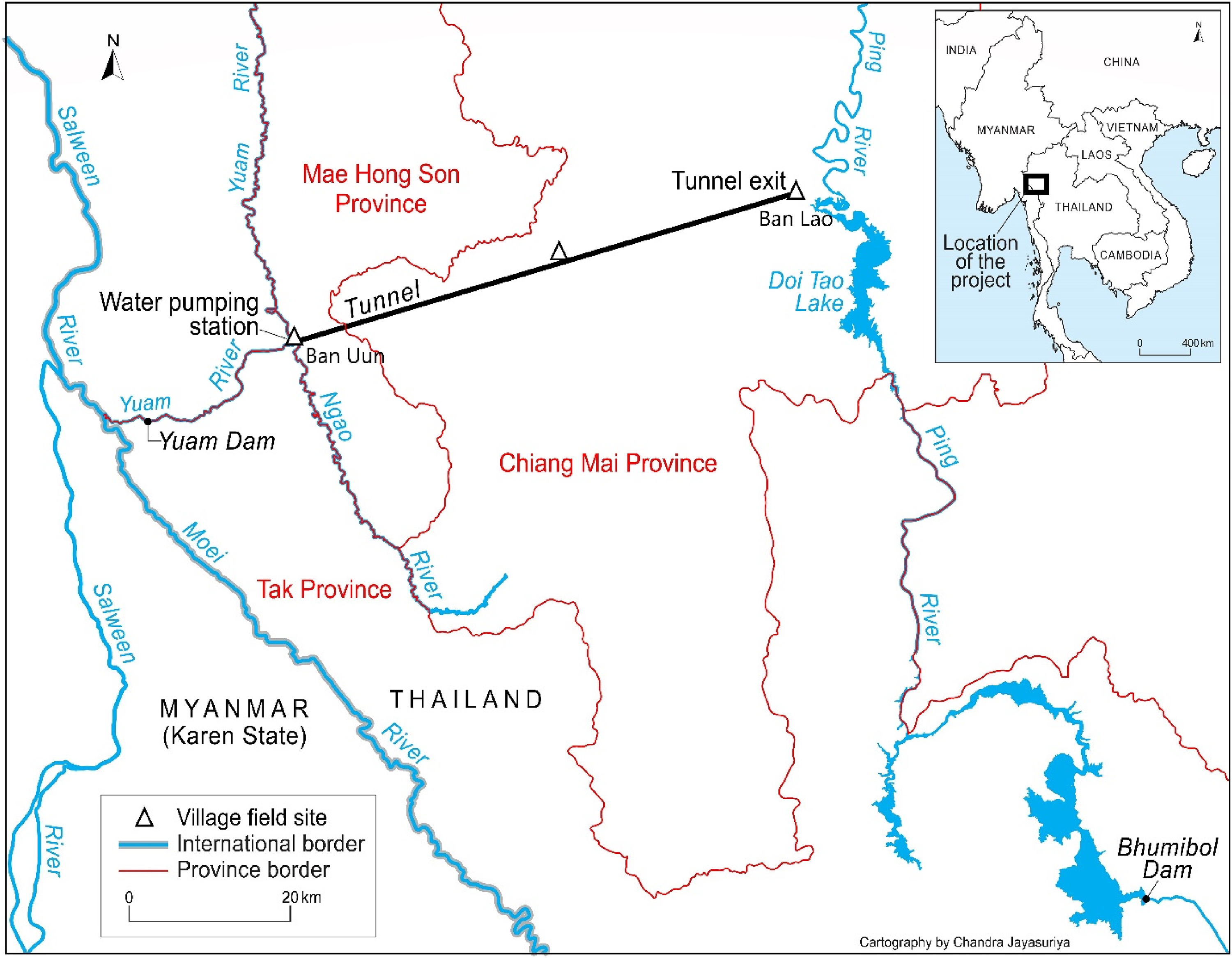
This map of Northwest Thailand, near to the border with Myanmar, shows the area of research and the proposed Yuam River water diversion project, including the proposed YuamDam site, water pumping station and diversion tunnel. The primary fieldsite, Ban Uun, is marked by a triangle beside the water pumping station. The second fieldsite, Ban Lao, is located near the tunnel exit. Source: Cartography by Chandra Jayasuriya, University of Melbourne.
The Yuam diversion is being developed by Thailand's Royal Irrigation Department (RID). According to the RID, the Yuam diversion would irrigate 256,000 hectares of farmland during the dry season and mitigate water scarcity in Central Thailand (ThaiPBS, 2021). Blake (2023: 988) describes the RID as a powerful ‘hydrocracy’ that maintains ‘material and discursive superiority’ over water management decision-making by cultivating patronage ties with powerful political and military actors and its ‘royal’ status. The Yuam diversion reflects the ‘supply augmentation logic’ (Molle, 2007) of the RID as they pursue ‘technically complex, grandiose and expensive’ projects, including transboundary diversions from the Mekong, Salween and other border rivers, to mitigate water scarcity and expand irrigation (Blake, 2023: 994). In such cases, scarcity is positioned as ‘natural’ rather than socially produced (Bakker, 1999; Molle, 2023; Molle and Floch, 2008).
Overall, I conducted 80 semi-structured interviews online from May to October 2021 and in-person from January-April 2022. Interviews were conducted with residents from two fieldsites affected by the Yuam diversion and diverse civil society actors including international and domestic NGO staff, activists and academics. To understand ‘amorphous’ infrastructure over time, I interviewed older generation residents and civil society actors who have been engaged in struggles over Salween developments for decades.
I also interviewed officials from the RID, a local-level forestry department, and the National Human Rights Commission of Thailand, and politicians from a military-aligned party and an opposition party. I analysed EIA reports and feasibility studies by different state agencies and consultants from the past four decades alongside NGO reports and media articles. I conducted follow-up fieldwork for one month in 2023 and one month in 2024. Interviews were conducted in English, or in Northern Thai or Karen languages with live interpretation into English by Research Assistants. I speak conversational Thai language and this enabled me to follow the contours of interview discussions.
The primary field site is Ban Uun, a village located along the Yuam River in Northwest Thailand and near the proposed Yuam Dam site. 3 Residents identify as Karen Pwo and Karen Sgaw 4 and practice Buddhism, Christianity and/or animism. Residents’ seasonally adapted livelihood strategies include fishing for consumption and sale, collecting edible forest products (e.g., mushrooms, konjac, riverbank vegetables) and labour migration. Residents anticipated that the project would generate a range of socioecological impacts that were overlooked in the EIA, many of which were linked to the ‘changing temporalities’ of ‘anthropogenic rivers’ (Whitington, 2018: 25). This includes changes to the timing and predictability of seasonal flows of water and sediments upon which residents’ livelihoods depend. Around 100 fish species migrate between the Salween and tributary rivers (Akimoto, 2004: 12). Residents were concerned that the Yuam dam would block seasonal fish migration between the Yuam and Salween Rivers and disrupt fish lifecycles and were aware of such impacts for operational dams elsewhere including Pak Mun Dam (see Baird et al., 2020). Many of these concerns were shared at the second fieldsite, Ban Lao, a Karen Pwo community located near the tunnel exit. Residents’ livelihoods are based on longan farming and gathering forest products and they are primarily concerned about the dumping of soil and rock debris from tunnel construction on their farmland and forests.
The field sites were selected in conversation with key Salween civil society actors who I have collaborated with since mid-2020. These actors shaped the design, direction, questions and outputs of research. In the spirit of producing collaborative research (see Fung, 2024), I have co-authored accessible research summaries and articles with Karen and locally-based collaborators (Fung et al. 2019; Fung et al., 2022) in English, Thai, and Burmese languages (Fung and Nawanat, 2023). In 2022, I was an affiliated researcher at Chiang Mai University's Regional Centre for Social Sciences and Sustainable Development (RCSD) which enabled me to deepen my connections with civil society actors and Salween communities. The RCSD has long been involved in cross-border Salween issues and RCSD academics were instrumental in developing Thai Baan. I also built on previous networks established during research conducted with a local NGO in Northern Thailand in 2016.
Amorphous infrastructure: The ‘before life’ of the Yuam diversion
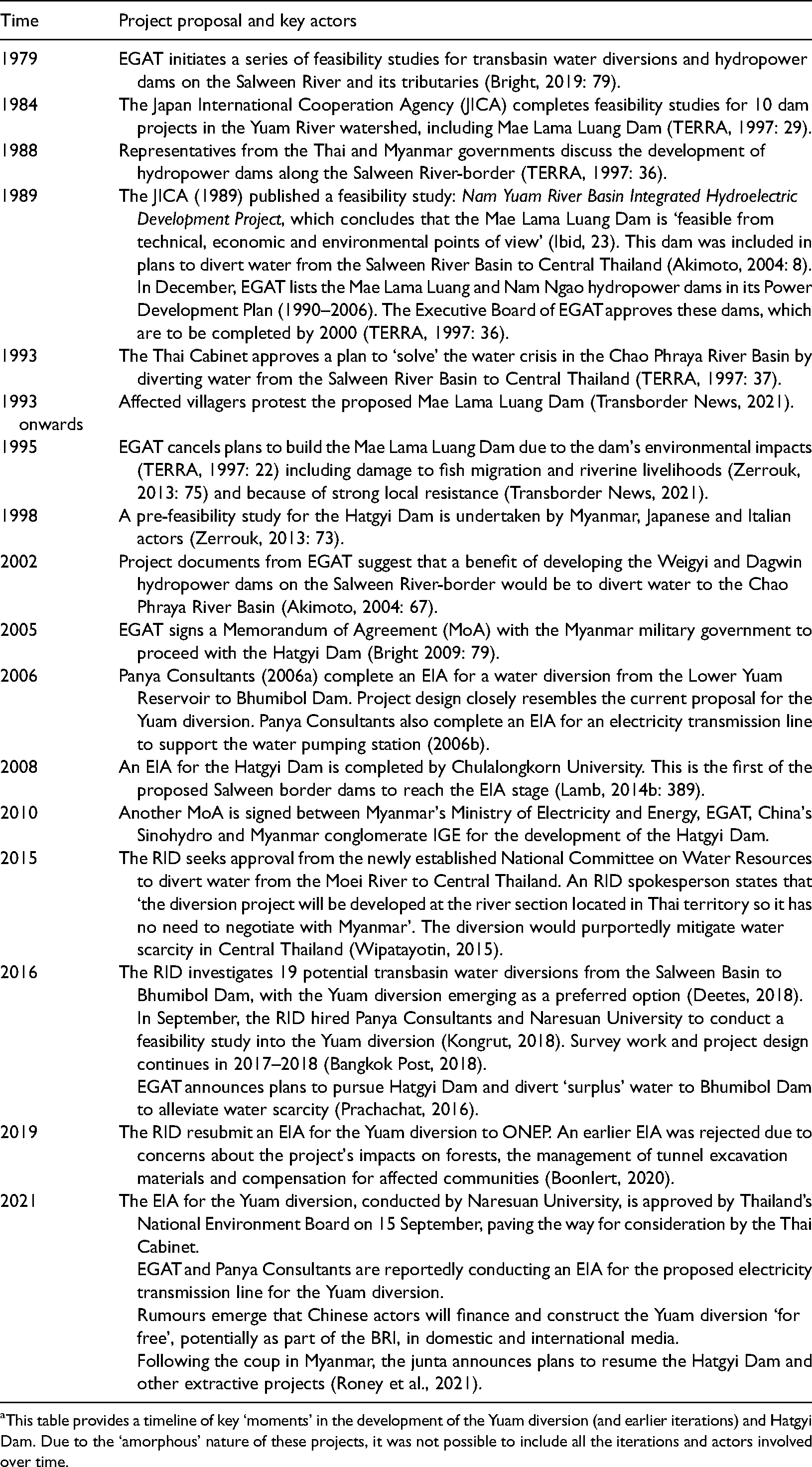
Tracing the extensive ‘before life’ of the Yuam diversion reveals how proposed infrastructure becomes amorphous over time and through protracted development processes (for a timeline, see Appendix A). EGAT began investigating transbasin diversions from Salween tributaries in 1979 (TERRA, 1997: 36). In 1984, the Japan International Cooperation Agency (JICA) completed feasibility studies for 10 dam projects in the Yuam River watershed, including Mae Lama Luang Dam (Ibid, 29; JICA, 1989). Many interviewees positioned this dam as a precursor to the Yuam diversion. Proposed on the Yuam River 7 km upstream from the Yuam–Moei confluence at the Thai–Myanmar border, this 100-m-high hydropower dam would create a reservoir from which water would be diverted to Bhumibol Dam (Vatcharasinthu and Babel, 1999: 39). In February 1995, EGAT cancelled their plans to construct this dam due to its environmental impacts (TERRA, 1997: 22) including damage to fisheries and livelihoods (Zerrouk, 2013: 75) and, as interviewees and recent media reports highlight, due to local-level resistance (Transborder News, 2021). These projects and struggles are positioned as interconnected over time.
These events were shaped by a growing anti-dam movement in Thailand which accelerated in the 1990s alongside global anti-dam struggles (Elinoff and Lamb, 2022: 385). A prominent example is resistance against Pak Mun Dam, which transformed the politics of dam building in Thailand and beyond (Ibid: 386–387). This dam was completed in 1994 with support from the World Bank and is operated by EGAT (Sangkhamanee, 2015). Resistance emerged during the proposal phase and intensified as the dam's impacts became evident, including on fish migration and riverine livelihoods (Elinoff and Lamb, 2022). Affected residents pioneered Thai Baan to document these impacts (Assembly of the Poor and SEARIN, 2004) and ‘scaled up’ their activism by mobilising under a nation-wide grassroots movement, the Assembly of the Poor (Green and Baird, 2020: 5). In 1997, they occupied the lawn outside Bangkok's Government House for 99-days (Sangkhamanee, 2015: 83). While some demands of affected residents were met, contestation endures regarding the opening of the dam's sluice gates and unresolved compensation claims (Green and Baird, 2020; Ibid). Thailand has been unable to construct large hydropower dams within the country since this time (Kirchherr, 2017) and anti-dam activism has prompted the Thai government to ‘‘spill’ it's flawed hydropower decision-making processes’ into neighbouring countries (Sangkhamanee, 2015: 88).
In response to anti-dam activism, the World Bank – the most significant dam financer at the time – reduced their support for hydropower development in the Salween Basin and globally in the early 1990s (Akimoto, 2004: 67; Han and Webber, 2020: 67). Chinese SOEs emerged as major dam financiers and developers in the Mekong Basin and across the Global South. This was also driven by China's ‘Going Out’ policy, which encourages Chinese SOEs to operate abroad and its subsequent adoption of the BRI (Han and Webber, 2020: 67). Chinese dam developers are also ‘less constrained’ by global social and environmental standards, as noted above, and are perceived as operating with fewer ‘strings’ than, for instance, the World Bank (Käkönen, 2023: 278). This history highlights the range of international actors involved in Salween developments over time and how this is connected to hydropower politics across scales.
When I asked respondents about the Yuam diversion, many began their story decades earlier with Mae Lama Luang Dam. One local NGO employee who has worked on Salween issues for decades explained that this dam was ‘basically the same’ as the Yuam dam in terms of location, but that the ‘difference is that Mae Lama Luang Dam was going to produce electricity only, but RID adapted it [from EGAT] to be the water diversion’. Reflecting this, Kiet, a middle-aged Ban Uun resident and fisherperson, explained that: Before they used the term kheuan [dam], which refers to something big. Now they changed to use the term pan nam [divert water] and ang-kep nam [reservoir], which makes it seem smaller than a dam … But the negative impacts will still happen. (Interview, January 2022)
Many interviewees similarly commented that proponents strategically reframed the project from a ‘dam’ to a ‘diversion’ in a bid to evade the attention of Thailand's anti-dam movement and reduce community opposition. This reflects the broader (geo)political dynamics outlined above.
In January 2022, I joined Kiet and residents on a boat trip along the Yuam River towards the proposed Yuam Dam site. Kiet explained that the Yuam diversion ‘started 30 or 40 years ago … [with] Mae Lama Luang Dam. … The people opposed the dam and then it was quiet. But now, it comes back again’, albeit in a different form. Kiet protested the Mae Lama Luang Dam when he was young and now opposes the Yuam diversion because he anticipates it will negatively impact fisheries and residents' resource-dependent livelihoods. When I enquired whether residents would resist the Yuam diversion again, Kiet replied: ‘Yes, you can see our opposition already. But now we are in a political atmosphere under … military power … so we cannot fully oppose the project’. Kiet's quote highlights the difficulties of openly resisting state-led development under authoritarian conditions (Fung and Lamb, 2023). This example illustrates how residents’ struggles are necessarily protracted in response to multiple projects that are (re)proposed by different actors over time.
Nat, a Thai aquatic ecosystems expert who voluntarily engages in Salween issues, joked that the Yuam diversion is ‘like a zombie, you never kill any of these projects’ [laughter] (Interview, September 2021). Similarly, Sunan, a long-term local NGO employee, explained that the Yuam diversion has been envisioned for a ‘long time, many times’ (Interview, May 2021). Discussing this in relation to the long-proposed ‘zombie’ Kaeng Suea Ten Dam, he reflected that ‘after elections … every time the politicians will propose this dam. Maybe it is different in detail, a little bit upstream or downstream. Even though they know it is very difficult, they propose it … again and again’. Reflecting on why projects are (re)proposed, Sunan explained that proponents ‘can get the budget for the feasibility study, they can make rumours, make something move, like buying or selling land … Even if they don’t think it can happen’, reflecting Tsing's (2000) notion of the ‘economy of appearances’.
Drawing on earlier plans and imaginaries, Panya Consultants, a Thai engineering consultancy, released an EIA for a transbasin water diversion from the Yuam River to Bhumibol Dam (2006a) and a transmission line (2006b). The EIA (2006a) proposes a 69.5-m-high dam located 12 km upstream from the Yuam–Moei River confluence, a water pumping station and a 61.85-km tunnel to divert water to Central Thailand (Ibid: 1). Comparing this EIA with the 2021 version by Naresuan University reveals that almost the same physical infrastructures are being proposed 15 years apart by different consultants. Reflecting this, a Thai academic, Suthida, commented that proponents ‘copy-and-paste’ the same information across different EIA reports (Interview, July 2021) which are conducted by ‘washing machine scholars’, as one international NGO employee noted during an RCSD-run workshop (Field notes, February 2022).
Panya Consultants’ (2006a: 3) EIA outlined that just ‘2 Thai citizens and 19 Karen hill tribes’ would be ‘directly’ impacted by the Yuam Dam and receive compensation. This wording hints at the enduring marginalisation of Karen residents by the Thai state (see Bundidterdsakul, 2019). While various iterations of the Yuam diversion were proposed in subsequent years (see Appendix A), in 2016, the RID (re)investigated 19 potential transbasin water diversions from the Salween Basin to Bhumibol Dam, with the Yuam diversion emerging as a preferred option (Deetes, 2018).
State actors claim that the EIA for the Yuam diversion is ‘very meticulous’ (Interview with Tan, a Thai politician, April 2022) and was conducted ‘according to the law’ (Interview with RID officers, March 2022). This EIA was approved by Thailand's National Environment Board in September 2021. Yet civil society actors and residents argue that the EIA is ‘deeply flawed’ because it excluded residents from meaningful public participation and includes false or misleading information (Deetes, 2022). Such critiques are common for EIAs in Thailand and Southeast Asia (Wells-Dang et al., 2016). They noted that the EIA was approved ‘quickly’ and in relative secrecy during the COVID-19 pandemic, which limited residents’ ability to travel to or participate in public hearings (see Fung et al., 2022). The approval of the EIA signalled that a long-proposed ‘amorphous’ project may materialise with limited public participation and information available and this was key to building momentum against the project (see Deetes, 2023b; Wipatayotin, 2021).
Yet the EIA was not made publicly available before it was approved. The agency responsible for regulating EIAs in Thailand, the Office of Natural Resources and Environmental Policy and Planning, requested more than 20,500 baht [US$600] to provide a copy of the EIA. After paying this fee, ONEP only provided civil society actors with a heavily redacted copy and they only received full access after the EIA was approved (RFA, 2023). In this case, RID officers and consultants produced uncertainty (Whitington, 2018) by obscuring information in the EIA process. This made it difficult for civil society and communities to know the ‘facts’ of the project, let alone engage with and critique it. Some interviewees saw this as a deliberate effort by state actors to limit public access to information and thereby reduce opposition. Many residents noted that proponents amplified benefits and obscured the impacts of the Yuam diversion during the EIA process, as one young Ban Uun resident reflected: ‘in public hearings … they only mention the positive impacts’ including promises of jobs in construction and tourism from the reservoir (Interview, September 2021). However, residents were not convinced, as one woman stated: ‘I cannot cook [for tourists] – how can I get more income? I am happy to get products from the forest’ (Interviews, September 2021).
In April 2022, I interviewed Tan, a Thai Member of Parliament (MP) from a military-civilian party who supports the Yuam diversion. Farmers living in the province that Tan represents would purportedly benefit from diverted water. Tan claimed that the project ‘will affect only three households … [of] Pakakayor [Karen people]’. He promised affected families that ‘if the RID does not give you enough money for compensation for this 40 rai [6.4 hectares] … I will give you 1 million baht of my own money … They are glad! Nobody opposes this project’. While the EIA report states that just four households will receive compensation for land lost due to development (Naresuan University, 2021), residents reported that RID officers and consultants provided conflicting information with regards to whether they would receive compensation, and if so, the amount.
Anticipating dispossession from land and livelihoods ‘once again’ (Goett, 2016) generates affective impacts. One older woman, Mae, commented that ‘the project makes us feel sia jai [sad or heartbroken]. We don’t want to lose our natural resources … It will damage our livelihoods’ (Interview, March 2022). Another resident explained that ‘I feel angry when RID says they will build the project here because of the negative impacts. The RID does not see us … they only want water’ (Interview, January 2022). Impacts were often positioned as spanning multiple generations, as one Ban Uun village leader, Chet, explained: ‘I’m concerned for the next generation … we built our house and family here, we do not want to move. For the elderly, when they hear about this project they are stressed, and this impacts their health’ (Interview, July 2021). Many residents did not want to relocate because of the time they had invested into building their homes, as saving money and constructing a house from wood can take years, as does planting trees and waiting for them to bear fruit. Such long-term and multi-generational impacts were overlooked by the ‘foreshortened’ timescale of the state-led EIA (Awâsis, 2020).
Building on a history of Thai Baan, Ban Uun residents are conducting a ‘People's EIA’ to challenge the findings of the ‘official’ EIA and their exclusion from it, with the support of academics and local NGOs. One Ajan [professor] described the state-led EIA as a ‘space of domination’ and positioned the People's EIA as a ‘new site of contestation, [to] change the battleground’ (Interview, January 2022). The People's EIA is ongoing and documents residents’ livelihoods and ecological knowledge, and how these would be impacted by the project. The interim findings of the People's EIA were presented at the International Day of Action for Rivers (hereafter, International Rivers Day) in Ban Uun in 2023. Reflecting on the alliances between local NGOs and communities in challenging Salween development, politicians and RID officers attributed community opposition to the Yuam diversion to the influence of NGOs. For example, a national-level RID officer, Channarong, lamented that ‘many NGOs always tell another story to [communities] and make them confused’ (Interview, February 2022).
Overall, this section illustrates the historical linkages between multiple dams and diversions and movements against them, which might otherwise be viewed as disconnected. In doing so, it highlights how infrastructures become ‘amorphous’ through protracted development processes. Next, I expand the geographic scope of analysis to understand the connections between multiple projects proposed across the Basin.
Amorphous infrastructure over time and across borders
State and corporate actors have long imagined proposed Salween dams and diversions as materially intertwined. For instance, EGAT documents from 2002 suggested the proposed Weigyi and Dagwin Dams on the Salween River-border could be used to both produce hydropower and divert water to Central Thailand (Akimoto, 2004: 67). Various configurations of dams and transbasin water diversions have been envisioned since this time (Zerrouk, 2013: 75). In 2016, EGAT again expressed interest in developing Hatgyi Dam and diverting ‘surplus’ water to Bhumibol Dam (Prachachat, 2016).
While civil society actors and residents also frame these projects as interconnected, they caution that the construction of one dam would enable other destructive infrastructures to materialise. Decades ago, Salween Watch (1999), a coalition of NGOs based in Thailand that investigate Salween and Myanmar-related environmental issues, warned that the construction of an electricity transmission line for the Hatgyi Dam would ‘increase the likelihood of other hydropower and water diversion dams eventually being built’ in the Basin, including Mae Lama Luang Dam. Similar concerns persist today, as I detail below.
What is being presented as new about the Yuam diversion is speculation around the role of Chinese capital and expertise in financing and constructing the Yuam diversion, potentially as part of the BRI (FIDH, 2022). While the involvement of any Chinese SOE is yet to be confirmed, in 2021, media reports claimed that Norinco International, a subsidiary of a Chinese weapons manufacturer Norinco Group, would build the Yuam diversion for around half the cost of previous estimates, and in four, rather than seven, years (Zsombor, 2021). The benefit of this, according to Weerakorn Kamprakob, a MP from the military-civilian Palang Pracharath Party, is that ‘if China builds this for us, we do not have to spend a dime’ (Jumlongrach, 2021). Domestic and international media analysts have framed the Yuam diversion as a ‘new outpost for [China's] sweeping Belt and Road Initiative’ (Zsombor, 2021), the ‘first of its kind’ in Thailand and a ‘stepping stone’ for the BRI (Macan-Markar, 2021). In an interview with Mr Kamprakob, US-based National Public Radio noted that the project raises ‘flags with those who fear China's growing influence’ in the region (Sullivan, 2021). Chinese SOEs remain phantom actors in these debates, which enables a range of conflicting claims to be made about Chinese-backed development and the BRI.
Even amongst state actors, claims about who will finance and construct the project and over what timescales, are contested. For instance, the Thai government's ‘Anti-Fake News Centre’ (2021) and the RID investigated claims that a Chinese SOE would build the project in four years; they concluded that this was ‘disinformation’ and reiterated that construction would take seven years. Tan, the politician, provided further detail: while a Chinese company has offered to construct the project through a public–private partnership (PPP) at a cost of 40 billion (US$1.2 billion) rather than 70 billion (US$2 billion) baht and in just 4 years, Thailand did not have to accept this offer (Interview, April 2022).
Channarong, the RID officer, explained that the government is still evaluating whether project financing will come from the government budget, or a PPP with a Thai or international company (Interview, February 2022). Yet the RID's Deputy Director-General publicly ‘dismissed … reports that a Chinese firm would be a partial investor in the project’ at all (ThaiPBS, 2021). When project construction would start is also subject to debate, given ongoing resistance and efforts to delay the project. These conflicting claims reflect a lack of coordination amongst state actors, even as they pursue the Yuam diversion. Like other ‘amorphous’ infrastructures, the modality of project development and the actors involved are uncertain and subject to speculation (Murton and Lord, 2020: 9).
A range of state and non-state actors imagine the Yuam diversion as expanding materially in a future ‘phase two’, albeit in different configurations. Echoing earlier visions of extracting water directly from the Salween mainstem, Tan stated: Why are we letting the water from the Yuam out of the country? Why don’t we take it back to use for the farmers? … In the second phase [of the Yuam diversion] … we are thinking of taking water from the Salween … it's only a 13-kilometre circle, this area that the Yuam merges with the Moei, and the Moei merges with the Salween. Only 13 kilometres! So we can make a big pipe and take water from the Salween … to the Yuam River.
Like Tan, national and provincial-level RID officers also framed the Yuam diversion as necessary to alleviate water scarcity by diverting ‘unused’ water to benefit Central Thai farmers. This reflects how state actors discursively frame Thailand's transboundary rivers as underutilised resources to justify the development of dams and transbasin diversions (Bakker, 1999).
I asked Channarong whether the RID had consulted with downstream states in Myanmar about the Yuam diversion, to which he replied: ‘It is a domestic project. The Yuam Dam is in Thailand’. Similarly, Tan insisted that for ‘phase one’ of the Yuam diversion, ‘we don't have to talk with Myanmar government, it's inside our sovereignty’. In this case, RID officers and politicians ‘rescaled’ (Lamb, 2014b) this transbasin diversion and its impacts within Thailand to justify their lack of engagement with relevant Myanmar authorities (see Motta et al., 2023) and the occlusion of cross-border impacts in the EIA. Overall, this section highlights both alignments and divergences in the narratives deployed by RID officers and military-aligned politicians to justify the Yuam diversion and the ‘facts’ that they present.
When I asked Tan whether China's offer to build the project would entail the construction of hydropower dams on the Salween River, he insisted several times that ‘on Salween River, no dams at all! Only a pumping station … to put water into the Yuam Dam’. This reflects the contested nature of hydropower in Thailand and the avoidance of the term ‘dam’, as noted above. While residents and civil society also positioned the Yuam diversion as expanding in future phases, they did so to raise a different set of issues, as I detail next.
The Yuam diversion: A ‘stepping stone’ towards future river development?
Following the (re)proposal of the Yuam diversion by the RID, it was primarily local-level NGOs and affected residents who voiced concerns about the project, with the support of a few international NGOs. Whilst acknowledging the uncertainty of China's involvement, Manee, an international NGO employee, highlighted how speculation about Chinese actors’ involvement could be deployed strategically to garner (inter)national attention to the overlooked Yuam diversion and amplify local-level voices: The project has been in secrecy for some years already … When we found out that the project intends to involve Chinese companies, that helped to bring public attention … rather than just a small domestic project in a ‘remote’ corner of the forest that nobody cares [about] … It is being portrayed as a potential Chinese investment … We’re not sure if it's true or not but it's claimed. (Interview, May 2021)
Local and international civil society actors and residents alike cautioned that China's offer to build the Yuam diversion ‘for free’ would spur the construction of long-proposed hydropower dams across the Basin. For instance, Pianporn Deetes, a long-term rivers activist who works for the NGO International Rivers, warned that ‘any such trade-off is hardly free. Plans for massive hydropower dams on the Salween River in Myanmar, to be developed and financed by Thai and Chinese firms, have a long history of opposition due to their extensive impacts’ (Deetes, 2020).
These actors positioned the Yuam diversion as expanding materially in future phases to foreground the transboundary impacts of multiple projects, as Deetes (2023a) notes: ‘politicians … revealed that the Yuam water diversion project would be only phase one … The next phases include dams on the Salween which would cause unavoidable impacts on the citizens of Myanmar’. This highlights the role of international NGOs such as International Rivers in shaping narratives and cross-border advocacy in the Basin. Having said this, Suphit, an employee at another international NGO, noted that their role was to support local organisations and ‘monitor’ the situation rather than lead the movement against the project (Interview, May 2021) and this is also what I observed during fieldwork.
Salween residents also warned that the construction of the Yuam diversion would enable the further development of dams across the Salween Basin, as one Salween youth activist, Ying, questioned: is this [Yuam] water diversion project just phase one? When the project is complete, will the Salween dams be phase two? … There are connections between development projects here and the Nam [River] Yuam. The end game is to build the Salween dams. (Interview, March 2022)
In this case, residents and civil society actors also ‘rescaled’ (Lamb, 2014b) the Yuam diversion to highlight its transboundary impacts and build momentum against multiple proposed projects.
Academics also positioned the Yuam diversion as a ‘stepping stone’ towards the future development of multiple Salween developments. As Ajan Chayan commented in a RCSD-run webinar: ‘I heard that the Thai government is getting assistance from the Chinese government … What are we going to have to exchange for this project, to trade and to sacrifice? Will it bring more large-scale projects?’ (Vaddhanaphuti, 2021). This webinar provided a platform for cross-border engagement between affected residents and activists from Northern Thailand and Karen State and for these actors to share their concerns with broader audiences. This highlights the role of Thai academics in bringing stakeholders together and shaping discourses about Salween development.
Multiple interviewees framed a Chinese-backed Yuam diversion as enabling the construction of the Hatgyi Dam specifically. As civil society researcher Sopera (2023: 45) writes, ‘it is speculated, the Chinese expect Thailand to lobby for dams along the Salween mainstream – in particular, the hugely controversial Hatgyi Dam project’ in return for financing the Yuam diversion. Kanchana, a youth activist from near Ban Uun, provided more detail: ‘if China builds the Yuam Dam for ‘free’, the Thai government will have to negotiate with people on the [Thai side of the] Salween River … so that China can build large hydropower dams … This is a long-term plan’ (Informal discussion, July 2020). Similarly, Suphit noted that ‘behind the scenes, the Chinese government needs Thai government support to build the dam in Myanmar, it is linked to Hatgyi Dam, it is not too far from the Yuam diversion’ (Interview, May 2021).
On the International Rivers Day in Ban Uun, the role of Yuam diversion in reviving ‘zombie’ dams and diversions was a key topic of discussion and concern. On this day, residents and a range of visitors – local and international NGO employees, academics and residents – come together to protect rivers. While the coup in Myanmar has limited cross-border activism and mobility (Roney et al., 2021), some youth activists travelled from the borderlands and Karen State to attend. Activities have been on this day since the early 2000s in the Basin, highlighting the history of cross-border river activism and alliances between Salween residents and civil society actors (Deetes, 2023a).
In a group discussion with civil society activists, Suphit commented that ‘once the [Yuam] dam is built, if there is cooperation between China and Thailand, China will build Hatgyi Dam. People in Thailand are against Hatgyi’ because of the dam's cross-border impacts, as noted above (Field notes, March 2022). A local NGO employee, Ampai, added that the construction of a transmission line for the Yuam diversion would provide ‘connections for the future, an infrastructural base for Hatgyi … There are always plans to promote energy across the region’. Ampai's concerns reflect that regional energy security has long been used by state and corporate actors to justify Salween dam development (Hengsuwan, 2019: 188). 5
Overall, this section demonstrates how the lack of confirmed project developers and financiers creates strategic space not only for project promotion but for resistance. Even as state actors promote the Yuam diversion, they do not present a coherent story about the project. By deploying rumours of Chinese actors’ involvement in project development and incorporating BRI narratives, civil society actors and residents successfully drew attention to an otherwise overlooked infrastructure proposal and built momentum against multiple proposed dams and diversions in the Basin.
Discussion and conclusion
Infrastructures across temporal phases and forms are characterised by contested ideas and knowledges that are produced by a range of actors with vested interests. In the absence of material infrastructures to map and ‘know’ (Björkman, 2014b), I studied a range of proposals, plans and contested EIA processes for long-proposed Salween dams and diversions.
Scholars have shown how proposed infrastructures ‘operate within a temporality of anticipation … of promise and threat’ and generate material and affective impacts (Cross, 2015; Murton and Lord, 2020; Whitington, 2018: 64). Extending this, I show how speculative ideas about proposed infrastructures are deployed strategically by differently placed actors working towards project development or demise. Indeed, the lack of confirmed developers and financiers during the proposal phase creates space for both project promotion and resistance. What is at stake is not only exploring proposed infrastructures as speculative ideas but how ‘development dreams circulate with material effects. Even if a road, [or] a dam … never materialises, the plans and speculations that accompany these hallmarks of developmentalism produce effects of their own’ (Campbell, 2012: 481).
Amorphous infrastructure positions proposed projects as part of a broader set of (geo)political processes, contested development plans and imaginaries and institutional and financial networks, all of which shift over time. I show how proposed infrastructures become, and are made, amorphous through the conflicting ‘facts’ of the case and protracted development processes including EIA. Tracing the ‘before life’ of the Yuam diversion reveals how a shifting conglomeration of state and corporate actors repropose the project in different iterations in response to shifting (geo)political conditions and the demands of anti-dam movements. Yet the same information and project designs are ‘recycled’ across different EIAs. Yuam River residents also framed these projects and their struggles, as interconnected over time and this is important for building enduring movements against multiple ‘zombie’ projects.
This paper highlights both convergences and divergences in the narratives deployed by proponents to justify the Yuam diversion. RID officers and military-aligned politicians positioned the Yuam diversion as necessary to harness the productive potential of water – which otherwise runs ‘wasted’ into Myanmar – to benefit Central Thai farmers. Yet proponents’ claims about who will finance and construct the project, over what timeframes and the role of Chinese actors, did not always align, illustrating that even ‘official’ knowledge about water infrastructure is conflicting and contested (Björkman, 2014b). For instance, politicians with a stake in project development suggested that a Chinese-backed Yuam diversion under the BRI would enable faster and cheaper development across the Basin, yet these claims were not always supported by RID officers. This reflects how politicians produce uncertainty to push proposed infrastructures forward (Whitington, 2018). ‘China’ emerged as an ambiguous and a phantom actor in the development of the Yuam diversion and this enabled an array of conflicting claims to be made about the role of Chinese actors under the BRI.
Salween civil society actors and residents deployed rumours of Chinese actors involvement and BRI narratives to draw (inter)national attention to an otherwise overlooked development proposal. In this way, they too deployed uncertainty (Whitington, 2018), or made infrastructure amorphous. They positioned a Chinese-backed Yuam diversion as a ‘stepping stone’ towards the development of multiple dams and diversions across the Basin to build a broader movement against these projects. In doing so, they reclaimed spaces of amorphous infrastructure under conditions of inequitable power in development decision-making.
In addition, they highlighted that the state-led EIA process and report for the Yuam diversion was ‘flawed’ (Deetes, 2022) and overlooked a range of voices and impacts from consideration. In response, residents, with the support of local NGOs and academics, are conducting a ‘People's EIA’ to challenge not only the Yuam diversion and the ‘official’ EIA but the authority of ‘expert’ environmental knowledge. This reflects a broader shift from ‘street politics to knowledge politics’ in Thailand's environmental movement and the use of counter-knowledge production to challenge dams and diversions in Southeast Asia (Sangkhamanee, 2021, 242; see also Green and Baird, 2020).
I developed a conceptualisation of amorphous infrastructure as a framing to examine how speculative ideas about proposed infrastructures are mobilised by divergent actors with different stakes in development and to what effect. I did so by bringing together critical scholarship on infrastructure in relation to time and anticipation and knowledge politics in human geography and political ecology. This paper generates new insights about the amorphous qualities of proposed infrastructures and their effects. Amorphous infrastructure could be used to analyse the strategies of actors promoting and resisting a range of long-proposed infrastructures in Southeast Asia and beyond.
Highlights
A framing of ‘amorphous infrastructure’ can be used to examine how speculative ideas about proposed infrastructures are deployed strategically by different actors working towards project development or demise.
The lack of confirmed project developers and financiers for the proposed Yuam River water diversion project in Northwest Thailand and the Salween River Basin creates strategic space for project promotion and resistance.
Rumours of Chinese actors’ involvement in project development, potentially as part of the Belt and Road Initiative, are deployed to evoke opportunity and threat by divergent actors.
Proposed hydropower dams and transbasin water diversions have been (re)proposed by a shifting network of actors, and resisted by multiple generations of activists and residents, over the past four decades in the Salween River Basin.
Footnotes
Acknowledgements
I would like to thank the community members, NGO staff, activists, academics and state actors, who generously shared their stories, time and knowledge with me. This research would not have been possible without the guidance and support of Mueda Nawanat, a Karen environmental defender from the Salween River Basin and members of the People's Network of the Yuam, Ngao, Moei and Salween River Basins. I also extend my gratitude to two Research Assistants and interpreters, Sanya Arora and Kanchana Di-ut. Special thanks to colleagues for reviewing drafts and providing important feedback, particularly my primary supervisor, Vanessa Lamb and co-supervisor, Sarah Rogers; as well as Hanna Geschewski and Nadia Degregori; and to Alec Scott for helping me refine the arguments made. I thank three anonymous reviewers and the journal editor for their insightful and constructive comments. The research benefited from feedback at the Royal Geographical Society Conference in London in 2023; the Burma Studies Conference at the University of Zurich in 2023; and the Transforming Mega-Infrastructures Workshop at Chiang Mai University in 2022.
Consent to participate
Potential research participants were provided with a statement that explained the purpose of the research, their role as a participant and that they could withdraw consent at any time during or after participating. Participants then provided their written or verbal consent to participate prior to interviews.
Data availability statement
The data are not meant for public use.
Declaration of conflicting interests
The author declared no potential conflicts of interest with respect to the research, authorship, and/or publication of this article.
Ethical considerations
This research received human research ethics approval from The University of Melbourne. I received approval from the National Research Council of Thailand to conduct fieldwork.
Funding
The author disclosed receipt of the following financial support for the research, authorship, and/or publication of this article: This research was generously supported by an Australian Government Research Training Program Stipend and a Science Abroad Travelling Scholarship, both through the University of Melbourne. It was also supported by a Postgraduate Writing-up Fellowship through the Dr Albert Shimmins Fund.

Notes
Appendix A. Timeline of development for Salween dams and diversions along the Thai–Myanmar border a
| Time | Project proposal and key actors |
|---|---|
| 1979 | EGAT initiates a series of feasibility studies for transbasin water diversions and hydropower dams on the Salween River and its tributaries (Bright, 2019: 79). |
| 1984 | The Japan International Cooperation Agency (JICA) completes feasibility studies for 10 dam projects in the Yuam River watershed, including Mae Lama Luang Dam (TERRA, 1997: 29). |
| 1988 | Representatives from the Thai and Myanmar governments discuss the development of hydropower dams along the Salween River-border (TERRA, 1997: 36). |
| 1989 | The JICA (1989) published a feasibility study: Nam Yuam River Basin Integrated Hydroelectric Development Project, which concludes that the Mae Lama Luang Dam is ‘feasible from technical, economic and environmental points of view’ (Ibid, 23). This dam was included in plans to divert water from the Salween River Basin to Central Thailand (Akimoto, 2004: 8). In December, EGAT lists the Mae Lama Luang and Nam Ngao hydropower dams in its Power Development Plan (1990–2006). The Executive Board of EGAT approves these dams, which are to be completed by 2000 (TERRA, 1997: 36). |
| 1993 | The Thai Cabinet approves a plan to ‘solve’ the water crisis in the Chao Phraya River Basin by diverting water from the Salween River Basin to Central Thailand (TERRA, 1997: 37). |
| 1993 onwards | Affected villagers protest the proposed Mae Lama Luang Dam (Transborder News, 2021). |
| 1995 | EGAT cancels plans to build the Mae Lama Luang Dam due to the dam's environmental impacts (TERRA, 1997: 22) including damage to fish migration and riverine livelihoods (Zerrouk, 2013: 75) and because of strong local resistance (Transborder News, 2021). |
| 1998 | A pre-feasibility study for the Hatgyi Dam is undertaken by Myanmar, Japanese and Italian actors (Zerrouk, 2013: 73). |
| 2002 | Project documents from EGAT suggest that a benefit of developing the Weigyi and Dagwin hydropower dams on the Salween River-border would be to divert water to the Chao Phraya River Basin (Akimoto, 2004: 67). |
| 2005 | EGAT signs a Memorandum of Agreement (MoA) with the Myanmar military government to proceed with the Hatgyi Dam (Bright 2009: 79). |
| 2006 | Panya Consultants (2006a) complete an EIA for a water diversion from the Lower Yuam Reservoir to Bhumibol Dam. Project design closely resembles the current proposal for the Yuam diversion. Panya Consultants also complete an EIA for an electricity transmission line to support the water pumping station (2006b). |
| 2008 | An EIA for the Hatgyi Dam is completed by Chulalongkorn University. This is the first of the proposed Salween border dams to reach the EIA stage (Lamb, 2014b: 389). |
| 2010 | Another MoA is signed between Myanmar's Ministry of Electricity and Energy, EGAT, China's Sinohydro and Myanmar conglomerate IGE for the development of the Hatgyi Dam. |
| 2015 | The RID seeks approval from the newly established National Committee on Water Resources to divert water from the Moei River to Central Thailand. An RID spokesperson states that ‘the diversion project will be developed at the river section located in Thai territory so it has no need to negotiate with Myanmar’. The diversion would purportedly mitigate water scarcity in Central Thailand (Wipatayotin, 2015). |
| 2016 | The RID investigates 19 potential transbasin water diversions from the Salween Basin to Bhumibol Dam, with the Yuam diversion emerging as a preferred option (Deetes, 2018). In September, the RID hired Panya Consultants and Naresuan University to conduct a feasibility study into the Yuam diversion (Kongrut, 2018). Survey work and project design continues in 2017–2018 (Bangkok Post, 2018). EGAT announces plans to pursue Hatgyi Dam and divert ‘surplus’ water to Bhumibol Dam to alleviate water scarcity (Prachachat, 2016). |
| 2019 | The RID resubmit an EIA for the Yuam diversion to ONEP. An earlier EIA was rejected due to concerns about the project's impacts on forests, the management of tunnel excavation materials and compensation for affected communities (Boonlert, 2020). |
| 2021 | The EIA for the Yuam diversion, conducted by Naresuan University, is approved by Thailand’s National Environment Board on 15 September, paving the way for consideration by the Thai Cabinet. EGAT and Panya Consultants are reportedly conducting an EIA for the proposed electricity transmission line for the Yuam diversion. Rumours emerge that Chinese actors will finance and construct the Yuam diversion ‘for free’, potentially as part of the BRI, in domestic and international media. Following the coup in Myanmar, the junta announces plans to resume the Hatgyi Dam and other extractive projects (Roney et al., 2021). |
aThis table provides a timeline of key ‘moments’ in the development of the Yuam diversion (and earlier iterations) and Hatgyi Dam. Due to the ‘amorphous’ nature of these projects, it was not possible to include all the iterations and actors involved over time.