




Abstract
The pathway to energy savings requires coordination of technological progress and policy implementation. Specific factors are needed to bridge cross-disciplinary conversations within just one system. Regional public digital infrastructure and enterprises’ environmental management capabilities are incorporated into a research framework on digitalization and energy savings based on the theory of digital ecosystems. A cross-level moderating model is constructed using data from 2014 to 2022 for 650 Chinese enterprises listed in the manufacturing industry to examine the impact of various digital technologies on energy savings, moderating effect of digital infrastructure and the constraint effect of environmental management systems (EMSs). Artificial intelligence and big data are found making more notable contributions to enterprise energy savings than cloud computing and block chain. For every doubling of a region's digital infrastructure level, the energy-saving effect of local enterprises’ digitalization increases by three times. Digitalization facilitates energy savings for enterprises while digital infrastructure helps overcome limitations associated with insufficient digitalization capabilities. Digitalization significantly affects energy consumption only in enterprises with EMSs, confirming digitalization as an effective energy-saving tool when the enterprise acquires environmental management capabilities.
Keywords
Introduction
In 2024, the electricity consumption of China's manufacturing industry reached 4,790 terawatt-hours, 1 accounting for 15% of the global total electricity generation of 31,023 terawatt-hours. 2 The energy conservation efforts of China's manufacturing enterprises are an important issue related to global sustainable development. Some reports at the industry and regional levels suggest that digitalization is one of the main drivers of the growth in energy demand, 3 while others suggest that the integration of digitalization enables the conversion of new and old kinetic energy, 4 and enhances energy efficiency. 5 Adoption of digitalization gets intertwined in sectors where transformation is driven by external pressures from value networks and institutional frameworks. 6 It remains unclear whether these effects stem from true enterprise-level conservation or industrial upgrading. A meaningful research framework should include external environment factors and internal management systems, since digitalization is a collaborative process within ecosystems 7 rather than an isolated enterprise problem. To clarify the driving factors of energy saving, a multi-level framework is required which distinguishes between regional digital infrastructure (such as broadband networks, communication hardware) and enterprise-level practices (such as the adoption of artificial intelligence (AI), blockchain (BC), cloud computing (CC); the implementation of environmental management systems (EMSs)).
Extant research reveals different mechanisms through which digitalization affects energy conservation at the firm-level. Some literature has reported significant efficiency improvements achieved through real-time monitoring, 8 operational mechanisms, 9 predictive maintenance, 10 and optimization of resource allocation. 11 In contrast, others have noted limited effects due to implementation obstacles such as incompatible legacy systems 12 or insufficient data standardization. 13 Coincidently, emerging research emphasizes the regulatory role of regional infrastructure: provinces with strong public digital infrastructure, by enhancing data accessibility and network effects, 7 have amplified the benefits brought about by digitalization. 14 Whether the spillover effects of digital infrastructure apply to energy conservation and whether the enterprise EMS can be combined with digitalization to drive energy conservation remains a fundamental gap.
Three additional contributions are made in this paper to advance this field:
Dimensional decomposition of digitalization: Different from the composite digitalization indicators used in previous studies,
15
the basic technologies (AI, BC, CC, big data (BD)) and their operational applications are explicitly distinguished. Empirical evidence has verified the dominant role of large data diagnostic analysis and the potential that AI has yet to realize. Cross-level regulatory effect: The regional digital infrastructure is included as a key moderating variable in the firm-level analysis, rather than discussing its impact on the efficiency of the industrial sector at a macro-level,
16
thus solving the problem of data-production disconnection that hinders energy-saving measures.
12
Threshold mechanism of EMS: The EMS is positioned as a collaborative hub rather than a passive compliance tool. It converts digital insights into executable energy-saving actions—for example, converting real-time analysis into process adjustments.
17
By analyzing enterprise-level data and provincial infrastructure indicators, it is possible to determine whether regional energy gains reflect true energy conservation (achieved through EMS-driven optimization) or is the result of industrial transfer. The new framework clarifies that continuous energy efficiency requires the coordinated efforts of regional infrastructure, enterprise technology adoption, and proactive environmental management.
In Chapter 2, theoretical model is introduced and several assumptions are put forward. In Chapter 3, data sources, methodology and the model are explained. Results are reported in Chapter 4. Conclusions are discussed and drawn in Chapter 5 while some limitations of the study are also highlighted.
Literature review
Given the significant challenges in energy conservation, several studies have examined the impact of a number of variables on energy savings, aiming to provide references for achieving the goal of improving energy usage. Three significant theoretical gaps still remain. The enterprise-level digitalization needs to be deconstructed organically, the mechanism of the digital infrastructure at the regional level has to be dissected in greater detail, and the collaborative role of the EMS within the digital ecosystem requires attention.
Digitalization and its sub-dimensions effects on energy savings
Studies on energy conservation usually use composite indicators or several digital technologies when discussing digitalization, which lacks quantitative deconstruction of the concept of digitalization and comparison between different dimensions. From the perspective of enterprises implementation, digitalization improves green innovation, 18 productivity, flexibility, responsiveness, and environmental performance of enterprises. 19 Digitalization, as a complex concept, has received more attention due to its diverse positive impacts rather than the concept itself. In fact, different digital technologies have varying impacts on energy savings. Through AI like intelligent information processing methods, factories apply predictive maintenance and intelligent energy saving to improve system reliability. 10 The use of intelligent equipment in the production process mitigates the increase in energy consumption to a certain extent. 20 The use of BD technology allows enterprises to accurately predict and intervene in their target demand for energy to reduce energy waste at the source. 21 Data-driven measurement methods enhance energy-saving technologies. 22 BD and CC can be applied to EMS to realize centralized monitoring and unified management when the production sites are numerous and scattered. 23
All in all, digitalization as a specific application of digital technology, such as AI, BD, CC, the Internet of Things and social media and how they have transformed the scope of environmental sustainability have been widely discussed. 15 Corresponding empirical analyses are still needed as data support them.
Direct impact and spillover effect of digital infrastructure on energy saving
Macro-level research suggests that digital infrastructure such as data centers and smart devices will increase electricity consumption. However, it neglects the contribution of digital infrastructure to the improvement of energy efficiency. These statistical increments actually come from the transfer of energy consumption from other sectors. Findings come from macro-level studies of regional energy consumption and industrial structure 24 show evidence that digitalization leads to an increase in energy consumption, which comes mainly from the Information and Communication Technology (ICT) sector (manufacturing, software publishing, telecommunications and other information technology services) 25 as direct effects. 26 Digital infrastructure such as 5G base stations and data centers use vast amount power, substantially more than electronic products such as computers and mobile phones 27 thereby becoming a serious problem. 28 However, the application of digital equipment and processes improves energy efficiency in industry, 16 housing, 29 and transportation, 11 while energy consumption has remained roughly constant. 30 Besides, the high-power consumption of traditional energy-intensive industries which do not include digital infrastructure is easily overlooked.
Cross-level research suggests that the indirect effect of digital infrastructure is achieved through the coordinating role of the digital ecosystem, enabling enterprises to adopt digital technologies. However, there is no quantitative verification in the energy-saving field regarding whether the spillover effect of digital infrastructure 31 is valid. Digital infrastructure focuses on how ecosystems are anchored in specific spatial locations or regions to create value for their participants. 32 Its impact on energy savings comes along with a complex mechanism. Digital infrastructure promotes energy savings by improving energy efficiency 27 when building smart cities. 33 The functional mechanism of digital infrastructure includes a platform network to promote dialogue efficiency, open architecture to enhance trust building, and resource reserves to reduce enterprise costs, among others. 34 Digital infrastructure facilitates the adoption of digital technologies by removing industry barriers and regional barriers. 27 The wider coverage of new digital infrastructure such as data analytics, CC, and social media facilitate their application towards energy savings. 35
Environment management system's contribution to energy saving in digital ecosystem
Theoretical and empirical issues embedded in the implementation of energy efficiency models still remain omitted. Models that omit industry implementation do not reflect the real world and lead to sub-optimal managerial decisions and mediocre outcomes. 17 Most of the solutions for digitally driven energy savings are based on prediction results of data modeling analysis or intelligent control. 36 Enabling data-driven models to restore the details of real-world practices 12 is key to solving the problem. 36
The solution of these issues is of great interest to the enterprise's management system and execution ability. Research on energy conservation and carbon dioxide emissions reduction identifies digitalization and EMSs as two factors that are closely interconnected. 37 Empirical studies based on the awareness-motivation-capability (AMC) framework have also been used to prove the relationship of digital technology applications and energy savings. 38 The AMC framework is typically applied to investigate green management and environmental strategies in enterprises. 38 Environmental management encourages enterprises to improve their ability to utilize resources efficiently, 39 and gain access to financial government support such as green credit lines. 40 An effective EMS can help enterprises better achieve energy savings and carbon dioxide emission reductions. 41 In China, some enterprises have designated an environmentally responsible individual capable of significantly improving their green innovation management level and comprehensively optimizing all aspects of control and response capabilities. 42
Theoretical foundation and hypothesis development
It becomes clear that the final result of energy consumption affected by digitalization comes from the hedging of two forces, an increase in electricity consumption due to the use of ICT devices, and a decrease in energy consumption due to efficiency gains in the production sector. A recent study that discusses the relationship between digitalization and environment at the macro-level included four different mechanisms: energy consumption of the ICT sector, energy efficiency and rebound effects, digital growth cycle and digital stagnation, and sectoral change. Energy efficiency gains led to energy savings, but most of these mechanisms were entrenched with economic growth at the macro-level, so it was not possible to draw definitely conclusions. 25
To get a more conclusive answer, the Resource Advantage Theory (RAT) is adopted to deconstruct a micro-level model coming from the macro-level one. RAT posits that an enterprise is a combination of tangible and intangible resources that an organization owns, controls, or has access to.
43
That means that digitalization of a company can be measured not only by the total cost of R&D or number of patents, which is heavily linked to the financial index. Management and the combination of resources being used is where the advantage comes from.
44
This theory decouples the firm's competitive advantages and its economic indicators to examine the relationship between digitalization and the environment.
45
Decoupling models of energy consumption have been constructed at the macro-level to improve resource efficiency and ultimately reduce resource consumption, but the effects of population and regional development are far more significant.
25
Deconstructing digitalization and analyzing the application of digital technologies at the micro-level contributes to determining the final result of the effects of digitalization on the environment.
38
Case in point is that the most important tangible and intangible resources used in the digitalization process include smart devices, BD, data mining, machine learning, smart grid, Internet of Things, cybersecurity, and automation solutions.
46
We break down the secondary dimensions of digitalization to analyze the impact of these aspects using the following hypotheses: H1a: Digitalization promotes energy savings in enterprises. H1b: Digital technologies have different effects on energy savings.
The Environmental Kuznets Curve shows that in the course of economic development, energy consumption and emissions first increase and then decrease. 47 Its main explanation is the low energy consumption in the agricultural sector, which increases during industrialization and decreases during the transition to a service-oriented economy. 48 Recent studies have found that industrial structural upgrading is not always accompanied by lower energy consumption, 20 which shows not only the structure of the industrial sector affects energy consumption, but also its inter-sectoral correspondence and spillover effects.
The second step of a hypothetical model is based on the digital ecosystems theory. Digital ecosystems emerge since the digital industry generates more participants and interactions in the macro environment. 32 In digital ecosystems, operations often require private constructors to work together by providing products and services for each other, while public constructors coordinate the overall activities through loosely coupled partnerships with a platform at the center. 49
The following hypotheses are proposed: H2: Digital infrastructure positively moderates the impact of digitalization on energy savings.
In contrast, at the micro-level, the standardized management level reflects an enterprise's management capabilities and brand credibility established in the traditional environment which is probably influencing the digital ecosystem participation. 14 Enterprises tend to have reservations about adopting digitalization due to the shortage of common standards and regulations. 50 Credit diversification and collaboration capabilities such as the level of standardized management of enterprises may also shape the effect of digitization and digital infrastructure.
The following hypotheses are proposed: H3a: A high-level of EMS helps enterprises improve the energy-savings effect generated by digitalization. H3b: A high-level of EMS promotes the moderating effect of digital infrastructure.
Materials and methods
Chinese listed enterprises are identified as object and used panel data from 2014 to 2022, with the indicators of the same statistical object and method picked, the samples with no missing data were kept. All continuous variables are winsorized at the micro-level to reduce the influence of outliers to obtain 650 valid observations. Stata 16 is used as the main statistical software. Python is used for text analysis.
Data collection
The source of data for the independent variable of digitalization comes from the board of directors of firms published by the Shanghai Stock Exchange. Specific information is obtained through textual and inductive analysis. Annual statements of the sample enterprises are collected and an analytical framework based on the three-level coding aggregation themes 51 is constructed through the inductive research method and on word expansion, data mining, and hierarchical text analysis to transform the keyword textual expressions contained in the annual reports into statistically tractable data indicators. Characteristics of enterprise digitalization are discussed by sub-items based on the academic and industrial fields. From an academic perspective, the literature on digitalization 52 are followed, specific keywords related to digitalization are summarized. From an industrial perspective, key policy documents and research reports are modeled, such as the Digital China Development Report, the Special Action Plan for Digital Empowerment of Small and Medium-sized Enterprises, the Implementation Plan for Advancing the “Cloud for Numerical Intelligence,” “Action to Cultivate New Economic Development,” “Digital Transformation Report,” and the recent “Government Work Report.” A further expansion of the database of characteristic words for digitalization and a structured classification based on the analysis described above (i.e. two levels of “underlying technical application” and “technical practice application”) resulted in the data dictionary presented in Table 1. On this basis, negative expressions such as “no,” “no,” and “no” are excluded before the keyword, as well as the “digitalization” keyword that is not the company (including company's shareholders, customers, suppliers, and corporate executive profiles). Logarithms are taken to correct for their “right-skewness” feature. In the robustness test, their calibers are subdivided and conducted another regression test according to the composition difference and application status of the technology.
Data dictionary.
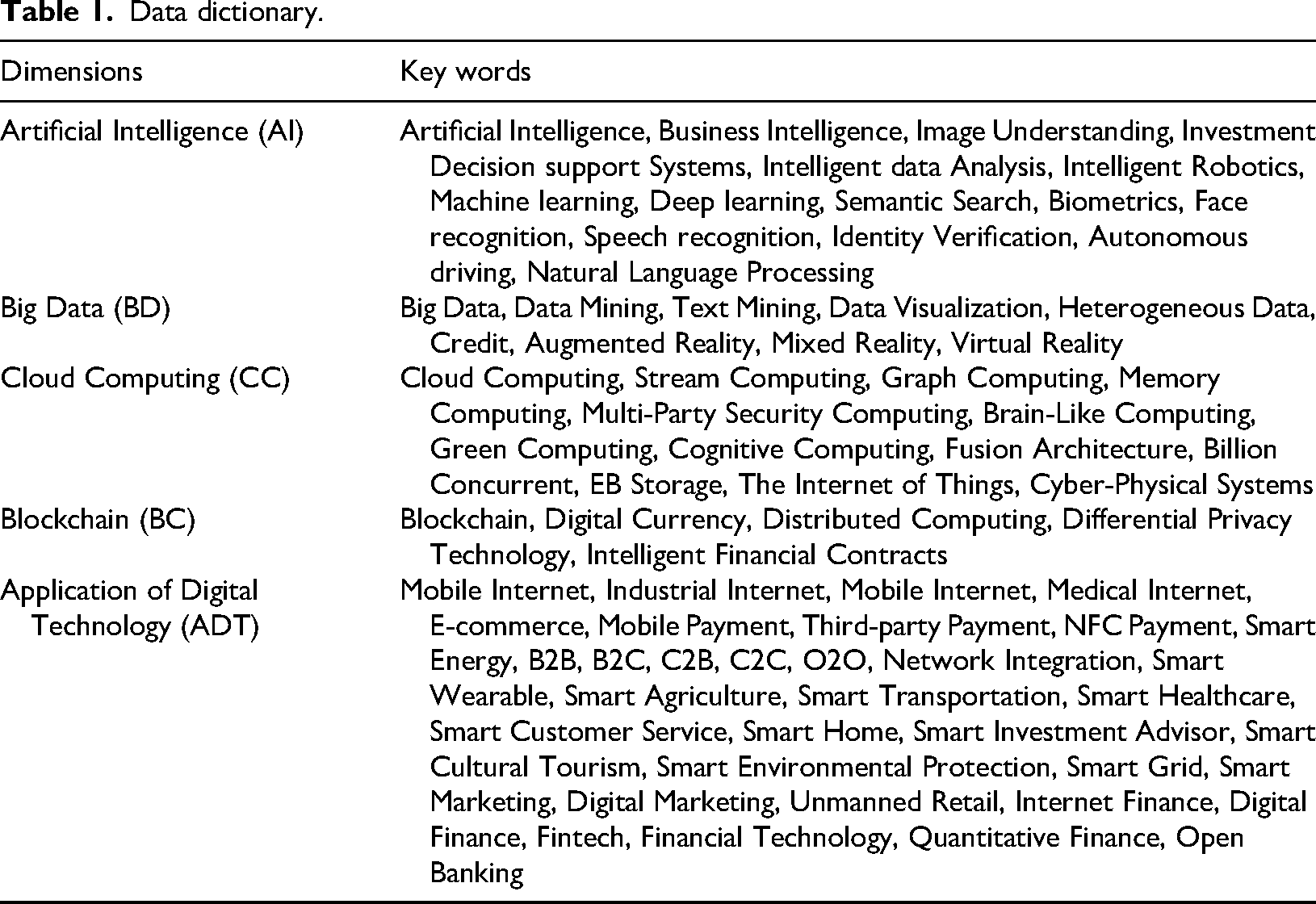
The provincial data of digital infrastructure construction came from the China Statistical Yearbook, the “Digital Economy” unit in the CMSAR database, and the Data Center of the National Bureau of Statistics. Data for the dependent variable, energy savings, came from annual reports. Firms’ performance and related financial control variables, were also derived from the CMSAR database while data on industry and region-related control variables were compiled from the Data Center of the National Bureau of Statistics.
Variables
Energy savings. Due to the limitation of data availability, real annual values of total electricity consumption are selected to measure energy savings 25 as opposite to enterprise studies which use composite dummy metrics. 38 When the electricity consumption of an enterprise decreases, it indicates that energy savings have been realized. The part of wind power generation and photovoltaic power generation owned by the enterprise to upgrade its energy structure is subtracted, for it is an important part of the energy-saving component. 38
Digitalization. The independent variable is a total indicator of digitalization. It means that enterprises take advantage of digital technology to drive upgrades in production and improve quality and efficiency. 30 Digitalization makes enterprises more interested in transforming and upgrading the original system and production system through “digital technology-driven,” which relies on the layout and development of key core technologies, 53 in which AI, BC, CC, BD, and other “ABCD” technologies constitute the core underlying technical architecture of digitalization. More specifically, basic technology means the underlying technology application split into four technical flows while practical technology leads to technical practice application. 54
Control Variables. Control variables at the enterprise level include scale, R&D, wage levels, total assets, total liabilities and net profits while cross-level control variables include two sets of industry and regional dummy variables (Table 2).
Symbols, measurement description and descriptive statistics.
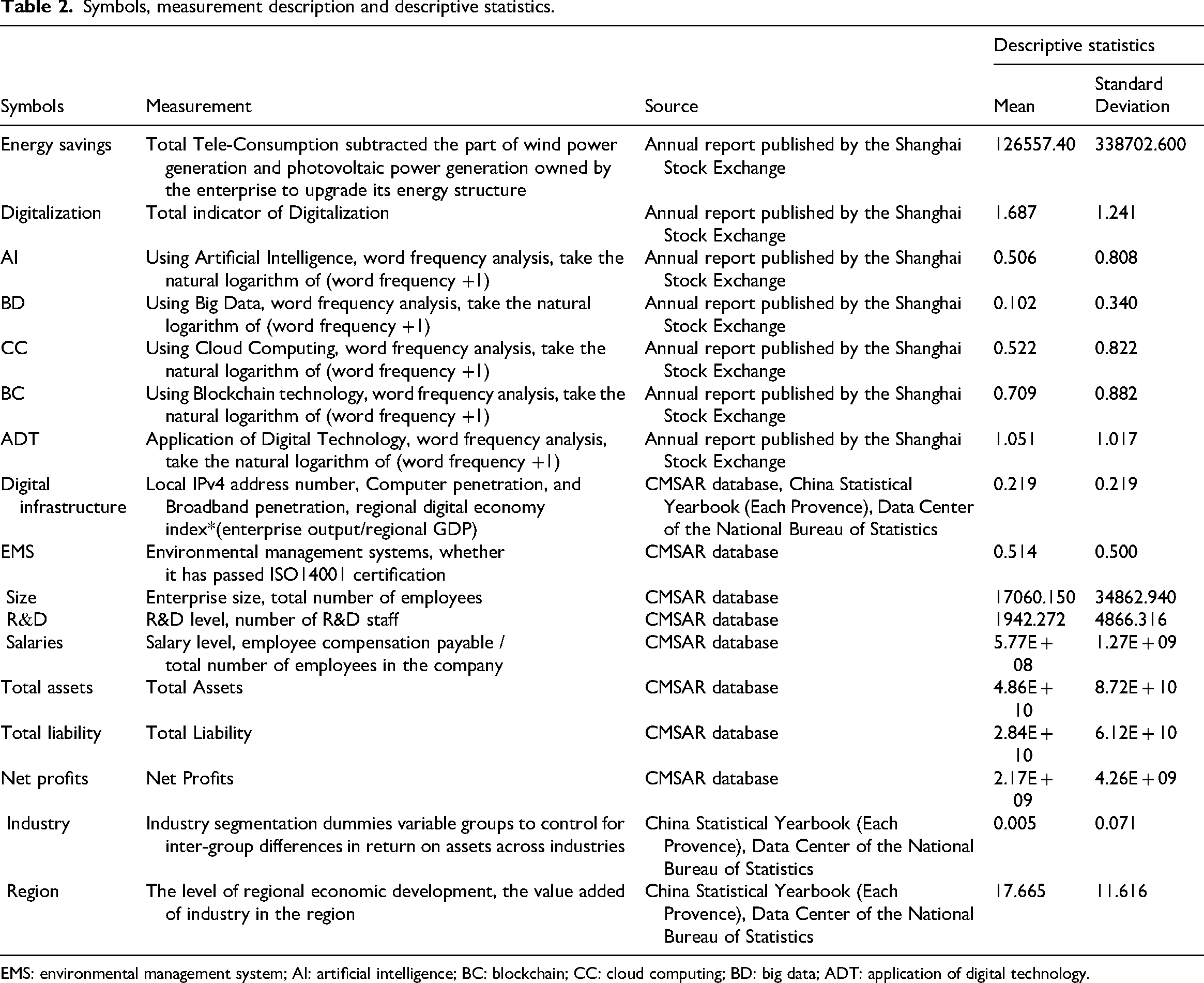
EMS: environmental management system; AI: artificial intelligence; BC: blockchain; CC: cloud computing; BD: big data; ADT: application of digital technology.
Models
To test the underlying hypotheses, a basic estimation model of digitalization and energy saving is established while controlling for variables related to financial, industry, and regional economic development, as shown in Equation (1).
Following relevant studies, 51 our digital indicators were characterized by inductive research. The 2014–2022 reports of sample enterprises are collected and data mining is conducted. Hierarchical text analysis is constructed according to the analytical framework of the three-level coding aggregation topic of the inductive research method, 51 where the expression of the first-order keywords in the enterprise annual report was digitized. It is found that the higher the index, the higher the degree of digitalization of the enterprise, and the overall digitalization level and sub-caliber digitalization index measurement were obtained.
On the basis of model (1), Digital Infrastructure (DI) is added to get model (2).
On the basis of model (2), EMS is added to get model (3).
Further, digital aperture decomposition of digitalization is carried out, and models (4)–(8) are obtained:




Results
According to the above-mentioned three sets of hypotheses, the basic model of energy savings, the model of sub-dimensions, the regulation model of digital infrastructure, the threshold model of EMS and the propensity matching analysis are tested.
Results of basic model test
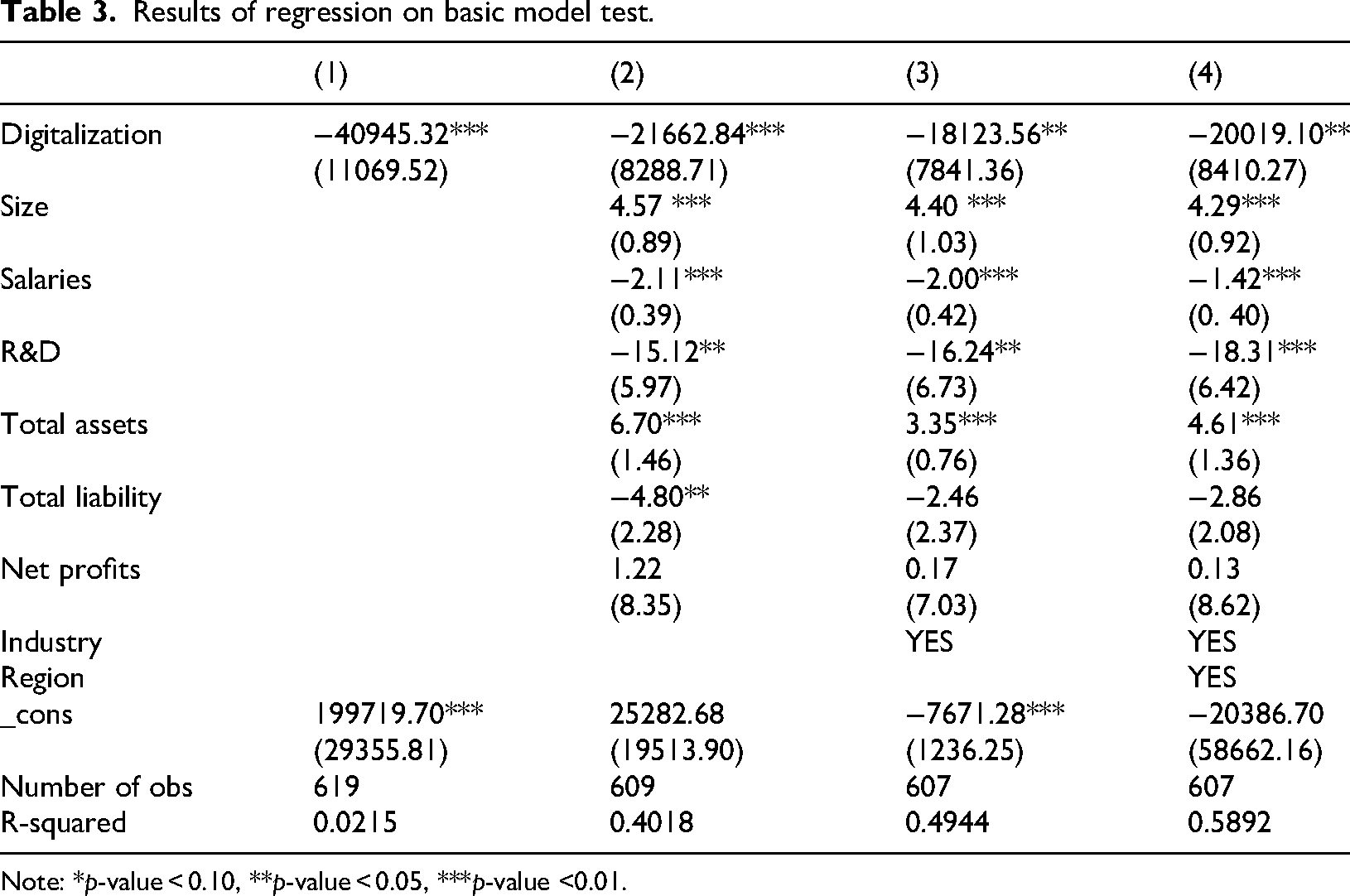
Based on the Hausman test results, an inter-group effect model for multiple linear regression is used to examine the relationship between digitalization and energy saving. The regression results of this basic model are presented in Table 3.
Results of regression on basic model test.
Note: *p-value < 0.10, **p-value < 0.05, ***p-value <0.01.
Table 3 shows the results of regression on basic model test. A progressive regression is chosen to analyze the relationship between digitalization and energy saving. Digitization is significantly negatively correlated with Tele-Consumption in the model controlling only for time and industry. That is, the higher the level of digitization, the less electricity is consumed. In column (2), after the set of control variables is included, the absolute value of the relevant regression coefficient is reduced (−21662.84) given the absorption of some influencing factors, but its statistical significance remains unchanged (t-value is 3.71). This means that the higher the degree of digitalization of enterprises the more energy saving there is, in addition to a significantly positive correlation between the two. A one-unit increase in Digitalization reduces electricity consumption by 20019MKWh annually, equivalent to 15.8% of average firm consumption (126557.4MKWh). The coefficients of the model tend to be stable after the control variable groups of industry and region are successively added in column (3) and column (4). Above all, H1a is supported, digitalization does promote energy saving in enterprises.
Results of sub-dimensions test
The overall digitalization indicator for enterprises is decomposed into two major dimensions: the “underlying technological level” and the “practical application level” in order to test the robustness of digitalization. For the underlying technological level, it is categorized into four sub-dimensions: AI, BC, CC, and BD, based on the conventional authoritative definitions of digitalization and using “ABCD” technology as the dividing line. 55 As for the practical application level of digital technology (ADT), we relied on specific keywords related to digital applications.
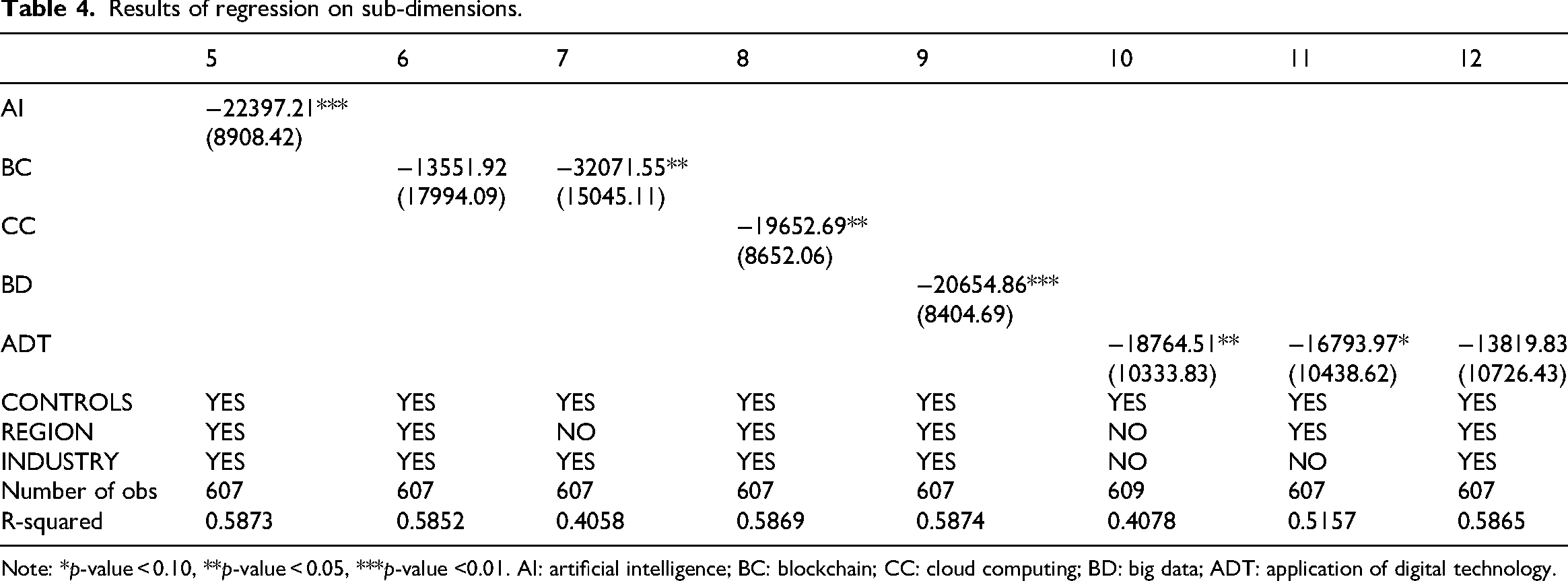
Table 4 shows that the regression coefficients for all sub-dimensions of digitalization are positive and statistically significant at least at the 10% level, which aligns with our expectations and demonstrates the high robustness of these regressions. Specifically, the transformation of AI and BD technology has the most significant impact on enhancing energy-saving efforts in enterprises. A one-unit increase in AI adoption reduces electricity consumption by 22,397MKWh annually, equivalent to 17.7% of average firm consumption (126557.4MKWh), and figure is 16.3% on BD. BC and ADT are more influenced by regional factors. All in all, H1b is empirically supported.
Results of regression on sub-dimensions.
Note: *p-value < 0.10, **p-value < 0.05, ***p-value <0.01. AI: artificial intelligence; BC: blockchain; CC: cloud computing; BD: big data; ADT: application of digital technology.
Figure 1 plots the results of Table 4. AI and CC have a more significant effect on energy saving. The development of BC is still far away from the other sub-indexes while the energy-saving effect of ADT is not as desirable as of AI and CC.
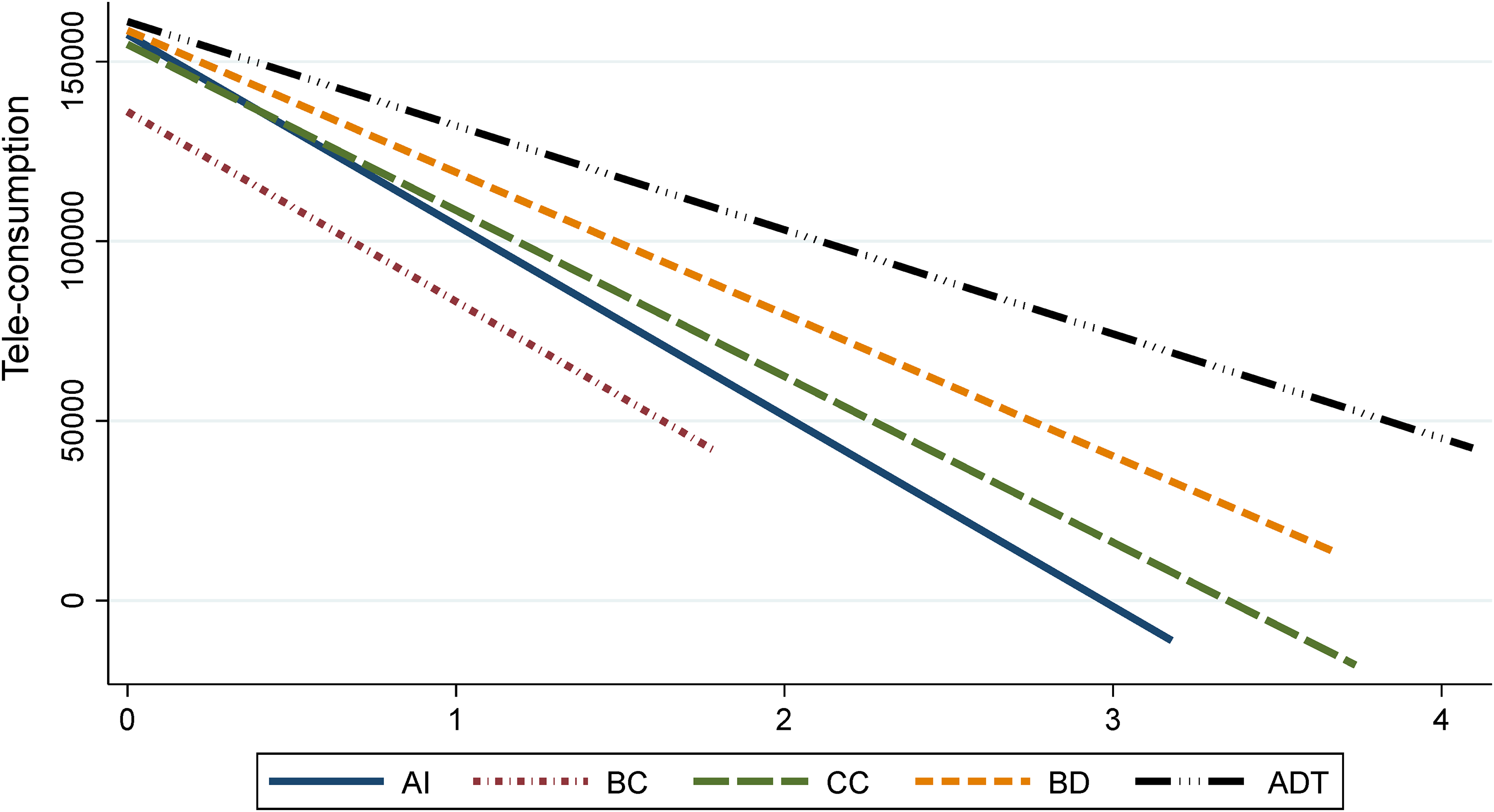
Results of regression on sub-dimensions.
Further analysis
Based on the fundamental assumption model, the variables of digital infrastructure and EMS are introduced. Normalization is conducted to ensure comparability across variable coefficients. Table 5 presents the results of the digital infrastructure moderation model. Columns (1) through (4) show the regression results with the progressive inclusion of the digital infrastructure moderation variable. The interaction term between digital infrastructure and digitalization is statistically significant with coefficients of −162776.5 and −483372.6. When compared to the coefficient of −108106.9 in column (1), it becomes evident that the improvement in digital infrastructure facilitates the reduction of energy consumption brought about by digitalization. The results in column (2) indicate that digital infrastructure itself does not have a significant impact on energy consumption, supporting H2. In conclusion, digital infrastructure positively moderates the impact of digitalization on energy saving.
Results of regression on moderating model test.
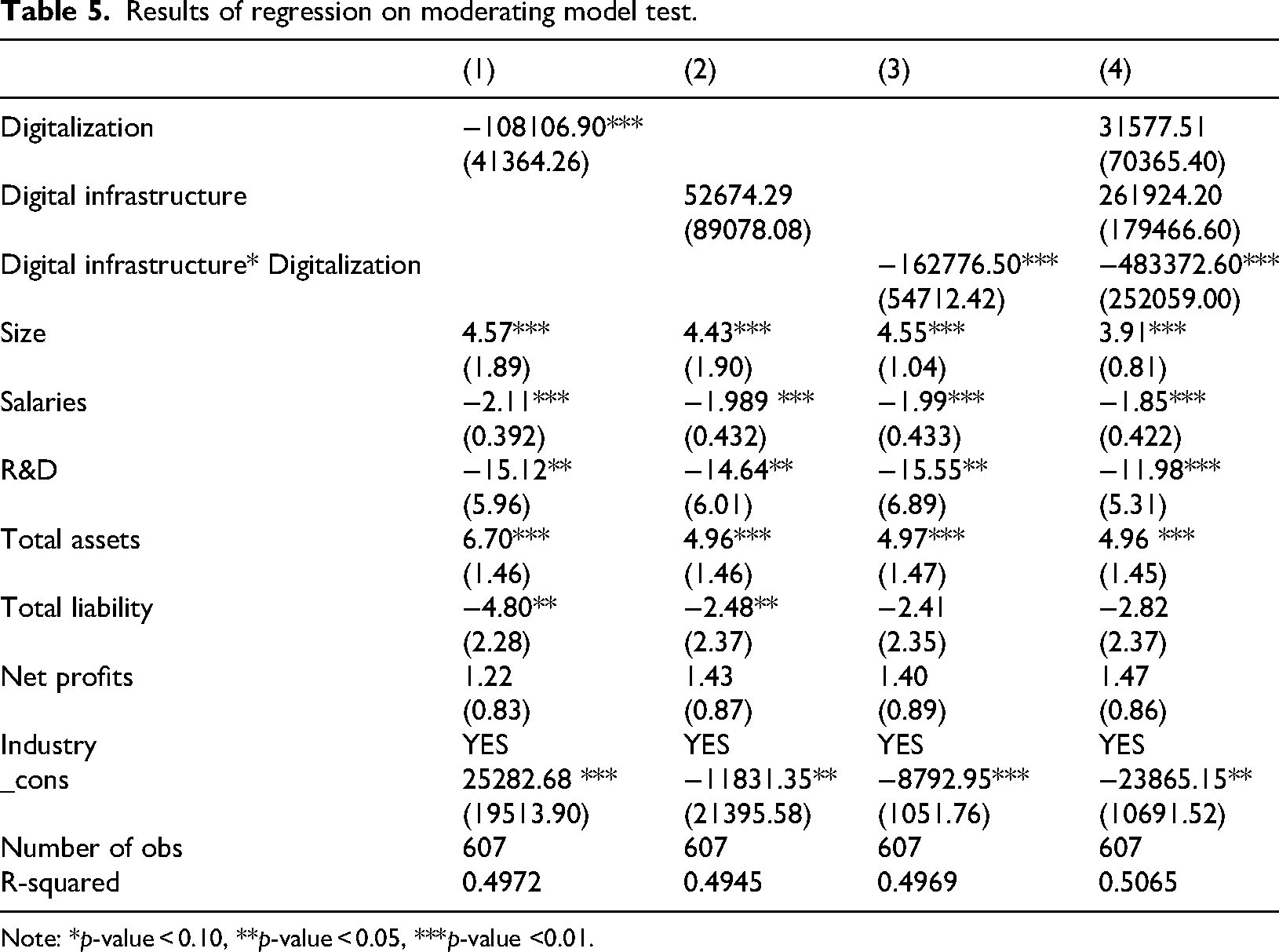
Note: *p-value < 0.10, **p-value < 0.05, ***p-value <0.01.
Figure 2 plots the results from Table 5. It highlights the moderating effect of digital infrastructure and the fact that digitalization leads to greater energy savings when the level of digital infrastructure is high.
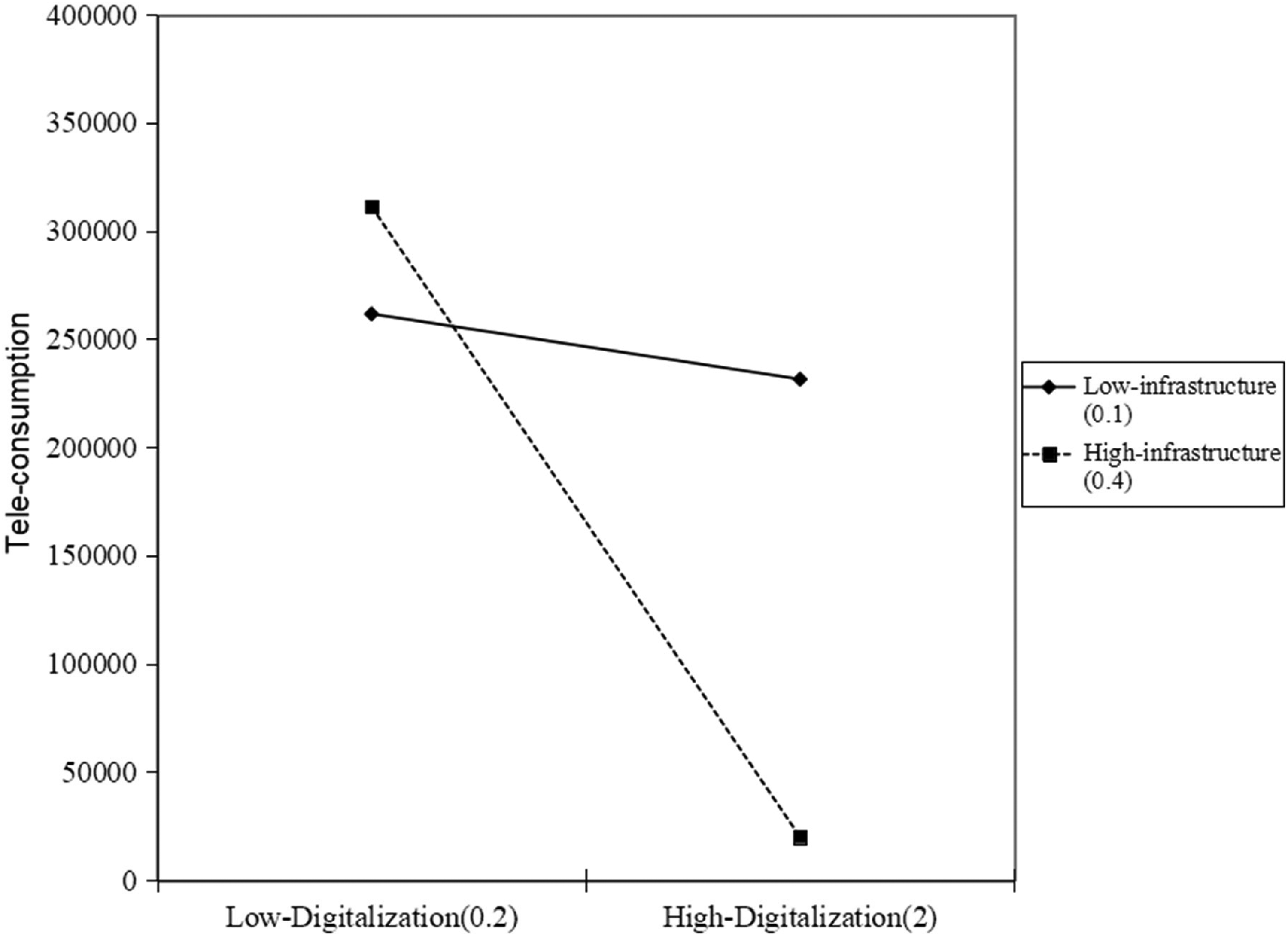
Moderating effect of digital infrastructure.
The influence of EMS on digitalization's promotion of energy savings is examined. Samples are categorized into two groups based on their environmental management level: enterprises certified by ISO14001 belonged to the high-level group, while those without ISO14001 certification were labeled as the low-level group. Column (1) in Table 6 presents the pooled regression results for enterprises with a low environmental management level while column (2) shows the combined regression results for enterprises with a high environmental management level. In column (1), the coefficients of both the independent variables and the moderators are insignificant, indicating that the energy-saving level of the low-level group is primarily explained by the financial dimensions in the control variables, with larger enterprises consuming more energy and having a non-significant impact of digitalization.
Results of regression on EMS moderating model test.
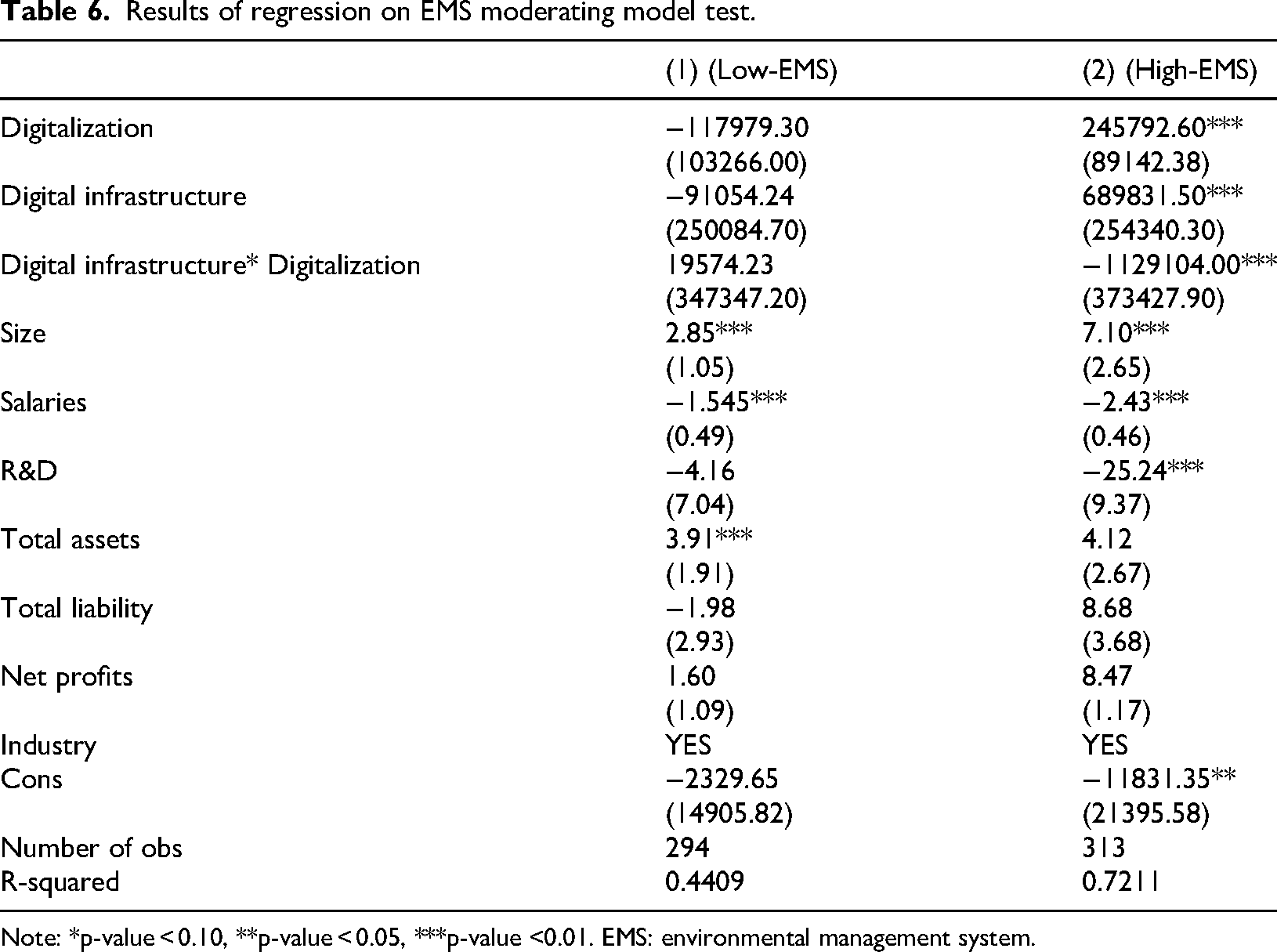
Note: *p-value < 0.10, **p-value < 0.05, ***p-value <0.01. EMS: environmental management system.
In Column (2), the coefficients of the independent variable digitalization, the moderator digital infrastructure, and their interaction term are all significant at the 1% level. While the coefficient of the independent term is positive, the coefficient of the interaction term is negative, and the absolute value of the latter is much larger than the former. This suggests that for enterprises with a high-level EMS, its combined effect with digital infrastructure significantly reduces the overall electricity consumption of the enterprise. Since the data is normalized, the critical point can be determined using a threshold value. When the level of digital infrastructure exceeds 0.6, energy consumption decreases significantly with the increase in digitalization. Notably, the model presented in column (2) has a much higher R-squared value (0.7211) than the other models, indicating a more comprehensive portrayal of the relationship between digitalization, digital infrastructure, and energy savings.
Table 6 shows that a high-level of EMS helps enterprises enhance the effect of digital energy savings. H3a is supported along with H3b since enterprises with improved EMS do take advantage of the cooperation in the digital ecosystem 14 and are able to respond more quickly and flexibly. 56 The reason is that they are better equipped for learning, applying, and absorbing new technologies and models. Enterprises can better utilize AI tools to improve efficiency and reduce energy consumption.
Discussion
Energy consumption affected by digitalization comes from the hedging of two forces, an increase in electricity consumption due to the use of ICT devices, and a decrease in energy consumption due to efficiency gains in the production sector. This two-step process undertaken to expand the study from the macro-level to the micro-level led us to identify the most energy efficient sub-dimensions of digitalization to ensure the maximization of energy efficiency gains in an enterprise. After including an external factor to build a cross-level regional-enterprise research framework we calculated the positive externalities of digital infrastructure, as each unit of electricity consumed leads to more energy efficiency gains.
Digitalization helps enterprises save energy by having proper digital infrastructure and mature EMS. Enterprises with high environmental management ability have a large demand for electricity and the combination of digitalization and digital infrastructure can substantially save energy consumption. China boasts the world's largest data-producing population, with a huge number of Internet users, mobile phones, and consumption volumes. These existing and incremental quantities provide scale advantages to the BD industry. Enterprises that prioritize such digitalization are more likely to gain market recognition and form positive effects. BC, CC, and ADT also contribute significantly to energy saving but they require a higher threshold of digital infrastructure.
Conclusions
Previous studies have confirmed that enhancing the digitalization level of the industrial sector in a specific region can lead to a reduction in overall energy consumption within the local area. 4 However, it remains uncertain whether this outcome stems from energy saving practices adopted by industrial enterprises themselves, upgrades in the local industrial structure, or shifts towards less energy-intensive sectors. The regional digital infrastructure is included as a key moderating variable in the cross-level analysis, rather than discussing the impact on the energy saving of the digital economy sector at a macro-level, 16 thus the different mechanisms on energy savings of regional digital infrastructure and the digitalization of manufacturing enterprises are clarified. For every doubling of a region's digital infrastructure level, the energy-saving effect of local enterprises’ digitalization increases by three times. Digitalization facilitates energy savings for enterprises while digital infrastructure helps overcome limitations associated with insufficient digitalization capabilities.
In terms of indicator construction, different from the composite digitalization indicators used in previous studies. 15 The impact effects of AI, BC, CC, and BD were quantitatively compared. Concrete conclusions were reached in the sub-dimensions, which verified the dominant role of large data diagnostic analysis and the potential that AI has yet to realize.
In response to the widely acknowledged challenge of aligning data models with real production processes, 17 we proposed a new solution by incorporating EMS as a key prerequisite within the existing research framework to facilitate both digital energy conservation and leveraging digital infrastructure. The EMS is positioned as a collaborative hub rather than a passive compliance tool.
A limitation of this study comes from the use of textual analysis to measure the level of digitalization. Future research should take into account the cost of digitalization and the adoption of digital technologies to finetune critical cost-benefit values of the model. The use of more diverse and accurate digital factors for economic practice scenarios would also support an in-depth study. Due to data availability, we were compelled to use the number of ipv4 addresses to calculate the level of digital infrastructure at the regional level. It is not clear how non-technical external events such as the COVID-19 global pandemic accelerated the digitalization of production and lifestyle to induce energy-saving effects.
Footnotes

Funding
The authors received no financial support for the research, authorship, and/or publication of this article.
Declaration of conflicting interests
The authors declared no potential conflicts of interest with respect to the research, authorship, and/or publication of this article.