



Abstract
The latest progress summary of sustainable development goals (SDGs) in 2023 reveals that the ongoing growth pattern of Asian economies is inadequate. Asian countries are facing several challenges in securing the targets of SDGs, and environmental degradation is one of the major issues among them. Hence, urgent actions are required to attain SDG targets. Several studies in the available literature have considered multiple determinants of environmental degradation. However, the impact of green production practices (GPP) and geopolitical risk (GPR) is relatively ignored particularly in the framework of Asian economies. Therefore, it is needed to propose an extensive policy framework for attaining the objectives of SDGs and raising environmental quality. Moreover, this study is a pioneering attempt that scrutinizes the eclectic influence of green production practices and geopolitical risk on carbon emissions. The study follows the model based on the environmental Kuznets curve (EKC) hypothesis for selected Asian countries. The study has utilized the Panel Quantile Regression (PQR) technique to analyze the facts from selected Asian economies from 1990 to 2020. The long-run evaluations reveal the EKC hypothesis proves valid in the preferred Asian economies. Moreover, green production practices play a crucial role in controlling the rising levels of carbon emissions in the selected Asian countries whereas, geopolitical risk and foreign direct investments are proven constructive elements in raising carbon emissions. Lastly, based on the empirical outcomes, this study provides policy implications for achieving the targets of SDG 07, SDG 09, SDG 12, SDG 13, SDG 15, SDG 16, and SDG 17.
This is a visual representation of the abstract.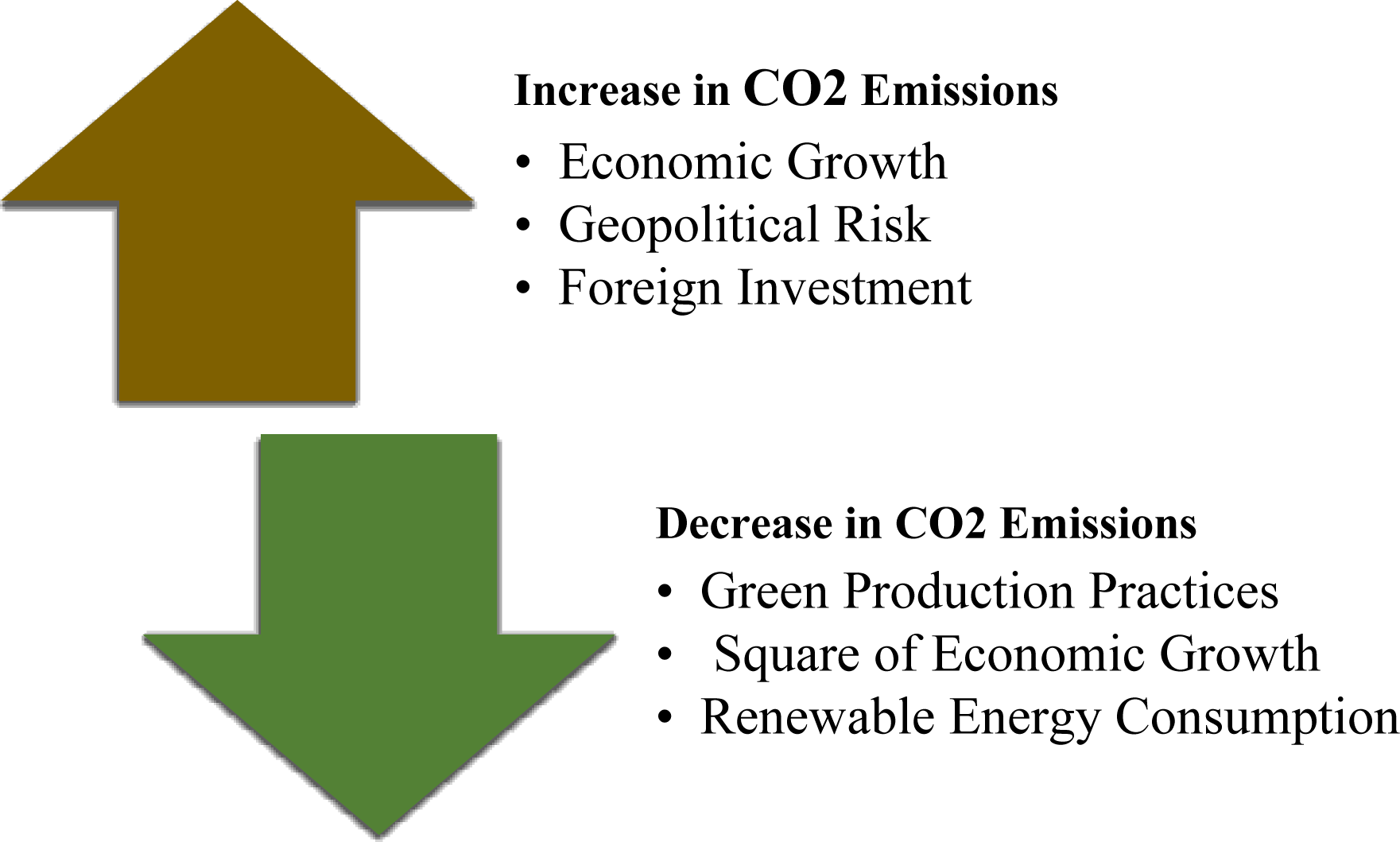
Get full access to this article
View all access options for this article.