




Abstract
Racism in rural England is pervasive yet underacknowledged due to popular depictions of rural England as idyllic and the epitome of quintessential national virtues, culture and identity. This article discusses one case study of the National Trust, which has begun to address its links to colonialism and historic slavery, and in doing so, faced significant online backlash, embedded within broader discriminatory and racist practices. Drawing on corpus-assisted Critical Discourse Analysis (CDA), we explore public discourses around how race and colonialism are constructed, contested, and resisted in online spaces. We argue that vehement reactions against the National Trust stem from deep emotional connections to history – history is perceived as sacred, and the National Trust is entrusted with preserving rather than commenting on historical artefacts and places. We demonstrate how national pride fuels opposition to the foregrounding of colonialism and historic slavery, especially when Britain is seen to be unfairly targeted.
Introduction
To claim that the countryside is racist is one of the most ridiculous examples of Left-wing identity politics. It’s a symptom of a deeper problem within our society – the urge to constantly view everything through the lens of race or gender, plead victimhood and point the finger at an oppressor. Whether it’s the patriarchy, or colonial masters, this desperation to divide society is ripping through our institutions, creating a culture of fear and self-censorship. (Suella Braverman, 2024)
The topic of rural racism continues to stimulate strong and polarising debate. Across Britain more broadly, discussions of race and racism are increasingly entering the mainstream (Solomos, 2022), yet these are marked by denial, whereby anti-racist efforts are framed as attacks on national identity and tradition. The tension between these two sides continues to shape public discourse, from education, heritage, to politics and media representation. With vehement denial from powerful public and political figures alongside a hypocritical narrative supporting a hostile environment towards migrants, the issue is increasingly framed as a battle between ‘traditional British values’ and the need for social justice.
Following the Black Lives Matter protests of 2020, there has been a significant increase in anti-racist praxis, including in rural spaces. The National Trust released a report discussing how 93 of its 300 properties, many of which are in rural or semi-rural England, are connected with colonialism and historic slavery (The National Trust, 2020). This move, marked by polarity and backlash was perceived as challenging the conception of rural England as a peaceful and uncontroversial idyll. This article explores this backlash, giving examples of the discursive strategies adopted by online commentators to dismiss or ridicule racism in rural spaces. As Eschmann et al. (2023) point out, while online racism can seem like the work of trolls and be rationalised as coming from outliers rather than respectable citizens, it is not insulated from ‘real-world racism’. Through the National Trust case, this article highlights how online resistance to a more inclusive and anti-racist countryside allows for the perpetuation of racism, centred around a particular narrative of identity and belonging, thereby contributing to a deeper understanding of the cultural and political implications of rural racism in contemporary Britain.
England’s rural idyll
The British countryside is typically understood through the dominant conceptualisation of the ‘rural idyll’, imagined through the dichotomisation of the urban and the rural (Chakraborti and Garland, 2011). Urban life is seen as unstable and insecure, whilst rural space is romanticised as problem-free and idyllic; as a sanctuary from the harsh realities of everyday life and a space which upholds traditional British identities and values (Agnew, 2011; Brooks, 2020; Lowenthal, 1991).
The idyllic constructions of the rural in the British context capture its supposed timeless and quintessential national virtues, such as chocolate-box houses (Agnew, 2011), tight-knit communities and low crime rates (Cloke, 2011), nature and romanticism (Bell, 2006), whilst offering sites of historical memory (Agnew, 2011). Rurality has become synonymous with lifestyle and wellbeing enhancement, distinct from city life’s hustle and bustle (Cloke, 2011; Hamza et al., 2024). Alongside these portrayals are ‘landscape ideals’ regarding how the space should be presented and preserved, and consequently, who can occupy that space (Bell, 2006). These ideals are largely based on the past (Massey, 1995), whereby any changes typically must adhere to historic customs (Huigen and Meijering, 2016).
The narrative of fear towards the ethnic and racial ‘other’ has been inflated for political effect, notably during the campaign to leave the European Union (EU), and through populist discourse regarding immigration. Indeed, it is the racialised question of ‘immigration’ that underpins the conversation around Englishness (Virdee and McGeever, 2018). Prior to Brexit, UK Independence Party (a far-right populist political party) tapped into a sense of nostalgic Englishness which motivated some leave voters, arguing for an empire-era version of rural England defined as the ‘ethnic homelands of the English’ (Reed, 2016: 228). In rural England, the result to leave the EU was more decisive than the overall result, at 55%–45% in favour of exiting the EU (Brooks, 2020). Meanwhile, hostility towards rural migrant workers increased following Brexit (Brooks, 2020; Neal et al., 2021). Whilst this may oversimplify the complex motivations for voting to leave, and whilst voting to leave the EU does not necessitate discriminatory values towards ethnic and racial minorities, the prevailing racial undertones that motivated and arose from the Brexit campaign are a useful example to highlight ongoing political discourse around race and immigration and hence, rural identities (Valluvan, 2017). Indeed, Burrell and Hopkins (2019) questioned whether Brexit introduced a new era in the mainstreaming of anti-immigrant populist sentiment or whether it was merely an evolution of historic (post)colonial uncertainties and prejudices. As such, Brexit can be read as part of a wider cultural project of reclaiming an idealised, monocultural past, one that remains central to constructions of the rural idyll itself (Brooks, 2020; Neal et al., 2021).
When tracing the origins of the idyllic rural life, Stewart (2020) argues that it is a product of the bourgeois imaginary, emerging from the modern urbanisation of the cityscape. The politics of landscape dictates that perceptions of rural life are representative of a model of national heritage and identity (Agnew, 2011), and as an object of desire (Bell, 2006), reinforced by media and capitalist depictions. Rurality then is both a geographical space and a sociocultural desire (Cloke, 2006, 2011), and we understand access and ownership of rural spaces through a lens of power/capital, shaped and influenced by race, religion and gender (Hamza et al., 2024). Over time, these perceptions have been internalised by the English population (Darby, 2020).
Nevertheless, such comforting constructions often correlate with a singular notion of national identity, foregrounding Whiteness, heterosexuality, and middle-class identities, thereby contributing to the neglect of social complexities and the marginalisation of various social groups. In particular, the obsession with a ‘de-racialized nostalgia for a pre-multicultural Britain’ (Neal, 2002: 444) overlooks the history of minoritised ethnic communities and their relationship with the British countryside. Where the city is seen as a place of multiculturalism and diversity (Amin, 2002; Hassen and Giovanardi, 2018), the rural is typically regarded as monocultural and homogenous in its White Britishness (Bell, 2006; Hickman, 2007; Jones and Tonkiss, 2024). In essence, the production of the rural idyll has given rise to various forms of ‘anti-idyll’ (Bell, 2006), with a set of binaries specifying whether someone belongs in the rural or not.
Rural racism
The construction of rurality as White and the enjoyment of historic properties as reflecting Britain’s histories of grandeur and idealism is one part of a larger, complex system of systemic, institutional, interpersonal and internalised hierarchies which unfairly disadvantages minoritised ethnic groups whilst unfairly providing advantages to White people (Jones, 2000; Nazroo and Becares, 2020). Underpinning this are the various ways the experiences of minoritised ethnic individuals living in and visiting rural spaces have remained a largely hidden and under-acknowledged reality. Despite some noteworthy research in the 1990s–2000s (Chakraborti and Garland, 2011; Cloke and Little, 1997; Holloway, 2003), the topic of race/racism in the rural context remains peripheral to the broader interest in British race relations (Hackett, 2020).
In what is viewed as a ‘White monocultural national space’ (Neal et al., 2021: 177), minoritised ethnic individuals are rendered invisible and regarded as unwelcome intrusions into the conventional sociocultural norms of rural life (Cloke, 2011). At best, they are expected to assimilate into their rural community, becoming amenable to the dominant social hierarchy as opposed to integrating differences that celebrate diversity. To assimilate is to achieve ‘honorary’ status as a rural community citizen, and to be regarded as a ‘good migrant’ (Jones and Tonkiss, 2024) whether the recipient desires this or not. However, it is a temporary status, often taken away if the recipient steps out of the lines of acceptable behaviour (Back et al., 2001). Hall (1992) and Hall and Du Gay (1996) argue that identity and difference then are not only what you are or choose to be but also include what you are allowed or required to be. The purported ‘problem of integration’ so central to narratives of the ‘English’ nation is underpinned by ‘bad diversity’ (Lentin and Titley, 2011: 166), leading to the persistence of historical hierarchical social structures in rural areas (Saunders et al., 1978). Such an approach is premised on the notion that multiculturalism has failed and is not desirable (Lentin and Titley, 2011; Valluvan, 2018). Integration, purported to be the solution, masquerading as welcoming inclusion, is thus predicated on ethno-nationalist belligerence (Valluvan, 2018).
Despite the recorded presence of racism in rural areas, and the fact that racism is inherently built into the structures of our White, middle-class, colonial society, some White rural populations deny its existence, contending that everyone has equal opportunities (Cloke, 2011), whilst being indifferent to racial and ethnic differences and the presence of hate and discrimination (Hirsch, 2018), both contemporary and historic. DiAngelo (2018) argues that ‘white fragility’ can describe the anger or denial expressed when White people are confronted with issues of race and racism. Such defensive responses are particularly visible in online spaces, where expressions of outrage are intensified and made performative, often centring around key issues that White people feel are inherently tied to their nationalistic values (Malik, 2020; Wolfgang, 2022). Known as ‘digital White rage’, such critical responses can be framed as a proxy for broader anxieties about national identity and belonging in rural spaces (Anderson, 2016; Eschmann et al., 2023). Consequently, we are living in a unique time, where the presence of racism is denied, whilst conversations about race and national identity are fraught with tension and division.
National Trust: Background and context
One area of Britain that epitomises the White British values and rural idyll lies within the history of the White British public’s relationship to the National Trust. As Europe’s largest conservation charity, The National Trust holds a unique and somewhat influential position within British cultural life. With estimated memberships of 2.62 million (5.38 million members), 8500 staff members and thousands of volunteers in 2023–2024, the National Trust is charged with looking after nature, beauty, and history for everyone to enjoy (The National Trust, n.d.a). Since 1895, the National Trust has taken ownership of a broad range of historic buildings and landscapes, caring for properties such as famous residences of great statesmen, literary legends, and cultural icons. Whilst these properties can be found nationwide, the majority are located in rural or semi-rural areas, often encompassing large country estates and parklands that have come to symbolise English heritage, tradition and class privilege. These landscapes have long been central to popular imaginaries of the countryside as the cradle of national identity, intertwined with notions of moral virtue (Neal and Agyeman, 2006). The Trust’s current strategy, ‘For everyone, for ever’, outlines its ambition to play a major role in the fight against climate change, as well as a renewed commitment to diversity and inclusion to create a fair, equal society, free from discrimination. It is within the EDI context that discussions around the National Trust’s relationship to colonialism and historic slavery emerge.
In 2020, the National Trust curated an interim report (The National Trust, 2020) detailing the connections that 93 historic places in its care have with colonialism and historic slavery, as part of its broader commitment to ensure that these properties and their histories are properly represented, shared and interpreted. This includes exploring ties to the global slave trade, goods and products of enslaved labour, abolition and protest, and the East India Company and the British Raj. It also sought to highlight other less visible or tangible connections to historic slavery, recognising how much more research is needed to further reveal the hidden histories that were historically written by and for the voices of privilege and authority. Thus, the report showcased how the proceeds of colonialism, conquest and the slavery economy built and furnished many of its properties, endowed the families who kept them, and helped to create the ideal of the country house that is so cherished by visitors annually (Mitchell, 2020).
Following the publication of this report, the National Trust received tremendous backlash from concerned citizens who did not think it appropriate to acknowledge the legacies of colonialism and slavery within the modern-day context of enjoying historical properties. 26 MPs and two peers from a ‘common sense group’ wrote to The Telegraph recommending that the organisation’s funding applications to public bodies be reviewed (The Telegraph, 2020). Their arguments rested on the assumption that the National Trust had tarnished the reputations of their country homes, including Winston Churchill’s legacy by linking his family home (Chartwell) with slavery and colonialism. They quoted Churchill as ‘one of Britain’s greatest sons’, whilst also complaining that most National Trust members ‘just want to see beautiful houses and gardens not to have others’ opinions pushed down their throats’. Meanwhile, many National Trust members allegedly cancelled their memberships in outrage, citing that the role of the National Trust is not to be political (Young, 2020). 1
Malik (2020) suggests that the central narrative behind this backlash is that Britain’s culture is being stolen. This implicates the White, native, cisgender and straight majority as the owner and proprietor of rural lands and associated properties. This is now disturbingly commonplace in our politics and social interactions. It suggests that the British identity and the rural idyll present particularly within National Trust properties ought only to be characterised by their beauty and grandeur and not by their association with slavery, colonialism, and racism. As Mitchell (2020) points out, country houses and by extension National Trust properties are easily mythologised as Britain’s soul, places where tradition and inheritance endure despite a move towards modernity. They are places of fantasy in which we step back in time and are rooted in a relationship with the British land that feels safe and secure and arguably wholly White. Thus, to tarnish this mythology, even with historical accuracy, is to warp the ‘landscape ideals’ of rural England (Bell, 2006; Shoard, 1987).
Methodology
This article is informed by research conducted as part of the Rural Racism Project – a nationwide study of rural racism in England, funded by The Leverhulme Trust. The project adopts a devolved approach to the study of rural racism, capturing backlash, exploring examples of good inclusionary practice and re-storying experiences of rural racism. The objective of the current article is to explore the National Trust’s reckoning with its colonial histories and the subsequent public backlash online, analysing defamatory and hate-fuelled comments relating to rural racism and colonial histories in the British countryside. In doing so, we hope to understand and describe the various triggers for backlash, and unpack the ways the rural English idyll and its enduring histories manifest in a tumultuous relationship between identity and belonging.
Data was collected between November 2023 and April 2024. News articles and social media posts commenting on the National Trust’s report and actions were identified through Google Search, resulting in the following sites for data collection: Facebook, Reddit, X, YouTube, and Daily Mail. Comments in response were collected manually, with only the top 150 comments included for each post/video. The analysis for this study is guided by corpus-assisted Critical Discourse Analysis (CDA). The entire Rural Racism corpus consists of about 193,000 words, including the National Trust subcorpus of 28,000 words, and was compiled using the corpus software #LancsBox (Brezina et al., 2021). Our focus in this article is the National Trust subcorpus.
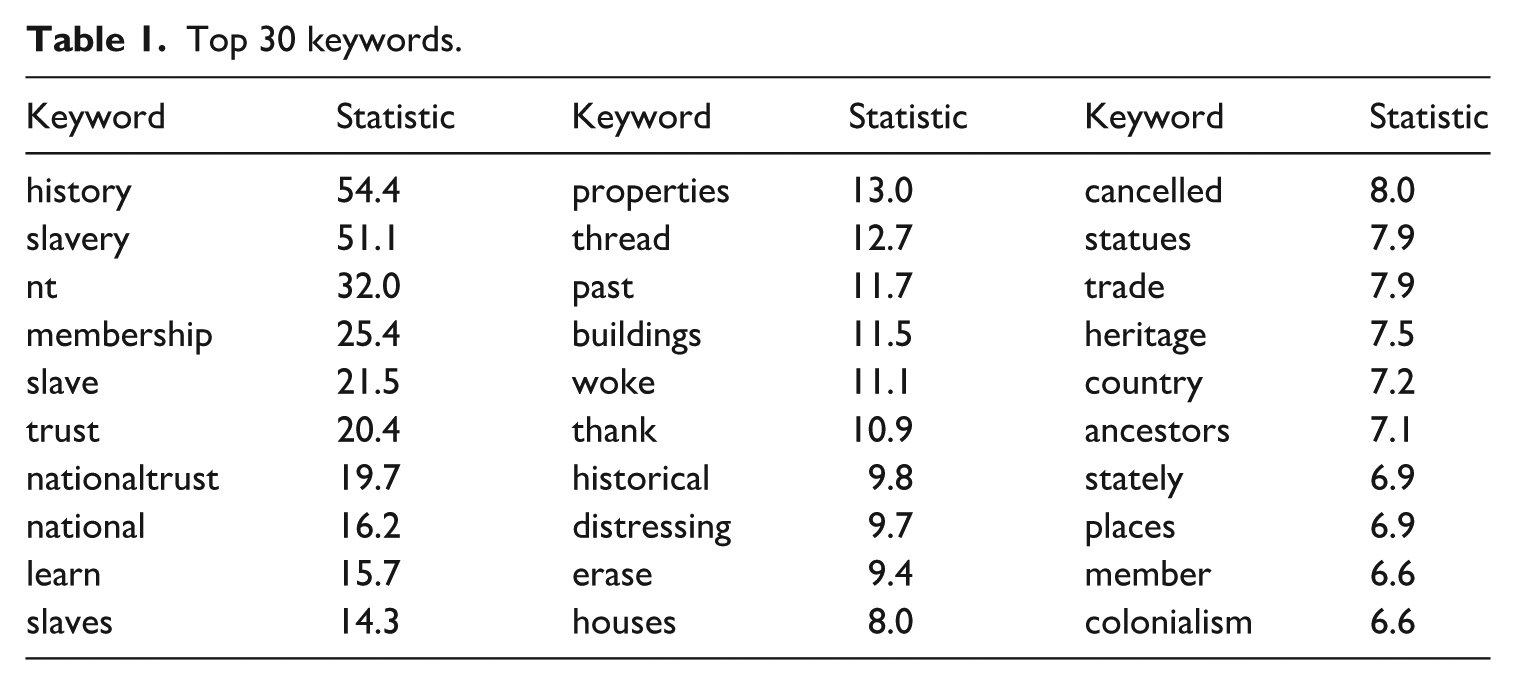
As a first step, keyword analysis was conducted using the British National Corpus 2014 (BNC2014) as the reference corpus. BNC2014 is a large collection of samples of British English collected from real-life contexts. Table 1 lists the top 30 keywords, which gives a sense of the most frequently discussed ideas in the dataset. The statistic (simple maths parameter) indicates approximately how many times a word occurs in the National Trust subcorpus than BNC2014.
Top 30 keywords.
The second step was collocation analysis. According to Baker (2006), collocation refers to ‘the phenomenon surrounding the fact that certain words are more likely to occur in combination with other words in certain contexts’, and a collocate is defined as ‘a word which occurs within the neighbourhood of another word’ (pp. 36–37). The following search terms were used: ‘British’, ‘country’, ‘National Trust’, ‘race’, ‘racism’, ‘racist’, ‘White’. Concordance lines of the top 20 collocates for each search term (and the top 30 keywords) were analysed to discern the semantic features embedded in varied forms of lexicalisation (Stubbs, 2001), and the semantic and thematic relations of different collocates (and keywords).
Our analysis of concordance lines is guided by CDA, which studies how relations of power and dominance in society are enacted, confirmed, legitimated, reproduced and resisted by text and talk (van Dijk, 2001). Conducting CDA means taking an explicit position, or as Jaworski and Coupland (2014) describe, engaging in a ‘forensic activity, with a libertarian political slant’ (p. 5). It involves ‘unveiling and challenging taken-for-granted assumptions about language and the social, as well as recognising discourse as a potentially powerful agent for social change’ (Mautner, 2009: 124). In discussing the connections between discourse and racism, Wodak and Reisigl (2015) explicate five types of discursive strategies that are commonly used to discriminate against racialised people: (i) nomination (e.g. constructing in-groups and out-groups); (ii) predication (e.g. associating individuals with positive and negative traits); (iii) argumentation (e.g. justifying discriminatory acts); (iv) perspectivation, framing, and discourse representation (e.g. denoting the point of view of the speaker); (v) intensification and mitigation (e.g. modifying the intensity of racist utterances). For the current study, an inductive approach is adopted: the five strategies represent potential dimensions that could be explored, and further themes are formulated as the concordance lines are analysed.
Results and discussion
History versus harm
Distress
In detailing the connections of its properties to colonialism and historic slavery, The National Trust (2020) addressed in its interim report that some artefacts stereotype and objectify black bodies, which could cause distress. While the National Trust decided to keep many ‘distressing’ artefacts in 2020 (Fahey, 2020), bringing forward the discussion about removing certain objects nonetheless caused a backlash.
The suggestion that ‘history causes distress’ sparked anger on social media, where hateful comments were directed at people who claimed to be distressed by historical artefacts. They are dismissed as out-group members via nomination strategies, being referred to as ‘fortune hunters’, ‘lefties’, ‘luuvies’, ‘miserable bed wetter’, ‘pathetic people’, ‘snowflakes’, ‘the weak’, ‘weak-kneed fools’, and ‘woke’. To online sceptics, the idea that history is ‘at fault’ is unacceptable, and distressed individuals are portrayed as the source of the problem – they are demanded to reconsider their perception of history and learn to manage their emotions better.
Table 2 lists 10 concordance lines using the search term ‘distress*’ (a wildcard search covering the word ‘distress’ and words that start with the same letters, such as ‘distressing’ and ‘distressed’). As illustrated in the table, online sceptics generally believe that historical objects do not cause negative emotions; they are shocked to learn that some people feel distressed, mocking them and representing them negatively (e.g. via predicational strategies, depicting them as ‘ludicrous’ and ‘pathetic’; and perspectivation, denoting themselves as people with common sense through questioning the sanity of people who feel distressed).
A concordance for ‘distress*’. 2
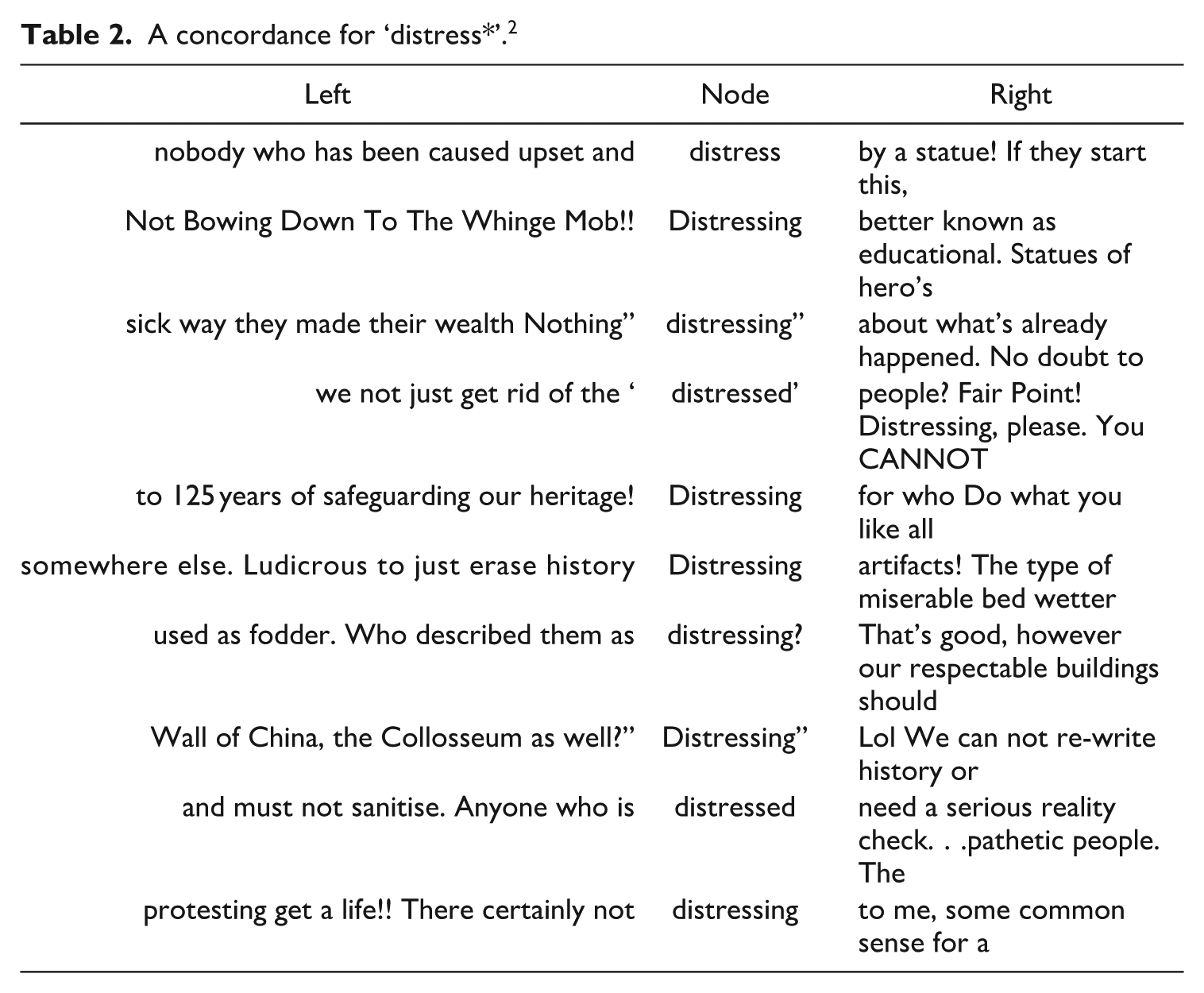
As exemplified in (1), individuals are criticised for labelling artefacts ‘distressing’ and voicing their frustration. They are represented as possessing a victim mentality, being easily offended and complaining without valid grounds; they should not blame anything/anyone but themselves for their own sufferings. Furthermore, a report published in June 2021 by King’s College London and Ipsos Mori indicates that the British public are among the most likely nationalities (of the 28 surveyed) to say that people are ‘too easily offended’ (Duffy and Skinner, 2021) – it is the offended who need to ‘stop searching for things that might offend’, rather than the alleged offenders who need to change the way they speak. As shown in (2), online sceptics further criticise individuals for their ‘abrupt’ change in attitude. They believe in the notion that history is static – they do not recognise the importance of revisiting history and considering its significance with regards to new research/information and changes in social circumstances (Fowler, 2022). Thus, they find it hard to comprehend how feelings and opinions about historical objects and events could change over time.
(1) Whats “Distressing” about an inanimate object? are these pathetic individuals really that soppy, most people look at a statue walk on and forget it in 30 seconds, it really is time to stop pandering to the permanently “Offended and outraged” tell them to grow up. (2) These artifacts were never distressing to anyone until the poor little woke soles decided that life was too hard for them to live in, unless they were centre of attention and that they had everything given to them on a plate !!!!! the people who would be offended are hardly likely to visit a national trust
Historic preservation
Online sceptics’ vehement reactions to the proposition that certain historic artefacts are distressing because of their links to historic slavery and colonialism are driven by the conviction that history should be appreciated, respected and preserved. In many cases, they justify the negative characterisation of the distressed people via the argumentation strategy of framing them as lacking respect for history. As shown in Table 3, which is a concordance of the word ‘history’ illustrating how it is being discussed, online sceptics equate discussion about removing or relocating artefacts to disregarding the significance of history, and attempting to erase, sanitise, or rewrite history. They view history as ‘factual and undisputable’, however it is a partial framing of this history. While they recognise that there is historical injustice, ‘history is history’ – the meanings of historical artefacts are seen as set in stone and new interpretations are not viable.
A concordance for ‘history’.
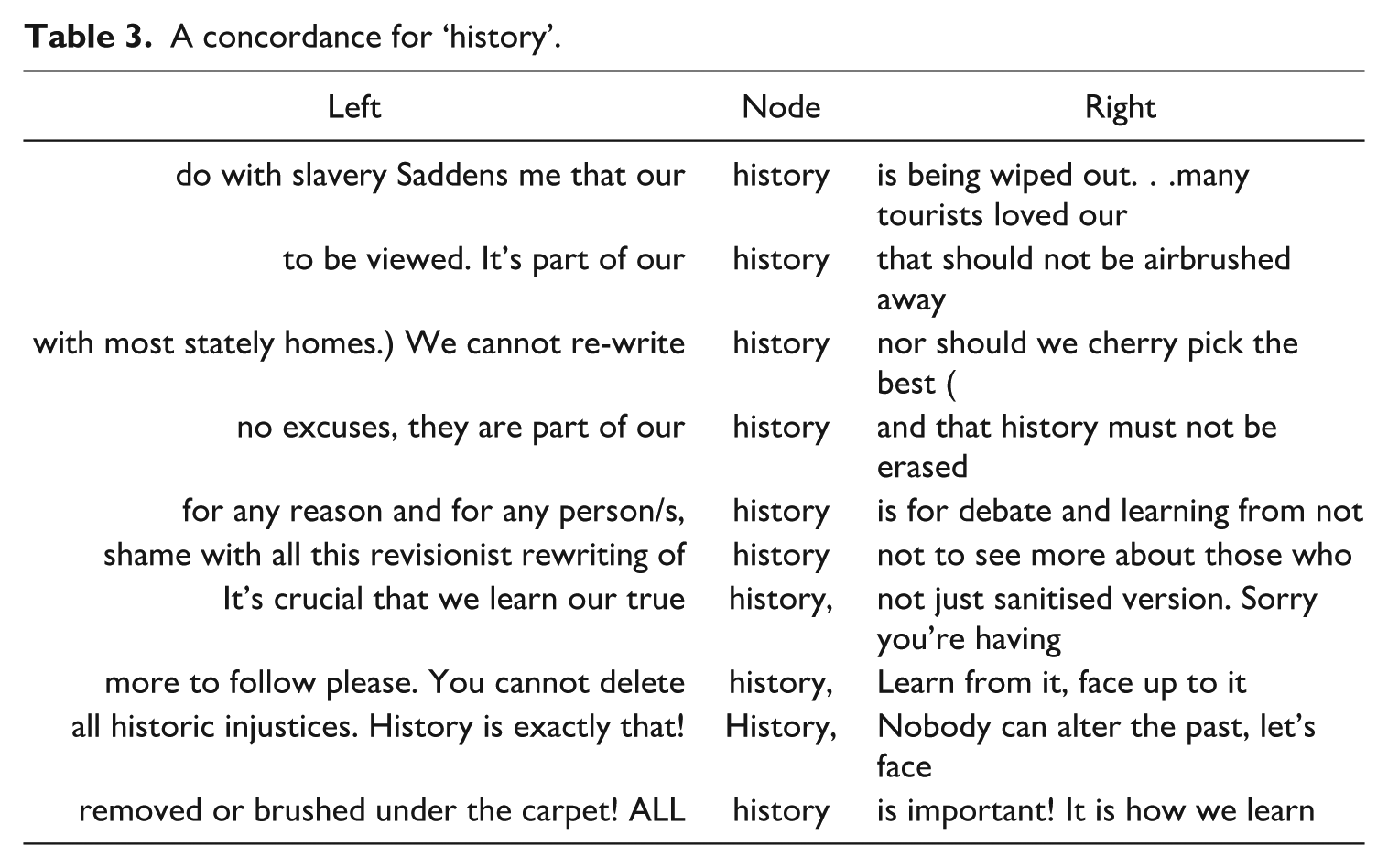
As exemplified in (3), online sceptics refuse to interpret history ‘by today’s standards’. Note that they do not refuse to acknowledge historical wrongs, but they are resentful of people who are perceived to exploit them and impose their own agendas. Where individuals invocate hurt feelings or accusations of historical erasure, this works discursively to re-centre White perspectives and preserve a sense of moral innocence around Britain’s history. Online, such reactions are amplified through performative outrage, where emotion becomes a tool for resistance (Anderson, 2016; Eschmann et al., 2023). To some extent then, these sceptics only recognise the descriptive content of history and artefacts (i.e. some content could be wrong) but fail to comprehend the significance of their effects (e.g. on the mental wellbeing of minoritised people) and their role in the continual subordination of minoritised people within contemporary systems of White Supremacy (Cashmore, 2020).
(3) Our History good or bad,. can’t be rewritten, erased, forgotten, or judged by todays standards, it is more important we see it for what it is, and learn from every page of it. Whatever the agenda some people are following with regards to this issue, needs to change, because the divisions it is causing do no one any credit.
It is ironic that online sceptics criticise the National Trust on the grounds of historic preservation when one of the primary causes of the National Trust is to conserve history and heritage. In their report on colonialism and historic slavery, The National Trust (2020) attend to a wide range of histories, pledging their commitment to researching and addressing the histories of slavery and legacies of colonialism while stating explicitly that they are equally devoted to highlighting ‘the histories of place, architecture, families, estates, staff, communities, artisanal practice and our remarkable collections’ (p. 5). This holistic approach to history is not recognised by online sceptics, who view historical sites and objects as ‘sacred’ and regard any attempts to alter them as disregarding, erasing or rewriting history.
It is worth noting that not all online commentators are hostile; some appreciate the National Trust’s efforts to educate the public about a wide range of histories. They refer to the importance of being transparent and honest in the processes of negotiating ‘truth’ and ‘fact’, pointing out that it is crucial to teach children the ‘unpleasant’ aspects of history that are often ‘glossed over’. As illustrated in (4), some commentators demonstrate a more nuanced understanding of discussing historic slavery and issues of race in the context of visiting the National Trust properties. They acknowledge that history must be presented in its wholeness and call out people who wrongly equate this with destroying history.
(4) As a member I’m pleased to hear this, always interesting and important to hear the whole story of a place, warts and all. Sorry that some people are wilfully misinterpreting this to mean destruction of history rather than broadening of it.
The role of the National Trust
We all want quiet. We all want beauty. . . We all need space. Unless we have it, we cannot reach that sense of quiet in which whispers of better things come to us gently. (Octavia Hill, Co-founder of the National Trust)
Conservation and preservation
Notwithstanding the National Trust’s commitment to diversity and inclusion (The National Trust, n.d.b), online sceptics hold a narrower view of its role. As exemplified in (5), the National Trust’s role is described as taking good care of the countryside and protecting and preserving artefacts of historical significance. This is only partially consistent with the National Trust’s mission: to look after nature, beauty and history for everyone to enjoy. Online commentators pay the most attention to the enjoyment component, urging the National Trust to fulfil their responsibility and restore historical sites for them to appreciate. Paying members, in particular, are most concerned about how their money is being spent. They pay for pleasure (or, as Octavia Hill says, for quiet, beauty and space) so they expect their visiting experience to be continuously enhanced. Spending on other items (e.g. writing reports about historic slavery and colonialism) is deemed a waste, with some commentators voicing their discontent and threatening to cancel their membership.
(5) NT. . .your job, the one we give you money to do, is to look after historical houses and countryside. Nothing else. How much money are you wasting on these vanity or political policies, on consultants and cultural directors rather than spend on restoration?
Anti-politicisation
Having established that the role of the National Trust is imagined to be rather limited, it is understandable that tensions could arise from the varying roles performed by the National Trust that are beyond conservation and preservation. Following the release of the interim report, the National Trust was criticised for playing the educator role and lecturing the public. In (6), online sceptics contend that the National Trust has agendas that are irrelevant for a conservation charity. They criticise it for being too ‘political’, attempting to preach its beliefs and force an unwelcome version of British history onto its members and visitors.
(6) Just look after the properties and leave the politics to the politicians. Ffs, go woke, go broke. Not visiting or supporting anymore. Please do not ‘educate’ or lecture us. I go round houses to appreciate furniture, art and gardens. We don’t need to have your view of history forced upon us.
Online sceptics argue that the National Trust should not express opinions on ‘political’ matters, claiming that it has become a ‘left-wing organisation’ by playing the ‘BLM political game’. To illustrate the negative sentiment towards the National Trust’s engagement in ‘politics’, Table 4 is a concordance of the search term ‘politic*’. Disapproving descriptions such as ‘idiocy’, ‘claptrap’, ‘diabolical’ and ‘rubbish’ are used to criticise the National Trust’s decision to elaborate on its strategies and actions for fostering a fair and equal society free from discrimination. Sceptics find it unreasonable for the National Trust to prioritise the interests of minoritised people, who are perceived as rarely visiting its properties; whereas interests of the ‘majority’ and ‘loyal members’ (in other words, White British folk) are sidelined.
A concordance for ‘politic*’.
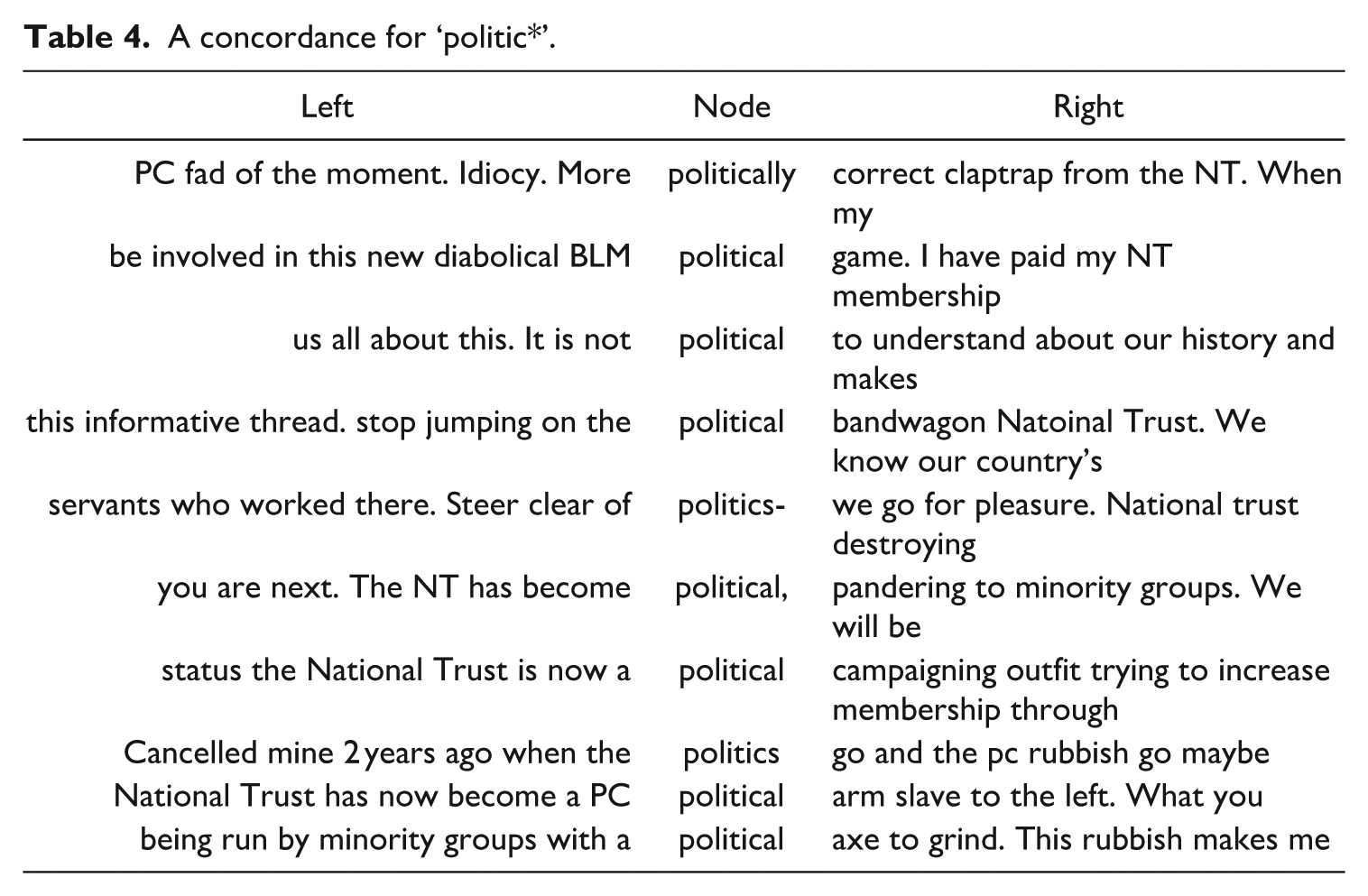
This rejection of the Trust’s engagement with issues of race and colonialism can also be understood through the lens of White fragility (DiAngelo, 2018). Here, discussions that challenge White historical innocence provoke anger and denial from online interlocutors. The insistence that the Trust should remain within their role (i.e. to conserve nature and country houses) reflects a desire to preserve a depoliticised and comforting narrative of heritage, which is able to shield White audiences from discomfort or accountability. The emotional tone of these responses, characterised by outrage and ridicule, also exemplifies what Anderson (2016) and Eschmann et al. (2023) describe as ‘online rage cultures’, where expressions of anger serve to reinforce belonging within a supposedly morally superior community. Such performances of outrage online provided sceptics with a sense of collective identity rooted in the defence of tradition and the rejection of perceived ‘wokeness’.
As demonstrated in (7), sceptics are doubtful of the genuineness of the National Trust’s concern for minoritised people, accusing it of virtue signalling. They do not understand why there is sudden interest in reconsidering the history and representational meanings of statues, questioning the intentions of the National Trust and its allies. In support of their negative characterisation of these ‘impromptu’ advocates, sceptics employ the argumentation strategy of whataboutery (i.e. asking ‘what about. . .’), shifting the attention to other examples of wrongdoings and discriminatory acts (such as modern slavery). They argue that the National Trust should attend to the more relevant and pressing issues if they are genuinely committed to supporting minoritised groups.
This rhetorical strategy of whataboutery and accusations of virtue-signalling can also be interpreted as a defensive manoeuvre consistent with White fragility, allowing individuals to deflect critique and recentre themselves as morally consistent. The whataboutery strategy draws on the false dilemma fallacy to maneuver people into comparing the sufferings of marginalised communities, creating the illusion that the gravity of an issue can be clearly determined and that we can only attend to one problem at a time. In the context of digital communication, such strategies gain traction through what Papacharissi (2015) terms ‘affective publics’, where emotions, particularly indignation and resentment, underpin their approach to political discourse. The result is a moralised and affective backlash that polices who can speak about race and history, and on what terms. Indeed, by shifting the topic and contrasting different forms of oppression, sceptics effectively refrain from engaging in important conversations about the legacies of colonialism and slavery. They do not recognise the interconnected nature of historical and contemporary issues, nor the ongoing impacts of past injustices and narratives on present-day inequalities.
(7) People are so concerned about slavery hundreds of years ago whereas they’ll happily shop in stores with very questionable ethical practices. If they really cared and were not just virtue signalling surely they would be working to eradicate what is happening NOW, as opposed to tearing down statues etc.
Nationalism
Us versus them
Online sceptics distinguish themselves from the National Trust and people who are distressed by artefacts with links to colonialism and historic slavery. This is commonly achieved by pronouns use, including ‘we’, ‘us’, ‘our’, ‘they’, ‘them’, ‘theirs’, ‘these’, ‘those’ and ‘you’. The contextualisation of such plural pronouns, as Koca-Helvaci (2023) explains, is informative of group formation, identification and polarisation, and the repetitive occurrences of pronouns subtly imprint ideological associations on our minds.
Table 5 presents a concordance of the search term ‘our’ to illustrate the major characteristics and topics of interest of the in-group constructed by online sceptics. ‘Our’ is used in conjunction with words such as ‘ancestors’, children’, ‘country’, ‘culture’, ‘heritage’ and ‘history’: the themes of showing respect for the ancestors, preserving one’s culture, history and heritage, and most importantly, showing love for one’s country are repeatedly represented. By discussing these concepts in a collective sense, online sceptics create a community for like-minded individuals (the in-group) who share a strong sense of national belonging, and intrusion to this space is condemned. This process of demarcating an in-group encourages defensiveness and moral manic in response to challenges around the dominant racial narratives. In this case, the in-group is comprised of White British individuals, who lay claim to rural spaces in England. Expressions of ‘our history’ and ‘our heritage’ thus become affective shields protecting the sanctity of Whiteness within the imagined nation.
A concordance for ‘our’.
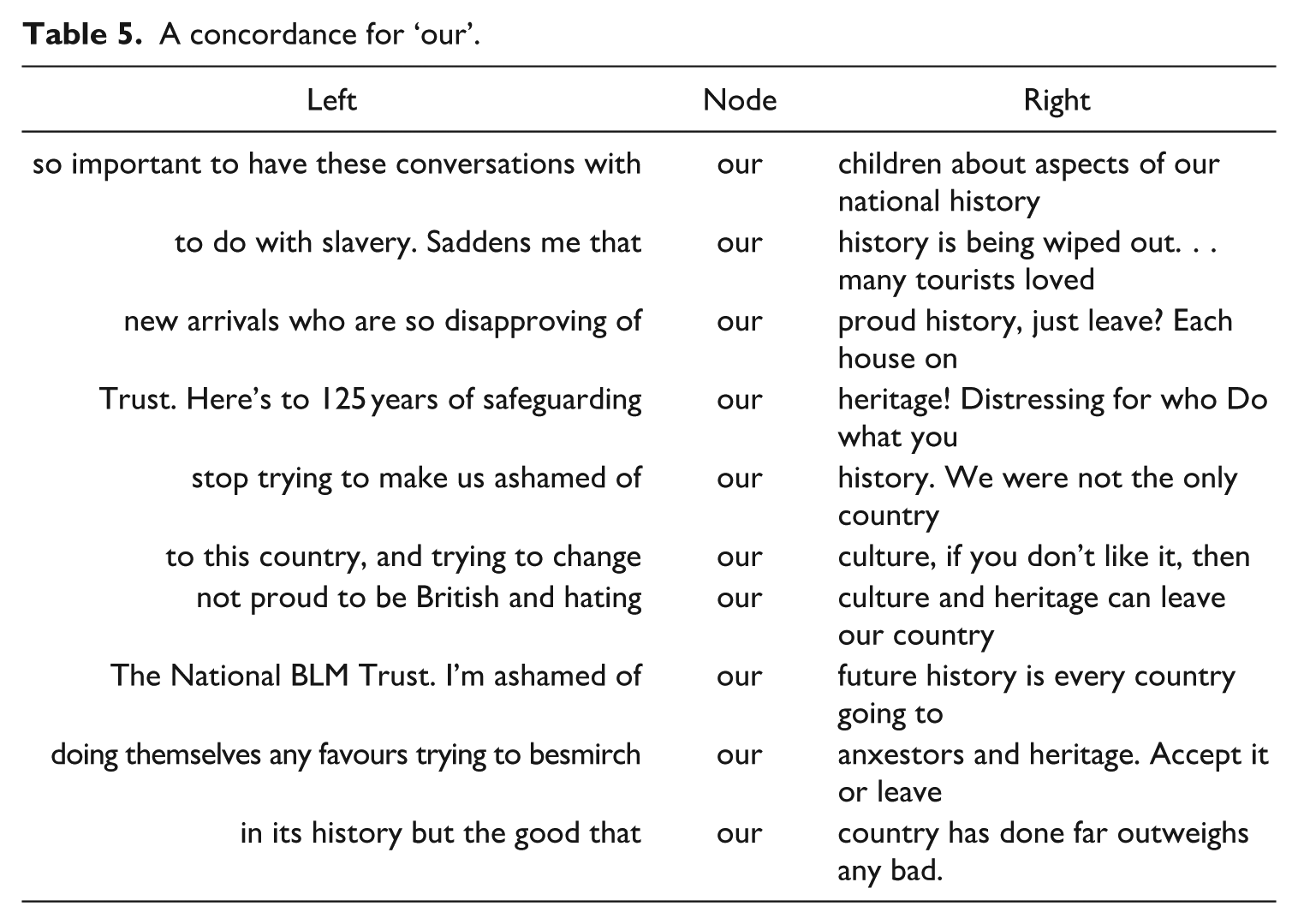
Nevertheless, the aggregation of social actors entails ambiguity and conceals diversity within the in-group (and the out-group), with the referents of the pronouns being routinely unclear. For example, when some sceptics claim that ‘our’ culture, history and heritage is under threat, who are members of the in-group (who feel threatened) and the out-group (the source of threat)? The categorisation exercise is often carried out based on the contentious concept of ‘the proud/true British’. As Clarke (2023) observes, there exists a racialised hierarchy of national belonging where the construction of Britishness is underpinned by whiteness – social actors who are more able and willing to inhabit and perform the norms of whiteness are more likely to be recognised as British.
The ‘us versus them’ framing is therefore not merely linguistic but deeply affective in its aims. It transforms perceived cultural critique into an existential threat to national (White) identity. Online discourses of such nature act as a form of ‘affective citizenship’ (Papacharissi, 2015), where participation in this collective anger becomes a way to perform loyalty to the nation as they see it. This then intensifies resistance to anti-racist interventions, which are cast as attacks on ‘our’ way of life, rather than efforts toward inclusion.
In (8) and (9), the use of plural pronouns including ‘we’, ‘our’, ‘you’ and ‘these (people)’ demarcates clearly two opposing groups: people who identify as ‘proud British’, conveying a sense of ownership of British culture, heritage and values; and people who are depicted as ‘unproud British’ and ‘migrants’. The ‘proud British’ construct an in-group and alienate the out-group, justifying their negative other-representations (e.g. representing them as enemies who want to ‘dismantle this country’) via the argumentation strategy of whataboutery – rather than acknowledging the historical wrongdoings of Britain, they highlight that it is an issue relevant to ‘every country’ and ‘every race’. These collective assertions of belonging through the use of pronouns also reflect the affective economies of online rage (Ahmed, 2004), where anger, ridicule and indignation consolidate national identity while discrediting voices that question it. Also, the ‘proud British’ put little effort into communicating or empathising with who they think show no respect for British culture and values and attempt to destroy the country.
(8) Anyone not proud to be British and hating our culture and heritage can leave our country and go and live in amore tolerant country if you can find one (9) Oh just STOP ever since we have allowed for migrants to come into Britain all it has created is a rod for our own backs with these people demonising Britain and wanting to dismantle this country piece by piece! EVERY country has done things wrong! EVERY country and EVERY race!
National pride
The rejection and derogation of the out-group is fuelled by unequivocal support for Britain. Online sceptics share collective pride and readily defend Britain which they think is being unfairly targeted. Referring to the work of Durkheim (1995), Beyer et al. (2014) explain the development of ‘collective effervescence’ (a heightened state of exaltation) and its significance to the strengthening of group identity and belonging as in-group members gather and construct boundaries to exclude outsiders. Crucial to this process is group-related affectively charged symbols. In the national context, national symbols (e.g. national flags), embodying feelings of belonging to the country, are central to nation-building and maintenance and must be treated with respect; any actions taken against the symbols are interpreted as against the nation. Such significance of national symbols illuminates the backlash against the National Trust, which mirrors what Billig (1995) calls ‘banal nationalism’ - the everyday reproduction of the nation through emotional and moral attachment to its symbols. When these symbols are reinterpreted or represented through anti-racist frameworks, White fragility is triggered: critique of history becomes sacrilege whilst maintaining traditional views of heritage becomes sacred. Online rage then operates as both a defence mechanism and a ritual of performative belonging, reaffirming who counts as a legitimate custodian of ‘our’ history.
Indeed, as demonstrated in (10), properties and artefacts in the custody of the National Trust are perceived as important national symbols, serving to remind British people of their ‘ancestors’ magnificent achievements’. They represent ‘imaginations and interpretations of the nation’s origin, its past, present and future’ (Elgenius, 2014). In the face of criticisms concerning historical wrongdoings, online sceptics adopt the perspectivation strategy, acknowledging the existence of different viewpoints but asserting that the only acceptable viewpoint is showing support for the country. As the sceptics ardently come to Britain’s defense, they employ the argumentation strategy of whataboutery by citing examples from other countries. The sceptics posit that ‘history is history’ and fail to recognise the ongoing impacts of past injustices and narratives on present-day inequalities. As Tomlinson (2019) delineates the impact of colonialism on ongoing issues facing minoritised individuals, one of its most damaging legacies is the widespread belief in ‘superior British heritage’ and the notion that ‘the White British had economic, moral and intellectual superiority over the formerly colonised people, and indeed, over all “foreigners”’ (p. 13).
(10) History is history. There’s no ‘range’ just different viewpoints. Your job is to preserve and protect Britain’s heritage, with pride in all our ancestors’ magnificent achievements. Is there a plaque on each of the pyramids in Egypt, saying ‘built by slaves’?
Conclusion
By drawing upon a case study of the ways the National Trust have faced backlash following its attempts to address its links to colonialism and historic slavery, this article has demonstrated how public discourses around race and colonialism are constructed, contested, and resisted in online spaces.
For these sceptics, the National Trust’s primary role should be preserving historical sites for the enjoyment of members/the British public, with no room for ‘political’ concerns or reinterpretations of history. The backlash often centres on the idea that history should be preserved in its original form, without modification, and that efforts to reconsider the past reflect a political agenda rather than a commitment to cultural stewardship. The interplay of White fragility and online rage provides a useful interpretive lens here. The defensive, emotionally charged responses outlined above reveal how Whiteness is perceived as being destabilised. In turn, this sense of threat prompts Whiteness to be reasserted as the dominant and primary racial position through online discourse. The opposition outlined is compounded by a sense of national pride and identity. For example, many invoke a collective sense of ownership over British culture, history, and heritage, often articulated using inclusive pronouns such as ‘our’ and ‘we’. However, these pronouns construct a partial framing of Britishness, formulating an in-group of ‘proud British’ individuals who believe that their culture and heritage are under threat from those who they think wish to tarnish or erase historical symbols of national pride. Attempts to confront our relationships to racism, colonialism and historic slavery, such as through the National Trust’s actions, are seen as an affront to sceptics’ sense of identity, as these historical sites and artefacts are viewed and mythologised as Britain’s soul, rooted in a relationship with the British land that feels safe, secure and White (Bell, 2006; Mitchell, 2020). Expressions of outrage and wounded pride reveal how the rural idyll functions as both a spatial and affective imaginary, where belonging and identity to the English countryside are fiercely guarded. This stance is further rooted in an understanding of history that prioritises pride in the nation’s past accomplishments, often at the expense of acknowledging the darker colonial legacies that continue to shape present-day inequalities.
The backlash against the National Trust is situated in the wider discourses that allege the ‘polarisation’ and ‘weaponisation’ of history and heritage. In addition to the interim report, between 2018 and 2022, the National Trust contributed to the writing and history project ‘Colonial countryside: Reinterpreting English country houses’ led by the University of Leicester. The project provided primary school students the opportunity to learn about country houses’ colonial connections, engage in broader conversations about Britain’s past, and share evidence-based stories with diverse audiences. Yet, it was accused of being biased and overly ‘political’, and some of the academics involved were being personally targeted (Doward, 2020). The National Trust case aside, we have examined other examples of backlash against the reinterpretation of history (or acts that are considered as such) within the Rural Racism project. Notably, there have been extensive debates on making changes to built environment, such as removing the statues of Edward Colston in Bristol (United Kingdom) and Cecil Rhodes in Cape Town (South Africa). As Tinsley et al. (2024) explicate, these cases are fuelled by the transnational systems of capitalism, empire, and slavery, which collectively contest the transnational narratives and values that sanitise history and glorify colonial elites.
As illustrated by the National Trust case, despite the backlash, the attempts to address colonial legacies reflect a broader societal push towards inclusivity and anti-racism. Though contested by some, the National Trust’s work exemplifies the importance of challenging exclusionary narratives and embracing a more inclusive understanding of history, identity and belonging to rural spaces. As the epigraph to this article exhibits, such efforts are increasingly framed as pleading victimhood, creating a culture of fear and dividing society. The backlash analysed here does not solely reflect the views of rural dwellers but rather illustrates how racism interacts with and is legitimised through idealised imaginaries of the countryside. The National Trust case demonstrates how the rural idyll continues to operate as a site through which national identity and racialised belonging are negotiated and defended. Ultimately, addressing the racialised dynamics embedded within these imaginaries is an arduous journey that requires institutions and individuals to engage critically with history while welcoming diverse perspectives and identities. In doing so, we can help shape a countryside that is a space of historical significance and also one that is inclusive, equitable, and reflective of the diversity of modern Britain.
Footnotes
Acknowledgements
The authors thank the Rural Racism Project research team members, including Neil Chakraborti, Amy Clarke, Corinne Fowler, Khadidja Kelalech, Viji Kuppan and Mulka Nisic, for their contribution to the research project.

Funding
The authors disclosed receipt of the following financial support for the research, authorship, and/or publication of this article: This work was supported by The Leverhulme Trust.
Declaration of conflicting interests
The authors declared no potential conflicts of interest with respect to the research, authorship, and/or publication of this article.