



Abstract
This paper presents a new taxonomy for classifying rape euphemisms and demonstrates its application through a study that systematically analysed closing arguments in four rape trials. In the study, all references to the rape in question were classified into four categories: (1) euphemistic, neutral, (2) euphemistic, sexual, (3) euphemistic, violent and (4) orthophemistic, violent. The findings showed that closing arguments contain many euphemistic references to rape, despite the fact that unambiguous, direct language is preferable in courtroom discourse. Furthermore, the following themes emerged in the lawyers’ euphemistic language: (1) rape testimony framed as a narrative, (2) sexual connotations in official legal charges, (3) highlighting the victim’s perspective and (4) conflating rape and sex. The study highlighted a need for sensitising the language of closing arguments to prevent retraumatising the rape victims and demonstrates how the proposed taxonomy can support future research on rape euphemisms and potentially other ‘taboo’ dicourse contexts.
Keywords
Introduction
In the US, one in six women will suffer attempted or completed rape in their lifetime (CMSAC (Central MN Sexual Assault Center), 2023). Despite this prevalence and the steady improvement of the legal treatment of rape, society’s understanding of sexual violence is still greatly influenced by false beliefs (Anderson and Doherty, 2008). These beliefs are also known as rape myths and include assumptions such as the victim being at least partly responsible for her rape due to her appearance or behaviour. Rape myths contribute to rape culture (see Brownmiller, 1975), a term describing environments or societies that foster the prevalence of rape and discourage victims from reporting the crime. This rape culture also manifests in the criminal justice system, informing counsels’ strategy and jury’s perception of such cases.
It is therefore unsurprising that previous literature has established that rape trials often revictimise rape complainants; a phenomenon that has been referred to as judicial rape (see Lees, 1996) or secondary rape (see Anderson and Doherty, 2008). One aspect of this stems from the language used to discuss the rape in question. Further, language has been described as crucial to the outcome of rape trials and lawyers, in particular, have the power to shape a jury’s perception of the case based on how they talk about it (Neal, 2015).
With this in mind, a study was conducted to examine euphemistic language in lawyers’ closing arguments of four US rape trials. Not only did the study provide a more up-to-date account of rape discourse in a courtroom context, it also highlighted the importance of sensitive language and the responsibility that comes with the institutional power that lawyers have. Further, it looked at speaker motivation of the lawyers on opposing sides of an adversarial trial and established patterns in the use of euphemisms and orthophemisms.
As part of the study’s methodology, a linguistic taxonomy for classifying such rape euphemisms was created based on previous work by Bavelas and Coates (2001) and Trinch (2001, 2003) . This article will outline the taxonomy and its accompanying hierarchy, and then demonstrate an exemplary application based on the abovementioned US data. The paper concludes with a discussion of how this taxonomy may provide a useful framework for further research on euphemistic language around rape or other ‘taboo’ concepts.
The socio-political context of rape
Prior to the organised efforts of second-wave feminists in the 1960s, rape offenders were typically viewed as individual outliers with mental disorders (MacLeod, 2010) and subjection to rape was considered an unfortunate personal matter. However, important publications by feminist scholars such as Brownmiller (1975) and Friedan (1963) brought about an opposition to such beliefs. Under the new slogan of ‘the personal is political’ (Thornham, 2006: 26), rape was highlighted as a structural issue in urgent need of addressing. Today, rape is seen as ‘both a socially produced and a socially legitimated phenomenon’ (Anderson and Doherty, 2008: 21) and the idea of what constitutes rape is broader than before.
Feminist scholars label (Western) society as rape supportive (Lazar, 2005; MacLeod, 2010), citing examples such as police officers who discourage victims from prosecuting their attackers or the relative ease with which lawyers can circumvent rape shield laws intended to protect victims (Anderson and Doherty, 2008). Additionally, a lack of differentiation between rape and consensual sex is common, both in society at large and in the judicial system (Coates et al., 1994). Brownmiller (1975) importantly characterises rape as a violent, non-sexual act, although other scholars argue that men’s sexual and violent urges cannot accurately be distinguished (MacKinnon, 1987) or that the violence is exacerbated by the sexually intimate nature of the crime. For Gavey (2005) too, heterosexual sex itself must be interrogated if we are to fully understand sexual violence as a social problem, providing as it does the ‘cultural scaffolding’ for rape.
Victims often struggle to even identify an incident as rape, especially when it does not fulfil the stereotype perpetuated by pervasive rape myths. These requirements are characteristic of a stranger rape, which typically describes a pre-planned rape where the perpetrator is unknown to the victim chosen at random. Both in society and the judicial system, stranger rape is taken more seriously than date rape or intimate partner rape (Ehrlich, 2010; Matoesian, 1993). Additionally, when a rape report is made, only a minority of cases end up being tried in court and conviction rates are drastically low (CMSAC (Central MN Sexual Assault Center), 2023).
Even today, perceptions and definitions of rape and sexual assault vary between people (Neal, 2015), lay and legal understandings (Campbell and Johnson, 1997) and different judicial systems (Allan and Burridge, 2006). The terms rape and sexual assault are often conflated, although the latter typically references a broader category of offences. However, as Brownmiller (1975: 376) fittingly puts it: ‘to a woman the definition of rape is fairly simple’.
Since the data in the study discussed below were taken from trials held in the US court system and specifically involved charges of rape rather than sexual assault, the following rape definition was adopted: ‘The penetration, no matter how slight, of the vagina or anus with any body part or object, or oral penetration by a sex organ of another person, without the consent of the victim’ (United States Department of Justice, 2012).
Euphemisms and lexical choice
Euphemisms function as a linguistic tool with which speakers can avoid directly mentioning ‘taboo’ topics. What constitutes a taboo varies based on speakers’ sociocultural background (Burridge, 2006). However, some taboo topics are near universal, such as sex, sexual organs and rape (Nowak-Michalska, 2020).
Casas Goméz (2009: 738) describes two options a speaker has when referencing such a taboo: attenuation or reinforcement. Attenuation results in a euphemistic expression by replacing a direct reference to the topic with a softer term. An example is replacing the expression to die with the alternative to pass away, to avoid direct reference to the uncomfortable concept of death. Reinforcement, on the other hand, results in a dysphemistic expression by using terms that are ‘harsh, blunt or offensive’ (Burridge, 2006: 457) and is thus the opposite of a euphemism. Continuing with this example, a dysphemistic realisation of to die would be to croak. In between these two options, not mentioned by Casas Goméz, are orthophemisms: neutral and direct references to the topic in question (Burridge, 2006), such as saying that somebody has died. Which of these three categories a specific lexical item falls under and which option a speaker will use depends on various factors such as situation, context, speakers and their cultural backgrounds (Burridge, 2006; Casas Goméz, 2009).
However, the overuse of euphemisms to avoid offence can become offensive in and of itself as it marks the substituted concept as a taboo, implying that it is too ‘dirty’ to explicitly discuss (Allan and Burridge, 2006). In the context of rape, this can add to the stigma around rape victims, implying that they are tainted by the assault to which they were subjected.
Euphemisms are based on the concept of lexical choice, meaning a speaker picks one term from a variety of options denoting a similar concept. The choice of one expression over alternatives will be perceived as deliberate and can affect how the subject matter is perceived. This was demonstrated in a well-known study by Loftus and Palmer (1974), where the use of different verbs describing a car accident influenced participants’ perception of that accident and even altered their memories of it. These findings can apply to a courtroom context, showing that lawyers’ lexical choices impact the jury’s perception of the alleged events and those involved.
Lastly, the further removed from the orthophemistic reference a euphemistic expression is, the greater the danger that the concept of the original reference will be misunderstood or even altered. Euphemisms can intentionally ‘obscure or deny alternative versions of events’ (Anderson and Doherty, 2008: 107). Applied to the context of rape trials, the discussion of sexual violence in vague, ambiguous and euphemistic terms can prevent the jury from having a clear understanding of the case or even actively deny that a rape has occurred.
Euphemisms in rape trials
Extensive scholarship exists on the language around rape and, specifically, on rape euphemisms in a courtroom context. A common finding across the decades is that the concepts of rape and consensual sex are routinely conflated by lay people (Anderson and Doherty, 2008) and members of the judicial system alike (Pritchard, 2014).
As juries in US courts are made up of members of the public, it is important to understand how lay people perceive rape cases and how their belief in rape myths may impact this perception. Anderson and Doherty (2008) analyse metaphors in participants’ discussions around accountability of male and female rape victims. They find that certain metaphors can function as a way of ‘justifying violence, concealing abuse and supporting entitlement to positions of power’ (2008: 109) and that participants believed that rape is similar to consensual sex. The authors also demonstrate the relationship between language and a rape-supportive society.
Pritchard found that explicit language, such as the term rape, is sometimes banned in courtroom discourse, as it is argued that such words ‘would conflict with the ideal of presuming innocence until guilt is proven’ (2014: 6). Interestingly, such language restrictions are almost exclusively found in rape cases, once again demonstrating how much power is attributed to such expressions. Importantly, research points out that direct and unambiguous language is favoured by the court (Svongoro et al., 2012; Trinch, 2001), whereby culturally or legally imposed euphemistic expressions would disadvantage the speaker. In contrast, Mulla (2015: 136) discusses instances of rape evidence being excluded from trial to avoid distressing the victim and jury members. While this could extend to factor in lawyers’ choice of including clear and thus distressing references to rape, Bartley (2020: 429) concludes in her research on the closing arguments of a rape trial that ‘the use of explicit negative lexis leaves a clear image in the minds of the jury and, thus, proves a powerful linguistic tool’.
Ehrlich (2002) highlights a positive example of language in a lawyer’s closing argument. She compares the language of a civil and criminal rape trial, showing how ‘feminist discourses or ideological ‘frames’ regarding women and sexual violence can be introduced into the discursive space of a trial’ (2002: 193). This demonstrates the prosecution lawyer’s ability to emphasise the violence of the offence committed against her client.
Felton-Rosulek (2008) analyses the closing arguments of a rape case involving a child victim, examining which aspects of the case are mentioned and how they are discussed. She finds that the prosecution covers the repeated rapes in explicit detail while the defence’s references to the rape in question are either entirely omitted or kept minimal and vague.
In sum, rape euphemisms downplay or omit the lack of consent and can be intentionally included by lawyers to portray the same event as either consensual sex or rape. Furthermore, rape euphemisms with a sexual connotation fulfil a different function than euphemisms typically do. Instead of attempting to soften the uncomfortable associations produced when referencing the concept of rape, they actively deny that a rape has even occurred by instead portraying it as a consensual act. This blurring of two mutually exclusive concepts is especially problematic when it occurs before a court of law that is intended to establish whether a criminal activity has taken place.
Taxonomy for (rape) euphemisms
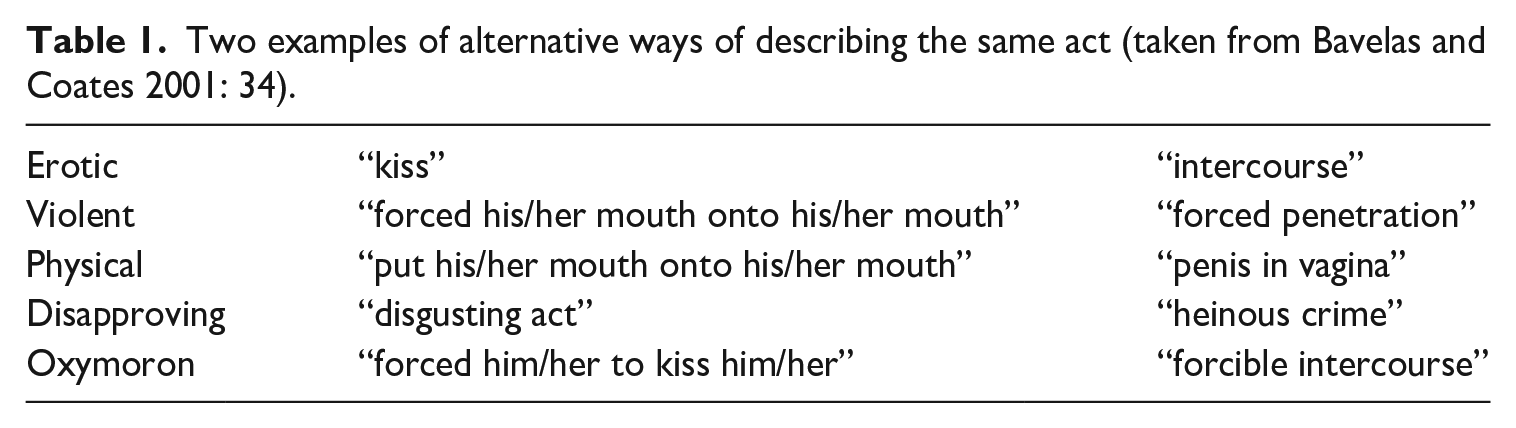
From the study outlined in the subsequent chapters emerged a taxonomy for classifying rape references. This taxonomy develops previous work by Bavelas and Coates (2001) and Trinch (2001, 2003), adapted to the language of lawyers in closing arguments. Bavelas and Coates (2001: 35) examined rape references in trial judgements of rape cases, finding that judges mostly used ‘erotic or affectionate language’, obscuring the violent nature of rape and conflating it with consensual sexual acts. The authors (2001: 33) classified any reference to the rape in question into five non-exclusive categories, based on ‘the denotation and connotations of the words used’: sexual, violent, physical, disapproving and sexual-violent oxymorons (see Table 1 for examples of each category).
Two examples of alternative ways of describing the same act (taken from Bavelas and Coates 2001: 34).
Similarly, Trinch (2001, 2003) looked at rape euphemisms in protective order interviews with victims of domestic and sexual violence, finding that victims (and sometimes also their interviewers) preferred to discuss the abuse in euphemistic language to save face. She also discusses the interviewers’ power to characterise the alleged abuse when summarising it for the official report. For this purpose, Trinch (2001: 582; 2003: 228) developed a ‘spectrum of directness’ which classifies the terms used by the victims to discuss their rape into six groups ranging from direct and explicit (Group A) to inexplicit, nearly non-existent (Group F). She bases her distinction on where the terms fall on the spectrum of legal – not legal, not euphemistic – euphemistic and unambiguous – ambiguous, and ranks the groups based on their ‘compatibility with the legal context’ (Trinch, 2001: 581).
While Bavelas and Coates (2001) focused on trial judgements and Trinch (2001, 2003) focused on victim interviews, the following taxonomy was developed based on the language used by lawyers in closing arguments of rape trials. It builds on elements from both aforementioned categorisations, by adopting the distinction of violent and sexual connotations found in Bavelas and Coates (2001) and euphemistic and not-euphemistic expressions from Trinch (2001, 2003). It expands these classifications by including a neutral connotation, which covers many of the terms and phrases Bavelas and Coates labelled as physical descriptions and Trinch (2001, 2003) labelled as ambiguous.
Subsequently, only references that accurately and directly label the crime as rape or limited alternatives such as sexual assault are classified as orthophemistic. All other reference types are considered euphemistic, even if they mention the violent or criminal nature of the described act, as these lexical choices obfuscate the fact that a rape has occurred, either by being indirect and vague or by actively classifying the interaction as sexual rather than violent. The resulting taxonomy with examples for each group can be seen in Figure 1, which also shows that orthophemistic expressions always have a ‘violent’ connotation since rape is inherently violent.
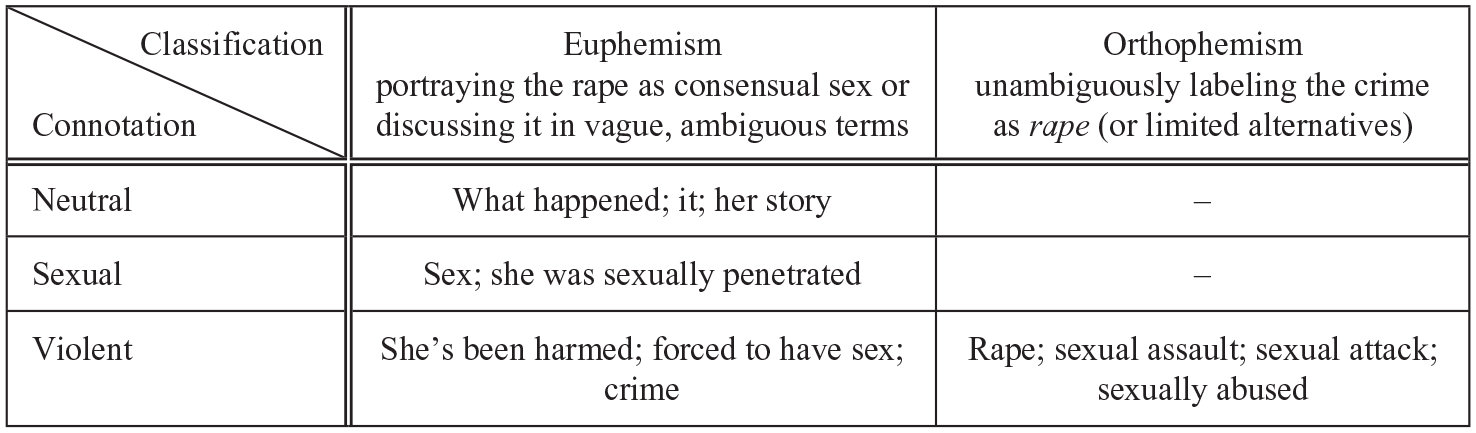
Taxonomy (with examples).
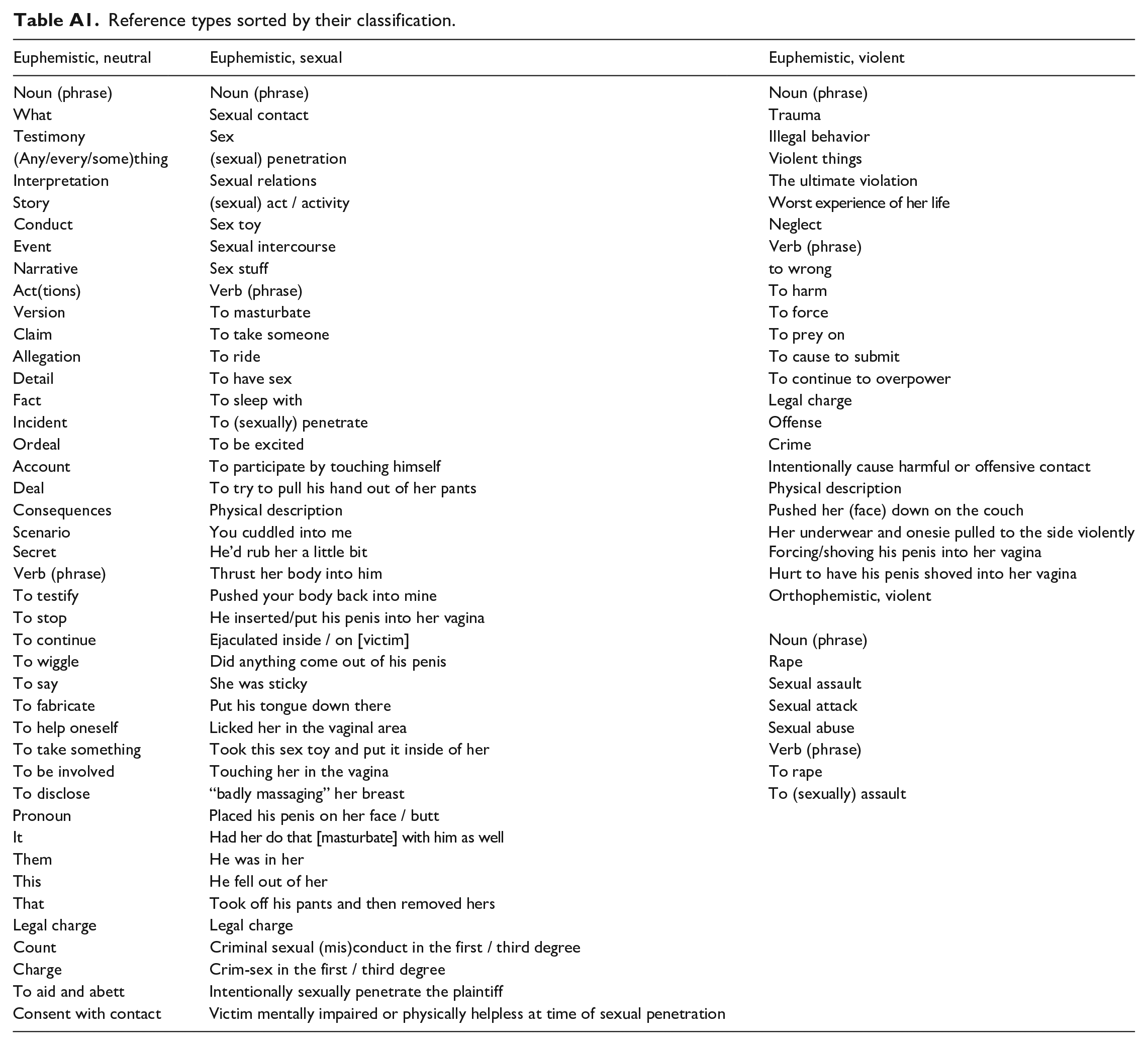
Naturally, these categories have fuzzy boundaries and are not mutually exclusive. Instead, each reference should be classed into the category deemed most suitable. For example, the phrase forced to have sex, which Bavelas and Coates (2001: 35) would label a sexual-violent oxymoron, has both a sexual and a violent connotation but was categorised as ‘euphemistic, violent’, as this aspect was deemed to take precedence. An overview of how the 551 rape references collected for the study were classified is in the appendix under Table A1.
Supplementing this taxonomy is a hierarchy of the four possible categories, as represented in Figure 2. Contrary to the spectrum of directness developed by Trinch (2001, 2003), the authors chose a hierarchy structure to reflect the harmful nature of euphemistic rhetoric used in rape discussions in a courtroom context. From left to right, the graph shows the least accurate category to be ‘euphemistic, sexual’ rape references, as they falsely imply that the perpetrator’s motivation was sexual rather than ‘power, control, or violence’ (Bavelas and Coates, 2001: 32). On the far right are the most accurate ‘orthophemistic, violent’ rape references, that clearly mark the alleged crime as a rape. In between are the categories ‘euphemistic, neutral’ and ‘euphemistic, violent’. The former comprises the majority of rape euphemisms that, due to their vague or ambiguous nature, are not ideal for the courtroom context. While references in the latter category at least mark the rape as a violent or criminal matter, they still fail to accurately label it as rape.

Hierarchy of reference classifications in a rape trial context.
In sum, the further left on the graph a rape reference falls, the further removed this reference is from the true nature of the subject it is intended to describe. Rape references in the ‘euphemistic, sexual’ category are unique in that they go so far as to actively deny that a rape has even occurred.
Research approach and methodology
The taxonomy’s accompanying study aimed to explore the often-inadequate legal response to rape by looking at the language of closing arguments in four US rape trials. It examined opposing lawyers’ inclusion of euphemistic references to the rape in question, thereby tackling a research gap that exists in this area (highlighted by Anderson and Doherty, 2008; Bartley, 2020; Neal, 2015). More specifically, it addressed the following two research questions:
What are the different connotations of any (euphemistic) references to the rape in question?
What themes are established in the closing arguments through the inclusion of euphemistic language?
The study combined a critical approach to discourse (see Fairclough, 1995; van Dijk, 2001; Wodak, 2001) with a Corpus Linguistics method. The former is often criticised for enabling researcher bias (Widdowson, 2000) and the latter for not taking the appropriate amount of context into consideration (Mautner, 2007). The mixed-methods approach, also known as Corpus-Assisted Discourse Studies (CADS; see Baker et al., 2008), helps reduce some of these limitations and has been applied to previous studies of courtroom discourse (Wright et al., 2022) and specifically to rape trials (Cotterill, 2004).
To minimise the ‘cherry-picking’ (Gillings et al., 2023: 1) this approach to discourse is often criticised for, a ‘principle of total accountability’ (Leech, 1992: 112) was adopted, meaning all instances of a linguistic phenomenon – in this case rape euphemisms – are analysed and quantified rather than just the best examples. Conversely, the more qualitative aspect of CADS enables the data’s (socio-political) context to be included when interpreting the findings. When analysing lexical choices, it is important for the researcher to take the term’s surrounding co-text into account (Baker et al., 2008). Further, it should be noted that since this study adopted a qualitatively informed approach, no general conclusions can be drawn. Instead, it wishes to shed further light on the language used in the four examined rape cases.
The study’s methodology builds on previous work by Trinch (2001, 2003) and Bavelas and Coates (2001). The first step consisted of a close reading of the data and manually extracting all references to the rape in question. Using the annotation tool NVivo (2023), all references (n = 551) were coded as either ‘euphemistic’, ‘orthophemistic’ or ‘dysphemistic’ and as highlighting a ‘violent’, ‘sexual’ or ‘neutral’ aspect of the rape. Since only one reference – raped by a homeless predator – was classified as dysphemistic, the category was excluded from subsequent analysis.
Ethics and data
The Ethics Committee of the authors’ university waived the need for ethics approval. The collected data are publicly available and all personal identifying information was removed to protect the privacy of those involved.
The data are made up of eight closing arguments and three rebuttals from four rape trials held in Minnesota (see Table 2 for an overview), since this state requires documents from appealed court cases to be made public. When working with such data, it is important to remember that the adversarial structure of such judicial proceedings motivates lawyers to present the case in a way that favours their client (Ponterotto, 2007). The prosecution aim to convince the jury of the victim’s credibility and thus the defendant’s guilt, while the defence’s goal is to either demonstrate their client’s innocence or mitigate the charges to a lesser charge or plea deal. Previous studies of closing arguments have shown that lawyers are aware of the effect their lexical choices have and word their closing arguments accordingly (Cotterill, 2004; Felton-Rosulek, 2008).
General overview of the four cases.
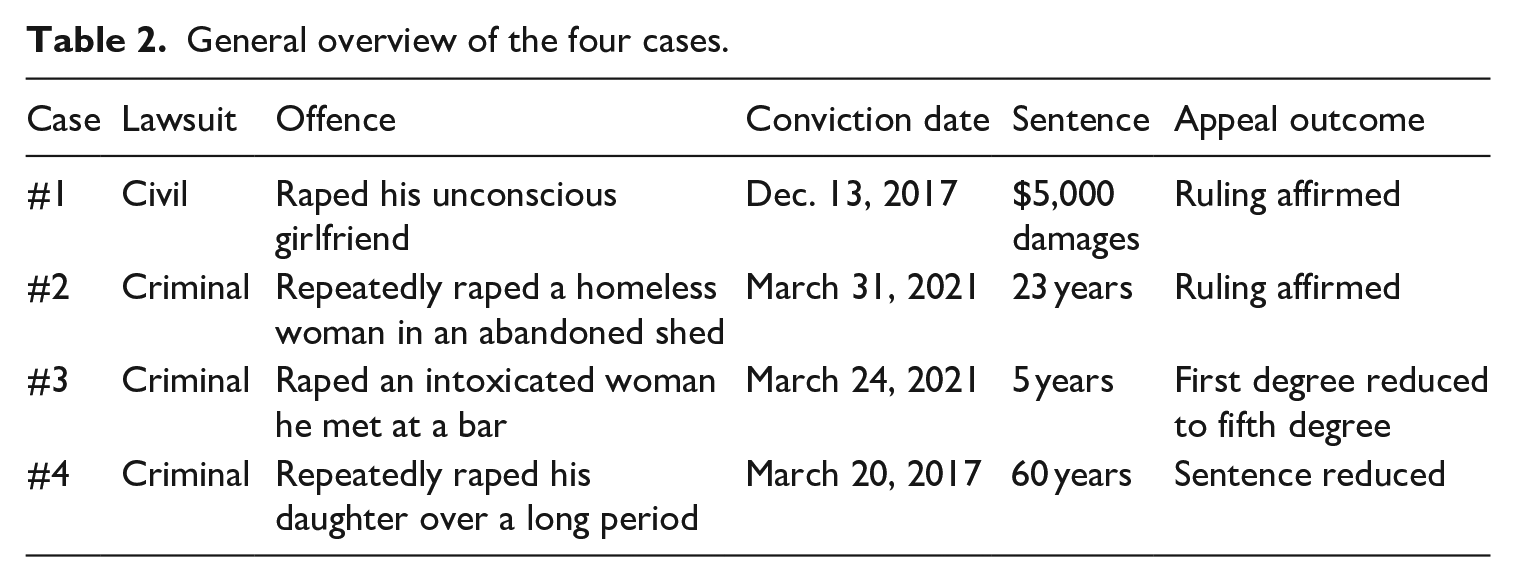
To reference these case transcripts, the following system was used: the case number assigned in Table 2, followed by a letter signalling whether the closing argument was presented by the prosecution (P), the defence (D) or as the prosecution’s rebuttal (R). Additionally, any page numbers used in connection with the data refer to page numbers found in the official transcript documents.
The focus was on female rape victims with male attackers since this is the most common gender distribution and ‘reflects the historical oppression of one sex by another’ (MacLeod, 2010: 11). Additionally, previous studies found that the victim’s gender influences the language that others use to discuss the victim’s rape (Anderson and Doherty, 2008). Thus, the focus on female victims eliminates the victim’s gender as a contributing factor to the results. It is acknowledged that classifying discourse participants based on their sex or gender is typically not straightforward and often rightfully criticised as being essentialist (Butler, 1993; Lazar, 2005). In this case, however, the classification was based on how the people are characterised by others in the discourse setting and, thus, how they were perceived by the jury.
Themes in rape euphemisms
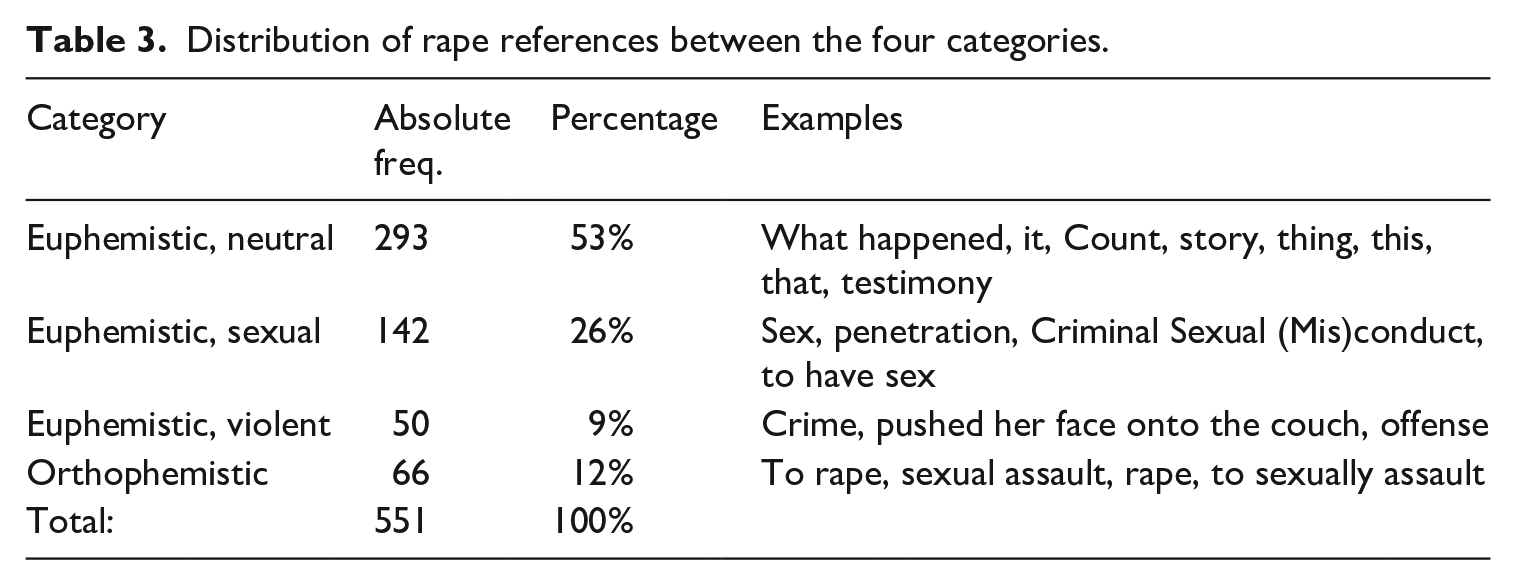
As shown in Table 3, most of the total 551 rape references collected in the study’s data were classified as ‘euphemistic, neutral’ (n = 293), while the category ‘euphemistic, violent’ accounted for the lowest percentage of references (n = 50). Every fourth reference to the rape in question was euphemistic with a sexual connotation (n = 142). Since unambiguous, direct language is preferred in courtroom discourse, it is surprising to find that only twelve percent of rape references were orthophemistic (n = 66). Overall, these results indicated that, in closing arguments, over 80% of rape references are euphemistic and frequently have sexual connotations.
Distribution of rape references between the four categories.
A close examination of the rape euphemisms revealed the presence of some particularly noteworthy themes in lawyers’ closing arguments. Each of these is briefly outlined below.
Framing rape testimony as a narrative
It was found that lawyers often characterise a person’s account of the rape in question using terms from the semantic field ‘narrative’ (see Table A1). While all of these terms were classified as ‘euphemistic, neutral’, their specific connotations seem to differ. Thus, the following section will examine how the prosecution and the defence characterise rape accounts as a narrative, by comparing the two most frequent realisations ‘story’ (n = 24) and ‘testimony’ (n = 16). It is acknowledged that these terms have a broader reference than the actual rape. However, the vagueness created by using such narrative terms contributes to the euphemistic language used to discuss rape accounts.
Examining the use of ‘story’ between the opposing lawyers, it is apparent that the defence lawyers in all four cases use this lexical item exclusively when referencing statements given by the victim. In comparison, the prosecution lawyers use ‘story’ in connection with the victim almost half the time, but also when talking about the trial in general (8%) or when referencing statements made by the defendant (23%) or other witnesses (23%). Figure 3 shows a sample of concordance lines for ‘story’ as a reference to rape, grouped by which trial participant is being referred to.
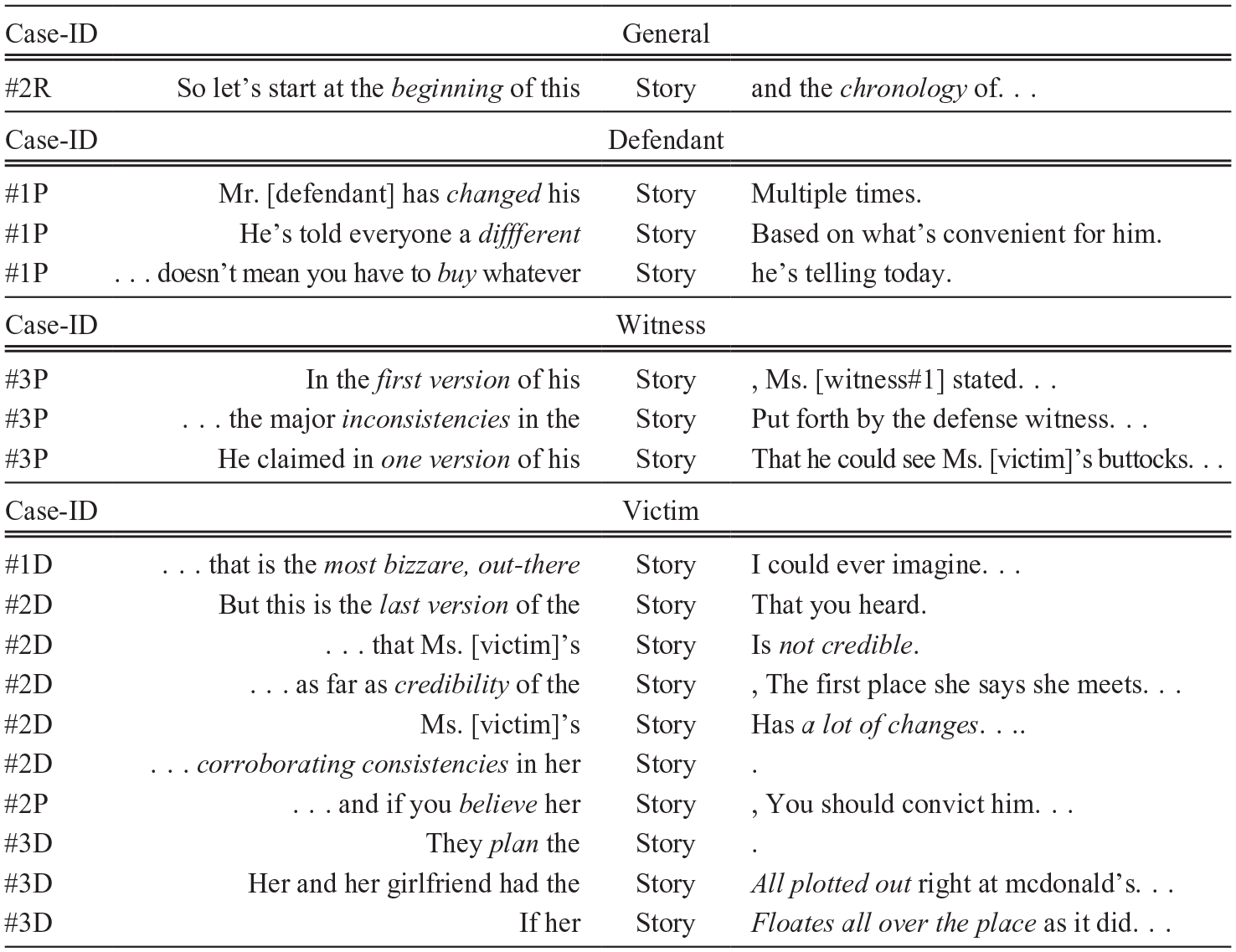
Exemplary concordances of ‘story’.
In the co-text surrounding this euphemism lawyers on both sides collocate ‘story’ with terms such as version, changed, credible, believe or buy (see italic words in Figure 3). These collocates frame the rape account as one story among many, where it is up to the jury to decide which version they believe to be the most credible. Thus, it inherently characterises the rape account as potentially fabricated. The euphemism ‘story’ is also used by the prosecution lawyers, mostly to refer to the victim’s account of the rape as her story or when pointing out that the defendant or other witnesses have made inconsistent statements before court about what occurred.
‘Testimony’, on the other hand, is used by both sides when referencing statements made by any relevant party of the trial, mostly in connection with the victim. Here, the co-text of ‘testimony’ predominantly modifies the term with expressions questioning consistency (see italic words in Figure 4). Additionally, most realisations of this term are phrased in such a way as to not call the speaker’s entire testimony into question. Instead, at most, specific details are portrayed as inconsistent.
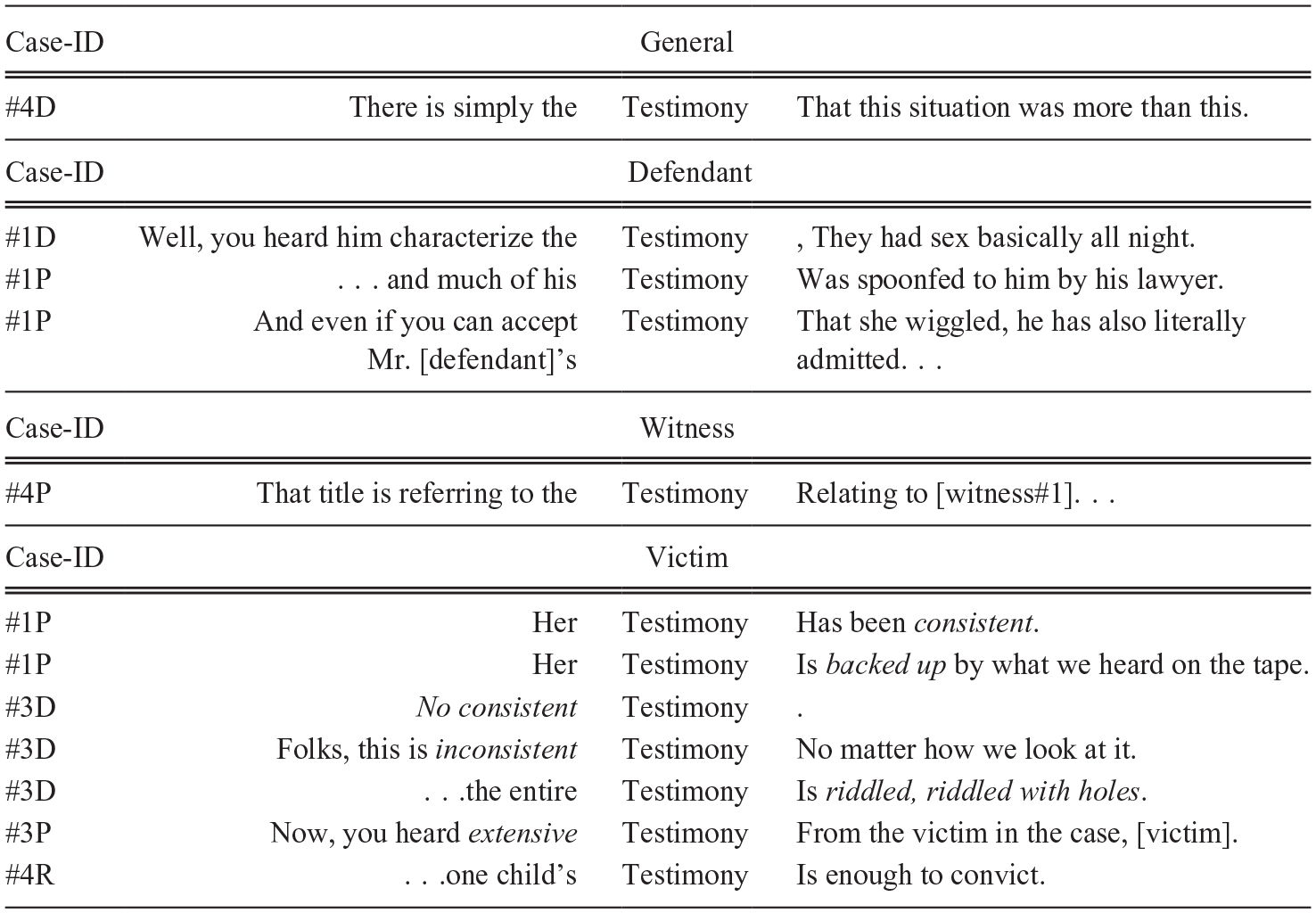
Exemplary concordances of ‘testimony’.
In sum, the collocates and the co-text of ‘story’ and ‘testimony’ characterise the two terms in a different manner. The former implies to the jury that the rape account is potentially not trustworthy and is thus frequently used by the defence when referring to statements made by the victim. The latter is associated with a courtroom setting and therefore lends a person’s account of the rape greater credibility. While the data also include instances of the defence lawyer using this term in connection with a victim’s statements, the lawyers often modify it by pointing out that her testimony is inconsistent.
Euphemistic legal charges with a sexual connotation
This section will take a closer look at the official legal language for rape charges before court. It is important to acknowledge that lawyers have little flexibility in the legal terms that they use. However, considering our critical approach, it is nevertheless fruitful to question such official language around rape. In fact, it is precisely because this language is determined that it is reflective of a pervasive problem with how rape is represented in the legal system.
All variations of these legal charges in the four cases can be seen in Table 4. Similar to previous findings by Allan and Burridge (1991) on euphemistic legal jargon, these references were all coded as euphemistic and the majority (75%) as having a ‘sexual’ connotation, despite explicitness being favoured in courtrooms (Svongoro et al., 2012; Trinch, 2001). When deciding whether to convict the defendant, the jury should be deliberating on charges that accurately and unambiguously label the crime as rape.
Reference types of ‘legal charges’.
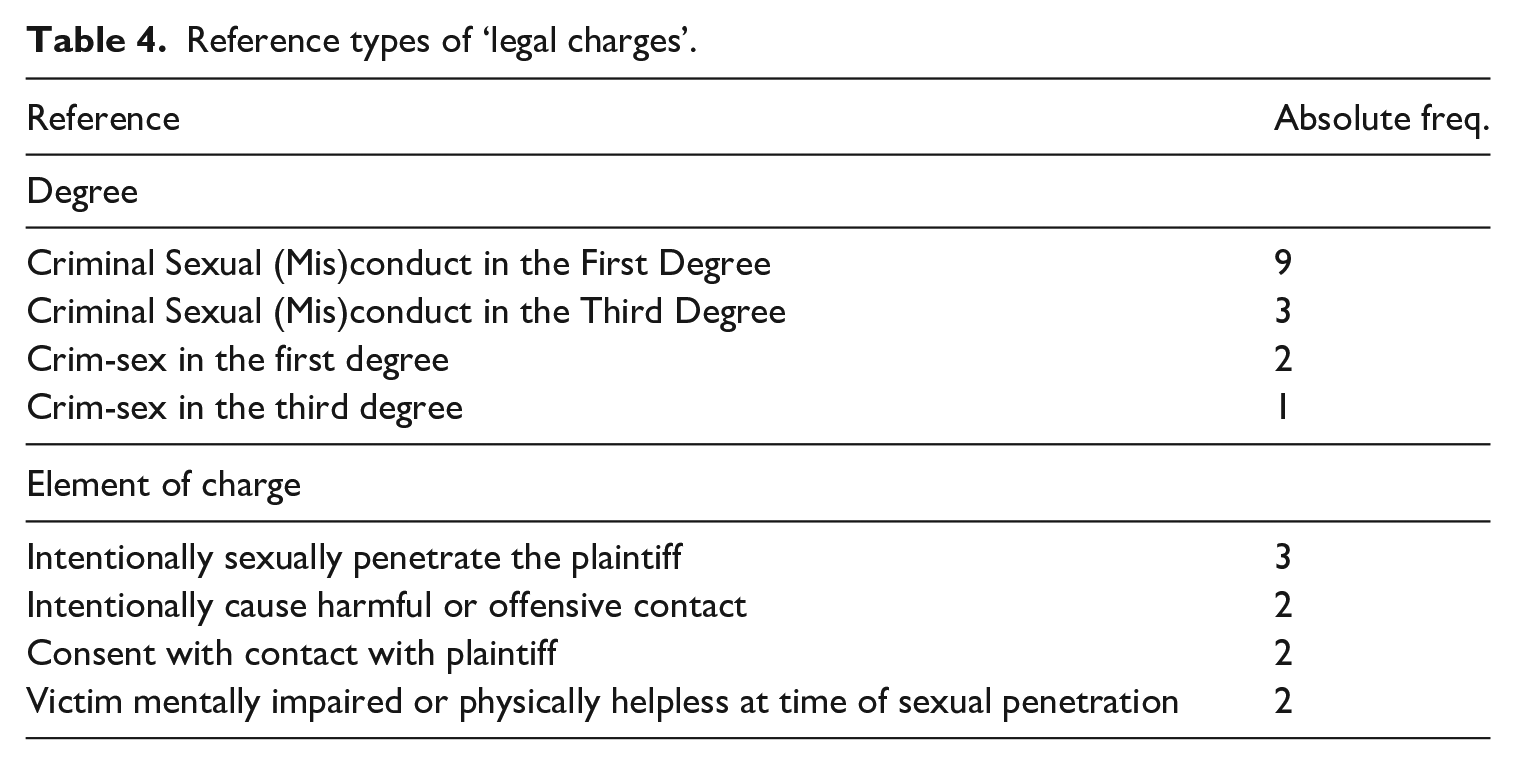
As can be seen in Table 4, the most frequent expression from the ‘legal charges’ category is Criminal Sexual (Mis)conduct in the First Degree (n = 9). By labelling rape charges as (mis)conduct, the severity of the offence is greatly minimised as the charge itself does not reflect the violent nature associated with rape, instead characterising it as misbehaviour.
Similarly, in two specific elements of the charge, the rape is referred to as contact, thus portraying it as a neutral interaction between two participants. It is only due to modifiers such as criminal or harmful that the interaction is even identified as illegal or immoral. The charges are phrased so vaguely that the exact nature of the crime is unclear unless the hearer is familiar with the legal jargon. Even more importantly, the other two elements and the official charges include the modifier sexual. This implies that the rape that has occurred had a sexual nature to it, although extensive scholarship exists to make clear that rape is a violent, non-sexual act.
Adopting the perspective of the victim
An important aspect when discussing the rape during closing arguments is which person’s perspective is highlighted. Bavelas and Coates (2001: 39) state that the prosecution especially should portray events from the victim’s perspective while not depicting her as an active participant ‘“performing” a sexual act’. In the fourth case analysed for the study, the prosecution adopts the victim’s language by referencing her testimony. However, since the victim is a minor, this creates some issues. Table 5 lists all excerpts in which the prosecutor mirrors the language of the child victim, using phrases such as dad does the ‘icky’ stuff to me and “badly massaging” her breast. It could be argued that using this childlike language functions to remind the jury of the victim’s innocence by emphasising that she is too young to even comprehend the rape she is being subjected to.
Excerpts of the lawyer adopting or reporting in the victim’s language (Case#4).
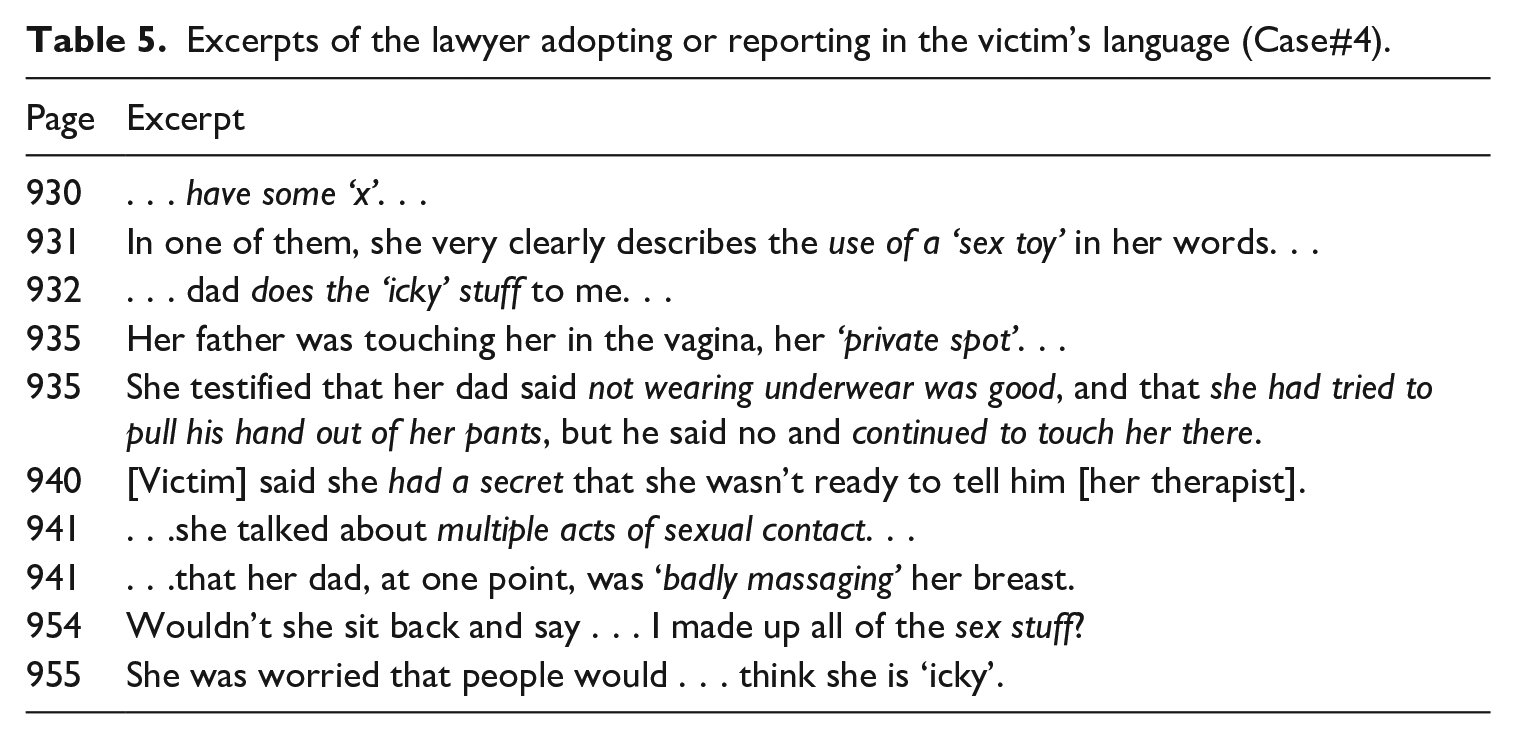
However, the prosecution lawyer fails to subsequently point out that the victim is clearly describing rape rather than sexual acts. Instead, the lawyer almost exclusively uses highly euphemistic references herself, as can be seen in Table 6 below. Contrary to Felton-Rosulek (2008), who found the prosecution in a child rape trial to use very explicit language, the closing argument and rebuttal of the prosecution lawyer in the fourth case contains close to no orthophemistic references to the child victim’s rape. This is especially problematic in a case where the victim’s age prevents her from characterising her own rape in a direct manner. Rather than relaying to the jury that the victim’s testimony describes multiple acts of rape, the lawyer in this case either portrays the rape in sexual terms or opts for highly vague references to the rape.
Excerpts of the lawyer’s euphemistic references to the victim’s rape (Case#4).
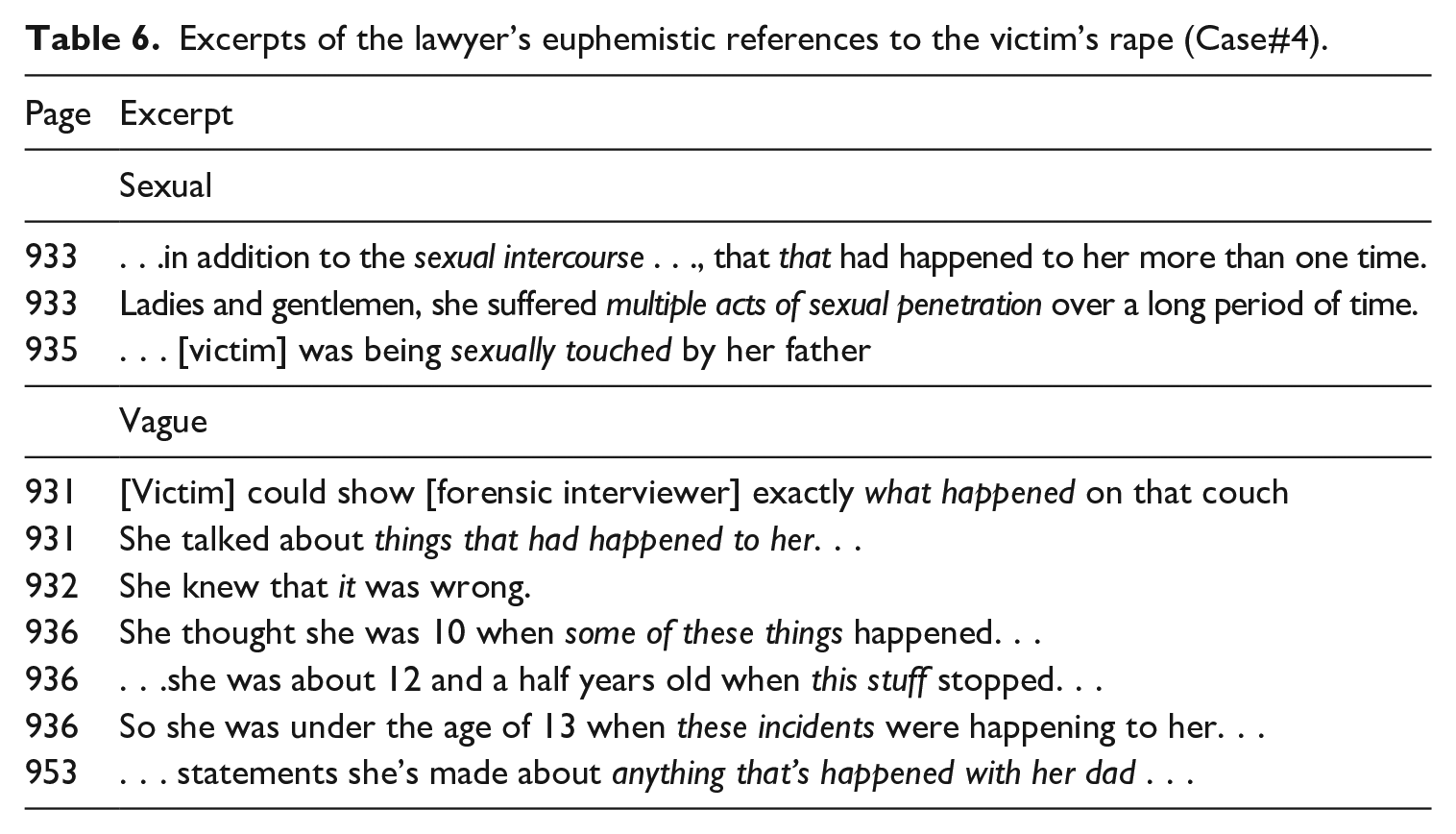
Trinch (2003: 241) found that legal workers sometimes accommodated their linguistic behaviour to mirror the more euphemistic language preferred by some of the rape victims they were interviewing. Similarly, one may argue that the lawyer in this case is aware of the child victim’s presence during the trial and adopts euphemistic language to avoid retraumatising the victim as well as portraying her in a more favourable light by lessening the stigma attached to victimhood. However, the lawyer does not seem generally opposed to including orthophemistic language into her closing argument; she just never uses such direct language when specifically talking about the rape perpetrated by the defendant on trial. This approach seems harmful to the lawyer’s communicative goal of convincing the jury that the defendant raped her client.
Conflating rape with sex
As was found in previous studies, lawyers often discuss rape in sexual terms. The present study corroborated this finding, as 26% of the overall references were classed as ‘euphemistic, sexual’ while only 9% were classed as ‘euphemistic, violent’. An additional, surprising finding is that these proportions not only apply to the defence’s language but also to that of the prosecution.
The data included phrases that Bavelas and Coates (2001: 34) refer to as ‘sexual-violent oxymorons’. These instances are listed in Table 7 and combine the lemma sexual with a physical description of what the victim was subjected to, counteracted by the immediate co-text, which describes circumstances that clearly negate a consensual, sexual interaction (see italic passages). It is worth pointing out that the inclusion of sexual to clear descriptions of rape mirrors the language used in two legal requirements of the rape charges (discussed above). While the prosecution must prove that the victim was penetrated to fulfil these legal requirements, this could be achieved without characterising the nature of the penetration as sexual. Bavelas and Coates (2001: 31) suggest that ‘the action is more accurately described as an assault or forced penetration’.
Exemplary excerpts containing the modifier ‘sexual’.
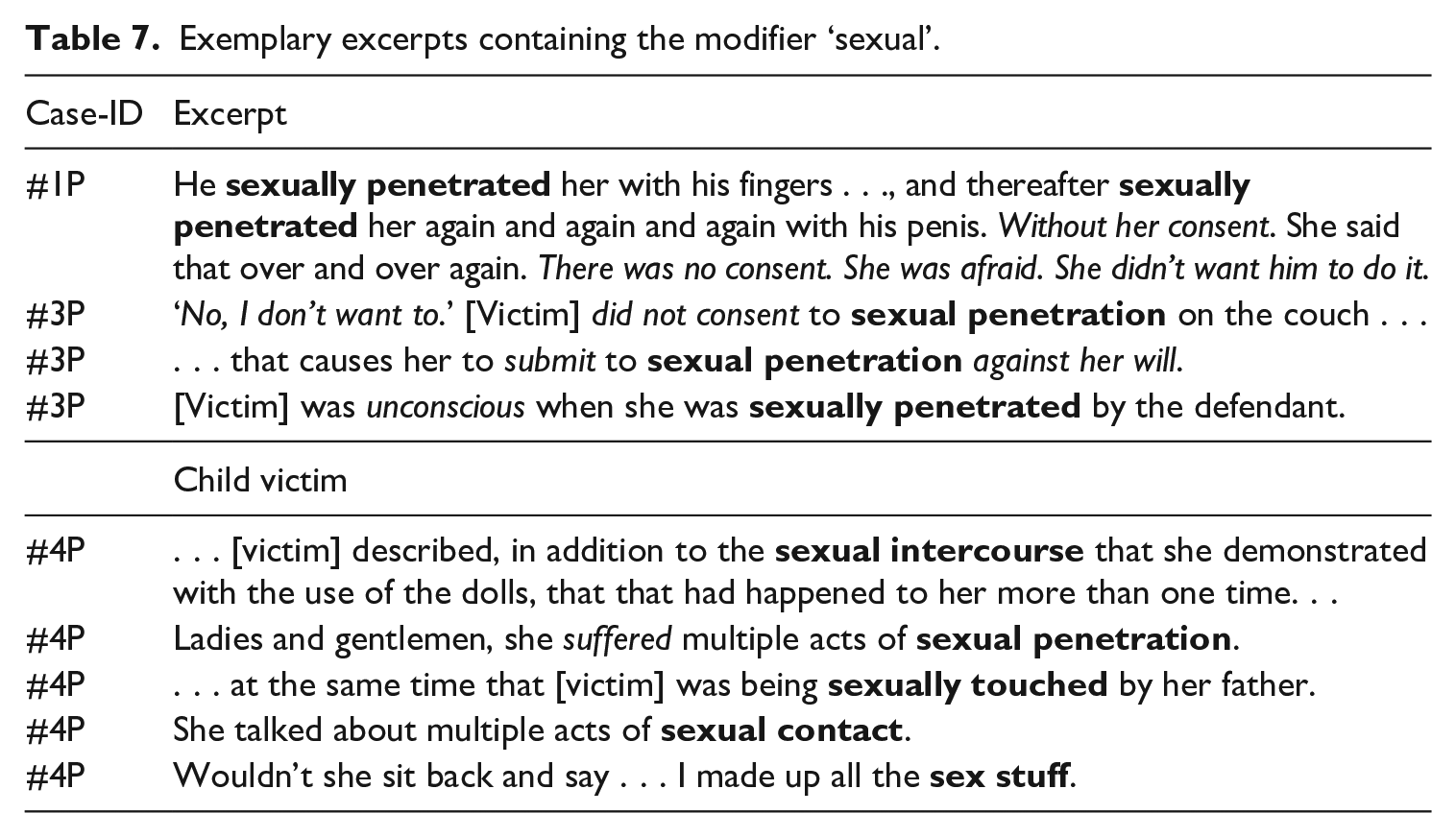
The preceding argument is particularly relevant to the excerpts listed under ‘child victim’ in Table 7, where the rape victim is a minor and thus inherently unable to consent to any form of sexual interaction. These observations are corroborated by Bavelas and Coates (2001: 38) who found that trial language surrounding child rape cases is ‘just as likely to be eroticized as assaults on adult women’. Overall, a distinction between rape and sex is more clearly articulated in cases of stranger rape (Case#2 and Case#3) than intimate partner rape (Case#1) or familial rape (Case#4), corroborating previous findings (Ehrlich, 2010).
Conclusion
The taxonomy outlined in the previous section is organised with rape references in a courtroom context in mind. However, it should also be applicable to rape references in other contexts such as media coverage or victim interviews. Furthermore, with some adaption, it could be used to examine euphemistic language around other ‘taboo’ concepts such as abortion or disability. The rules for distinction between orthophemistic and euphemistic references would still hold, and there may also be instances of dysphemistic references. The euphemistic references would have to be examined for connotation patterns and the taxonomy altered accordingly.
Concluding on the study’s findings, it should be acknowledged that euphemistic references are just one factor among many that need to be considered in relation to an appropriate and successful closing argument (Pritchard, 2014) and that some of the issues surrounding rape trials arise from their adversarial nature (Luchjenbroers and Aldridge, 2007). Nonetheless, forensic linguistic research can help to inform the use of sensitive language and thus improve the judicial process.
The need for varied language is acknowledged as it creates a more engaging narrative. In fact, the language in the present paper also inevitably varies in terms of how it references rape, although euphemisms were avoided as far as possible. However, since the courtroom context limits the interpretation of lexical choices, ambivalence or sexual connotations in the lawyer’s language will be perceived as intentional (Neal, 2015), even if their intention was to be mindful of lay participants’ potential aversions to explicit, ‘unsavoury’ language. Euphemistic discussions of rape not only shift the blame away from the defendant, they implicitly criticise the victim for ‘her perception of the events’ (Anderson and Doherty, 2008: 7).
Ponterotto (2007) argues that the judicial process in rape trials currently protects the perpetrator more than the victim. However, such institutionalised ideologies can be contested and improved (Fairclough, 1992) and the present article has hopefully contributed to that endeavour. It has been shown that lawyers have the institutional power to influence the discourse around rape and rape victims (Baker et al., 2008). The lexical choices they make are transcribed and thereby become ‘institutional memory’ (Trinch, 2001: 584). Pritchard (2014: 18) fittingly sums up the importance of language in rape trials by stating the following: ‘There is a reason that discussing sexual violence is uncomfortable – it is a gross violation of human rights. Let’s not use our language to make it seem more palatable’.
Footnotes
Appendix
Reference types sorted by their classification.
| Euphemistic, neutral | Euphemistic, sexual | Euphemistic, violent |
|---|---|---|
| Noun (phrase) | Noun (phrase) | Noun (phrase) |
| What | Sexual contact | Trauma |
| Testimony | Sex | Illegal behavior |
| (Any/every/some)thing | (sexual) penetration | Violent things |
| Interpretation | Sexual relations | The ultimate violation |
| Story | (sexual) act / activity | Worst experience of her life |
| Conduct | Sex toy | Neglect |
| Event | Sexual intercourse | Verb (phrase) |
| Narrative | Sex stuff | to wrong |
| Act(tions) | Verb (phrase) | To harm |
| Version | To masturbate | To force |
| Claim | To take someone | To prey on |
| Allegation | To ride | To cause to submit |
| Detail | To have sex | To continue to overpower |
| Fact | To sleep with | Legal charge |
| Incident | To (sexually) penetrate | Offense |
| Ordeal | To be excited | Crime |
| Account | To participate by touching himself | Intentionally cause harmful or offensive contact |
| Deal | To try to pull his hand out of her pants | Physical description |
| Consequences | Physical description | Pushed her (face) down on the couch |
| Scenario | You cuddled into me | Her underwear and onesie pulled to the side violently |
| Secret | He’d rub her a little bit | Forcing/shoving his penis into her vagina |
| Verb (phrase) | Thrust her body into him | Hurt to have his penis shoved into her vagina |
| To testify | Pushed your body back into mine | Orthophemistic, violent |
| To stop | He inserted/put his penis into her vagina | |
| To continue | Ejaculated inside / on [victim] | Noun (phrase) |
| To wiggle | Did anything come out of his penis | Rape |
| To say | She was sticky | Sexual assault |
| To fabricate | Put his tongue down there | Sexual attack |
| To help oneself | Licked her in the vaginal area | Sexual abuse |
| To take something | Took this sex toy and put it inside of her | Verb (phrase) |
| To be involved | Touching her in the vagina | To rape |
| To disclose | “badly massaging” her breast | To (sexually) assault |
| Pronoun | Placed his penis on her face / butt | |
| It | Had her do that [masturbate] with him as well | |
| Them | He was in her | |
| This | He fell out of her | |
| That | Took off his pants and then removed hers | |
| Legal charge | Legal charge | |
| Count | Criminal sexual (mis)conduct in the first / third degree | |
| Charge | Crim-sex in the first / third degree | |
| To aid and abett | Intentionally sexually penetrate the plaintiff | |
| Consent with contact | Victim mentally impaired or physically helpless at time of sexual penetration |
Acknowledgements
Not applicable
Data availability statement

Declaration of conflicting interests
The author(s) declared no potential conflicts of interest with respect to the research, authorship, and/or publication of this article.
Funding
The author(s) received no financial support for the research, authorship, and/or publication of this article.
Ethical approval
The Ethics Committee of Aston University, Birmingham, UK waived the need for ethics approval and patient consent for the collection, analysis and publication of the retrospectively obtained and anonymised data for this non-interventional study.
Consent to participate and for publication
Not applicable.
Author biographies