




Abstract
Together, with the rise in populist politics and growing polarisation, immigration detention is a salient topic mobilised during elections to generate political support and votes in Aotearoa New Zealand (NZ), Australia and the United Kingdom (UK). The language used about immigration detention, refugees and asylum seekers has impacts on policy and on lives, including exclusion, criminalisation, detainment, detention and expulsion. Existing scholarship lacks research on the role election periods play in facilitating the transfer of immigration detention discourses and policy across the case countries. We ask: is there evidence that immigration detention discourses transferred between NZ, Australia and the UK during recent elections (2013–2024)? And if so, in what possible ways are these discourses reflected in subsequent policy decision-making? With focus on the examples of ‘stop the boats’ and ‘mass arrivals’ discourses, we argue there is evidence that Australia’s immigration detention rhetoric has developed roots in NZ and UK discourses and policy, echoing similar narratives of deservingness and legality, security and humanitarianism.
Keywords
Introduction
The year 2024 is anticipated to have the largest number of forcibly displaced people on record, exceeding 120 million, some of whom are imprisoned while seeking safe countries (UNHCR, 2024). Together, with the rise in populist politics and growing polarisation, immigration detention 1 is a salient topic mobilised during elections to shore up political support and votes in Aotearoa New Zealand (NZ), Australia and the United Kingdom (UK) (Capdevila and Callaghan, 2007; Lippi et al., 2017; McDonald, 2011). While supporters position immigration detention as a tool to ensure state objectives of security, safety and fairness, opponents criticise it for failing human rights and dignity (Griffiths, 2015; Lindey, 2019). 2 In the tense environment of elections, the language used to garner political support reveals assumptions and values of political actors and stakeholders. Language has power, it can be used to humanise or dehumanise people, to mobilise votes and to frame policy (Lassen, 2017; Leruth and Taylor-Gooby, 2019). The language used about immigration detention, refugees and asylum seekers has impacts on policy and on lives, including exclusion, criminalisation, detainment, detention and expulsion (Banks, 2008; Koerner, 2010; Lawston and Escobar, 2010; Maneri, 2011).
To explore policy and discourse transfer relating to immigration detention across NZ, UK and Australia, we analyse political and public discourse using a combination of corpus assisted and critical discourse analysis. We ask: (Q1) have immigration detention discourses transferred between NZ, Australia and the UK during recent elections (2013–2024)? (Q2) If so, in what ways are these discourses reflected in subsequent policy decision-making? We seek to delineate the origin of these narratives (who evoked them and how did they evolve), transfer (movement of narratives to the other jurisdictions), and reflection in public policy. Our analysis suggests examples of policy and discourse transfer across elections, involving bipartisan support, with focus on the transfer of Australia’s 2013 ‘stop the boats’ policy and language to the UK, and the ‘mass arrivals’ amendment bill put forward by the NZ Labour government in 2023 to detain maritime arrivals without a warrant for 28-days. In the NZ case, a vessel of this kind has never reached the country’s shores (Graham-McLay, 2023; Turnbull, 2023). We argue that Australia’s immigration detention rhetoric has developed roots in NZ and UK discourses and policy, echoing similar narratives of deservingness and legality, security and humanitarianism.
Method and data
We use corpus-assisted discourse analysis (CADS), a ‘big data’ method that involves analysing statistical patterns in text (Ancarno, 2020; Mautner, 2005). Hidden patterns unseen to the naked eye can reveal knowledge about how language is being used. We combine this with a close qualitative reading, allowing us to combine a top-down and bottom-up approach to textual analysis. While CADS allows picking up patterns in text, also practicing a deep qualitative reading using critical discourse analysis (CDA) allows the appreciation of the context that words appear in and relationships of power.
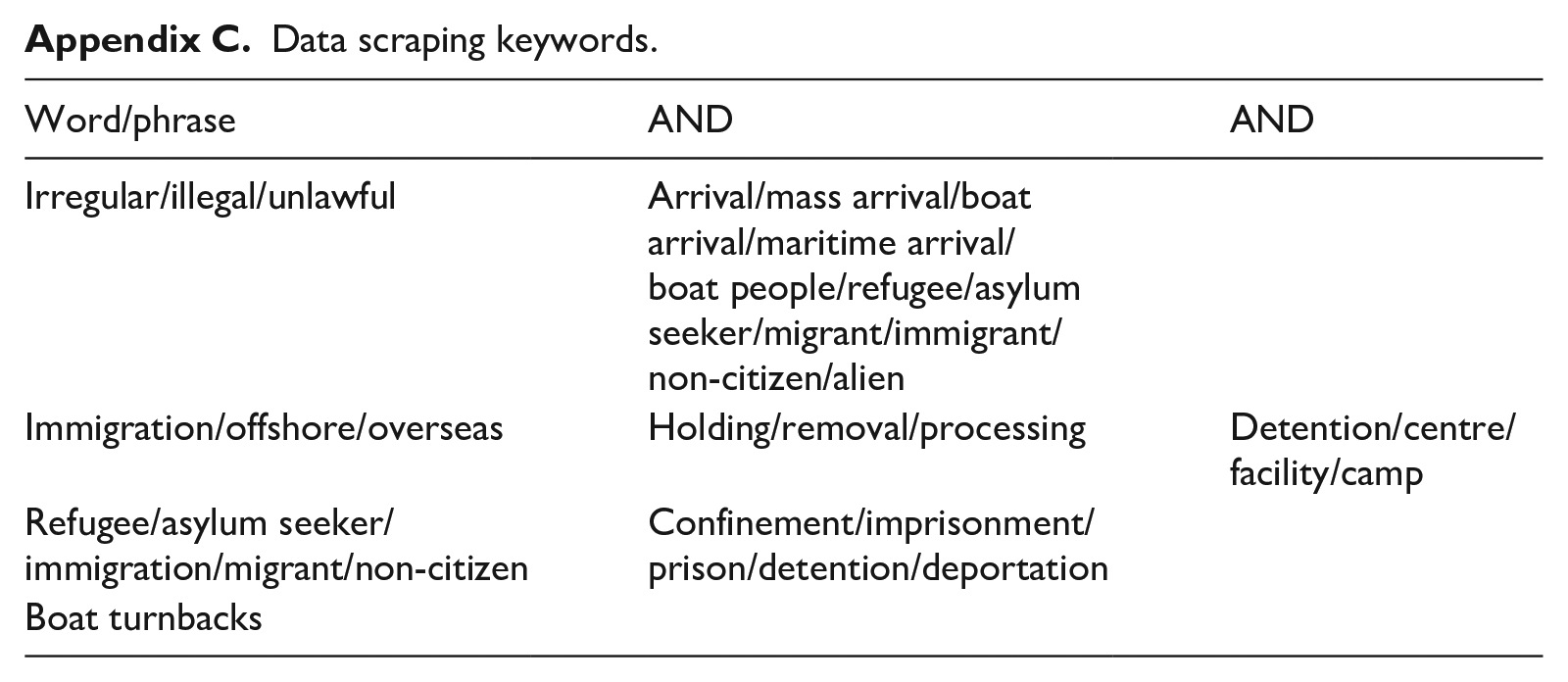
First, we built three corpora (bodies) of immigration detention discourse, one for each case country. Each corpus contains sources from news media (Appendix A) and Hansard of each country, from a month on either side of each election which occurred 2013–2024 (Appendix B). We additionally collected reports, speeches and news releases published by immigration ministries, the 15 largest political parties (by seats), and the nine largest immigration detention related nonprofits (by budget) across the case countries, but excluded this from the corpora because of the relatively small size of these data. These documents were used during qualitative analysis to gain additional insights. Keywords used for scraping content were selected as those related to policies (e.g. detention) and to the people targeted by policies (e.g. detainee) (Appendix C). The keywords were intended to narrow down findings to discourse happening in relation to policy specifically.
To analyse the corpora we use normalised frequencies, collocations and concordances. Frequency can be ‘‘an indicator of markedness’’ (Baker, 2010: 125), and normalised frequencies have been calculated using a base of 1,000,000. Collocations identify the company a word keeps through providing a statistical measure of the words most frequently and/or most uniquely appearing within a particular span of words either side of the target word (Baker, 2010: 127–132). Collocates have been calculated using a mutual information score for effect size and log-likelihood with a threshold of p < 0.01 for likelihood. Following the conventions of corpus linguistics we have used a collocation span of five words to the left and five words to the right (Baker et al., 2008: 278), and a minimum frequency and range of 5 to avoid over-focusing on collocates which may have been over-represented in a small handful of texts within the corpora (Egbert and Schnur, 2018: 168–169). All our analysis applies the NLTK stopword list which allows for more context-specific collocates (Bird et al., 2009), and uses AntConc (Anthony, 2023). Concordances examine a target word in context, showing the target word within a certain number of words to the left or right (Baker, 2010: 132–133).
During our qualitative reading, we use CDA (Baker et al., 2008) to examine the way power relationships are enacted in written text. For some scholars like Gillings et al. (2023), CDA is an aim within the framework of CADS, while for others CADS is ‘‘not confined by topic or the stance or school of the researchers, whether it be ontological and descriptivist, or normative and political’’ (Partington, 2023: 55). We combine CDA and CADS in the vein of Baker et al. (2008), who view these approaches as contributing ‘‘equally and distinctly to a methodological synergy’’ (p. 274) and that each can serve as an entry point of analysis. For this study, we began with CADS techniques that provided a ‘map’ of the corpus, pinpointing areas of interest for a subsequent close CDA analysis.
Further, we draw on the concept of policy learning, to discuss how language and policy has moved across borders (Dolowitz and Marsh, 2000; Evans, 2004; Stone et al., 2020), and theories of penal nationalism and border industrial complex (Barker, 2017; Boochani, 2018). Policy transfer falls under the umbrella of policy learning and is defined as ‘‘a process in which knowledge about policies, administrative arrangements, institutions, etc. in one time and/or place is used in the development of policies, administrative arrangements and institutions in another time and/or place’’ (Dolowitz and Marsh, 1996: 344). Discourse has power, and we are interested in how language used about immigration detention in one country can have impacts on humanitarian and securitisation promises in other countries.
Literature
Available comparative literature on immigration detention examines policy-making objectives and discourse found in the case countries, but often not the specific country grouping of focus in this paper nor with connection to resulting policy. Akbari and MacDonald (2018) present an overview of immigration policy changes and context in Australia, Canada, NZ and the United States (US). Economic and humanitarian considerations are key themes across the literature, and the authors note less emphasis on humanitarian concerns, and a tightening of refugee admission systems. Little and Vaughn-Williams (2017) speak to the pairing of securitisation and humanitarianism in border control and migration management in Europe and Australia. They discuss the co-optation of humanitarianism discourse by securitising actors, and how this delimits political and ethical possibilities and has concrete effects on the lives of migrants. The authors focus on two case studies of how discourse is reflected in policies—responses to the 2015 European migrant crisis, and the Australian Human Rights Commission 2014 report The Forgotten Children.
A collection of literature speaks to policy transfer and diffusion, but lacks detail on the specific examples of this article, namely control of ‘mass arrivals’ by Australia, NZ and the UK. Mainwaring and Cook (2019) look at the commonalities of four liberal democratic countries with the largest immigration detention systems—Australia, Canada, the UK and the US. A key theme in this literature is on coercive and non-coercive transfer, namely what motivations underlie the spread of policy. The authors identify that policy diffusion fuels the expansion of immigration detention, rather than coercive policy transfers, and identify the need for future research to understand how the adoption of detention policies takes place across similarly strong states. Ghezelbash (2014) examines the motivations which drive the transfer of immigration policies, namely efficiency, prestige, coercion, as well as cooperative and competitive interdependence between governments. Nethery and Silverman (2015) identify that discourse has played an important role in justifying the adoption of policies to secure borders, including against terrorism. They also note that wealthier states provide political and financial incentives to neighbouring countries to adopt certain policies. The literature speaks to which countries are precipitating the spread of policy, with both Australia and the US placed at the centre. Nethery and Gordyn (2014) examine incentivised policy transfer between Australia and Indonesia, whereby Australia has provided financial and diplomatic incentives for Indonesia to adopt certain policies including detention (also see Nethery et al., 2013). Flynn (2018) speaks to key events which led to the diffusion of immigration detention over the last 30-years, focusing on the US.
During elections, the literature largely focuses on discourse within individual countries, rather than transfer between states. Leruth and Taylor-Gooby (2019) note the 2015 UK General Election was dominated by the issue of immigration, and look at whether recent party pledges are used by citizens in large group policy discussion. At that time, an unprecedented number of migrants were arriving in Europe, primarily from the Middle East. This European migrant crisis was also mobilised during campaigning ahead of the 2016 Brexit vote to leave the EU. The authors found that participants’ individual political preferences do not seem to match their own positions on immigration and that there is little difference between left-leaning and right-leaning election voters. Regarding Australia, McDonald (2011) focuses on the shift in the lead-up to the 2010 Australian federal election, examining border security framing as both a generalised threat to border security, and a risk of terrorism and integration. In 2010, a boat carrying migrants sank off the coast of Christmas Island, and in 2013, Australia experienced a peak of migrants arriving by boat, both events receiving media and political attention. Lippi et al. (2017) look at news media representations of refugees and asylum seekers during the 2013 election, identifying two key themes: arrivals as a threat requiring military intervention, or as victims requiring management.
Findings
Prevalence of RASIM terms
To analyse the transfer of immigration detention discourse, we begin with terms relating to ‘refugees’, ‘asylum seekers’, ‘immigrants’ and ‘migrants’ (Baker has termed this ‘RASIM’). How these terms are used often reflects political choices and narrative devices, determining for instance whether these issues are seen through a humanitarian or border security framing. Table 1 below lists the normalised frequencies of RASIM terms. Normalised frequency is a measure of how prominent each term is within its own corpus as a proportion of all words or phrases used (Table 2).
Size of corpora (tokens).

Normalised frequencies of RASIM terms.
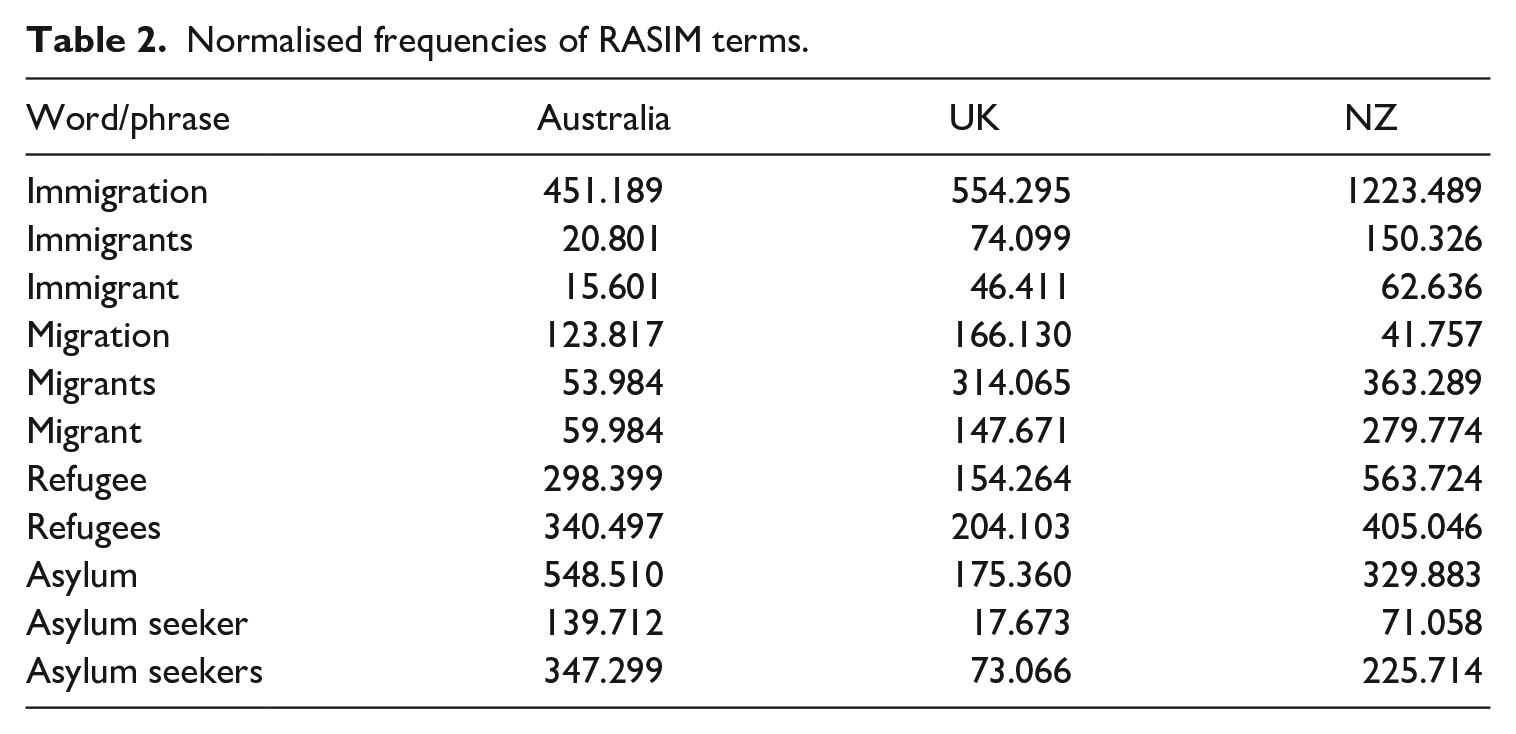
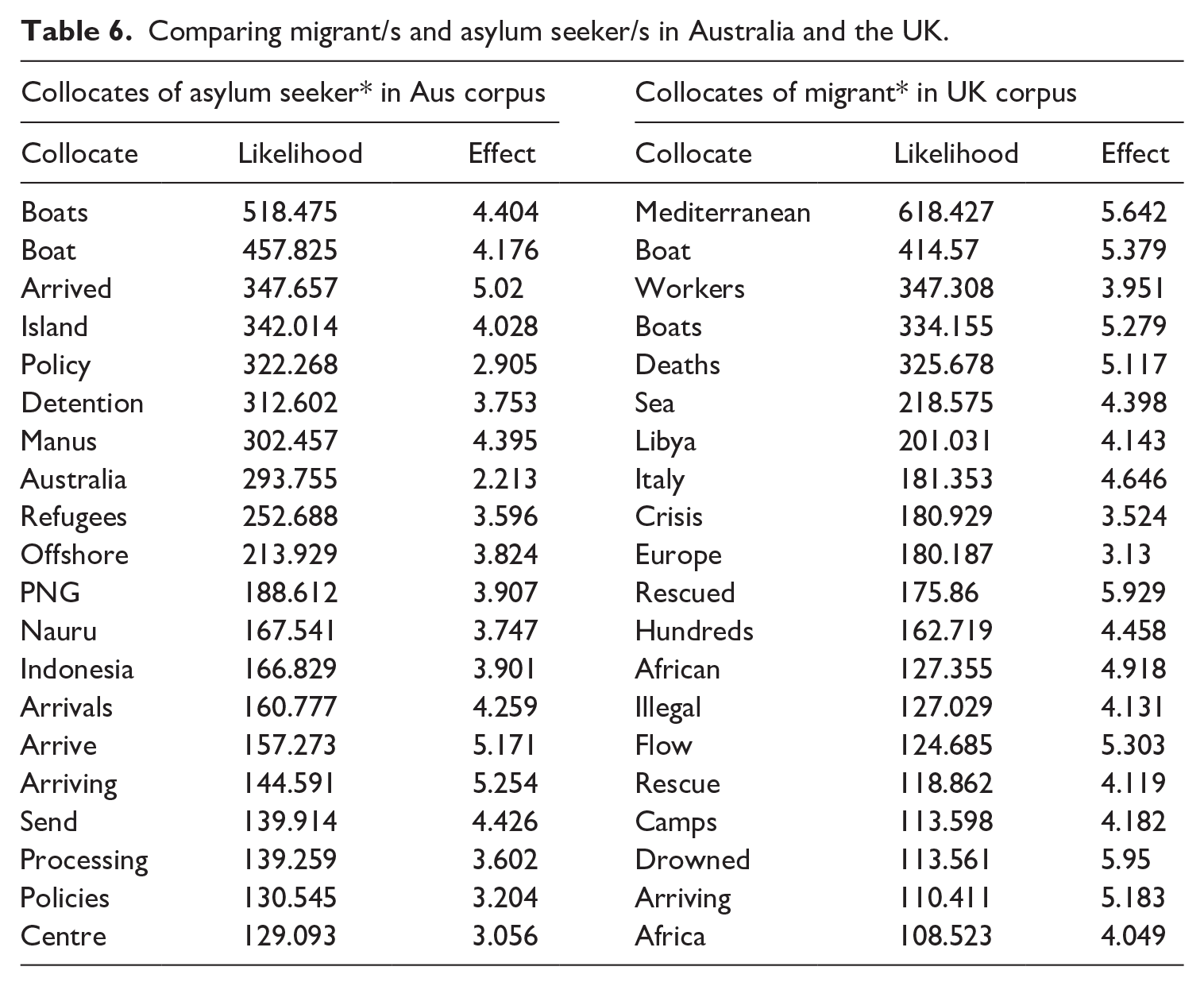
In Australia, the most frequent RASIM term is ‘asylum’. Comparatively, in both NZ and the UK it is ‘immigration’. This would seem to indicate asylum seekers draw more focus in the Australian context. Upon looking at collocates of ‘migrants’ in the UK, it is clear that the UK tends to use the term ‘migrants’ rather than ‘asylum seekers’. The top collocates of ‘migrants’ are ‘mediterranean’, ‘sea’, ‘boat’, and ‘rescued’. Reading a sample of these collocates in context confirms that the UK uses ‘migrants’ in place of ‘asylum seekers’. One article, for example, “describes the misery and despair that drives so many migrants to risk their lives fleeing to Europe” (Sandeed, 2015: n.p.).
In NZ the same is not true, despite a similar prevalence of ‘migrants’ to the UK. Rather, ‘migrants and asylum seekers’ are discussed together within the same context in reporting on the US, while the phrase ‘migrants and refugees’ is used in reporting on Europe. This may reflect syndication practices. The term ‘refugee’ is most frequent in the NZ context. Using concordances shows a significant outward focus in NZ discourse. Within a random sample of 100 mentions of refugee/s (out of a total 232 mentions), less than half were about NZ (39%). Twenty-seven percent of mentions were about Australia (including Nauru and Manus Island), and 26% about other countries such as the US, Myanmar and Syria. Subjects under discussion when ‘refugee/s’ relate to NZ included: refugee resettlement in NZ, rainbow refugee policies, and reporting on a report advocating for the need for an ‘emergency resettlement plan’ for Afghan refugees. This analysis indicates a trend often prevalent in the NZ corpus: the focus in media reporting and legislative discussions relating to asylum seekers and refugees draws on matters external to the country.
Prevalence of policy terms
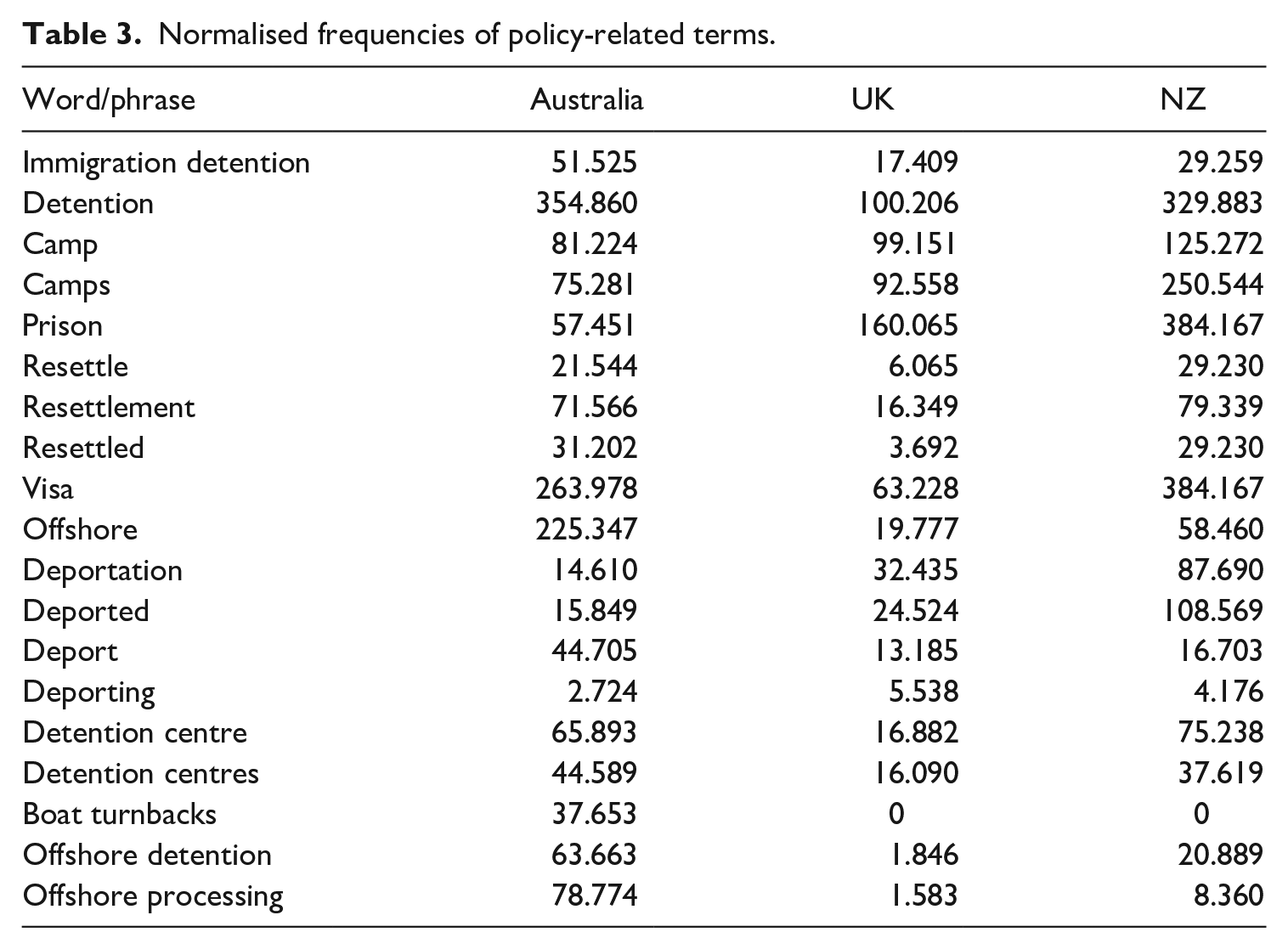
It is illustrative to explore the policy-related words appearing in each corpora. By policy-related words, we mean those related to government decision-making targeted to RASIM such as ‘detention’, ‘resettlement’ and ‘deportation’.
Australia’s most frequent policy-related word is ‘detention’. Comparatively, for the UK it is ‘prison’, and for NZ it is equally ‘prison’ and ‘visa’. The use of ‘detention centre’ is connected to Australia 70% of the time. The dominance of ‘detention’ in the Australian corpus is often related specifically to offshore detention, with ‘offshore detention’ being the most frequent 2-gram (two-word phrase ending in detention). In the UK ‘offshore detention’ is far less frequent, with a normalised frequency of 1.846 compared to 63.663 in Australia and 20.899 in NZ.
The size of the NZ corpus indicates that these are not necessarily being discussed in relation to NZ policy or as policy ideas. Concordances show the terms appear in reporting on Australia and the US. Less than half (43%) mentions of ‘resettlement’, for instance, relate to resettlement policies within NZ, with most referring again to Australia and the US. Only 15% of the mentions of ‘refugee camps’ relate to a discussion of NZ policy or NZ’s role in refugee resettlement. ‘Detention centre/s’ does not once refer to NZ, with 70% of mentions relating to Australia. Comparatively, 66% of mentions of ‘deportation’ relate to cases of NZ deporting or attempting to deport individuals. Sixty-four percent of mentions of ‘prison’ relate to NZ, however only 37% of those mentions relate to immigration in some way. Meanwhile, 88% of mentions of ‘visa’ do relate in some way to NZ. In general terms, it appears that when discourse relates to NZ the subjects under discussion tend to relate more to restrictive/control policies, while discussion about humanitarian issues or refugee resettlement tends to occur in the context of places outside NZ.
Prevalence of narratives identified in the literature
The existing literature has identified a number of prominent narratives across the three case countries relating to immigration, refugees and asylum seekers. Given their salience, this section will explore how they appear in these corpora, focusing on two key themes: genuineness and borders/security.
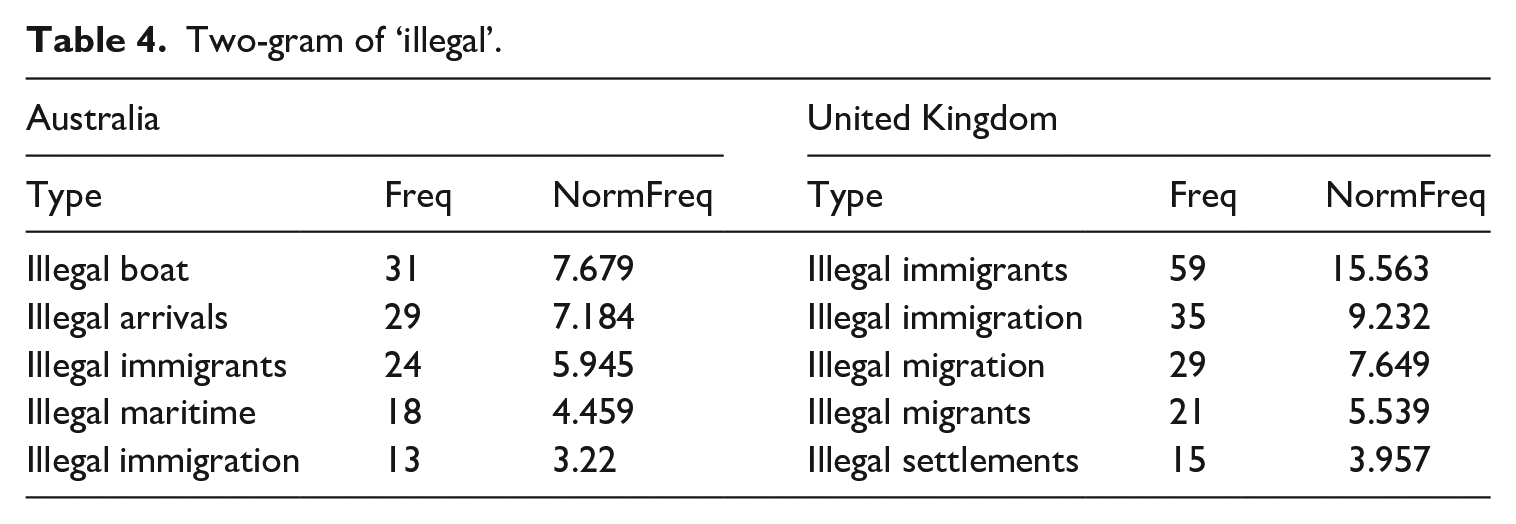
From the literature, we know that one of the common assertions of a lack of genuineness relates to illegality. In looking at what words come before ‘migrants’ in the UK, ‘illegal migrants’ is the third most frequent 2-grams after ‘EU migrants’ and ‘many migrants’. Table 3 below shows the five most frequent 2-grams which appear in the UK and Australia beginning with the word ‘illegal’. NZ is excluded due to the small size of the corpora (Tables 4–7).
Normalised frequencies of policy-related terms.
Two-gram of ‘illegal’.
Normalised frequency of ‘border/s’.

Comparing migrant/s and asylum seeker/s in Australia and the UK.
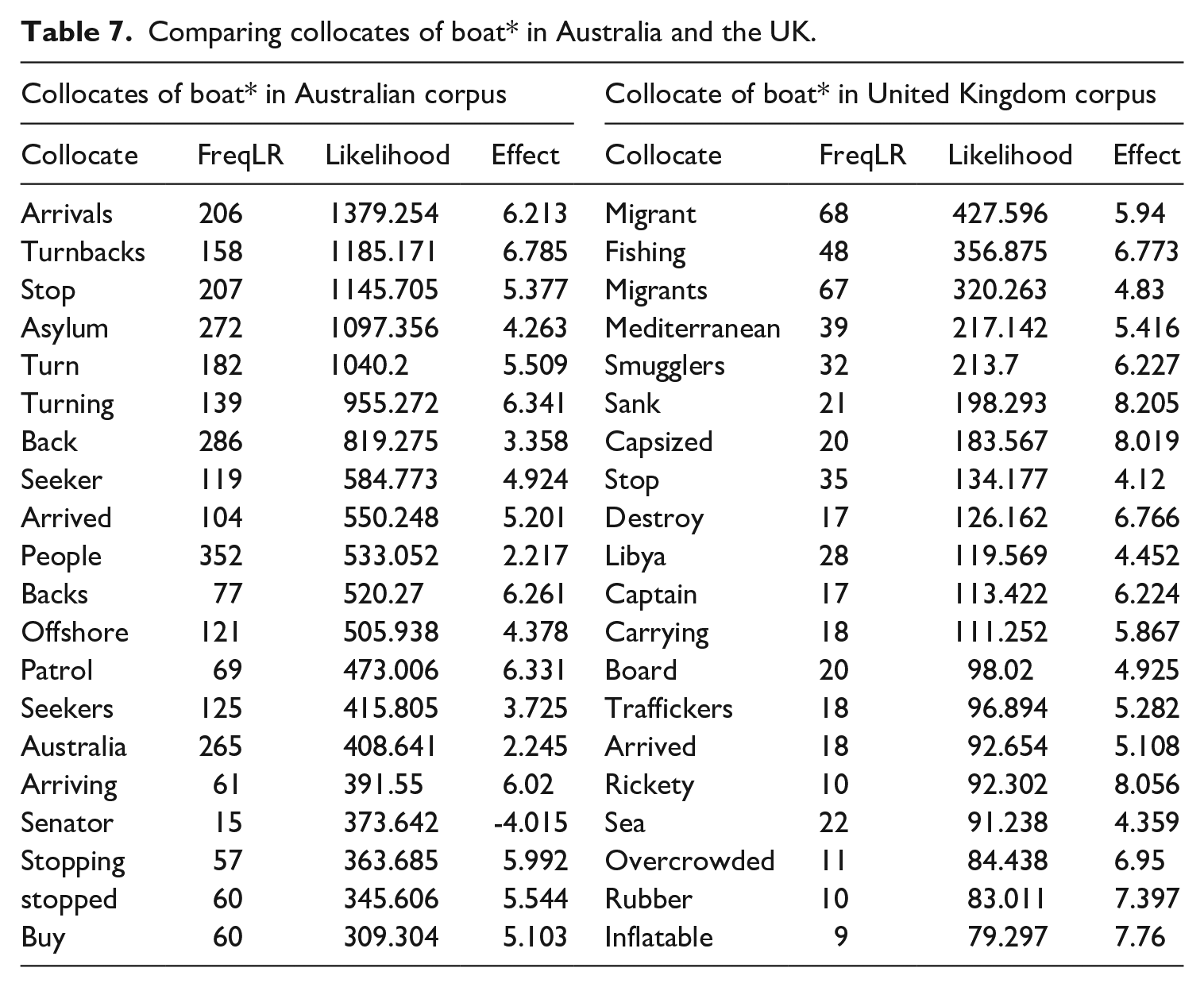
Comparing collocates of boat* in Australia and the UK.
In Australia, the language of ‘illegal’ gets applied in particular to those who arrive by boat. The other key known mechanism to downplay the genuineness of refugees is to refer to them as ‘economic migrants’. This narrative does not appear as frequently as that of illegality in any of the three corpora. It is strongest in the UK, with the phrase ‘economic migrants’ appearing with a normalised frequency of 4.784, compared to 2.477 in Australia and no mentions in NZ.
The flipside of the genuineness coin is the very idea of a ‘genuine refugee’. Looking at what words appear after ‘genuine’ in the corpora, the most frequent 2-gram in Australia is ‘genuine refugees’. As with the phrase ‘illegal asylum seekers’, this is considered a ‘nonsensical term’ since a person is either a refugee or not a refugee (Gabrielatos and Baker, 2008). Further, as found by Phillips (2015), the fear that asylum seekers arriving by boat are not refugees is not backed by evidence.
The idea and materiality of the state border also plays a key role in RASIM discourse. Both ‘border’ and ‘borders’ are most prominent in the Australian corpus.
In the Australian context, the top collocate of ‘border*’ is ‘protection’. Sixteen percent of these collocations relate simply to department names, but even with these removed it remains the most frequent collocate. Comparatively in the UK the top collocate of ‘border*’ is ‘control’. Fifty-five percent of those collocates when exploring further using concordances relate in some way to the idea of taking back control of the UK’s borders from the EU through Brexit. Twenty-two percent specifically use the phrase ‘take back control’. Below is an illustrative sample of the ‘take back control’ concordances. The NZ corpus is once again small and distinct, with the top two collocates of ‘across’ and ‘Bangladesh’ relating to reporting on Rohingya.
which is therefore inconsistent with our desire to ago, the voters decided that they wanted to voted to leave in 2016 they were voting to that one of her red lines is to first time in 40-years. She said: “We’ll
Transfer of discourse from Australia to the UK
Throughout this analysis there have been more similarities between Australia and the UK when compared to NZ. We posit that policy changes in the UK have been inspired by Australian policies, including the use of the phrase ‘stop the boats’. Remembering that ‘migrant/s’ is used in the UK comparably to ‘asylum seeker/s’ in Australia, it is helpful to compare the collocates of these terms in tandem. Doing so reveals the prevalence of ‘boats’.
Given this clear dominance, exploring ‘boat/s’ further using collocates is useful, particularly given that there is similar policy in Australia and the UK to ‘stop the boats’ and pursue offshore detention.
The dominance of the phrase ‘stop the boats’ is evident in the Australian corpus. Seventy-seven percent of collocates of ‘stop’ and ‘boat*’ are specifically the phrase ‘stop the boats’. Also dominant is the focus on ‘turnbacks’, ‘turn’ and ‘turning’. The relation of ‘turn’ to ‘turn back the boats’ is confirmed through concordances—98% of collocations relate to ‘turn back the boats’, ‘boat turn backs’ or similar phrases such as ‘turn back asylum-seeker boats’. Similarly for ‘turning’, 99% relate to ‘turning back boats’ or similar phrases. An illustrative sample of the Australian concordances including the phrase ‘stop the boats’ is shown below.
regional cooperation is an essential part of our plan to to scrap the carbon tax, to end the waste, to As the Coalition has always said, our commitment is to unpopular but right. Scott Morrison has nominated his work to you do have them. You know the only way to
Comparatively, the UK has more words relating to the boats themselves, including ‘fishing’, ‘sank’ and ‘capsized’. What is most notable in the case of the UK is that 67% of appearances of ‘stop’ as a collocate of ‘boat*’ in the UK corpus relate to Australia, indicating the prominence of Australia in UK discourse. An illustrative sample of the UK concordances including the phrase ‘stop the boats’ is shown below.
Europe has been urged to copy Australia’s military-led Could Australia’s ‘ lauded its hardline asylum policy as the only way to ‘ reaction. In Australia, Tony Abbott, the prime minister, promised to “ sea, he told reporters this week, “is in fact, to
We can also see the role Australia plays in UK discourse through the prevalence of ‘Australia’ in UK media. Breaking the UK news media corpus down into the three different periods (1-month before, during and after) of collection surrounding the elections we can see the increase of mentions of ‘Australia’ over time (Figures 1 and 2).
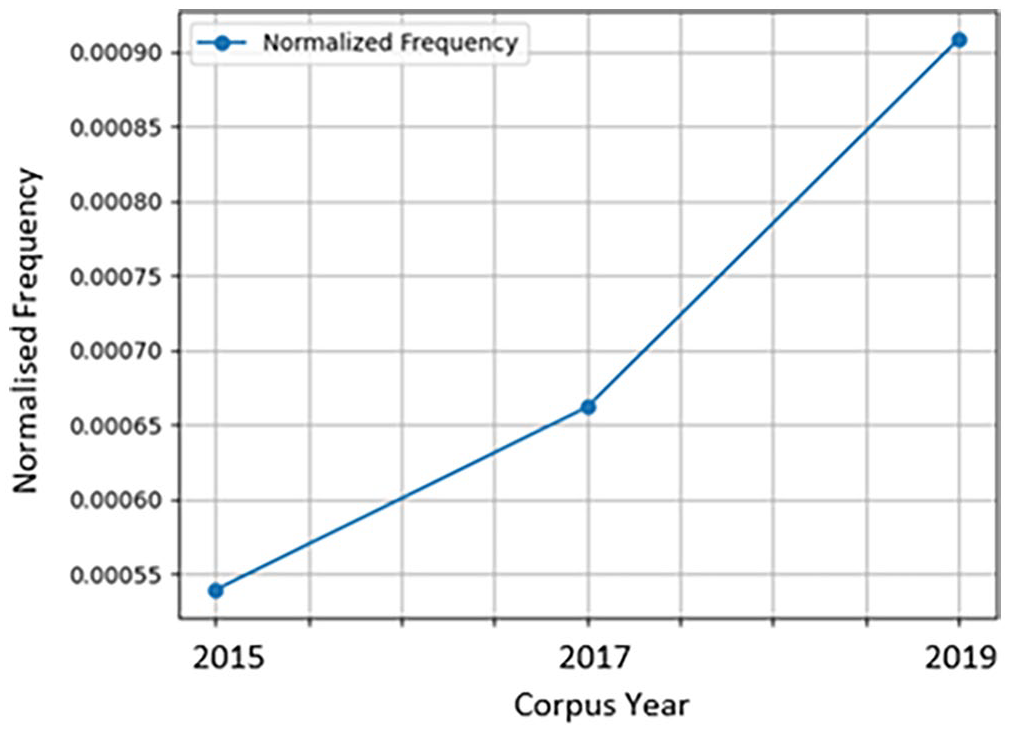
Normalised frequency of ‘Australia’ in the UK News media corpus during the 2015, 2017 and 2019 UK elections.
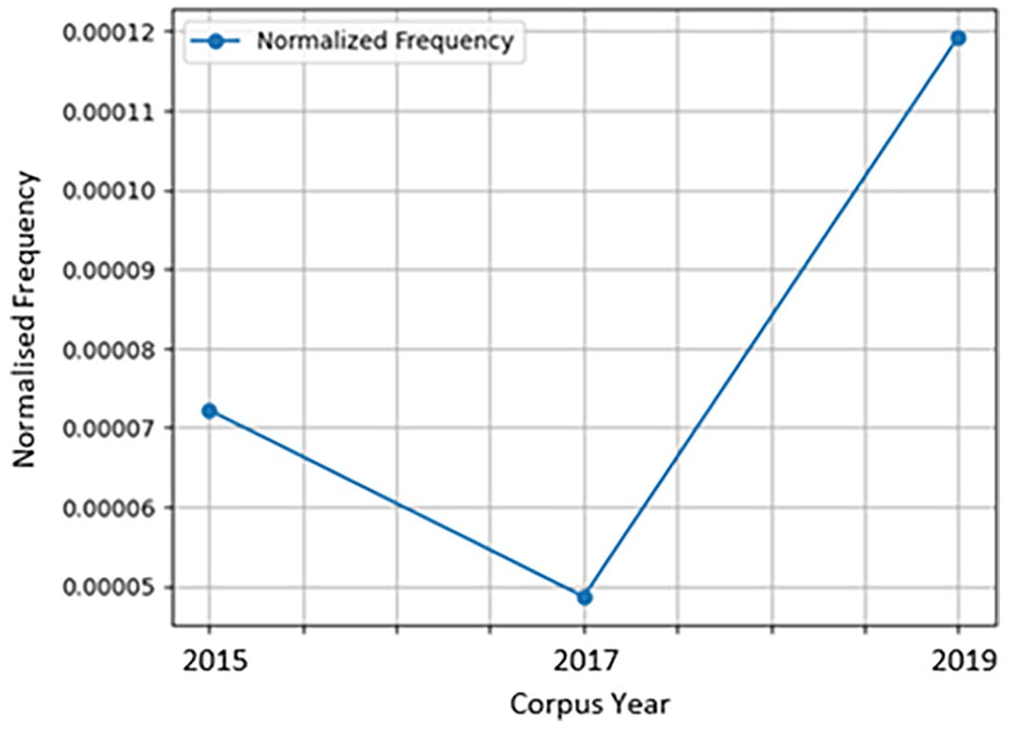
Normalised frequency of ‘offshore’ in the UK News media corpus during the 2019 UK election.
Similarly, particularly with the 2019 election, there is a notable increase in mentions of ‘offshore’.
Qualitative analysis: Reflection of discourse in policy
In this section we examine how transferred discourses are reflected in subsequent policy decision-making. We take policy decision-making broadly, as what governments do or neglect to do (Klein and Marmor, 2006).
Notable policy development in Australia includes mandatory detention (Migration Reform Act 1992) for people who enter the country without a visa, section 501 of the Australian Migration Act (1998) which introduces a ‘character test’ to allow deportation, 3 the use of indefinite migrant detention, and the 2013 Operation Sovereign Borders policy which entailed rapid offshore processing to move RASIM who arrived to Australia by boat to Christmas Island and then to Nauru or Manus Island for detention (Parliament of Australia, 2013). 2013 was an election year in Australia, which saw peak numbers of RASIM arriving by boat, heavy use of the ‘stop the boats’ slogan, and the launch of Operation Sovereign Borders. These policies contributed to the Liberal Party’s electoral success (Lippi et al., 2017). The same year, the NZ National government created the Mass Arrivals Bill, echoing a focus on RASIM arrivals by boat despite not receiving any, which was unveiled in the lead-up to its successful bid for the 2014 NZ election. 4 The UK Conservative government also implemented a bilateral agreement with France to control channel crossings in 2014, in the lead-up to its successful bid for the general election in 2015. This 2014 agreement preceded the surge of RASIM during the 2015 European migrant crisis, and arrivals by boat were very low until 2017. 5 It also preceded the 2016 Brexit vote.
2022 was the most recent election year in Australia, which saw bipartisan platforms for maintaining ‘stop the boats’ policy, and an uptick in RASIM arrivals by boat that year. 6 That year also saw particular focus on the length of detention with the introduction of a private members bill to end indefinite detention of immigration detainees, and a landmark court ruling following in 2023 which found indefinite detention unconstitutional. In the months leading up to the 2024 NZ election, the NZ Labour government adopted the Mass Arrivals Bill which also focused on the length of detention of arrivals by boat, lengthening it with bipartisan support, despite receiving no RASIM arrivals by boat. The UK Conservative government passed the Illegal Migration Act in 2023 with focus on detainment and deportation of ‘illegal’ migrants, 7 and in 2024, the ‘stop the boats’ slogan and policy promises were frequently evoked during the general election. UK Labour, the victor of the 2024 election, promised to respond to channel crossings with a focus on border enforcement, vowing to “smash the criminal boat gangs” (Dearden, 2024: n.p.). Numbers of RASIM arriving by boat were relatively high in the lead up to these policy developments, peaking in 2022. 8
From our qualitative reading, and focusing on the most recent elections in NZ and UK, the policy language echoed that of prior elections in Australia, and evoked similar ideas of illegality, genuineness, security and humanitarianism. In 2013, Australian Tony Abbott introduced the ‘stop the boats’ rhetoric seen in the NZ and UK examples. Such policies were affirmed by Home Affairs Minister Peter Dutton in 2015 as presenting important security benefits, stating they have “restored integrity to Australia’s borders” (Australia Home Affairs, 2015, n.p.). While positioning the need to secure borders from ‘illegal’ RASIM, such policies were also framed as humane and safeguarding social objectives of mutual respect and freedom. Dutton expressed, “As long as the boats keep coming, we will keep having deaths at sea. So, the most decent, humane and compassionate thing you can do is to stop the boats” (Australian Department of Prime Minister and Cabinet, 2014, n.p.). Referring to overwhelming numbers of ‘migrants’, former Prime Minister Malcolm Turnbull defended ‘strong borders’ as necessary to maintain public support for multiculturalism, immigration and refugee aid (Crowe, 2018). There is continuing bipartisan support for punitive RASIM policy in Australia (Karp, 2024).
The use of the term ‘migrant’ by the UK and ‘illegal’ asylum seekers in Australia partially speaks to a denial or erasure of status of people as ‘asylum seekers’ or ‘refugees’, and the idea of migrants as economic monopolisers exploiting state processes intended for a ‘deserving’ minority of asylum seekers or refugees. The cases illustrate politicised framings of ‘genuine/disgenuine’ or ‘legal/illegal’ RASIM. Alongside these framings, there also is a focus on securing borders while appearing to serve humanitarian goals.
Data from our UK sample echo the use of this language. Former UK Home Secretary James Cleverly spoke of ‘failed asylum seekers’ also labelled ‘illegal migrants’—in the lead up to the 2024 UK election, indicating that such people have no basis for remaining in the country. Former UK Home Secretary Suella Braverman spoke of migrants as undeserving, “from safe countries” and “rich enough to pay criminal gangs thousands of pounds for passage” (Harrison, 2023: n.p.). Additionally, the UK Government (2024: n.p.) framed “illegal migrants” as presenting disorder, including supporting “organised crime groups” through channel crossings, “and disruption and criminal behaviour by trying to obstruct detention activity”. Cleverly used the language of military force to describe securing the border, “We continue to swiftly detain those in line for removal to ensure we have a steady drumbeat of flights to Rwanda” (UK Government, 2024: n.p., emphasis added). Braverman referred to her work as “stopping the invasion on our southern coast” specifically of “illegal migration” by boat (BBC, 2023: n.p., emphasis added).
Former Prime Minister Rishi Sunak positioned RASIM as not only disruptive, but at times vulnerable to crime networks, “We introduced the Rwanda bill to deter vulnerable migrants from making perilous crossings and break the business model of the criminal gangs who exploit them” (McKiernan and Wright, 2024: n.p.). While positioning RASIM as illegitimate and exploiting the system or vulnerable to exploitation, the government positioned itself as fair, seeking to not only secure borders but to uphold humanitarian values. Braverman spoke of the UK as acting with “compassion” and “proportion” seeking to stop perilous channel crossings (UK Government, 2023: n.p.). The UK Government promised “a full package of support” for those deported to Rwanda, drawing on “hundreds of trained and dedicated caseworkers” (UK Government, 2024: n.p.).
The rhetoric of undeservingness and illegitimacy, yet with ‘compassionate’ focus, is bipartisan in the UK. The Labour Party (2024: n.p.) successfully campaigned on “stop[ping] the boats”, with focus on “border security”, addressing “criminal gangs” who are “exploiting vulnerable people”, and funding “enforcement units”. The focus was also on migration for economic reasons, with Labour framing such migration as harming resident workers and straining social services.
In NZ, the Mass Arrivals Amendment Bill was introduced by the Labour government shortly before the 2023 election. This bill proposed increasing the amount of time RASIM arrivals by boat could be detained by the government. This is despite no precedent for such arrivals by boat given the remote location of the country. The bill was pitched as an “orderly and rights-compliant framework” to respond with such an event by former Immigration Minister Michael Wood (New Zealand Parliament, 2023: n.p.). Wood claimed this policy was not intended to align NZ with Australia’s harsher policies, rather to affirm humanitarian commitments, claiming, “We do have international obligations to prevent and combat people smuggling and to protect the rights of smuggled migrants” (Graham-McLay, 2023: n.p.). Immigration Minister Andrew Little spoke to the legislation as also reflecting the need to bolster border security, labeling “mass arrivals” as a “pretty serious potential national security risk” (Smith, 2023: n.p.). This bill was passed by the new coalition government in 2024, reflecting cross-party agreement like in the other case countries. When an earlier amendment to the bill was being discussed in 2012, then Minister of Immigration Nathan Guy claimed that “recent events in Darwin [a boat that had attempted to reach New Zealand reached Darwin having run out of fuel] show that New Zealand is a target for dangerous and illegal mass arrivals by boat” (Foulkes, 2012: 548). The fixation on ‘mass arrivals’, despite their incredible unlikelihood, shows the extent to which Australia also looms large in the NZ policy imagination.
Discussion
In this section we discuss why we see policy and discourse transfer between the case countries. ‘Policy transfer’ (Dolowitz and Marsh, 2000; Stone, 2012) is an important element of the movement of discourse and policies. Parties across the political spectrum learn from or impose language, practices and policies across borders. Countries pay attention to the experiences of others, and policy transfer can occur through bureaucratic research and advice (lesson drawing) and relationships which may endorse or push certain practices (voluntary or coercive transfer). Among the case countries for this article, there are histories of cooperative interdependency which may encourage transfer between them specifically (Ghezelbash, 2014). In terms of policy originating from Australia this includes immigration policy more broadly (i.e. points-based immigration policy) and immigration detention practices specifically. For example, Australia’s ‘stop the boats’ policy arguably served as a blueprint for UK policy, and also influenced the ‘mass arrivals’ bill in NZ. This constitutes non-coercive transfer, and contributes to the spread of particular immigration detention discourses and policies (Mainwaring and Cook, 2019). Australian Foreign Minister Julie Bishop stated that she received “numerous requests” from officials seeking advice on border protection policy during a visit to Europe in 2015 (Lewis, 2015: n.p.). Former Australian Prime Minister Tony Abbott outwardly recommended that Europe adopts its own ‘stop the boats’ policy (Chan, 2015). Abbott was appointed as official UK trade advisor in 2020. In addition to policies discussed previously, during Abbott’s time as advisor, the UK adopted an ‘Australian style’ points-based immigration system (Sumption and Walsh, 2023).
Elections serve as key moments of discourse and policy transfer. In the lead-up to elections policy platforms are reviewed, developed and pitched, and parties make promises on salient issues with the goal of gaining seats (vote-seeking), forming/maintaining their place as government (office-seeking), and further policy objectives (policy-seeking) (Strom, 1990). Politician perceptions of how citizens decide which party to vote for matter. In one recent study, MPs reported they believe citizens choose how to vote according to individual candidates and campaign communications (Soontjens, 2023). Politicians are not necessarily convinced that citizens pay close attention to policy decision-making in the years leading up to elections, nor to policy-making that will come, and instead believe citizens focus on how politicians communicate about issues during the election period (also see Esaiasson and Holmbert, 1996, on Swedish MPs). This has implications for accountability when it comes to policy-making, as politicians may discount ongoing public reception to policy decisions and instead focus on how to communicate about issues during a narrow election timeframe. In this case, it may include galvanising language like ‘stop the boats’ and ‘mass arrivals’, with less attention to public criticism of associated immigration detention practices. This also means that politicians may not be incentivised to make feasible or realistic promises during elections, such as NZ crafting the Mass Arrivals Bill in the lead-up to the most recent election despite a low possibility of ‘mass arrivals’. We argue a likelihood that parties look to recent elections in similar countries where parties found election success communicating about immigration in particular ways. Parties have been rewarded for galvansing voters on immigration during elections (e.g. see Leruth and Taylor-Gooby, 2019 on the UK), advancing both securitising and ostensibly humanitarian discourse. We also posit that the policy decisions relating to immigration detention following elections, such as the Illegal Migration Act 2023 in the UK and the Mass Arrivals Bill in NZ, are shaped by this political and media discourse in the case countries (e.g. see Martin and Tazreiter, 2018 on Australia). Like Nethery and Silverman (2015), we argue that discourse plays an important role in policy. We see this language crystalised in subsequent immigration detention and border securitisation policies.
During elections we see the transfer of specific discourses regarding genuine/disingenuous or legal/illegal RASIM as requiring security intervention and humanitarian management (Lippi et al., 2017; McDonald, 2011). In these discursive framings of humanitarian and securitisation, we identify the operation of penal nationalism, a set of discourses and practices that make use of mechanisms of criminalisation to manage unwanted mobility, posited as a real or potential threat to the nation (Barker, 2017; Pratt, 2007). More specifically, penal nationalism is identified as a populist response to growing social dislocation owing to the decline of the welfare state under neoliberalism. RASIM are framed as both responsible for, and threats to, the state of national wellbeing which requires a penal response. This threat is variably posited as a threat of violence, a threat to the ‘purity’ of the nation, a threat to the dominant cultural and moral values of a nation, a threat to the physical health of the nation, or a threat to the financial welfare of the nation. Such threats legitimise penal responses to what are matters of civil and administrative law. What is at stake is not simply the ability of the case countries to respond to a perceived external threat, but the ability to produce, reproduce and legitimise the idea of a secure nation, the contours of membership, and the legitimate allocation and exercise of power.
Boochani (2018), who was formerly confined to Manus Island by Australia, refers to a ‘‘border industrial complex’’ (p. 375) as the instruments of an efficient and resourceful state to manage and confine RASIM, and construct images of Australia and RASIM to legitimise such action. Case country discourses present ‘boat people’ as cheating laws, jumping the queue, disingenuous and in overwhelming number, while positioning the country as protecting borders and citizenry from this threat. On the other hand, border control policies aimed to limit the inflow of RASIM draw on humanitarian rationale for legitimacy, termed ‘‘compassionate border securitisation’’ by Naper (2022: 4). This construction serves to portray Australia, the UK and NZ, countries with legacies of colonialism and racially-based migration policies, as guardians of humanitarianism and human rights. The case countries seek to make arrivals unviable by criminalising people who arrive ‘illegally’, while framing such response as humane. Ealom (2021), who was confined on Manus Island, speaks of how he had heard stories about the compassion Australians offer refugees, but this image was soon replaced when he was met with harsh and extended conditions of imprisonment. 9
Conclusion
States should seek to implement alternatives to detention, however, that is not always followed in the case countries. We argue political parties in the UK and NZ are disproportionately influenced by Australia’s particularly punitive approach through discourse and policy transfer. This paper sought to contribute insights regarding the role election periods have played in facilitating the transfer of immigration detention discourses and policy across the three case countries over the last 10-years. Such contributions are particularly important now given the rise in populist politics and growing polarisation alongside record numbers of forced displacement and humanitarian emergencies globally. Evoking language such as ‘stop the boats’ and controlling ‘mass arrivals’ is a bi-partisan approach to seek political seats, form government and push ideological policy goals in the three case countries. This discourse has material impacts, as it is adopted as policies such as the Illegal Migration Act 2023 in the UK and the Mass Arrivals Bill in NZ. Such discourse can contribute to exclusion, criminalisation, detainment, detention and expulsion of people seeking safety in countries abroad, yet instead finding fear.
Footnotes
Appendix
Data scraping keywords.
| Word/phrase | AND | AND |
|---|---|---|
| Irregular/illegal/unlawful | Arrival/mass arrival/boat arrival/maritime arrival/boat people/refugee/asylum seeker/migrant/immigrant/non-citizen/alien | |
| Immigration/offshore/overseas | Holding/removal/processing | Detention/centre/facility/camp |
| Refugee/asylum seeker/immigration/migrant/non-citizen | Confinement/imprisonment/prison/detention/deportation | |
| Boat turnbacks |
Acknowledgements
We thank Emma Marie for research assistant work, and Dr. Geoff Ford and Kaspar Middendorf for University of Canterbury Arts Digital Lab support.
Data availability
We are unable to make our data publicly available due to copyright of news media data.
Declaration of conflicting interests
The author(s) declared no potential conflicts of interest with respect to the research, authorship and/or publication of this article.
Funding
The author(s) disclosed receipt of the following financial support for the research, authorship and/or publication of this article: The authors received Arts Digial Lab seed support (in-kind) from the University of Canterbury to hire research assistants.
Ethical approval
Ethical approval was not required for this study.
