




Abstract
This paper examines the representation of Syrian refugees in the Canadian press, from December 2015 to December 2017, in four English-language major newspapers. Using methods of Corpus Linguistics (CL) and Critical Discourse Analysis (CDA), this study found three prominent themes, namely intake, integration, and concern, through which Syrian refugees are depicted across the political spectrum. The results indicate that adopting a more inclusive immigration policy did not totally negate the biased and discriminatory representations entrenched in the media coverage of refugees, but it can set the stage for more empowering and sympathetic treatment of refugees in the media. This analysis speaks to the importance of media discourse in producing and maintaining particular depictions of refugees among the Canadian public, highlighting the role of ideological and political stances in the portrayals of refugees across news outlets.
Introduction
Canada’s response to the plight of Syrian refugees became a focal point in the country’s 2015 federal election campaign after a picture of the lifeless body of the Syrian toddler, Alan Kurdi, on a Turkish beach in 2015, provoked criticism of the Conservative government for not doing enough to help the Syrians. During the campaign, the Liberals vowed to quickly take in 25,000 Syrian refugees if elected. Consequently, the country’s immigration policy became more inclusive after the election and the media adopted a more humanizing tone in relation to Syrian refugees as the coverage shifted from the conflict in Syria to the resettlement of Syrian refugees in Canada (Mohamed and Bastug, 2021; Wallace, 2018). However, the findings of this study indicate that even adopting a more inclusive immigration policy can not totally negate the biased and discriminatory representations entrenched in the media coverage of refugees. The findings also demonstrate that there is a capacity for a more empowering and sympathetic treatment of refugees in the media suggested by Wallace (2018).
Henry and Tator (2002) maintain that the Canadian public mostly gains an understanding of immigrants including refugees by turning to the news rather than through first-hand experiences and interactions with newcomers. Moreover, a large number of scholars have emphasized the power of media discourse in normalizing certain images and perceptions of minorities which are often not completely impartial and accurate (Baker et al., 2013; Fairclough, 1989; Fairclough and Wodak, 1997; van Dijk, 1992). This is extremely important in light of a survey, conducted in 2018, which found the majority of Canadians believe in the objectivity of the news they consume (Mitchell et al., 2018).
Fairclough (1989) views discourse as language in use and reiterates that the power of media discourse is a matter of, but not limited to, language. He also underlines the relation between language, ideology, and power, emphasizing the role of ideology and, more particularly, ‘the ideological workings of language’ as a primary means of ‘manufacturing consent’ through which power is exercised in modern society (Fairclough,1989: 4). He stresses the linguistic analysis of media texts as a fundamental tool to uncover the embedded commonsense assumptions or ideologies which are shaped, maintained, and reinforced about minorities in media representations. However, Fairclough (1989) recommends the linguistic analysis of texts not in isolation, but rather in tandem with the wider social context in which the texts are produced and interpreted, emphasizing that ‘all linguistic phenomena are social’ (p. 23). In doing so, Fairclough proposes a three-level model for the analysis of any given discursive event. The first level is concerned with the description of formal properties of the text, the second level deals with an interpretation of the text in light of the processes that affect its production and consumption, and the third level seeks to give an explanation of the social conditions which affect the processes of text production and consumption.
The current study is informed by Fairclough’s model of discourse analysis and aims to examine the media coverage of Syrian refugee resettlement in Canadian newspapers in light of the newspapers’ political and ideological alignments and against a backdrop of a more embracing refugee policy under the Canadian Liberal government.
Refugees in the news
A substantial body of research that investigates the depiction of refugees in media discourse points to the tendency to depict refugees as outsiders (Baker and McEnery, 2005; Baker et al., 2008; Bradimore and Bauder, 2012; Gabrielatos and Baker, 2008; KhosraviNik, 2010; Krishnamurti, 2013; Pickering, 2001). These studies find that refugees are frequently discriminated against and deemed as a threat and burden, and more recently, as victims (Aswad, 2019; Holzberg et al., 2018). The negative effect of such depictions is, perhaps, intensified due to the ability of the news media to speak to, for, and from individuals and groups in authoritative ways from a presumed impartial stance (Johnson, 2013; Matheson, 2005). In a cross-linguistic examination of the Italian and UK press, Taylor (2014) concludes that refugees from certain nationalities are foregrounded and more likely to be the subject of moral panic. A number of studies carried out on British and Australian press reports found that refugees are frequently misrepresented and dehumanized by connecting them with unwantedness, destruction, and uncertainty (Baker and McEnery, 2005; Baker et al., 2008; Gabrielatos and Baker, 2008; KhosraviNik, 2010; Pickering, 2001). This was commonly achieved by using liquid metaphors as shown in a diachronic study of the use of metaphor by Taylor (2022) who posits that water is a ‘long-standing’ metaphor used in relation to migration in the press over 200 years.
In addition to depicting refugees as invaders, the media also attributes criminality through lexical choices, mainly used in association with criminals, namely ‘detainees’, ‘isolated from the rest’ and ‘little prospect of release’, which further contributes to the portrayal of refugees as a threat (Parker, 2015: 6). Such reports potentially diminish the willingness of host communities to welcome refugees (Aswad, 2019). In their study of media representations and public perceptions of refugees in Australia, McKay et al. (2011) discovered a correspondence between the coverage and an increasingly unfavorable perception of refugees by the public.
The arrival of scores of migrants in Europe in 2015 was a turning point in how the media represent refugees (Chouliaraki and Zaborowski, 2017). Some studies of the coverage of refugees in newspapers in Greece, Serbia, Hungary, Czech Republic, Germany, France, the UK, and Ireland demonstrated a swing between narratives that depict refugees as a threat and narratives that highlight the humanitarian needs of refugees (e.g. see Chouliaraki and Zaborowski, 2017; Holzberg et al., 2018). However, the victimization of refugees can be used to support and encourage dehumanizing and marginalizing practices against them and suggest their inferiority to the people of host communities (Steimel, 2010).
The treatment of refugees by the Canadian media has been extensively researched (Bradimore and Bauder, 2012; Greenberg, 2000; Henry and Tator, 2002; Hier and Greenberg, 2002; Ibrahim, 2005; Krishnamurti, 2013; Wallace, 2018). Although Canada is believed to be more open to immigration compared to Europe and the representation of refugees in Canadian media is considered more positive than that of other Western countries (Esses et al., 2013), a large number of studies has found practices of misrepresentation and underrepresentation of refugees in Canadian news, particularly against those who arrive via ‘unconventional’ means at the borders and seek refuge. The Chinese and Sri Lankan refugees who arrived in Canada by boat in 1999 and 2009, respectively, provide excellent examples of negative media reactions that dehumanized the refugees and described them as a security threat (Bradimore and Bauder, 2012; Ibrahim, 2005; Krishnamurti, 2013). Although Syrian refugees entered Canada through a highly-praised sponsorship program rather than ‘illegally’ crossing the borders, studies of the coverage of Syrian refugees in the Canadian media have found biased depictions of the group as passive victims and potential threats and burdens. For example, Tyyskä et al. (2017) identified frequent descriptions of Syrian refugees as vulnerable and lacking agency, while Syrian men were specifically highlighted as would-be terrorists in disguise. Although the tone of the coverage became softer and more humanizing after the emergence of the Kurdi photo (Wallace, 2018), another study found that in conservative-leaning newspapers, Syrian refugees were depicted as a burden on the healthcare system and housing resources, demonstrating the role of ideological stances of the news sources in their representations (Mustafa et al., 2021).
The above-mentioned studies provide invaluable insights into the depiction of Syrian refugees in Canadian media; nevertheless, a more linguistically-grounded analysis is needed because ‘in texts, we may be aware of what the speaker or author is doing, but not so much how they are doing this’ (Machin and Mayr, 2012: 5). Also, in contrast to previous studies, which utilized a purely qualitative approach (Mustafa et al., 2021), the current study merges quantitative and qualitative tools and methods of Corpus Linguistics (CL) and Critical Discourse Analysis (CDA) to examine the data from bottom-up and top-down perspectives, respectively. A corpus-assisted approach enables the analyst to have a thorough understanding of ‘the meanings and functions of certain lexical choices made in texts about refugees’ (Baker and McEnery, 2005: 223), while CDA is used to critically examine the micro-structures of the text and tries to interpret the findings in the social context, maintaining that discourse is both ‘socially constitutive as well as socially conditioned’ (Fairclough and Wodak, 1997: 258). Corpus-assisted CDA has proven to be highly conducive to the studies of the media representation of refugees and other types of immigrants, for example, in the UK, Turkey, and Australia (Gabrielatos and Baker, 2008; Efe, 2019; Salahshour, 2016). This paper intends to apply this approach to the analysis of media representation of Syrian refugees in the Canadian context.
In this paper, I examine the representations of Syrian refugees in two national newspapers, the Globe and Mail (GM) and the National Post (NP), and two regional newspapers, the Toronto Star (TST) and the Toronto Sun (TSU). All four sources are highly circulated newspapers (Agility PR Solutions, 2022) , plus the Toronto Star is Canada’s most popular newspaper based on weekly publications and second in daily publications behind The Globe and Mail (WorldAtlas, 2019). The Toronto Sun, as a tabloid, has a certain way of selecting and presenting news that is viewed by many people as valid (Örnebring and Jönsson, 2004). Plus, both newspapers cover the city of Toronto which hosts the largest population of Syrian refugees resettled in the country (Immigration Refugees and Citizenship Canada [IRCC] , 2020). The selected sources also reflect the diversity of political and ideological stances as the National Post and the Toronto Sun are considered conservative-leaning media and the Toronto Star and the Globe and Mail favor the Liberal Party and centrism, respectively. This paper aims to address the following questions: 1. What are the themes in relation to Syrian refugees and to what extent do the themes vary across the data? 2. What are discursive strategies and linguistic choices used to represent Syrian refugees in sources with different political leanings?
Data and method
The newspaper articles for inclusion in the corpus were retrieved from the archive ProQuest using the search words ‘Syrian’, ‘refugee*’, and ‘Canada’ from December 2015, when the first Syrian refugees landed in Canada, to December 2017, after which the news coverage of the refugees sharply declined according to my pilot study. A total of 280 articles including hard news and opinion pieces were collected (Table 1). The former contains facts or what is known to be normalized discourse (Bradimore and Bauder, 2012), and the latter is believed to formulate certain preferred viewpoints about issues that matter to the public (Greenberg, 2000; Van Dijk, 1988). Hence, the inclusion of both types of articles will broaden the scope of the analysis by examining any reference to Syrian refugees in the newspapers under study. The newspaper articles downloaded from ProQuest included information about their type and publication section that facilitated the classification of the data presented in Table 1.
Number of words and articles in each corpus.
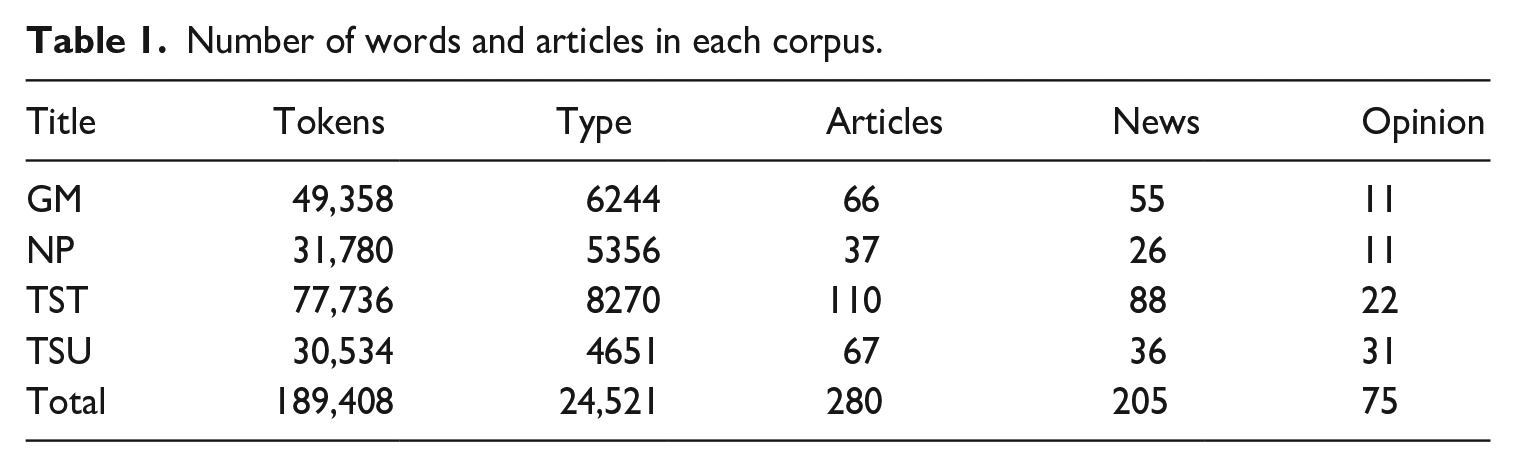
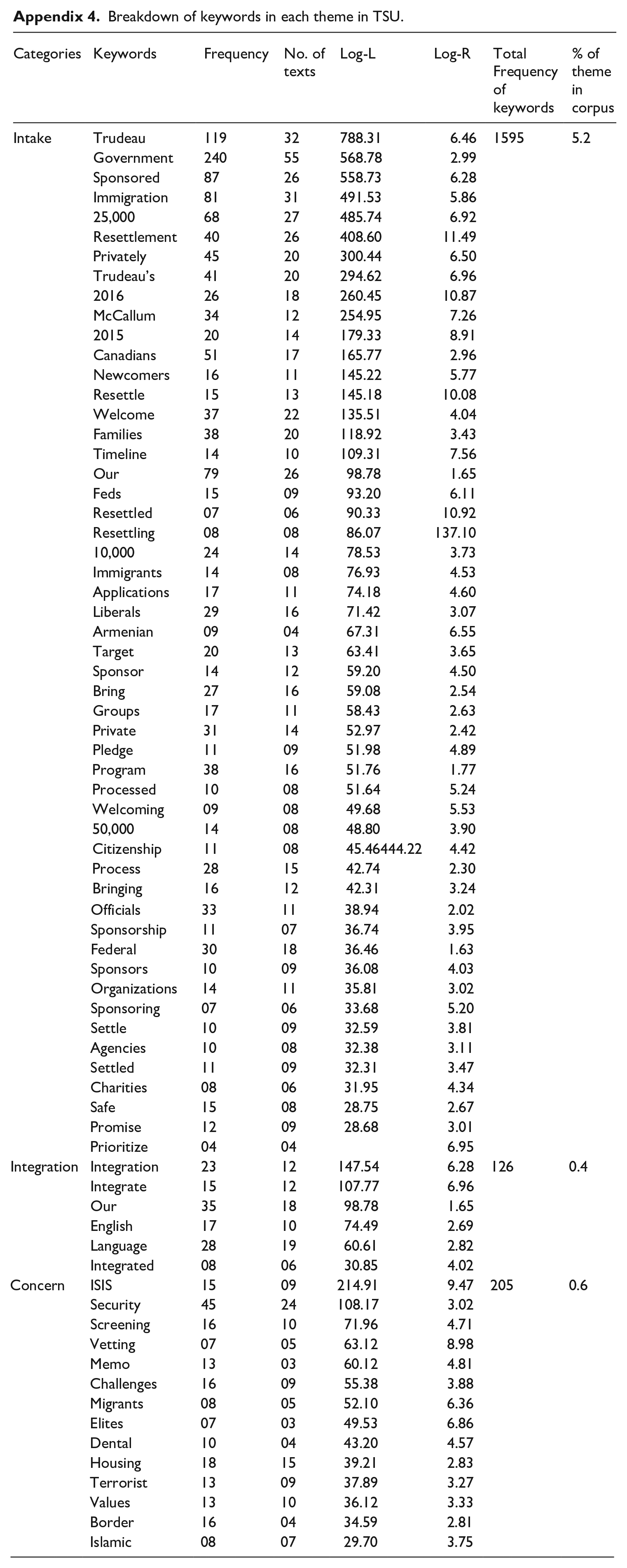
CL is the study of language based on examples of naturally-occurred language use employing computerized software which is able to carry out complex calculations quickly and accurately on the linguistic data (McEnery and Wilson, 2001). Corpus-assisted studies typically begin with generating a list of keywords (words that appear more frequently than would be expected) by comparing their frequency between the study corpus and a reference corpus which, in this case, is the news section of Strathy Corpus of Canadian English (13,451,003 tokens). For this study, I used WordSmith Tools 7 to generate keywords for each newspaper. The threshold for keyness was set at p value (p ⩽ 0.0000001) which is WordSmith’s default setting. All the generated keywords were examined for this study. Keywords were grouped into thematic categories through the examination of their collocates (words that co-occur more frequently than expected within a specified span) and concordance lines (all the occurrences of keywords in a corpus) which were expanded to the whole text when needed. Note that the statistical measure chosen for the collocates is Mutual Information (MI) which ‘highlights rare exclusivity of the collocational relationship’. (Brezina, 2018: 70). Next, the proportion of each theme was calculated by adding up the frequency of all of its keywords and then dividing the total by the overall number of tokens in the corpus (See Appendices 1–4 for a detailed breakdown of keywords in each corpus). It is imperative to note that collocates were mostly used to determine the themes, and concordances were heavily utilized in uncovering the representational strategies used by the sources under study.
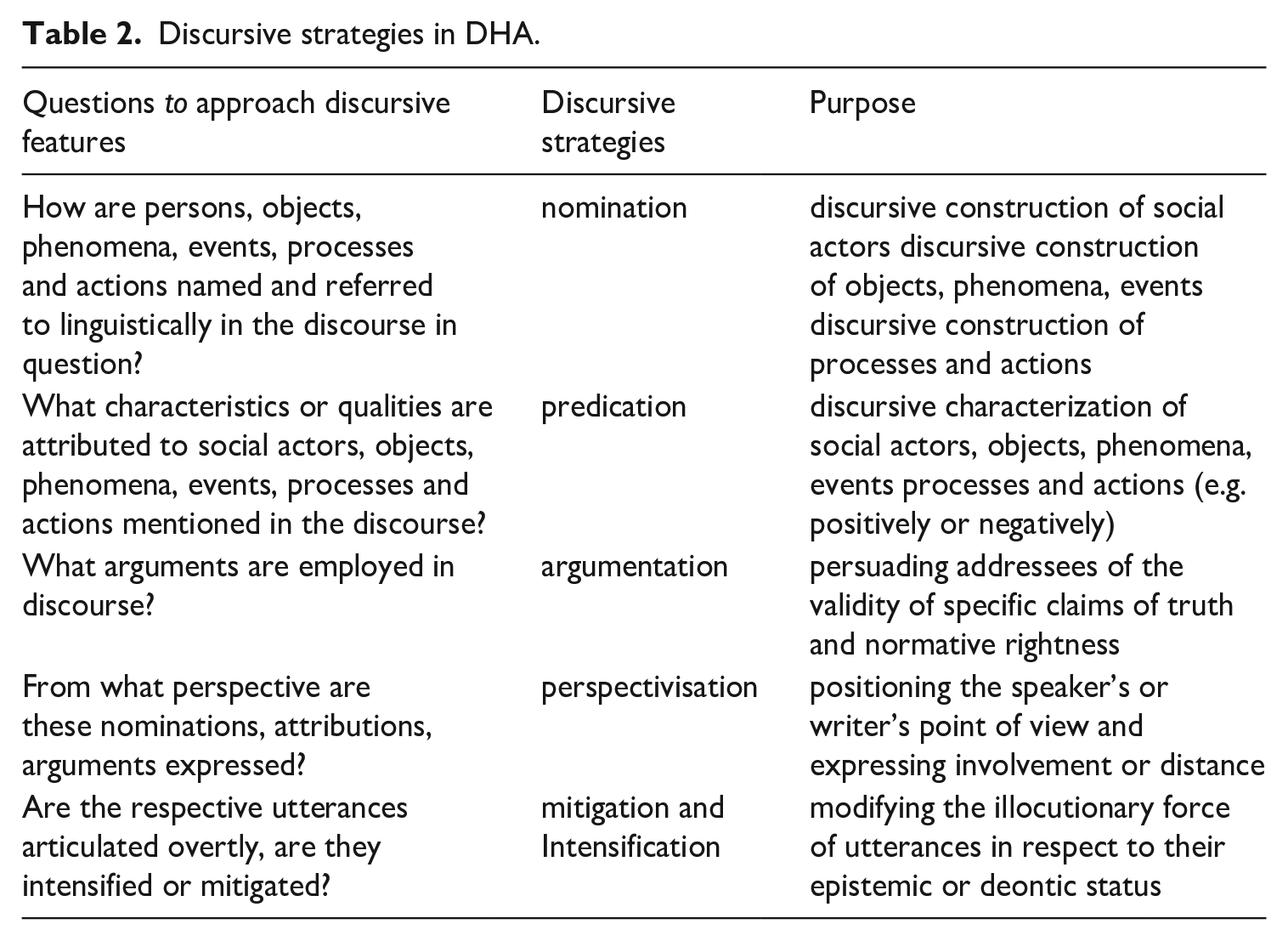
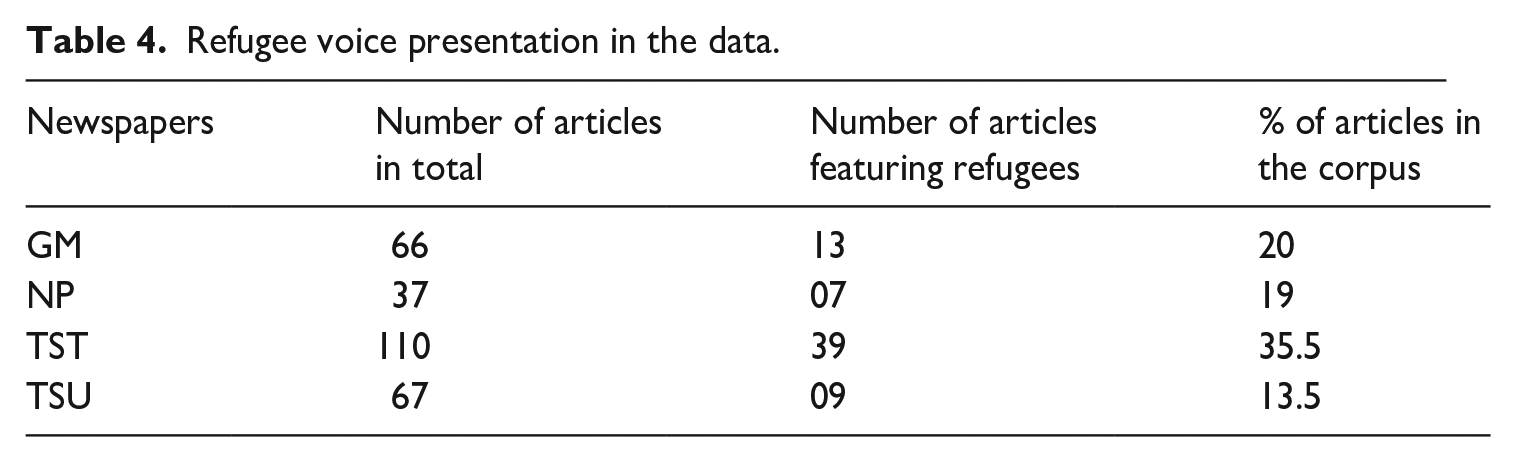
I employed two prevailing approaches in CDA, namely Van Leeuwen’s (2008) model and discourse-historical approach (DHA) proposed by Wodak (2001) to unravel the newspapers’ representational strategies and corresponding linguistic realization in relation to Syrian refugees. Van Leeuwen’s (2008) model was used to explore the representation of the integration of Syrian refugees into Canada. Social actors can be activated in a text as either dynamic forces in an activity or passivated as undergoing or benefiting from an activity through linguistic means (p. 44). In doing so, the newspapers under study appeared to use linguistic items which denote processes of doing/happening, sensing, and behavior known as material, mental, and behavioral respectively (Halliday, 1985 cited in Van Leeuwen, 2008). It should be mentioned that the implementation of Van Leeuwen’s model was preceded by a thorough reading of each newspaper article to examine if and to what extent the refugees were given a voice, that is, the newspapers talk ‘to’ Syrian refugees and not just ‘about’ them (Table 4). Finally, DHA proved to be highly conducive to studies concerned with the role of ideology in media representations (Reisigl and Wodak, 2001; Wodak, 2001; Wodak and Matouschek, 1993). To explore the role of the political positions of the newspapers in their representation of Syrian refugees, I drew on DHA to examine the discursive strategies and related linguistic devices used to refer to and describe Syrian refugees and their resettlement in Canada, to justify arguments in favor of or against them, to frame the newcomers and issues related to them from speakers’ point of view, and to intensify or mitigate the force of utterances (Table 2).
Discursive strategies in DHA.
Analysis
In this section, I present the thematic categories identified in the study along with a tabular description of the definition of each category and examples of keywords in each theme, followed by a discussion of the proportion of the themes among the sources under study. Next, I discuss how Syrian refugees are linguistically and discursively represented in the data, and the role these portrayals play in shaping and/or promoting particular representation of the refugees for the reader.
Themes related to Syrian refugees
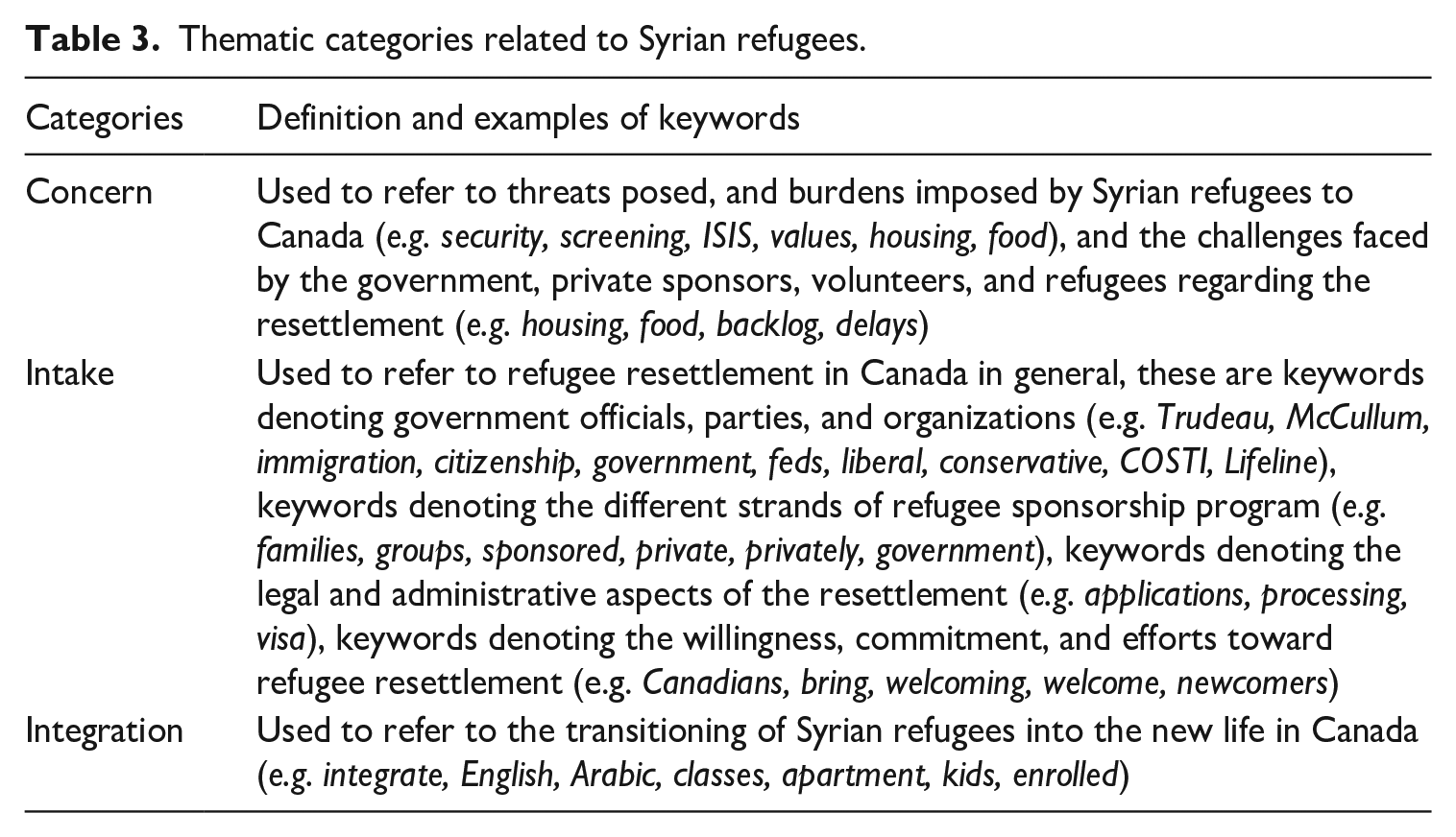
The themes that emerged from the analysis are concern, intake, and integration (Table 3). These thematic groupings indicate the focus and interest of the newspapers’ coverage of Syrian refugees. As Figure 1 indicates, the most conspicuous similarity between the newspapers pertains to the saliency of the theme of intake, reflecting the central focus of all the newspapers, regardless of their political alignments, on the resettlement of 25,000 Syrian refugees in Canada as a result of adopting a more welcoming immigration policy under the Liberal government. However, a more CDA-inspired analysis of keywords in this theme found that the intake is put in a relatively negative light in the NP and TSU, the conservative-leaning media, while TST and GM adopt a more positive view in support of the resettlement.
Thematic categories related to Syrian refugees.
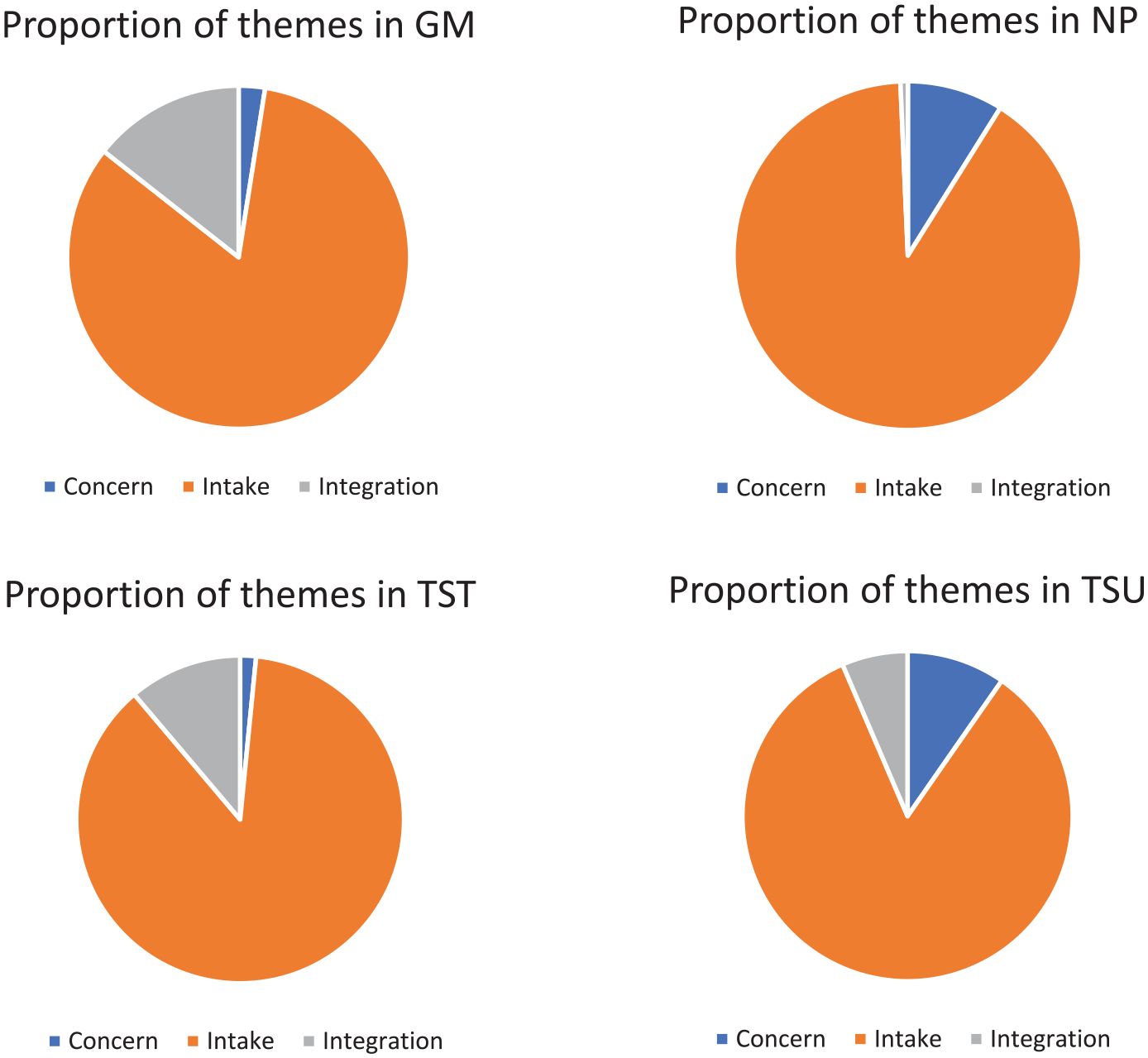
Proportion of themes in each newspaper.
Next, Figure 1 shows that integration is also an observable theme in the majority of the sources with the exception of NP, suggesting the newspapers’ interest in the coverage of the life and activities of Syrian refugees in Canada although with different representational purposes which will be explained in more detail in the next section. Finally, the theme of concern has a markedly smaller proportion in GM and TST in comparison with the other two conservative-leaning newspapers which appeared to highlight presumed threats and burdens associated with Syrian refugees. It is worth mentioning that in addition to the observed variation in the proportion of concern in sources with different political leanings, the CDA-informed analysis found that GM and TST opted for mitigating challenges and obstacles facing the Canadian government, sponsors, and Syrian refugees themselves which is in line with their perceived stance in favor of the resettlement.
Discursive strategies and linguistic choices used to represent Syrian refugees in each theme
Representation of refugees in terms of intake
The more close-reading of the keyword resettlement (46 occurrences in GM and 85 occurrences in TST) shows that the intake is neutrally referred to as program, plan, and effort, and is magnified by using evaluative words and expressions in GM and TST:
It is
. . ., and to make sure that this
Local sponsorship groups that were formed after the Liberal government launched the
City wraps
The use of evaluative words and expressions can be seen as an attempt to magnify Canada’s humanitarian response to the plight of Syrian refugees in the above-mentioned excerpts. Additionally, the significance of being helped by Canada for Syrian refugees is intensified in the liberal-leaning TST by using figurative language, namely simile (Example 1), allusion (Example 2), and metaphor (Example 2). The intensification techniques used to magnify the intake help construct an image of Canada, particularly the Liberal government, as a savior:
‘It’s
They braved the hell of war in their ravaged homeland, and languished in camps for as long as 3 years for a ticket to
The close-reading of the keyword resettlement (27 occurrences in NP and 40 occurrences in TSU) in the conservative-leaning sources reveals representations that attribute negativity to the Syrian resettlement although in slightly different ways. To elaborate, NP implicitly describes the intake as a political gesture (Example 1). However, the resettlement efforts are found to be highly spoken of only when the credit is given to the Canadian public rather than the government (Examples 2):
The refusal rate for Syrian refugees was 4% according to the documents, which, though released only recently, date to the early stages of the Syrian refugee program, when the
A close look at Canada’s
On the other hand, TSU uses a more subjective language in relation to the resettlement calling it a pledge, promise, gesture, and ploy. The newspaper employs the strategies of perspectivation and intensification to criticize the government’s fast-tracking of Syrian refugees, using expert voice (Examples 1), impersonalization (Example 2), and evaluative expressions (Examples 1, 2,):
‘The way they’ve been handling this is just
Also in TSU, the concordance analysis of the keyword Trudeau’s (41 occurrences) points to the widespread criticism of Liberal Prime Minister Justin Trudeau. As can be seen below, the texts frequently use nomination, predication, perspectivation, and intensification strategies to depict the resettlement as a political play which is not surprising given the stance of the newspaper. However, the portrayal of Syrian refugees as a political tool in the right-wing Canadian newspaper is in line with the practice of politicizing immigration by the media in other countries, such as France, Poland, Sweden, and the US, and contributes to the dehumanization of the refugees (Aswad, 2019; Gattinara and Zamponi, 2020; Krzyżanowski, 2018; Nagel, 2016). In addition, it can be argued that transforming the refugees into a political tool can downplay the sense of emergency in response to the humanitarian crisis and consequently undermine the efforts by the government as well as sponsors and advocacy groups to garner public support for Syrian refugees coming to Canada.
Justin
The forum was held on Nov. 28-29, 2015, in Toronto, in the midst of the turmoil of trying to implement
Representation of refugees in terms of integration
As Table 4 shows, TST has the highest number of articles (35.5%) featuring refugee personal stories and quotations. The texts quote the refugees as expressing hope and willingness to build a new life and show them as engaging in their daily life in Canada, activating the refugees in mental, behavioral, and material processes respectively (Halliday, 1985). The activation helps give more agency to refugees than is normally attributed to them in their news representations. Similarly, about 20% of the coverage (13 texts) in GM features Syrian refugee stories (Table 3) including interviews with them and their sponsors and employers. The refugees are described as dedicated workers (Examples 2) and entrepreneurs (Examples 3) who bring their skills, knowledge, and experience gained in Syria to build their lives in a new country:
Refugee voice presentation in the data.
‘
Across Canada,
GM compares government-sponsored refugees with those sponsored by private individuals and groups. While acknowledging that the privately sponsored refugees are facing less difficulty in their integration into Canada, the author makes arguments to justify the intake of government-sponsored Syrians through topicalization (Example 1) and adjacent text positioning (Example 2):
Government-sponsored refugees are typically
The portrayal of the activities, efforts, and progress of Syrian refugees in daily life helps to construct the newcomers as resilient and determined individuals who are keen on and capable of integration despite the acknowledged challenges and struggles faced by immigrants in Canada including the language barrier and lack of Canadian work experience and credentials (Ricento, 2021). Comparatively, there is more tendency in NP to underscore the challenges of refugee integration by passivating them through perspectivation strategy using quotations that indicate an implicit bias toward the refugees:
But Fakih says the
On the other hand, Syrian refugees are often passivated by being shown as ‘beneficiaries’ (Van Leeuwen, 2008: 44), enjoying the safety of Canada. They are mostly activated in material processes that denote criminality in TSU. The refugees are reported as committing domestic violence and sexual assault (Malcolm, 2017). While both of these crimes are serious and require corrective actions, the overt framing bias of the author who uses hyperbolic and sensationalist phrases to generalize isolated events contributes to reinforcing the long-established image of refugees as culturally unadaptable and helps shape the perception of domestic violence and sexual assault as foreign constructs in Canada (Mustafa and Pilus, 2020):
A group of recently-arrived Syrian refugees
Now we learn that one of these Syrian refugees used
Moreover, the analysis suggests that the authors attempt to give the impression that crimes such as domestic violence and sexual assault have been imported by refugees to Canada (Examples 1,2 below). More importantly, Syrian refugees are attributed responsibility for instances of sexual misconduct in Europe through semantic contagion between the categories of ‘asylum-seeking men’ and ‘Syrian refugees’ and adjacent text positioning (Example 3 below). It is argued that such depiction is not only an unfair generalization but also a ‘misattribution of behavior’ (Aswad, 2019: 365), given the lack of evidence that Syrian refugees have committed those acts in Europe:
Instead, the Trudeau government rushed to
In Canada, women and girls should be able to go to a public swimming pool without fear of being assaulted. They should be free to wear a bathing suit - a bikini even - if they so please.
The federal government wants
The comparison of the manners in which Syrian refugees are activated and passivated in relation to their integration confirms the existence of two opposing perspectives of paternalism versus empowerment through which refugees can be represented in the media. The former sees refugees as vulnerable and in need of saving, while the latter promotes a view of self-reliant and independent refugees. The problem with the paternalist view is that it places refugees ‘in a subordinate role to professionals who are responsible for providing the services and the help they need’ (Hardy and Phillips, 1999: 10).
The concordance analysis of the keyword values (13 occurrences) in TSU highlights a prevalent argument against Syrian refugees that represents them as a threat to Canadian culture. The expressions such as Canadian values (6 occurrences), our values (2 occurrences), and our cultural values (2 occurrences) suggest assimilationist undertones associated with the concerns expressed about the integration of Syrian refugees. Plus, the use of expressions such as ‘at odds with Canadian values’ and ‘coming to terms with Canadian culture and values’, in the excerpt below, presupposes Syrian refugees as being inherently different; therefore, their integration can be difficult: But when the offending student is part of a wave of recently arrived Syrian refugees - unable to speak English and
Finally, the concordance analysis of the keyword our (35 occurrences) in TSU reveals the prevalent use of the word as a discursive strategy that creates a divide between ‘us’ and ‘them’ (Van Dijk, 1991). Similarly, our collocates with country (MI 6.27/12 occurrences) reinforces the perception of Syrian refugees as an out-group, plus, the emphasis on both the significance of refugee integration and the efforts to ensure it, leads the reader to perceive the Syrians as fundamentally different from Canadians and thus contributes to the further Othering of the group.
Representation of refugees in terms of concern
It is imperative to mention that the representational difference between the newspapers is most noticeable in this thematic category. To begin with, concordance analyses of keywords challenges (16 occurrences), delays (15 occurrences), and backlog (09 occurrences) in TST demonstrate that the Liberal-leaning newspaper is mainly concerned with the problems that affect refugee intake, well-being, and success in Canada. Similarly, a close reading of the keyword trauma (09 occurrences) in GM found a relatively sympathetic attitude toward Syrian refugees’ mental health issues acknowledging the challenges faced by the newcomers. Also, a close analysis of the keyword housing in GM (32 occurrences) and TST (22 occurrences) indicates that the newspapers drew upon mitigation strategy to downplay the challenge of finding permanent ac commodation for Syrian refugees using impersonalization and quotations from officials:
On Tuesday,
In contrast, TSU uses argumentation strategies that depict Syrian refugees as a burden on the country’s resources. The authors take an explicit stance to express concern about Syrian refugees using hyperbolic and sensationalist phrases, aggregation, and liquid metaphor (Examples 1,2,3 below). Meanwhile, NP alludes to the refugee burden on the Canadian economy by highlighting the worries of business owners about reducing the number of skilled workers to accommodate the temporary upsurge in the intake of Syrian refugees (Examples 4,5):
No sanctuary from costs;
But the move has nonetheless
When raising security concerns about Syrian refugees, the conservative-leaning media draws on arguments that echo the possibility that Syrian refugees suspiciously carry ISIS members within their midst into Canada and even infiltrate US soil. The depiction of the refugees as a security threat is done by using impersonalization (Example 1), quotations from officials (Example 2), and topicalization (Example 3) as shown below:
‘
The above-mentioned arguments can be seen as fallacious for two reasons. First, there has been no evidence that Syrian refugees have been involved in acts of terrorism in the United States (Friedman 2017 cited in Aswad, 2019: 365). Second, an intelligence report by Canada’s immigration officials found little evidence of security concerns about Syrians (Bell, 2017). Contrariwise, security concerns regarding Syrian refugees coming to Canada are mentioned in GM and TST, but they are often mitigated by referring to official statements dispelling those concerns about the Syrians. Nevertheless, it should be noted that references to the connection between Syrian refugees and terrorism and emphasis on security issues can prompt the reader to infer a link between the refugees and terrorist activities:
Janet Dench, executive director of the Canadian Council for Refugees, said any concerns that Syrian refugees are a security risk is
. . .,
Further insight into these findings can be gained by situating the findings in Fairclough’s model. The analysis indicates how the discursive and linguistic choices made in each newspaper contribute to the construction of a particular understanding of Syrian refugees in terms of the themes highlighted by the newspapers under study. The findings also demonstrate that Canada’s response to the humanitarian crisis is transformed and recontextualized in ways that correspond to the concerns, priorities, and goals, determined by the political alignments and ideological stances, of these newspapers. Finally, the more empowering and sympathetic depictions of refugees in centrist and liberal-leaning sources seem to be part of the country’s wider sociopolitical changes in reaction to the plight of Syrian refugees which was symbolized by the photo of the perished child Alan Kurdi.
Conclusion
The findings of this analysis shed light on the media discourses on and around refugees through the examination of the representation of Syrian refugees in the Canadian press during a period that marks a shift to more welcoming immigration policies in the country. The findings indicate that adopting a more inclusive immigration policy did not totally negate the biased and discriminatory representations entrenched in the media coverage of refugees, but it set the stage for more empowering and sympathetic treatment of refugees in the media. By employing corpus-assisted critical discourse analysis, I determine three themes through which Syrian refugees are depicted and perceived across the political spectrum. The analysis finds that the news coverage revolves around the intake operations, the integration, and the concerns associated with Syrian refugees which are represented in noticeably different manners reflecting the political and ideological stances of the four newspapers.
First, the resettlement operation is generally supported by the centrist and liberal-leaning media which also leverages it to render a glorified picture of Canada as a savior. In contrast, the conservative newspapers mainly criticize and politicize the country’s response to the humanitarian crisis which is described as the worst since the World War II. Second, the integration of Syrian refugees receives a relatively more empowering treatment in the centrist and left-leaning newspapers, which depict the refugees as willing and capable of improving their lives, versus paternalist and pessimistic attitudes found in conservative-leaning newspapers, where refugees are characterized as not matching the presumed culture and values of the country. Third, the liberal and centrist newspapers turn the spotlight on the logistical challenges associated with refugee intake and, at times, sympathize with their lingering mental sufferings, while the conservative media covertly and overtly raise alarmist views about economic and security issues.
The portrayal of Syrian refugees as different, involved in negative acts, and threatening economic interests is in line with what Van Dijk (1987) categorizes as topics that reinforce racist discourse. It has been argued that ‘[negative] media representations affect attitudes towards migrants, create anxieties and fears, rally support for and against immigration, and legitimate immigration laws’ (Bauder, 2008: 290). Further research can involve the regional newspapers in other provinces across Canada, using a corpus-assisted approach, to ascertain to what extent the findings of this study might be parallel to the representation of Syrian refugees in other parts of Canada since regions experienced different interactions with refugee intake (Wallace, 2018). Additionally, given Canada’s two official languages, a cross-linguistic analysis of the refugee coverage between Canada’s anglophone and francophone media would be a valuable research avenue, especially since Quebec – where French is the official language – hosts the second largest population of Syrian refugees in Canada (IRCC, 2020).
These points notwithstanding, the findings of this study have shown the importance of the role of media discourse which builds and promotes certain representations of refugees and the ideologies underlying these representations. It is imperative to note that welcoming Syrian refugees by Canada is not solely a humanitarian gesture but a legal requirement as a signatory to the 1951 Refugee Convention which calls for protecting refugees and respecting their rights and dignity. It can be argued that the protection of and respect for refugees is not only the duty of the Canadian government, but it also behooves the Canadian media to be more mindful of their influence because media depictions of refugees can sway public opinion and attitude for or against the minorities which, in turn, affect the way refugees are treated in Canadian society (Bauder, 2008; Duffy and Rowden, 2005).
Footnotes
Appendix
Breakdown of keywords in each theme in TSU.
| Categories | Keywords | Frequency | No. of texts | Log-L | Log-R | Total Frequency of keywords | % of theme in corpus |
|---|---|---|---|---|---|---|---|
| Intake | Trudeau | 119 | 32 | 788.31 | 6.46 | 1595 | 5.2 |
| Government | 240 | 55 | 568.78 | 2.99 | |||
| Sponsored | 87 | 26 | 558.73 | 6.28 | |||
| Immigration | 81 | 31 | 491.53 | 5.86 | |||
| 25,000 | 68 | 27 | 485.74 | 6.92 | |||
| Resettlement | 40 | 26 | 408.60 | 11.49 | |||
| Privately | 45 | 20 | 300.44 | 6.50 | |||
| Trudeau’s | 41 | 20 | 294.62 | 6.96 | |||
| 2016 | 26 | 18 | 260.45 | 10.87 | |||
| McCallum | 34 | 12 | 254.95 | 7.26 | |||
| 2015 | 20 | 14 | 179.33 | 8.91 | |||
| Canadians | 51 | 17 | 165.77 | 2.96 | |||
| Newcomers | 16 | 11 | 145.22 | 5.77 | |||
| Resettle | 15 | 13 | 145.18 | 10.08 | |||
| Welcome | 37 | 22 | 135.51 | 4.04 | |||
| Families | 38 | 20 | 118.92 | 3.43 | |||
| Timeline | 14 | 10 | 109.31 | 7.56 | |||
| Our | 79 | 26 | 98.78 | 1.65 | |||
| Feds | 15 | 09 | 93.20 | 6.11 | |||
| Resettled | 07 | 06 | 90.33 | 10.92 | |||
| Resettling | 08 | 08 | 86.07 | 137.10 | |||
| 10,000 | 24 | 14 | 78.53 | 3.73 | |||
| Immigrants | 14 | 08 | 76.93 | 4.53 | |||
| Applications | 17 | 11 | 74.18 | 4.60 | |||
| Liberals | 29 | 16 | 71.42 | 3.07 | |||
| Armenian | 09 | 04 | 67.31 | 6.55 | |||
| Target | 20 | 13 | 63.41 | 3.65 | |||
| Sponsor | 14 | 12 | 59.20 | 4.50 | |||
| Bring | 27 | 16 | 59.08 | 2.54 | |||
| Groups | 17 | 11 | 58.43 | 2.63 | |||
| Private | 31 | 14 | 52.97 | 2.42 | |||
| Pledge | 11 | 09 | 51.98 | 4.89 | |||
| Program | 38 | 16 | 51.76 | 1.77 | |||
| Processed | 10 | 08 | 51.64 | 5.24 | |||
| Welcoming | 09 | 08 | 49.68 | 5.53 | |||
| 50,000 | 14 | 08 | 48.80 | 3.90 | |||
| Citizenship | 11 | 08 | 45.46444.22 | 4.42 | |||
| Process | 28 | 15 | 42.74 | 2.30 | |||
| Bringing | 16 | 12 | 42.31 | 3.24 | |||
| Officials | 33 | 11 | 38.94 | 2.02 | |||
| Sponsorship | 11 | 07 | 36.74 | 3.95 | |||
| Federal | 30 | 18 | 36.46 | 1.63 | |||
| Sponsors | 10 | 09 | 36.08 | 4.03 | |||
| Organizations | 14 | 11 | 35.81 | 3.02 | |||
| Sponsoring | 07 | 06 | 33.68 | 5.20 | |||
| Settle | 10 | 09 | 32.59 | 3.81 | |||
| Agencies | 10 | 08 | 32.38 | 3.11 | |||
| Settled | 11 | 09 | 32.31 | 3.47 | |||
| Charities | 08 | 06 | 31.95 | 4.34 | |||
| Safe | 15 | 08 | 28.75 | 2.67 | |||
| Promise | 12 | 09 | 28.68 | 3.01 | |||
| Prioritize | 04 | 04 | 6.95 | ||||
| Integration | Integration | 23 | 12 | 147.54 | 6.28 | 126 | 0.4 |
| Integrate | 15 | 12 | 107.77 | 6.96 | |||
| Our | 35 | 18 | 98.78 | 1.65 | |||
| English | 17 | 10 | 74.49 | 2.69 | |||
| Language | 28 | 19 | 60.61 | 2.82 | |||
| Integrated | 08 | 06 | 30.85 | 4.02 | |||
| Concern | ISIS | 15 | 09 | 214.91 | 9.47 | 205 | 0.6 |
| Security | 45 | 24 | 108.17 | 3.02 | |||
| Screening | 16 | 10 | 71.96 | 4.71 | |||
| Vetting | 07 | 05 | 63.12 | 8.98 | |||
| Memo | 13 | 03 | 60.12 | 4.81 | |||
| Challenges | 16 | 09 | 55.38 | 3.88 | |||
| Migrants | 08 | 05 | 52.10 | 6.36 | |||
| Elites | 07 | 03 | 49.53 | 6.86 | |||
| Dental | 10 | 04 | 43.20 | 4.57 | |||
| Housing | 18 | 15 | 39.21 | 2.83 | |||
| Terrorist | 13 | 09 | 37.89 | 3.27 | |||
| Values | 13 | 10 | 36.12 | 3.33 | |||
| Border | 16 | 04 | 34.59 | 2.81 | |||
| Islamic | 08 | 07 | 29.70 | 3.75 |
Declaration of conflicting interests
The author(s) declared no potential conflicts of interest with respect to the research, authorship, and/or publication of this article.
Funding
The author(s) received no financial support for the research, authorship, and/or publication of this article.