




Abstract
This paper examines political protest in 40 purposively sampled internet memes circulated among Nigerian Facebook and WhatsApp users during the socio-political crises that engulfed the country ahead of the 2023 general elections. It explores the thematic preoccupation as well as the representation of participants and processes in the memes. Data were subjected to qualitative anaysis, and examined from the perspectives of multimodal and critical discourse analysis. The analysis reveals that the memes are used to protest cash crunch, fuel scarcity, socio-political unease and other government’s anti-people policies with their attendant effects. The memes are circulated to instantiate a negative representation of the Nigerian government and resist perceived anti-people ideology of the government.
Keywords
Introduction
The federal government of Nigeria introduced some economic and political policies towards the end of the year 2022 and ahead of the 2023 general elections. These policies, including the naira redesign, cash mop up exercise, that is, mopping up of excess cash from circulation, and proposed fuel subsidy removal, were largely perceived as ill-conceived because they practically grounded economic and social activities while they lasted in the country. Consequently, many Nigerians considered it necessary to protest these anti-people policies of government (Akintoye, 2023; Monye, 2024). Chong (2015: 421) defines political protest as ‘a multitude of methods used by individuals and groups within a political system to express their dissatisfaction with the status quo’. Further, Ruijgrok (2017) and Soh (2020) posit that political protest is ideologically biased and can be expressed through voting, letter writing, electoral campaigns, demonstrations, marches, sit-ins and blockades. Apart from these methods of protests, the social media has also been largely employed as platform for political protests. Hence, Chong (2015) claims that social media has changed the form of political protest as it facilitates communication, helps discover the extent of dissatisfaction, strengthen the development of networks. Remarkably, Nigerians employed social media platforms to protests the perceived anti people policies of government. This is mostly actualised through the production of internet memes. Memes provide an avenue for improved social engagement and could be inherently ideological (Holmes and Marra 2002; Shifman, 2014).
A meme has been variously defined (see Burgess 2008; Johnson 2007; Jones and Schieffelin 2009; Knobel and Lankshear 2007). For instance, Shifman (2014: 341) defines it as an image or video that represents the thoughts and feelings of a specific audience. It is a group of digital items which share common features such as content, form and/or stance, and is ‘circulated, imitated, and transformed via the internet by multiple users’. Also, Davison (2012) posit that memes are learned and constructed by social forces such as culture, religion, education, and greatly determine much of human behaviour. The term ‘meme’ was coined by Richard Dawkins, a biologist who believes that cultural ideas are like genes. He argues that societal concepts spread from brain to brain, multiplying and mutating thereby (Dawkins, 1976). Memes are a worldwide social phenomenon and an increasingly important aspect of viral marketing and social engagement and they express a wide range of messages including religious, political and sociological. For example, Grundlingh (2018) investigates the way internet users use memes to reply to each other on social networking sites or other online platforms. They argue that memes are successfully used to communicate the desired message. They also posit that memes can be created for different purposes and as such, could be classified as speech acts. Also, Msughter (2020), using data from Facebook, explores how people used Internet memes on social media platforms to respond to the threat or danger inherent in the coronavirus. From the Nigerian perspective, studies have focused on a linguistic and pictorial analysis of some internet memes and their implications for the socio-political conversations in Nigeria (cf. Jimoh, 2019; Onanuga and Ajao, 2017; Tella, 2018; Yékú, 2018). Durotoye (2020) argues that ‘intermediality’ promotes dynamism of opinion characterised by technological innovation and that Twitter memes enhance the expression of political agency and furtherance of critical engagement within the Nigerian political domain. Also, Ugah (2022) argues that internet memes significant in contemporary political restructuring and reformation. Furthermore, studies have examined the way memes have been created to protest unpleasant situations/government policies, especially in Nigeria. Alfred (2019) posits that social media memes reflect the negative disposition of meme producers to the leadership style and agenda of the All Progressives Congress (APC) president-elect. The study also affirms that memes about the APC change slogan are used to express displeasure over the socio-economic realities in Nigeria and to dissuade viewers from voting for the APC in future elections.
Similarly, Adebomi (2020) focuses on a linguistic and pictorial analysis of the way personalities and institutions in the All Progressives Congress (APC) led national government in Nigeria are represented through social media memes. The study reveals how Nigerians expressed their disapproval for the important personalities and major institutions in the Buhari led national government. Further, Adebomi (2021, 2022) appraises the covid-19 interventions of the Buhari-led government in Nigeria and expounds that social media memes are deployed for the assessment of government, its key players and their activities within the Nigerian political landscape and that memes are useful in the construction of political ideology in Nigeria. Furthermore, Unuabonah and Oyebode’s (2021) study reveal that memes are used to protest corruption, perceived government deceit, insecurity, hunger and inadequate health facilities and other social amenities. The study affirms that the protest is borne out of the need to ‘resist an anti-welfarist ideology and emphasise the negative representation of the government’ (Unuabonah and Oyebode, 2021: 200). Likewise, Adegoju (2022) avers that internet memes are used to indicate backlashes of democratic deficits relating largely to worsening poverty, hunger, struggle for survival and political cynicism in an emerging democracy [such as Nigeria]. Also, Okesola and Oyebode (2023) posit that meme producers effectively utilize multimodal elements to interrogate various expressions of attitude and intersubjective opinions that Nigerians made about Nigeria’s year 2020 #ENDSARS protest and its management by the Nigerian government. Even though studies, for example, Adebomi (2020) and Unuabonah and Oyebode (2021), have declaimed the interception of internet memes and political protest, existing studies have overlooked the multimodal analysis of the internet memes produced to protest Nigerian government’s cashless policy, proposed fuel subsidy removal and the attendant crises in the pre-general election era. Thus, this study examines political protest in internet memes circulated among Nigerian Facebook and WhatsApp users during the 2022/early 2023 socio-economic crises, with a view to exploring the thematic preoccupation and the representation of participants and processes in the memes.
In this section, we have presented the background to the study. The section: ‘perspectives on multimodality and political discourse analysis’ presents the theoretical framework for the study, the research methodology is presented in the section on ‘Methods’. The findings of the study are presented in the section on ‘Results and discussion’. The section on ‘Observations and conclusion’ presents the conclusion of the study.
Perspectives on multimodality and critical discourse analysis
In their framework on multimodal discourse analysis (MDA), Kress and van Leeuwen (2001) affirm that there are communicative activities that can never exist without being linked to some form of representational ‘content’, which is not restricted to language but also includes all other modes of communication. These communicative activities, through which meanings are made in a multimodal text, are grouped into four domains including: discourse, design, production and distribution. Discourses are ‘socially situated forms of knowledge about aspects of reality’ (Unuabonah and Oyebode, 2021: 202). They include knowledge of events which relate to who is involved, what takes place, where and when it takes place, and so on. It also includes a set of related evaluations, purposes, interpretations and legitimations. All these are actualised by drawing from the various semiotic resources available, such as: colours, words, pictures, language and so on, in a particular culture as a means of projecting the intended meaning in a multi-modal environment. Design is realised through the selection of the objects in a semiotic ensemble as well as the salience given to particular themes and to the modes chosen in representing specific meanings. Production refers to the creative process of the semiotic resources. It adds meanings which flow directly from the physical process of articulation to the physical qualities of the material used. Distribution media serve mainly to record or distribute the semiotic artefact through, for example, radio, television or digital media. The way in which the resources are distributed can also, sometimes, express cultural values (see Kress and van Leeuwen, 2001). These four domains work together to contribute significantly to meaning making in a multimodal text. These four domains of meaning will be explored in order to be able to adequately analyse the important role that multimodal resources play in the production, reproduction and transformation of the social practices (Caldas-Coulthard and van Leeuwen, 2003) that characterise the Nigerian society where the semiotic resources for this study are produced.
Critical discourse analysis (CDA), an interdisciplinary method of research, examines the relationship between power and ideology in texts, as well as the interconnection between language and society (Fairclough and Wodak 1997; van Dijk 2001). It views language as a form of social practice (Fairclough, 2013), and proposes that the way people use language in speech are socially conditioned and have social effects. CDA provides the framework to investigate the biases and imbalance in political discourse with a view to describing how participants navigate them (see Igwebuike and Chimuanya, 2023). Even though there are various approaches to CDA, this study benefits from van Dijk’s (2001) socio-cognitive model which investigates the link between ‘discourse, cognition and society’ (van Dijk, 2001: 354) as well as the mental models which give rise to ideologies. Ideologies refer to the overall abstract, mental systems that organize socially shared attitudes. They serve as a basis for competition, conflict, struggle, differences of opinion and knowledge between groups (van Dijk, 2006). Specifically, the socio-cognitive framework of CDA involves a series of mental or cognitive activities which are required in discourse production and comprehension. These cognitive set include personal knowledge, opinions, attitudes, feelings etc. Furthermore, van Dijk (2001) posits that social inequality is cognitively represented and enhanced by the us-them polarization, in such a way that there is a positive representation of the in-group (us) and negative representation of the out-group (them). In addition, van Dijk (2001: 362) observes that the negative other representation is ‘discursively sustained and reproduced by derogating, demonizing, and excluding other from the community’. Apart from these discursive practices, arguments, stories, semantic moves, and other structures of discourse such as rhetorical figures, lexical style, storytelling, structural emphasis of out-group’s negative actions and quoting credible witnesses, sources or experts are used in instantiating the us-them polarity. Hence, in this study, attention is paid to how ideologies are constructed and resisted through multimodal resources, especially as van Dijk (1995) observes that ‘ideologies are typically, though not exclusively, expressed and reproduced in discourse and communication, including non-verbal semiotic messages, such as pictures, photographs and movies’ (p. 17). Drawing insights from Kress and van Leeuwen’s (2001) multimodal discourse analysis and van Dijk’s (2001, 2006) socio-cognitive CDA, therefore, this study will answer the following research questions: (i) What are the major thematic preoccupations of the memes? (ii) What kinds of ideologies are produced and resisted through the semiotic resources in the political memes? (iii) How are participants and processes represented in the memes?
Data and methods
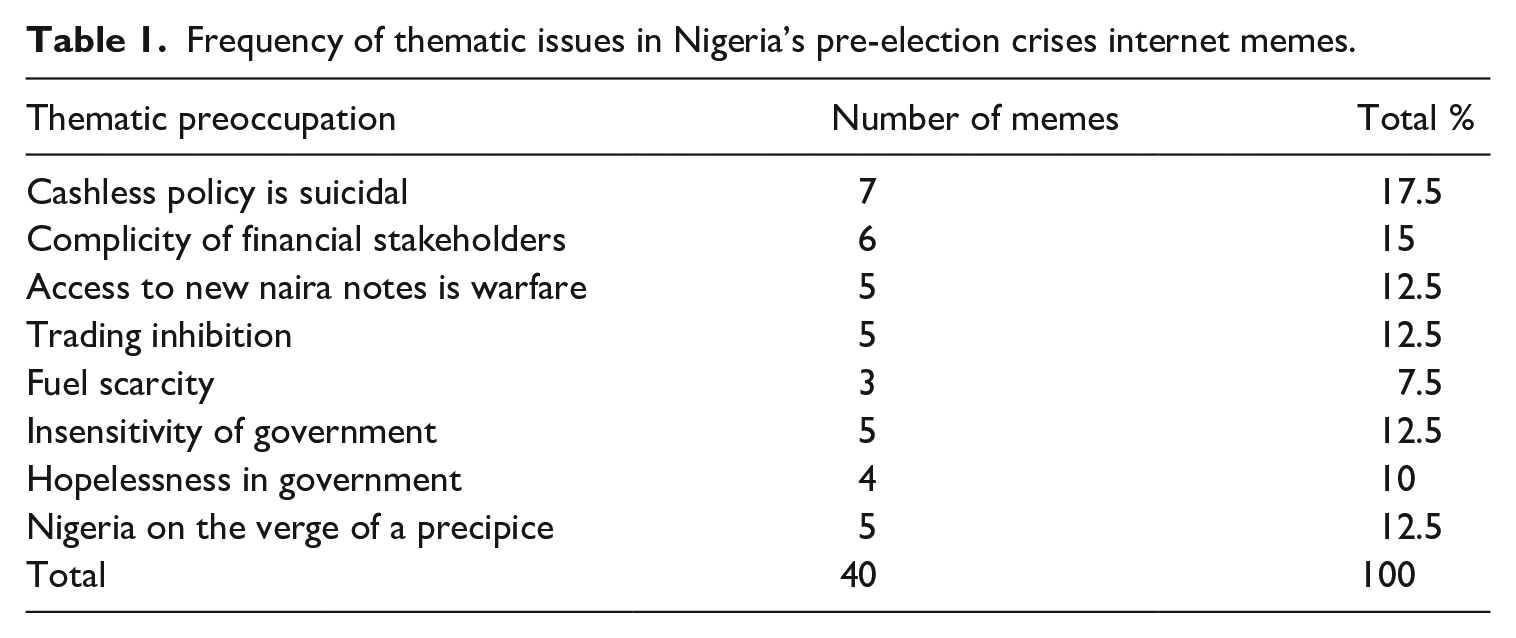
Forty purposively sampled internet memes constitute the data for this study. The data were gathered between November 2022 and May, 2023, representing the peak of the electioneering season and the attendant political unease in Nigeria. The data were sourced from Facebook and WhatsApp spaces because the two social media platforms draw a traffic of users. About 73% of Nigerians are active on Facebook (Opeibi, 2015) while about 94% of Nigerian social media users are active on WhatsApp (Kemp, 2020). The sampled memes expose the negative impact of government’s cashless policy, proposed fuel subsidy removal and heated pre-election polity. Even though the study is qualitative, the following table presents the frequency distribution of the dominant themes in the memes:
The data were qualitatively analysed using insights from Kress and van Leeuwen’s (2001) MDA and van Dijk’s (2001, 2006) CDA. At least one meme is used to explain each of the eight dominant themes identified in the data.
Results and discussion
A number of internet memes were circulated during the cash mop-up/introduction of cashless policy to the Nigerian economy, proposed fuel subsidy removal and pre-general election period. An investigation of the memes revealed that they extend the perceived insensitivity of the Nigerian government to the problems of the masses. The memes were [re]produced and distributed to negatively represent the Nigerian government as well as to resist government’s anti-social ideology. The channels of circulation/distribution (Facebook and WhatsApp) were adopted for ease of access and to show that the message being expressed is representative of the wishes of a vast majority of the Nigerian masses. The design of the memes teased out thematic delineations including: cashless policy is suicidal, complicity of financial stakeholders, access to new naira notes is warfare, trading inhibition, fuel scarcity, insensitivity of government, hopelessness in government and Nigeria on the edge of a precipice (the distribution of these thematic issues is presented in Table 1). Meaning is teased out in some of the memes based on shared background knowledge. This is so because of the high context culture of communication (see Hofstede, 1980; Wurtz, 2006) in Nigeria. Also, negative other-representation of the Nigerian government is realised in the memes through several semiotic resources as well as rhetorical-discursive devices such as metaphor, sarcasm, paradox, repetition, rhetorical question, imagery and pun. Through the media of production of the memes, the meme producers instantiate the anti-social ideology of the Nigerian government which are also resisted through the design of the memes. These shall be explicated in the following subsections.
Frequency of thematic issues in Nigeria’s pre-election crises internet memes.
Cashless policy is suicidal
One of the aftermaths of the introduction of cashless policy to Nigeria’s economic space is its life-threatening nature. There were several reports of people who lost their lives or almost did because of their inability to access medical care during the cash mop-up exercise. This is largely because the introduction and the execution of the policy were sudden and caught many Nigerians unawares. Similar to this is the unavailability of the necessary infrastructure to support the cashless policy. The result of this was utter frustration and even death, as expressed in Figure 2.
The discourse design of Figure 1 is a combination of visual and verbal resources. The meme contains the image of two individuals conveying the body of a dead person. The message of the meme producer in Figure 1 is hinged on shared background knowledge. People living in Nigeria in the heat of the cash mop-up exercise implemented by the federal government and enforced by the central bank of Nigeria can relate to why, according to the meme, the loss of five thousand naira could claim the life of a human being. During the cash mop-up exercise, individuals were only entitled to a maximum and cumulative (within the banking hall and through internet banking) daily withdrawal limit of twenty thousand naira (N20,000). Even though N20,000 was the official amount individuals were entitled to, many bank users could not withdraw this amount from their savings. This is because deposit money banks (DMBs) kept complaining about shortage which necessitated the need to ration the available cash. In the end, most bank users could only access between two and five thousand naira daily. As if that was not enough, the smallness of the amount to be withdrawn is usually incomparable to the stress that bank users were made to go through before they could get some money. Sometimes, they [bank users] may have to wait for long hours before they are able to withdraw some paltry sum. When getting money from deposit money banks became almost impossible, many Nigerians resorted to buying cash from Point of Sale (POS) operators at very ridiculous rates. Accessing cash from POS operators, who themselves would have been subjected to uncomfortable situations by DMBs, was usually a tug of war. Their rates were often exorbitant and reflective of the stress they were subjected to by DMBs before they could get some money to trade with. Hence, only those who desperately needed money or who found themselves in close to life-threating situations patronised them. This scenario is captured in Figure 1 where the dead person is said to have used ‘2k’ to purchase ‘5k’. The individual represented in the meme could have died apparently because they could not sort the emergency for which they used ‘2k to buy 5k’, in spite of the troubles. The lexical choice of ‘2k’and ‘5k’to represent two thousand naira and five thousand naira respectively in the meme further reinforces the shared background knowledge of the participants in the meme. It is common knowledge within the Nigerian social system to represent thousand(s) as ‘k’. The use of pidgin in the construction of the verbal resource: ‘Wetin kill am He use 2k withdraw 5k, the money come lost’ foregrounds the negative effect of the cashless policy on the Nigerian people. Thus, the discursive relevance of the use of pidgin is that it strategically depicts the group of people affected by the cashless policy as ‘ordinary’ Nigerians or the common masses. Similarly, the choice of dummy image or faceless humans in the discourse design of Figure 1 teases out an ideological representation the Nigerian masses as undetermined.
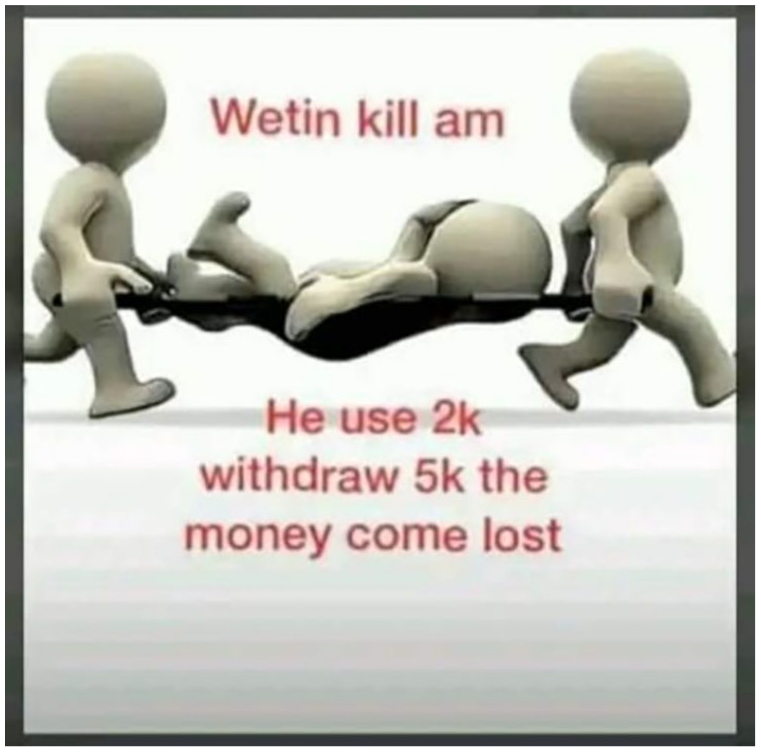
Wetin kill am?
Complicity of financial stakeholders
Another meme aimed at negatively representing the federal government of Nigeria and its anti-people cashless policy is presented in Figure 2.
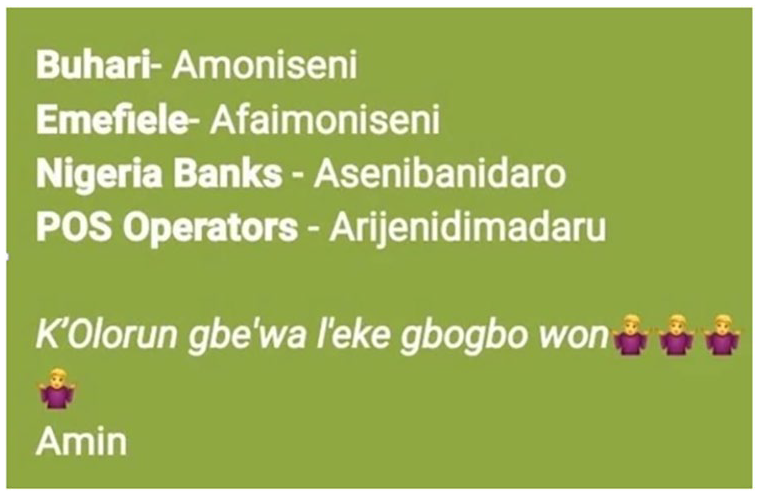
Buhari and Emefiele.
The discourse design of Figure 2 is almost made up of verbal resources except for the emoticons at the end of the message which suggests that the represented participant is looking for answers to the puzzle around the cash crunch policies. The verbal resource in the meme has special expression structures, a combination of bold fonts and italics. On the one hand, the bold font is deployed to highlight the identity of the stakeholders. On the other hand, the adjectives qualifying the stakeholders are constructed in normal fonts. The bold fonts are used to put salience on the social-political actors that are being lampooned. The first stakeholder identified is President Buhari who is the executive head of Nigeria’s national government and the most recognized policy maker. He is believed to be the mastermind of the cash mop-up exercise and is referred to in the meme as ‘Amoniseni’, a word in the Yoruba language translated as ‘the one who intentionally perpetrates evil’. The second stakeholder who is identified is the governor of the Central Bank of Nigeria, Godwin Emefiele who is described as ‘Afaimoniseni’, interpreted as the one who implicitly executes wickedness. The third financial stakeholder in the meme are the DMBs referred to in the meme as ‘Nigerian Banks’. They are qualified as ‘Asenibanidaro’, translated as ‘the one who pacifies after executing wickedness’. This lexical choice may not be unconnected with the perception that many of the commercial banks staff used the cash mop-up period for personal gains, such as hoarding and selling cash to moneybags who are capable of compensating them heavily. This attitude was believed to have affected the available deposits in the banks and reduced the amount regular Nigerians could gain access to, daily. The last stakeholder that is negatively represented in the meme is the group of POS operators who are described as ‘Arijenidimadaru’ which could be interpreted as the one who profits from mischief’ or ‘the opportunist’. This name calling is, arguably, associated with the extortionist tendencies exhibited by the POS Operators when the cashless policy was rife. The linguistic expression concludes with a prayer also in the Yoruba language: ‘K’Olorun gbe wa l’eke gbogbo won . . . Amin’ (May God help us to overcome them all . . . Amen). The socio-political stakeholders are described in negative, ‘demonizing’ and ‘derogating’ (van Dijk, 2001: 362) adjectives. This discursive strategy is deployed to reiterate the negative representation of the government and its anti-prosperity ideology. Importantly, the negative adjectives in Figure 2 are constructed in Yoruba, which is one of the major national languages in Nigeria. This indigenous language is used to domesticate the issue being portrayed. It depicts a sense of solidarity and further insinuates the actual people the policy has adverse effects on which are ordinary Nigerians.
Access to new naira notes is warfare
Nigerian banking halls witnessed episodes of rancor, either among bank customers or between bank officials and bank customers during the cash mop-up exercise. This almost made the Nigerian banking system to fall into an abyss. The warlike banking experienced while the cashless policy lasted is portrayed in Figure 3.
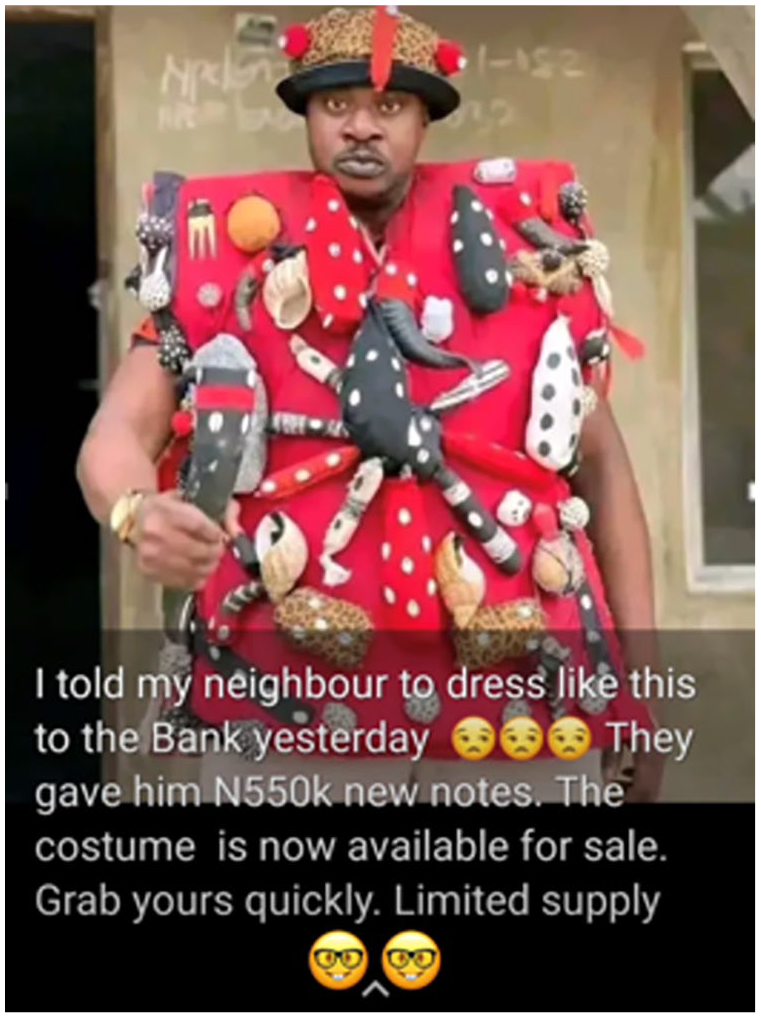
Limited supply.
The introduction of the new naira notes came as a surprise to many Nigerians. The governor of the Central Bank of Nigeria (CBN) unveiled the new notes on November 23, 2022 with the caveat that the old naira notes will cease to be legal tender by January 31, 2023. The time frame for the mop-up of the old naira notes and circulation of the new notes was considered short and the intentions of the CBN governor were deemed fishy, especially since the general election was rife. There were even debates that the outgoing government of Muhammadu Buhari instigated the naira mop-up in a bid to frustrate monetized electioneering (Ayantoye, 2023). Since many Nigerians did not want to be in possession of old naira notes by the January deadline, there was a frightful hurry to deposit their old currencies. Even though loads of old naira notes were deposited, there was no corresponding circulation of new naira notes. The situation was worsened with DMBs claiming that the amount of new naira notes allocated to them by the CBN was far from sufficient. What transpired most of the time was that many bank users were only able to gain access to cash based on their personal relationship with officials of DMBs (see Abubakar, 2023; Kaledzi, 2023; Olisah, 2023). Those who did not have such relationships had to devise other means including confrontation. Figure 3 is produced to sarcastically represent this reality. The meme is a remixed image, apparently culled from a Nigerian home video scene. Its discourse design is a combination of visual and verbal resources. Both of these combines to extend the protest against the scarcity of the new naira notes. The meme contains the image Odunlade Adekola. The choice of Odunlade Adekola, a popular Nigerian Nollywood actor and brand influencer, signifies solidarity and the localness of the issue being addressed. The metaphor of warfare is depicted in Adekola’s mode of dressing. His attire is designed with a paraphernalia of warfare, especially from the Yoruba cultural perspective. This discursive strategy is aimed at negatively representing the cash mop-up exercise- as a form of warfare declared by the government – which the Nigerian masses are also determined to resist.
The first set of emoticons in meme 3 reinforces the message expressed in the visual mode. The represented participant wears stern looks to suggest discontent with/resistance of the perceived anti-people cashless policy. It also suggests battle readiness. The opening part of the verbal resource: ‘I told my neighbor to dress like this to the bank yesterday . . . they gave him 550k new notes’ gives the impression that what was tagged scarcity of new naira notes was artificial. Ironically, the bank could afford to give 550 thousand naira to an individual in spite of the cries of no cash in circulation. This reiterates the negative representation of the socio-political stakeholders as waging a needless war on the Nigerian masses. The use of pronouns ‘I’, ‘he’ and ‘yours’ in Figure 3 suggest that resisting government’s anti-people ideology require both individual and collective efforts. The need for collective effort is, particularly, reinforced in the expression: ‘The costume is now available for sale. Grab your copy’. This is a call by the meme producer to other Nigerians to join in the resistance of the perceived government’s anti-social ideology. Ironically, the verbal resources end with laughter emoticons to show sarcasm and to ideologically represent the ordinary Nigerians as helpless. This argument is plausible considering that many Nigerians have the culture of trivializing issues just to escape from harsh realities, a kind of suffering and smiling attitude (see Inya and Inya, 2021; Zombobah, 2020).
Trading inhibition
One of the attendant effects of the cash mop-up/cashless policy of the federal government of Nigeria was an inhibition of seamless trading. Prior to the introduction of the cashless economy, many local traders sold their goods in exchange for cash. Many of these traders keep their proceeds so that there would be no hitches whenever they needed to restock. A few of them also deposit such in the bank with the intention that their money would be made available to them when the need arises. This chain of trading and receiving money in exchange was largely inhibited with the cashless policy. This is articulated in Figure 4.
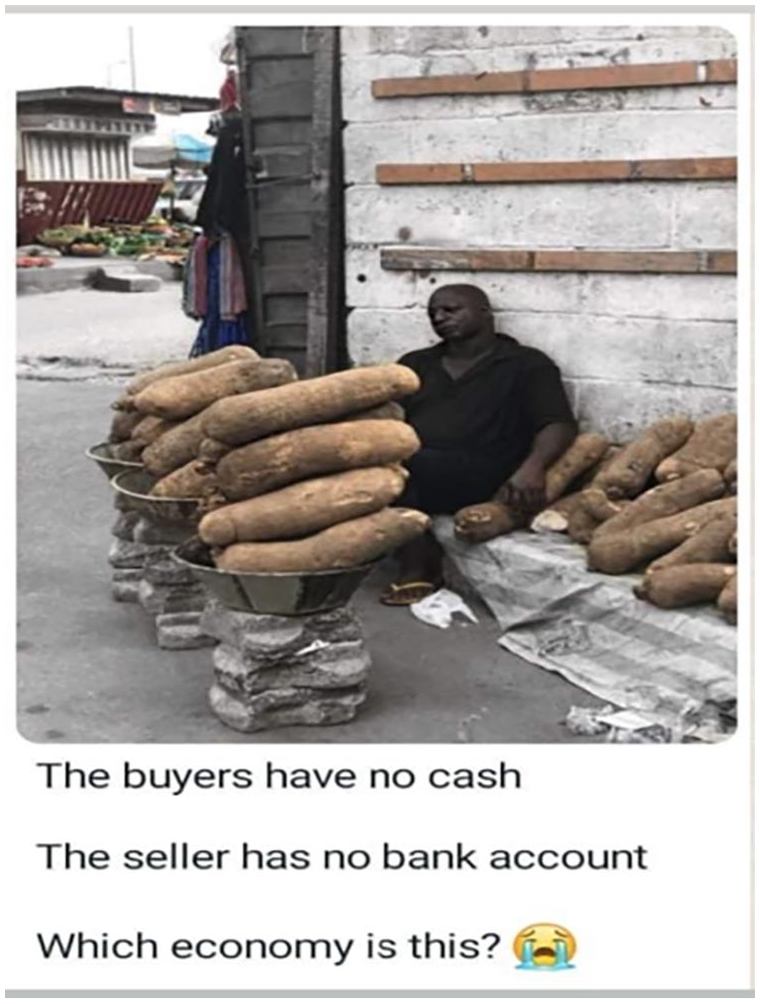
The buyers have no cash.
The discourse design of Figure 4 is a combination of visual and verbal resources. The meme is a remixed image produced from the picture of a Nigerian yam seller. The yam seller is presented in a sleepy posture with several tubers of yam displayed for sale. The predominant colours in the image are also black and grey, except for the tubers of yam which are presented in their original colours to lend credibility to the issue being foregrounded, trading. Some yam sellers in Nigeria hawk their products with wheelbarrows. The colours black and grey could sometimes signify loss, heaviness, grief and darkness (Adedina and Taiwo, 2020). These colours reinforce the unhappy condition of the represented participant in the meme. The object of trade, which are the tubers of yam, are given salience. The tubers are piled up in a large quantity with no buyer in sight. This strategy is adopted to emphasise that the cashless policy is having a negative effect on trading, a means of sustenance. Hence, this meme extends a negative representation of government as inhibiting the means of sustenance of the people, thereby causing untold hardship. This is reinforced by the weeping emoticon in the meme. The choice of the yam seller also ideologically represents ordinary Nigerians as victims of the cashless policy. The verbal resource in Figure 4 complement the visual resource to reiterate the frustrations of the victims of the cashless economy. The paradoxical expression: ‘The buyers have no cash. The seller has no bank account’ captures the static economic situation occasioned by the cashless policy. The third expression in Figure 4: ‘which economy is this?’ is a rhetorical question deployed to emphasise the negative implications of the cashless policy. This discursive-rhetorical strategy seeks to negatively represent and resist the Nigerian government’s cashless policy.
Fuel scarcity
The federal government of Nigeria proposed to remove the fuel subsidy in the heat of the cash mop-up exercise. This heightened tension in the polity, especially because the Nigerian electorate was preparing for the general election. Things became topsy-turvy and people had to go through a lot of stress to get things sorted. This is represented in Figure 5.
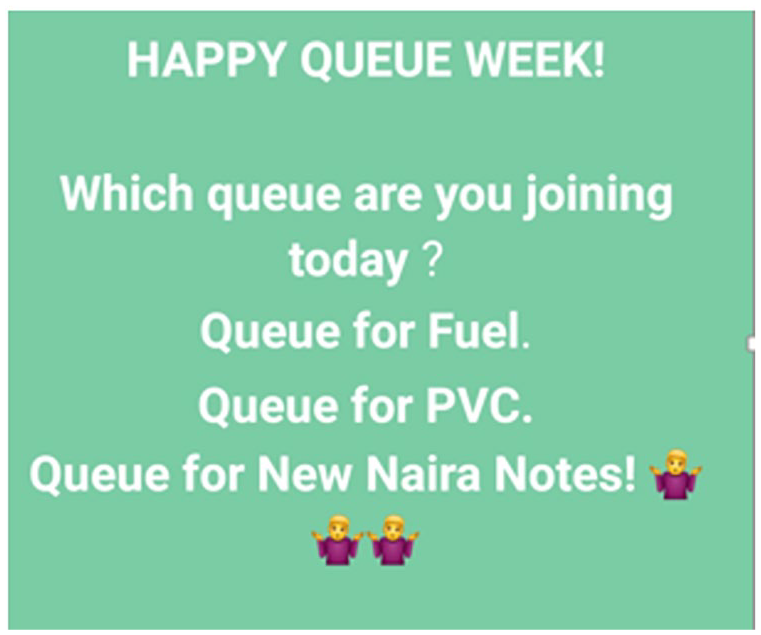
Queue for everything.
Figure 5 is produced to reveal the hassles that Nigerians went through when preparation for the 2023 general elections was rife. The discourse design of Figure 5 is almost made up of verbal resources except for the emoticons at the end of the linguistic expression indicating bafflement. This suggests resistance on the part of the represented participant who, plausibly, wants an explanation to why government will subject people to such unnecessary stress. The sarcastic expression: ‘Happy queue week!’ is a combination of the upper case and bold fonts. This discursive strategy is deployed to emphasise the magnitude of queue, and by extension, discomfort that Nigerians were subjected to during this period. The repetitive use of the exclamation mark emphasizes that ordinary Nigerians cannot escape queues before they can gain access to basic social services. The punny repetition of the word ‘queue’ for about five times in the meme suggests stalemate and reiterates the fact that people had to go through seemingly unending stress to access the naira, gasoline or their permanent voter card (PVC). The first expression after the headline is presented in a question format: ‘which queue are you joining today?’ This discursive strategy also reiterates the fact that Nigerians are deprived of unhindered access to basic services. The use of the generic pronoun ’you’ in the expression suggests that the generality of the common masses is affected and reiterates the ideological construction of the ordinary Nigerians as victims of unfavourable governmental policies. The other lexical expressions identify the various social services that Nigerians queue to access. These include ‘fuel’, ‘PVC’ and ‘new naira notes’. The expressions are strategically deployed to signify the social (fuel is needed for mobility); political and economic sectors of the country. By implication, therefore, social, political and economic activities in the country were grinded to a halt while the queues persisted. Importantly, fuel is enlisted as the first social service that people had to queue for. This accentuates the importance of this product in the Nigerian state. Without it, mobility is almost impossible. Without mobility, people cannot go to the electoral office to get their voter cards or even visit the bank to make cash withdrawals. In essence, the meme suggests that gasoline scarcity has ripple effect on other socio-political activities Nigeria. In Figure 5, the verbal resource and the emoticons combine to negatively represent the Nigerian government as well as expose its anti-progressive ideology.
Insensitivity of government
The insensitivity of government to the plight of the Nigerian masses is instantiated in some of the memes selected for this study. Figure 6 is a representation of this theme.
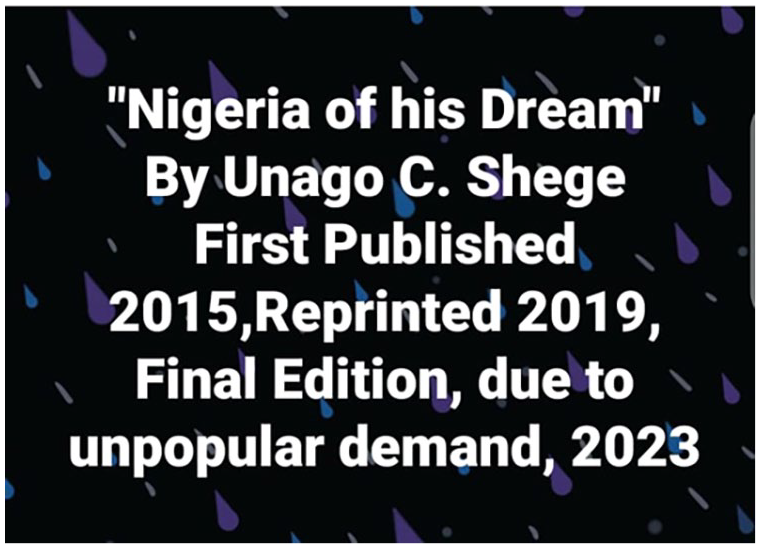
Unago C. Shege.
The discourse design of Figure 6 is made up of verbal resources. The meme is produced to negatively represent former Nigerian President Muhammadu Buhari’s government. Structurally, the meme is presented like the bibliographic details of a book. This discursive strategy is adopted to chronicle Buhari’s administration. The linguistic expression: ‘Nigeria of his Dream’ is presented in inverted commas to attribute it to another person, indicating exclusion/dissociation. This is reinforced by the deployment of the third person singular pronoun ‘his’ which, like the pronouns they and them, refers to the out-group. The expression: ‘Unago C. Shege’ is presented as if it is the author of the book: ‘Nigeria of his Dream’ whereas this is not so. ‘Unago C. Shege’, is formed from a blend of Pidgin [una means ‘you’ while go means ‘will’ in Nigerian Pidgin], abbreviation [the verb ‘see’ is commonly abbreviated as the letter ‘c’] and Hausa language [shege means problem, hell or an unpleasant situation in Hausa]. The expression loosely translates as ‘you will see hell’. This negatively represents Nigerian government, led by Buhari, as insensitive and one which intentionally inflicts pains on the Nigerian masses. Pun is essentially deployed as a rhetorical device in this meme to conceal Buhari’s identity. However, an understanding of the words in the meme suggests that he is the one being referred to. ‘First Published, 2015’, for example, refers to year 2015 when Buhari was newly elected as the executive president and head of the Nigerian government. ‘Reprinted 2019’ suggests the year Buhari’s second tenure in office commenced. Buhari’s perceived mis-governance climaxed towards the end of year 2022 and the beginning of 2023 with the introduction of the cashless policy and the proposed fuel subsidy removal. This further triggered people’s disapproval and resistance of his anti-people ideology as represented in the expression: ‘Final Edition, due to unpopular demand, 2023’. The word ‘final’ reiterates peoples’ unwillingness to continue to bear with the president’s inadequacies while ‘unpopular’ negatively represents Buhari’s government.
Hopelessness in government
Closely related to the theme of insensitivity of government is the hopelessness in government which is expressed in Figure 7. Nigerians are overtly religious. Hence, they often use religious sentiments as a respite from harsh socio-political and economic realities. This has further strengthened the irresponsibility and lack of accountability by heads of government at various levels of governance in the country: local, state, federal on the one hand, and legislative, judiciary and the executive, on the other hand (Eluu, 2018; Yesufu, 2016). Hopelessness in government and trust in God as a thematic preoccupation in the memes is exemplified in Figure 7.
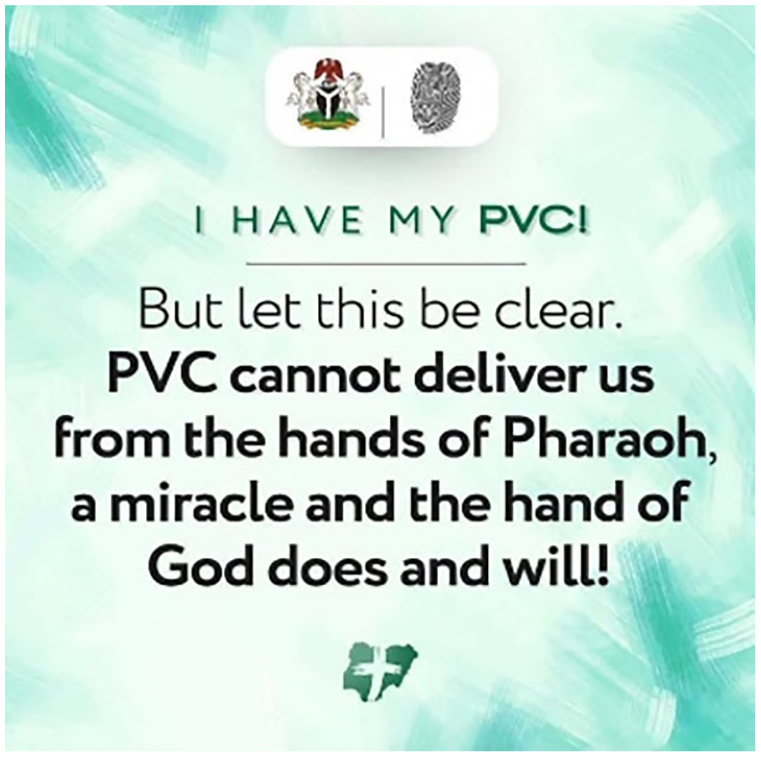
I have my PVC.
The discourse design of Figure 7 is a combination of visual and verbal resources. The meme focuses on the 2023 general elections in Nigeria. It is produced in the similitude of Nigeria’s Permanent Voter Card (PVC). The verbal and visual resources are placed on a green and white background just as the PVC. It is remarkable that green and white are Nigeria’s national colours. One of the visual resources is the image of the Nigerian Coat of Arms which buttresses the indigeneity of the issues and processes being portrayed. The second image is a thumbprint which reinforces the fact that the issue being addressed has connections with the Nigerian election. The third visual mode is the map which reiterates that the issue being projected is centred on the Nigerian nation. Rather than divide the map according to the nation’s geopolitical zones, the symbol of the cross is rendered across it. The cross in the Christian religion signifies Jesus Christ and redemption. By adopting this mode, the represented participant projects Jesus Christ as the one who can save the Nigerian masses from misrule. Thus, the meme is deployed to ideologically represent Nigerians as religious and negatively represent the Nigerian government as hopeless and lacking credibility. Remarkably too, the inscriptions are presented in paradoxes such as ‘I have my PVC, but . . . PVC cannot deliver’, and ‘. . . PVC cannot deliver us from the hands of Pharaoh, a miracle and the hand of God will’. This discursive-rhetorical strategy is utilized in the meme to reiterate the hopelessness in the Nigerian government and its systems. On the contrary, religion is positively represented as the escape route from the failures of the Nigerian government. The use of verbs ‘does’ and ‘will’ buttresses the meme producer’s conviction about the continuous ability of God to save. The allusion to Pharaoh is worthy of note. Pharaoh in the Holy Bible is represented as a devil, a stumbling block and one with an unyielding heart. The reference to him in the meme is an attempt to negatively represent Nigeria’s President Buhari, especially because as Pharaoh was head of the Egyptian government, Buhari was the Head of government in Nigeria. Again, the allusion to Pharaoh could indicate the attribution of some divine, god-like powers to the Nigerian president and the ideological representation of the Nigerian masses as feeble. This reiterates the nature of social relations that exists between the government and the masses. However, the lexical choice of ‘miracle’ and the ‘hands of God’ (Psalm 118: 16) in the meme seeks to resist Buhari’s perceived invincibility and reiterate the represented participant’s belief in the supremacy of God and His ability to deliver the common Nigerians from poor governance.
Nigeria on the edge of a precipice
The few months preceding Nigeria’s general elections witnessed a heated polity. There were protests in various parts of the country. The Nigeria Labour Congress declared a national strike action. Work and business places were largely deserted either because people had no fuel to travel to their places of work or there was no cash, or worse still because of the fear of being harassed or maimed. Many bank structures were destroyed while bank officials were exposed to threats to their lives on a daily basis. Some filling stations were also set on fire by irate residents who were determined to vent their frustrations on suspected culpable stakeholders. There was a breakdown in governance, a situation that was close to anarchy. This era of heightened tension is captured in Figure 8.
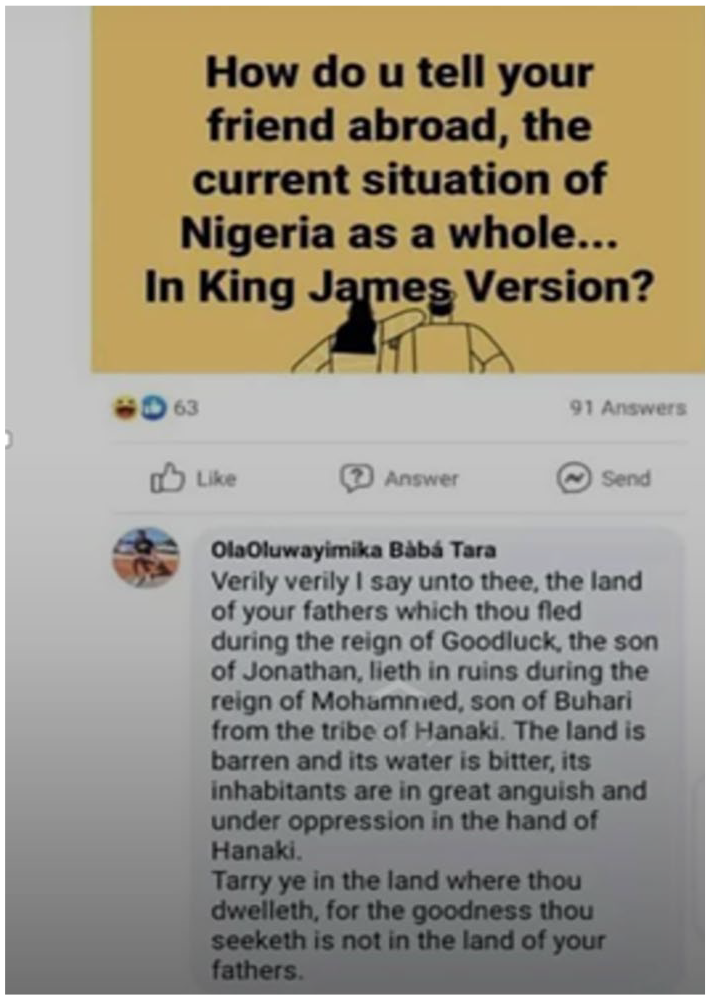
King James version.
Figure 8 is produced to parody the Nigerian situation during the pre-election crises. The meme is a remixed image which is, plausibly, produced from the screenshot of a social media (Facebook) page. The discourse design of the meme essentially consists of verbal resources. This is accompanied by an emoticon of laughter and like button. The meme is designed in a dialogic mode. This strategy is deployed to lend credibility to the process being projected and also present it as a product of public opinion. This is reinforced by ‘63 likes’ and ‘91 Answers’ as well as the mentioning of a seemingly credible source (see van Dijk, 2001) ‘OlaOluwayimika Baba Tara’. The question: ‘How do u tell your friend abroad, the situation of Nigeria as a whole . . . in King James Version?’ is posed by the meme producer. The expression is presented in the Nigerian English marked by the use of abbreviation of ‘you’ as ‘u’ and incomplete expression: ‘How do you tell your friend abroad [about] the current situation of Nigeria?’ This linguistic pattern is deployed to ideologically construct the represented participant as one with a disjointed thought pattern, which is likely occasioned by the intolerable state of the country. The question is succeeded by a response which is, probably, the most relevant to the question, considering that Facebook often displays only the most relevant reaction to a post. The response is presented in a punny manner with the meme producer playing around the names of former Nigeria’s presidents. For example, ‘the land of your fathers which thou fled during the reign of Goodluck, the son of Jonathan’ refers to the administration that preceded Buhari’s which was led by Goodluck Jonathan. The expression: ‘The land . . . lieth in ruins during the reign of Mohammed, son of Buhari, from the tribe of Hanaki’ seeks to negatively represent Buhari’s administration as frustrating, oppressive and anti-people. Even though there is no tribe by the name Hanaki in Nigeria or elsewhere, the name is believed to be a parody of the Biblical Anak, one of the descendants of Canaan whom the Israelites had to contend with and conquer before they could enter the Promised Land (Numbers 13: 22–33). With this allusion, Buhari is negatively represented as the biblical giant/adversary who has to be overpowered for peace to be restored. Also, onomatopoetically, the name ‘Hanaki’ sounds like anarchy which refers to a situation where there is a breakdown in governance. Both interpretations of ‘Hanaki’ portend a negative representation of Buhari. Several other imageries are used to reinforce the dangerous state of the Nigerian nation occasioned by Buhari’s anti-people ideology. These include: ‘the land is barren’, ‘its water is bitter’ and ‘its inhabitants are in great anguish and under oppression’. The deployment of negative qualifiers such as barrenness, bitterness, anguish and oppression are rhetorical tropes deployed by Nigerians to negatively represent Buhari’s government/resist harsh government policies. Hopelessness in government and Nigeria is further externalized by the meme producer in the expression: ‘Tarry ye in the land where thou dwelleth, for the goodness thou seeketh is not in the land of your fathers’.
Observations and conclusion
This study has explored the way Nigerians have used Internet memes to express their opinions on the perceived anti-welfarist’s ideology of Buhari led administration and criticise many of its policies that have negatively impacted on them. These policies include: cashless policy, naira redesign, proposed fuel subsidy removal as well as the perceived general insensitivity of government to the plight of the Nigerian masses. The findings reveal that the meme producers use remixed images, dummy image, texts and emoticons in the production of the memes, and deploy metaphor, sarcasm, paradox, repetition, rhetorical question, imagery and pun as rhetorical-discursive strategies to pass on their messages. Through the memes, the meme producers are able to expose the leadership failure of the Nigerian government and other socio-political stakeholders, and establish that the Nigerian government, under Buhari, was driven by an anti-people ideology, which are resisted in the memes. By appropriating the semiotic resources, as drawn from Kress and van Leeuwen (2001), the meme producers are able to critically appraise Nigeria’s government under Buhari’s leadership, expose the leadership failure of the Nigerian president as well as other financial stakeholders, condemn the unpatriotic and opportunistic tendencies of some socio-political stakeholders, condemn unfriendly government policies, and evoke the negative, other representation of the government, as projected in van Dijk’s (2001, 2006) socio-cognitive approach to critical discourse analysis. Using this combined theoretical framework, this study has been able to instantiate how Nigerians use Internet memes to express their displeasure with the Nigerian government as well as protest against government’s anti-people policies.
Footnotes
Declaration of conflicting interests
The author declared no potential conflicts of interest with respect to the research, authorship, and/or publication of this article.
Funding
The author(s) disclosed receipt of the following financial support for the research, authorship, and/or publication of this article: The author acknowledges the Alexander von Humboldt Foundation, Germany, for sponsoring their research stay at the University of Hamburg.