




Abstract
This article explores the under-researched area of discursive tactics employed in terrorist threat texts that exploit moral values to constantly justify violence, fostering a ‘discourse of justification’, disaffiliation and conflict. Employing a discursive pragmatic analysis, it delves into the tactics of violent extremists associated with jihadism and far-right ideologies. Utilising the Appraisal framework and the ‘moral disaffiliation’ strategy, the study uncovers verbal practices shaping a dynamic of justification. Findings reveal threateners’ involvement in regulatory discursive functions – manipulation, deontic-retaliation, and boulomaic effect – and practices of ideologically positioning functions – discrediting, blaming, denying and (de)legitimating. The analysis highlights the construction of negative victim individuals and societies while praising the threatener/in-group, anchored predominantly in values of propriety, capacity, valuation and veracity, as the primary dynamic of threatener-victim disalignment. This study contributes insights into threatener profiling, motivations of violence and future research on threat-genre rhetorical structure analysis.
Keywords
Introduction
Communicated threats operate within the context of threatener-threatened interpersonal relations and attitudes (Etaywe, 2022a; Gales, 2011; Storey, 1995), making threatening communication an intersubjective process par excellence. Forensic discourse analysis of criminal texts, particularly those involving terrorist threats, seeks to unravel these interpersonal elements, including the ideological schemas of violent extremists (Shuy, 2021) and text functions influenced by ideologies and context-dependent factors (Coulthard et al., 2017). Central to this exploration, thus, is the dichotomous portrayal of victims and threateners, revealing the inherent criminality in extremist threat texts (Etaywe, 2022a, 2023a). As Van Dijk (1995) emphasises, such dichotomy stems from language users’ ideologies, exposing the contextual embeddedness of discourse. In terrorist discourse, akin to other polarised discourses (e.g. Van Dijk, 1998, 2015), language serves to convey characterisations and evaluations, highlighting positive aspects of ‘Us’ and negative aspects of ‘Them’, while downplaying negative details about ‘Us’ and positive aspects about ‘Them’ (Etaywe, 2023b, 2023c; Etaywe and Zappavigna, 2021). This positive/negative representation constructs deontic versions of reality, justifying terrorist acts and exerting social impact (Etaywe, 2022b). The extremist evaluative style, termed the ‘extremist appraisal signature’ (Etaywe, 2022a, 2024; Etaywe and Zappavigna, 2023), emerges as a distinctive feature of terrorist-threatening communication. However, a limited understanding exists regarding how the ‘appraisal signature’ (Martin and White, 2005: 208) manifests and functions in terrorist threat texts concerning the writer’s or threatener’s attempt to influence or ‘de-bond’ with victims and justify violence against them.
This paper investigates two main aspects: (i) discernible patterns of meanings and values construed in discourse as interpersonal bonds in terms of the social relations they enact and moral foundations they establish for threatener-victim disaffiliation (i.e. value misalignment), and (ii) operational mechanisms through which these patterns justify violence and influence victims’ behaviour. The study emphasises tactics and associated evaluative language patterns contributing to constructing a justification dynamic, including blaming, denial (D’Errico and Poggi, 2012; Hansson, 2015; Van Dijk, 1989, 1992; Wodak, 2006), discrediting (Poggi et al., 2011) and (de)legitimation (Van Leeuwen, 2007), detailed in the Results and Discussion Section. The research employs a case study approach, examining threat texts from three transnational violent extremists: Osama bin Laden (henceforth OBL, former al-Qaeda leader), Abubaker Shekau (henceforth Shekau, former Boko Haram leader) and the far-right ethnonationalist Australian individual Brenton Tarrant (henceforth Tarrant). The study does not aim to compare and contrast discursive practices used by jihadists versus far-right extremists, as this is beyond the scope of the research. Instead, its focus is on providing a representation of discursive practices employed in the justification process within the context of terrorist threat texts.
Examining terrorist threat texts through Bourdieu’s (1991) lens, as products shaped by their socio-historic and socio-political context, underscores the significance of investigating them within a framework that views language as an integral part of a broader semiotic system of meanings. This system revolves around an author’s culturally and morally informed attitudes, values and worldviews. Employing the Appraisal framework (Martin and White, 2005) and the ‘moral disaffiliation’ principle (Etaywe, 2022a, 2024), rooted in the Appraisal framework (elaborated in Section Three), this study engages in a discursive pragmatic analysis (e.g. Blitvich and Sifianou, 2019; Zienkowski et al., 2011). Given the pragmatic focus of appraisal, the study aims to illustrate how discursive pragmatics facilitates a systematic analysis of attitudinal evaluation and stance in forensic texts. Aligned with Zienkowski (2011: 5) and White (2011: 14), this includes capturing how these elements operate in entire texts and text groupings as an ongoing and intersubjective process, as well as understanding the role of context and form concerning the realisation of these functions. This also involves explaining linguistic phenomena by reference to the functional demands placed upon language by its users.
The paper begins with a critical review of interdisciplinary literature on threatening communications, highlighting the role of linguistic investigative analysis in establishing evidence of real threats. It offers an overview of relevant analytical tools, followed by a description of the dataset and analytical procedure. The results and discussion section explores identified patterns of attitudinal meanings, contested bonds and macro text functions, and elucidates how these semantic patterns dynamically contribute to justifying violence.
Literature review: Interdisciplinary perspectives on threatening communications
Threatening communications in threat assessment practice
The extensive cross-disciplinary literature on threatening communications highlights the interdisciplinary nature of the subject, particularly in the context of terrorist-threatening communications. This literature spans diverse disciplines such as security, psychology, sociology and anthropology (e.g. Atran, 2016; Baumgartner et al., 2001; Meloy, 2001). Despite the diversity, these studies share a common interest in investigating threats as perceived possibilities of harm or potential dangers (Meloy and Hoffmann, 2014: 3). This study contributes to behavioural predictors and criminal profiling by examining acts like discrediting and blaming within threatening communication. These acts offer insights into potential violence and aggressive linguistic personae, enabling threat analysts to anticipate and protect potential victims (e.g. Meloy and Gill, 2016).
In non-linguistic research, violent behaviour predictors delve into the offender’s emotions, perceptions, dispositions, motivations, interests, agendas and other elements informing violent behaviour and communication (e.g. Meloy et al., 2008; O’Hair et al., 2011). However, given that terrorism is a multifaceted sociopolitical construct and so is terrorist communication (Bhatia, 2009), it necessitates a more comprehensive exploration of its discursive practices. This linguistic study focuses on the nuances of attitudinally loaded language in terrorist texts, aiming for a fuller understanding of the morality of terrorism (e.g. Seto, 2002) and decoding the author’s emotions, perceptions, stances and justifications.
Linguistic study of threat texts in criminal contexts: Real threat and the element of coercion
Within linguistics, the analysis of threatening communications often centres on statements conveying menacing utterances or an intention to cause harm, disturbing victims’ peace of mind and impacting their rights (Black, 1995: 1154; Etaywe, 2023c; Kniffka, 2007; Olsson, 2008). This analysis extends to various incriminating threat texts, including robbery, extortion, blackmail, ransom notes, hate mail and terror mail (Olsson, 2008). Understanding the nature of these types of threat texts aids in establishing evidence of criminal intent. For example, in ransom notes, a criminal threatens to return what is in their possession, dead or alive. In extortion, a criminal threatens to expose information unless bribery is paid; and in robbery, a criminal threatens to cause injury unless some belongings are handed over (Kniffka, 2007; Olsson, 2008). This present study delves into the discursive criminal nature of justifications for threatened violence within terrorism, addressing the issue of diversity of threat text types and contributing to efforts to continue categorising threat text types and their characteristic features as stressed by Kniffka (2007: 163–164).
The study delves into the criminal nature of terrorist threatening communication, acknowledging the harm inflicted on individuals and the public. Linguistic research reveals the multifaceted nature of threats, showcasing diverse reasons for their communication within the broader category of speech acts, contingent on context (Fraser, 1998: 159–160). Threats serve various communicative functions such as expressing anger, humour, intimidation, realising desired outcomes, challenging authorities, drawing attention, saving face, demonstrating seriousness and influencing negotiations. The spectrum of threats extends beyond harm, encompassing legal and worrisome forms. Some threats aim to control or regulate behaviour, seek intervention for child safety, pursue legal action, initiate strikes, or serve as warnings, making them legal but unsettling (Fraser, 1998). Conversely, illegal threats, deemed ‘dangerous’ by assessors, instil fear or intend harm, necessitating law enforcement involvement (Fraser, 1998; Gales, 2013). In the context of illegal threats, linguists grapple with ‘real threats’ characterised by a deliberate intent to harm, prior disclosure to the target and coercion by social actors possessing the power to inflict injury for compliance or non-compliance (Martínez, 2013: 194). The study focuses on these ‘real’, illegal and dangerous threats, particularly those publicly communicated in terrorist contexts. It explores the communicative functions embedded in these threats, with a significant emphasis on coercion as a central theme (Kniffka, 2007: 162). The coercive power of threat texts becomes a pivotal element in the legal consideration of threats, aligning with Martínez’s and Kniffka’s perspective, which underscores the threatener’s willingness and capability to cause harm, viewed as a socially constructed act manifested in the threatener’s control over intention and capability (e.g. Bourdieu, 1991: 8). This study exclusively scrutinises texts from ‘genuine’ violent extremist group members, excluding ‘peripheral’ or non-violent extremist ideology members.
Key current approaches to examining the functions of threat texts
A productive line of research into communicated threats is the pragmatics-based approach, focusing on the internal properties of single-sentence utterances conceived as ‘the speech act of threatening’ (Berk-Seligson and Seligson, 2016; Culpeper, 2011; Limberg, 2009; Shon, 2005; Storey, 1995). According to this research tradition, the function of the speech act of threatening is of a ‘directive-commissive’ illocutionary point (Salgueiro, 2010: 214); that is, an utterance aims to influence the threatened party to (not) do something and represent a commitment by the threatener to undertake the proposed action (e.g. Searle, 1999). However, the status of a speech act and its function cannot always be determined by examining sentence internal properties (Hasan, 2016). This insight calls for a complementary perspective.
Attention, in response, has been drawn to the co-text of a threatening speech act to account for the wider linguistic context and the threat function (Muschalik, 2018). This Muschalik’s (2018) discourse analysis approach to threat texts has identified two functions of threats: (i) manipulation, as in ‘If you call the police, I will kill you’; and (ii) retaliation, such as ‘You made a mistake. You will die hard’. This categorisation depends on whether a threat utterance is articulated before or after an offence made against the threatener or their in-group, hence anticipatory or retrospective. While some previous research at the sentence level (e.g. Martínez, 2013) only considers the coercive aspect of the manipulative function of threats, Muschalik has extended these functions. Nevertheless, Muschalik recommended further research focus on more fine-grained categorisation of these as well as new influence tactics, which is a contribution of this article.
This study presents a complementary perspective using text-based analysis of the threat text functions. It concerns itself with the attitudinal and moral motivation of communicated threats, along with contested values social bonds therein, to categorise threat functions and justification practices – a dimension receiving limited attention in terrorist threat texts. This study takes a discourse analysis approach, viewing behaviour-regulatory functions like manipulation as inherently discursive dimensions focusing on polarised semantic structures of positive self-presentation and negative other presentation (e.g. De Saussure and Schulz, 2005; Van Dijk, 2006). The study aligns with discourse analysis research testing whether linguistic features in threateners’ stances could serve as evidence of commitment to and justification of communicated threats (e.g. Gales, 2011). Focus on stance indicators and how evaluative language operates to forge moral value-disalignment – that is, ‘moral disaffiliation’ (Etaywe, 2022a, 2024) – can yield insight into the role of negative evaluations of others or alternatively ‘coercive impoliteness’ (e.g. Culpeper, 2011: 233) in achieving disalignment between threateners and their victims.
Appraisal and disaffiliation
The analytical tools employed in this study are grounded in Systemic functional linguistics (SFL), a social semiotic theory of language (Halliday, 1978). The SFL focus on semantics and paradigmatic relations, key language properties, has proven highly effective as a foundation for practical applications in linguistic analysis for forensic purposes, providing evidence of meaning-making and semantic patterning (e.g. Nini and Grant, 2013; Zappavigna et al., 2008). Given the emphasis on interpersonal evaluative meanings in this study, the Appraisal framework (Martin and White, 2005) is used. The framework proves valuable for capturing subtle interpersonal meanings, exploring the rhetorical mechanisms of ideological positioning and value alignment with audiences, and providing a means by which language user aligns or disaligns themselves with individuals holding similar or dissimilar social positions (White, 2011).
The Appraisal framework presents a discourse semantic approach to evaluative language, consisting of three interacting systems of meaning:
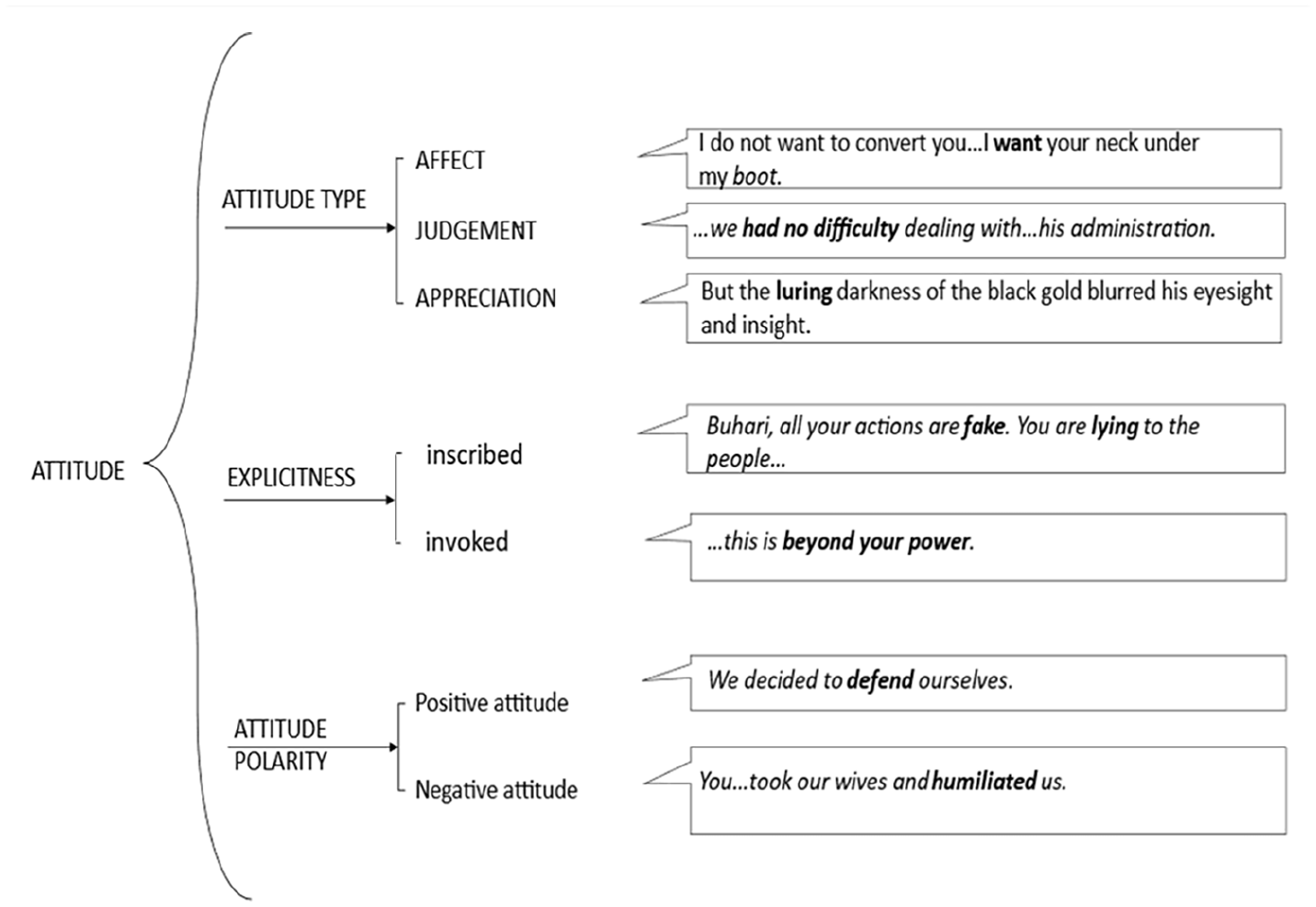
Attitude system (adapted from Martin and White, 2005).
The
Considering that interpersonal and ideational social functions of language are always spoused (Halliday and Matthiessen, 2014), this study examines multiple functions simultaneously, offering a more comprehensive analysis of a text’s style and meaning potential. This intertwining is also key to arguing for how threat texts forge disalignment with the victims, the concept of ‘moral disaffiliation’ is adopted (Etaywe, 2022a, 2024), shedding light on the ‘direct link’ between social values and evaluative language that is essential for negotiating community and social affiliations (Millar and Hunston, 2015; Thompson and Alba-Jues, 2014: 6). The study takes meanings and values construed in discourse as interpersonal bonds in terms of the social relations they enact. That is, in addition to the positioning and appraising functions of the evaluative acts in terrorist threat texts, they also have a disalignment function.
The main analytical unit used in the disaffiliation analysis is akin to affiliation analysis grounded in SFL, the coupling of ideational and attitudinal meanings (Knight, 2010). That is, the combination of the social function by which language represents the world of experience (the ideational) and the function by which social roles and relationships are constructed (the interpersonal) (White, 2011). The main assumption of affiliation is that social bonds are realised in discourse as ‘couplings’ (Martin, 2010) of ideational and attitudinal meanings through which participants discursively co-identify (Knight, 2010). This is based on Martin’s insight that we do not simply affiliate with feelings but with feelings about phenomena ‘and the activities [people] participate in, however abstract or concrete’ (Martin, 2008: 57–58). In disaffiliation, however, we have an instance of values being rejected and bonds are positioned as unshareable, hence ‘a sense of alienation sets in’ (Martin, 2002: 196).
Acts of disaffiliation create a sense of alienation, detachment and discord through dissonance, conflicting values, emphasising differences and discouraging the formation of shared connections or attitudinal rapport among readers. For example, the following extract of a clear dichotomous representation (‘you’ versus ‘us’) incorporates a coupling of the ‘Christians’ (bold) with negative
You
Akin to affiliation analysis, this perspective on social disaffiliation draws on Martin and White’s (2005) Appraisal framework to systematically explain how attitude in these couplings is realised through evaluative language across three semantic regions:
Method
Dataset
Twelve post-9/11 written terrorist public statements were analysed in this study. Table 1 shows the title and word count of each text. The choice of the texts was based on the need to provide a representation of threat texts (which are made scarcely available due to local regulations on online content) by transnational terrorist organisations from jihadist and far-right violent extremism ideologies. The adherents are considered the most lethal actors worldwide (Global Terrorism Index, 2020). In addition, a forensic linguist usually works with already provided data, regardless of its size, to analyse the language used as evidence (Shuy, 2011). The texts analysed present a span of time following the 9/11 attacks on the USA and from a variety of geographical, socio-cultural and political contexts and ideological backgrounds.
Overview of the dataset.
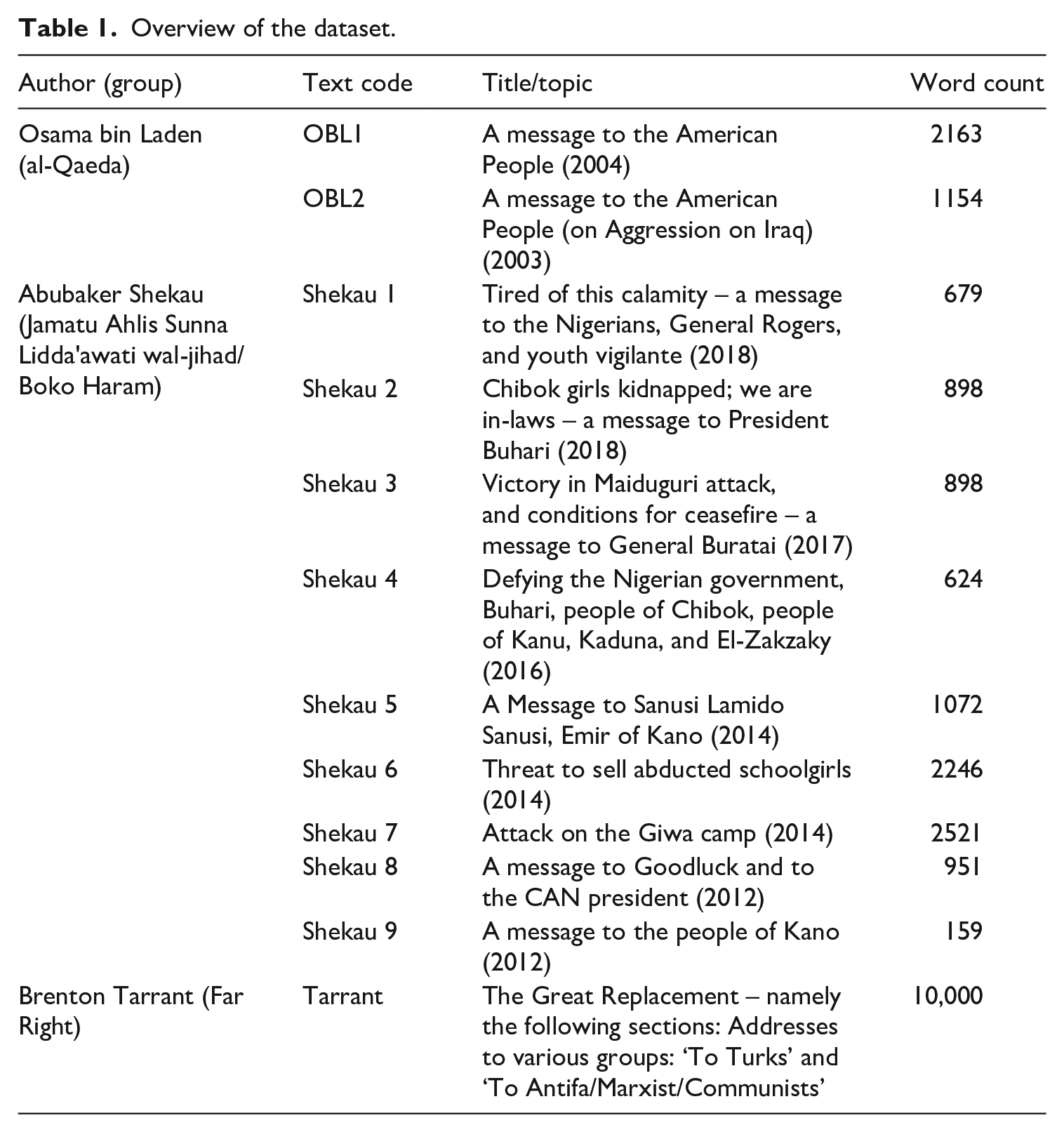
The terrorist public statements are texts made available online by the associated terrorists and are not privately owned data. The texts were produced by three terrorists (See Table 1 for an overview of these texts). The first is Osama bin Laden (OBL) (al-Qaeda) who dedicated himself to a violent global struggle against the United States of America (USA) and his two texts were directed at the people of the United States. The second terrorist is Abubaker Shekau (Boko Haram). Shekau’s terrorist narrative was responsible for recruiting violent actors on a massive scale and threatened the stability of Nigeria’s federal government and neighbouring countries. Shekau’s nine texts were produced between 2012 and 2018, and were made public by Nigerian media outlets, namely the ‘Sahara Reporters’ and ‘Premium Times’ websites. The third terrorist is the far-right, white supremacist, ethnonationalist Australian man Brenton Tarrant. His manifesto, ‘The Great Replacement’, is used in this paper. The manifesto was published before Tarrant attacked two mosques in Christchurch, New Zealand, in 2019. The manifesto communicates messages, including threatening messages against Communists, Antifa, Marxists and Turk, and texts inciting Christians and European men against, for example, immigrants, Muslims and democrats.
Analytical procedure
This Subsection outlines the step-by-step procedures employed to investigate the patterning and functions of bond types in a terrorist’s threat text, characterising the appraisal signature or evaluative style. It describes how these patterns contribute to the process of disaffiliation between primary social actors, specifically, threateners and their victims and how they operate to justify violence:
Coding scheme for the text analysis.
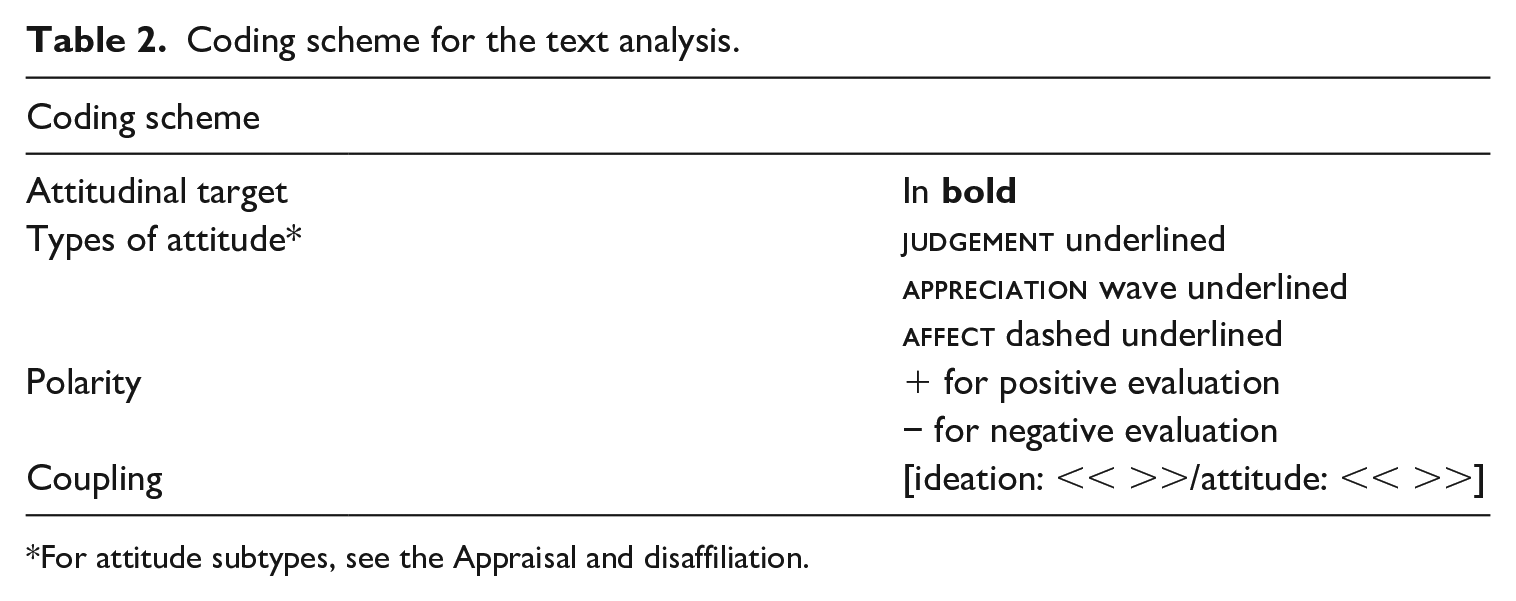
For attitude subtypes, see the Appraisal and disaffiliation.
incorporates a coupling of the ‘America’ with negative
Aligned with Hurt and Grant’s (2019) analytical value of a focus on victims as the main topic of threat discourse, this study focuses on references to victims as primary participants and as the target of value-disalignment (with threateners). The threateners and their victims were taken as general ideations or attitudinal targets that facilitate disalignment and (re)positioning by acting as loci of attitudinal and moral evaluations – that is, ‘category-bound features’ (Antaki and Widdicombe, 1998: 3–4).
The style of bonding patterning and functioning is thought of as a form of evaluative coupling disposition (Etaywe and Zappavigna, 2021). That is, positive ‘we’ versus negative ‘they’ construction serves to present social groups in discourse as opposing networks of bonds that cause interpersonal tension and morally justified violence. By reference to
○ the types of
○ their associated subcategories (e.g.
the types of bonds and their ideological ground – be it ethical (i.e.
Identifying the types of bonds allows us to explore which attitudinal bases tend to receive a heightened rate of use and which bases are used frequently to justify disalignment, violence and victimising others. We argue that the moral ground for disalignment departs from a terrorist’s alleged ‘care’ or part of collective responsibility for the ingroup they claim to protect (e.g. Wilkins, 1992); that is, disaffiliation and threatened violence depart from a community-driven vantage point through attempting to influence the actions and positions of the victims and/or the members of their society.
●
○
○
○
●
○ Discrediting.
○ Blaming.
○ Denying.
○ De/Legitimating.
Results and discussion: Contested bonds and discursive practices in threat texts
The analysis reveals a prevalent strategy of positive self-presentation and negative victim portrayal. This approach articulates beliefs advantageous to threateners while discrediting, delegitimising and blaming victims. Evaluative couplings and bond types strategically align with three discursive macro-functions: ethical manipulation, retaliation and boulomaic effect (elaborated in subsequent subsections). These findings accord with Hermann’s (2003) assertion that threateners engage in regulating others’ behaviour and persuading social groups. Regulatory discursive macro-functions are evident in attempts to shape behaviour. The second activity involves threateners persuading and ideologically positioning individuals and groups through tactics such as discrediting, blaming, denying and (de)legitimating, which all operate to justify forceful actions. Evaluative couplings forming contested, disaligning bonds (e.g. victims’ impropriety) manifest in distinct patterns summarised in Table 3, offering a synoptic view of attitudinal bases fostering disaffiliation and morally justifying violence against victims (Note: Most frequent attitudinal bases are in bold).
Summary of the bases of bonds tabled as bases for disalignment.
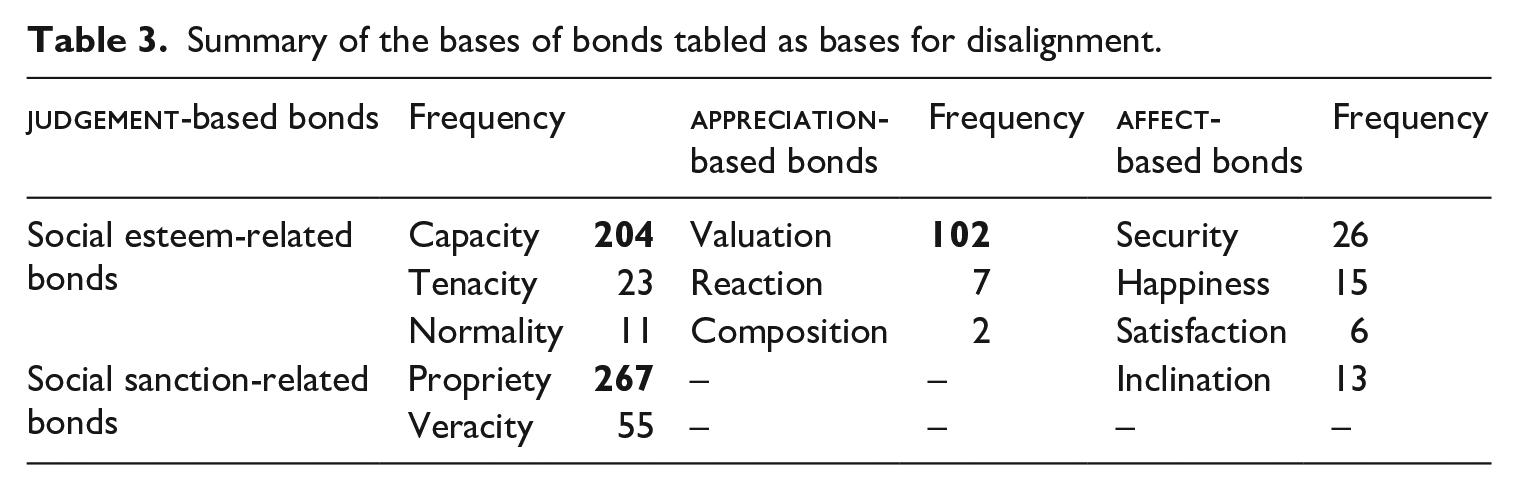
Table 3 reveals an elevated utilisation of
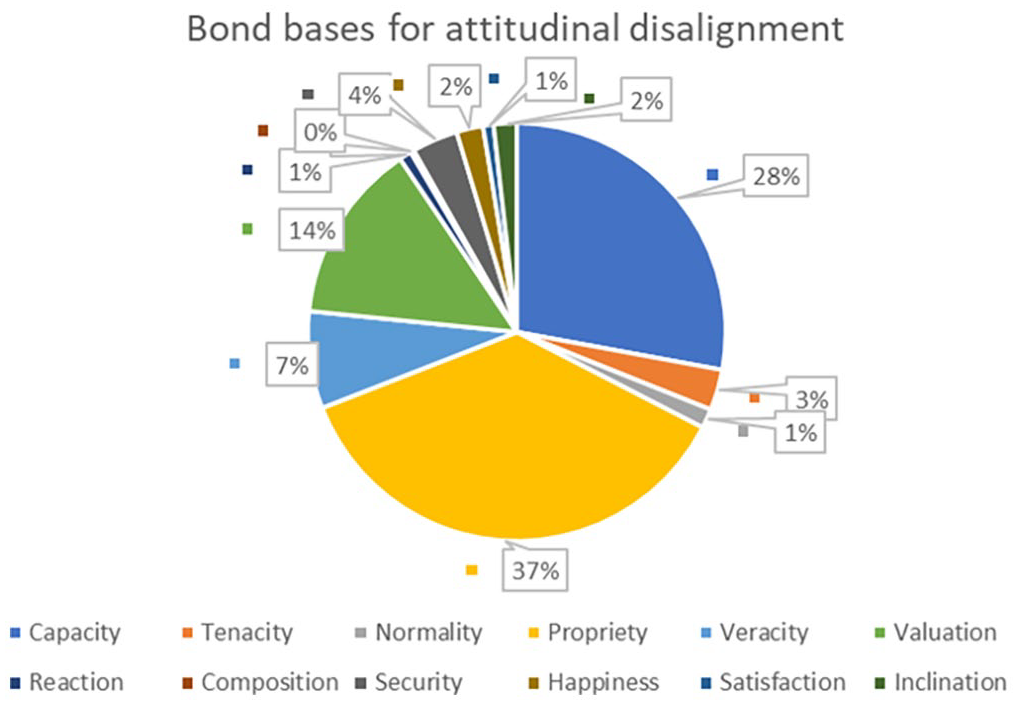
Frequency of attitude type-based bonds used in the threat texts.
The subsequent sections present an analysis and discussion of the discursive functions within threat texts and the corresponding justification practices employed to achieve these functions. Table 4 offers a summary of the threat texts, identifying instances of discursive functions in distinct textual segments, accompanied by manual counts. The analysis reveals manipulation as the predominant function, followed by retaliation and the boulomaic effect. Notably, seven instances of reported retaliatory acts are strategically used in manipulation (explained in the next Subsection). The overall percentages for each function are as follows: manipulation (73.68%), retaliation (18.42%) and boulomaic threat (7.89%). Further elaboration on these functions is provided in the subsequent subsections.
Summary of the discursive functions in the threat texts.
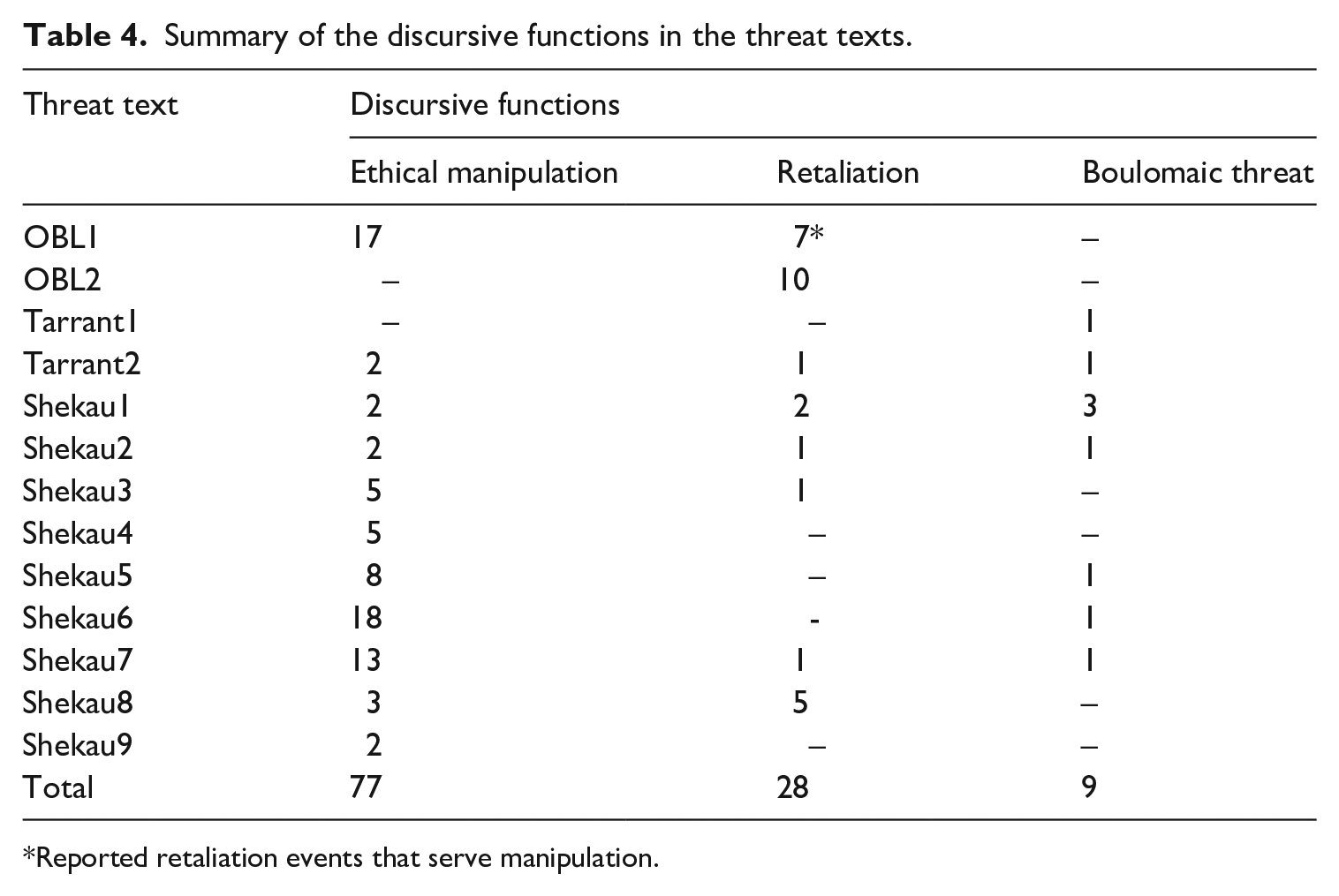
Reported retaliation events that serve manipulation.
Ethical manipulation and unveiling the dynamics of threatener-victim disalignment
Ethical manipulation (defined in the Method Section) characterises a terrorist threat text’s function, aiming to influence the threatened party’s behaviour for the benefit of the threatener’s ingroup. For instance, OBL1 exemplifies manipulative content, explicitly articulating its deterrence function and the avoidance of war costs in Iraq (Example 1 in bold). This aligns with Muschalik’s (2018) and Martínez’s (2013) coercive, manipulative threat functions, characterised by deterrence and/or compulsion in Sachs’ (2012) terms.
(1) People of America, this talk of mine, for you, concerns the ideal way
Ethical manipulation relates to actions or inactions by threatened audiences, utilising evaluative language to instantiate bonds justifying ethical avoidance of non-compliance. Achieving this manipulation involves threateners strategically utilising key bonds through discrediting, blaming, denying (including responsibility-shifting, framing, denial of intention and reversal) and (de)legitimating tactics, detailed and exemplified in subsequent subsections.
Discrediting
Discrediting, a primary tactic employed by threateners, is pivotal in creating disalignment between the threatener and the victim by tarnishing the image of the targeted audience, such as American citizens or specific entities like the Bush administration. This is achieved through critical, accusatory or insulting descriptions that challenge their credibility and capabilities. Grounded in Poggi et al.’s (2011) concept of discrediting in political discourse, this practice involves casting doubt on opponents by negatively evaluating their characteristics, vilifying dissidents and victims as opportunistic and untrustworthy, and simultaneously enhancing the threatener’s moral superiority. Discrediting is notably prominent in the texts of OBL and Shekau.
OBL strategically employs discrediting in his threat texts to sway the American people’s trust in their political leadership, particularly the Bush administration, and to influence anti-war sentiment. This serves as a precursor to urging Americans to protest the Iraq war and avoid a recurrence of the 9/11 attacks. In OBL1, Bush and his administration are portrayed negatively, being held responsible for the 9/11 attacks, benefiting corruptly from wars, and failing to protect Americans from al-Qaeda. OBL attacks Bush’s features of
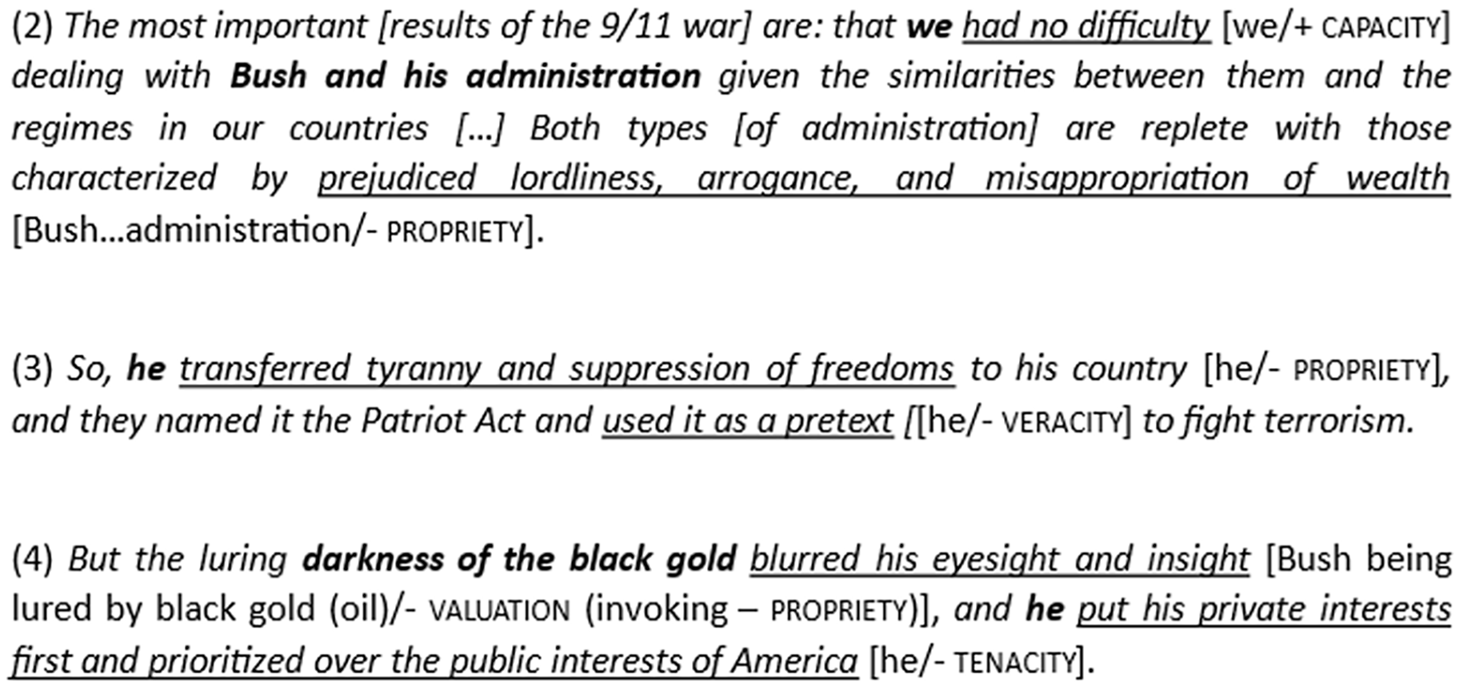
In response to perceived ethical shortcomings in the US political leadership, al-Qaeda is portrayed not only as capable of confronting the US leadership and troops but also as possessing superior morality (fighting against oppression) (Example 5). This self-moral empowerment contrasts with US Army Generals’
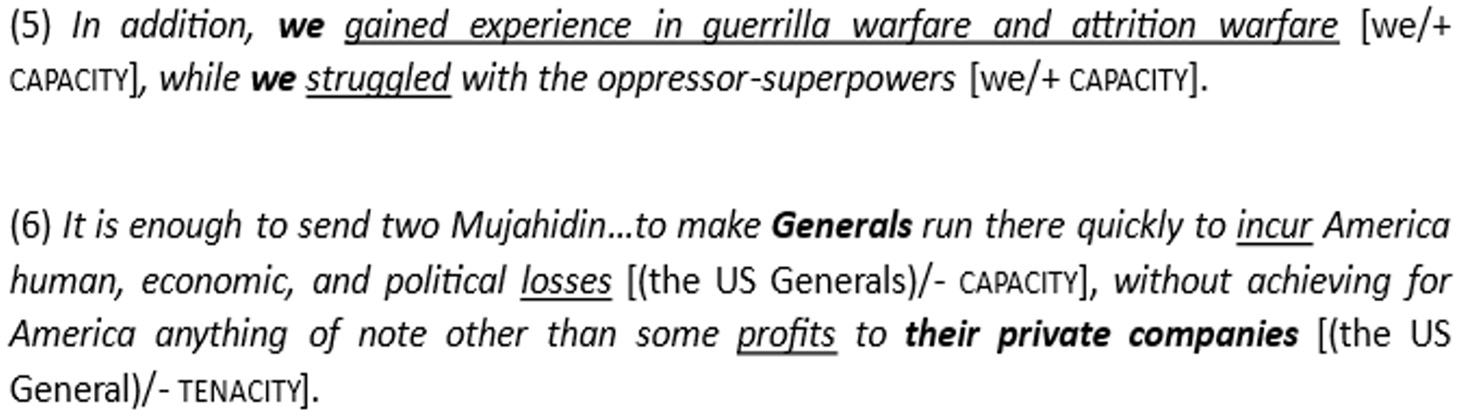
Discrediting is strategically employed to instil doubt about key aspects of the threatened audience, particularly the Bush administration. This aims to shape Americans’ perception of and relationship with their leadership, influencing their stance and actions towards ending the Iraq war. OBL employs discrediting to depict the American leadership as untrustworthy and incapable of securing citizens, emphasising the real losers as the Americans, not president-associated corporations like ‘Halliburton’. In terms of Poggi et al.’s (2011) and D’Errico and Poggi’s (2012) framework, discrediting enables OBL to challenge Bush’s benevolence, presenting him as a politician engaged in malevolent actions, aligning with the manipulative function of OBL’s threat texts. This construction serves to prompt the threatened audience to reconsider their ties with corrupt entities and position them as being with

Regarding Shekau’s act of discrediting, it serves to undermine governance and power image in Nigeria. Shekau discrediting tactics aims to establish his caliphate as an alternative to what he perceives as weak, dishonest and illegitimate governance. Shekau enhances his own
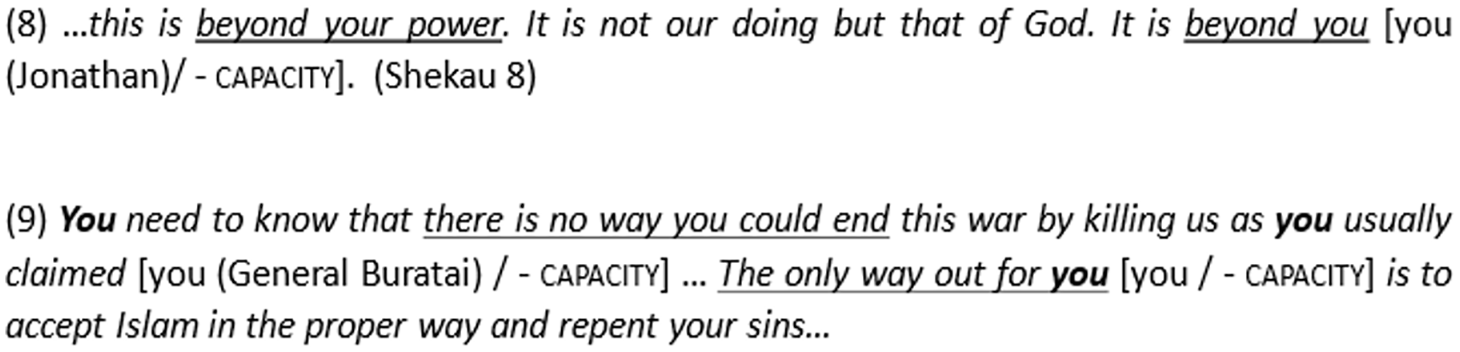
Shekau also strategically discredits opponents by linking them to negative
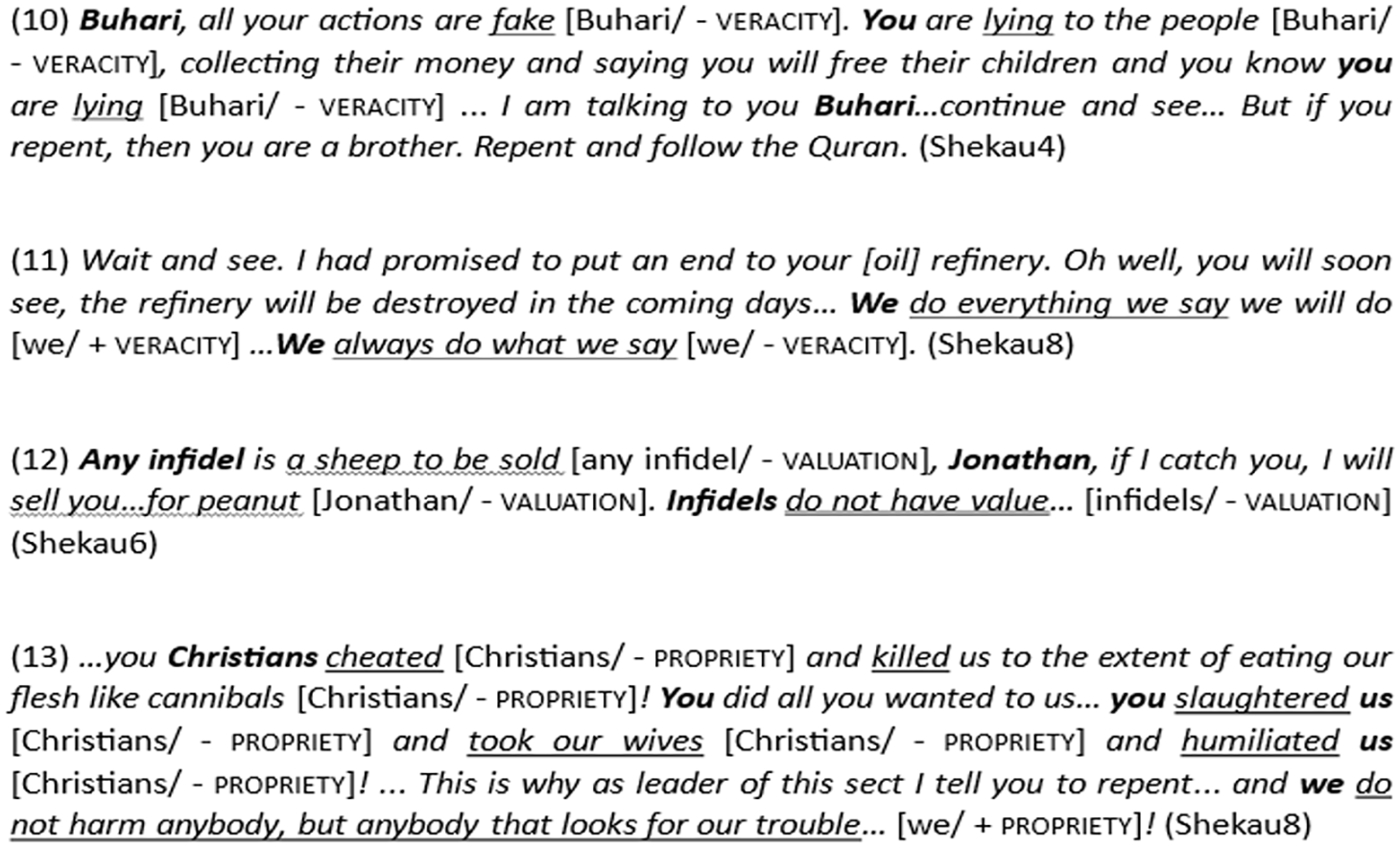
Blaming and denying: Responsibility and blame shifting
The tactic of blaming and denying is employed by OBL and Shekau to disalign threateners from responsibility and shift blame onto the victims. This manipulative strategy, rooted in Hansson’s (2015) blame-avoidance and Van Dijk’s (2006) blaming as a discursive manipulation, shapes audience perceptions of harm and agency. OBL, in OBL1, attributes the 9/11 attacks to Americans’ historical actions in Lebanon, casting them with
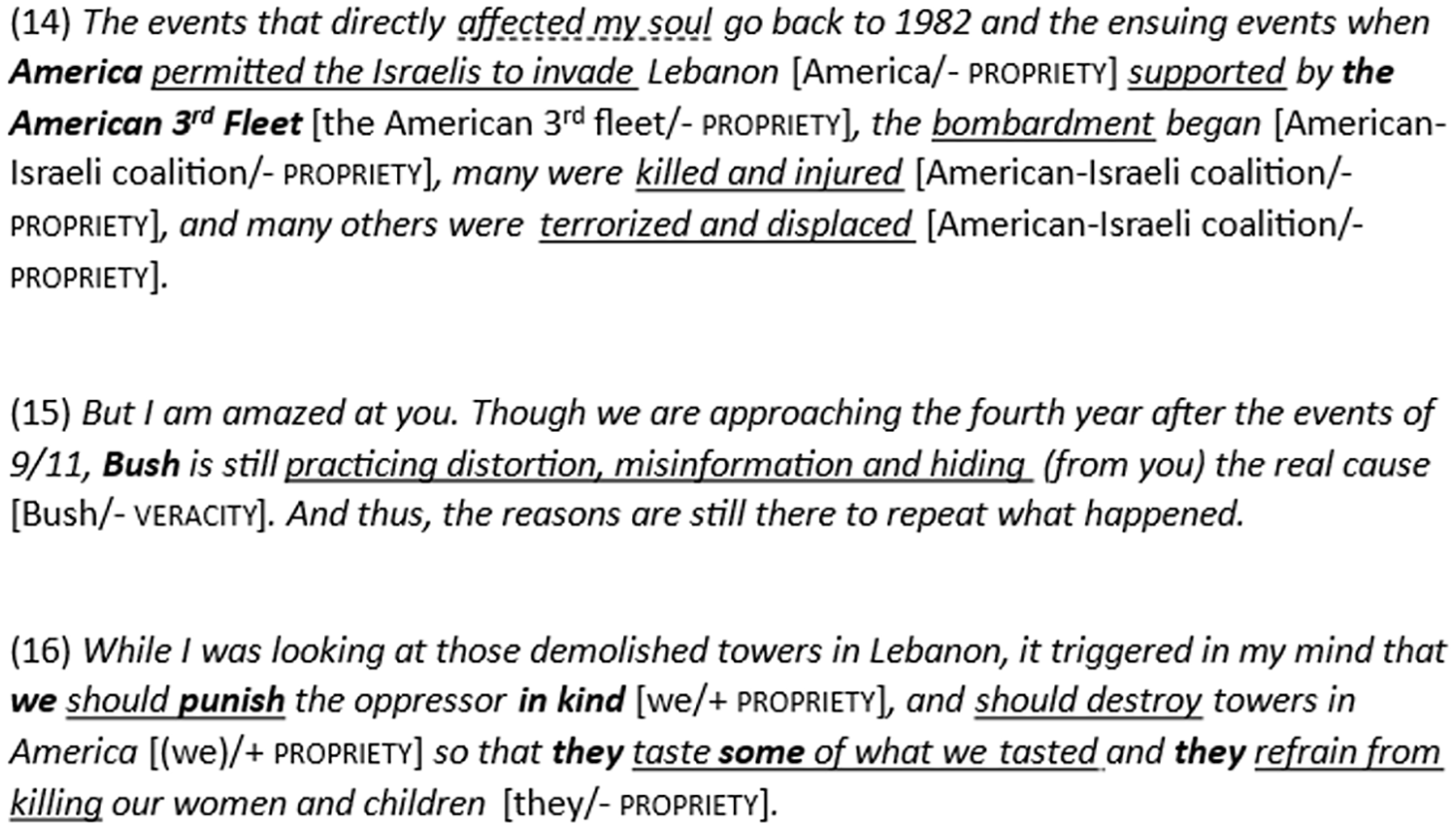
Shekau strategically employs responsibility shifting to deflect blame, attributing harmful actions to a divine source, specifically God, in order to enhance positive
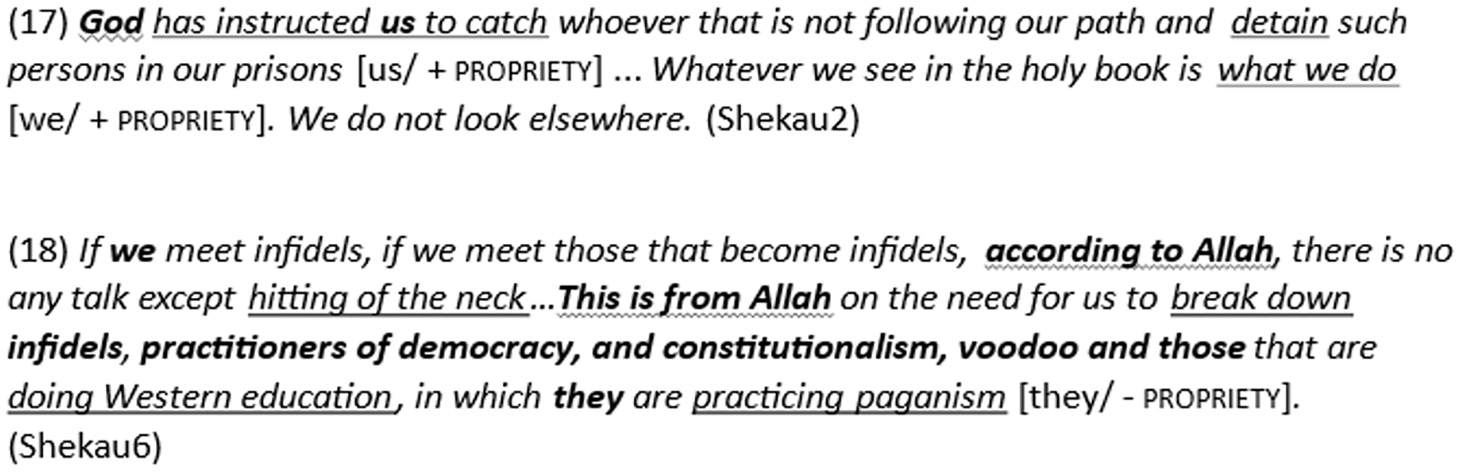
Blaming and denying: Framing
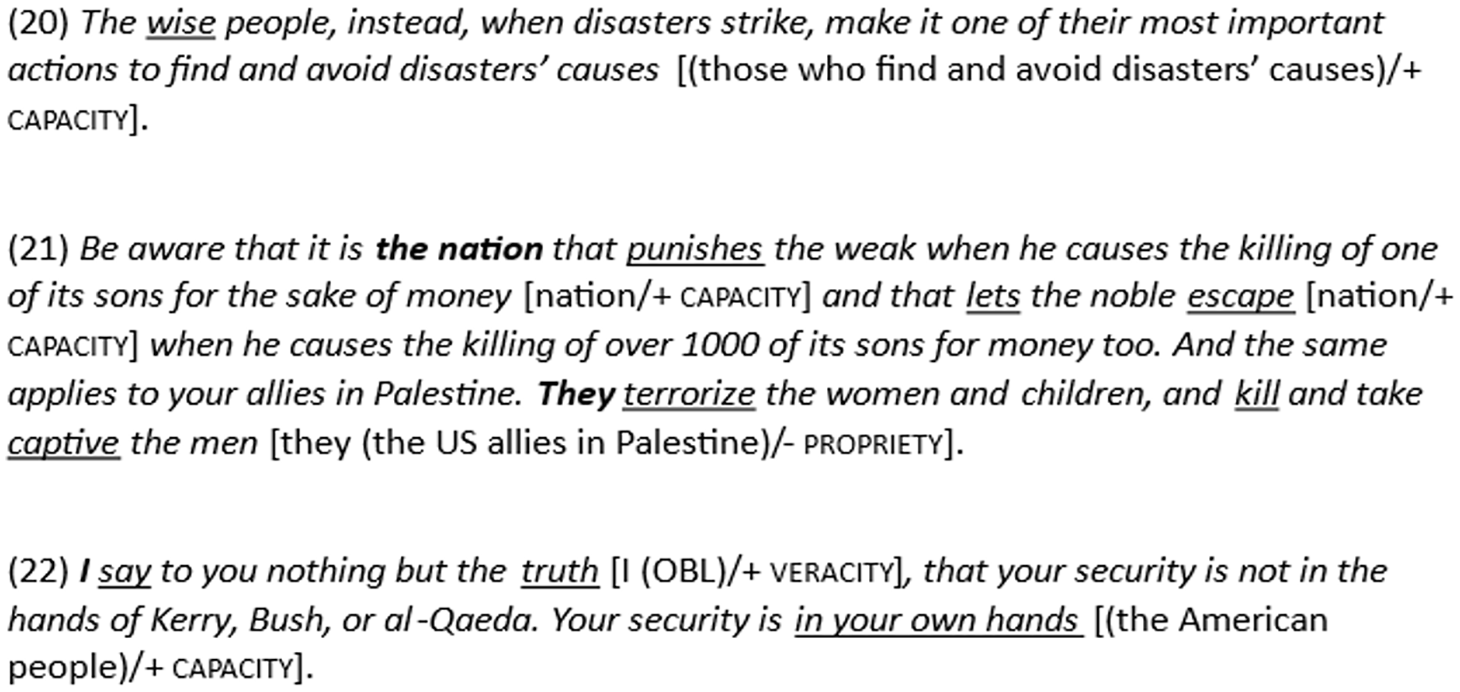
Framing, a tactic employed in OBL’s and Tarrant’s texts, plays a crucial role in shaping threatener-victim disalignment by structuring experiences to establish situational definitions (e.g. Goffman, 1974). Rooted in Hansson’s (2015) blame avoidance concept and Gordon’s (2015) framing role in positioning and (dis)alignment, this tactic is utilised to manipulate perception and realign participants. OBL uses the ‘Bad Apple’ frame (Lakoff, 2008: 163–167), illustrated in Example 19, employing a proverb – ‘An ounce of prevention is better than a pound of cure’ – to convey a moral imperative for the American people to save their country. Positioned positively with

OBL also employs the ‘Rescue narrative’ frame (Lakoff, 2008: 24) to assign blame to the American people and manipulate their stance. Within this frame, OBL constructs a social reality where the Bush administration (Villain) harms Americans (Victim), and the wise or inherently good social actor (Hero) must defeat and punish the Villain to rescue the Victim for security and wellbeing. In Example 20, OBL positions Americans as potential Heroes, wise enough to take actions against those causing harm. Failure to punish the Villain, responsible for ‘killing over 1000 of their sons for money’ in Iraq and Palestine, renders Americans blameworthy. The entire nation is framed (Example 21) as having the
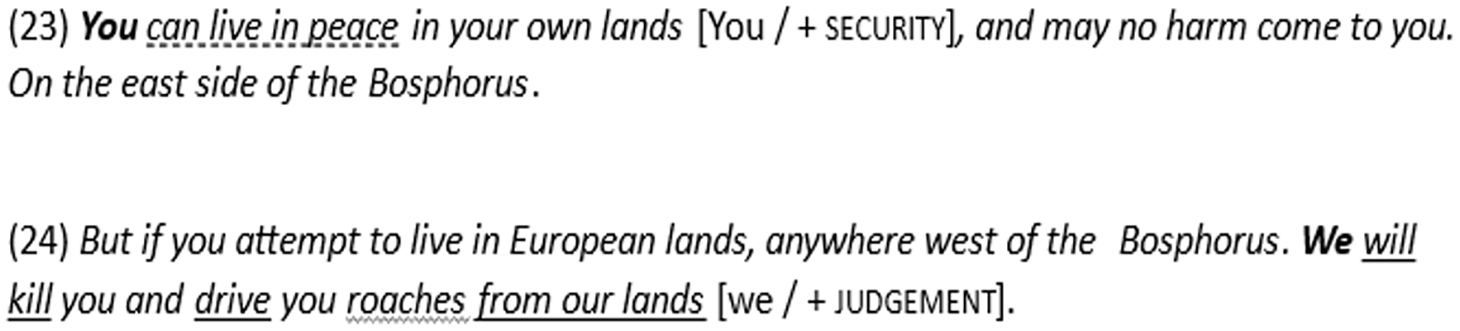
Tarrant employs framing in his threat against Turks (in Tarrant2), shifting responsibility onto them for their security or any potential violence against them. Through Examples 23–24, he manipulates Turks’ perception, compelling them to reconsider their stay in Europe and opt for living in Turkey ‘On the east side of the Bosphorus’, coupled with positive
Blaming and denying: Denying and reversal
The denying and reversal mechanism serves as a social defence strategy for threatener-victim disalignment. This strategy involves defending against accusations and negative impressions about oneself or the ingroup (denying) and accusing victims of the same acts or portraying them as aggressors while reversing roles. This tactic is based on Van Dijk’s (1989, 1992, 1998: 92) reversal tactic (by blaming the victim) and his typology of denying which includes, inter alia, intention-denial and goal-denial. OBL, in Example 25, denies any prior intention to target the Twin Towers (‘it had never come to our mind. . .’) but attributes the situation change to America’s

Reversal is also employed by OBL to accuse America of acts of

Retaliation and disaffiliation tactics: Deontic retaliation
Deontic retaliation (defined in the Method Section) involves constructing a threat text where a threatened act is presented as a justified response or retaliation for a perceived past event or offence. Inspired by Searle’s concept of ‘deontic powers’, this function morally motivates a threatener’s behaviour to protect ingroup interests. In the terrorist context, achieving deontic retaliation involves deploying couplings that portray the threatener as a value-serving agent obligated to retaliate. This discursive function employs tactics such as legitimating, discrediting, blaming and denying (specifically framing), detailed and exemplified in the subsequent subsections.
Legitimating: Establishing a ‘proairetic’ code
Legitimating, employed by OBL and Tarrant to frame retaliation, forges disalignment by emphasising victims as wrongdoers and portraying threateners as morally and legally obliged to retaliate to immoral or illegal values, positioning threateners and victims on opposing moral poles. This tactic draws from Van Leeuwen’s (2007) legitimation techniques: authorisation, moralisation and rationalisation. OBL frames retaliation in his texts as a ‘proairetic’ code (Barthes, 1974), a legitimate action responding to previous events and aligned with a governing ‘semic’ code of moral values (e.g. justice, security and freedom). In Example 29, ‘to retaliate’ against an oppressor is portrayed as loaded with positive
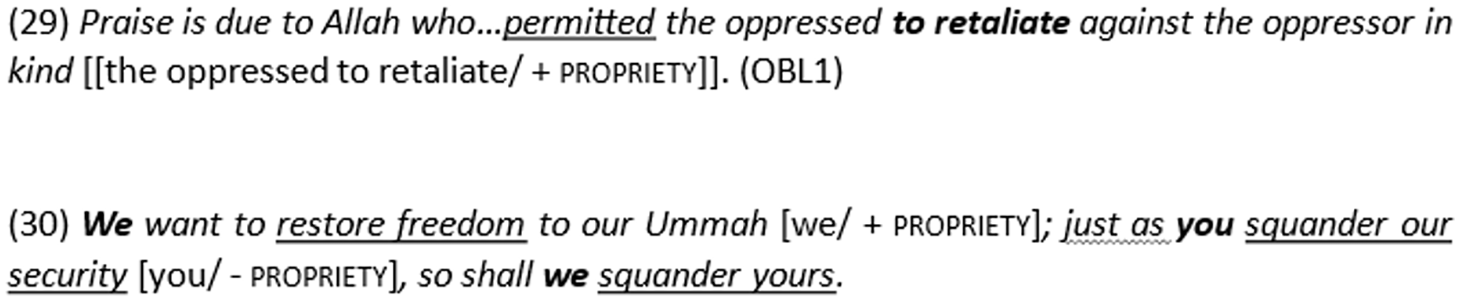
OBL utilises legitimation in OBL1 to bolster the credibility of his manipulative threat by employing anecdotal retaliation. While OBL1 primarily serves a manipulative function, he cites the 9/11 attacks as instances of past retaliation to substantiate his serious intentions. This anecdotal evidence aims to prompt the American people to take his threats seriously and reconsider their stance on the US war in Iraq, suggesting potential further retaliatory actions. In OBL2, retaliation is the central discursive function, presented as an imminent moral response.
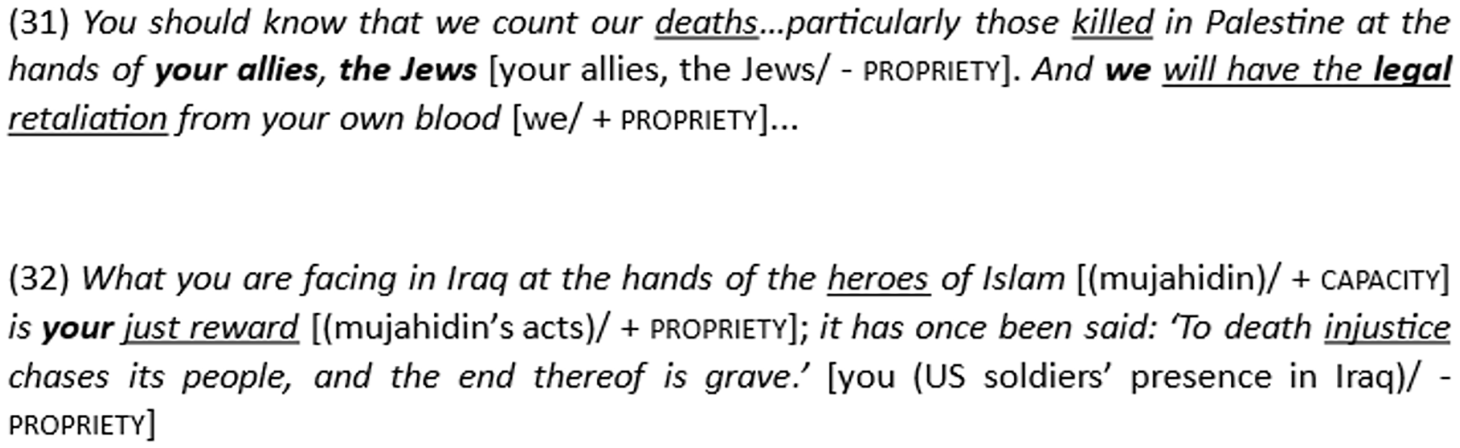
Evaluative couplings operate to legitimise retaliation by appealing to a moral value system of justice and legality. In Example 31, OBL positions retaliation as ‘legal’, framing it as a justified response to the bloodshed for which the US and Israeli allies are held responsible. Similarly, OBL (Example 32) portrays the mujahidin’s fight in Iraq as a ‘just reward’ for US ‘injustice’, aligning positive
Tarrant employs the legitimating tactic in by leveraging the moral value of freedom and the legal right to rectify what he deems ‘rightful’. In Example 33, Tarrant frames his threat as an endeavour to ‘free’ the Hagia Sophia mosque in Istanbul, an iconic structure with historical significance reflecting religious transitions in the region. By invoking the mosque’s past as a Christian church, Tarrant positions his threat as a retaliatory effort to restore it to Christianity. This appeal to legal and moral considerations serves as a topos – a shortcut warrant – legitimising the threatener’s retaliatory intentions and positions against the targeted Turks.

Discrediting
Discrediting, in retaliation, plays a crucial role in forging threatener-victim disalignment, particularly in OBL2, where moral foundations for retaliation are established by casting discredit on the victims. OBL strategically discredits the US leadership by attacking their perceived lack of
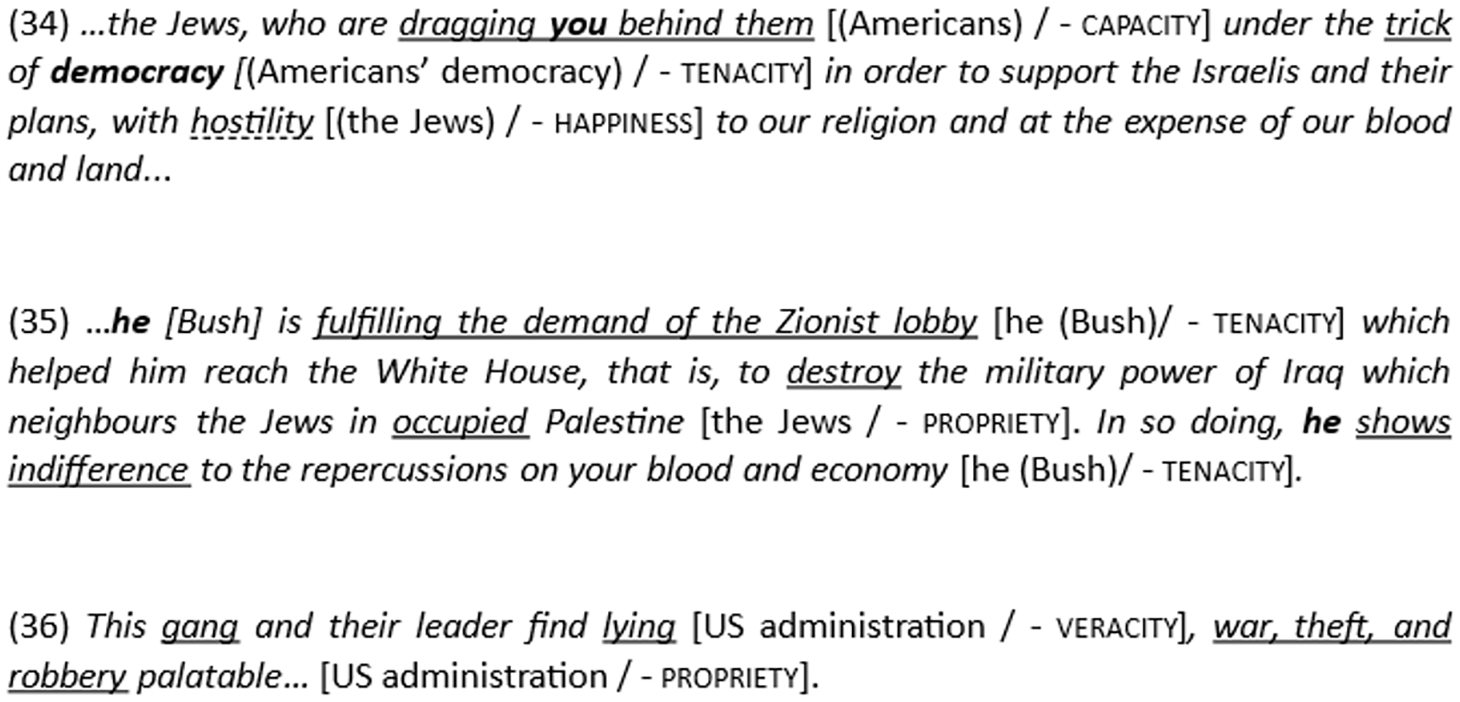
The strategic discrediting of American audiences or segments thereof serves to legitimise retaliation as a form of ‘honour violence’, as defined by Thrasher and Handfield (2018: 371). In this context, the threatened acts aim to uphold norms within Muslim societies that lack effective governance. Two specific norms come into play in inter-group relationships (see, e.g. Sommers, 2009): firstly, the norm of preserving honour as a rational response to perceived wrongdoing, and secondly, the norm of moral responsibility imposed on the threatened audience. By framing retaliation within these norms, threateners seek to justify their actions as morally and honourably motivated responses, shaping the discourse around perceived offences and the moral duties of the threatened audience.
Blaming and denying: Framing
Framing, particularly through the ‘Bad Apple’ and ‘Rescue narrative’ frames, is a prevalent tactic in Shekau’s threat communications to create a disconnection with victims and justify a retaliatory response. In Shekau1, he declares war against ‘any Nigerian’ in Cameroon, Chad and Benin Republic (Example 37), presenting it as a reaction to the joint efforts of Nigerian and Cameroonian forces against Boko Haram. This framing thus extends to victims in neighbouring African countries, and Nigerian Vigilant troops and the combined joint task force (CJTF) (Example 38), positioning them as the undesirable element. Within this context, Shekau portrays his impending war as a response to the government’s perceived
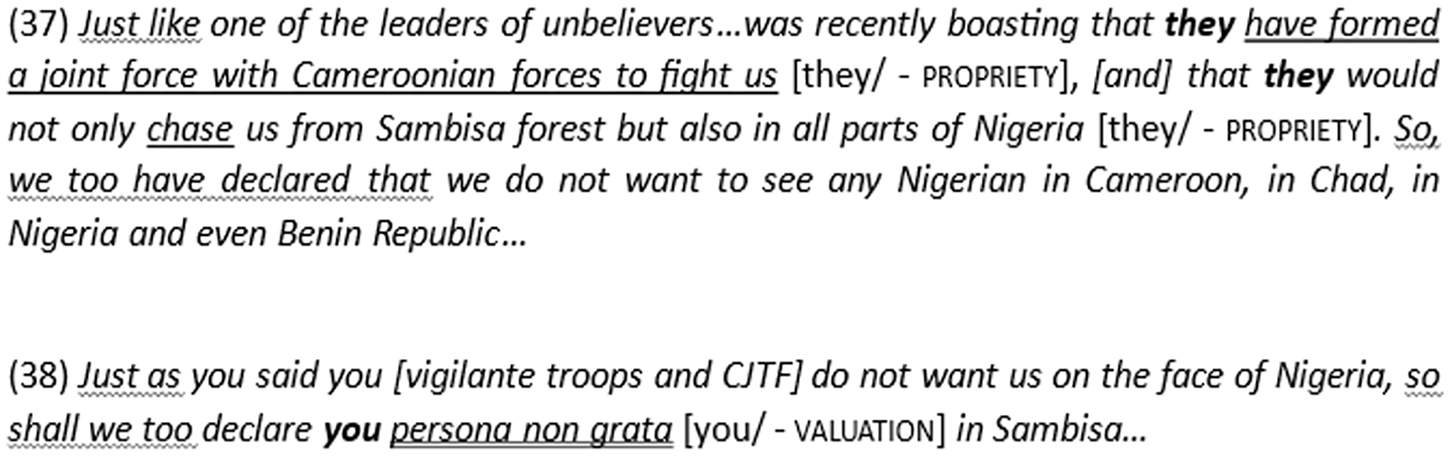
In Example 39 from Shekau8, Shekau constructs his threat as a reactive response to perceived acts of
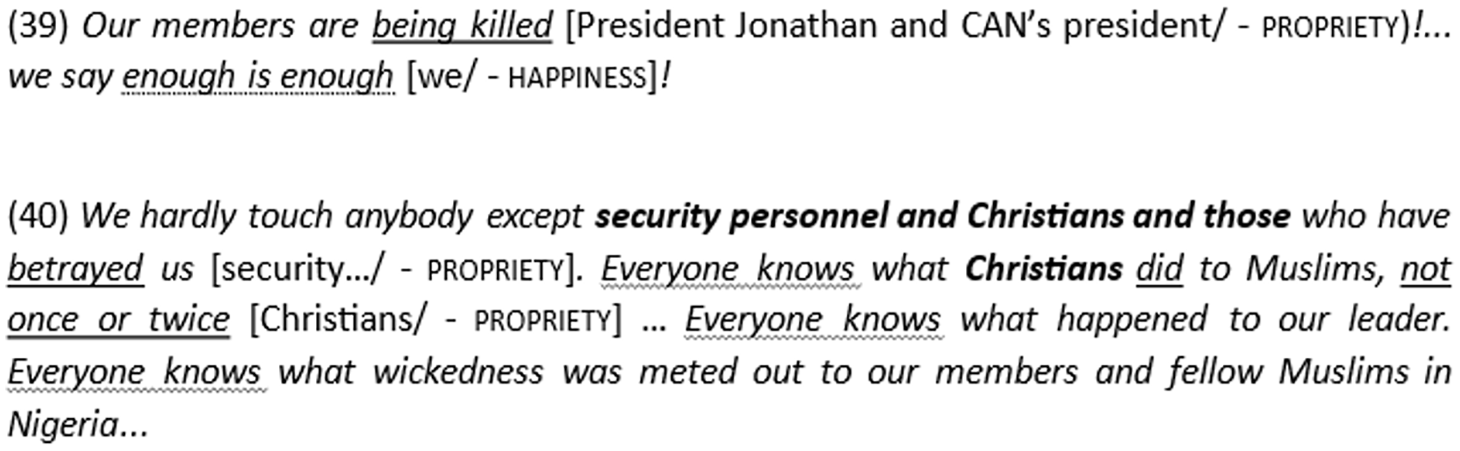
Shekau’s tactic of blaming and denying, akin to a ‘blame game’ (Fairclough and Fairclough, 2012: 172), strategically shifts blame by justifying his actions as a retaliatory response. He attributes blame to government officials and ‘infidel’ troops, alleging they tend to target Muslims and Boko Haram members first. This framing creates opposing social groups, allowing Shekau to avoid the Villain role in officials’ narratives, presenting himself as a Rescuer of Muslims. Negative evaluative couplings within the Rescue narrative frame aid Shekau in escaping the Villain label in his discursively constructed act of retaliation.
Boulomaic function
The boulomaic function, rooted in master identity attacks and violent fantasy wants and pledge to harm, employs lexicogrammatical elements like verbs (want, wish, hope) and descriptions of wishes and fantasies to symbolically damage the identity of threatened audiences without coercing specific actions. The boulomaic function, involving expressions of desire (

The boulomaic function appears not only as an independent, primary function (as in Tarrant-Example 41 above) but also as an ancillary to the manipulation or retaliation functions in Tarrant and in Shekau’s texts (namely, Shekau 1, 2, 5, 6 and 7). In both observed forms of the boulomaic function, as independent and as an ancillary, the text serves to inflict harm by generating fear and disrupting the peace of mind of threatened audiences. In Example 42 (from Tarrant), the boulomaic effect complements manipulation of Turks’ stay in Europe, operating as an intensifier of the desire to come to Istanbul and destroy ‘every mosque and minaret’. Unlike Example 41, where there is no explicit behavioural demand, Example 42 issues a warning, predicting a violent movement signalled by the use of ‘we are coming’. This dual function aims to evoke a negative impact, emphasising the threatener’s commitment to causing harm and instilling fear in the targeted groups.

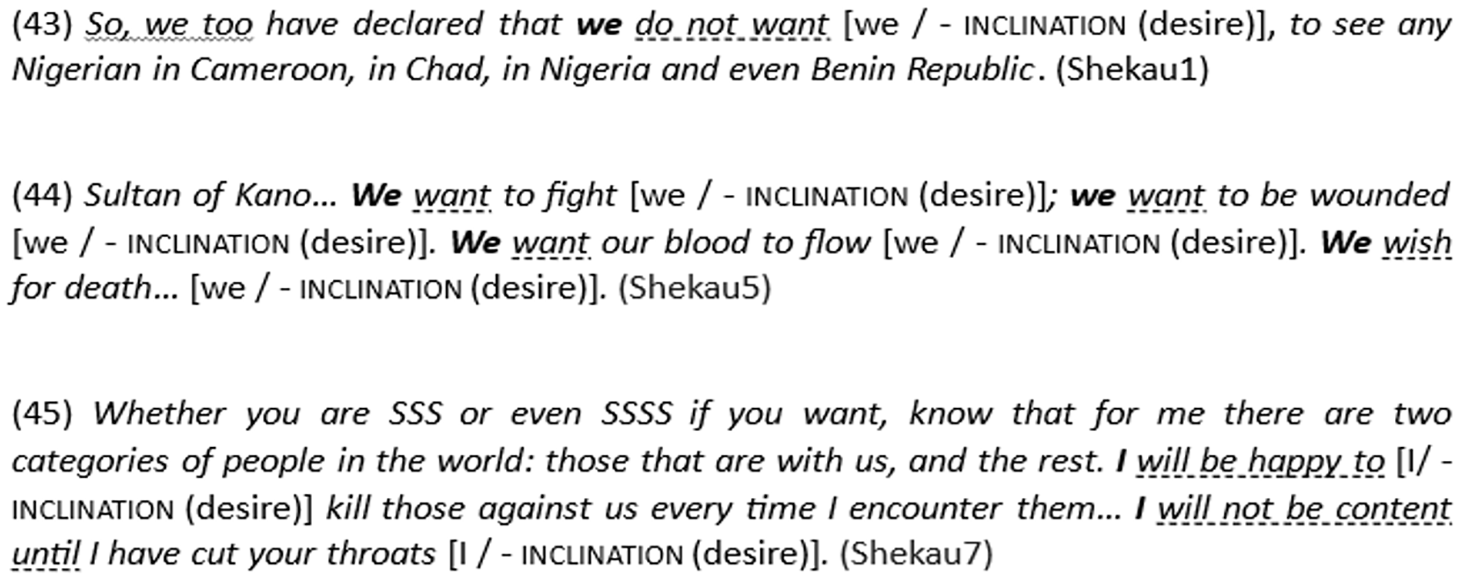
The ancillary boulomaic effect is also manifested in Shekau’s threat texts to colour the manipulation or retaliation function with increased fear that is generated to target and – in Chiluwa’s (2017) terms – chill the spine of Shekau’s victims. Example 43 illustrates Shekau expressing a strong desire to expel Nigerians from various regions, even though it exceeds his capability. This psychological warfare, combined with constructed retaliation against the Nigerian military’s actions, aims to generate fear. Example 44 emphasises Shekau’s wishful pursuit of death, presented as morally justified in the context of a global conflict between ‘Us’ and ‘the rest’ (infidels). The frightening effect of threat (Storey, 1995), as well as the divisive narrative, is heightened by the boulomaic effect, evident in Shekau’s desire for harm against, for example, the State Security Service (SSS) in Example 45.
Conclusion and further research
Grounded in the Appraisal framework and the moral disaffiliation strategy, this research article has presented an exploration into discursive pragmatics in terrorist threat texts by jihadists and far-right violent extremists. The study has revealed terrorist threat texts as ideological-struggle discourse where meanings and social values are contested (e.g. Verschueren, 2012). Discourse pragmatic analysis has proved crucial for understanding forensic texts with underlying ideologies and recognising the variability in authors’ texts, emphasising language’s context-dependence (e.g. Coulthard et al., 2017). In Coulthard’s (1994: 4) terms, the examination of ‘attitude-ideation’ couplings highlights terrorists’ strategic decisions in textualising messages within specific ideational limits. Focusing on evaluative couplings’ patterning and functioning unveils the stakes involved in choosing one stance over another in a threat text (e.g. Martin and White, 2005). The increased use of
The analysis reveals that by attending to the extremist appraisal signature and understanding its ideological operation in positioning victims and threateners while disaligning with victims’ values, analysts of forensic texts can foreground the ongoing process of evaluation. Viewing style as a polarised coupling disposition (Etaywe and Zappavigna, 2021), similarities in attitude system network choices in terrorist threat texts can be ascribed to functional and ideological needs of text producers and the norms of the socially appropriate terrorist threatening genre, a topic for further future research. Focusing on attitudinal meanings coupled with victims, in Butler’s terms (1988: 87), has proven useful for forensic analysts to ‘specify explicitly which options at a particular level of the language can be combined in the ‘selection expression’ describing a given stretch of language’. The language of appraisal highlights how a criminal’s appraisal signature represents characteristic reconfigurations of attitudinal meaning-making primarily influenced by an ideological view of victims’ behaviours and processes, offering insight to criminal interrogators on why some texts are polarising and mind-unsettling.
The study has uncovered verbal practices that underpin value disalignment and ideological positioning, along with a dynamic of justification or ‘justification discourses’ collapse (Wodak, 2006). That is, threat texts include a mix of acts of blaming, denying, discrediting and (de)legitimation. These practices of influence and justification use predominantly judgemental and appreciation-based values as an ideological launching pad for disaffiliation. This linguistic similarity could be ‘the product of adaptability’ (Butler, 1988: 97) meeting communicative purposes in a speech event (e.g. Grant, 2010; Olsson, 2008). The article demonstrates the regulatory functions of appraisal in threat texts – manipulation, retaliation and boulomaic effect. These functions offer linguistic evidence supporting psychological research findings on violence and coercive actions (e.g. Tedeschi and Felson, 1994), showing how a threat can force behavioural compliance (as in manipulation and deontic retaliation in the dataset) and aim to cause ‘damage to the social identity of target persons and a lowering of their power or status’ (Tedeschi and Felson, 1994: 171) as in the boulomaic effect in this study.
The research contributes to future studies into Shuy’s (1993) notion of threatener profiling, revealing argumentative tactics typical of terrorist threatening communication. Future research can extend the examination of evaluative structure, patterns of bonds and practices of justifications in threat texts communicated by threateners from different ideologies and in different sociopolitical contexts to highlight any commonalities and differences with the findings of this study. We hope that by focusing on interpersonal meaning-making resources, this study has contributed to a fuller understanding of the nuances of the discursive pragmatics of appraisal and its pre-occupation with pragmatic concerns in violent extremist discourse.
Footnotes
Declaration of conflicting interests
The author(s) declared no potential conflicts of interest with respect to the research, authorship, and/or publication of this article.
Funding
The author(s) received no financial support for the research, authorship, and/or publication of this article.